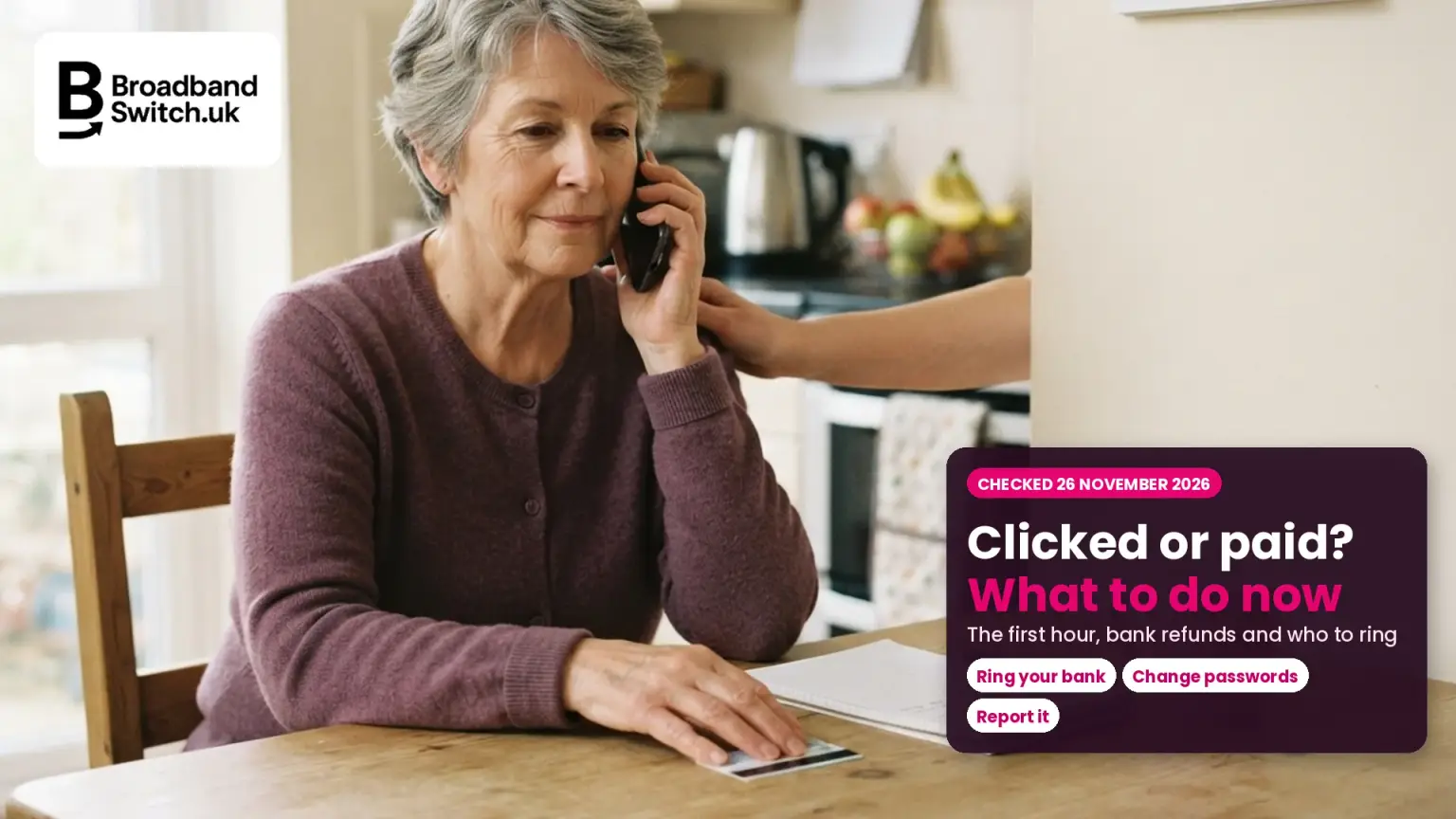
It happens to careful people every day, and there's a clear order to put it right. Here's what to do in the first hour, how to get money back, and who to ring
Checked 26 November 2026
The first hour, in order
Ring now
the number on your card
They can sometimes stop a payment.
Change
any you typed or shared
And anywhere you reuse them.
0300 123 2040
Report Fraud
In Scotland, ring 101.
£85,000
the usual upper limit
For a UK bank transfer.
If you've clicked a scam link, shared a passcode or paid a scammer, act now. Ring your bank on the number on your card. Change any password you typed or gave out. Report it to Report Fraud on 0300 123 2040, or Police Scotland on 101. If you sent money by UK bank transfer, your bank must usually refund you up to £85,000. You can expect the money within five business days, or a decision within 35 if the bank investigates. You have 13 months to claim. You haven't been stupid. These people do this for a living. Start with the bank, then work down this page.
Did the call claim to be about your broadband?
Sort the bank out first. Then see the real prices for your address, with nobody on the phone and nobody rushing you.
- ✓Every provider we can find at your address
- ✓No cold calls, ever
- ✓Free to use. Ring us if you'd like a hand
Prefer to talk it through? Call us on 0330 122 1223
Key facts, verified 26 November 2026
- If you've lost money, contact your bank, then report it to Report Fraud, or to Police Scotland (National Cyber Security Centre, read 26 November 2026).
- Banks must usually refund scam payments made by UK bank transfer on or after 7 October 2024, up to £85,000 (Payment Systems Regulator, read 26 November 2026).
- The bank should refund within 5 business days. It can pause the clock to investigate, but must decide within 35 (Payment Systems Regulator, read 26 November 2026).
- You must claim within 13 months of the payment. The bank may take an excess of up to £100, but not from a vulnerable customer (Payment Systems Regulator, read 26 November 2026).
- Card, cash and cheque payments aren't covered by those rules. They have their own protections (Payment Systems Regulator, read 26 November 2026).
- A credit card purchase over £100 and up to £30,000 is covered by Section 75, and chargeback claims must be made within 120 days (MoneyHelper, read 26 November 2026).
- For a payment you didn't authorise, the bank must normally refund by the end of the next business day, and you can usually be charged no more than £35, unless you were fraudulent or grossly negligent (Payment Services Regulations 2017, regulations 76 and 77).
- If the bank says no, the Financial Ombudsman Service is free and can award up to £455,000 (Financial Ombudsman Service, 1 April 2026).
- Cifas Protective Registration costs £30 for two years (Cifas, read 26 November 2026).
- There were 4.5 million fraud incidents in the year to June 2026, up 11% (Office for National Statistics, 22 October 2026).
Who this is for: You, if something has just gone wrong, or you're helping someone it's happened to. Meet Linda. She's 63. On Tuesday a man rang, said he was from her bank's fraud team and knew the last four digits of her card. He said her account was under attack and she should move £2,400 to a "safe account". She did. Ten minutes later it didn't feel right. She wants to know what to do, and whether she'll see the money again. Linda is an example built from the calls we take on our help line, not a real customer.
I've been scammed. What do I do first?
Direct answer: Ring your bank straight away, on the number on the back of your card. Then change any passwords you typed or shared, and report it to Report Fraud on 0300 123 2040, or Police Scotland on 101. Keep every message and note the times. Speed matters most.
First steps, in order
Ring your bank
Use the number on your card. Say it was a scam and ask them to stop or recall the payment.
Change your passwords
On any account involved, and anywhere you've used the same password.
Report it
Report Fraud on 0300 123 2040, Monday to Friday, 8am to 8pm. In Scotland, Police Scotland on 101.
Keep the evidence
Screenshots, phone numbers, account details, dates and times. Don't delete the messages.
Tell someone you trust
A second pair of eyes helps, and the scammer may ring back.
The order comes from the National Cyber Security Centre. If you've given bank details, contact the bank. If you've lost money, tell the bank, then report it as a crime.
Many banks answer on 159, a short number run by Stop Scams UK. Not every bank is on it, and it says the cost of calling varies with your phone provider. The number on your card always works.
Linda rang her bank eleven minutes after the transfer. That call is the most useful thing she did. A payment that has only just left can sometimes be stopped or frozen at the other end.
I clicked a link in a scam text. What now?
Direct answer: If you only clicked and typed nothing, the risk is low. Close the page and run a full antivirus scan. If you typed in a password or card details, change the password and ring your bank. Then forward the text to 7726, which is free.
It depends what you did next
Close the page. Run a full antivirus scan to be safe.
Change it now, and on every account where you use the same one.
Ring your bank. They can cancel the card and watch the account.
Run a full antivirus scan and remove the app or program.
Ring your bank, say it was a scam, then report it.
In our view, a click on its own is low risk. The harm usually comes from what you do on the page that opens: typing a password, entering a card number or installing something. the National Cyber Security Centre says to run a full antivirus scan if you've opened a link.
Reporting the text helps everyone else. Ofcom says forwarding it to 7726 is free. For how to spot the next one, see our guide to the six festive scams to watch out for.
I gave out a passcode or a password. What now?
Direct answer: Change the password straight away, and on every account where you've used the same one. If you read out a one-time passcode, ring the company it came from and tell them. Then check the account for changes you didn't make, and turn on two-step verification.
A one-time passcode is the last lock on the door. A caller who asks you to read one out is using it to get in at that moment. The government and the mobile networks say never to share a password or one-time passcode, and that your provider won't ask you to share your screen.
If you think someone is already in an account, the NCSC recovery guide has nine steps. The ones people miss: check your email for forwarding rules you didn't set, log out all other devices, and tell your contacts so they don't trust messages from you.
Here's a tip that's ours, not the NCSC's. If your phone loses signal soon after you've shared details, ring your mobile network from another phone. A criminal may be trying to move your number to their own SIM, so they receive your codes.
A caller got me to install something or share my screen. What now?
Direct answer: Turn the device's internet off, then remove the program they asked you to install. Run a full antivirus scan. From a different device, change your banking and email passwords and ring your bank. Anything you typed while they were connected may have been seen.
This is the fake engineer scam. The caller says they're from your broadband provider or "the fibre company", that your router has been hacked or your speed is slow, and that they need to connect to your computer to fix it.
the National Cyber Security Centre says to run a full scan with your antivirus software if you've opened a link or installed something. We'd add three things from our own experience. Uninstall the remote access tool. Change your Wi-Fi password and your router's admin password. And restart the router.
Your real provider doesn't cold-call to fix a fault you haven't reported. Our guide to scam calls pretending to be your broadband provider lists what they will and won't ask. For the router, see router security and how to log in and change the settings.
Told your broadband was slow or hacked?
Check the speed yourself in about 20 seconds. If it's normal, the call was the problem, not your line. Free, with no sign-up.
Run UK Speed Test →Will my bank refund me?
Direct answer: Usually, if you sent the money by UK bank transfer. Since 7 October 2024, banks must refund victims of this kind of scam up to £85,000, normally within 5 business days. You have 13 months to claim. Card payments are protected in a different way.
The refund rules, in four numbers
£85,000
the most a bank must refund
It can choose to pay more.
5 days
to refund you
Business days. 35 at most if it investigates.
13 months
to make your claim
From the date of the payment.
£100
the most it can hold back
Not from a vulnerable customer.
The rules come from the Payment Systems Regulator. They cover people, very small businesses and charities who were tricked into sending money from a UK account to another UK account. Most everyday bank transfers travel that way.
For payments the rules cover, there are two main exceptions. The bank can refuse if you were part of the fraud, or if you were grossly negligent, which the regulator calls a high bar. Neither the negligence test nor the excess applies if you were vulnerable at the time.
When you ring, use plain words. "I've been the victim of a scam. I sent a bank transfer on this date for this amount. I'd like to claim a refund under the reimbursement rules." Ask for a reference number.
How much came back, by type of scam (2025)
How much comes back depends on the scam. UK Finance's 2026 fraud report shows 80% of losses returned where the criminal posed as the police or a bank, and 78% for purchase scams. For investment scams it was 48%.
The totals are large. There were 248,070 cases of this kind of fraud in 2025, with £576.4 million lost. Linda's bank-impersonation case sits in the group with the best odds. Her bank refunded her £2,400, less a £100 excess, four working days later.
What if I paid by card, PayPal or gift card?
Direct answer: The bank transfer rules don't apply, but others do. A credit card covers purchases over £100 and up to £30,000. Any card can use chargeback, within 120 days. PayPal gives 180 days to open a dispute. Gift card and cryptocurrency payments are very hard to recover.
| How you paid | Your route | Time limit |
|---|---|---|
| UK bank transfer | Claim a scam refund from your bank | 13 months |
| Credit card | Section 75, for purchases over £100 and up to £30,000 | Ask your card provider |
| Any card | Chargeback, through your bank | 120 days |
| A payment you didn't make | Normally refunded by the end of the next business day. You can usually be charged no more than £35 | Tell the bank at once |
| PayPal | Open a dispute under Buyer Protection | 180 days |
| Gift cards | Contact the card's issuer straight away | Minutes matter |
MoneyHelper explains the two card routes. Section 75 makes your credit card provider jointly responsible for a purchase. Chargeback is a card scheme rule, not a law, and it works on debit cards too.
A payment you didn't make at all is different again. If a criminal used your card details without you, the Payment Services Regulations say the bank must normally refund you by the end of the next business day, unless it has reason to suspect fraud. Regulation 77 usually limits what you can be asked to pay to £35, unless you were fraudulent or grossly negligent.
Gift cards are the hard case. Apple says to contact Apple Support online. Be quick, because once a code has been spent the money is very hard to recover. PayPal gives you 180 days from the payment to open a dispute. Payments sent to friends and family aren't covered.
What if the bank says no?
Direct answer: Complain to the bank in writing. For fraud and payment complaints it has 15 days to reply. If you're still unhappy, take it to the Financial Ombudsman Service within six months. It's free, and it can award up to £455,000.
If the bank refuses
Step 1
Complain in writing
Say what happened and that you want the decision reviewed.
Step 2
Wait for the reply
The bank has 15 days for fraud and payment complaints.
Step 3
Go to the Ombudsman
Within six months. Free, with awards up to £455,000.
the Financial Ombudsman Service describes itself as free and easy to use. Its award limit for complaints referred on or after 1 April 2026 is £455,000, more than five times the £85,000 the refund rules require. That matters if you lost a large sum and the bank missed warning signs.
You don't need a claims firm for any of this. Making a refund claim is free. Complaining is free. The Ombudsman is free. A firm that takes a cut is charging you for forms you can fill in yourself.
How do I report a scam to the police?
Direct answer: In England, Wales and Northern Ireland, report it to Report Fraud online or on 0300 123 2040, Monday to Friday, 8am to 8pm. In Scotland, ring Police Scotland on 101. Action Fraud changed its name to Report Fraud on 4 December 2025.
The change of name is on Report Fraud's own site. The phone number stayed the same.
Citizens Advice gives the number and hours. You'll be asked what happened, when, how you were contacted and where the money went. Have your notes and screenshots to hand.
Most fraud never reaches that point. The Office for National Statistics estimates 4.5 million fraud incidents in the year to June 2026, up 11%. A further 348,944 offences were reported to Report Fraud directly. On our sum that's about one for every 13 incidents.
Reporting may not bring an officer to your door. It does give you a crime reference number, which banks and insurers often ask for, and it adds your case to the picture the police use to find the people behind it.
Someone has my details. How do I protect my identity?
Direct answer: Check your credit reports, which are free, for accounts or searches you don't recognise. Consider Cifas Protective Registration, which costs £30 for two years and asks lenders to make extra checks. Change the passwords on your email first, because email unlocks everything else.
Protect your identity
Change your email password first
Email can reset every other account. Turn on two-step verification.
Check your credit reports
Free from Experian, Equifax and TransUnion. Look for accounts you didn't open.
Consider Cifas Protective Registration
£30 for two years. Lenders make extra checks before opening credit in your name.
Watch your statements
Small test payments often come before a larger one.
Don't trust a call offering to recover your money
It's usually the same criminals coming back.
MoneyHelper confirms every credit reference agency must give you your statutory report free. Cifas charges £30 for two years of Protective Registration, which works out at £1.25 a month.
If a phone or broadband contract appears in your name that you didn't take out, tell that provider's fraud team in writing and ask them to remove it from your credit file. Report it to Report Fraud too.
A company says it can get my money back. Is that real?
Direct answer: Be very wary. The Financial Conduct Authority warns about recovery room scams, where victims are contacted out of the blue by someone offering to recover lost money for a fee. An upfront fee is the sign. Your bank and the Ombudsman don't charge.
The FCA explains how it works. Criminals keep lists of people they've already tricked, or sell them on. A second caller may claim to be from the FCA, the government, the police or another regulator.
If you're contacted like this, hang up. The FCA's consumer helpline is 0800 111 6768. Nobody legitimate will ask for money before returning money.
Who can I talk to?
Direct answer: Victim Support runs a free line, open all day, every day, in England and Wales on 08 08 16 89 111. Age UK's advice line is 0800 678 1602. Citizens Advice is on 0808 223 1133. Being scammed can knock your confidence badly, and talking helps.
| Who | Number | When |
|---|---|---|
| Victim Support England and Wales | 08 08 16 89 111 | Free, all day, every day |
| Age UK Advice Line | 0800 678 1602 | Free, 8am to 7pm, every day |
| Citizens Advice consumer helpline | 0808 223 1133 | Monday to Friday, 8am to 6pm |
| Advice Direct Scotland | 0808 164 6000 | Monday to Friday, 9am to 5pm |
| Consumerline Northern Ireland | 0300 123 6262 | Check its page for hours |
| Report Fraud | 0300 123 2040 | Monday to Friday, 8am to 8pm |
The feeling afterwards is often worse than the loss. People tell us they feel ashamed and don't want the family to know. Please tell someone. The scammers rely on silence, and a second call is more likely to work on someone who's dealing with it alone.
If you're helping a parent or an older neighbour, sit with them while they ring the bank. Then switch on the protections their provider offers. Our page on broadband for pensioners lists them.
Should I change my broadband or phone provider after a scam?
Direct answer: You don't have to. If the scammer knew details of your account, tell your provider and change your account password. If the call left you wondering whether you're on a fair deal, check that separately, in your own time, with real prices in front of you.
A fake call that quotes your provider's name doesn't mean your provider leaked anything. Callers often guess, because a few big names cover most homes. Tell your provider anyway, so they can note it on your account.
If your contract has ended, you may well be paying more than you need to. That's worth fixing, but not on a call someone else started. Put your postcode into our comparison and see what's there. Our guide to switching explains how the move works.
Check your deal on your own terms
Enter your postcode to see real broadband prices for your address, side by side. We'll never ring you out of the blue.
- ✓Every provider we can find at your address
- ✓Price rises and set-up fees shown
- ✓Free to use, and you choose in your own time
Prefer to talk it through? Call us on 0330 122 1223
Free tools that help
Know your own broadband, and a fake engineer has nothing to work with. These are all ours, and all free.
All-round check
Told your line is slow or hacked? Check the speed yourself in about 20 seconds.
Family safety
Tests what your broadband blocks, with set-up guides for phones and consoles.
Not sure which test to run? See our four speed tests and which one to use.
What should I do now?
Direct answer: Ring your bank, change your passwords and report it. Then make the refund claim, note the reference number and put the deadlines in your diary. Check your credit reports this week. And tell someone you trust what happened.
In the next hour
Ring your bank on the number on your card. Change the passwords involved. Report it to Report Fraud on 0300 123 2040, or Police Scotland on 101.
This week
Make the refund claim and note the reference. Check your free credit reports. Run a full antivirus scan. Forward the scam text to 7726.
This month
Chase the bank if you've heard nothing. If it refuses, complain in writing, then go to the Financial Ombudsman Service. Ignore anyone offering to recover the money for a fee.
When things have settled, check you're on a fair deal
See every broadband provider we can find at your address, with prices side by side. Or ring us and we'll talk it through.
- ✓Real prices for your address
- ✓No cold calls, ever
- ✓Free to use, and your new provider handles the switch
Prefer to talk it through? Call us on 0330 122 1223
In summary
- Ring your bank first, on the number on your card. A payment that has just left can sometimes be stopped.
- Change any password you typed or shared, and anywhere you use the same one.
- Report it to Report Fraud on 0300 123 2040, or Police Scotland on 101.
- For a UK bank transfer, banks must usually refund up to £85,000 within 5 business days. You have 13 months to claim.
- Cards have their own protections: Section 75 on credit cards, and chargeback, within 120 days.
- If the bank says no, the Financial Ombudsman Service is free and can award up to £455,000.
- Anyone who rings offering to recover your money for a fee is very likely another scammer.
Alex's closing thought
The people who ring us after a scam nearly always start with an apology, as though they've done something wrong. They haven't. They were targeted by someone who does this all day and is good at it. What I'd ask is that you don't lose an hour to embarrassment. The bank call is the one that counts, and the rules are far more on your side than they were a few years ago. If the call that caught you was about your broadband and you're not sure what's real, ring us on 0330 122 1223 and we'll help you check. We're always happy to help.
Keep going: scams, your broadband and your rights
Know someone this has happened to?
Send them this. The first hour matters most.
Cite this page
You're welcome to quote or link to this guide. Please credit BroadbandSwitch.uk and link to this page.
In a sentence: UK banks must usually refund victims of scam payments made by bank transfer on or after 7 October 2024, up to £85,000 and normally within 5 business days, with 13 months to claim, according to the Payment Systems Regulator; UK Finance data for 2025 shows 80% of losses returned where criminals posed as the police or a bank, against 48% for investment scams.
Martin-Smith, A. J. (2026, November 26). Clicked a scam link or paid a scammer? What to do now. BroadbandSwitch.uk. https://broadbandswitch.uk/insights/scam-text-call-clicked-link-paid-what-to-do/
Frequently asked questions
What should I do first if I've been scammed?
Ring your bank on the number on your card and say it was a scam. Then change any passwords you typed or shared, and report it to Report Fraud on 0300 123 2040, or Police Scotland on 101.
I clicked a link in a scam text. Am I at risk?
If you only clicked and typed nothing, the risk is low. Close the page and run a full antivirus scan. If you entered a password or card details, change the password and ring your bank.
Will my bank refund me if I paid a scammer?
Usually, if you paid by UK bank transfer on or after 7 October 2024. Banks must refund up to £85,000, normally within 5 business days. They can refuse if you were part of the fraud or grossly negligent, or if the payment falls outside the rules.
How long do I have to claim a scam refund?
13 months from the date of the payment, under the Payment Systems Regulator's rules. Don't wait. Tell your bank as soon as you realise.
How long does the bank have to refund me?
5 business days. It can pause the clock while it investigates, but it must give you an outcome within 35 business days.
Can the bank keep some of the money?
It can take an excess of up to £100 from the refund. It can't do that if you were vulnerable at the time of the scam.
What if I paid by credit or debit card?
The bank transfer rules don't apply. A credit card covers purchases over £100 and up to £30,000 under Section 75. On any card you can ask for a chargeback, within 120 days.
What if I paid with gift cards?
Contact the card's issuer straight away. Apple says to contact Apple Support online. Money paid this way is very hard to recover once the code has been spent.
What if my bank refuses to refund me?
Complain to the bank in writing. If you're still unhappy, go to the Financial Ombudsman Service within six months of its final response. It's free and can award up to £455,000.
How do I report a scam to the police?
In England, Wales and Northern Ireland, contact Report Fraud online or on 0300 123 2040, Monday to Friday, 8am to 8pm. In Scotland, ring Police Scotland on 101.
Is a company offering to recover my money real?
Be very wary. The Financial Conduct Authority warns about recovery room scams, where victims are contacted out of the blue and asked for an upfront fee. Your bank and the Ombudsman don't charge.
How do I protect my identity after a scam?
Change your email password first, check your free credit reports from Experian, Equifax and TransUnion, and consider Cifas Protective Registration, which costs £30 for two years.
References
- Advice Direct Scotland. (n.d.). Contact. Retrieved 26 November 2026, from https://consumeradvice.scot/contact/
- Age UK. (n.d.). Age UK Advice Line. Retrieved 26 November 2026, from https://www.ageuk.org.uk/services/age-uk-advice-line/
- Apple. (2026, June 30). About gift card scams. Retrieved 26 November 2026, from https://support.apple.com/en-gb/gift-card-scams
- Cifas. (n.d.). Protective Registration. Retrieved 26 November 2026, from https://www.cifas.org.uk/pr
- Citizens Advice. (n.d.). Get help with scams. Retrieved 26 November 2026, from https://www.citizensadvice.org.uk/consumer/scams/get-help-with-online-scams/
- Citizens Advice. (n.d.). Report a scam. Retrieved 26 November 2026, from https://www.citizensadvice.org.uk/consumer/scams/reporting-a-scam/
- Department for the Economy. (2024, September 12). Consumerline: Know your rights. Retrieved 26 November 2026, from https://www.economy-ni.gov.uk/articles/consumerline-know-your-rights
- Financial Conduct Authority. (2026, January 19). Recovery room scams. Retrieved 26 November 2026, from https://www.fca.org.uk/consumers/recovery-room-scams
- Financial Ombudsman Service. (n.d.). How to complain. Retrieved 26 November 2026, from https://www.financial-ombudsman.org.uk/consumers/how-to-complain
- Financial Ombudsman Service. (2022, August 17). Time limits. Retrieved 26 November 2026, from https://www.financial-ombudsman.org.uk/consumers/expect/time-limits
- Financial Ombudsman Service. (2026, April 1). Understanding compensation for financial loss. Retrieved 26 November 2026, from https://www.financial-ombudsman.org.uk/consumers/expect/compensation
- Home Office. (2026, November 25). Home Office and mobile networks dial up the fight against fraud. Retrieved 26 November 2026, from https://www.gov.uk/government/news/home-office-and-mobile-networks-dial-up-the-fight-against-fraud
- MoneyHelper. (n.d.). How to check your credit report for free. Retrieved 26 November 2026, from https://www.moneyhelper.org.uk/en/everyday-money/credit/how-to-check-your-credit-report
- MoneyHelper. (n.d.). How you're protected when you pay by card. Retrieved 26 November 2026, from https://www.moneyhelper.org.uk/en/everyday-money/credit/how-youre-protected-when-you-pay-by-card
- National Cyber Security Centre. (n.d.). Phishing scams: If you've shared sensitive information. Retrieved 26 November 2026, from https://www.ncsc.gov.uk/collection/phishing-scams/what-to-do
- National Cyber Security Centre. (n.d.). Recovering a hacked account. Retrieved 26 November 2026, from https://www.ncsc.gov.uk/guidance/recovering-a-hacked-account
- Ofcom. (2026, July 15). What to do about a scam call, text or message. Retrieved 26 November 2026, from https://www.ofcom.org.uk/phones-and-broadband/scam-calls-and-messages/what-to-do-about-a-scam-call-text-or-message
- Office for National Statistics. (2026, October 22). Crime in England and Wales: Year ending June 2026. Retrieved 26 November 2026, from https://www.ons.gov.uk/peoplepopulationandcommunity/crimeandjustice/bulletins/crimeinenglandandwales/yearendingjune2026
- Payment Systems Regulator. (n.d.). APP fraud reimbursement protections. Retrieved 26 November 2026, from https://www.psr.org.uk/information-for-consumers/app-fraud-reimbursement-protections/
- PayPal. (2026, October 12). PayPal's Buyer Protection Programme. Retrieved 26 November 2026, from https://www.paypal.com/uk/legalhub/paypal/buyer-protection
- Report Fraud. (2025, December 4). Report Fraud service goes live. Retrieved 26 November 2026, from https://www.reportfraud.police.uk/news/report-fraud-service-goes-live/
- Stop Scams UK. (2025, June 23). Stop, hang up, call 159. Retrieved 26 November 2026, from https://stopscamsuk.org.uk/campaign/get-help-now/
- UK Government. (2017). The Payment Services Regulations 2017, regulation 76. Retrieved 26 November 2026, from https://www.legislation.gov.uk/uksi/2017/752/regulation/76
- UK Government. (2017). The Payment Services Regulations 2017, regulation 77. Retrieved 26 November 2026, from https://www.legislation.gov.uk/uksi/2017/752/regulation/77
- UK Finance. (2026, June 15). Annual fraud report 2026. Retrieved 26 November 2026, from https://www.ukfinance.org.uk/system/files/2026-06/UK%20Finance%20Fraud%20Report%202026.pdf
- Victim Support. (n.d.). Supportline. Retrieved 26 November 2026, from https://www.victimsupport.org.uk/help-and-support/get-help/supportline/