CARDIFF · THE CITY AND COUNTY OF CARDIFF
Broadband in Cardiff: what reaches your door, and what you should pay
Cardiff was a gigabit city before it was a fibre city, and that is the thing to understand first. In January 2026, Ofcom put a gigabit-capable service within reach of 96% of Cardiff homes, the highest of Wales’s 22 councils, because Virgin Media’s cable runs under most of the city. Full fibre, the newer wiring the big brands now sell, reached 89%, which is seventh in Wales and above the Welsh 82% and the UK 82%. The four parliamentary areas that cover the city run from 94% in Cardiff North to 83% in Cardiff East.
The second thing to know is that fewer than half the homes that could have fibre have it. Only 45% of the Cardiff premises that could get full fibre had taken it, and on its own network Openreach said in May 2025 that “less than two in five who could upgrade to the new network have done so”. It is also the easiest thing on this page to put right, and it usually puts money back in your pocket while you are at it.
So this guide starts from the numbers and ends at your front door. The figures come from Ofcom’s files and from each network’s own site, with their dates attached; the decision comes from one address check, because in a city of terraces, Bay flats and shared houses in Cathays, the house you are in matters more than the street it stands on.
After your own bit of the city? The area table is here. Rather just look? See what reaches your postcode.
Check your address first
Direct answer: 11 to 15 gigabit networks are expected in Cardiff by 2029, on Ofcom’s count, and none of them reaches every street or every block, so the only true answer is the one your own address returns.

Everything below is commentary on what that check returns, which is why it comes first. Which networks have reached your house, or your block, decides which of the sections that follow are about you and which are about your neighbours.
Full fibre, area by area
Direct answer: In January 2026, full fibre reached 89% of homes across Cardiff, from 94% in Cardiff North down to 83% in Cardiff East, according to Ofcom. Gigabit-capable coverage, which adds Virgin Media’s cable, was at least 91% in every one of the four areas.
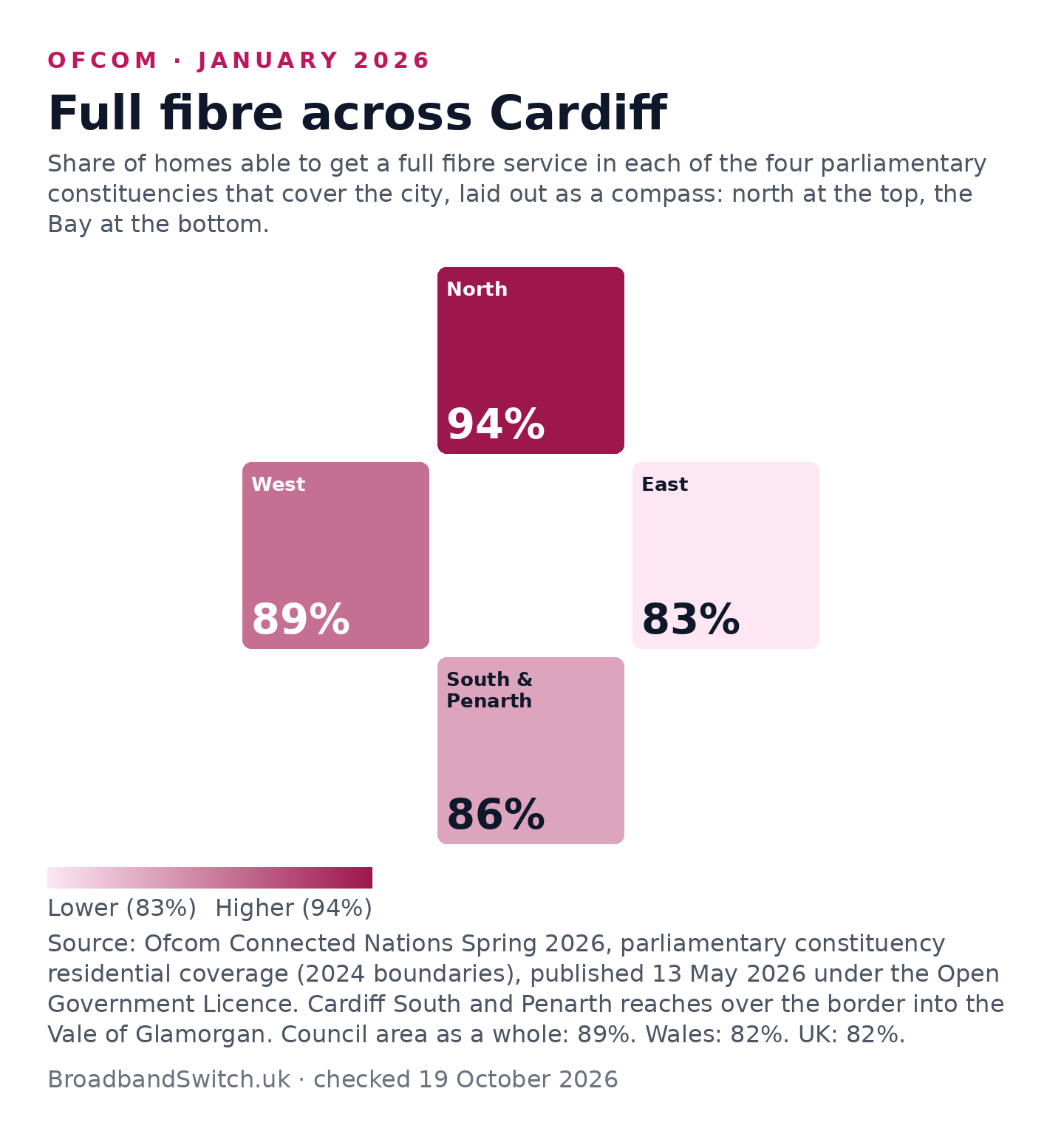
Ofcom’s Spring 2026 update, published on 13 May 2026, gives a January 2026 figure for every council and every parliamentary seat in the UK, and four seats between them cover Cardiff. The counts are of homes rather than businesses, which is the same footing as the Welsh figure of 82% and the UK’s 82%. Two of Ofcom’s definitions do the work on this page. Full fibre is “An access network structure in which an optical fibre runs all the way from customers’ premises to the local exchange or access node.” Gigabit-capable is “A network connection to a customer’s premises capable of delivering download speeds of 1 Gbit/s or more.” Cable passes the second test and fails the first, and in Cardiff the distance between the two is unusually wide, 7 points, against a point or two in most cities, because the cable network here is old and nearly everywhere.
The map tells a simple story. Cardiff North, which runs from Heath and Whitchurch up to Lisvane, is third of Wales’s 32 parliamentary seats for full fibre at 94%. Cardiff West and Cardiff South and Penarth sit close behind. The exception is Cardiff East, at 83%, which takes in Adamsdown, Roath and Plasnewydd and runs out to Pentwyn, Llanrumney and Rumney: the densest streets of Victorian terraces, many of them shared, and the one corner of the city where Grain and YouFibre have chosen to build. Across Wales the council area as a whole sits seventh of the 22 for full fibre and first for gigabit, and across the UK’s 361 councils it sits 101st.
| Which part of the city | ||||
|---|---|---|---|---|
| Cardiff North | Gabalfa, Heath and Whitchurch up to Llanishen and Lisvane, plus Taff’s Well over the border | 94% | 97% | 41,461 |
| Cardiff West | Riverside, Canton and Llandaff out to Ely, Fairwater, Radyr and Pentyrch | 89% | 97% | 47,167 |
| Cardiff South and Penarth | the city centre, Cathays, the Bay, Grangetown and Splott, plus Penarth, Dinas Powys and Sully over the border | 86% | 92% | 49,262 |
| Cardiff East | Adamsdown, Roath and Penylan out to Pentwyn, Llanrumney and Rumney | 83% | 98% | 45,998 |
Ofcom publishes a row for every parliamentary constituency on the 2024 boundaries, and four of them cover Cardiff; the “which part” column is our rough translation. Cardiff South and Penarth takes in Penarth, Dinas Powys and Sully across the Vale of Glamorgan border and Cardiff North takes in Taff’s Well, which is why the four rows add up to 183,888 homes against the council’s 161,129. The full fibre and gigabit columns are the share of homes (residential premises) able to get each, from Ofcom’s January 2026 data published 13 May 2026. Tap a column heading to sort.Swipe sideways for the homes column.
Two warnings before you read your own row. Every figure in the table is an average of forty-odd thousand homes, and the variation inside an area is bigger than the variation between them: on a Roath street the odd numbers can be fed from a pole the fibre has reached and the even numbers from one it has not. And a home that can get fibre is not a home that has it. How many Cardiff homes have taken what already passes the door is the subject of the next section, and it is the number this page most wants to change.
Built but not bought: Cardiff’s take-up gap
Direct answer: In January 2026, 45% of the Cardiff premises that could get full fibre had a full fibre line, Ofcom says, which ranks the city 20th of Wales’s 22 councils. On its own network Openreach put it this way in May 2025: “less than two in five who could upgrade to the new network have done so”.
Ofcom, January 2026
Every 100 Cardiff homes, as a stand at the stadium: whose seat is taken
- 39have a full fibre line
- 50could get full fibre and have not taken it
- 7can get gigabit speeds over cable, not full fibre
- 4can get neither yet
Ofcom Connected Nations Spring 2026, Cardiff residential row: full fibre 89%, gigabit-capable 96%, full fibre take-up 39% of all homes. One seat per home in a hundred; the arrangement is ours.
The regulator and the biggest builder agree, from different vantage points. Ofcom counts every network and puts Cardiff at 45% of covered premises switched, where Wales comes out at 53% on our weighting of the council rows and the UK at “47% of all premises with access to full fibre”, in Ofcom’s words. Openreach’s figure covers only its own wires, and a year later it was still making the same point about the whole of Wales: “Close to half of those able to upgrade have already made the switch”, and “But these upgrades don’t happen automatically. Many homes and businesses could already benefit from better broadband today”. Its advice has not changed in two years of Cardiff releases: “It’s important to remember that upgrades don’t happen automatically. People need to place an order through a broadband service provider to take advantage of our cutting-edge network”.
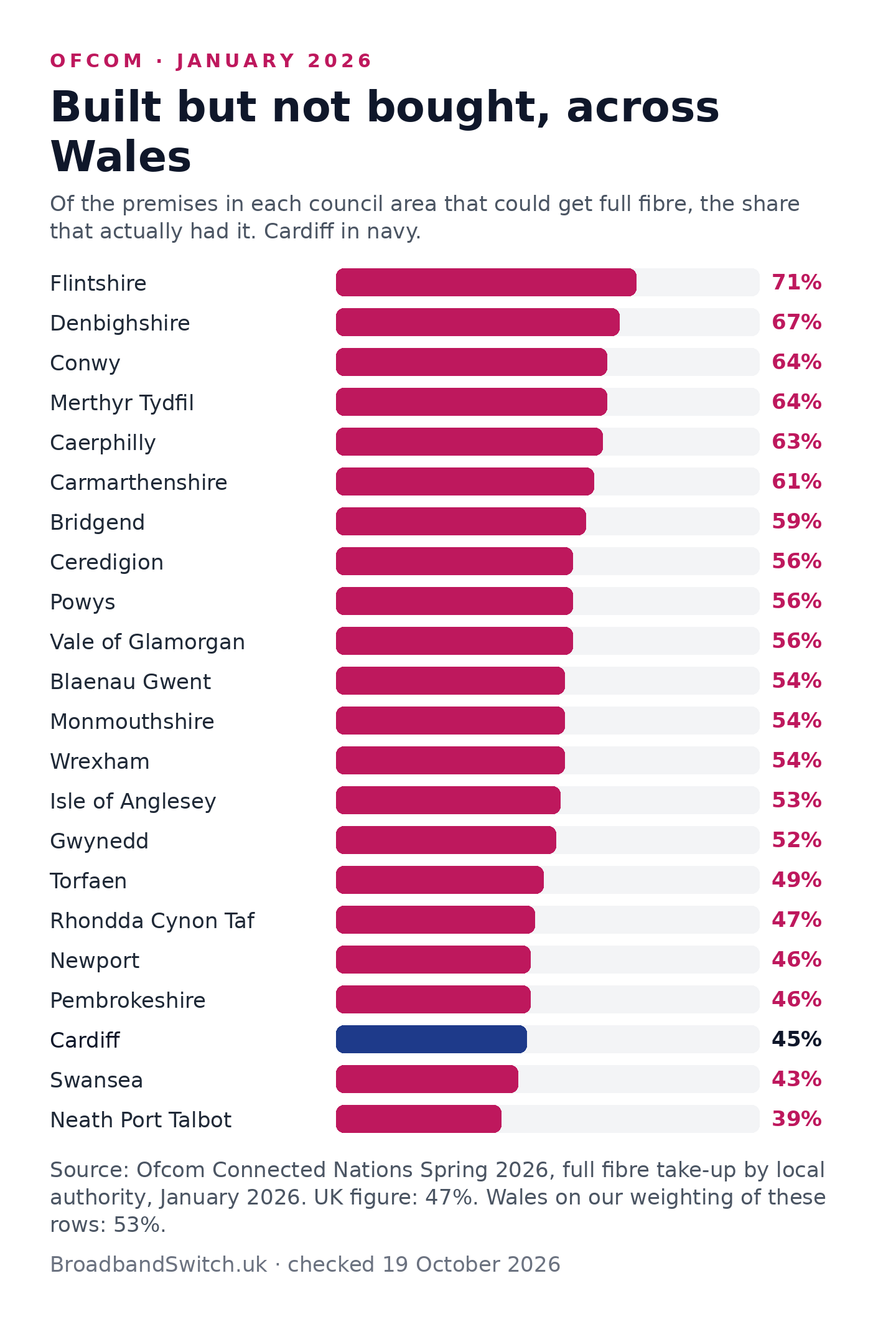
Flintshire is the highest council in Wales at 71%; Neath Port Talbot is the lowest at 39%. Cardiff sits at 45%, below Swansea’s 43% and Newport’s 46%. Ofcom gives the figures without the reasons and this page will not invent one, but one fact on the page fits: Cardiff is the one Welsh council where a gigabit line already reaches 96% of homes without any fibre at all, because Virgin Media’s cable got there first. A household on cable has less reason to notice a new wire on the pole, which is a reason to check what it now costs rather than a reason not to.
What the gap means for you
If your broadband has not changed since before the pandemic, the likelier case is that a better line is already past your door than that it is not. A fibre package in Cardiff rarely costs more than the copper or cable contract it replaces, and with three networks after the same terrace it tends to cost less. The postcode box at the top settles it in ten seconds, cheapest first.
There is also a clock running, and in Cardiff it started early. When three quarters of the homes on an exchange can get full fibre, Openreach stops selling copper broadband there; on 31 January 2027 the analogue phone network is switched off everywhere. Eight Cardiff exchanges passed the first mark between 2021 and 2026, which earns them a section of their own below.
The networks that build in Cardiff
Direct answer: Openreach under most of the city and Virgin Media’s cable under nearly all of it, with nexfibre’s fibre arriving on Virgin’s behalf, Grain and YouFibre in the east, and Hyperoptic in some blocks. Ogi, the Welsh builder based in the city, sells to Cardiff businesses and not yet to Cardiff homes. Ofcom expects 11 to 15 gigabit-capable operators to be running in the council area by January 2029.
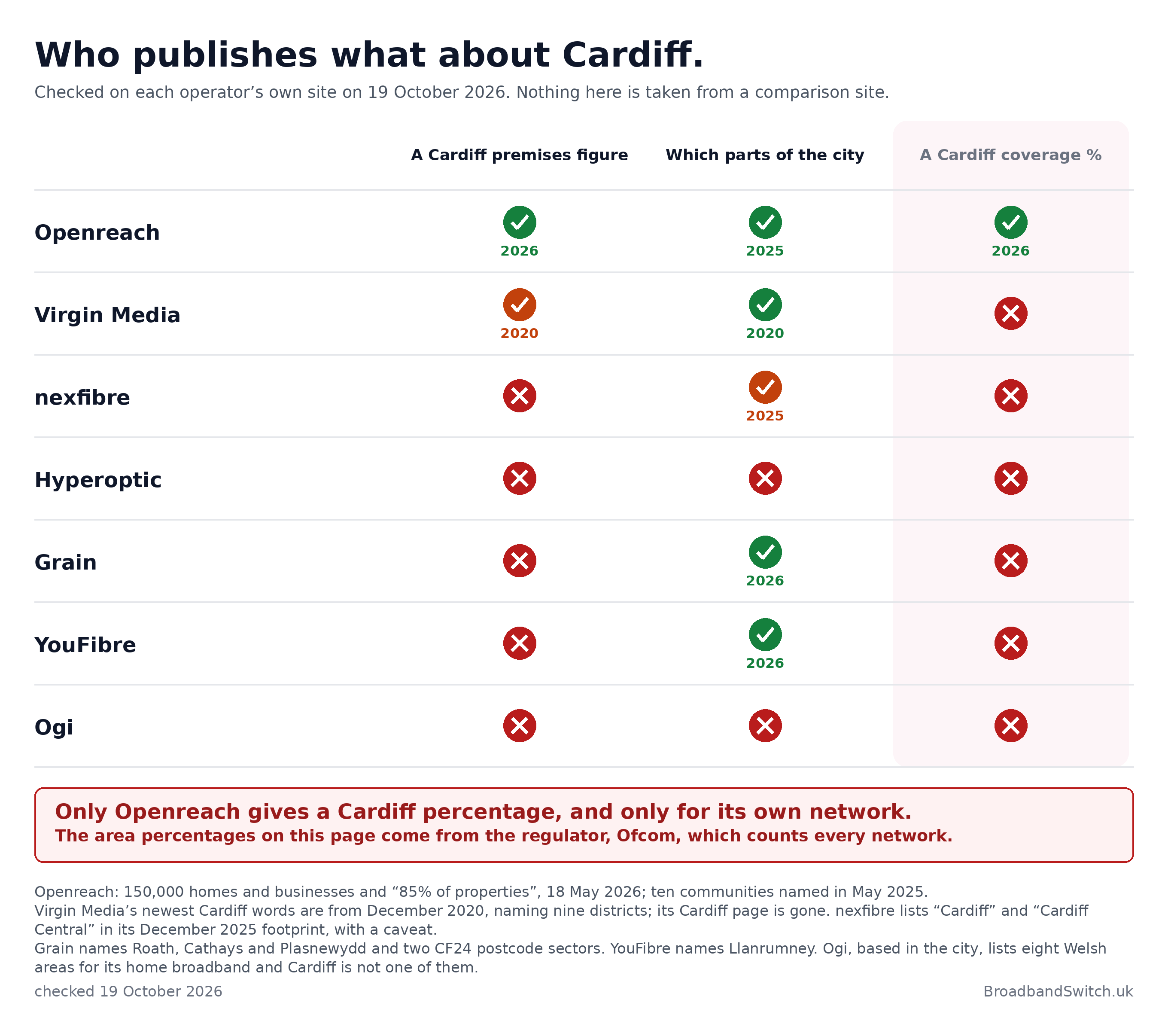
Every broadband bill has two names behind it, the brand on the envelope and the network it rents, and in Cardiff the second name is usually Openreach, often Virgin Media, and in two corners of the city Grain or Netomnia. What follows is each network in its own words, taken from its own site on the date given. Old dates are left in deliberately: a 2020 figure tells you something a fresh one would not.
Openreach, the network behind most of the big brands
Most of the brands you have heard of, BT, Sky, TalkTalk, Vodafone, EE and Plusnet among them, sell over Openreach, and Openreach is the one network that puts a Cardiff number on the record and updates it each year. Its release of 18 May 2026 says “Full Fibre broadband is now available to more than 150,000 homes and businesses across Cardiff thanks to a major investment of around £45m”, puts coverage at “85% of properties in the area now able to upgrade their broadband service”, and has its Welsh director say that “Most of Cardiff is now covered by Full Fibre, but many residents and businesses still haven’t made the switch. It’s not automatic”. A year earlier, on 21 May 2025, it said “More than 140,000 homes and businesses across Cardiff are now able to access Full Fibre broadband”, “now reaching around 80 per cent of properties across the city”, and named the places next in line: “Llanishen, Pentyrch, Creigiau, Llanrumney, Llandaff, Penarth, Taff’s Well, Culverhouse Cross, Dinas Powys and Llanedeyrn”. Both releases were published in Welsh on the same page, the 2025 one under the heading “Gwasanaeth ffeibr cyflawn yn y brifddinas - ond miloedd yn dal heb elwa”. Openreach’s own 85% against Ofcom’s 89% for every network tells you how much of Cardiff the smaller builders account for: a little.
Nationally, in the same May 2026 release: “Openreach’s Full Fibre network now reaches 22 million homes and businesses across the UK”, and “The company plans to extend this to 25 million by the end of 2026, with the potential to reach 30 million by 2030 with the right investment conditions”. For Wales, on 3 June 2026: “more than 1.25 million homes and businesses now able to connect to Openreach’s Full Fibre network”, which is “around eight in ten premises across Wales are now within reach of Full Fibre on the Openreach network”, and “Close to half of those able to upgrade have already made the switch”. The warning it attaches is the one that matters for this page: “availability and speeds can vary street by street”.
Virgin Media, on its own cable, and nexfibre, which has now put Cardiff on its list
Virgin’s cable is Virgin’s alone; no other brand sells on it. It is the oldest network on this page and the quietest about the city: on 19 October 2026 the address where a Cardiff page would sit answered “404 - Page not found”. Its archive is better. On 3 December 2020 it said “Hundreds of thousands of homes in Cardiff and across South Wales can now benefit from Wales’ fastest home broadband”, that its gigabit service “is now available across its entire network in Cardiff and surrounding areas such as Adamstown, Ely, Grangetown, Lisvane, Pentwyn, Rumney, Saint Mellons, Thornhill and Whitchurch”, with “average download speeds of 1,140Mbps”, and that “Virgin Media has now switched on gigabit speeds in all four of the UK’s capital cities”. The council leader’s words in the same release were that “Virgin Media’s investment in Cardiff, making the Welsh capital its next Gigabit city, is great news for residents and businesses”. For Wales as a whole, in March 2022, it put its spend at “investing more than £61 million to connect 104,000 more homes and businesses through its Project Lightning programme”, and said “More than 412,000 homes across Wales now have access to gigabit broadband speeds”. Nothing newer names the city and nothing gives a Cardiff percentage; Ofcom’s gigabit figure of 96% is the nearest thing to one.
Virgin’s second route into homes is nexfibre, a separate fibre builder whose network Virgin sells over, and unlike Glasgow, Cardiff is on its list. Its coverage report to the end of December 2025 puts Cardiff and Cardiff Central inside its existing footprint, with Caerphilly, Dinas Powys, Llantwit Major, Cowbridge and Pontypridd close by, and attaches to each entry the caution that “locations listed as part of nexfibre’s existing footprint may or may not yet have services available and services may not be available to every premise in a particular location”. So a Virgin salesperson offering you full fibre rather than cable in Cardiff may well be right; the address check is how you find out whether your street is one of the ones they mean.
Grain and YouFibre, one corner each
Two smaller builders have chosen the east of the city, which is the area with the lowest full fibre figure on this page, and they say exactly where. Grain’s Cardiff page, updated on 12 October 2026, says “Grain has you covered across parts of Roath, Cathays and Plasnewydd”, that “We’re proud to bring our Full Fibre broadband network to parts of Cardiff, including Roath and the wider CF24 area”, and, asked which postcodes, that “Grain predominantly provides services to CF24 4 and CF24 3”. It sells 18-month contracts with “No in-contract price rises”, with “Available speeds range from 250Mbps to 2Gbps”. YouFibre, the retail brand on Netomnia’s network, says of Wales that “From the south Wales valleys to the north, YouFibre is connecting Welsh homes to 100% full-fibre broadband”, lists Barry, Bridgend, Hengoed, Llanelli, Llanrumney, Morriston, Neath, Newport, Swansea and Wrexham, and of the Cardiff one says “High-five Llanrumney, we’re live!”: “YouFibre has built a brand new 100% Full Fibre network in Llanrumney, bringing fibre optic cables all the way to homes across the neighbourhood”, with “plans in Llanrumney start at 200 Mbps for everyday performance and go all the way up to 8000 Mbps”. Both are street-by-street networks, so the postcode check is the only map of them that exists.
Hyperoptic, which wires the building rather than the street
Hyperoptic wires blocks rather than streets, which in a city with the Bay should give it plenty to say about Cardiff, and it says nothing. Its own description is “We work with property owners, developers and partners, designing and installing dedicated fibre infrastructure to new buildings and existing developments”, with the aim to “We focus exclusively on high density urban areas and cover 64 towns and cities in the UK”. On 19 October 2026 the address where a Cardiff page would sit answered “Sorry, we cannot find that page”, and the two Cardiff press releases it once published now bounce to its press index. What it will say is national: “Our network now passes more than 2 million homes”. Inside a block it has wired, its Fair Fibre social tariff costs £13 a month for 150 Mbps, and the only way to learn whether yours is such a block is to type the postcode.
Ogi, the Welsh builder that lives in Cardiff and builds around it
Ogi is the network a Cardiff reader would expect to find on this list, because its head office is at Tŷ Ogi, Hodge House, 114-116 St. Mary Street, Cardiff and because the earlier version of this page said it was Cardiff’s largest local altnet. It is not, by its own account. “We’re Wales’s leading alternative network provider”, it says, “installing a brand new Gigabit-capable network in the towns and villages we call home”, and the areas it lists for home broadband are Bridgend County Borough, Caerphilly County Borough, Monmouthshire, Newport County, Pembrokeshire, Rhondda Cynon Taff, Torfaen and the Vale of Glamorgan. Cardiff is not among them; the only Cardiff page on its site is headed “Full fibre broadband for Cardiff”, and it is the business one. In the Vale next door, “Born and bred in Wales, Ogi is available in Dinas Powys, Llantwit Major, Rhoose and St Athan”. What Ogi does in the city is business and venue work, such as the stadium wifi it built this year, which its chief executive described as taking on “take on the connectivity challenges others walk past, for the places that matter to Wales”. If that changes, this page will change; until it does, a Cardiff home cannot order Ogi.
The ones that are not for homes, and the one that is not here
Transport for Wales’s fibre arm, TfW ffeibr, announced on 2 April 2026 that its network now runs “off the Core Valley Lines train-tracks and right into the heart of Cardiff’s city centre” and “all the way down to Cardiff Bay”. It is a business and public-sector network, “every pound of profit being reinvested back into the Welsh public sector through Transport for Wales”, and its invitation is explicit: “For businesses looking for scalable, purpose driven, future ready connectivity please get in touch”. It does not sell to households, so it is not on the grid above. CityFibre, which lies under most big English and Scottish cities, lists no place in Wales on its coverage page. And Ofcom’s 11 to 15 operators for the council area include business networks and small builders with no public map, which is the reason no written list, this one included, replaces typing the postcode.
What is coming by 2029
Direct answer: Nearly the whole city, and a choice of three. Ofcom’s planned deployments file puts Cardiff at 99% of homes with full fibre by January 2029, up 10.8 points from January 2026, with 75% of homes expected to have three or more gigabit networks at the door, second of Wales’s 22 councils behind Newport. Rhondda Cynon Taf goes from 83% to 99% on the same plans.
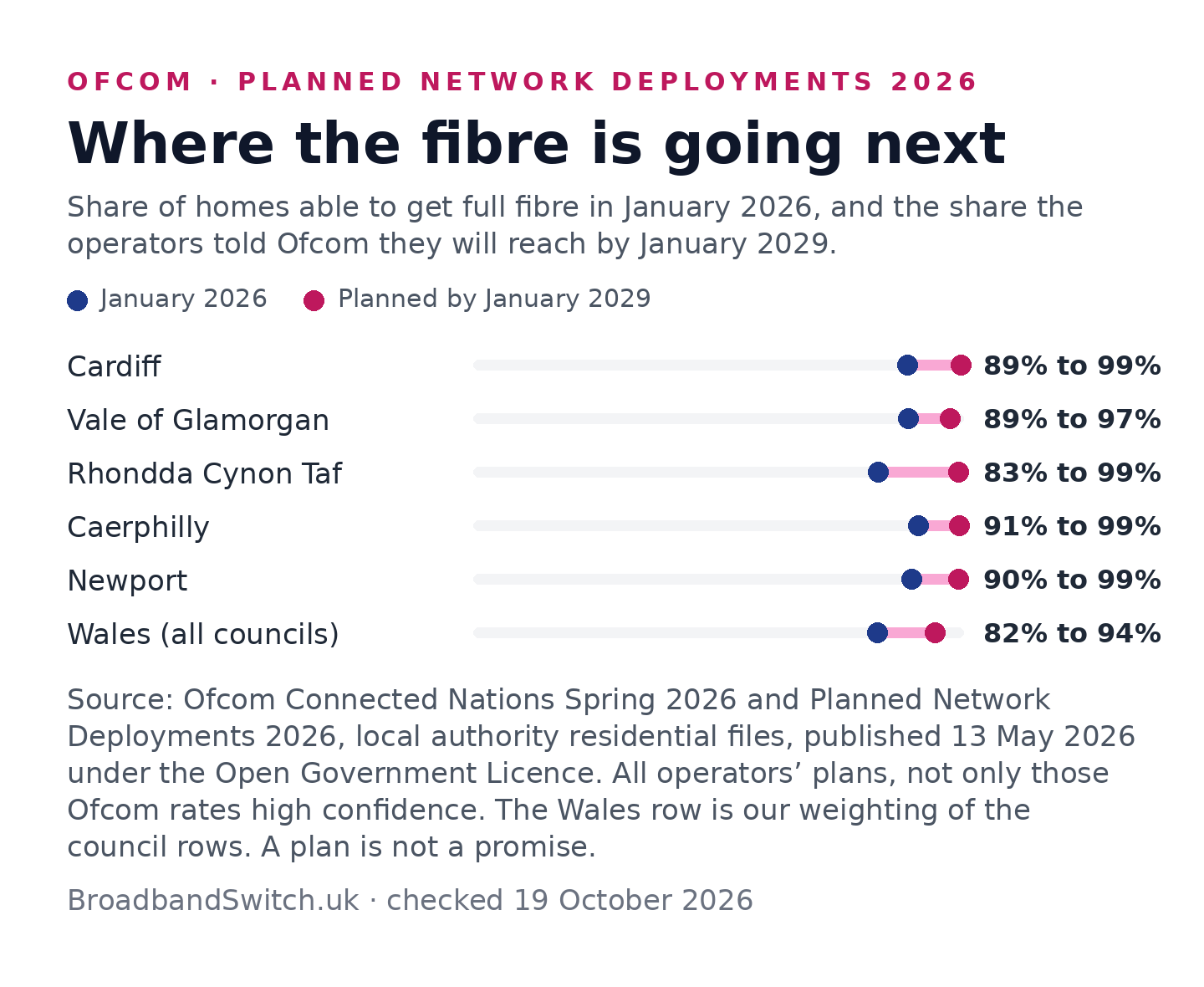
Once a year Ofcom collects every builder’s three-year plan and totals the answers council by council. Cardiff’s January 2029 line reads 99% full fibre and 99.8% gigabit-capable, and the gigabit figure hardly changes when only the plans Ofcom rates ‘High Confidence’ are kept, the ones that “have reached both the low-level design stage and for which funding has been committed”: 97%. The same file has 11 to 15 gigabit-capable operators at work in the council area by 2029, with 95% of homes able to pick between two or more and 75% between three or more. That last figure is the real Cardiff dividend, second of the 22 Welsh councils, behind only Newport’s 76%. Next door it is 53% in the Vale of Glamorgan and 43% in Caerphilly; Wales as a whole moves from 82% to 94% for full fibre on the same plans, and the fastest risers around the city are Rhondda Cynon Taf and Newport.
For anyone in the east of the city the figure to look at is Ofcom’s count of postcodes that no builder plans to reach with gigabit by January 2029: 31 in the council area. In a city of 147,334 households that is a sliver, but a sliver with addresses in it, and if one of them is yours the next three years will not fix it unless you ask; the voucher below is the thing to ask about. Openreach’s own national plan, in its words from May 2026: “The company plans to extend this to 25 million by the end of 2026, with the potential to reach 30 million by 2030 with the right investment conditions”.
Public money is not behind any of it, and the paperwork says so. The Welsh Government states that “Digital connectivity and telecommunications policy is the responsibility of the UK Government”, and no Project Gigabit lot covers Cardiff: the gov.uk contracts collection has no Welsh entry at all, and the two Welsh call-offs under Openreach’s Project Gigabit framework, “Call-Off 2 - Devon, Mid Wales and South East Wales”, for 41,140 premises, and “Call-Off 3 - North Herefordshire, North Wales, Shropshire and South West Wales”, for 65,120 premises, are rural contracts that do not name the city. Ofcom’s Cardiff row shows 99 planned lines with public funding behind them, a rounding error in a city this size. What subsidy Wales does offer is for the addresses the builders will not reach by themselves. The UK voucher applies where “Eligible homes and businesses can access vouchers worth up to £4,500” provided “existing available broadband download speeds are less than 1Gbps”. The Welsh Government’s Access Broadband Cymru grant “provides grant funding to support the installation of a broadband solution to any premises within Wales that is unable to achieve a connection via any other means”, pays “Funding of up to £800 per premises is available”, and is only for a home that “is not able to achieve a connection of a minimum of 30mbps download speeds via any provider”. In a city where Ofcom counts 99% of homes as able to get superfast broadband, that is a very short list, and if you are on it, the voucher section below is written for you.
Your exchange and the copper switch-off
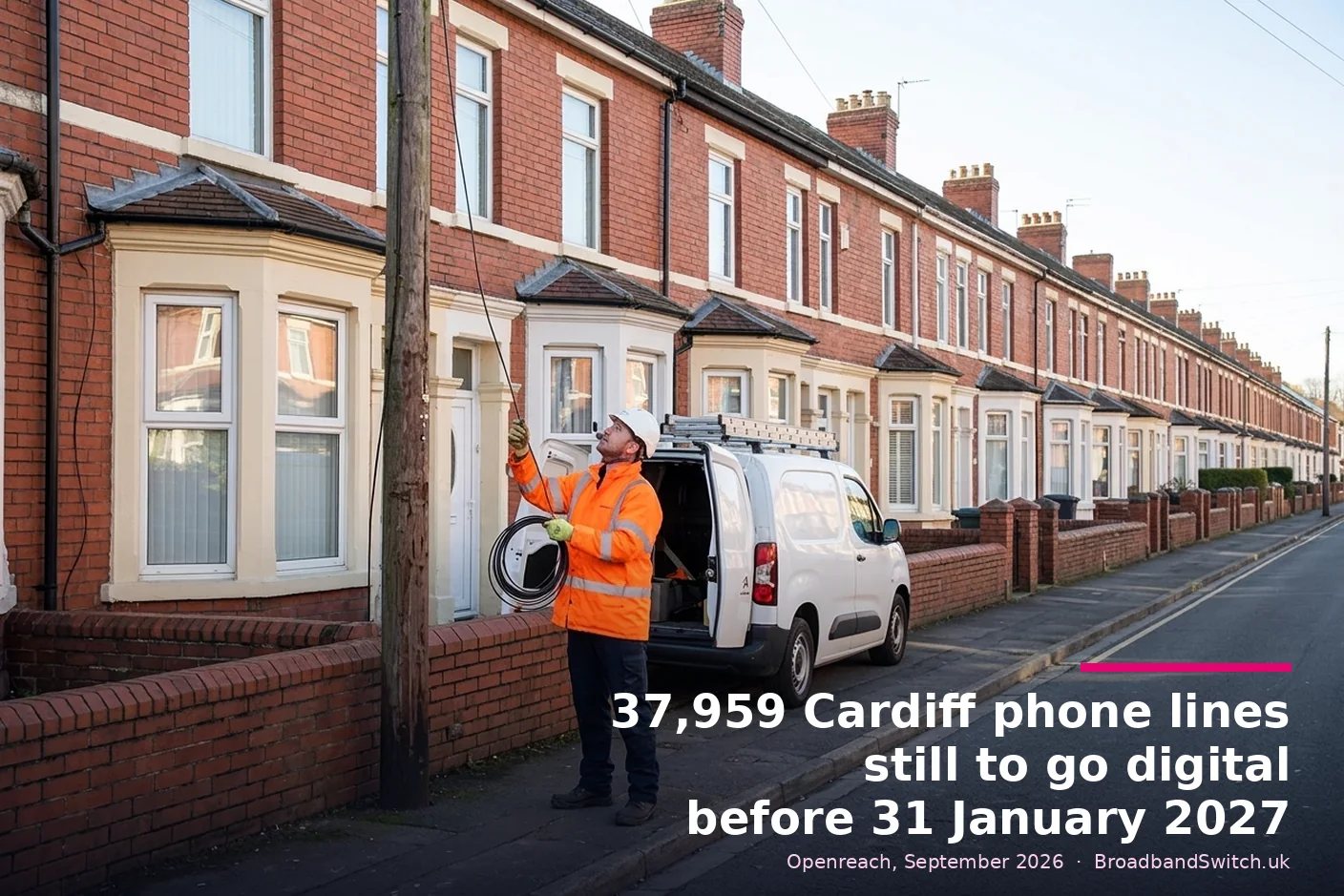
Direct answer: Cardiff had 37,959 telephone lines still to move off the old copper network in September 2026, 8.35% of its 454,527 lines, on Openreach’s count: the fourth best of the ten cities it measured, ahead of Edinburgh, Bristol, Glasgow and London. The old network goes dark at the end of January 2027, and eight Cardiff exchanges have stopped selling copper already, the first of them in October 2021.
Two separate changes tend to arrive in Cardiff letterboxes as one. The first is the national switch-off of the analogue phone network, on a single date: “On 31 January 2027, all traditional phone lines will be going digital - so it’s important to switch now.”, in Openreach’s words. The second is “stop sell”, which comes exchange by exchange and changes only what can be sold, not what is already connected. Its trigger, as Openreach defines it: “Stop Sell is triggered when a majority (75%) of premises connected to a particular exchange can get ultrafast Full Fibre”. After that date a new order in the exchange area, whether a move, a switch or an upgrade, comes as a digital line over fibre. Cardiff reached that point early: Whitchurch was in the first tranche of the programme in 2021, and the central Cardiff exchange followed in 2022.
Openreach and BT Wholesale, 2021 to 2027
Cardiff’s copper switch-off, exchange by exchange
- 13 October 2021Whitchurch: the first Cardiff exchange to stop selling copper Named in the first tranche of Openreach’s programme, with notice given in May 2021. Since then every new order in the area has been a digital line over fibre.
- 2 August 2022Cardiff exchange, the city centre The big central exchange followed in the fifth tranche.
- 8 February 2023Llandaff Tranche 7, the same day as Rhoose in the Vale.
- 9 November 2023Roath Tranche 10. Four of the city’s exchanges were now under stop sell.
- 26 May 2025Llanrumney Tranche 16, the first of the eastern exchanges.
- 14 February 2026Culverhouse Tranche 19, serving the west of the city around Culverhouse Cross.
- 15 May 2026Pentyrch is given a year’s notice Named in the round in which Openreach announced “Openreach has announced a further 238 new exchange locations, covering a whopping 1.69 million premises across the UK”, and that by 5 June “‘stop sell’ rules will have been activated in 1432 exchanges across the UK”.
- 5 June 2026Llanishen Tranche 20, the north of the city.
- 17 September 202637,959 Cardiff lines still to move 8.35% of the 454,527 lines in Openreach’s Cardiff patch, fourth best of its ten cities. Liverpool led at 6.35%; London trailed at 12.92%.
- 19 October 2026Where this page was last checked Anything Openreach announces after this date is not on the line yet; its stop sells page carries the newest round.
- 6 November 2026Penarth Tranche 22, the exchange across the border that serves the southern end of the Cardiff South and Penarth seat.
- 31 January 2027The old phone network goes dark Whatever copper phone lines remain are replaced by digital ones over broadband; Openreach’s phrase is “before the old legacy copper-based network is switched off at the end of January 2027”.
BT Wholesale’s stop sell list, “Product stop sells and FTTP exchange upgrades”, dated November 2025, for the exchange dates and tranches; Openreach’s stop sell announcement of 15 May 2026, its digital phone league table of 17 September 2026 and its switch-off page. Read 19 October 2026.
Cardiff is ahead on both changes. Openreach’s league table of 17 September 2026 counted 37,959 lines left to convert in the Cardiff area out of 454,527, which is 8.35%, and its summary put the city in the top five: “Other cities that made it into the top five in the race to make the digital switch are Manchester with just over seven per cent, followed by Cardiff with just over eight per cent”. Liverpool, the best of the ten, was at 6.35%; Edinburgh at 8.82%, Bristol at 8.99%, Glasgow at 10.60% and London at 12.92%. One footnote to carry: the table is “Numbers calculated using Openreach regional patch data”, so the Cardiff patch is wider than the council boundary.
On stop sell, the record is BT Wholesale’s list, “Product stop sells and FTTP exchange upgrades”, which runs to “1,747 exchanges moving to FTTP” and notes that “a UK wide WLR Stop Sell commenced on 5 September 2023”. Its November 2025 edition carries eight exchanges with a Cardiff address: Whitchurch from 13 October 2021, Cardiff from 2 August 2022, Llandaff from 8 February 2023, Roath from 9 November 2023, Llanrumney from 26 May 2025, Culverhouse from 14 February 2026, Llanishen from 5 June 2026, and Radyr with no date yet. Penarth, across the border but serving the southern end of the Cardiff South and Penarth seat, follows on 6 November 2026. Openreach’s round of 15 May 2026 then added Pentyrch, with a year’s notice, and its rounds of 27 July 2026 and 8 October 2026 added Dinas Powys and Castleton at the city’s edges. The list is by exchange and not by district, and the street name does not tell you which exchange serves your line: Openreach’s own stop sells page has the newest round, and our landline switch-off checker reads it for your line.
| Exchange | Serves, roughly | Copper stop sell from |
|---|---|---|
| Whitchurch | Whitchurch, Rhiwbina, Llandaff North | 13 October 2021 |
| Cardiff | The city centre, Cathays, Butetown, the Bay | 2 August 2022 |
| Llandaff | Llandaff, Fairwater, Danescourt | 8 February 2023 |
| Roath | Roath, Penylan, Cyncoed | 9 November 2023 |
| Llanrumney | Llanrumney, Rumney, St Mellons | 26 May 2025 |
| Taffs Well | Taff’s Well and Tongwynlais, over the border | 19 August 2025 |
| Culverhouse | Culverhouse Cross, Caerau, Ely | 14 February 2026 |
| Llanishen | Llanishen, Lisvane, Thornhill | 5 June 2026 |
| Penarth | Penarth and the south of the Cardiff South and Penarth seat | 6 November 2026 |
| Pentyrch | Pentyrch and Creigiau | a year’s notice from 15 May 2026 |
| Radyr | Radyr and Morganstown | listed, no date yet |
The “serves” column is our rough reading of where each exchange sits; the exchange that serves your line is the one Openreach’s checker returns. Stop sell affects what can be sold at the exchange, not what you have; the dates are BT Wholesale’s list of November 2025, read on 19 October 2026, and Openreach’s own stop sells page always has the newest round.
Seeing your exchange in that table does not alter the line you have today; it alters the next one, which will be digital and over fibre, with the copper retired once it is live. The households with a reason to go early are the ones with something other than a phone on the line, a care alarm, a health pendant or a monitored burglar alarm, and Cardiff is the one city where a network has said so in public. In May 2025 Virgin Media O2 announced that a “First-of-its-kind trial in Wales will see the telecoms provider work with Telecare Cardiff to identify, contact and provide comprehensive support to telecare customers”, with “Telecare Cardiff, which provides services on behalf of Cardiff Council”, asking that “Virgin Media customers in Cardiff with fall alarms, personal alarms and lifeline devices should look out for communications from Virgin Media O2” and promising that “Engineers have committed to never leave a customer without a working landline or telecare device”. Without a battery backup a digital line falls silent in a power cut; our care alarm guide sets out what to test and whom to tell before the switch.
Terraces, Bay flats and shared houses: how the fibre gets in
Direct answer: Three Cardiff households in ten live in a terraced house and one in four in a flat, twice the Welsh share, on Census 2021 figures. In a terrace the fibre comes off the pole or up from the pavement, and nobody has to say yes but you. In a block it needs the owner’s agreement before it can enter, and in a shared house in Cathays it needs the landlord’s.
Census 2021
What Cardiff’s homes are, against Wales and England and Wales
- Terraced
- Semi-detached
- Detached
- Flats, converted houses and rooms over shops
ONS, Census 2021, table TS044 Accommodation type, households. “Flats” adds purpose-built blocks, converted or shared houses, other converted buildings and homes in commercial buildings. Caravans, 0.1% of Cardiff households, are left off the bar.
Cardiff’s housing is unlike the rest of Wales, and the difference shapes how the fibre arrives. The census counts 29.6% of the city’s 147,334 households in a terrace and 26.5% in a flat of some kind, where Wales as a whole has 26.6% in terraces and 12.5% in flats. Add the 24.3% of households that rent privately, up from 21.9% in 2011, and you have the three Cardiff cases: the terrace, which is the easy one; the block, which needs one signature for everyone; and the rented house, which needs one landlord to answer an email.
How it reaches you
How full fibre gets from the pole in the street to the box by your skirting board
- On the pole Many Cardiff terraces are fed from a telegraph pole, not from under the pavement. The fibre runs along the street to a small box on the pole, and that is what Ofcom means when it says a home “can get” full fibre.
- The drop An engineer runs a new thin cable from the pole to the eaves of your house on the install day, in place of the old copper one. No digging, no wayleave: the house is yours, or your landlord’s, and the pole is theirs.
- The box on the wall The cable comes down the front wall to a small grey box, then through the wall. The networks that build underground, Virgin Media among them, arrive at the same wall from a chamber in the pavement instead.
- The box inside Inside, a small white box is fitted low on the wall and the router plugs into it. So does your phone handset once the copper line goes, which for nine Cardiff lines in ten it already has.
A typical terrace install, drawn by BroadbandSwitch.uk. The same four steps apply to a semi or a detached house; a flat in a block has a different second step, covered further down.

The terrace first, because it is most of the city. Openreach feeds many Cardiff terraces from poles, which is why the engineer in the photograph above is looking up a pole rather than down a hole, and it means the install needs no permission from anyone: the drop wire is replaced, a small box goes on the wall, and the visit is over in an hour or two. Virgin Media and nexfibre arrive underground instead, from a chamber in the pavement to the same wall, and that is the whole of the difference. Where a street has both, which in Cardiff is common, the postcode check shows two sets of prices.
Blocks are different, and the Bay is mostly blocks. Fibre can run past the entrance of a building and serve nobody inside it until the owner signs a wayleave, the written permission the cable needs to come indoors, and that applies to Openreach as much as to Hyperoptic, whose entire model is “We work with property owners, developers and partners, designing and installing dedicated fibre infrastructure to new buildings and existing developments”. A council or housing association block is one owner and one signature, which is why those tend to be wired early; a leasehold block means the freeholder or its managing agent, and an unanswered letter there can stall a hundred flats for a year. Our wayleave guide explains what is being asked and why the building loses nothing by agreeing.
The rented house is Cathays, Roath and Plasnewydd, where the terraces are shared and the landlord is the one who has to say yes to an engineer drilling the wall. The ask is small, and two of our guides take it from there: a tenant’s rights to full fibre covers what to do when the landlord goes quiet, and switching in a rented property is the easy case, because where a line already exists, changing the provider on it is your decision alone. Halls are a different arrangement again, and our student halls page deals with them. Grain and YouFibre both chose this corner of the city to build in, so the chance of a third set of prices at a CF24 address is better than anywhere else in Cardiff.
Cheaper broadband if you receive certain benefits
Direct answer: Anyone in Cardiff on Universal Credit, Pension Credit or certain other benefits can pick a social tariff from one of four providers, the cheapest at £12.50 a month, and Ofcom holds every one of them to the same rule: “It costs nothing to leave. You won't pay a fee to leave the tariff before the end of your contract.”
Which of the four is cheapest for you follows from which network reaches the house. On Virgin’s cable, which in Cardiff means nearly every street, Essential Broadband costs £12.50 a month on a rolling 30-day contract. On an Openreach line the choice is BT Home Essentials at £16.50 a month or Vodafone Essentials at £20 a month, up to 80 Mbps on a 12 months contract. In a block Hyperoptic has wired, its Fair Fibre Plan is £13 a month for 150 Mbps. Sky’s tariff is for people who already have Sky: “Our Sky Broadband Basics offer is only available if you already have Sky Broadband with us”. Our social tariffs guide carries every tariff on Ofcom’s register and who qualifies for each, checked by hand. If you rent from a housing association, ask the office which networks are already in the building before you ring anyone else: a cheap tariff on a network that stops at the pavement is no tariff at all.
Ofcom lists 31 Cardiff postcodes with no gigabit plan from anyone, and for those the help on offer goes to the builder, not the household. Under the UK Gigabit Broadband Voucher Scheme, “Eligible homes and businesses can access vouchers worth up to £4,500”, provided that “existing available broadband download speeds are less than 1Gbps”. The Welsh Government’s Access Broadband Cymru grant is narrower still: it “provides grant funding to support the installation of a broadband solution to any premises within Wales that is unable to achieve a connection via any other means”, with “Funding of up to £800 per premises is available”, but only for a home that “is not able to achieve a connection of a minimum of 30mbps download speeds via any provider”, and on Ofcom’s count almost no Cardiff home is in that position. The Welsh Government’s own advice for everyone else is the point of this page: “If fibre broadband is available, you need to upgrade to get faster speeds. Your current broadband won’t change unless you upgrade”.
Look up your part of the city
Direct answer: Pick one of the four areas to see its Ofcom figures and where it ranks. The lookup runs on your device and sends nothing anywhere.
Your part of Cardiff, in one card
The four parliamentary constituencies that cover the city, with Ofcom’s January 2026 figures for each. Not sure which one you are in? The UK Parliament’s Find your MP page will tell you from a postcode.
What this page used to say
Direct answer: Five corrections: two coverage numbers that had no source, a network that does not sell to Cardiff homes described as the city’s largest, a £45 million attributed to the wrong company, a Hyperoptic neighbourhood list Hyperoptic has never published, and a business network listed as one you could order at home.
The previous version of this page got things wrong, and if you read it, you deserve to know which. It ran to eight thousand words, recommended providers for named neighbourhoods, quoted typical prices street by street, gave the city a median speed of 72 Mbps from tests nobody can check, and built much of its advice around Ogi, a network whose own website does not list Cardiff among the places it serves. Its coverage percentages had no traceable source. Where a figure could not be traced we have removed it rather than hedged it, and where a company’s own words contradicted ours, the company’s words stand and ours have gone. The “best provider for Canton” style of recommendation has gone too, because no one can know what reaches a house without the address, and the address check at the top is where that answer lives.
Two coverage figures with nothing behind them, one of them a gigabit figure wearing a full fibre label
What this page saidThis page said Openreach reached approximately 96.87% of Cardiff premises and that full fibre covered approximately 95% of the city. Openreach’s own words, in May 2026, are “85% of properties in the area now able to upgrade their broadband service”. Ofcom’s residential figures for January 2026 are 89% full fibre and 96% gigabit-capable, the second of which counts Virgin Media’s cable. Neither old number appears in any published source.
What it says now, and whyOfcom’s figures, dated and with the method stated, for the council and the four areas, and Openreach’s own percentage quoted as Openreach’s rather than passed off as the city’s.
A Cardiff network Ogi does not say it has
What this page saidThis page said Ogi was Cardiff’s largest local altnet, covered Cardiff Bay and Penarth, started at £17 a month and measured 258 Mbps on average in the city. Ogi’s own areas page lists Bridgend County Borough, Caerphilly County Borough, Monmouthshire, Newport County, Pembrokeshire, Rhondda Cynon Taff, Torfaen and the Vale of Glamorgan. Its Cardiff page is headed “Full fibre broadband for Cardiff” and sells to businesses. Its Vale page says “Born and bred in Wales, Ogi is available in Dinas Powys, Llantwit Major, Rhoose and St Athan”. No Cardiff speed figure exists on its site.
What it says now, and whyOgi’s own words about where it builds, the plain statement that a Cardiff home cannot order it today, and a note that this page changes if that does.
A £45 million that belongs to a different company
What this page saidThis page said Ogi had secured a £45 million Cardiff Capital Region funding deal with plans for around 500,000 Welsh premises. Ogi’s site carries neither figure. The £45m that does appear in a Cardiff release is Openreach’s, which on 18 May 2026 said “Full Fibre broadband is now available to more than 150,000 homes and businesses across Cardiff thanks to a major investment of around £45m”.
What it says now, and whyOpenreach’s £45m attributed to Openreach, with its date, and nothing attributed to Ogi that Ogi has not said.
A Hyperoptic neighbourhood list Hyperoptic does not publish
What this page saidThis page said Hyperoptic covered the City Centre, Butetown, Cardiff Bay and the International Sports Village from £17.99 a month. There is no Cardiff page on Hyperoptic’s site (on 19 October 2026 the address answered “Sorry, we cannot find that page”), and its only statements are national: “Our network now passes more than 2 million homes” and “We focus exclusively on high density urban areas and cover 64 towns and cities in the UK”.
What it says now, and whyHyperoptic’s national statements with their dates, and the plain fact that its Cardiff buildings are not listed anywhere, so the postcode check is the only test.
A business network listed as a home one
What this page saidThis page listed TfW ffeibr among the networks to check for a Cardiff home and said it reached the city centre and the Bay in April 2026. The extension is real: Transport for Wales said on 2 April 2026 that the network runs “off the Core Valley Lines train-tracks and right into the heart of Cardiff’s city centre” and “all the way down to Cardiff Bay”. Its customers are businesses: “For businesses looking for scalable, purpose driven, future ready connectivity please get in touch”.
What it says now, and whyTfW ffeibr described as what it is, a business and public-sector network, in a section of its own, and left off the grid of networks a home can order.
Cardiff broadband: frequently asked questions
Which part of Cardiff has the best full fibre coverage?
On Ofcom’s January 2026 figures, Cardiff North, where 94% of homes could get a full fibre service. The lowest was Cardiff East at 83%, which takes in Adamsdown, Roath and Plasnewydd and runs out to Pentwyn and Rumney. Each is an average over a constituency of forty-odd thousand homes, and streets inside it differ more than the four areas differ from each other, so the address check beats the area figure every time.
What percentage of Cardiff has full fibre broadband?
89% of homes in the Cardiff council area could get full fibre in January 2026, according to Ofcom, against 82% for Wales and 82% for the UK, which puts Cardiff seventh of Wales’s 22 councils. Gigabit-capable coverage, which adds Virgin Media’s cable, was 96%, the highest in Wales.
Is Ogi available in Cardiff?
Not for homes, on Ogi’s own account. The areas it lists for home broadband are Bridgend County Borough, Caerphilly County Borough, Monmouthshire, Newport County, Pembrokeshire, Rhondda Cynon Taff, Torfaen and the Vale of Glamorgan, and the only Cardiff page on its site is the business one. Its head office is in the city and it has wired venues such as Sophia Gardens, but a Cardiff household cannot order it today. In the Vale of Glamorgan it says it is available in Dinas Powys, Llantwit Major, Rhoose and St Athan.
Does Virgin Media cover all of Cardiff?
Nearly, on Ofcom’s figures rather than Virgin’s. Ofcom counts 96% of Cardiff homes as able to get a gigabit-capable service, and in Cardiff the gap between that and the full fibre figure is Virgin’s cable. Virgin’s own newest Cardiff words are from December 2020, when its gigabit service “is now available across its entire network in Cardiff and surrounding areas such as Adamstown, Ely, Grangetown, Lisvane, Pentwyn, Rumney, Saint Mellons, Thornhill and Whitchurch”, and its Cardiff web page no longer exists. Its second network, nexfibre, lists Cardiff in its December 2025 footprint with a caveat, so the address check is the answer.
Is CityFibre in Cardiff?
No. CityFibre’s coverage page lists no place in Wales, and the earlier version of this page was right about that, if about little else. The second wire under most Cardiff streets is Virgin Media’s cable, with nexfibre’s fibre now arriving on Virgin’s behalf, and in the east of the city Grain and YouFibre have built their own.
How many Cardiff homes have actually switched to full fibre?
Fewer than half of those that could. Take-up was 45% of covered premises in January 2026 on Ofcom’s figures, 20th of the 22 Welsh councils, and on its own network Openreach said in May 2025 that “less than two in five who could upgrade to the new network have done so”. No other number on this page matters as much as the distance between built and bought.
Is Cardiff getting more full fibre?
Yes, nearly all of it. On the plans the operators gave Ofcom, full fibre reaches 99% of Cardiff homes by January 2029, up 10.8 points, and 75% of homes are expected to have a choice of three or more gigabit networks, second of Wales’s 22 councils for that. Against that, Ofcom lists 31 council-area postcodes that no gigabit plan reaches.
Which networks are available in Cardiff?
Openreach carries BT, Sky, TalkTalk, Vodafone, EE, Plusnet and most of the smaller brands; Virgin Media sells only on its own cable and, where nexfibre has built, on nexfibre; Grain is in parts of Roath, Cathays and Plasnewydd; YouFibre is in Llanrumney; Hyperoptic sells only in the blocks it has wired. Ogi sells to Cardiff businesses and TfW ffeibr to businesses and public bodies, not to homes. Ofcom’s 2029 count for the council area is 11 to 15 gigabit-capable operators; the ones not named here are business networks and small builders.
My street has fibre on the pole. Why does my flat not have it?
Because reaching the building and reaching your flat are two jobs, and only the first is the network’s alone. The second needs a wayleave from whoever owns the building: the council or housing association, the freeholder or managing agent of a leasehold block, or the landlord of a shared house. Our wayleave guide covers what is being asked. A terrace skips the step entirely: the drop wire from the pole is yours to have replaced.
What is happening to landlines in Cardiff?
The same thing that is happening to landlines everywhere, with Cardiff further ahead than most. Openreach puts it as “On 31 January 2027, all traditional phone lines will be going digital - so it’s important to switch now.” Its league table of September 2026 found 37,959 lines in the Cardiff area still on the old network, 8.35% of the total, the fourth best of the ten cities it measured. Copper “stop sell” is a separate thing, done exchange by exchange once “Stop Sell is triggered when a majority (75%) of premises connected to a particular exchange can get ultrafast Full Fibre”; eight Cardiff exchanges have crossed that line, Whitchurch first in 2021. If a care alarm hangs off your line, do things in the order our care alarm guide gives, and if you are a Virgin customer, expect a letter: it is running a telecare trial with Cardiff Council.
Is there cheaper broadband in Cardiff if I receive benefits?
Yes, from four providers, and the network at your address decides which. With Universal Credit, Pension Credit or certain other benefits: Virgin Media’s Essential Broadband is £12.50 a month on its cable, BT Home Essentials £16.50 and Vodafone Essentials £20 on an Openreach line, and Hyperoptic’s Fair Fibre Plan £13 a month in a block it has wired. No exit fee on any of them. The full register, with who qualifies, is in our social tariffs guide.
Can I get help paying for a fibre connection in Cardiff?
Only if no gigabit service reaches your address, and then through help that goes to the builder rather than to you. The UK voucher page says “Eligible homes and businesses can access vouchers worth up to £4,500” provided “existing available broadband download speeds are less than 1Gbps”. The Welsh Government’s Access Broadband Cymru grant pays “Funding of up to £800 per premises is available” but only for a home that “is not able to achieve a connection of a minimum of 30mbps download speeds via any provider”, which on Ofcom’s figures almost no Cardiff home is. No Project Gigabit contract covers the city.
Is broadband cheaper in Cardiff than elsewhere?
Cheaper in choice, not in price. A provider’s price list is the same in Cardiff as in Swansea; what differs is how many providers are on it. Cardiff’s edge is competition: Ofcom expects 75% of its homes to have three or more gigabit networks to choose between by 2029, second of the 22 Welsh councils, and the cheapest of those only shows up when the address is checked.
How current is this page?
Every source was read on 19 October 2026. Ofcom’s numbers describe January 2026 and were published on 13 May 2026; when the next update lands, this page is rebuilt from it. Every quotation from a company carries the date it was made, so an old figure, like Virgin Media’s from 2020, shows its age without our help.
In short
- Cardiff is a gigabit city first: 96% of homes could get a gigabit-capable service in January 2026, the highest in Wales, because Virgin Media’s cable is nearly everywhere. Full fibre reached 89%, seventh of Wales’s 22 councils, against 82% for Wales and 82% for the UK.
- The four areas run from Cardiff North at 94% to Cardiff East at 83% on Ofcom’s figures. The east is the laggard and the place the smaller builders chose.
- Take-up was 45% of covered premises, 20th in Wales, and Openreach said of its own network in May 2025 that “less than two in five who could upgrade to the new network have done so”: for most of the Cardiff homes that could have it, the fibre is on the pole and not in the house.
- Three households in ten live in a terrace and one in four in a flat, twice the Welsh share. In a terrace nobody has to say yes but you; in a block it is the owner, and in a shared house the landlord.
- Openreach’s own Cardiff figure is 150,000 homes and businesses passed and “85% of properties in the area now able to upgrade their broadband service”, from May 2026. Virgin Media’s newest Cardiff words are from 2020, nexfibre now lists the city, Grain names Roath, Cathays and Plasnewydd, YouFibre names Llanrumney, and Ogi, based in Cardiff, does not list Cardiff.
- On the plans the operators gave Ofcom, full fibre reaches 99% of Cardiff homes by January 2029, and 75% of homes get a choice of three or more gigabit networks, second in Wales for that.
- Eight Cardiff exchanges have stopped selling copper already, the first in October 2021, and 37,959 lines were still to move off the old phone network in September 2026, the fourth best share of the ten cities Openreach measured. The whole network goes digital on 31 January 2027.
- One operator publishes a Cardiff percentage, Openreach, and it is for Openreach’s wires only; the rest of the figures here are Ofcom’s, and the one that counts for you is the one your postcode returns.
Every line above carries its own date and stands alone. This page is re-read at least once a quarter; the last read was .
References
- OFCOM.ORG.UK
Ofcom. (2026, May 13). Connected Nations update: Spring 2026, with the data download “Fixed broadband coverage and full fibre take-up”, local and unitary authority and parliamentary constituency files, data as at January 2026, Open Government Licence. The council, area, Wales and UK figures. Data files read 19 October 2026.
- OFCOM.ORG.UK
Ofcom. (2026, May 13). Connected Nations: Planned network deployments 2026, with the data download “Planned network deployments for local and unitary authorities”, residential file. Source of the 2029 plans, the operator count, the unplanned postcodes and the publicly funded lines. Data file read 19 October 2026.
- OFCOM.ORG.UK
Ofcom. (2025, November 19). Connected Nations 2025: Methodology annex. The definitions of full fibre and gigabit-capable. Read 15 October 2026.
- OPENREACH.COM
Openreach. (2026, May 18). Thousands in Cardiff yet to benefit from major broadband upgrade. The 150,000 figure, the £45m, the 85% and the Martin Williams quotations. Read 19 October 2026.
- OPENREACH.COM
Openreach. (2025, May 21). Cardiff reaches Full Fibre broadband milestone, with its Welsh text. The 140,000 figure, the 80%, the two-in-five line and the ten communities named. Read 19 October 2026.
- OPENREACH.COM
Openreach. (2026, June 3). More than 8 in 10 Welsh homes can get Full Fibre, but many yet to switch; and (2026, June 5) Martin Williams, Wales’s Full Fibre moment, and why the next stage matters just as much. The 1.25 million, the eight in ten, the take-up line and the street-by-street warning. Read 19 October 2026.
- OPENREACH.COM
Openreach. (2026, September 17). Liverpool tops major UK city league table in move to digital phone services. The Cardiff, Liverpool, Edinburgh, Bristol, Glasgow and London rows and the method footnote. Read 19 October 2026.
- OPENREACH.COM
Openreach. (2025, July 25) Openreach to stop selling copper services in 137 more locations; (2026, May 15) Openreach stops copper for another 1.69 million premises; (2026, July 27) Openreach puts a stop to copper for another half million premises; (2026, October 8) Openreach accelerates copper retirement across 600,000 more UK premises. The stop sell definition, Pentyrch, Dinas Powys, Castleton and the national totals. Read 19 October 2026.
- OPENREACH.COM
Openreach. (n.d.). Switching off PSTN across the UK. The 31 January 2027 date. Read 15 October 2026.
- BTWHOLESALE.COM
BT Wholesale. (2025, November). Product stop sells and FTTP exchange upgrades. The 1,747-exchange list with the Cardiff-area exchanges, their tranches and stop sell dates, and the WLR stop sell date. Read 19 October 2026.
- VIRGINMEDIA.COM
Virgin Media. (2026). The address where a Cardiff page would sit, which returned a 404. Read 19 October 2026.
- VIRGINMEDIAO2.CO.UK
Virgin Media. (2020, December 3). Virgin Media brings gigabit broadband to Wales; (2022, March 22) Virgin Media O2 investment gives Welsh customers and businesses a mobile and broadband boost; (2025, May 15) Virgin Media O2 and Telecare Cardiff collaborate to support vulnerable customers through digital voice migration. The Gig1 districts, the 1,140Mbps, the council leader’s words, the £61 million and 104,000, the 412,000 and the telecare trial. Read 19 October 2026.
- NEXFIBRE.CO.UK
nexfibre. (2026, February). Network coverage update, as at 31 December 2025. The Cardiff and Cardiff Central entries, the entries nearby and the caveat. Read 19 October 2026.
- HYPEROPTIC.COM
Hyperoptic. (2026). News and press; and the address where a Cardiff page would sit, which returned a 404. The two million and 64-city figures and the building model. Read 19 October 2026.
- GRAINCONNECT.COM
Grain. (2026, October 12). Broadband deals in Cardiff. Roath, Cathays and Plasnewydd, the CF24 sectors, the speeds and the price-rise promise. Read 19 October 2026.
- YOUFIBRE.COM
YouFibre. (2026). Our locations, Wales region, and Llanrumney. The Wales line, the town list and the Llanrumney statements. Read 19 October 2026.
- OGI.WALES
Ogi. (2026). About; Ogi full fibre broadband in your area; Full fibre broadband in the Vale of Glamorgan; Business Broadband Cardiff; (2026, September 9) Howzat for connectivity? Powering Sophia Gardens; and (2026, September 29) The Big Welsh Switch. The areas list, the Vale towns, the business page, the £5 million line and the chief executive’s words. Read 19 October 2026.
- TFW.WALES
Transport for Wales. (2026, April 2). TfW ffeibr extends next generation full-fibre network into the heart of Cardiff. The route, the business invitation and the reinvestment line. Read 19 October 2026.
- CITYFIBRE.COM
CityFibre. (n.d.). Network availability and coverage. The absence of any Welsh place and the national premises figure. Read 19 October 2026.
- GOV.UK
Building Digital UK. (2025, December 17). Project Gigabit contracts; (2026, July 29) Project Gigabit framework agreement: Openreach; and (2026, March 16) Gigabit Broadband Voucher Scheme information. The absence of a Welsh lot, the two Welsh call-offs and the voucher terms. Read 19 October 2026.
- GOV.WALES
Welsh Government. (2026, October 7). Support for connecting to faster broadband; (2026, June 12) Access Broadband Cymru Grant scheme: guidance; and (2026, September 30) Solutions available for getting faster broadband. The policy line, the grant amount and rule, and the upgrade advice. Read 19 October 2026.
- ONS.GOV.UK
Office for National Statistics. (2023). Census 2021, table TS044: Accommodation type, households, via nomis; and (2023, January 19) How life has changed in Cardiff: Census 2021. The household count, the house-type shares for Cardiff, Wales and England and Wales, the population and the tenure figures. Read 19 October 2026.
- PARLIAMENT.UK
UK Parliament. (n.d.). Find your MP. The constituency finder linked from the lookup. Read 19 October 2026.
How switching works
Three steps, and the new provider does the rest
- Step 1Postcode in, address picked
Every network that has reached the house appears, and in a block, every network that has reached the block.
- Step 2Every provider, cheapest first
Nothing to sign up to and no brand left out. Three networks in the street, three price lists on one screen.
- Step 3Order, and that is it
Your new provider arranges the move with your old one. You never ring the company you are leaving, and the old service stops the day the new one starts.
One Touch Switch, Ofcom’s process for home broadband and landlines since September 2024, as it runs on BroadbandSwitch.uk.
Find out what reaches your door
Type the postcode, pick the house, and every provider that reaches it appears with the cheapest at the top. Ten seconds for the one Cardiff answer that is about your address.
Compare at my postcode →