UK broadband guides 2026: a complete index for switching, speed, comparison, business, trust, and more
Welcome to the BroadbandSwitch.uk guides index for 2026. This page brings together every guide we publish across switching, speed and needs, comparison frameworks, cost and value, setup and installation, business broadband, local UK location guides, broadband terminology, and the trust framework that underpins our editorial work. Whether you're switching for the first time, comparing 5 Gbps gigabit options, exploring 5G home broadband, planning a business broadband move without downtime, checking your local UK address coverage, or simply wanting to understand the One Touch Switch process launched 12 September 2024, this index points you to the right place. All BroadbandSwitch.uk guides are written by Adrian James (broadband editor) and reviewed by Dr Alex J. Martin-Smith (head of editorial), follow our published editorial policy, and are routinely updated to reflect UK regulatory changes, new product launches, and the changing UK altnet landscape. Last updated 28 April 2026; next review within 90 days.
For most UK households exploring broadband options in 2026, the most useful starting points across our guides are: the switching hub (One Touch Switch since 12 September 2024, mid-contract pricing rights, automatic compensation rates, and consumer protections); the speed and needs hub (working out what speed your household actually needs and avoiding overpaying for unused gigabit headroom); the compare-by-postcode hub and compare-by-feature hub (the two complementary frameworks for surfacing genuine deals at your address); the local broadband hub (56 UK location pages covering cities, metropolitan regions, and major towns from Aberdeen to Bournemouth); the methodology and trust hub (how we research, rank, and review deals plus our editorial-commercial separation); and the broadband glossary (152 UK 2026 terms from FTTP and XGS-PON to GMS, ETF, and TOTSCo). This page indexes every guide we publish so you can find the right one quickly.
1. UK broadband guides 2026: what these guides cover
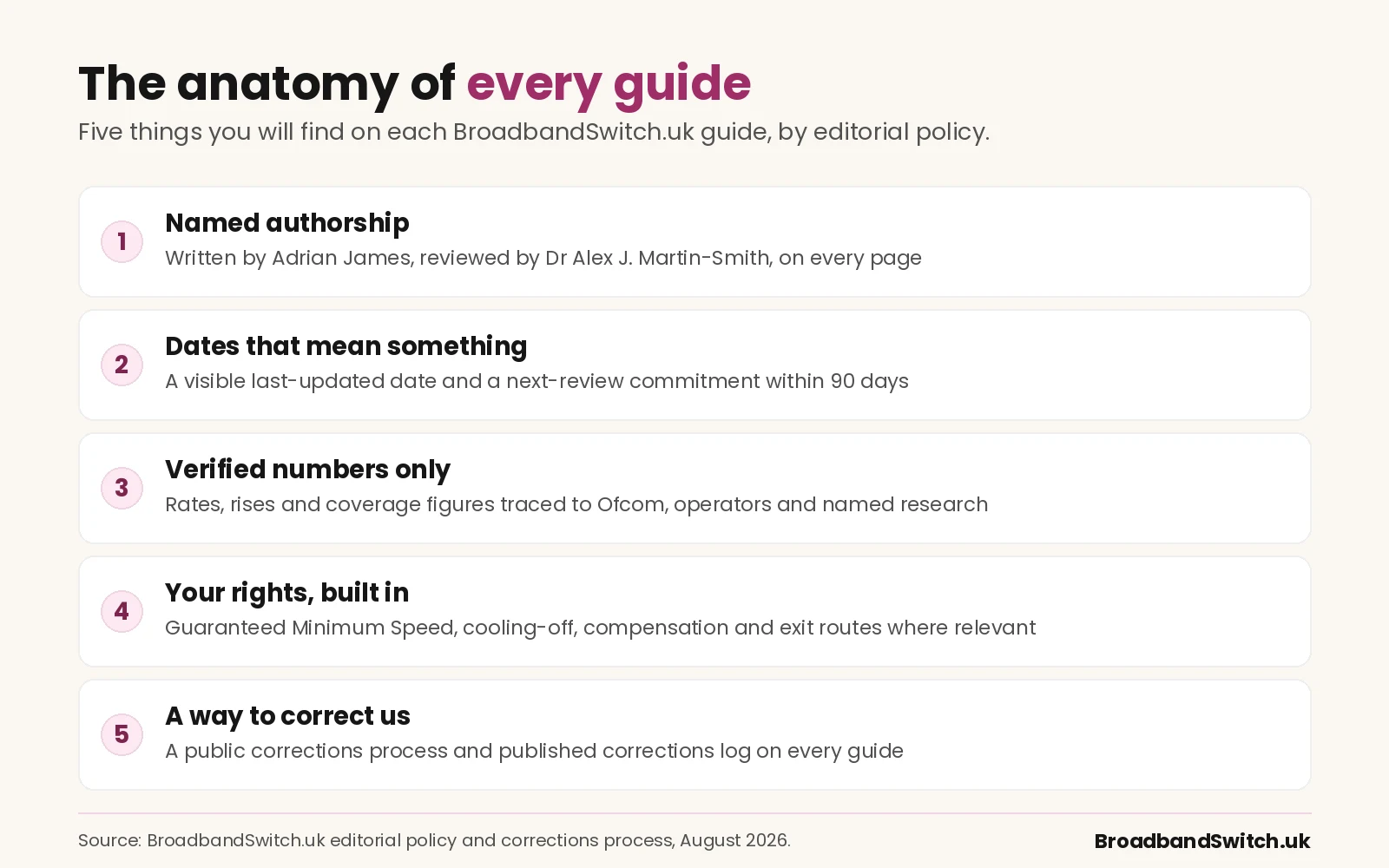
The BroadbandSwitch.uk guides cluster covers the full UK broadband consumer journey in 2026. Every guide is written under the same editorial conventions: paraphrased rather than direct-quoted source material to respect copyright, comprehensive UK altnet inclusion regardless of affiliate relationships, named credentialled editorial team operating under documented two-stage editorial workflow (Adrian writes; Alex reviews), and clear structural editorial-commercial separation documented in the affiliate disclosure.
The 2026 UK broadband guides cluster spans:
- Switching and consumer rights guides covering the One Touch Switch process launched 12 September 2024, the TOTSCo Hub, mid-contract price rises (BT/EE/Plusnet £4 from 31 March 2026; Virgin Media O2 £4 new and £3.50 in-contract from April 2026; Sky £3 flat from 1 April 2026; Vodafone £3.50 post 2 July 2024; TalkTalk £3 post 12 August 2024; Three Broadband £3 post 1 September 2024), the Automatic Compensation scheme with updated April 2026 rates, the Telecoms Consumer Charter introduced February 2026, the Voluntary Code of Practice on Broadband Speeds, and the 14-day cooling-off period.
- Speed, needs, and technical performance guides helping you work out what speed your household actually needs (avoiding overpaying for unused gigabit headroom) and understand the technical metrics that matter beyond headline download speeds (latency, jitter, packet loss, upload speed).
- Comparison hubs covering both the compare-by-postcode framework (surfacing genuine deals at your address) and the compare-by-feature framework (comparing across speed, contract length, technology type, price tier, provider category, usage context, and regulatory protection).
- Cost, value, and money-saving guides covering average monthly UK broadband cost, household money-saving strategies, and broadband contract length analysis.
- Setup, installation, and engineer visit guides covering UK broadband installation times across providers and the engineer visit checklist for installation day.
- Business broadband guides covering home vs business broadband decisions for small companies, business broadband for guest Wi-Fi, professional services, short leases and pop-ups, trades and mobile teams, switching without downtime, 4G backup, card machines and EPOS, static IP, plus dedicated provider pages for BT Business, Sky Business, TalkTalk Business, Virgin Media Business, Vodafone Business, and Trooli Business.
- Local UK broadband location guides covering 56 UK cities, towns, and metropolitan regions from Aberdeen and Belfast in the north to Bournemouth-Poole and Plymouth in the south, including major regional companion pages such as Greater London, Greater Manchester, West Midlands, West Yorkshire, and Greater Glasgow.
- Glossary and broadband terminology guide covering 152 UK 2026 terms from FTTP and XGS-PON to GMS (Guaranteed Minimum Speed), ETF (Early Termination Fee), TOTSCo (The One Touch Switching Company), MEIF (Macquarie European Infrastructure Fund), and Project Mustang.
- Trust framework and methodology guides documenting how we research, rank, and review broadband deals; the editorial-commercial separation; the named credentialled editorial team; and the corrections process available to readers.
The 2026 UK broadband guides priorities: the BroadbandSwitch.uk guides cluster prioritises practical, actionable, accurate UK information over filler content. Every guide is updated to reflect 2026 UK regulatory frameworks, current product launches, and the changing UK altnet landscape including CityFibre's UK rollout, Virgin Media plus Nexfibre with Project Mustang XGS-PON expansion, Openreach FTTP target of 25 million premises by end of 2026, Netomnia/YouFibre (the latter being acquired by Nexfibre as announced February 2026), Hyperoptic, plus regional altnets including KCOM Lightstream in Hull, Brawband in Scotland, and many others.
2. Switching and One Touch Switch guides
The UK broadband switching landscape changed materially with the launch of the One Touch Switch (OTS) process on 12 September 2024. Switching is now genuinely simpler than at any point in UK broadband history; this section indexes our switching guides covering OTS, the TOTSCo Hub, network-by-network switching considerations, and practical step-by-step guidance.
| Guide | What it covers | Best for |
|---|---|---|
| UK broadband switching hub 2026 | The complete OTS overview, TOTSCo Hub, mid-contract pricing rights, compensation rates, end-of-contract notifications, exit fees, and consumer protections. | Households new to switching or wanting a comprehensive overview before signing. |
| One Touch Switch UK | Step-by-step OTS walkthrough, the TOTSCo Hub explained, what happens during the switch, switching downtime expectations, and how OTS interacts with cross-network switches. | Households planning their first OTS-era switch. |
| Switch broadband UK 2026 | Practical UK broadband switching covering postcode checking, network choice, total contract cost calculation, and timing. | Households comparing options before initiating a switch. |
| Broadband switch checklist | The pre-switch and post-switch UK broadband checklist including documentation, postcode checks, exit fee verification, address-specific Guaranteed Minimum Speed (GMS), and engineer visit planning. | Households wanting a structured switching process to avoid surprises. |
| Switch broadband before contract ends and still save money | Mid-contract switching scenarios where switching before contract end can still save money including the five legitimate scenarios where exit fees may not apply. | Households considering early switching where current pricing has become uncompetitive. |
| Business broadband switching without downtime | Business broadband switching procedures designed to minimise downtime including parallel running, OTS for business, engineer visit coordination, and migration planning. | Business broadband customers wanting zero-downtime switching. |
| What happens to my number when I switch | Number portability across UK broadband and home phone providers including Virgin Media, Openreach, altnets (CityFibre, Hyperoptic), and digital voice migration. | Households worried about retaining their existing landline number after switching. |
The switching hub is the most comprehensive starting point. It covers OTS step-by-step, the TOTSCo Hub mechanics, what cross-network switches feel like (effectively zero downtime as the new line is provisioned in parallel and activated when ready), the 14-day cooling-off period, exit fees and the five legitimate scenarios for fee-free cancellation, and end-of-contract notifications timing.
3. Mid-contract pricing, exit fees, and consumer rights guides
UK broadband consumer rights have strengthened materially in 2026 thanks to Ofcom's Voluntary Code of Practice on Broadband Speeds, the Automatic Compensation scheme with updated April 2026 rates, the Telecoms Consumer Charter introduced February 2026, and the One Touch Switch process. This section indexes our guides on consumer rights including in-contract price rises, exit fees, and what happens if your provider goes out of business.
| Guide | What it covers | Best for |
|---|---|---|
| In-contract price rises 2026 | Comprehensive 2026 UK ISP mid-contract pricing change schedules including BT/EE/Plusnet £4 from 31 March 2026, Virgin Media O2 £4 new and £3.50 in-contract from April 2026, Sky £3 flat from 1 April 2026, Vodafone £3.50 post 2 July 2024, TalkTalk £3 post 12 August 2024, Three Broadband £3 post 1 September 2024. Plus altnets (Zen, Hyperoptic, YouFibre, Lit Fibre, toob) typically without mid-contract rises. | Households calculating total contract cost before signing and considering whether mid-contract rises trigger their right to leave penalty-free. |
| Exit fees and setup fees | UK ISP exit fee structures, the five legitimate scenarios where exit fees may not apply, setup fee analysis, and how to calculate the genuine cost of switching mid-contract. | Households weighing the economics of mid-contract switching versus waiting until contract end. |
| Router return charges explained after switch | How UK ISPs handle router returns after switching, typical return windows, return charges if routers aren't returned, and which providers operate return-free models. | Households recently switched and managing the post-switch router return process. |
| What happens if your broadband provider goes out of business | The UK consumer protection framework for ISP bankruptcies, the Ofcom transfer process, customer rights, and what to do if your altnet or smaller ISP encounters financial difficulty. | Households on smaller altnets or wanting to understand the full UK regulatory protection framework. |
Per Ofcom's Voluntary Code of Practice on Broadband Speeds and related UK consumer regulation, the five main scenarios where exit fees may not apply are: (1) the address-specific Guaranteed Minimum Speed (GMS) is consistently not met after the 30-day fix window; (2) the provider materially changes contract terms to your detriment; (3) the provider increases prices beyond what was contractually agreed at sign-up; (4) you exercise the 14-day cooling-off period under UK consumer regulation for distance contracts; (5) the provider materially fails to deliver service as agreed (extended outage scenarios). See the exit fees guide for detailed coverage of each scenario.
4. Speed, needs, and technical performance guides
UK households frequently overpay for broadband speeds they don't actually need. Our speed and needs guides help you work out genuine household requirements before signing. Beyond headline download speeds, technical metrics including upload speed, latency, jitter, and packet loss matter for working from home, video calls, gaming, and content creation.
| Guide | What it covers | Best for |
|---|---|---|
| Speed and needs hub | The complete framework for working out household speed needs across light, standard, heavy, and multi-gigabit usage profiles, plus when 5G home broadband or fixed FTTP makes more sense. | Households planning to switch and wanting to confirm the right speed tier before signing. |
| UK broadband speed guide 2026 | Comprehensive UK broadband speed reference covering FTTC speeds (35-80 Mbps), FTTP speeds (typically 100 Mbps to 1.6 Gbps with provider variations), Virgin Media cable speeds (up to 1.1 Gbps Gig1 and 2 Gbps Gig2 through Project Mustang Nexfibre infill), CityFibre wholesale partner speeds (up to 5 Gbps via Sky Gigafast), and 5G home broadband speeds. | Households researching speed terminology and what each speed tier delivers in practice. |
| What broadband speed do I need | Practical speed framework for UK households by usage profile: single-person light usage (30-60 Mbps comfortable); standard multi-device household with regular streaming and working from home (100-300 Mbps comfortable); heavy households with multiple simultaneous 4K streams, content creation, gaming (500+ Mbps); content creators, multiple working-from-home users with heavy uploads, technology professionals (1+ Gbps). | Households unsure whether 100 Mbps, 500 Mbps, or 1 Gbps is the right starting point. |
| Upload speed vs download speed: what broadband switchers should compare | The asymmetric vs symmetric upload distinction, why upload matters for working from home with video calls, cloud syncing, content creation, live streaming, hosting, and which UK networks offer symmetric speeds (CityFibre retail brands at higher tiers including Vodafone Pro II 2.2 Gbps; Hyperoptic; Lit Fibre; Yayzi; KCOM Lightstream packages up to 500 Mbps). | Working-from-home households, content creators, and technology professionals. |
| Latency, jitter, packet loss: hidden broadband metrics | The technical metrics beyond headline download speed that matter for video calls, gaming, VoIP, and content streaming. How to measure latency, jitter, and packet loss; typical UK ISP performance; and why fibre networks generally outperform cable on these metrics. | Households where video call quality, gaming, or VoIP performance matters more than raw download speed. |
Most UK households find 100-300 Mbps comfortable for typical use including 4K streaming, video calls, working from home, and gaming. Multi-gigabit speeds (1 Gbps and above) typically benefit content creators, multiple simultaneous heavy uploaders, and technology professionals; for typical UK households the 5 Gbps Sky Gigafast package available on CityFibre exceeds genuine household requirements but suits advanced power users. See the what broadband speed do I need guide for a structured framework.
5. Comparison frameworks and hubs
BroadbandSwitch.uk publishes two complementary comparison frameworks: comparing by postcode (surfacing genuine deals at your address) and comparing by feature (across speed, contract length, technology, price tier, provider category, usage context, and regulatory protection). Both work together for thorough UK broadband comparison.
| Comparison hub | Framework focus | Best for |
|---|---|---|
| Compare broadband by postcode | The postcode-first framework for surfacing actual UK broadband options at a specific address: which networks reach your address, which retail brands operate on each network, and how to verify the genuine option set before signing. | Households planning a switch and wanting to confirm what is actually available at their address (not just what major UK ISPs advertise nationally). |
| Compare by feature hub | The feature-first framework for comparing UK broadband across seven dimensions: speed, contract length, technology type, price tier, provider category, usage context, and regulatory protection. Helps you identify the right options across different priorities. | Households who already know broadly what's available and want to evaluate options across multiple decision criteria. |
| Best UK broadband deals (May 2026) | The current best-value UK broadband deals across major UK ISPs and altnets, ranked using the BroadbandSwitch.uk methodology covering total contract cost, speed value, customer service satisfaction, and contract flexibility. | Households seeking the current month's standout value picks across different speed tiers and price points. |
How the two complementary comparison frameworks work together. The postcode framework comes first because it surfaces the genuine option set at your specific address (filtering out anything not actually available). Once you know which networks reach your address, the feature framework helps you evaluate options across speed, contract length, total cost, technology, customer service, and regulatory protection. Together they form the complete UK broadband comparison process.
6. Cost, value, and money-saving guides
UK broadband costs have changed materially in 2026 with the introduction of standardised pence-format mid-contract rises across major UK ISPs, the Ofcom regulatory framework strengthening, and intensifying altnet competition. Our cost and value guides help UK households understand the genuine total contract cost and identify money-saving opportunities.
| Guide | What it covers | Best for |
|---|---|---|
| Average monthly broadband cost explained | UK average monthly broadband cost analysis covering FTTC, FTTP, cable, and altnet pricing, plus how introductory pricing, mid-contract rises, and standard pricing after the introductory period combine to determine genuine total contract cost. | Households wanting to understand UK broadband cost benchmarks before signing. |
| How to save money on broadband | Practical UK broadband money-saving strategies including switching at contract end (avoiding exit fees), social tariffs for qualifying households, network type comparison (CityFibre/altnet often cheaper than Openreach for equivalent speed), shorter contract options, and comparing total contract cost rather than introductory monthly price. | Households seeking concrete cost-reduction strategies. |
| Broadband contract lengths explained | UK broadband contract length analysis covering 12-month, 18-month, 24-month, and 30-day rolling options. Major UK ISPs typically offer 18-24 month contracts; altnets including 4th Utility and Hyperoptic offer 30-day rolling options. | Households evaluating short-tenancy needs or wanting to avoid long contract commitments. |
The cheapest introductory monthly price doesn't always have the cheapest total contract cost. When comparing UK broadband options in 2026, calculate introductory pricing multiplied by introductory months plus standard pricing multiplied by remaining contract months plus April 2026 mid-contract rises (£3-£4 per month for major UK ISPs; altnets typically without rises). See the how to save money on broadband guide for detailed framework and the in-contract price rises guide for the complete 2026 mid-contract rise schedule.
7. Setup, installation, and engineer visit guides
UK broadband installation has become more variable as the network landscape diversifies. Same-network transitions (for example Sky to BT both on Openreach) typically don't require engineer visits; cross-network switches (for example Openreach to CityFibre) typically do. Our installation guides cover what to expect and how to prepare.
| Guide | What it covers | Best for |
|---|---|---|
| UK broadband installation times | Typical UK broadband installation timelines across providers and network types: same-network transitions (typically 1-2 hours of switch downtime); cross-network switches (effectively zero downtime as new line provisioned in parallel); Openreach FTTC to FTTP migration; altnet installations (typical 1-2 weeks for major UK ISPs; some altnets schedule longer); KCOM installation in Hull (typically two to three weeks). | Households planning timing around moving home, contract expiry, or working-from-home commitments. |
| Engineer visit checklist: broadband installation day | The pre-arrival, day-of, and post-installation checklist for UK broadband engineer visits including access arrangements, internal wiring considerations, router placement, Wi-Fi optimisation, signal strength checks, and what to verify before the engineer leaves. | Households preparing for a fixed broadband installation visit, particularly cross-network switches and FTTC to FTTP migrations. |
8. Business broadband guides
UK business broadband has different requirements from home broadband: SLA-backed reliability, static IP availability, 4G backup options, dedicated business switching workflows, plus specialist verticals including guest Wi-Fi, professional services, trades and mobile teams, short leases and pop-ups, and card machines and EPOS systems. This section indexes our complete business broadband guide cluster.
| Business broadband guide | What it covers | Best for |
|---|---|---|
| Business broadband UK 2026 | Comprehensive business broadband overview covering UK business ISPs, SLA standards, static IP options, 4G backup, contract structures, and switching workflows. | SMEs and businesses considering a business broadband line for the first time or reviewing existing arrangements. |
| Home vs business broadband for small companies | Decision framework for small companies and sole traders weighing home vs business broadband: SLA differences, static IP availability, business support hours, contract length flexibility, and total cost analysis. | Small businesses and sole traders unsure whether business or home broadband better fits their use case. |
| Business broadband for guest Wi-Fi | Guest Wi-Fi specialist guide covering separate VLANs, captive portals, content filtering, GDPR considerations, and the broadband providers best-suited to multi-network guest deployments. | Cafes, hotels, gyms, retail spaces, and other businesses offering guest Wi-Fi. |
| Business broadband for professional services | Professional services-specific guidance covering law firms, accountancy practices, consultancy, and similar information-heavy businesses where data security, video conferencing reliability, and SLA-backed availability matter. | Law firms, accountancy practices, consultancies, and other professional services. |
| Business broadband for short leases, pop-ups, and temporary premises | Short-tenancy business guidance covering 30-day rolling contracts, 4G/5G business broadband for instant deployment, plug-and-play business options, and what to do when fixed broadband isn't viable. | Pop-up retailers, market traders, short-let businesses, and temporary office spaces. |
| Business broadband for trades and mobile teams | Trades and mobile teams guidance covering 4G/5G business broadband, mobile hotspots, multi-site connectivity, and what trades businesses need beyond residential broadband. | Builders, plumbers, electricians, mobile teams, and other businesses operating across multiple sites. |
| Business broadband switching without downtime | Business broadband switching workflows designed to minimise downtime including parallel running, OTS for business, engineer visit coordination, and migration planning. | Business broadband customers wanting zero-downtime switching. |
| Business broadband with 4G backup | 4G/5G backup connectivity for business broadband including which providers offer integrated 4G backup, how failover works, and whether the additional cost justifies itself. | Businesses where broadband downtime materially affects operations. |
| Broadband for card machines and EPOS | Specialist guidance for retail, hospitality, and food service businesses depending on broadband for card payment terminals and EPOS systems. | Retailers, restaurants, cafes, and other businesses with card payment dependencies. |
| Static IP business broadband guide | UK business broadband static IP analysis covering which providers include static IP at standard tiers, which charge separately, and the use cases that require static IP (remote access, hosting, VPN endpoints, video surveillance). | Businesses needing reliable static IP addressing. |
BroadbandSwitch.uk publishes provider-specific business broadband guides for the major UK ISPs:
9. Local UK broadband location guides
BroadbandSwitch.uk publishes 56 UK location guides covering cities, towns, and metropolitan regions across England, Scotland, Wales, and Northern Ireland. Each guide documents what is genuinely available at local addresses including network coverage, retail brand availability, neighbourhood-by-neighbourhood patterns, postcode breakdowns, and local market context. See the local broadband hub for the complete index organised by UK region.
Featured location guides span:
- Major UK cities: Birmingham, Bristol, Cardiff, Edinburgh, Glasgow, Leeds, Leicester, Liverpool, London, Newcastle, Sheffield.
- Major regional companion pages: Greater London, Greater Manchester, West Midlands, West Yorkshire, Greater Glasgow.
- Distinctive UK markets: Kingston upon Hull (the only UK city without Openreach or Virgin Media networks; KCOM Lightstream operates the local loop with approximately 100 percent FTTH coverage).
- UK university cities: Oxford, Cambridge, Leicester, Newcastle, Sheffield, Leeds, Aberdeen.
- Northern Ireland: Belfast.
- Welsh cities: Cardiff, Swansea, Newport.
- Scottish cities: Edinburgh, Glasgow, Aberdeen, plus the Greater Glasgow regional companion.
Several BroadbandSwitch.uk location guides cover UK markets with genuinely distinctive features worth understanding before signing:
- Kingston upon Hull: The only UK city without Openreach or Virgin Media networks. KCOM Lightstream is the longstanding incumbent with approximately 100 percent FTTH coverage; recent altnet competition through MS3 Networks (~130,000 premises), CityFibre (~80,000 premises following the March 2025 Connexin acquisition), and Grain Connect.
- Greater Glasgow: Home to CityFibre's largest UK city-wide investment for full fibre deployment with £270m and more than 2,600km of fibre across the Glasgow City Region's seven local authorities.
- Greater London: The most competitive UK broadband market with extensive Openreach FTTP, Virgin Media plus Nexfibre, Hyperoptic, Community Fibre, G.Network, and other altnets.
- Belfast: 95 percent FTTP coverage thanks to Openreach's Northern Ireland FTTP investment programme, the highest UK city-level FTTP coverage.
Browse all 56 location guides organised by UK region at the local broadband hub.
10. Glossary and broadband terminology
UK broadband terminology is dense with acronyms, technical specifications, and regulatory shorthand. The BroadbandSwitch.uk glossary covers 152 UK 2026 broadband terms in plain English, organised alphabetically and cross-linked from across the guides cluster.
The broadband glossary covers 152 UK 2026 broadband terms organised alphabetically, including:
- Network technology terms: FTTP (Fibre to the Premises / FTTH), FTTC (Fibre to the Cabinet), DOCSIS, GPON, XGS-PON, RFOG, DSL, ADSL, ADSL2+, VDSL, G.fast, OAN.
- Speed and performance terms: Mbps, Gbps, GMS (Guaranteed Minimum Speed), advertised speed, peak time speed, latency, jitter, packet loss, ping, throughput, contention ratio, oversubscription.
- UK regulatory terms: Ofcom, OTS (One Touch Switch), TOTSCo (The One Touch Switching Company), Voluntary Code of Practice on Broadband Speeds, Telecoms Consumer Charter, Automatic Compensation, USO (Universal Service Obligation), USC (Universal Service Commitment), TAR (Telecoms Access Review), WLA (Wholesale Local Access), PIA (Physical Infrastructure Access).
- Contract and pricing terms: ETF (Early Termination Fee), introductory pricing, standard pricing, mid-contract rise, in-contract price rise, end-of-contract notification, cooling-off period, social tariff.
- UK altnet and provider terms: Altnet, ISP, MEIF (Macquarie European Infrastructure Fund), Project Lightning, Project Mustang, Project Gigabit, Connected Nations.
11. Trust framework and methodology guides
BroadbandSwitch.uk operates under a transparent six-tier trust framework with named credentialled editorial team, documented two-stage editorial workflow, structural editorial-commercial separation, and a public corrections process. This section indexes our trust and methodology pages.
| Trust framework page | What it covers | Best for |
|---|---|---|
| About BroadbandSwitch.uk | The mission, editorial team, methodology, and trust framework. The Tier 1 about page. | First-time visitors wanting to understand who BroadbandSwitch.uk is and how we operate. |
| Methodology and trust hub | The Tier 2 hub covering how we research, rank, and review broadband deals; the editorial-commercial separation; and the relationship between editorial work and affiliate revenue. | Readers wanting comprehensive methodology coverage. |
| How we rank broadband deals | The Tier 3 detailed methodology page documenting the BroadbandSwitch.uk ranking criteria across total contract cost, speed value, customer service satisfaction, contract flexibility, and regulatory protection. | Readers wanting granular detail on the ranking framework. |
| Editorial policy | The Tier 3 editorial policy covering writing standards, source verification, the two-stage editorial workflow (Adrian writes; Alex reviews), conflict of interest disclosure, and copyright respect. | Readers wanting to understand the editorial standards. |
| Affiliate disclosure | The Tier 3 affiliate disclosure documenting how BroadbandSwitch.uk earns revenue, the structural editorial-commercial separation, and how affiliate relationships are managed alongside editorial independence. | Readers wanting transparency on revenue sources. |
| AI disclosure | The Tier 3 AI disclosure documenting the editorial use of AI tools, human review processes, and the editorial standards applied to AI-assisted research. | Readers concerned about AI in editorial workflows. |
| Why trust BroadbandSwitch | The Tier 4 trust framework rationale page documenting the named credentialled editorial team, the two-stage workflow, the corrections process, and the editorial-commercial separation. | Readers comparing BroadbandSwitch.uk against other UK comparison sites. |
| Dr Alex J. Martin-Smith | The Tier 5 personal page for the head of editorial covering credentials (CMgr MBA LLM DBA), professional background, and editorial review work. | Readers wanting to know who reviews the BroadbandSwitch.uk editorial output. |
| Adrian James | The Tier 5 personal page for the broadband editor covering professional background, sustained focus on UK telecoms and consumer journalism, and editorial work. | Readers wanting to know who writes the BroadbandSwitch.uk editorial output. |
| Contact | The Tier 6 contact page with full contact channels for queries, corrections, partnership enquiries, and editorial feedback. | Readers wanting to get in touch with BroadbandSwitch.uk. |
| Corrections log | The published corrections log documenting any factual errors identified after publication and how they were resolved. | Readers wanting visibility into the corrections accountability mechanism. |
| Accessibility statement | The Tier 6 accessibility statement documenting our commitment to accessible web content and the standards followed. | Readers using assistive technology. |
| Media | The Tier 6 media page covering press contacts, brand assets, and editorial expert positioning for journalists. | Journalists and media partners. |
12. Provider directory pages
BroadbandSwitch.uk publishes detailed provider pages for major UK ISPs and altnets. Each provider page documents typical 2026 packages, pricing, mid-contract rise structures, customer service ratings, and the network underlying the retail brand. See the providers directory for the full provider index.
The major UK ISP provider pages cover the largest national brands operating on Openreach, Virgin Media, and CityFibre wholesale networks:
- BT Group brands: BT, EE, Plusnet (all on Openreach plus selected CityFibre coverage).
- Sky Group brands: Sky Broadband, NOW Broadband (on Openreach plus Sky Gigafast on CityFibre).
- Virgin Media O2: Virgin Media (on cable and Nexfibre XGS-PON).
- Vodafone Group brands: Vodafone (on Openreach and CityFibre).
- TalkTalk: TalkTalk (on Openreach and CityFibre).
- Three Broadband: Three (5G home broadband and partnership offerings).
- Major UK altnets: Hyperoptic (selected MDU buildings UK-wide), CityFibre (third-largest UK full fibre operator), Community Fibre (London-focused), 4th Utility, Lit Fibre, toob (south-east England), Cuckoo, YouFibre (acquired by Nexfibre in February 2026), KCOM (Hull-only), Brawband (Scottish provider on CityFibre).
13. How to use these guides effectively
The BroadbandSwitch.uk guides cluster works best when used in sequence rather than independently. This section provides a practical walkthrough for getting the most value from the cluster.
- Start with your address. Use the compare-by-postcode hub or the local broadband hub to identify which networks reach your address. In Hull this means KCOM plus altnets MS3, CityFibre (following the Connexin acquisition), and Grain Connect; elsewhere across the UK this typically means a combination of Openreach FTTP, Virgin Media plus Nexfibre, CityFibre, plus regional altnets including Hyperoptic, Community Fibre, YouFibre, 4th Utility, Lit Fibre, toob, Cuckoo, and others.
- Confirm your speed needs. Use the speed and needs hub or the what speed do I need guide to confirm whether 100 Mbps, 500 Mbps, or 1+ Gbps is the right starting point. Most UK households find 100-300 Mbps comfortable.
- Calculate total contract cost. Use the in-contract price rises 2026 guide and exit fees guide to calculate genuine total contract cost rather than relying on introductory monthly price. Major UK ISPs apply £3-£4 per month April 2026 mid-contract rises; altnets typically don't.
- Consider regulatory protections. Use the switching hub to understand your consumer rights including OTS, the 14-day cooling-off period, the Voluntary Code of Practice on Broadband Speeds (with address-specific Guaranteed Minimum Speed at sign-up), the Automatic Compensation scheme, and the Telecoms Consumer Charter.
- Verify with the provider directly. After narrowing options through our guides, run a final postcode check on the chosen provider's own website (or use the best UK broadband deals (May 2026) page for current standout value picks) to confirm address-specific availability, pricing, and the GMS estimate.
Different households benefit from starting at different points:
- Working from home: Start at upload speed vs download speed and latency, jitter, packet loss.
- Lower household incomes: Start at the social tariffs UK 2026 guide.
- Small businesses and sole traders: Start at home vs business broadband for small companies.
- Short-tenancy households: Start at broadband contract lengths explained and consider 4th Utility 30-day rolling, KCOM Flex (Hull only), Three 5G home broadband.
- Households worried about provider stability: Start at what happens if your broadband provider goes out of business.
Frequently asked questions about UK broadband guides
What is the BroadbandSwitch.uk guides cluster?
The BroadbandSwitch.uk guides cluster is the complete collection of UK broadband guides covering switching, speed and needs, comparison frameworks, cost and value, setup and installation, business broadband, local UK location guides, broadband terminology, and the trust framework. The cluster includes more than 100 individual guides organised across themed hubs including the switching hub, speed and needs hub, compare-by-postcode hub, compare-by-feature hub, methodology and trust hub, and local broadband hub. All guides are written by Adrian James (broadband editor) and reviewed by Dr Alex J. Martin-Smith (head of editorial), follow the published editorial policy, and are routinely updated to reflect UK regulatory changes, new product launches, and the changing UK altnet landscape. Last updated 28 April 2026; next review within 90 days.
Where do I start if I'm new to UK broadband switching?
For households new to UK broadband switching in 2026, the best starting points are the switching hub (covering the One Touch Switch process launched 12 September 2024, the TOTSCo Hub, mid-contract pricing rights including BT/EE/Plusnet £4 from 31 March 2026 and Sky £3 flat from 1 April 2026, the Automatic Compensation scheme with updated April 2026 rates, the Voluntary Code of Practice on Broadband Speeds, and the 14-day cooling-off period) and the broadband switch checklist (the structured pre-switch and post-switch checklist). For postcode-specific options, the compare-by-postcode hub or the local broadband hub (covering 56 UK locations) help you identify which networks reach your address. For speed needs, the what broadband speed do I need guide helps you confirm whether 100 Mbps, 500 Mbps, or 1+ Gbps is the right starting point; most UK households find 100-300 Mbps comfortable.
How do I find broadband options at my specific UK address?
The compare-by-postcode hub is the postcode-first framework for surfacing actual UK broadband options at a specific address: which networks reach your address (Openreach FTTP, Virgin Media plus Nexfibre, CityFibre, plus altnets including Hyperoptic, Community Fibre, YouFibre, 4th Utility, Lit Fibre, toob, Cuckoo, and others), which retail brands operate on each network, and how to verify the genuine option set before signing. The local broadband hub provides location-specific coverage analysis for 56 UK cities, towns, and metropolitan regions including major regional companion pages such as Greater London, Greater Manchester, West Midlands, West Yorkshire, and Greater Glasgow. Distinctive UK markets covered include Kingston upon Hull (the only UK city without Openreach or Virgin Media networks; KCOM Lightstream operates the local loop), Belfast (95 percent FTTP coverage thanks to Openreach's Northern Ireland investment), and Greater Glasgow (CityFibre's largest UK city-wide investment with £270m and more than 2,600km of fibre across the seven-local-authority Glasgow City Region).
What speed broadband do I actually need?
Most UK households find 100-300 Mbps comfortable for typical use including 4K streaming, video calls, working from home, and gaming. The framework: light usage households (single-person, modest digital needs) typically comfortable with 30-60 Mbps; standard households (multi-device, regular streaming, working from home) typically comfortable with 100-300 Mbps; heavy households (multiple simultaneous 4K streams, content creation, gaming) benefit from 500+ Mbps; multi-gigabit (1+ Gbps) makes sense for content creation, multiple working-from-home users with heavy uploads, technology professionals. The 5 Gbps Sky Gigafast package available on CityFibre is the fastest UK residential broadband currently widely available; Vodafone Pro II at up to 2.2 Gbps on CityFibre is widely available; EE Full Fibre 1.6 Gbps at £47.99 per month on Openreach is one of the most competitively-priced gigabit-plus options. Beyond headline download speed, technical metrics including upload speed (symmetric vs asymmetric), latency, jitter, and packet loss matter for working from home, video calls, gaming, and content creation; see the speed and needs hub plus latency, jitter, packet loss guide for detailed framework.
How does One Touch Switch (OTS) work in 2026?
The One Touch Switch (OTS) process launched 12 September 2024 is now the standard UK broadband switching mechanism with most UK ISPs participating including BT, EE, Plusnet, Sky, NOW Broadband, Vodafone, TalkTalk, Three Broadband, Virgin Media O2, plus most major altnets (CityFibre retail brands via Vodafone, Sky, TalkTalk, Zen, 4th Utility, Lit Fibre, plus YouFibre, Hyperoptic, Community Fibre). Switch initiated through the new provider; old provider notified automatically through the TOTSCo Hub; no break in service in most cases. Same-network transitions (for example Sky to BT both on Openreach) typically 1-2 hours of switch downtime; cross-network switches (for example Openreach to CityFibre or Virgin Media to YouFibre) typically have effectively zero downtime as the new line is provisioned in parallel and activated when ready, with the old line then ceased. The 14-day cooling-off period under UK consumer regulation for distance contracts allows reconsideration shortly after sign-up. See the switching hub and One Touch Switch UK guide for comprehensive coverage.
What are the 2026 mid-contract price rises and how do they affect me?
The 2026 UK ISP mid-contract pricing change schedule is: BT/EE/Plusnet £4 per month flat from 31 March 2026; Virgin Media O2 £4 per month for new contracts and £3.50 per month for in-contract customers from April 2026; Sky £3 per month flat from 1 April 2026; Vodafone £3.50 per month from April 2026 for contracts post 2 July 2024; TalkTalk £3 per month from April 2026 for contracts post 12 August 2024; Three Broadband £3 per month from April 2026 for contracts post 1 September 2024. Major UK altnets typically do not apply mid-contract price rises during the contract term; this includes Hyperoptic, YouFibre, Lit Fibre, toob, 4th Utility (on the 30-day rolling option), Zen Internet (which doesn't apply rises during contracts), and KCOM Flex social tariff in Hull (exempt from KCOM's annual March 3.9% plus CPI rise). Calculate total contract cost including standard pricing after introductory periods end and these mid-contract rises before signing. See the in-contract price rises 2026 guide for the comprehensive schedule and the exit fees and setup fees guide for the five legitimate scenarios where exit fees may not apply if rises trigger your right to leave.
Are there UK broadband social tariffs for low-income households?
Yes, UK households on Universal Credit, Pension Credit, Income Support, Income-based Jobseeker's Allowance, Income-related Employment and Support Allowance, and similar benefits typically qualify for social tariffs at £15-£20 per month. Major UK social tariff options include BT Home Essentials at £15 per month for 36 Mbps and £20 per month for 67 Mbps both on Openreach; Sky Broadband Basics at £20 per month for 36 Mbps; Vodafone Pro Voucher Scheme; Virgin Media Essential Broadband (and Essential Broadband Plus); Now Broadband Basics; Hyperoptic Fair Fibre in connected MDU buildings. In Kingston upon Hull where BT, Sky, Vodafone, and Virgin Media don't directly operate on Openreach or Virgin Media networks, KCOM Flex is the primary social tariff at £14.99 per month for 30 Mbps full fibre on a 30-day rolling contract for qualifying households in HU1-HU17 postcodes (one of the UK's most flexible social tariffs). All UK social tariffs are exempt from mid-contract price rises. Eligibility verification typically happens through the Department for Work and Pensions or similar government databases. Citizens Advice research shows £113 average loyalty penalty per customer per year and £451 million cumulative annual UK impact disproportionately affecting older customers and lower-income households; social tariffs address this for eligible households. See the social tariffs UK 2026 guide for comprehensive coverage.
How does BroadbandSwitch.uk earn revenue and how does that affect editorial content?
BroadbandSwitch.uk is independent and operates under a transparent six-tier trust framework with named credentialled editorial team, documented two-stage editorial workflow, structural editorial-commercial separation, and a public corrections process. We sometimes earn affiliate fees from broadband switching deals; this never affects which providers we cover or how we describe them. Adrian James (broadband editor) writes the editorial content; Dr Alex J. Martin-Smith (head of editorial, holding CMgr MBA LLM DBA credentials) reviews every piece before publication. Comprehensive UK altnet inclusion regardless of affiliate relationships is a documented editorial standard. See the affiliate disclosure for the complete revenue transparency statement, the editorial policy for the writing and review standards, the methodology and trust hub for the comprehensive trust framework, the why trust BroadbandSwitch page for the trust framework rationale, and the corrections log for the published accountability mechanism. Reader corrections are welcome via the corrections process.
Authoritative UK sources informing the BroadbandSwitch.uk guides cluster
- Ofcom Connected Nations 2025 report: Published 19 November 2025 with UK coverage figures. Available at ofcom.org.uk.
- Ofcom Voluntary Code of Practice on Broadband Speeds: Address-specific Guaranteed Minimum Speed at sign-up. Available at ofcom.org.uk.
- Ofcom Automatic Compensation scheme: Updated April 2026 rates. Available at ofcom.org.uk.
- Ofcom Telecoms Consumer Charter: Introduced February 2026. Available at ofcom.org.uk.
- Ofcom Hull Area Telecoms Access Review 2026: Published December 2025 covering approximately 198,000 Hull Area premises and KCOM regulation framework 2026-2031. Available at ofcom.org.uk.
- TOTSCo (The One Touch Switching Company): OTS process operator. Available at totsco.org.uk.
- Citizens Advice: Loyalty penalty research showing £113 average loyalty penalty per customer per year and £451 million cumulative annual UK impact. Available at citizensadvice.org.uk.
- BroadbandSwitch.uk switching hub: broadbandswitch.uk/switching-hub.html.
- BroadbandSwitch.uk speed and needs hub: broadbandswitch.uk/speed-and-needs-hub.html.
- BroadbandSwitch.uk compare-by-postcode hub: broadbandswitch.uk/compare-broadband-by-postcode.html.
- BroadbandSwitch.uk compare-by-feature hub: broadbandswitch.uk/compare-by-feature-hub.html.
- BroadbandSwitch.uk local broadband hub: broadbandswitch.uk/local-broadband-hub.html.
- BroadbandSwitch.uk methodology and trust hub: broadbandswitch.uk/methodology-and-trust-hub.html.
- BroadbandSwitch.uk best UK broadband deals (May 2026): broadbandswitch.uk/best-broadband-deals-uk-may-2026.html.
- BroadbandSwitch.uk providers directory: broadbandswitch.uk/providers.html.
- BroadbandSwitch.uk glossary: broadbandswitch.uk/glossary.html.
- BroadbandSwitch.uk affiliate disclosure: broadbandswitch.uk/affiliate-disclosure.html.
- BroadbandSwitch.uk editorial policy: broadbandswitch.uk/editorial-policy.html.
- BroadbandSwitch.uk corrections log: broadbandswitch.uk/corrections-log.html.
How we put this guides index together
This guides index documents the genuine BroadbandSwitch.uk content cluster as of 28 April 2026. Verified facts include the BroadbandSwitch.uk operating under a transparent six-tier trust framework with named credentialled editorial team comprising Dr Alex J. Martin-Smith (head of editorial, founder, holding CMgr MBA LLM DBA credentials reflecting management qualifications, legal training, and doctoral-level research) and Adrian James (broadband editor with editorial background combined with sustained focus on UK telecoms, regulatory frameworks, and consumer journalism); the documented two-stage editorial workflow where Adrian writes and Alex reviews; structural editorial-commercial separation documented in the affiliate disclosure with comprehensive UK altnet inclusion regardless of affiliate relationships; the public corrections process available to readers; the One Touch Switch process launched 12 September 2024; the major UK ISP April 2026 mid-contract rises (BT, EE, Plusnet £4 per month flat from 31 March 2026; Virgin Media O2 £4 new contracts and £3.50 in-contract from April 2026; Sky £3 flat from 1 April 2026; Vodafone £3.50 from April 2026 for contracts post 2 July 2024; TalkTalk £3 for contracts post 12 August 2024; Three Broadband £3 for contracts post 1 September 2024) with most altnets (Hyperoptic, YouFibre, Lit Fibre, toob, 4th Utility, Zen) typically without mid-contract rises; the Voluntary Code of Practice on Broadband Speeds (advertised speed achievable for at least 50 percent of customers, address-specific Guaranteed Minimum Speed at sign-up, right to terminate without penalty if speeds consistently fall below GMS after 30-day fix window); the Automatic Compensation scheme with updated April 2026 rates; the Telecoms Consumer Charter introduced February 2026; the 14-day cooling-off period under UK consumer regulation; the social tariffs at £15-£20 per month for qualifying households on Universal Credit and similar benefits; the Citizens Advice loyalty penalty research showing £113 average per customer per year and £451 million cumulative annual UK impact; the 56 UK location pages organised across the local broadband hub; the more than 100 individual guides across switching, speed and needs, comparison, cost and value, setup, business broadband, location guides, glossary, and trust framework themes; the 152-term BroadbandSwitch.uk broadband glossary covering UK 2026 broadband terminology; and the comprehensive UK altnet coverage including CityFibre's UK rollout, Virgin Media plus Nexfibre with Project Mustang XGS-PON expansion, Openreach FTTP target of 25 million premises by end of 2026, Netomnia/YouFibre (the latter being acquired by Nexfibre in February 2026), Hyperoptic, plus regional altnets including KCOM Lightstream in Hull, Brawband in Scotland, and many others.
Editorial: Written by Adrian James, broadband editor. Reviewed by Dr Alex J. Martin-Smith, head of editorial. Last updated 28 April 2026; next review within 90 days. Corrections welcome via our corrections process.
How we earn: BroadbandSwitch.uk is independent. We sometimes earn affiliate fees from broadband switching deals; this never affects which providers we cover or how we describe them. See our affiliate disclosure and editorial policy.
References
- Ofcom. (2025, November 19). Connected Nations UK report 2025. Office of Communications. https://www.ofcom.org.uk/phones-and-broadband/coverage-and-speeds/nations-report-2025
- TOTSCo. (n.d.). The One Touch Switching Company. TOTSCo. https://totsco.org.uk
- Citizens Advice. (2018). The cost of loyalty: exploring how long-standing customers pay more for essential services. Citizens Advice. https://www.citizensadvice.org.uk