Sky TV deals: the four routes into Sky content, and what each one commits you to
The same Sky content comes four ways and the commitments are nothing like each other. The sharpest example is Sky Glass, and Sky publishes it in one paragraph on its own page: “Based on 43" Sky Glass Air on 48-month interest free loan. Upfront fee from £20. Subject to status and credit check. 24-month contract for Sky Essential TV that includes a selection of Sky channels. Prices may change during this period. Sky Essential TV: ongoing price after 24 months will be £21 a month.” A 48 month loan for the television and a 24 month contract for the subscription, two years apart.
At the other end is NOW, which is Sky's own brand and has no contract at all on most memberships. The catch is not in the price, it is in what you get: standard NOW is “720p” and “1 person can stream at a time”, which NOW publishes in its help section and nowhere on the pages where people buy.
So the two headline prices are not comparing the same thing, and once they are made to, the gap is narrower than either side advertises: The only like for like comparison the two brands' own published prices allow is no commitment against no commitment: NOW Entertainment plus Boost at £13.99 a month against Sky Essential TV at £18pm on a 31 day rolling subscription. Boost is in that figure because without it NOW is 720p and one stream.
Start with your postcode
Three of the four routes are carried by your broadband, so what reaches your address decides which of them are genuinely open to you. Check the exact address rather than the postcode.
Tempted by Sky Glass? Read the two clocks first, because they are two years apart. Want the answer for your own house? Answer three questions and see which checks are yours.
The short version, in a minute
Direct answer: Four routes, largely the same content, and commitments running from twenty four hours to forty eight months.
Nothing on this page argues against buying Sky. The content is the content, the hardware is good, and a household that watches a lot of it is buying something real. Two of these four routes are among the most flexible things sold in this market.
The argument is narrower and every bit of it is built from what Sky and NOW publish about themselves. The four routes commit you to wildly different amounts of time. One of them is a regulated credit agreement with a television attached. And the single most useful fact about the cheapest route sits in a help article rather than on the page you buy from.
If what you are really buying is a bundle, our broadband, phone and TV guide covers what happens when you change one part of it. If it is Sky broadband you are after rather than Sky television, our Sky broadband guide is the one to read.
The four routes, and what each commits you to
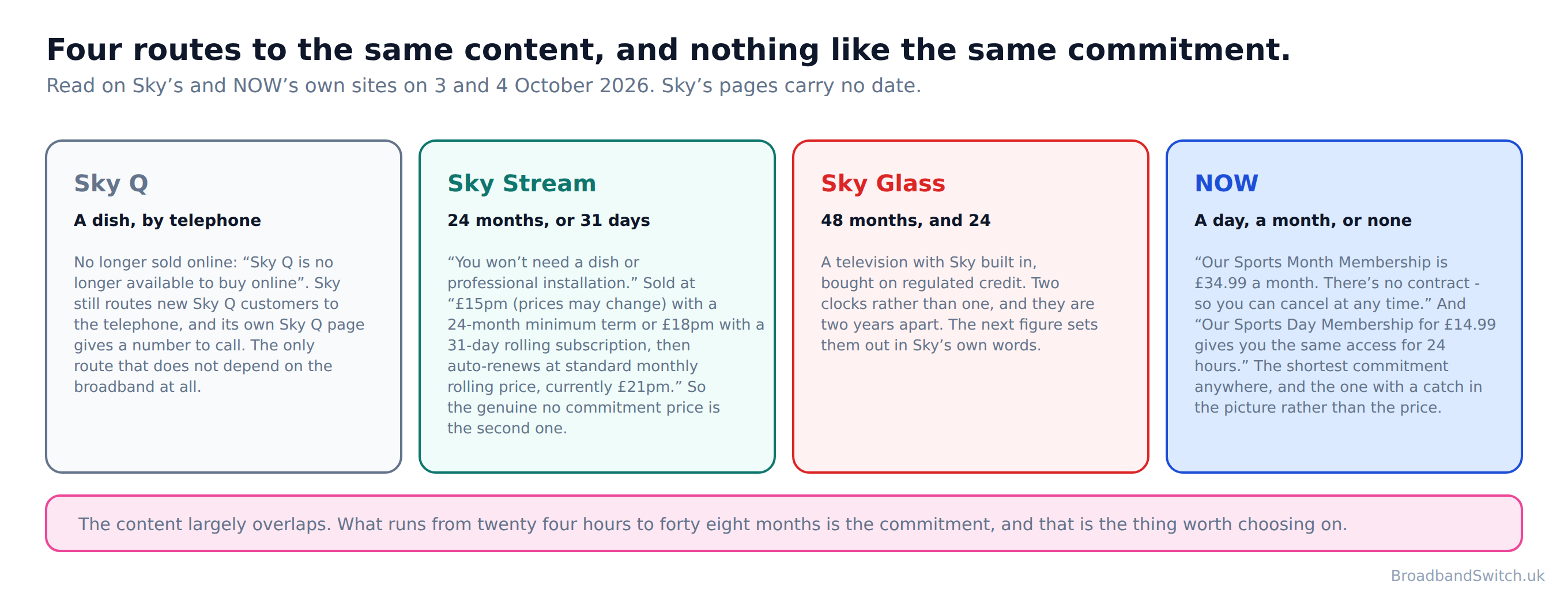
Direct answer: Sky Q needs a dish and a telephone call. Stream and Glass need broadband. NOW needs neither.
Comparing the four on what you can watch gets a household nowhere, because the catalogues sit almost on top of each other. Compare them on what you are signing up to instead, and they separate immediately.

<strong>Sky Q</strong> is the satellite route and it is the only one that does not depend on your broadband at all. Sky: “Sky Q is no longer available to buy online”. Sky still routes new Sky Q customers to the telephone, and its own Sky Q page gives a number to call.
<strong>Sky Stream</strong> is the same Sky experience over a puck and your own broadband. Sky: “You won't need a dish or professional installation.” It is sold on two clocks, a 24 month term or a 31 day rolling month, and the second one is the genuinely flexible price.
<strong>Sky Glass</strong> is a television with Sky built into it, bought on credit. That is the route with two separate commitments and it has a section of its own below.
<strong>NOW</strong> is Sky's own brand and most of its memberships carry no contract whatsoever. NOW: “Our Sports Month Membership is £34.99 a month. There's no contract - so you can cancel at any time.” And for a single match: “Our Sports Day Membership for £14.99 gives you the same access for 24 hours.” Twenty four hours is the shortest commitment anybody in this market sells.
Sky Glass: two clocks, two years apart
Direct answer: A 48 month loan for the television against a 24 month contract for the subscription, in one Sky paragraph.
This is the finding of the research, and it is not buried in a contract PDF anywhere. Sky sets both commitments out on its own commercial page, in one paragraph, under the price.
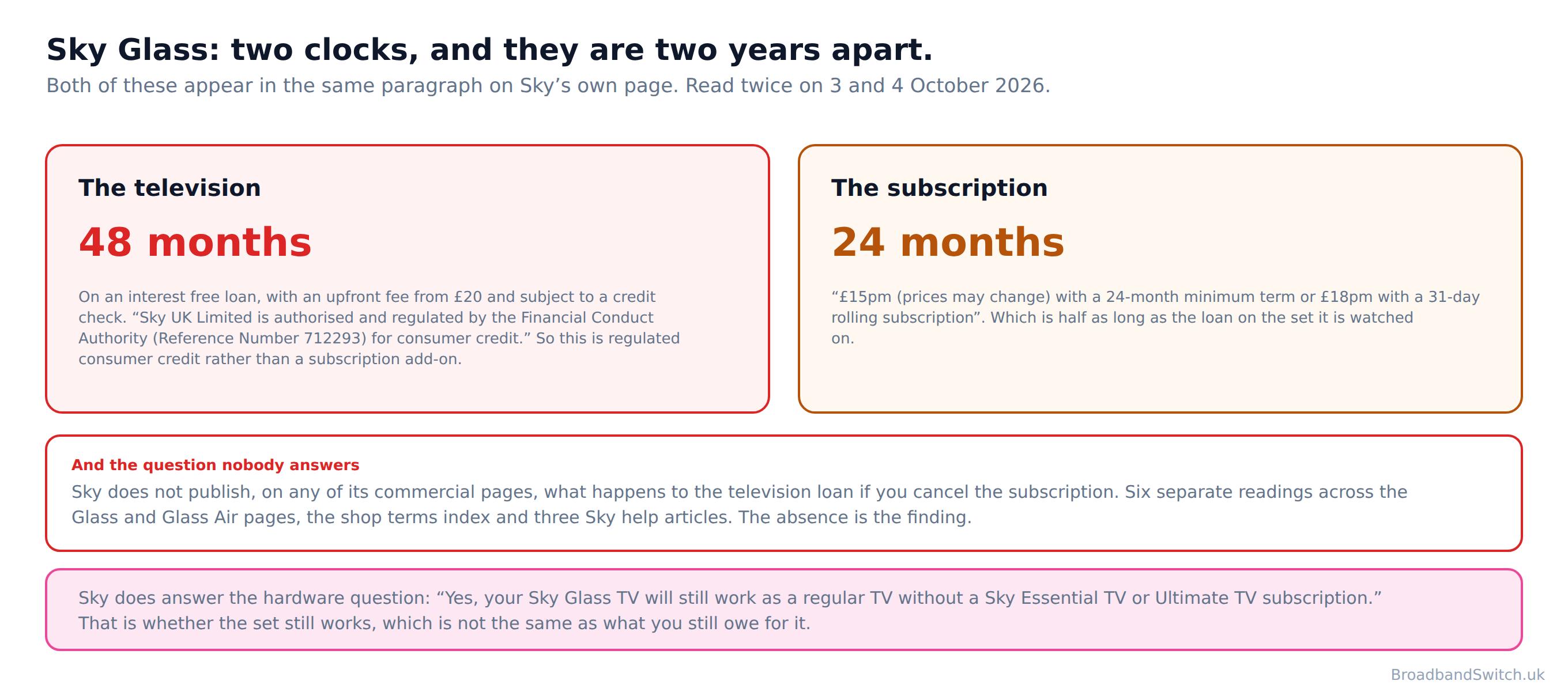
Sky, on its Glass Air page: “Based on 43" Sky Glass Air on 48-month interest free loan. Upfront fee from £20. Subject to status and credit check. 24-month contract for Sky Essential TV that includes a selection of Sky channels. Prices may change during this period. Sky Essential TV: ongoing price after 24 months will be £21 a month.”
Read it twice, because two different clocks go past in one breath. The set is on a 48 month interest free loan. The subscription that makes it a Sky set is on a 24 month contract. The loan therefore outlives the contract by a full two years, and nothing on the page draws the line between them.
The monthly figure for the smallest size is published too: “£7a month for 48 months 0% interest or £359”. And this is credit rather than a subscription add-on, which Sky also says: “Sky UK Limited is authorised and regulated by the Financial Conduct Authority (Reference Number 712293) for consumer credit.” A Financial Conduct Authority registration number is not decoration. It is there because the television is a regulated consumer credit agreement.
The question Sky does not answer
Sky does not publish, on any of its commercial pages, what happens to the 48 month television loan if you cancel the 24 month subscription. We looked across the Glass pages, the deals pages and the help section, and the answer is not in any of them. Ask Sky directly before you sign, and get the answer in writing.
What Sky does answer is the hardware question, and the answer is reassuring: “Yes, your Sky Glass TV will still work as a regular TV without a Sky Essential TV or Ultimate TV subscription.” So the set does not stop being a television. It stops being a Sky one.
One more thing worth knowing if a bundle is involved. Sky publishes that adding a subscription on a minimum term can restart the clock on the rest: “Both subscriptions must be kept for 24 months to maintain this price, unless you also add Sky Cinema on a minimum term, in which case your current subscriptions will end, and you will enter new minimum terms for each of the three subscriptions.”
Sky Stream, and the one Sky route with no dish
Direct answer: No dish and no engineer, and a published broadband figure to check before you order.
Sky Stream is a small puck that plugs into a television you already own. For most households it is the sensible way into Sky now, and it is the only Sky route you can genuinely buy by the month.
Sky: “You won't need a dish or professional installation.” Which means no wall bracket, no landlord conversation and no installation appointment. What it needs instead is broadband, and Sky publishes the figure: “All content on Sky Glass and Sky Stream is streamed via broadband, minimum speed of 25mbps recommended.”
Note the word recommended rather than required. And note that each additional room costs you bandwidth as well as money: “Additional 5Mb/s required for each Sky Stream puck added.” A three room house on a slow line is the case where this route quietly stops working.
The prices come on two clocks, and the second number is the one a flexible household wants. Sky Essential TV: “£15pm (prices may change) with a 24-month minimum term or £18pm with a 31-day rolling subscription, then auto-renews at standard monthly rolling price, currently £21pm.” Sky Ultimate TV: “£24pm (prices may change) with a 24-month minimum term or £30pm with a 31-day rolling subscription, then auto-renews at standard monthly rolling price, currently £38pm.”
If the broadband is the part you are unsure about, our streaming broadband guide covers what a household actually needs, and our gigabit guide covers what happens between the line and the screen.
Sky Q, which is not dead
Direct answer: Sky says it is no longer available to buy online. Its own Sky Q page still gives a number to ring.
This one is a straight correction to something this site published, and it matters most to the households with the least choice about it.
Sky's wording is narrower than the claim everybody repeats: “Sky Q is no longer available to buy online”. Sky still routes new Sky Q customers to the telephone, and its own Sky Q page gives a number to call. The word online is doing real work in that sentence, and most guides have dropped it.
It matters because a dish does not care how fast your broadband is. Every other Sky route runs over the line into your house, so in a place where that line is slow, the satellite route is the one that still works. It is clearly a legacy product and Sky is steering new customers away from it, but steering is not the same as closing.
And if you are leaving Sky Q for Stream or Glass
Two things to get right, and neither costs money unless you miss it. Sky: “If you have Sky Q, you will need to send back your Sky Q box(es) within 60 days of your Streaming TV cooling off period ending”. And the one people are sorriest about: “Any recordings you have on Sky Q or Sky+ will not transfer to Sky Glass or Sky Stream puck”. Watch anything you care about before the engineer's van arrives, because nothing on that box is coming with you.
NOW, and the catch nobody prints
Direct answer: Standard NOW is 720p and one stream at a time, and NOW publishes that in its help section.
NOW is Sky's own brand, the content is Sky's content, and on commitment it is the most honest thing in this market. The catch is not in the price. It is in the picture.

In NOW's own comparison table, standard membership is “720p” and “1 person can stream at a time”. Standard NOW is stereo sound with no ad free viewing: the Sound quality row reads Stereo and the Ad-free streaming row reads No.
NOW corroborates the stream limit on a second page, which it updated on 30 September 2026: “If you've got Boost or Ultra Boost, you can stream on 2 or 3 devices at a time. Otherwise, it's just one.” That is the only freshly dated page in this entire research, and it says the same thing.
The fix is a published product. NOW: “It costs just £6 extra a month for Boost, or £9 for Ultra Boost.” Boost gives Full HD 1080p, Dolby Digital 5.1 and two streams at a time. Ultra Boost gives up to 4K Ultra HD HDR, Dolby Atmos and three streams at a time. So Boost is not an upsell on top of a comparable product. It is what makes the product comparable.

Where we come down on it
NOW never claims that standard membership is HD or multi stream. It simply does not say that it is not, on the pages where people buy. This is a disclosure failure rather than a false claim, and this guide says so.
We would like that table, or one line from it, on the page where the money changes hands. Putting the resolution and the stream count beside the price would cost NOW nothing, and it would make the cheapest route into this content an honest one to compare.
The no contract part, which is real
On the memberships that carry no contract, NOW means it. “Our Sports Month Membership is £34.99 a month. There's no contract - so you can cancel at any time.” And “You can get a membership for £9.99 a month that you can cancel at any time.” There is no notice period at all: “You can ask us to cancel a monthly membership at any time before your next access period is due to start.”
The cheaper Entertainment price is a different animal and worth reading slowly. NOW: “Memberships start from £4.99 a month for a 6-month minimum term.” Alongside it: “Looking for more flexibility? You can get a membership for £7.99 a month that you can cancel at any time.” So the headline figure buys six months and the flexible one costs three pounds more.
And within a minimum term the cancel button does not do what the word suggests: “If you're on a minimum-term plan and you ask to cancel during your minimum term, your cancellation will only take effect when your plan ends.” NOW's own summary of it is blunt enough: “Cancel anytime effective at the end of the minimum term.” At least it is candid. And after the term: “After the 6-month minimum term, Entertainment Membership auto-renews at £7.99pm, unless cancelled.”
Which route fits your house?
Direct answer: Three questions, and five checks sorted into the ones with a deadline and the ones you can leave.
The commitment question does most of the work, because a household that wants to walk away in a month should not be looking at a forty eight month credit agreement, and a household happy to commit for two years is paying over the odds on a rolling membership. The dish question decides what is physically possible.
It runs entirely in your browser. There is no form to submit, nothing sent to any server and nothing stored.
Three questions, and five jobs sorted into the ones that decide the answer and the ones that do not apply to you
The second question does most of the work, because the four routes carry wildly different commitments for very similar content. One of them puts a forty eight month credit agreement behind a twenty four month subscription. Nothing you answer here leaves your browser.
The only comparison the published prices allow
Direct answer: No commitment against no commitment, and it is closer than the headlines suggest.
Comparing a Sky term price against a NOW rolling price compares two different things, and comparing a Sky subscription against standard NOW compares two different products. Strip both problems out and one honest comparison is left.
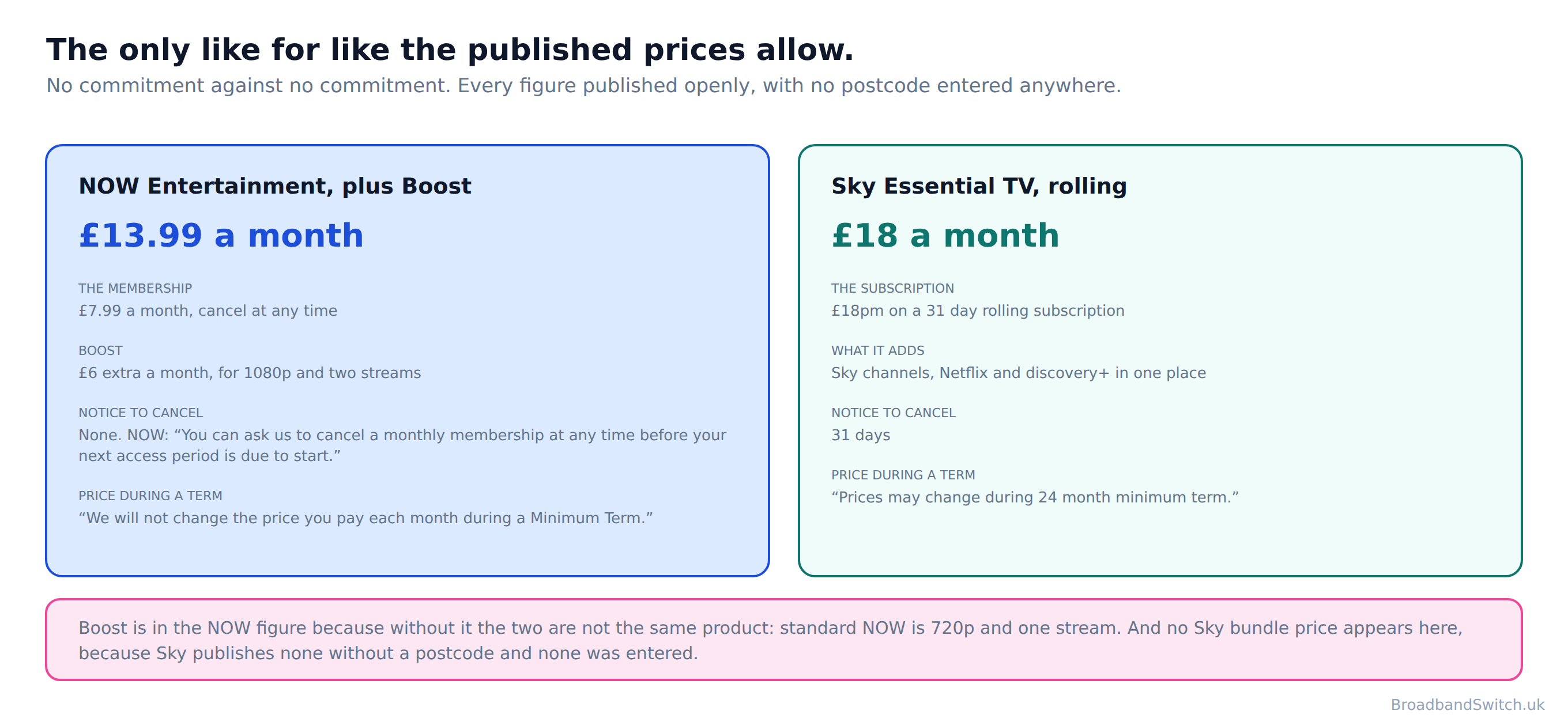
The only like for like comparison the two brands' own published prices allow is no commitment against no commitment: NOW Entertainment plus Boost at £13.99 a month against Sky Essential TV at £18pm on a 31 day rolling subscription. Boost is in that figure because without it NOW is 720p and one stream.
Four pounds a month between them, for a household that wants to be able to stop. That is a much narrower gap than the advertising on either side implies, and the choice stops being about money and starts being about what you actually want to watch.
Two cautions belong with those figures. The Boost price is published plainly: “It costs just £6 extra a month for Boost, or £9 for Ultra Boost.” The Sky figure is the rolling half of this one: “£15pm (prices may change) with a 24-month minimum term or £18pm with a 31-day rolling subscription, then auto-renews at standard monthly rolling price, currently £21pm.” It is the number you pay for the right to leave.
And one asymmetry worth naming
Every NOW price on this page is published openly on NOW's own site. Every Sky price on this page is an advertised headline rate, and Sky's actual price at an address, its Glass upfront fee beyond from £20, and its credit decision are all behind a check.
What Sky publishes about its terms, and what it does not
Direct answer: Two of the seven questions a buyer would ask have no published answer at all.
Sky publishes more than most of this market about what happens at the end of a term, and less than any of it about what happens if you want out before then. Both halves are below, in Sky's own words where there are any.
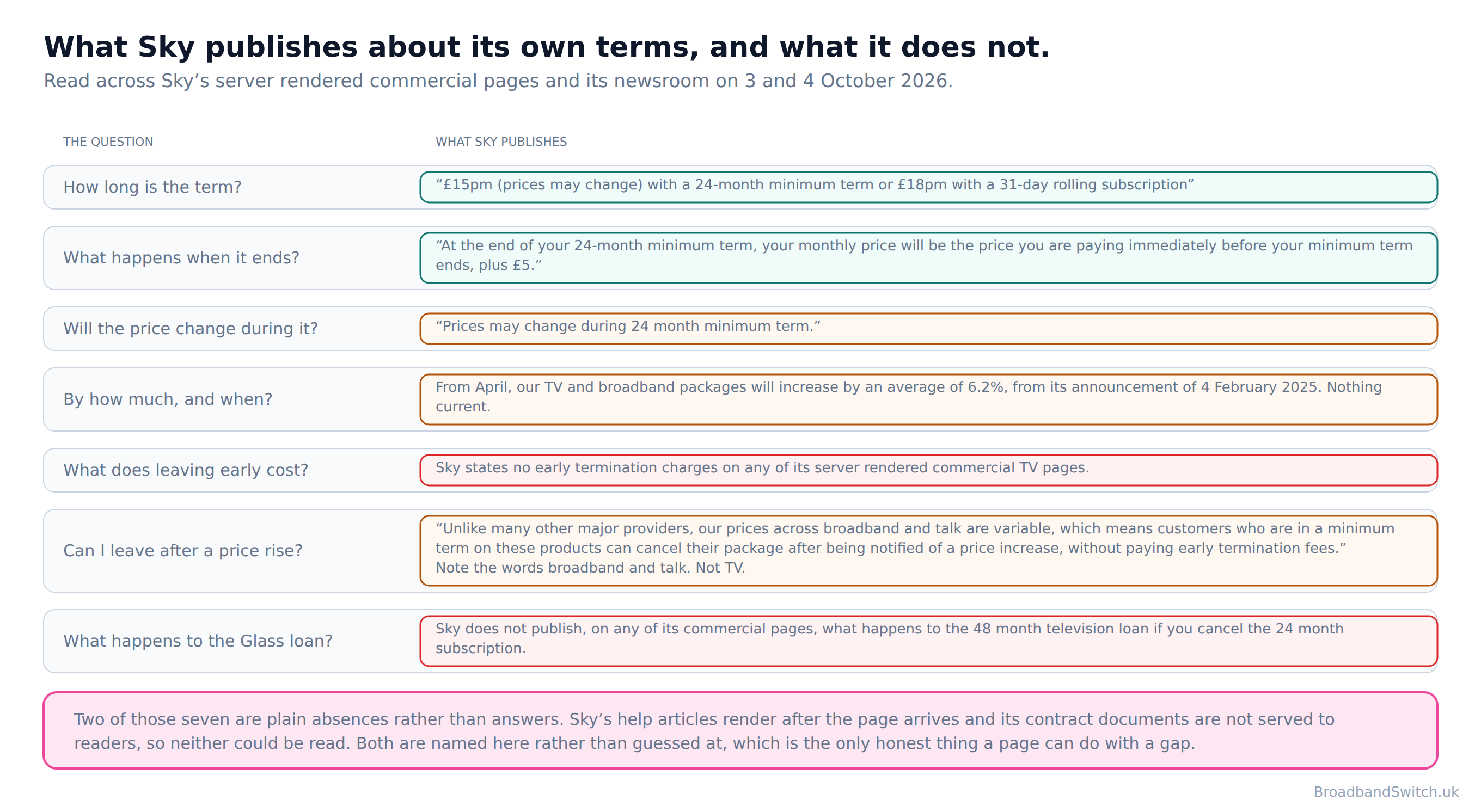
Start with the clearest sentence Sky writes about any price change: “At the end of your 24-month minimum term, your monthly price will be the price you are paying immediately before your minimum term ends, plus £5.” That is pounds and pence, it is on the page before you sign, and it is worth putting in a diary for month twenty five.
Then the least clear one, on the same subject: “Prices may change during 24 month minimum term.” No amount, no date and no mechanism. Ofcom's rule since January 2025 is that any rise written into a contract has to be set out in cash at the point of sale: “From 17 January 2025, phone, broadband and pay TV providers will be prohibited from including inflation-linked, or percentage-based, price rise terms in all new contracts.” Sky's TV wording gives neither an amount nor a date, which is worth noticing even though prices that are simply variable sit outside that rule.
The only figure Sky publishes at all comes from its newsroom announcement of 4 February 2025: “From April, our TV and broadband packages will increase by an average of 6.2%”. That describes the 2025 rise. It is quoted here with its date because this page previously carried it as though it were current, and that is one of the corrections below.

The two absences, named rather than guessed at
Sky states no early termination charges on any of its server rendered commercial TV pages. So the charge for leaving a 24 month Sky TV contract early is not published anywhere a buyer can read it before signing. Sky's help articles render after the page arrives and its contract documents are not served to readers, so neither could be read.
And in the same announcement, Sky extends an exit right that stops just short of television: “Unlike many other major providers, our prices across broadband and talk are variable, which means customers who are in a minimum term on these products can cancel their package after being notified of a price increase, without paying early termination fees.” Broadband and talk. Not TV.
Where NOW promises what Sky does not
NOW's terms of use, on a document dated July 2026: “We will not change the price you pay each month during a Minimum Term.” And Sky, on its own 24 month terms: “Prices may change during 24 month minimum term.” Same company, opposite promise, and the one with no contract is the one making it.
Live Sky deals at your postcode
Direct answer: Sky's advertised prices are headline rates. What it will actually charge you depends on the address.
The check below shows the Sky television and broadband packages available at the address. Three of the four routes on this page are carried by your broadband, so the line is worth settling before the subscription.
Every provider that reaches your address
Sky Stream, Sky Glass and NOW all ride on the line into your house, so the line is worth settling first. One postcode shows every provider that reaches it, lowest price first.
Compare at your postcode →What this page used to say, and why it changed
Direct answer: Three corrections, and the second one was comparing two different products.
The old version of this page compared four routes into Sky content without reading a single Sky term, and its break-even section had no prices in it. This version quotes Sky and NOW on their own sites, and the three things it got wrong are below.
Saying Sky Q had been withdrawn
What this page said
That the product had gone and that new customers could not take it at all. This page said so and so did two others on this site.
What it says now, and why
Sky's own wording is narrower than that: “Sky Q is no longer available to buy online”. Sky still routes new Sky Q customers to the telephone, and its own Sky Q page gives a number to call. So the widely repeated claim that you cannot get Sky Q any more is wrong, and the word online is doing real work in Sky's sentence.
Comparing NOW's headline price against a Sky bundle
What this page said
That NOW Entertainment at its headline monthly price was the cheap alternative to a Sky TV subscription, which is how the break-even section of this page used to read.
What it says now, and why
Standard NOW is “720p” and “1 person can stream at a time”, so the comparable product is NOW plus Boost at “It costs just £6 extra a month for Boost, or £9 for Ultra Boost.” The only like for like comparison the two brands' own published prices allow is no commitment against no commitment: NOW Entertainment plus Boost at £13.99 a month against Sky Essential TV at £18pm on a 31 day rolling subscription. Boost is in that figure because without it NOW is 720p and one stream. The old comparison was between two different things.
Quoting a Sky price rise percentage as current
What this page said
That Sky raised prices by a stated percentage each April, carried on this page without a date.
What it says now, and why
Sky states no early termination charges on any of its server rendered commercial TV pages. The only figure Sky publishes is from its announcement of 4 February 2025: “From April, our TV and broadband packages will increase by an average of 6.2%”. That describes the 2025 rise and this page now dates it explicitly rather than presenting it as current. What Sky publishes for the current term is this: “Prices may change during 24 month minimum term.” Neither an amount nor a date.
Sky TV deals: frequently asked questions
What are the four ways to get Sky TV?
Sky Q over a satellite dish, Sky Stream over any broadband with a puck, Sky Glass which is a television with Sky built in, and NOW, which is Sky's own no contract streaming brand. The content largely overlaps. What differs enormously is what each one commits you to.
How long is a Sky Glass contract?
Two of them, and they are two years apart. Sky, in one paragraph on its own page: “Based on 43" Sky Glass Air on 48-month interest free loan. Upfront fee from £20. Subject to status and credit check. 24-month contract for Sky Essential TV that includes a selection of Sky channels. Prices may change during this period. Sky Essential TV: ongoing price after 24 months will be £21 a month.” The television is on a 48 month interest free loan and the subscription is on a 24 month contract.
What happens to the Sky Glass loan if I cancel the subscription?
Sky does not publish an answer anywhere a buyer can read it. Sky does not publish, on any of its commercial pages, what happens to the 48 month television loan if you cancel the 24 month subscription. What it does answer is whether the set still works: “Yes, your Sky Glass TV will still work as a regular TV without a Sky Essential TV or Ultimate TV subscription.” That is the hardware question rather than the money one.
Does Sky Stream need a dish?
No. Sky: “You won't need a dish or professional installation.” It needs broadband instead, and Sky publishes the figure: “All content on Sky Glass and Sky Stream is streamed via broadband, minimum speed of 25mbps recommended.” Note that Sky says recommended rather than required. Each extra puck adds to that: “Additional 5Mb/s required for each Sky Stream puck added.”
Can I still get Sky Q?
Yes, by telephone. Sky: “Sky Q is no longer available to buy online”. Sky still routes new Sky Q customers to the telephone, and its own Sky Q page gives a number to call. So the common claim that Sky Q has been withdrawn is wrong, although it is clearly a legacy product now.
What does it cost to leave Sky Q for Sky Stream or Glass?
Two things, and neither is money unless you get them wrong. “If you have Sky Q, you will need to send back your Sky Q box(es) within 60 days of your Streaming TV cooling off period ending”. And “Any recordings you have on Sky Q or Sky+ will not transfer to Sky Glass or Sky Stream puck”
Is NOW cheaper than Sky?
On the headline price yes, and that is not a like for like comparison. Standard NOW is “720p” and “1 person can stream at a time”, so the comparable product includes Boost at “It costs just £6 extra a month for Boost, or £9 for Ultra Boost.” The only like for like comparison the two brands' own published prices allow is no commitment against no commitment: NOW Entertainment plus Boost at £13.99 a month against Sky Essential TV at £18pm on a 31 day rolling subscription. Boost is in that figure because without it NOW is 720p and one stream.
Does NOW really have no contract?
On most memberships, yes. “Our Sports Month Membership is £34.99 a month. There's no contract - so you can cancel at any time.” And “You can get a membership for £9.99 a month that you can cancel at any time.” The cheaper Entertainment price is different: “Memberships start from £4.99 a month for a 6-month minimum term.” And a cancellation inside that term: “If you're on a minimum-term plan and you ask to cancel during your minimum term, your cancellation will only take effect when your plan ends.”
Will my NOW price go up mid-contract?
Not during a minimum term, and NOW's own terms say so: “We will not change the price you pay each month during a Minimum Term.” That is the opposite of what Sky publishes for its own 24 month terms: “Prices may change during 24 month minimum term.” Same company, opposite promise.
What notice do I have to give?
Sky sells its flexible option as a 31 day rolling subscription, so a month is the shortest unit it offers: “£15pm (prices may change) with a 24-month minimum term or £18pm with a 31-day rolling subscription, then auto-renews at standard monthly rolling price, currently £21pm.” NOW requires no notice at all: “You can ask us to cancel a monthly membership at any time before your next access period is due to start.”
What happens to my Sky price when the contract ends?
It goes up by a published amount: “At the end of your 24-month minimum term, your monthly price will be the price you are paying immediately before your minimum term ends, plus £5.” That is the clearest pounds and pence statement Sky makes about any price change, and it is worth diarising.
What does Sky charge to leave early?
Sky states no early termination charges on any of its server rendered commercial TV pages. Which is itself the finding: the charge for leaving a 24 month Sky TV contract early is not published anywhere a buyer can read it before signing.
In short
- The same Sky content comes four ways and the commitments are nothing like each other.
- Sky Glass is the sharpest example, and Sky publishes it in one paragraph.
- Sky: “Based on 43" Sky Glass Air on 48-month interest free loan. Upfront fee from £20. Subject to status and credit check. 24-month contract for Sky Essential TV that includes a selection of Sky channels. Prices may change during this period. Sky Essential TV: ongoing price after 24 months will be £21 a month.”
- Sky: “£7a month for 48 months 0% interest or £359”
- Sky: “Sky UK Limited is authorised and regulated by the Financial Conduct Authority (Reference Number 712293) for consumer credit.”
- So the television is regulated consumer credit, not a subscription add-on.
- Sky does not publish, on any of its commercial pages, what happens to the 48 month television loan if you cancel the 24 month subscription.
- Sky does answer the hardware question: “Yes, your Sky Glass TV will still work as a regular TV without a Sky Essential TV or Ultimate TV subscription.”
- Sky Stream needs no dish: “You won't need a dish or professional installation.”
- It needs broadband: “All content on Sky Glass and Sky Stream is streamed via broadband, minimum speed of 25mbps recommended.”
- And more for each extra room: “Additional 5Mb/s required for each Sky Stream puck added.”
- Sky Q is not dead. Sky: “Sky Q is no longer available to buy online”
- Sky still routes new Sky Q customers to the telephone, and its own Sky Q page gives a number to call.
- Leaving it costs two things: “If you have Sky Q, you will need to send back your Sky Q box(es) within 60 days of your Streaming TV cooling off period ending”
- And “Any recordings you have on Sky Q or Sky+ will not transfer to Sky Glass or Sky Stream puck”
- NOW is Sky's own no contract brand.
- NOW: “Our Sports Month Membership is £34.99 a month. There's no contract - so you can cancel at any time.”
- But standard NOW is “720p”
- And “1 person can stream at a time”
- Standard NOW is stereo sound with no ad free viewing: the Sound quality row reads Stereo and the Ad-free streaming row reads No.
- NOW, on a page it updated on 30 September 2026: “If you've got Boost or Ultra Boost, you can stream on 2 or 3 devices at a time. Otherwise, it's just one.”
- Boost is what makes it comparable: “It costs just £6 extra a month for Boost, or £9 for Ultra Boost.”
- Boost gives Full HD 1080p, Dolby Digital 5.1 and two streams at a time. Ultra Boost gives up to 4K Ultra HD HDR, Dolby Atmos and three streams at a time.
- NOW never claims that standard membership is HD or multi stream. It simply does not say that it is not, on the pages where people buy. This is a disclosure failure rather than a false claim, and this guide says so.
- The only like for like comparison the two brands' own published prices allow is no commitment against no commitment: NOW Entertainment plus Boost at £13.99 a month against Sky Essential TV at £18pm on a 31 day rolling subscription. Boost is in that figure because without it NOW is 720p and one stream.
- On price during a term, NOW promises what Sky does not.
- NOW: “We will not change the price you pay each month during a Minimum Term.”
- Sky: “Prices may change during 24 month minimum term.”
- At the end of a Sky term: “At the end of your 24-month minimum term, your monthly price will be the price you are paying immediately before your minimum term ends, plus £5.”
- Sky states no early termination charges on any of its server rendered commercial TV pages.
- Every NOW price on this page is published openly on NOW's own site. Every Sky price on this page is an advertised headline rate, and Sky's actual price at an address, its Glass upfront fee beyond from £20, and its credit decision are all behind a check.
Each line stands on its own and carries its date. Reviewed by a person at least quarterly, last on .
References
- sky.com
Sky. Sky Glass Air. The paragraph putting a 48-month interest free loan and a 24-month subscription contract in the same sentence, and the monthly price and cash alternative for each size. Carries no date, so read twice on 3 and 4 October 2026. sky.com
- sky.com
Sky. Sky Glass. The FAQ answer saying the subscription can be cancelled at any time, the small print setting a 24-month minimum term on the same page, and the Financial Conduct Authority registration for the credit. Read three times on 3 and 4 October 2026. sky.com
- sky.com
Sky. Sky Stream. No dish, the 25mbps recommended figure, the 5Mb/s per extra puck, and the Essential and Ultimate prices on both the 24-month and 31-day rolling options. Read twice on 4 October 2026. sky.com
- sky.com
Sky. Sky Q. No longer available to buy online, the route to taking it by telephone, the 60 day box return and the warning that recordings do not transfer. Read twice on 4 October 2026. sky.com
- sky.com
Sky. Deals. The plus £5 end of term rule and the prices may change wording, both of which appear on more than one Sky page. Read three times across two pages on 3 and 4 October 2026. sky.com
- skygroup.sky
Sky Group. An update on our TV and broadband prices. Published 4 February 2025. The only price rise figure Sky publishes for television, which describes the 2025 rise, and the exit right Sky extends to broadband and talk and not to TV. skygroup.sky
- nowtv.com
NOW. Membership FAQs. Every membership price, the minimum term options, and the statement that a cancellation during a minimum term only takes effect when the plan ends. Published openly with no postcode check anywhere. Read twice on 4 October 2026. nowtv.com
- nowtv.com
NOW. What are Boost and Ultra Boost?. The comparison table giving standard membership as 720p, stereo, with ads and one stream at a time, and the cost of Boost and Ultra Boost. Read three times on 4 October 2026. nowtv.com
- nowtv.com
NOW. Managing my devices. Last updated 30 September 2026, which makes it the only freshly dated page in this entire research. Independent corroboration of the one stream limit. nowtv.com
- nowtv.com
NOW. Terms of Use. Version dated July 2026. Clause 4.9.3, which promises the price will not change during a minimum term, and clause 8.2 on cancelling a monthly membership. nowtv.com
- nowtv.com
NOW. Home. The Cancel anytime effective at the end of the minimum term wording against the six month Entertainment saver plan, and the auto-renewal price. Read twice on 4 October 2026. nowtv.com
- ofcom.org.uk
Ofcom. Ofcom bans mid-contract price rises linked to inflation. Published 19 July 2024. The requirement that any price rise written into a contract be set out in pounds and pence at the point of sale, which is the standard Sky’s prices may change wording is measured against here. ofcom.org.uk
Ready to see what reaches your address?
Three of the four routes ride on your broadband. One postcode shows every provider that reaches the address, lowest price first.
Compare at this postcode →