How to tell which network your UK broadband provider uses: the retailer to access network map for 2026, and why the brand on your bill no longer answers the question
The honest answer to which network your provider uses is that it depends on your address, not on your provider, and that nobody is required to tell you either way. Five of the best-known names in UK broadband sell over more than one network, so the brand on your bill does not tell you whose fibre is in the ground outside your house. All five appear on CityFibre's own retailer list, which names 44 providers, and all five also sell over Openreach. It runs the other way too: Hyperoptic will continue to expand coverage through its wholesale agreement with Openreach. toob built its own network and also sells over CityFibre, and it appears on CityFibre's own retailer list. Then the part that makes it hard to check. Ofcom requires your provider to tell you the technology, in four plain words. It requires nobody to tell you the network. Ofcom's contract summary rules require the speed, the price, the contract length and the exit terms. The network is not on the list. And Ofcom says of its own postcode checker: “We only provide the names of network providers that have expressly given permission to include their names and web details on our checker.” On this evidence, there is no published way to look up which network serves your address and be sure of the answer. Ask your provider, in writing, which access network your line runs on. They know, the answer costs them nothing, and asking is the only method on this page that works on every network. Compare every network available at your address at broadbandswitch.uk/compare/.
See which networks reach your address
One postcode, every provider we can switch you to, sorted by price with the lowest first. This is the question the page keeps coming back to: which networks have built past your house, because that decides what the brands can actually sell you.
IndependentLowest price firstLive, refreshed dailyPostcode only, nothing stored
Every number here carries the date it was checked, and here is where each one comes from. The retailer list is CityFibre's own consumer directory, which carries its own last-updated date of 15 June 2026. Openreach's footprint, connections and take-up are BT Group's, from its Q1 FY27 results of 23 July 2026; its provider count and its equipment guidance are Openreach's own. Virgin Media O2's figures are from its own Q2 2026 earnings release of 24 July 2026, nexfibre's premises figure is its own and dated to 31 December 2025, and the nexfibre shareholdings come from Liberty Global's 2025 Form 10-K. The rules about what you must be told, the checker's limits and the switching position are Ofcom's. The merger facts and the quoted submissions come from the CMA's own published case file. The live comparison lower down is refreshed daily.
The short version, and when it matters
Direct answer: The honest answer to which network your provider uses is that it depends on your address, not on your provider, and that nobody is required to tell you either way.
If you want the one-line answer and nothing else: Ask your provider, in writing, which access network your line runs on. They know, the answer costs them nothing, and asking is the only method on this page that works on every network. Everything below is the working, and the reason the working is needed at all is that the obvious methods have stopped returning an answer.
Before any of that, the honest caveat: most households never need this answer, and a section further down sets out the four situations where it genuinely changes something. If none of those four is you, the technology and the price matter more than the name of the network underneath, and the sister guide to this one is the better read. The four technologies are closer on speed than the adverts suggest and further apart on what happens when it goes wrong. That is the comparison worth making, and it is the one nobody puts on the box.
That guide is full fibre against FTTC against cable against 4G and 5G, and it is the one to read if what you actually want to know is which technology to buy. This page is about who owns the wire.
Which retailer sells over which network
Direct answer: Five of the best-known names in UK broadband sell over more than one network, so the brand on your bill does not tell you whose fibre is in the ground outside your house.
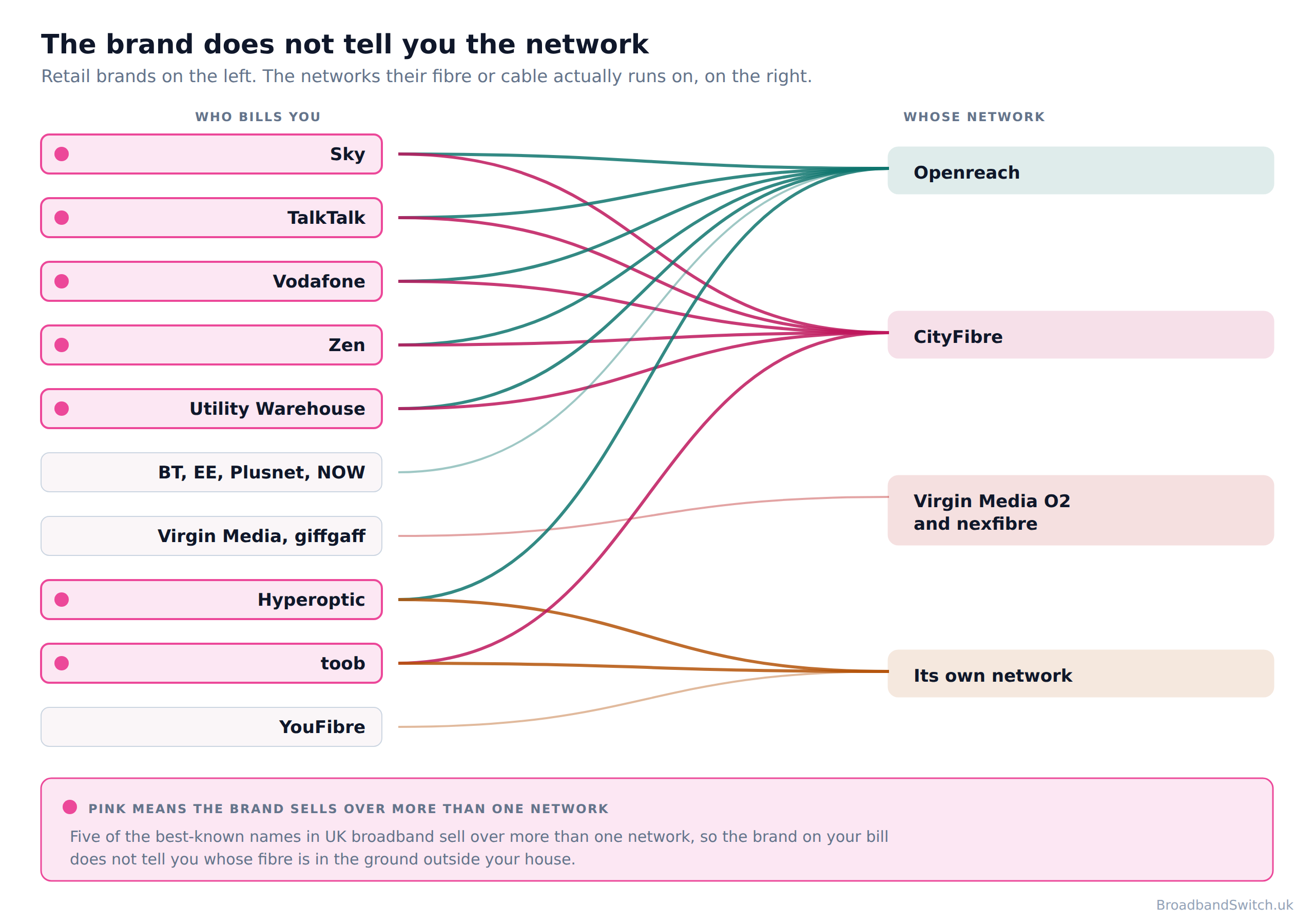
The evidence is CityFibre's own published retailer directory, which names 44 providers and carries its own last-updated date. Sky, TalkTalk, Vodafone, Zen and Utility Warehouse are all on it, and all five also sell over Openreach. Sky and CityFibre signed a partnership in August 2024 to put Sky Full Fibre on the CityFibre network, and Sky is named on CityFibre's own retailer list today. CityFibre is VodafoneThree's anchor customer and the two extended the arrangement in June 2026. VodafoneThree also sells over Community Fibre's London network, which Vodafone says reaches up to 1.3 million homes in the capital. Zen's own words: “We've provided broadband over the Openreach network for many years”, and in the same post it describes selling over CityFibre, Trooli and Freedom Fibre as well.
It runs the other way too, and that is the part that catches people who follow this closely. Hyperoptic will continue to expand coverage through its wholesale agreement with Openreach. Those are Hyperoptic's own words. Its own network reaches 1.9 million homes passed, and beyond that it is an Openreach retailer like any other. Hyperoptic publishes nothing telling a customer which of the two networks their own line uses. toob built its own network and also sells over CityFibre, and it appears on CityFibre's own retailer list. And YouFibre is not a network at all, in its own words: “Each week, we connect thousands of new homes across the UK to the network that's built for broadband by Netomnia.”
| Retail brand | Networks it sells over | How many, and how we know |
|---|---|---|
| Sky | Openreach and CityFibre | Both. Sky named both as its wholesale suppliers to the CMA in July 2026 |
| TalkTalk | Openreach and CityFibre | Both. On CityFibre's own retailer list and a long-standing Openreach retailer |
| Vodafone | Openreach, CityFibre and Community Fibre | Three. CityFibre is its anchor network and it sells over Community Fibre in London |
| Zen Internet | Openreach, CityFibre, Trooli and Freedom Fibre | Four, in Zen's own published words |
| Utility Warehouse | Openreach and CityFibre | Both. On CityFibre's own retailer list |
| BT, EE, Plusnet, NOW | Openreach | One. All four are BT Group or Sky brands on the Openreach line |
| Virgin Media, giffgaff | Virgin Media O2 and nexfibre | Its own cable network and the nexfibre full fibre network |
| Hyperoptic | Its own network and Openreach | Both, under a wholesale agreement Hyperoptic publishes |
| toob | Its own network and CityFibre | Both. toob is also named on CityFibre's retailer list |
| YouFibre | Netomnia | One, and it is the same group: YouFibre is Netomnia's retail brand |
So the table that used to answer this question has stopped being able to. A retailer with one network has a row. A retailer with three has an address.
Our UK wholesale network matrix tracks who owns which fibre, which providers use Openreach covers that network in detail, and who owns which UK broadband brand covers the ownership behind the names.
Brand by brand, which network each one uses
Direct answer: Five of the eight answers below are more than one network, and in every one of those five cases the company does not tell you which of them you are on.
Does Sky use Openreach?
Yes, and CityFibre as well. Sky and CityFibre signed a partnership in August 2024 to put Sky Full Fibre on the CityFibre network, and Sky is named on CityFibre's own retailer list today. Sky named both as its wholesale suppliers in its own submission to the CMA in July 2026. Which one you get depends on which has built past your house.
Does BT use Openreach?
Yes, and only Openreach. BT Group owns Openreach, and EE and Plusnet are BT Group brands on the same network, so all three sell over the same line. That is the one brand-to-network answer on this page that is still simple.
Does Vodafone use Openreach or CityFibre?
Both, and Community Fibre too. CityFibre is VodafoneThree's anchor customer and the two extended the arrangement in June 2026. VodafoneThree also sells over Community Fibre's London network, which Vodafone says reaches up to 1.3 million homes in the capital. Vodafone also sells over Openreach, so three different Vodafone customers can be on three different networks.
Does TalkTalk use Openreach?
Yes, and CityFibre. TalkTalk is on CityFibre's own retailer directory and has been a long-standing Openreach retailer. NOW Broadband, which is a Sky brand, is Openreach only.
Does Virgin Media use Openreach?
No. Virgin Media sells over its own cable network and over nexfibre, which is why switching to or from Virgin Media usually means an engineer and a new cable where switching between Openreach retailers does not. Virgin Media does not publish how much of its own network is still coaxial and how much is full fibre, and it does not tell a customer which of the two they are on.
Does Hyperoptic use its own network?
Sometimes. Hyperoptic will continue to expand coverage through its wholesale agreement with Openreach. Its own network reaches 1.9 million homes passed and beyond that it is an Openreach retailer. Hyperoptic publishes nothing telling a customer which of the two networks their own line uses.
Is YouFibre its own network?
No. YouFibre’s own words: “Each week, we connect thousands of new homes across the UK to the network that's built for broadband by Netomnia.” Netomnia reports 3 million premises serviceable and 445,000 connected. The two are the same group, so it is a brand-and-network pair rather than two companies.
Does Zen use Openreach?
Yes, and three others. Zen's own words: “We've provided broadband over the Openreach network for many years”, and in the same post it describes selling over CityFibre, Trooli and Freedom Fibre. Of the brands on this page it is the most explicit about being multi-network.
A pattern worth noticing across those eight: the answer is simple only where the retailer and the network are the same company, or where the retailer has never bought from anyone else. Every time a retailer adds a second network the answer stops being a fact about the brand and becomes a fact about your street.
Our which providers use Openreach page keeps the longer list, and who owns which UK broadband brand covers the ownership behind the names, which is a different question again.
The four networks, and how far each reaches
Direct answer: Openreach reaches 23.4 million premises, Virgin Media O2 passes 16.2 million, CityFibre passes 4.7 million and nexfibre 2.6 million. Reaching a premises is not the same as serving it.
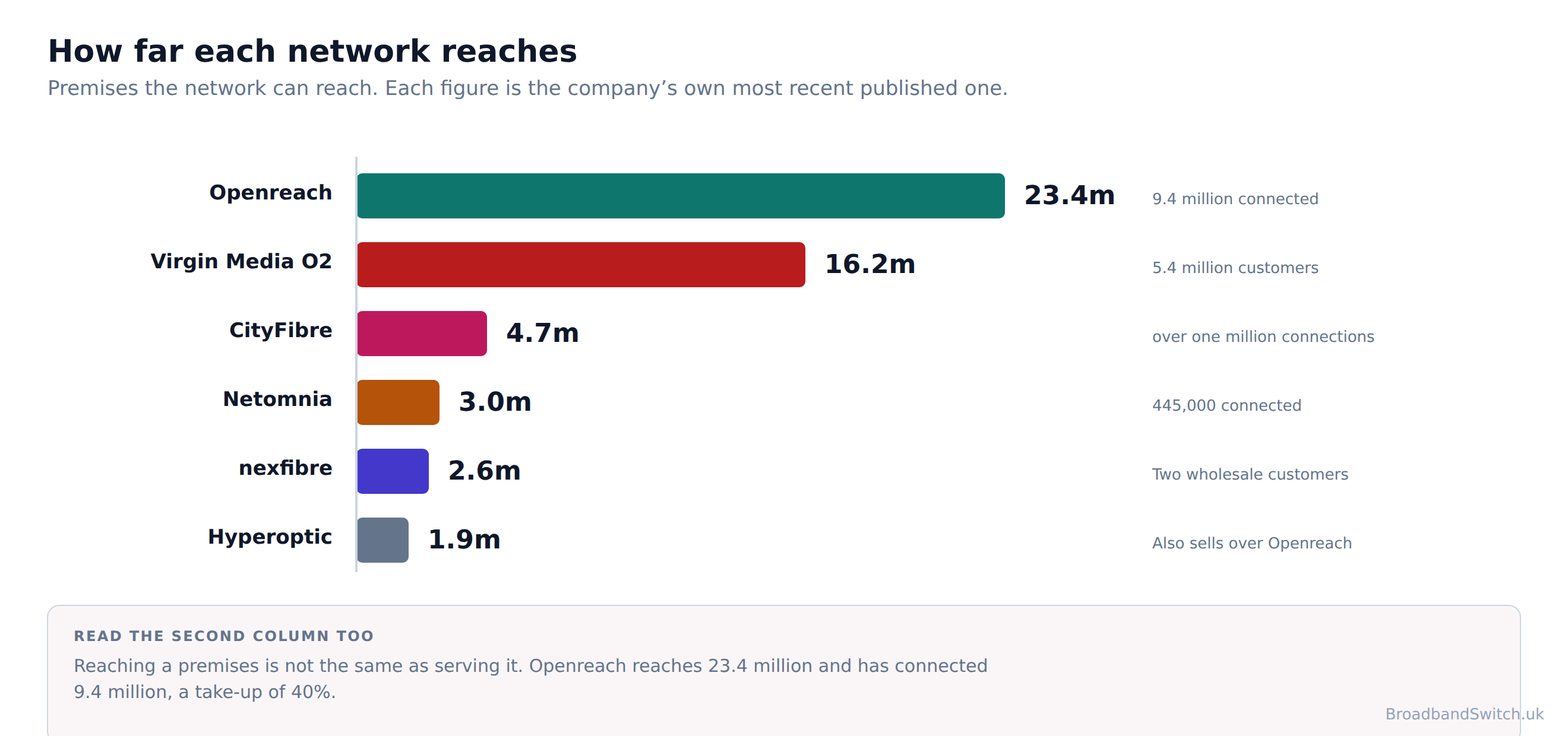
Openreach is the one most households are on, and the gap between its two numbers is the whole story of the last five years: it reaches 23.4 million and has connected 9.4 million, a take-up of 40%. It is building towards 25 million by December 2026. Its older copper-based FTTC still reaches 96% of the country. Openreach does not retail: it sells to between 650 and 690 providers who do, though Openreach's own pages give three different counts of how many providers sell over it, and none of the three pages carries a date.
CityFibre is the largest network with no retail arm at all. CityFibre sells only wholesale. It has no retail brand of its own, so every CityFibre line is sold to you by somebody else. It passes 4.7 million and has over one million connections, and it describes its retail partners as representing around 50% UK broadband market share. CityFibre publishes no recommendation between the providers on its own network, and no ranking of them. Its shareholders are Antin Infrastructure Partners, Goldman Sachs Asset Management, Mubadala Investment Company, Interogo Holding, Newlight Partners and PATRIZIA's European Infrastructure Fund II.
Virgin Media O2 is the only one of the four that is both a network and a big retailer. It passes 16.2 million premises and serves 5.4 million consumer broadband customers, and its full fibre footprint is 9 million, which its own release says includes nexfibre. The rest is still coaxial cable. Virgin Media does not publish how much of its own network is still coaxial and how much is full fibre, and it does not tell a customer which of the two they are on.
The wholesale-only network with two customers
nexfibre calls itself a wholesale-only operator open to all internet service providers. Its only two named wholesale customers are Virgin Media O2 and giffgaff, and giffgaff is a Virgin Media O2 brand. InfraVia holds 50%, Liberty Global about 25% and Telefonica 25%, and the first two of those own Virgin Media O2 between them. So the network that is open to everybody currently carries one company's retail brands.

Below those four sit the smaller networks, and they matter more than their size suggests because several of them also sell wholesale. Netomnia, Freedom Fibre, G.Network, Gigaclear, OFNL, FullFibre, Connect Fibre and LightSpeed all publish wholesale offers of their own, so on any of them the retailer and the network can be different companies. Fibrus publishes wholesale access only in areas where public funding has been used, which makes it an obligation attached to a subsidy rather than a commercial choice. On a new-build development the network is often neither Openreach nor an altnet you have heard of: OFNL builds wholesale-only fibre on new estates and names around 18 residential retailers on its own site.
Networks also change hands, and when they do the retail brand usually carries on unchanged. CityFibre has grown by buying as well as building: it acquired Lit Fibre in 2024 and Connexin's fibre infrastructure in 2025, and in both cases the retail brand carried on selling while the network underneath changed hands. Even the networks buy from each other. Hyperoptic buys wholesale from Openreach, toob buys from CityFibre, and Connexin now sells over the network CityFibre bought from it. None of that is visible from the outside, which is the recurring theme of this page.
Read more in how UK wholesale broadband works, Openreach against CityFibre, Openreach against the altnets and what altnets are and why they matter.
How to tell which one you are on
Direct answer: Ask your provider, in writing, which access network your line runs on. They know, the answer costs them nothing, and asking is the only method on this page that works on every network.
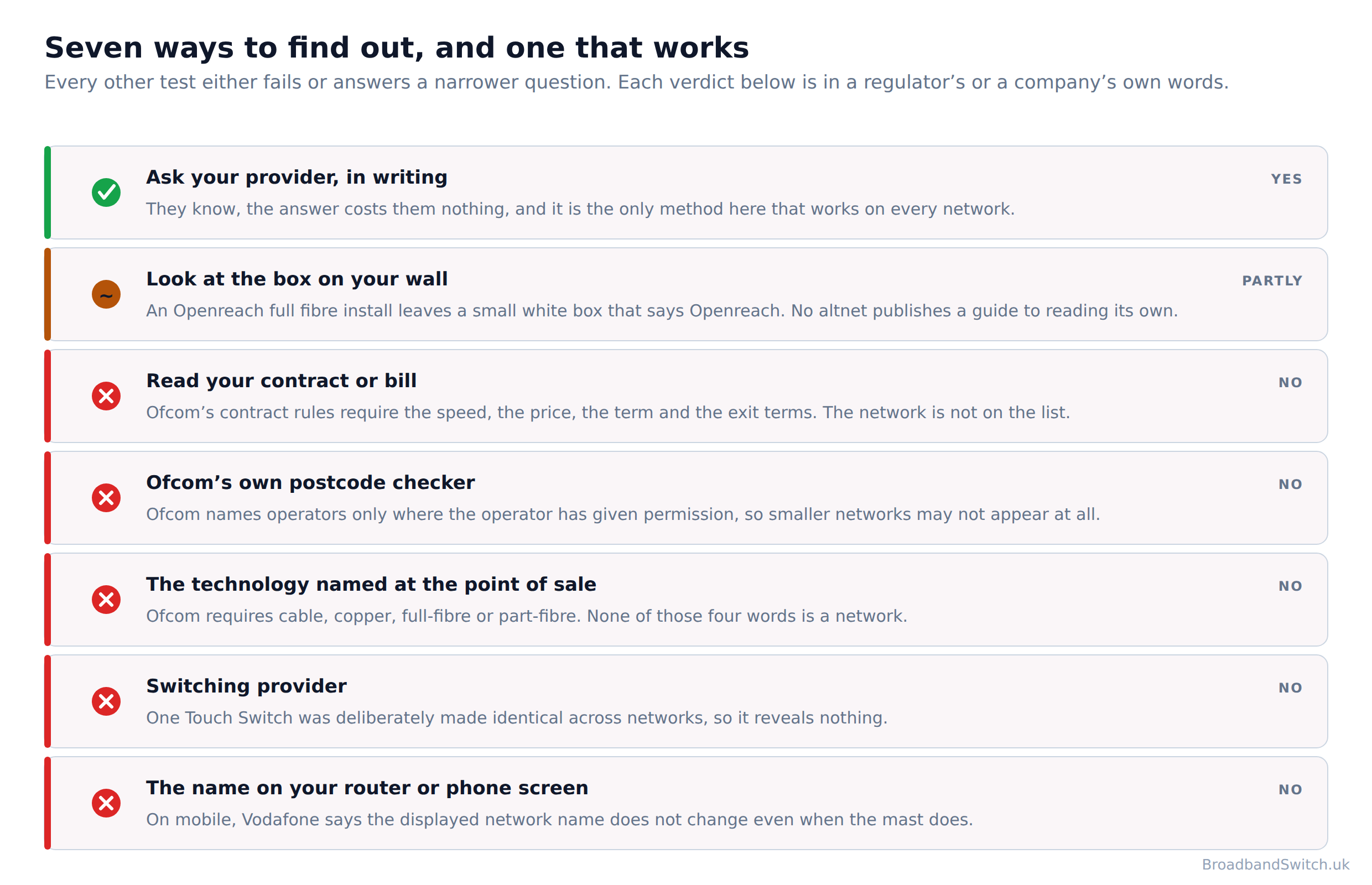
That is an unsatisfying answer and it is the true one, so it is worth showing the working rather than asserting it. Here is each method in turn, and what it actually tells you.
The box on your wall is the one partial test that works. If a full fibre install left a small white box, look at it: Openreach labels its own. In Openreach's words the unit is an Optical Network Terminal, and “It belongs to Openreach, not your provider, and not you.” The reason it identifies the network rather than the retailer is the useful part: “Because multiple providers use the same Openreach network, it can support whichever provider you're with.” That test works for Openreach and stops there. No altnet publishes an equivalent guide to reading its own box.
Your contract will not tell you. Ofcom's contract summary rules require the speed, the price, the contract length and the exit terms. The network is not on the list. Your bill will not either. Ofcom's own postcode checker is not a reliable answer, in Ofcom's own words: “We only provide the names of network providers that have expressly given permission to include their names and web details on our checker.” Switching provider reveals nothing either, because switching was deliberately made the same whichever network you are moving between. Ofcom's own description: “This means you can switch between different networks or technologies, for example from a provider using the Openreach network to one using CityFibre's, or from Virgin Media to Hyperoptic.” That uniformity is good for you. It just means the process is silent on this question.
Which leaves asking, and it is worth being specific when you do. The phrase that gets a useful reply is access network, because that is the industry's own term for the thing you are asking about, and a retailer's support team will recognise it where they may not recognise a question about who owns the cable. Your provider has to know the answer in order to place the order in the first place, and there is no commercial reason to withhold it. If you are about to move house or about to sign, it is worth the email.
Our One Touch Switch explainer covers how switching works now, and which network are you actually on covers the same confusion on mobile.
Why nobody has to tell you
Direct answer: Ofcom requires your provider to tell you the technology, in four plain words. It requires nobody to tell you the network.
This is not an oversight so much as a boundary nobody has moved. Ofcom looked hard at broadband labelling and concluded that “the term 'fibre' is being applied inconsistently by the telecoms industry and is often used to describe different types of networks, leading to confusion among customers”. Its answer was to require four unambiguous words at the point of sale: cable, copper, full-fibre and part-fibre. That rule has applied since 16 September 2024, it is a genuine improvement, and it means a shopper can no longer be sold a copper line described only as fibre.
But none of those four words is a network. Full-fibre describes a line that could be Openreach's, CityFibre's, Netomnia's or Hyperoptic's, and the rule is satisfied either way. The contract summary rules, set out above, do not carry it either. So there is no point in the sales process, and no document afterwards, where the answer is required to appear.
What you are entitled to be told, and what you are not
Entitled: the technology in four plain words, the speed you can expect, a guaranteed minimum from a code signatory, the price, the contract length and the exit terms. Not entitled: the name of the company whose cable runs to your house. On the evidence of this page, there is no published way to look up which network serves your address and be sure of the answer.
Our guide to the minimum guaranteed download speed covers what you are entitled to on speed, and up to speed against guaranteed minimum explains the two numbers you will be quoted.
Mobile home broadband, where the network moved under you
Direct answer: On mobile there are now effectively three networks selling home broadband rather than four, because Vodafone and Three merged and O2 does not sell it.
Start with the one that surprises people. O2's own words on its own broadband page: “We don't offer home broadband as O2.” That page sends you to Virgin Media instead. O2 is one of the four mobile networks and is routinely listed as a home broadband seller, and it is not one.
Then the merger. Vodafone and Three are now one company, and the two mobile networks have been joined underneath. Vodafone's own explanation: “Whether your phone has a Vodafone or a Three SIM, it will connect to either a Vodafone or a Three mast, whichever one provides the best signal in your location.” For a phone that is straightforwardly good news, and for a 4G or 5G home broadband router it is the same technology doing the same thing.
The part worth knowing is what the device shows you. In Vodafone's own words, “there won't be any change in the stated name of the network as it appears in your phone's settings or at the top of its screen”. So on mobile, as on fixed lines, the name in front of you is not a reliable guide to the network behind it. The difference is that on mobile the company has published that plainly, which is more than the fixed side manages.
See 5G home broadband deals and 4G home broadband deals as they stand today, or fixed wireless against fibre for the trade-off. What you give up on protections is covered in our technology guide.
Why your provider cares which network you are on
Direct answer: Your retailer chooses the network, and it is paid to care which one. You are not told, and no rule says you have to be.
A retailer buys the line wholesale and sells it to you retail, so the wholesale price is most of its cost. Networks compete for that business with discounts, and the discounts are large enough to be worth a regulator's attention. Ofcom proposed in July 2026 to block a new Openreach discount, worth up to £9.50 a month per customer for up to 30 months, on the ground that it was aimed at exactly the customers smaller networks need in order to grow. Ofcom's consultation on it closed on 27 August 2026 and no final decision had been published when this page was last checked.
Whatever Ofcom decides, the shape of it is the point for a reader of this page: when a retailer can put you on two networks, it has a commercial reason to prefer one, and you have no way to see which reason applied to you. That is not an accusation about any particular company. It is a description of a market in which the buyer cannot see the product.
It also explains why this is worth checking at renewal. CityFibre sells only wholesale. It has no retail brand of its own, so every CityFibre line is sold to you by somebody else. A network with a long list of retailers on it gives you somewhere to go when your price goes up. A network with one gives you the same company under a different name.
Our explainer on the Ofcom discount decision covers what it means for your bill, and altnet economics covers why the smaller networks are merging.
When the answer actually changes something
Direct answer: It matters in three situations and almost nowhere else: when you are deciding whether a switch will need an engineer and a new cable, when you want to know whether a faster package can ever reach you, and when you are weighing how much choice of provider you will have later.
You are switching, and want to know whether an engineer is coming
If you are switching to a network that has not served your house before, expect an engineer, a new cable and a hole in the wall. If you are switching between two retailers on the same network, expect none of that. Ask the new provider which network it will put you on, and if it is the same one you are already on, ask them to confirm no new cable is needed.
You want to know whether a faster package can ever reach you
The network sets the ceiling. A retailer cannot sell you a gigabit over a line that does not carry one, however good its marketing is, and a retailer on a network that has not built past your house cannot sell to you at all. Which is why a postcode check tells you more than any brand page: it answers the network question by proxy, by showing you what can actually be sold to you.
You are thinking about what happens at the end of the contract
The network sets how much choice you will have at renewal. On Openreach you have hundreds of retailers to move between without an engineer visit. On a network with one retailer, leaving the retailer means leaving the network. It is the least urgent of the three and the one that costs the most over time, because a price rise on a network with no alternative retailer is a price rise you cannot walk away from without an engineer visit.
You have just moved into a new build
On a new-build development the network is often neither Openreach nor an altnet you have heard of: OFNL builds wholesale-only fibre on new estates and names around 18 residential retailers on its own site. If the developer handed you a provider leaflet and the name meant nothing to you, that is why, and the retailer list on that network is the thing to check before you sign anything long.
Outside those four situations, the network is trivia. The technology decides what your connection can do and the retailer decides what you pay and who answers the phone, and both of those are published. This page exists for the minority of weeks in a household's life when the third question suddenly matters, and for the fact that in those weeks the answer is unreasonably hard to get.
If you are mid-move, our Virgin Media to Openreach guide and what changes on installation day cover the two most common cross-network switches, and a new build with no Openreach line yet covers the case above.
The map is about to be redrawn
Direct answer: nexfibre is buying Netomnia, and with it YouFibre and brsk. It is in a Phase 2 inquiry, which is the deeper of the CMA's two stages, and it has not completed. The statutory deadline is 15 December 2026.
If it goes through, two of the networks on this page become one, and a YouFibre or brsk customer's network changes owner without their line changing at all. Nothing on this page assumes an outcome, because the decision has not been made, and a Phase 2 inquiry can end in a block, a clearance or a clearance with conditions.
What is already public is who has objected and why, because the CMA publishes the submissions. Sky, BT Group, CityFibre, Hyperoptic and Grain Connect have all filed submissions the CMA has published. Sky's own words: “The CMA should therefore treat nexfibre and VMO2 as a single economic entity for the purposes of its competitive assessment.” CityFibre's: “Competition from VMO2/Nexfibre alone has not been sufficient to constrain Openreach in the past, and will not be sufficient”. Both are arguing that the deal removes a competitor rather than creating one.
For a household the practical question is narrower. If you are a YouFibre or a brsk customer, your line does not change and your service does not change; the company that owns the network behind it might. If you are shopping now in an area where both nexfibre and Netomnia have built, the number of independent networks at your address could fall from two to one. Either way, 15 December 2026 is the date to watch.
Our altnet consolidation tracker follows who has bought whom, and what the CMA decision means for your broadband covers the customer side.
Every network available at your postcode
See which networks reach your address
One postcode shows every provider we can switch you to, lowest price first, across full fibre, FTTC, cable and 5G home broadband. Which networks have built past your house is the thing that decides everything else on this page.
Show every provider at my postcode →Which network does my provider use: frequently asked questions
Which network does Sky use?
Both Openreach and CityFibre, and Sky does not tell you which one you are getting. Sky and CityFibre signed a partnership in August 2024 to put Sky Full Fibre on the CityFibre network, and Sky is named on CityFibre's own retailer list today. In its own submission to the CMA in July 2026 Sky named Openreach and CityFibre as its wholesale suppliers. Which of the two reaches your address decides which you get, and the answer is an address answer rather than a Sky answer.
Which network does Vodafone use?
Three of them. CityFibre is VodafoneThree's anchor customer and the two extended the arrangement in June 2026. Vodafone also sells over Openreach, and VodafoneThree also sells over Community Fibre's London network, which Vodafone says reaches up to 1.3 million homes in the capital. So a Vodafone customer in London, a Vodafone customer in a CityFibre town and a Vodafone customer in a village can be on three different networks under one brand.
Is Hyperoptic always on Hyperoptic's own network?
No, and this is the clearest example on the page of the brand not matching the network. Hyperoptic's own words: “Hyperoptic will continue to expand coverage through its wholesale agreement with Openreach.” Its own network reaches 1.9 million homes passed, and beyond that it resells Openreach. Hyperoptic publishes nothing telling a customer which of the two networks their own line uses.
How do I find out which network my broadband is on?
Put the question to your provider and put it in writing. Ask your provider, in writing, which access network your line runs on. They know, the answer costs them nothing, and asking is the only method on this page that works on every network. Every other method either fails or answers a narrower question: Ofcom's contract summary rules require the speed, the price, the contract length and the exit terms. The network is not on the list. Ofcom says of its own checker: “We only provide the names of network providers that have expressly given permission to include their names and web details on our checker.” And switching tells you nothing either. Ofcom's own description: “This means you can switch between different networks or technologies, for example from a provider using the Openreach network to one using CityFibre's, or from Virgin Media to Hyperoptic.” One partial test does work: if a small white box on your wall says Openreach, you are on Openreach. “Because multiple providers use the same Openreach network, it can support whichever provider you're with.” That test works for Openreach and stops there. No altnet publishes an equivalent guide to reading its own box.
Does my contract have to say which network I am on?
No. Ofcom's contract summary rules require the speed, the price, the contract length and the exit terms. The network is not on the list. What Ofcom does require is the technology, in four specific words: cable, copper, full-fibre and part-fibre. That rule exists because, in Ofcom's words, “the term 'fibre' is being applied inconsistently by the telecoms industry and is often used to describe different types of networks, leading to confusion among customers”. It has applied since 16 September 2024 and it is a real improvement. It just answers a different question from the one this page is about.
Why does the network matter at all?
It matters in three situations and almost nowhere else: when you are deciding whether a switch will need an engineer and a new cable, when you want to know whether a faster package can ever reach you, and when you are weighing how much choice of provider you will have later. It also decides how much competition you will have at your address later, because a network with many retailers on it gives you somewhere to go at renewal and a network with one does not. CityFibre sells only wholesale. It has no retail brand of its own, so every CityFibre line is sold to you by somebody else. For most households, most of the time, the technology and the price matter more than the name of the network underneath.
Is YouFibre a network?
No, it is a retail brand. In its own words: “Each week, we connect thousands of new homes across the UK to the network that's built for broadband by Netomnia.” The network is Netomnia, which reports 3 million premises serviceable and 445,000 connected, and the two are the same group. The same distinction catches people out with giffgaff, which is a Virgin Media O2 brand rather than a network.
Who actually owns nexfibre?
InfraVia holds 50%, Liberty Global about 25% and Telefonica 25%, and the first two of those also own Virgin Media O2 between them. nexfibre calls itself a wholesale-only operator open to all internet service providers. “We're delighted to welcome giffgaff on board as our second wholesale customer.” were its own words in April 2025, and second meant Virgin Media O2 was first, so on that date the wholesale-only network had no customer outside the group that part-owns it.
Is my Three or Vodafone home broadband on the network I bought?
Not necessarily, and the companies say so. Vodafone's own explanation of the merged network: “Whether your phone has a Vodafone or a Three SIM, it will connect to either a Vodafone or a Three mast, whichever one provides the best signal in your location.” And the part worth knowing: “there won't be any change in the stated name of the network as it appears in your phone's settings or at the top of its screen”. So the name your router or your phone displays is no longer a reliable guide to which network is carrying the connection. And O2, in its own words: “We don't offer home broadband as O2.”
Can two houses on the same street be on different networks?
Yes, and it is more common than people expect. Networks build street by street and sometimes side by side, so one house can have Openreach full fibre while the one next door is still waiting, and an address can sit inside a CityFibre town without CityFibre having reached it. CityFibre's own wording is that only when your full fibre network is built will you know which providers are offering services to your property. It is why a postcode check beats any national figure, and why the answer to this page's question is an address answer.
Does it matter for the copper switch-off?
Only indirectly, and it is worth separating the two. The switch-off is about the old copper telephone network, which is Openreach's, so if you are on Virgin Media, CityFibre, Netomnia or any other network you are not in that programme. If you are on an Openreach copper or FTTC line you are, and the date is 31 January 2027. Our technology guide covers what that changes and what it does not.
Is the answer going to change?
For some households, yes, and a regulator will decide it rather than a company. nexfibre is buying Netomnia, and with it YouFibre and brsk. It is in a Phase 2 inquiry, which is the deeper of the CMA's two stages, and it has not completed. The statutory deadline is 15 December 2026. If it goes through, two of the networks on this page become one, and a YouFibre or brsk customer's network changes owner without their line changing at all. Sky, BT Group, CityFibre, Hyperoptic and Grain Connect have all filed submissions the CMA has published. Sky's own submission argues that “The CMA should therefore treat nexfibre and VMO2 as a single economic entity for the purposes of its competitive assessment.”
In short
- The honest answer to which network your provider uses is that it depends on your address, not on your provider, and that nobody is required to tell you either way.
- Five of the best-known names in UK broadband sell over more than one network, so the brand on your bill does not tell you whose fibre is in the ground outside your house. All of them appear on CityFibre's own list of 44 retailers, and all of them also sell over Openreach.
- Hyperoptic will continue to expand coverage through its wholesale agreement with Openreach. Hyperoptic publishes nothing telling a customer which of the two networks their own line uses.
- toob built its own network and also sells over CityFibre, and it appears on CityFibre's own retailer list. And YouFibre is a retail brand rather than a network, in its own words: “Each week, we connect thousands of new homes across the UK to the network that's built for broadband by Netomnia.”
- Ofcom requires your provider to tell you the technology, in four plain words. It requires nobody to tell you the network.
- Ofcom's contract summary rules require the speed, the price, the contract length and the exit terms. The network is not on the list.
- Ofcom, on its own postcode checker: “We only provide the names of network providers that have expressly given permission to include their names and web details on our checker.”
- Ofcom's description of switching: “This means you can switch between different networks or technologies, for example from a provider using the Openreach network to one using CityFibre's, or from Virgin Media to Hyperoptic.” So the switching process cannot tell you either.
- The one partial test that works: “Because multiple providers use the same Openreach network, it can support whichever provider you're with.” That test works for Openreach and stops there. No altnet publishes an equivalent guide to reading its own box.
- nexfibre calls itself a wholesale-only operator open to all internet service providers. Its only two named wholesale customers are Virgin Media O2 and giffgaff, and giffgaff is a Virgin Media O2 brand.
- Vodafone's own description of the merged mobile network: “there won't be any change in the stated name of the network as it appears in your phone's settings or at the top of its screen”. And O2 does not sell home broadband at all: “We don't offer home broadband as O2.”
- Ofcom proposed in July 2026 to block a new Openreach discount, worth up to £9.50 a month per customer for up to 30 months, on the ground that it was aimed at exactly the customers smaller networks need in order to grow. Ofcom's consultation on it closed on 27 August 2026 and no final decision had been published when this page was last checked.
- nexfibre is buying Netomnia, and with it YouFibre and brsk. It is in a Phase 2 inquiry, which is the deeper of the CMA's two stages, and it has not completed. The deadline is 15 December 2026.
- It matters in three situations and almost nowhere else: when you are deciding whether a switch will need an engineer and a new cable, when you want to know whether a faster package can ever reach you, and when you are weighing how much choice of provider you will have later.
- Ask your provider, in writing, which access network your line runs on. They know, the answer costs them nothing, and asking is the only method on this page that works on every network.
Each line stands on its own and carries its date. Reviewed by a person at least quarterly, last on 21 September 2026.
References
- Ofcom
Ofcom. (2022, June 17). New rules on short and simple contract details, the required contents of a contract summary, which do not include the access network. ofcom.org.uk
- Ofcom
Ofcom. (2026). About the Ofcom checker, the statement that operator names appear only with the operator’s express permission. checker.ofcom.org.uk
- Ofcom
Ofcom. (2023, March 16). Switching broadband: easier than ever, the statement that One Touch Switch works across different networks and technologies. ofcom.org.uk
- Ofcom
Ofcom. (2026, July 28). Ofcom proposes to block new Openreach commercial offer, the £9.50 discount, the reasoning and the consultation that closed on 27 August 2026. ofcom.org.uk
- BT Group
BT Group. (2026, July 23). Q1 FY27 results, the Openreach full fibre footprint, premises connected, take-up rate and build target. newsroom.bt.com
- Openreach
Openreach. (2026). Service providers on our network, the named list of retailers and the instruction to find the one that bills you. openreach.com
- Openreach
Openreach. (2026). Openreach equipment in my home, the optical network terminal, who owns it and why it supports whichever provider you are with. openreach.com
- CityFibre
CityFibre. (2026, June 15). Broadband providers on the CityFibre network, the retailer directory, which carries its own last-updated date. cityfibre.com
- Virgin Media O2
Virgin Media O2. (2026, July 24). Q2 2026 earnings release, homes passed, homes serviceable, the nine million full fibre footprint and consumer broadband connections. news.virginmediao2.co.uk
- nexfibre
nexfibre. (2025, April 30). nexfibre welcomes giffgaff to its wholesale platform, the second wholesale customer. nexfibre.co.uk
- CMA
Competition and Markets Authority. (2026). nexfibre / Substantial merger inquiry, the Phase 2 case, the 15 December 2026 deadline and the published third-party submissions. gov.uk
- Vodafone
Vodafone. (2026, April). Sharing mobile networks: everything you need to know about MOCN, including that the displayed network name does not change. vodafone.co.uk
- BroadbandSwitch.uk
BroadbandSwitch.uk. (2026). Broadband deals, checked by hand, our own hand-checked prices and the date each was verified. broadbandswitch.uk
Ready to find out which technology reaches your address?
One postcode shows every provider that can reach you, lowest price first, on all four technologies. Then ask the one question on this page that does the most work: what is the guaranteed minimum download speed?
Compare at your postcode →