
About this report
The Loyalty Penalty is an independent research publication from BroadbandSwitch.uk, part of the SearchSwitchSave group. It is prepared to a point-in-time standard: every statistic is attributed to a named, dated source, and the full APA 7th edition reference list at the back lets any reader check any figure. Where official Ofcom data and fresher industry data differ, both are presented with a reconciliation note rather than one being quietly preferred.
Important notices
Point in time. Version 1.1, published July 2026. All data, prices and product details were checked to 17 July 2026 and may change. Verify current details with your provider before acting. All consumer prices in this report include VAT. Next scheduled review: on publication of Ofcom's next Pricing and Consumer Engagement report, expected 2027.
Analysis, not advice. This report is independent analysis of the UK broadband market. It is not financial, legal or contractual advice. Your own best deal depends on your address, your usage and your circumstances, so treat the figures here as a guide to the questions worth asking, not a recommendation to act.
Independence. BroadbandSwitch.uk operates comparison services and may receive commission when readers switch provider through our links. This does not influence the analysis in this report, and no provider has paid for inclusion or seen this document before publication. The social tariff guidance in Section 5 earns us nothing: it is here purely to help households who qualify.
Trade marks. BT, EE, Plusnet, Sky, TalkTalk, Vodafone, Virgin Media O2, Zen, YouFibre and all other company and product names are the trade marks of their respective owners and are used here for identification only. No endorsement is implied in either direction.
Corrections. We correct errors promptly and transparently. Spotted one? Contact the editorial team via broadbandswitch.uk/corrections and we will review, correct and note the change.
Media enquiries. Journalists and editors are welcome to quote from this report with attribution to BroadbandSwitch.uk. For interviews, the underlying data or a press pack, contact press@searchswitchsave.com or visit the media centre at broadbandswitch.uk/media. Our previous reports have been covered by outlets including ISPreview.co.uk.
Publisher. © 2026 BroadbandSwitch.uk, a trading name of SearchSwitchSave (Isle of Man company 030828B · UK IP UK00004211113 · ICO IoM R697728). Registered office: Sycamore House, Glen Duff, Lezayre, IM7 2AT, Isle of Man.
How to cite this report
Suggested attribution: BroadbandSwitch.uk, The Loyalty Penalty (Report No. 28), July 2026, broadbandswitch.uk. Corrections are welcome, answered and published.
The gap you never agreed to
Most reporting on broadband prices asks whether bills are going up. The more useful question is quieter: who pays more than they need to, simply for staying put, and why.
The loyalty penalty is an unusual consumer harm. It punishes people for doing nothing wrong. You signed a fair deal, you kept paying, and at some point the price a new customer is offered quietly dropped below the price you were left on. Nobody sent you a bill marked "penalty". It simply accrued, a few pounds a month, in the space between the deal you took and the deal you could have.
This report sets out to measure that space honestly. It names the size of the gap, shows exactly who it falls on, and, just as importantly, says clearly where it does not apply. A report that only prosecuted providers would be a weaker one, so Section 8 is given over to the evidence that the market as a whole is competitive and getting cheaper in real terms. Both things are true at once, and the interesting story lives in holding them together.
One finding matters to me more than the rest. There is a discount that already exists, that millions of households on Universal Credit and Pension Credit qualify for, and that around nine in ten of them never claim. We make no money from social tariffs. Section 5 is here for one reason only: to help the people this penalty hits hardest. If this report moves a single family onto a deal they did not know they could have, it will have earned its place.
Dr Alex J. Martin-Smith
CMgr MBA LLM DBA · Isle of Man, July 2026 · alexmartinsmith · Reviewed by Adrian James
The loyalty penalty, on one page
The gap is real, and it is measurable. Ofcom's latest pricing research finds that out-of-contract customers pay £7 a month more on standalone broadband, £8 more on dual-play and £9 more on triple-play bundles than in-contract customers[27]. That is £84 to £108 a year, rounded. At the end of June 2025, 28% of broadband customers were out of contract for at least one service in their bundle[27], the single biggest predictor of overpaying, though the regulator is careful to say most, not all, of them could save.
It grows with your speed. On dual-play packages the gap runs from £4.17 a month on a standard tier to £7.94 on ultrafast[27], often for the identical line into the identical home. And in the year to July 2025, standalone prices fell 6% on average in real terms across the five speed tiers, for every tier except the slowest, which rose 17%[27].
It falls hardest on those least able to fight it. Just 19% of over-64s switched a communications service last year against 29% of 25 to 44 year olds, and 21% of the poorest households against 27% of the most affluent[27]. Low-income households already pay a poverty premium of around £217 a year across essential markets[8].
The clearest waste is a discount nobody claims. Only 532,000 of roughly 6.2 million eligible households are on a broadband social tariff, a take-up of 8.6%[27], because 70% do not know the tariffs exist[25]. Citizens Advice put the unclaimed support at more than £824 million a year in 2023, and on today's larger eligible base the figure would be higher still[5].
The market is moving the right way. The out-of-contract pool has fallen from 40% in 2019[17], switching is up from 14% to 18%[27], and the providers winning customers fastest are the challenger networks that have stopped raising prices mid-contract at all[13]. The penalty is not a fixed feature of UK broadband. It is a gap that is closing.
The whole report in one sentence
UK broadband is competitive and getting cheaper in real terms, yet a stubborn transfer persists, from the disengaged to the engaged and from the poorer to the better-off, and the fastest way to close it is a contract check, a social-tariff check, and a look at what full fibre now costs in your street.
01The £7 question
There is a number at the heart of the UK broadband market that sounds like an accusation: 28%. That is the share of broadband customers who, at the end of June 2025, were out of contract for at least one service in their bundle, measured across the largest providers[27]. It is tempting to read that as 28% being overcharged. The truth is more useful, and more precise, than the headline.
Here is the figure that gives this section its name, stated plainly so there is no confusion. Ofcom's Pricing and Consumer Engagement report finds that out-of-contract customers pay £7 a month more for standalone broadband, £8 more for dual-play and £9 more for triple-play bundles than in-contract customers buying the same kind of service[27]. It is not a million-pound question and there is no trick in it. It is simply £7 to £9 a month, which is £84 to £108 a year rounded, sitting in the gap between the deal a new customer is offered and the deal a lapsed customer drifts onto.
The regulator is careful about the very next word, and so are we. It says most out-of-contract customers could save money, not all[28]. Some have already negotiated their price down. Some sit on rolling deals at or below new-customer rates. Some have looked and decided the saving is not worth the effort. Being out of contract is not the same as being overcharged, but it is the single strongest predictor of it.
In short
What out of contract actually means
Your broadband deal has a minimum period, usually 12, 18 or 24 months. Once it ends you are out of contract: your service carries on, but usually at a higher standard price, and you are free to leave, re-contract or switch at any time without an exit fee.
The direction of travel matters as much as the level. In 2019, four in ten broadband customers were out of contract[17]. A wave of Ofcom interventions followed: end-of-contract notifications, annual best-tariff reminders and voluntary pricing commitments from the major providers[15][16]. The pool fell to 35% in 2020[17] and 28% by 2025[27]. The market is getting better at nudging people, but tens of millions of pounds still change hands every year on the strength of inertia alone. This report sets out who pays it, how much, why, and what closes the gap.
02The gap, tier by tier
A single average hides the real story. The loyalty penalty is not one number; it grows with the speed of your connection. The figures below are for dual-play packages, meaning broadband plus a landline on one bill, the most common way UK households buy.
In short
Dual-play, and real terms
Dual-play means broadband and a home phone line bought together on one bill; triple-play adds pay TV. Real terms means after stripping out general inflation, so prices can be compared fairly across years.
On a standard sub-30 Mbit/s dual-play package, the gap between the promoted price a new customer pays and the list price a lapsed customer drifts onto is £4.17 a month[27]. Step up to superfast and it widens to £6.84. On an ultrafast package it reaches £7.94 a month, for what is very often the identical line into the identical home[27]. Over a year that is roughly £50, £82 and £95 respectively, rounded: the more you pay for speed, the more staying put tends to cost you.
The pattern is not an accident of one dataset. Ofcom's earlier pricing work found the same shape a year before, with out-of-contract customers on superfast and full-fibre bundles consistently paying the widest premiums[22]. The loyalty penalty, in other words, is concentrated exactly where the market is growing fastest: the higher-speed tiers that more and more households are moving onto. It is not a flat surcharge; it scales with the value of the connection.
The paradox worth knowing
In the year to July 2025, standalone prices fell in real terms for every speed tier except one: the slowest. Sub-30 Mbit/s packages rose 17% in real terms, 22% in cash, on July 2024. The customers on the oldest, slowest copper lines, who are disproportionately older and least likely to switch, are the only group whose prices went the wrong way[27]. We return to them in Section 4.
03The pounds-and-pence era
For years the loyalty penalty had a silent accomplice: the mid-contract price rise, dressed up as a percentage no one could predict. That era is ending, and 2026 is the hinge.
Until recently, most large providers raised prices every April by a formula: the consumer prices index plus, typically, 3.9%. In a calm year that was a mild irritation. In April 2023, with CPI at 10.5%, it meant increases of 14.4% on bills that customers had been told were fixed[1]. The year before it was 9.3%, the year after 7.9%[1]. The one thing these rises had in common was that you could not know the number when you signed.
From 17 January 2025, Ofcom banned inflation-linked mid-contract rises in all new contracts[21]. Any rise must now be set out in pounds and pence, in cash, before you sign. The Telecoms Consumer Charter agreed in February 2026 confirmed the direction, and April 2026 saw the last round of the old inflation-linked increases work through legacy contracts[10].
So what does the new fixed era actually cost? The table below turns the 2026 pounds-and-pence rises into what they add over a typical two-year contract[1]. A flat £4 a month is £96 across 24 months. And there is a sting the headline rate hides: a £4 rise on a £20 package is a 20% increase, while the same £4 on a £60 package is under 7%. The pounds-and-pence approach is fairer to predict, but it lands hardest on the cheapest packages, and therefore often on the customers with the least to spare. The tracker behind these figures is kept current at broadbandswitch.uk/in-contract-price-rises-2026.
| Provider | Monthly rise | Over 24 months | As % of a £25 bill |
|---|---|---|---|
| BT | £4.00 | £96 | 16% |
| EE | £4.00 | £96 | 16% |
| Plusnet | £4.00 | £96 | 16% |
| TalkTalk | £4.00 | £96 | 16% |
| Virgin Media | £4.00 | £96 | 16% |
| Vodafone | £3.50 | £84 | 14% |
| Sky | £3.00 | £72 | 12% |
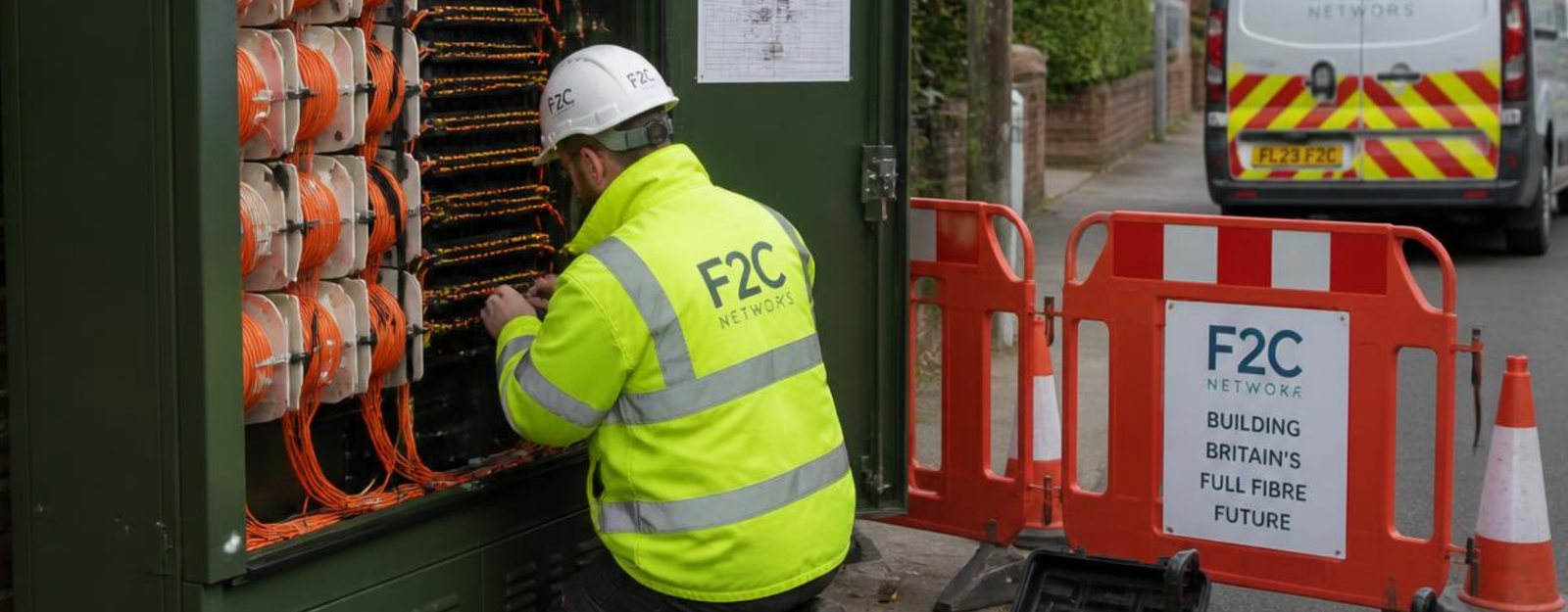
The most interesting development is at the other end of the market. A growing group of providers now promises no mid-contract rises at all. Zen holds your price for the life of the contract[35], YouFibre makes no-surprise pricing an explicit promise[34], and Rebel and other challengers have made price certainty their calling card[13]. This is not a footnote. As Section 7 shows, the providers winning customers fastest are, to a striking degree, the ones that have stopped raising prices mid-contract at all. Price certainty has become a competitive weapon. One honest caveat holds throughout, though: a fixed price removes the nasty surprise, but it is not automatically the lowest price. The test is the same as ever, which is the total you will pay across the whole term, including any rise, checked against what a new deal at your address would cost today.
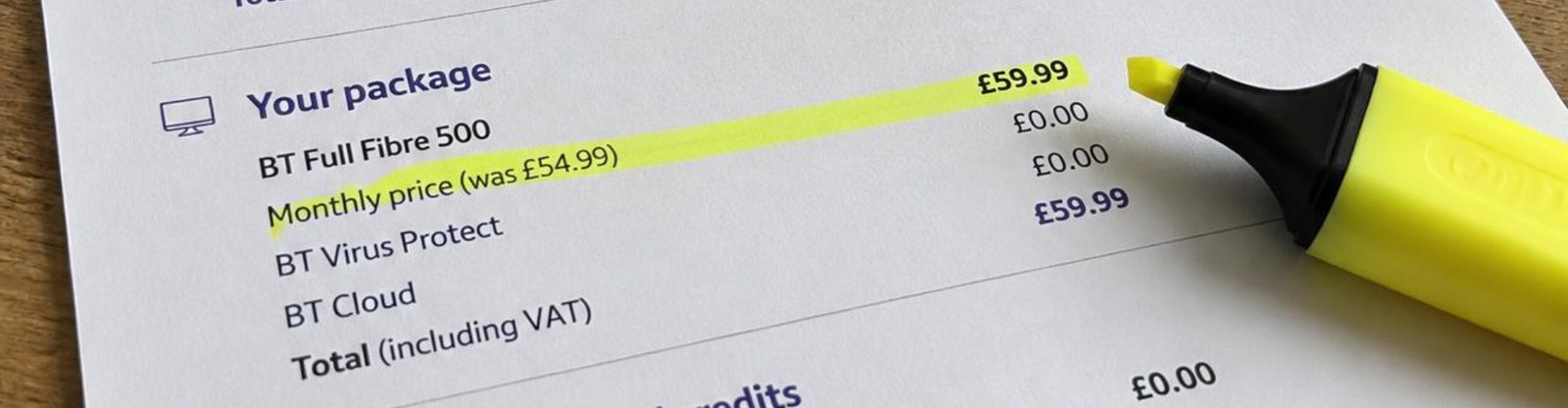
A worked example: what re-contracting actually saves
Suppose you are out of contract on a superfast dual-play deal at the £38.48 list average and you re-contract at the £31.64 in-contract average. You save £6.84 a month. If your new deal carries a stated £3 rise the following April, you pay the lower price until then and £34.64 after it, still below where you started. Illustrative and derived from the Ofcom averages above; your own prices will differ.
04The people who pay most
If the loyalty penalty were spread evenly it would be an annoyance. It is not. It concentrates on the customers with the least time, confidence and money to fight it, which is what turns a pricing quirk into a fairness problem.

Ofcom's engagement data is stark. In the past year, 29% of 25 to 44 year olds switched a communications service against just 19% of the over-64s[27]. By social grade, 27% of the most affluent AB households switched against 21% of the poorest DE households[27]. The pattern is not a neat gradient, since skilled manual C2 households were the most active of all at 29%, but the DE group is clearly the least engaged[27]. Longevity compounds it: 43% of broadband customers have been with the same provider for more than five years, on Ofcom's own switching-tracker data[33], and older customers are consistently the group least likely to have moved at all[14]. The people most exposed to the penalty are the least likely to act on it, and the least confident comparing deals in the first place.
There is a hard financial edge to this. Research by the University of Bristol and Fair By Design found that low-income households pay a poverty premium averaging £217 a year across essential markets (median £182), simply for being poor, through pricier tariffs, payment methods and lost switching gains; the researchers flag the 2022 figure as artificially low given energy market conditions that year[8]. Broadband is woven through that premium[11]. And Ofcom's own history shows the direction of harm: vulnerable out-of-contract broadband customers were overpaying £4.40 a month each in 2019, a figure the regulator's interventions cut to £2.30 by 2020[17]. Real progress, but not a solved problem, and Citizens Advice estimates around 3.9 million broadband bill payers in Great Britain are struggling to afford their bills, a figure it derives by applying a 13.1% rate to the bill-paying population[6], a strain Ofcom's own affordability tracking continues to record[23].
Two older benchmarks, treated strictly as context
Citizens Advice’s 2018 super-complaint put the loyalty penalty at around £877 a year, but across five essential markets, not broadband alone[4]. Separately, its 2017 broadband-only estimate was around £113 for every year a customer stays beyond their initial term[3]. Both predate the reforms in this report, so we cite them as history, not as current broadband totals. The principle they capture, though, has not changed.
05The £824m no one is claiming
There is one part of the loyalty penalty that is not about switching at all. It is about a discount that already exists, that millions qualify for, and that almost nobody takes. It is the clearest waste in the whole market.
Broadband social tariffs are cut-price packages, typically £12.50 to £20 a month, for households on Universal Credit, Pension Credit and other qualifying benefits. They save an eligible household around £200 a year, and Ofcom has pressed providers to promote them since 2022[20]. In June 2025, just 532,000 households were on one. That is 8.6% of the roughly 6.2 million eligible[27]. The other nine in ten are, in effect, paying a loyalty penalty they do not even know they could avoid.
The reason is not price. It is awareness. In Ofcom research, 70% of eligible households did not know social tariffs existed as of October 2025[25]. Citizens Advice put the unclaimed support at more than £824 million a year in December 2023, calculated as roughly 95% of the then 4.3 million eligible households missing a saving of about £200 each[5]. On the 2025 base of 6.2 million, the same sum exceeds £1.1 billion (derived). And there is a quiet paradox in the numbers: the count of households on a social tariff keeps rising, yet the share of eligible households it represents has fallen, because Universal Credit has grown even faster[30]. The safety net is expanding more slowly than the need.

| Date | On a social tariff | Eligible households | Take-up |
|---|---|---|---|
| February 2022 | 55,000 | 4.2m | 1.3% |
| April 2023 | 220,000 | 4.3m | 5.1% |
| June 2024 | 506,000 | 5.3m | 9.6% |
| June 2025 | 532,000 | 6.2m | 8.6% |
One provider is missing
BT carries roughly two thirds of all broadband social tariff connections and Sky about a quarter[27]. Among the major providers, TalkTalk remains the notable exception with no standard social tariff, a gap worth watching as scrutiny of affordability grows.
Take action
If you receive Universal Credit, Pension Credit or similar, check this first
A social tariff is the single biggest saving in this report, and around nine in ten eligible households are missing it. It is not a charity handout: it is a discounted package you qualify for. Ask your provider by name whether they offer one, or see every provider’s current offer in our social tariffs guide. We earn nothing from this. It is simply the right thing to check.
06The small business blind spot
Almost every figure in the loyalty penalty debate is about households. That leaves the country’s 5.6 million small businesses in a data blind spot, and many of them in a protection gap they do not know exists.
Here is the finding that should give regulators pause. According to Ofcom's most recent dedicated study of small business connectivity, published in 2022, 58% of micro-firms, those with one to nine staff, run their internet on a residential contract rather than a business one[19]. They do it because it looks cheaper and simpler. But in doing so they can fall between two stools: they miss the service guarantees and support a business contract carries, while the consumer protections built around households were not designed with a business in mind.
There are 5.64 million small businesses in the UK, some 99% of the business population[9], and connectivity has long been one of their most common friction points, with the Federation of Small Businesses documenting persistent gaps in speed, reliability and value for smaller firms[12]. A residential line bought to save a few pounds can quietly become the most expensive one a business runs, precisely because nobody reviews it. Our guide to home versus business broadband for small companies weighs the trade-offs in detail.
The protection picture is genuinely mixed. End-of-contract and best-tariff notifications do reach the smallest business customers, those with ten or fewer staff, though in a looser form than households receive[16]. But One Touch Switch, the single-request way to change provider, launched as a residential service, and its business version was still in trials in mid-2026[31], so a micro-firm wanting to leave has faced more friction than the household next door. And there is a deeper gap still: no UK source publishes average business broadband spend by firm size, or a business out-of-contract share. That absence is itself a finding. Measured only for households, the bill small firms quietly pay is invisible by design, and it deserves its own data series.
07Who’s winning
If you want to know whether the loyalty penalty is finally being competed away, follow the customers. In 2025 they moved in one direction with unusual clarity, and it tells you exactly what people will switch for.
In short
What an altnet is
An altnet, short for alternative network, is a newer provider building and running its own full fibre lines in competition with the big established networks, Openreach and Virgin Media O2.
Across 2025, the alternative networks, the challenger providers building their own full fibre, added around 850,000 broadband customers[13]. Over almost exactly the same period, the Openreach network that BT's rivals also rent lost around 860,000 lines[2], and Virgin Media O2 shed 138,400 broadband customers of its own on a net basis[32]. The symmetry is the story. Where consumers finally have a real choice of infrastructure, they are taking it.
Why does this belong in a report about loyalty? Because of what these networks compete on. The challengers have, as a group, led the market on price certainty, largely refusing the inflation-linked mid-contract rises that the incumbents leaned on for years[13]. They dominate customer satisfaction rankings. The lesson for the whole market is that the antidote to a loyalty penalty is not just easier switching; it is giving people something worth staying for.
Switching itself is ticking up, from 14% of broadband customers in 2023 to 18% in 2025[27], helped by One Touch Switch passing three million completed moves by 15 June 2026[31]. The market is getting more fluid. But 18% switching in a year still means the other four in five stayed, and as Section 1 showed, many of them are paying for the privilege. The loyalty penalty has even reached the courts: in November 2025 the Competition Appeal Tribunal certified collective claims against the four largest mobile networks, alleging customers who stayed past their minimum term were left on penalised prices; the scope was narrowed at certification, the operators deny the claims, and it concerns mobile rather than broadband, but it shows how seriously loyalty pricing is now treated[7].
08Is it fair? What drives the price
A report that only prosecuted the providers would be a weaker one. To be trusted on where loyal customers lose, it has to be straight about where they do not, and about what actually sits behind a broadband bill.
Start with the counter-evidence. Despite the headline rises, average revenue per user (ARPU), the average monthly amount a provider collects per customer, is falling at the biggest firms, not climbing. BT's consumer broadband ARPU was £41.80 in the quarter to December 2025, down 1% on the year[2], and Virgin Media O2 reported declining consumer fixed revenue across 2025[32]. These are not the numbers of companies fattening margins on the backs of loyal customers. They are the numbers of a market under real competitive pressure, exactly as Section 7 would predict.
Behind the retail price sits a wholesale one. The rental every provider pays to run a line into your home is regulated by Ofcom, which has deliberately held the entry-level fibre charge flat in real terms to keep bills down while still letting networks recover the huge cost of building fibre[18][29]. Some of what customers pay is genuine cost: civil works, energy, wages, and the tens of billions being spent to wire the country for fibre.
So the fair verdict is a split one. The market as a whole is competitive and getting cheaper in real terms[27]. Providers are not, in aggregate, growing fat on loyalty. But within that healthy average sits a stubborn transfer, from the disengaged to the engaged, from the older to the younger, from the poorer to the better-off. That is the penalty this report measures, and it persists precisely because it is invisible on any single bill.
The counterfactual we could not find
Providers argue a waterbed effect: press prices down in one place, the idea goes, and they rise somewhere else, so new-customer discounts are partly funded by out-of-contract customers, and abolishing the penalty could raise headline prices. It is a reasonable argument, but no UK regulator has published a number that proves or disproves it. We flag it as a genuine open question rather than settle it with a figure we cannot source.
09What to do about it
The loyalty penalty is unusual among consumer harms: for most people it can be undone in the time it takes to make a cup of tea. Here is where the data points.
If you are a household
Find out when your contract ends; your provider must tell you, and the notification often carries their best available price[16]. If you are past your minimum term, you are in the group most likely to be overpaying, so treat that as a prompt to act. If anyone in your household receives Universal Credit or similar support, check a social tariff before anything else: it is the single biggest saving in this report and nine in ten eligible households are missing it[25]. And if you are on an old sub-30 Mbit/s package, check what full fibre now costs in your street: it reached 82% of UK homes by January 2026[26], and it is often the same price or less for many times the speed.
Report No. 28 measures the market-wide average. If you want the specific figures your own provider publishes, see our guide to out of contract broadband prices by provider.
If you run a small business
Check whether you are on a residential or a business contract, and whether that is actually the right call for your protections as well as your price[19]. Watch for the arrival of business One Touch Switch in 2026, which should make leaving a poor deal far easier than it has been[31].
Where you live changes the picture too. Northern Ireland's early fibre build put availability at 95% of homes with take-up at 62% by July 2025, while Scotland trailed at 71% availability; England and Wales sat between, at 79% and 78% available but with only 41% and 49% taken up[24]. In much of the UK the fast, competitively priced line is already in the street. The gap is the decision to use it.
If you are a policymaker or provider
Three gaps in the public data stand out, and closing them would sharpen everyone's understanding: a published measure of the business loyalty penalty; clearer, directional switching data so we can see who is really gaining and losing; and a settled answer on the waterbed question. On social tariffs, the evidence is overwhelming that the barrier is awareness, not eligibility or price[25]. That is a marketing and signposting problem before it is a regulatory one, and it is eminently fixable.
Three households, worked through
The long-standing copper customer
Out of contract on a standard dual-play deal at the £34.99 list average. Re-contracting at the £30.82 in-contract average saves £4.17 a month, and moving to full fibre may cost no more.
~£50 a yearThe Universal Credit household
Paying a typical market price while eligible for a social tariff at £12.50 to £20 a month. The social tariff check comes before any switching decision.
~£200 a yearThe micro-firm on a residential deal
Out of contract on an ultrafast package at the £51.88 list average. Re-contracting at the £43.94 average saves £7.94 a month, before even weighing a proper business product.
~£95 a yearIllustrative examples, derived from the Ofcom averages and social tariff prices cited in Sections 2 and 5. Individual prices vary by address and provider.
The good news threaded through this report is that the market is moving the right way. The out-of-contract pool is shrinking, real prices are falling, switching is rising, and the providers competing hardest are the ones offering price certainty rather than mid-contract surprises. The loyalty penalty is not a fixed feature of UK broadband. It is a closing gap, and every household and small business has the power to close it a little faster.
Take action
Two minutes, one postcode
See what full fibre and digital deals reach your address, with real prices, at broadbandswitch.uk. It is the same free checker used by thousands of UK households every week, and it is the fastest way to find out whether your loyalty is costing you. Not sure what speed you actually need? Our free speed test answers that in thirty seconds.
Eight common questions
The whole report, answered the way people actually ask. Every answer is sourced, and each links to a free guide if you want the detail.
If you are past your minimum term, quite possibly. At the end of June 2025, 28% of broadband customers were out of contract for at least one service, and Ofcom finds most of that group could save by switching or re-contracting[27]. Start with your contract end date, which your provider must tell you[16].
Your minimum period, usually 12, 18 or 24 months, has ended. The service carries on, normally at a higher standard price, and you are free to leave, switch or agree a new deal at any time without an exit fee.
Under One Touch Switch you contact only the new provider, which manages the whole move and tells your old provider. The system had completed three million switches by 15 June 2026[31].
A discounted package, typically £12.50 to £20 a month, for households claiming Universal Credit, Pension Credit and certain other benefits, saving around £200 a year[27]. See our social tariffs guide.
For contracts signed since 17 January 2025, any rise must be set out in pounds and pence before you sign[21]. Legacy inflation-linked contracts saw their final indexed rise in April 2026[10]. Your own terms are the final word, so check them.
On the averages in Section 2, closing the gap is worth roughly £50 to £95 a year depending on your speed tier[27], and full fibre reached 82% of UK homes by January 2026[26], so many households can go faster for the same money or less.
Mostly households, but Section 6 covers the smallest firms: 58% of micro-businesses run on residential contracts[19], and a business version of One Touch Switch was still in trials in mid-2026[31]. More at our business hub.
Named primary sources only: Ofcom, government statistics, audited company results and named research bodies, each graded in the appendix and listed at the back. Our methodology and public corrections log are online.
Take action
Still not sure? Check your own address in two minutes
Put your postcode into broadbandswitch.uk and see the real prices available where you live, across 30+ providers. Free, no signup, and the fastest way to find out whether your loyalty is costing you.
The acronym and jargon decoder
Every abbreviation and term of art in this report, translated once and properly. Telecoms loves its alphabet; nobody should have to keep up.
| ABTN | Annual Best Tariff Notification. The yearly reminder of your provider's cheapest available deal |
| Altnet | Alternative network. A challenger provider building and running its own full-fibre network |
| ARPU | Average Revenue Per User. What a provider earns per customer on average, a gauge of pricing power |
| CAT | Competition Appeal Tribunal. The specialist court hearing collective consumer claims |
| CPI | Consumer Prices Index. The main official measure of inflation |
| Dual-play | Bundle type. Broadband plus a home phone line on one bill; triple-play adds pay TV |
| ECN | End-of-Contract Notification. The alert telling you your minimum term is ending |
| FTTC | Fibre To The Cabinet. Fibre to the street cabinet, copper for the last stretch to the home |
| FTTP | Fibre To The Premises. Full fibre, all the way into the building |
| LLU / MPF | Local Loop Unbundling / Metallic Path Facility. Rival-run lines using their own exchange equipment |
| Ofcom | Office of Communications. The UK communications regulator |
| OOC | Out of contract. Past your minimum term and free to leave, the group most likely to overpay |
| OTS | One Touch Switch. Change provider by contacting only the new one |
| Real terms | Inflation-adjusted. After stripping out general inflation, so prices compare fairly across years |
| RPI | Retail Prices Index. An older, usually higher, inflation measure |
| SME | Small and medium-sized enterprise. Here, chiefly micro-firms of one to nine staff |
| SOGEA | Single Order Generic Ethernet Access. Broadband on a copper line with no separate phone service |
| TOTSCo | The One Touch Switching Company. The industry body that runs the switching hub |
| UC | Universal Credit. The main working-age benefit, and a common gateway to a social tariff |
| WFTMR | Wholesale Fixed Telecoms Market Review. Ofcom's rules governing the wholesale price of lines |
Missing a term?
The full living glossary, kept current beyond this report’s print date, is at broadbandswitch.uk.
How we sourced every figure
This report names a source and a date for every number, but they do not all carry equal weight, so each key figure sits in one of the four grades below. The rule has been the same throughout: where a claim rests on a single party’s word, or is a calculation of ours, we say so plainly rather than dress it as settled fact.
| Grade | What it means | Examples in this report |
|---|---|---|
| Confirmed | Traced to a named primary source: Ofcom, a government statistic, or audited company results | The £7 to £9 monthly gap; the tier gaps; the 28% out-of-contract share (all Ofcom, 2026) |
| Corroborated | Consistent across two or more independent sources on different dates | The 850,000 altnet gain against Openreach's loss (INCA; BT); the falling ARPU figures |
| Single-source | Rests on one organisation's statement, and is flagged as such in the text | The £824m unclaimed support (Citizens Advice); the 70% unaware figure (Ofcom) |
| Derived | A calculation, shown with its workings so it can be checked | The 24-month cost of a fixed rise; the annual value of each tier gap; the £1.1bn current-basis social tariff estimate; the three worked household examples |
Caveats worth stating plainly
Being out of contract is not the same as overpaying: 28% out of contract does not mean 28% are being overcharged, only that they are the group most likely to be[27]. Reporting periods differ across figures and are stated beside each one. Ofcom's real-terms price falls can coexist with cash increases on individual bills, so both are presented where possible. The Citizens Advice £877 figure spans five essential markets and is not a broadband-only number[4]. The poverty premium research does not isolate a standalone broadband line and reports a mean of £217 against a median of £182, so it is cited as context[8]. The £824 million unclaimed-support figure is a December 2023 Citizens Advice estimate on a 4.3 million eligibility base; our £1.1 billion restatement on the 2025 base is labelled derived[5]. The 3.9 million affordability figure is a Citizens Advice estimate for Great Britain bill payers, derived by applying a 13.1% rate to the bill-paying population, and is graded single-source[6]. Switching rates by social grade are not a linear gradient: C2 households switch more than AB, so we report the AB and DE figures with that caveat attached[27]. An earlier draft claim that most older customers have never switched was removed at fact-check because no current primary source supports it at that strength. A current Virgin Media O2 fixed ARPU figure could not be verified to a primary source, so it is omitted rather than estimated. Coverage snapshots are dated in each caption because availability moves quarterly. Comparison-site figures were excluded as primary sources. Where an aggregate is our own calculation, it is labelled derived, not attributed to a regulator.
Why grade our own numbers?
Because the fastest way to lose a reader’s trust is to present a guess as a fact. Telling you how firm each number is, and showing the sums behind the soft ones, is the discipline that runs through this entire report and every report before it.
References (APA 7th)
Numbered and sorted alphabetically by author. All URLs verified 17 July 2026. Where official and industry data differ, both appear in the text with dates and scope.
Read the previous reports
Every BroadbandSwitch.uk report and guide is free, independently produced and fully sourced. Pull one off the shelf.
A Century in Red
Report No. 31 · August 2026100 years of the red telephone box: the verified story, and why nobody minted a coin.Read the report →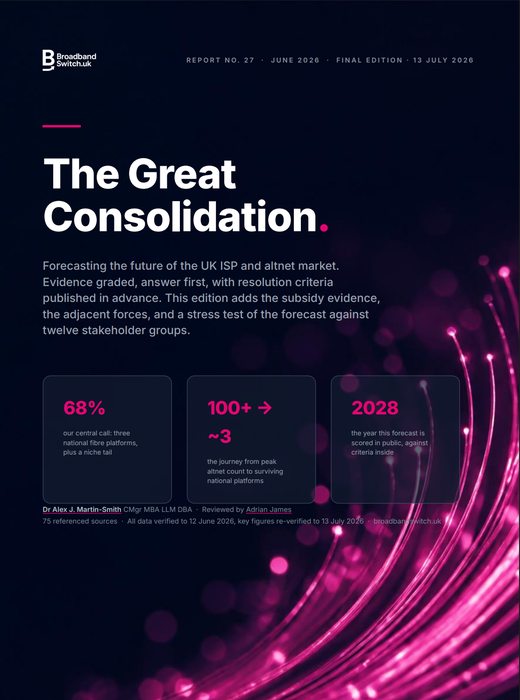
The Great Consolidation
Report No. 27 · July 2026Forecasting the UK ISP and altnet market, with resolution criteria set in advance.Read the report →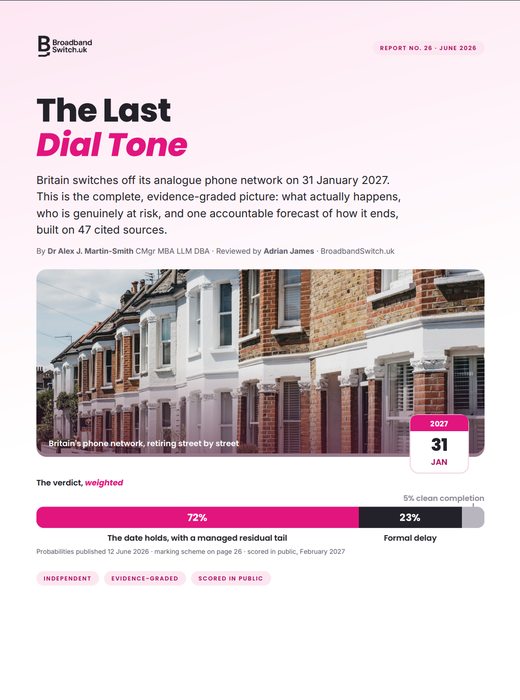 ★
★The Last Dial Tone
Report No. 26 · June 2026The 31 January 2027 analogue phone switch-off, and one accountable forecast.Read the report →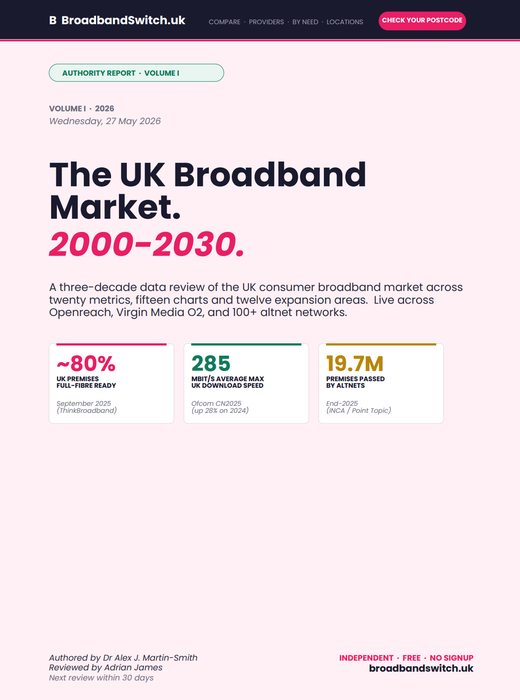
The UK Broadband Market
Authority report · 2000 to 2030A three-decade data review across twenty metrics and fifteen charts.Read the report →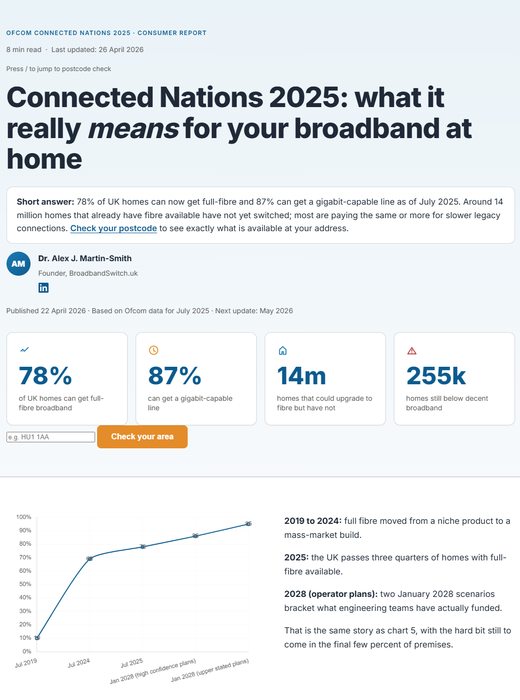
Connected Nations 2025
Consumer report · April 2026What Ofcom’s coverage data really means for your broadband at home.Read the report →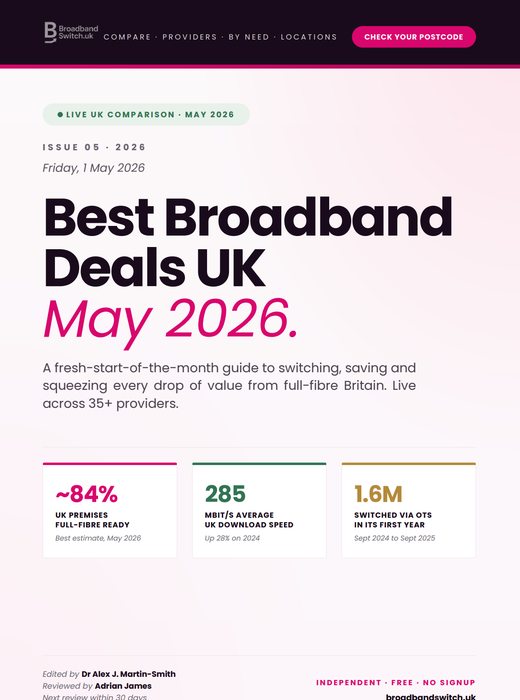
Best Broadband Deals UK
Monthly deals guide · May 2026The monthly verified guide to switching and saving across 30+ providers.Read the report →★ Featured in the press. The Last Dial Tone (Report No. 26) was picked up and published by ISPreview.co.uk, one of the UK’s leading broadband news outlets, which called it “one of the better overarching summaries” of the switch-off.
The next one
Report No. 29 is already in the diary. Every report is announced first at the reports hub, and each one is built to be better than the last.
The author, and the promise

Dr Alex J. Martin-Smith CMgr MBA LLM DBA
Alex is the founder of BroadbandSwitch.uk and the SearchSwitchSave network of UK comparison and digital tools. His work sits at the junction of consumer telecoms, regulation and clear explanation. His doctoral research in organisational capability underpins the analytical method running through this report, and his standing rule for everything the network publishes is the one applied here: every figure dated, every source named, nothing guessed.
Connect: linkedin.com/in/alexmartinsmith · Reviewed by Adrian James, Sales Director and Broadband Editor, BroadbandSwitch.uk. Every figure in this report was checked against its named source by both author and reviewer before publication.
Author pages: broadbandswitch.uk/alex-martin-smith · broadbandswitch.uk/adrian-james
About BroadbandSwitch.uk. An independent UK broadband comparison service: postcode-level availability checking across dozens of live providers, a free speed test, clear guides, and a verified market directory tracking 429 UK ISPs. The service earns commission when readers switch through its links; analysis and rankings are never sold, and this report was produced without provider involvement or sight before publication.
The promise. Every report we publish is held to the same standard, and every one is built to be better than the last. The figures here are dated, the sources named, and the soft numbers flagged. If you find an error, tell us: we correct promptly, transparently, and in public. Authority is not a claim. It is a habit, kept in the open.
Take action
One postcode. Two minutes. Every option we compare, at your address.
broadbandswitch.uk · The Loyalty Penalty, Report No. 28 · July 2026