New-build broadband delays: why your address cannot be found, who actually creates one, and which of the five links you are stuck at
Your home almost certainly has an address already. What it does not have yet is a postcode in the file every broadband checker reads, and the thing that releases it is not paperwork. Here is what nobody tells new-build buyers, and it is Royal Mail's own wording: “When building a new development, property developers contact the Local Authority to request a new address. The Local Authority assigns a street name and number and contacts Royal Mail to request a Postcode.” So the council creates the address and Royal Mail adds the postcode, which is the opposite way round from how almost everybody assumes it works. Your home has a unique property reference from even earlier than that: GeoPlace publishes that a council allocates one “We give a range of UPRNs to each local authority, which allocates one to each new address as soon as 'street naming and numbering' gets started or 'construction' starts - whichever comes first.” The condition for the last step is physical rather than administrative, and Royal Mail prints it on the very form you would use to ask: “New or existing addresses cannot be added to the Postcode Address File unless they are able to receive a delivery of mail.” Until then it sits in a separate file: “Once created, new addresses enter PAF Not Yet Built address product: a file of assigned addresses that aren't yet capable of receiving mail.” Which Royal Mail sells to businesses monthly, while you cannot order broadband at it. Five things have to happen before broadband can be ordered at a brand new address, they happen in a fixed order, and five different organisations do them. Every link in this chain is knowable, three of the five you can check yourself in an afternoon, and none of it requires anybody to do you a favour. Find out which link in the chain you are stuck at, because the five have five different owners and only one of them is worth an email this week.
Try your postcode, then read on
Use the confirmed postal address rather than the plot number if you have one. If this finds you, the first three links of the chain have finished and the rest of this page will tell you a great deal less than the answer already has.
Checker cannot find your new address? Four questions find the link that is actually holding you up, and write the letter to the body that owns it. Address fine but nothing on offer? That is the network rather than the address, and it has its own guide.
The short version, for somebody a checker cannot find
Direct answer: Your home almost certainly has an address already. What it does not have yet is a postcode in the file every broadband checker reads, and the thing that releases it is not paperwork.

Almost everything written about this says the same two things: the address has not reached the systems yet, and the network has not finished commissioning your street. Both are true and neither is useful, because they do not tell you which one you have, who owns it, or whether anything you do this week will move it.
So this page does something different. It sets out the chain that creates a UK postal address, link by link, with the organisation that owns each one. Five things have to happen before broadband can be ordered at a brand new address, they happen in a fixed order, and five different organisations do them. Once you know which link you are standing at, the next step is obvious, and for two of the five the answer is that nobody can help yet, which is worth knowing before you spend a fortnight on the phone.
The single most surprising thing in it, and it is Royal Mail’s own published account: “When building a new development, property developers contact the Local Authority to request a new address. The Local Authority assigns a street name and number and contacts Royal Mail to request a Postcode.” Your council creates the address. Royal Mail attaches the postcode. That is the opposite way round from the way almost every page on this subject, including the version of this one being replaced, describes it.
Nobody in this chain is being slow on purpose. Each link waits on the one before it, and the last two are databases on refresh cycles rather than people ignoring you. Every link in this chain is knowable, three of the five you can check yourself in an afternoon, and none of it requires anybody to do you a favour.
If the checkers can find your address perfectly well and simply have nothing to sell you, this is the wrong page and that is good news: it means the addressing is done. Our new builds guide covers which network was actually built to your plot, which is the question you actually have.
The five links, in order
Direct answer: Five things have to happen before broadband can be ordered at a brand new address, they happen in a fixed order, and five different organisations do them.
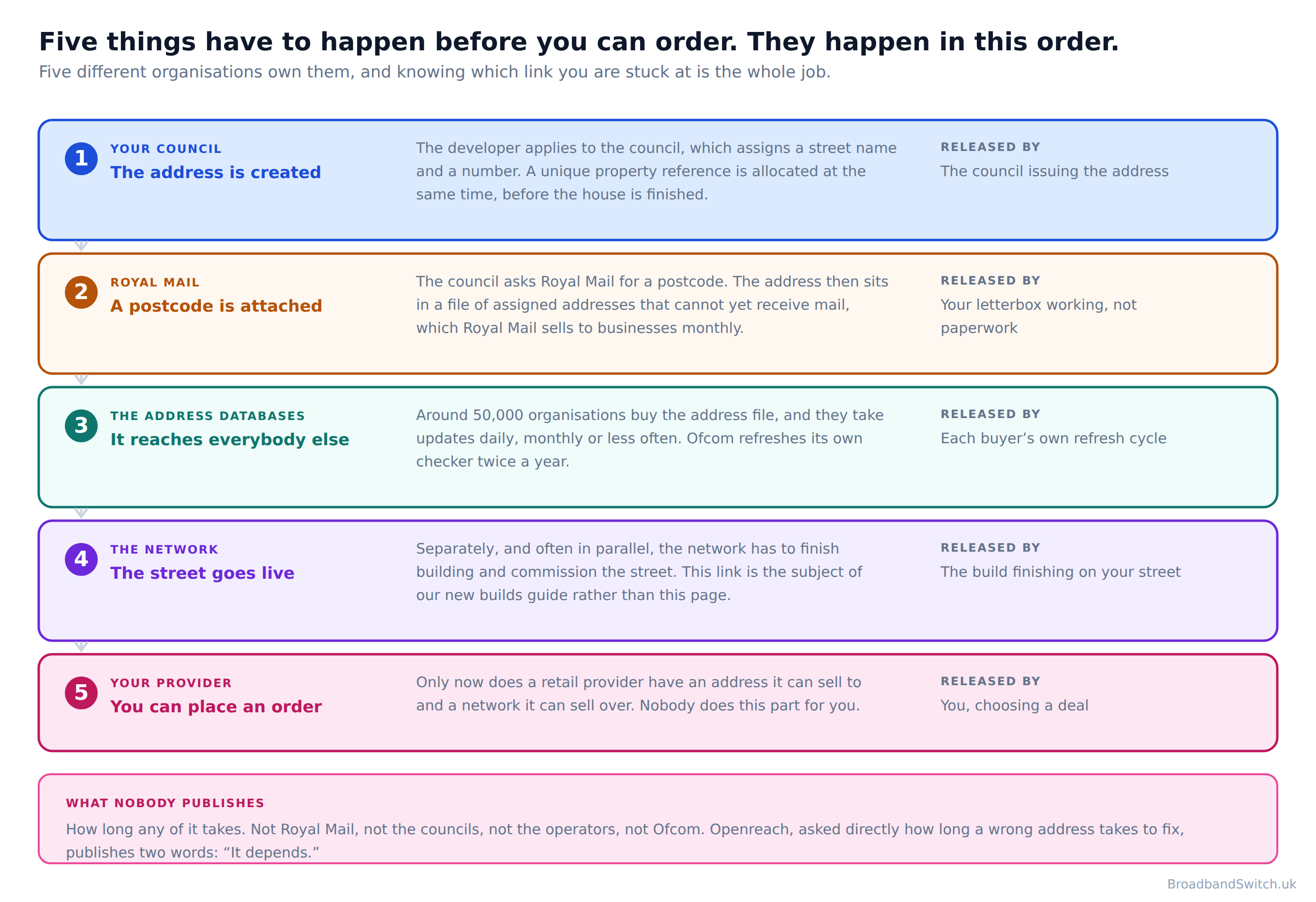
Start at the top, because everything else waits on it, and it is the link the sentence above puts plainly: the council creates the address and the developer is the one who applies for it. Royal Mail’s part comes next and is narrower than most people assume: “Royal Mail assigns a Postcode and passes this information back to the local authority as soon as it is available.” It is also exclusive: “Royal Mail is the only organisation in the UK to assign Postcodes.”
Something happens even before that, which nobody tells buyers about at all, and it involves an organisation almost no reader will have heard of. “GeoPlace is a Limited Liability Partnership (LLP) jointly owned by the Local Government Association and Ordnance Survey, providing the central source of information for all UK addresses and streets.” It hands each council a range of permanent identifiers, and the council allocates one to your home “We give a range of UPRNs to each local authority, which allocates one to each new address as soon as 'street naming and numbering' gets started or 'construction' starts - whichever comes first.” Then: “From the planning stage, right through to demolition, the UPRN never changes.” So your house has a national reference number before it has a roof.
That identifier is not a curiosity. It is what the country’s broadband coverage data is actually built on. Ofcom, setting out how it measures the whole United Kingdom, describes a base built by “AddressBase includes information about 44 million addresses, properties, and land areas where services are provided, by combining three datasets: Local Government National Land and Property Gazetteer (NLPG), Ordnance Survey MasterMap address layer, Royal Mail Postal Address File (PAF)”, and then publishes the figure that shows how much rides on the identifier itself: “31.4 million premises (97.1%) were matched to provider records using only the UPRN.”
The link most people never reach, and the reason they get stuck
Between the council creating your address and a checker finding it, there is a step with no paperwork in it at all. It is covered properly in the next section, and the short version is that the condition is physical rather than administrative: “New or existing addresses cannot be added to the Postcode Address File unless they are able to receive a delivery of mail.”
Find the link you are stuck at, and write to the body that owns it
Direct answer: Find out which link in the chain you are stuck at, because the five have five different owners and only one of them is worth an email this week.
Four questions. Three of them place you on the chain and the fourth changes what the letter says rather than which link you are at. Then the tool writes the letter, addressed to whichever organisation actually owns that link, which for two of the five is not the developer and for one of them is nobody at all.
It runs entirely in your browser. There is no form to submit, nothing sent to any server and nothing stored: what you choose and type is assembled on this page and gone when you close the tab. Every quoted line inside it is published wording from the body named, and where nobody publishes a timescale it says so rather than estimating one.
Find the link that is actually holding you up, and write to the body that owns it
Four questions. Five organisations have to act before a new address can be ordered at, and for two of the five links the developer is not the right person to ask. Nothing you choose or type here leaves your browser.
Why your address is in the wrong file
Direct answer: Royal Mail keeps two address files. Broadband checkers read one of them, and a working letterbox is what moves an address across.
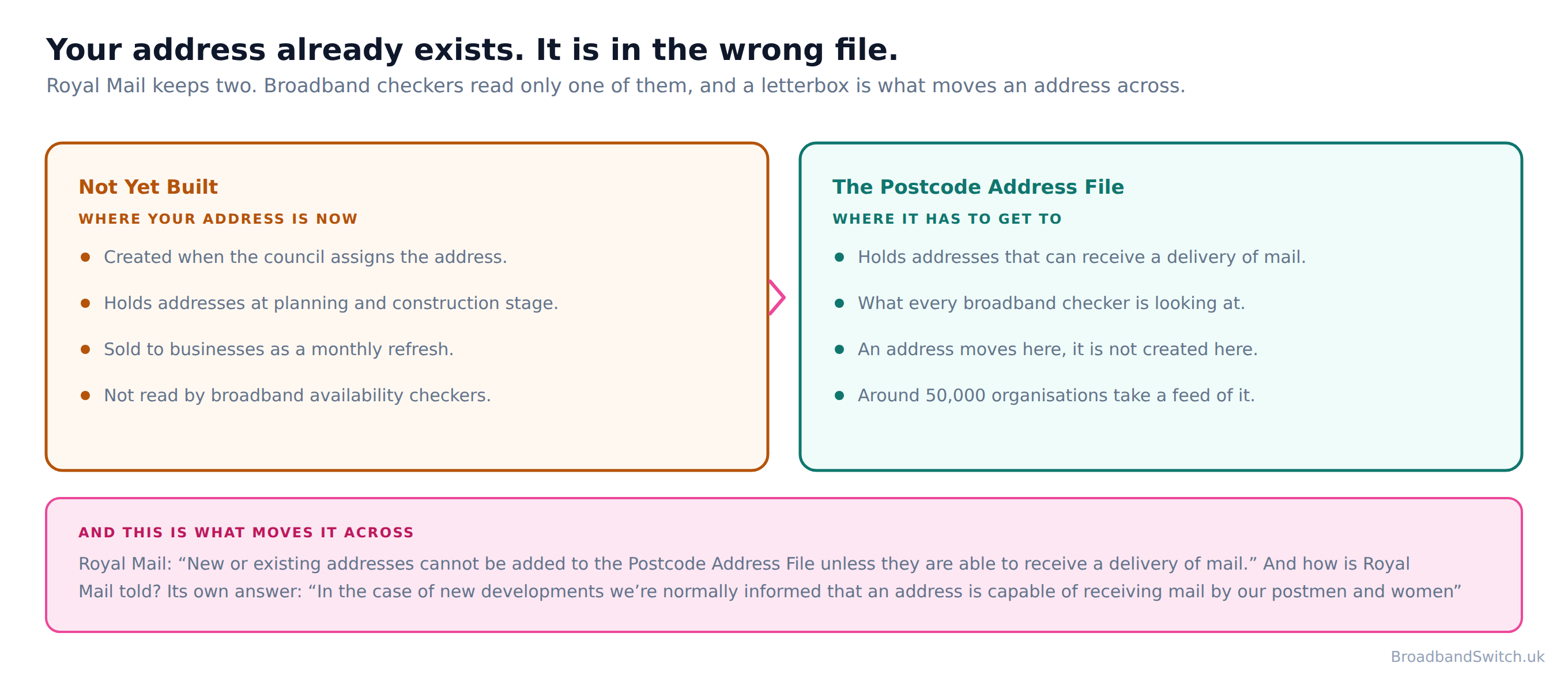
When your council creates the address and Royal Mail attaches a postcode, the result does not go straight into the file the checkers read. It goes somewhere else first: “Once created, new addresses enter PAF Not Yet Built address product: a file of assigned addresses that aren't yet capable of receiving mail.” That file has a name and a price. Royal Mail publishes: “Royal Mail forms part of the process when an address is created, meaning that information relating to new developments is received from Local Authorities on a daily basis. We capture this new address information on our Not Yet Built database and can supply you with a full refresh of data monthly.” And what it is for: “By using Not Yet Built together with PAF businesses can identify and deliver services to the addresses of properties that are at the planning and construction stage.”
Read that twice, because it is the oddest fact on this page. Your address exists, Royal Mail has it, and Royal Mail is already selling it to businesses on a monthly refresh, at a point where you personally cannot order a broadband service at it. Nothing about that is improper. It is simply not what anybody assumes is happening.
What moves it across is published plainly and it is not a form: “New or existing addresses cannot be added to the Postcode Address File unless they are able to receive a delivery of mail.” The trigger is an event rather than a date: “Once the local Delivery Office has confirmed the address is able to receive mail, our team adds it to PAF.” And how is Royal Mail normally told? “In the case of new developments we're normally informed that an address is capable of receiving mail by our postmen and women”, and they capture details of thousands of address changes every year whilst out on their walks.
So do not report your address early, and here is Royal Mail asking you not to
“If you haven't moved in yet please only let us know about this property no more than 2 weeks before you move.” The reporting route is genuinely useful and it is the right thing to do once post is arriving. Doing it in advance cannot work, because the thing being asked for is the one thing that cannot be granted yet. The page this replaces told readers to do exactly that, and that correction is set out below with the other four.
One thing Royal Mail does commit to, once you are in a position to report: “We'll drop you another email within two working days to confirm the outcome of our investigation, or in some cases, to request further information.” And for a change it has agreed: “Changes to PAF may take up to five days to come into effect and to appear on Royal Mail's Postcode Finder.” Note the scope of that second figure carefully, because it is the one most often quoted as though it meant something else. It is how long an agreed change takes to show on Royal Mail’s own finder. It is not how long it takes to create an address.
A plot number is not an address
Direct answer: Four different identifiers attach to a new home, four different bodies issue them, and only one of them is the address you order broadband against.
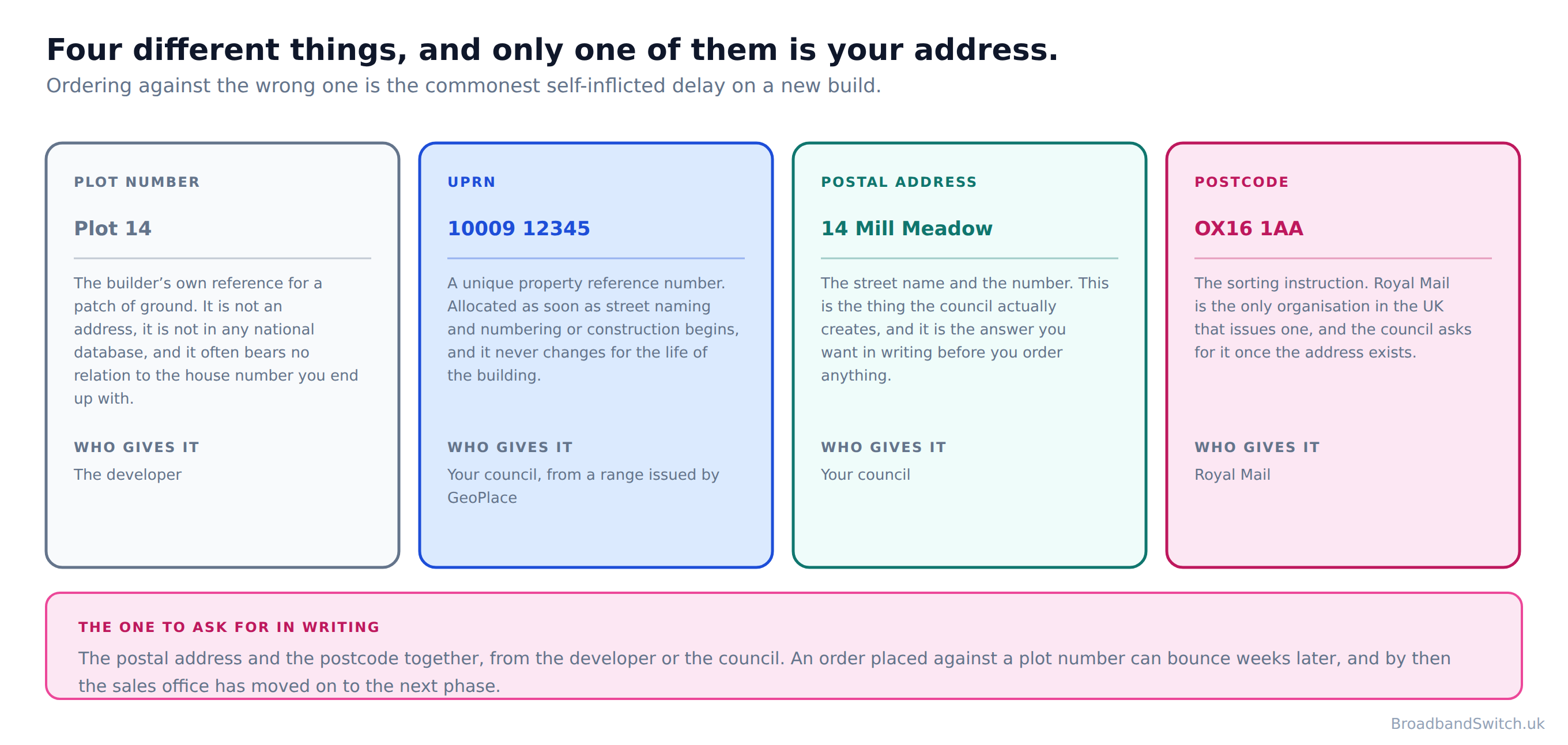
Ordering against a plot number is the commonest self-inflicted delay on a new build, and it is easy to do, because during construction the plot number is the only reference anybody uses. It is the builder’s own shorthand for a patch of ground. No national database holds it, no checker will ever find it, and an order placed against it can fail weeks later when somebody tries to match it to a real address.
The confirmed postal address is the one to ask for, and to ask for in writing. It is created by your council, which is the body the rest of this page keeps returning to, and the developer applied for it so they hold it. Getting it wrong at this stage is the single most expensive small mistake in the whole subject.
Why the reference number is worth knowing about too
Because it is stable when nothing else is. “From the planning stage, right through to demolition, the UPRN never changes.” If you are ever asked to prove which property you mean, or you find two versions of your address in circulation, that number settles it. Most councils will tell you yours, and it is what the national coverage data is keyed on.
Who owns each link, and what they can actually do
Direct answer: Five organisations, and for two of the five links the honest answer is that nobody can move it for you yet.
Your council
Creates the address. It is the only body that can, and in Northern Ireland nidirect states the function about as plainly as anybody does: “City, borough and district councils allocate postal numbers to houses and buildings in their area. They also name new roads and streets.” It also works with the builder rather than around them: “The council involves the land developer in the street naming process. They invite suggestions and possible alternative names from the developer.”
Royal Mail
Attaches the postcode and holds the address until it can receive post. Nothing more, and it says so: “If your request relates to the change of property name or street name however, you will need to contact your Local Authority, as they are solely responsible for this.” It cannot bring the release forward and does not publish a timescale for it.
The address databases
Buy a copy of the file and refresh on their own schedules. “Around 50,000 organisations in the UK access PAF, most using the data in an addressing solution purchased through a PAF Solutions Providers. Many of our Solutions Providers take updates to PAF on a daily or a monthly basis, others less frequently.” Nobody can make one of them take an update sooner.
The network
Builds and commissions your street, in parallel with all of the above. This one is the subject of our new builds guide rather than this page, and it is the link most people assume they are at.
Your provider
Sells you a service, and can raise an address record with the network on your behalf: “They'll contact Openreach on your behalf to get the records checked and corrected.” It cannot create an address and cannot find one that Royal Mail does not have.
Two honest observations about that list. Not one of the six networks publishes where its address data comes from. Ofcom is the only body in the chain that publishes its address base at all. That is the first. The second is that where a network does publish something, the wording is careful: Openreach admits “We do our best to keep the Fibre Checker accurate and up to date, but sometimes it might show the wrong details for your address.” and explains it as “This can happen because of the way our network records are matched to properties.”, which is as close as any of them comes to naming a source.
And the part of English addressing law nobody can look up
Which is worth knowing before you assume your council is being slow by comparison with somebody else’s. The department responsible published this about the English street naming powers: “There is no central register of which councils have adopted which of the three Acts, which has led to a confusing mix of provisions across England, some of which are over a century old with no transparency on which Acts apply where.” There is no national timescale for street naming and numbering and no national service standard. Individual councils publish their own targets and they differ by a factor of three. So there is no national standard to hold a council to, and no way for this page to tell you which rules yours is working to.
Who to write to, and in what order
Direct answer: The developer first, then your council’s street naming and numbering team, then Royal Mail but only once you have moved in, and a provider rather than Royal Mail if Royal Mail already has you.
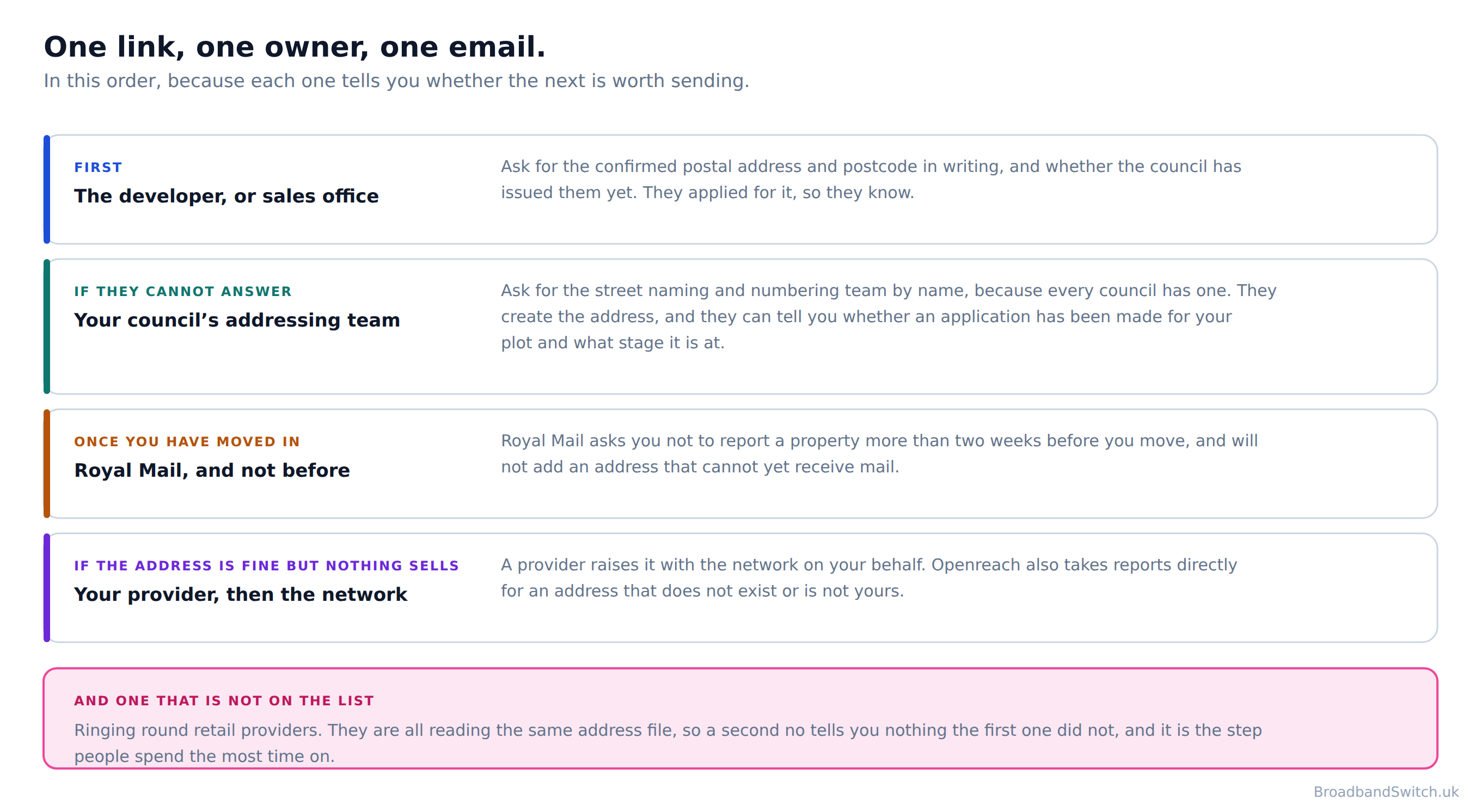
The order matters because each answer tells you whether the next letter is worth sending. The developer applied for the address, so they know whether it exists and what it is. If they cannot say, the council can, because the council issued it. Royal Mail can only help once the property can receive mail. And a provider is the right recipient in exactly one case: where Royal Mail already has your address and a checker does not.

The tracer above writes that letter, addressed to whichever body your answers point at, and you can edit every word before it goes. If you would rather write your own, the four questions it asks are the whole of it: what the confirmed address and postcode are, when the council issued them, whether Royal Mail has been given them, and which network reached the plot.
The step most people spend longest on, and it is not on the list
Ringing round retail providers. They are all reading a copy of the same address file, so a second checker returning nothing tells you nothing the first one did not, and the time goes nowhere. The one exception is the case where Royal Mail has your address and one provider does not: then a different provider genuinely might, because they refresh on different schedules.
Why two people on the same street wait different lengths of time
Direct answer: Nobody publishes how long any of this takes. Not Royal Mail, not the councils, not the operators, not Ofcom. The figure this page used to carry had no published source.
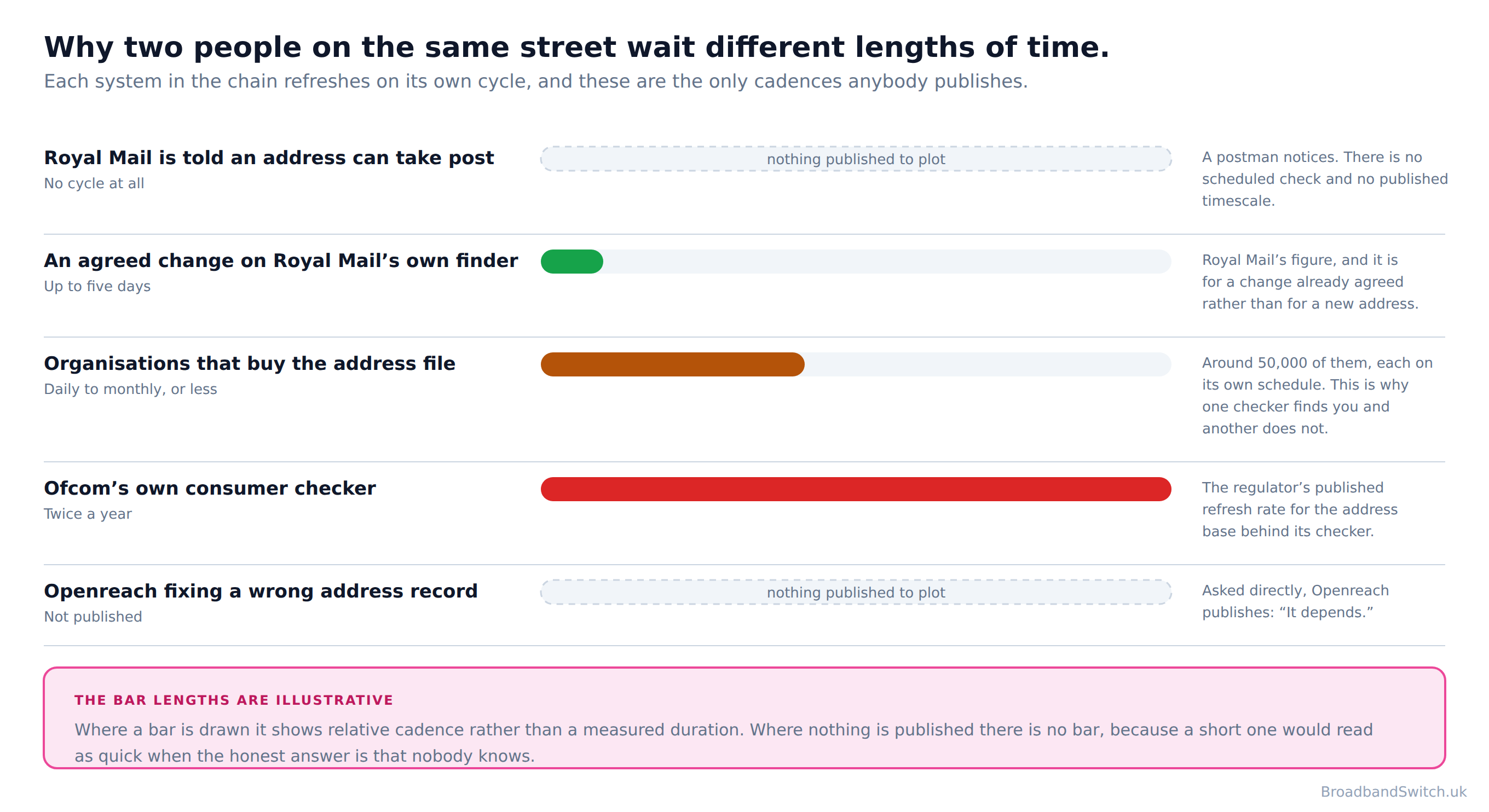
Every figure on that chart is published wording and every gap on it is a real absence rather than something we could not find. Openreach, asked in terms how long it takes to fix a wrong checker result, publishes two words: “It depends.” Then: “Simple record corrections can be quick, but if engineering checks are needed it may take longer.” That is the whole answer, and it is more honest than most of what is written about this.
Ofcom publishes the one cadence that explains most of the confusion, and it is about the regulator’s own consumer checker rather than about any company: “Ofcom uses data from the Ordnance Survey to provide the base dataset used to assess broadband for properties in the UK.” And: “This data is updated in our checker twice a year, so some properties may not be identified at least until these updates have been implemented.” A house can be standing, occupied and receiving post, and still be missing from the national checker for months, for no reason other than a refresh cycle.
It is not only new builds either. Ofcom’s own methodology reports a residue it cannot confidently match at all: just over 81,000 premises in the July 2025 premise base where no confident match could be used. That is the scale of the gap between the map and the country, published by the body that draws the map.
What this means for you, practically
That a timescale is the wrong thing to plan around, because nobody owes you one and nobody has published one. Plan around what you control instead: get the address confirmed in writing, check it on Royal Mail’s own finder, and put something in place that needs no engineer. Those three all work whatever the chain is doing.
Getting online while the chain finishes
Direct answer: Something that needs no engineer covers the whole gap, which is why an address delay is never a reason to move a completion date.

A 4G or 5G home broadband package needs no address in anybody’s file beyond a postcode, no ducting, no street works and no engineer. It arrives in a box and works the same afternoon, and you retire it when the fixed line is ready. Our 5G home broadband deals and 4G home broadband deals are the short lists, and mobile broadband as a temporary bridge covers the same gap for a single laptop.
Two things worth doing in the same week, because they cost nothing and they both shorten the tail. Get the confirmed postal address and postcode in writing from the developer. And check that address on Royal Mail’s own postcode finder, because whether it is there or not splits the problem cleanly in two and tells you which half of this page applies to you.
And one to do the week you move in
Report the address to Royal Mail, once post is arriving. That is the moment the reporting route becomes useful, and it is the moment the page this replaces told you the moment had passed. “We'll drop you another email within two working days to confirm the outcome of our investigation, or in some cases, to request further information.”
If you are renting the new build rather than buying it, the ordering is the same and the permissions are not: our renters guide covers what you may arrange in your own name, and switching in a new build before the line is live covers the contract side.
Broadband at your postcode
Every provider that can find your address
One postcode shows every provider we can switch you to, lowest price first, across full fibre, FTTC, cable and 5G home broadband. If your address is not in the file yet, the 5G packages need nothing from it.
Show every provider at my postcode →What this page used to say, and why it changed
Direct answer: Five corrections. One is the reason the page was rebuilt, one is a timescale with no source, one is a cause the page never named, one misreads the scope of the cost cap, and one treated England as the whole United Kingdom.
Naming a correction rather than quietly making it is the house rule here. The version being replaced was a clear and readable page, and its problem was not carelessness: it was built from the regulations and a developer-facing summary rather than from what the operators publish about the thing a buyer is actually looking at.
Telling readers to get their address added to the Royal Mail file
What it saidThis page said: “get the postal address added to the Royal Mail address file, which providers rely on”, and listed it as one of two steps that “clear most cases”.
What it says nowYou cannot, and Royal Mail publishes why on the very form you would use: “New or existing addresses cannot be added to the Postcode Address File unless they are able to receive a delivery of mail.” It also asks you not to report a property you have not moved into yet: “If you haven't moved in yet please only let us know about this property no more than 2 weeks before you move.” The step is real and it is worth doing. It comes after you move in, not before, and telling somebody to do it in advance sends them to the one body that has published that it cannot help them yet.
Never mentioning the body that actually creates an address
What it saidThe page named Royal Mail, the developer, the network and individual providers. It never mentioned a local authority once.
What it says nowThe council creates the address and Royal Mail adds the postcode, which is the opposite way round from the way the page implied. Royal Mail's own account: “When building a new development, property developers contact the Local Authority to request a new address. The Local Authority assigns a street name and number and contacts Royal Mail to request a Postcode.” And on its consumer page: “If your request relates to the change of property name or street name however, you will need to contact your Local Authority, as they are solely responsible for this.” A reader with only a plot number was being pointed at everybody except the one organisation that could actually answer them.
How long it takes
What it saidThe page said a delay is “normally a matter of weeks, not months”, that it “usually resolve[s] within weeks”, and repeated the figure twice more in the FAQ.
What it says nowNobody publishes how long any of this takes. Not Royal Mail, not the councils, not the operators, not Ofcom. The figure this page used to carry had no published source. Openreach, asked directly, publishes two words: “It depends.” The figure was not wrong so much as unsourced, and in this subject that is worse than no figure at all: a buyer who plans around it and misses it has been set up to be disappointed by a process that was never late.
Treating two different causes as one
What it saidThe page gave a single answer for an address that is missing: chase Royal Mail and the developer.
What it says nowRoyal Mail not having your address and Royal Mail having it while a checker does not are different links in the chain with opposite fixes. For the first, nobody can help yet. For the second, Royal Mail has already done its part and it is a provider you want, because “Around 50,000 organisations in the UK access PAF, most using the data in an addressing solution purchased through a PAF Solutions Providers. Many of our Solutions Providers take updates to PAF on a daily or a monthly basis, others less frequently.” However, it will take longer for the PAF changes to filter out to other organisations. The tracer on this page exists to tell those two apart.
Saying the developer chose your network
What it saidThe page said: “Start with your developer, since they chose the network and hold the site details.”
What it says nowThe first half of that is right and the second is the claim we corrected on our new builds guide in the same week. Not one of the six operators building to UK new-build developments publishes any claim to be the only network allowed on a site. Hyperoptic publishes the opposite: “Our infrastructure can coexist alongside other network providers.” Start with the developer by all means, because they do hold the site details. Not because they picked your provider, which they did not.
If you read the old version and acted on it, the one that mattered most is the first. A buyer who concluded from a single no that their plot had nothing may have spent months waiting for a network that was never coming, when a different one had already built to the street.
New-build addresses: frequently asked questions
Why can I not order broadband at my new-build address?
Because one of five links in a chain has not finished, and they belong to five different organisations. Five things have to happen before broadband can be ordered at a brand new address, they happen in a fixed order, and five different organisations do them. The council creates the address, Royal Mail attaches a postcode and holds it until the property can receive mail, the address then reaches the databases that broadband checkers read, the network commissions the street, and only then can a provider take an order. The tracer on this page works out which link you are at in four questions, because the fix is different at each one.
Who actually creates a UK postal address?
Your council does, and Royal Mail's own published account of it is unambiguous: “When building a new development, property developers contact the Local Authority to request a new address. The Local Authority assigns a street name and number and contacts Royal Mail to request a Postcode.” Royal Mail's part is the postcode: “Royal Mail is the only organisation in the UK to assign Postcodes.” nidirect puts the council function plainly for readers in Northern Ireland, and the position is the same across the UK: “City, borough and district councils allocate postal numbers to houses and buildings in their area. They also name new roads and streets.”
Can I ask Royal Mail to add my address early?
No, and this page used to suggest you could, which is corrected below. Royal Mail publishes on the reporting form itself: “New or existing addresses cannot be added to the Postcode Address File unless they are able to receive a delivery of mail.” And it asks you not to report early: “If you haven't moved in yet please only let us know about this property no more than 2 weeks before you move.” So the step exists, it is useful, and it comes after you have moved in rather than before.
What moves my address into the file the checkers read?
Your letterbox working. Royal Mail: “Once the local Delivery Office has confirmed the address is able to receive mail, our team adds it to PAF.” And how is it normally told? “In the case of new developments we're normally informed that an address is capable of receiving mail by our postmen and women”, and they capture details of thousands of address changes every year whilst out on their walks. There is no application to make and no form that brings it forward, which is genuinely unusual and is why no timescale is published for it.
My address is on Royal Mail's finder but not on the broadband checkers. Why?
Because they are reading licensed copies that refresh on their own schedules. Royal Mail: “Around 50,000 organisations in the UK access PAF, most using the data in an addressing solution purchased through a PAF Solutions Providers. Many of our Solutions Providers take updates to PAF on a daily or a monthly basis, others less frequently.” And: “However, it will take longer for the PAF changes to filter out to other organisations.” Ofcom's own consumer checker states its cadence: “This data is updated in our checker twice a year, so some properties may not be identified at least until these updates have been implemented.” This is the stage most often mistaken for the one before it, and the fix is the opposite: go to a provider, not to Royal Mail.
How long does any of this take?
Nobody publishes how long any of this takes. Not Royal Mail, not the councils, not the operators, not Ofcom. The figure this page used to carry had no published source. Openreach, asked directly how long it takes to fix a wrong result, publishes two words: “It depends.” Followed by: “Simple record corrections can be quick, but if engineering checks are needed it may take longer.” The only published cadences are for different things entirely: five days for an already agreed change to appear on Royal Mail's own finder, and twice a year for Ofcom's checker. Neither is a timescale for creating a new address.
Is my plot number my address?
No, and ordering against it is the commonest self-inflicted delay on a new build. A plot number is the builder's own reference for a patch of ground. It is in no national database and no checker will ever find it. Four different identifiers attach to a new home and only one of them is the address you order against.
What is a UPRN, and why should I care?
It is the identifier that follows your home for its whole life, and it exists before the house does. “GeoPlace is a Limited Liability Partnership (LLP) jointly owned by the Local Government Association and Ordnance Survey, providing the central source of information for all UK addresses and streets.” It publishes that a council allocates one “We give a range of UPRNs to each local authority, which allocates one to each new address as soon as 'street naming and numbering' gets started or 'construction' starts - whichever comes first.” And: “From the planning stage, right through to demolition, the UPRN never changes.” It matters because it is what the coverage data is actually built on: Ofcom reports that “31.4 million premises (97.1%) were matched to provider records using only the UPRN.”
Who should I contact, and in what order?
The developer first, because they applied for the address and hold the answer. Then your council's street naming and numbering team if the developer cannot answer, because they create the address. Then Royal Mail, but only once you have moved in. And a provider rather than Royal Mail if the address is already on Royal Mail's finder. The order is set out properly here, and the tracer writes the letter to whichever of them your answers point at.
A provider cannot find my address. Can I report it to the network directly?
With Openreach, yes. It explains why it happens: “This can happen because of the way our network records are matched to properties.” Among the things it lists as worth reporting is “An address that doesn't exist or isn't yours”, and it sets out the route through a retail provider: “They'll contact Openreach on your behalf to get the records checked and corrected.” Virgin Media, nexfibre and Community Fibre publish no way at all to report an address their checker cannot find. Hyperoptic publishes a route and names the cause first on its own list: “Your property is a new build”
Should I delay my move because the broadband is not ready?
No. A fixed line is the one part of a move that something else covers completely. A 4G or 5G package needs no engineer, no ducting and no street works, and you retire it when the fixed line arrives. The section on this page sets out what to do in the meantime, and it is built round what you control rather than round a date nobody publishes.
Is anything on this page not published anywhere?
Three things, and their absence is deliberate. Nobody publishes how long any of this takes. Not Royal Mail, not the councils, not the operators, not Ofcom. The figure this page used to carry had no published source. There is no national timescale for street naming and numbering and no national service standard. Individual councils publish their own targets and they differ by a factor of three. Not one of the six networks publishes where its address data comes from. Ofcom is the only body in the chain that publishes its address base at all. Where nobody publishes a figure this page says so rather than estimating one, and every quotation here carries the date it was read.
In short
- Your home almost certainly has an address already. What it does not have yet is a postcode in the file every broadband checker reads, and the thing that releases it is not paperwork.
- Five things have to happen before broadband can be ordered at a brand new address, they happen in a fixed order, and five different organisations do them.
- The council creates it: “When building a new development, property developers contact the Local Authority to request a new address. The Local Authority assigns a street name and number and contacts Royal Mail to request a Postcode.”
- Royal Mail's part: “Royal Mail assigns a Postcode and passes this information back to the local authority as soon as it is available.” And: “Royal Mail is the only organisation in the UK to assign Postcodes.”
- It sends you to the council too: “If your request relates to the change of property name or street name however, you will need to contact your Local Authority, as they are solely responsible for this.”
- In Northern Ireland, put plainly: “City, borough and district councils allocate postal numbers to houses and buildings in their area. They also name new roads and streets.” And: “The council involves the land developer in the street naming process. They invite suggestions and possible alternative names from the developer.”
- The identifier comes first: “We give a range of UPRNs to each local authority, which allocates one to each new address as soon as 'street naming and numbering' gets started or 'construction' starts - whichever comes first.”
- And it outlives everything: “From the planning stage, right through to demolition, the UPRN never changes.”
- Who GeoPlace is: “GeoPlace is a Limited Liability Partnership (LLP) jointly owned by the Local Government Association and Ordnance Survey, providing the central source of information for all UK addresses and streets.”
- The file your address is in now: “Once created, new addresses enter PAF Not Yet Built address product: a file of assigned addresses that aren't yet capable of receiving mail.”
- Which is sold: “Royal Mail forms part of the process when an address is created, meaning that information relating to new developments is received from Local Authorities on a daily basis. We capture this new address information on our Not Yet Built database and can supply you with a full refresh of data monthly.”
- And what it is sold for: “By using Not Yet Built together with PAF businesses can identify and deliver services to the addresses of properties that are at the planning and construction stage.”
- The condition for the file you need: “New or existing addresses cannot be added to the Postcode Address File unless they are able to receive a delivery of mail.”
- What meets it: “Once the local Delivery Office has confirmed the address is able to receive mail, our team adds it to PAF.”
- And how Royal Mail is told: “In the case of new developments we're normally informed that an address is capable of receiving mail by our postmen and women”, and they capture details of thousands of address changes every year whilst out on their walks.
- So do not report early: “If you haven't moved in yet please only let us know about this property no more than 2 weeks before you move.”
- When you do report, the one undertaking given: “We'll drop you another email within two working days to confirm the outcome of our investigation, or in some cases, to request further information.”
- And for an agreed change: “Changes to PAF may take up to five days to come into effect and to appear on Royal Mail's Postcode Finder.”
- But: “However, it will take longer for the PAF changes to filter out to other organisations.”
- Because: “Around 50,000 organisations in the UK access PAF, most using the data in an addressing solution purchased through a PAF Solutions Providers. Many of our Solutions Providers take updates to PAF on a daily or a monthly basis, others less frequently.”
- Ofcom's base: “Ofcom uses data from the Ordnance Survey to provide the base dataset used to assess broadband for properties in the UK.” Refreshed: “This data is updated in our checker twice a year, so some properties may not be identified at least until these updates have been implemented.”
- What it is built from: “AddressBase includes information about 44 million addresses, properties, and land areas where services are provided, by combining three datasets: Local Government National Land and Property Gazetteer (NLPG), Ordnance Survey MasterMap address layer, Royal Mail Postal Address File (PAF)”
- How much rides on the identifier: “31.4 million premises (97.1%) were matched to provider records using only the UPRN.”
- And the residue: just over 81,000 premises in the July 2025 premise base where no confident match could be used
- Openreach admits the gap: “We do our best to keep the Fibre Checker accurate and up to date, but sometimes it might show the wrong details for your address.” Because: “This can happen because of the way our network records are matched to properties.”
- How long to fix it: “It depends.” “Simple record corrections can be quick, but if engineering checks are needed it may take longer.”
- The route: “They'll contact Openreach on your behalf to get the records checked and corrected.”
- Hyperoptic's first listed cause: “Your property is a new build”
- CityFibre: “Address information is reviewed and updated on an ongoing basis, but occasionally an address may not appear as expected within the checker.”
- Virgin Media, nexfibre and Community Fibre publish no way at all to report an address their checker cannot find.
- Not one of the six networks publishes where its address data comes from. Ofcom is the only body in the chain that publishes its address base at all.
- On the English naming powers: “There is no central register of which councils have adopted which of the three Acts, which has led to a confusing mix of provisions across England, some of which are over a century old with no transparency on which Acts apply where.”
- There is no national timescale for street naming and numbering and no national service standard. Individual councils publish their own targets and they differ by a factor of three.
- Nobody publishes how long any of this takes. Not Royal Mail, not the councils, not the operators, not Ofcom. The figure this page used to carry had no published source.
- Nobody in this chain is being slow on purpose. Each link waits on the one before it, and the last two are databases on refresh cycles rather than people ignoring you.
- Every link in this chain is knowable, three of the five you can check yourself in an afternoon, and none of it requires anybody to do you a favour.
- Find out which link in the chain you are stuck at, because the five have five different owners and only one of them is worth an email this week.
Each line stands on its own and carries its date. Reviewed by a person at least quarterly, last on 28 September 2026.
References
- Royal Mail
Royal Mail. Report an incorrect or missing address, the statement that new or existing addresses cannot be added to the Postcode Address File unless they are able to receive a delivery of mail, the request that a property not yet moved into is reported no more than two weeks before the move, and the reporting options including a newly built property. The page carries no publication or last-updated date, so it was read on 28 September 2026. royalmail.com
- Royal Mail
Royal Mail Group. Delivering Mail Efficiently: how PAF is maintained, the account of how a new address is created: that property developers contact the local authority to request a new address, that the local authority assigns a street name and number and contacts Royal Mail to request a postcode, that Royal Mail assigns the postcode and passes it back, that Royal Mail is the only organisation in the UK to assign postcodes, that new addresses enter the Not Yet Built product, and that the address is added to the Postcode Address File once the local delivery office confirms it can receive mail. The document carries no printed date, so the reading date of 28 September 2026 is its only anchor. Published on Royal Mail Group’s PAF Licensing Centre site. poweredbypaf.com
- Royal Mail
Royal Mail Group. My address is wrong, missing, does not exist or is not recognised, the statement that changes to the Postcode Address File may take up to five days to appear on Royal Mail’s postcode finder and longer to filter out to other organisations, that around 50,000 organisations access the file through solutions providers taking updates daily, monthly or less frequently, that a confirmation of the outcome of an investigation follows within two working days, that in the case of new developments Royal Mail is normally informed that an address is capable of receiving mail by its postmen and women, and that a change of property or street name is solely the local authority’s responsibility. Published 22 March 2016, last modified 10 March 2026, read 28 September 2026. poweredbypaf.com
- Royal Mail
Royal Mail Group. Not Yet Built, the statement that information on new developments is received from local authorities daily, that it is captured on the Not Yet Built database and supplied as a monthly full refresh, and that businesses use it together with the Postcode Address File to identify and deliver services to properties at the planning and construction stage. The page shows no visible date; its metadata gives 1 October 2025. Read 28 September 2026. poweredbypaf.com
- GeoPlace
GeoPlace LLP. How an address is created, the statement that GeoPlace gives a range of unique property reference numbers to each local authority which allocates one to each new address as soon as street naming and numbering gets started or construction starts, whichever comes first; and Frequently asked questions, the description of GeoPlace as a limited liability partnership jointly owned by the Local Government Association and Ordnance Survey providing the central source of information for all UK addresses and streets, and the statement that the unique property reference number never changes from planning stage through to demolition. Neither page shows a date, so both were read on 28 September 2026. geoplace.co.uk
- Ofcom
Ofcom. About the Broadband and mobile checker, the statement that Ofcom uses Ordnance Survey data as the base dataset for assessing broadband and that the data is updated in the checker twice a year, so some properties may not be identified until those updates have been implemented. No date shown, read 28 September 2026. ofcom.org.uk
- Ofcom
Ofcom. Connected Nations 2025: methodology annex, the statement that AddressBase combines the Local Government National Land and Property Gazetteer, the Ordnance Survey MasterMap address layer and the Royal Mail Postcode Address File; the figure that 31.4 million premises, being 97.1%, were matched to provider records using only the unique property reference number; and the figure of just over 81,000 premises in the July 2025 premise base where no confident match could be used. Published 19 November 2025, read 28 September 2026. ofcom.org.uk
- Openreach
Openreach. My Fibre Checker result is wrong, the admission that the checker may show the wrong details for an address and that this can happen because of the way network records are matched to properties, the list of reportable problems including an address that does not exist or is not yours, the route through a broadband provider, and the answer given to how long a fix takes, which is “It depends.” The page carries no publication or last-updated date, so it was read on 28 September 2026. openreach.com
- Hyperoptic
Hyperoptic. Check availability and register interest, the list of reasons an address may not appear in its availability checker, of which a new-build property is the first. Of the five networks other than Openreach that were checked, this is the only one publishing a missing-address process. Undated, read 28 September 2026. hyperoptic.com
- CityFibre
CityFibre. Queries on availability checker results, the statement that address information is reviewed and updated on an ongoing basis but that occasionally an address may not appear as expected within the checker. CityFibre also publishes a page titled for a missing or incorrect address whose answer does not address the question. Undated, read 28 September 2026. cityfibre.com
- Government
Department for Levelling Up, Housing and Communities. Technical consultation on street naming, the statement that there is no central register of which councils have adopted which of the three Acts, which has led to a confusing mix of provisions across England, some of which are over a century old with no transparency on which Acts apply where. Published 11 April 2022, last updated 5 July 2022, read 28 September 2026. gov.uk
- Government
nidirect. How streets are named and numbered, the statement that city, borough and district councils allocate postal numbers to houses and buildings in their area and also name new roads and streets, and that the council involves the land developer in the street naming process. Quoted because it is the clearest consumer-facing statement of the council function published anywhere in the UK. Published 6 November 2015, last updated 19 August 2024, read 28 September 2026. nidirect.gov.uk
- Legislation
The statutory basis for street naming and numbering, checked on 28 September 2026 and cited rather than quoted because it differs by nation and by council: in England and Wales the numbering power is sections 64 and 65 of the Towns Improvement Clauses Act 1847, incorporated by section 160 of the Public Health Act 1875, with naming under either that provision or sections 17 to 19 of the Public Health Act 1925 depending on which applied to the area before 1 April 1974; in Scotland it is section 97 of the Civic Government (Scotland) Act 1982; in Northern Ireland it is Article 11 of the Local Government (Miscellaneous Provisions) (Northern Ireland) Order 1995. legislation.gov.uk
Ready to see what your address can actually get?
One postcode shows every provider that can reach your exact address, lowest price first. If nothing comes back, that is information rather than a dead end, and the tracer further up this page tells you which link is holding it.
Compare at your postcode →