BRISTOL · FIVE SEATS · THIRTY-FOUR WARDS
Bristol broadband: fibre and cable ward by ward, and the 2029 catch-up
Bristol is one of England’s best-served cities for gigabit broadband, thanks to two networks working side by side. In January 2026, Ofcom found 94.7% of its 204,332 homes able to get a gigabit-capable line, well above England’s 89.5%. Full fibre reached 83.3%, and Virgin Media’s cable covered most of the difference.
The plans are the exciting part. Bristol has the least full fibre of the eight core cities today, yet the builders’ forecasts lift it to 99.3% by January 2029, the highest of the eight. By then, 94.8% of homes should be able to choose between two gigabit networks or more. The slow lines that remain, 3,543 homes below 30Mbit/s, are gathered in Lawrence Hill, the centre, Hengrove and Southville.
Each number on this page is dated and sourced: Ofcom, the 2021 census, Openreach, the council and the networks. Inside are all five seats and 34 wards, every network quoted directly, each exchange’s copper date and the change coming to phone lines on 31 January 2027. Your own address is settled by the postcode check. Just beyond the city? Swindon, up the M4, and Newport, over the Severn, have their own pages.
Want your own neighbourhood? The ward card has it, and the skyline shows it beside the rest. After the best price? Go to the postcode check.
First, your own address
Direct answer: Most Bristol homes already have a choice of network. In January 2026, Ofcom found 94.7% of homes able to get a gigabit-capable line and 83.3% able to get full fibre, and the builders’ plans give 94.8% two gigabit networks or more by 2029. The live list below shows what is on sale at your own door today.
Bristol runs on two layers. Openreach’s full fibre now passes most streets, and Virgin Media’s cable brings gigabit speeds to many of the homes that fibre has not reached yet. Around the edges, newer networks such as YouFibre and Truespeed are building in South Gloucestershire, just over the boundary. The networks section quotes each one in its own words. Because every network has built street by street, the list at your address can look quite different from a friend’s across town.
Moving provider is easier than you might think
Ofcom’s One Touch Switch process has covered home broadband since 12 September 2024. Its guidance is: “Contact the provider you want to move to, and they will manage the switch for you.” It also bars the old provider from billing you for notice after the switch date. In practice, you place the new order and leave the rest to the incoming provider, with no awkward call to the old one.
Fibre and cable: the two layers under Bristol
Direct answer: Bristol leans on cable more than any other core city. Ofcom counted 83.3% of homes able to get full fibre in January 2026 but 94.7% able to get a gigabit-capable line, a gap of 11.4 points that Virgin Media’s cable fills. That comes to 23,401 homes with a gigabit line and no full fibre yet.
Ofcom, January 2026
Every 100 Bristol homes, as a hundred balloons
- 36have a full fibre line in use
- 47could order full fibre and have not yet
- 12reach gigabit through Virgin Media’s cable alone
- 5have no gigabit-capable line yet
Ofcom’s January 2026 council figures for Bristol, rounded to whole homes in every hundred: full fibre lines in use as a share of all homes, full fibre coverage, and gigabit-capable coverage, which adds cable.
Picture the city as a hundred homes. In 36 of them, someone has already ordered a full fibre line. Another 47 could order one tomorrow and have not yet. In 12 more, the fastest line on offer is Virgin Media’s cable, which still reaches gigabit speeds, and 5 have no gigabit line at all so far. Across England the gap between the two measures is 7.5 points, so Bristol’s cable layer is unusually thick.
Does it matter which kind of gigabit line you have? For everyday streaming, gaming and video calls, both are quick. The differences are in the detail. Full fibre deals usually come with upload speeds closer to the download speed, which helps if you send big files or work from home, and they are sold by providers on more than one network. Cable deals come from Virgin Media alone. So on a street with cable and no full fibre yet, your choice of gigabit provider is narrower for now, and the plans section shows when that is expected to change. Our guide to upload and download speeds explains why the upload figure matters more than it used to.
Below gigabit, Bristol is in good shape too. Ofcom lists 3,543 homes unable to get 30Mbit/s, the old superfast mark, out of 204,332, and just 1 home without what it calls decent broadband from a fixed or fixed wireless line. Superfast reaches 97.6% of homes. The next section shows exactly where the slower lines sit.
Lawrence Hill, the centre and the southern edge
Direct answer: Bristol’s slow lines gather in a handful of wards. Of the 3,543 homes Ofcom found unable to get 30Mbit/s in January 2026, 2,217 are in four: Lawrence Hill with 711, Central with 673, Hengrove and Whitchurch Park with 554 and Southville with 279. Together those four hold only 16% of the city’s homes.
Ofcom, January 2026
Bristol’s slower lines, ward by ward, as a ring
- 711in Lawrence Hill, east of the centre
- 673in Central, the city centre
- 554in Hengrove and Whitchurch Park, on the southern edge
- 279in Southville, south of the harbour
- 178in Hotwells and Harbourside
- 116in St George West
- 103in Ashley, around St Pauls and Montpelier
- 929in the other twenty-seven wards together
Built from Ofcom’s output area file for January 2026, sorted into Bristol’s 34 wards using nomis. Added together, the wards give back the city’s 3,543 homes under 30Mbit/s, and every arc’s length matches that ward’s portion.
Each cluster has its own shape. Lawrence Hill and Central are wards of flats: at the 2021 census, 68.1% of Lawrence Hill’s households lived in one, and 93.2% of Central’s. In Central, 71.9% lived in a purpose-built block and 58.3% rented privately. When a landlord owns a block or an agent manages it, a network needs the owner’s signature before it can run fibre to each door, and new blocks can take time to appear in the returns networks send to Ofcom. Ofcom’s files give no reasons, so read this as what the figures suggest rather than the result of a survey.
Central is also growing fast. Ofcom’s January 2026 file has 8,369 homes in the ward, 1,879 above the number of households the 2021 census found. The census files students in halls as communal residents, not households, which may account for part of the gap. Southville, just south of the harbour, has grown as well: 7,387 homes on Ofcom’s count, 1,613 up on 2021, and it has the lowest gigabit share of any ward, 80.0%.
Hengrove and Whitchurch Park, on the southern edge, is a different case. There, the gigabit and superfast shares are almost identical, 93.8% and 93.8%, so the 554 homes below 30Mbit/s are, nearly to a home, the ones without a gigabit line as well. That points to a particular group of addresses rather than the whole ward, and the postcode check is the quickest way to see whether yours is among them.
Elsewhere the picture is bright. In three wards, Bishopston and Ashley Down, Hartcliffe and Withywood, and Knowle, Ofcom found no home below 30Mbit/s at all, and the twenty-seven wards outside the seven in the ring share just 929 slow lines between them.
Living in a flat near the centre?
The postcode check works at the level of your own flat, not the ward, so run that first. A short list is worth a question to the managing agent: which networks are in the building now, and could another be let in? Our wayleave guide explains what the owner signs, and our guide to broadband in flats covers the rest. Living in halls? Start with our page for student halls. Stuck below 10Mbps? The Universal Service Obligation lets you ask BT to bring a better line.
Five seats, one shared with South Gloucestershire
Direct answer: Bristol South has the most full fibre of the five seats named after the city, 84.6%, and Bristol North East the least, 73.8%, a spread of 10.8 points. Cable closes most of that gap: every seat reaches gigabit for 93.4% of homes or more, with Bristol Central the lowest and Bristol North West the highest, at 96.5%.
Ofcom, January 2026
Five seats in two layers: fibre first, then cable on top
Bristol North EastEastville, Frome Vale, Hillfields, Lockleaze, plus four South Gloucestershire wards
73.8% full fibre +20.1 by cable
Bristol CentralAshley, Central, Clifton, Clifton Down, Cotham, Hotwells and Harbourside, Redland
78.6% full fibre +14.8 by cable
Bristol North WestAvonmouth and Lawrence Weston, Bishopston and Ashley Down, Henbury and Brentry, Horfield, Southmead, Stoke Bishop, Westbury-on-Trym and Henleaze
83.9% full fibre +12.6 by cable
Bristol EastBrislington East, Brislington West, Easton, Knowle, Lawrence Hill, St George Central, St George Troopers Hill, St George West, Stockwood
83.8% full fibre +10.4 by cable
Bristol SouthBedminster, Bishopsworth, Filwood, Hartcliffe and Withywood, Hengrove and Whitchurch Park, Southville, Windmill Hill
84.6% full fibre +10.1 by cable
Bristol, the cityall 34 wards
83.3% full fibre +11.4 by cable
- Full fibre
- Gigabit by cable alone
- No gigabit line yet
Westminster seats on their 2024 boundaries, from Ofcom’s January 2026 constituency data, with the biggest difference between the layers at the top. The pink layer is full fibre; the navy layer is the extra reach of gigabit-capable lines, which in Bristol means Virgin Media’s cable. Bristol North East includes four South Gloucestershire wards.
Bristol North East shows the two layers most clearly. Only 73.8% of its homes can order full fibre, yet 93.9% can get a gigabit-capable line, a gap of 20.1 points made up by cable. The seat is shared: alongside Eastville, Frome Vale, Hillfields and Lockleaze, it takes in Kingswood, New Cheltenham, Staple Hill and Mangotsfield, and Woodstock, four wards of South Gloucestershire. On our count its Bristol wards hold 23,512 homes and its South Gloucestershire wards 18,965.
Bristol Central, from Clifton and Cotham across to St Pauls and the harbour, has 78.6% full fibre and 93.4% gigabit, a gap of 14.8 points, and it holds 30% of the city’s homes below 30Mbit/s. Bristol East, running from Lawrence Hill out to Stockwood, has 83.8% full fibre. Bristol South, from Bedminster to Hartcliffe, leads on full fibre at 84.6%, and Bristol North West, from Avonmouth to Horfield, reaches 96.5% gigabit with only 272 homes below 30Mbit/s.
| SouthBedminster, Bishopsworth, Filwood, Hartcliffe and Withywood, Hengrove and Whitchurch Park, Southville, Windmill Hill | 84.6% | 94.7% | 10.1 | 47,884 | 960 |
|---|---|---|---|---|---|
| North WestAvonmouth and Lawrence Weston, Bishopston and Ashley Down, Henbury and Brentry, Horfield, Southmead, Stoke Bishop, Westbury-on-Trym and Henleaze | 83.9% | 96.5% | 12.6 | 44,173 | 272 |
| EastBrislington East, Brislington West, Easton, Knowle, Lawrence Hill, St George Central, St George Troopers Hill, St George West, Stockwood | 83.8% | 94.2% | 10.4 | 47,443 | 1,045 |
| CentralAshley, Central, Clifton, Clifton Down, Cotham, Hotwells and Harbourside, Redland | 78.6% | 93.4% | 14.8 | 41,320 | 1,049 |
| North EastEastville, Frome Vale, Hillfields, Lockleaze, with four South Gloucestershire wards | 73.8% | 93.9% | 20.1 | 42,477 | 264 |
Short names stand for the full seat names, on the 2024 boundaries. The homes column is Ofcom’s count of residential premises for January 2026; the cable gap is gigabit less full fibre, in points; the ward lists follow the 2023 Order. Sort with the headings.
Add the four whole Bristol seats to the four Bristol wards of North East and you arrive at Ofcom’s city total exactly, so nothing is counted twice or missed. A seat covers tens of thousands of homes, so treat its figure as the broad picture, and use the ward skyline below to get closer to your street. Not sure which seat you are in? Find your MP on the UK Parliament site will tell you from your postcode.
Thirty-four wards, ranked as a skyline
Direct answer: No official source gives full fibre ward by ward, so we built gigabit and superfast totals for each of Bristol’s 34 wards from Ofcom’s smallest areas. In thirteen of them, at least 98% of homes can get gigabit, with Stockwood highest at 99.2%. Only four fall below 90%: Southville, Lawrence Hill, Central, and Hotwells and Harbourside.
Ofcom, January 2026
Thirty-four wards as a skyline
- 1Southville 80.0%
- 2Lawrence Hill 82.9%
- 3Central 86.2%
- 4Hotwells and Harbourside 86.6%
- 5Stockwood 99.2%
- 98% or more
- 95% to 97.9%
- 90% to 94.9%
- Under 90%
Our own sums: each ward is the set of census output areas nomis assigns to it, with Ofcom’s January 2026 counts added together, and the 34 results agree with Ofcom’s figure for the whole city. Ofcom gives no full fibre count below council level, so building heights show gigabit-capable coverage. The vertical scale begins at 75%.
The tallest buildings come from all over the map. Stockwood leads at 99.2%, with Easton on 99.0% and Hartcliffe and Withywood on 99.0%, and Cotham and Filwood just behind at 98.9% each. Superfast is all but complete in many of them too: Bishopston and Ashley Down shows 100.0%, as do Knowle and Hartcliffe and Withywood.
At the short end, the four wards under 90% are all near the centre or the harbour. Southville shows 80.0% gigabit and 85.0% superfast, Lawrence Hill 82.9% and 91.2%, Central 86.2% and 89.4%, and Hotwells and Harbourside 86.6% and 93.7%. If you live in one of them, the 2029 plans are worth a look, because citywide they lift gigabit coverage to 99.6%.
New ward boundaries are on the way. The Local Government Boundary Commission for England has settled on 76 councillors for the city, held its consultation on draft wards from 30 June to 7 September 2026, and expects to issue final recommendations on 1 December 2026. This page sticks with today’s 34, which match your council tax bill, the census and the 2023 seat list, so the figures stay comparable.
All 34 wards side by side, coverage and housingopen the wards
| AshleyBristol Central | 93.6% | 98.8% | 103 | 55.0% | 38.2% |
|---|---|---|---|---|---|
| Avonmouth and Lawrence WestonBristol North West | 97.4% | 99.3% | 67 | 26.7% | 14.8% |
| BedminsterBristol South | 96.3% | 99.0% | 60 | 30.9% | 27.2% |
| Bishopston and Ashley DownBristol North West | 98.6% | 100.0% | 0 | 29.3% | 30.9% |
| BishopsworthBristol South | 98.8% | 99.9% | 6 | 21.5% | 16.9% |
| Brislington EastBristol East | 98.1% | 99.0% | 49 | 22.9% | 19.1% |
| Brislington WestBristol East | 97.0% | 99.3% | 31 | 24.2% | 20.9% |
| CentralBristol Central | 86.2% | 89.4% | 673 | 93.2% | 58.3% |
| CliftonBristol Central | 94.2% | 98.9% | 63 | 75.4% | 48.0% |
| Clifton DownBristol Central | 98.2% | 99.6% | 12 | 78.5% | 58.7% |
| CothamBristol Central | 98.9% | 99.5% | 17 | 64.6% | 50.2% |
| EastonBristol East | 99.0% | 99.2% | 47 | 21.4% | 32.9% |
| EastvilleBristol North East | 93.9% | 98.5% | 88 | 32.5% | 30.3% |
| FilwoodBristol South | 98.9% | 99.4% | 37 | 11.4% | 13.8% |
| Frome ValeBristol North East | 92.9% | 95.3% | 78 | 26.3% | 21.3% |
| Hartcliffe and WithywoodBristol South | 99.0% | 100.0% | 0 | 30.6% | 10.1% |
| Henbury and BrentryBristol North West | 94.3% | 98.5% | 86 | 32.7% | 15.8% |
| Hengrove and Whitchurch ParkBristol South | 93.8% | 93.8% | 554 | 13.8% | 13.7% |
| HillfieldsBristol North East | 98.0% | 99.0% | 49 | 16.6% | 21.2% |
| HorfieldBristol North West | 97.2% | 99.9% | 5 | 23.7% | 28.9% |
| Hotwells and HarboursideBristol Central | 86.6% | 93.7% | 178 | 80.1% | 50.7% |
| KnowleBristol East | 98.1% | 100.0% | 0 | 15.8% | 15.7% |
| Lawrence HillBristol East | 82.9% | 91.2% | 711 | 68.1% | 32.7% |
| LockleazeBristol North East | 96.4% | 99.9% | 2 | 18.5% | 21.5% |
| RedlandBristol Central | 98.7% | 99.9% | 3 | 41.0% | 30.8% |
| SouthmeadBristol North West | 96.8% | 100.0% | 2 | 19.8% | 17.7% |
| SouthvilleBristol South | 80.0% | 85.0% | 279 | 49.7% | 34.9% |
| St George CentralBristol East | 94.7% | 99.7% | 16 | 23.8% | 25.9% |
| St George Troopers HillBristol East | 90.0% | 98.7% | 37 | 18.0% | 20.8% |
| St George WestBristol East | 90.9% | 96.3% | 116 | 38.1% | 32.5% |
| StockwoodBristol East | 99.2% | 99.3% | 38 | 17.8% | 10.7% |
| Stoke BishopBristol North West | 94.7% | 99.3% | 32 | 25.9% | 12.2% |
| Westbury-on-Trym and HenleazeBristol North West | 95.9% | 98.7% | 80 | 19.9% | 13.3% |
| Windmill HillBristol South | 98.5% | 99.6% | 24 | 29.7% | 27.9% |
We totalled the coverage columns ourselves from Ofcom’s January 2026 output areas, using nomis to place each area in a ward. The two housing columns are shares of 2021 census households; anyone living rent free is counted as renting privately. Sort with the headings.
Each ward here is built from census output areas, so a boundary can drift by a street from the official one, but the 34 add up to Ofcom’s city figure exactly. One small area in Southville, E00174317, has no row in Ofcom’s file and counts as empty. The coverage is from January 2026 and the households from 2021, so recent building appears as additional homes. At your own front door, trust the postcode check.
Bristol among the core cities and its neighbours
Direct answer: Among England’s eight core cities, Bristol comes eighth for full fibre, at 83.3%, but fourth for gigabit, at 94.7%, because so much of its gigabit reach is cable. It beats England on both, where the figures are 82% and 89.5%. Beside its three neighbouring councils, Bristol is second for full fibre and first for gigabit.
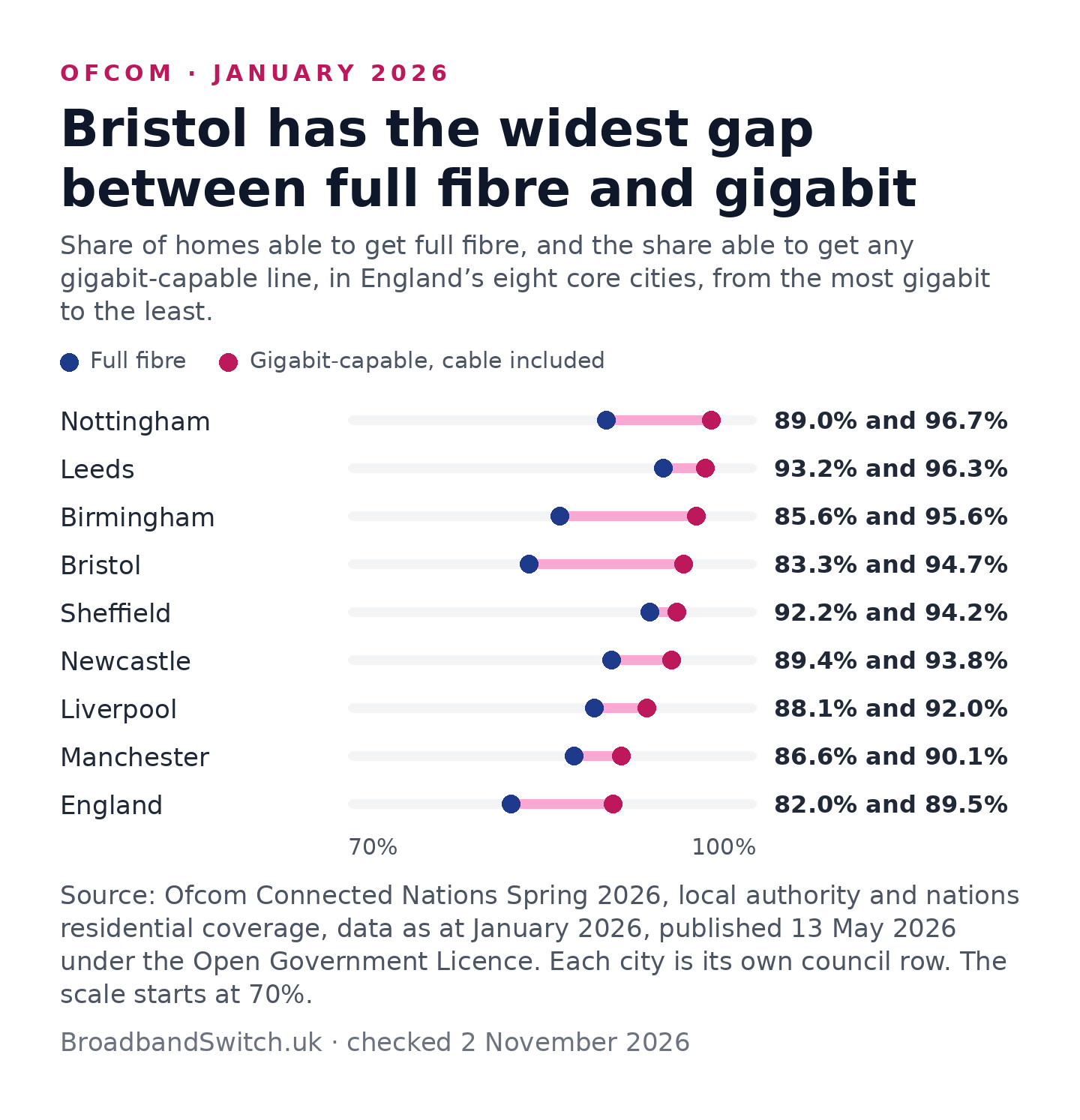
By core cities we mean the English councils in the Core Cities group, eight in all, each measured on its own council boundary in Ofcom’s files. Bristol’s gap between gigabit and full fibre, 11.4 points, is the widest of the eight; Birmingham comes next at 10.0, while in Sheffield, at 2.0, there is barely one. Across all 296 English councils, Bristol ranks 81st for gigabit and 137th for full fibre. Nottingham tops the eight for gigabit at 96.7% and Leeds for full fibre at 93.2%.
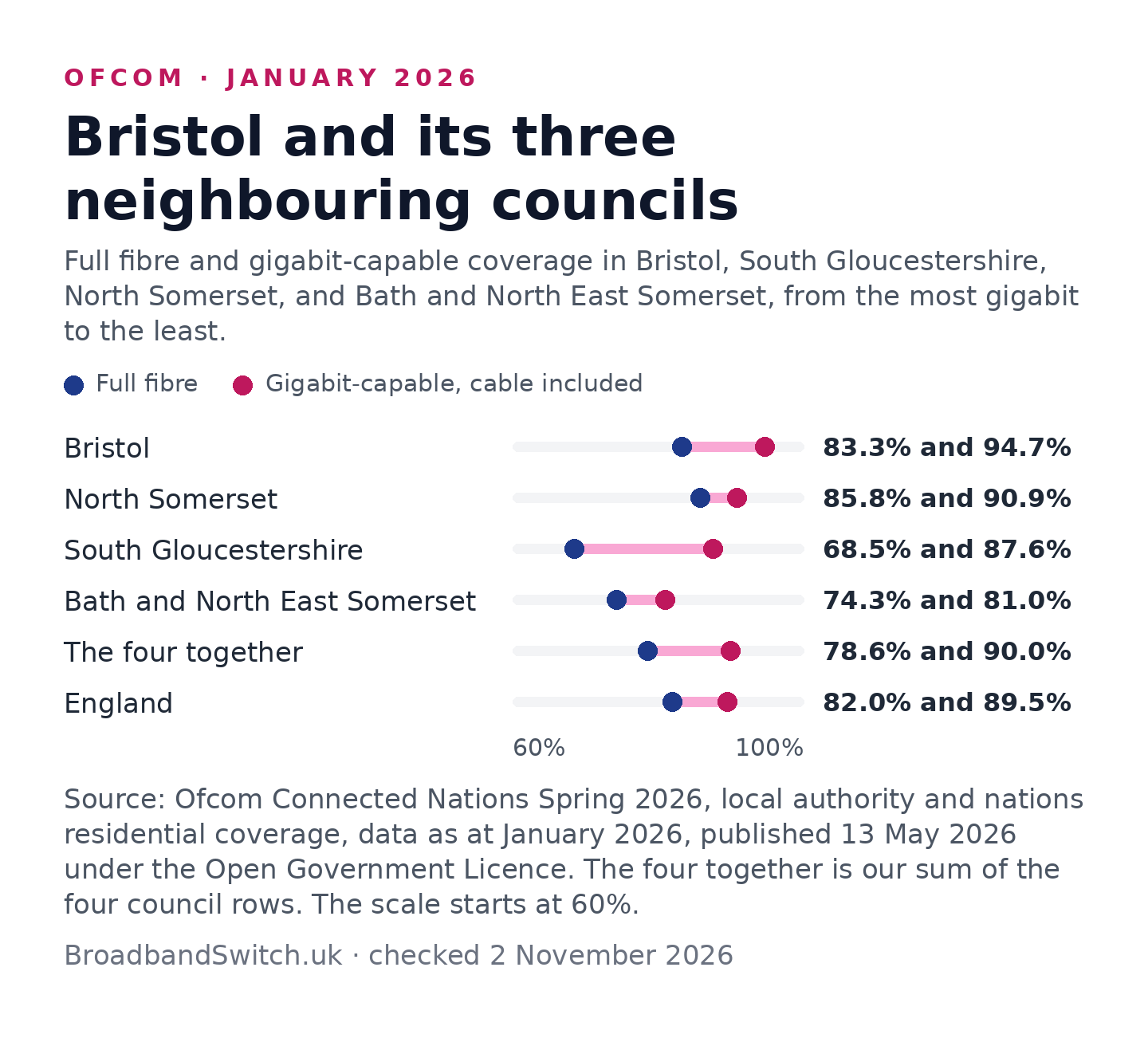
Of all the homes in Bristol and the three councils around it, 39% are in the city, and taken together the four have 78.6% full fibre by our calculation. North Somerset edges ahead for full fibre at 85.8%, Bath and North East Somerset sits at 74.3%, and South Gloucestershire has the lowest share, 68.5%. Take-up tells another story: South Gloucestershire leads with 64%, and Bristol comes third on 43%. If you live close to a council border, your line may belong to the area next door in these tables, so your own postcode is a better guide than any council average. Cardiff and Newport, across the Severn, have pages of their own.
The 2029 plans: from last to first
Direct answer: The builders’ forecasts to Ofcom take full fibre in Bristol from 83.3% now to 99.3% by January 2029, the biggest climb of the eight core cities and the highest finish. They also give 94.8% of homes two gigabit networks or more, against 74.0% for England, and 73.8% three or more.
Ofcom, January 2026 and plans to 2029
From last to first: full fibre now, and on the 2029 plans
Bristol
83.3% 99.3%
Liverpool
88.1% 98.9%
Leeds
93.2% 94.1%
Newcastle
89.4% 94.0%
Sheffield
92.2% 93.2%
Manchester
86.6% 92.5%
Nottingham
89.0% 92.0%
Birmingham
85.6% 88.0%
England
82.0% 92.2%
- January 2026, Ofcom
- January 2029, on the builders’ plans
Each arrow starts at the share of homes able to get full fibre in January 2026 and ends at the share on the builders’ plans for January 2029, from Ofcom’s Connected Nations and Planned Network Deployments 2026. England’s plan figure is our weighting of its council rows. The scale starts at 80%.
In homes rather than shares, the plans bring full fibre to 32,774 Bristol homes that cannot get it today, a rise of 16.0 points. Gigabit coverage reaches 99.6% on the same plans, against 95.3% for England. Ofcom’s file anticipates 16 to 20 gigabit-capable operators working in the city by 2029, so for most households the question will be which network to pick, not whether one turns up.
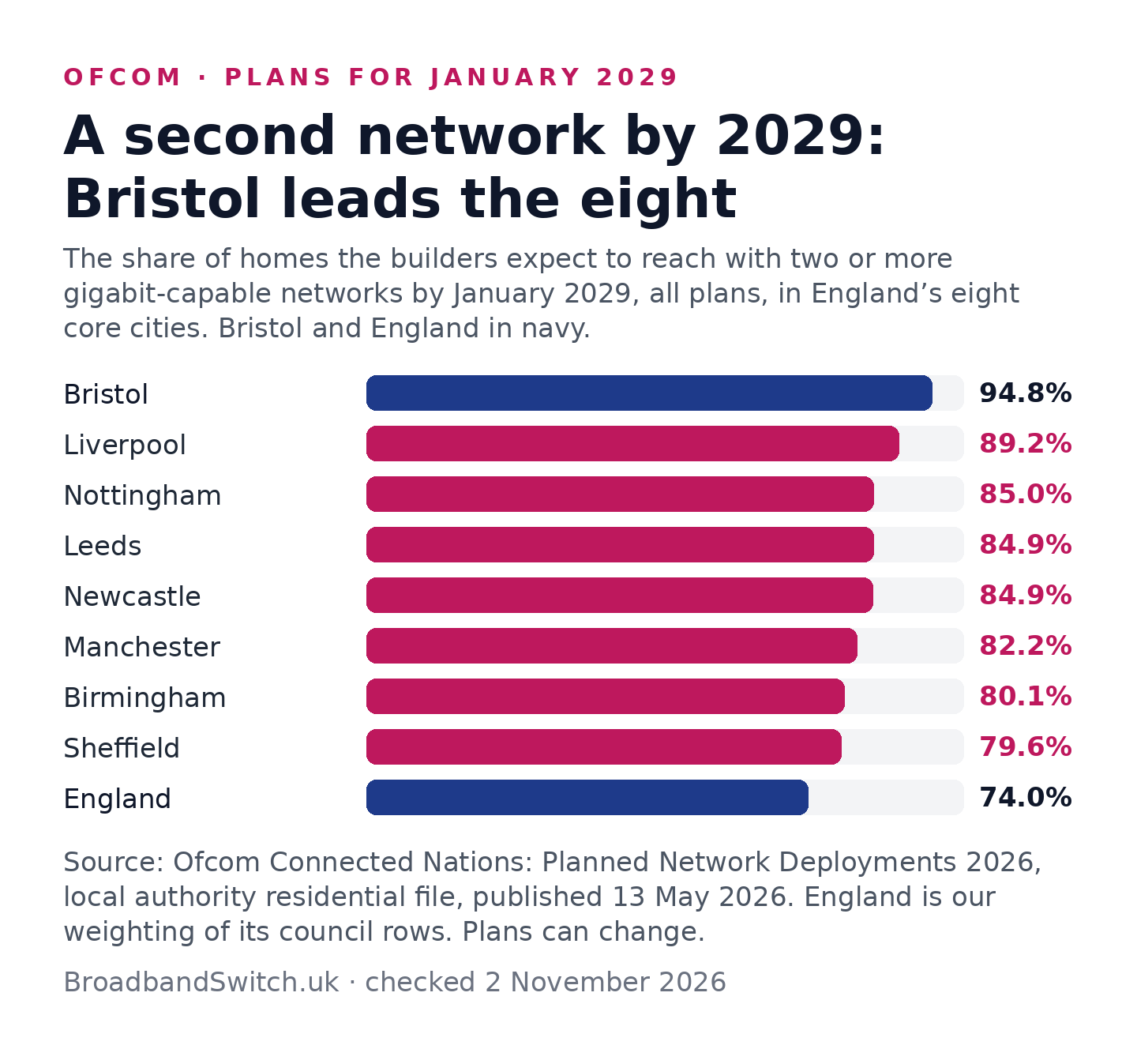
A second network matters because it brings a second set of providers and prices. On the plans, Bristol leads the core cities for two networks, at 94.8%, and for three or more, at 73.8%, where England’s figures are 74.0% and 36.0%. If your street has Virgin Media cable today, the second choice may well arrive as full fibre laid beside it.
A few gaps remain. On paper, 1,366 Bristol homes still sit outside every full fibre plan and 22 postcodes have no gigabit plan at all, and Ofcom’s file counts 57 planned lines paid for from public funds. Ofcom’s yardstick for a decent line is “a download speed of at least 10 Mbit/s and an upload speed of at least 1 Mbit/s”. A home below it can request a better connection from BT through the Universal Service Obligation, and our USO guide walks you through the request. Every 2029 number is a forecast, so read it as a plan that may move.
Ordering the upgrade: sixth of eight
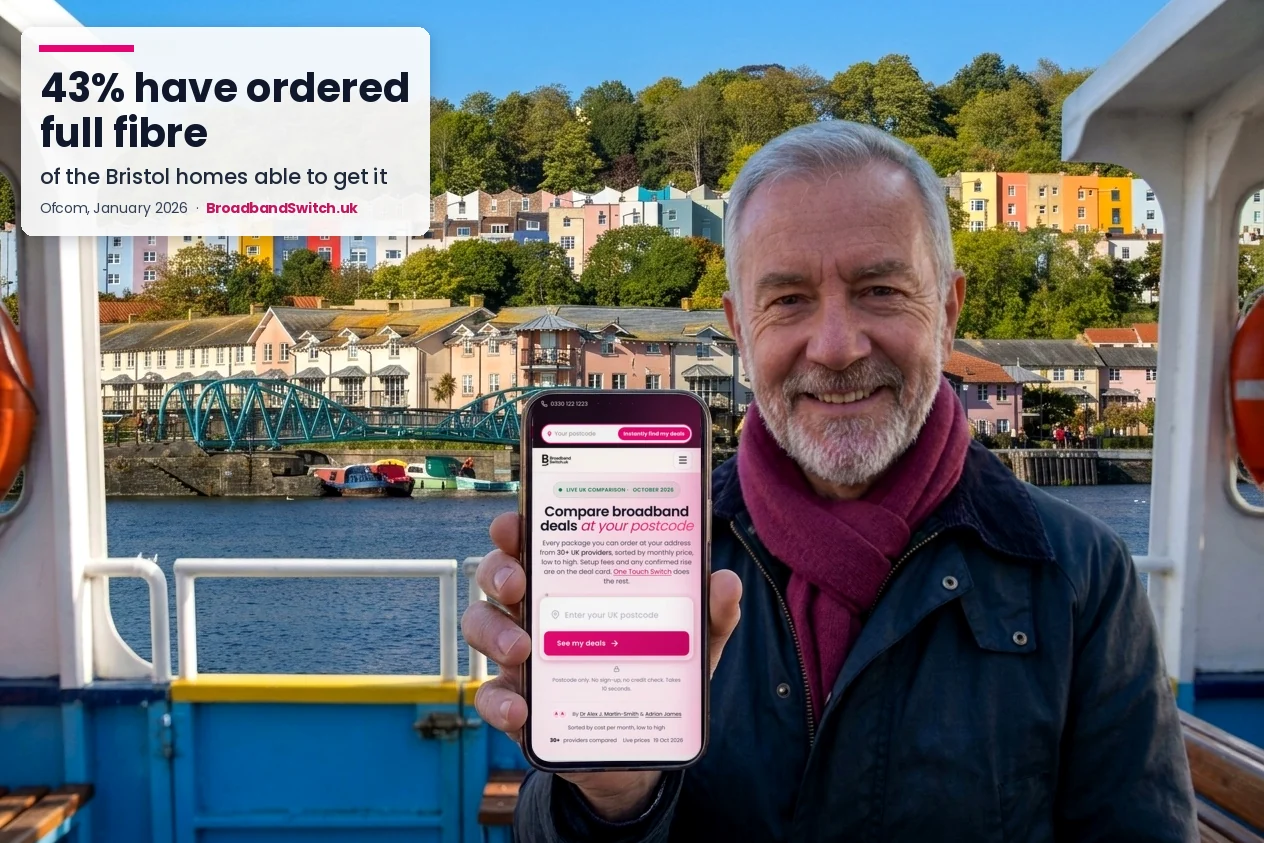
Direct answer: Of the Bristol homes that could order full fibre in January 2026, 43% had a line working. That puts the city sixth of the eight core cities, just under England, where our weighting of Ofcom’s council rows gives 46.2%. Put another way, more than half of the homes that could move to full fibre today have not done so yet.
Ofcom, January 2026
Eight dials: who has ordered the fibre
51%
Sheffield
50%
Leeds
47%
Newcastle
45%
Liverpool
45%
Manchester
43%
Bristol
37%
Birmingham
34%
Nottingham
The small tick on each dial marks England, 46.2%
Take-up is Ofcom’s measure of how many homes able to order full fibre in January 2026 actually had a line working, given to the nearest whole number for each council. Our England figure weights all 296 councils by the homes they cover. Dials run from 0% at the far left to 100% at the far right.
Openreach, the network behind BT, EE, Sky, TalkTalk and many smaller brands, sees the same on its own lines. Its Bristol release of 27 February 2026 began: “More than 165,000 homes and businesses in Bristol now have access to Full Fibre”. Martin Williams, its partnership director for Wales and the South West, said: “Most of Bristol is covered by Full Fibre, but many residents and businesses haven’t yet made the switch.” The release adds that £49m of Openreach investment has brought gigabit-capable broadband to “over 75 per cent of properties in the area”.
That figure covers Openreach’s own network and includes businesses. Ofcom, which counts all networks, had 183,259 of Bristol’s 219,825 homes and businesses within reach of full fibre in January (83.4%), which leaves about 18,259 premises served by someone other than Openreach. Across every home, covered or not, 36% had a full fibre line in use. Across all 296 English councils, Bristol’s take-up ranks 185th.
Fibre already in your street?
Then the hard part is done: the cable is in, and nobody needs to dig. What is left is choosing a package, and with full fibre and cable chasing the same homes, it is worth checking whether a faster deal costs any more than the one you have. As Williams put it, “you need to place an order with your chosen provider”, so the postcode box at the top is the place to start.
Copper also has a sell-by date. When full fibre covers most of an exchange, Openreach withdraws copper from sale there, and 9 of the 14 exchanges it files under Bristol have reached that point. The departures board shows each one with its date, so you can see where yours stands.
The networks building in and around Bristol
Direct answer: Two big networks cover most of Bristol: Openreach, with full fibre to more than 165,000 homes and businesses on its own count, and Virgin Media, whose cable supplies most of the remaining gigabit reach. Newer networks are building just over the boundary: YouFibre lists Downend, Filton and Kingswood as live, and Truespeed has eleven location pages in its Bristol group, all in neighbouring council areas.
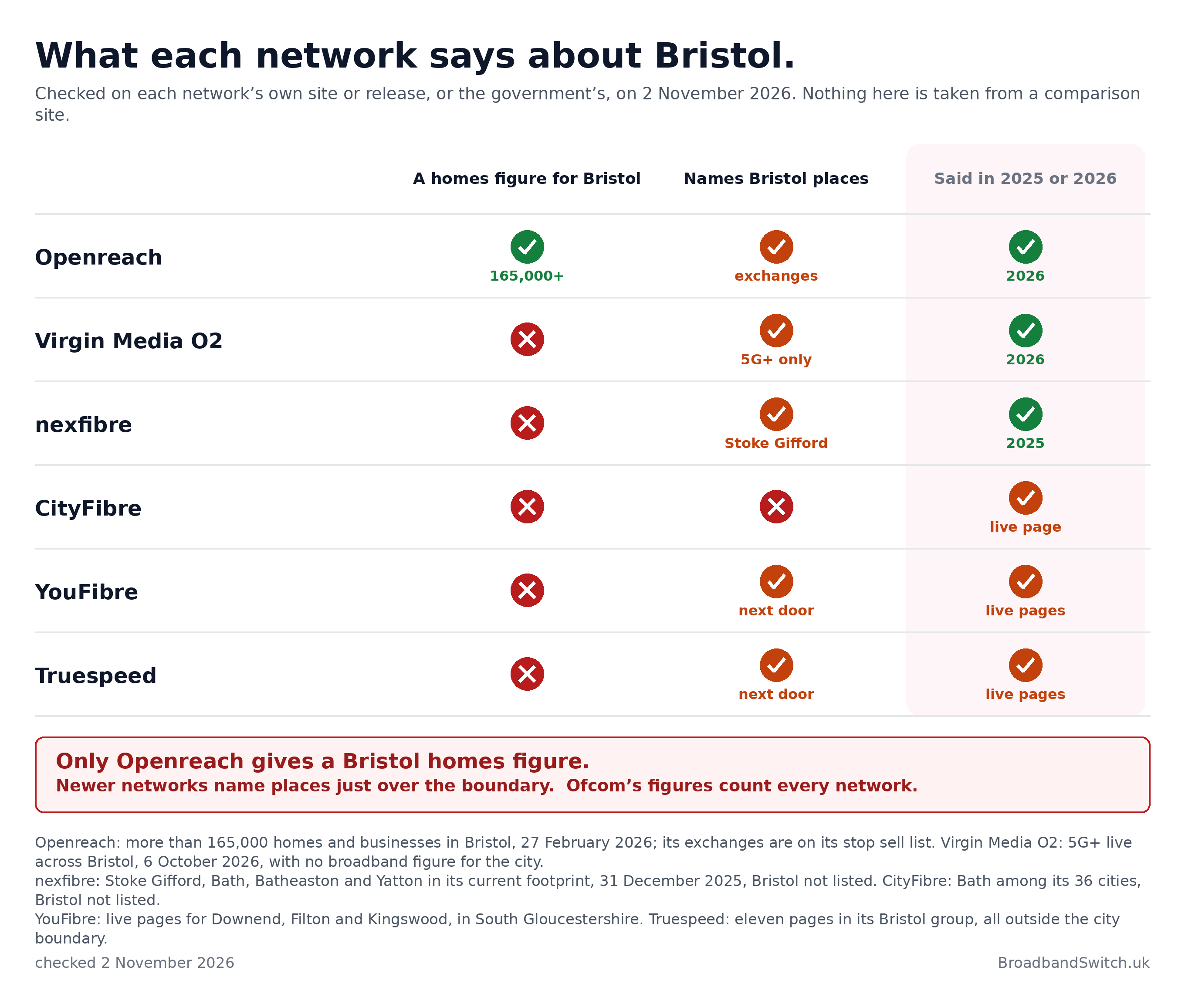
Two words first. The provider is the firm on your bill; the network is the firm whose cable runs down your street. A provider may use a single network or a handful, which is why the networks at your door decide your shortlist. What follows comes from each network’s own pages and press releases, dated. Not sure which network you are on now? Ask your provider, or read our guide to telling which network you use, because the answer decides whether a move needs an engineer.
Openreach: the biggest wholesale network
Openreach carries the full fibre that BT, EE, Sky, TalkTalk, Vodafone, Plusnet and a long tail of smaller brands sell. On 27 February 2026 it put its Bristol reach at more than 165,000 homes and businesses, after £49m of investment. Across the UK it reaches more than 21 million properties, with a plan for 25 million homes and businesses by the end of 2026.
Virgin Media: cable across the city
Virgin Media is the reason Bristol’s gigabit share runs so far ahead of its full fibre share. Ofcom’s gap of 11.4 points works out at 23,401 Bristol homes with a gigabit line and no full fibre, and that extra reach is cable. We found no Bristol broadband figure from Virgin Media O2. Its mobile side did announce on 6 October 2026 that “O2 5G+ is live across Bristol”, adding: “Up to 495,000 people could benefit from faster speeds, better reliability and lower latency at no extra cost.” Our Virgin Media page covers the home broadband deals.
nexfibre, owned by InfraVia, Liberty Global and Telefónica, lays new full fibre for Virgin Media to sell. Its report to 31 December 2025 gives a reach of c. 2.6 million premises, and its list of current places near the city takes in Bath, Batheaston, Stoke Gifford and Yatton, but not Bristol itself; it presents that list as a guide rather than a promise for every address.
Those owners are also buying Substantial Group, parent of the Netomnia network and of YouFibre, through nexfibre. The £2 billion purchase was announced on 18 February 2026, and the Competition and Markets Authority began an in-depth look on 1 July 2026. Its provisional view, published from 2 October 2026, is that the deal could lead to a “substantial lessening of competition” for wholesale fixed broadband, though it stressed: “This is not our final decision”. It invited comments on possible remedies on 20 October 2026, and its decision is due by 15 December 2026. Our altnet consolidation tracker follows the deal.
CityFibre: not on its list for Bristol
CityFibre’s coverage page says: “Our full fibre network is available to over 4.5 million premises across the UK.” It names thirty-six cities served by its network, and the only one among Bristol’s neighbouring council areas is Bath. Bristol is not on that list, nor on its list of towns and communities. So unless your postcode check shows a provider on CityFibre, do not count on one.
YouFibre: live just over the boundary
YouFibre sells over Netomnia’s network. It has no Bristol page, but it lists Downend, Filton and Kingswood as live, each described as being in Gloucestershire, and its Filton page says: “YouFibre has built a brand new 100% Full Fibre network in Filton”. All three sit in South Gloucestershire, on Bristol’s north-eastern edge, so if you live near the boundary in Frome Vale, Hillfields or Eastville, a postcode check is worth doing. Our YouFibre page explains its deals.
Truespeed: the towns and villages around the city
Truespeed is a South West network with its customer team in Bath. Its Bristol group has eleven location pages: Bradley Stoke, Patchway, Stoke Gifford, Little Stoke, Winterbourne, Coalpit Heath, Yate, Chipping Sodbury and Thornbury in South Gloucestershire, plus Portishead and Clevedon in North Somerset. Its Bradley Stoke page says: “Our new ultrafast, full-fibre network is connecting customers in Bradley Stoke and the surrounding area.” None of those places is inside the city council’s boundary, so you are most likely to see Truespeed near the edge of Bristol. Our Truespeed page sets out what it sells.
Hyperoptic: buildings, not streets
Hyperoptic wires individual blocks rather than whole streets. Its press page says: “We focus exclusively on high density urban areas and cover 64 towns and cities in the UK.” It also says: “Our network now passes more than 2 million homes.” It does not list those towns, and we could not find a current Hyperoptic page naming Bristol buildings, so check your own block with the postcode box. Our Hyperoptic page explains how its building connections work.
Leaving the old phone network: seventh of ten
Direct answer: In Openreach’s league of ten big cities moving to digital phone lines, Bristol comes seventh. The table, dated 17 September 2026, leaves 43,775 lines across the Bristol area on the old service, from 486,612 in 2020, which is 8.99%. Liverpool is furthest along with 6.35% left, and London has the most to do, at 12.92%.
Openreach, 17 September 2026
Ten cities: the share of old phone lines still to move
1Liverpool
6.35%2Manchester
7.35%3Sheffield
7.55%4Cardiff
8.35%5Leeds
8.62%6Edinburgh
8.82%7Bristol43,775 lines left of 486,612
8.99%8Birmingham
9.08%9Glasgow
10.60%10London
12.92%Each stem runs from 0% to the share of the city’s 2020 lines still on the old service, on a scale to 14%. Shorter is further along.
At the foot of its 17 September 2026 release, Openreach set out how many old analogue lines each city had left to move, beside the number it had in 2020. Each figure includes the area around the city as well as the city itself.
In the release’s own words, Bristol sits in the bottom five with “Birmingham, Bristol and Edinburgh with around nine per cent” still to go. The figures cover major cities and their surrounding areas, so they reach well beyond the council boundary. Even so, 442,837 of the area’s 2020 lines have already moved, which is 91.01% of them. That is real progress, and the lines left tend to be the tricky ones: alarms, lift phones and card machines.
The national date is fixed. BT Group, Openreach’s owner, retires the analogue network on 31 January 2027, and Openreach warned on 30 October 2026 that approximately one million copper-based lines remain active across the UK, including 300,000 within business premises. From that date, customers who have not moved may be transferred to EVAc, which Openreach describes as “a limited, temporary, last-resort phone service designed strictly to maintain access to essential calls”. It also says: “Where technically possible, Openreach will keep linked broadband services running.” For most homes the change simply means plugging the phone into the router rather than the wall socket.
Power cuts are the thing to think about. A digital phone runs through the router, and BT spells out what that means: “If there is a power outage or your broadband fails, you’ll be unable to make calls using Digital Voice, including calls to 999.” If someone at home depends on the phone, ask your provider about a battery back-up before the change.
Using Bristol Careline?
Bristol City Council describes its alarm service like this: “Bristol Careline is a telephone based service that gives you support and protection, 24 hours a day, 365 days a year.” It adds: “Anyone in Bristol can use this service on a standard home phone line that’s close to a power socket.” There is already an answer for homes without a line: “If you don’t have a home phone line, you can order a device from us that uses a mobile network.” And on power cuts: “The home unit has its own battery power, so you’re still protected even if the electricity in your home goes off.” If your unit plugs into the phone socket, ring the Careline team on 0117 922 3269, and tell your broadband provider, before anything changes on the line. There is a checklist in our care alarm guide, and our landline switch-off checker takes any Bristol number.
Fourteen exchanges on the departures board
Direct answer: When we checked on 2 November 2026, 9 of the 14 exchanges Openreach files under Bristol had stopped selling copper. South, Bishopsworth and Westbury-on-Trym went first, on 13 October 2021, and Fishponds most recently, on 5 June 2026. Avonmouth follows on 12 February 2027, Winterbourne on 3 June 2027, and Henbury and Downend on 4 November 2027, while Easton shows its date as TBD.
Openreach, 8 October 2026
The copper departures board
Openreach’s stop sell list of 8 October 2026, sorted by date: the fourteen exchanges it places under Bristol. Some, such as Winterbourne and Downend, are named after places just outside the city boundary.
Do not confuse stop sell with the phone switch-off; they run on separate tracks. Stop sell arrives exchange by exchange when full fibre covers a majority (>75%) of premises, and providers get a year’s notice first. After that, a new order, a house move or a speed change at an address with full fibre goes onto fibre. Addresses still waiting for fibre carry on with copper. The analogue phone network, separately, closes on 31 January 2027.
Openreach files all fourteen under the location Bristol, but exchanges take their names from their buildings, and Winterbourne and Downend are named after places in South Gloucestershire. Easton’s row changed on 8 October 2026, when the newest list appeared, and shows TBD for both date and tranche. Below, a table gives each exchange’s code and tranche, the date its row last changed, and its stop sell date, with the exchanges filed under nearby places underneath.
The fourteen Bristol exchanges in a table you can sortopen the table
| Code | Tranche | List last changed | ||
|---|---|---|---|---|
| Bishopsworth | SSBIS | 1b | 10 May 2021 | 13 October 2021 |
| South | SSSOU | 1b | 10 May 2021 | 13 October 2021 |
| Westbury-On-Trym | SSWOT | 1b | 10 May 2021 | 13 October 2021 |
| North | SSNOR | 3 | 25 January 2021 | 25 January 2022 |
| Bedminster | SSBED | 4 | 29 April 2021 | 29 April 2022 |
| Eastville | SSEAV | 4 | 29 April 2021 | 29 April 2022 |
| Whitchurch | SSWHI | 7 | 12 January 2022 | 8 February 2023 |
| West | SSWES | 11 | 16 January 2023 | 16 February 2024 |
| Fishponds | SSFIS | 20 | 2 May 2025 | 5 June 2026 |
| Avonmouth | SSAVO | 23 | 16 January 2026 | 12 February 2027 |
| Winterbourne | SSWIB | 24 | 8 May 2026 | 3 June 2027 |
| Downend (DWD) | SSDOW | 26 | 8 October 2026 | 4 November 2027 |
| Henbury | SSHEN | 26 | 8 October 2026 | 4 November 2027 |
| Easton | SSEAS | TBD | 8 October 2026 | TBD |
Italic rows have a date still ahead. “List last changed” is the “Last amended date” Openreach prints beside each row: the day the row went on or was last moved, which is not always when providers heard. An exchange is named after its building, and yours may be one named after the next district, so Openreach’s own address checker is the surest guide. Sort with the headings.
Nearby exchanges listed under other places
- Wrington (filed under Wrington): 29 April 2022
- Long Ashton (filed under Long Ashton): 8 November 2024
- Weston-Super-Mare (filed under Weston-Super-Mare): 6 November 2025
- Keynsham (filed under Keynsham): 14 February 2026
- Pill (filed under Pill): 5 June 2026
- Yatton (filed under Yatton): 5 June 2026
- Midsomer Norton (filed under Midsomer Norton): 19 August 2026
- Filton (FIO) (filed under Filton): 3 June 2027
- Pilning (PNG) (filed under Severn Beach): 3 June 2027
- Almondsbury (ACW) (filed under Filton): 4 November 2027
What stop sell means for you
- Happy where you are? Your line carries on, and the only date that applies to everyone is 31 January 2027.
- New order at a stop sell exchange? If fibre reaches your home, the new service goes over fibre, whether you move, switch or change speed.
- No full fibre at your address yet? You can keep copper until it arrives.
Summarised from Openreach’s stop sell announcement of 15 May 2026.
Buying or renting somewhere new in Bristol? Run the new postcode before moving day, so the line is ready when you are. For the national picture, read our stop sell explainer. Fresh rounds appear every few months, so Openreach’s own list is worth a look now and then.
Flats, terraces and a city of renters
Direct answer: Bristol is a city of flats and terraced streets. The 2021 census put 35.2% of households in a flat, 13.0 points above England’s 22.2%, and 32.1% in a terraced house, where England has 23.0%. Only 6.0% lived in a detached house, compared with 22.9% across England, and 26.4% rented privately, against 20.6%.
Census 2021
A hundred squares each: who owns, who rents
Bristol
private renting 26.4%
England
private renting 20.6%
Clifton Down
private renting 58.7%
Hartcliffe and Withywood
social renting 49.6%
Westbury-on-Trym and Henleaze
owned 81.2%
- Owned, outright or with a mortgage
- Social rented
- Private rented or rent free
Census 2021 table TS054 via nomis, households, for Bristol, England and three contrasting wards. One square stands for one household in every hundred; people living rent free sit with private renters.
The wards vary widely. In Clifton Down, 58.7% of households rent privately, and in Central 58.3%. Hartcliffe and Withywood has 40.1% renting from the council. Westbury-on-Trym and Henleaze has the most owners, 81.2%, and Easton the most terraced houses, 69.7%. In Clifton, 45.4% of households live in flats carved out of converted houses or other buildings.
So what does that mean for your connection? Whoever owns the building, and the sort of building it is, determine whose permission new cabling needs. For a terraced house, the engineer normally brings fibre in from a pole or an underground duct and fits a small box indoors, usually in one trip. Renting? Get the landlord’s agreement before any drilling, and if no answer comes, our tenant rights guide sets out the next step. Switching provider over the line you already have needs nobody’s permission, as our renters’ guide explains.
Flats, whether purpose-built or carved out of a big house, need a yes from whoever owns the building before kit goes in: the council or housing association in social housing, the freeholder or agent in private blocks. The paperwork is covered in our wayleave guide. With 68,800 students registered at the city’s two main universities in 2024/25, on the council’s count, plenty of Bristol homes are shared. For shorter contracts that fit a tenancy, see our student guide, and for sharing the cost, our house share guide.
Paying less: social tariffs
Direct answer: A social tariff is a lower-priced broadband deal from a big provider for households on Universal Credit, Pension Credit and several other benefits, and you can leave one without a fee.
Social housing is a bigger slice of Bristol than of England: 18.7% of households against 17.1%, with 13.0% renting directly from the council. Which tariffs you can get depends on the networks at your door. On Openreach lines, you could pay £16.50 a month for BT Home Essentials or £20 for Vodafone Essentials, with speeds up to 80 Mbps and a term of 12 months. Virgin Media runs its own, Essential Broadband, on its cable network. In total Ofcom counts 33 social tariffs; our social tariff guide sets out the rules for each.
In the 22 Bristol postcodes with no gigabit plan to 2029, the first job is a dependable line, and the Universal Service Obligation is the way to ask for one. Everywhere else, your postcode results begin with the cheapest deal at your address.
Look up your ward
Direct answer: Choose any of the 34 wards for a card of its own. It shows gigabit and superfast shares, homes below 30Mbit/s, the ward’s place in the city, its seat’s figures and the 2021 census mix of homes. It all runs in your browser, so nothing you choose is sent anywhere.
Your corner of Bristol, on one card
Coverage on the card is our total of Ofcom’s January 2026 output areas for the ward, and the homes come from the 2021 census. Your council tax bill names your ward, and the UK Parliament’s Find your MP service gives your seat from a postcode.
What the old page got wrong
Direct answer: Ten claims on the old page needed fixing. It set coverage too high, borrowed an Openreach share from a comparison site, and placed CityFibre, Truespeed, Hyperoptic and YouFibre inside the city on evidence we could not find. It also treated a takeover as finished, quoted a CityFibre statement we could not trace, ran the phone and copper changes together and gave an old population figure.
The earlier page ran past eleven thousand words, much of it undated prices and network names. This version keeps a number only if Ofcom, the census, the council or the named company has published it, and drops anything untraceable instead of rewording it. That removed a list of small networks, none of which says anything public about Bristol, though any that serves your building will still appear at your postcode. The price tables went as well: prices are national, and your results show the live ones.
Coverage set too high
What it saidThe old version said “approximately 92% of Bristol premises can access full fibre” and “almost 100%” could get a gigabit-capable line. Ofcom’s January 2026 figures are lower on both, at 83.3% full fibre and 94.7% gigabit across 204,332 homes. Bristol’s real strength is the cable layer, which the old page folded into the fibre figure.
What we use nowOfcom’s January 2026 counts, from the whole city down to each ward.
An Openreach share taken from a comparison site
What it saidAn Openreach share of “approximately 68%” was credited to a comparison site. We go to the network instead. On 27 February 2026 Openreach put its Bristol reach at more than 165,000 homes and businesses, and said its £49m had brought gigabit-capable broadband to “over 75 per cent of properties in the area”.
What we use nowOpenreach’s own Bristol release, dated.
CityFibre placed in six neighbourhoods
What it saidThe old page described “established CityFibre in Redland, Cotham, Bishopston, Southville, plus parts of Bedminster and Knowle”. When we read CityFibre’s coverage page on 2 November 2026, it named thirty-six cities served by its network, Bath among them, and Bristol was not one. Nothing from CityFibre we could find names those six areas, so the claim has gone.
What we use nowCityFibre’s own list of the places it serves.
Truespeed placed inside the city
What it saidTruespeed was said to serve “parts of South Bristol plus neighbouring Keynsham and Whitchurch”. Keynsham and the North Somerset villages hold up: Truespeed has pages for them. South Bristol does not, because the eleven pages in its Bristol group are Bradley Stoke, Patchway, Stoke Gifford, Little Stoke, Winterbourne, Coalpit Heath, Yate, Chipping Sodbury and Thornbury, plus Portishead and Clevedon, all outside the city boundary.
What we use nowTruespeed’s own location pages.
Named buildings we could not confirm
What it saidThe old page placed Hyperoptic in “the Finzels Reach mixed-use development, Harbourside developments, and the Temple Meads area”. Hyperoptic’s own pages today name no Bristol building, and its press page says: “We focus exclusively on high density urban areas and cover 64 towns and cities in the UK.” We could not confirm the developments, so they have been taken out. If Hyperoptic serves your block, the postcode check will show it.
What we use nowHyperoptic’s press page, and the postcode check for each block.
A provider and a “fastest” label inside the city
What it saidYouFibre was placed “in growing Bristol postcodes” and labelled “Bristol’s fastest residential broadband”. YouFibre’s own pages list Downend, Filton and Kingswood as live, describing them as being in Gloucestershire, and it has no page for Bristol. With no published ranking of home speeds across the city either, both lines have gone.
What we use nowYouFibre’s own location pages, and no ranking.
A takeover written up as finished
What it saidNetomnia’s sale was reported as complete, along with a price for YouFibre and Brsk that we could not trace anywhere. What actually happened: a deal agreed on 18 February 2026, an in-depth competition inquiry from 1 July 2026, and a decision due by 15 December 2026. The separate retail price has been dropped.
What we use nowThe agreed deal and the CMA’s live timetable.
A CityFibre statement we could not trace
What it saidA CityFibre retreat from commercial building was reported as fact. No CityFibre statement we could find says that, and its update of 6 October 2026 gives 4.8m premises passed, so the sentence is gone.
What we use nowCityFibre’s October 2026 numbers.
Two changes run together as one
What it saidA single switch-off date was given for “copper phone lines”, which blurs two things. The old analogue phone network closes on 31 January 2027, and calls then travel over digital lines. Copper broadband is a separate matter, taken off sale one exchange at a time, and homes without full fibre keep it.
What we use nowTwo separate dates: the phone network’s closure, and each exchange’s stop sell.
A population figure that had fallen behind
What it saidThe old page gave Bristol “approximately 470,000 residents”. The council’s own statistics page says “Bristol is the largest city in the South West”, and puts the mid-2025 population at an estimated 495,300, from figures the Office for National Statistics published in July 2026.
What we use nowThe council’s latest estimate, dated.
FAQ: Bristol broadband questions, answered
What share of Bristol can order full fibre?
Ofcom put it at 83.3% of homes in January 2026, slightly ahead of England on 82%. Counting Virgin Media’s cable as well, 94.7% had a gigabit-capable line available.
Can I get gigabit broadband in Bristol?
Very likely. Ofcom found a gigabit-capable line within reach of 94.7% of homes, and our ward totals put thirty of the 34 wards at 90% or more. The four below that are Southville, Lawrence Hill, Central, and Hotwells and Harbourside. Your postcode gives the answer for your home.
Is Virgin Media available in Bristol?
Across much of the city. Ofcom’s figures show 23,401 Bristol homes with a gigabit line but no full fibre, and that extra reach is Virgin Media’s cable. Whether it reaches your door is one of the things the postcode check shows.
Where in Bristol is broadband slowest?
In four wards. Lawrence Hill, Central, Hengrove and Whitchurch Park, and Southville hold 63% of the homes that cannot get 30Mbit/s, and Southville has the lowest gigabit share, 80.0%. In three wards, nobody is below 30Mbit/s at all.
Which Bristol seat has the most full fibre?
Bristol South, with 84.6%. Bristol North East has the least, 73.8%, but cable lifts it to 93.9% gigabit. Bristol North West has the most gigabit, 96.5%.
Will more Bristol homes get full fibre by 2029?
Yes, on the builders’ plans. The builders tell Ofcom they will take full fibre from 83.3% to 99.3% by January 2029, top of the core cities, and offer 94.8% of homes two or more gigabit networks. Plans can change, so check again as dates near.
Is CityFibre in Bristol?
Not on CityFibre’s own list. Its coverage page names thirty-six cities served by its network, including Bath, and Bristol is not among them. If a provider on CityFibre did serve your building, the postcode check would show it.
Can I get YouFibre or Truespeed in Bristol?
Mostly just outside the city. YouFibre lists Downend, Filton and Kingswood as live, all in South Gloucestershire, and Truespeed’s Bristol group of pages covers places such as Bradley Stoke, Patchway, Stoke Gifford, Little Stoke, Winterbourne, Coalpit Heath, Yate, Chipping Sodbury and Thornbury. Near the boundary, a postcode check is worth doing.
How many Bristol households have upgraded to full fibre?
Of the homes that could order it, 43% had a line in use by January 2026, sixth of the eight core cities and a little under the 46.2% we calculate for England. That leaves more than half of covered homes free to upgrade without any digging.
When do Bristol landlines go digital?
On the same day as everywhere else: 31 January 2027, when the analogue network closes across the UK. In Openreach’s table of 17 September 2026, the Bristol area still had 8.99% of its 2020 lines to move, placing it seventh of ten. For most homes the phone simply moves to a socket on the router.
Can I still buy copper broadband in Bristol?
At a few exchanges, for now. By 2 November 2026, 9 of the 14 Bristol exchanges had copper off sale. Avonmouth joins them on 12 February 2027, Winterbourne on 3 June 2027, and Henbury and Downend on 4 November 2027, with Easton yet to get a date. A home without full fibre keeps its copper line regardless.
Does Bristol Careline need my landline?
It can use one, and it does not have to. The council says: “Anyone in Bristol can use this service on a standard home phone line that’s close to a power socket.” It adds: “If you don’t have a home phone line, you can order a device from us that uses a mobile network.” If yours runs over the landline, call the Careline team on 0117 922 3269 before your line moves to digital.
Renting in Clifton: is the broadband my choice?
In most tenancies, yes. Changing provider on the line already there needs nobody’s consent, while a new line or any drilling needs the landlord’s. Private renters make up 58.7% of Clifton Down households and 48.0% in Clifton, so raise it when you sign.
I claim benefits. Can I pay less for broadband?
Very likely. Social tariffs from the big providers are open to people on Universal Credit, Pension Credit and other benefits, with BT Home Essentials at £16.50 a month and 33 such deals on Ofcom’s list.
In short: Bristol in eight points
- A gigabit-capable line reached 94.7% of Bristol homes in January 2026, on Ofcom’s count, and full fibre 83.3%; Virgin Media’s cable fills the gap.
- That gap, 11.4 points, is the widest of England’s eight core cities.
- On the builders’ plans, full fibre reaches 99.3% by January 2029, the highest of the eight.
- Should the plans be delivered, 94.8% of homes will be able to choose between two or more gigabit networks by 2029.
- Four wards, Lawrence Hill, Central, Hengrove and Whitchurch Park, and Southville, hold 63% of the homes below 30Mbit/s.
- Of the homes able to order full fibre, 43% had done so, leaving more than half free to upgrade.
- Copper is off sale at 9 of the 14 exchanges filed under Bristol, and the analogue phone network closes on 31 January 2027.
- Your own address has its own answer: the postcode check lists the networks and prices at your door in seconds.
Every point can be quoted alone, date included. You can expect a review every quarter or sooner; the last one was on .
References
- OFCOM.ORG.UK
Ofcom. (2026, May 13). Connected Nations, Spring 2026 update. January 2026 coverage and take-up tables for councils, constituencies, output areas and the nations, under the Open Government Licence, used for every coverage and take-up share on this page. Downloaded 2 November 2026.
- OFCOM.ORG.UK
Ofcom. (2026, May 13). Planned network deployments 2026. Residential plans by council to January 2029: full fibre, gigabit, the number of networks, operators, postcodes without a plan and publicly funded lines. Downloaded 2 November 2026.
- NOMISWEB.CO.UK
ONS Census 2021 through nomis. (2023). Accommodation type (TS044) and tenure (TS054) for Bristol, each ward, the three neighbouring councils and England, plus the output areas nomis places in each ward. Read 2 November 2026.
- LEGISLATION.GOV.UK
Parliamentary Constituencies Order 2023, Schedule 1, Part 7 (South West). The wards in each Bristol seat, and the South Gloucestershire wards in Bristol North East. Read 2 November 2026.
- LGBCE.ORG.UK
Local Government Boundary Commission for England. (2026). The Bristol review page, with councillor numbers and dates. Read 2 November 2026.
- BRISTOL.GOV.UK
Bristol City Council. (2026). Population of Bristol, and Guide to Bristol Careline. The mid-2025 estimate, student numbers, and how Careline connects. Read 2 November 2026.
- OPENREACH.COM
Openreach. (2026, February 27). Thousands in Bristol yet to benefit from major broadband upgrade. Its Bristol reach, spending and Martin Williams’s remarks. Read 2 November 2026.
- OPENREACH.COM
Openreach. (2026, September 17). Liverpool tops major UK city league table in move to digital phone services, with its closing table of ten cities; and (2026, October 30), its 100-day warning to businesses. Read 2 November 2026.
- OPENREACH.COM
Openreach. (2026, May 15). Its Tranche 24 announcement, for the stop sell rules, and its page on the PSTN switch-off date. Read 2 November 2026.
- OPENREACH.CO.UK
Openreach. (2026, October 8). FTTP priority exchange stop sell list, version 35: codes, tranches, last amended dates and stop sell dates for the exchanges filed under Bristol and nearby places. Read 2 November 2026.
- VIRGINMEDIAO2.CO.UK
Virgin Media O2. (2026, October 6). O2’s next-generation 5G+ network brings faster connectivity to Bristol in 2026. Read 2 November 2026.
- NEXFIBRE.CO.UK
nexfibre. (2026, February). Its coverage report as at the end of 2025, and its news of the Substantial Group deal. Read 2 November 2026.
- GOV.UK
Competition and Markets Authority. (2026). The nexfibre and Substantial case page, with the interim report quoted at paragraphs 4 and 5. Read 2 November 2026.
- CITYFIBRE.COM
CityFibre. (n.d.). Network availability and coverage; (2026, October 6), trading update. Read 2 November 2026.
- YOUFIBRE.COM
YouFibre. (2026). Location pages for Downend, Filton and Kingswood. Read 2 November 2026.
- TRUESPEED.COM
Truespeed. (2026). Locations sitemap and the Bradley Stoke page. Read 2 November 2026.
- HYPEROPTIC.COM
Hyperoptic. (2026). Press page. Read 2 November 2026.
- PARLIAMENT.UK
UK Parliament. (n.d.). Find your MP. Postcode search for your Westminster seat. Read 2 November 2026.
How switching works
Switching in Bristol: three steps
- Step 1Type your postcode, pick your address
Next-door houses can be on different networks, so choose your exact door.
- Step 2Compare every deal in one list
Providers on Openreach, Virgin Media’s cable and newer networks sit together, lowest price at the top, and looking costs nothing.
- Step 3Order, and the new provider handles the move
Under Ofcom’s One Touch Switch process, the provider you are joining arranges everything, and the old service ends as the new one starts.
Ofcom’s One Touch Switch rules apply to every Bristol address, from Bedminster to Bishopston.
See the deals at your Bristol address
Enter a Bristol postcode, choose the address, and you get every provider able to connect it, on fibre or cable, cheapest first. Everything above describes the city; this part is about your own home.
Compare at my postcode →