Rolling 1-month broadband: flexibility that pays off
Rolling broadband renews month to month, cancels on about 30 days' notice, and never charges an exit fee, because there is no early. The trade is £5 to £15 a month over the same provider's 12-month deal, brilliant value for short lets, uncertain moves and bridge periods, wasted money past the nine-month mark. This page helps you price the trade for your stay, then the live comparison below shows the rolling deals at your address.


The live comparison further down is pre-filtered to 1-month contracts, or run the full check here and see every contract length side by side.
Independent and free. Or jump to the rolling-only deals below.- 30 daystypical notice to cancel a rolling contract
- £5 to £15the monthly flexibility premium over a 12-month deal
- £28 to £45typical UK monthly range for rolling fibre
- ~6 monthswhere rolling stops being the cheaper call
What a rolling contract actually is
The contract renews automatically each month until you give notice, typically 30 days, and you pay for the month that notice covers. Exit fees cannot exist because nothing is ever early. In exchange, the provider prices in its risk: expect £5 to £15 a month over the equivalent 12-month deal, and watch for setup fees of £30 to £80 that longer contracts often waive, since a £60 setup over a three-month stay is £20 a month in disguise.
Five people it genuinely suits
Flexibility is only expensive if you never use it. For these five, the alternative, a 12-month contract plus the early-termination fees when plans change, reliably costs more.
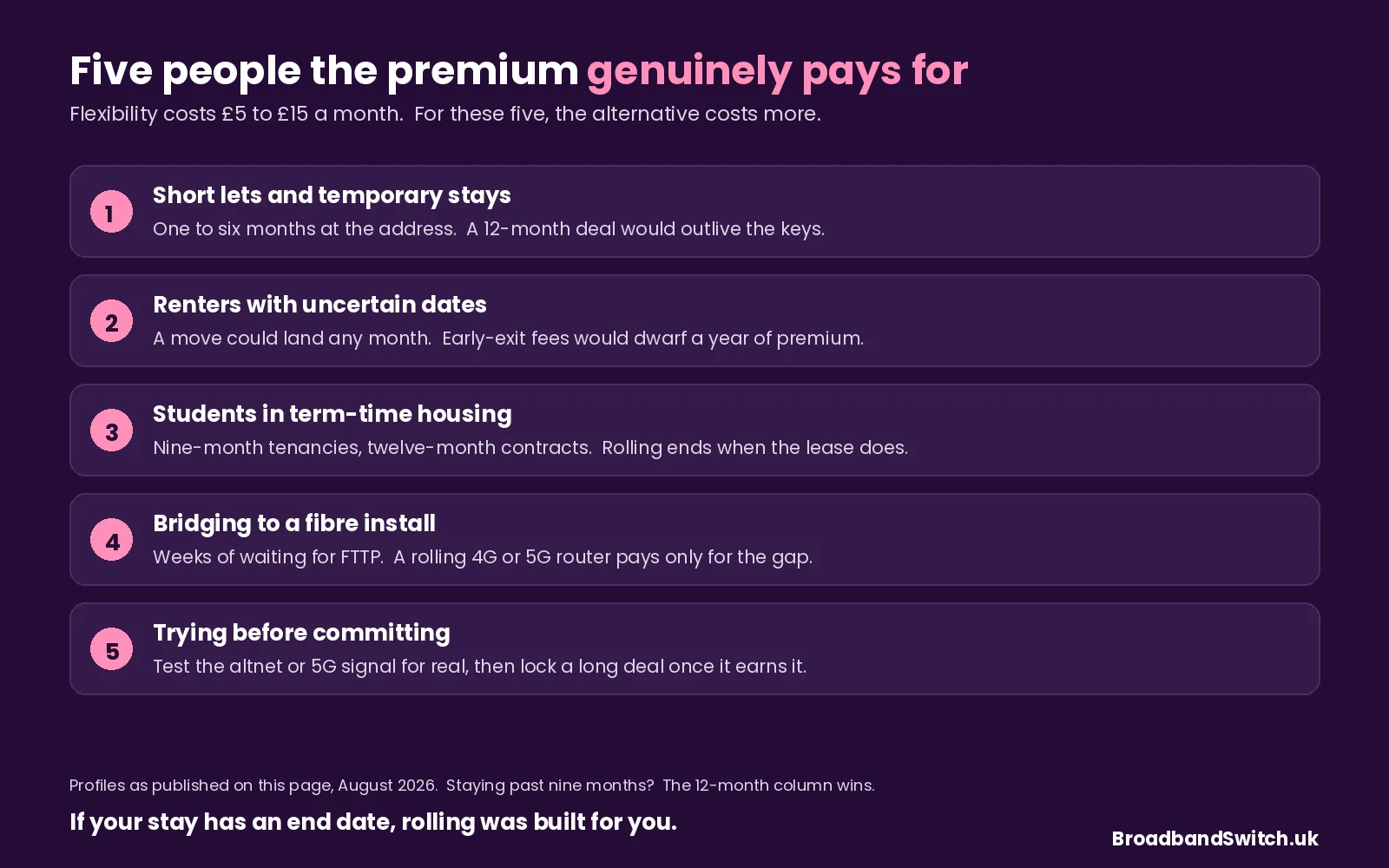
Renters get their own tenancy-first walkthrough in the no-contract broadband for renters guide, students in the student guide, and the bridge play, a rolling 4G or 5G router while the fibre engineer is weeks away, in the temporary backup guide.
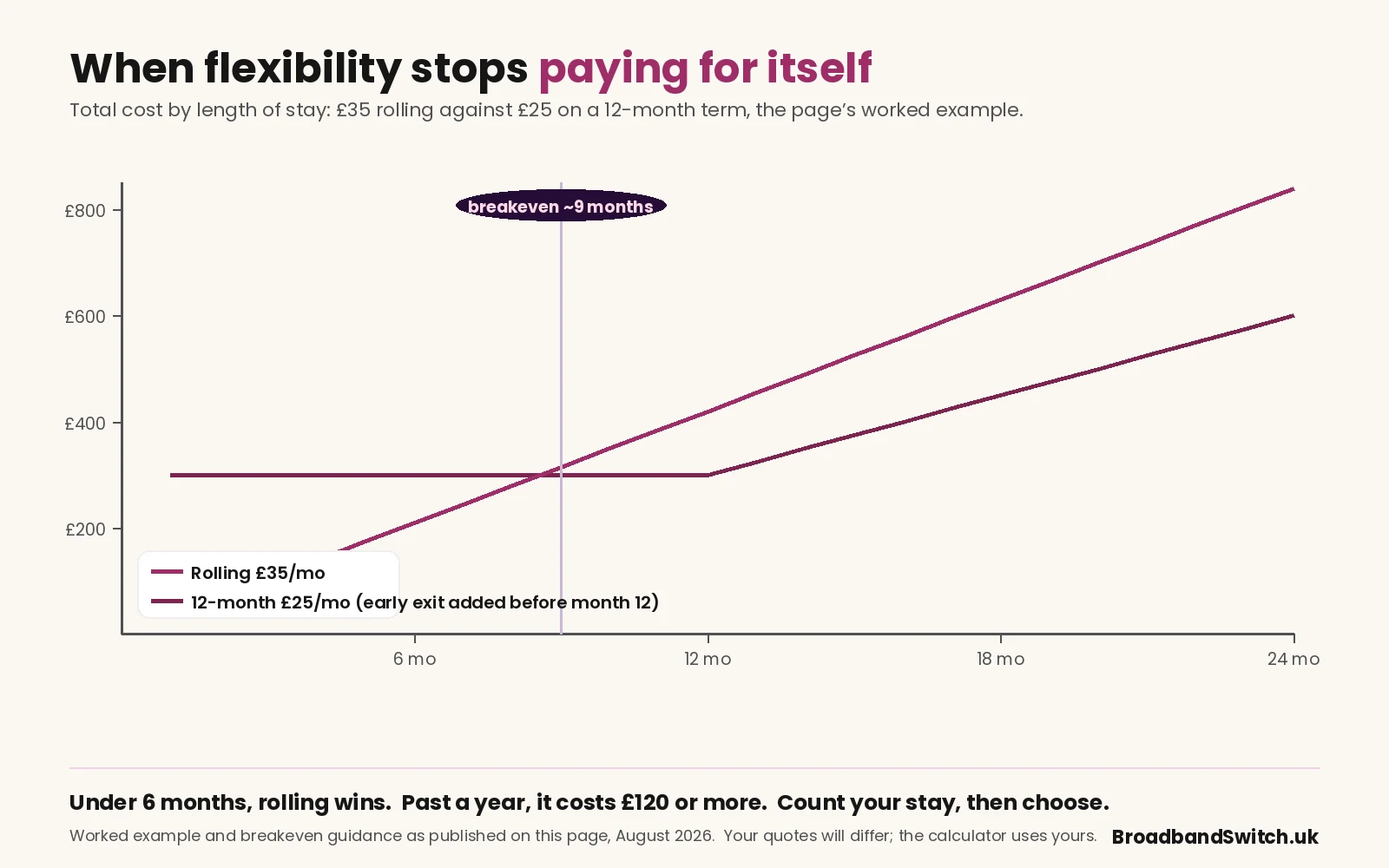
The breakeven, drawn honestly
Take the page's worked example: £35 a month rolling against £25 on a 12-month term, both with nothing upfront. At three months, rolling costs £105 while walking out of the contract would cost £75 plus the remaining nine months, so rolling wins by a street. The lines cross around nine months. By twelve, the contract has saved £120, and by twenty-four, £240 or more. The rule of thumb: rolling wins comfortably under six months, breaks even near nine, and loses three figures beyond a year. The calculator above runs the same sums on your actual quotes.
Rolling or the 12-month? Pick your column
- Choose rolling when the premium is insuranceA move inside six months looks likely; you are a student on a nine-month tenancy; you are bridging to an FTTP install; the tenancy itself is short or rolling; you are actively house-hunting; or you want to test an altnet or 5G signal before committing. In each case, a 12-month deal risks £100 plus in early-termination fees the premium quietly avoids.Uncertainty with a date attached
- Choose 12-month when the flexibility would sit idleYou have been at the address a year or more with no concrete move; you own the place; the tenancy runs long and renewal is likely; the "might move" is a feeling rather than an event; the local premium tops £10 a month for your tier; or you have never once left a broadband contract early. The discount is yours to keep.Stability, priced properly
- The third doorSome providers waive early-termination fees for specific life events, such as moving somewhere they cannot serve. If your only worry is a possible move, a 12-month deal with a genuine moves policy can beat both columns. The contract length guide compares all three.Check the moves policy first
Before you order a rolling deal, check five things
- The premium against the same provider's 12-month priceUnder £5 a month, rolling is close to a free option. Over £15, be sure you genuinely need the exit.
- The setup fee£30 to £80 upfront is common on rolling and often waived on longer terms. Over a three-month stay, £60 of setup is £20 a month; prefer £0-setup rolling for genuinely short stays.
- The exact notice periodThirty days is typical, but a few providers use 14 and a few 31, and a late-month notice can cost an extra full month. Diarise it against your move date.
- The router return policyMost expect the kit back within 14 to 28 days of cancelling, with £30 to £60 charges if it never arrives. Keep the box, keep proof of postage, and see the return charges guide.
- The price-rise wordingPounds-and-pence disclosure rules apply to rolling deals too. Read the schedule before signing, with the 2026 rises guide as your reference.
Who sells rolling deals in 2026
- Wireless: the rolling nativesMost 4G and 5G home broadband comes rolling by default, with Three, EE and Vodafone selling plug-and-play routers that suit short stays and bridges perfectly.
- Fixed line: altnets and specialistsProviders like Cuckoo and NOW Broadband have historically been the rolling-friendly corner of fixed line, with availability varying by postcode, and rolling FTTP genuinely exists where altnet coverage allows.
- The majors: check, do not assumeBT, Sky and Virgin Media default to 12, 18 or 24-month terms, with rolling appearing on specific tariffs and promotional windows. The live comparison below is the truth for your address, and product lines change often enough that the provider's own terms get the final word.
Live rolling deals at your postcode
Everything below is limited to 1-month rolling packages, sorted by monthly price. Enter your postcode for availability at your address, and compare each rolling price against the same provider's 12-month equivalent using the breakeven above.
Rolling deals are a subset of the whole market, so if results look thin at your address, the full comparison shows every contract length, and a similarly priced 12-month option may be the sensible pick if you expect to stay.
Rolling broadband, asked and answered
How much more does rolling 1-month broadband cost?
Typically £5 to £15 a month over the same provider's 12-month equivalent, on headline monthly prices that mostly run £28 to £45 for fibre. At the bottom of that premium range rolling is close to a free option; at the top it only earns its keep if you are confident of leaving within six to nine months. The live comparison above shows the actual gap at your postcode.
How much notice do I need to give to cancel?
Usually 30 days, which in practice means paying for the current month and the notice month before service ends. A few providers use 14 days and a few 31, so check the exact figure in the terms and give notice early against a known move date, since a late-month notification can cost an extra full month.
Can I move to a longer contract later if I stay?
Yes, and it is usually the smart sequel: most providers will move you from rolling onto a 12 or 24-month term without any break in service, locking the lower price immediately. Ask the provider to convert the account directly rather than cancelling and re-ordering, which risks a needless service gap.
Are there setup fees on rolling contracts?
Sometimes, and they matter more than the monthly premium on short stays: £30 to £80 upfront is common where longer terms waive it, and a £60 fee across a three-month stay is effectively £20 a month on top of the headline. For genuinely short stays, a £0-setup rolling deal at a slightly higher monthly price usually wins.
Do I have to return the router when I cancel?
Almost always, typically within 14 to 28 days of cancellation, with charges of £30 to £60 if it never arrives. Keep the original packaging if there is any chance you will cancel inside the first year, get proof of postage, and see the router return charges guide for the provider-by-provider picture.
Does One Touch Switch work from a rolling contract?
For fixed-line rolling contracts, yes: the new provider coordinates the move and the 30-day notice folds into the switch. Wireless 4G and 5G home broadband sits outside One Touch Switch, so those cancellations follow the provider's own process, and it is worth aligning the dates yourself to avoid paying twice.
Can I get rolling terms on a social tariff?
Some social tariffs offer rolling or flexible terms for households on qualifying benefits, which stacks the two best features in the market: a lower monthly price and a free exit. If you might qualify, check the social tariffs guide before shopping the regular rolling market, because eligibility can beat every deal on this page.
Is rolling available on full fibre?
Yes, where coverage allows: altnets and specialist providers sell rolling FTTP at a premium over their 12-month fibre deals, with the same speeds underneath. The FTTP deals page and the live comparison above show whether a rolling fibre option exists at your address, and the 4G or 5G rolling route remains the fallback where it does not.
About this guide. Compiled by Adrian James and reviewed by Dr Alex J. Martin-Smith, with market figures, the worked example and provider patterns stated as published at 5 August 2026. The stay-length calculator runs in your browser on your own numbers and stores nothing. Rolling terms, notice periods and setup fees vary by provider and tariff, so always verify in the provider's own terms before ordering. We earn commission when you order through the comparison, which never changes the price you pay: see how we rank deals, the editorial policy and the affiliate disclosure, or submit a correction and a human will read it.
References
- Ofcom. (2024, July 19). Ofcom bans mid-contract price rises linked to inflation. Office of Communications. https://www.ofcom.org.uk/phones-and-broadband/bills-and-charges/ofcom-bans-mid-contract-price-rises-linked-to-inflation
- Ofcom. (2024, September 12). Simpler and quicker broadband switching is here. Office of Communications. https://www.ofcom.org.uk/phones-and-broadband/switching-provider/simpler-broadband-switching-is-here
- Ofcom. (n.d.). Social tariffs: cheaper broadband and phone packages. Office of Communications. Retrieved August 5, 2026, from https://www.ofcom.org.uk/phones-and-broadband/saving-money/social-tariffs
Rolling if the stay is short, 12-month if it is not, and thirty seconds either way to see the real prices at your door.
Independent and free. Also worth a look: 12-month deals and this month's verified deals.