AUTOMATIC COMPENSATION · OFCOM SCHEME · 2026 RATES
Ofcom Automatic Compensation Rates 2026 Explained
Broadband down for days, engineer a no-show, or start date missed? Under Ofcom's automatic compensation scheme, your provider owes you money for all three, credited to your bill without you even asking. These are the exact rates from 1 April 2026, what qualifies, the small print that catches people out, and what to do if the credit never arrives.
Written by Dr Alex J. Martin-Smith · Reviewed by Adrian James · Published 11 June 2026 · Rates effective 1 April 2026; refreshed at each April uprating · ~9 minute read
Prefer to read offline? Download the free PDF guide: Ofcom Automatic Compensation Rates 2026 (6 pages, ~300KB). No signup, no email, just the guide.
The quick answer
If your provider is in Ofcom's automatic compensation scheme, three failures pay you without you asking: a total loss of service not fixed within two working days pays £10.34 per day after that, a missed engineer appointment pays £32.31, and a late start to a new service pays £6.46 per day from the missed date. The money lands as a credit on your bill within 30 days.
Key facts · rates from 1 April 2026, verified June 2026
- £10.34 per day for a total loss of service that is not fixed within two full working days of you reporting it.
- £32.31 per missed engineer appointment, including cancellations with less than 24 hours' notice.
- £6.46 per day when a new service does not start on the promised date, counted from the missed day, including during switches.
- Rates rise every 1 April in line with CPI inflation; incidents are paid at the rate in force when they began.
- Around £63 million was paid out in 2024, across roughly one million individual payments (Ofcom scheme data).
- The scheme covers about 91% of broadband customers via BT, EE, Plusnet, Sky, NOW, TalkTalk, Virgin Media, Vodafone, Utility Warehouse, Hyperoptic and Zen.
The three triggers, and exactly when they pay
| What went wrong | When it starts paying | 2026 rate |
|---|---|---|
| Total loss of service | Not fixed by 11.59pm on the second working day after you report it | £10.34 per day after that |
| Missed engineer appointment | No-show, or cancelled with under 24 hours' notice | £32.31 per appointment |
| Delayed start of service | Not live by 11.59pm on the promised day, including switches | £6.46 per day, from the missed day |
Two definitions matter here. Total loss means no internet access at all, or a phone line that cannot make or receive calls, rather than a slow or flaky connection. And the repair clock only starts when you report the fault, so always report it the day it happens: an unreported outage earns nothing, however long it lasts.
What a real outage pays, with worked examples
The daily rates sound small, but real outages add up quickly.
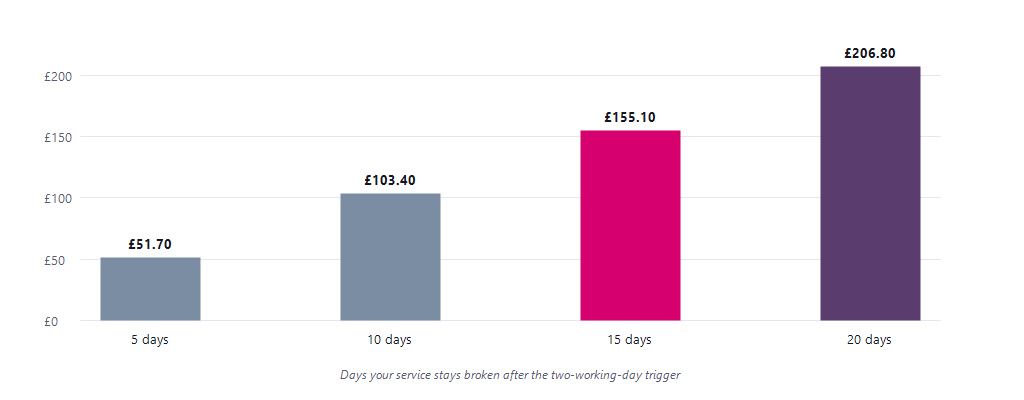
Two worked examples at the 2026 rates. The outage: your broadband dies and you report it on Monday. The provider has until 11.59pm Wednesday, two full working days, to fix it. It is actually fixed on Sunday, so Thursday to Sunday pays four days at £10.34, which is £41.36. The late start: your new service is promised for Monday but goes live on Friday. Monday to Thursday pays four days at £6.46, which is £25.84.
How the rates have risen since 2019
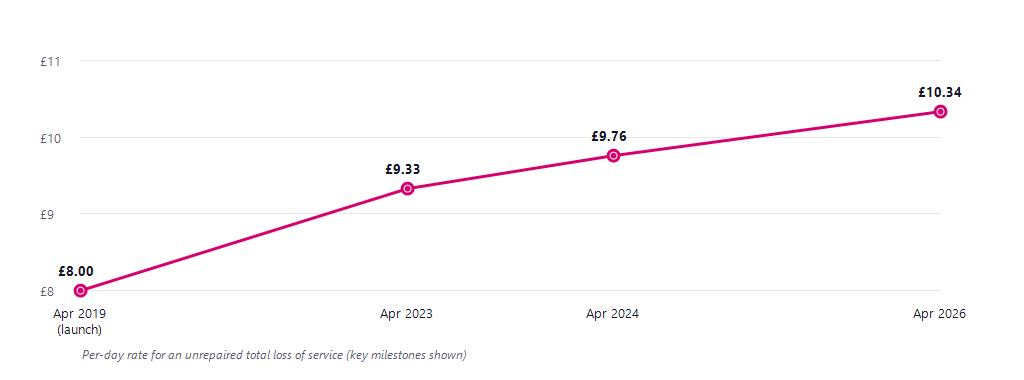
| Effective | Delayed repair (per day) | Missed appointment | Delayed start (per day) |
|---|---|---|---|
| 1 April 2019 (launch) | £8.00 | £25.00 | £5.00 |
| April 2023 | £9.33 | £29.15 | £5.83 |
| April 2024 | £9.76 | £30.49 | £6.10 |
| 1 April 2026 | £10.34 | £32.31 | £6.46 |
The mechanism is simple: rates rise each 1 April in line with the Consumer Price Index as of the previous 31 October. One practical consequence is that incidents are paid at the rate in force when they began, so an outage that started in March 2026 pays at the previous year's rates even if it ran into April.
The small print: when it does not pay
- You caused it, or blocked the fix. Damage your own router, refuse access, or miss the engineer appointment yourself, and the clock stops. It restarts if the next visit also fails.
- Proper notice was given. An appointment moved with more than 24 hours' notice pays nothing, and nor does one you asked to change.
- Planned engineering work. Notified, planned outages are excluded.
- Two services, one payment. If broadband and landline fail together, you are compensated for one service, not both.
- Residential only. Business lines have separate arrangements.
- There can be a cap. A provider may limit payments to 60 calendar days for a single issue, but only after giving you 30 days' notice of that decision.
Who is in the scheme, and the switching question
The scheme is voluntary, but it covers the big names: BT, EE, Plusnet, Sky, NOW, TalkTalk, Virgin Media, Vodafone, Utility Warehouse, Hyperoptic and Zen, together serving around 91% of broadband customers and 97% of landline customers. If your provider is not a member, check who is before your next switch via our provider guides.
Switching soon? Loss of service during a switch counts too. If a switch leaves you offline for more than a working day, or your go-live date is missed, the compensation rules apply, which is one more reason the modern process is designed around no-gap handovers. How that works: One Touch Switch explained.
If the money does not arrive
The whole point of the scheme is that you should not need to chase. But if the credit has not appeared, here is the route.
- Check the next bill or two. Providers have 30 days from the fix, the missed appointment, or the late activation to apply the credit.
- Raise it in writing, with dates. State the fault report date, the fix date or missed appointment, and the rate you are owed. A missing credit is itself grounds for a formal complaint.
- Escalate if they stall. After six weeks unresolved, or sooner with a deadlock letter, the free ombudsman route opens. Our companion guide walks every rung of that ladder: Broadband complaints and your rights: the Escalation Hub.
For worked examples of service-failure scenarios beyond the scheme, see our guide to compensation and service failure.
The scheme sits within a wider service-quality picture, charted in UK broadband statistics 2026.
If service failure pushes you towards leaving, read can you leave your contract early? The five exits.
Questions people ask
How much compensation do I get per day for a broadband outage in 2026?
£10.34 per day, for a total loss of service that is not fixed within two full working days of you reporting it, at the rates effective from 1 April 2026. The payment runs for each day after that trigger until the fault is fixed, credited to your bill within 30 days.
When does compensation actually start for an outage?
The clock starts when you report the fault, and the provider has until 11.59pm on the second working day after your report to fix it. Compensation accrues from the day after that deadline, which is why reporting a fault the day it happens matters so much.
Do I have to claim automatic compensation?
No. That is the point of the scheme: qualifying payments are credited to your bill automatically within 30 days, with no claim needed. If the credit does not appear within 30 days, that is itself grounds for a formal complaint to your provider.
What does not qualify for automatic compensation?
Faults you caused, appointments you missed or moved, appointments cancelled with more than 24 hours' notice, planned engineering work, and business lines. If broadband and landline fail together you are compensated for one service, and providers may cap a single issue at 60 days after giving 30 days' notice.
Do the compensation rates change?
Yes, every 1 April, in line with CPI inflation measured the previous October. The per-day repair rate has risen from £8 at the scheme's 2019 launch to £10.34 from April 2026, and this page is refreshed at each uprating.
About this guide
This guide is part of the BroadbandSwitch.uk 2026 Guide Library, published by BroadbandSwitch.uk, the consumer arm of the SearchSwitchSave network. Our approach to evidence and corrections is documented in the methodology and trust hub, and every published correction appears in the corrections log.
Take it with you: download the free 6-page PDF guide, including the rate history, payout ladder and full sources.
Citing this guide: BroadbandSwitch.uk. (2026, June 11). Ofcom automatic compensation rates 2026 explained. SearchSwitchSave. https://broadbandswitch.uk/guides/automatic-compensation-rates/
Sources
- Ofcom. (2026). Automatic compensation: What you need to know. https://www.ofcom.org.uk/phones-and-broadband/service-quality/automatic-compensation-need-know
- Ofcom. (2025, October). Automatic compensation scheme [Freedom of Information response]. https://www.ofcom.org.uk/siteassets/resources/documents/about-ofcom/foi/2025/october/automatic-compensation-scheme.pdf
- ISPreview UK. (2026, April). Ofcom raise UK consumer compensation payments for broadband ISP woes. https://www.ispreview.co.uk/index.php/2026/04/ofcom-raise-uk-consumer-compensation-payments-for-broadband-isp-woes.html
- ISPreview UK. (2024, April 15). Ofcom raise automatic compensation payouts for UK broadband woes. https://www.ispreview.co.uk/index.php/2024/04/ofcom-raise-automatic-compensation-payouts-for-uk-broadband-woes.html
- ISPreview UK. (2023, March 31). Ofcom raise UK automatic compensation payments for broadband woes. https://www.ispreview.co.uk/index.php/2023/03/ofcom-raise-uk-automatic-compensation-payments-for-broadband-woes.html
This guide is general consumer information, not legal advice. Rates apply to incidents from 1 April 2026 and rise each April; earlier incidents are paid at the rate in force at the time. The scheme is voluntary and the 2024 payout total is reported between £62.4m and just over £63m in Ofcom data; eligibility rules summarised here are abridged from the industry Code of Practice.