FTTC broadband deals: compare fibre-to-the-cabinet at your postcode
FTTC, fibre to the cabinet, remains the most widely available broadband in the UK and is genuinely sufficient for most typical households. The thing nobody tells you is that your distance from the green street cabinet decides everything, including whether the faster tier is worth paying for at all: beyond about a kilometre of copper, Entry and Full FTTC deliver the same speed and the premium buys a ceiling your line can never reach. This page explains how FTTC works, what your distance really means, and when it is time to move to full fibre instead.


See live FTTC deals from 20+ UK providers at your address, and if full fibre has reached your street, we will show that too, because it is often the cheaper option of the two.
Independent, free, no signup. Or jump to the FTTC deals below.Quick answer. FTTC, fibre to the cabinet, is a broadband technology where fibre runs from the exchange to a green street cabinet, then switches to copper on the final stretch to your home. UK FTTC packages advertise download speeds up to 80 Mbps, though actual speed depends on your distance from the cabinet: within 200 metres expect 70 to 80 Mbps, at 300 to 700 metres expect 40 to 60, and beyond 1000 metres expect 20 to 35. Typical monthly prices run £22 to £35. It remains widely available and genuinely sufficient for most typical households.
- Up to 80 Mbpsthe typical UK FTTC speed ceiling
- £22 to £35typical UK monthly range
- Widely availableat most UK addresses today
- Distance decidesspeed drops sharply with cabinet distance
- What FTTC is
- Why distance decides
- The two tiers
- When it still makes sense
- When to move to FTTP
- The 2027 switch-off
- Live deals
- FAQ
What to know first
- Fibre to the cabinet, copper to the homeFTTC uses fibre optic from the exchange to a green street cabinet, then the existing copper phone line for the last stretch to your property. That copper section caps the top speed.The technology
- Up to 80 Mbps advertisedThe two common UK tiers are up to 38 Mbps and up to 80 Mbps. Real speeds sit a little below the headline and depend on how far your home is from the cabinet.The ceiling
- Distance is the main variableWithin 200 metres of the cabinet, 70 to 80 Mbps is typical. At 300 to 700 metres, 40 to 60. Beyond 1000 metres, 20 to 35. Your exact speed depends on your address.The variable
- Still enough for most householdsA 50 to 70 Mbps FTTC line handles HD streaming, video calls, gaming and browsing for typical families of two to four people. Most UK homes do not yet need more.The reality
- £22 to £35 a month is typicalFTTC is usually the cheapest fixed-line broadband option, with setup fees of £0 to £29 depending on promotion, and contracts almost always 18 or 24 months.The price
- Full fibre is the upgrade path, and often cheaperIf full fibre has reached your street you can switch up for faster, more consistent speeds and often symmetrical upload. On this site's own published pricing, entry full fibre frequently costs less than Full FTTC.The upgrade
What FTTC actually is
FTTC stands for fibre to the cabinet, and the technology works in two halves. The first half is fibre optic: a fibre cable runs from the telephone exchange to the green metal cabinet you see on street corners across the UK. These cabinets were originally just copper junction boxes, and Openreach upgraded tens of thousands of them to fibre between 2009 and the late 2010s.
The second half is copper. From the cabinet to your house, the signal travels on the existing phone line, which is a thin copper wire. Copper is a slower medium than fibre and its signal degrades with distance, which is why FTTC is a part-fibre rather than a full-fibre technology, and why top speed is capped at around 80 Mbps even on a short line.
Before FTTC came ADSL: pure copper all the way, delivering 5 to 24 Mbps depending on line length, with most lines managing 5 to 17 in practice. FTTC was the big leap that made consistent 50 to 70 Mbps feasible for much of the UK. See our ADSL guide for that older technology, or full fibre for the newer one.
Why your FTTC speed depends on distance
Two houses on the same road can get very different speeds on the same product, because the copper-wire distance from the cabinet differs. That distance does not only set your speed: it also decides whether the more expensive tier is worth buying at all.
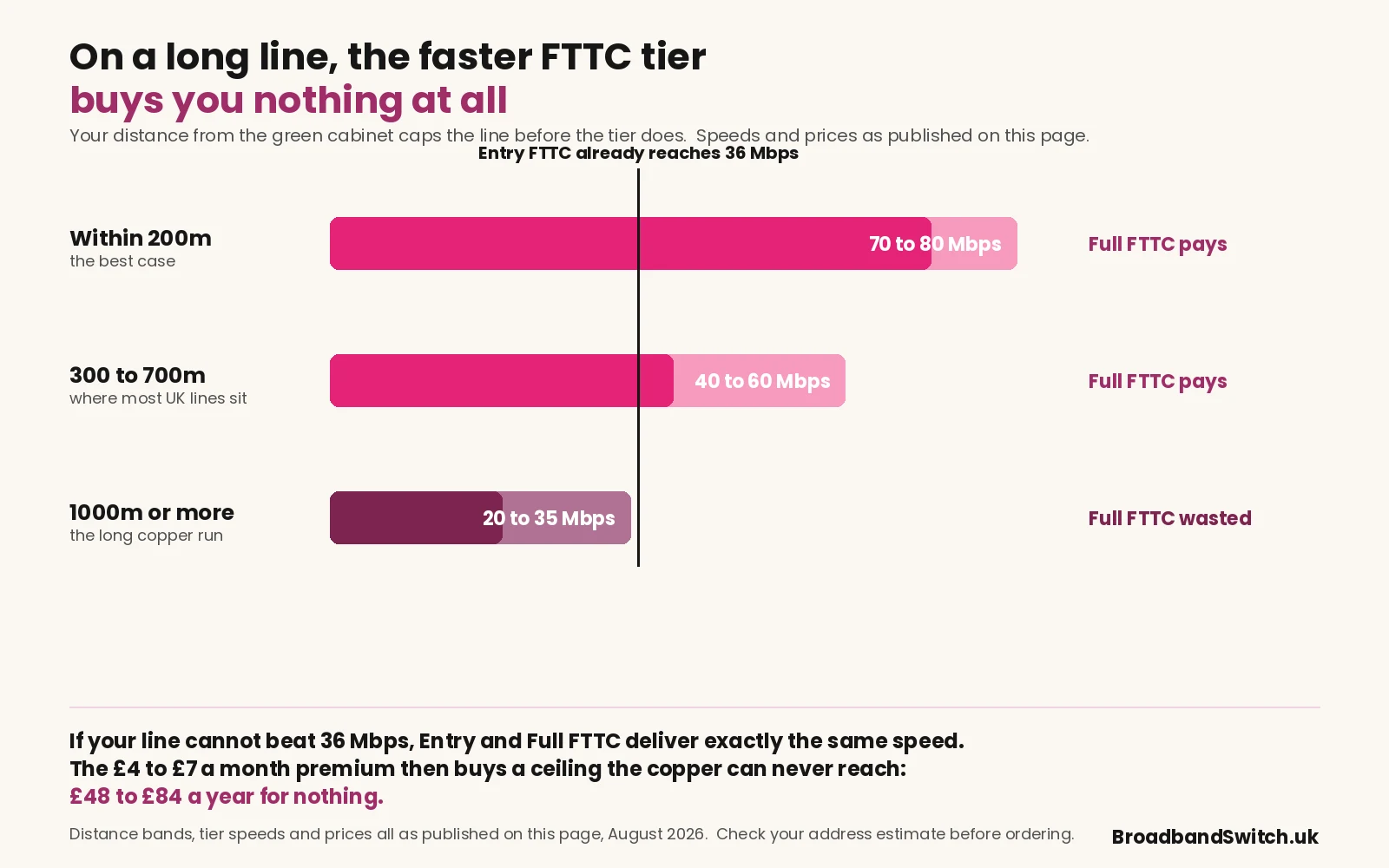
- Close, within 200m · 70 to 80 Mbps typicalAt short distances the copper signal is strong and the full advertised speed is usually delivered. This is the best-case FTTC outcome and what headline speeds reflect.
- Mid, 300 to 700m · 40 to 60 Mbps typicalMost UK FTTC connections sit in this range, which is enough for most households but noticeably below the 80 Mbps advertised ceiling.
- Far, 1000m or more · 20 to 35 Mbps typicalOn long copper runs speeds fall sharply, and ADSL-grade results are not uncommon despite paying for an 80 Mbps product. This is also the band where the faster tier stops being worth buying.
Check the estimate, not the headline. Providers now display an estimated speed range for your exact address at checkout, following ASA guidance. Always check that estimate before ordering FTTC, because the advertised up to 80 Mbps may not be what your line can actually deliver.
UK FTTC speed tiers and what they suit
Most UK providers offer FTTC in two tiers. The right choice depends on how many devices you use at once, how heavy the use is, and, crucially, how far you sit from the cabinet.
- Entry FTTC · up to 38 Mbps · £22 to £28Typical real speed 25 to 36 Mbps. Best for light households of one to two people, and the sensible choice on a long line where the copper caps you below 36 Mbps anyway.
- Full FTTC · up to 80 Mbps · £26 to £35Typical real speed 40 to 72 Mbps on short and mid-range lines. Best for families, home workers and multi-device homes.
On a short or mid-range line there is little reason to pick Entry FTTC over Full FTTC, because Full typically costs only £4 to £7 more a month and roughly doubles what you actually receive. On a long line the calculation reverses. If your copper cannot deliver more than about 36 Mbps, Entry FTTC already reaches your line's ceiling, and the Full FTTC premium buys headroom the copper can never carry: £48 to £84 a year for no extra speed at all. The checker at the top of this page settles which side of that line you are on.
When FTTC still makes sense
FTTC is often treated as yesterday's technology, but for a large portion of UK households it remains the most practical option.
- Full fibre is not yet at your addressOpenreach's FTTP rollout is extensive but not universal. If full fibre has not yet reached your street, FTTC is the fastest fixed-line option you can order today, and it is worth checking back every 6 to 12 months as rollout continues.Case one
- You want the lowest monthly priceFTTC sits at the lowest end of fixed-line pricing. For budget-focused households, a social tariff on FTTC or a promotional entry deal is frequently the cheapest route to reliable home broadband. See cheapest deals.Case two
- Your household use is modestA one to two-person home that mostly streams, browses and takes video calls rarely hits the FTTC ceiling. A full 70 Mbps line handles all of that comfortably, and upgrading beyond it is a premium for headroom you may not use.Case three
When to upgrade to full fibre instead
The usual assumption is that moving to full fibre means paying more. On this site's own published pricing, that is frequently not true.
- Go for full fibre whenYou need reliable upload for video calls, cloud backup or live streaming; your household has four or more active users streaming and gaming at once; your FTTC line is long and delivering under 40 Mbps; an altnet has reached your postcode at a competitive price; or the entry full fibre deal at your address simply costs less than the FTTC tier you are on, which happens more often than people expect.
- Stick with FTTC whenFull fibre is not yet available at your address; your current FTTC speed is comfortably sufficient for your household; the specific full fibre deals live at your postcode genuinely do cost more and the speed gain would not be used; or you are happy to revisit in 12 months as rollout and pricing both move.
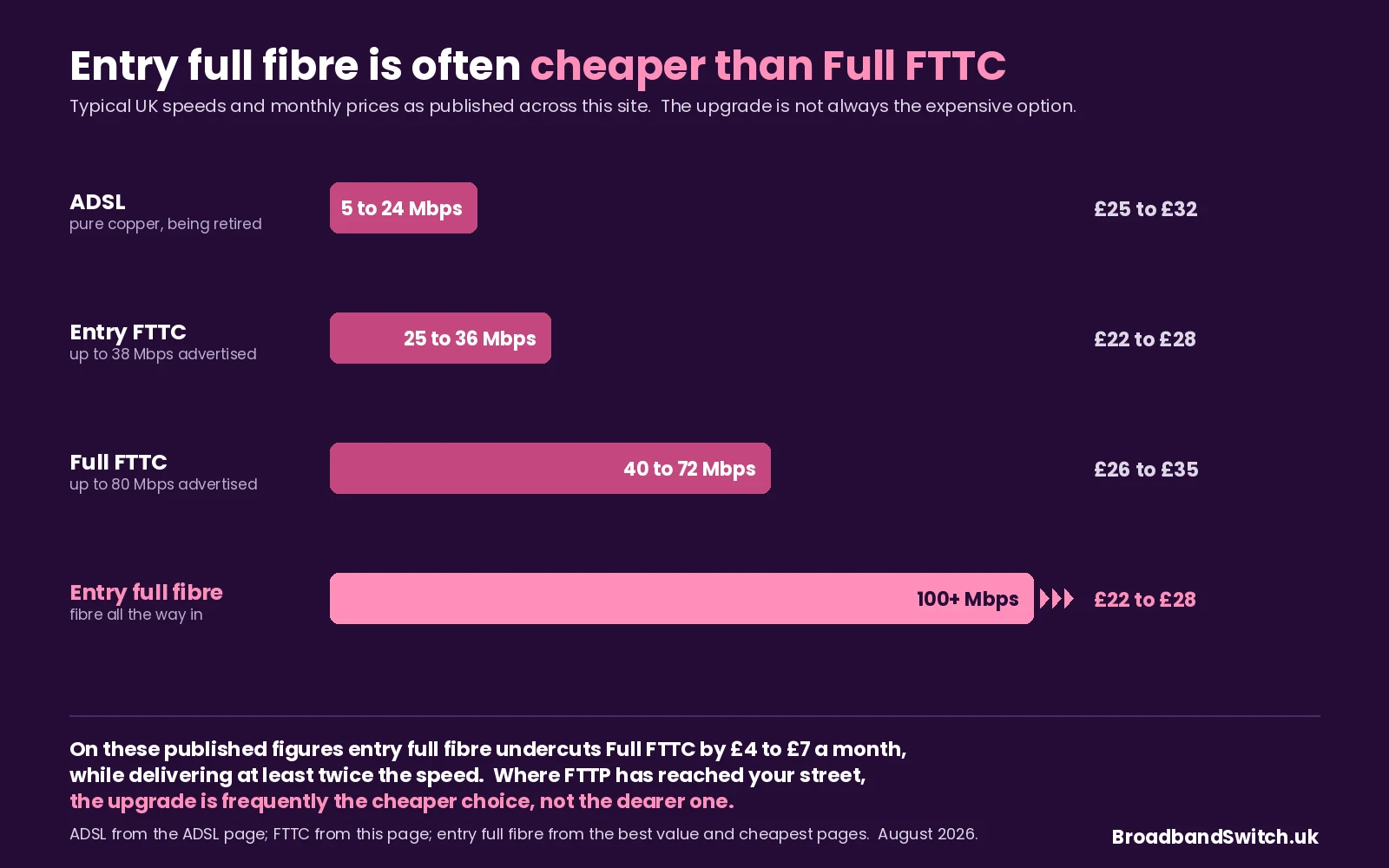
On those figures entry full fibre runs £22 to £28 a month for 100+ Mbps, against Full FTTC at £26 to £35 for 40 to 72 Mbps. Where full fibre has reached your street, the upgrade is frequently the cheaper choice as well as the faster one, so check both before assuming. For the side-by-side technical comparison, see our full fibre versus FTTC versus cable and 4G or 5G guide.
What the PSTN switch-off means for FTTC
A common concern: does the PSTN switch-off mean my FTTC broadband will stop working? The short answer is no, but the detail matters. PSTN is the UK's old copper-based phone network, and it is being switched off on 31 January 2027. That affects landline voice service, not FTTC broadband itself. After the switch-off, your home phone moves from PSTN to Digital Voice, which routes calls over your broadband connection instead, while your FTTC broadband continues to work over the same physical copper wires.
- If you use FTTC with a PSTN landlineYour provider will migrate you. You will be contacted before the switch-off and moved to Digital Voice, and the broadband keeps working the same way.Your provider acts
- If you have a care alarm on the landlineCheck compatibility before switching, because not all care alarms, health pendants or security alarms work on Digital Voice. See our care alarm guide before you move.Check first
- If you switched to FTTC without a landlineNo action needed. FTTC broadband runs over the same copper pair regardless of whether PSTN voice is active, so your broadband continues past 31 January 2027.Nothing to do
See also our Digital Voice guide for more detail, and the landline page if you want to see where your own contract falls against the deadline.
Live FTTC deals at your postcode
Live deals below are limited to packages delivered over FTTC. Enter your postcode to narrow to what is actually live at your address, sorted by monthly price, low to high.
Availability and realistic speed are postcode and address specific, and your distance from the street cabinet is the main variable on any FTTC line. Always check your estimated speed at the exact address before ordering, and look at what full fibre costs there too, because it is often less than the FTTC tier above it.
Related ways to compare
FTTC broadband, asked and answered
What does FTTC stand for?
FTTC stands for fibre to the cabinet. The fibre-optic cable runs from the telephone exchange to the green street cabinet near your home, then switches to copper for the final stretch to your property. It is often called part fibre or super-fast fibre in UK marketing, to distinguish it from FTTP, or full fibre, which uses fibre the whole way.
What speeds can I realistically expect on FTTC?
It depends on your distance from the green street cabinet. Within 200 metres you can expect 70 to 80 Mbps on the standard tier. At 300 to 700 metres you typically see 40 to 60 Mbps. At 1000 metres or more the speed can fall to 20 to 35 Mbps. Providers display an estimated speed range for your exact address during checkout, following ASA guidance, and that estimate is the number to trust.
Is the faster FTTC tier always worth paying for?
No, and this is the check most people miss. Entry FTTC delivers 25 to 36 Mbps and Full FTTC delivers 40 to 72, but only if your line can carry it. On a long copper run of 1000 metres or more, where the line gives 20 to 35 Mbps, both tiers deliver the same speed because the copper caps you first. The Full FTTC premium of £4 to £7 a month then buys a ceiling your line can never reach, which is £48 to £84 a year for nothing. On short and mid-range lines the upgrade is well worth it.
Is FTTC being phased out?
FTTC is gradually being superseded by full fibre as the UK rollout continues, but it is not being switched off and no retirement date has been announced. Millions of UK homes continue to use FTTC happily and will do for years yet. The decision to upgrade is yours, based on availability, price and need, rather than on a deadline.
Does FTTC stop working when PSTN is switched off in January 2027?
No. The PSTN switch-off affects the old landline voice network, not FTTC broadband, and your FTTC connection continues to work over the same copper pair. What changes is your home phone: PSTN landline service moves to Digital Voice, which routes calls over broadband. Your provider will contact you before the switch-off to migrate the phone side of your service.
Is FTTC better than ADSL?
Significantly, yes. ADSL is pure copper all the way and typically delivers 5 to 24 Mbps, with most lines managing 5 to 17 in practice. FTTC uses fibre for the exchange-to-cabinet leg and delivers 40 to 72 Mbps on most short and mid-range lines. For any UK household that has FTTC available it is the better choice, and the price difference is usually small or in FTTC's favour. See our ADSL guide for the comparison.
Is full fibre more expensive than FTTC?
Often not. On the figures published across this site, entry Openreach full fibre runs £22 to £28 a month for 100+ Mbps, while Full FTTC runs £26 to £35 for 40 to 72 Mbps, so the upgrade frequently costs less as well as delivering more. Prices vary by address and by provider, so check both at your postcode rather than assuming full fibre carries a premium.
Do social tariffs work on FTTC?
Yes. Most UK social tariffs are delivered over FTTC lines, and Ofcom's 2026 pricing report puts broadband social tariffs at £12.50 to £24 a month, with more than 30 options available as at December 2025 and many committing to no in-contract price rises. If you receive Universal Credit, Pension Credit, Employment and Support Allowance, Jobseeker's Allowance or Income Support, see our social tariffs guide or Ofcom's current list.
About this guide. Compiled by Adrian James and reviewed by Dr Alex J. Martin-Smith, with every speed and price stated as published at 9 August 2026, and the distance checker reading its bands and tier figures from this page's own cards so tool and text cannot drift. BroadbandSwitch is an independent UK broadband comparison service owned by SearchSwitchSave. FTTC speeds vary by distance from the cabinet and by exact address, and the copper route is often longer than the walking distance, so always trust the provider's address-level estimate over any rule of thumb. We earn commission when you order via our comparison, which does not change the price you pay: read how we rank deals, our editorial policy, the methodology and trust hub and our affiliate disclosure. Spotted something wrong? Submit a correction and a human will read it.
References
- Ofcom. (2026). Pricing and consumer engagement: trends in the UK communications sector. Office of Communications. Retrieved August 9, 2026, from https://www.ofcom.org.uk/phones-and-broadband/bills-and-charges/pricing
- Ofcom. (2024, July 19). Ofcom bans mid-contract price rises linked to inflation. Office of Communications. Retrieved August 9, 2026, from https://www.ofcom.org.uk/phones-and-broadband/bills-and-charges/ofcom-bans-mid-contract-price-rises-linked-to-inflation
- Ofcom. (2024, September 12). Simpler and quicker broadband switching is here. Office of Communications. Retrieved August 9, 2026, from https://www.ofcom.org.uk/phones-and-broadband/switching-provider/simpler-broadband-switching-is-here
- Ofcom. (n.d.). Social tariffs: cheaper broadband and phone packages. Office of Communications. Retrieved August 9, 2026, from https://www.ofcom.org.uk/phones-and-broadband/saving-money/social-tariffs
Also worth checking: full fibre if it has reached your address, since it often costs less than the FTTC tier above yours, cheapest deals for the lowest monthly, or social tariffs if you qualify.
Independent, free, no signup. 20+ FTTC providers.