BIRMINGHAM · TEN SEATS · SIXTY-NINE WARDS
Broadband in Birmingham: full fibre seat by seat, ward by ward, and what reaches your street
Birmingham is well wired, and for gigabit speeds it is among the leaders of England’s big cities. In January 2026 Ofcom counted 95.6% of the city’s 459,000 homes able to get a gigabit-capable line, against 89.5% for England, and 85.6% able to get full fibre, against 82%. The difference between those two figures is mostly Virgin Media’s cable, which already brings gigabit speeds to streets the full fibre builders have yet to reach.
The fibre is largely in place; what lags is people ordering it. Only 37% of the homes that could have full fibre had taken it, which puts Birmingham 244th of England’s 296 councils on take-up and leaves most households an easy upgrade within reach. Openreach has stopped selling copper at 20 of the 24 exchanges on its list for the city, and the builders’ plans give 80.1% of homes two gigabit networks or more by 2029.
Every figure below is dated and sourced, whether it comes from Ofcom, the 2021 census, Openreach or a company speaking for itself. Inside are all 10 Westminster seats and all 69 wards, the networks in their own words, each exchange and its date, the reasons the centre and a few leafy wards lag, and what the 2029 plans bring. Your own postcode has the final say. Live in Solihull, Wolverhampton or the Black Country? Our West Midlands page covers the neighbouring councils.
Want your own corner of the city? Pick your ward for one card of figures, or see all ten seats side by side. Here for the deals? Check your postcode.
Start with your address, not the city average
Direct answer: No single figure describes Birmingham. Across the city Ofcom puts a gigabit-capable line within reach of 95.6% of homes and full fibre within reach of 85.6%, and the builders plan two gigabit networks or more for 80.1% by 2029. Whether your home is one of them depends on your road, and in a block of flats on the building, so the figure that matters is the one for your own postcode.
For most Birmingham households the choice starts with Openreach and Virgin Media, and many can have either. A growing number have a third option too: the Netomnia network, sold as YouFibre; Grain, in the inner-city districts it names; CityFibre, through providers such as toob, in the north of the city; and Hyperoptic in some blocks. Further down, each company is quoted in its own words and dated, which explains the list your postcode search brings back, and why next door can sometimes be on a different network from you.
Ten seats, from Yardley to Edgbaston
Direct answer: Full fibre across the ten Westminster seats ranges from 94.2% in Yardley down to 78.3% in Edgbaston. Part of Edgbaston’s shortfall is a counting matter: 917 of its premises could not be matched to Ofcom’s coverage records, and over the matched premises alone it reaches 79.8%. On gigabit, nine seats are at 93.9% or better; Ladywood, at 87.8%, is the exception.
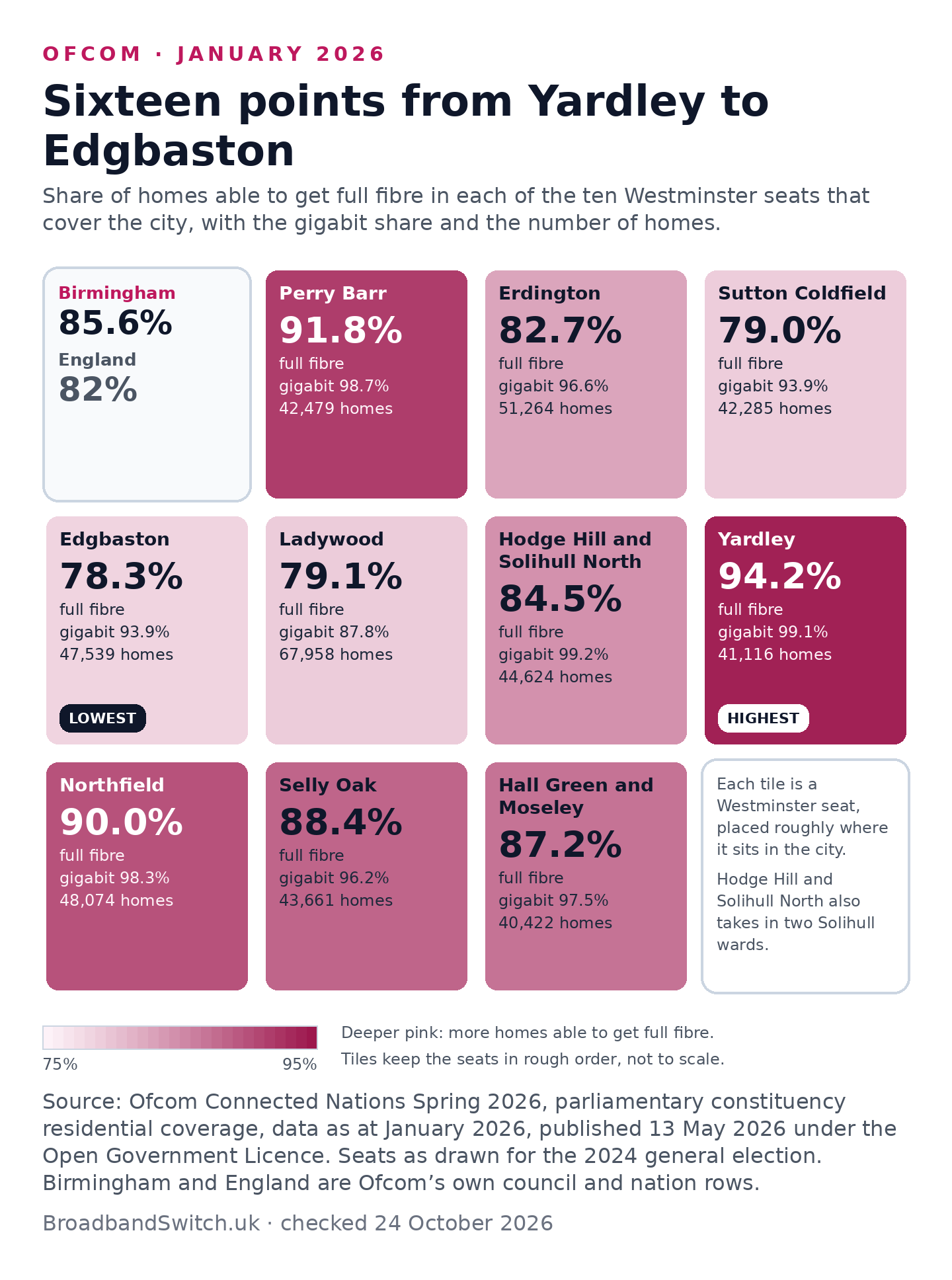
These are the seats drawn for the 2024 general election. Together they cover the whole city plus two wards of Solihull, Castle Bromwich and Smith’s Wood, which sit in Hodge Hill and Solihull North. That is why Ofcom’s ten seat rows add up to 469,422 homes, 10,402 more than its row for the city. Each seat’s wards are listed under its name in the table, taken from the Boundary Commission for England’s final report, so you can find yours even if you have never thought of your road as Erdington or Selly Oak.
| YardleyAcocks Green, Sheldon, Small Heath, South Yardley, Tyseley & Hay Mills, Yardley East, Yardley West & Stechford | 94.2% | 99.1% | 41,116 | 39 |
|---|---|---|---|---|
| Perry BarrAston, Birchfield, Handsworth, Handsworth Wood, Holyhead, Lozells, Oscott (part), Perry Barr | 91.8% | 98.7% | 42,479 | 231 |
| NorthfieldAllens Cross, Frankley Great Park, King’s Norton North, King’s Norton South, Longbridge & West Heath, Northfield, Rubery & Rednal, Weoley & Selly Oak (part) | 90.0% | 98.3% | 48,074 | 407 |
| Selly OakBillesley, Bournbrook & Selly Park, Bournville & Cotteridge, Brandwood & King’s Heath (part), Druids Heath & Monyhull, Highter’s Heath, Stirchley, Weoley & Selly Oak (part) | 88.4% | 96.2% | 43,661 | 268 |
| Hall Green and MoseleyBrandwood & King’s Heath (part), Hall Green North, Hall Green South, Moseley, Sparkbrook & Balsall Heath East, Sparkhill | 87.2% | 97.5% | 40,422 | 272 |
| Hodge Hill and Solihull NorthBromford & Hodge Hill, Garretts Green, Glebe Farm & Tile Cross, Heartlands, Shard End, Ward End, Castle Bromwich (Solihull), Smith’s Wood (Solihull) | 84.5% | 99.2% | 44,624 | 59 |
| ErdingtonCastle Vale, Erdington, Gravelly Hill, Kingstanding, Oscott (part), Perry Common, Pype Hayes, Stockland Green | 82.7% | 96.6% | 51,264 | 662 |
| LadywoodAlum Rock, Balsall Heath West, Bordesley & Highgate, Bordesley Green, Ladywood, Nechells, Newtown, Soho & Jewellery Quarter | 79.1% | 87.8% | 67,958 | 3,951 |
| Sutton ColdfieldSutton Four Oaks, Sutton Mere Green, Sutton Reddicap, Sutton Roughley, Sutton Trinity, Sutton Vesey, Sutton Walmley & Minworth, Sutton Wylde Green | 79.0% | 93.9% | 42,285 | 260 |
| EdgbastonBartley Green, Edgbaston, Harborne, North Edgbaston, Quinton | 78.3% | 93.9% | 47,539 | 542 |
| Birmingham | 85.6% | 95.6% | 459,020 | 6,690 |
Seats follow the boundaries used since the 2024 general election, with each seat’s Birmingham name shortened. All four columns are Ofcom’s counts of residential premises for January 2026. The wards under each seat come from the Boundary Commission for England’s final report of 2023; “part” marks a ward split between two seats. The Birmingham row is Ofcom’s figure for the city council area. Press a heading to sort.
The seats furthest ahead
Yardley leads at 94.2%, then Perry Barr at 91.8% and Northfield at 90.0%. In the east and north-west of the city the work is nearly finished: Yardley’s gigabit figure is 99.1% and Perry Barr’s 98.7%. For homes there, the question is less whether the fibre has arrived than whether anyone has ordered it, which the take-up section takes up.
The seats with most still to do
The lowest three sit close together: Edgbaston at 78.3%, Sutton Coldfield at 79.0% and Ladywood at 79.1%. They could hardly be more different. Sutton Coldfield, the Royal Town to the north, is a place of large houses where full fibre has come more slowly, but cable reaches far, so its gigabit figure is 93.9%. Ladywood takes in the city centre and the inner districts around it, with more flats than any other seat and 3,951 homes unable to get even 30Mbit/s. Edgbaston runs from the leafy roads near the Botanical Gardens out to Harborne, Quinton and Bartley Green, and holds most of the premises Ofcom could not match.
Every seat holds forty thousand homes or more, so read its figure as a forecast for the district rather than a promise for your road. The ward figures below go one level closer.
Sixty-nine wards, and where the gaps are
Direct answer: Ofcom does not publish full fibre by ward, but its output area file gives gigabit coverage street by street, and we have added it up for all 69 wards. In 23 of them, 99% or more of homes can get a gigabit-capable line. Eight wards fall below 90%, and the lowest four are Edgbaston, Sutton Four Oaks, Bordesley & Highgate and Ladywood.
Ofcom, January 2026
Sixty-nine wards, one dot each: who can get a gigabit line
- Edgbaston 74.1%
- Sutton Four Oaks 75.5%
- Bordesley & Highgate 80.9%
- Ladywood 84.4%
Ofcom Connected Nations Spring 2026, output area residential coverage, January 2026. Each ward is the 2021 output areas the ONS’s nomis service fits to it, and the 69 wards add up exactly to Ofcom’s figures for the city. Ofcom’s output area file gives gigabit and superfast coverage but not full fibre. Dots stack where wards share a half-point band.
Two of the four may surprise you. Sutton Four Oaks is one of the city’s most spacious wards, with 54.1% of households in a detached house on the census, yet 75.5% of its homes can get a gigabit line. Almost none of them is slow: Ofcom counts 11 homes there unable to get 30Mbit/s. So the gap is for the newer networks to close, not a shortage of basic broadband. Edgbaston is the other. 913 of its premises could not be matched to Ofcom’s data, and over the matched premises alone its gigabit figure is 83.2%.
The slow lines gather in the middle of the city. Bordesley & Highgate, which takes in Digbeth, has 1,350 homes that cannot get 30Mbit/s, more than any other ward, and superfast coverage of 85.9%. Add Ladywood ward, at 898, and Nechells, at 627, and three inner wards hold 2,875 homes, 43% of the city’s total. The city-centre section looks at what may lie behind that.
All 69 wards: gigabit, slow lines, flats and council homesopen the table
| Acocks GreenYardley | 99.0% | 11 | 22.2% | 14.7% |
|---|---|---|---|---|
| Allens CrossNorthfield | 99.3% | 0 | 11.8% | 21.3% |
| Alum RockLadywood | 98.1% | 1 | 13.6% | 9.9% |
| AstonPerry Barr | 99.2% | 28 | 17.4% | 11.1% |
| Balsall Heath WestLadywood | 96.8% | 4 | 37.1% | 14.9% |
| Bartley GreenEdgbaston | 99.3% | 0 | 20.6% | 30.3% |
| BillesleySelly Oak | 99.2% | 0 | 20.4% | 19.5% |
| BirchfieldPerry Barr | 96.3% | 92 | 35.4% | 9.5% |
| Bordesley & HighgateLadywood | 80.9% | 1,350 | 65.5% | 19.4% |
| Bordesley GreenLadywood | 98.4% | 20 | 25.8% | 15.6% |
| Bournbrook & Selly ParkSelly Oak | 88.2% | 2 | 14.0% | 4.7% |
| Bournville & CotteridgeSelly Oak | 97.1% | 68 | 25.5% | 6.6% |
| Brandwood & King’s HeathHall Green and Moseley and Selly Oak | 99.7% | 9 | 20.0% | 10.6% |
| Bromford & Hodge HillHodge Hill and Solihull North | 98.9% | 13 | 17.6% | 17.9% |
| Castle ValeErdington | 91.0% | 63 | 30.3% | 6.5% |
| Druids Heath & MonyhullSelly Oak | 93.2% | 89 | 28.1% | 27.2% |
| EdgbastonEdgbaston | 74.1% | 436 | 55.3% | 8.9% |
| ErdingtonErdington | 97.3% | 116 | 35.0% | 12.8% |
| Frankley Great ParkNorthfield | 98.2% | 0 | 12.1% | 29.9% |
| Garretts GreenHodge Hill and Solihull North | 98.9% | 20 | 17.0% | 29.9% |
| Glebe Farm & Tile CrossHodge Hill and Solihull North | 99.8% | 1 | 15.4% | 25.7% |
| Gravelly HillErdington | 93.6% | 96 | 37.4% | 12.2% |
| Hall Green NorthHall Green and Moseley | 99.2% | 15 | 12.0% | 7.2% |
| Hall Green SouthHall Green and Moseley | 99.0% | 0 | 7.3% | 1.3% |
| HandsworthPerry Barr | 97.6% | 0 | 19.2% | 8.1% |
| Handsworth WoodPerry Barr | 98.1% | 38 | 21.4% | 3.8% |
| HarborneEdgbaston | 97.3% | 42 | 33.1% | 15.4% |
| HeartlandsHodge Hill and Solihull North | 99.9% | 0 | 17.8% | 20.5% |
| Highter’s HeathSelly Oak | 99.5% | 0 | 11.8% | 12.7% |
| HolyheadPerry Barr | 99.6% | 0 | 10.7% | 7.1% |
| KingstandingErdington | 98.6% | 29 | 12.5% | 21.2% |
| King’s Norton NorthNorthfield | 96.1% | 166 | 18.0% | 14.4% |
| King’s Norton SouthNorthfield | 97.4% | 139 | 22.7% | 33.7% |
| LadywoodLadywood | 84.4% | 898 | 87.7% | 14.5% |
| Longbridge & West HeathNorthfield | 99.4% | 2 | 25.0% | 18.2% |
| LozellsPerry Barr | 99.4% | 9 | 19.7% | 16.4% |
| MoseleyHall Green and Moseley | 92.9% | 124 | 48.7% | 4.3% |
| NechellsLadywood | 85.5% | 627 | 64.1% | 40.9% |
| NewtownLadywood | 88.7% | 540 | 65.6% | 47.7% |
| North EdgbastonEdgbaston | 96.9% | 61 | 39.9% | 7.6% |
| NorthfieldNorthfield | 96.3% | 100 | 17.0% | 3.6% |
| OscottErdington and Perry Barr | 99.8% | 4 | 8.2% | 8.6% |
| Perry BarrPerry Barr | 99.3% | 64 | 9.0% | 3.0% |
| Perry CommonErdington | 97.4% | 0 | 16.9% | 21.4% |
| Pype HayesErdington | 93.2% | 220 | 13.4% | 17.9% |
| QuintonEdgbaston | 99.2% | 3 | 13.6% | 15.1% |
| Rubery & RednalNorthfield | 99.9% | 0 | 25.1% | 18.4% |
| Shard EndHodge Hill and Solihull North | 99.2% | 24 | 20.2% | 32.4% |
| SheldonYardley | 99.7% | 3 | 17.8% | 11.5% |
| Small HeathYardley | 99.5% | 1 | 7.6% | 6.5% |
| Soho & Jewellery QuarterLadywood | 86.7% | 511 | 52.4% | 10.4% |
| South YardleyYardley | 99.4% | 23 | 16.1% | 11.2% |
| Sparkbrook & Balsall Heath EastHall Green and Moseley | 98.1% | 123 | 19.4% | 9.6% |
| SparkhillHall Green and Moseley | 99.4% | 2 | 12.1% | 2.9% |
| StirchleySelly Oak | 98.4% | 70 | 13.1% | 8.0% |
| Stockland GreenErdington | 97.9% | 134 | 28.9% | 11.6% |
| Sutton Four OaksSutton Coldfield | 75.5% | 11 | 24.5% | 2.1% |
| Sutton Mere GreenSutton Coldfield | 90.0% | 3 | 20.4% | 5.4% |
| Sutton ReddicapSutton Coldfield | 96.2% | 9 | 22.3% | 17.5% |
| Sutton RoughleySutton Coldfield | 98.4% | 12 | 7.3% | 4.6% |
| Sutton TrinitySutton Coldfield | 94.4% | 45 | 27.6% | 3.0% |
| Sutton VeseySutton Coldfield | 97.6% | 20 | 16.2% | 3.3% |
| Sutton Walmley & MinworthSutton Coldfield | 95.7% | 160 | 15.7% | 1.7% |
| Sutton Wylde GreenSutton Coldfield | 96.7% | 0 | 17.9% | 2.5% |
| Tyseley & Hay MillsYardley | 99.9% | 0 | 18.5% | 21.8% |
| Ward EndHodge Hill and Solihull North | 98.9% | 0 | 12.9% | 11.7% |
| Weoley & Selly OakNorthfield and Selly Oak | 98.3% | 38 | 21.3% | 17.9% |
| Yardley EastYardley | 98.0% | 0 | 19.7% | 11.8% |
| Yardley West & StechfordYardley | 97.9% | 1 | 21.2% | 15.9% |
Gigabit is the share of residential premises able to get a gigabit-capable line, and “under 30Mbit/s” the number unable to get superfast speeds. Both come from Ofcom’s output area file of January 2026, with each ward built from the output areas nomis fits to it. Flats and council renting are shares of households in the 2021 census. A ward split between two seats names both. Press a heading to sort.
Two cautions before you lean on a ward figure. The wards are built from output areas, the census’s smallest building blocks, which nomis fits to each ward, so a ward’s edge can be out by a street; even so, the 69 wards add up exactly to Ofcom’s figures for the whole city. And Ofcom counts premises in January 2026 while the census counted households in 2021, so a ward with new blocks shows more premises than households. Ladywood has 4,821 more, a sign of how much the centre has grown. For your own door, the postcode check is still the one to trust.
The ten-point gap that cable fills
Direct answer: In January 2026, 95.6% of Birmingham homes could get a gigabit-capable line, but 85.6% could get full fibre. The gap of 10 points, about 46,216 homes, is cable: Virgin Media’s network brings gigabit speeds over coaxial cable to homes the full fibre builders have not reached yet.
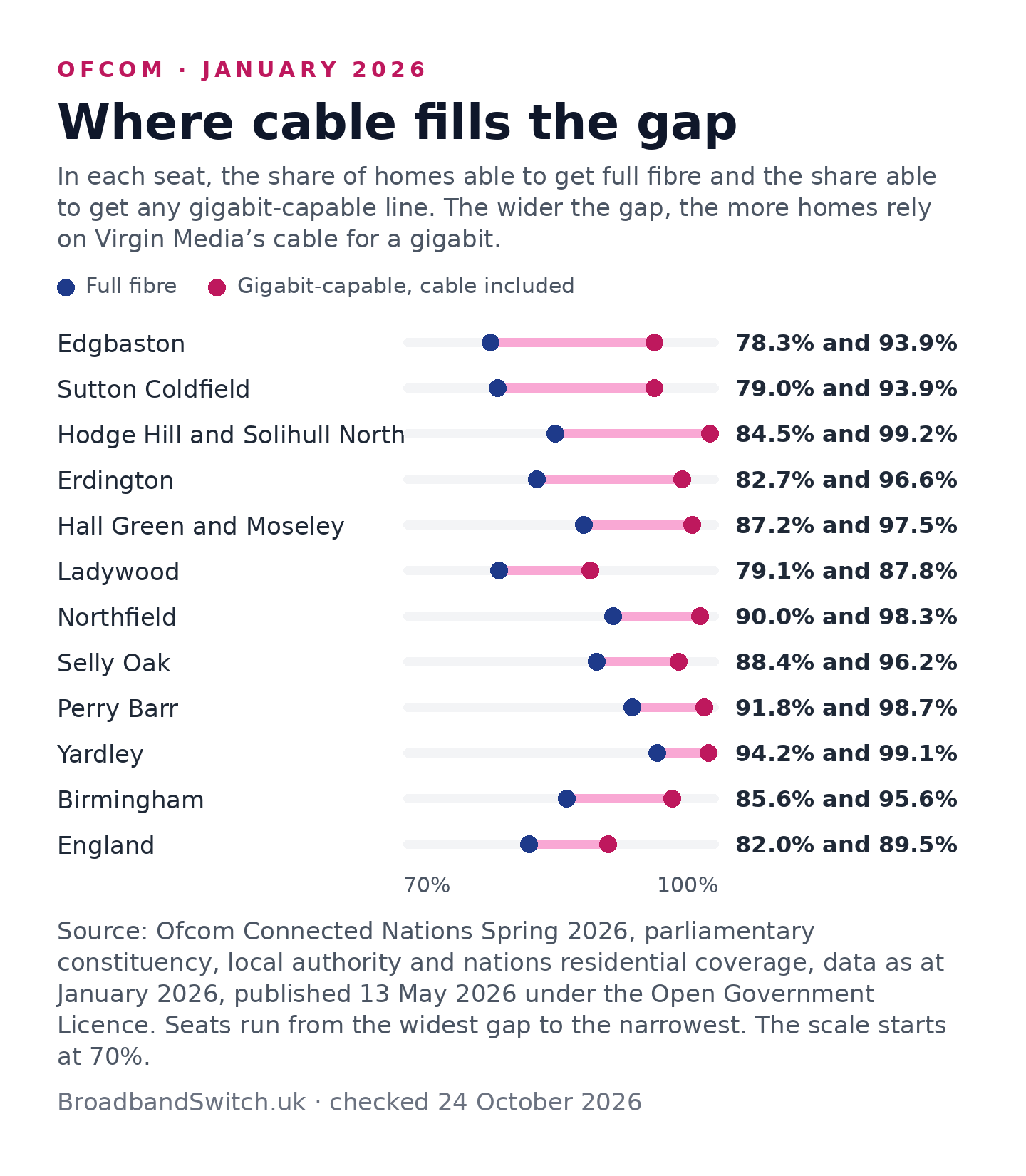
Ofcom keeps the two measures apart for good reason. Full fibre, in its definitions, means fibre running the whole way from the network to the home; gigabit-capable means any connection that can download at a gigabit or more, whatever it is made of. A home on Virgin Media’s cable can have the second without the first, and in Birmingham about one home in ten is in that position. Download speeds on a gigabit cable line and a gigabit full fibre line are much alike. Upload is where they part: cable packages generally send data more slowly than full fibre ones, which matters for video calls, backups and big files.
The gap is widest in Edgbaston, 15.6 points, Sutton Coldfield, 14.9, and Hodge Hill and Solihull North, 14.7, and narrowest in Yardley, 4.9. Across England as a whole the city is 3.6 points ahead on full fibre and 6 ahead on gigabit, and the cable network does much of that second lift.
Virgin Media is adding full fibre too
On 18 August 2025 Virgin Media published an article headed “Virgin Media Full Fibre has reached 68,631 homes in Birmingham”. Its own footnote explains that the figure counts homes added to its full fibre network in Birmingham in 2025, up to June, rather than the whole of its footprint. It gives no share of the city for either network, which is why the corrections remove the cable share the old version of this page printed.
On cable today?
If your home is in that one in ten, you already have a choice of gigabit speeds through Virgin Media, and full fibre may follow. Happy on cable? Nothing needs to change. If you would rather have full fibre, or a provider that sells only over Openreach or another fibre network, the postcode check shows whether it has reached you yet.
Birmingham against England’s other core cities
Direct answer: Among England’s eight core cities, Birmingham is third for gigabit coverage at 95.6%, behind Nottingham at 96.7% and Leeds at 96.3%, and seventh for full fibre at 85.6%, ahead of Bristol. Among its six West Midlands neighbours it sits in the middle, with Coventry leading on full fibre at 96.8% and Solihull trailing at 81.7%.
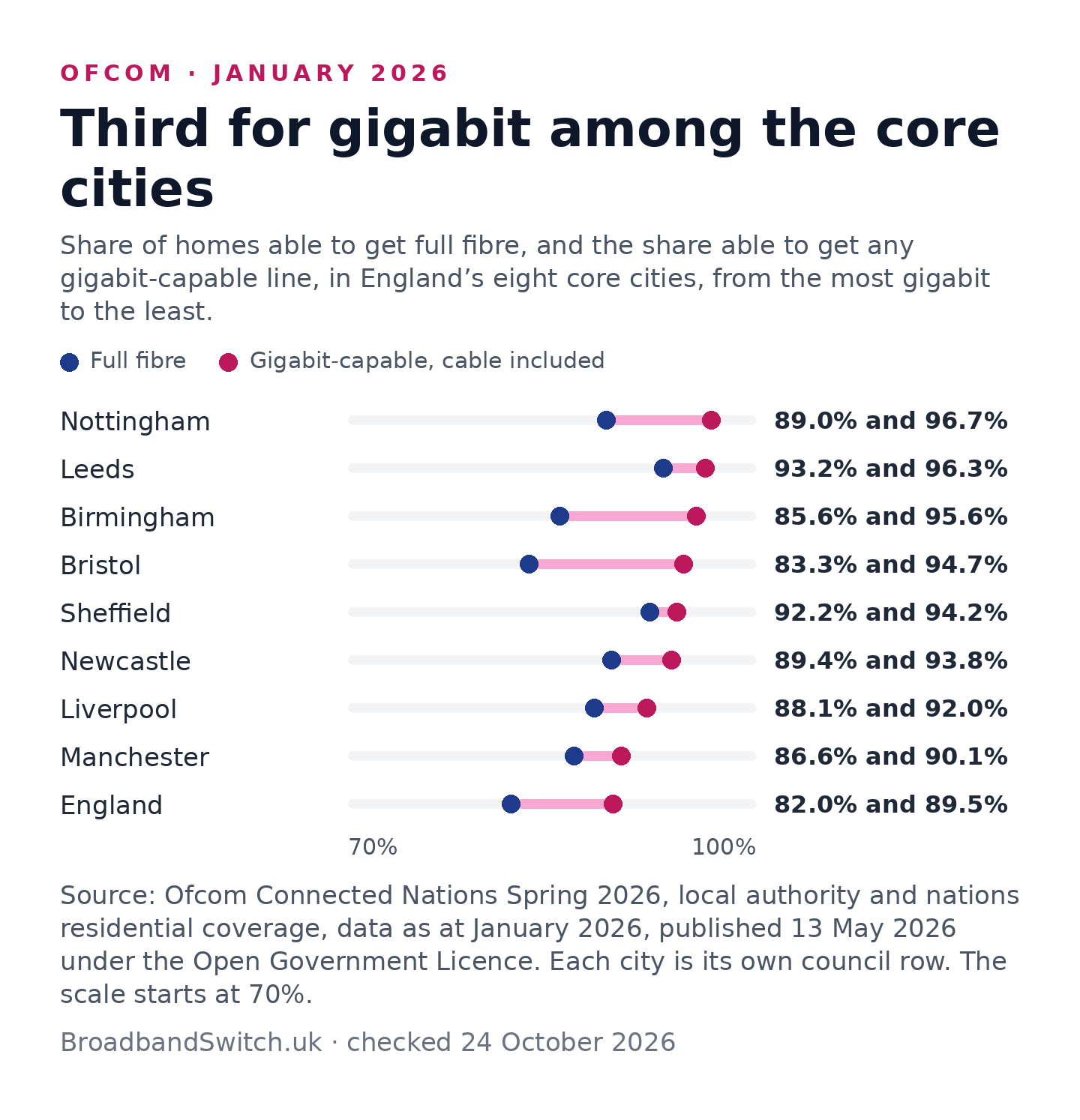
The core cities are the eight biggest English cities outside London, which work together as a group: Birmingham, Bristol, Leeds, Liverpool, Manchester, Newcastle, Nottingham and Sheffield. Each figure here is the city council’s own row in Ofcom’s file, so like is compared with like. Leeds has the most full fibre of the eight, 93.2%, and Nottingham the most gigabit, 96.7%. Against all 296 English councils, Birmingham is 111th for full fibre and 59th for gigabit, comfortably inside the top quarter on the faster measure.
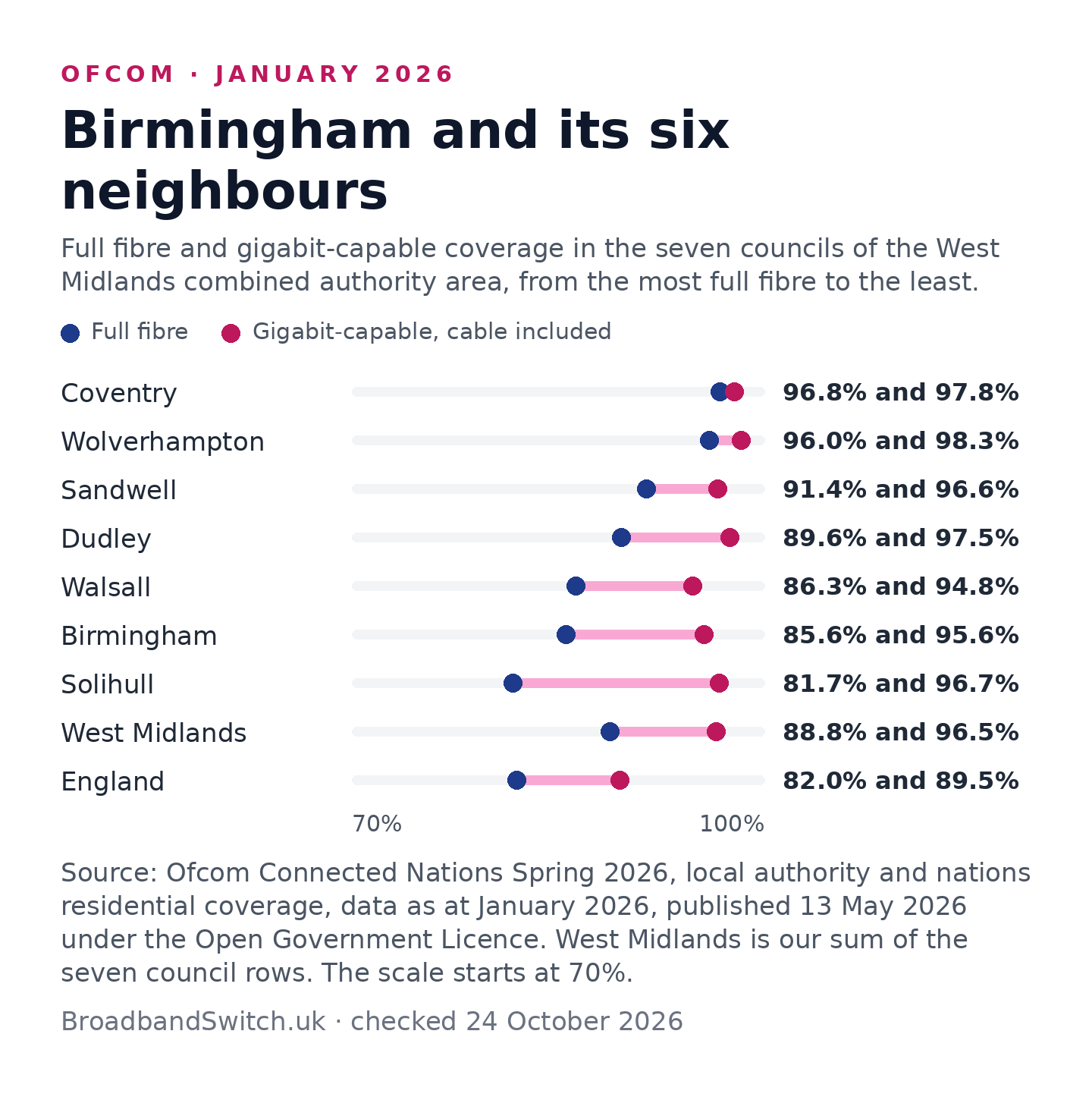
Birmingham is by far the largest of the seven West Midlands councils, with 38% of their homes, so it sets the region’s figures: the combined authority area has 88.8% full fibre and 96.5% gigabit, on our sum of the council rows. Coventry stands out, with 96.8% full fibre and the highest take-up of any council on this page, 60%. The combined authority has an ambition of its own, which its digital roadmap names as “Mission 3: Becoming the UK’s best-connected region”. For the neighbours’ own figures, the West Midlands page covers Wolverhampton, Solihull, Walsall, Dudley and Sandwell, and Coventry has a page of its own.
Moving to Birmingham from another core city? You can expect much the same speeds and a slightly different mix. More homes are on cable, full fibre is a little behind Leeds or Sheffield, and the 2029 plans promise more choice of gigabit networks than England as a whole. Manchester, Leeds, Bristol and Nottingham each have a page of their own.
Fibre at the door, old line inside
Direct answer: In January 2026, 37% of Birmingham homes that could get full fibre had placed an order, compared with 46.2% across England when Ofcom’s council figures are weighted together. That puts the city 244th of England’s 296 councils, and it means about 63% of homes with full fibre outside are still on an older line: the simplest upgrade in the city.
Ofcom, January 2026
Every 100 Birmingham homes as the windows of a tower block
- 31have full fibre now
- 55could order full fibre and have not yet
- 10have gigabit cable but no full fibre yet
- 4have neither yet
Ofcom Connected Nations Spring 2026, Birmingham’s council row: full fibre 85.6% of homes, gigabit-capable 95.6%, full fibre lines 31% of all homes. Each window stands for one home in a hundred, rounded.
Openreach sees the same thing on its own network. On 2 February 2026 it said that “More than 400,000 homes and businesses in Birmingham now have access to Full Fibre”. It also said: “The £120m investment by Openreach has brought gigabit-capable broadband to around 75 per cent of properties in the area.” Kasam Hussain, its Partnership Director for the North and Midlands, summed up the problem: “Most of Birmingham is covered by Full Fibre, but many residents and businesses haven’t yet made the switch.” On what to do about it, Hussain was just as direct: “It’s not automatic - you need to place an order with your chosen provider.” And on why it is worth the trouble: “The difference in speed and reliability can be significant, especially for busy households or people working from home.”
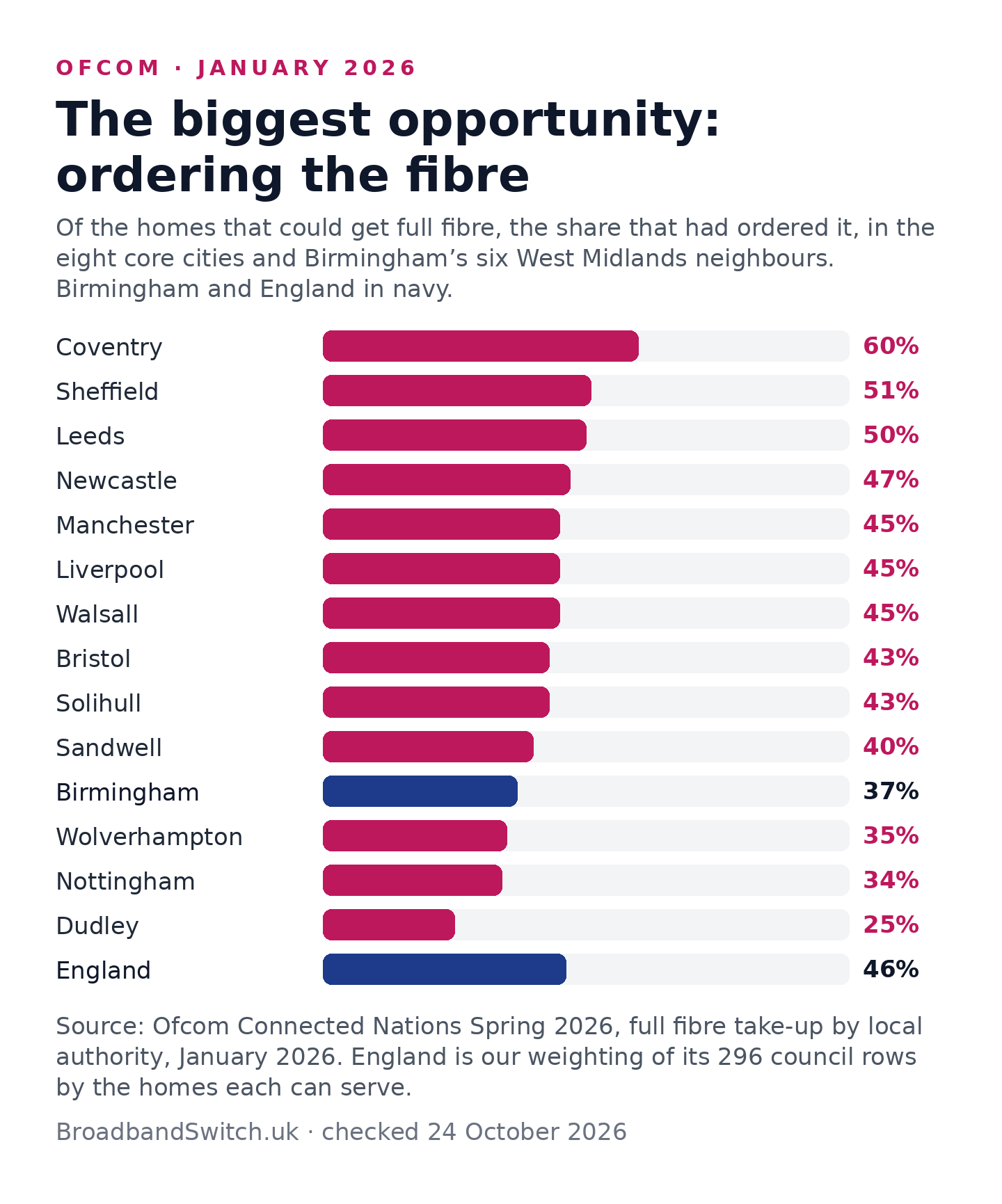
Low take-up is a regional pattern, not only a Birmingham one. Dudley, at 25%, and Wolverhampton, at 35%, are lower still, and Nottingham, at 34%, is the only core city below Birmingham. Coventry shows how high it can go, at 60%. As a share of all homes, including those without full fibre outside, 31% of Birmingham homes had a full fibre line.
Is your window light pink?
Then the hard part is done: the fibre has reached your building and no roadworks are needed. Switching is a matter of ordering, and with two or three networks competing, a full fibre deal can cost the same as your current bill, or less. The postcode box at the top puts the cheapest first.
Two deadlines sit in the background. Openreach stops selling copper at an exchange once three in four of its premises can get full fibre, which has happened at 20 of Birmingham’s 24. The other is national and fixed, and Openreach states it simply: “By 31 January 2027, all traditional phone lines will be going digital.” The exchange section names every Birmingham exchange and its date.
How much choice by 2029
Direct answer: On the builders’ plans, 80.1% of Birmingham homes should have two or more gigabit networks by January 2029 and 41.5% three or more, against 74.0% and 36.0% across England. The city keeps its lead on choice, even though full fibre on its own is forecast to rise only from 85.6% to 88.0%, which places Birmingham eighth of the eight core cities on that measure.
Ofcom, planned network deployments 2026
Three lanes: how far one, two and three gigabit networks should reach by 2029
Birminghamthree or more: 41.5%
41%80%96%England (all councils)three or more: 36.0%
36%74%95%Bristolthree or more: 73.8%
74%95%99.6%Manchesterthree or more: 61.5%
61%82%94%Liverpoolthree or more: 57.0%
57%89%99%Newcastlethree or more: 52.4%
52%85%96%Leedsthree or more: 49.1%
49%85%97%Nottinghamthree or more: 35.3%
35%85%98%Sheffieldthree or more: 34.3%
34%80%95%- Top lane: three networks or more
- Middle lane: two or more
- Bottom lane: at least one
From Ofcom’s 2026 planned network deployments, council residential file, counting every builder’s plan. The bottom lane is the share of homes due to have at least one gigabit-capable network by January 2029, the middle lane two or more and the top lane three or more. England weights its council rows together. Forecasts shift from year to year.
Every year Ofcom asks each builder where it expects to be, and publishes the answers council by council. For Birmingham they add up to 96.2% gigabit coverage by January 2029, 96.2% counting only the plans Ofcom rates high confidence, against 95.3% for England. Its file puts the number of gigabit builders active in the city by then at 11 to 15. Bristol shows how far the plans can reach: there, three networks or more should serve 73.8% of homes, the most of any core city.
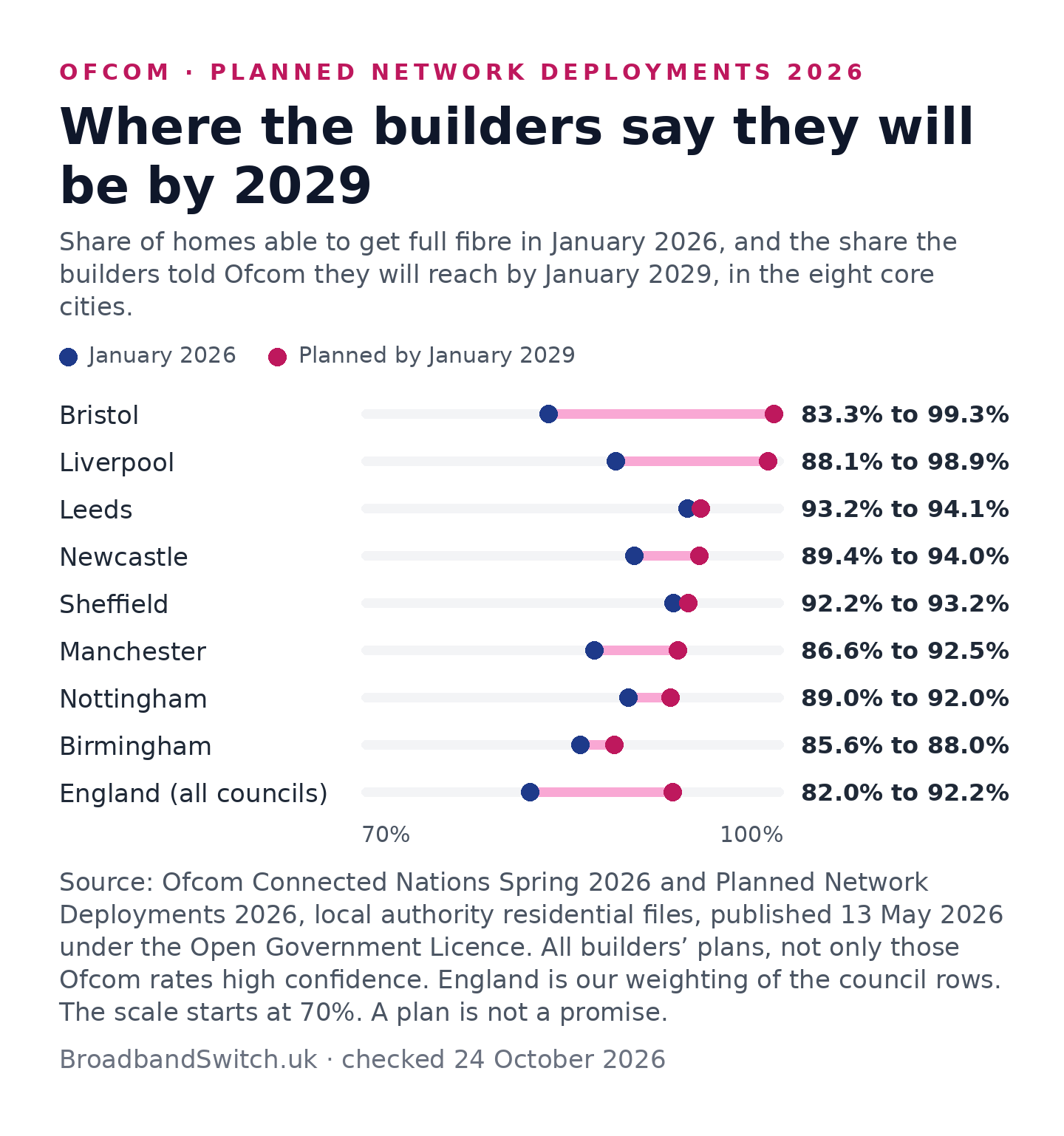
Why does full fibre rise by only 2.4 points? The plans do not say, and we will not guess at a builder’s reasons. What the figures do show is that Birmingham starts high on gigabit, and that most homes without full fibre already have a gigabit cable line, which is where Virgin Media’s own move to full fibre, in the cable section, comes in. Treat the forecasts as intentions: a builder can change its mind, and each new edition of the file can raise or lower the 2029 figures.

The gaps left are small. Ofcom counts 590 postcodes in the city with no gigabit plan at all for 2029, and its count of planned lines paid for with public money is 0, because the building here is commercial. If your line cannot manage 10Mbps, you can ask BT for a better one under the broadband Universal Service Obligation, which sets the bar at a download speed of at least 10 Mbit/s and an upload speed of at least 1 Mbit/s. Our guide to the USO explains how to ask.
The companies building Birmingham’s broadband
Direct answer: Openreach says that “More than 400,000 homes and businesses in Birmingham now have access to Full Fibre”, and Ofcom’s figures show Virgin Media’s cable bringing a gigabit to about one home in ten that full fibre has not reached, so many homes can get both. YouFibre on the Netomnia network, Grain, CityFibre through providers such as toob, and Hyperoptic in some blocks add a third choice in parts of the city.
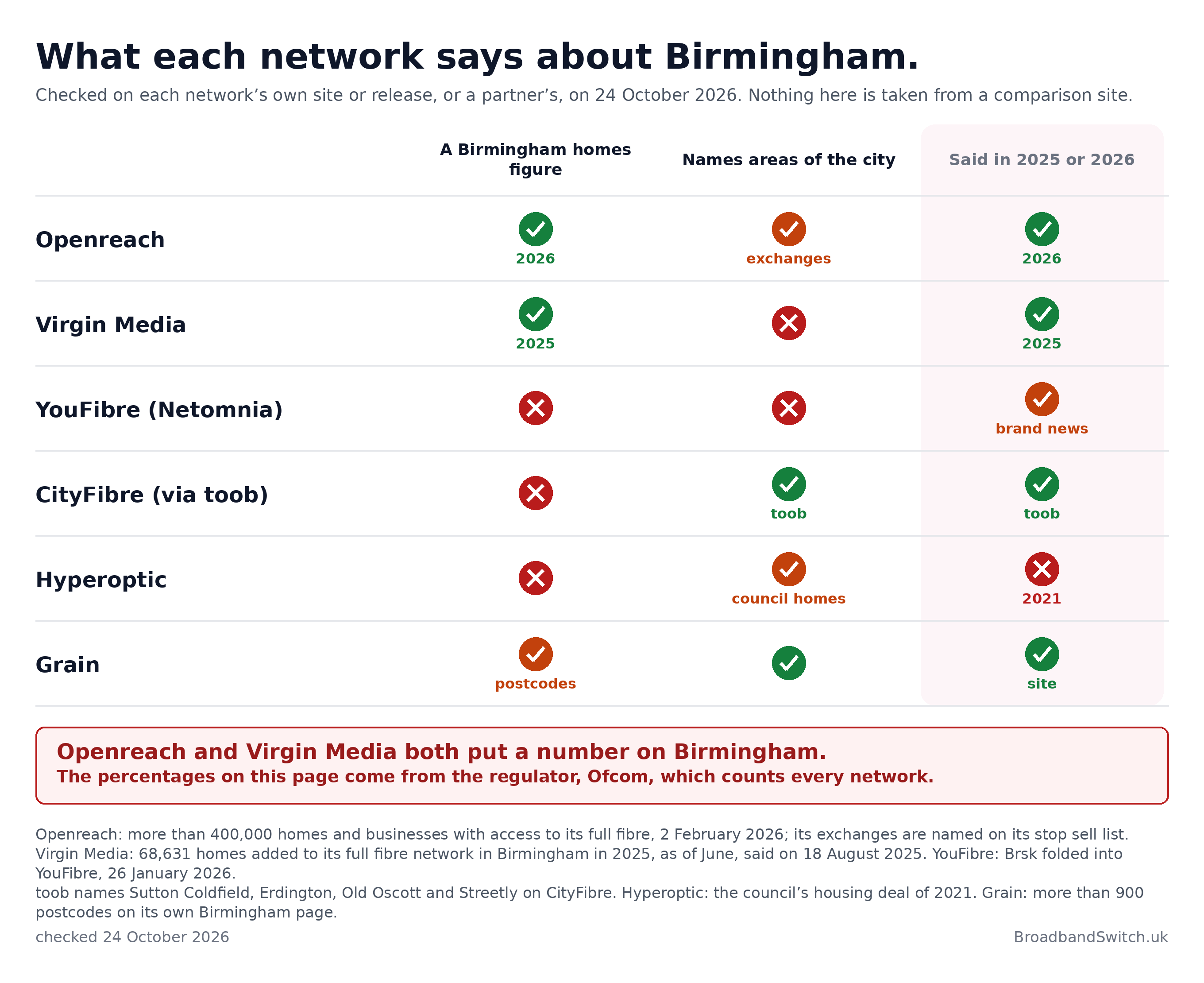
Your bill shows a provider, but the cable or fibre outside belongs to a network company, and one road can have several. Each network below is quoted from its own release or web page, with a date, because a recent statement tells you more about your street than an undated table on a comparison site. Unsure which network you use now? Your provider can tell you, and that settles whether a switch brings a new connection or reuses the one already in your wall.
Openreach, the network under the big brands
Openreach carries BT, EE, Sky, TalkTalk, Vodafone, Plusnet and dozens of smaller brands. On 2 February 2026 it said that “More than 400,000 homes and businesses in Birmingham now have access to Full Fibre”. It also said: “The £120m investment by Openreach has brought gigabit-capable broadband to around 75 per cent of properties in the area.” Across the UK, it added, its full fibre network now reaches “more than 21 million properties”. Openreach’s share for its own network, about three properties in four, is a different measure from Ofcom’s, which counts homes only and every network together.
Virgin Media, on cable and on fibre
Virgin Media’s cable is the reason the city’s gigabit figure runs 10 points ahead of its full fibre figure, and the cable section sets out what it has said about its new full fibre homes. Virgin Media’s full fibre partner, nexfibre, names no Birmingham location in its coverage report dated 31 December 2025, so we make no claim for it here. The Competition and Markets Authority, looking at the networks as a whole, described the overlap like this: “VMO2/nexfibre’s network is fully overlapped by Openreach, c.14% overlapped by Substantial, and c.18% overlapped by CityFibre.”
YouFibre and Netomnia, which now include Brsk
The Competition and Markets Authority describes the group behind YouFibre and Netomnia this way: “Substantial’s network is concentrated in the midlands and north of England (including Birmingham, Bradford and Manchester).” Brsk, once a name of its own here, has been folded in. On 26 January 2026 YouFibre explained: “Back in 2024, Netomnia and Brsk joined forces to create the UK’s second largest Alt-Net.” It told customers: “Nothing changes overnight.” And: “Your contract, your plan, your price and your day-to-day service all stay exactly the same.” Its group chief executive, Jeremy Chelot, said: “Moving to one brand is the natural next step.” It puts the combined business at this size: “Together, we now serve 396,000 customers across 2.8 million premises”.
Ownership is on the move too. On 18 February 2026 nexfibre agreed a £2 billion deal to buy Substantial Group, which owns Netomnia and YouFibre, with the retail brands going to Virgin Media O2. The Competition and Markets Authority opened an in-depth inquiry on 1 July 2026, published provisional findings on 2 October 2026, asked for views on possible remedies on 20 October 2026, and has to decide by 15 December 2026. None of this affects a contract you already hold: YouFibre and Virgin Media customers carry on as normal while the review runs. We follow the case on our altnet consolidation tracker, and the YouFibre page has its current packages.
CityFibre, through toob in the north of the city
CityFibre builds networks that other companies sell over. In Birmingham the clearest sign of it is in the north. toob, one of the providers that uses it, says: “we have partnered with CityFibre, to bring great-value connectivity to homes in Sutton Coldfield, Erdington, Old Oscott & Streetly, and communities across England and Scotland.” We found no CityFibre release of its own describing a Birmingham build, so the districts the old page listed have been taken out, as the corrections explain. Our toob page has its packages.
Hyperoptic, and the council’s own homes
On 1 July 2021 Birmingham City Council announced that, with Hyperoptic, it was “rolling out gigabit-capable broadband across its housing stock”. Councillor Sharon Thompson, then the cabinet member for homes, said: “Having access to online services should be a basic right for every citizen.” Where a block is on Hyperoptic, your postcode search lists it with everything else; our Hyperoptic page explains the packages.
Grain, in the inner districts
Grain, a smaller full fibre network, says on its Birmingham page that “We currently serve more than 900 postcodes across Alum Rock, Birchfield, Sparkbrook, Lozells, Aston, Witton, and Bearwood”. It adds: “Available speeds range from 250Mbps to 2Gbps, depending on your location and the package selected.” If you live in one of those districts, Grain may be a fourth name on your list, alongside Openreach, Virgin Media and YouFibre.
Twenty-four exchanges and the copper switch-off
Direct answer: By 24 October 2026, copper was off sale at 20 of the 24 Birmingham exchanges on Openreach’s stop sell list, starting with five on 29 June 2021 and most recently at Smallbrook on 19 August 2026. The remaining four have dates: Erdington and Priory on 6 November 2026, Selly Oak on 12 February 2027, and Rectory, in Sutton Coldfield, on 4 November 2027.
People often mix up two separate changes. The national one has a fixed date: “By 31 January 2027, all traditional phone lines will be going digital.” The other, stop sell, reaches one exchange at a time: “Stop Sell is triggered when a majority (75%) of premises connected to a particular exchange can get ultrafast Full Fibre”. Openreach’s page on the programme promises notice: “Openreach will provide 12 months’ notice for any exchange that will be impacted by this Stop Sell programme.” So stop sell is about what you order next, not the line you have today. A move, a new provider or a change of speed is the moment full fibre takes over, if it reaches you.
Openreach, 8 October 2026
Every Birmingham exchange, by the year copper sales stop
- 20218
- Stechford29 June 2021
- Sheldon29 June 2021
- Highbury29 June 2021
- Beacon29 June 2021
- Streetly29 June 2021Sutton Coldfield
- Bearwood13 October 2021
- Springfield13 October 2021
- Birchfield13 October 2021
- 20224
- Harborne29 April 2022
- Woodgate29 April 2022
- Hillside29 April 2022
- Sutton Coldfield1 November 2022
- 20231
- Acocks Green9 November 2023
- 20243
- Northern16 February 2024
- Victoria4 June 2024
- Four Oaks8 November 2024Sutton Coldfield
- 20251
- Kings Norton6 November 2025
- 20265
- Calthorpe14 February 2026
- East5 June 2026
- Smallbrook19 August 2026
- Erdington6 November 2026
- Priory6 November 2026
- 20272
- Selly Oak12 February 2027
- Rectory4 November 2027Sutton Coldfield
- Copper no longer on sale
- Stop sell date ahead
Openreach, “FTTP Priority Exchanges: List of Exchanges where order restrictions will be / are applied”, version of 8 October 2026, listing each exchange it places in Birmingham or Sutton Coldfield, plus Streetly, which BT Wholesale puts in Sutton Coldfield, sorted into the year its order restrictions begin.
Birmingham was in the national programme from its first round. BT Wholesale records that “Due to delays caused by the coronavirus pandemic the first tranche of upgrades was split in two.” The city had five exchanges in the first half, Tranche 1a, on 29 June 2021: Stechford, Sheldon, Highbury and Beacon, with Streetly on the Sutton Coldfield side of the boundary, and three more before the end of 2021. Sutton Coldfield has four exchanges on the list, the last of them Rectory, added in the round of 8 October 2026.
Openreach and BT Wholesale, 2021 to 2027
From Stechford to Rectory: Birmingham’s copper switch-off
- 29 June 2021The first five Stechford, Sheldon, Highbury, Beacon and Streetly, in Openreach’s opening round, Tranche 1a.
- 13 October 2021Bearwood, Springfield and Birchfield The second half of the first round, which BT Wholesale says was split in two.
- 29 April 2022Harborne, Woodgate and Hillside
- 1 November 2022Sutton Coldfield The town’s own exchange, with Four Oaks following two years later.
- 19 August 2026Smallbrook, in the city centre After Kings Norton, Calthorpe and East, which took the city to 20.
- 24 October 2026We checked the list New rounds are added to Openreach’s list as they are announced.
- 6 November 2026Erdington and Priory
- 31 January 2027Traditional phone lines go digital Any analogue line still in use moves to a digital phone service running over broadband.
- 12 February 2027Selly Oak
- 4 November 2027Rectory, the last date on the list Added in Openreach’s round of 8 October 2026.
Exchange dates: Openreach, “FTTP Priority Exchanges: List of Exchanges where order restrictions will be / are applied”, version of 8 October 2026. The end of analogue lines: Openreach’s big switch off page. The two halves of the first round: BT Wholesale, November 2025. All read 24 October 2026.
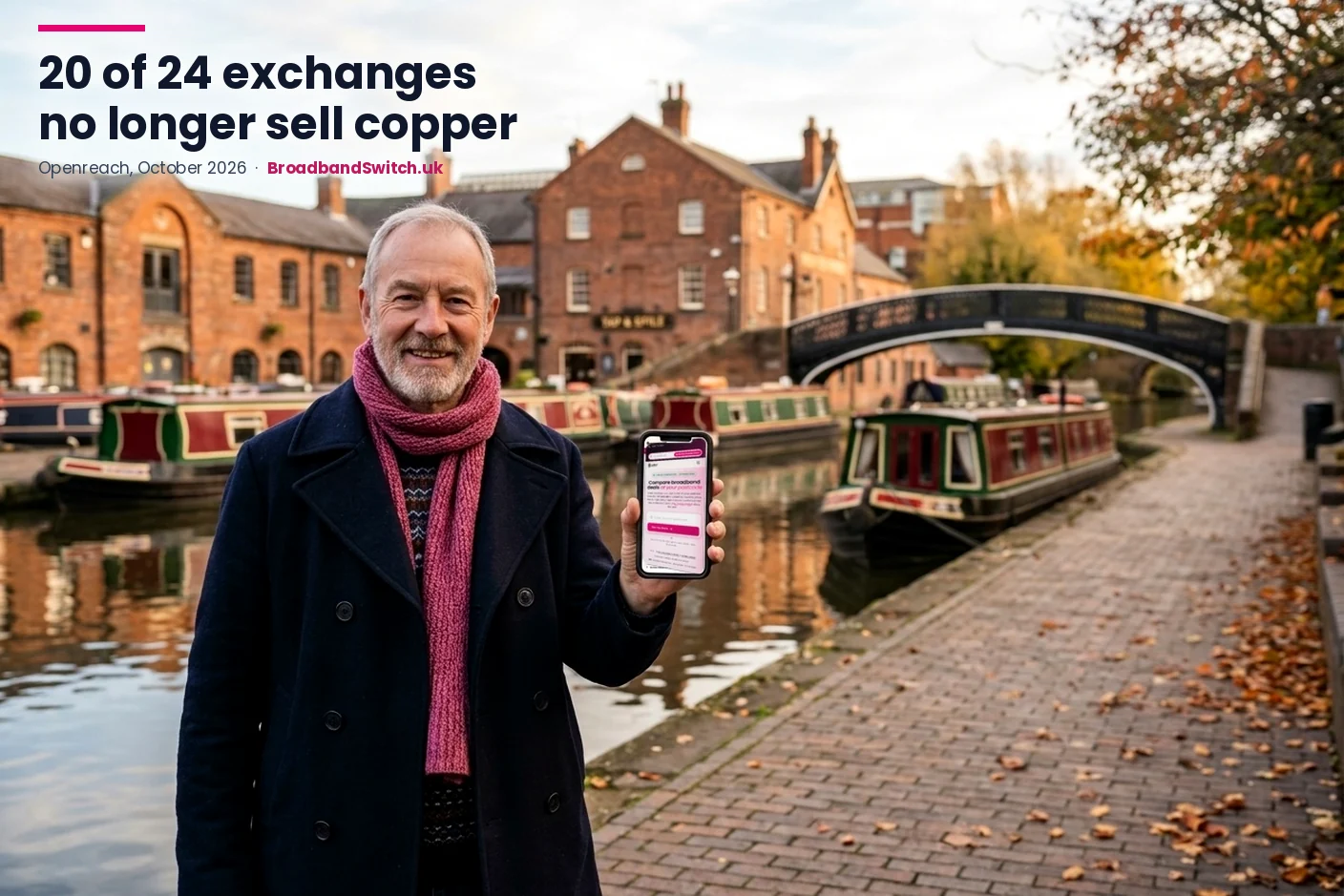
Below is every exchange in date order, followed by its neighbours over the boundary. Openreach’s own list is the one to trust, because it changes with every round.
Every exchange, with its date: 24 in allshow the table
| Code | Tranche | |||
|---|---|---|---|---|
| Beacon | Birmingham | CMBEAC | 1a | 29 June 2021 |
| Highbury | Birmingham | CMHIGH | 1a | 29 June 2021 |
| Sheldon | Birmingham | CMSHEL | 1a | 29 June 2021 |
| Stechford | Birmingham | CMSTE | 1a | 29 June 2021 |
| Streetly | Sutton Coldfield | CMSTRE | 1a | 29 June 2021 |
| Bearwood | Birmingham | CMBEAR | 1b | 13 October 2021 |
| Birchfield | Birmingham | CMBIR | 1b | 13 October 2021 |
| Springfield | Birmingham | CMSPR | 1b | 13 October 2021 |
| Harborne | Birmingham | CMHARBO | 4 | 29 April 2022 |
| Hillside | Birmingham | CMHILL | 4 | 29 April 2022 |
| Woodgate | Birmingham | CMWDGT | 4 | 29 April 2022 |
| Sutton Coldfield | Sutton Coldfield | CMSUT | 6 | 1 November 2022 |
| Acocks Green | Birmingham | CMACO | 10 | 9 November 2023 |
| Northern | Birmingham | CMNOR | 11 | 16 February 2024 |
| Victoria | Birmingham | CMVIC | 12 | 4 June 2024 |
| Four Oaks | Sutton Coldfield | CMFOU | 14 | 8 November 2024 |
| Kings Norton | Birmingham | CMKING | 18 | 6 November 2025 |
| Calthorpe | Birmingham | CMCAL | 19 | 14 February 2026 |
| East | Birmingham | CMEAS | 20 | 5 June 2026 |
| Smallbrook | Birmingham | CMSMBK | 21 | 19 August 2026 |
| Erdington | Birmingham | CMERD | 22 | 6 November 2026 |
| Priory | Birmingham | CMPRI | 22 | 6 November 2026 |
| Selly Oak | Birmingham | CMSEL | 23 | 12 February 2027 |
| Rectory | Sutton Coldfield | CMREC | 26 | 4 November 2027 |
Italic rows are still to come. Openreach files each exchange under Birmingham or Sutton Coldfield; Streetly has no location on its list, and BT Wholesale’s copy of November 2025 puts it in Sutton Coldfield. Exchanges are named after the building that houses them, so the one serving you may carry a neighbouring district’s name, and homes near the edge of the city can be served from just over the boundary. Openreach’s online checker names the exchange that serves you. Press a heading to sort.
Just over the boundary, on the same list
- Lapworth (Solihull): 29 April 2022
- Shirley (Solihull): 9 May 2023
- Great Barr (West Bromwich): 16 February 2024
- Broadwell (Oldbury): 16 August 2024
- Solihull (Solihull): 26 May 2025
- West Bromwich (West Bromwich): 6 November 2025
- Stone Cross (West Bromwich): 6 November 2025
- Walsall (Walsall): 6 November 2026
- Dudley (Dudley): 3 June 2027
- Brierley Hill (Dudley): 3 June 2027
What stop sell means for your line
- Staying as you are? Your copper line keeps working. The only date that applies to everyone is 31 January 2027, when traditional phone lines go digital.
- Moving home, changing provider or changing speed? Then stop sell applies, and where full fibre reaches you, the new service runs over it.
- No full fibre at your address? You can still order copper there until it arrives, Openreach says.
Our summary of Openreach’s stop sell rules, from its announcement of 15 May 2026.
In most homes the only thing you notice is that the phone now plugs into the router rather than the wall. If a telecare alarm, a lift phone or a burglar alarm relies on your line, check with the alarm company and with your broadband provider before the line changes; our care alarm guide has a list of questions. Any Birmingham number can be checked with our landline switch-off checker, and our stop sell explainer covers the national programme. Buying or renting a new home? Ask which networks already serve it, so the connection can be booked before you move in.
Digbeth, Ladywood and the city-centre puzzle
Direct answer: Nearly three in five of the Birmingham homes that cannot get 30Mbit/s are in one seat, Ladywood, which holds the city centre: 3,951 of the city’s 6,690, or 59%. Ward by ward, the largest group is in Bordesley & Highgate, which includes Digbeth, with 1,350, ahead of Ladywood ward and Nechells.
In a city where 95.6% of homes can get a gigabit line, that cluster stands out, and you will want to know why. Ofcom’s files do not give reasons, and we have not visited the buildings, so what follows is a short list of possibilities that the figures cannot settle. A block may have been wired by one network under a deal with its owner. A new building’s lines may not yet show in what the networks report to Ofcom. Or the owner may not yet have given a network consent to come in. What the data does show is that superfast coverage in Bordesley & Highgate is 85.9%, while across the city it matches England’s 98.2%.
Edgbaston has a different issue, which is counting. Ofcom could not match 917 of the Edgbaston seat’s premises to its coverage data, most of them in Edgbaston ward itself, out of 1,422 across the whole city. Ofcom divides by every premises, matched or not, so a home it cannot place lowers the percentage even if it is well served: the seat’s full fibre figure is 78.3% over all its premises and 79.8% over the matched ones. Plenty of those homes may have a fast line already; the files cannot tell either way.
The centre is also growing quickly. Ofcom counted 17,854 residential premises in Ladywood ward in January 2026, 4,821 more than the households the census found there in 2021, and every new block is a new conversation between a developer and the networks.
Living in a flat in the centre?
The postcode check works on your exact address, so begin there. A short list, or no fast option at all, is your cue to ask the building manager or managing agent which networks are already in the building and whether another could be invited in. Before it can wire a block, a network has to get the owner’s written consent, known as a wayleave; our wayleave guide walks through what that document covers. In student halls? Our student halls page is written for you. And where a line cannot manage even 10Mbps, the Universal Service Obligation applies to flats just as it does to houses.
Tower blocks, terraces and whose permission you need
Direct answer: Birmingham is a city of terraces and flats as well as semis. On the 2021 census 25.4% of households lived in a flat and 27.8% in a terraced house, against 22.2% and 23.0% across England, while fewer lived in a detached house, 11.2% against 22.9%. 23.5% rented from a council or housing association, against 17.1% across England.
Census 2021
Twenty little homes each: what kind of home, city and ward
Birminghamowned 53.5%
Englandowned 62.3%
Ladywoodflats 87.7%
Small Heathflats 7.6%
Perry Barrflats 9.0%
Sutton Four Oaksflats 24.5%
- Terraced
- Semi-detached
- Detached
- Flat
ONS Census 2021, tables TS044 Accommodation type and TS054 Tenure, households, via nomis, for Birmingham, England and four wards. Each little house stands for a twentieth of households, rounded. A flat here means any flat, whether in a purpose-built block, a converted house or above a shop. Caravans and mobile homes, under 1% everywhere shown, are not drawn, and “owned” takes in shared ownership.
The city council is a very large landlord. Its housing strategy describes it as “one of the largest landlords in Europe, with a stock profile of just under 60,000 properties”, and its housing options update of July 2026 says that “The City Council has approximately 57,928 properties, and this is decreasing each year”. For comparison, it notes that “in 1981 the council had over 123,000 properties”. The same update reports: “There are currently over 35000 households on the housing register.” The strategy also notes: “Birmingham has the largest number of high-rise blocks in the country, with 213 still operating.” That matters for broadband, because a block needs its owner’s agreement before any network can wire it, and in a council block the owner is the council.
The census counts 423,455 households in the city, 58,609 of them renting from the council. Ward by ward the picture changes fast: Ladywood has 87.7% of households in flats, Small Heath 60.7% in terraces, Perry Barr 69.6% in semis and Sutton Four Oaks 54.1% in detached houses. Newtown has the highest share renting from the council, 47.7%, and Sutton Wylde Green the highest share owning, 85.0%. Bournbrook & Selly Park, next to the university, has the most private renting, 54.2%.
For a house, whether terraced, semi or detached, the work is normally quick. An engineer brings the fibre in from a telegraph pole or an underground duct, fits a compact white box where it enters the house, and connects the router to it, often in one morning. If you rent, get your landlord’s agreement before any holes are drilled; if they are slow to reply, a tenant’s rights to full fibre sets out the next steps. Switching to another provider on the line you already have is different: no permission is needed, as switching in a rented property explains.
Flats work differently. Nobody can wire a block without its owner’s signature: the council or a housing association for social homes, the freeholder or managing agent for private ones. Our wayleave guide explains the paperwork and why owners are not usually asked to pay. Students sharing a house in Selly Oak or Bournbrook can start with our student broadband guide.
Cheaper broadband on certain benefits
Direct answer: Households on Universal Credit, Pension Credit and several other benefits can usually get a social tariff: a cheaper package, with no charge for leaving. Ofcom spells that out: “It costs nothing to leave. You won't pay a fee to leave the tariff before the end of your contract.”
That matters a good deal in Birmingham, where 23.5% of households rent from a council or housing association, against 17.1% across England. The tariffs open to you depend on the networks at your address. BT Home Essentials costs £16.50 a month on Openreach, and Vodafone Essentials £20 a month for up to 80 Mbps, with a contract of 12 months. Virgin Media’s Essential Broadband is available wherever its network reaches, Sky keeps its offer for existing Sky customers, and Hyperoptic’s Fair Fibre 150Mb plan is £13 a month in the buildings it serves. Our social tariffs guide covers all 33 on Ofcom’s list, with who can apply for each.
For the 590 Birmingham postcodes without any gigabit plan for 2029, the priority is getting connected at all, and the Universal Service Obligation is how to ask. For everyone else, the cheapest deal sits at the top of the postcode results.
Your ward in one card
Direct answer: Choose a ward and the card fills with its Ofcom gigabit and slow-line counts, its seat’s full fibre share and the census picture of its homes. Everything runs in your browser, and nothing you pick is sent anywhere.
Your part of Birmingham, in one card
All 69 wards, each with Ofcom’s January 2026 figures built from its output areas, its Westminster seat and the census picture of its homes. Not sure of your ward? The seat table above lists each seat’s wards, and the UK Parliament’s Find your MP page tells you your seat from your postcode.
What the old version of this page got wrong
Direct answer: We found five things to put right. The old page gave a cable share no company publishes and an Openreach share older than Openreach’s own, wrote up Brsk after it joined YouFibre, placed CityFibre in zones we could not source, and listed a suburb of Aberdeen as part of Birmingham.
The previous page was around twelve thousand words long, and most of its package and price recommendations carried no date or source. Its headline figures, “approximately 86.08% FTTP coverage” and “approximately 96.76% gigabit-capable coverage”, came from a third-party tracker’s modelled snapshot of 20 September 2025: close to the regulator’s, but not Ofcom’s own, which for January 2026 are 85.6% and 95.6%. This version keeps a figure only where a primary source supports it, and drops the rest instead of rephrasing it. When a company describes itself differently from the old page, its own description wins. The price tables have gone as well: prices are set nationally, so they belong in your postcode results.
A cable share no company publishes
What we saidThis page claimed “approximately 83.09% Virgin Media cable coverage” and called it “one of the strongest UK city footprints”. Virgin Media gives no share for the city. Its own Birmingham article of 18 August 2025 is headed “Virgin Media Full Fibre has reached 68,631 homes in Birmingham”, and Ofcom’s gigabit figure for Birmingham, which counts cable, is 95.6%.
What we say now, and whyVirgin Media in its own words and dated, with Ofcom’s gigabit figure for the city and every seat.
An Openreach share older than Openreach’s own
What we saidThis page put Openreach at “approximately 72.78% Openreach FTTP”, from a third-party snapshot of September 2025, and called it “one of the best Openreach city coverage figures in the UK”. On 2 February 2026 Openreach said that “More than 400,000 homes and businesses in Birmingham now have access to Full Fibre”, and that its investment had brought gigabit-capable broadband to “around 75 per cent of properties”. We found no source for the ranking.
What we say now, and whyOpenreach’s own Birmingham figures, dated, beside Ofcom’s count of every network.
Brsk, described after it joined YouFibre
What we saidThis page described “Brsk own-network full fibre dominant in South Birmingham” and named a “BetterNet2000” package. On 26 January 2026 YouFibre explained: “Back in 2024, Netomnia and Brsk joined forces to create the UK’s second largest Alt-Net.” The group is now part of nexfibre’s deal for Substantial Group, which the Competition and Markets Authority must decide on by 15 December 2026. We found no source for “dominant”.
What we say now, and whyNetomnia and YouFibre today, with the takeover and the review dated.
CityFibre in the north of the city, not in four named zones
What we saidThis page placed CityFibre in “specific zones (Gravelly Hill, Erdington, Acocks Green, Tyseley)” and called Vodafone Pro II on it “the fastest widely-available speed in Birmingham”. Erdington is right: toob, which sells over CityFibre, says “we have partnered with CityFibre, to bring great-value connectivity to homes in Sutton Coldfield, Erdington, Old Oscott & Streetly, and communities across England and Scotland.” We found no CityFibre source for the other three, and no basis for the speed claim.
What we say now, and whyCityFibre as toob describes it, with nothing we could not source.
A suburb from the wrong city
What we saidThis page listed “Edgbaston, Harborne, Cults, and outer northern suburbs” as suburban Birmingham. Edgbaston and Harborne are; Cults is a village on the edge of Aberdeen, more than three hundred miles away, which has a page of its own.
What we say now, and whyBirmingham’s own 69 wards, each with its Ofcom and census figures.
Birmingham broadband: frequently asked questions
What percentage of Birmingham has full fibre broadband?
85.6% of homes, on Ofcom’s figures for January 2026, compared with 82% in England and 81.8% across the UK. Count Virgin Media’s cable as well and 95.6% can get a gigabit line, and the builders’ plans take full fibre to 88.0% by January 2029.
Can I get gigabit broadband in Birmingham?
Very probably. In January 2026, 95.6% of Birmingham homes could get a gigabit-capable line, against 89.5% for England, and in 23 of the city’s 69 wards the figure is 99% or more. Where full fibre has not arrived, Virgin Media’s cable often carries a gigabit instead. The postcode check shows what reaches your address.
Which part of Birmingham has the most full fibre?
Of the ten Westminster seats, Yardley has the most, 94.2%, followed by Perry Barr at 91.8% and Northfield at 90.0%. Edgbaston has the least, 78.3%, partly because Ofcom could not match some of its premises to its data.
Why is broadband slower in Digbeth and the city centre?
Ofcom’s figures do not give reasons, but they show where: the Ladywood seat, which holds the centre, has 59% of the city’s homes unable to get 30Mbit/s, and Bordesley & Highgate, which includes Digbeth, has 1,350 on its own. Blocks of flats need the owner’s permission before a network can wire them, which is one likely part of the story.
How does Birmingham compare with other big cities?
Among England’s eight core cities, Birmingham is third for gigabit coverage and seventh for full fibre, on Ofcom’s January 2026 figures. Against its six West Midlands neighbours it sits in the middle, with Coventry ahead on full fibre at 96.8%.
How many Birmingham homes have switched to full fibre?
By January 2026, 37% of the homes able to get full fibre had taken it up, leaving the city 244th of England’s 296 councils. As a share of every home, 31% had a full fibre line. Most of the others could switch without any building work.
Is Virgin Media available across Birmingham?
Across much of it. Ofcom’s gigabit figure for the city, which counts cable, is 95.6%, about 10 points above full fibre, and Virgin Media’s article of 18 August 2025 is headed “Virgin Media Full Fibre has reached 68,631 homes in Birmingham”. The postcode check shows whether it reaches your road.
What happened to Brsk in Birmingham?
Brsk has been folded into YouFibre, which sells over the Netomnia network. On 26 January 2026 YouFibre told customers: “Your contract, your plan, your price and your day-to-day service all stay exactly the same.” The group is being bought by nexfibre, and the Competition and Markets Authority’s deadline for a decision is 15 December 2026.
Is CityFibre available in Birmingham?
In parts of the north of the city. toob, which sells over CityFibre, names Sutton Coldfield, Erdington, Old Oscott and Streetly on its Birmingham page. We found no CityFibre release of its own describing a wider Birmingham build.
Which Birmingham exchanges have stopped selling copper?
As at 24 October 2026, 20 of the 24 on Openreach’s Birmingham list, beginning with five on 29 June 2021. Erdington and Priory follow on 6 November 2026, and the exchange section lists the rest with their dates.
What is happening to landlines in Birmingham?
Openreach’s summary is short: “By 31 January 2027, all traditional phone lines will be going digital.” Until then a working line keeps working, and at a stop sell exchange it is a move, a switch or an upgrade that takes you onto a digital service over fibre. Is a care alarm connected to the line? Speak to its supplier before you change anything.
Will I have more choice of broadband network by 2029?
Most probably. The builders’ plans give 80.1% of Birmingham homes at least two gigabit networks by January 2029, and 41.5% at least three, ahead of England’s 74.0% and 36.0%. Forecasts move, so the postcode check is the way to see today’s choice.
Do I need permission for full fibre in a council flat or rented home?
For a block, yes: the owner, whether the council, a housing association or a freeholder, has to sign a wayleave before a network can install fibre. Tenants in houses should ask the landlord before any drilling. Moving to a different provider over an existing line needs no one’s consent.
How current is this page?
We last read every source on 24 October 2026. Ofcom’s data is for January 2026, published in May; the census dates from 2021; Openreach’s exchange list is the version of 8 October 2026. Each company quote shows when it was said, so its age is never hidden.
In short
- In January 2026 Ofcom counted 95.6% of Birmingham homes able to get a gigabit-capable line and 85.6% able to get full fibre, both ahead of England.
- Virgin Media’s cable fills the 10-point gap between the two, and Virgin Media is adding full fibre of its own.
- Yardley leads the ten seats at 94.2% full fibre; Edgbaston, Sutton Coldfield and Ladywood trail, each for its own reason.
- In 23 of the 69 wards, 99% or more of homes can get a gigabit line, and the slow lines cluster in Digbeth, Ladywood and Nechells.
- Only 37% of homes able to get full fibre had ordered it, so most households could upgrade without any digging.
- On the builders’ plans, 80.1% of homes should have two or more gigabit networks by 2029, more than across England.
- Openreach has stopped selling copper at 20 of the city’s 24 exchanges, and traditional phone lines go digital on 31 January 2027.
- Your address is what counts: the postcode check lists the providers that reach your door, with their prices.
Every point can be read on its own, and each is dated. The page is reviewed at least once a quarter, most recently on .
References
- OFCOM.ORG.UK
Ofcom. (2026, May 13). Connected Nations update: Spring 2026 and its open data files for councils, constituencies, output areas and nations, describing January 2026, under the Open Government Licence. Source of every coverage and take-up percentage on this page. Downloaded 24 October 2026.
- OFCOM.ORG.UK
Ofcom. (2026, May 13). Connected Nations: Planned network deployments 2026, residential data for local and unitary authorities. The 2029 forecasts, how many networks each home should have, the range of builders, postcodes with no plan and publicly funded lines. Downloaded 24 October 2026.
- OFCOM.ORG.UK
Ofcom. (2025, November 19). Connected Nations 2025: Methodology annex. How Ofcom defines full fibre and gigabit-capable lines. Read 24 October 2026.
- NOMISWEB.CO.UK
Office for National Statistics. (2023). Census 2021, tables TS044 Accommodation type and TS054 Tenure, households, through nomis: Birmingham, all 69 of its wards, five other core cities and England, plus the output areas nomis assigns to each ward. All the home type and tenure shares here. Read 24 October 2026.
- INDEPENDENT.GOV.UK
Boundary Commission for England. (2023, June). The 2023 Review of Parliamentary Constituency Boundaries in England, Volume two: constituency names, designations and composition. Which wards make up each of the ten seats. Read 24 October 2026.
- OPENREACH.COM
Openreach. (2026, February 2). Thousands in Birmingham yet to benefit from major broadband upgrade. Its Birmingham footprint, its investment and Kasam Hussain’s words. Read 24 October 2026.
- OPENREACH.COM
Openreach. (2026, May 15). Openreach stops copper for another 1.69 million premises in bid to push customers to new digital lines; and The big switch off. What triggers stop sell, the UK footprint and the January 2027 date for traditional lines. Read 24 October 2026.
- OPENREACH.CO.UK
Openreach. (2026, October 8). FTTP Priority Exchanges: List of Exchanges where order restrictions will be / are applied, version 35, on its portal for communications providers, with the stop sell updates page. Each Birmingham and Sutton Coldfield exchange with its code, tranche and date, and the notice Openreach gives. Read 24 October 2026.
- BTWHOLESALE.COM
BT Wholesale. (2025, November). Product stop sells and FTTP exchange upgrades. The two halves of the 2021 round and where Streetly sits. Read 24 October 2026.
- VIRGINMEDIA.COM
Virgin Media. (2025, August 18). Virgin Media Full Fibre has reached 68,631 homes in Birmingham. The headline and the footnote that defines it. Read 24 October 2026.
- NEXFIBRE.CO.UK
nexfibre. (2026, February). Network coverage update, as at 31 December 2025, which names no Birmingham place; and nexfibre. (2026, February 18). Netomnia news, announcing the £2 billion deal for Substantial Group. Read 24 October 2026.
- GOV.UK
Competition and Markets Authority. (2026). nexfibre / Substantial merger inquiry, case page and interim report. The in-depth inquiry, paragraphs 31 and 34 of the provisional findings, the remedies notice and the decision deadline. Read 24 October 2026.
- YOUFIBRE.COM
YouFibre. (2026, January 26). Brsk becomes YouFibre. The single brand, what it means for customers and Jeremy Chelot’s words. Read 24 October 2026.
- TOOB.CO.UK
toob. (n.d.). Broadband deals in Sutton Coldfield, Erdington, Old Oscott & Streetly. CityFibre in the north of the city. Read 24 October 2026.
- BIRMINGHAM.GOV.UK
Birmingham City Council. (2021, July 1). Birmingham moving to broadband fast lane; (2023). Housing Strategy 2023 to 2028; and (2026, July). Housing Options Update. The Hyperoptic agreement and Councillor Sharon Thompson’s words, the high-rise blocks, the council’s homes and the waiting list. Read 24 October 2026.
- GRAINCONNECT.COM
Grain. (n.d.). Broadband deals in Birmingham. The districts Grain serves and its speeds. Read 24 October 2026.
- WMCA.ORG.UK
West Midlands Combined Authority. (2024). West Midlands Digital Roadmap 2024 to 2027. The region’s connectivity mission. Read 24 October 2026.
- PARLIAMENT.UK
UK Parliament. (n.d.). Find your MP, which the ward card points to for anyone unsure of their seat. Read 24 October 2026.
How switching works
Switching in Birmingham: three steps
- Step 1Put in the postcode, then pick the address
Two flats on one landing, or two houses on one road, can be on different networks, so choose the exact door.
- Step 2See every network side by side
Openreach, Virgin Media and any newer network at the address share one list, the lowest monthly price at the top, and looking is free.
- Step 3Order, and the new provider does the rest
Your new provider contacts the old one for you under Ofcom’s One Touch Switch rules. You do not need to ring anyone to cancel, and the old service stops on the day the new one begins.
Ofcom’s One Touch Switch process, which providers have followed since September 2024, works the same way in every ward.
Every provider at your door
Type a Birmingham postcode, pick your address, and a moment later you have every provider that can connect it, lowest price first. Everything above describes the city; this box is about your own front door.
Compare at my postcode →