Best value broadband: speed per pound, judged over the whole term
Best value is not cheapest: it is the most useful speed and reliability per pound across the full contract, which is why a £22 headline with a £59 setup fee and a £3 rise at month 13 loses to a £25 flat deal. In the UK right now that usually means entry full fibre at £22 to £28 a month with no rise and no setup, at a speed that matches the household rather than the marketing. This page carries the whole method: the four measures, the three value-killers priced honestly, the league of routes, and a duel tool that computes the true cost of any two deals, plus the live comparison at your postcode where the answer actually lives.


Every range on this page is UK-typical; the live comparison below shows what your exact address can actually reach, with true costs side by side. Prefer a hand-checked shortlist? See this month's verified deals.
Independent and free. Or jump to the live deals below.- £22 to £28the entry full fibre sweet spot where value usually lives
- 17 Jan 2025since when in-contract rises must be stated in pounds and pence
- £12 to £20social tariffs, the best value in the UK for anyone who qualifies
- ~300 Mbpsabove which most homes see no real-world difference
- How we define value
- What delivers it
- The value-killers
- The four checks
- By household
- The value league
- Live deals
- FAQ
How we define best value
Best value is not the same as cheapest: a £22 headline with a £59 setup fee and a £3 mid-contract rise is objectively worse value than a £25 flat-rate deal with no setup and no rise, even though £22 looks lower. We treat value as a ratio, useful speed and reliability divided by what you actually pay over the full contract term, and we measure four things.
- Total cost over the termEvery pound you will pay: setup, activation, any stated mid-contract rise, any router return charge. Never the first-month promo price.
- Useful speedAverage advertised speed weighted against what the household actually needs, because a 1 Gbps plan is not better value than 150 Mbps if nobody uploads files or streams on more than three screens at once.
- ReliabilityConnection type, network track record and the provider's Ofcom complaint position. Full fibre generally beats FTTC and ADSL; cable sits between.
- Contract fitLength against your likely plans: a 24-month deal is only good value if you stay 24 months, and early-exit fees can erase the saving.
The full routine lives in the methodology and trust hub, alongside the checks applied to every provider profile.
What usually delivers best value in 2026
- Altnet entry full fibreThe builders compete hardest at entry level because it wins customers from the incumbents: at coverage addresses, 100 to 300 Mbps often runs £20 to £28 a month with no setup, no landline and a fixed price. Worth checking: Community Fibre, Hyperoptic, YouFibre, Gigaclear, Brsk, Toob, BeFibre, Connect Fibre and 4th Utility.The open-market winner
- Big-brand fibre in promotional windowsBT, Sky, Vodafone, TalkTalk and EE run entry-fibre promotions regularly, and when the price is fixed for the full term with setup waived, they match altnet value while adding big-brand service and recovery. When the promo reverts to a higher standard tariff mid-contract, the value collapses: read the term.Read the term
- Social tariffs, if you qualifyThe highest-value broadband in the UK for eligible households: roughly £12 to £20 a month, many with no in-contract rises, at 15 to 73 Mbps depending on scheme. Receiving Universal Credit, Pension Credit, Employment and Support Allowance, Jobseeker's Allowance or Income Support? See the social tariffs guide or Ofcom's current list.Beats every open-market deal
The three biggest value-killers
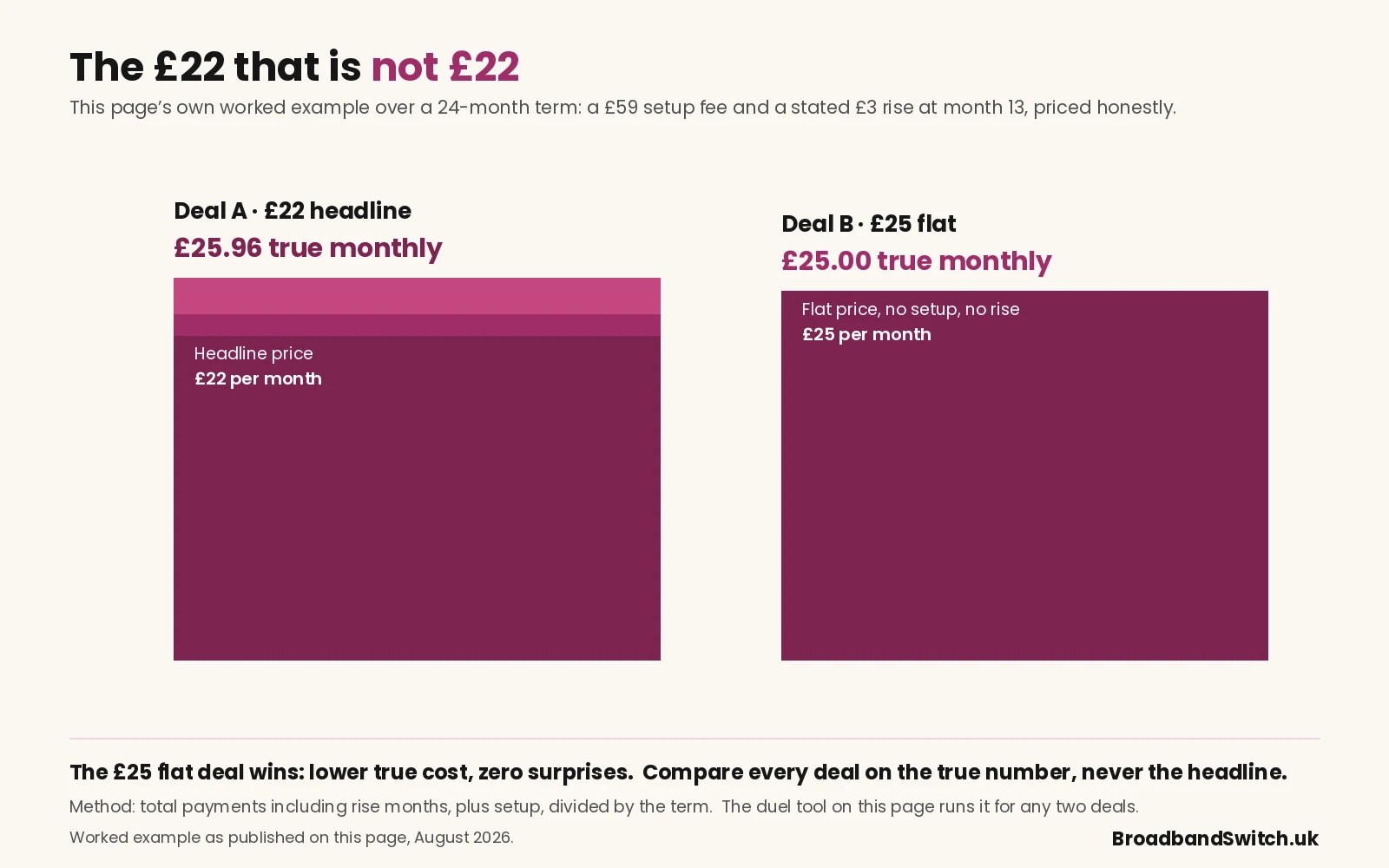
- Setup and activation feesA £49 or £59 setup fee on a 24-month deal adds roughly £2 to £2.50 a month to the effective cost, quietly turning a £23 headline into a £25 real price. Zero setup at the same monthly rate is almost always better value.
- Mid-contract price risesSince 17 January 2025, any in-contract increase must be stated in pounds and pence at sign-up rather than linked to CPI or RPI. A £22 headline with a stated £3 rise at month 13 becomes £25 in year two, an effective £23.50 over 24 months. Read the clause before signing; the rises guide tracks every provider's numbers.
- Over-buying speedA 1 Gbps plan is not better value than 150 Mbps if the household never uses it, and most UK homes see no real-world difference above around 300 Mbps day to day. The speed-needs guide finds the lowest tier that still covers you.
The best-value method
- Run a postcode and exact-address check firstNetworks change street by street, so the shortlist starts with what is actually live at your door, never with national advertising.
- Pick the lowest speed tier that still covers real useVideo calls, streaming, gaming, uploads: cover them and stop, because paying for speed you will not notice is the quietest value-killer of the three.
- Compare total cost over the full termAdd setup fees, add any stated mid-contract rise across its months, divide by contract length: that is the true monthly cost, and the duel tool at the top of this page runs it for any two deals.
- Check the length against your likely plansA 24-month deal saves money only if you stay 24 months; if a move is plausible, a 12-month or rolling 1-month deal can be better value despite the higher headline. When ready, One Touch Switch makes the move a single step handled by the new provider.
Best value by household type
What counts as best value depends on what the household actually does online. Typical profiles, indicative at publication, always confirmed at your postcode.
- Single occupant, light useBrowsing, email, HD streaming and calls: entry full fibre at 50 to 100 Mbps, or a social tariff if eligible. Main risk: over-buying speed never used.
- Couple working from homeTwo simultaneous video calls, regular uploads, streaming: full fibre at 100 to 300 Mbps with solid upload. Main risk: picking cheapest FTTC where full fibre is actually available.
- Family of four, mixed useSeveral streams, online gaming, homework, calls: full fibre at 150 to 500 Mbps. Main risk: stretching to gigabit when 300 Mbps would be enough.
- Students or shared houseHeavy streaming and gaming on short tenancies: rolling 1-month or a 9-month academic deal at full fibre speeds. Main risk: locking into 24 months with early-exit exposure.
- Pensioners, light useBrowsing, email, occasional calls: a social tariff if eligible, otherwise entry FTTC or entry full fibre. Main risk: paying a big-brand premium for speed never used.
- Rural addressVariable fixed-line options, sometimes no FTTP yet: fast FTTC, 4G or 5G home broadband, or fixed wireless. Main risk: assuming full fibre is on its way when build dates slip.
When to prioritise something other than value
- Live broadcasting and heavy cloud uploadReliability and symmetric upload matter more than cost per megabit: look at full fibre with the best upload your postcode supports.
- Competitive online gamingLow latency and stable jitter beat peak speed and price: the gaming guide covers what actually matters.
- Running a business from the premisesUptime, support hours and a static IP can outrank value: start at the business broadband hub.
The value league
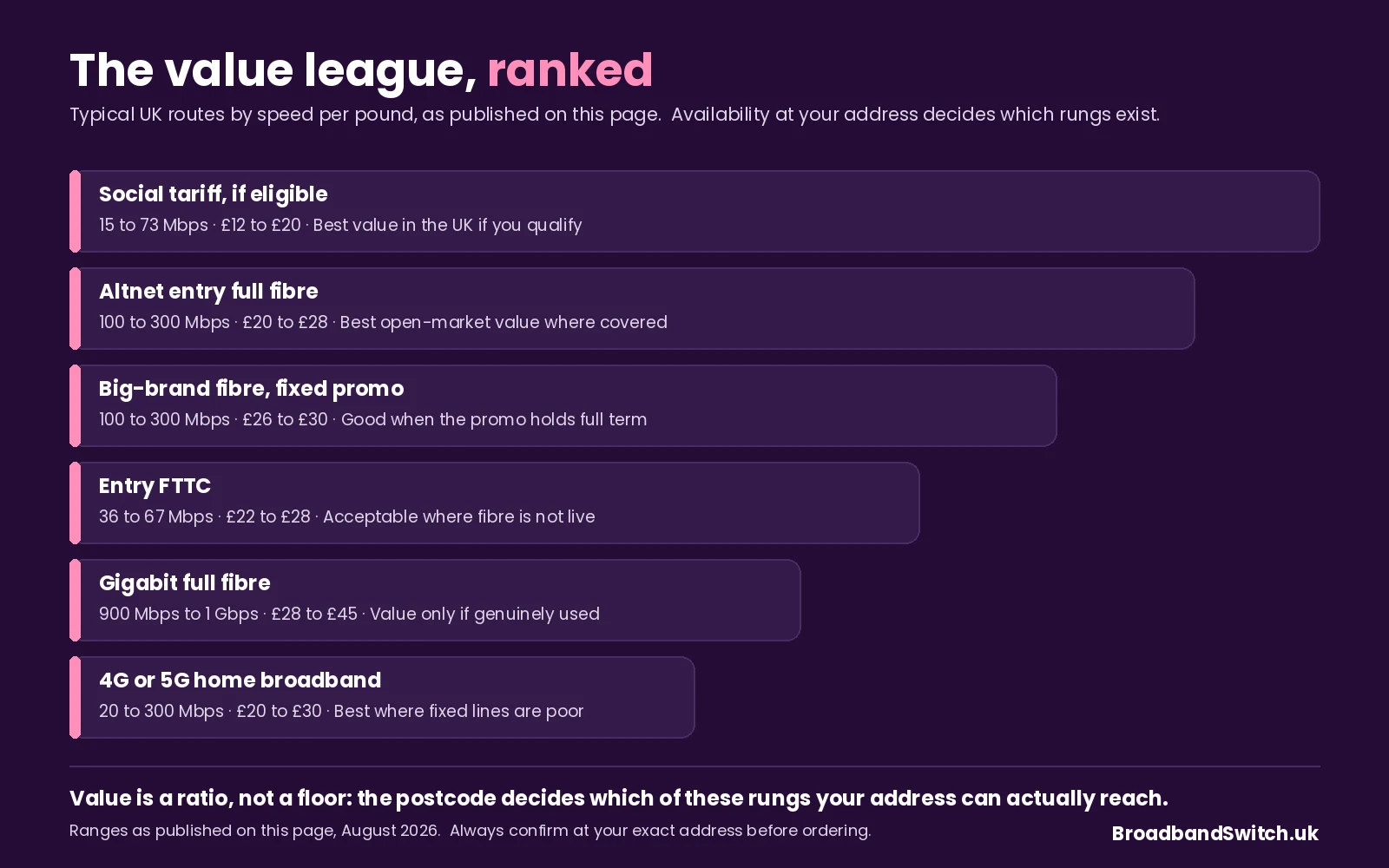
- Social tariff, if eligible15 to 73 Mbps at £12 to £20: the best value available in the UK for anyone who qualifies.
- Altnet entry full fibre100 to 300 Mbps at £20 to £28: the best open-market value at altnet-covered addresses.
- Big-brand entry fibre, fixed promo100 to 300 Mbps at £26 to £30: good value when the promo is fixed for the full term.
- Entry FTTC36 to 67 Mbps at £22 to £28: acceptable where full fibre is not yet live.
- Gigabit full fibre900 Mbps to 1 Gbps at £28 to £45: value only if the household actually uses it. The gigabit page makes that case honestly.
- 4G or 5G home broadband20 to 300 Mbps, variable, at £20 to £30: the best value where fixed lines are poor. The wireless hub covers the checks.
Live best-value deals at your postcode
Enter your postcode and the comparison shows live, address-level availability across 30+ UK providers, each card carrying its monthly price, any setup fee, its stated April rise amounts in pounds and pence and any switching credit, exactly the ingredients the true-cost method needs. Pick your exact address where prompted, and run any close call through the duel above.
Related ways to find value
Best value broadband, asked and answered
What does "best value" mean for broadband?
The highest ratio of useful speed and reliability to what you actually pay over the full contract term, which is a different question from cheapest. A £22 headline with a £59 setup fee and a £3 mid-contract rise is worse value than a £25 flat-rate deal with zero setup and no rise, even though £22 looks lower, so always compare total cost over the term.
Is the cheapest broadband deal always the best value?
No: cheapest is about the floor, best value is about the ratio. A social tariff at £15 for 67 Mbps is almost always better value than a non-social deal at £22 for 36 Mbps even though the second saves less from the average UK bill, because speed, reliability and contract clarity all feed into value.
Which type of broadband usually offers the best value in the UK?
At altnet-covered addresses, entry altnet full fibre typically wins on speed per pound: 100 to 300 Mbps for £20 to £28 a month with no setup and no in-contract rises. Eligible benefit claimants do better still on social tariffs, and where neither is available, fast FTTC at around £24 is usually the most honest value.
How do I calculate the true cost of a broadband deal?
Add every monthly payment for the full contract, plus any setup or activation fee, plus any stated mid-contract rise across the affected months, then divide by the number of months: that is the true effective monthly cost, and the number to compare on. The duel tool at the top of this page runs the whole calculation for any two deals.
Why do mid-contract price rises affect value so much?
Because a small number compounds: a £3 rise at month 13 on a 24-month contract adds £36 across year two, 14% more than the year-one price on a £22 headline. Since 17 January 2025 providers must state any in-contract rise in pounds and pence at sign-up, which makes the comparison honest, and deals committing to no rise at all are the most predictable value.
Is it worth paying more for full fibre?
At most UK addresses now, yes: full fibre is typically more reliable than FTTC and often ships a better router, and entry full fibre at an altnet address can actually be cheaper than entry FTTC from a big brand. The question is usually not "pay more" but "check what is live at your postcode".
Which providers offer the best value broadband in the UK?
No single provider wins nationwide, because it depends on your postcode: altnet builders like Community Fibre, Hyperoptic, YouFibre, Gigaclear, Brsk and Toob score well on speed per pound where they have coverage, while big-brand value shifts week to week with promotions. The postcode comparison shows the live answer at your address.
How often should I review my broadband for value?
Once a year as a minimum, and always when your contract ends or auto-renews, because a deal that was good value on signing day can look quite different against today's market. One Touch Switch makes moving a single-step process, so switching friction is no reason to stay on a weak deal.
About this guide. Compiled by Adrian James and reviewed by Dr Alex J. Martin-Smith, with every range and figure stated as published at 6 August 2026, and the duel tool computing exactly the true-cost method this page teaches, from defaults carried in its own markup. Prices, availability and package structure vary by exact address and change over time. We earn commission when you order through the comparison, which never changes the price you pay: see how we rank deals, the editorial policy, the methodology and trust hub and the affiliate disclosure, or submit a correction and a human will read it.
References
- Ofcom. (2024, July 19). Ofcom bans mid-contract price rises linked to inflation. Office of Communications. https://www.ofcom.org.uk/phones-and-broadband/bills-and-charges/ofcom-bans-mid-contract-price-rises-linked-to-inflation
- Ofcom. (2024, September 12). Simpler and quicker broadband switching is here. Office of Communications. https://www.ofcom.org.uk/phones-and-broadband/switching-provider/simpler-broadband-switching-is-here
- Ofcom. (n.d.). Social tariffs: cheaper broadband and phone packages. Office of Communications. Retrieved August 6, 2026, from https://www.ofcom.org.uk/phones-and-broadband/saving-money/social-tariffs
On the tightest budget, start with cheapest deals; know your ceiling, try under £25 or under £30; unsure on speed, the speed-needs guide sorts it. Then thirty seconds here settles the value question at your address.
Independent and free. 30+ providers, true costs side by side.