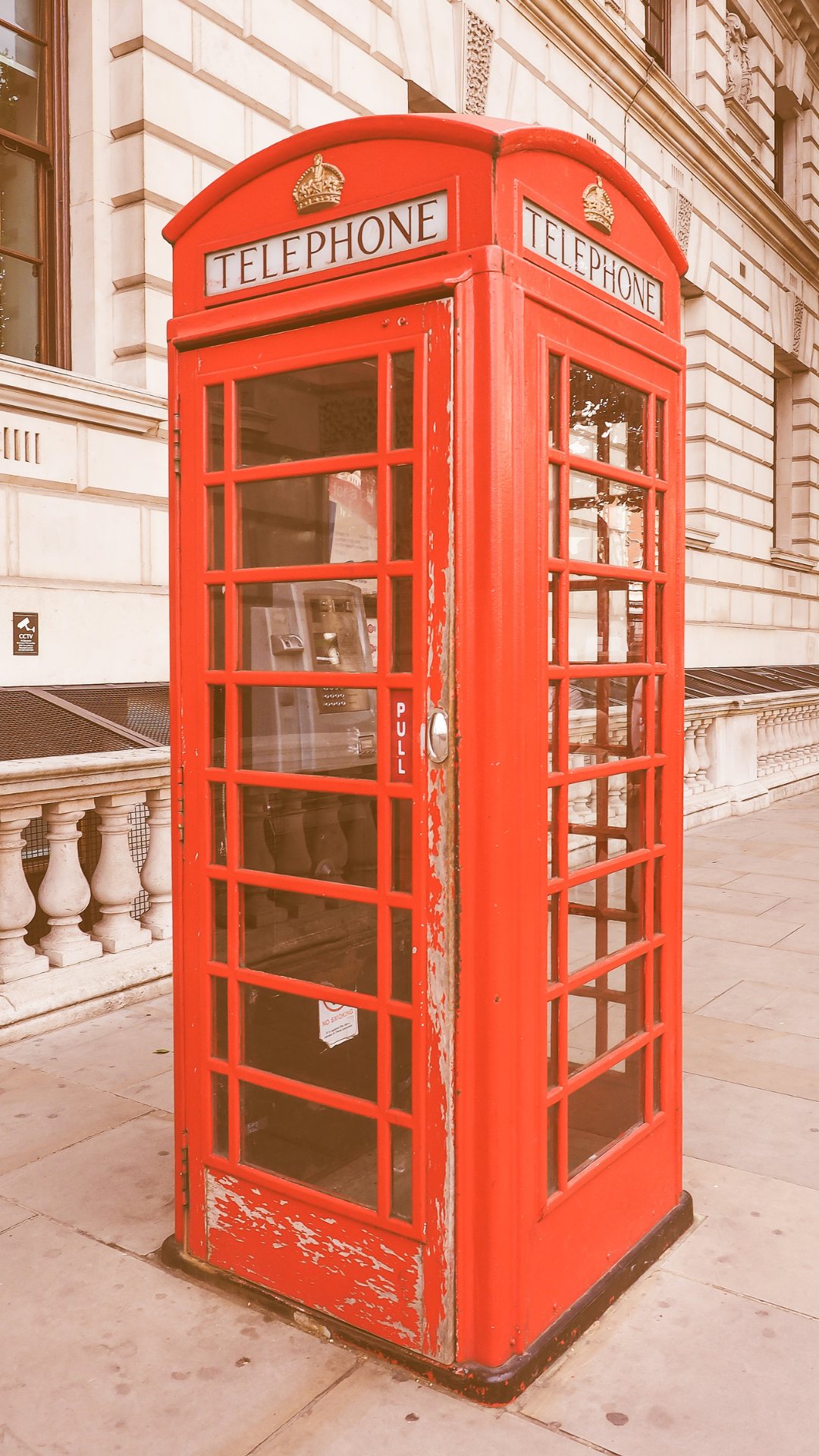
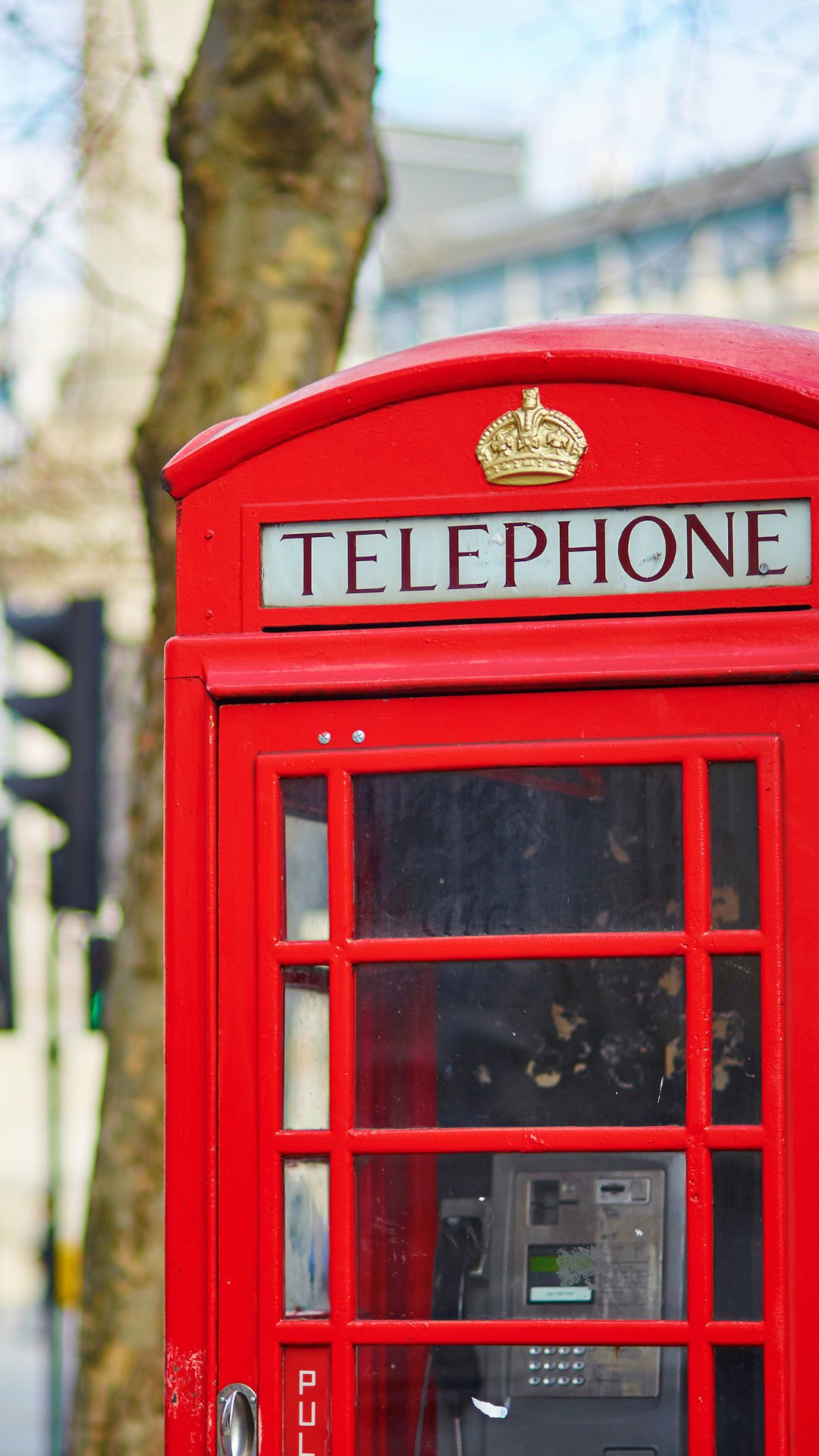
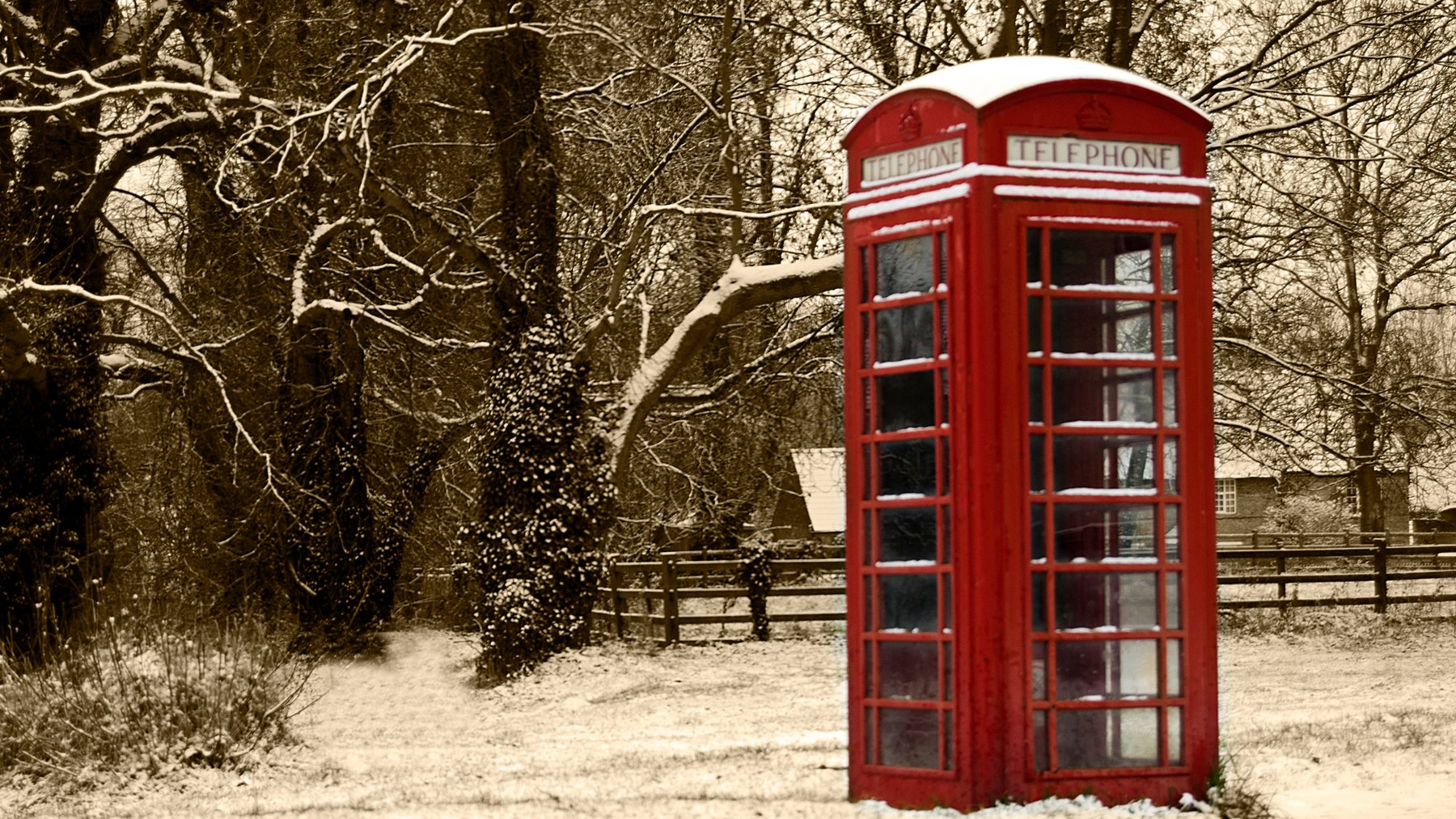
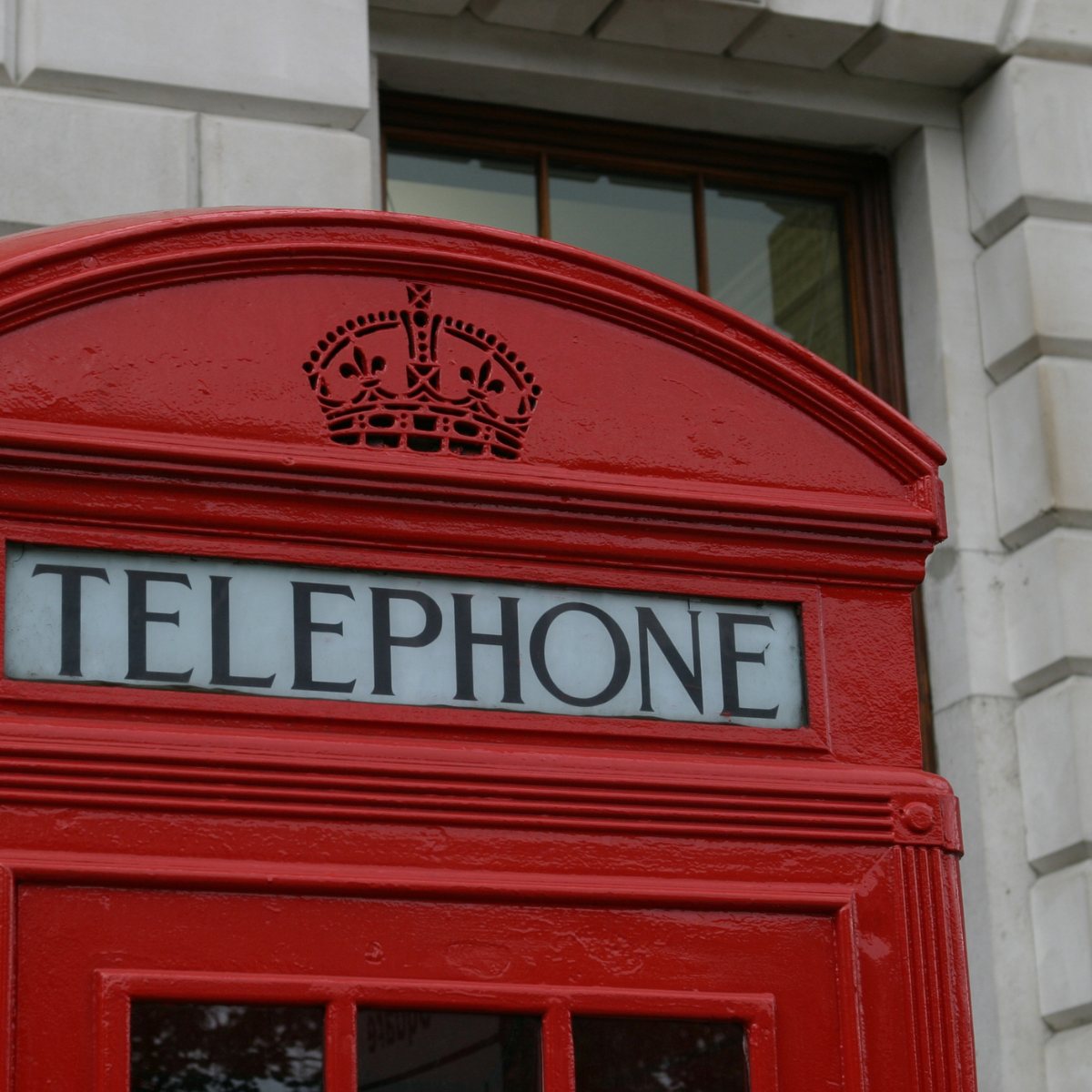
The K2, Britain's first red telephone kiosk, reached London's streets in 1926. A century on, we trace its record from 92,000 payphones at the peak to 3,000 working red survivors, the rules that protect them, the £1 second lives, and the full fibre country that replaced the queue at the box.
By Dr Alex J. Martin-Smith CMgr DBA · Reviewed by Adrian James · BroadbandSwitch.uk
1926 THE FIRST RED K2 KIOSK REACHES LONDON'S STREETS
100years of the red telephone box in 2026, with the K6 turning 90
3,000classic red kiosks still working as phones (BT, 2023)
£1for a council or charity to adopt a decommissioned kiosk
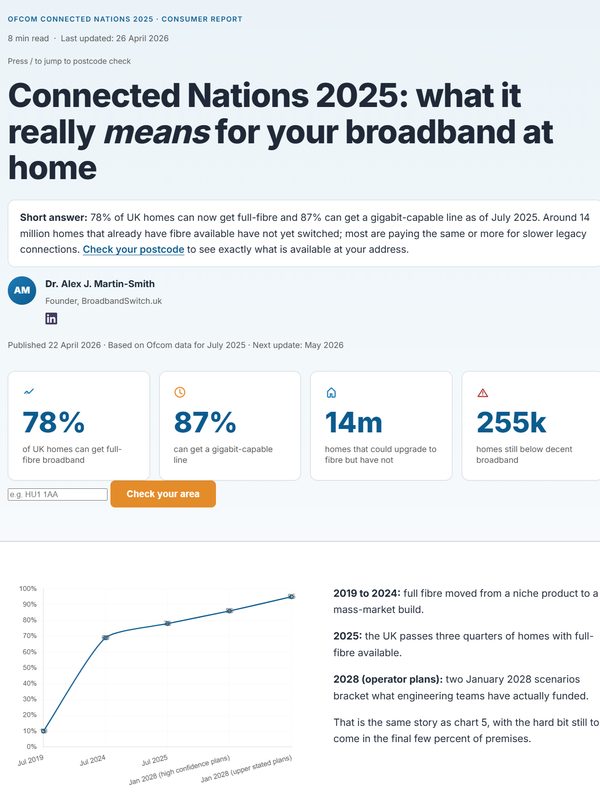
82%of UK homes could get full fibre by January 2026 (Ofcom)
One hundred years of the red telephone box, verified from named sourcesAll figures verified 18 August 2026
THE QUICK ANSWER
How many red telephone boxes are left, and can you still get one?
About 3,000 classic red kiosks still work as phones inside BT's estate of roughly 20,000 payphones, one hundred years after the first red K2 reached London in 1926. Around 3,000 kiosks hold listed status. Communities have adopted more than 7,200 for £1 since 2008, over 700 now hold public defibrillators, and at auction, where anyone can bid, listed K6s made £8,000 to £17,000 in 2024 to 2025. One more finding: no Royal Mail stamp, no Royal Mint coin and no BT campaign exists to mark the centenary.
Data: BT Group (2023); Ofcom (2022, 2026); BBC News (2025); checks to 18 August 2026.
Publication details
About this report
A Century in Red is Report No. 31 in the BroadbandSwitch.uk research series, part of the SearchSwitchSave group: a one off centenary special that puts the coverage spreadsheets down for a single edition. It marks one hundred years of the red telephone kiosk, 1926 to 2026. Historical statistics describe the dates stated beside them; in particular, BT's payphone estate and adoption figures date from its August 2023 announcement, the most recent BT has published, and are flagged as such throughout.
Important notices
Point in time. Version 1.0, published August 2026. All sources were checked to 18 August 2026.
Analysis, not advice. This report is independent analysis and heritage journalism. It is not financial, legal or contractual advice, and anyone buying or adopting a kiosk should take their own advice on planning, listed building consent and title.
Independence. BroadbandSwitch.uk operates comparison services and may receive commission when readers switch provider through our links. This does not influence the analysis in this report, and no provider has paid for inclusion or had sight of this document before publication.
Imagery. Photography is from the BroadbandSwitch.uk image library except where credited otherwise. The Street Hub photograph is used courtesy of BT. Two period scenes, a 1990s KX high street and a BT Chargecard, are AI generated illustrations created for this report and are labelled as such in their captions, file names and the manifest. A full image manifest with titles, alt text and credits appears before the reference list.
Trade marks. BT, Openreach, KCOM and all other company and product names are the trade marks of their respective owners and are used here for identification only. The kiosk designs are protected by trade marks and copyright held by BT. No endorsement is implied in either direction.
Corrections. We correct errors promptly and transparently. Spotted one? Email the editorial team via broadbandswitch.uk/corrections and we will review, correct and footnote the change in the public corrections log.
How to cite this report Suggested attribution: BroadbandSwitch.uk, A Century in Red (Report No. 31), August 2026, broadbandswitch.uk. Corrections are welcome, answered, and published in our public corrections log.
Foreword
A send off worthy of a century of service
My four children have never queued in the rain to make a phone call. To them, the red telephone box is scenery: something to photograph, not something to feed with coins while the pips count down. That is exactly why we have written this report.
In 2026 the red telephone box turns one hundred. Sir Giles Gilbert Scott's K2 first appeared on London's streets in 1926, and for the best part of a century its descendants stood on ours: through the war, through the boom years, through every awkward teenage call home. At the peak there were about 92,000 public payphones in Britain. Around 20,000 remain, and only about 3,000 of those are the classic red kiosks.
BroadbandSwitch.uk exists because of what replaced them. The same century of engineering that took Britain from one shared phone per street to full fibre in 82% of homes is the story we tell every day, and the box deserves a proper send off into its second century. This report gathers the verified numbers, the rules that protect the survivors, the £1 adoptions, the auction bidding wars and the quiet heroism of a kiosk that now holds a defibrillator instead of a handset.
This is our thirty first report, and the first to put the coverage spreadsheets down for a week. Numbers 26 to 30 tracked the copper switch off, complaints, prices and the fibre build. Number 31 asks a simpler question: what do we owe the machine that started it all? Quite a lot, as it turns out, because the box's own story is usually told with numbers that melt the moment you ask for a source.
So the rules here are the rules everywhere else in our library. Every figure carries a date. Every source is named. The soft numbers are flagged rather than smoothed over, and where the record is silent, including on why nobody minted a coin or printed a stamp for the centenary, we say so and move on. Happy hundredth, old friend. You served.
“The red box is not a relic of a failed technology. It is chapter one of the most successful one.”
Dr Alex J. Martin-Smith CMgr DBA · Founder, BroadbandSwitch.uk
Page numbers refer to the designed PDF edition; each entry links to the matching card on this page.
A CENTURY IN RED · 1926 TO 2026
One hundred years, one street corner at a time.
Westminster, London
Section 01 · The story
01 The centenary, on one page
The box turns one hundred. Sir Giles Gilbert Scott's K2, winner of the 1924 competition, reached London's streets in 1926. The Post Office overruled his silver livery and painted it red so it could be spotted at a glance, and an icon was born (London Museum, n.d.). Remarkably, as we went to press no official stamp, coin or BT campaign had been announced to mark the hundredth.
The service record is immense. Around 1,700 K2s led to roughly 60,000 K6s, putting a red box in almost every town and village, and the wider payphone network peaked at about 92,000 in the early 1990s (Historic England, n.d.; ISPreview, 2023).
The decline was brutal. Call minutes collapsed by 99.5% between 2002 and 2022, and about 20,000 working payphones remain, some 3,000 of them red kiosks (BT Group, 2023). The cause is in your pocket: 98% of adults now use a mobile.
The survivors are protected and loved. Ofcom's rules stop the removal of boxes that communities still need, more than 7,200 kiosks have been adopted for £1, over 700 now hold defibrillators, and auction bidders paid £8,000 to £17,000 for listed examples in 2025 (Ofcom, n.d.; BT Group, 2023; BBC News, 2025).
And the story ends where we begin. The copper network that fed every kiosk closes on 31 January 2027, while full fibre now reaches 82% of UK homes (Ofcom, 2026). The red box is chapter one of the connected country.
iTHE WHOLE REPORT IN ONE SENTENCEIn 1926 a whole street shared one telephone in a handsome cast iron box; in 2026, 82% of homes can order full fibre, and the kiosk that started it all has 3,000 working survivors, 7,200 adopted second lives and a legally protected place on the corners where the signal still fails.
Section 02 · The story
02 Britain answers the call
The first standard public kiosk, the concrete K1 of 1921, was not loved. The London boroughs largely refused to have it, and Eastbourne's council found it ugly enough to hide its seafront boxes under thatched roofs (Nicholls-Lee, 2026). In 1924 the Royal Fine Art Commission ran a competition for a better design, and the winner was Sir Giles Gilbert Scott, then engaged on Liverpool's Anglican cathedral (Twentieth Century Society, n.d.).
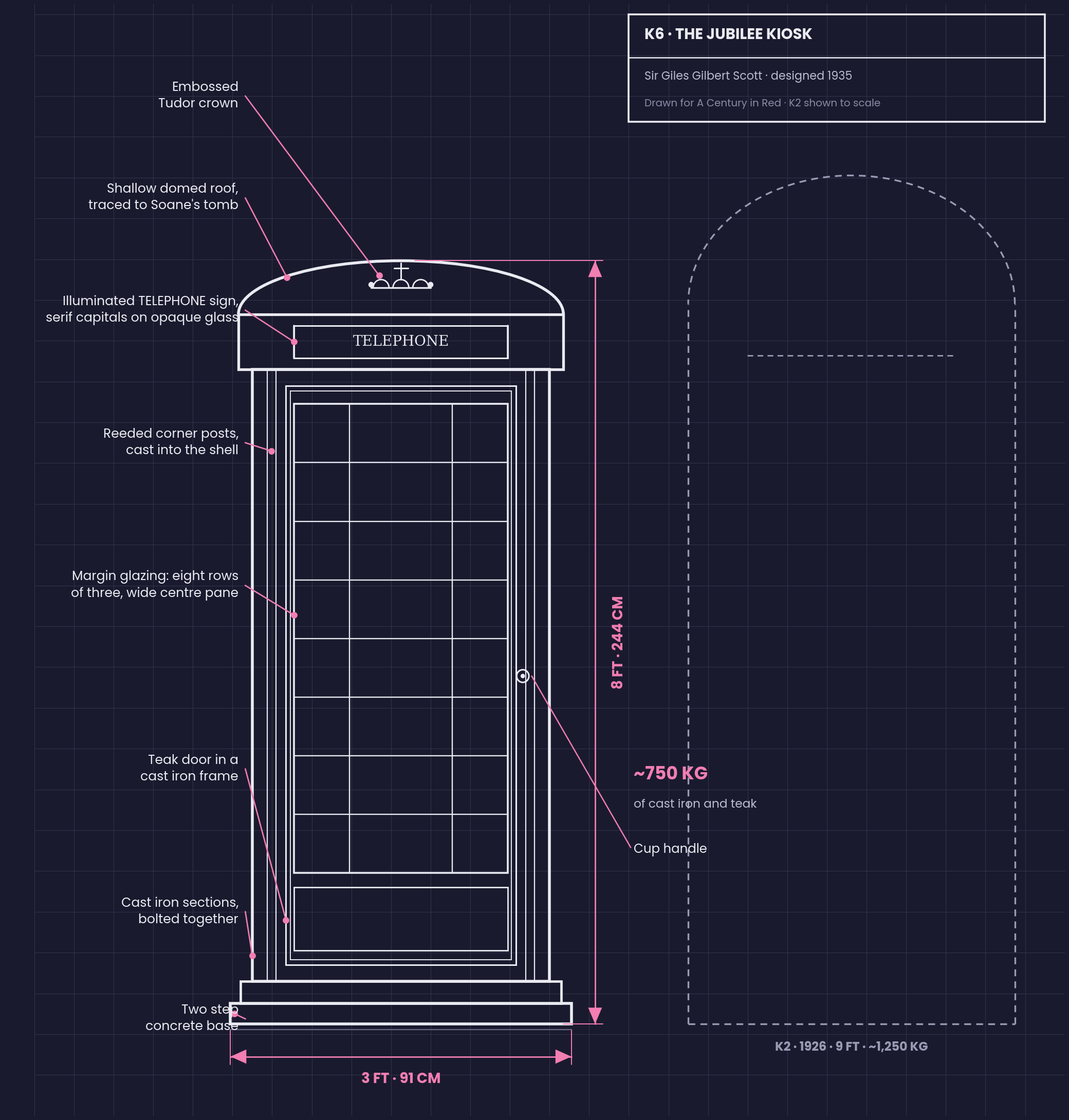
Scott wanted his kiosk finished in silver with a blue green interior. The General Post Office overruled him, choosing cast iron painted red so the boxes would stand out on the street (London Museum, n.d.). The result, the K2, reached London in 1926. About 1,700 were installed over the following decade, almost all in the capital, and just over 200 survive under Grade II listing; Scott's wooden prototype still stands in the entrance arch of the Royal Academy, listed at Grade II* (Historic England, n.d.). The shallow dome is widely traced to Sir John Soane's tomb in Old St Pancras churchyard: Scott became a trustee of Soane's museum in 1925, the year his design won, though he never named his source (Sir John Soane's Museum, n.d.). Internal Post Office papers from December 1926 record that each K2 cost £33 against £13 for a K1 (Linge et al., 2024).
The family grew quickly. The concrete K3 of 1929 took Scott's shape nationwide at lower cost, the K4 of 1927 added a post box and stamp machines though only about 50 were built, the K5 was a portable prototype that never entered production, and the K7 of the 1960s never left the drawing stage (Gilbert Scott Archive, n.d.; The Telephone Box, n.d.). Then came the one everybody knows: the K6, designed in 1935 to mark George V's Silver Jubilee and rolled out from 1936. Roughly 60,000 were installed, and more than 11,000 still stand (London Museum, n.d.; see the verification list). The K8 of 1968, by Bruce Martin, was the last red design: about 11,000 were installed between 1968 and 1983 and barely 50 survive in their original positions, before the plainer KX series arrived in 1985, after BT's privatisation (Twentieth Century Society, n.d.; Historic England, 2023).
The anatomy of an icon: the K6, measured
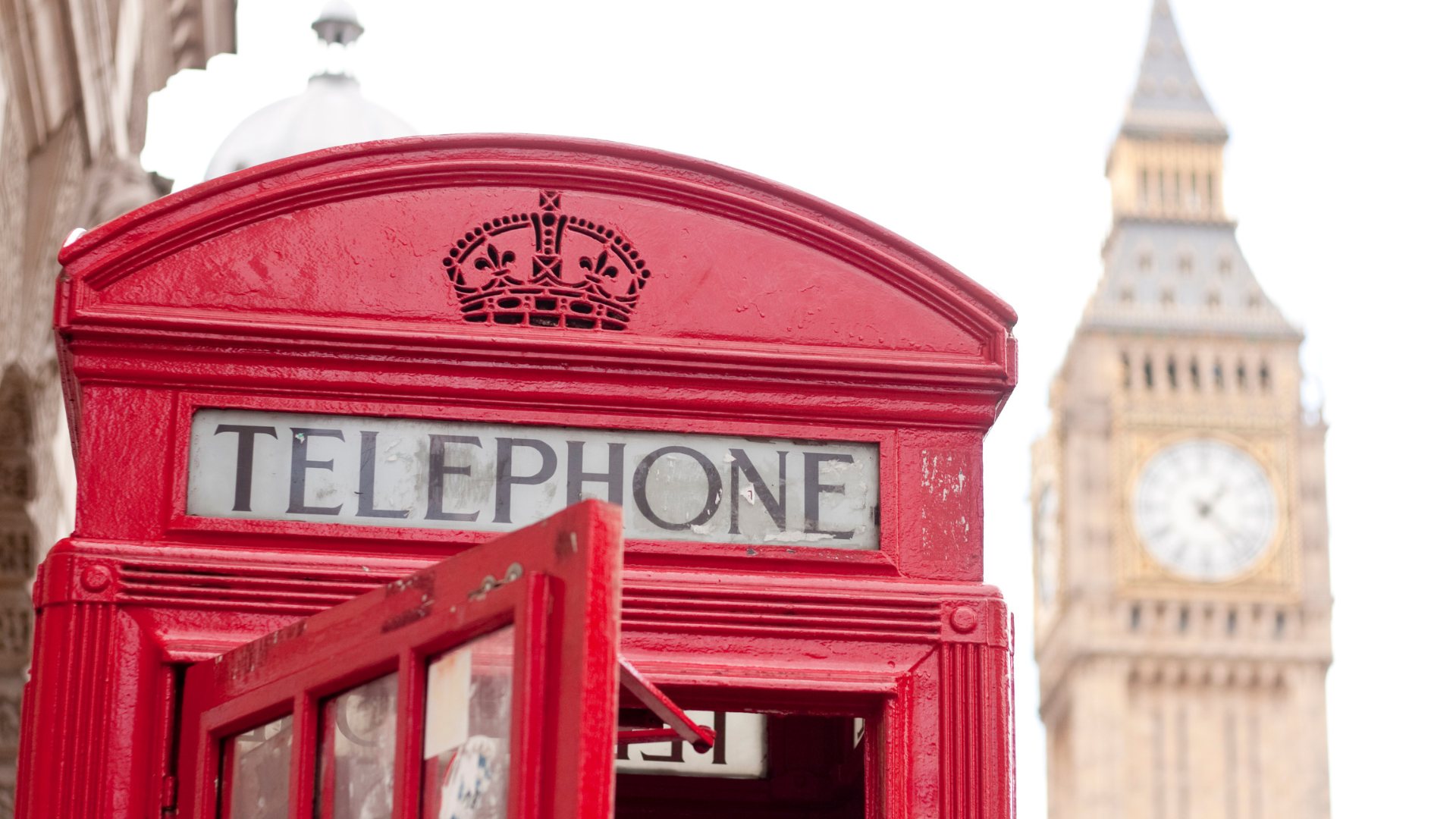
Dimensions and construction as recorded by The Telephone Box (n.d.): about 8 ft (244 cm) tall, 3 ft (91 cm) wide and roughly 750 kg, with eight rows of three panes, a teak door and cast iron sections bolted together. The K2 outline is shown to scale. Figure 1.
Survivors: kiosks installed versus kiosks still standing (log scale)
Sources: Historic England (n.d.); The Telephone Box (n.d.); London Museum (n.d.); the K6 survivor figure is flagged in the verification list. Figure 2.
The KX programme very nearly wiped the red boxes out. The Thirties Society, now the Twentieth Century Society, fought back with its Take It As Red campaign, and in 1986 a kiosk at London Zoo became the first to be listed. Around 3,000 kiosks across the UK now hold listed status (Nicholls-Lee, 2026; Twentieth Century Society, n.d.).
iIN SHORT · WHY “K”?K simply stands for kiosk. The Post Office numbered its standard street designs K1 to K8, which is why the famous pair are known as the K2 and the K6, and the 1980s replacements took the KX name (The Telephone Box, n.d.).
The city that never went red
One British city never had a red box at all. Hull's municipally owned telephone network, bought by the corporation in 1914 and now run by KCOM, painted its kiosks cream and left off the royal crown, the mark of a Crown service its operator never was (The Telephone Box, n.d.). In February 2023 nine of Hull's rare K8 kiosks were listed at Grade II on Historic England's advice, the largest surviving cluster of the type anywhere (Historic England, 2023). A century on, the city that went its own way on colour tops our fibre tables too, at 99.6% coverage and 78% take up (The 82% Country).
iIN SHORT · THE EXACT REDCurrant red, British Standard BS381C 539, adopted with the K8 in 1968 and then applied across the estate; earlier boxes wore the slightly darker 538. Listed kiosks must keep the colour (Department for Communities NI, n.d.).
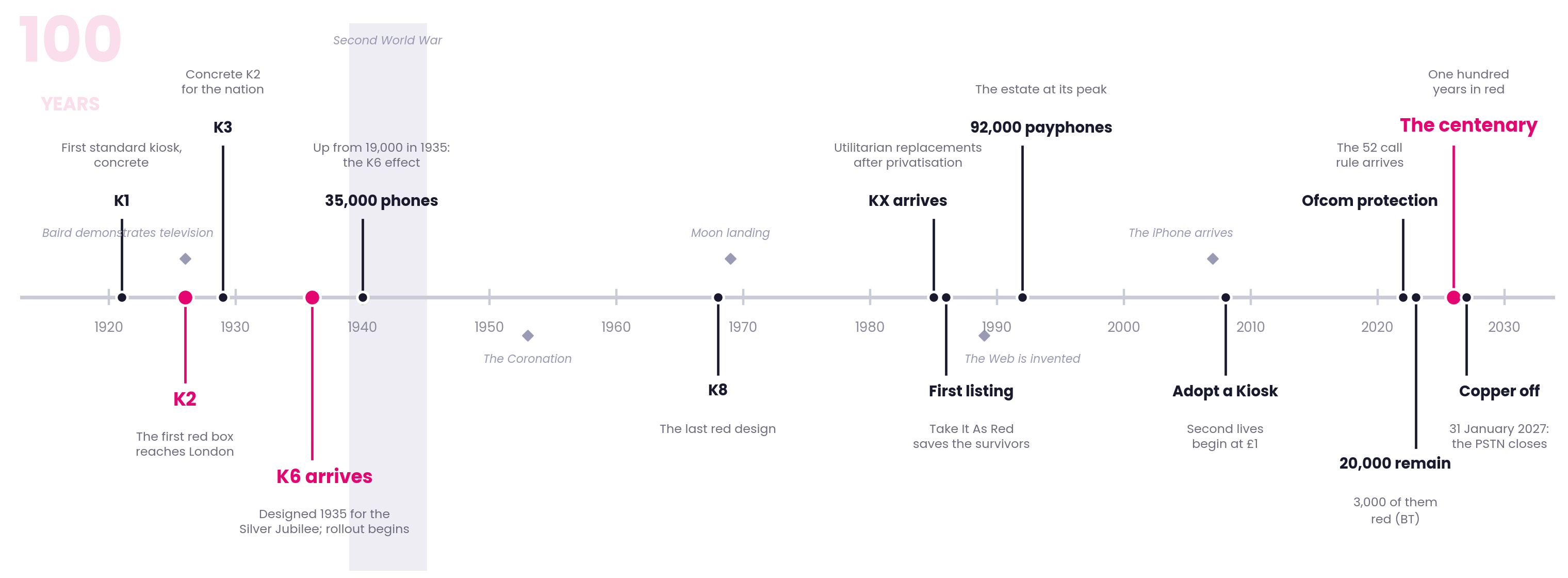
The century on one line
The kiosk century, 1921 to 2027
Sources: London Museum (n.d.); Gilbert Scott Archive (n.d.); Twentieth Century Society (n.d.); Red telephone box (n.d.) for the 1935 to 1940 telephone counts; ISPreview (2023); BT Group (2023); Ofcom (n.d.). World events in grey are common historical record. Figure 3.
Section 03 · The story
03 Red around the world
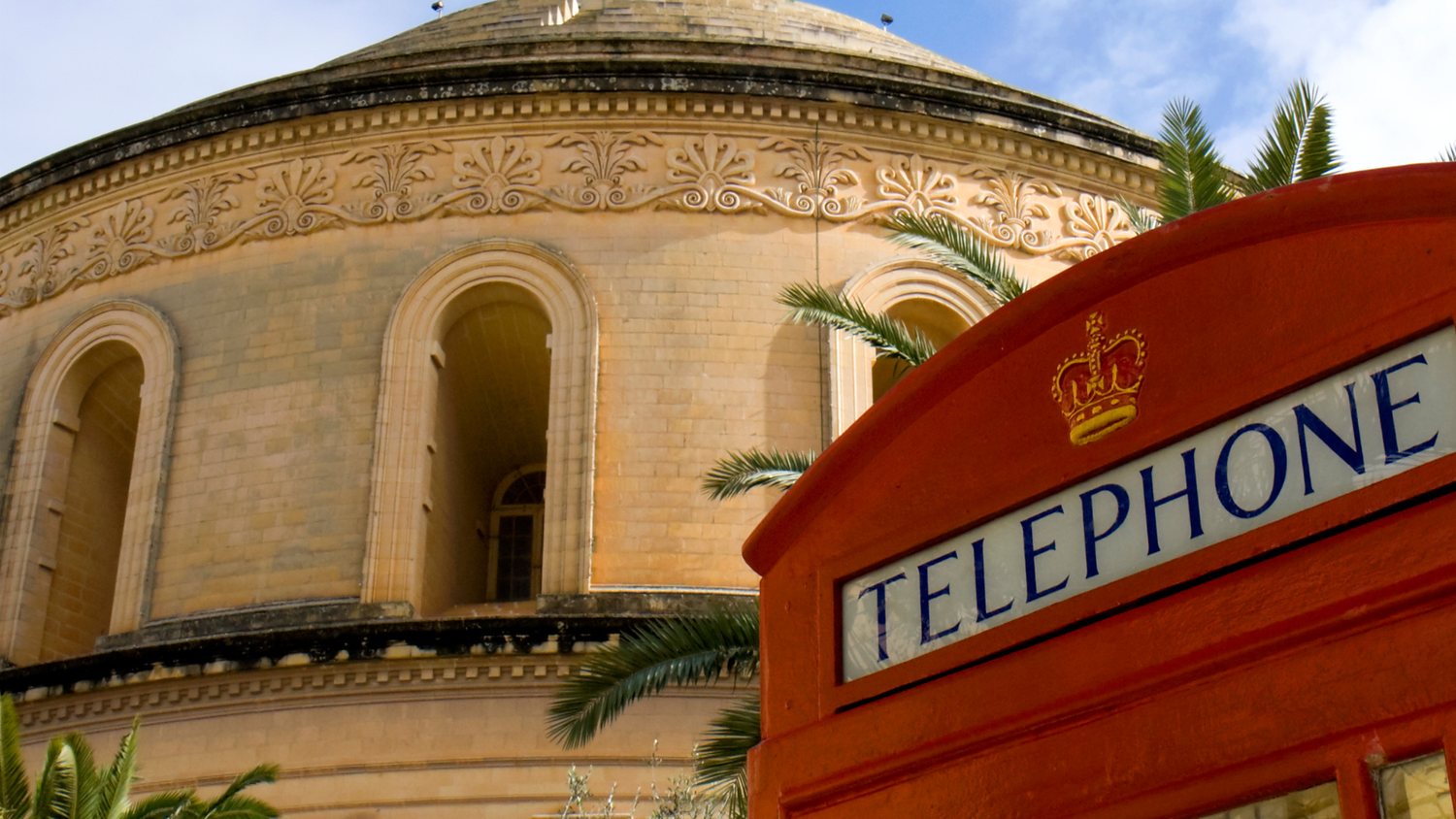
The red box did not stay at home. Kiosks were installed across the UK's Crown Dependencies and Overseas Territories and in Malta, and survivors still stand in Malta and Gozo, Gibraltar and Bermuda, with examples recorded as far afield as the Caribbean and the odd adopted box in France and Germany (Red telephone box, n.d.). Lightweight replica K6s are manufactured as flat packs and shipped worldwide for bars, restaurants and film sets, which is why a red box can turn up almost anywhere on Earth.
Still standing to attention a long way from home: a red kiosk beneath the Mosta Rotunda in Malta.
For a century of service, that is a fair definition of reach: a piece of street furniture designed for London in 1924 that became shorthand for Britain everywhere else on Earth.
Section 04 · The story
04 The long goodbye
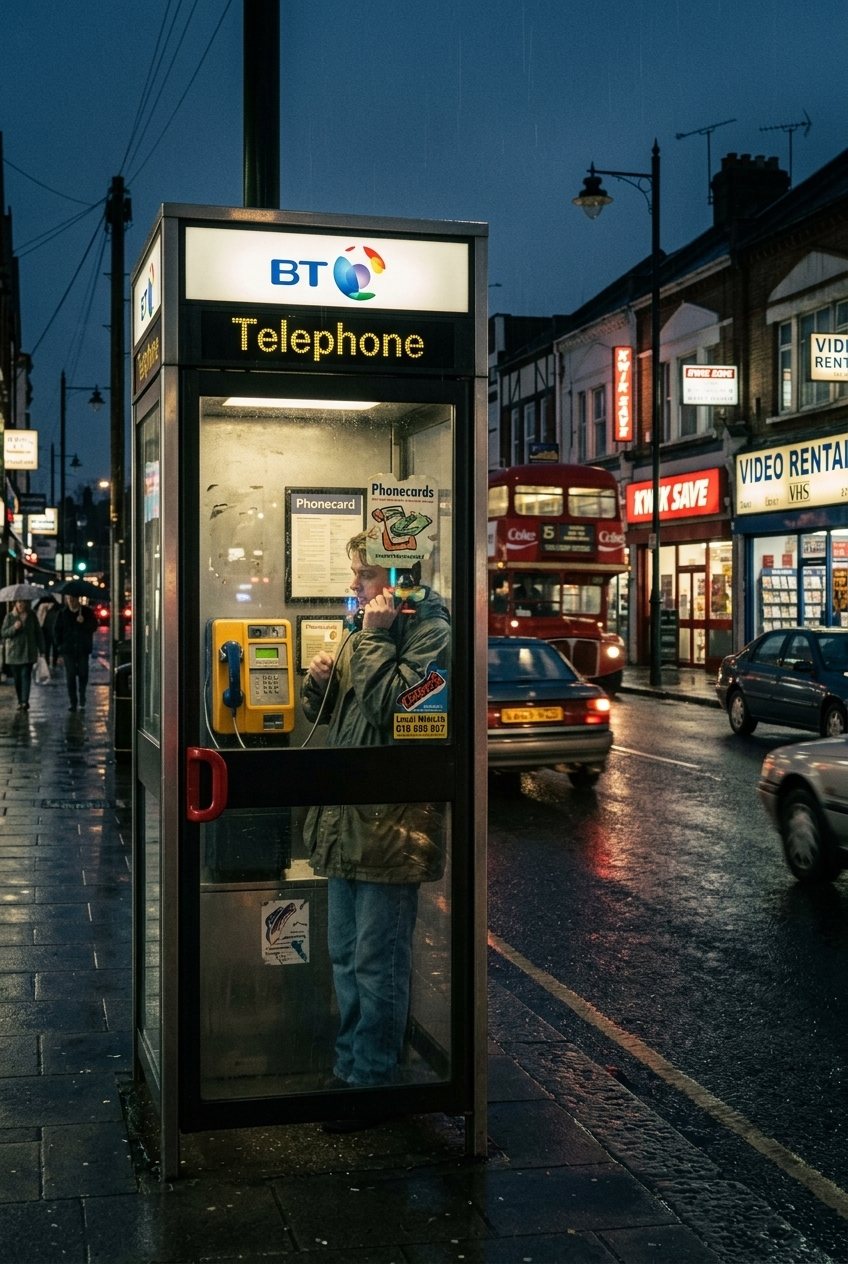
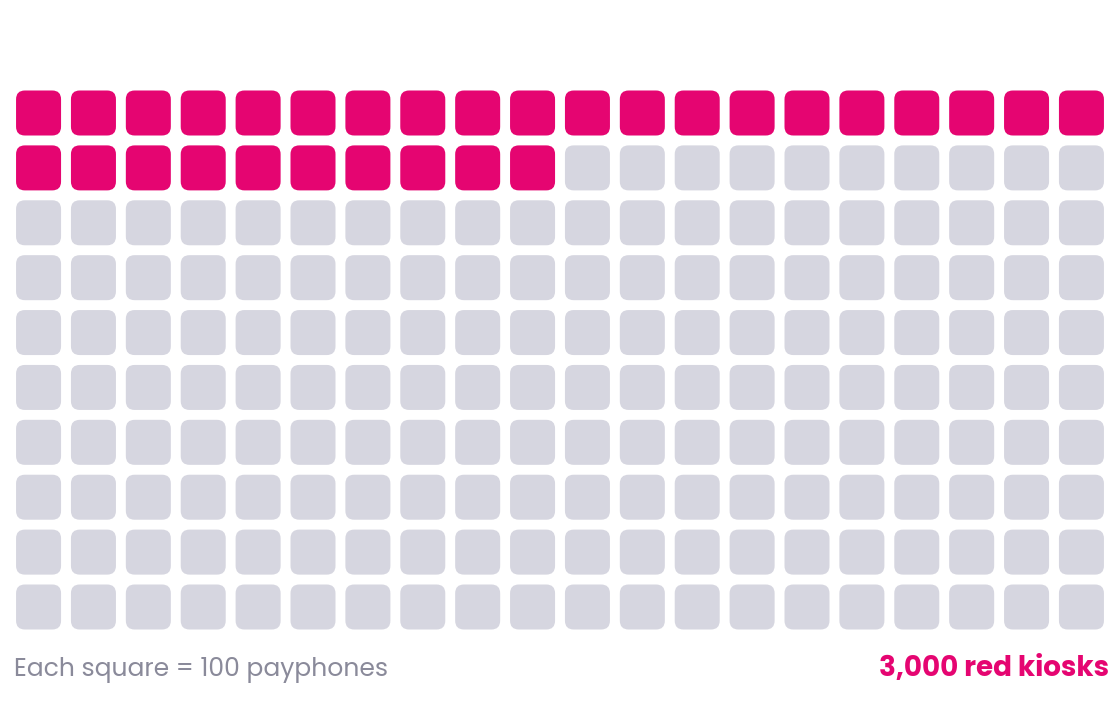
The numbers tell the story with brutal clarity. At the early 1990s peak the UK had around 92,000 public payphones, a figure some BT material rounds to 100,000 (ISPreview, 2023; BBC News, 2023a). By 2017 about 40,000 remained, some 7,000 of them red kiosks, a third of the estate never made a call, and upkeep was costing BT about £6 million a year, so the company announced it would remove 20,000 boxes over five years (BBC News, 2017). Ofcom later confirmed that nearly 20,000 went between 2017 and 2020, including almost 5,000 last at site kiosks in the year to May 2020 (Ofcom, 2022). Industry reporting put the estate at roughly 31,000 in 2019, of which around 5,000 were red kiosks (NBC News, n.d.). Ofcom's June 2022 statement counted around 20,000 boxes across the UK, 19,433 of them BT's and about 290 KCOM's (Ofcom, 2022), and by August 2023 BT still reported about 20,000 working payphones, some 3,000 of them in traditional red kiosks (BT Group, 2023).
The long goodbye: UK public payphones, 1992 to 2023
Sources: ISPreview (2023); BBC News (2017) for the 2017 point; NBC News (n.d.); BT Group (2023). Figure 4.The era the numbers describe: a KX on a rainy 1990s high street. AI generated image, created for this report.
Usage fell even faster than the estate. Calls from payphones totalled around 800 million minutes in 2002 and just 4 million in the 2021/22 year, a collapse of 99.5%, with about 7 million recorded in 2020 along the way (Ofcom, 2022; the 2020 midpoint is on the verification list). Around 2.3 million individual calls were still made from boxes in the 2021/22 year (Ofcom, 2022). The cause is no mystery: 98% of UK adults now use a mobile phone, and mobile coverage has improved sharply (BT Group, 2023).
A 99.5% collapse in call minutes from payphones (log scale)
Source: Ofcom (2022); the 2020 midpoint is flagged in the verification list. Figure 5.
92,000 to 20,000the payphone estate, early 1990s peak to BT's August 2023 count
99.5%the collapse in call minutes between 2002 and 2021/22
2.3mcalls still made from boxes in the 2021/22 year
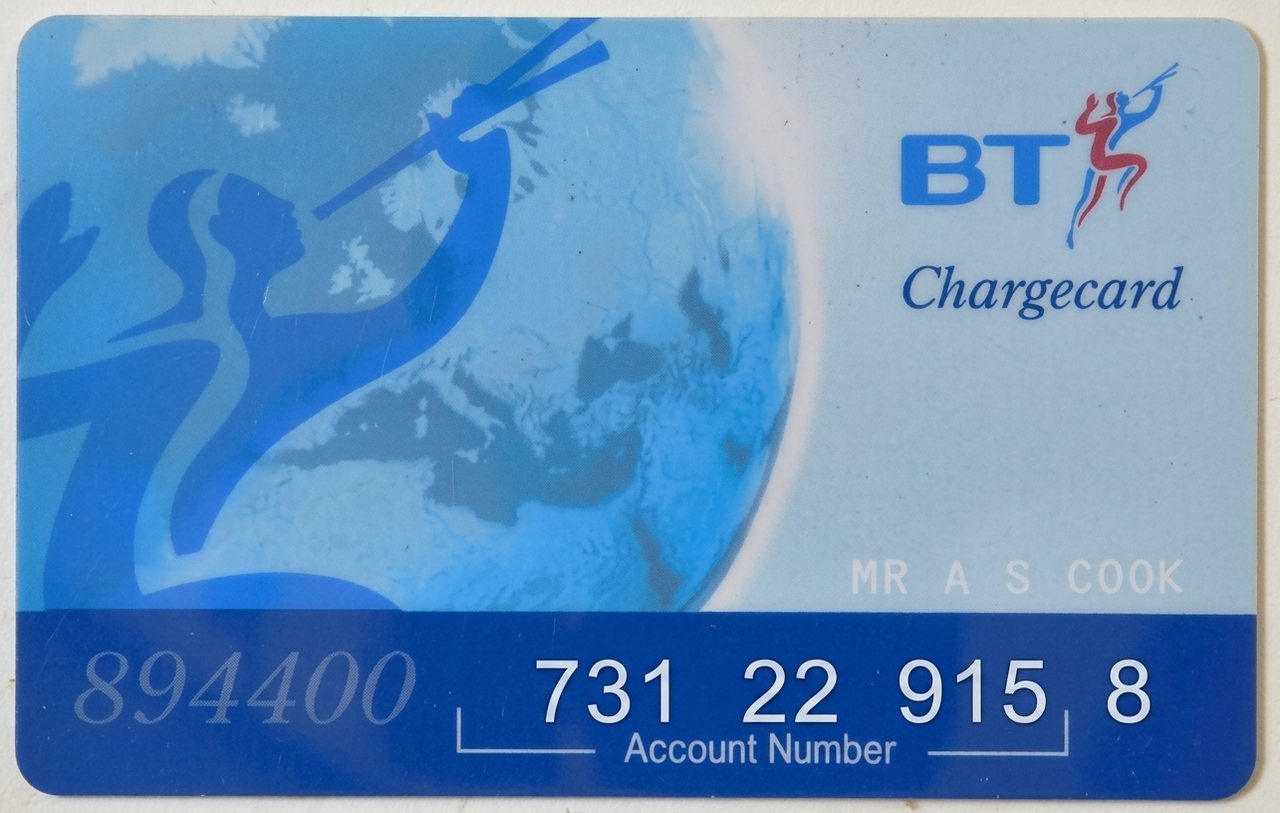
The same story played out abroad, only faster. United States payphones peaked above 2.1 million in 1999 and fell below 100,000 by the end of 2016, and New York City removed its last public payphone in May 2022 (FCC, 2018). Britain's boxes outlasted the coins that fed them: by the 1990s callers were as likely to carry a Phonecard or a BT Chargecard, billed to an account number, as a pocketful of change.
Paying without coins: a BT Chargecard of the era. AI generated image, created for this report.
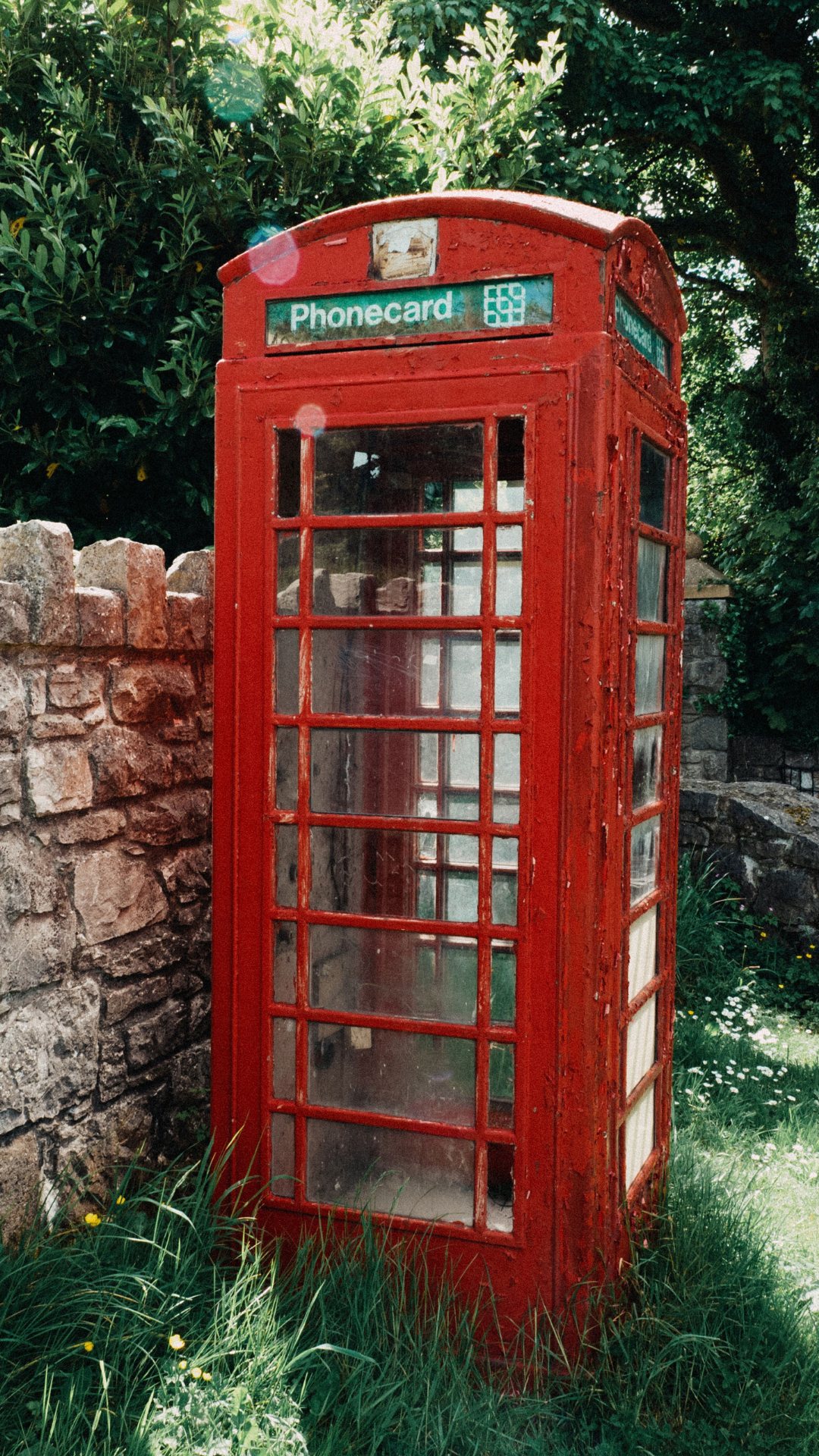
Phonecard era survivor: paint peeling, glass intact, still on its corner.
Where the 20,000 stand
Each square represents 100 payphones. Of about 20,000 still working, some 3,000 are classic red kiosks (BT Group, 2023). Figure 6.
Section 05 · The story
05 The rules that keep a lifeline
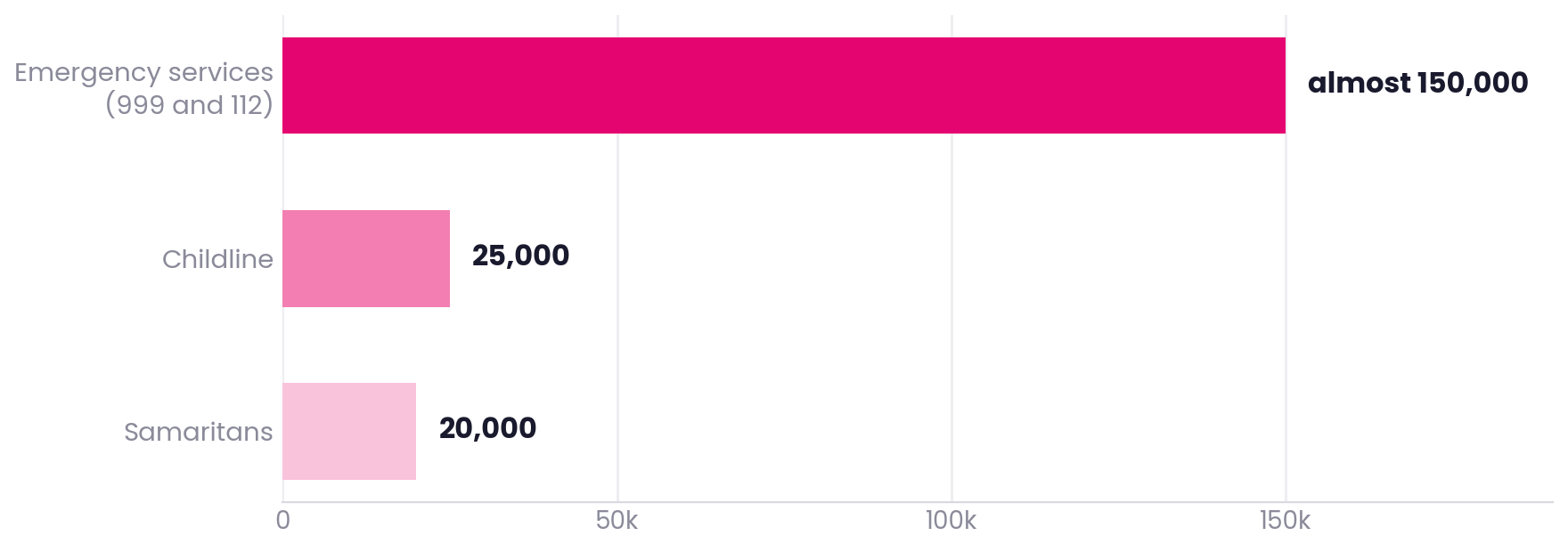
A phone box is not just heritage. In the year to May 2020, almost 150,000 calls were made from phone boxes to the emergency services, alongside 25,000 to Childline and 20,000 to Samaritans (Ofcom, 2021). For someone with no mobile signal, no credit or no safe place to talk, the box on the corner still matters.
Still a lifeline: calls from phone boxes, year to May 2020
Source: Ofcom (2021). Figure 7.
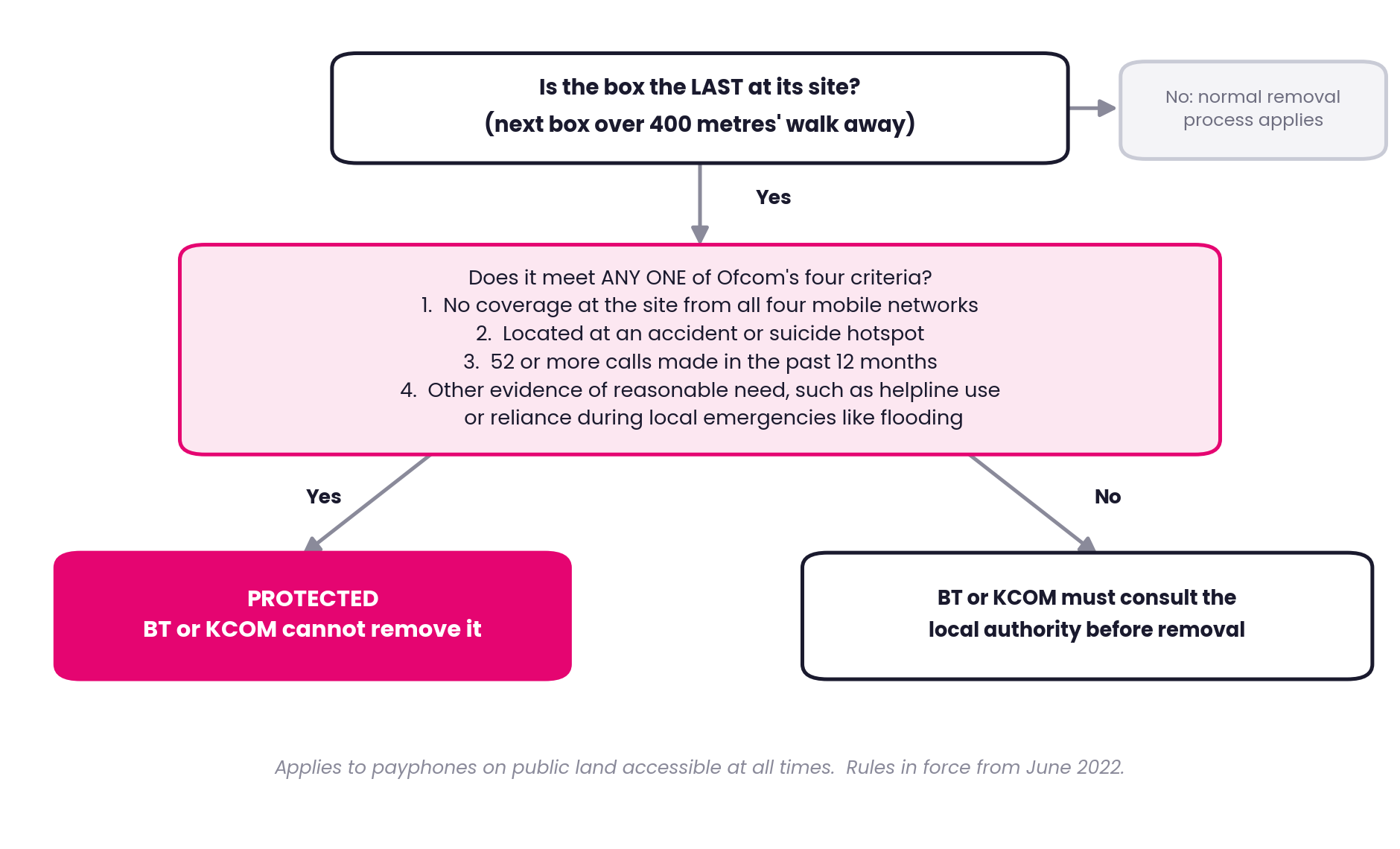
That is why Ofcom rewrote the removal rules, in force from June 2022. BT and KCOM cannot remove the last box at a site, defined as one more than 400 metres' walk from the next, if it meets any one of four criteria: no coverage from all four mobile networks; an accident or suicide hotspot; 52 or more calls in the past 12 months; or other evidence it is reasonably needed (Ofcom, n.d.). If none applies, the operator must still consult the local authority before removal. Ofcom initially estimated around 5,000 boxes would be protected, later revising this to at least 1,400 in areas without good mobile coverage (Ofcom, 2021; BBC News, 2022). The need is not abstract: in North Yorkshire alone, boxes at risk of removal logged 68 calls to the police in a single year (BBC News, n.d.).
Can your phone box be removed? Ofcom's protection test
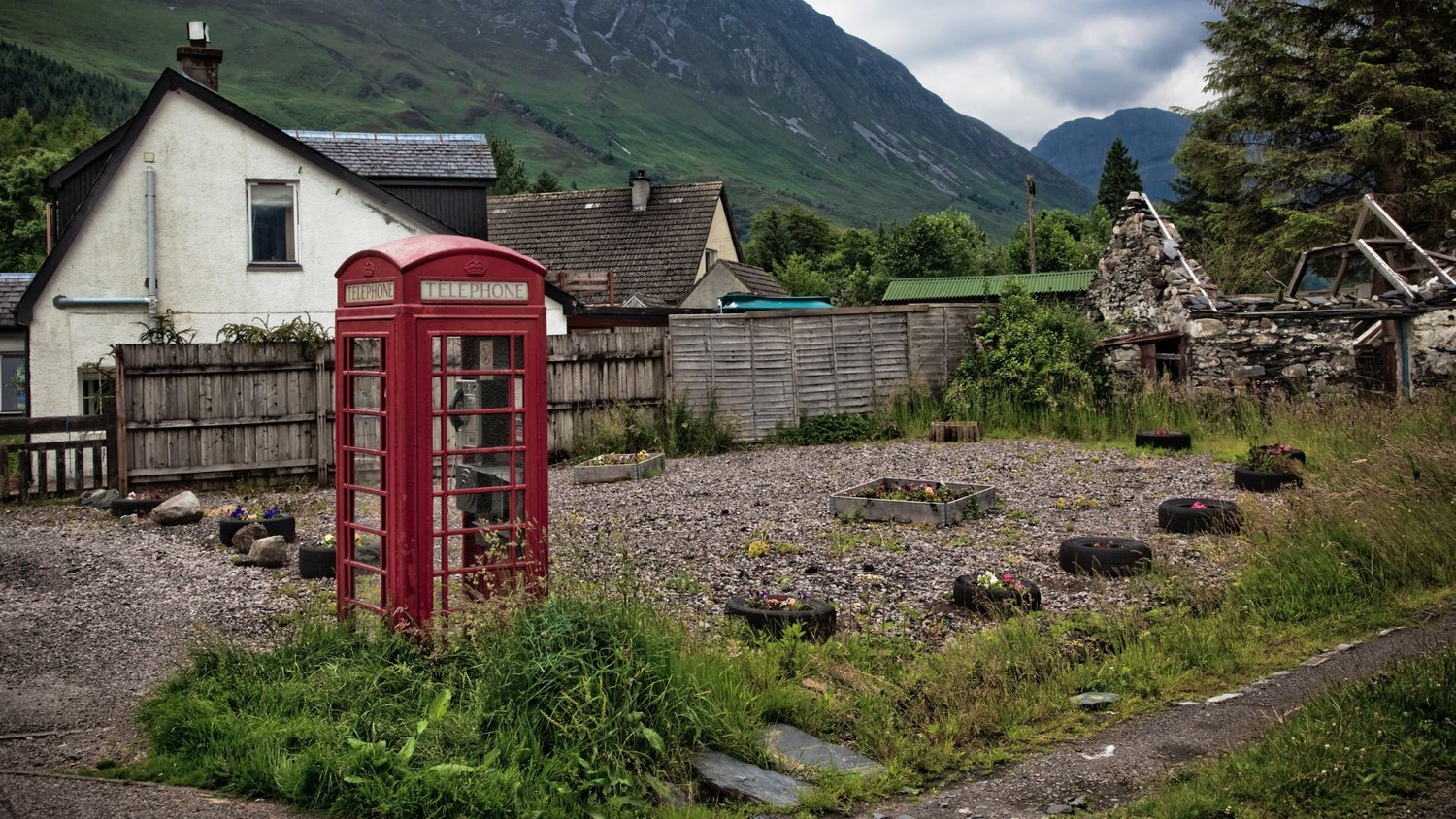
Source: Ofcom (n.d.), rules in force from June 2022. Figure 8.Where the four networks fade, the box still stands guard.
Communities have learned to work the rules. In Sharrington in Norfolk, villagers organised themselves to make 52 calls a year from their kiosk, enough to keep it safely over the threshold (Nicholls-Lee, 2026).
iIN SHORT · THE 52 CALL RULEOne call a week is enough. A last at its site box that clocks 52 calls in 12 months cannot be removed under Ofcom's rules, so a village rota of one call every Sunday keeps the kiosk officially needed (Ofcom, n.d.).
Section 06 · The story
06 £1 adoptions, defibrillators and auction fever
Since 2008, BT's Adopt a Kiosk scheme has let recognised public bodies such as parish, town and community councils, along with registered charities, take on a decommissioned kiosk for £1, and landowners can adopt a box standing on their own land. BT even keeps the light on, continuing to supply electricity for the famous glow free of charge. More than 7,200 kiosks have been adopted across the UK, around 550 of them in Scotland (BT Group, 2023; BT Group, n.d.; BBC News, 2023b).
£1the adoption price under BT's scheme
7,200+kiosks adopted across the UK since 2008
700+conversions now holding defibrillators
1,000red kiosks still available to adopt (2023)
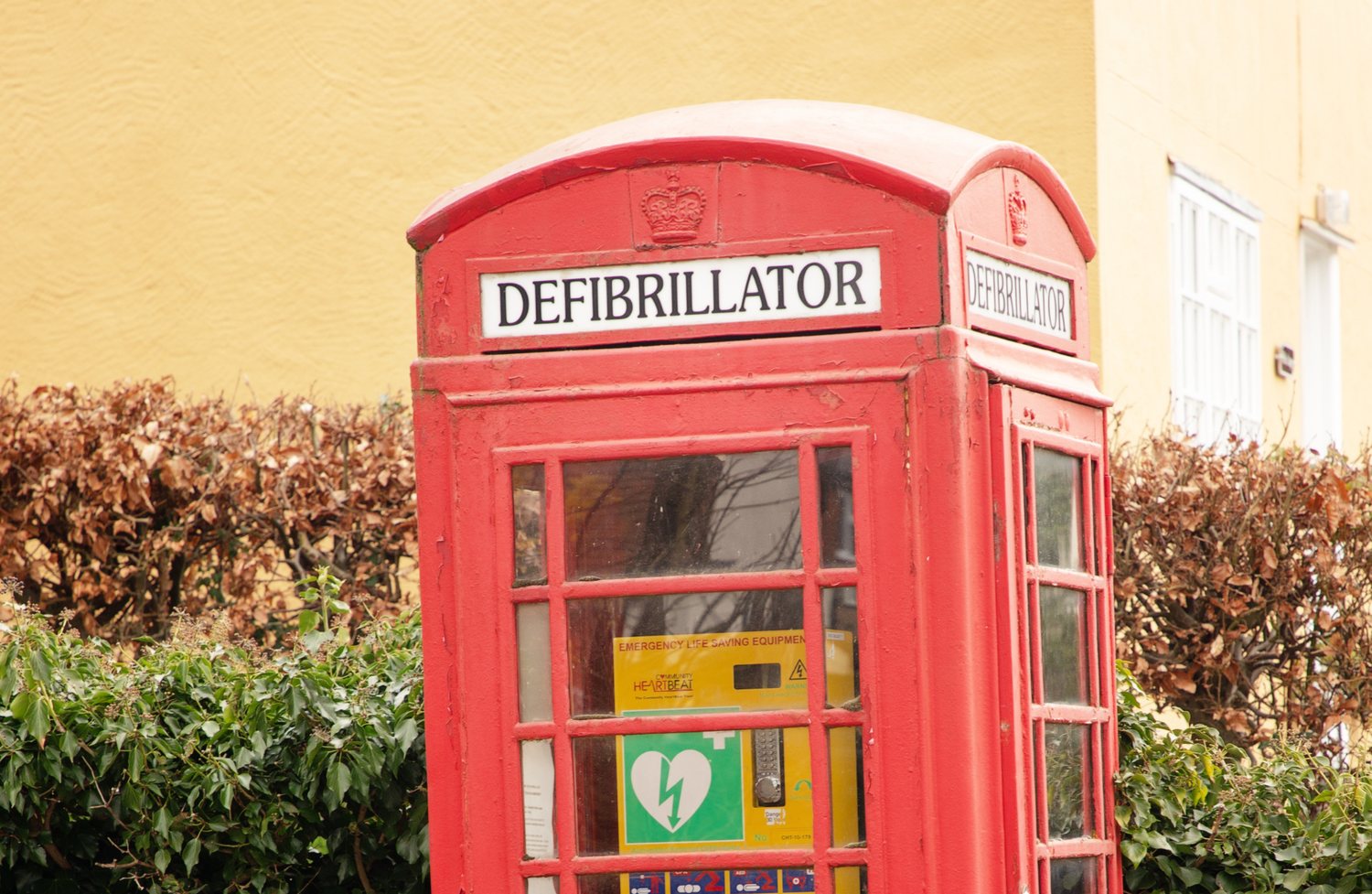
The smallest ambulance station in Britain: one of more than 700 defibrillator conversions, this one under the Community Heartbeat Trust scheme (BT Group, 2023).
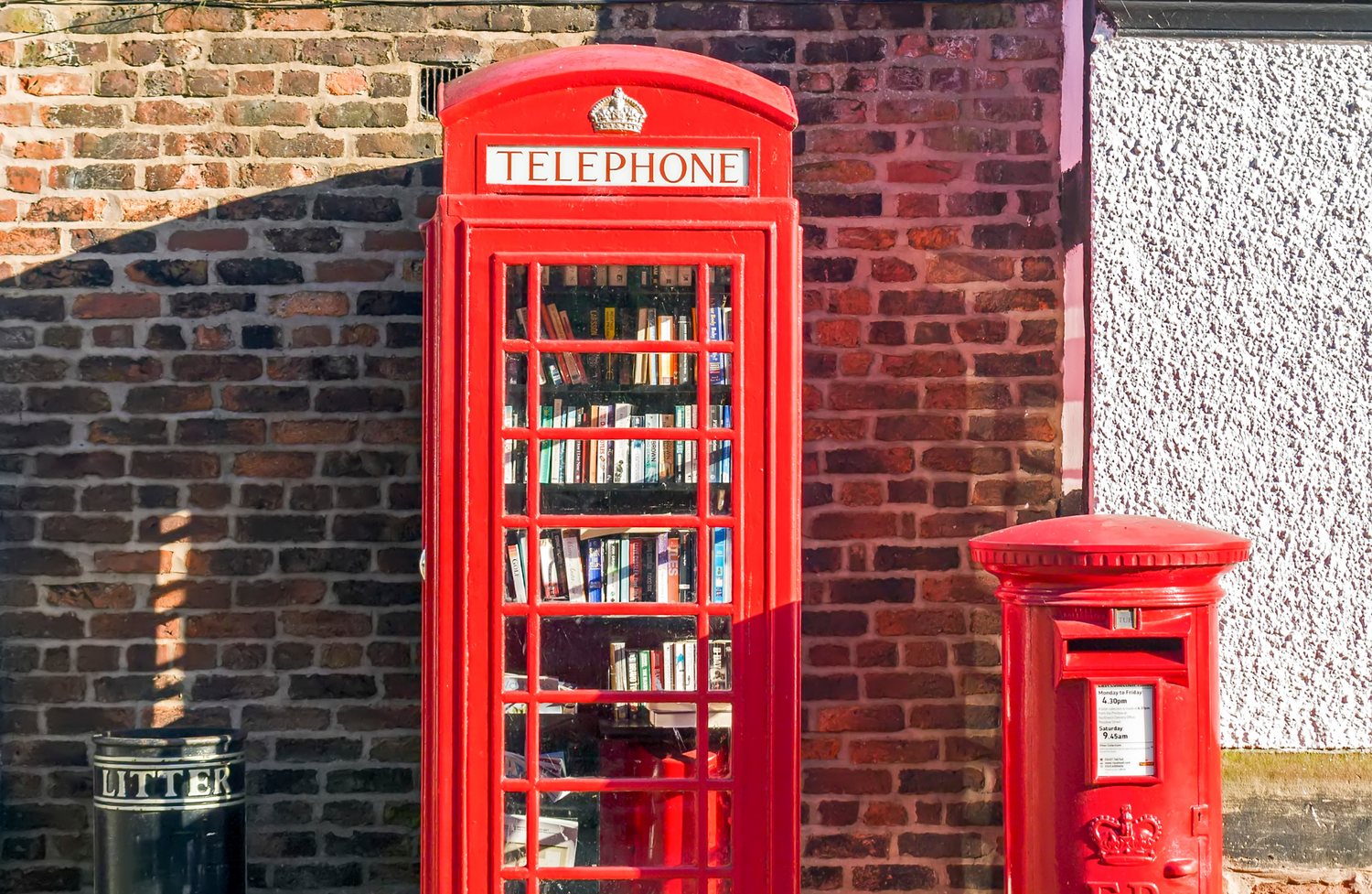
The best known second life is exactly that. Working with the Community Heartbeat Trust, communities have placed life saving kit where the village has always gathered (Community Heartbeat Trust, n.d.). Others have become book exchanges and micro libraries, from Marton cum Grafton in North Yorkshire to Lewisham in London (Auction House London, n.d.), a book swap plus defibrillator double act in Little Hale in Lincolnshire (Little Hale Parish Council, n.d.), an art gallery near St Andrews (BBC News, 2023b), a tourist information point in Rowen in Eryri (BBC News, 2023c), and in central London a working falafel stand (NBC News, n.d.). The tradition is still growing: Dunstable's last red box reopened as a defibrillator station on 1 October 2025 (Dunstable Town Council, 2025).
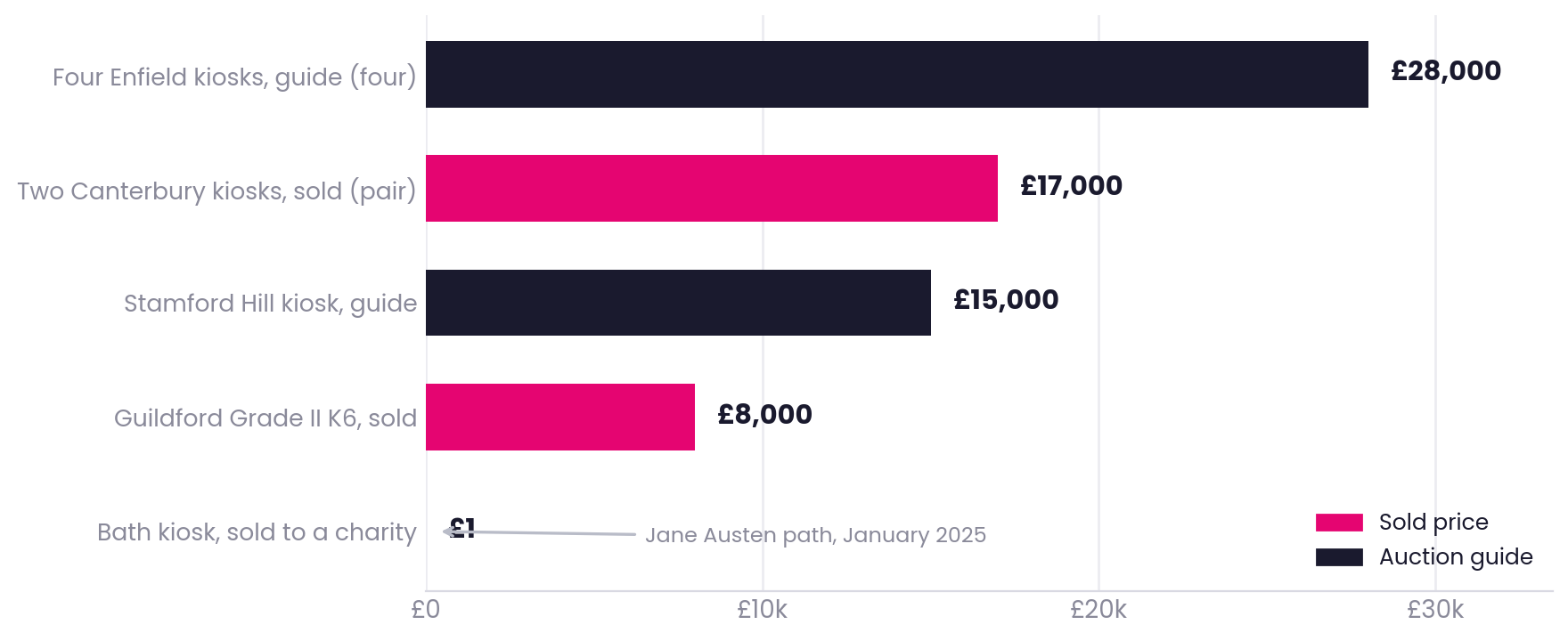
Where a box is sold rather than adopted, the bidding can be fierce. In early 2025 a Grade II listed K6 outside Holy Trinity Church in Guildford sold at a Strettons auction for £8,000, against a £7,500 guide, to local businessman Matt Gaskin, who planned to fit a defibrillator and a 999 button while keeping the box in place (BBC News, 2025; Surrey Live, 2025). Two Canterbury boxes made £17,000 between them the same week, while in January 2025 a kiosk on a Bath path made famous by Jane Austen went to a charity for £1 (BBC News, 2025). Robert Woolfe of Strettons called the kiosks “an iconic symbol of British history” (BBC News, 2025). A Stamford Hill K6 with retail planning permission was offered at around £15,000 (Rabin, 2024; BidX1, n.d.), and four Enfield boxes went to auction with a combined £28,000 guide in September 2025 (Talker News, 2025).
Where a removed box goes
Removal is not the end of the story, and there are four honest routes. First, adoption in place: the £1 scheme keeps the box on its corner under community care. Second, public auction, where anyone can bid, as the 2024 and 2025 sales above show (BBC News, 2025). Third, refurbishment and resale: decommissioned kiosks are restored and sold worldwide through BT's approved reseller X2Connect, alongside specialist restorers such as Unicorn Kiosks, while the Phoneybox Company makes lightweight reproductions for those who want the look without the cast iron (X2Connect, n.d.; The Telephone Box, n.d.). Fourth, community relocation: Uckfield Town Council bought its box for £1 in 2016 and moved it beside Harlands School for use as a library, with a defibrillator also considered (Clerks and Councils Direct, n.d.). Two questions we could not close this session sit on the verification list: whether any kiosks have been formally installed in care settings for reminiscence, and BT's end of life recycling policy for boxes beyond saving.
From trunk calls to paperbacks: the nation's smallest lending libraries.
Enthusiasts buy them for their gardens too. A K6 that spent 30 years on a Staffordshire driveway sold through Hansons in 2022 to a local couple as a housewarming gift for their daughter, destined for life as a log store (Hansons Auctioneers, 2022). Buyers should note that listed kiosks need listed building consent for alterations, and street conversions usually need planning permission.
What a kiosk fetched, 2024 to 2025
Sold prices and auction guides as reported. Sources: BBC News (2025); Rabin (2024); BidX1 (n.d.); Talker News (2025). Figure 9.
⚡TAKE ACTION
Fancy the smallest building project in Britain?
Parish, town and community councils and registered charities can adopt a decommissioned kiosk for £1, and BT keeps powering the light. Defibrillator projects start with the Community Heartbeat Trust.
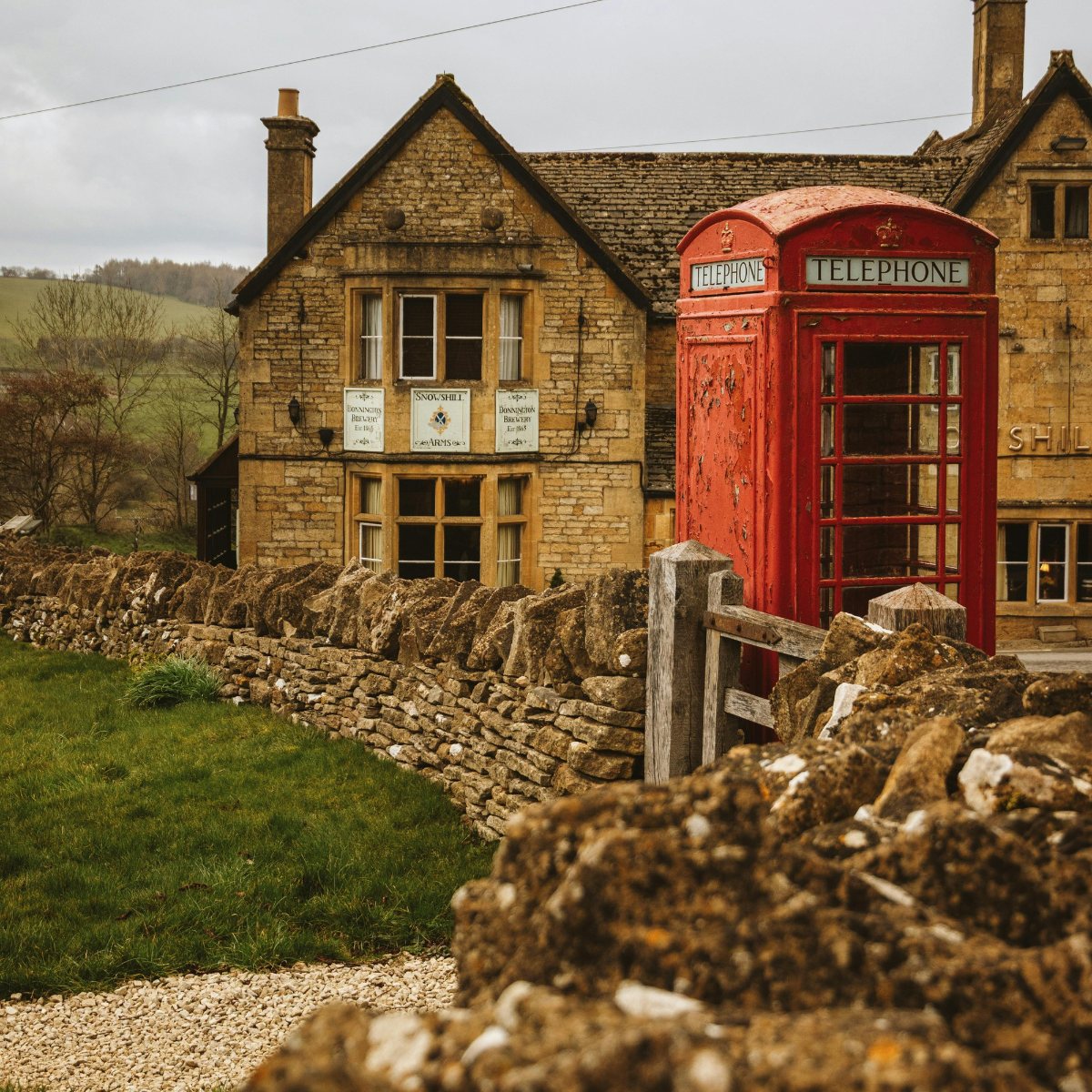
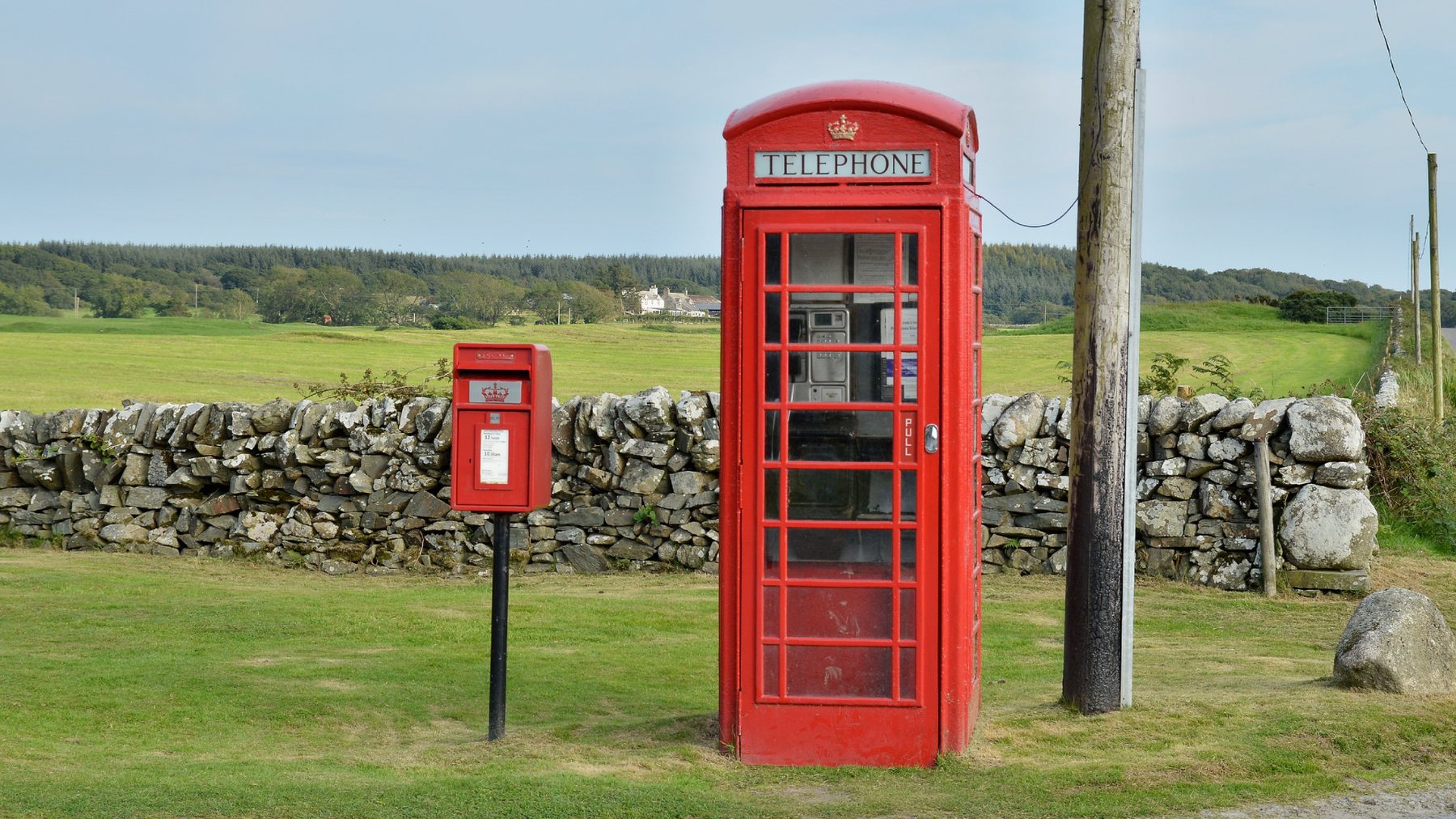
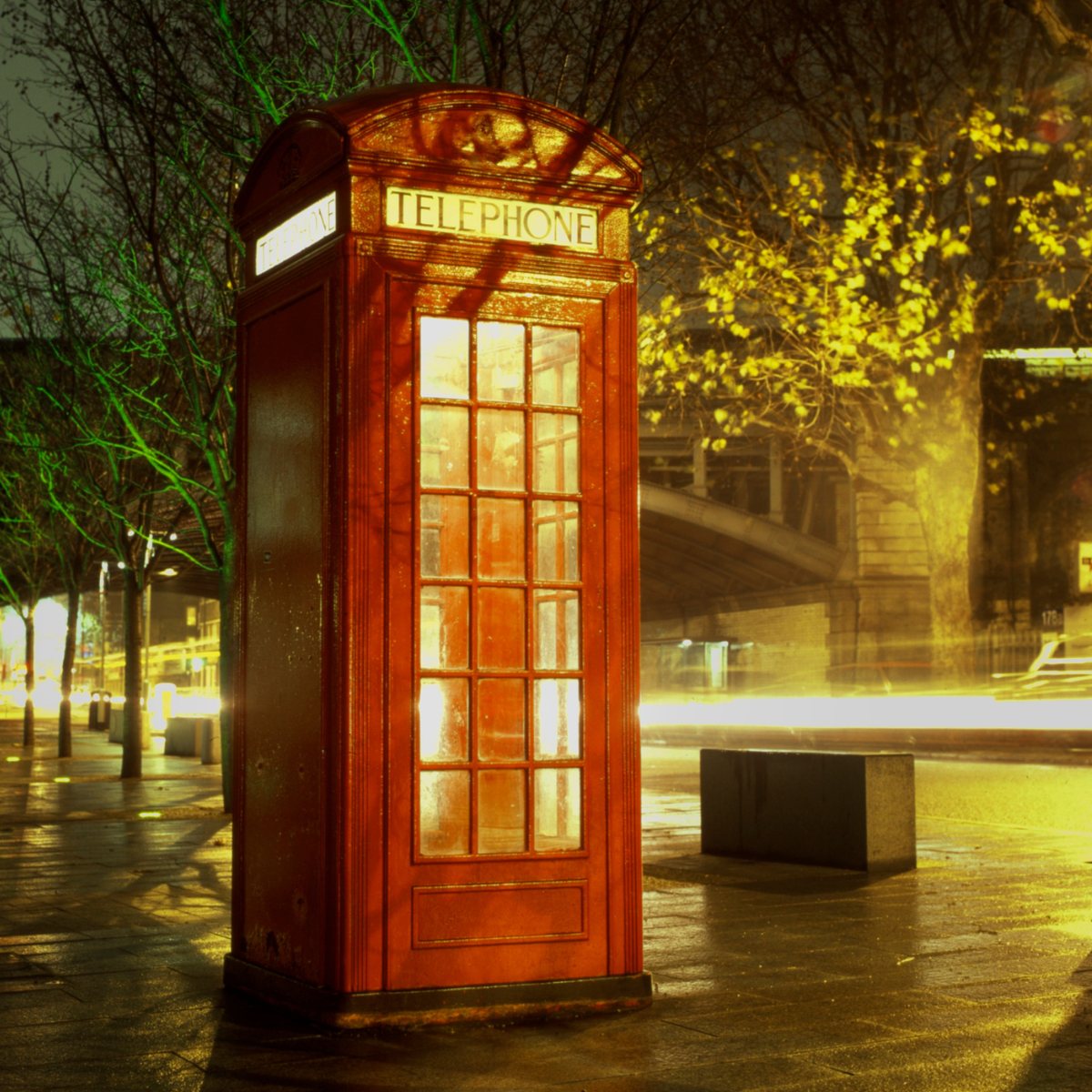
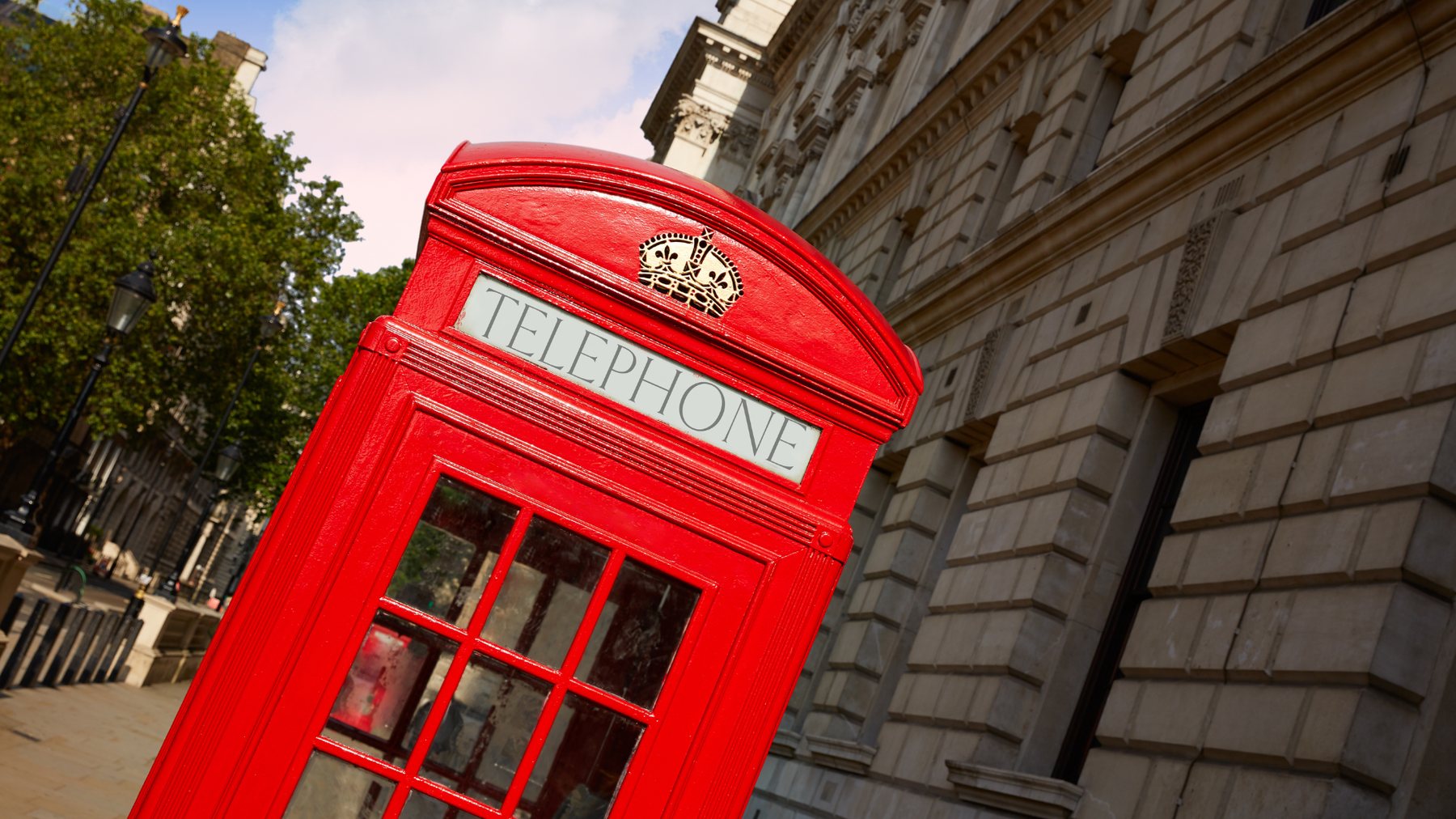
Village fixture: on duty outside the Snowshill Arms in the Cotswolds.Paired for a century: kiosk and post box on the dry stone wall road.The famous glow: BT still powers adopted kiosks free of charge.The classic profile, holding its ground on the city pavement.The crown, still wearing its gilt after all these winters.Out in all weathers, one hundred years and counting.
Section 07 · The story
07 From one phone per street to full fibre
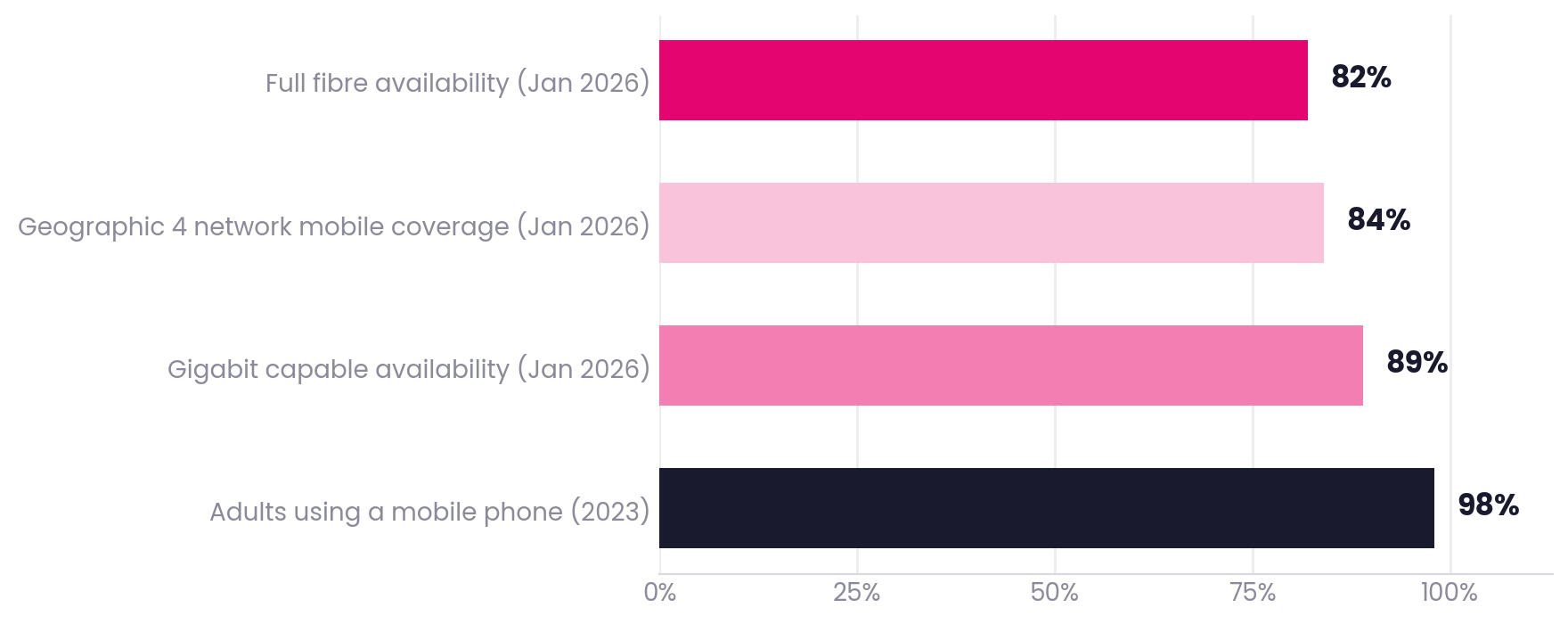
Why does a broadband comparison site care about a Georgian style cast iron box? Because the red kiosk is chapter one of the story we cover every day. In 1926 the K2 gave whole streets shared access to a single line. A century later, Ofcom's latest coverage data shows full fibre available to 24.9 million UK homes, 82% of the country's 30.5 million residential premises, with 1.2 million homes added in just six months. Gigabit capable connections reach 89% of homes, and geographic mobile coverage from all four networks now spans 84% of the UK's landmass, up from 66% before the Shared Rural Network began (Ofcom, 2026; CSL Group, 2026).
Britain connected in 2026
Sources: Ofcom (2026); CSL Group (2026); BT Group (2023). Figure 10.
The same engineering shift is writing the box's final chapter as a telephone. The copper based public telephone network that fed every kiosk is being retired, with new copper sales stopped since September 2023 and the full switch off of the old network set for 31 January 2027 (Openreach, n.d.). Surviving payphones move to digital lines, and where a box is likely to be relied on in a power cut it must be able to make emergency calls for at least three hours on battery backup (Ofcom, 2022). For the wider story of that retirement, see The Last Dial Tone (Report No. 26), our copper switch off guide and our Connected Nations analysis.
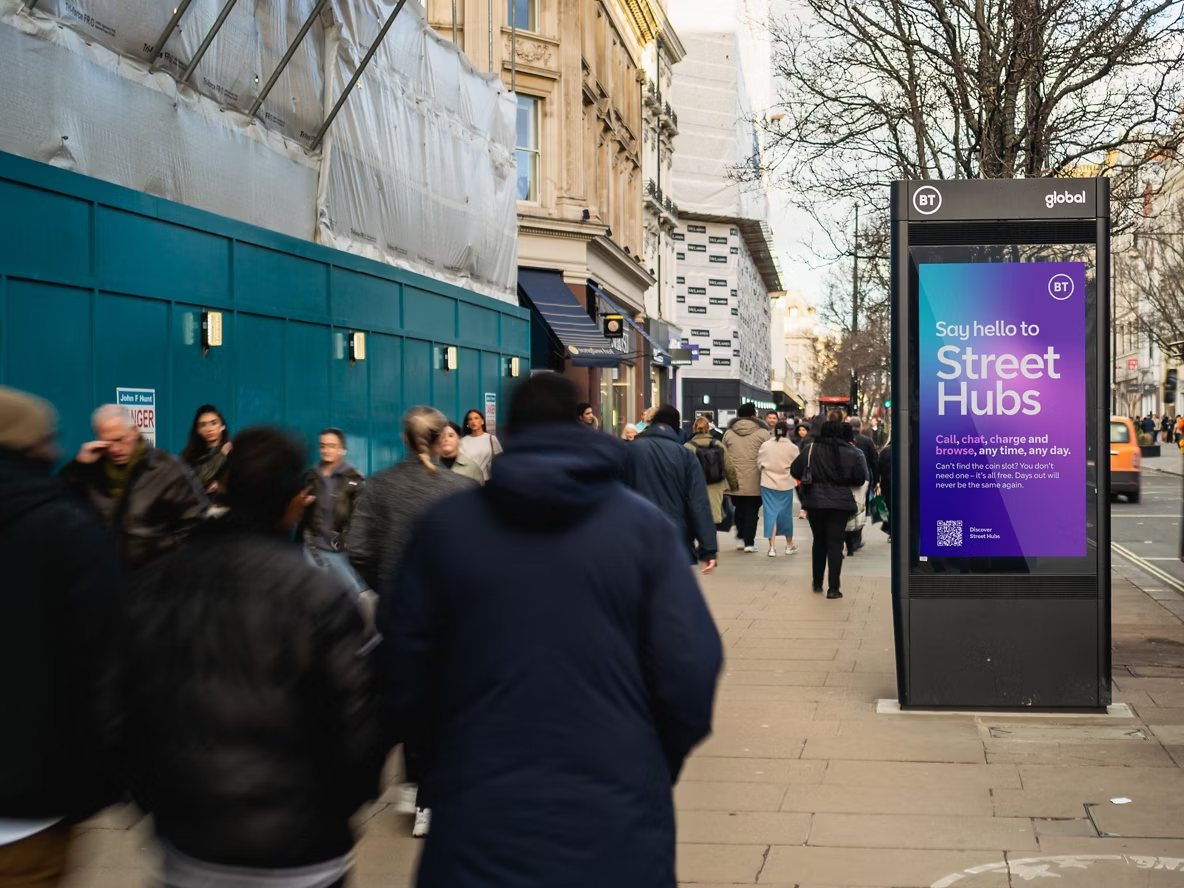
The payphone's digital successor: free calls, wi fi and a 999 button. Image courtesy of BT (business.bt.com).
The kiosk even has a digital heir. BT's Street Hub units, successors to the InLink project, offer free calls, wi fi, charging and a dedicated 999 button on the pavements the payphones once held, though not everyone approves: Bristol's council refused a batch of applications in 2018 amid concerns over advertising and data (see the verification list). One hundred years on, the argument over what belongs on a British street corner is still going strong.
⚡TAKE ACTION
One postcode. Two minutes.
The kiosk's successor is the connection in your own front room. See every option we compare at your address, and check your contract end date before you decide anything.
In 2006 the K2 was voted one of Britain's top ten design icons, sharing the honour with the Mini, the Supermarine Spitfire and the London Underground map (Gilbert Scott Archive, n.d.). A 2015 Samsung poll of 2,000 adults, led by Kingston University's Professor Catherine McDermott, went further, naming the red box the greatest British design of all with 39% of the vote, ahead of the Routemaster bus on 28% (Design Week, 2015). The kiosk designs remain protected by trade marks and copyright held by BT (Gilbert Scott Archive, n.d.), and heritage K6s have been reinstalled at tourist honeypots, including the much photographed cluster of five K2s in Covent Garden (Nicholls-Lee, 2026).
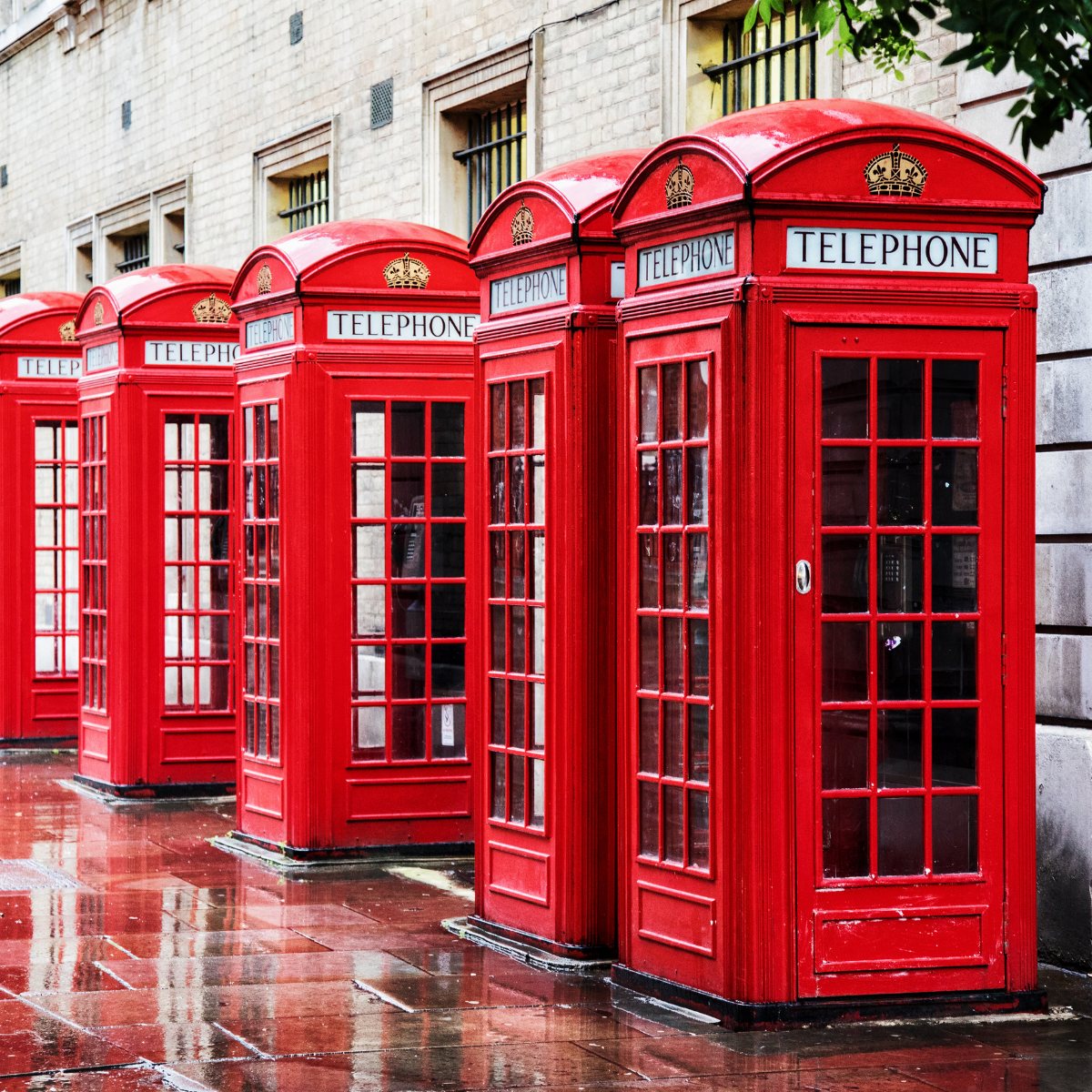
Five in a row on a rainy pavement: the K series still earns its keep as scenery.
Individual boxes have become stars in their own right. The kiosk at Pennan in Aberdeenshire, made famous by the 1983 film Local Hero, is one of the most photographed in the world and survives partly because the village has no mobile signal (The Scots Magazine, n.d.). The K2 that appeared on the back cover of David Bowie's Ziggy Stardust vanished from Heddon Street, and a K6 was installed on the spot in April 1997 for pilgrims to find (The Ziggy Stardust Companion, n.d.). And in 2008 Banksy's Vandalised Phone Box, a crumpled kiosk with a pickaxe through it, sold at Sotheby's in New York for 605,000 dollars (see the verification list for the lot record).
One clarification for visiting Doctor Who fans: the TARDIS is not a red telephone box. Police boxes were a separate design commissioned for the Metropolitan Police, blue in London, and the replica outside Earl's Court station is a police box, not a GPO kiosk (London Museum, n.d.). The red box never needed to be bigger on the inside. It just needed to be there.
iIN SHORT · RED BOX OR TARDIS?Red with TELEPHONE over the door: a GPO kiosk by Giles Gilbert Scott. Blue with POLICE PUBLIC CALL BOX: a Metropolitan Police design, made immortal by Doctor Who from 1963. Different colour, different job, different icon.
One more finding belongs on the record. Our checks of Royal Mail's published 2026 stamp programme and the Royal Mint's announced 2026 commemorative coins found no kiosk issue of any kind, and no BT centenary campaign had been announced by 18 August 2026. The red box's hundredth birthday is being marked by local councils, a handful of magazines and reports like this one. That is either an oversight or an opportunity, and we would happily be proved out of date.
Section 09 · Reference
09 Quick answers: twelve questions
1 How many red telephone boxes are left?
About 3,000 still work as phones within BT's estate of roughly 20,000 payphones (BT Group, 2023). Around 3,000 kiosks hold listed status (Nicholls-Lee, 2026), and thousands more survive in adopted, museum or private hands.
2 Can you still make a call from one?
Yes. Around 20,000 public payphones remain in service and accept several payment methods. Check BT's current price list before you dial (BT Business, n.d.).
3 Are 999 calls free from a phone box?
Yes. Calls to 999 and 112 are free from every public payphone, and freephone 0800 and 0808 numbers cost nothing (Ofcom, n.d.; BT Business, n.d.).
4 Who designed it, and why is it red?
Sir Giles Gilbert Scott won the 1924 competition. He wanted silver; the Post Office chose red so the boxes would be easy to spot (London Museum, n.d.).
5 What is the difference between a K2 and a K6?
The K2 of 1926 is the large London original, about 1,700 built. The K6 of 1936 is the smaller Jubilee Kiosk installed nationwide, roughly 60,000 built, and it is the box most people picture (London Museum, n.d.).
6 How do I adopt a phone box?
Recognised public bodies and registered charities can apply to BT to adopt a decommissioned kiosk for £1, and BT keeps powering the light. Start at bt.com/adopt (BT Group, n.d.). For defibrillator projects, the Community Heartbeat Trust can help (Community Heartbeat Trust, n.d.).
7 Can a private individual buy one?
Not through the £1 scheme unless the box stands on your own land, but decommissioned kiosks come up at auction: genuine listed K6s made £8,000 to £17,000 in 2025 sales (BBC News, 2025). Listed boxes need consent for alterations.
8 Why can BT not remove some boxes?
Ofcom's rules protect the last box at a site if it has no four network mobile coverage, stands at an accident or suicide hotspot, made 52 or more calls in the past year, or is otherwise reasonably needed (Ofcom, n.d.).
9 What happens after the 2027 switch off?
The copper network closes on 31 January 2027 (Openreach, n.d.) and surviving payphones move to digital lines, with at least three hours of battery backup where a box may be needed during a power cut (Ofcom, 2022).
10 Is the TARDIS a red telephone box?
No. The TARDIS is a blue police box, a separate Metropolitan Police design. The red kiosk is a GPO telephone box by Giles Gilbert Scott (London Museum, n.d.).
11 What happens to a box once it is removed?
It is adopted in place for £1, sold at public auction where anyone can bid, or refurbished and resold worldwide through BT's approved reseller X2Connect and restorers such as Unicorn Kiosks (X2Connect, n.d.; The Telephone Box, n.d.). Some are relocated by councils, including one moved beside a school as a library (Clerks and Councils Direct, n.d.).
12 Are old kiosks recycled responsibly?
The strong preference is reuse: the cast iron shells are restored and resold rather than scrapped, through the approved reseller route above. BT's formal recycling policy for kiosks beyond saving is on our verification list, and we will publish it when confirmed.
Photogenic to the last: the angle every visitor tries.
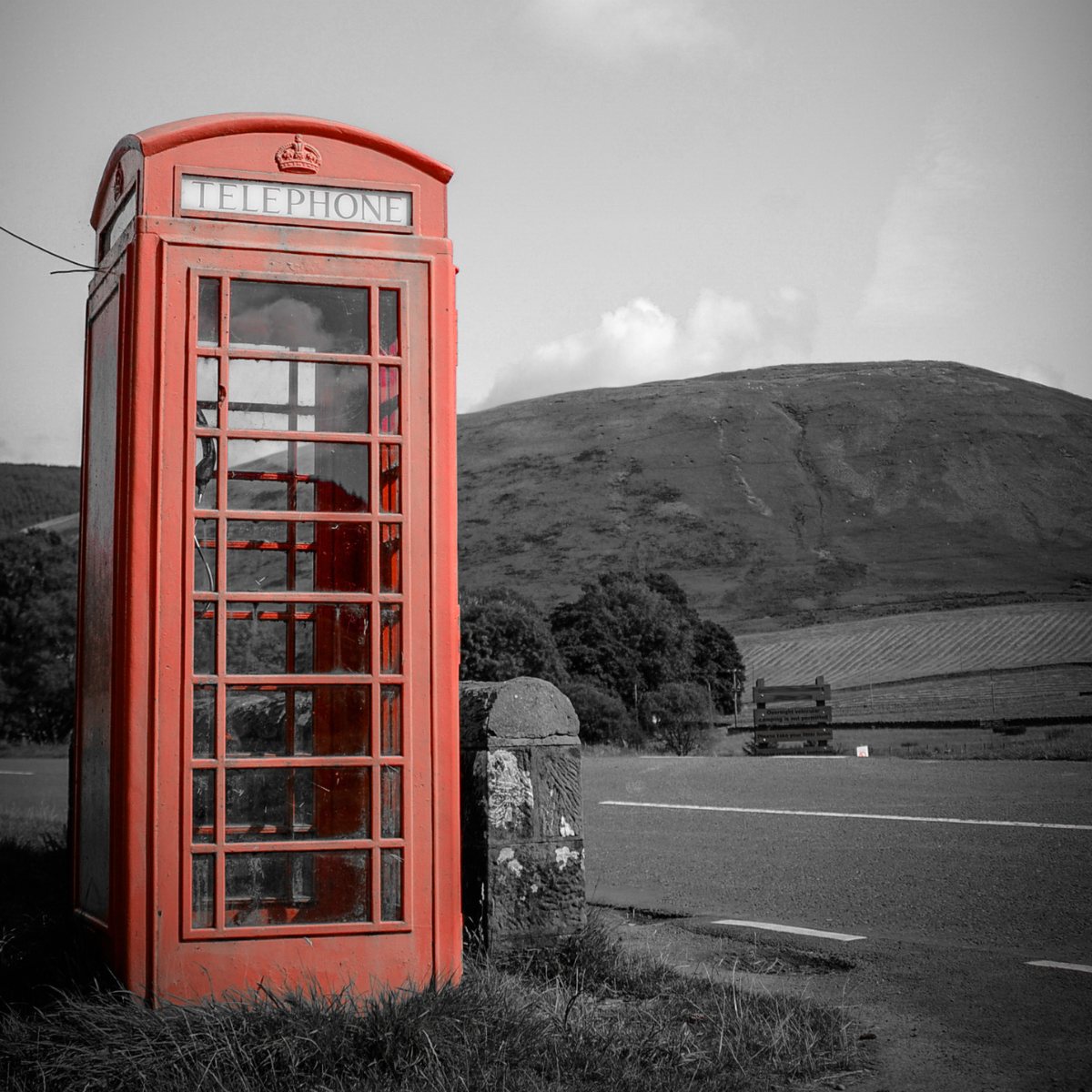
And the last splash of colour on the hill road.
The numbers
Key statistics
Figure
Value
Source
Date
The design story
First K2 installed
London, 1926
London Museum
n.d.
K2 kiosks installed / surviving
about 1,700 / just over 200
Historic England
n.d.
Cost of a new K2 (K1)
£33 (£13)
Linge et al. (2024)
1926 papers
K6 designed / rolled out
1935 / 1936
London Museum
n.d.
K6 kiosks installed / surviving
about 60,000 / over 11,000
London Museum; verification list
n.d.
K6 size and weight
8 ft tall, 3 ft wide, ~750 kg
The Telephone Box
n.d.
The exact red
Currant red BS381C 539
Dept for Communities NI
n.d.
Listed kiosks, UK
about 3,000
Nicholls-Lee (Country Life)
2026
The estate and its decline
Payphones at peak
92,000 (some say 100,000)
ISPreview; BBC News
2023
Payphones / red kiosks, 2017
about 40,000 / 7,000
BBC News
2017
Removal plan announced
20,000 over five years
BBC News
2017
Annual upkeep of the estate
about £6 million
BBC News
2017
Payphones, 2019
about 31,000
NBC News
n.d.
Payphones, 2022
about 20,000 (19,433 BT)
Ofcom
June 2022
Payphones / red kiosks, 2023
about 20,000 / 3,000
BT Group
2023
Red kiosks open to adoption
about 1,000
BT Group
2023
Call minutes, 2002 / 2021 to 22
800 million / 4 million
Ofcom
2022
Calls from boxes, 2021 to 22
about 2.3 million
Ofcom
2022
US payphones, 1999 peak / 2016
over 2.1m / under 100,000
FCC
2018
Adults using a mobile
98%
BT Group
2023
Lifeline and protection
999 and 112 calls from boxes
almost 150,000
Ofcom
year to May 2020
Childline / Samaritans calls
25,000 / 20,000
Ofcom
year to May 2020
Boxes protected by rules
5,000 est., revised to 1,400+
Ofcom; BBC News
2022
Second lives and sales
Kiosks adopted since 2008
more than 7,200
BT Group
2023
Defibrillator conversions
more than 700
BT Group
2023
Guildford K6 auction sale
£8,000
BBC News
2025
Two Canterbury kiosks
£17,000
BBC News
2025
Bath kiosk, charity sale
£1
BBC News
2025
Four Enfield kiosks, guide
£28,000
Talker News
2025
The connected country
Full fibre availability
82% (24.9m homes)
Ofcom
13 May 2026
Gigabit capable availability
89% (27.1m homes)
Ofcom
13 May 2026
Four network geographic coverage
84%, up from 66% pre SRN
Ofcom via CSL Group
2026
Copper network switch off
31 January 2027
Openreach
n.d.
Full source details, including URLs and access dates, appear in the reference list. Pages 25 to 26 of the PDF.
Appendix · Method
How we sourced every figure
Every number in this report names a source and a date, but they do not all carry equal weight, so each key figure sits in one of four grades: confirmed against a primary source, corroborated across independent sources, resting on a single source, or flagged for verification. Where published figures conflict, we report both: the 92,000 peak against BT's 100,000; Ofcom's 5,000 protection estimate against its later 1,400; installed, surviving and listed kiosk counts, which measure different things. No reputable source gives a month for the K2's 1926 street debut, so we date it simply to 1926: the first production models were approved on 10 December 1925 (Linge et al., 2024).
Still open on the verification list
The 7 million call minutes figure for 2020, quoted alongside Ofcom's confirmed 2002 and 2021/22 endpoints.
The Oldie centenary article URL (figures confirmed: over 70,000 installed, some 8,000 surviving; Warshaw, 24 February 2026).
The Building Centre page cited for over 11,000 surviving K6s; several sources attach 11,000 to K8s installed, not K6s surviving.
Bristol's 2018 refusal of InLink applications: the specific Adfree Cities article URL and the council decision notices.
BT's current payphone tariff page for live call pricing.
The Sotheby's lot record for Banksy's Vandalised Phone Box, sold 14 February 2008 for 605,000 dollars.
A named, verified kiosk installation in a care or reminiscence setting.
BT's end of life recycling and disposal policy for kiosks beyond restoration.
Spotted an error, or can you close one of the items above? Tell us at broadbandswitch.uk/corrections: we correct promptly, transparently, and log every change in the public corrections log. Pages 27 of the PDF.
Sources
References, graded (APA 7th)
A primary source B reported source C our own working. URLs verified 18 August 2026 except where flagged on the verification list.
BISPreview. (2023, August 17). BT reveals 1,000 of its old UK payphone kiosks up for grabs.ispreview.co.uk
ALinge, N., Johannessen, N., Hurley, A., Simmons, A., & Sutton, A. (2024). Sir Giles Gilbert Scott's K2 telephone kiosk: A design classic. Industrial Archaeology Review.tandfonline.com
BTwentieth Century Society. (n.d.). 19. K2 and 20. K6 red telephone boxes.c20society.org.uk
AX2Connect. (n.d.). Buy an original BT K6 red telephone box.x2connect.com
Pages 28 to 29 of the PDF.
Appendix
Image credits and alt text
Every image in this report and on this page carries descriptive alt text, a caption and a credit. Photography is from the BroadbandSwitch.uk image library; the Street Hub image is used courtesy of BT; the 1990s KX street scene and the BT Chargecard are AI generated illustrations, disclosed in their captions and file names. The full 24 asset manifest, including titles, alt text and credits for every photograph, chart and drawing, ships in the press image pack and with the machine readable data. Pages 30 to 31 of the PDF.
Our reports have been covered by outlets including ISPreview.co.uk, and every report is announced first at broadbandswitch.uk.
About
The author, and the promise
Dr Alex J. Martin-Smith CMgr DBA is the founder of BroadbandSwitch.uk and the SearchSwitchSave network of UK comparison and digital tools. His work sits at the junction of consumer telecoms, regulation and clear explanation, and his standing rule for everything the network publishes is the one applied here: every figure dated, every source named, nothing guessed.
Connect: linkedin.com/in/alexmartinsmith · Reviewed by Adrian James, Sales Director and Broadband Editor · Author pages: broadbandswitch.uk/alex-martin-smith · broadbandswitch.uk/adrian-james
About BroadbandSwitch.uk. An independent UK broadband comparison service: postcode level availability checking across dozens of live providers, a free speed test, clear guides, and a verified market directory tracking hundreds of UK ISPs. The service earns commission when readers switch through its links; analysis and rankings are never sold, and this report was produced without provider involvement or sight before publication.
The promise. Every report we publish is held to the same standard, and every one is built to be better than the last. The figures here are dated, the sources named, and the soft numbers flagged. If you find an error, tell us: we correct promptly, transparently, and in public. Authority is not a claim. It is a habit, kept in the open.
⚡TAKE ACTION
One postcode. Two minutes.
Every option we compare, at your address. A Century in Red · Report No. 31 · August 2026.
 REPORT NO. 31 · CENTENARY SPECIAL · AUGUST 2026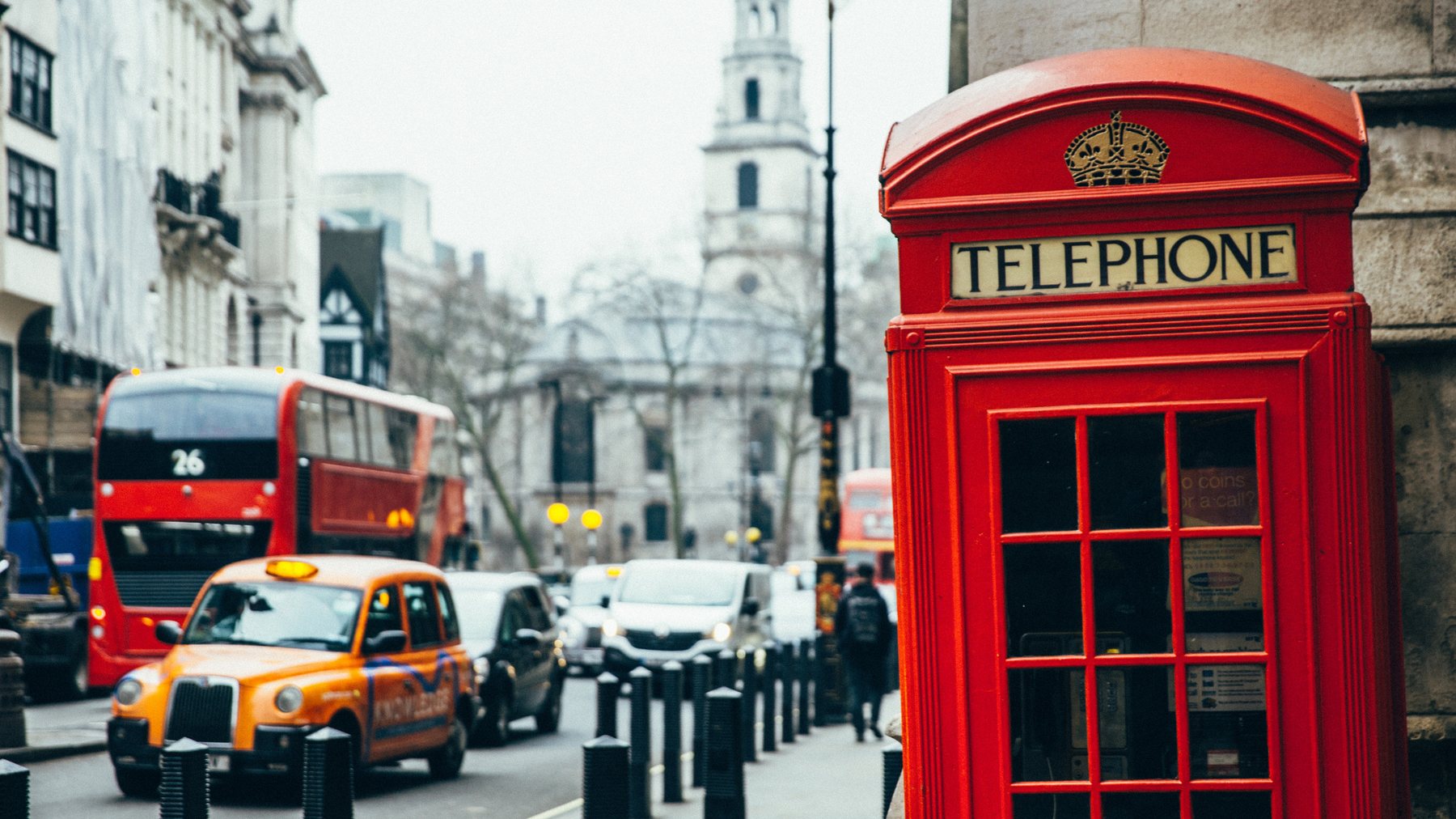



 The anatomy of an icon: the K6, measured