NETWORK GUIDE · COPPER SWITCH-OFF · JUNE 2026
The UK Copper Switch-Off: 2027 Explained
On 31 January 2027 the UK's analogue phone network goes silent after more than a century. Here is what actually switches off, what does not, the protections for those who need them, and exactly what your household should do.
Written by Dr Alex J. Martin-Smith · Reviewed by Adrian James · Published 11 June 2026 · Figures from parliamentary, regulatory and operator sources, verified June 2026 · ~9 minute read
Prefer to read offline? Download the free PDF guide: The UK Copper Switch-Off 2027 (6 pages, ~290KB). No signup, no email, just the guide.
The quick answer
On 31 January 2027 the analogue phone network (the PSTN) is retired. Phone calls move onto your broadband, with the handset plugging into the router. Your broadband itself does not switch off, your number is kept, and for most homes the change is one engineerless swap. The people who must plan ahead are those with telecare alarms or no mobile signal, and the protections for them are real.
Key facts · verified June 2026
- The deadline is fixed: 31 January 2027, described by Openreach as locked in, with no further extensions planned. The original date was December 2025, delayed to protect vulnerable users.
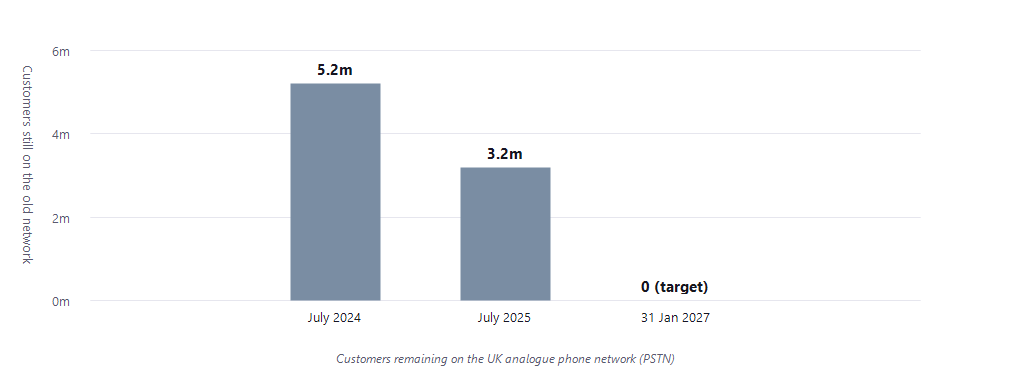
- Migration is well advanced: customers still on the old network fell from 5.2 million in July 2024 to 3.2 million by July 2025.
- It is the phone network, not your broadband: copper-based broadband such as FTTC keeps working after the date; it is analogue calling that ends.
- Power cuts change: digital phones need mains power, so providers must give at least one hour of backup, free, to customers who depend on their landline.
- Telecare users are specifically protected: under the industry charter, providers must not migrate telecare users until the device is confirmed to work digitally.
How we got to 2027
The switch-off has been a long and, at times, bumpy road. The deadline moved once, and for the right reason: making sure the most vulnerable were not left behind.
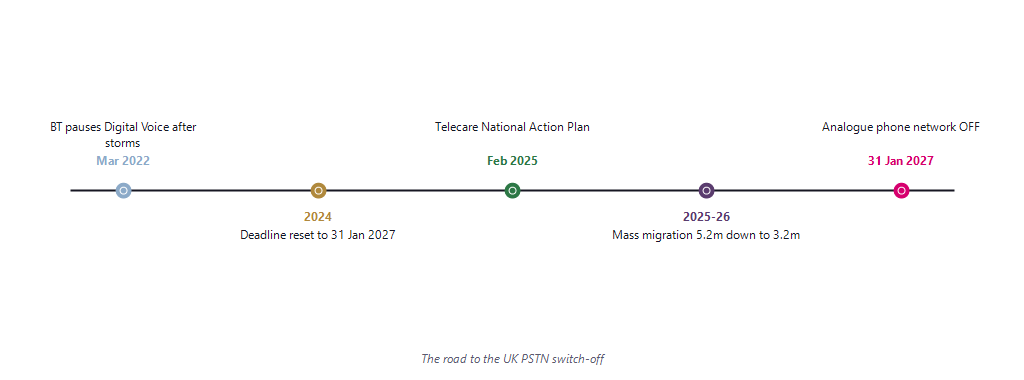
- Storms exposed the weak spot. BT paused its Digital Voice rollout for over a year from March 2022 after long power cuts in the winter storms showed what happens when phones need mains power.
- Telecare forced the rethink. Some personal alarms stopped working in early migrations, so the deadline was reset to 31 January 2027 and a government-and-industry Telecare National Action Plan followed in February 2025.
- The barriers are now cleared. Openreach's telecare-checking service safely migrated more than a thousand alarm users in its pilot, and the operator says the technical obstacles are resolved, which is why the 2027 date is final.
What changes at your house
Find your situation below. For most homes this is a small change; for a few it needs genuine planning.
| Your situation | What changes | What to do |
|---|---|---|
| Broadband only, no landline use | Effectively nothing | Nothing; carry on |
| Landline user with broadband | Phone replugs into the router; number kept | Wait for your provider's instructions |
| Landline only, no broadband | Moved to a dedicated landline-style service | Your provider arranges it; broadband not forced on you |
| Telecare or personal alarm user | Device must be checked before migration | Tell your phone AND alarm provider now |
| Vulnerable, or no mobile signal | Power-cut protection applies | Tell your provider; free battery backup, at least one hour |
| Still on ADSL or FTTC broadband | Broadband keeps working after the date | None required, but full fibre is the long-term home |
Monitored burglar alarms, lift lines and some payment terminals also lean on the old network, so businesses and landlords should audit early. Your number survives every version of this: how that works in detail is at what happens to my number when I switch, with the digital voice picture at digital voice and broadband switching.
The one genuine safety point
A digital phone does not work in a power cut without a backup, unlike the old copper line. If anyone in your home relies on the landline for emergencies, tell your provider: at least one hour of free battery backup is your right, the industry charter pushes providers beyond that minimum, and a charged mobile is the sensible second layer.
After the switch-off
- Copper broadband does not die in 2027. Where full fibre has not yet arrived, FTTC and ADSL carry on as broadband-only services. The phone network retires; the copper data line lingers until fibre replaces it.
- But the direction is one-way. New analogue products are already unsellable, exchanges are retiring ahead of the national date, and legacy line prices are rising sharply through 2026 to push the stragglers, part of the wider picture at in-contract price rises 2026. Copper's full retirement follows the fibre rollout.
- Full fibre is the destination. 82% of UK homes can already get it, and it is the network everything, calls included, is moving to. What it is and how to get it: what is FTTP? Full fibre explained, with live pricing at full fibre deals.
- Switching stays simple throughout. One contact to the new provider handles everything, number included: One Touch Switch explained.
A century, in perspective: the copper phone network carried British voices for over a hundred years, through everything from the first transatlantic calls to dial-up's screech. It earned its retirement. What replaces it is faster, clearer and built for the next century, and by the time you read this, most of the country is already there.
If a migration goes wrong, your complaint and escalation rights are unchanged: broadband complaints and your rights.
For coverage, switching and the wider statistical backdrop, see UK broadband statistics 2026: the reference.
Questions people ask
When is the UK copper switch-off?
31 January 2027, the date the analogue phone network (PSTN) is retired nationally. Openreach describes the deadline as locked in with no further extensions planned; the original December 2025 date was moved specifically to protect telecare and vulnerable users.
Will my broadband stop working in 2027?
No. The switch-off retires the analogue phone network, not broadband: copper-based broadband such as FTTC and ADSL keeps working after the date as a broadband-only service. What ends is analogue calling, which moves onto your broadband as digital voice.
Do I have to get broadband to keep my landline?
No. Landline-only households are moved to a dedicated landline-style service, such as BT's Dedicated Landline Service, arranged by their provider, and broadband is not forced on you. Your number is kept whichever route applies.
What happens to telecare alarms in the switch-off?
They are specifically protected: under the industry charter, providers must not migrate telecare users until the device is confirmed to work on the digital line, a government-and-industry Telecare National Action Plan has run since February 2025, and Openreach's checking service safely migrated over a thousand alarm users in its pilot. If you have an alarm, tell both your phone provider and your alarm provider now.
Will my phone work in a power cut after the switch-off?
Not without a backup, because digital phones need mains power, unlike the old copper line. Providers must give customers who depend on their landline at least one hour of battery backup free of charge, the industry charter pushes beyond that minimum, and a charged mobile is the sensible second layer.
Business and SME readers can also track the 2026 Openreach copper line price rises on our WLR copper price rise tracker.
About this guide
This guide is part of the BroadbandSwitch.uk 2026 Guide Library, published by BroadbandSwitch.uk, the consumer arm of the SearchSwitchSave network. The deadline, protections and migration figures are drawn from parliamentary, regulatory and operator sources. Our approach to evidence and corrections is documented in the methodology and trust hub, and every published correction appears in the corrections log.
Take it with you: download the free 6-page PDF guide, including the timeline, the household table and full sources.
Citing this guide: BroadbandSwitch.uk. (2026, June 11). The UK copper switch-off: 2027 explained. SearchSwitchSave. https://broadbandswitch.uk/guides/copper-switch-off-2027/
Sources
- House of Commons Library. (2026, April). The switch to digital landlines (Research Briefing CBP-9471). https://commonslibrary.parliament.uk/research-briefings/cbp-9471/
- Ofcom. (2024). Protecting customers during the migration to digital landlines. https://www.ofcom.org.uk/phones-and-broadband/landline-phones/protecting-customers-during-the-migration-to-digital-landlines
- Openreach. (2025, September 17). Openreach clears major hurdle to PSTN switch-off. https://www.openreach.com/news/openreach-clears-major-hurdle-to-pstn-switch-off/
- Openreach. (2026). Time for a big switch-up as PSTN switch-off looms. https://www.openreach.com/news/time-for-a-big-switch-up-as-pstn-switch-off-looms/
- UK Telehealthcare. (n.d.). Digital phone switchover. https://www.uktelehealthcare.com/digital-phone-switchover/
This guide is general consumer information. Migration figures and protections are as published by parliamentary, regulatory and operator sources in mid-2026; individual provider arrangements, including battery backup beyond the one-hour minimum and landline-only services, vary, so confirm your own provider's offer.