

Deal A
£679.76
Total Contract Value
£28.32 / month effective
Every package you can order at your address from 30+ UK providers, sorted by monthly price, low to high. Setup fees and any confirmed rise are on the deal card. One Touch Switch does the rest.
Postcode only. No sign-up, no credit check. Takes 10 seconds.
Every package available at your postcode, sorted by monthly price, low to high. Use the filters to narrow by speed, price, contract length, connection type and provider, then click through to the provider to complete the order. Under One Touch Switch your new provider handles the old one.
Loading live broadband comparison results for your postcode.
Check your postcode above and try again, or refresh this page.
Affiliate disclosure: we earn a commission when you choose a provider via our comparison. This does not affect the prices you see.
Enter your postcode above and the comparison lists every package you can order at your address, from 30+ UK providers, sorted by monthly price, low to high. In our 1 November 2026 deals check the cheapest open market deal was £13.50 a month for the first 12 months, then £18.00 (4th Utility, 150 Mbps on CityFibre), and most homes found full fibre between £22 and £34 a month, median £27 (BroadbandSwitch.uk, 2026a). Full fibre can now be ordered at 82% of UK homes and gigabit-capable broadband at 89% (Ofcom, 2026b). What you can actually get comes down to your street, so the postcode check is the only figure that is yours.
The headline monthly price is one number. Four others decide what you actually pay. Run these before you pick anything from the list above, and the deal that looks cheapest often stops being the cheapest.

Monthly price multiplied by the contract length, plus the setup fee, minus any reward, plus any confirmed rise. A £1 a month gap at the headline becomes £80 over 24 months once two £4 April rises are counted. The calculator below does the sum for any two deals.
Since 17 January 2025 any rise during a new contract has to be a fixed pounds and pence figure, shown before you sign, not a formula tied to inflation (Ofcom, 2024). The rises announced for 2026 run from £2 to £4 a month on fixed broadband (Ofcom, 2026c). Some providers hold the price for the whole minimum term. The table below shows who does what.
Most homes are comfortable on 50 to 150 Mbps. Paying for gigabit that nobody in the house touches is the most common overspend we see. Work out what your household needs with our speed calculator, or the free RightSpeed check, then filter the deals to that band.
Contract length, exit fees and the 14 day cooling off period. If you are still inside a contract, leaving usually means paying the remaining months, so check your end date before you start a new one. Exit and setup fees explained covers the exceptions, including price rises you were not told about at sign-up.
Short, straight answers from the editors, made for people who would rather watch than read. New ones most weeks on SearchSwitchSave.
Megabits and megabytes are different units. Divide the advertised speed by eight and that is your download speed in MB/s. Nobody is short-changing you.
Video calls lean on upload, and most packages give you a fraction of the download figure. What to check before you blame the line, and what to change.
Gaming gets the blame, but it is rarely the heavy user. A sixty second look at what really fills a busy evening at home.
From basic broadband to gigabit: what each rung of the speed ladder is good for, and where most households sit.
Where a router sits changes what every room gets. Ofcom's placement advice in under a minute, and a free checker for your own home.
Prefer to read? The four checks above cover the same ground, and the quick answers below go a little deeper.
Headline monthly prices hide setup fees and the annual rise. Put two deals in and see the full-term cost side by side. The defaults show the worked example from the picture below.

Formula: total contract value = (months at the intro price × intro price) + (months at each risen price × that price) + setup fee − cashback. The calculator assumes the contract starts in May: the first rise lands after month 11, a second after month 23. Start later in the year and the first rise arrives sooner.
Example A worked: Deal A at £25.99 a month for 24 months with a £4 rise each April. Total = (11 × £25.99) + (12 × £29.99) + (1 × £33.99) + £0 = £285.89 + £359.88 + £33.99 = £679.76, or £28.32 a month in real terms.
Example B worked: Deal B at £24.99 a month for 24 months with no mid-contract rise. Total = 24 × £24.99 = £599.76, or £24.99 a month.
Why this matters: the difference between Deal A and Deal B looks small at the headline (£1 a month). Once the April rises are included, the gap is £80 across the contract. Same broadband speed, very different real cost. See how we rank and price rises explained.
Sources: Ofcom (2024) rule that any rise in a new contract must be a fixed pounds and pence figure, in force from 17 January 2025; provider positions for 2026 in the table below.
From 17 January 2025 every new UK broadband contract has to state any mid-contract rise as a fixed pounds and pence figure, not a formula linked to CPI or RPI (Ofcom, 2024). This table tracks the published position of the major providers for contracts taken in 2026. Legacy contracts signed before the rule can still carry an inflation-linked clause, and the deal card you click through to is the final word for any package.
| Provider | 2026 rise (new contracts) | Cost over a 24-month deal | Notes |
|---|---|---|---|
| BT | £4.00 a month | +£52 | Contracts from 9 January 2025. Older contracts: CPI plus 3.9%. |
| EE | £4.00 a month | +£52 | BT Group. Same rule as BT. |
| Plusnet | £4.00 a month | +£52 | BT Group. Pre-11 July 2024 contracts: CPI plus 3.9%. |
| Virgin Media | £4.00 a month | +£52 | Contracts from 9 January 2025. Some mid-contract deals £3.50. Older contracts: RPI-based. |
| TalkTalk | £4.00 a month | +£52 | Contracts from 16 November 2025 (£3 for 12 August 2024 to 15 November 2025). |
| Vodafone | £3.50 a month | +£45.50 | Contracts from 12 November 2025 (£3 for 2 July 2024 to 11 November 2025). |
| Sky | £3.00 a month | +£39 | Sky lets you leave penalty-free within 31 days of any rise notice. |
| NOW Broadband | £3.00 a month, typical | +£39 | Sky group. Same 31 day exit window on any rise. |
| Three | Fixed £ amount, varies by package | Varies | Contracts from 1 September 2024 on a fixed-rate basis. Check the deal card. |
| Hyperoptic | Fixed annual increase | Varies | Contracts from June 2025. Earlier contracts carried no rise. Check the deal card. |
| Community Fibre | £0 in minimum term | £0 | Published position: price held for the minimum term. |
| Zen Internet | £0 in minimum term | £0 | Published position: price held for the minimum term. |
| YouFibre | £0 in minimum term | £0 | Published position: price held for the minimum term. |
| Brsk | £0 in minimum term | £0 | Published position: price held for the minimum term. |
| Connect Fibre | £0 in minimum term | £0 | Terms state the price will not change during the minimum term. |
| BeFibre | £0 in minimum term | £0 | Published position: price held for the minimum term. |
Reading the table: "+£52" is what a single £4 rise adds to a 24-month contract when it lands after month 11 and runs for the remaining 13 months. Most 24-month contracts see two Aprils, so the real figure is often higher: the calculator above shows £80 for a contract that starts in May. Where a provider holds price for the minimum term, that is worth £39 to £80 over 24 months against the big brands. Sources: provider terms as tracked on our 2026 price rises guide (BroadbandSwitch.uk, 2026c) · Ofcom (2024) statement banning inflation-linked rises · Ofcom (2026c) pricing trends report. Spotted a change? Tell us and we will log it publicly.
Full fibre could be ordered at 82% of UK homes, 24.9 million of them, by January 2026, and 89% were within reach of a gigabit-capable network once Virgin Media's cable network is counted (Ofcom, 2026b). Take-up lags the build: 12.4 million full fibre connections were live, 47% of the premises that could have one. The nation figures below come from Ofcom's Spring 2026 data as reported by ISPreview (Jackson, 2026).

| Nation | Full fibre available | Gigabit-capable | Full fibre take-up |
|---|---|---|---|
| Northern Ireland | 95% | 96% | 65% |
| Wales | 82% | 85% | 53% |
| England | 82% | 89% | 46% |
| Scotland | 75% | 84% | 47% |
| United Kingdom | 82% | 89% | 47% |
How to read this: "Full fibre available" is the share of residential premises where an FTTP service can be ordered. "Gigabit-capable" adds Virgin Media's cable network. "Take-up" is the share of premises with full fibre available that have a live full fibre connection, which is why the postcode check matters: a street can be built and still mostly on the old copper. Source: Ofcom (2026b), Connected Nations update: Spring 2026, published 13 May 2026, data as at January 2026 · nation splits via Jackson (2026). Ofcom's next full report is due in December 2026 and this table is re-baselined when it lands.
Go deeper: our Connected Nations 2025 report explains what the Ofcom numbers mean for a household, and the BDUK gigabit rollout report tracks the publicly funded build in the hardest places.
Five UK connection types, ranked by who they suit. Pick the one that matches your home, then filter the deals above to that connection type. Speeds are the typical advertised ranges for a wired connection, not Wi-Fi in the far bedroom.
Pick this if: you can get it, and 82% of UK homes now can. Lowest latency, fewest faults, same speed whatever the weather, and upload speeds that FTTC cannot match.
Pick this if: Virgin Media's network passes your address and full fibre does not yet, or you want big download speeds without waiting for an FTTP install.
Pick this if: neither full fibre nor cable has reached your street yet. It runs on the copper line from the green cabinet, so speed depends on how far you are from it.
Pick this if: you rent, move often, or want to skip the engineer. Plug in and go. Speed depends on the 5G signal at your window, so test it in the cooling off period.
Pick this if: you have no full fibre, no usable FTTC and no 5G. If you cannot get a decent connection at all, the Universal Service Obligation gives you the right to request one.
Short answers to the broadband questions UK households search most, each with a source and a link to the deeper guide.
In our 1 November 2026 check of 32 providers, the cheapest open market deal was £13.50 a month for the first 12 months, then £18.00 (4th Utility, 150 Mbps on CityFibre) (BroadbandSwitch.uk, 2026a). Most homes found full fibre between £22 and £34 a month. If someone in the household receives Universal Credit, Pension Credit or certain other benefits, social tariffs start at £12.50 a month and we earn nothing on them.
Cheapest broadband guide →Full fibre packages of 1 Gbps and above are sold widely, and some altnets sell 2 Gbps and faster, but only where their network reaches your address. Ofcom's Connected Nations 2025 report put the average UK connection at 285 Mbps in July 2025 (Ofcom, 2025a). Few homes need more than a few hundred Mbps; what matters more is a connection that holds up at 8pm.
Gigabit broadband deals →Most UK households are comfortable on 50 to 150 Mbps, which covers 4K streaming, video calls and gaming at the same time. A busy family home with several people working and streaming at once is well served by 200 to 500 Mbps. Upload matters more than most people think if you work from home.
Speed needs by household →Yes, but on a new contract only as a fixed pounds and pence amount that was shown to you before you signed. Inflation-linked clauses have been banned in new contracts since 17 January 2025 (Ofcom, 2024). The fixed broadband rises announced for 2026 range from £2 to £4 a month (Ofcom, 2026c), and some providers hold the price for the whole minimum term.
2026 price rises by provider →No. Under One Touch Switch you deal only with the new provider, who tells the old one for you. The process has been mandatory for residential broadband since 12 September 2024, and TOTSCo, the industry body that runs it, passed 3 million completed switches in June 2026 (TOTSCo, 2026). You keep a 14 day cooling off period on the new contract.
One Touch Switch explained →Probably. Ofcom found in-contract customers paying £7 to £9 a month less than out-of-contract customers for standalone broadband and for bundles (Ofcom, 2026c). That is roughly £84 to £108 a year for staying put. Check your postcode above, or ask your current provider what it would offer a new customer.
How to save money on broadband →Four situations that catch UK households out, each with the rule that protects you and the figure that applies in 2026.
Run a wired speed test at ukspeedtest.co.uk at peak time, 8pm to 10pm, not over Wi-Fi. If the result keeps falling below the minimum guaranteed speed quoted when you signed up, providers signed up to Ofcom's speeds code have 30 days to fix it, after which they must let you leave without early exit fees (Ofcom, 2022). If the line is fine and the far bedroom is not, it is a Wi-Fi problem: RouterMap will show you where the router should be.
Your rights: Speeds lower than advertised · Leaving early over poor speeds
Under Ofcom's automatic compensation scheme the signed-up providers pay £6.46 for each calendar day a new service starts late, £32.31 for a missed engineer appointment, and £10.34 for each calendar day a total loss of service goes unrepaired after two working days (Ofcom, 2026a). No claim form: it should land as a credit. Signed up: BT, EE, Hyperoptic, Plusnet, Sky and NOW, TalkTalk, Utility Warehouse, Virgin Media, Vodafone and Zen.
Your rights: Automatic compensation rates 2026 · Compensation calculator
A postcode can cover dozens of properties and a fibre build can stop part way along a street. If the comparison does not match what you know about your door, find your UPRN (the government's unique number for every address) at findmyaddress.co.uk and quote it to the provider. New build homes often sit in a queue between the developer, Royal Mail and the network before they can be ordered against.
What to do: Availability checker · New build delays explained · Ask the editors
Complain to the provider first and keep the date. If it is not resolved, from 8 April 2026 you can take it to the independent ombudsman after six weeks, down from eight, or sooner if the provider issues a deadlock letter (Ofcom, 2025b). The two Ofcom-approved schemes are the Communications Ombudsman and CISAS; your provider's complaints code tells you which one it belongs to. It is free and the decision binds the provider.
Your rights: Complaints and your rights · Escalating to the ombudsman
Every figure on this page is dated and cited in APA style. Live prices come from the comparison itself at the moment you look. Corrections are logged in our public corrections log. All links retrieved .
Editorial review: written by Dr Alex J. Martin-Smith (CMgr DBA, Lead Editor) and reviewed by Adrian James, Broadband Editor. Last editorial review . We follow our published methodology and disclose every affiliate relationship: we earn a commission when you choose a deal through the comparison, which never changes the order you see or the price you pay. Spot something wrong? Submit a correction and we publish the fix.
Run a quick speed test before you switch. You will see whether you are getting what you pay for, have a baseline if you ever need to use Ofcom's speeds code, and know which package speed to choose next. Test over a cable, not Wi-Fi, and at 8pm if you can.
Run a free UK speed testThe questions worth answering while you have a shortlist on screen. Data accuracy, address-level checks, total cost, mid-contract rises, the order process and your rights.
Speeds shown are the average download speed at peak times (8pm to 10pm), measured under Ofcom's Voluntary Code of Practice on Broadband Speeds. Once you confirm your exact address, the speed range narrows and your minimum guaranteed download speed appears at sale. Wired speeds are the comparable benchmark, not WiFi.
Live deals come from 30+ retail providers including BT, Sky, Virgin Media, Vodafone, TalkTalk, EE, Plusnet, NOW Broadband, Hyperoptic, Community Fibre, YouFibre, Zen, Three and the larger altnets. Our provider directory tracks more than 500 UK ISPs, including many that sell only in their own footprint and do not appear in any comparison. If a local network serves your street and is not in the live results, the directory will still show you who they are.
Live prices and availability are refreshed multiple times each working day from each provider's commercial feed. Coverage data is benchmarked against Ofcom's Connected Nations 2025 dataset and updated monthly. Editorial figures on this page carry their own dates, and the last editorial review date is published in the references section.
Deals are ordered by cost per month, low to high, by default, so the lowest monthly price at your address appears at the top. 'Featured Deals' is an optional sort you can choose from the dropdown above the deals: it is an algorithmic ordering operated by our data partner stickee that weights effective monthly cost, historical consumer take-up across its network, connection technology and speed. Commercial payments never influence any ordering. You can also re-rank by fastest speed or shortest contract.
BroadbandSwitch.uk is not a broadband provider so is not directly regulated by Ofcom. We comply with Ofcom rules on price and speed disclosure where applicable, and our editorial methodology is published. Disputes between you and a broadband provider can be escalated free of charge to CISAS or the Communications Ombudsman after six weeks, a limit Ofcom cut from eight weeks on 8 April 2026.
BroadbandSwitch.uk earns a commission from providers when you choose a deal via our comparison and complete the order with the provider. Commission rates do not affect the prices you are shown and do not change the ranking logic. All affiliate relationships are disclosed in our affiliate disclosure and on every relevant page.
BroadbandSwitch.uk publishes a public methodology document, an affiliate disclosure listing all commission relationships, an editorial policy with named editors and a public corrections log of every fix made to live data. All four documents are linked from every page footer. Editorial standards are reviewed by Dr Alex J. Martin-Smith and Adrian James.
Broadband availability and price are determined house-by-house, not street-by-street, because Openreach, Virgin Media and altnet rollouts can stop at a specific cabinet, exchange or property boundary. Two neighbours can have very different options if one is connected to a CityFibre or Hyperoptic full-fibre network and the other is on Openreach FTTC. Always compare at exact-address level.
A UK postcode covers 15 to 80 properties on average, and full-fibre rollout often stops mid-postcode. Confirming your exact address triggers an address-level availability lookup and pulls the right deal price for your line condition. Without an exact address you risk seeing a deal that is not actually orderable at your property.
If your address is missing from the dropdown after entering your postcode, your property may be a new build awaiting Openreach activation, a flat without an assigned address ID, or a property in a manually managed block. Try entering your postcode and house number separately, or contact us so the editorial team can investigate and update directory data.
Yes. Where Openreach or an altnet has built infrastructure to a new-build property but commercial activation is delayed, we flag the address as 'awaiting commercial launch' and link to our new-build broadband delays guide. This avoids you ordering a deal that cannot start service until the property is live on the provider's network.
UK providers price by line type, address-level network reach, and sometimes by promotional offer at the time of order. A property on Openreach FTTP may see a different BT price to a neighbouring property still on FTTC, even though the package name is identical. Promotional pricing also varies between new-customer and renewal offers.
Optimise for the lowest Total Contract Value (TCV), not the lowest monthly price. TCV adds setup fees, confirmed mid-contract price rises, rewards and cashback into a single full-term cost, so you can compare like-for-like across 12, 18 and 24-month contracts. A deal with a £25 monthly price and a £40 setup fee can easily cost more over 24 months than a £27 monthly with no setup.
Total Contract Value (TCV) is the full amount you will pay over the entire length of your broadband contract, including monthly bills, setup fees, mid-contract price rises and any cashback or rewards. It matters because headline monthly prices alone hide setup fees and the typical April price rise. Two deals with similar monthly prices can differ by over £100 in TCV across a 24-month contract.
Since 17 January 2025, every UK broadband contract must disclose any planned mid-contract rise as a fixed pounds-and-pence figure at the point of sale, not as a CPI or inflation-linked formula. The increase appears in the deal terms shown before checkout and on this comparison page. If no figure is shown, the contract is fixed for the full term.
Average speed is the download speed at least 50% of customers receive at peak times (8pm to 10pm) on that package, measured under Ofcom's Voluntary Code of Practice on Broadband Speeds. Your actual speed depends on the line condition at your property and is confirmed at point of sale as your minimum guaranteed download speed.
No hidden fees are added by BroadbandSwitch.uk. The deal cards show monthly price, any setup fee, and any confirmed mid-contract price rise. The provider may add a one-off connection fee for new line installation in some cases, which is shown at checkout on the provider's site. Router charges are included in the package unless explicitly listed.
In our 1 November 2026 deals check the cheapest open market deal was £13.50 a month for the first 12 months, then £18.00 (4th Utility, 150 Mbps on CityFibre), and most homes found full fibre between £22 and £34 a month. What appears at your postcode depends on which networks reach it. For households on Universal Credit, Pension Credit or other qualifying benefits, social tariffs start at £12.50 a month; we earn nothing on those and list them anyway.
Yes. Use the connection-type filter to include or exclude full fibre (FTTP), fibre-to-the-cabinet (FTTC), cable (Virgin Media), 4G home broadband, 5G home broadband, ADSL or fixed wireless. All connection types are surfaced together when available at your address, and the comparison sorts across them by cost per month, low to high, with Total Contract Value shown on every deal.
Use the package-type filter on the left side of the comparison and select 'Broadband only' to hide all bundles with TV, phone or SIM. This shortens your shortlist if you already have streaming services and use mobile for calls. Broadband-only deals are typically £5 to £15 per month cheaper than equivalent bundles.
The fastest widely available residential broadband in the UK in 2026 is 1.8 Gbps full fibre (FTTP), offered by BT, Vodafone, Hyperoptic, Community Fibre, YouFibre and several altnets where Openreach or alt-network full fibre is built. Some altnets offer 2 Gbps and 5 Gbps tiers in dense urban areas.
Yes. Filter by 1-month rolling contracts to surface deals from NOW Broadband, Cuckoo, Three 5G Hub and EE 5G that have no early-termination charge and can be cancelled with 30 days notice. Some providers also offer 9-month student deals timed for the academic year. Use the contract-length filter to narrow your shortlist.
No. Comparing on BroadbandSwitch.uk requires no credit check, no signup and no personal details beyond your postcode. A soft or hard credit check may apply when you place the actual order with your chosen provider, depending on their policy. Some providers, such as NOW Broadband, offer no-credit-check broadband for customers with thin or impaired credit.
Before ordering, confirm five things: address-level availability, the minimum guaranteed download speed, the full Total Contract Value including any setup fee, any confirmed mid-contract price rise in pounds and pence, and the activation or engineer-visit date. Your new provider must disclose all five in writing under Ofcom rules in force from January 2025.
Clicking Buy Now opens the provider's own checkout page in a new window with your postcode and chosen package pre-loaded. You complete the order directly with the provider, including identity verification, payment details and an activation date. BroadbandSwitch.uk does not take payment or store your personal details.
Pick a deal, click Buy Now, and complete the order on the new provider's site. Under One Touch Switch (in force since 12 September 2024) the new provider notifies your old provider automatically and arranges the changeover. You do not need to call or write to your old provider. Most switches complete in 2 to 14 working days, with a 14-day cooling-off period.
Yes. Going direct to a single provider only shows their packages. Comparing on BroadbandSwitch.uk surfaces deals from 30+ providers side-by-side at your exact address, including altnets and 5G home broadband options that direct-to-BT or direct-to-Sky checkouts will not show. Promotional pricing on this comparison is matched to or better than direct-customer pricing.
BroadbandSwitch.uk sorts deals by cost per month, low to high, publishes a Total Contract Value calculator so you can check the full-term cost before you commit, includes verified altnets alongside major providers, publishes a public corrections log, and discloses all affiliate relationships on every page. Editorial standards are set by named editors with disclosed methodology, and ranking is independent of commission outcomes.
Start with a formal written complaint to your provider, ask for a deadlock letter if it cannot resolve the problem, and after six weeks (cut from eight on 8 April 2026) escalate free of charge to CISAS or the Communications Ombudsman. Both schemes are free for consumers and their decisions bind the provider.
A new article every day on switching, contracts, social tariffs and the rules shaping UK broadband in 2026. The nine newest are below, refreshed automatically.

West Devon came last and Watford top in Ofcom's 2026 mobile league. The top and bottom 10, every network's score, and how to fix poor signal at home.

Bad weather can disrupt some broadband connections, usually through damaged local equipment. Find the likely cause and decide what to check next at home.
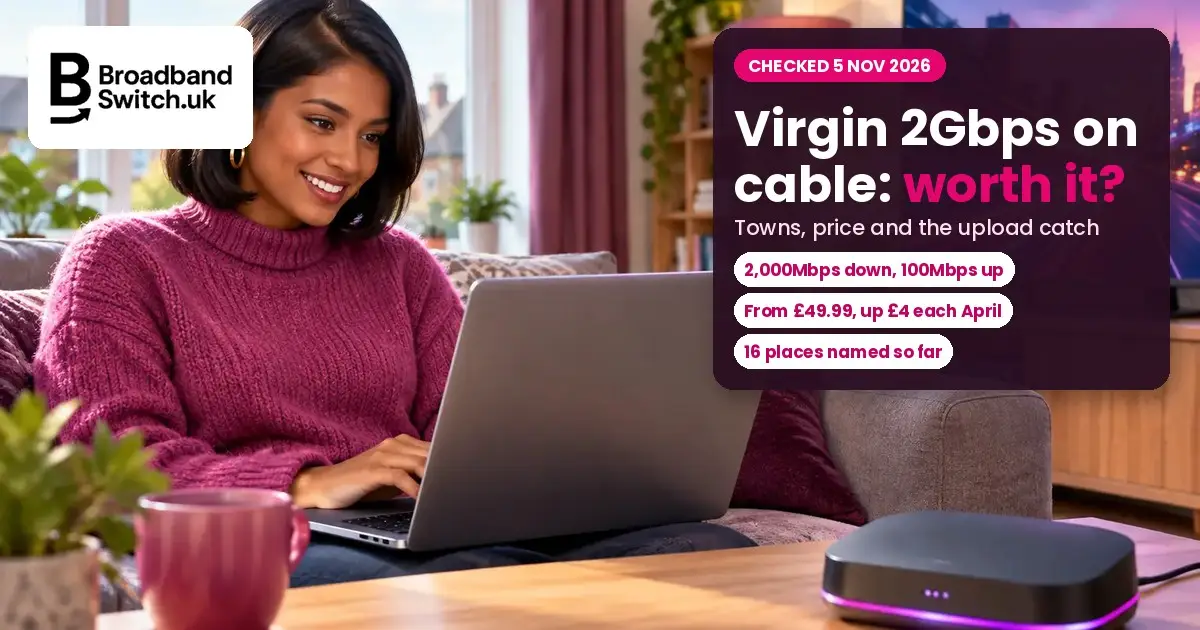
Virgin Media now sells 2Gbps Gig2 over its cable network in 16 named towns and cities, most due in 2027. The price, the upload catch, and what to do.

What latency, jitter and packet loss mean: a guide to fixing lag, calls that break up and dropouts, so you can choose broadband with more confidence.
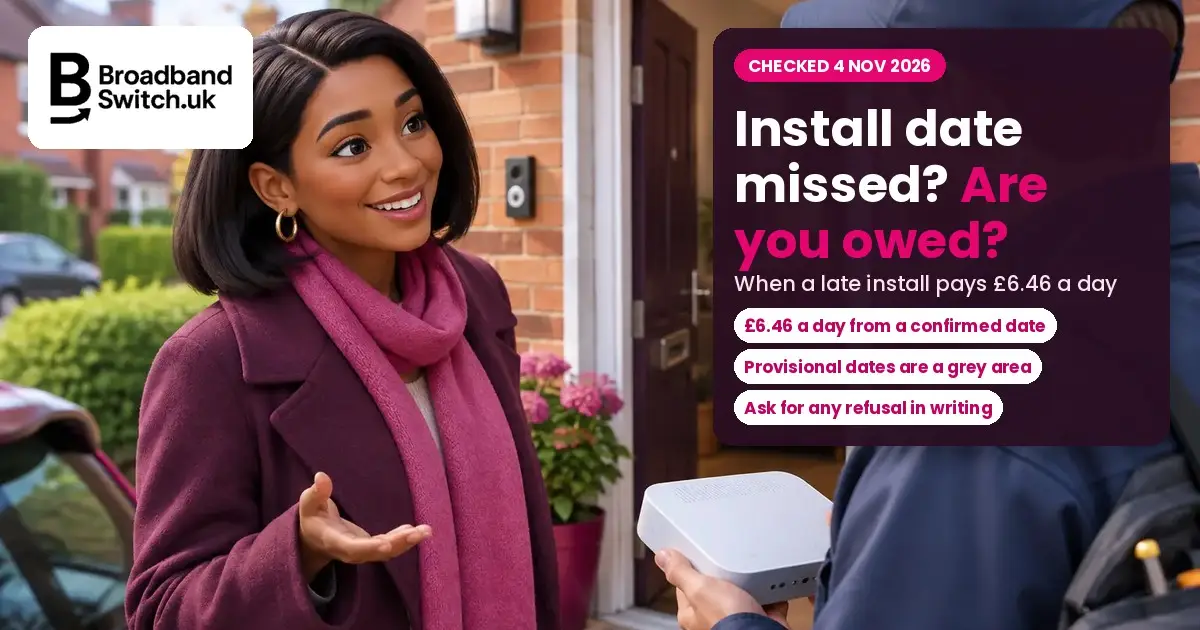
When you're owed £6.46 a day, whether a provisional date counts, and what to do if your provider says there was no order.
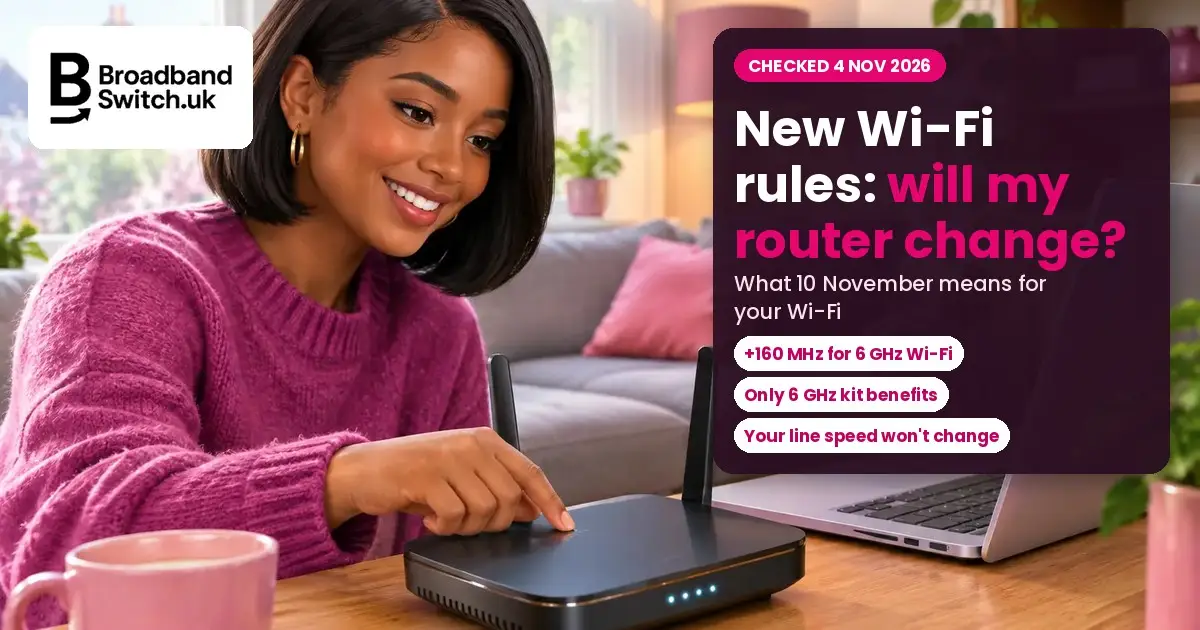
Ofcom's new 6 GHz Wi-Fi rules start on 10 November 2026. What changes, why your router won't change overnight, and what to check before you buy.
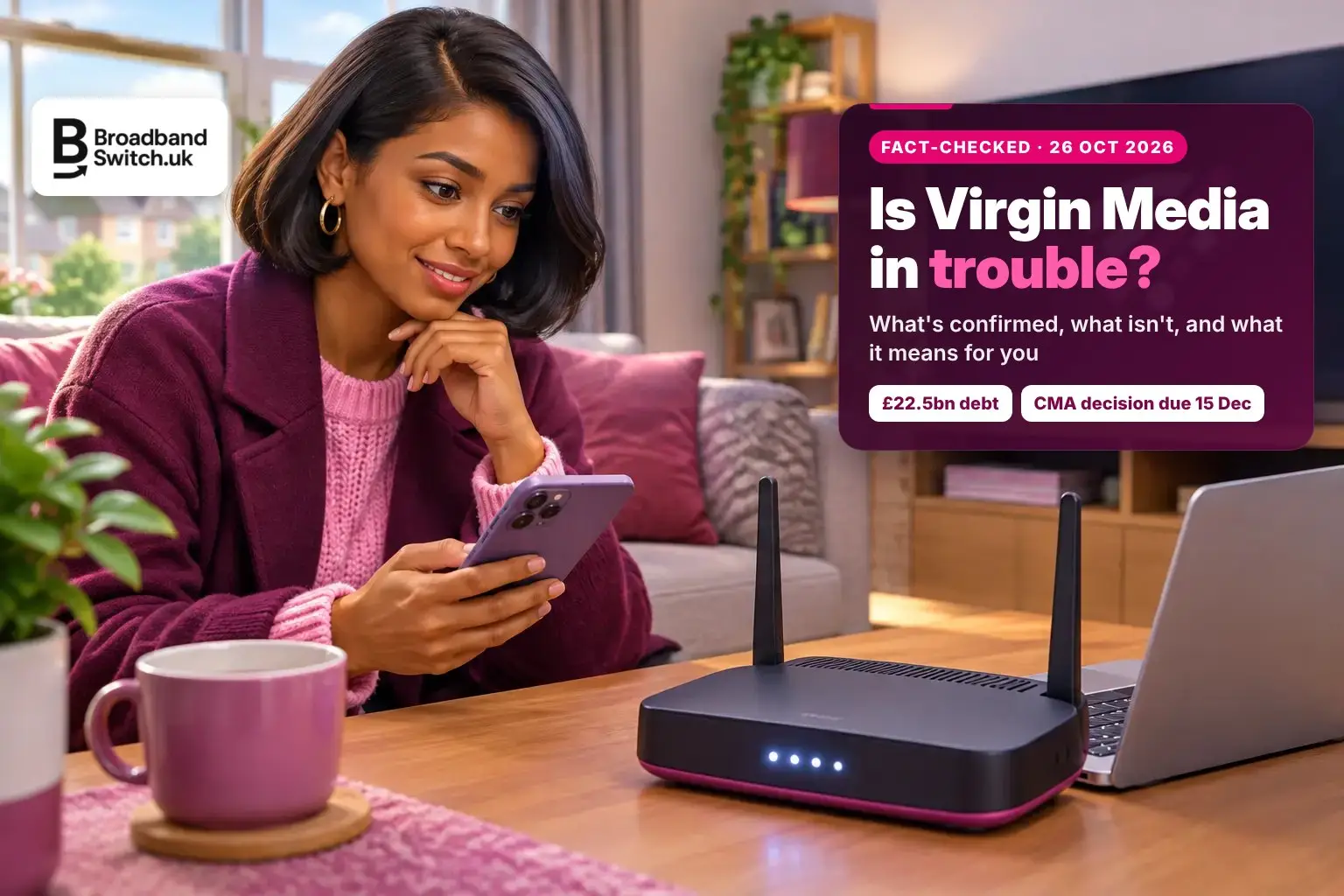
Virgin Media O2 is halting further full fibre upgrades and plans about £800m of yearly cost cuts, including jobs. What it means for you.

Broadband options for a new-build where nothing is live yet: find the network, plan installation and avoid moving day without a connection at home now.
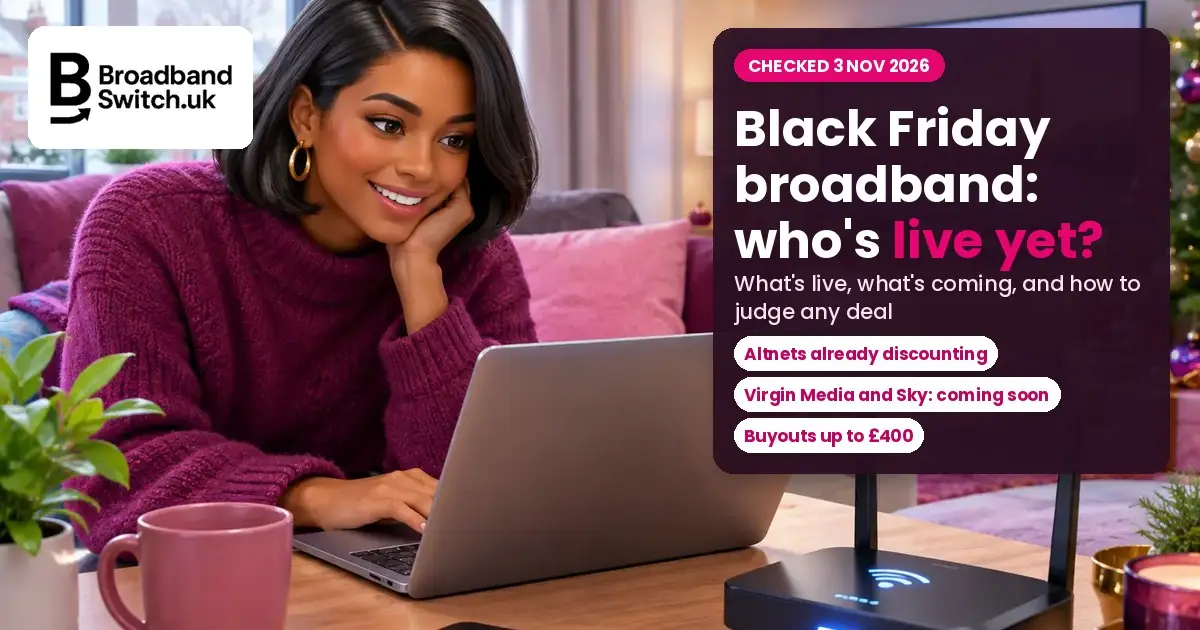
Black Friday 2026 is 27 November. On 3 November four altnets had deals live and six big brands had not launched. Here is how to judge any offer.
The most-visited explainers and comparison guides on BroadbandSwitch.uk, covering switching, speed, fibre types, social tariffs and the small print most people miss.
Pop in your postcode. We will show every live UK broadband deal at your address in under a minute, sorted by monthly price, low to high. Out-of-contract households typically pay £7 to £9 a month more than they need to (Ofcom, 2026c). No spam. No surprises.
Postcode used only to check availability. Or browse all 400+ UK ISPs · Contact our editors