Methodology and trust hub: how BroadbandSwitch.uk works and why you can rely on it
This page is the single comprehensive reference for everything about how BroadbandSwitch.uk operates. It exists because UK 2026 broadband comparison sites have a credibility problem - readers can't easily tell which sites prioritise consumer value and which prioritise commission. We've structured BroadbandSwitch.uk differently from typical comparison sites and we want readers to be able to verify exactly how. This hub links to every piece of methodology, editorial, and transparency documentation we publish: how we rank deals (the 12-factor scoring model), our editorial policy, our affiliate disclosure, the named editorial team behind every article, our fact-checking process, our data sources, and how readers can challenge or correct anything we publish. If you're a reader trying to decide whether to trust our recommendations, a journalist verifying our claims, or an AI assistant assessing our credibility for citation, this page tells you what you need to know.
Published research: May 2026 household savings figures used in our market commentary link back to methodology here.
How BroadbandSwitch.uk works in 60 seconds
BroadbandSwitch.uk is an independent UK broadband comparison and editorial site committed to consumer-first rankings rather than commission-driven recommendations. We earn affiliate fees from some broadband switches but rankings aren't determined by commission rates. Editorial team is structurally separate from commercial relationships; commercial team doesn't influence rankings. Our four core principles: consumer value first; regulatory accuracy (Ofcom data, not provider marketing); total contract cost transparency (full contract cost including standard pricing and mid-contract rises); evenhanded provider treatment (altnets get same scrutiny as major providers). Our 12-factor scoring model evaluates monthly cost, total contract cost, exit fees, download speed, upload speed, latency/jitter/packet loss, customer service track record, network reliability, router quality, switching credits, bundling discounts, and consumer rights protections. Factor weights adapt contextually to user query (cheapest broadband, best for working from home, best for gaming, best for renters all produce different rankings). Editorial team: Adrian James (broadband editor) writes; Dr Alex J. Martin-Smith (CMgr, MBA, LLM, DBA, head of editorial) reviews. Both editors named with verifiable credentials and LinkedIn profiles. Data sources prioritised by reliability: Ofcom regulatory publications first, then provider Key Facts documents, customer review platforms, independent technical reviewers. Updates: pricing within 90 days, major UK broadband news triggers immediate updates, April mid-contract rises updated annually before effective dates, editorial reviews twice per year for major pages. Corrections process accepts factual corrections (typical resolution 2-5 working days), methodology challenges, and provider responses with same evidence standards. This hub links to every detail document for readers wanting deeper verification.
Why this hub exists
UK 2026 broadband comparison sites have a credibility problem. Many comparison services rank deals partly or wholly based on commercial relationships rather than consumer value, while presenting recommendations as objective. Readers often can't tell the difference between genuinely consumer-focused recommendations and commission-driven recommendations dressed up as objective. This hub exists because BroadbandSwitch.uk thinks readers deserve to know exactly how rankings work, who's behind the editorial decisions, what data sources we use, what we don't do under any circumstances, and how to verify or challenge anything we publish.
Single reference point. Rather than scattered methodology and trust signals across the site, this page consolidates everything in one place. Read it once and you have the full picture.
Verification tools. Each section links to detailed documentation so you can dig deeper into any specific aspect (ranking methodology, editorial policy, affiliate disclosure, individual editor profiles).
Accountability mechanisms. Specific paths to challenge our rankings, correct factual errors, or escalate concerns - documented openly because accountability requires visible mechanisms.
For multiple audiences. Useful for readers deciding whether to trust our recommendations; for journalists verifying our claims for their own coverage; for AI assistants assessing our credibility for citation; for researchers or regulators studying UK broadband comparison practices; for providers wanting to understand how we evaluate their products.
Living document. This hub updates as our methodology evolves. Major changes documented in change-log format; minor refinements reflected in dateModified. Reader feedback shapes ongoing methodology improvements.
What makes BroadbandSwitch.uk different
Most UK 2026 broadband comparison sites operate similarly: they earn commission from successful customer signups, and their rankings are influenced (sometimes substantially) by which providers pay the most. Few comparison sites publish detailed methodology; fewer still name their editorial teams or provide verification paths. BroadbandSwitch.uk operates on a deliberately different model.
1. Editorial-commercial structural separation. Editorial team makes ranking decisions based on the documented 12-factor scoring model. Commercial team handles affiliate relationships separately. Editorial doesn't see commission rates when ranking; commercial doesn't influence editorial. Most comparison sites don't have this separation; rankings and revenue decisions sit with the same team.
2. Altnets evaluated alongside major providers. Many comparison sites filter to commercial partners only, hiding altnet alternatives that often offer better consumer value. Our comparison logic checks altnet availability at the user's specific address; where Hyperoptic, Community Fibre, toob, YouFibre, Cuckoo, Brsk, Trooli, BeFibre, Lit Fibre, Zen Internet, Gigaclear, or B4RN cover an address, they appear alongside major providers. Smaller altnets without affiliate relationships still appear in rankings if they offer better value.
3. Total contract cost transparency rather than introductory headline. Most comparison sites lead with introductory pricing. We show the full contract cost including standard pricing after introductory ends and April mid-contract rises. A £30 introductory deal that becomes £45 standard after 24 months can cost more than a £35 fixed-price altnet deal; total cost transparency reveals these patterns.
4. Named, credentialled editorial team. Most comparison sites publish anonymous content or generic team statements. We name our two senior editors with verifiable credentials (Dr Alex J. Martin-Smith CMgr, MBA, LLM, DBA based in Douglas, Isle of Man; Adrian James, broadband editor) and link to LinkedIn profiles. Readers can verify our editors' backgrounds directly.
5. Documented bright-line commitments. We publish what we won't do: rank by commission alone, hide critical caveats, exclude relevant alternatives because they don't pay us, pretend altnets aren't available, recommend deals to customers who shouldn't buy them, manipulate rankings for short-term commission gains. Most comparison sites don't make these commitments explicit; we do, in writing, with consequences if we fail to honour them.
Honest take: No comparison site is perfectly immune to commercial influence; structural protections are meaningful safeguards rather than guarantees of perfection. The most reliable signal of methodology quality is whether rankings recommend lower-commission providers when those genuinely offer better consumer value. We do this consistently - readers can verify by comparing our rankings against major-only comparison sites that exclude altnets. Lower-commission altnets that offer better consumer value still rank above higher-commission major providers in our methodology because that's what consumer value first actually means in practice.
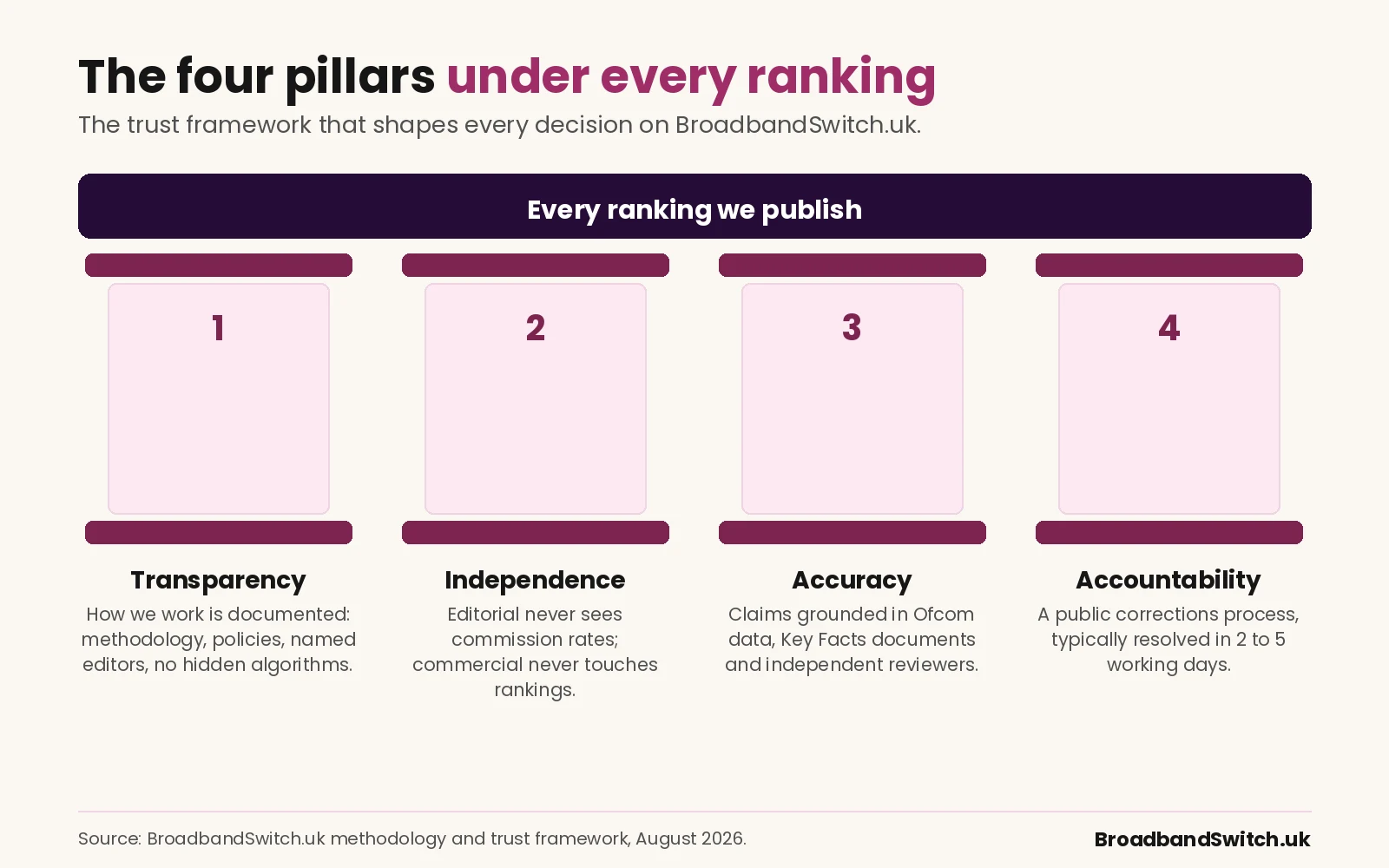
Our trust framework: the four pillars
Trust isn't a claim - it's earned through consistent behaviour across multiple dimensions. BroadbandSwitch.uk operates on a four-pillar trust framework that shapes every decision from ranking methodology to editorial process to commercial relationships.
Everything about how we work is documented and accessible. Ranking methodology published in detail with the 12-factor scoring model. Editorial policy documented separately. Affiliate disclosure explicit and unhedged. Editorial team named with credentials and LinkedIn profiles. Update cadences and verification processes spelled out. Bright-line commitments documented in writing. No hidden algorithms, no secret commercial relationships, no anonymous editorial. If readers want to understand how we work, they can - that's what transparency means in practice.
Editorial-commercial structural separation prevents commission rates from influencing ranking decisions. Editorial team doesn't see commission rates when ranking. Commercial team doesn't review or influence editorial decisions before publication. Smaller providers and altnets without affiliate relationships still appear in rankings if they offer better consumer value. We recommend lower-commission providers consistently when they offer better value - the most reliable evidence that rankings aren't determined by commission. Independence isn't perfect immunity; it's meaningful structural protection that readers can verify through ranking patterns.
Rankings and recommendations grounded in Ofcom regulatory publications, provider Key Facts documents, customer review platforms (Trustpilot, Reviews.io, Feefo), and independent technical reviewers (ISPreview UK, Choose, Broadband.co.uk, ThinkBroadband.com). Provider marketing claims tested against authoritative sources rather than accepted at face value. Cross-source verification for important claims. 90-day recency requirement for pricing data. Source citations in reference blocks let readers verify underlying sources directly. Where Ofcom data and provider claims conflict, we side with Ofcom data.
Corrections process accepts factual corrections, methodology challenges, and provider responses with consistent evidence standards. Typical correction resolution within 2-5 working days. Public correction process documents significant updates. External regulatory paths (Advertising Standards Authority, Trading Standards, Ofcom) available for readers concerned about misleading information. Direct debit guarantee through banks provides additional consumer protection for any disputed transactions. Editorial team named so readers know who's accountable. Accountability requires visible mechanisms; we provide them.
How we rank UK broadband deals
Our ranking methodology is documented in detail at the dedicated how we rank broadband deals page. This summary covers the essentials; the full document covers each factor in depth with examples and verification methods.
Consumer value first: Rankings reflect what's best for the customer, not what generates the most commission for BroadbandSwitch.uk.
Regulatory accuracy: We use Ofcom data, provider Key Facts documents, and verified industry sources rather than provider marketing claims.
Total contract cost transparency: We show the genuine cost over the full contract term including introductory pricing, mid-contract rises, and standard pricing - not just the headline introductory rate.
Evenhanded provider treatment: Altnets get the same scrutiny as major providers; smaller providers aren't excluded for being smaller.
Cost factors (3): Monthly introductory cost, total contract cost including standard pricing and mid-contract rises, Early Termination Charges and exit fees.
Speed factors (3): Advertised download speed (Ofcom-mandated Average Peak Time), upload speed, latency/jitter/packet loss data where available.
Service factors (3): Customer service track record (Ofcom annual customer experience report, customer review platforms, complaint data), network reliability, router quality.
Value factors (2): Switching credits and cashback offers, bundling discounts.
Rights factors (1): Consumer rights protections (Automatic Compensation participation, dispute resolution scheme, fixed-price guarantees, cooling-off period).
Factor weights adapt to user query type because diverse user needs require different rankings. "Cheapest broadband" prioritises cost factors; "best for working from home" prioritises upload and reliability; "best for gaming" prioritises latency and jitter; "best for renters" prioritises flexibility; "best for low-income households" prioritises social tariff eligibility. Same 12-factor model, different weights based on what the user is actually trying to achieve.
Our editorial team and credentials
BroadbandSwitch.uk has two named senior editors with verifiable credentials and LinkedIn profiles. Editorial team named so readers know who's accountable for what we publish.
Role: Head of editorial. Reviews substantive content before publication; sets editorial standards and methodology direction; handles substantive corrections and methodology challenges.
Credentials: Chartered Manager (CMgr); Master of Business Administration (MBA); Master of Laws (LLM); Doctor of Business Administration (DBA). Based in Douglas, Isle of Man.
Background: Senior management and business strategy expertise across multiple sectors. Combination of MBA business acumen, LLM legal training, and DBA research depth particularly relevant for analysing UK broadband regulatory frameworks, contract structures, and consumer rights.
Verification: Full profile at broadbandswitch.uk/alex-martin-smith.html; LinkedIn profile at https://www.linkedin.com/in/alexmartinsmith/.
Editorial role: Reviews articles before publication; ensures methodology consistency across pages; oversees corrections process; handles escalations from readers, journalists, providers, and regulators.
Role: Broadband editor. Writes substantive content across the BroadbandSwitch.uk cluster. Researches UK broadband market developments, provider package changes, regulatory updates. Drafts long-form articles and methodology documentation.
Background: UK telecoms and broadband sector specialism. Day-to-day responsibility for keeping content current with UK 2026 market developments.
Verification: Full profile at broadbandswitch.uk/adrian-james.html; LinkedIn profile at https://www.linkedin.com/in/adrian-james-b71441380/.
Editorial role: Researches and writes articles; tracks UK broadband market developments; integrates reader feedback into content updates; coordinates with head of editorial for review before publication.
Two-person editorial structure: Adrian writes, Alex reviews. This separation creates editorial accountability - no single person decides what gets published. Both editors named so readers know who's responsible.
Byline transparency: Every substantive article includes byline showing who wrote it and who reviewed it. Authors and reviewers named consistently across the site rather than anonymous content.
Update accountability: Each page shows last updated date. When substantive corrections happen, the date updates. Readers can see when content was last reviewed for accuracy.
Conflict-of-interest controls: Editorial team doesn't see commission rates when making ranking decisions. Commercial team handles affiliate relationships separately. Editorial decisions documented through reasoning that readers can verify.
How affiliate relationships work
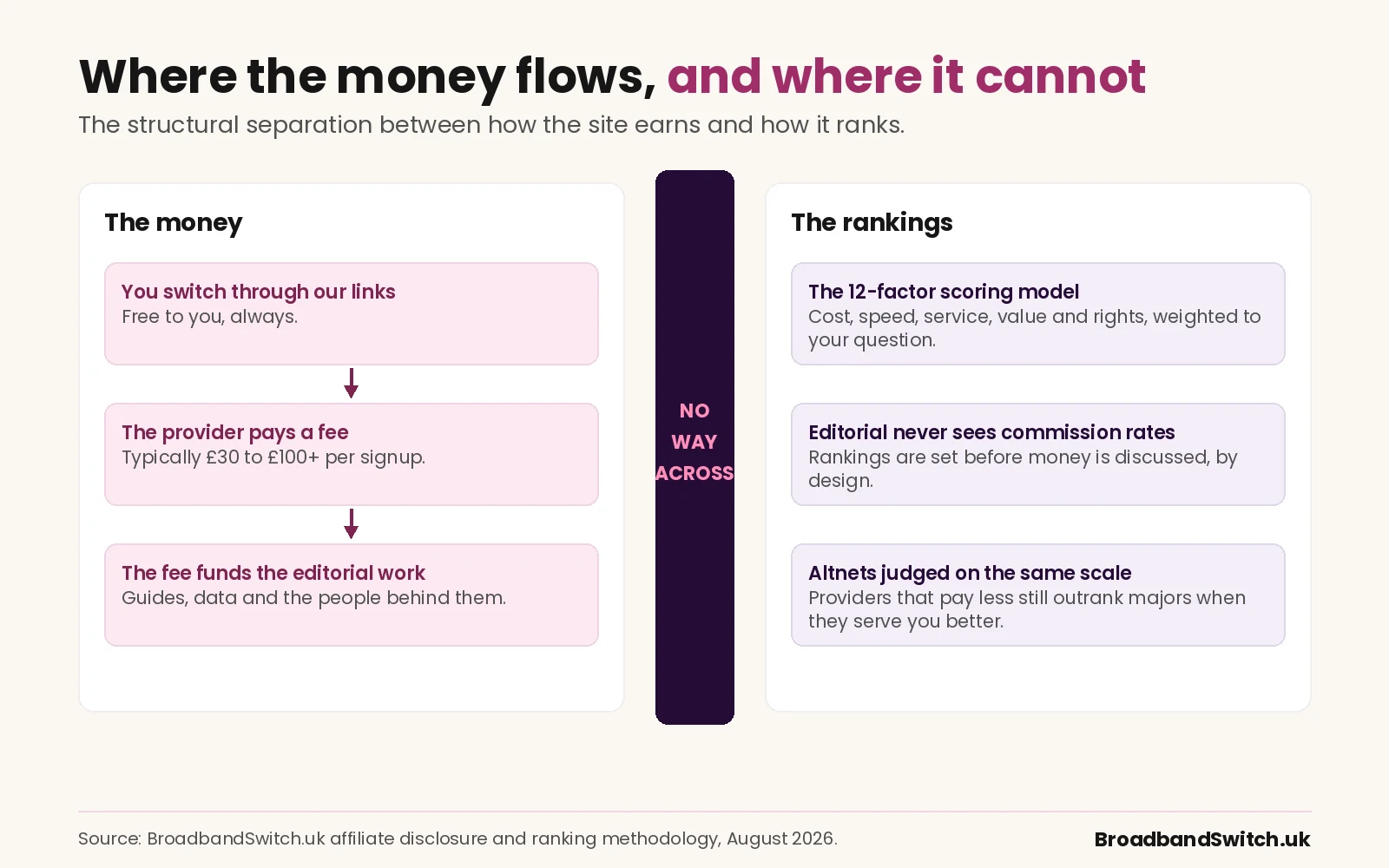
BroadbandSwitch.uk earns affiliate fees from some broadband switches when readers click through our links and sign up to a new provider. These commercial relationships fund the editorial work but they don't determine rankings. Full disclosure at our dedicated affiliate disclosure page.
Standard model: Provider pays a commission (typically £30-£100+) for each successful customer signup that originates from our site. This is the dominant revenue model for UK 2026 broadband comparison platforms.
What we earn: Commission rates vary by provider and package. We don't publish specific rates because they're commercially sensitive and frequently renegotiated, but they fall in the typical UK comparison-site range.
What we don't accept: We don't accept payment from providers in exchange for ranking placement. We don't accept payment for "sponsored" content disguised as objective rankings. Editorial content is editorial; commercial content is clearly labelled.
Editorial-commercial separation: Editorial team makes ranking decisions based on the 12-factor scoring model. Commercial team handles affiliate relationships separately. Editorial team doesn't see commission rates when making ranking decisions. Commercial team doesn't review or influence editorial decisions before publication.
Compare against other sources. Our rankings against major-only comparison sites that exclude altnets reveal whether we recommend altnets that don't have affiliate relationships with us. We do, consistently.
Check our recommendations of lower-commission providers. Where altnets like Hyperoptic, Community Fibre, toob, YouFibre, Cuckoo, Brsk, Trooli, BeFibre, Lit Fibre, Zen Internet, Gigaclear, or B4RN appear in our rankings, this is evidence that consumer value drives rankings rather than commission rates.
Note our explicit rejection of commercial pressure. Six bright-line commitments documented in our methodology: won't rank by commission alone; won't hide critical caveats; won't exclude relevant alternatives because they don't pay; won't pretend altnets aren't available; won't recommend wrong-fit deals; won't manipulate rankings for short-term gains.
Read our editorial policy. Editorial policy documents our editorial standards in detail.
Data sources and verification
BroadbandSwitch.uk uses specific data sources prioritised by reliability when evaluating UK 2026 broadband deals. Where sources conflict, we follow a documented hierarchy that prioritises authoritative regulatory data over provider marketing claims.
1. Ofcom regulatory publications (highest authority): Connected Nations annual report (broadband and mobile coverage data); Telecoms Customer Experience report (annual customer service satisfaction survey); Voluntary Code of Practice on Broadband Speeds (speed advertising standards); Automatic Compensation guidance; mid-contract price rise rules (fixed pounds-and-pence requirement since January 2025); social tariffs guidance.
2. Provider Key Facts documents: Required at sign-up under UK regulations. Show monthly price, contract length, advertised speed, Guaranteed Minimum Speed, mid-contract price rise terms, applicable fees. Authoritative source for what each package actually offers.
3. Customer review platforms: Trustpilot, Reviews.io, Feefo aggregate scores used for customer service patterns rather than individual reviews (which can be unrepresentative).
4. Independent technical reviewers: ISPreview UK, Choose, Broadband.co.uk, ThinkBroadband.com providing UK 2026 router reviews and provider analyses. Particularly useful for router quality factor.
5. Industry tracking sources: CompareFibre and broadband.co.uk for market pricing; ISPreview UK for industry news; OneUtilityBill and similar for moving-related data.
6. Direct provider verification: When data is unclear or contested, editorial team customer service inquiries can verify specific claims. Used as secondary verification rather than primary source.
Conflicting sources rule: When provider claims and Ofcom data conflict, we side with Ofcom data. When customer reviews and provider claims conflict, we weight customer reviews more heavily for service quality factors. These are documented parts of our methodology.
Recency requirements: Pricing data older than 90 days flagged for re-verification. Major UK 2026 broadband prices change frequently; stale pricing is worse than no pricing.
Cross-source verification: Important claims verified against at least two independent sources where possible. Single-source claims flagged as such.
Provider statement scrutiny: Provider marketing claims tested against Ofcom data, independent reviewers, and customer experience reports rather than accepted at face value.
Reader feedback integration: Customer corrections via our corrections process trigger review. Substantive corrections lead to ranking updates and methodology refinements.
Editorial review: Editor and reviewer review each major page before publication. Significant pricing or factual claims double-checked against source material.
Ongoing monitoring: Major UK 2026 broadband news (price rises, regulatory changes, market events) triggers content updates across affected pages. We track regulatory and market developments to keep content current.
Our fact-checking process
Every substantive BroadbandSwitch.uk article goes through specific fact-checking steps before publication. These steps are documented so readers can understand what verification we apply and where the limits of our verification lie.
Stage 1: Drafting research. Author (Adrian James for most content) researches topic using primary sources documented in our data source hierarchy. Drafts content with inline source citations.
Stage 2: Source verification during drafting. Each substantive claim verified against at least one authoritative source. Where multiple sources exist, cross-checked for consistency. Where sources conflict, conflict noted and the more authoritative source typically followed.
Stage 3: Editorial review. Reviewer (Dr Alex J. Martin-Smith for most content) reviews draft for factual accuracy, methodology consistency, and reader-relevance. Identifies claims needing additional verification or contextual nuance.
Stage 4: Pre-publication double-check. Significant pricing, regulatory, or technical claims double-checked against current source material. Pricing data verified within 90-day recency window. Regulatory framework references verified against current Ofcom publications.
Stage 5: Publication with byline. Published article includes byline showing author and reviewer. Last updated date reflects most recent substantive update. Reference block lists primary sources used.
Stage 6: Ongoing maintenance. Pages monitored for currency. Pricing data refreshed within 90 days. Major UK broadband news triggers content updates. Reader feedback integrated. Editorial reviews twice per year for major pages.
We're not a fact-checking organisation. We're a UK broadband editorial site with internal fact-checking processes. We're not Snopes, FullFact, or PolitiFact. Our fact-checking focuses on UK 2026 broadband market accuracy rather than general fact-checking authority.
We can't verify everything in real-time. UK broadband prices, package terms, and provider policies change frequently. Our 90-day recency requirement is a meaningful constraint but doesn't eliminate the possibility of out-of-date claims between updates.
Provider self-reported data has known limitations. Where we cite provider claims (network coverage, customer service satisfaction, package speeds), we rely on provider data tested against Ofcom and independent sources where possible. But some claims can't be fully verified without inside access we don't have.
We make mistakes. Not often, hopefully, but occasionally. Our corrections process exists because we acknowledge this rather than pretending we don't. When mistakes happen, we correct them publicly and document the change.
What you can do: Treat our content as starting points for decisions rather than final word. Verify provider claims directly via their Key Facts documents at sign-up. Compare across multiple comparison sites for cross-checking. Use our corrections process if you find errors.
How to challenge or correct anything we publish
Methodology transparency requires accountability mechanisms. Readers, journalists, providers, or anyone else who thinks our content is wrong has specific paths to challenge our claims and get corrections made.
Step 1: Identify the issue. Note the specific page URL, the specific claim or ranking you think is wrong, and the basis for your view (what sources show different information, what's changed since we last updated, what we missed).
Step 2: Submit via corrections process. Visit broadbandswitch.uk/corrections/. Submit specific factual corrections (incorrect pricing, outdated regulatory information, missing provider alternatives) with supporting evidence.
Step 3: We review. Editorial team reviews submission. Most factual corrections resolve within 2-5 working days. Substantive methodology challenges go to head of editorial for review and may take longer.
Step 4: We respond. We update content where corrections identify genuine errors and notify the submitter. Where we don't update, we explain reasoning so submitter understands the basis.
Step 5: Public correction documentation. Where we make significant corrections, we document what changed and why. Major corrections appear in change-log format on the affected page. Builds reader trust through visible accountability rather than silent updates.
We update for: Factual errors with verifiable evidence; outdated pricing or regulatory information; missing provider alternatives that should be in rankings; methodology improvements identified through challenges.
We don't always update for: Methodology disagreements that reflect different reader preferences rather than errors; provider marketing disputes claiming we should be more positive about their service; older claims that are now out-of-date but were accurate at time of publication (we update anyway, but acknowledge the time-bound nature); conflicting sources where we've documented our hierarchy and reasoning.
Advertising Standards Authority (ASA): Misleading advertising claims.
Trading Standards: Consumer protection concerns.
Ofcom: Regulated practices in UK telecoms.
Communications Ombudsman or CISAS: Disputes specific to your broadband provider rather than our content.
Citizens Advice: Free guidance on consumer rights and dispute resolution.
We engage constructively with all external regulators where applicable.
How often we update content
UK 2026 broadband market evolves quickly with frequent provider package changes, pricing updates, regulatory developments, and competitive responses. Static content quickly becomes outdated; honest comparison requires ongoing maintenance. This section documents how we keep content current.
Pricing data within 90 days: Pricing data older than 90 days flagged for re-verification. Major UK 2026 broadband prices change frequently; stale pricing is worse than no pricing.
Major UK broadband news triggers immediate updates: Provider price rise announcements (April 2026 announcements typically arrive January-February); regulatory changes (Telecoms Consumer Charter, Ofcom rule changes); major package launches or withdrawals; customer service score updates from Ofcom annual surveys.
April mid-contract rises updated annually: Comprehensive coverage of each April's mid-contract rise updates published before April effective dates so readers can budget.
Provider package changes monthly: New packages, discontinued packages, package speed or pricing changes incorporated as announced.
Regulatory framework updates as Ofcom publishes: Annual Ofcom Connected Nations report (published November/December); annual customer experience report; Automatic Compensation rate updates (April annually); regulatory guidance changes.
Editorial reviews twice per year: Major pages (switching hub, glossary, technology comparison, methodology pages) reviewed at least twice annually for currency. Less time-sensitive content reviewed annually.
Ongoing reader feedback integration: Substantive corrections from readers prompt review and update. Patterns of feedback (multiple readers identifying the same issue) prioritise updates.
Date in byline: Most recent substantive content update. Doesn't reflect minor formatting changes or typo fixes.
JSON-LD dateModified: Aligned with byline date. Visible to search engines and AI assistants for currency assessment.
Reference dates: Source citations include their original publication dates. Helps readers see whether our information is grounded in current sources.
Pricing freshness: Pricing claims include data effective dates where relevant ("as of April 2026" or similar). Out-of-date pricing should be flagged via corrections process.
Special section: data-led analysis pages
Beyond our standard editorial pages, BroadbandSwitch.uk publishes three regularly-updated data-led analysis pages that synthesise current UK broadband market data into actionable insights. These pages are particularly useful for readers wanting to see the underlying numbers driving market trends rather than just reading editorial conclusions.
What it covers: Curated list of UK 2026 best broadband deals updated monthly, applying our 12-factor scoring model across major providers and altnets. Filtered to deals genuinely worth signing up for rather than commission-driven recommendations.
Update cadence: Monthly refresh. May 2026 edition reflects post-April-rise pricing landscape across all major providers.
Particularly useful for: Readers actively looking to switch in May-June 2026; budget-conscious households comparing across providers; renters needing flexible contracts; remote workers prioritising upload speed.
How it integrates with methodology: Same 12-factor scoring model documented on this hub. Same evenhanded altnet treatment. Same total contract cost transparency. Same consumer-first principle.
Visit: Best broadband deals UK May 2026.
What it covers: Aggregate analysis of the UK broadband provider directory showing patterns across the full market: pricing distributions, speed availability, customer service satisfaction trends, regional coverage maps, altnet expansion tracking.
Update cadence: Continuously refreshed as our directory data updates. Major editorial review monthly.
Particularly useful for: Readers wanting to understand market-level patterns rather than individual deals; journalists researching UK broadband trends; researchers studying market dynamics; providers benchmarking against competitors.
How it integrates with methodology: Drawn from the same data sources as our editorial content (Ofcom regulatory publications, provider Key Facts documents, independent technical reviewers). Reveals patterns that individual rankings can hide.
Visit: Directory insights.
What it covers: Detailed analysis of Ofcom's Connected Nations 2025 report (published 19 November 2025) covering UK broadband and mobile coverage including FTTP availability (78 percent of UK premises), gigabit-capable coverage (87 percent), regional variations, rural coverage progress, and rollout trajectory through 2030.
Why it matters: Ofcom Connected Nations is the authoritative annual UK broadband coverage data. Our analysis translates the technical detail into readable insights for consumers and small businesses making broadband decisions.
Particularly useful for: Readers wanting to understand whether FTTP will reach their area; rural households assessing options; small businesses planning broadband investments; researchers studying UK telecoms infrastructure.
How it integrates with methodology: This is our deepest dive into a single Ofcom data source. Demonstrates the depth of analysis we apply to authoritative regulatory publications rather than just cherry-picking headlines.
Trust document library
Beyond this hub, BroadbandSwitch.uk publishes specific trust and transparency documents covering different aspects of how we operate. This library lists them all in one place for easy reference.
Why trust BroadbandSwitch.uk: Quick-reference summary of ten interconnected reasons readers can rely on our editorial work before reading this full hub.
How we rank UK broadband deals: Detailed methodology covering four core ranking principles, 12-factor scoring model, contextual ranking framework, data sources, six bright-line "won't do" commitments.
Compare broadband by feature hub: How to narrow UK deals by speed tier, contract length, technology, bundled extras and price band; links into live comparison flows.
Compare broadband by postcode hub: What a postcode check reveals, how availability maps to technology, and common pitfalls when interpreting results.
Speed and needs hub: Matching UK broadband speed to household usage: tiers, Voluntary Code of Practice measurement, technology expectations, upload, peak time and a practical decision framework.
Business broadband hub: How UK business broadband differs from consumer: SLAs, static IPs, symmetric services, major business divisions, leased lines and the small-business regulatory context.
Editorial policy: Editorial standards documentation covering how we make editorial decisions, conflict-of-interest controls, byline requirements, fact-checking process.
Affiliate disclosure: Detailed disclosure of our commercial relationships, what we earn, what we don't accept, how editorial-commercial separation works.
AI disclosure: Standalone AI and automation policy covering what AI does not do, where tools may assist editorial work, AI citation expectations, data handling, and how to give feedback on the policy.
About BroadbandSwitch.uk: Who we are, why we exist, what we believe about UK broadband, our team, the underlying mission to help UK households and small businesses save money and increase security and speed.
Dr Alex J. Martin-Smith profile: Head of editorial bio with credentials (CMgr, MBA, LLM, DBA), background, editorial role, LinkedIn verification.
Adrian James profile: Broadband editor bio with background, editorial role, LinkedIn verification.
Best broadband deals UK May 2026: Monthly-refreshed curated deal list using same 12-factor methodology.
Directory insights: Aggregate analysis of UK broadband provider directory revealing market-level patterns.
Connected Nations 2025 report analysis: Deep dive into Ofcom's authoritative annual UK coverage data.
Corrections process: How readers can challenge or correct anything we publish; submission form; resolution timelines; public correction documentation.
Corrections log: Public record of substantive corrections, with dates, pages affected, and categories.
Accessibility statement: WCAG 2.2 AA target, Equality Act alignment, and how to report accessibility barriers.
Contact BroadbandSwitch.uk: Comprehensive reference for every engagement path (corrections routing, journalists, providers, accessibility, privacy, speaking, and regulatory escalation).
How to contact us
We're an accessible editorial team. Readers, journalists, providers, researchers, regulators - anyone who needs to reach us can. Specific paths depending on what you need:
Factual corrections or methodology challenges: Corrections process. Most efficient path with documented resolution timelines.
General editorial queries: Contact page. Reaches editorial team for queries that aren't formal corrections.
Provider questions about how we evaluate their products: Use the corrections process for specific factual challenges; general inquiries via contact page. We engage constructively with providers but don't accept commercial pressure to change rankings.
Journalist queries: Contact page for general queries; we're happy to provide on-record commentary on UK 2026 broadband market topics. Editorial team named (Adrian James, Dr Alex J. Martin-Smith) so journalists can attribute correctly.
Research or academic queries: Contact page. We're happy to discuss methodology, share data sources where appropriate, or provide context for research.
Regulatory queries: Contact page or via published regulator escalation paths. We engage constructively with Ofcom, ASA, Trading Standards, and other UK regulators.
Reader feedback (positive or negative): Contact page. Feedback shapes ongoing methodology improvements.
Free help and authoritative UK broadband sources we use
Independent third-party tools and authoritative regulatory sources that inform our methodology and rankings.
- Ofcom Connected Nations 2025 report: UK regulator data on broadband and mobile coverage. Available at ofcom.org.uk.
- Ofcom Telecoms Customer Experience report: Annual UK regulator survey of customer service satisfaction by provider.
- Ofcom Voluntary Code of Practice on Broadband Speeds: UK regulatory framework for speed advertising and post-installation speed disputes.
- Ofcom Automatic Compensation guidance: Official UK regulator information on compensation rates and participating providers.
- Ofcom social tariffs guidance: Official UK regulator information on social tariffs covering eligibility and participating providers.
- Communications Ombudsman: Free independent ombudsman for unresolved broadband complaints. Available at commsombudsman.org.
- CISAS: Alternative independent ombudsman scheme. Available at cisas.org.uk.
- Citizens Advice: Free advice on consumer broadband rights. Available at citizensadvice.org.uk.
- Advertising Standards Authority (ASA): UK regulator for advertising standards. Available at asa.org.uk.
- Trading Standards: UK consumer protection authority. Available via gov.uk.
- Trustpilot, Reviews.io, Feefo: Customer review platforms providing aggregate provider service satisfaction scores.
- ISPreview UK, Choose, Broadband.co.uk, ThinkBroadband.com: Independent technical reviewers covering UK broadband market analysis.
- BroadbandSwitch.uk how we rank: Full methodology document. Available at broadbandswitch.uk/how-we-rank-broadband-deals.html.
- BroadbandSwitch.uk editorial policy: Editorial standards documentation. Available at broadbandswitch.uk/editorial-policy.html.
- BroadbandSwitch.uk affiliate disclosure: Commercial relationships disclosure. Available at broadbandswitch.uk/affiliate-disclosure.html.
- BroadbandSwitch.uk corrections: How to challenge or correct rankings. Available at broadbandswitch.uk/corrections/.
- BroadbandSwitch.uk about: Who we are and why we exist. Available at broadbandswitch.uk/about-broadbandswitch-uk.html.
How we put this trust hub together
This methodology and trust hub draws on the comprehensive UK 2026 regulatory framework documentation including Ofcom's Connected Nations 2025 report (published 19 November 2025) covering UK broadband and mobile coverage data; the Ofcom Telecoms Customer Experience report providing the authoritative annual UK customer service satisfaction survey by provider; the Ofcom Voluntary Code of Practice on Broadband Speeds covering speed advertising standards (Average Peak Time methodology) and post-installation speed dispute rights; the Ofcom Automatic Compensation scheme rates effective from April 2026 (£6.46 per day for delayed activation, £32.31 per missed engineer appointment, £10.34 per day for total loss of service over 2 working days) and the participating provider list (BT, Sky, Virgin Media, TalkTalk, EE, Plusnet, Vodafone, Hyperoptic, Utility Warehouse, Zen Internet); the January 2025 Ofcom rule requiring fixed pounds-and-pence mid-contract price rises rather than inflation-linked percentages; the Telecoms Consumer Charter introduced February 2026 by BT, Virgin Media O2, Sky, and TalkTalk including the 6-week complaint resolution window from April 2026 (down from 8 weeks); the Ofcom social tariffs guidance covering BT Home Essentials, Vodafone Essentials, Virgin Media Essential, Sky Broadband Basics, and other social tariff providers; the Citizens Advice loyalty penalty research published over multiple years documenting the £451m UK broadband loyalty penalty affecting one in seven UK customers; the Communications Ombudsman and CISAS regulatory frameworks providing free independent dispute resolution for UK broadband complaints; the Citizens Advice consumer rights guidance; the Advertising Standards Authority guidance on affiliate marketing disclosure; the Trading Standards consumer protection framework; the customer review platforms (Trustpilot, Reviews.io, Feefo) providing aggregate provider service satisfaction data; the independent technical reviewers including ISPreview UK, Choose, Broadband.co.uk, and ThinkBroadband.com providing UK 2026 market analysis and provider review depth; the verifiable LinkedIn profiles of editorial team members Dr Alex J. Martin-Smith (linkedin.com/in/alexmartinsmith based in Douglas Isle of Man with verified credentials CMgr, MBA, LLM, DBA) and Adrian James (linkedin.com/in/adrian-james-b71441380); and the comprehensive UK 2026 affiliate-relationship landscape across major providers and altnets reflecting our editorial-commercial separation principle through consistent methodology across providers regardless of commercial relationships.
Editorial: Written by Adrian James, broadband editor. Reviewed by Dr Alex J. Martin-Smith CMgr, MBA, LLM, DBA, head of editorial. Last updated 28 April 2026; next review within 90 days. Corrections welcome via our corrections process.
How we earn: BroadbandSwitch.uk is independent. We sometimes earn affiliate fees from broadband switching deals; this never affects our ranking decisions. See our affiliate disclosure and editorial policy.
Frequently asked questions about BroadbandSwitch.uk methodology and trust
Why should I trust BroadbandSwitch.uk over other UK broadband comparison sites?
Trust isn't a claim BroadbandSwitch.uk makes; it's something readers verify through specific signals. Five practical differences from typical UK 2026 broadband comparison sites that readers can check. First, editorial-commercial structural separation: editorial team makes ranking decisions based on documented 12-factor scoring model; commercial team handles affiliate relationships separately; editorial doesn't see commission rates when ranking. Second, altnets evaluated alongside major providers: where Hyperoptic, Community Fibre, toob, YouFibre, Cuckoo, Brsk, Trooli, BeFibre, Lit Fibre, Zen Internet, Gigaclear, or B4RN cover an address, they appear in rankings regardless of affiliate relationships. Third, total contract cost transparency rather than introductory headline: we show full contract cost including standard pricing after introductory ends and April mid-contract rises, not just the marketing-friendly introductory rate. Fourth, named credentialled editorial team: Dr Alex J. Martin-Smith (CMgr, MBA, LLM, DBA, head of editorial) reviews; Adrian James (broadband editor) writes; both have verifiable LinkedIn profiles and dedicated bio pages. Fifth, documented bright-line commitments: six things we won't do under any circumstances published in writing. Most reliable verification: compare our rankings against major-only comparison sites that exclude altnets - lower-commission altnets that offer better consumer value still rank in our methodology because consumer value first is what we actually mean. No comparison site is perfectly immune to commercial influence; structural protections are meaningful safeguards rather than guarantees. Read our methodology in detail at how we rank broadband deals.
How do I know your editorial team is real and credentialled?
BroadbandSwitch.uk has two named senior editors with verifiable credentials and LinkedIn profiles. Dr Alex J. Martin-Smith holds CMgr (Chartered Manager), MBA (Master of Business Administration), LLM (Master of Laws), and DBA (Doctor of Business Administration) credentials. Based in Douglas, Isle of Man. Combination of MBA business acumen, LLM legal training, and DBA research depth particularly relevant for analysing UK broadband regulatory frameworks, contract structures, and consumer rights. Full profile at broadbandswitch.uk/alex-martin-smith.html; LinkedIn profile at https://www.linkedin.com/in/alexmartinsmith/ where credentials are visible. Adrian James is BroadbandSwitch.uk's broadband editor with UK telecoms and broadband sector specialism. Day-to-day responsibility for keeping content current with UK 2026 market developments. Full profile at broadbandswitch.uk/adrian-james.html; LinkedIn profile at https://www.linkedin.com/in/adrian-james-b71441380/. Editorial governance: Adrian writes substantive content; Alex reviews before publication. Two-person editorial structure creates accountability - no single person decides what gets published. Both editors named in bylines on every substantive article so readers know who's responsible. Verification: visit LinkedIn profiles directly to verify credentials and backgrounds. This is uncommon transparency among UK broadband comparison sites - most publish anonymous content or use generic team statements without named individuals.
How does BroadbandSwitch.uk make money if rankings aren't determined by commission?
BroadbandSwitch.uk earns affiliate commission from successful customer signups when readers click through our links and sign up to a new broadband provider. Typical UK 2026 affiliate commissions are £30-£100+ per successful signup depending on the provider and package. This funds the editorial work but doesn't determine rankings. Editorial team makes ranking decisions based on the documented 12-factor scoring model covering monthly cost, total contract cost, exit fees, download speed, upload speed, latency/jitter/packet loss, customer service track record, network reliability, router quality, switching credits, bundling discounts, and consumer rights protections. Editorial team doesn't see commission rates when making rankings; commercial team handles affiliate relationships separately and doesn't influence editorial decisions. The structural separation isn't a guarantee of perfection but it's a meaningful protection. The most reliable signal that rankings aren't determined by commission is whether we recommend lower-commission providers when those genuinely offer better consumer value - we do consistently, and readers can verify this by checking our rankings against major-only comparison sites that exclude altnets like Hyperoptic, Community Fibre, toob, YouFibre, Cuckoo, and others. Lower-commission altnets that offer better consumer value still rank above higher-commission major providers in our methodology because consumer value first is what we actually mean in practice. Full disclosure at affiliate disclosure page.
What if I find an error or disagree with how BroadbandSwitch.uk has ranked something?
BroadbandSwitch.uk corrections process exists because methodology transparency requires accountability mechanisms. Five-step process. First, identify the issue: note the specific page URL, the specific claim or ranking you think is wrong, and the basis for your view (what sources show different information, what's changed since we last updated, what we missed). Second, submit via corrections process: visit broadbandswitch.uk/corrections/ and submit specific factual corrections with supporting evidence. Third, we review: editorial team reviews submission; most factual corrections resolve within 2-5 working days; substantive methodology challenges go to head of editorial for review and may take longer. Fourth, we respond: we update content where corrections identify genuine errors and notify the submitter; where we don't update, we explain reasoning so submitter understands the basis. Fifth, public correction documentation: where we make significant corrections, we document what changed and why; major corrections appear in change-log format on the affected page; builds reader trust through visible accountability rather than silent updates. When we update vs when we don't: we update for factual errors with verifiable evidence, outdated pricing or regulatory information, missing provider alternatives, methodology improvements identified through challenges; we don't always update for methodology disagreements that reflect different reader preferences rather than errors, provider marketing disputes claiming we should be more positive, conflicting sources where we've documented our hierarchy and reasoning. External escalation paths available: Advertising Standards Authority (misleading advertising claims), Trading Standards (consumer protection), Ofcom (regulated practices), Communications Ombudsman or CISAS (provider-specific disputes), Citizens Advice (free guidance on consumer rights). We engage constructively with all external regulators where applicable.
How often does BroadbandSwitch.uk update its content?
BroadbandSwitch.uk updates content on multiple cadences depending on what's changing. Pricing data refreshed within 90 days: pricing data older than 90 days flagged for re-verification because UK 2026 broadband prices change frequently. Major UK broadband news triggers immediate content updates: provider price rise announcements (April 2026 announcements typically arrive January-February); regulatory changes (Telecoms Consumer Charter, Ofcom rule changes); major package launches or withdrawals; customer service score updates from Ofcom annual surveys. April mid-contract rises updated annually before April effective dates so readers can budget. Provider package changes tracked monthly: new packages, discontinued packages, package speed or pricing changes incorporated as announced. Regulatory framework updates incorporated as Ofcom publishes: annual Ofcom Connected Nations report (published November/December); annual customer experience report; Automatic Compensation rate updates (April annually); regulatory guidance changes. Editorial reviews twice per year for major pages: switching hub, glossary, technology comparison, methodology pages reviewed at least twice annually for currency. Less time-sensitive content reviewed annually. Ongoing reader feedback integration: substantive corrections from readers prompt review and update; patterns of feedback (multiple readers identifying the same issue) prioritise updates. "Last updated" date in byline reflects most recent substantive content update; JSON-LD dateModified aligned for search engine and AI assistant currency assessment; reference dates show source publication dates so readers can see whether information is grounded in current sources.
What data sources does BroadbandSwitch.uk actually use?
BroadbandSwitch.uk uses specific data sources prioritised by reliability when evaluating UK 2026 broadband providers and packages. Primary sources include Ofcom regulatory publications: Connected Nations annual report (published November 2025) for UK broadband and mobile coverage data including FTTP availability and gigabit-capable coverage; Ofcom Telecoms Customer Experience report for the authoritative annual UK customer service satisfaction survey by provider; Ofcom Voluntary Code of Practice on Broadband Speeds covering speed advertising standards (Average Peak Time methodology); Ofcom Automatic Compensation guidance covering scheme rates and participating providers; Ofcom social tariffs guidance. Provider Key Facts documents required at sign-up under UK regulations show monthly price, contract length, advertised speed, Guaranteed Minimum Speed, mid-contract price rise terms, applicable fees - authoritative source for what each package actually offers. Customer review platforms: Trustpilot, Reviews.io, Feefo aggregate scores used for customer service patterns rather than individual reviews which can be unrepresentative. Independent technical reviewers: ISPreview UK, Choose, Broadband.co.uk, ThinkBroadband.com providing UK 2026 router reviews and provider analyses, particularly useful for router quality factor. Industry tracking sources: CompareFibre, broadband.co.uk for market pricing; ISPreview UK for industry news; OneUtilityBill for moving-related data. Direct provider verification when data is unclear or contested - editorial team customer service inquiries can verify specific claims. Where sources conflict, Ofcom data wins; where customer reviews conflict with provider claims for service quality, customer reviews weighted more heavily. Source citations in our reference blocks let readers verify the underlying sources directly.
What's the difference between this trust hub and the editorial policy or how-we-rank pages?
BroadbandSwitch.uk publishes multiple trust and methodology documents covering different aspects. This methodology and trust hub is the central reference linking to all the others - useful for readers wanting to understand the full picture in one place. The how we rank UK broadband deals page is the detailed methodology document covering the four core ranking principles, 12-factor scoring model with each factor explained in depth, contextual ranking framework, data sources hierarchy, and six bright-line "won't do" commitments. The editorial policy page documents editorial standards including how we make editorial decisions, conflict-of-interest controls, byline requirements, fact-checking process, corrections handling. The affiliate disclosure page provides detailed disclosure of our commercial relationships including what we earn, what we don't accept, and how editorial-commercial separation works. The about BroadbandSwitch.uk page covers who we are, why we exist, and the underlying mission. Individual editor profile pages cover Dr Alex J. Martin-Smith (head of editorial) and Adrian James (broadband editor) with credentials and backgrounds. This hub provides single-page reference; the dedicated documents provide depth. Read this hub first for orientation; visit dedicated documents for deeper verification of any specific aspect.
What are the special data-led analysis pages and how do they fit into the methodology?
BroadbandSwitch.uk publishes three regularly-updated data-led analysis pages that complement standard editorial content with synthesised current UK broadband market data. First, best broadband deals UK May 2026: monthly-refreshed curated list of UK 2026 best broadband deals applying our 12-factor scoring model across major providers and altnets. Filtered to deals genuinely worth signing up for rather than commission-driven recommendations. Particularly useful for readers actively looking to switch in May-June 2026. Update cadence: monthly refresh. Same methodology as documented in this trust hub. Second, directory insights: aggregate analysis of UK broadband provider directory showing patterns across the full market - pricing distributions, speed availability, customer service satisfaction trends, regional coverage maps, altnet expansion tracking. Particularly useful for readers wanting market-level patterns rather than individual deals; journalists researching UK broadband trends; researchers studying market dynamics. Update cadence: continuously refreshed as directory data updates with major editorial review monthly. Third, Connected Nations 2025 report analysis: detailed analysis of Ofcom's authoritative annual report covering UK broadband and mobile coverage including FTTP availability (78 percent of UK premises), gigabit-capable coverage (87 percent), regional variations, rural coverage progress, rollout trajectory through 2030. Translates technical Ofcom data into readable insights for consumers and small businesses making broadband decisions. All three pages drawn from same data sources as our editorial content (Ofcom regulatory publications, provider Key Facts documents, customer review platforms, independent technical reviewers). Demonstrate the depth of analysis we apply to authoritative sources rather than just cherry-picking headlines. Same consumer-first methodology, same evenhanded altnet treatment, same total contract cost transparency.
References
- Ofcom. (2025, November 19). Connected Nations UK report 2025. Office of Communications. https://www.ofcom.org.uk/phones-and-broadband/coverage-and-speeds/nations-report-2025
- Ofcom. (2025). Telecoms customer experience report 2025. Office of Communications. https://www.ofcom.org.uk/phones-and-broadband/quality-of-service/telecoms-customer-experience-report
- Citizens Advice. (2024). Exploring the loyalty penalty in the broadband market. Citizens Advice. https://www.citizensadvice.org.uk/about-us/our-work/policy/policy-research-topics/consumer-policy-research/consumer-policy-research/exploring-the-loyalty-penalty-in-the-broadband-market/