What can you actually get where you live?
UK broadband is decided street by street, not city by city: the networks chose which roads to dig, so your options can differ from the next street over, never mind the national average. This page gets you to the answer two ways. Check your postcode for the exact list at your address, or find your area's guide for the local picture: who has built there, what the fast options cost, and where the catches are.


One check shows every network and live price at your address, majors and altnets together. Independent, free, about 30 seconds.
See how we rank deals.- 95%full fibre in Northern Ireland, the best-covered UK region
- 82%of UK homes can order full fibre (Spring 2026), so averages hide a lot
- £0April rise at several altnets, against £3 to £4 at the majors
- 1UK city, Hull, runs on its own network entirely
Browse by region
Jump to your part of the country. Each region below carries a short read on what makes its market tick, then every local guide we publish for it.
- Scotland4 guides
- Northern Ireland1 guide
- North East England4 guides
- North West England8 guides
- Yorkshire and the Humber6 guides
- Wales3 guides
- West Midlands4 guides
- East Midlands5 guides
- East of England6 guides
- South West England3 guides
- South East England10 guides
- Greater London2 guides
Counts are read from this page each time it loads, so they stay correct as guides are added. The baseline of 56 guides was correct as of 5 August 2026.
How to use a local guide
- Find who has built your streetsEach guide maps the networks on the ground: Openreach, Virgin Media with Nexfibre, CityFibre and the local altnets, neighbourhood by neighbourhood.
- Add the metropolitan contextIn the biggest city regions, the companion guides for Greater London, Greater Manchester, the West Midlands, West Yorkshire and Greater Glasgow cover the boroughs around the centre.
- Learn the local twistEvery market has one: KCOM's city-wide network in Hull, toob across Hampshire, YouFibre's 7 Gbit/s towns in Lanarkshire and Lancashire. The twist is often where the value hides.
- Price the whole contractIntroductory months, standard price and the April rises together, with the price rises schedule doing the arithmetic. Several altnets skip mid-contract rises entirely.
- Let your postcode decideAverages end at your doorstep: a final check on the postcode hub or the comparison confirms what your address can actually order.
How does your area compare?
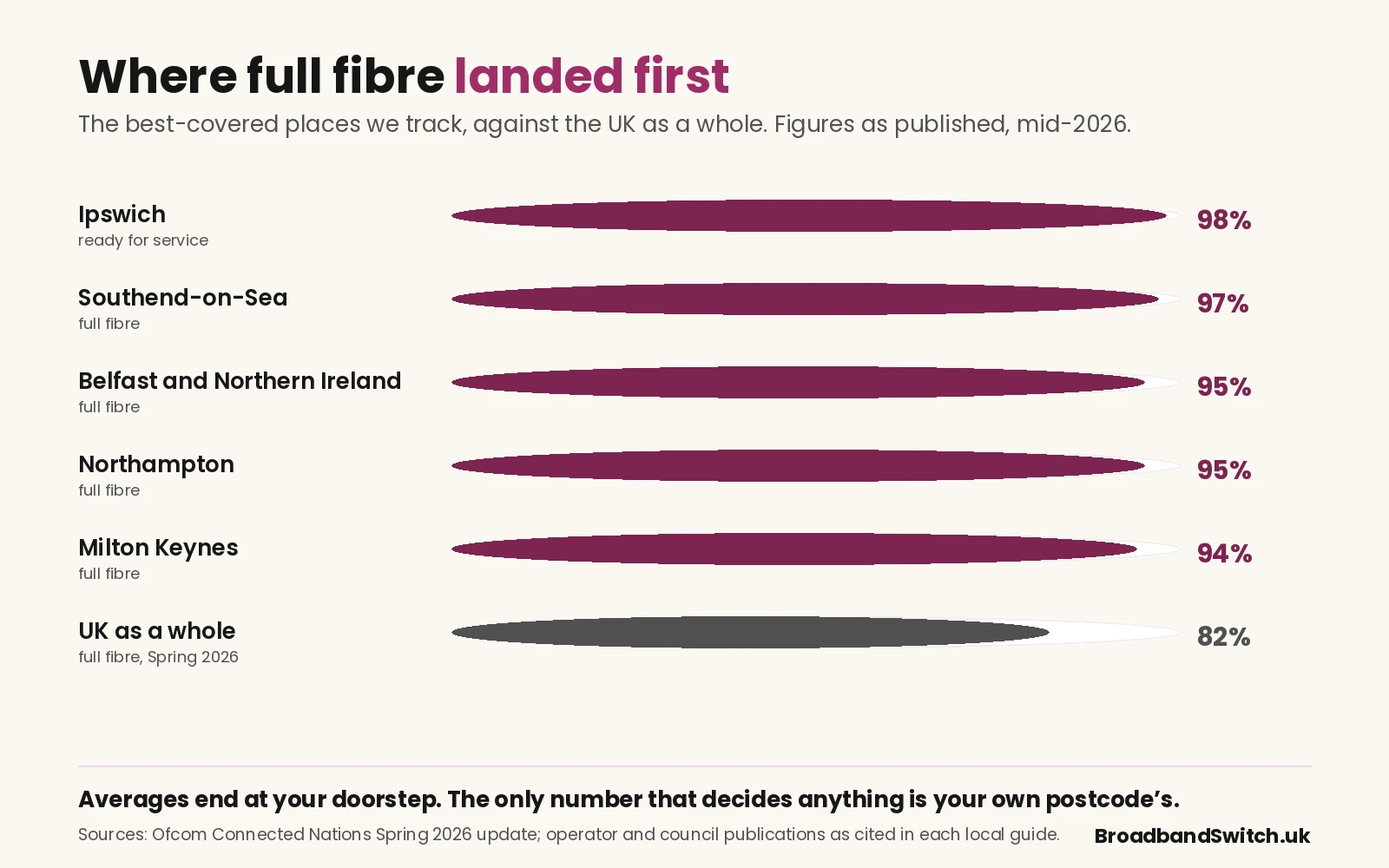
Coverage is nowhere near even. Northern Ireland leads every region at 95% full fibre, a handful of towns are close to complete after finished altnet builds, and the UK as a whole sits at 82% on Ofcom’s Connected Nations Spring 2026 update, which means almost one home in five still waits. Where you sit on this spread shapes both your speed options and, through altnet competition, your price. Our report The 82% Country digs into the Spring 2026 numbers.
And the April bill question
Location also decides whether you can dodge the annual rise. The big national providers add fixed amounts each April; many altnets, which only exist in the places they have built, charge flat prices with no mid-contract rise at all. If an altnet has reached your street, that is often the price lever.
- BT, EE and Plusnet £4.00
- Virgin Media (new contracts) £4.00
- Vodafone £3.50
- Virgin Media (in contract) £3.50
- Sky £3.00
- TalkTalk £3.00
- Three Broadband £3.00
- Several altnets £0.00
Fixed April 2026 monthly rises on the main national providers against the flat-price altnets, per provider announcements; qualifying contract dates apply on Vodafone, TalkTalk and Three. Full schedule and dates in the price rises guide. Verified before each April.
Greater London
The most competitive broadband market in the country: Openreach, Virgin Media with Nexfibre, CityFibre and the strongest altnet field anywhere, led by Community Fibre across most boroughs and Hyperoptic in apartment blocks. Around two thirds of inner London homes can already order full fibre, and the fastest widely sold packages reach 5 Gbit/s.
South East England
Strong almost everywhere, with toob building across Hampshire, CityFibre's Slough build complete and its £40 million Medway programme under way. Milton Keynes stands out at roughly 94% full fibre with the densest altnet coverage in the country.
East of England and East Anglia
Ipswich is one of Britain's best-connected towns, roughly 98% ready for service after CityFibre's completed build, with Southend close behind at about 97% full fibre. Norwich, Peterborough and Luton each carry their own CityFibre programme, and Project Gigabit is filling in the villages.
South West England
Bristol anchors the region with strong full fibre and growing altnet competition, Swindon performs strongly across the SN postcodes, and Plymouth's coastal market continues to build out.
West Midlands
Birmingham's multi-network market leads the region, and the seven-borough companion guide adds street-level context across the wider metropolitan area, with Coventry and Stoke-on-Trent completing the set.
East Midlands
Leicester is one of the strongest regional markets in Britain at roughly 90% full fibre with 84% of homes able to choose an altnet, Northampton runs at about 95% full fibre, and Nottingham fields one of the busiest multi-altnet line-ups outside London.
Yorkshire and the Humber
From Leeds and Sheffield through the Dearne Valley, plus the single most distinctive market in the country: Hull, where KCOM's full-fibre network covers essentially every home and MS3, CityFibre and Grain now compete on the same streets.
North West England
Manchester runs at roughly 88% full fibre with two thirds of the city able to choose an altnet, the ten-borough Greater Manchester companion covers the rest of the conurbation, and Preston's YouFibre build sells the region's fastest connections at up to 7 Gbit/s symmetric.
North East England
Newcastle and Sunderland lead the region's markets, and the Tyneside and Teesside companions cover the two conurbations end to end, Gateshead to Hartlepool.
Scotland
Greater Glasgow hosts CityFibre's largest city build anywhere in the UK, £270 million and over 2,600 km of fibre across seven councils, alongside Openreach's £100 million-plus Glasgow programme and YouFibre's Lanarkshire towns at up to 7 Gbit/s. Edinburgh and Aberdeen carry strong markets of their own.
Wales
Cardiff is the strongest Welsh market, with CityFibre building alongside Openreach and Virgin Media, while Swansea and Newport continue to grow and Project Gigabit reaches into the valleys.
Northern Ireland
The best-covered corner of the UK: 95% full fibre, the highest of any region, with Belfast at the centre and Fibrus building beyond it.
Three markets unlike anywhere else
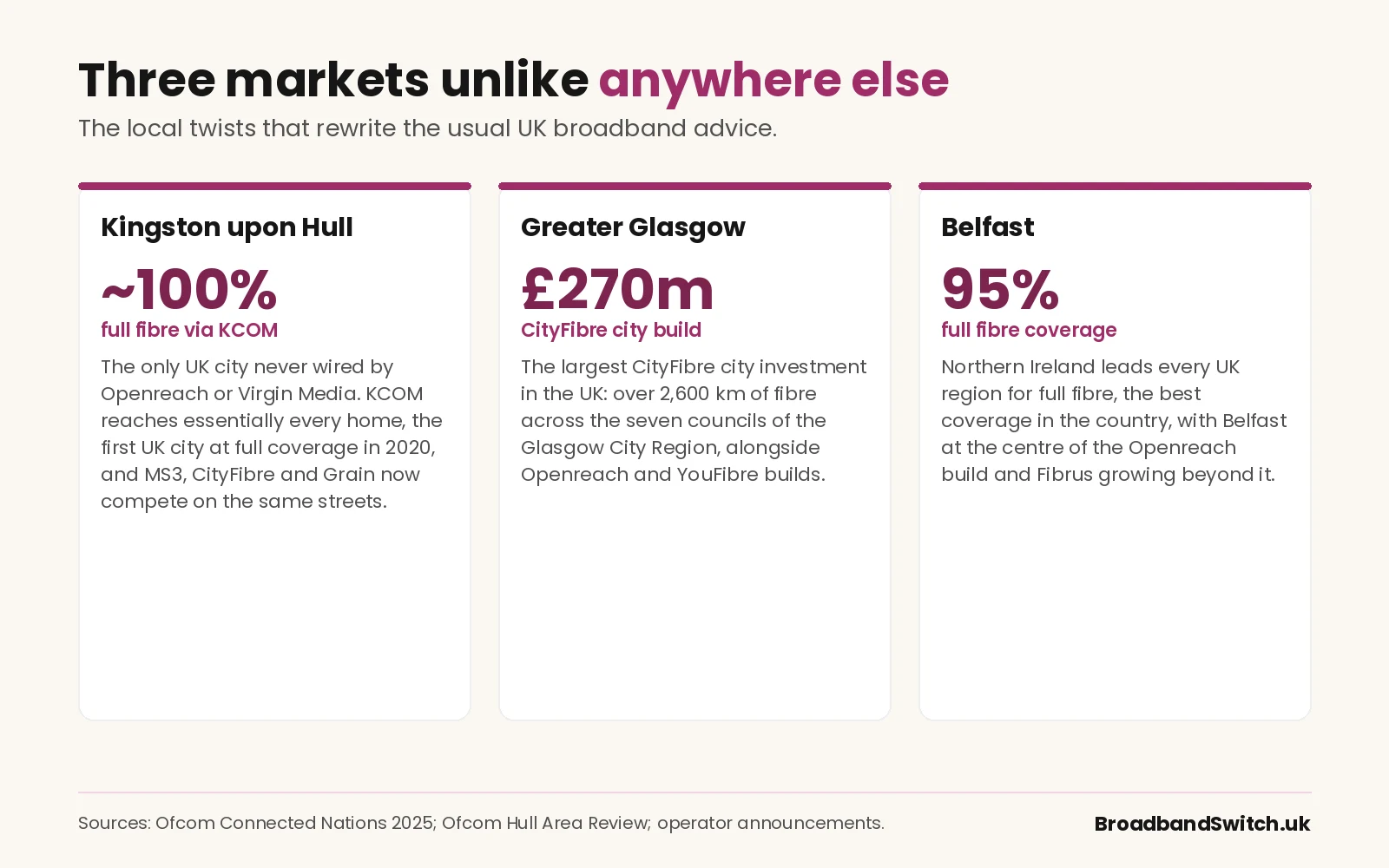
Hull deserves the longest look: the only city in the country that Openreach and Virgin Media never wired, served instead by KCOM's network reaching essentially every home since 2020, now with roughly seven in ten premises also able to pick MS3, CityFibre or Grain, and one of the UK's most flexible social tariffs in KCOM Flex at £14.99 a month. The Hull guide tells the whole story.
Moving house? Check the new address before you commit to anything: the moving and renting hub covers the whole sequence, availability checks before you move included. And if your area is rural, the rural switching guide covers Project Gigabit, community networks and the 4G, 5G and satellite fallbacks.
Whatever the local picture, only one list matters: the networks and prices at your exact address.
Independent and free. Takes about 30 seconds.Frequently asked questions
Why can my neighbour get full fibre when I cannot?
Because networks are built street by street, not postcode by postcode. Fibre follows ducts, poles and cabinets, so a build can stop at a junction, skip a cul-de-sac, or cover one side of a road first. That is why two neighbouring addresses can see different provider lists, and why the only reliable answer is a check on your exact address rather than anything written about your city.
Is broadband really better or cheaper in some places?
Genuinely, yes, on both counts. Northern Ireland leads the regions at 95% full fibre while the UK overall sits at 82, and towns with completed altnet builds, Ipswich near 98% ready for service, Southend about 97, Northampton and Milton Keynes in the mid-nineties, enjoy both faster options and keener prices, because competition on your street is what pushes bills down. Where an altnet has built, flat-price deals with no April rise are often on the menu.
What is an altnet, and is it safe to switch to one?
An alternative network: a company that built its own fibre rather than reselling Openreach's, such as Hyperoptic, Community Fibre, toob or YouFibre. They are regulated by Ofcom like any provider, One Touch Switch handles the move, the 14-day cooling-off applies, and a Guaranteed Minimum Speed comes with the contract. The practical differences are smaller footprints and, often, symmetric speeds and flat pricing that the majors do not match.
My town is not listed here. What should I do?
Run the postcode check anyway: it covers every UK address, listed or not, and shows exactly which networks have reached yours. The local guides grow over time, and the counts on this page update as they do, but no guide is ever required, since the check is the ground truth. If your area is rural, the rural switching guide covers Project Gigabit builds, community networks like B4RN, the Universal Service Obligation, and 4G, 5G and satellite options.
How do I find out exactly what my address can get?
One postcode check on this site shows every network and live price at your address, majors and altnets together, in about 30 seconds. Your local guide is the context around that answer: who built what nearby, what the local twist is, and which direction prices are moving. Context first if you like reading, check first if you like answers; both roads end at the same place.
Do broadband prices rise everywhere each April?
The national providers add fixed amounts: £4 a month on BT, EE, Plusnet and new Virgin Media contracts, £3.50 on Vodafone and in-contract Virgin Media, £3 on Sky, TalkTalk and Three, with qualifying contract dates on some. Many altnets add nothing at all, which is the quiet advantage of living where one has built. The rises are pounds-and-pence and shown before you sign, so the full contract cost is checkable up front.
Why is Hull always the exception?
Because it is the only UK city that Openreach and Virgin Media never wired. KCOM runs the local network, reaching essentially every home with full fibre since 2020, when Hull became the first UK city at complete coverage, and competition has since arrived on top through MS3, CityFibre and Grain, now reaching roughly seven in ten premises. Standard national advice barely applies there, which is exactly why the dedicated Hull guide exists.
How current is this page?
The guide counts are read from the page itself every time it loads, so they stay correct as new local guides are added, with the stated baseline accurate as of 5 August 2026. Coverage percentages and the April rise schedule are editorial figures carried from the cited sources at mid-2026, sit inside the site's 90-day review cycle, and anything that slips can be flagged through the public corrections process.
How we put this hub together. Compiled by Adrian James and reviewed by Dr Alex J. Martin-Smith from the live BroadbandSwitch.uk location cluster, current at August 2026. Guide counts are computed from this page's own markup in the browser, so they cannot drift as the cluster grows; coverage figures draw on Ofcom's Connected Nations 2025, Ofcom's Hull Area Review, Switchity's coverage analysis and operator announcements as cited in each local guide, and carry their as-published dates. The framework behind every guide: our editorial policy, methodology and trust hub and affiliate disclosure. Spotted something out of date? Use the corrections process or contact us.
References
- Ofcom. (2025, November 19). Connected Nations UK report 2025. Office of Communications. https://www.ofcom.org.uk/phones-and-broadband/coverage-and-speeds/nations-report-2025
- Ofcom. (2025, December). Promoting competition and investment in fibre networks: Hull Area Review 2026-31. Office of Communications. https://www.ofcom.org.uk
- Ofcom. (n.d.). Switching broadband provider. Office of Communications. Retrieved August 5, 2026, from https://www.ofcom.org.uk/phones-and-broadband/switching-provider
- Switchity. (n.d.). UK broadband area coverage analysis. Retrieved August 5, 2026, from https://switchity.co.uk