Broadband, phone and TV deals: one bill, and what happens when you change one part of it
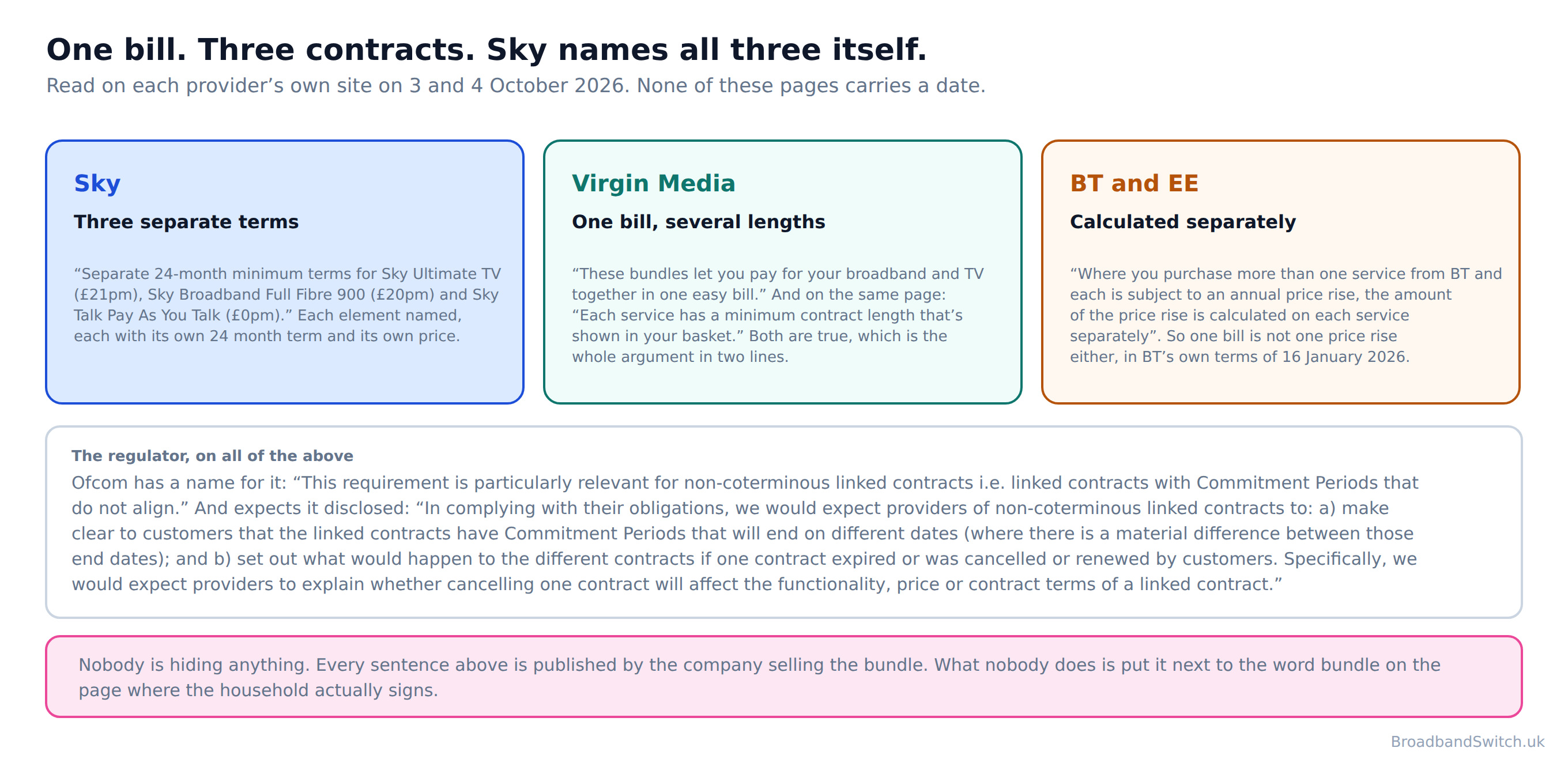
A triple play bundle is one bill and it is not one contract. Sky publishes it plainly in the small print of the page that sells them together: “Separate 24-month minimum terms for Sky Ultimate TV (£21pm), Sky Broadband Full Fibre 900 (£20pm) and Sky Talk Pay As You Talk (£0pm).” Virgin Media says the same on its own sales page: “Each service has a minimum contract length that's shown in your basket.”
So the elements end on different dates, rise by different rules and cost different amounts to leave. BT itemises its own bundle rise rather than giving one figure: “On 31 March each year the monthly price shown for broadband plans will increase by £4 and for TV plans by £2 (if you take Broadband and TV that's £6 in total).” At TalkTalk the annual rise “This will only impact the price you pay for your broadband service.”
And the practical one, which is where households actually get caught. Ofcom, on a page it updated on 25 August 2026: “If your bundle also includes other types of services, such as TV, you might need to contact your current provider to cancel those.” Switch your broadband and the TV does not come with it.
Start with your postcode
Which providers can sell you all three depends on what reaches your address, and in most of the country it is fewer than four. Check the exact address rather than the postcode.
About to switch your broadband? Read what the switch does not move first, because it is the expensive mistake. Want the answer for your own bundle? Answer three questions and see which jobs are yours.
The short version, in a minute
Direct answer: One bill, several contracts, several end dates, and a switch that moves some of them and not others.
Nothing on this page argues against buying a bundle. The one bill is a genuine convenience, the content is the same content, and for a household that wants all three from one place it is a perfectly sensible purchase.
The argument is narrower and it is entirely built from what the providers publish about themselves. There are several contracts behind that one bill. They end on different dates. They rise by different rules, which differ by provider rather than by any industry standard. And when you switch your broadband, the television stays where it is and keeps billing.

If you are looking at Sky specifically, our Sky TV guide compares the four routes into Sky content and the very different commitments they carry. If the phone part is what you are unsure about, our digital voice guide covers what is happening to landlines.
One bill, several clocks
Direct answer: Sky names three separate terms in its own small print. Virgin Media says the same on its sales page.
Here is Sky, on the page that sells them together: “Separate 24-month minimum terms for Sky Ultimate TV (£21pm), Sky Broadband Full Fibre 900 (£20pm) and Sky Talk Pay As You Talk (£0pm).” Three elements, three terms, each with its own price. That is not buried in a contract PDF; it is in the small print of the commercial page.

And Virgin Media, which puts both halves of the story on one page. The selling sentence: “These bundles let you pay for your broadband and TV together in one easy bill.” And a few lines away: “Each service has a minimum contract length that's shown in your basket.” Both are true. Read together they are the whole argument of this page in two lines.
Virgin also publishes what that costs you if you want out: its early disconnection fee depends on “the services you have, how much you pay for those services (including any discounts or offers), and how much of your minimum period remains for each service.” Several separate clocks, and no way to work out the total without asking.
The regulator has a name for it
Ofcom: “This requirement is particularly relevant for non-coterminous linked contracts i.e. linked contracts with Commitment Periods that do not align.” And it expects the providers to say so: “In complying with their obligations, we would expect providers of non-coterminous linked contracts to: a) make clear to customers that the linked contracts have Commitment Periods that will end on different dates (where there is a material difference between those end dates); and b) set out what would happen to the different contracts if one contract expired or was cancelled or renewed by customers. Specifically, we would expect providers to explain whether cancelling one contract will affect the functionality, price or contract terms of a linked contract.”
Read the last clause of that again, because it is the thing households are least warned about. Dropping one element can move the price of the others, the regulator expects you to be told so, and most providers do tell you, in the footnote.
The rises, which all differ
Direct answer: Four providers, four different answers. At one of them the television does not rise at all.
There is no such thing as the annual bundle rise in this market, which is worth knowing before anybody tells you how it works. A household that learns the rule at one provider has learnt nothing useful about the next.
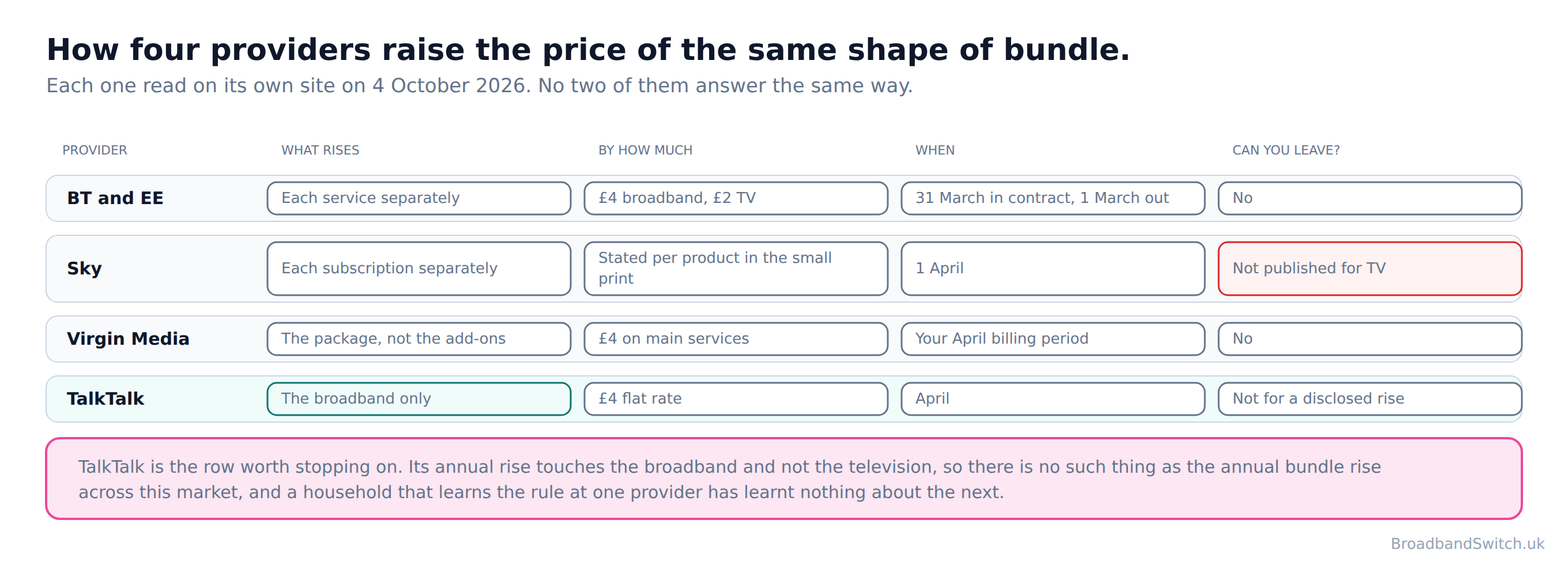
BT itemises it, in plain English, on its own TV packages page: “On 31 March each year the monthly price shown for broadband plans will increase by £4 and for TV plans by £2 (if you take Broadband and TV that's £6 in total).” And explains why in its terms: “Where you purchase more than one service from BT and each is subject to an annual price rise, the amount of the price rise is calculated on each service separately”
Virgin Media does the opposite, and applies one figure to the package: “The monthly subscription charge for your main services will increase by £4”. With an exclusion: “This price increase only applies to your main services and not any add-ons”. And a timing that is keyed to you rather than to a date: “You'll see changes on your bill from your April billing period onwards.”
And TalkTalk publishes the most unusual rule in the market: the rise “This will only impact the price you pay for your broadband service.” Its amount: “From 16 November 2025 we're changing our annual price increases on broadband plans to a flat rate of £4.” Its timing: “Any planned increases will be applied each April, starting in 2026.” And the television it sells alongside does not rise with any of it.
And none of them lets you leave because of it
BT's terms: “The change to your subscription charge as a result of the annual increases will not give you the right to terminate this agreement during the minimum term without paying an early termination charge.” Virgin Media's own page: “you won't be given a right to cancel your agreement during your minimum period without incurring an early disconnection fee”
The reason is the same at both and it is a reasonable one. Ofcom's exit right attaches to a CHANGE made to your detriment: “they must give you at least one month's notice and a right to exit the contract without penalty if the change does not benefit you.” A rise that was set out in pounds and pence when you signed is not a change, it is the deal. That is why providers moved to publishing figures rather than inflation formulas: “From 17 January 2025, phone, broadband and pay TV providers will be prohibited from including inflation-linked, or percentage-based, price rise terms in all new contracts.”
The switch that leaves your TV behind
Direct answer: One Touch Switch moves the broadband and the landline. The television stays, and keeps billing.
This is the most practically useful thing on the page, it costs one phone call to avoid, and almost nothing written about bundles mentions it.
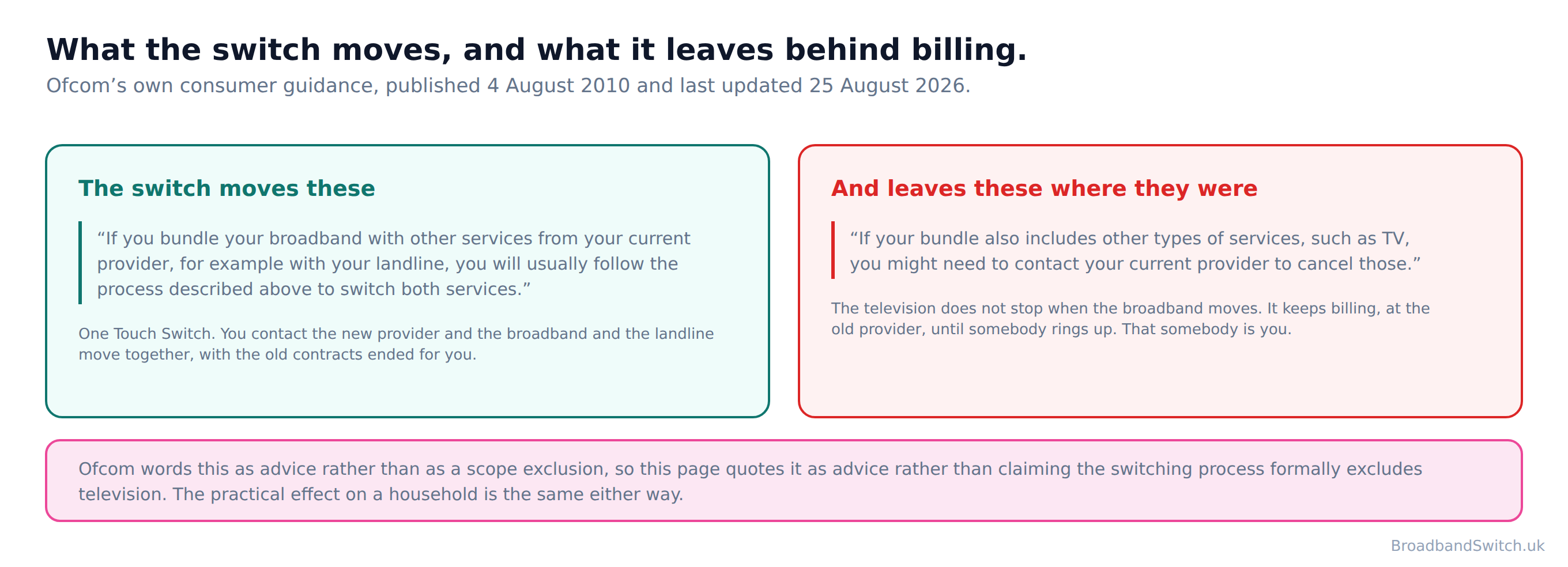
Ofcom, on its own consumer guidance page, last updated on 25 August 2026. First what the switch carries: “If you bundle your broadband with other services from your current provider, for example with your landline, you will usually follow the process described above to switch both services.”
Then what it does not: “If your bundle also includes other types of services, such as TV, you might need to contact your current provider to cancel those.” So the household that switches broadband and assumes the whole bundle went with it is often still paying a television subscription at the old provider three months later, and the first they know of it is the bank statement.
We are quoting Ofcom as advice rather than as a rule, because that is how Ofcom words it. No Ofcom page found states that the switching process formally excludes television. The practical effect on a household is the same either way, and the fix is the same: ring up and cancel it by name, on the day the broadband switch completes.
What depends on what
Direct answer: The television needs the broadband. The broadband does not need the television.
The dependency runs one way, and knowing which way decides what is possible. BT's EE TV terms, effective from 16 January 2026: “Sometimes we can only provide you with the service if you also have one of our other services. If one service ends or is suspended, we might need to end or suspend the other.” In practice that means one thing. EE TV requires an EE broadband connection, so cancelling the broadband ends the TV.
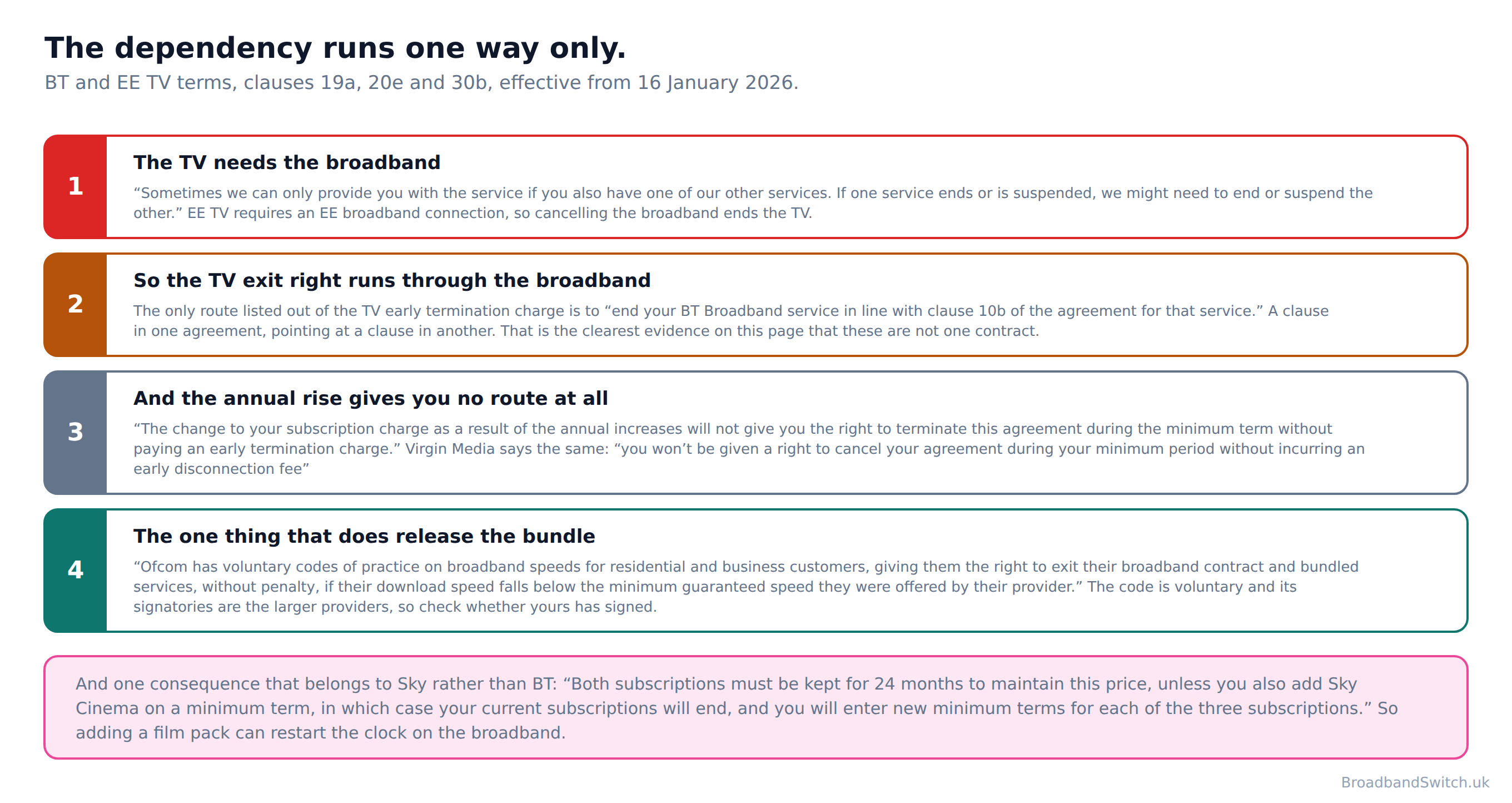
Which produces the single clearest piece of evidence on this page that a bundle is not one contract. The only published route out of the TV early termination charge is to “end your BT Broadband service in line with clause 10b of the agreement for that service.” A clause in one agreement, pointing at a clause in another agreement, for a different service.
Sky publishes the consequence from the other direction, and it is the sentence we would most want a household to read before agreeing to anything: “Both subscriptions must be kept for 24 months to maintain this price, unless you also add Sky Cinema on a minimum term, in which case your current subscriptions will end, and you will enter new minimum terms for each of the three subscriptions.” Adding a film pack can restart the clock on the broadband.
And one case where the broadband does release everything
Ofcom: “Ofcom has voluntary codes of practice on broadband speeds for residential and business customers, giving them the right to exit their broadband contract and bundled services, without penalty, if their download speed falls below the minimum guaranteed speed they were offered by their provider.” That is the one route in this whole subject where a problem with one element lets you out of all of them. The code is voluntary and its signatories are the larger providers, so check whether yours has signed before relying on it.
And if a genuine exit right does arise, you are not forced to take all or nothing. Ofcom: “Where a customer has the right to exit a bundle of services and/or terminal equipment (where applicable) as a result of a contractual modification falling under Conditions C1.14 and C1.15, they should have the choice to exit the whole bundle, retain the whole bundle or retain the elements that are not subject to the contractual modification (where those elements are offered by the provider separately to the service that is subject to the contractual modification), if they so wish.” Read that carefully, because it is easy to over-read: it says that where the right exists you choose, not that a price rise creates one.
What happens if you change one part?
Direct answer: Three questions, and five jobs sorted into the ones with a deadline and the ones you can leave.
The second question decides most of it, because the four things a household might want to do here are not variations on one job. Leaving is several cancellations. Dropping the television can put the price of the rest up. Switching the broadband is the one where the television is left behind. And renewing resets every clock in the bundle at once.
It runs entirely in your browser. There is no form to submit, nothing sent to any server and nothing stored.
Three questions, and five jobs sorted into the ones with a deadline and the ones you can leave
The second question sorts the rows, because the four things a household might do with a bundle pull in four different directions. Nothing you answer here leaves your browser.

The four providers, and why there are really three
Direct answer: Two of the four names belong to the same product, so most guides to this subject count one option too many.
BT TV and EE TV are now one product on one set of terms, published on bt.com under the heading EE TV terms and conditions and effective from 16 January 2026. Anywhere else on this site that lists them as two separate triple play options is on the standing list to be corrected, and that correction is at the foot of this page.
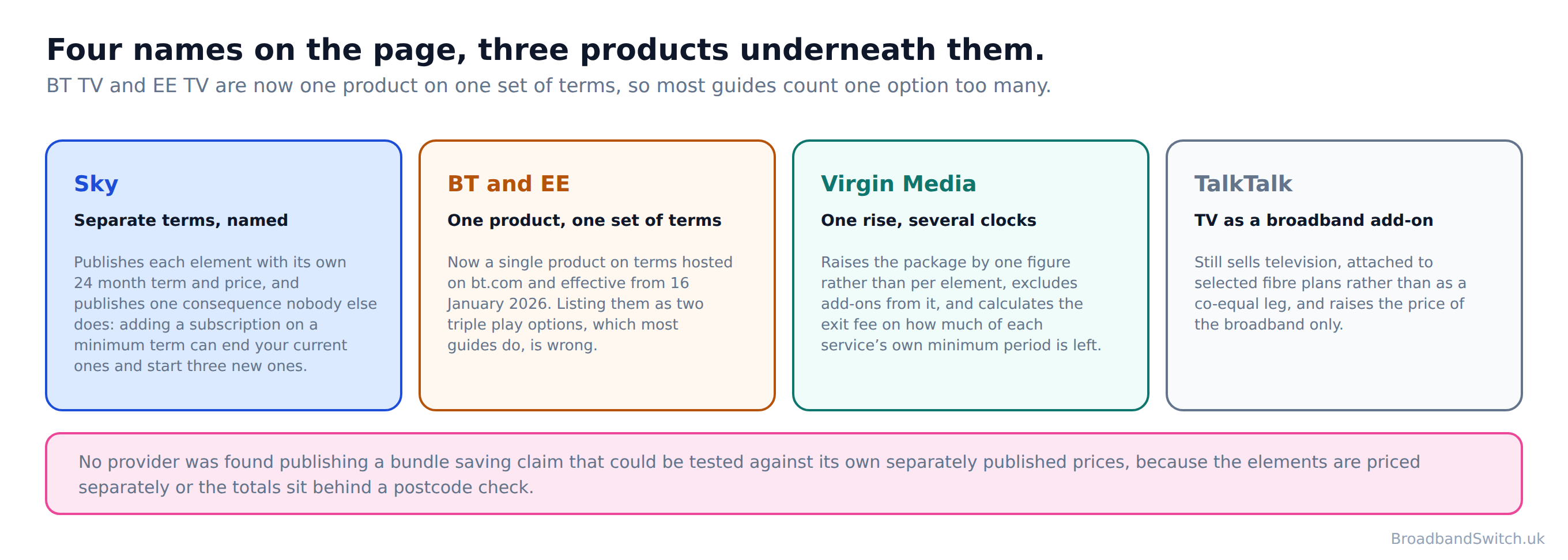
TalkTalk is the fourth and it is a different shape from the other three: it sells television attached to selected fibre plans rather than as a co-equal leg of a bundle, and its annual rise touches the broadband only. It also publishes the one claim on this page we would correct.
No lengthy contracts, and the same page's own answer
TalkTalk's TV Hub page carries the callout “No lengthy contracts”. In the FAQ on the same page: “The length of the contract varies by product and will be shown clearly when you view individual plans, so you can review it before committing.” The page also says some add-ons or services may have their own minimum commitment periods, and TalkTalk's own customer terms cap those at no longer than 24 months.
A reader meeting that headline cold would not expect a two year commitment on anything in the basket, and the page's own small print concedes there may be one. We are not saying TalkTalk is hiding it, because the answer is on the same page. We are saying the two sentences should not both be on it.

And one thing nobody publishes
No provider was found publishing a bundle saving claim that could be tested against its own separately published prices, because the elements are priced separately or the totals sit behind a postcode check. So this page cannot tell you whether a bundle saves you money, because no provider publishes enough for anybody to check without entering an address. What it can tell you is which question to ask, and the question is what each element costs on its own.
What Ofcom expects them to tell you
Direct answer: Most of what this page says, the regulator already expects the providers to say.
Which is worth stating plainly, because it would be easy to read this page as an accusation and it is not one. Ofcom set out what a provider has to disclose about a bundle in 2022, and the providers largely do disclose it. The problem is where.

On the contract summary itself, Ofcom set the page counts: “Individual mobile, broadband, landline and pay-TV contract summaries should be no longer than one page. Bundled contract summaries can run to no more than three pages.” One bill, three pages, which is the regulator conceding the complexity in the paperwork rather than in the marketing.
On being told when things end, pay TV is expressly in scope: “Our new requirements will mean broadband, mobile, home phone and pay TV companies must notify their residential and business customers when their minimum contract period is coming to an end.” And out of contract, “All customers who remain out-of-contract will also be given best tariff information by their provider at least annually.” Since the elements end on different dates, expect several of those notices at different times rather than one.
We looked for an Ofcom sentence addressing bundles specifically within the end of contract rules and did not find one, so this page does not claim there is one. The rules name pay TV and broadband as services, and the consequence for a household with a bundle follows from that rather than from anything Ofcom wrote about bundles.

The add-ons, which are the seam inside the seam
Virgin Media: “This price increase only applies to your main services and not any add-ons”. And Sky: “Both subscriptions must be kept for 24 months to maintain this price, unless you also add Sky Cinema on a minimum term, in which case your current subscriptions will end, and you will enter new minimum terms for each of the three subscriptions.” So the element a household adds most casually, usually a sport or film pack, is the one with the least predictable consequences for everything else on the bill.
Live bundles at your postcode
Direct answer: The list below is the only place this page can tell you who can actually sell you all three.
The check below shows every provider that reaches the address, lowest price first. Before you choose, ask the one question this page exists to supply: what does each element cost on its own, and when does each one end?
Every provider that reaches your address
Put the address in once and every provider that reaches it comes back, cheapest first. Ask what each element costs separately before you sign for all three.
Compare at your postcode →What this page used to say, and why it changed
Direct answer: Three corrections, and the second one could have cost a reader money.
The old version of this page had an intersection test in which all three elements had to pass, which is a reasonable idea built on nothing: no provider terms were read and nothing was quoted. This version quotes four providers and the regulator, and the three things it got wrong are below.
Treating a bundle as one contract with one end date
What this page said
That a triple play bundle ran for one minimum term and ended on one date, which is how the old version of this page described it throughout.
What it says now, and why
The providers publish the opposite in their own small print. Sky: “Separate 24-month minimum terms for Sky Ultimate TV (£21pm), Sky Broadband Full Fibre 900 (£20pm) and Sky Talk Pay As You Talk (£0pm).” Virgin Media: “Each service has a minimum contract length that's shown in your basket.” And Ofcom has a name for it: “This requirement is particularly relevant for non-coterminous linked contracts i.e. linked contracts with Commitment Periods that do not align.”
Saying a switch moves the whole bundle
What this page said
That switching provider moved every service in a bundle together, which this page said and which the switching guide on this site implied.
What it says now, and why
Ofcom's own consumer guidance, on a page last updated 25 August 2026: “If you bundle your broadband with other services from your current provider, for example with your landline, you will usually follow the process described above to switch both services.” And then: “If your bundle also includes other types of services, such as TV, you might need to contact your current provider to cancel those.” So broadband and landline move together under One Touch Switch and the TV does not, which is how a household ends up paying a TV subscription at a provider it has already left.
Counting the same product twice
What this page said
That BT and EE were two separate triple play providers, giving five options in total.
What it says now, and why
BT TV and EE TV are now one product on one set of terms, published on bt.com under the heading EE TV terms and conditions and effective from 16 January 2026. So this page counts them once, and anywhere else on this site that lists them separately is on the standing list to be fixed.
Broadband, phone and TV bundles: frequently asked questions
Is a broadband, phone and TV bundle one contract?
No, and the providers say so themselves. Sky: “Separate 24-month minimum terms for Sky Ultimate TV (£21pm), Sky Broadband Full Fibre 900 (£20pm) and Sky Talk Pay As You Talk (£0pm).” Virgin Media, on its own sales page: “Each service has a minimum contract length that's shown in your basket.” Ofcom calls the arrangement non-coterminous linked contracts and expects providers to make the different end dates clear.
If I switch broadband, does my TV come with it?
Not under One Touch Switch. Ofcom: “If you bundle your broadband with other services from your current provider, for example with your landline, you will usually follow the process described above to switch both services.” And then the sentence households get caught by: “If your bundle also includes other types of services, such as TV, you might need to contact your current provider to cancel those.” So the broadband and the landline move and the TV is left where it was, still billing.
Does the annual price rise apply to the whole bundle?
It depends entirely on the provider, which is the point of this page. BT itemises it: “On 31 March each year the monthly price shown for broadband plans will increase by £4 and for TV plans by £2 (if you take Broadband and TV that's £6 in total).” Virgin applies one figure to the package: “The monthly subscription charge for your main services will increase by £4”. And at TalkTalk it “This will only impact the price you pay for your broadband service.”
Can I leave because they put the price up?
Not if the rise was disclosed when you signed, which it now has to be. BT's own terms: “The change to your subscription charge as a result of the annual increases will not give you the right to terminate this agreement during the minimum term without paying an early termination charge.” Virgin's own page: “you won't be given a right to cancel your agreement during your minimum period without incurring an early disconnection fee”. Ofcom explains why: a rise set out in advance is not a change, and the exit right attaches to changes.
When does the right to exit actually apply?
When the provider changes something to your detriment that was not disclosed. Ofcom: “they must give you at least one month's notice and a right to exit the contract without penalty if the change does not benefit you.” With three exceptions: “However, you won't have the right to exit the contract if the change being made is: 1. exclusively to your benefit, for example a speed upgrade; 2. purely administrative and has no negative effect on you, for example a change in the address or bank details of your provider; or 3. directly imposed by law, for example, a change in the rate of VAT.”
If I can leave, do I have to leave the whole bundle?
No, and Ofcom is explicit about the choice. “Where a customer has the right to exit a bundle of services and/or terminal equipment (where applicable) as a result of a contractual modification falling under Conditions C1.14 and C1.15, they should have the choice to exit the whole bundle, retain the whole bundle or retain the elements that are not subject to the contractual modification (where those elements are offered by the provider separately to the service that is subject to the contractual modification), if they so wish.” Read it carefully, though: it says that where an exit right exists you choose, not that a rise on one element creates one.
Can I drop the TV and keep the broadband?
Usually, and it may cost you twice. BT's terms warn about the price of what is left: dropping one service can increase the charges on another. And Virgin's early disconnection fee depends on “the services you have, how much you pay for those services (including any discounts or offers), and how much of your minimum period remains for each service.” Sky goes further: “Both subscriptions must be kept for 24 months to maintain this price, unless you also add Sky Cinema on a minimum term, in which case your current subscriptions will end, and you will enter new minimum terms for each of the three subscriptions.”
Can I keep the TV and drop the broadband?
At BT and EE, probably not. Their terms: “Sometimes we can only provide you with the service if you also have one of our other services. If one service ends or is suspended, we might need to end or suspend the other.” In practice that means one thing. EE TV requires an EE broadband connection, so cancelling the broadband ends the TV.
What does it cost to leave a TV contract early?
At BT and EE the TV has its own early termination charge, and the only published way out of it runs through the broadband: “end your BT Broadband service in line with clause 10b of the agreement for that service.” So the TV exit right is parasitic on the broadband exit right, which is the clearest evidence on this page that these are not one contract.
Is there any case where a problem with the broadband releases the whole bundle?
Yes, one, and it is worth knowing. Ofcom: “Ofcom has voluntary codes of practice on broadband speeds for residential and business customers, giving them the right to exit their broadband contract and bundled services, without penalty, if their download speed falls below the minimum guaranteed speed they were offered by their provider.” The code is voluntary and its signatories are the larger providers, so check whether yours has signed.
Do bundles really need a longer contract summary?
Ofcom set the page counts itself: “Individual mobile, broadband, landline and pay-TV contract summaries should be no longer than one page. Bundled contract summaries can run to no more than three pages.” One bill, three pages of contract summary.
Will I be told when each part of my bundle ends?
You should be, and for each service rather than once. Ofcom's end of contract notification rules cover pay TV as well as broadband: “Our new requirements will mean broadband, mobile, home phone and pay TV companies must notify their residential and business customers when their minimum contract period is coming to an end.” And out of contract, “All customers who remain out-of-contract will also be given best tariff information by their provider at least annually.” Since the elements end on different dates, expect several notices at different times.
In short
- One bill is not one contract, and the providers publish that themselves.
- Sky: “Separate 24-month minimum terms for Sky Ultimate TV (£21pm), Sky Broadband Full Fibre 900 (£20pm) and Sky Talk Pay As You Talk (£0pm).”
- Virgin Media, on its own sales page: “Each service has a minimum contract length that's shown in your basket.”
- Virgin Media, on the same page: “These bundles let you pay for your broadband and TV together in one easy bill.”
- Both of those sentences are true, which is the whole argument in two lines.
- BT itemises its own bundle rise: “On 31 March each year the monthly price shown for broadband plans will increase by £4 and for TV plans by £2 (if you take Broadband and TV that's £6 in total).”
- BT's terms, on why: “Where you purchase more than one service from BT and each is subject to an annual price rise, the amount of the price rise is calculated on each service separately”
- Virgin applies one figure to the package: “The monthly subscription charge for your main services will increase by £4”
- And excludes add-ons: “This price increase only applies to your main services and not any add-ons”
- Virgin's rise lands “You'll see changes on your bill from your April billing period onwards.”
- At TalkTalk the rise “This will only impact the price you pay for your broadband service.”
- TalkTalk: “From 16 November 2025 we're changing our annual price increases on broadband plans to a flat rate of £4.”
- TalkTalk: “Any planned increases will be applied each April, starting in 2026.”
- None of those rises gives you a way out.
- BT: “The change to your subscription charge as a result of the annual increases will not give you the right to terminate this agreement during the minimum term without paying an early termination charge.”
- Virgin: “you won't be given a right to cancel your agreement during your minimum period without incurring an early disconnection fee”
- Ofcom, on when the exit right does apply: “they must give you at least one month's notice and a right to exit the contract without penalty if the change does not benefit you.”
- And the three exceptions: “However, you won't have the right to exit the contract if the change being made is: 1. exclusively to your benefit, for example a speed upgrade; 2. purely administrative and has no negative effect on you, for example a change in the address or bank details of your provider; or 3. directly imposed by law, for example, a change in the rate of VAT.”
- Where a right exists, Ofcom says you choose: “Where a customer has the right to exit a bundle of services and/or terminal equipment (where applicable) as a result of a contractual modification falling under Conditions C1.14 and C1.15, they should have the choice to exit the whole bundle, retain the whole bundle or retain the elements that are not subject to the contractual modification (where those elements are offered by the provider separately to the service that is subject to the contractual modification), if they so wish.”
- The switch does not move the TV.
- Ofcom: “If you bundle your broadband with other services from your current provider, for example with your landline, you will usually follow the process described above to switch both services.”
- Ofcom: “If your bundle also includes other types of services, such as TV, you might need to contact your current provider to cancel those.”
- The elements depend on each other, in one direction.
- BT: “Sometimes we can only provide you with the service if you also have one of our other services. If one service ends or is suspended, we might need to end or suspend the other.”
- BT: “end your BT Broadband service in line with clause 10b of the agreement for that service.”
- EE TV requires an EE broadband connection, so cancelling the broadband ends the TV.
- Sky, on what adding one element does to the others: “Both subscriptions must be kept for 24 months to maintain this price, unless you also add Sky Cinema on a minimum term, in which case your current subscriptions will end, and you will enter new minimum terms for each of the three subscriptions.”
- Ofcom has a name for all of this: “This requirement is particularly relevant for non-coterminous linked contracts i.e. linked contracts with Commitment Periods that do not align.”
- And expects it disclosed: “In complying with their obligations, we would expect providers of non-coterminous linked contracts to: a) make clear to customers that the linked contracts have Commitment Periods that will end on different dates (where there is a material difference between those end dates); and b) set out what would happen to the different contracts if one contract expired or was cancelled or renewed by customers. Specifically, we would expect providers to explain whether cancelling one contract will affect the functionality, price or contract terms of a linked contract.”
- BT TV and EE TV are now one product on one set of terms, published on bt.com under the heading EE TV terms and conditions and effective from 16 January 2026.
- No provider was found publishing a bundle saving claim that could be tested against its own separately published prices, because the elements are priced separately or the totals sit behind a postcode check.
Each line stands on its own and carries its date. Reviewed by a person at least quarterly, last on .
References
- ofcom.org.uk
Ofcom. Switching broadband provider. Published 4 August 2010, last updated 25 August 2026. The sentence that broadband and landline move together, and the sentence that a bundle’s other services may need cancelling separately. ofcom.org.uk
- ofcom.org.uk
Ofcom. Guidance under General Condition C1: contract requirements. June 2022, paragraphs 1.32, 1.33 and 1.95. The definition of non-coterminous linked contracts, what Ofcom expects providers to disclose about them, and the choice a customer gets where an exit right exists. ofcom.org.uk
- ofcom.org.uk
Ofcom. Ofcom bans mid-contract price rises linked to inflation. Published 19 July 2024. The pounds and pence rule, and the confirmation that pay TV is in scope. ofcom.org.uk
- ofcom.org.uk
Ofcom. Contracts. Published 24 July 2023, last updated 1 May 2026. The right to exit when a change does not benefit you, and the three exceptions. ofcom.org.uk
- ofcom.org.uk
Ofcom. New rules on short and simple contract details. Published 17 June 2022. One page for a single service, three for a bundle. ofcom.org.uk
- ofcom.org.uk
Ofcom. Helping consumers get better deals. Published 14 December 2018. End of contract notifications, which cover pay TV, and the annual best tariff notice. ofcom.org.uk
- ofcom.org.uk
Ofcom. Updating and clarifying customers’ right to exit contracts for broadband services. Published 11 May 2022. The one case where a broadband speed failure releases the bundled services too. ofcom.org.uk
- bt.com
BT. EE TV terms and conditions. Effective from 16 January 2026. Clauses 19a, 20e, 30b and 30c: the dependency between services, the exit route that runs through the broadband, the carve-out of the annual rise from the right to exit, and the statement that the rise is calculated on each service separately. BT TV and EE TV are one product on this one set of terms. bt.com
- bt.com
BT. TV packages. The itemised annual rise of £4 for broadband and £2 for TV, with BT’s own bracketed total. Carries no date, so read 4 October 2026 and read three times. bt.com
- sky.com
Sky. Deals. The separate 24-month minimum terms, named element by element with their prices, and the end of term uplift. Carries no date, so read 3 and 4 October 2026. sky.com
- sky.com
Sky. TV and broadband. The sentence about what adding Sky Cinema on a minimum term does to the subscriptions you already have, which is the single most consequential line in this research. sky.com
- virginmedia.com
Virgin Media. Annual price change. The £4 rise applied to the package rather than per element, the exclusion of add-ons, the April billing period and the absence of any exit right. Carries no date, so read 4 October 2026. virginmedia.com
- virginmedia.com
Virgin Media. Broadband packages. One easy bill and each service has a minimum contract length, on the same page. Read 4 October 2026. virginmedia.com
- virginmedia.com
Virgin Media. Early disconnection fees. What the fee depends on, including how much of the minimum period remains for each service. Read 4 October 2026. virginmedia.com
- talktalk.co.uk
TalkTalk. Annual price change policy. The flat £4 rate, the April application, and the sentence that it touches the broadband only. Carries no date, so read 4 October 2026. talktalk.co.uk
- talktalk.co.uk
TalkTalk. TV Hub. The No lengthy contracts callout and the FAQ on the same page conceding that contract length varies by product. Read twice on 4 October 2026. talktalk.co.uk
Ready to see what reaches your address?
One postcode shows every provider that reaches it, lowest price first. Ask what each element costs on its own, and when each one ends.
Compare at this postcode →