LIVERPOOL · FIVE SEATS · THIRTY WARDS
Broadband in Liverpool: full fibre by seat and ward, and what reaches your door
Liverpool is well on its way. In January 2026 Ofcom counted 88.1% of the city’s 219,000 homes able to get full fibre, against 82% for England, and 92.0% able to get a gigabit-capable line. The builders’ own plans take full fibre to 98.9% by January 2029, which would lift the city from fifth to second of England’s eight core cities.
What gaps remain sit close together. Of the 5,830 homes that cannot get 30Mbit/s, 60 in every hundred are in one ward, Central, and 84% are in one seat, Riverside. Across most of the city the fibre is already in the street, and the next step is yours: 45% of homes that could have full fibre had ordered it. Openreach’s own table, meanwhile, puts Liverpool first of ten big cities in moving off the old phone network, with 6.35% of its 2020 lines still to go.
Each figure below carries a date and a source, whether that is Ofcom, the 2021 census, Openreach or a company speaking for itself. Inside you will find all five Westminster seats and the thirty wards they are built from, every network in its own words, each exchange with its copper date, and what the 2029 plans bring. Your own postcode has the last word. Across the water? Our Birkenhead page covers the Wirral side.
Want the figures for your own neighbourhood? The ward card has them, and the five seats sit side by side further down. Only after a deal? Go straight to the postcode box.
Begin at your own front door
Direct answer: Liverpool’s broadband is good and getting better, but it is not the same on every street. Full fibre reaches 88.1% of homes on Ofcom’s count and a gigabit-capable line 92.0%, and the builders expect to give 89.2% a choice of two gigabit networks by 2029. To find out which side of those numbers you are on, the quickest route is your postcode.
Most Liverpool homes can pick between Openreach and Virgin Media, and in many streets a third name joins them: the Netomnia network, sold as YouFibre; Grain, in the districts north and east of the centre that it names; and Hyperoptic in some apartment blocks. Further down, each one is quoted in its own words and dated. That explains the list your postcode brings up, and why the house across the road may be on a different network from yours.
The city centre, where most slow lines are
Direct answer: Most of Liverpool’s slow broadband is in one small part of the city. Of the 5,830 homes that cannot get 30Mbit/s, 3,526 are in Central ward, which takes in the city centre, and 1,150 more are in Riverside ward next door. Add Greenbank and those three wards hold 5,320, or 91% of the city’s total.
Ofcom, January 2026
Where Liverpool’s slow lines are: a hundred dots
- 60in Central ward, which takes in the city centre
- 20in Riverside ward, south of the centre along the river
- 11in Greenbank, south-east of the centre
- 3in Kirkdale, north of the centre
- 6in the other 26 wards together
Ofcom’s January 2026 output area file counts 5,830 Liverpool homes below 30Mbit/s. We grouped its small areas into wards with nomis’s best fit, which reproduces the city total exactly, and rounded each ward to whole dots, one for every hundredth of the total.
That cluster explains a figure that might otherwise puzzle you. Liverpool’s superfast coverage is 96.6%, 1.6 points behind England’s 98.2%, which leaves it 254th of 296 English councils on that one measure even though it is 82nd for full fibre. In Central ward itself Ofcom finds superfast coverage of 69.1% and gigabit coverage of 55.5%. Step outside the centre and the picture brightens fast: 24 of the thirty wards have gigabit for nine homes in ten or more.
Ofcom’s files do not give reasons, and we have not surveyed the buildings, so here is what the figures can and cannot tell you. Central ward is mostly flats: on the census 74.6% of its households lived in one, and 66.9% rented privately. Before a network can wire a block it needs the owner’s written consent, called a wayleave, and lines in a newly finished building can take time to show in what the networks report to Ofcom. The centre is also growing quickly. Ofcom counted 13,611 residential premises in Central ward in January 2026, 6,408 more than the households the 2021 census found there. Student accommodation is one likely part of that difference, because the census counts students in halls as living in communal establishments rather than households.
Counting plays a part too. Ofcom could not match 682 of Central ward’s premises, or 1,154 of the Riverside seat’s, to its coverage records. Its percentages divide by every premises, matched or not, so an address it cannot place pulls the share down even when the home is well served. Over matched premises alone, the Riverside seat’s full fibre figure rises from 74.9% to 76.5%.
Renting a flat in the centre?
Begin with the postcode check, which reads your exact address rather than the ward. If the list is short, ask your letting agent or the building’s managing agent which networks are already in, and whether another could be invited. Our wayleave guide explains the document a network needs from the owner. In halls? Our student halls page is written for you. And if a line cannot manage 10Mbps, the Universal Service Obligation applies to a flat just as it does to a house.
Five seats, from West Derby to Riverside
Direct answer: Full fibre across Liverpool’s five Westminster seats runs from 96.4% in West Derby down to 74.9% in Riverside, a spread of 22 points. Garston, at 95.0%, and Walton, at 94.0%, are close behind West Derby, Wavertree sits in the middle at 87.4%, and Riverside, which holds the city centre, has 4,923 of the city’s homes unable to get 30Mbit/s.
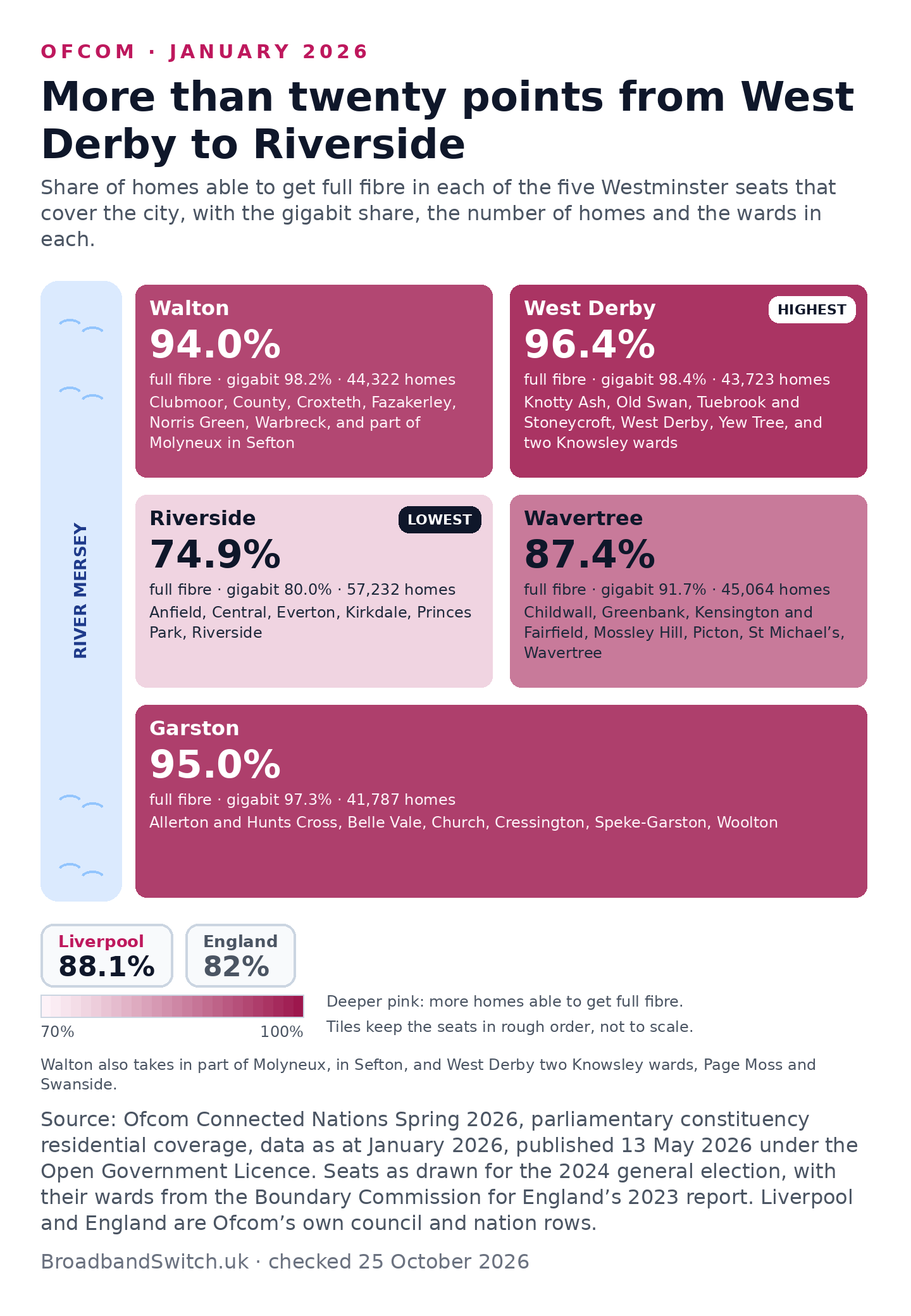
The boundaries are the ones voters used in 2024, and the Boundary Commission drew them from the thirty wards Liverpool had until May 2023. Two seats spill over the city edge: Walton takes in part of Molyneux, in Sefton, and West Derby two Knowsley wards, Page Moss and Swanside. Add Ofcom’s five seat figures together and you get 232,128 homes, which is 12,685 more than it counts in the city itself. Under each seat in the table you will find its wards, so you can locate yours by neighbourhood.
| West DerbyKnotty Ash, Old Swan, Tuebrook and Stoneycroft, West Derby, Yew Tree, Page Moss (Knowsley), Swanside (Knowsley) | 96.4% | 98.4% | 43,723 | 24 |
|---|---|---|---|---|
| GarstonAllerton and Hunts Cross, Belle Vale, Church, Cressington, Speke-Garston, Woolton | 95.0% | 97.3% | 41,787 | 79 |
| WaltonClubmoor, County, Croxteth, Fazakerley, Norris Green, Warbreck, Molyneux (part, Sefton) | 94.0% | 98.2% | 44,322 | 52 |
| WavertreeChildwall, Greenbank, Kensington and Fairfield, Mossley Hill, Picton, St Michael’s, Wavertree | 87.4% | 91.7% | 45,064 | 763 |
| RiversideAnfield, Central, Everton, Kirkdale, Princes Park, Riverside | 74.9% | 80.0% | 57,232 | 4,923 |
| Liverpool | 88.1% | 92.0% | 219,443 | 5,830 |
Names are shortened from Liverpool Garston, Liverpool Riverside and so on, on the 2024 boundaries. The figures are Ofcom’s, residential premises only, for January 2026; the ward lists are the Boundary Commission’s, from its 2023 report, and name the pre-2023 wards. The bottom row is the city council area as Ofcom counts it. Tap a column heading to reorder.
Where the work is nearly done
West Derby, Garston and Walton each give full fibre to more than nine homes in ten, and gigabit to 98.4%, 97.3% and 98.2%. Between them Ofcom counts just 155 homes unable to get 30Mbit/s. For most households in the north, east and south of the city, then, the fibre is already outside, and the take-up section shows how many have ordered it.
Wavertree and Riverside
Wavertree, at 87.4%, runs from Kensington and Picton out to Childwall and Mossley Hill, and has 763 slow lines, most of them in Greenbank ward. Riverside takes in the city centre, the waterfront, Princes Park to the south and the inner north from Everton to Anfield, and its wards hold a larger share of flats than any other seat’s. Its gigabit figure is 80.0% and its superfast figure 89.4%, the lowest of the five on both.
Each seat covers upwards of forty thousand homes, so treat its percentage as a portrait of the district and not a verdict on your door. The thirty wards, next, bring the picture closer.
Thirty wards, one rung each
Direct answer: There is no official ward table for full fibre, so we built one for gigabit and superfast instead, from Ofcom’s street-level output area file, for the thirty wards behind Liverpool’s seats. 24 of them have gigabit for 90% of homes or more, and 4, Old Swan, Fazakerley, Church and Wavertree, reach 99%. The six below 90% are Central, Riverside, Mossley Hill, Greenbank, Princes Park and Everton.
Ofcom, January 2026
Thirty wards, one rung each: gigabit and superfast
- Gigabit, 97% or more
- Gigabit, 90% to 97%
- Gigabit, under 90%
- Tick: superfast, 30Mbit/s
Built by us from Ofcom’s January 2026 output area file, adding up the small census areas that nomis places in each of the thirty pre-2023 wards. Together they match Ofcom’s city totals to the home. That file has gigabit and superfast columns only, with no full fibre column, and the bars here begin at 50%.
Five of those six are inner-city wards close to the centre. Mossley Hill is the odd one out, and its numbers tell a different story. Its superfast figure is 95.4% and Ofcom counts only 4 homes there unable to get 30Mbit/s, so basic broadband is fine. The gap is in gigabit, at 81.3%. Mossley Hill also has 276 premises Ofcom could not match, the second most in the city after Central, and over matched premises alone its gigabit figure is 85.2%.
A word on the wards themselves. Liverpool redrew them for the elections of May 2023, with 85 councillors in all, and the new Order puts it simply: “The city of Liverpool is divided into the 64 wards listed in the first column of the table in the Schedule.” We use the thirty earlier wards because the census tables, nomis’s output area fits and the Boundary Commission’s seat lists are all built on them, so every figure here lines up with every other. Your council tax bill may show a newer ward name; the neighbourhood names here will still find you.
All thirty wards: gigabit, superfast, slow lines, flats and private rentingopen the table
| Allerton and Hunts CrossGarston | 95.1% | 99.2% | 47 | 10.7% | 11.6% |
|---|---|---|---|---|---|
| AnfieldRiverside | 97.7% | 99.2% | 50 | 13.5% | 35.4% |
| Belle ValeGarston | 98.8% | 99.9% | 5 | 8.6% | 9.5% |
| CentralRiverside | 55.5% | 69.1% | 3,526 | 74.6% | 66.9% |
| ChildwallWavertree | 97.2% | 98.0% | 33 | 5.5% | 9.2% |
| ChurchGarston | 99.0% | 99.6% | 18 | 14.1% | 15.2% |
| ClubmoorWalton | 98.7% | 99.8% | 11 | 7.0% | 12.5% |
| CountyWalton | 98.8% | 99.9% | 0 | 10.0% | 35.3% |
| CressingtonGarston | 97.9% | 99.9% | 3 | 18.3% | 14.7% |
| CroxtethWalton | 98.0% | 100.0% | 0 | 6.9% | 14.6% |
| EvertonRiverside | 89.9% | 96.8% | 10 | 29.2% | 19.6% |
| FazakerleyWalton | 99.3% | 99.5% | 36 | 7.8% | 22.4% |
| GreenbankWavertree | 81.7% | 89.5% | 644 | 47.3% | 43.3% |
| Kensington and FairfieldWavertree | 93.0% | 99.9% | 3 | 29.6% | 44.4% |
| KirkdaleRiverside | 91.4% | 96.9% | 175 | 32.2% | 29.5% |
| Knotty AshWest Derby | 98.8% | 100.0% | 3 | 13.9% | 14.8% |
| Mossley HillWavertree | 81.3% | 95.4% | 4 | 22.3% | 15.1% |
| Norris GreenWalton | 98.0% | 100.0% | 0 | 5.9% | 14.8% |
| Old SwanWest Derby | 99.4% | 99.9% | 2 | 14.8% | 29.6% |
| PictonWavertree | 94.1% | 99.2% | 47 | 20.7% | 40.7% |
| Princes ParkRiverside | 86.8% | 99.5% | 12 | 50.8% | 28.4% |
| RiversideRiverside | 77.9% | 89.4% | 1,150 | 59.2% | 48.3% |
| Speke-GarstonGarston | 98.5% | 99.9% | 5 | 13.2% | 17.8% |
| St Michael’sWavertree | 95.0% | 99.4% | 32 | 48.2% | 33.8% |
| Tuebrook and StoneycroftWest Derby | 97.9% | 100.0% | 1 | 19.8% | 37.9% |
| WarbreckWalton | 96.7% | 100.0% | 2 | 16.3% | 25.0% |
| WavertreeWavertree | 99.0% | 100.0% | 0 | 16.5% | 24.2% |
| West DerbyWest Derby | 97.5% | 99.9% | 2 | 10.6% | 13.4% |
| WooltonGarston | 93.8% | 100.0% | 1 | 22.9% | 13.0% |
| Yew TreeWest Derby | 98.2% | 99.9% | 8 | 9.2% | 18.0% |
The first three columns are ours, added up from Ofcom’s January 2026 output area file using nomis’s ward fit: two shares of homes, then a count of homes below superfast speed. The last two are census shares of households in 2021, with people living rent free counted as private renters. Tap a column heading to reorder.
Ward edges here follow output areas, the small blocks the census is counted in, so a boundary can stray by a road or two, and yet the thirty add up exactly to Ofcom’s figures for the city. Ofcom’s counts are for January 2026 and the census for 2021, so new blocks show up as extra premises. For your own home, trust the postcode check.
Liverpool among the core cities and its neighbours
Direct answer: Among England’s eight core cities, Liverpool is fifth for full fibre at 88.1%, ahead of Manchester, Birmingham and Bristol, and seventh for gigabit at 92.0%. Its gigabit figure is only 4 points above its full fibre figure, against 10 in Birmingham and 11 in Bristol, so fewer homes rely on cable alone for a gigabit. In the Liverpool City Region it is fifth of six councils for full fibre.
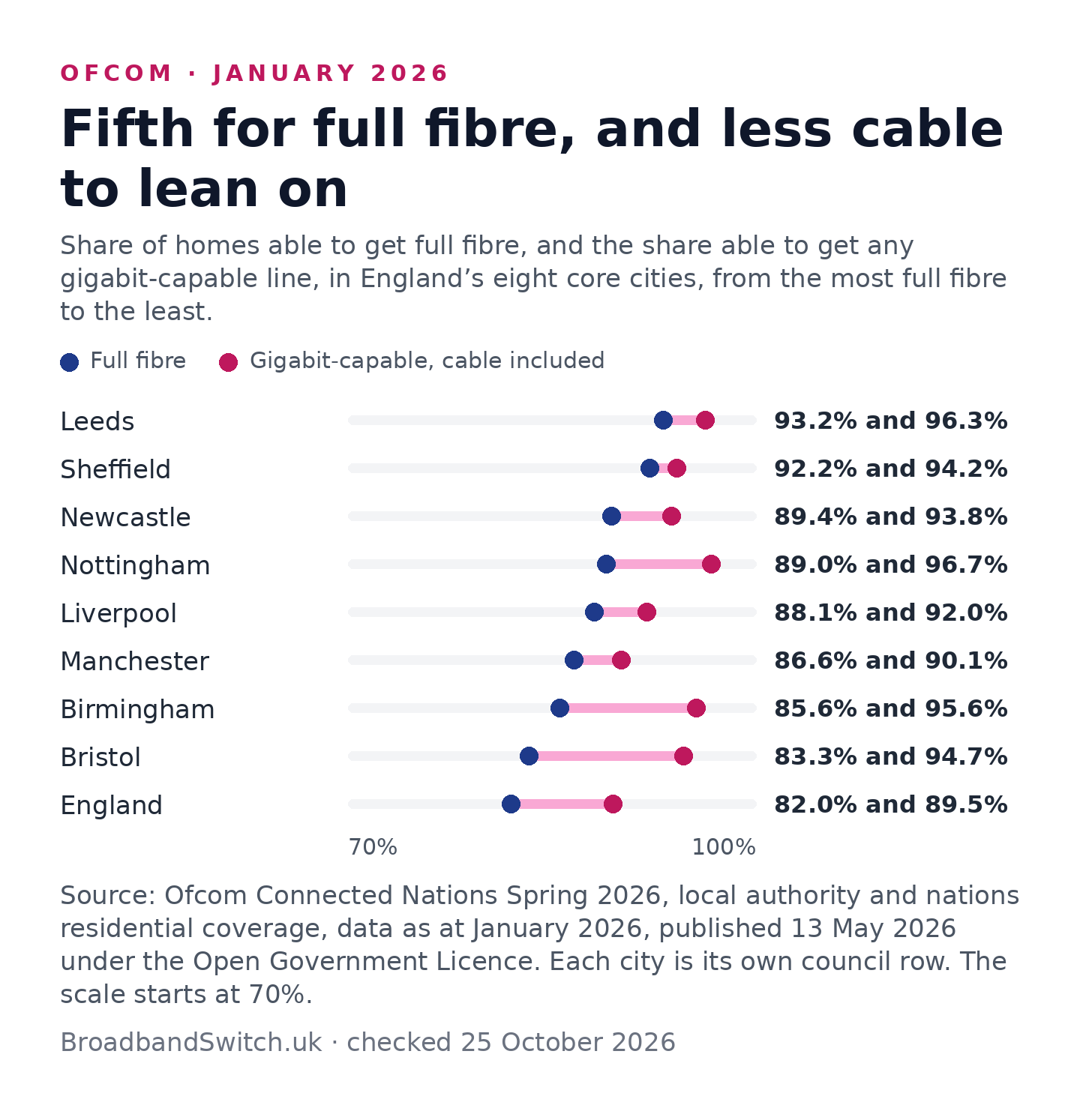
England’s core cities are its eight biggest outside London. We use the council area for each, as Ofcom reports it, so no city gains from a generous boundary. Leeds leads on full fibre at 93.2% and Nottingham on gigabit at 96.7%. Liverpool’s weaker spot is superfast: at 96.6% it is seventh of the eight, which is the city-centre cluster above showing through. Against all 296 English councils, the city is 82nd for full fibre and 131st for gigabit.

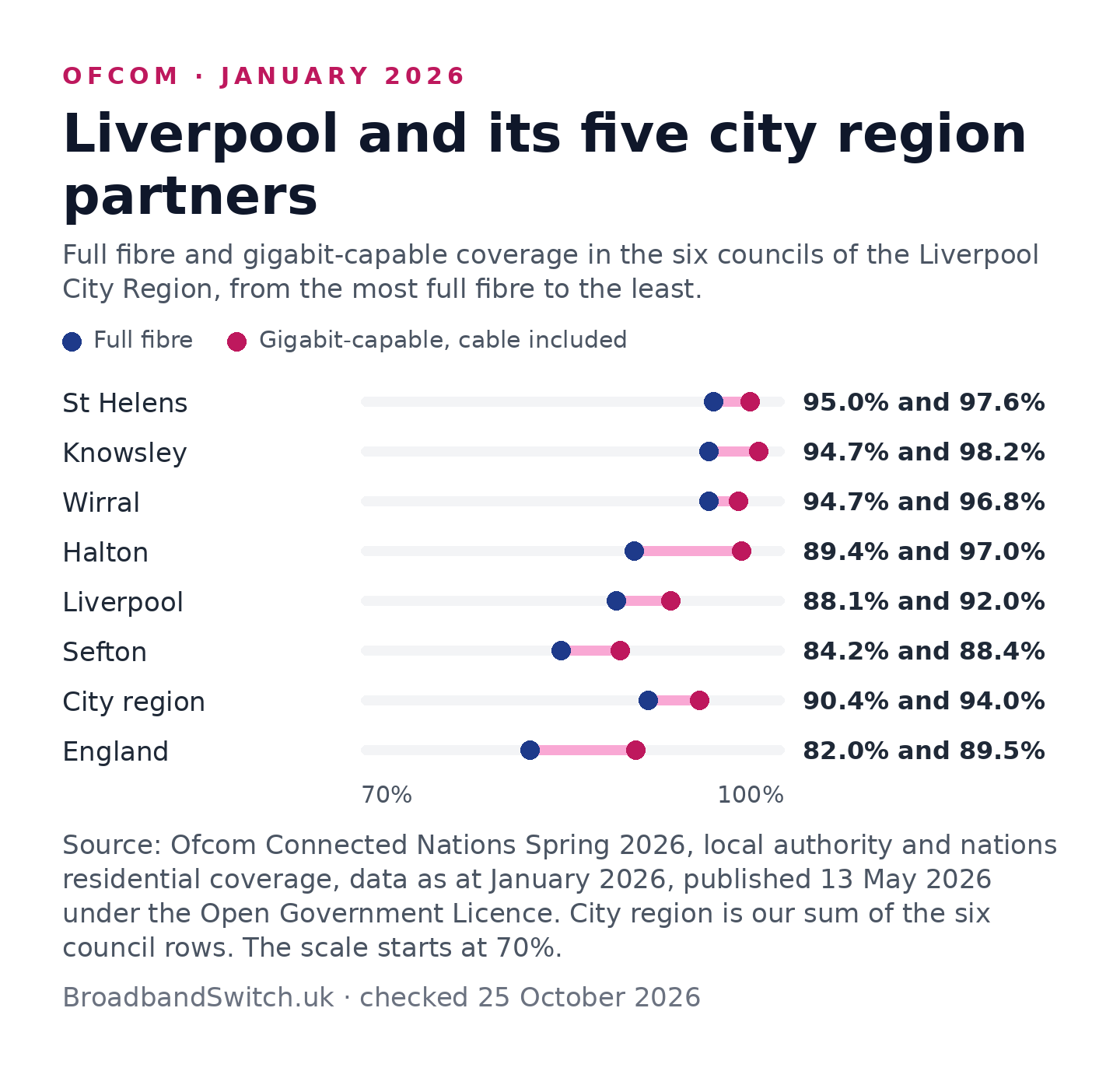
Liverpool has 30% of the city region’s homes, so it weighs on the region’s figures: the six councils together have 90.4% full fibre and 94.0% gigabit, on our sum of their rows. St Helens leads at 95.0%, with Knowsley and Wirral level at 94.7%, and Sefton trails at 84.2%. Knowsley stands out on gigabit, at 98.2%. The city region also has a full fibre network of its own, LCR Connect, which is built for businesses, as the networks section explains. If you live just outside the city, Birkenhead, Warrington and Wigan each have a page of their own.
Fibre in the street, an old line indoors
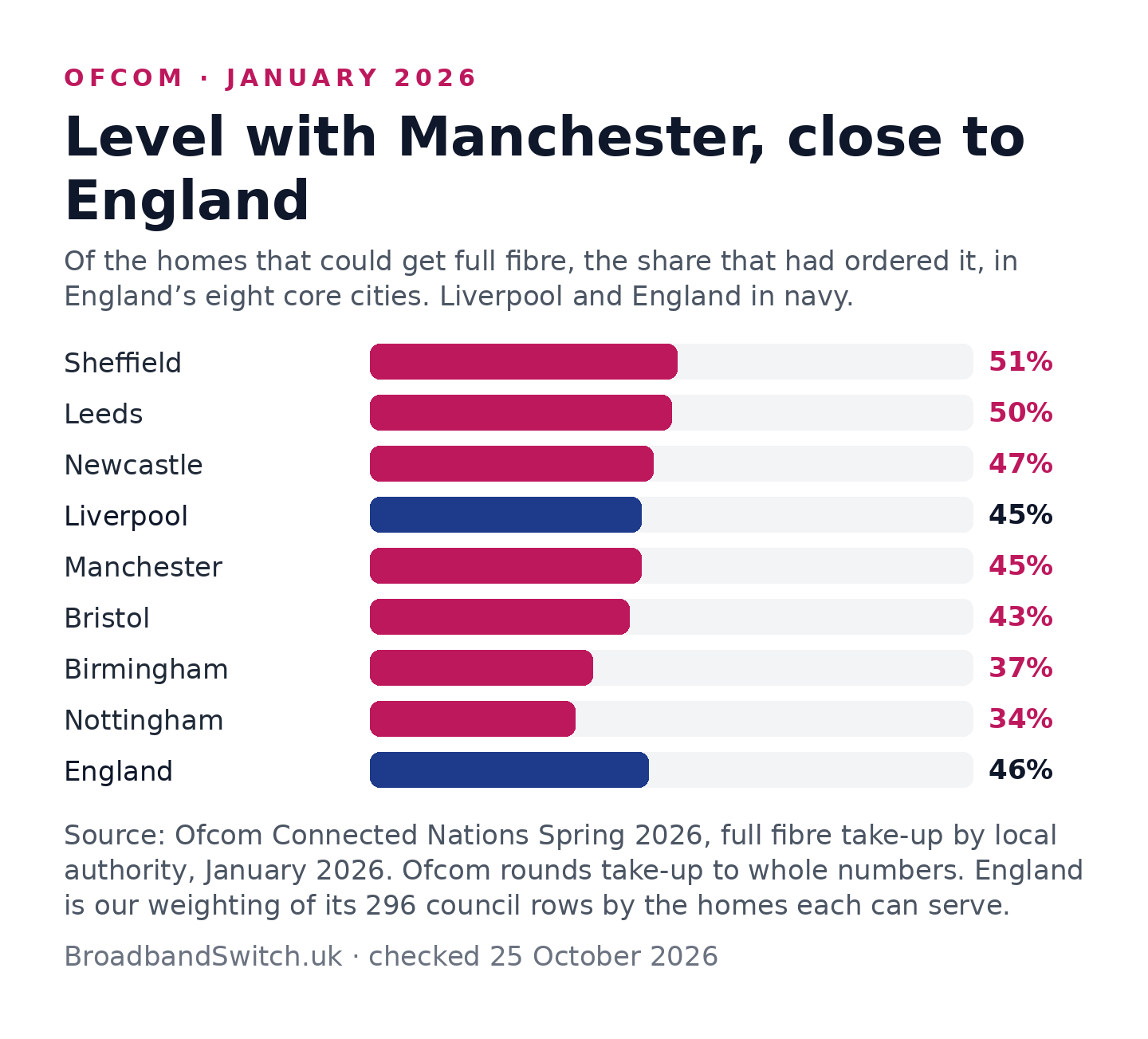
Direct answer: In January 2026, 45% of Liverpool homes that could get full fibre had ordered it, just under the 46.2% we get for England by weighting Ofcom’s council figures together. That places the city 159th of England’s 296 councils, level with Manchester and fourth of the core cities, and it means 55% of homes with full fibre in the street are still on an older line.
Ofcom, January 2026
Ten streets of ten terraced houses: every 100 Liverpool homes
- 40on full fibre already
- 48fibre in the street, not ordered yet
- 4a gigabit over cable, full fibre still to come
- 8neither of those so far
From the Liverpool row of Ofcom’s Connected Nations Spring 2026 files. Ofcom gives 88.1% full fibre coverage, 92.0% gigabit coverage and full fibre lines in use at 40% of all homes; we rounded each to a whole door.
Openreach sees the same on its own network across Merseyside. On 11 May 2026 it said: “Full Fibre broadband is now available to 655,000 homes and businesses across Merseyside thanks to a major £196m investment”, adding that it had almost 90% of properties in the area now able to upgrade their broadband service. Kasam Hussain, its Partnership Director for the North and Midlands, put it plainly: “Most of Merseyside is now covered by Full Fibre, but many residents and businesses still haven’t made the switch.” And he added: “We want to make sure everyone knows what’s available and how to get it.” A year earlier, on 13 June 2025, Openreach had said: “Almost 600,000 homes and businesses in the region can already upgrade to Full Fibre, but so far around 40% of properties have made the switch.” So in under a year its Merseyside network grew from almost 600,000 premises to 655,000, and its investment from £177m to £196m.
Openreach’s figures cover its own network across Merseyside, homes and businesses together, and they come four months after Ofcom’s. For comparison, Ofcom’s January count for the five Merseyside councils, every network included, was 634,745 of 704,321 premises able to get full fibre, or 90.1%.
Ofcom, January 2026
Six councils, six rings: who has ordered the fibre
Wirral
full fibre 94.7%
Knowsley
full fibre 94.7%
Liverpool
full fibre 88.1%
Halton
full fibre 89.4%
Sefton
full fibre 84.2%
St Helens
full fibre 95.0%
Ofcom Connected Nations Spring 2026, full fibre take-up by local authority, January 2026: of the homes able to get full fibre, the share with a full fibre line. Ofcom rounds take-up to whole numbers. Under each ring is the council’s full fibre coverage.
Across the city region, ordering varies more than coverage does. Wirral leads at 57%, a sign of how far take-up can climb, and Knowsley is at 50%. St Helens has the most fibre of the six, 95.0%, and the lowest take-up, 38%, so it has the largest share of covered homes still to switch.
Is your door pale pink?
Good news: the fibre already runs past your house, so nobody needs to dig. All that is left is placing an order, and where several networks compete for your street, full fibre often costs no more than you pay today. Pop your postcode in the box at the top and the lowest price comes first.
There is a practical reason not to wait too long, too. At an exchange where most premises can get full fibre, Openreach stops selling copper, and 13 of the 15 Liverpool exchanges on its list have reached that point. The exchange section lists them all with their dates.
Fifth today, second by 2029
Direct answer: On the builders’ plans, full fibre in Liverpool should rise from 88.1% to 98.9% by January 2029, a gain of 10.8 points that would take the city from fifth to second of the eight core cities, behind only Bristol. 89.2% of homes should have two or more gigabit networks and 57.0% three or more, against 74.0% and 36.0% across England.
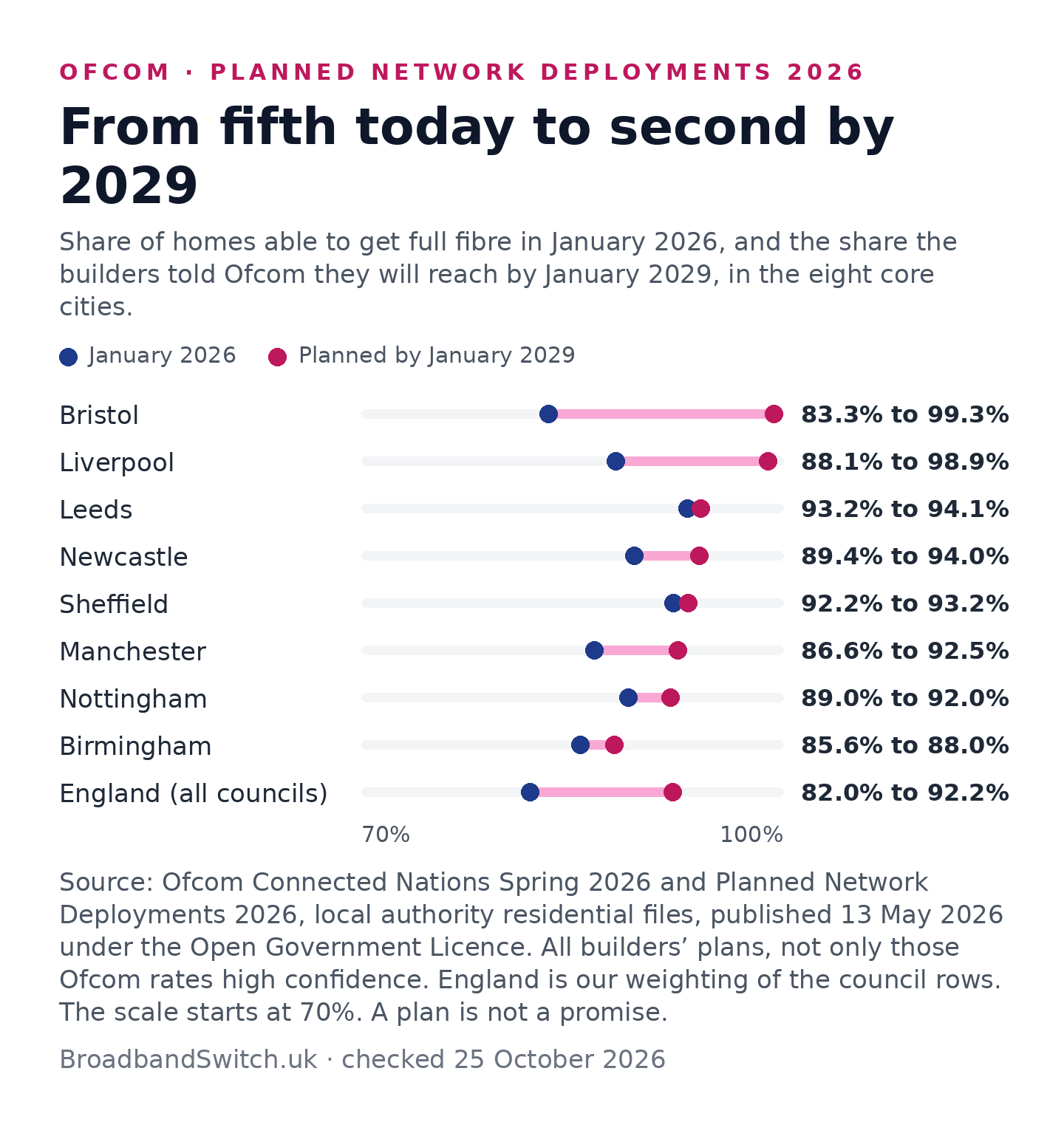
Ofcom collects the builders’ own forecasts every year and publishes them for each council. For Liverpool they add up to gigabit coverage of 99.3% by January 2029 on every plan, or 92.2% counting only the plans Ofcom rates high confidence, against 95.3% for England. Ofcom’s file expects 11 to 15 gigabit builders to be at work in the city by then, so on those plans the question for most homes by 2029 is which network to choose, not whether one arrives.
Very little is left out. Ofcom’s file has 2,354 homes in the city on no full fibre plan for 2029 and 44 postcodes with no gigabit plan at all. The file counts 0 planned lines funded by the taxpayer: the builders here pay their own way. Stuck below 10Mbps today? The broadband Universal Service Obligation lets you ask BT for an upgrade, and the legal minimum it sets is a download speed of at least 10 Mbit/s and an upload speed of at least 1 Mbit/s; the USO page takes you through a request. Builders can change course, so treat every 2029 figure as an intention, not a promise.
Who builds Liverpool’s broadband
Direct answer: Openreach reports 655,000 homes and businesses across Merseyside able to get its full fibre, and Virgin Media says it added 118,262 Liverpool homes to its own full fibre network in 2025. Netomnia’s Liverpool page, for the network YouFibre sells over, reads “Improving connectivity for over 130,000 homes and businesses”, and Grain names six districts, one of them over the boundary in Bootle. In much of the city you can choose between two or three of them.
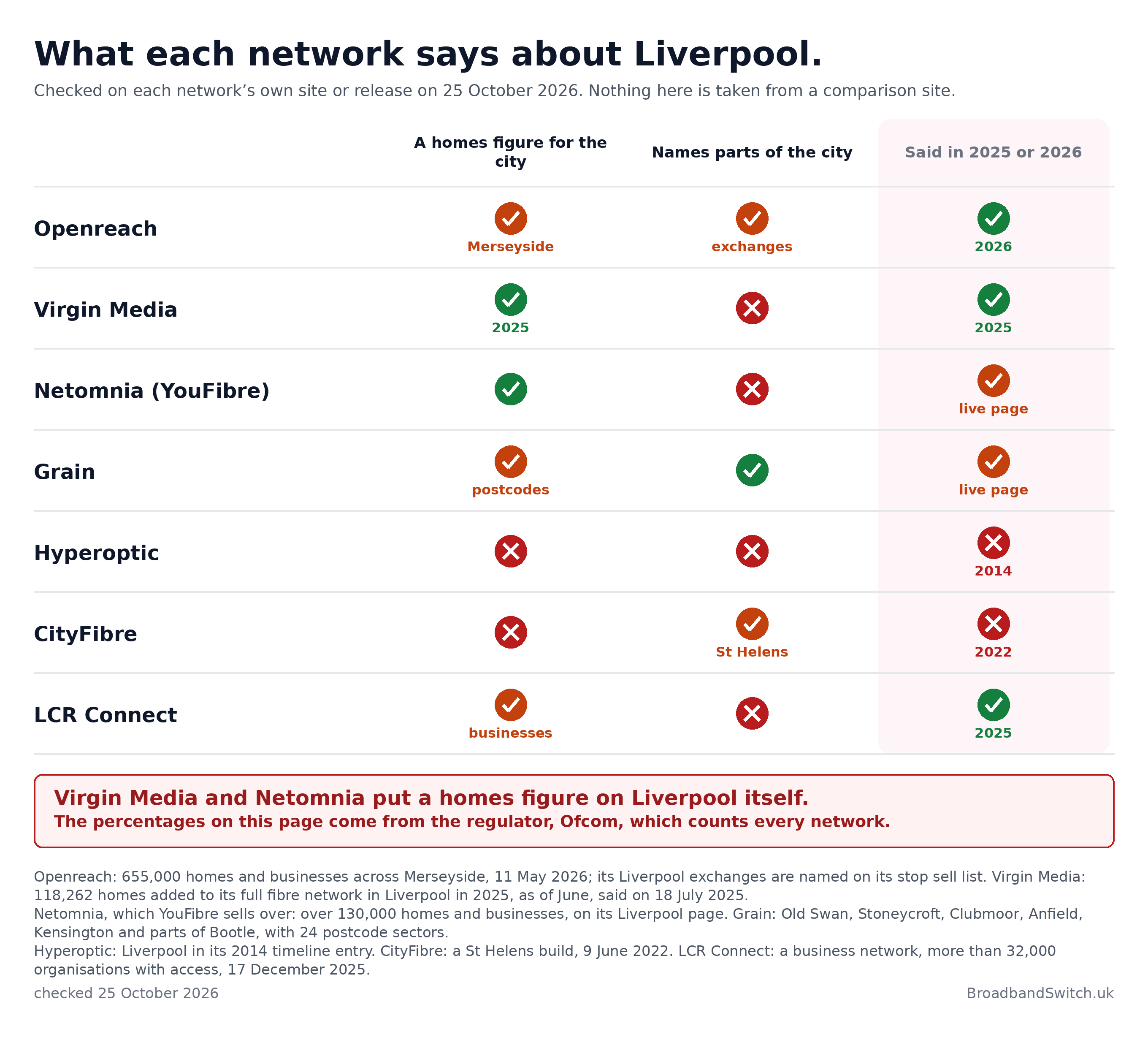
A quick way to think about it: the name on your bill is the provider, and the company that owns the fibre under the pavement is the network. Most providers rent space on one network, a few on several, so the list at your address depends on which networks reach it. Below, each network speaks for itself, quoted and dated from its own site. If you are not sure which one you use now, your provider will know, and the answer tells you whether a switch needs an engineer.
Openreach, under the big brands
Openreach runs the network behind BT, EE, Sky, TalkTalk, Vodafone, Plusnet and many smaller brands. It does not publish a figure for the city on its own; for Merseyside, on 11 May 2026, it reported 655,000 homes and businesses able to get its full fibre, after an investment of £196m. Across the UK it now reaches “22 million homes and businesses across the UK”, and it says: “The company plans to extend this to 25 million by the end of 2026, with the potential to reach 30 million by 2030 with the right investment conditions.”
Virgin Media, moving from cable to fibre
Virgin Media’s article of 18 July 2025 says: “A total of 118,262 homes* in Liverpool can now get Virgin Media Full Fibre broadband”. The asterisk leads to its footnote: “Number of homes added to our full-fibre network in Liverpool in 2025 as of June.” So the figure counts homes added to its full fibre network in the first half of 2025 rather than its whole Liverpool network, and the same article’s standfirst gives a slightly different number, 118,272. Ofcom’s figures fit that picture: gigabit coverage, cable included, is only 4 points above full fibre, so few homes are left with a gigabit cable line and no full fibre. Virgin Media’s full fibre partner, nexfibre, lists Liverpool, Birkenhead, Bebington, Southport, Runcorn and Widnes in its coverage report as at 31 December 2025, with the caution that “services may not be available to every premise in a particular location”. The same report adds: “Broadband services are currently available on nexfibre’s network through Virgin Media O2”.
Netomnia, the network YouFibre sells over
Netomnia builds the network and YouFibre is the provider most of its customers see. Netomnia’s Liverpool page says: “Improving connectivity for over 130,000 homes and businesses”. It goes on: “Up to £39,000,000 will be invested to deliver the infrastructure”. And it is upbeat about the work: “The network is currently being built!” If your street is on Netomnia, YouFibre will appear in your postcode results, and our YouFibre page has its current packages.
Both networks may soon share an owner. On 18 February 2026 nexfibre, whose network Virgin Media O2 sells over, agreed a £2 billion deal for Substantial Group, which owns Netomnia and YouFibre. The Competition and Markets Authority opened an in-depth inquiry on 1 July 2026, and in its interim report of 2 October 2026 it provisionally found that the deal may be expected to cause a “substantial lessening of competition” in the wholesale supply of fixed broadband. It is careful to add: “This is not our final decision”. Comments on possible remedies were due by 27 October 2026, and the decision is due by 15 December 2026. Nothing changes for a contract you already hold while the review runs, and our altnet consolidation tracker follows the case.
Grain, north and east of the centre
Grain, a smaller full fibre network, says on its Liverpool page that it is bringing full fibre to “homes across Old Swan, Stoneycroft, Clubmoor, Anfield, Kensington and parts of Bootle”. In its answers to common questions it adds: “Grain Full Fibre broadband is available in selected areas of Liverpool, including parts of Anfield, Kensington, and Old Swan.” It lists 24 postcode sectors that it serves or plans to serve soon: L13 2, L13 3, L13 5, L13 6, L13 8, L13 9, L20 2, L20 7, L20 9, L4 0, L4 2, L4 7, L4 8, L5 6, L6 0, L6 3, L6 4, L6 5, L6 6, L6 8, L6 9, L7 0, L7 2 and L7 8. If your postcode starts with one of those, Grain may be one more name on your list.
Hyperoptic, in apartment blocks
Hyperoptic wires blocks of flats. Its own company timeline, under 2014, reads: “We launch in Cardiff, Bristol, Liverpool and Manchester.” Today it says it is live in 64 towns and cities. Where your block is on Hyperoptic, it shows in your postcode results with everyone else, and our Hyperoptic page explains its packages.
CityFibre, next door in St Helens
CityFibre’s nearest build is in St Helens. On 9 June 2022 it announced a “£30m Borough-wide full fibre network”, and said: “The overall project is expected to reach completion by 2025”. toob, which sells over CityFibre, lists St Helens as its only location on Merseyside. We found no CityFibre source for a Liverpool build, which is why the corrections take out the old page’s claim.
LCR Connect, the city region’s business network
The city region has a fibre network of its own, built for organisations rather than homes. On 17 December 2025 the Combined Authority described LCR Connect as a “350km business-first fibre network, which is 50% owned by the Liverpool City Region Combined Authority”. The £30m joint venture, it said, now gives more than 32,000 local businesses and organisations access to gigabit-capable services, with 1,000 connections live. If you run a business, it may be worth asking about; for broadband at home, the postcode check is the place to look.
First of ten cities off the old phone network
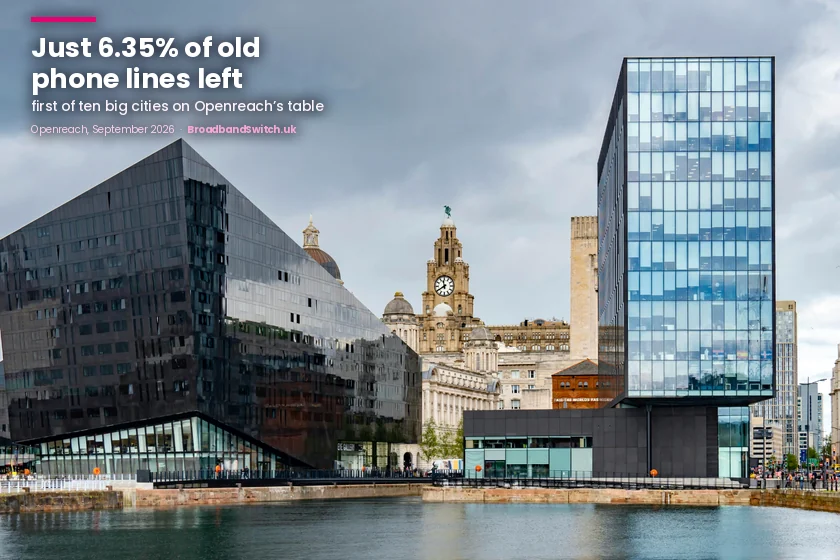
Direct answer: On Openreach’s figures, Liverpool is further along than any of ten big UK cities in leaving the old analogue phone network. Its table of 17 September 2026 gives Liverpool and its surrounding area 42,351 lines still to move, out of 667,215 in 2020: just 6.35%. Manchester is next at 7.35%, and London has the most left, at 12.92%.
Openreach, 17 September 2026
Ten big cities leaving the old phone network: how much is left
Liverpool42,351 lines left of 667,215
Manchester
Sheffield
Cardiff
Leeds
Edinburgh
Bristol
Birmingham
Glasgow
London
0%left to move, of 2020’s lines14%
Openreach, “Liverpool tops major UK city league table in move to digital phone services”, 17 September 2026, notes to editors: wholesale line rental lines left to convert in each city and its surrounding area, as a share of the lines it had in 2020. The table covers major cities and their surrounding areas, so each figure reaches beyond the city council’s boundary.
Openreach headed its release “Liverpool tops major UK city league table in move to digital phone services”, and James Lilley, its Director of All-IP, said: “When it comes to preparing for the switch-off, our Northern cities appear to have a head start.” The release has Liverpool leading the way “with just six per cent of legacy lines left to migrate before the old legacy copper-based network is switched off at the end of January 2027”. The table covers major cities and their surrounding areas, so the Liverpool figure takes in more than the city council area, which is why it counts more lines than the city has homes. In all, there are 624,864 fewer Liverpool-area lines on the old service than in 2020.
The date behind it is fixed. Openreach puts it this way: “Our parent, BT Group signalled their intention to retire the PSTN network by 31st January 2027”. For most homes the change is small, and the phone simply plugs into the router instead of the wall socket. The lines left to move are often the fiddly ones, though, and Lilley listed services that can still depend on the old network, “from payment terminals and lift alarms to security systems, door entry systems and building management technology”. Across the UK, Openreach estimates “around 1.5 million lines are still operating on the old copper-based phone network, including around 350k business premises”.
Renting from Torus or another housing association?
Torus, which is based in Liverpool and has “41,000+ homes in the Group portfolio”, explains the switchover on its own site. It says: “Torus is carrying out a major programme of service upgrades to ensure all essential systems are digitally compatible ahead of the switchover.” Its list covers warden call services, door entry systems, lifts, fire alarms, CCTV and intruder alarms. It also reminds tenants: “You will need an internet connection at home to use the new landline digital system.” If you have a telecare alarm, a pendant or a lift phone, speak to its supplier and to your broadband provider before your line changes. Our care alarm guide has the questions to ask, and our landline switch-off checker works for any Liverpool number.
Fifteen exchanges and their copper dates
Direct answer: By 25 October 2026, copper was off sale at 13 of the 15 exchanges Openreach files under Liverpool, starting with five on 13 October 2021 and most recently at Stanley on 5 June 2026. The other two have dates: North on 6 November 2026 and Larklane on 12 February 2027.
Stop sell and the switch-off are two separate changes. Stop sell reaches one exchange at a time, once full fibre is available to a majority (>75%) of premises, and Openreach gives providers a year’s notice. After that, a move, a new contract or a change of speed puts you on a digital service over full fibre. If full fibre has not reached your home yet, Openreach is clear: “Customers in these exchanges not yet able to get Ultrafast Full Fibre at their premises won’t be impacted and can stay on their existing copper-based service until Full Fibre does become available.” The retirement of the old analogue network is national, and its date is 31 January 2027.
Openreach, 8 October 2026
Every Liverpool exchange, by the year copper sales stop
- 20215
- Stoneycroft13 October 2021
- Cressington13 October 2021
- Sefton Park13 October 2021
- Childwall13 October 2021
- Gateacre13 October 2021
- 20222
- Netherley1 November 2022
- Hunts Cross1 November 2022
- 20231
- Huyton8 February 2023
- 20243
- Hale16 February 2024
- Aintree4 June 2024
- Allerton8 November 2024
- 20251
- Anfield6 November 2025
- 20262
- Stanley5 June 2026
- North6 November 2026
- 20271
- Larklane12 February 2027
- Copper sales stopped
- Date still to come
Openreach’s stop sell list for communications providers, version of 8 October 2026: all fifteen exchanges it places in Liverpool, grouped by the year copper sales end.
Liverpool joined the programme early. Its first five exchanges, Stoneycroft, Cressington, Sefton Park, Childwall and Gateacre, all stopped selling copper on 13 October 2021. Three on the list, Huyton, Hale and Aintree, carry the names of places over the boundary in Knowsley, Halton and Sefton, but Openreach files all three under Liverpool.
Openreach, 2021 to 2027
From Stoneycroft to Larklane: Liverpool’s road off copper
- 13 October 2021Five exchanges at once Stoneycroft, Cressington, Sefton Park, Childwall and Gateacre stop selling copper on the same day.
- 1 November 2022Netherley and Hunts Cross
- 8 November 2024Allerton After Huyton, Hale and Aintree, all named after places just over the boundary.
- 6 November 2025Anfield
- 5 June 2026Stanley The thirteenth, and the most recent so far.
- 17 September 2026Liverpool tops Openreach’s table Just 6.35% of its 2020 phone lines still to move, the smallest share of ten big cities.
- 25 October 2026We checked the list Openreach adds new rounds as it announces them.
- 6 November 2026North
- 31 January 2027The old analogue network retires Calls move to digital lines that run over broadband.
- 12 February 2027Larklane, the last date on the list Openreach gave notice of it on 16 January 2026, more than a year ahead.
Exchange dates from the version of Openreach’s stop sell list issued on 8 October 2026; the ten-city table from its release of 17 September 2026; the retirement date from its big switch off page. Each read on 25 October 2026.

The table has all fifteen in date order, then the nearest exchanges in Sefton, Knowsley, Wirral, Halton and St Helens. Each new round from Openreach can add to it, so its own list is worth a look too.
All fifteen Liverpool exchanges, with their datesshow the table
| Code | Tranche | ||
|---|---|---|---|
| Childwall | LVCHI | 1b | 13 October 2021 |
| Cressington | LVCRE | 1b | 13 October 2021 |
| Gateacre | LVGAT | 1b | 13 October 2021 |
| Sefton Park | LVSEF | 1b | 13 October 2021 |
| Stoneycroft | LVSTO | 1b | 13 October 2021 |
| Hunts Cross | LVHUN | 6 | 1 November 2022 |
| Netherley | LVNET | 6 | 1 November 2022 |
| Huyton | LVHUY | 7 | 8 February 2023 |
| Hale | LVHAL | 11 | 16 February 2024 |
| Aintree | LVAIN | 12 | 4 June 2024 |
| Allerton | LVALL | 14 | 8 November 2024 |
| Anfield | LVANF | 18 | 6 November 2025 |
| Stanley | LVSTA | 20 | 5 June 2026 |
| North | LVNOR | 22 | 6 November 2026 |
| Larklane | LVLAR | 23 | 12 February 2027 |
Italic rows are still to come. Openreach files all fifteen under the location Liverpool. An exchange takes its name from its building or the district it was built for, so Huyton, Hale and Aintree carry the names of places just over the city boundary, and the exchange that serves your home may carry a neighbouring district’s name. Openreach’s online checker names yours. Press a heading to sort.
Nearest exchanges in the neighbouring councils
- Great Crosby (Crosby): 13 October 2021
- Wallasey (Wallasey): 13 October 2021
- Waterloo (Crosby): 13 October 2021
- Birkenhead (Birkenhead): 25 January 2022
- Maghull (Maghull): 2 August 2022
- Simonswood (Kirkby): 4 June 2024
- Widnes (Widnes): 4 June 2024
- Prescot (Prescot): 19 August 2025
- Bootle (Bootle): 6 November 2025
- St.Helens (St Helens): 6 November 2025
- Hightown (Hightown): 3 June 2027
What stop sell means for you
- Keeping your current deal? Nothing changes on your line, and the only date that applies to everyone is 31 January 2027.
- Moving, switching provider or changing speed at a stop sell exchange? Where full fibre reaches you, your new service uses it.
- Full fibre not at your address yet? You can stay on your copper service until it arrives.
Summarised by us from Openreach’s stop sell announcement of 15 May 2026.
Buying or renting a new home in the city? Ask which networks already serve it, so you can book the connection before you move in. Our stop sell explainer covers the national programme.
Terraces, renters and whose say-so you need
Direct answer: Liverpool is a city of terraces and renters. On the 2021 census 37.9% of households lived in a terraced house, against 23.0% across England, and only 8.2% in a detached house, against 22.9%. More than half rented their home, 52.6% against 37.7%, split almost evenly between social landlords, 26.4%, and private ones, 26.2%.
Census 2021
Twenty little homes each: what kind of home, city and ward
Liverpoolrenting 52.6%
Englandrenting 37.7%
Centralflats 74.6%
Countyterraced 75.0%
Childwallsemis 79.9%
Wooltondetached 30.7%
- Terraced
- Semi-detached
- Detached
- Flat
From the 2021 census, tables TS044 and TS054 read through nomis, for the city, England and four of the old wards. Each icon is one twentieth of the households. We count every kind of flat together, whether in a block, a split house or over a shop, and leave out caravans, which are below 1% in every row.
Ward by ward the mix changes quickly. County has 75.0% of households in a terraced house, Childwall 79.9% in a semi and Central 74.6% in a flat, while Woolton has 30.7% in a detached house, the highest share of any ward. Childwall also has the most owners, 83.9%, Princes Park the most social renting, 55.8%, and Central the most private renting, 66.9%. Flats across the city, at 23.2% of households, run a little above England’s 22.2%.
Why does this matter for broadband? Because the kind of home decides who has to agree to the work. In a terraced house the engineer usually brings the fibre from a pole or an underground duct to a small box on the wall where it enters, often in a single morning. If you rent, ask your landlord before any drilling, and if the answer is slow to come, a tenant’s rights to full fibre sets out what to do next. Switching provider over the line you already have needs nobody’s permission, as switching in a rented property explains.
In a block of flats nothing can be installed without the owner’s signature: a housing association such as Torus for many social homes, and the freeholder or managing agent for private ones. Our wayleave guide explains what the owner is being asked to sign. Sharing a house near the universities? Our student broadband guide covers contracts that end with the tenancy, and splitting the bill covers sharing the cost fairly.
Social tariffs if you claim benefits
Direct answer: Claiming Universal Credit, Pension Credit or one of several other benefits? Then a social tariff, a lower-priced broadband package from a mainstream provider, is very likely open to you, and you can walk away from one without a fee.
In a city where 26.4% of households rent from a social landlord, against 17.1% nationally, that can make a real difference. What is on offer depends on the networks at your door. Over Openreach, BT’s Home Essentials is £16.50 a month, and Vodafone’s Essentials tariff is £20 a month, up to 80 Mbps, on a term of 12 months. On Virgin Media’s network there is Essential Broadband, and in Hyperoptic buildings the Fair Fibre 150Mb plan is £13 a month. Ofcom lists 33 social tariffs in all, and our guide shows who can apply for each.
In the 44 Liverpool postcodes with no gigabit plan for 2029, getting a reliable connection comes first, and the Universal Service Obligation is the route to one. For everybody else, the postcode results open with the lowest price at your address.
Your ward at a glance
Direct answer: Choose one of the thirty wards and you get its gigabit and superfast shares, how many of its homes are below 30Mbit/s, the full fibre figure for its seat, and what the census says about its homes. Everything happens on your own device; your choice never leaves the page.
Your part of Liverpool, in one card
The wards are the thirty Liverpool used until May 2023, with coverage we added up from Ofcom’s January 2026 output areas and housing from the 2021 census. Unsure of your ward? Look under your seat in the table above, or let the UK Parliament’s Find your MP page find your seat from your postcode.
Putting the old page right
Direct answer: We found seven things to put right. The old page gave coverage figures above Ofcom’s, a cable share no company publishes, a “fastest” label we cannot support, a takeover described as complete while the regulator reviews it, seat figures that understated every seat, a CityFibre build we could not find, and a Hyperoptic date that differs from Hyperoptic’s own timeline.
The earlier page ran to almost eleven thousand words, and few of its prices or package tips said where they came from or when. We have rebuilt it on primary sources alone: a number stays only if the regulator, the census or the company itself says so, and anything we could not trace has been cut, not reworded. If a network now describes itself in a different way, we use its words. The price tables are gone as well, because prices are national and your postcode results show the ones you can actually buy.
Coverage figures above Ofcom’s own
The old page saidThis page said Liverpool had “approximately 91% FTTP coverage, approximately 94% gigabit-capable coverage” and called it “one of the strongest UK city broadband markets”. Ofcom’s figures for January 2026 are 88.1% and 92.0%, which put the city fifth for full fibre and seventh for gigabit among the eight core cities. We found no source for the ranking.
Now, and the reasonOfcom’s own figures for the city, every seat and every ward, each dated.
Virgin Media’s share, which it does not publish
The old page saidThis page claimed “approximately 79% Virgin Media cable coverage” and placed Gig2 in “Aigburth, Wavertree, and Liverpool city centre”. Virgin Media gives no share for the city. Its own article of 18 July 2025 says: “A total of 118,262 homes* in Liverpool can now get Virgin Media Full Fibre broadband”, and names no districts. Ofcom’s gigabit figure for Liverpool, which counts cable, is 92.0%.
Now, and the reasonVirgin Media in its own words, with its footnote, and Ofcom’s gigabit figure for the city.
A “fastest” label we cannot support
The old page saidThis page called YouFibre on Netomnia “Liverpool’s fastest residential broadband”. We found no source that ranks speeds across the city, so the label has gone. Netomnia’s own Liverpool page reads “Improving connectivity for over 130,000 homes and businesses”, and the speeds on offer at your address show in your postcode results.
Now, and the reasonNetomnia and YouFibre described in their own words, with no ranking.
A takeover described as done while the regulator reviews it
The old page saidThis page described “the February 2026 Nexfibre/Virgin Media O2 acquisition of Netomnia” as complete, with the retail brands bought “for approximately £150 million”. The deal was agreed on 18 February 2026 and is under review: the Competition and Markets Authority opened an in-depth inquiry on 1 July 2026 and must decide by 15 December 2026. We found no source for the £150 million figure.
Now, and the reasonThe deal and the review, each step dated.
Seat figures that understated every seat
The old page saidThis page put gigabit availability at “approximately 96.1%” in West Derby, “94.3%” in Walton, “94.6%” in Garston, “86.4%” in Wavertree and “approximately 68.2%” in Riverside. Ofcom’s figures for January 2026 are 98.4%, 98.2%, 97.3%, 91.7% and 80.0%. Every old figure was lower, and Walton is in fact ahead of Garston on gigabit.
Now, and the reasonAll five seats from Ofcom’s constituency file, with their wards.
CityFibre placed in the city, not next door
The old page saidThis page said “CityFibre is rolling out gradually across Liverpool” and that it was “stopping commercial build and reducing staff” outside Project Gigabit areas. We found no CityFibre source for either. Its nearest build is in St Helens, announced on 9 June 2022, and toob, which sells over it, lists St Helens as its only Merseyside location.
Now, and the reasonCityFibre’s St Helens build, dated, and no claim we could not source.
Hyperoptic’s Liverpool date, by its own timeline
The old page saidThis page said Liverpool “joined the gigabit cities list in 2015 with Hyperoptic at Wapping Quay, Dock Mill, and Hamilton House”. Hyperoptic’s own timeline, under 2014, reads: “We launch in Cardiff, Bristol, Liverpool and Manchester.” We found no current Hyperoptic source naming those buildings, so the names have gone; your postcode results show whether your block is on Hyperoptic.
Now, and the reasonHyperoptic’s own date, and the postcode check for your building.
FAQ: your Liverpool broadband questions
What percentage of Liverpool has full fibre broadband?
Ofcom put it at 88.1% of homes in January 2026, ahead of England at 82% and the UK at 81.8%. With Virgin Media’s cable included, 92.0% could get gigabit speeds, and if the builders deliver their plans, full fibre will reach 98.9% by January 2029.
Why is broadband slower in Liverpool city centre?
Ofcom’s figures show where rather than why. Central ward has 60% of the city’s homes unable to get 30Mbit/s, and superfast coverage there is 69.1%. Most homes in the centre are flats, and a block needs its owner’s consent before a network can wire it, which is one likely part of the story.
Which part of Liverpool has the most full fibre?
Of the five Westminster seats, West Derby has the most, 96.4%, followed by Garston at 95.0% and Walton at 94.0%. Riverside, which holds the city centre, has the least, 74.9%.
Can I get gigabit broadband in Liverpool?
Very likely. In January 2026, 92.0% of Liverpool homes could get a gigabit-capable line, against 89.5% for England, and 24 of the thirty wards are at 90% or more. The postcode check shows what reaches your address.
How does Liverpool compare with other big cities?
Among England’s eight core cities, Liverpool is fifth for full fibre and seventh for gigabit on Ofcom’s January 2026 figures, and on the builders’ plans it moves to second for full fibre by 2029, behind only Bristol.
How many Liverpool homes have switched to full fibre?
Of the homes that could order it, 45% had done so by January 2026. That ranks the city 159th among 296 English councils, the same as Manchester. Counted across all homes it is 40%, and for most of the others the switch needs no building work at all.
Is Virgin Media full fibre available in Liverpool?
In much of the city. On 18 July 2025 Virgin Media said: “A total of 118,262 homes* in Liverpool can now get Virgin Media Full Fibre broadband”, a figure its footnote defines as homes added in 2025, up to June. The postcode check shows whether it reaches your road.
Is YouFibre available in Liverpool?
In parts of it. YouFibre sells over the Netomnia network, whose Liverpool page reads “Improving connectivity for over 130,000 homes and businesses” and “The network is currently being built!”. The postcode check shows whether your street is on it.
Which Liverpool exchanges have stopped selling copper?
As at 25 October 2026, 13 of the 15 Openreach files under Liverpool, beginning with five on 13 October 2021. North follows on 6 November 2026 and Larklane on 12 February 2027.
Is Liverpool ahead on the move to digital phone lines?
On Openreach’s figures, yes. Its table of 17 September 2026 gives Liverpool and its surrounding area 6.35% of its 2020 lines still to move, the smallest share of the ten cities it listed. The old analogue network retires on 31 January 2027.
Will I have more choice of broadband network by 2029?
Very probably. If the builders stick to their plans, 89.2% of Liverpool homes will have a choice of two gigabit networks or more by January 2029 and 57.0% a choice of three, compared with 74.0% and 36.0% for England. For the choice you have today, use the postcode check.
Do I need permission for full fibre if I rent?
For a block of flats, the owner must sign a wayleave before a network can install fibre. In a rented house, ask the landlord before any drilling. Moving to another provider over the line you already have needs nobody’s consent.
Why does this page use the old wards?
Liverpool moved to new wards in May 2023, but the census tables, nomis’s output area fits and the Boundary Commission’s seat lists are built on the thirty earlier ones, so we use those to keep every figure consistent. The ward card lists them all.
How up to date is this page?
Every source was checked again on 25 October 2026. The Ofcom figures describe January 2026 and came out in May, the census is the 2021 one, and the exchange dates come from the Openreach list issued on 8 October 2026. Next to each quote you will find the date it was published.
In short
- In January 2026 Ofcom counted 88.1% of Liverpool homes able to get full fibre and 92.0% able to get a gigabit-capable line, both ahead of England.
- On the builders’ plans, full fibre reaches 98.9% by 2029, taking the city from fifth to second of the eight core cities.
- The slow lines are concentrated: 91% of the city’s homes unable to get 30Mbit/s are in Central, Riverside and Greenbank wards.
- West Derby leads the five seats at 96.4% full fibre, and Riverside, which holds the centre, trails at 74.9%.
- 45% of homes able to get full fibre had ordered it, so many households could upgrade without any digging.
- Openreach’s table puts Liverpool first of ten big cities off the old phone network, with 6.35% of its 2020 lines left.
- Copper is off sale at 13 of the 15 exchanges filed under Liverpool, and the old analogue network retires on 31 January 2027.
- None of this replaces your own postcode, which turns the city picture into the providers and prices for your door.
You can quote any of these points on its own; each carries its date. The page gets a fresh review every quarter or sooner, and the latest was on .
References
- OFCOM.ORG.UK
Ofcom. (2026, May 13). Connected Nations, Spring 2026 update, with its downloadable coverage and take-up files by council, constituency, output area and nation for January 2026, Open Government Licence. Source of every coverage and take-up percentage here, and of the all-premises totals for Merseyside. Downloaded 25 October 2026.
- OFCOM.ORG.UK
Ofcom. (2026, May 13). Planned network deployments 2026, council-level residential file. Where the builders say full fibre and gigabit lines will reach by January 2029, how many networks each home should have, Ofcom’s builder range, postcodes left without a plan, and lines paid for publicly. Downloaded 25 October 2026.
- NOMISWEB.CO.UK
Office for National Statistics, through nomis. (2023). Census 2021 tables TS044 (accommodation type) and TS054 (tenure), households, for Liverpool, its pre-2023 wards, its five city region partners and England, with nomis’s list of output areas in each ward. Read 25 October 2026.
- INDEPENDENT.GOV.UK
Boundary Commission for England. (2023, June). 2023 Review, final report, volume two, the lists of wards in every new constituency. Used for the make-up of Garston, Riverside, Walton, Wavertree and West Derby. Read 25 October 2026.
- LGBCE.ORG.UK
Local Government Boundary Commission for England. (2022). Liverpool electoral review, with The Liverpool (Electoral Changes) Order 2022 on legislation.gov.uk. The new wards, the size of the council and when the change took effect. Read 25 October 2026.
- OPENREACH.COM
Openreach. (2026, May 11). Thousands in Merseyside yet to benefit from major broadband upgrade, and (2025, June 13) Merseyside hits Full Fibre broadband milestone. Openreach’s Merseyside build a year apart, its spending, and what Kasam Hussain and Robert Thorburn said. Read 25 October 2026.
- OPENREACH.COM
Openreach. (2026, September 17). Liverpool tops major UK city league table in move to digital phone services. The ten cities ranked by old phone lines still to move, with James Lilley’s comments and the UK total. Read 25 October 2026.
- OPENREACH.COM
Openreach. (2026, May 15). Tranche 24 stop sell announcement, plus its page The big switch off. What sets stop sell off, the notice period, the promise to homes without full fibre, and BT Group’s date for retiring the analogue network. Read 25 October 2026.
- OPENREACH.CO.UK
Openreach. (2026, October 8). Stop sell exchange list, version 35, on the portal it runs for communications providers. Code, tranche and date for each of the fifteen Liverpool exchanges and their nearest neighbours. Read 25 October 2026.
- VIRGINMEDIA.COM
Virgin Media. (2025, July 18). Full fibre broadband has arrived to 118,262 new homes in Liverpool. The headline number, its footnote, and the other figure in its standfirst. Read 25 October 2026.
- NEXFIBRE.CO.UK
nexfibre. (2026, February). Coverage update as at 31 December 2025, listing Liverpool and five places nearby; and its 18 February 2026 announcement of the Substantial Group purchase. Read 25 October 2026.
- GOV.UK
Competition and Markets Authority. (2026). Case page for the nexfibre and Substantial merger, and the interim report of 5 October 2026. The referral date, the provisional finding in paragraphs 4 and 5, the remedies consultation and the statutory deadline. Read 25 October 2026.
- NETOMNIA.COM
Netomnia. (n.d.). Fibre broadband in Liverpool. The size of its build, the money behind it and how far it has got. Read 25 October 2026.
- GRAINCONNECT.COM
Grain. (n.d.). Broadband deals in Liverpool. The districts and postcode sectors Grain names. Read 25 October 2026.
- HYPEROPTIC.COM
Hyperoptic. (n.d.). About us. The 2014 line in its history and the towns and cities it serves now. Read 25 October 2026.
- CITYFIBRE.COM
CityFibre. (2022, June 9). Its release on breaking ground in St Helens; and toob’s page of locations. Where CityFibre is building on Merseyside, and where toob sells. Read 25 October 2026.
- LIVERPOOLCITYREGION-CA.GOV.UK
Liverpool City Region Combined Authority. (2025, December 17). LCR Connect celebrates 1,000th connection milestone. The region’s business fibre network: its length, its owners and the firms it reaches. Read 25 October 2026.
- TORUS.CO.UK
Torus. (n.d.). Digital Phone Switchover, and the group’s home page. What the housing group is upgrading, and how many homes it has. Read 25 October 2026.
- PARLIAMENT.UK
UK Parliament. (n.d.). Find your MP. Linked from the ward card for readers who want to confirm their seat. Read 25 October 2026.
How switching works
Switching in Liverpool: three steps
- Step 1Type the postcode, then choose your door
Neighbouring houses on one terrace, or two flats on one landing, can be on different networks, so pick the exact address.
- Step 2Compare every network at once
Providers on Openreach, on Virgin Media and on the newer fibre networks line up together, cheapest at the top, and looking costs nothing.
- Step 3Order, and the new provider handles the move
Under Ofcom’s One Touch Switch rules your new provider contacts the old one. You do not have to ring anyone to cancel, and the old service ends on the day the new one starts.
The handover follows One Touch Switch, the process Ofcom brought in for every provider in September 2024, so it is the same on any Liverpool street.
See what reaches your address
Enter a Liverpool postcode and choose your home from the list: within seconds you will see each provider that can connect it, starting with the cheapest. Everything above is about the city as a whole; this part is about you.
Compare at my postcode →