Broadband deals under 500 Mbps: the sensible-speed bracket for most UK homes
This is the speed range that suits most UK households comfortably: enough for 4K streaming on multiple screens, smooth video calls, online gaming and home working at the same time. A typical family peaks at around 70 Mbps when everything runs at once, which a 100 Mbps plan covers with 30% to spare and a gigabit plan covers roughly fourteen times over. This page helps you work out your own peak, pick the right tier for it, and see live deals at your postcode.


Live deals up to 500 Mbps at your exact address, sorted cheapest first: the speed that suits most UK homes, at the monthly price that fits most UK budgets.
Independent, free, no signup. Or jump to the deals under 500 Mbps.Quick answer. Broadband deals under 500 Mbps cover the speed range that suits most UK households comfortably. The most popular tiers are 100, 150, 300 and 500 Mbps, available on full fibre, cable and faster FTTC, with typical monthly prices of £22 to £38. For a typical family home, anything above 150 Mbps handles 4K streaming, video calls, gaming and home working simultaneously without noticeable slowdown, because the busiest realistic moment in a family home comes to around 70 Mbps.
- 100 to 300 Mbpsthe UK household sweet spot
- £22 to £38typical UK monthly range in this bracket
- ~70 Mbpsa typical family's busiest realistic moment
- 30+ providersselling in this bracket
- What speed you need
- What each tier handles
- Tiers and pricing
- Why it is best value
- When to go higher
- Live deals
- FAQ
What to know first
- It covers the popular UK tiers38, 50, 67, 80, 100, 150, 200, 300 and 500 Mbps all fit in this bracket. This is where most UK households actually buy their broadband.The bracket
- 150 Mbps handles almost everythingFour 4K streams plus a video call plus online gaming comes to 109 Mbps, which fits inside 150 with real headroom. Most UK homes never approach that ceiling.The ceiling
- Often the best real-world valueGigabit costs £5 to £15 more a month for speed most households cannot actually use, so under 500 Mbps is where the value sweet spot lives.The value
- Gaming works fine herePing matters far more than peak download speed for online gaming. A 100 Mbps full fibre line with good latency beats a 1 Gbps cable line on competitive play.The gamers
- Your Wi-Fi can actually deliver itMost home Wi-Fi setups deliver 200 to 500 Mbps to laptops and phones, so picking a 300 Mbps plan means the line speed matches what your devices really see.The bottleneck
- Any UK broadband technologyFull fibre entry tiers, Virgin Media cable entry and FTTC's 80 Mbps top all sit inside this bracket, so you have options at most UK addresses.The coverage
What speed do you actually need?
Match your household to a speed tier, not the other way around. These are practical working ranges based on typical simultaneous use, not theoretical minimums, so pick the profile that fits your home and move on to the live comparison at that tier.
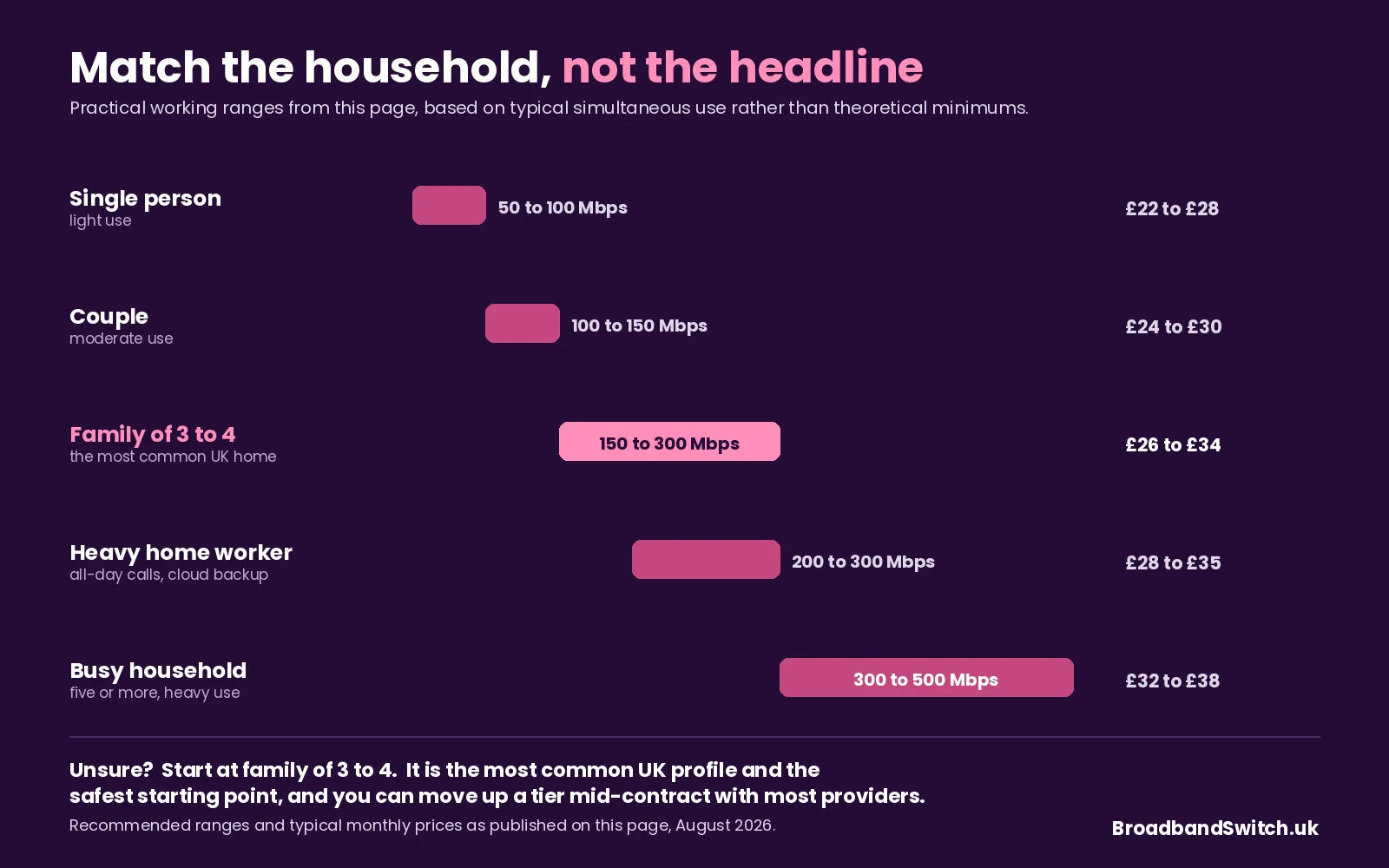
- Single person, light use · 50 to 100 MbpsOne 4K stream, browsing, the occasional video call, one device active at a time. Typically £22 to £28 a month.
- Couple, moderate use · 100 to 150 MbpsTwo simultaneous 4K streams, video calls and gaming, with no slowdown when one person uploads. Typically £24 to £30 a month.
- Family of 3 to 4 · 150 to 300 MbpsMultiple 4K streams on different TVs, simultaneous video calls, gaming and home learning. Typically £26 to £34 a month. This is the most common UK household profile and the best starting point if you are unsure.
- Heavy home worker · 200 to 300 MbpsReliable all-day video calls, regular cloud backup and family streaming alongside work. Typically £28 to £35 a month.
- Busy household, five or more · 300 to 500 MbpsHeadroom for many simultaneous 4K streams, gaming, calls and occasional large downloads. Typically £32 to £38 a month.
For a more personalised answer, use the peak-demand calculator at the top of this page or our what speed do I need calculator.
What each speed tier actually handles
Here is what your connection can do in concrete terms. Each activity carries a typical download requirement in Mbps, so you can do the arithmetic for your own household, and the calculator above does it for you.
- 4K video · 25 Mbps per streamNetflix, Disney+, Prime Video and YouTube all recommend around 25 Mbps per concurrent 4K stream. Four simultaneous 4K streams come to exactly 100 Mbps, which is why 150 Mbps is the tier that carries four streams with genuine headroom.Streaming
- HD video · roughly 5 Mbps per streamStandard HD streaming is undemanding, and several HD streams together barely trouble any plan in this bracket.Streaming
- HD video call · 2 to 4 Mbps each wayZoom, Teams and Google Meet all run HD calls well on 4 Mbps down and 2 Mbps up. Upload speed matters more than download for good video quality.Video calls
- Online gaming · 3 to 5 Mbps, ping matters moreLive gaming uses very little bandwidth. What matters is latency under 30 ms and stability, which is why a 100 Mbps full fibre line outperforms a 1 Gbps cable line for competitive play.Gaming
- Cloud backup · upload-boundPhotos, documents and device backup run in the background, and performance is limited by upload speed rather than download. Full fibre usually has much better upload than FTTC at the same tier.Background
- Music streaming · 0.3 to 1 MbpsSpotify, Apple Music and Tidal Hi-Fi all use tiny amounts of bandwidth, and never trouble any broadband plan in this bracket.Background
- Game downloads · benefits from speedA 100 GB release takes about 45 minutes on 300 Mbps, about 90 minutes on 150 Mbps and about 13 minutes on a gigabit line. If you regularly buy new releases on launch day, pick the higher end of this bracket.Occasional
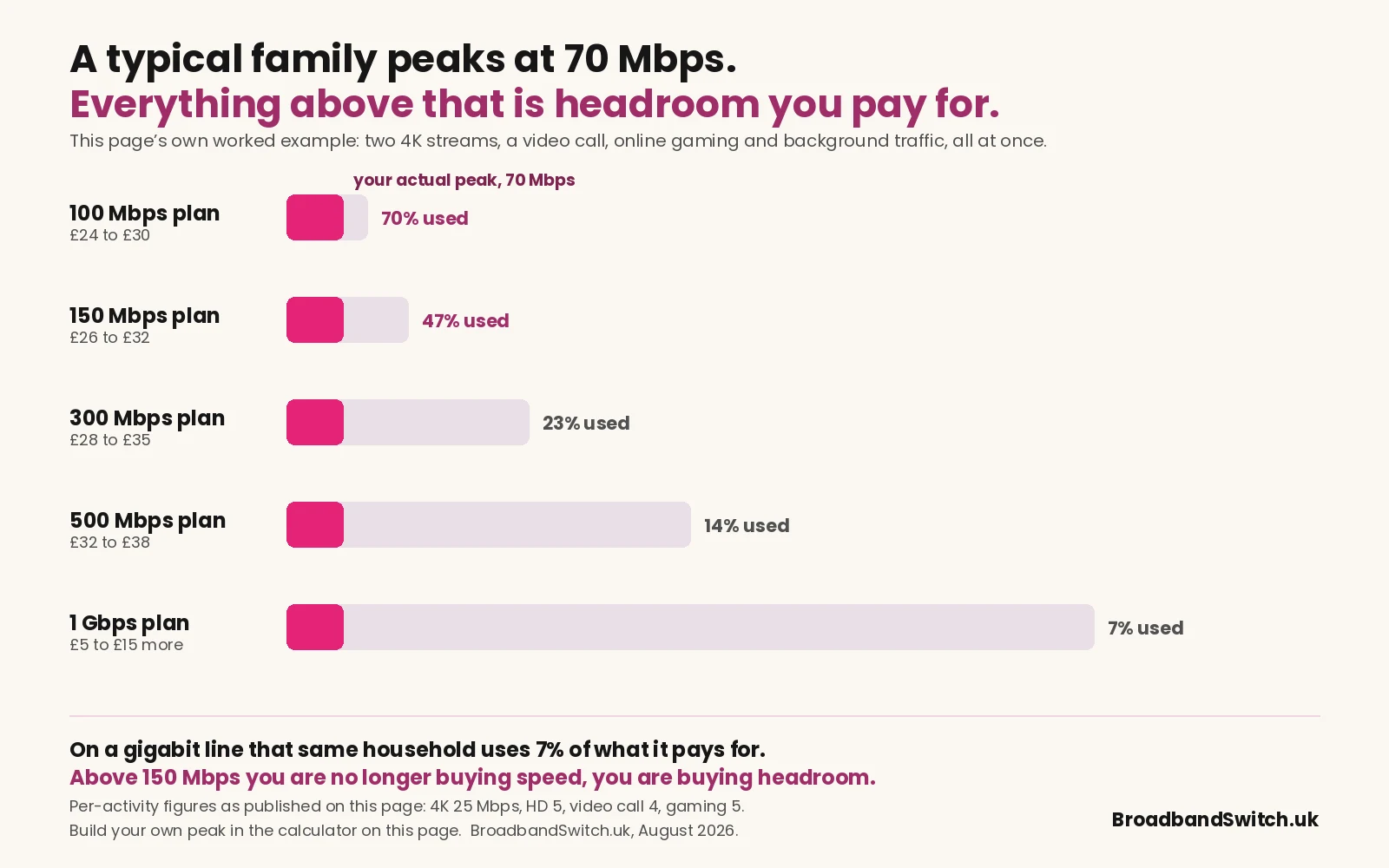
Add up what your household does simultaneously at its busiest moment. A typical family runs two 4K streams at 50 Mbps, one video call at 4, gaming at 5 and background traffic, which comes to around 70 Mbps peak. Even a 100 Mbps plan has 30% headroom above that, and a gigabit plan would sit 93% idle at the same moment.
UK speed tiers under 500 Mbps and typical pricing
Common UK broadband speed tiers under 500 Mbps, with the delivery technology and typical monthly price at time of publication.
- 38 Mbps · £22 to £26FTTC entry. Best suits a single person, light use, budget first.
- 67 to 80 Mbps · £24 to £30FTTC full tier. Best suits couples, small families and FTTC-only postcodes.
- 100 Mbps · £24 to £30Full fibre entry and cable entry. Best suits couples and light to moderate families.
- 150 Mbps · £26 to £32Full fibre mid tier and cable. Best suits the typical UK family home.
- 200 to 300 Mbps · £28 to £35Full fibre and cable. Best suits home workers and families of three to five.
- 500 Mbps · £32 to £38Full fibre and cable. Best suits busy households with heavy simultaneous use.
Actual speed tiers vary by provider and by what is available at your exact address, and pricing shifts with promotions, so use the live comparison below to see today's prices.
Why this bracket is often the best value
The speed-to-price curve in UK broadband flattens sharply above 300 Mbps. The extra £5 to £15 a month for gigabit buys speed that most households cannot actually use, because of the Wi-Fi bottleneck, device limits and real-world usage patterns.
- Real-world speed matches plan speedAt 300 Mbps, what you pay for is roughly what Wi-Fi delivers to your devices. At 1 Gbps, Wi-Fi becomes the bottleneck and most devices never see the full speed.
- £120 to £360 saved over 24 monthsPicking 300 Mbps over a gigabit plan saves £5 to £15 a month, and across a typical 24-month contract that is £120 to £360 back in your pocket for speed you would not notice anyway.
- Room to upgrade laterYou can switch up to gigabit when you actually need it, so starting at the sensible tier keeps your options open without paying for headroom you may never use.
For the full picture on gigabit trade-offs, see our gigabit broadband deals page, which covers the specific cases where gigabit genuinely is worth paying for.
When you might want more than 500 Mbps
There are specific profiles where going above 500 Mbps genuinely helps. If any of these describe you, see our gigabit broadband deals page.
- Heavy upload workflowsVideo editors, photographers, software engineers and livestreamers who routinely upload tens of gigabytes benefit from symmetrical gigabit full fibre, where upload matches download.Profile one
- Six or more simultaneous heavy usersLarge houseshares and big families where six or more people stream, call and game at the same time. The gigabit headroom prevents slowdowns when one person starts a large download.Profile two
- Regular launch-day game downloadsOn this page's own arithmetic a 100 GB release takes about 90 minutes at 150 Mbps, about 45 minutes at 300 and about 13 minutes on gigabit. If that difference matters to you often, gigabit earns its money on those days.Profile three
- Long-stay futureproofingIf you plan to stay at the property five years or more and the gigabit price gap is small, locking in the top tier can make sense, since speed expectations have historically risen roughly every three years.Profile four
Live deals under 500 Mbps at your postcode
Live deals below are limited to packages advertising up to 500 Mbps. Enter your postcode to narrow to what is actually live at your address, sorted by monthly price, low to high, so the best value appears first.
Availability and pricing are postcode and address specific, and all technologies under 500 Mbps appear: full fibre, cable and faster FTTC tiers. Always pick your exact address in the widget where prompted.
Related ways to compare
Broadband under 500 Mbps, asked and answered
What broadband speed does a typical UK household actually need?
For a typical UK family of three to four people, 150 to 300 Mbps handles everything comfortably: multiple 4K streams, video calls, gaming and home working simultaneously. Single-person households do well on 50 to 100 Mbps, and busy households with five or more simultaneous heavy users may benefit from 300 to 500 Mbps. Most homes never actually hit the ceiling of a 150 Mbps plan, because the busiest realistic moment in a family home comes to around 70 Mbps.
Is 100 Mbps enough for a family?
In most cases, yes. At 100 Mbps a family can run two 4K streams plus a video call plus gaming with no slowdown, which comes to about 70 Mbps and leaves 30% headroom. Four simultaneous 4K streams come to exactly 100 Mbps, so if that genuinely happens in your house, 150 Mbps is the tier that carries it with room to spare. For most family homes 100 Mbps is rarely the bottleneck.
Will I notice the difference between 300 Mbps and gigabit?
For normal day-to-day use, no. Both feel identical for streaming, browsing, calling and gaming. You would only notice if you regularly download very large files, where the actual download time is shorter on gigabit, or if you run heavy cloud upload workflows that benefit from a symmetrical connection. For the typical household the experience is indistinguishable.
Does a lower-speed plan save meaningful money?
Yes, over a contract term. A 300 Mbps plan typically costs £5 to £15 less a month than gigabit, and across a 24-month contract that is £120 to £360 saved for speed most households would not notice. The saving is larger at altnet providers, where the gigabit premium tends to be highest.
Does Wi-Fi actually deliver my full plan speed?
It depends on your equipment. A 300 Mbps plan usually delivers close to the full speed over modern Wi-Fi 6 in the same room as the router, and 200 Mbps or more elsewhere in the house. On older Wi-Fi 5 routers, real-world speed to a laptop or phone is typically 200 to 500 Mbps regardless of whether the underlying line is 300 Mbps or 1 Gbps, so matching your plan to what your Wi-Fi can actually carry is often smarter than overpaying.
Is 500 Mbps enough for gaming?
More than enough. Online gaming uses surprisingly little bandwidth, 3 to 5 Mbps per session, and is far more sensitive to latency than to peak speed. A 100 Mbps full fibre line with 10 ms ping typically outperforms a 1 Gbps cable line with 30 ms ping on competitive play. Higher speed helps on install day but not during actual play. See our latency and jitter guide.
Which provider has the best value at this tier?
It varies sharply by postcode. Altnet full fibre providers such as Community Fibre, Hyperoptic, Gigaclear and YouFibre often have the lowest prices per Mbps, but only where they have built. Big-brand full fibre via Openreach has broader coverage, and Virgin Media cable is widely available but typically a little more expensive. The live comparison above shows your actual options sorted cheapest first.
Can I switch between under-500 Mbps tiers mid-contract?
Usually yes, with the same provider. Most UK providers let existing customers move up a speed tier mid-contract without penalty, while moving down is sometimes restricted until the contract ends. Moving to a different provider triggers exit fees on your current contract unless you are in the 30 days before renewal or within a cooling-off period, and One Touch Switch handles the provider move once your contract allows it.
About this guide. Compiled by Adrian James and reviewed by Dr Alex J. Martin-Smith, with every speed and price stated as published at 8 August 2026, and the peak-demand calculator reading its per-activity figures from this page's own activity cards so tool and text cannot drift. BroadbandSwitch is an independent UK broadband comparison service owned by SearchSwitchSave. Speeds, availability and package structure vary by exact address and change over time, and advertised average speeds are not guarantees, so check the estimate your provider gives for your line. We earn commission when you order via our comparison, which does not change the price you pay: read how we rank deals, our editorial policy, the methodology and trust hub and our affiliate disclosure. Spotted something wrong? Submit a correction and a human will read it.
References
- Ofcom. (2024, July 19). Ofcom bans mid-contract price rises linked to inflation. Office of Communications. Retrieved August 8, 2026, from https://www.ofcom.org.uk/phones-and-broadband/bills-and-charges/ofcom-bans-mid-contract-price-rises-linked-to-inflation
- Ofcom. (2024, September 12). Simpler and quicker broadband switching is here. Office of Communications. Retrieved August 8, 2026, from https://www.ofcom.org.uk/phones-and-broadband/switching-provider/simpler-broadband-switching-is-here
- Ofcom. (n.d.). Ofcom checker: broadband and mobile coverage. Office of Communications. Retrieved August 8, 2026, from https://www.ofcom.org.uk/phones-and-broadband/coverage-and-speeds/ofcom-checker
Also worth checking: gigabit deals if you have a specific reason to need more, best value deals ranked by speed per pound, or our speed calculator to personalise the recommendation.
Independent, free, no signup. Up to 500 Mbps, cheapest first.