Moving and renting broadband: what a move actually costs, why the switching protection you have heard of does not cover it, and the deadline that decides all of it
Moving home is not switching, and the protection everybody has heard of does not cover it. One Touch Switch is a genuinely good reform and it is about the address you are arriving at: “you will only need to contact your new home broadband provider to switch, and you won't need to speak to your current provider before making the move”. Nothing equivalent exists for the address you are leaving, and Ofcom's own moving-home guidance is three tips last updated on 5 July 2023, before One Touch Switch went live. Its only sentence about the contract is “If you're changing broadband provider, you'll need to cancel your current contract and arrange a start date for your new service in time for when you move.” So the rules that decide what a move costs are the companies' own. Nine providers publish their own moving rules, and they disagree with each other on the fee, on whether the contract restarts, and on what happens if they cannot reach your new address. Two providers charge you to keep your contract and nothing to start a new one, so on a move the loyal option is the expensive one. TalkTalk: “If you want to carry over your existing contract there'll be a charge of £60 for moving your services. However if you're starting a brand new contract at your new property you wont face any additional fees.” Plusnet: “We won't charge you for moving home if you take out a new contract. However, if you stay on your existing contract you may be charged a home move fee of £65”. A move can also restart your clock: Vodafone’s terms say “you may become subject to a new agreement with us and a new minimum period may be applicable from the service activation date at your new home”. Everybody believes that if a provider cannot reach the new address you walk away free. Four publish exactly that, one publishes a conditional version, one grants the right without calling it free, and three publish nothing about it at all. Renters have a separate problem of their own. There is no statutory right for a tenant to have fibre installed. The law passed in 2021 gives operators a route through the courts where a landlord will not answer; it gives the tenant nothing to enforce. None of this is sharp practice. A move genuinely is a different job from a switch, the engineers and the wayleaves are real, and most of these companies move most people without incident. What is missing is anybody telling you the rules before the week you need them. Find your provider's published notice period, count back from your move date, and put that date in your calendar today. Every charge on this page is decided by whether you told them in time. The three tools below do the counting, entirely in your browser.
See what your new address can actually get
One postcode, every provider we can switch you to, sorted by price with the lowest first. Check the exact address rather than the street: two doors on one road can sit on different networks.
Want the answer rather than the argument? Jump to the three tools, or go straight to the ten guides.
The short version, and what it does not claim
Direct answer: Moving home is not switching, and the protection everybody has heard of does not cover it.

Switching broadband in Britain got genuinely better. One Touch Switch means one phone call to the company you want, and Ofcom's description is worth reading closely: “you will only need to contact your new home broadband provider to switch, and you won't need to speak to your current provider before making the move”. It applies right across the market, because “This will apply to all home broadband users, including cable and full-fibre customers.”
Moving house got none of that. A move is a different transaction in Ofcom's own rules, it happens at the address you are arriving at, and there is no equivalent mechanism for the one you are leaving. Ofcom's consumer guidance for movers is three tips, and Ofcom's moving-home guidance was published on 14 September 2021 and last updated on 5 July 2023, which is before One Touch Switch went live. It mentions One Touch Switch nowhere, early termination charges nowhere and notice periods nowhere.
Into that gap, the companies have written their own. Nine providers publish their own moving rules, and they disagree with each other on the fee, on whether the contract restarts, and on what happens if they cannot reach your new address. The striking thing is not that any of them is harsh. Mostly they are reasonable. The striking thing is that the same household, moving in the same week, gets a different answer depending on the logo on the bill.
None of this is sharp practice. A move genuinely is a different job from a switch, the engineers and the wayleaves are real, and most of these companies move most people without incident. What is missing is anybody telling you the rules before the week you need them.
This hub sits over ten guides, one for each of the common situations. The first tool below picks the two that are yours in about twenty seconds, or you can browse all ten.
Three tools: which guide, what deadline, what cost
Direct answer: Find your provider's published notice period, count back from your move date, and put that date in your calendar today. Every charge on this page is decided by whether you told them in time.
All three run entirely in your browser. There is no form to submit, no address to type and no request to any server: what you put in is worked out on the page and gone when you close the tab. Every figure they use is published by the company named, and where a company publishes nothing, they say so rather than estimating.
Which of these ten guides is yours?
Four questions, about twenty seconds. It reads nothing and sends nothing: the answer is worked out in your browser and forgotten when you close the tab.
What is your actual deadline?
Every charge on this page is decided by whether you told them in time, and no two providers publish the same period. Put your move date in and it counts back using the period your provider publishes.
The published notice period and move fee for each of the nine, and where each came from
| Provider | Notice it asks for | What a move costs |
|---|---|---|
| BT | 30 days' notice to cancel | Not published. BT says it will tell you if a new line installation is chargeable when you start the move. |
| Sky | 2 to 4 weeks before the move | £50, and free for Sky VIP customers. |
| TalkTalk | 3 to 4 weeks before the move, and no sooner than 3 months | £60 to carry your existing contract across, and nothing at all if you start a new contract at the new property. |
| Virgin Media | 30 days' notice | Not published. Its terms say a service transfer fee may apply and point at the price guides. |
| EE | at least 3 weeks before the move | No activation or connection fees for broadband. New equipment carries a delivery charge. |
| Vodafone | at least 30 days in advance | Not published. Its terms point at the Price Guide for connection charges. |
| Plusnet | at least four weeks before, and no more than 90 days | £65 to stay on your existing contract, and nothing at all if you take out a new contract. |
| NOW Broadband | 31 days' notice, and 2 weeks for a change of address | Not published as an amount, but NOW undertakes to tell you whether a charge applies and what it is before it processes the move. |
| Hyperoptic | 30 days' notice of any cancellation, rolling plans included | Free within the same building. No figure is published for a move to a different building. |
| Another provider, or not sure | 30 days is the commonest published period, so plan on that | Find it in your contract summary, which Ofcom requires your provider to have given you before you were bound. |
Cheaper to take it with you, or to leave?
On TalkTalk’s own published figures the £60 move fee beats the exit charge from six months out, and loses below five. This runs the same sum for whoever you are with, and tells you plainly when the figure is not published.
This is an illustration built from published figures, not a quotation. Ask your provider for both numbers in writing before you decide, and remember that a published fee is a starting position: Citizens Advice publishes that a provider “might reduce or remove any fee” if you explain the situation.
Why moving is not switching
Direct answer: One Touch Switch changes who supplies an address. Nothing covers somebody leaving one.
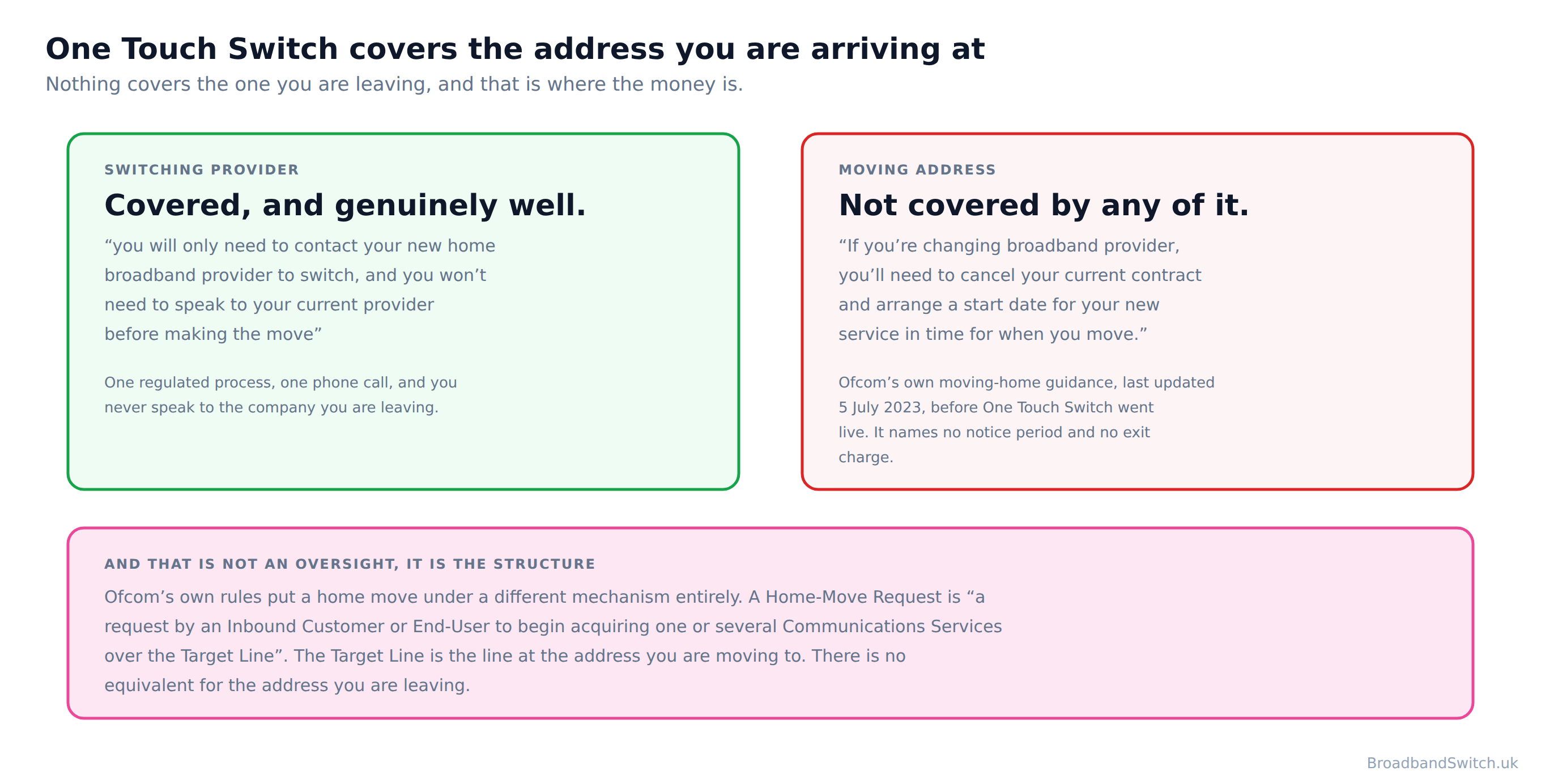
Start with what the good reform actually says. Ofcom: “Switching broadband is simple with One Touch Switch. Contact the provider you want to move to, and they will manage the switch for you.” For a household changing provider at the same address that is close to frictionless, and it was not always so.
Now read Ofcom's own moving-home page, which is the one a mover would find. Its single substantive sentence about the contract is “If you're changing broadband provider, you'll need to cancel your current contract and arrange a start date for your new service in time for when you move.” Note the verb. Not switch: cancel. Ofcom's moving-home guidance was published on 14 September 2021 and last updated on 5 July 2023, which is before One Touch Switch went live. It mentions One Touch Switch nowhere, early termination charges nowhere and notice periods nowhere.
That is not an oversight, it is the structure. Ofcom's General Conditions define a Home-Move Request as “a request by an Inbound Customer or End-User to begin acquiring one or several Communications Services over the Target Line”. The Target Line is the line at the address you are moving to. The rules describe arriving somewhere in detail and leaving somewhere not at all, which is exactly why the cost of leaving is set by nine different sets of company terms rather than by one regulated process.
Citizens Advice is the body that addresses the gap most directly: “You should check if your provider offers the same service in your new area. If they do, you might have to pay a small fee to move the service to your new address.” Small is doing some work in that sentence. The published fees in this research run from nothing to £65.
What nine providers actually publish
Direct answer: Nine providers publish their own moving rules, and they disagree with each other on the fee, on whether the contract restarts, and on what happens if they cannot reach your new address.
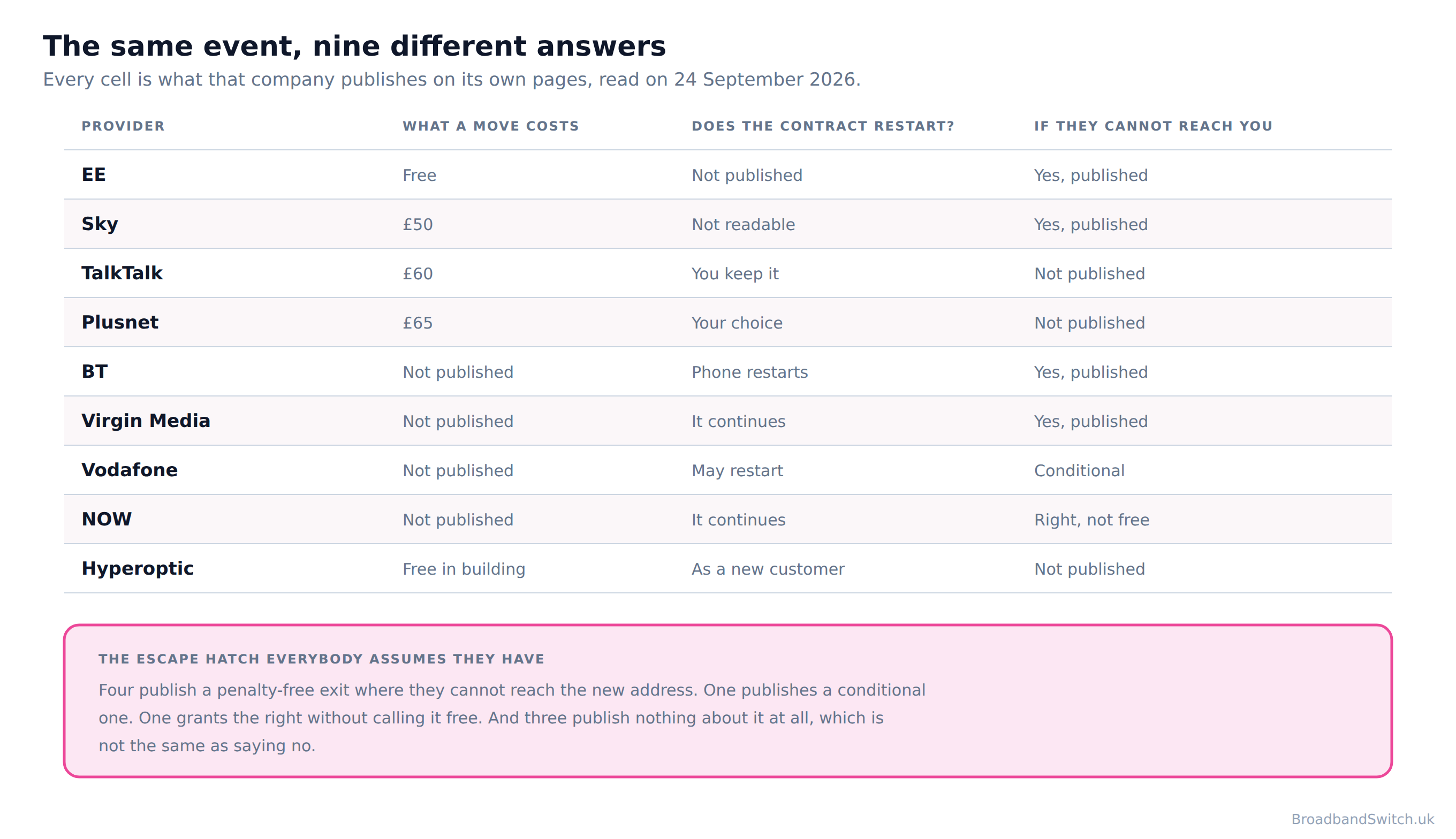
Three columns, nine companies, every cell read on their own pages on 24 September 2026. Take them one at a time.
On cost, EE is free: “If you've got broadband with us, there are no activation or connection fees.” Hyperoptic is free in one specific case: “If you are moving within the same building, moving your Hyperoptic service is free of charge and can be done quickly.” Sky publishes “If you're a Sky VIP customer, your home move is free. If not, it will cost £50.” TalkTalk and Plusnet both charge, and both charge nothing if you re-contract, which is the next section. BT, Virgin Media, Vodafone and NOW publish that a charge may apply without publishing the amount. Virgin's terms say only “A service transfer fee may apply, please see the price guides for details”, and NOW at least commits to quoting it first: “We may charge you any costs we reasonably incur as a result of transferring your service to your new Address. We will tell you whether a charge applies and the amount of this charge before processing your move.”
On the contract clock, the same event has opposite consequences. Virgin Media: “your minimum period will continue (e.g. where your services are on a 12 month minimum period, if you move during month 7 of your minimum period, the remaining 5 months of your minimum period will apply)”. NOW: “This Contract will continue unless you exercise a right to end it under this Contract or we are unable to transfer your NOW Broadband and Calls services to your new Address”. Against those, Vodafone's terms say “you may become subject to a new agreement with us and a new minimum period may be applicable from the service activation date at your new home” and Hyperoptic says “Provision of our services to you at your new home will usually be handled as if you are a new customer.” BT splits the difference in a way worth knowing if you still have a landline: “If you want telephone service at your new address, a new 12-month contract term will always apply for the telephone line.”, while “Any term remaining on your existing broadband contract will be transferred to your new address if you take the same service at your new address. However, if the term on your broadband contract is less than three months, a new three-month contract will apply at your new address.”
The three-month floor nobody mentions
Read BT's broadband rule again. A customer with one month left on a contract, moving house, arrives at the new address owing three. It is published, it is not hidden, and almost nobody discovers it before the move rather than after.
And on notice, no two of the nine agree. Plusnet has the shortest cancellation period in this research: “We require 14 days' notice in order to cancel a residential account and 28 days' notice to cancel a business account.” NOW has the longest: “you must either give us at least 31 days' notice or place an order with another provider who can provide broadband and home telephone calls on your existing Line”. Thirty-one days rather than thirty is the kind of difference that costs a household an extra month of line rental, and it is published rather than concealed. The planner above counts back from your move date using whichever period applies to you.
The fee for staying loyal
Direct answer: Two providers charge you to keep your contract and nothing to start a new one, so on a move the loyal option is the expensive one.
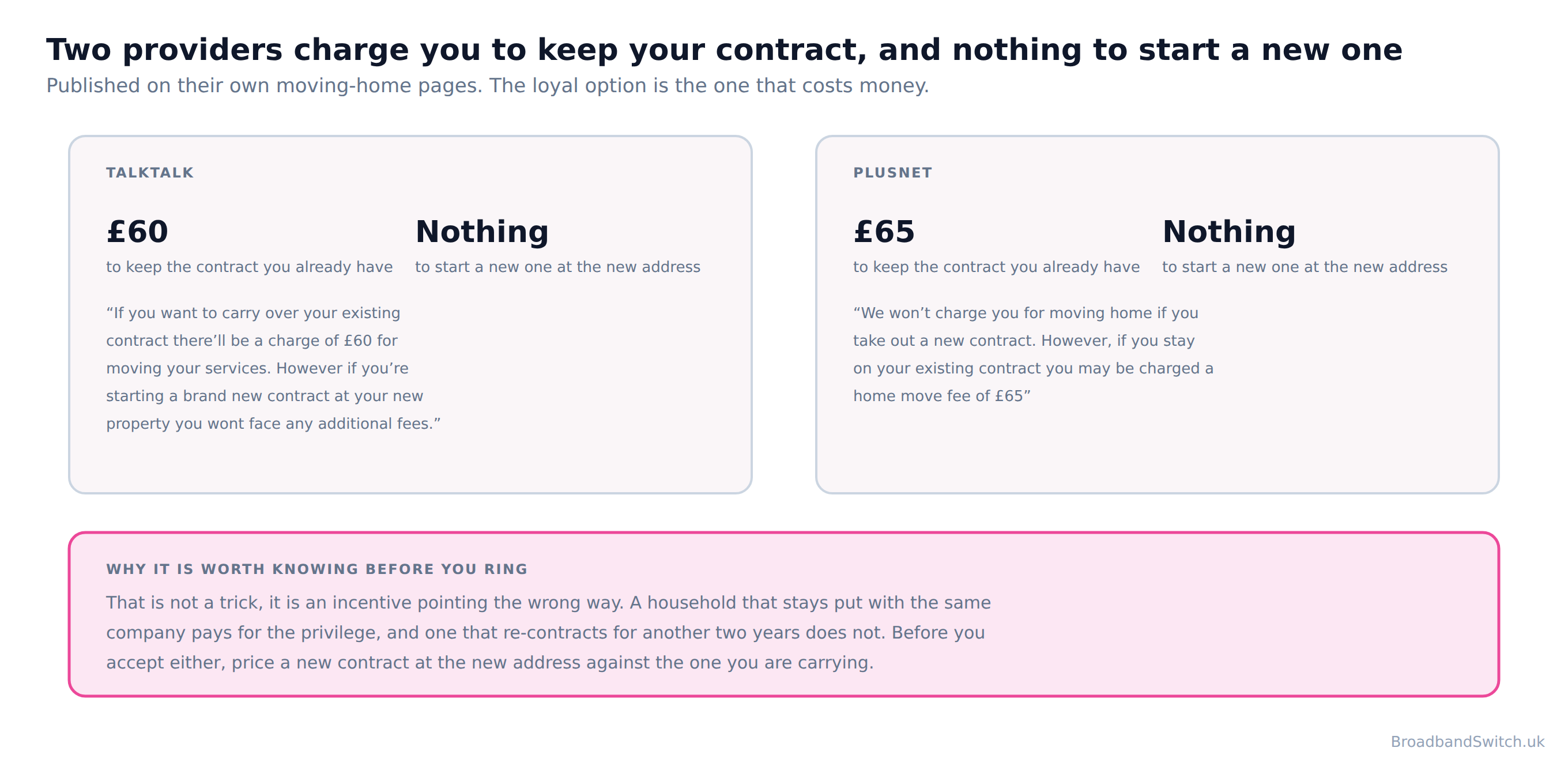
This is the finding on this page least likely to be written anywhere else, and both halves of it are published by the companies themselves.
TalkTalk: “If you want to carry over your existing contract there'll be a charge of £60 for moving your services. However if you're starting a brand new contract at your new property you wont face any additional fees.” What the £60 buys is continuity: “If you're currently on one of our plans, you'll be able to keep your current contract.” Plusnet, five pounds dearer and identical in shape: “We won't charge you for moving home if you take out a new contract. However, if you stay on your existing contract you may be charged a home move fee of £65”
Nobody designed that to be unfair. It is what happens when a company prices a move as an administrative job and prices a new sale at nothing because a new sale is worth having. The effect, though, is that the household which keeps the arrangement it already has pays, and the household that signs up for another two years does not.
What to do with it
Before you accept either, price a new contract at the new address against the one you are carrying. If re-contracting is free and the new price is lower, carrying the old contract is costing you twice. If the new commitment is longer than you want to be somewhere, that is a real cost too, and only you can weigh it. What you should not do is assume that keeping what you have is the cautious option: at these two companies it is the expensive one.
Citizens Advice adds the line that applies to every fee on this page: “It's worth trying to explain your situation to your provider - they might reduce or remove any fee.” A published fee is a starting position.
The escape hatch that is not universal
Direct answer: Everybody believes that if a provider cannot reach the new address you walk away free. Four publish exactly that, one publishes a conditional version, one grants the right without calling it free, and three publish nothing about it at all.
Almost everybody believes that if their provider cannot reach the new address, they walk away without paying. For four of the nine that belief is exactly right, and published in plain words.
BT's terms, clause 39: “You will not have to pay this charge in the event that you move home and we are unable to provide the service at your new UK address.” Sky: “In the event we're not available at your new address, you'll be able to cancel when you move with no exit fees.” Virgin Media's terms, where it cannot provide the same services: “you can cancel your services and you will not need to pay an early disconnection fee”. EE lists among the cases where no early termination charge is payable: “you move home and we cannot provide the price plan service at your new UK address”
Vodafone's version is real but conditional, and the conditions are the point: “If we are unable, for any reason, to provide a Home Broadband and Phone Services to your new address in the UK then you will be entitled to end this Agreement subject to provision by you of reasonable evidence of your change of address and payment by you of all charges owing up to the date that we disconnect your service.” Subject to is doing the work there. NOW publishes a right to end the contract in that situation without saying anywhere that it is free of charge, which is a meaningfully weaker thing.
And three publish nothing at all
TalkTalk, Plusnet and Hyperoptic publish nothing on their moving-home pages about what happens if they cannot serve the new address. An absence is not a refusal. It is also not a promise, and it is the difference between knowing where you stand and hoping. If you are with one of those three, ask the question before you need the answer, and ask for it in writing.
Moving outside a network entirely is handled differently again. Virgin Media publishes a credit-back mechanism rather than a straight waiver, requiring evidence of the new address within thirty days. It is a reasonable rule and it is one more thing that only exists in the terms.
Renting: the right that is not a right
Direct answer: There is no statutory right for a tenant to have fibre installed. The law passed in 2021 gives operators a route through the courts where a landlord will not answer; it gives the tenant nothing to enforce.

The private rented sector is not a niche: “In 2024-25, the private rented sector accounted for 4.7 million or 19% of households.” And it is concentrated where the flats are, which is where the permission problem lives: “In 2024-25, 28% of households in London were private renters, compared to 17% in the rest of England.”
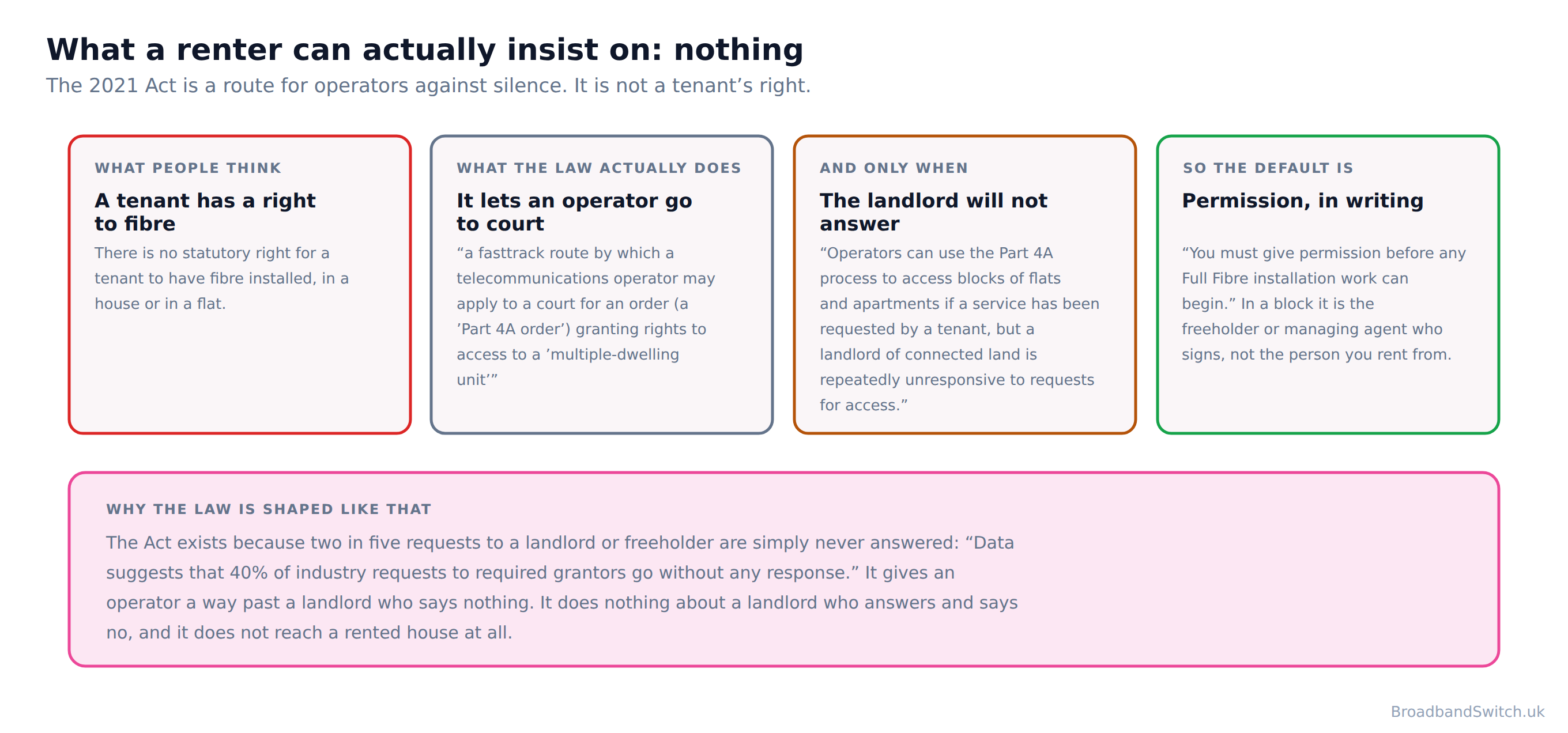
The Telecommunications Infrastructure (Leasehold Property) Act 2021 is regularly described as giving tenants a right to fibre. Read what it actually creates: “a fasttrack route by which a telecommunications operator may apply to a court for an order (a 'Part 4A order') granting rights to access to a 'multiple-dwelling unit'”. An operator, a court, a multiple-dwelling unit. None of those words is the tenant.
And it bites only in one situation. The Government's guidance: “Operators can use the Part 4A process to access blocks of flats and apartments if a service has been requested by a tenant, but a landlord of connected land is repeatedly unresponsive to requests for access.” Two limits sit inside that sentence and both matter. Blocks of flats, not a rented house. And a landlord who does not answer, not a landlord who answers and refuses.
So the published default stands, and Openreach states it plainly to landlords: “You must give permission before any Full Fibre installation work can begin.” In a block the person who has to agree is frequently not the person you rent from: “Before we can begin installation to blocks of flats and apartments, we'll need permission from the Freeholder or Managing Agent, also known as a wayleave.” A wayleave is “A written legal agreement between us and the land or property owner. It gives us permission to install, maintain or repair the network equipment that's on their property.”
Which makes the ask the whole of your position
Ask early, ask in writing, and make it easy to say yes: name the provider, say whether any drilling is involved, and offer to pass on the operator's own landlord information. The Act exists precisely because so many of these requests vanish: “Data suggests that 40% of industry requests to required grantors go without any response.” A landlord who has simply not got round to it is the commonest obstacle, not a landlord who objects.

If you are renting with other people, one more thing has to be agreed before anybody orders anything: no UK provider publishes a way to put two people on one broadband account, so the name on the bill is the person liable for all of it, including the exit charge. Our house shares guide covers the arrangements that actually work.
What you are owed when it goes wrong
Direct answer: A missed go-live date is the commonest thing that goes wrong on a move, and there is a published rate for it.
Ofcom's automatic compensation scheme pays without you having to argue, and the rates published as at 24 September 2026 are “£6.46 for each calendar day of delay” where a provider promises to start a service on a date and fails to, “£32.31 per missed appointment” for an engineer who does not turn up or cancels on under 24 hours' notice, and “£10.34 for each calendar day the service is not repaired” for each day of a total loss of service once two working days have passed.
Two caveats belong with that and neither is usually mentioned. The scheme is voluntary rather than universal: BT, EE, Hyperoptic, Plusnet, Sky (including NOW Broadband), TalkTalk, Utility Warehouse, Virgin Media, Vodafone and Zen Internet are signed up to Ofcom's automatic compensation scheme. It is voluntary, so a provider outside that list owes none of it. And Ofcom publishes no statement on whether automatic compensation applies when a customer is moving home. A move is not among its published exclusions, and it is not named as covered either.
What to keep
The date you were promised, in writing, and the reference number of the call where you were given it. That is the whole of what a claim needs, and it is the thing nobody has when they need it. The amounts also move: “Compensation amounts increase each year in line with inflation.”, so check the current figure rather than quoting this page back at anybody.
One more piece of paper is worth asking for if a move re-contracts you. Ofcom requires your provider to give you “a one-page (or three-page for bundled services) contract summary in writing, that includes key information, such as charges, the length of the contract and the process for cancelling” before you are bound. On a home move that document is where a new minimum term would appear, and reading its length takes about ten seconds.
The ten guides in this series
Direct answer: Ten guides, one for each common situation. The router at the top picks yours in four questions.
Alongside these, the questions next door: what a full house actually needs, why a contract outlives a tenancy, what a pensioner household is entitled to and which technology to buy.
Broadband at your postcode
See what your new postcode can actually get
One postcode shows every provider we can switch you to, lowest price first, across full fibre, FTTC, cable and 5G home broadband. A move is the one moment when you are free to buy on what is actually best rather than on what you already have.
Show every provider at my postcode →Moving and renting broadband: frequently asked questions
Does One Touch Switch cover me when I move house?
Not in the way most people assume. Ofcom describes it plainly: “Switching broadband is simple with One Touch Switch. Contact the provider you want to move to, and they will manage the switch for you.” and “you will only need to contact your new home broadband provider to switch, and you won't need to speak to your current provider before making the move”. Read what that is about: the provider you are moving to, at the address you are arriving at. It is a genuine improvement and it applies broadly, “This will apply to all home broadband users, including cable and full-fibre customers.” What it does not do is end a service at the address you are leaving. Ofcom's own rules treat a home move as a separate transaction, defining a Home-Move Request as “a request by an Inbound Customer or End-User to begin acquiring one or several Communications Services over the Target Line”, and the Target Line is the line at the address you are moving to. There is no equivalent mechanism for the one you are leaving behind, which is why the money on a move is decided by your provider's terms rather than by a regulated process.
How much notice do I have to give before I move?
It depends entirely on who you are with, and no two of the nine publish the same period. EE asks for “Get in touch at least 3 weeks before your move.” on its help page, though its own terms document says fourteen days. Sky: “Just let us know 2-4 weeks in advance so we can get you ready for move-in day.” TalkTalk: “The ideal time to let us know is 3-4 weeks before you're due to move (but no sooner than 3 months before).” Plusnet: “Let us know at least four weeks before your move-in date, but no more than 90 days in advance”. Vodafone: “Let us know your moving date at least 30 days in advance, and we can get your installation booked in for the day you move.” BT, Virgin Media and Hyperoptic all publish thirty days. NOW publishes thirty-one, which is the kind of detail that costs somebody an extra month. The planner above counts back from your move date using whichever of those applies to you.
Will I have to pay to move my broadband to a new address?
Sometimes, and the published figures run from nothing to sixty-five pounds. EE: “If you've got broadband with us, there are no activation or connection fees.” Sky: “If you're a Sky VIP customer, your home move is free. If not, it will cost £50.” TalkTalk: “If you want to carry over your existing contract there'll be a charge of £60 for moving your services. However if you're starting a brand new contract at your new property you wont face any additional fees.” Plusnet: “We won't charge you for moving home if you take out a new contract. However, if you stay on your existing contract you may be charged a home move fee of £65”. Hyperoptic: “If you are moving within the same building, moving your Hyperoptic service is free of charge and can be done quickly.” BT, Virgin Media, Vodafone and NOW all publish that a charge may apply without publishing the amount, so for those four the figure has to be asked for. NOW at least commits to telling you first: “We may charge you any costs we reasonably incur as a result of transferring your service to your new Address. We will tell you whether a charge applies and the amount of this charge before processing your move.” Citizens Advice adds something worth remembering about all of them: “It's worth trying to explain your situation to your provider - they might reduce or remove any fee.”
Does moving house restart my broadband contract?
For some providers yes, for others no, and the same event has opposite consequences depending on the logo on the bill. Vodafone's terms: “you may become subject to a new agreement with us and a new minimum period may be applicable from the service activation date at your new home”. Hyperoptic: “Provision of our services to you at your new home will usually be handled as if you are a new customer.” BT restarts one part and not the other: “If you want telephone service at your new address, a new 12-month contract term will always apply for the telephone line.”, while “Any term remaining on your existing broadband contract will be transferred to your new address if you take the same service at your new address. However, if the term on your broadband contract is less than three months, a new three-month contract will apply at your new address.” Against that, Virgin Media's terms say “your minimum period will continue (e.g. where your services are on a 12 month minimum period, if you move during month 7 of your minimum period, the remaining 5 months of your minimum period will apply)” and NOW's say “This Contract will continue unless you exercise a right to end it under this Contract or we are unable to transfer your NOW Broadband and Calls services to your new Address”. If a move does re-contract you, Ofcom requires you to be given “a one-page (or three-page for bundled services) contract summary in writing, that includes key information, such as charges, the length of the contract and the process for cancelling” before you are bound, and that document is where the new minimum term is written down. Ask for it and read the length before you agree.
What if my provider cannot reach my new address?
This is the protection everybody assumes they have, and it is published by four of the nine rather than all of them. BT's terms: “You will not have to pay this charge in the event that you move home and we are unable to provide the service at your new UK address.” Sky: “In the event we're not available at your new address, you'll be able to cancel when you move with no exit fees.” EE lists among the cases where no early termination charge is payable: “you move home and we cannot provide the price plan service at your new UK address”. Virgin Media: “you can cancel your services and you will not need to pay an early disconnection fee”. Vodafone's version is conditional: “If we are unable, for any reason, to provide a Home Broadband and Phone Services to your new address in the UK then you will be entitled to end this Agreement subject to provision by you of reasonable evidence of your change of address and payment by you of all charges owing up to the date that we disconnect your service.” NOW publishes a right to end the contract without stating that it is free. And TalkTalk, Plusnet and Hyperoptic publish nothing on their moving-home pages about what happens if they cannot serve the new address. An absence is not a refusal, but it is not a promise either, so if you are with one of those three, ask before you assume.
Is it cheaper to take my broadband with me or to cancel it?
It depends on how many months are left, and on TalkTalk's published figures there is a clean break-even. On TalkTalk's own published numbers the £60 move fee is cheaper than the exit charge from six months out: six months at £11.25 is £67.50. With five months or fewer to run, leaving costs less than moving. The calculator above runs the same arithmetic for whoever you are with, and tells you plainly when a company does not publish one of the two numbers, which is the case more often than you would expect. Where a rate is published it uses it: TalkTalk's is “This charge is set at £11.25 per month for the remaining duration of your contract term.” and Vodafone publishes a formula, “Monthly cost x 0.8 x number of months left on your contract”. Two things the arithmetic cannot settle: whether the move re-contracts you, and what is actually available at the new address.
Can my landlord stop me getting full fibre installed?
Yes, and there is no statutory right that overrides it. There is no statutory right for a tenant to have fibre installed. The law passed in 2021 gives operators a route through the courts where a landlord will not answer; it gives the tenant nothing to enforce. The Telecommunications Infrastructure (Leasehold Property) Act 2021 is often described as giving tenants a right; read what it actually creates, which is “a fasttrack route by which a telecommunications operator may apply to a court for an order (a 'Part 4A order') granting rights to access to a 'multiple-dwelling unit'”. It applies only where “Operators can use the Part 4A process to access blocks of flats and apartments if a service has been requested by a tenant, but a landlord of connected land is repeatedly unresponsive to requests for access.” Two limits sit inside that: blocks of flats rather than rented houses, and landlords who do not answer rather than landlords who refuse. The published default is Openreach's: “You must give permission before any Full Fibre installation work can begin.” In a block, the person who has to agree is often not the person you rent from: “Before we can begin installation to blocks of flats and apartments, we'll need permission from the Freeholder or Managing Agent, also known as a wayleave.” So ask early, ask in writing, and remember the Act exists because “Data suggests that 40% of industry requests to required grantors go without any response.”
Am I owed anything if the broadband is not on when I move in?
Possibly, under Ofcom's automatic compensation scheme, and the published rates as at 24 September 2026 are “£6.46 for each calendar day of delay” for a delayed start, “£32.31 per missed appointment” for a missed engineer appointment and “£10.34 for each calendar day the service is not repaired” for each day of a total loss of service. Two caveats matter and neither is usually mentioned. The scheme is voluntary: BT, EE, Hyperoptic, Plusnet, Sky (including NOW Broadband), TalkTalk, Utility Warehouse, Virgin Media, Vodafone and Zen Internet are signed up to Ofcom's automatic compensation scheme. It is voluntary, so a provider outside that list owes none of it. And Ofcom publishes no statement on whether automatic compensation applies when a customer is moving home. A move is not among its published exclusions, and it is not named as covered either. So log the date you were promised, keep the reference number, and claim it: the amounts rise each year, because “Compensation amounts increase each year in line with inflation.”
I am moving into a house share. Whose name should the broadband be in?
Somebody's, and that person carries the whole of it. No UK provider publishes a way to put two people on one broadband account, so the name on the bill is the person liable for the monthly charge and for the entire exit charge if the house breaks up early. Agree three things before anybody orders: whose name it goes in, how the others pay that person, and what happens to the remaining months if somebody leaves. Our house shares guide covers the arrangements that work, and the router above will send you there if it applies to you.
How much of the UK can actually get full fibre now?
Most of it, and the answer at your new address is now different from the answer at your old one far more often than it used to be. Ofcom's Connected Nations update, published 13 May 2026 on data to January 2026: “Full fibre is available to 24.9 million UK residential premises (82% of the UK's 30.5 million homes). This corresponds to an additional 1.2 million homes with access to full fibre in the six months up to January 2026.” That is why the first step on every timeline on this page is checking the exact address rather than the street. Two doors on the same road can sit on different networks, and a full fibre install needs an engineer appointment where a self-install on a live line can be done in days.
In short
- Moving home is not switching, and the protection everybody has heard of does not cover it.
- One Touch Switch: “you will only need to contact your new home broadband provider to switch, and you won't need to speak to your current provider before making the move”. That is the address you are arriving at.
- Ofcom's moving-home guidance says only: “If you're changing broadband provider, you'll need to cancel your current contract and arrange a start date for your new service in time for when you move.”
- Ofcom's moving-home guidance was published on 14 September 2021 and last updated on 5 July 2023, which is before One Touch Switch went live. It mentions One Touch Switch nowhere, early termination charges nowhere and notice periods nowhere.
- A home move is a separate transaction in Ofcom's own rules: “a request by an Inbound Customer or End-User to begin acquiring one or several Communications Services over the Target Line”
- Nine providers publish their own moving rules, and they disagree with each other on the fee, on whether the contract restarts, and on what happens if they cannot reach your new address.
- Two providers charge you to keep your contract and nothing to start a new one, so on a move the loyal option is the expensive one. TalkTalk: “If you want to carry over your existing contract there'll be a charge of £60 for moving your services. However if you're starting a brand new contract at your new property you wont face any additional fees.”
- Plusnet: “We won't charge you for moving home if you take out a new contract. However, if you stay on your existing contract you may be charged a home move fee of £65”
- EE is free: “If you've got broadband with us, there are no activation or connection fees.” Sky publishes “If you're a Sky VIP customer, your home move is free. If not, it will cost £50.”
- Vodafone's terms: “you may become subject to a new agreement with us and a new minimum period may be applicable from the service activation date at your new home”
- BT: “If you want telephone service at your new address, a new 12-month contract term will always apply for the telephone line.” And “Any term remaining on your existing broadband contract will be transferred to your new address if you take the same service at your new address. However, if the term on your broadband contract is less than three months, a new three-month contract will apply at your new address.”
- Virgin Media: “your minimum period will continue (e.g. where your services are on a 12 month minimum period, if you move during month 7 of your minimum period, the remaining 5 months of your minimum period will apply)”. NOW: “This Contract will continue unless you exercise a right to end it under this Contract or we are unable to transfer your NOW Broadband and Calls services to your new Address”
- Hyperoptic: “Provision of our services to you at your new home will usually be handled as if you are a new customer.”
- Everybody believes that if a provider cannot reach the new address you walk away free. Four publish exactly that, one publishes a conditional version, one grants the right without calling it free, and three publish nothing about it at all.
- BT: “You will not have to pay this charge in the event that you move home and we are unable to provide the service at your new UK address.” Sky: “In the event we're not available at your new address, you'll be able to cancel when you move with no exit fees.”
- Vodafone's is conditional: “If we are unable, for any reason, to provide a Home Broadband and Phone Services to your new address in the UK then you will be entitled to end this Agreement subject to provision by you of reasonable evidence of your change of address and payment by you of all charges owing up to the date that we disconnect your service.”
- TalkTalk, Plusnet and Hyperoptic publish nothing on their moving-home pages about what happens if they cannot serve the new address.
- Notice runs from Plusnet's “We require 14 days' notice in order to cancel a residential account and 28 days' notice to cancel a business account.” to NOW's “you must either give us at least 31 days' notice or place an order with another provider who can provide broadband and home telephone calls on your existing Line”
- There is no statutory right for a tenant to have fibre installed. The law passed in 2021 gives operators a route through the courts where a landlord will not answer; it gives the tenant nothing to enforce.
- The Act creates “a fasttrack route by which a telecommunications operator may apply to a court for an order (a 'Part 4A order') granting rights to access to a 'multiple-dwelling unit'”, and only where “Operators can use the Part 4A process to access blocks of flats and apartments if a service has been requested by a tenant, but a landlord of connected land is repeatedly unresponsive to requests for access.”
- Openreach: “You must give permission before any Full Fibre installation work can begin.” In a block: “Before we can begin installation to blocks of flats and apartments, we'll need permission from the Freeholder or Managing Agent, also known as a wayleave.”
- It exists because “Data suggests that 40% of industry requests to required grantors go without any response.”
- Compensation: “£6.46 for each calendar day of delay”, “£32.31 per missed appointment”, “£10.34 for each calendar day the service is not repaired”
- BT, EE, Hyperoptic, Plusnet, Sky (including NOW Broadband), TalkTalk, Utility Warehouse, Virgin Media, Vodafone and Zen Internet are signed up to Ofcom's automatic compensation scheme. It is voluntary, so a provider outside that list owes none of it.
- Ofcom publishes no statement on whether automatic compensation applies when a customer is moving home. A move is not among its published exclusions, and it is not named as covered either.
- Sky's early termination charge table and its position on whether a move restarts the contract could not be read: its help articles are generated in the browser and its contract PDFs are disallowed to automated readers, so nothing from either is quoted or inferred here.
- None of this is sharp practice. A move genuinely is a different job from a switch, the engineers and the wayleaves are real, and most of these companies move most people without incident. What is missing is anybody telling you the rules before the week you need them.
- Find your provider's published notice period, count back from your move date, and put that date in your calendar today. Every charge on this page is decided by whether you told them in time.
Each line stands on its own and carries its date. Reviewed by a person at least quarterly, last on 24 September 2026.
References
- Ofcom
Ofcom. (2023). Moving home: tips for keeping connected, the guidance that if you are changing broadband provider you will need to cancel your current contract and arrange a start date for the new service. Published 14 September 2021, last updated 5 July 2023, before One Touch Switch went live; it mentions One Touch Switch, early termination charges and notice periods nowhere. ofcom.org.uk
- Ofcom
Ofcom. (2021, September 28). Easier than ever to switch and (2024) Simpler broadband switching is here, the description of One Touch Switch, the statement that a customer need only contact the provider they are moving to, and its application to all home broadband users across networks and technologies. ofcom.org.uk
- Ofcom
Ofcom. General Condition 22: Service Migrations and Home-Moves, the definition of a Home-Move Request at paragraph 22.30(y) as a request to begin acquiring services over the Target Line, and the Working Line Takeover provisions at 22.22. ofcom.org.uk
- Ofcom
Ofcom. (2026). Automatic compensation: what you need to know, the published rates for a delayed start, a missed engineer appointment and a total loss of service, the annual inflation uprating, the list of providers signed up to the voluntary scheme, and the published exclusions. Last updated 20 July 2026. Ofcom publishes no effective date beside the amounts and no statement on whether the scheme applies on a house move. ofcom.org.uk
- Ofcom
Ofcom. (2026, May 13). Connected Nations update: Spring 2026, full fibre available to 24.9 million UK residential premises, 82% of homes, on data to January 2026. ofcom.org.uk
- Ofcom
Ofcom. (2026). Checklist when taking out a new phone or broadband contract, the contract summary and detailed contract information a provider must give before a customer is bound. Last updated 26 June 2026. ofcom.org.uk
- Government
Department for Science, Innovation and Technology. (2022, December 26). Electronic Communications Code: Part 4A guidance, the Part 4A process for operators to access blocks of flats where a service has been requested by a tenant and a landlord is repeatedly unresponsive. gov.uk
- Legislation
Explanatory Memorandum to SI 2022/1323, describing the Telecommunications Infrastructure (Leasehold Property) Act 2021 as a fast-track route by which an operator may apply to a court for a Part 4A order, and the finding that 40% of industry requests to required grantors go without any response. legislation.gov.uk
- Openreach
Openreach. Landlords: single dwelling, Landlords: multi dwelling and Obtaining wayleaves, the requirement for the property owner to give permission before full fibre installation work begins, the freeholder or managing agent wayleave for blocks of flats, and the definition of a wayleave. None of the three pages carries a visible publication date. openreach.com
- Government
Ministry of Housing, Communities and Local Government. (2026, July 9). English Housing Survey 2024 to 2025, Chapter 1: Profile of households and dwellings, the private rented sector at 4.7 million or 19% of households, and 28% of London households. England rather than the UK. gov.uk
- BT
BT. Moving home with BT and Broadband service terms, the transfer of the remaining broadband term with a three-month floor, the new 12-month term that always applies to a telephone line, the 30 days notice to cancel, and clause 39 waiving the cease charge where BT cannot provide the service at the new address. The terms page states it is effective from 26 October 2015. bt.com
- Sky
Sky. Moving home, the £50 home move charge, the free move for Sky VIP customers, the 2 to 4 weeks notice, and the cancellation with no exit fees where Sky is not available at the new address. Sky’s early termination charge table and its position on whether a move restarts the contract are named here because they could not be read: its help articles are generated in the browser and its contract PDFs are disallowed to automated readers, so nothing from either is quoted on this page. sky.com
- TalkTalk
TalkTalk. Home move and Cancel your TalkTalk service, the £60 charge to carry an existing contract across against no additional fees on a new contract, the 3 to 4 week window, the 30 days notice, and the £11.25 per remaining month Full Fibre exit rate with £10.20 and £10.80 on its other packages. Pages last modified 22 September 2026 and 16 July 2026. talktalk.co.uk
- Virgin Media
Virgin Media. Terms and Conditions: TV, Fibre and Phone (effective 1 December 2025) and Early Disconnection Fees, the continuation of the minimum period on a move, the service transfer fee pointing at the price guides, the waiver where the same services cannot be provided, the credit-back mechanism for a move outside the network area, and the 30 days notice. virginmedia.com
- EE
EE. Arrange my move (last updated 10 January 2026), Leaving EE and the Home Network terms and conditions, no activation or connection fees for broadband, the transfer of the current plan and pricing, at least 3 weeks notice on the help page against 14 days in the terms, the 30 days notice to cancel, the published early termination method, and point 11c(vii) waiving the charge where EE cannot provide the plan at the new address. ee.co.uk
- Vodafone
Vodafone. Home Broadband and Phone terms and conditions clause 7.5 (effective 2 July 2024), I’m moving home and How is my early termination fee calculated?, the statement that a new agreement and a new minimum period may apply from activation at the new home, the conditional right to end the agreement where Vodafone cannot serve the new address, the 30 days notice, and the published formula of monthly cost times 0.8 times the months left. vodafone.co.uk
- Plusnet
Plusnet. Moving home or office (last updated 19 December 2025), Early termination charges and Cancellation policy (last updated 11 June 2026), the £65 home move fee to stay on an existing contract against no charge on a new one, the four weeks notice with a 90-day ceiling, the published early termination method, and the 14 days notice to cancel a residential account. plus.net
- NOW
NOW. Your NOW Broadband & Calls contract (April 2025) and Early termination charges, the continuation of the contract at a new address, the undertaking to quote any transfer charge before processing the move, the right to end the contract where services are unavailable at the new address, the 31 days notice, and the published per-plan monthly early termination rates. nowtv.com
- Hyperoptic
Hyperoptic. Moving home (last updated 28 May 2026), the free move within the same building, the statement that provision at a new home is usually handled as if the customer is a new customer, the service termination charges for each month remaining on a 12 or 24 month package, and the 30 days notice including on rolling monthly packages. hyperoptic.com
- Citizens Advice
Citizens Advice. Cancelling a phone, TV, internet or mobile contract, the position that a provider offering the same service in a new area may charge a small fee to move it, and that it is worth explaining the situation because a provider might reduce or remove any fee. citizensadvice.org.uk
Ready to see what your new postcode can get?
Put the notice deadline in your calendar first, because that is the only part of this that expires. Then compare: one postcode shows every provider that can reach the new address, lowest price first.
Compare at your postcode →