Wayleave explained: what you are actually being asked to sign, what the law already requires it to say, and how you would ever bring one to an end
You are being asked to sign an agreement that five of the six operators building to UK flats will not show you first. Six operators build full fibre to UK blocks of flats. One of them publishes the wayleave a building owner is asked to sign. That one is Hyperoptic, and what its template shows is why this page exists: one page, fourteen clauses, no end date, no payment, no insurance, no obligation to take the equipment away afterwards, and no notice at all before somebody comes into the building. The operator's liability to you is capped at a million pounds in aggregate; your indemnity back to them is not capped at all. Then the part no operator page explains. An end date in a wayleave is not an end date. When it passes, the agreement carries on by operation of law until somebody ends it properly. Paragraph 30 of the Electronic Communications Code: “Where this sub-paragraph applies the code agreement continues so that the operator may continue to exercise that right, and the site provider continues to be bound by the right.” Ending one takes a notice under paragraph 31 specifying a date “after the end of the period of 18 months beginning with the day on which the notice is given”, and that notice has to state one of exactly four statutory grounds. None of which makes signing a bad idea. None of this makes the operators villains. A wayleave that runs with the building is what lets them invest in it at all, and an owner who understands that signs faster, not slower. And one thing almost nobody tells building owners: you may be owed money. Openreach publishes that it pays where the apparatus serves a third party, and then: “We have standard rates which you can ask to see.” Before you sign, ask for the four things the law already requires the document to contain, and ask what you are being paid.
See what your postcode can actually get
If you are a resident rather than the person being asked to sign, start here: the checker knows whether your building already has a network in it, which decides whether a wayleave is needed at all.
Holding a wayleave right now? Check it against the four things the law requires, and write the questions. Looking for who signs rather than what it says? Our flats guide finds them in three questions.
The short version, written for the person being asked
Direct answer: You are being asked to sign an agreement that five of the six operators building to UK flats will not show you first.

Almost everything written about wayleaves is written for the resident who wants one. This page is for the other end of that request: the freeholder, the managing agent or the director of a residents' company who has just been sent a document and a covering letter, and who would quite reasonably like to know what it says before agreeing to it.
The honest answer is that you usually cannot find out. Six operators build full fibre to UK blocks of flats. One of them publishes the wayleave a building owner is asked to sign. What the readable one contains is the rest of this page, and it is worth saying at the outset that publishing it was to that operator's credit. A company that publishes its terms is the one you can check.
And there is one thing in the law that no operator document explains, which changes what signing means. An end date in a wayleave is not an end date. When it passes, the agreement carries on by operation of law until somebody ends it properly. That is not a trick and nobody is hiding it: it is paragraph 30 of the Electronic Communications Code, doing exactly what it says. But a freeholder who signs believing the date on the page is the date it ends has misunderstood their own agreement.
None of which is an argument against signing. An owner who reads the agreement first is an owner who signs it. Nearly every objection in this field is really a question nobody answered. None of this makes the operators villains. A wayleave that runs with the building is what lets them invest in it at all, and an owner who understands that signs faster, not slower.
If what you actually need is the other half, our broadband for flats guide covers who signs in each kind of block, how a resident finds them, and what the building is being asked for. This page picks up where that one ends.
What a wayleave actually is
Direct answer: An agreement, not a permission slip. Both sides are bound by it, and it will bind whoever owns the building next.

The Government publishes a definition, and it is a careful one: “A wayleave is a contractual agreement between a landowner or landlord and a telecommunications provider, where the landowner grants the network provider a licence with the right to access land and/or property, to install and/or maintain electronic communications apparatus.” Read it slowly, because three things in it matter. It is an agreement rather than a consent form. It grants a licence to access, so you keep the building and the operator keeps the equipment it installs. And it says nothing about a period or a payment, which is the difference the same page draws against a lease: “A lease is a contractual agreement in which the owner of property grants a right to use the property for a specified period of time in return for specific periodic payments.”
The operators define it more briefly and they do not entirely agree with each other. Openreach: “A written legal agreement between us and the land or property owner. It gives us permission to install, maintain or repair the network equipment that's on their property.” CityFibre scopes its definition to a survey rather than an installation: “A wayleave agreement is a legal contract, between us and the land or property owner or agent acting on their behalf. It provides us with permission to visit your property to carry out a survey to identify the route we could use to install Full Fibre, connecting your property to our network.” Virgin Media's is the broadest on who may consent, and it is the only one of the four that names a tenant: “Wayleave (or an access agreement) is written consent - from the homeowner, developer, housing association member, local authority, landlord or tenant - which gives us permission to carry out construction work on private land or property, and to install and maintain our equipment.”
The part that surprises owners most
It runs with the building rather than with you. gov.uk: “Regardless of form of code agreement (wayleave or easement), a successors in title (subsequent owners or purchasers) remain bound to code rights previously agreed.” And the Act goes further than merely binding a buyer: a successor in title is “A successor in title who is bound by a code right by virtue of sub-paragraph (2)(a) is to be treated as a party to the agreement by which O conferred the right.” Treated as having signed it. That is a disclosure point on a sale, and it is also the reason an operator is willing to put glass into your risers at its own cost.
So the right frame is not a favour being asked. It is a long-term property agreement being proposed, on terms somebody else drafted, that will outlast your ownership. Which is a perfectly normal thing to be offered, and a perfectly normal thing to read first.
The one you are allowed to read
Direct answer: Six operators build full fibre to UK blocks of flats. One of them publishes the wayleave a building owner is asked to sign.
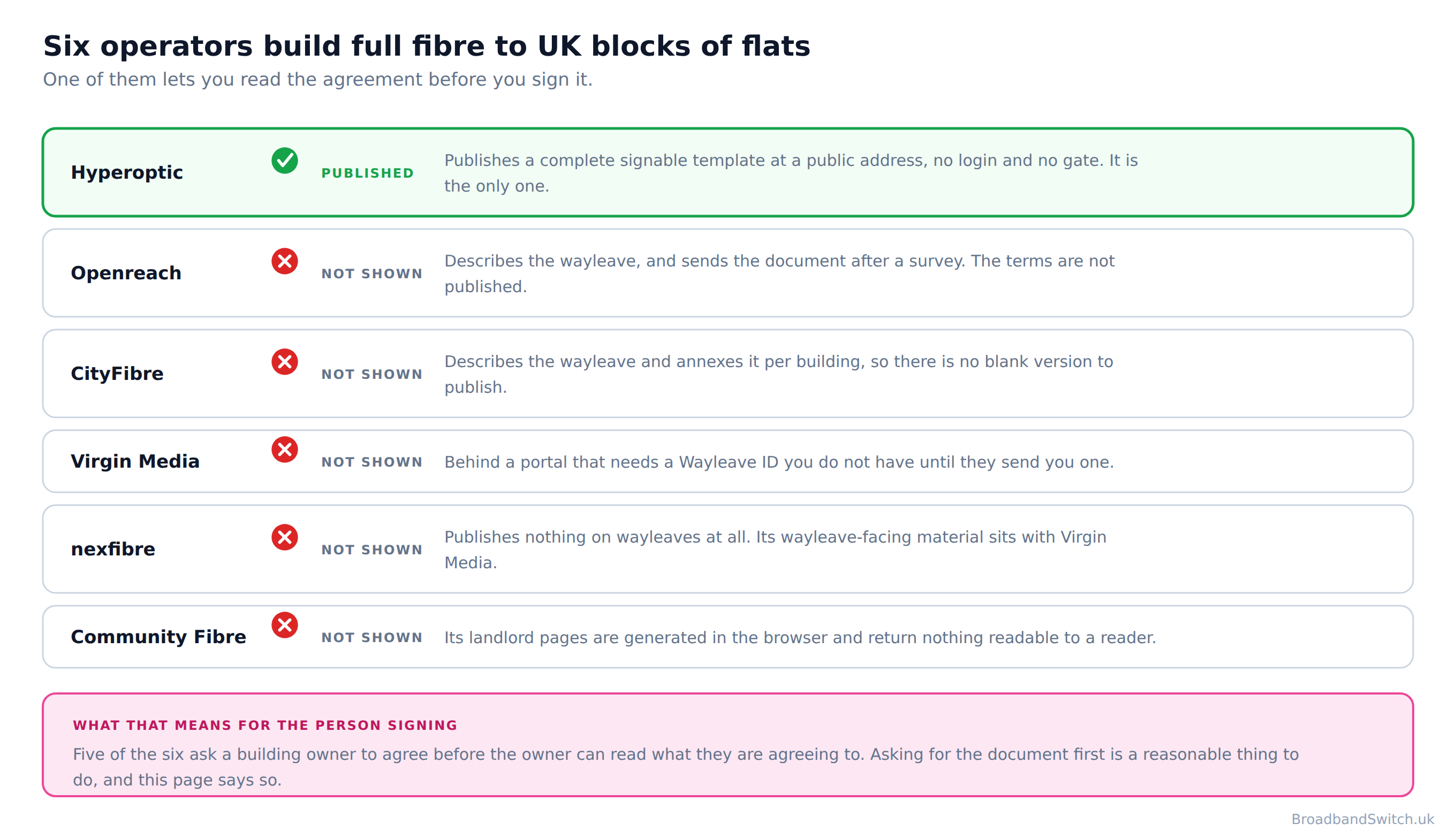
This is the finding this page is built on, and it is checkable in about four minutes because the one published template is linked below. Hyperoptic publishes a complete signable wayleave at a public address with no login and no gate. The other five describe theirs, send theirs after a survey, annex theirs per building, keep theirs behind a portal that needs an identifier you do not have yet, or publish nothing at all.

If you want to read it before you read what we say about it, that is the right instinct and here it is: Hyperoptic's published wayleave agreement. It takes about four minutes. We have no relationship with Hyperoptic and earn nothing from linking it, and we would rather you formed your own view of it before reading ours.
Why publishing it deserves credit, not a kicking
The section below goes through that template clause by clause and finds things worth raising. That is the deal a company makes when it publishes: it becomes the one that can be checked. The other five may have better terms, worse terms or identical ones, and no building owner can know until the document arrives. So read the criticism as what an owner should look for in ANY wayleave, rather than as a verdict on one operator.
Check your own document, and write the questions
Direct answer: Before you sign, ask for the four things the law already requires the document to contain, and ask what you are being paid.
Four of the boxes below are not our opinion. They are what paragraph 11 of the Code already requires an agreement to contain, so a document missing one of them is worth a question whoever drafted it. The rest of the tool writes the questions that the operators' own published material suggests are worth asking, and puts them into a reply you can paste into an email.
It runs entirely in your browser. There is no form to submit, nothing sent to any server and nothing stored: what you tick and type is assembled on this page and gone when you close the tab. It is a drafting aid rather than legal advice, and the page says so again at the bottom because it matters.
Check the document you have been sent, and write the questions worth asking
Four of these the law already requires your wayleave to contain, so tick what yours actually has. The rest is a list of questions built from what the operators themselves publish, ready to paste into a reply. Nothing you tick or type here leaves your browser, and none of it is legal advice.
Four things the law already requires it to say
Direct answer: An agreement under this Part of the Code “An agreement under this Part must be in writing, must be signed by or on behalf of the parties to it, must state for how long the code right is exercisable, and must state the period of notice (if any) required to terminate the agreement.”
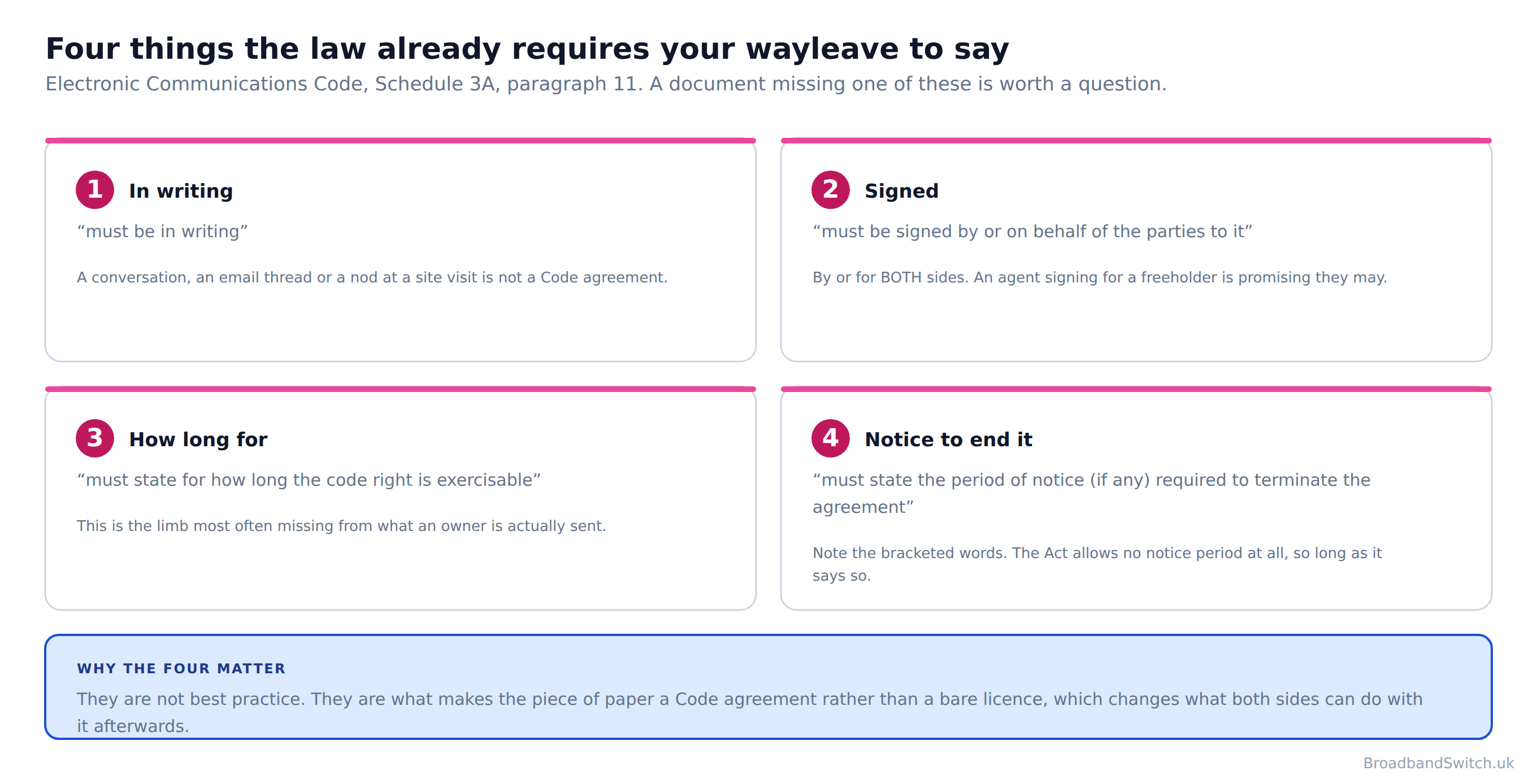
The distinction the diagram draws is not academic, and it is worth spelling out what turns on it. A Code agreement carries the statutory machinery with it: the continuation in paragraph 30, the exit in paragraph 31, and the protections and constraints that apply to both sides. A document that misses one of the four is a document whose status somebody will eventually have to argue about, and the easiest moment to sort that out is before anybody signs.
Two of the four are worth a second look. On duration, the Act requires that the agreement “must state for how long the code right is exercisable”, which is the limb most often absent from what an owner is actually sent. On notice, it requires that the agreement “must state the period of notice (if any) required to terminate the agreement”, and the bracketed words are doing real work: an agreement may provide for no notice period at all, so long as it says so. What it may not do is leave the question open.
What to do if one is missing
Ask, in writing, and do not treat it as an accusation. Templates get sent in a hurry, a covering letter is not the agreement, and the missing limb is very often in a schedule somebody forgot to attach. The checker above writes that question for you along with the rest, so it arrives as one polite email rather than as four.
Inside the only template published in full
Direct answer: Continuous access, a capped liability one way and an uncapped indemnity the other, and no payment, insurance, end date or removal obligation anywhere in it.
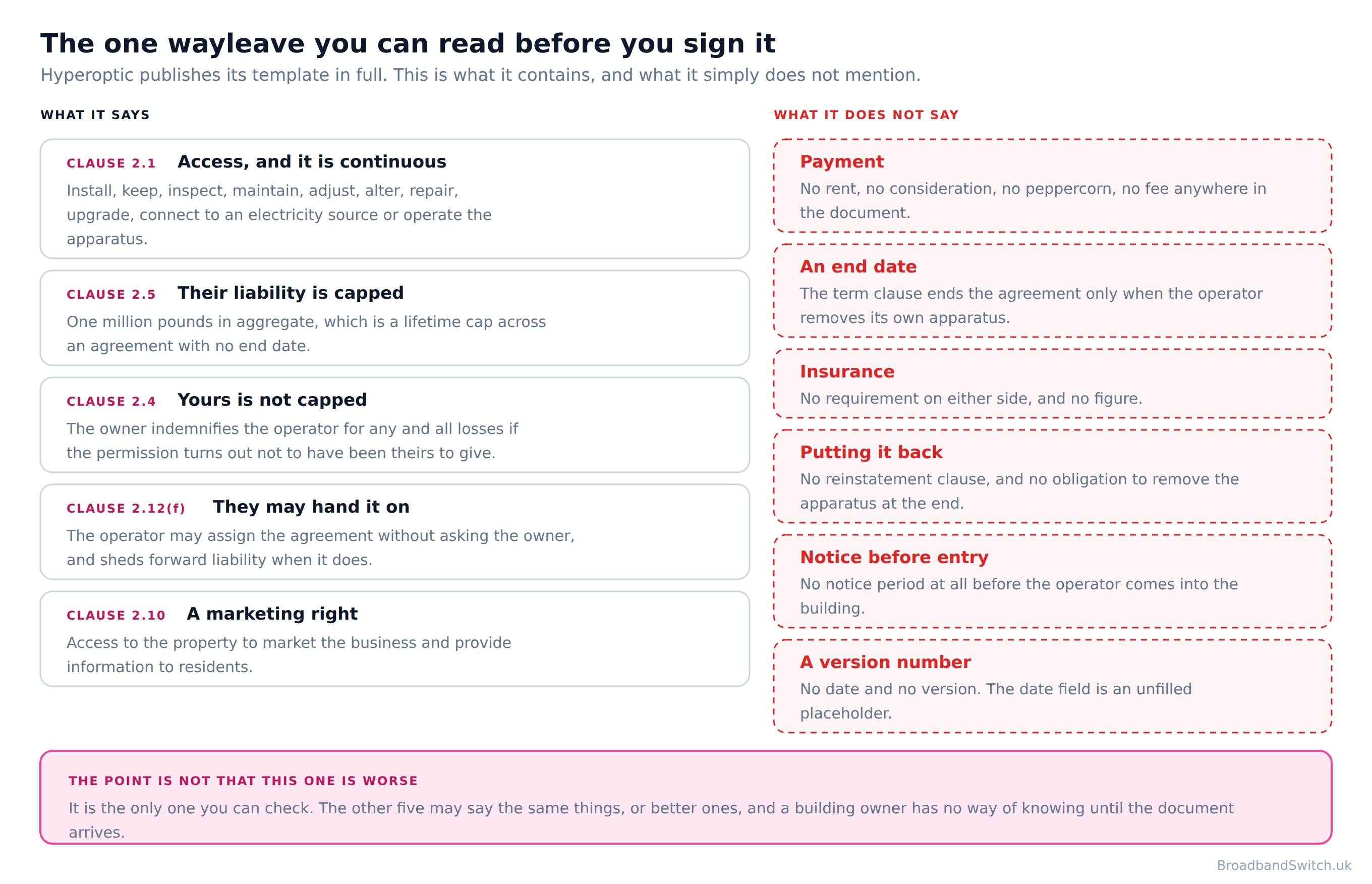
Start with what it grants, because it is broad and it is the operative clause. “You will allow us access to the Property (and bring vehicles and machinery) in order to carry out the Works to install, keep, inspect, maintain, adjust, alter, repair, upgrade, connect to an electricity source or operate the electronic communications apparatus (as defined in the Code) on, over, through or under the Property.” The clause then says it again for the communal parts, and attaches a promise: “You will allow us to install our apparatus on, over, through or under all communal or other areas at the site at which the Property is located and you undertake (promise) that you have all and any permissions and/or rights necessary to enable us to do so”. The definition of the works is the only published operator document that names risers: “The work required by us to install apparatus at the Property. This may include access to other parts of the Property (such as risers, or site access points, existing ducts for broadband and telephone services).”
Now the two clauses that should be read together rather than apart. The operator's liability is capped: “Our liability to you under this Agreement (including clause 2.4) is limited to the sum of £1,000,000 in aggregate but this does not affect our liability for death or personal injury caused by our negligence.” In aggregate, across an agreement that has no end date, which makes it a lifetime cap rather than a cap per incident. The building owner's indemnity back is not capped at all: “You will cover (indemnify) us for any and all losses, costs and damages which we incur as a result of you not having obtained permission for us to have access to the Property and carry out the Works. This indemnity will extend to any wasted installation costs which we may incur.” And what triggers it is the promise in the access clause that the signatory had the rights to grant.

If you are signing for somebody else, read this one twice
The template asks the signatory to warrant their authority in terms: “When signing this agreement you warrant that you have the required authority to sign as, or for, the Owner or Occupier and that the Owner or Occupier is and will remain able to grant or procure the grant of the Rights contained herein.” A managing agent signing for a freeholder is making that promise personally, and the uncapped indemnity above is what sits behind it. None of that makes signing wrong. It makes a written instruction from the freeholder worth having on file first.
Three more clauses an owner would want to have noticed before signing rather than afterwards. The operator may hand the agreement on without asking: “We may assign this Agreement. If we do, and provide you with the transferee's name and address, then the transferee will be bound from the date of transfer and we will not be liable for any breach of this Agreement from that date on.” The equipment stays theirs: “Our apparatus will continue to belong to us and your right to use it is dependent upon you having a valid services agreement with us.” And there is a marketing right inside the access agreement: “You agree we can access the Property to market our business and services and provide information to residents.”
Moving the equipment, if you ever redevelop, is a request rather than a requirement: “You may request that we relocate the apparatus by giving us not less than 6 months' written notice if you plan to carry out any proposed alterations, redevelopment or improvement to the Property that will negatively affect the apparatus.” The clause is silent on who pays to move it.
And then the six things it does not mention at all
It contains no payment clause. No rent, no consideration, no peppercorn, no fee. It contains no insurance clause on either side, and no figure. It contains no reinstatement clause and no obligation to remove the apparatus when the agreement ends. It sets no notice period before the operator enters the building. The access right in clause 2.1 is simply continuous. It contains no exclusivity clause, and no express statement that the arrangement is non-exclusive either. The document is simply silent. The published template carries no date and no version number. The date field is an unfilled placeholder. Each of those is a question the checker above puts into your reply, because silence in a template is not the same as an answer.
It does not end when it says it ends
Direct answer: An end date in a wayleave is not an end date. When it passes, the agreement carries on by operation of law until somebody ends it properly.
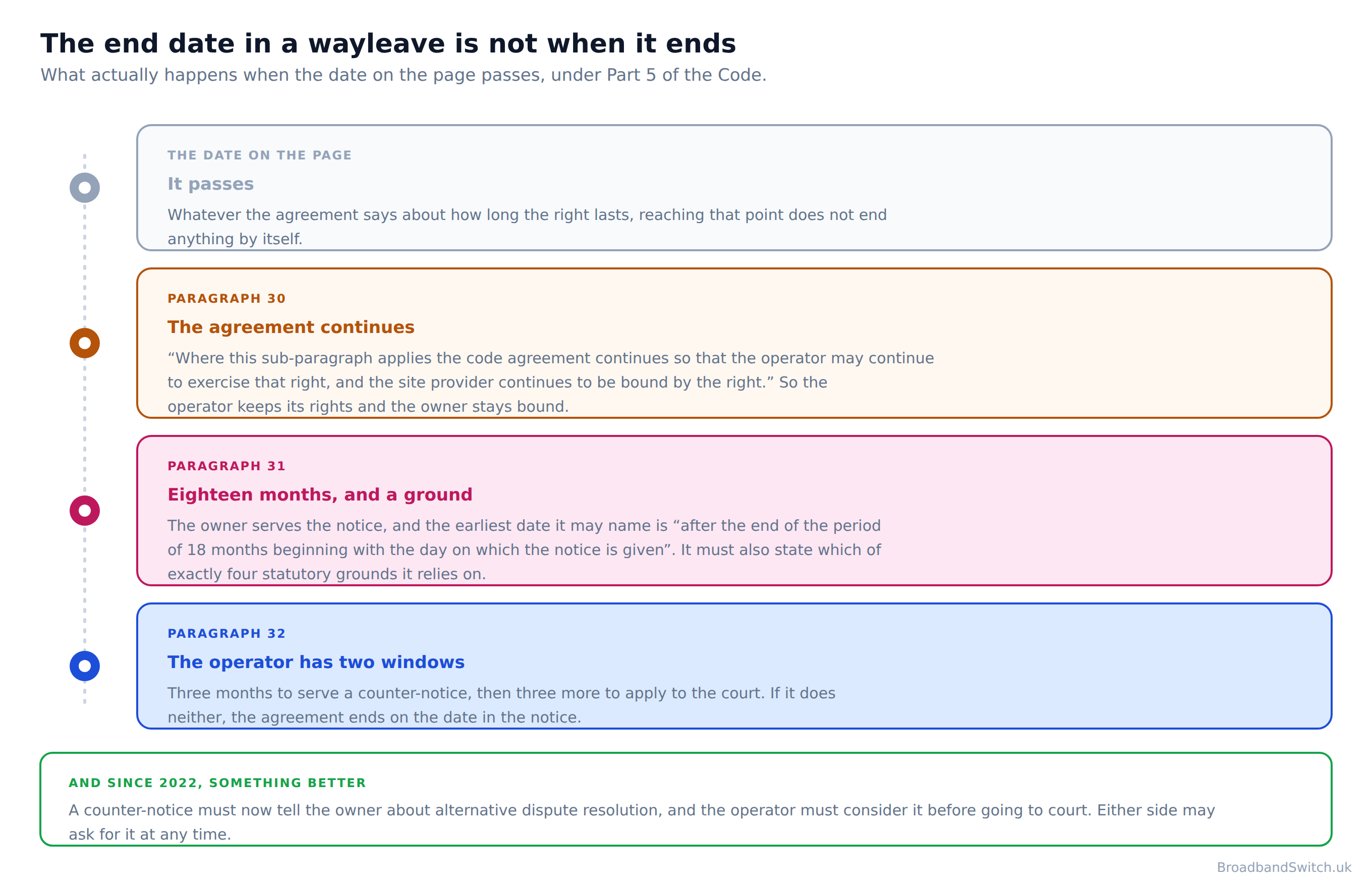
Here is the provision, and it is short. Paragraph 30 of the Code applies where, under the terms of the agreement, the right would cease to be exercisable or the owner could bring it to an end. In that case: “Where this sub-paragraph applies the code agreement continues so that the operator may continue to exercise that right, and the site provider continues to be bound by the right.” The agreement carries on by operation of law, the operator keeps its rights, and the owner stays bound.
The operators do not hide this, and two of them state the practical result plainly on their own sites. Openreach: “Usually a wayleave is an ongoing agreement without an end date. So it'll continue to apply to the apparatus it covers, even if the owner of the land or property changes.” CityFibre: “A wayleave is indefinite, it is an ongoing agreement allowing us to maintain the apparatus.” What none of them explains is the mechanism, which is why an owner reading an end date in a draft can reasonably think it means what end dates usually mean.
The one published template does not even offer an end date to misread. Its term clause runs: “This Agreement will come to an end if we remove our apparatus from the Property and there is no likelihood of us providing services in the future or if we cease to have the Code applied to us. The Rights will be exercisable until this Agreement is terminated in accordance with clause 2.7 below.” So the agreement ends when the operator removes its own apparatus and does not expect to come back, or when it stops being a Code operator. Neither of those is something the building owner can bring about.
Why this is reasonable, even though it sounds one-sided
An operator is putting equipment into your building at its own cost and expecting to serve residents from it for decades. An agreement a new owner could end on three months' notice would not support that investment, and the result would be fewer connected buildings rather than better terms. None of this makes the operators villains. A wayleave that runs with the building is what lets them invest in it at all, and an owner who understands that signs faster, not slower. The problem is not the rule. It is that almost nobody signing a wayleave has been told the rule exists.
How you would actually bring one to an end
Direct answer: A notice under paragraph 31, with at least eighteen months and one of exactly four grounds. Then the operator has two windows of its own.
The exit is statutory rather than contractual, which cuts both ways: no operator can draft it away, and no operator has to offer you anything better. The notice “The notice must specify the date on which the site provider proposes the code agreement should come to an end, and state the ground on which the site provider proposes to bring the code agreement to an end.” And the date it specifies must fall “after the end of the period of 18 months beginning with the day on which the notice is given”
The ground has to be one of four, and they are worth reading in full because three of them will not apply to most buildings. The first: “that the code agreement ought to come to an end as a result of substantial breaches by the operator of its obligations under the agreement”. The second: “that the code agreement ought to come to an end because of persistent delays by the operator in making payments to the site provider under the agreement”. Note what the second assumes, which is that payments are being made, in a field where the one published template provides for none.
The third is the one most freeholders would actually rely on: “that the site provider intends to redevelop all or part of the land to which the code agreement relates, or any neighbouring land, and could not reasonably do so unless the code agreement comes to an end”. And the fourth: “that the operator is not entitled to the code agreement because the test under paragraph 21 for the imposition of the agreement on the site provider is not met”
Serving it is not the end of it. The agreement ends on your date unless the operator gives you a counter-notice “within the period of three months beginning with the day on which the notice is given, the operator gives the site provider a counter-notice in accordance with sub-paragraph (3)”, and then applies to the court “within the period of three months beginning with the day on which the counter-notice is given, the operator applies to the court for an order under paragraph 34”. Do neither and your notice takes effect. Do both and it is decided rather than settled.
The good news nobody reports, and it is four years old
Since 2022 the Code pushes both sides away from a hearing. A counter-notice must “The counter-notice must also contain information about the availability of alternative dispute resolution in the event that the operator and the site provider are unable to reach agreement, and explain the possible consequences of refusing to engage in alternative dispute resolution.” And the operator carries a duty of its own: “Before applying under sub-paragraph (1)(b) for an order under paragraph 34 the operator must, if it is reasonably practicable to do so, consider the use of one or more alternative dispute resolution procedures to reach agreement with the site provider.” And either party may raise it at any time: “The operator or the site provider may at any time give the other party to the agreement a notice in writing stating that the operator or the site provider (as the case may be) wishes to engage in alternative dispute resolution”. So the realistic path for a building owner with a genuine problem is a conversation with a structure behind it, not a tribunal.
Which is the honest summary of this section. Ending a wayleave is slow and needs a reason, so the moment that actually matters is the one before you sign, and that is what the rest of this page is for.
You may be owed money for it
Direct answer: One operator publishes that it pays, and that its rates exist and can be asked for. Almost nothing written for building owners mentions this.
Openreach, answering whether it will pay for a wayleave on your land: “Yes, but only if the wayleave is for apparatus on your property that will provide service to a third party. This is someone who you'll be legally unrelated to.” Read the condition rather than skipping it. Payment arises where the apparatus on your property serves somebody you are legally unrelated to, which in a block of flats is exactly what a communal installation does.
And then the sentence to act on: “We have standard rates which you can ask to see.” The rates exist. They are not published. You have to ask, and nobody will offer.
What this page is not going to tell you
Openreach publishes that its standard rates exist. It does not publish what they are, and no other operator publishes a rate at all. We are not going to print a number we cannot source, and we would treat any page that does with suspicion. What we will say is that the question costs one line in an email, that the checker above writes it for you, and that a building owner who has never asked has no idea what the answer is.
Two honest caveats belong here. Free installation and payment for a wayleave are different things, and an operator telling you the installation is free has not answered the second question. And No operator and no government source publishes a figure for what a wayleave or a connected network does to a building's value, so none is offered here. You will read elsewhere that a connected building is worth more. It may well be. Nobody publishes the figure, so it is not on this page.
If it ever goes to law, and whose route that is
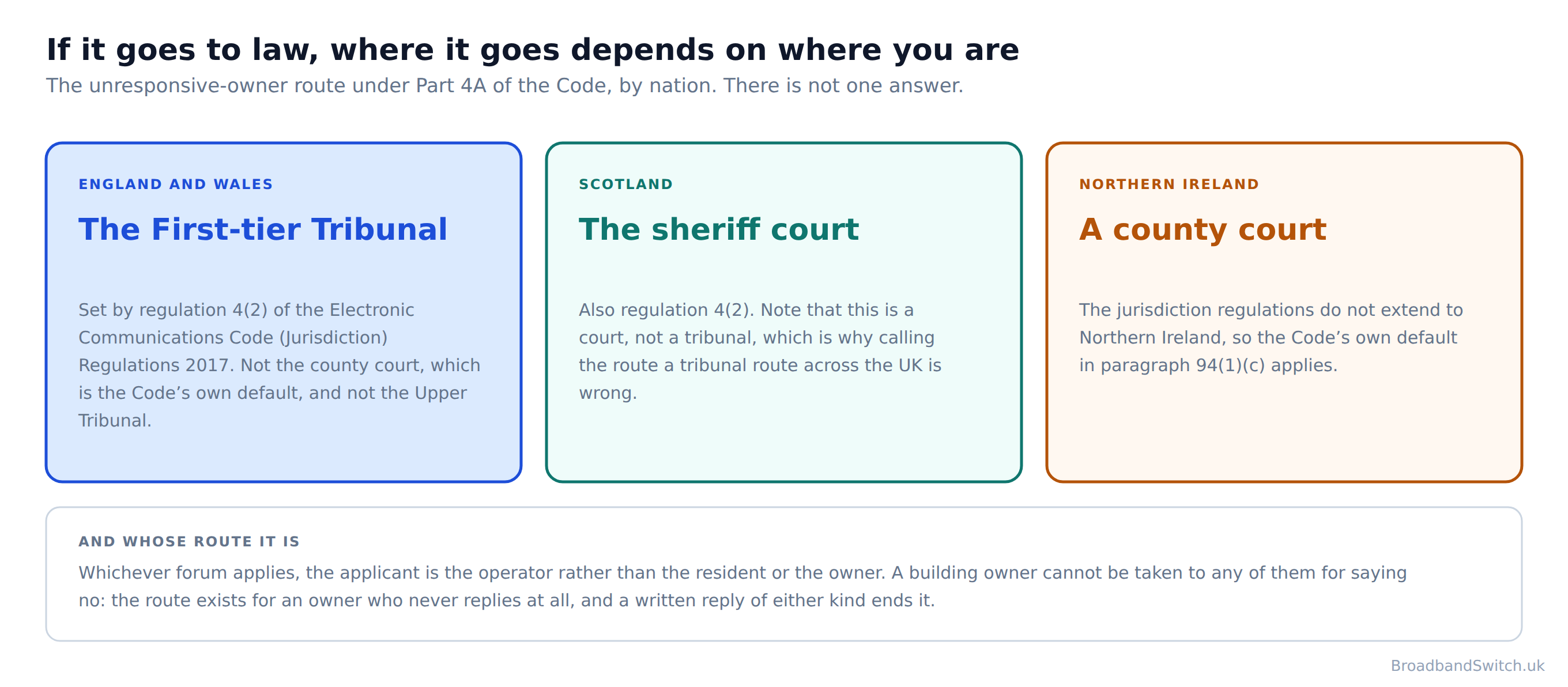
Direct answer: The route exists for an owner who never replies at all, it belongs to the operator, and where it goes depends on which nation the building is in.
First the reassuring part, because this is the bit that frightens building owners into silence and silence is the one thing that actually triggers it. A written reply of either kind ends the process. Agreeing ends it. Refusing ends it. Acknowledging the letter ends it. The route exists only for the owner nobody can get an answer out of.
Second, it is not yours and it is not the resident's. The applicant is the operator, which means a building owner cannot be dragged there by a frustrated leaseholder, and also that a resident cannot make it happen however strongly they feel.
Third, where it goes. “Part 4A proceedings must be commenced in relation to England and Wales, in the First-tier Tribunal, or in relation to Scotland, in the sheriff court.” The jurisdiction regulations extend to England and Wales and to Scotland. They do not reach Northern Ireland, where the Code's own default of a county court applies. The Code's own default, which is what applies where those regulations do not reach, is that “In this code "the court" means, in relation to England and Wales, the county court, in relation to Scotland, the sheriff court, and in relation to Northern Ireland, a county court.” The regulations say the First-tier Tribunal and name no chamber, so neither does this page.
And it does not last forever. An imposed right expires: “For the purposes of paragraph 27G(1)(c) of the code, the "specified period" means a period of 18 months.” The operator also has a limited window to apply at all: “For the purposes of paragraph 27D(2) of the code, the "specified period" means a period of 42 days.” Those regulations extend to England and Wales and Scotland, coming into force on 26 December 2022 in England and Wales and 1 July 2023 in Scotland.
The practical reading for a freeholder
Reply. That is the whole of it. Even a holding line saying you have received the request and will come back within a month puts you outside this route entirely, and it costs nothing. If you would rather understand the request first, the checker above writes the questions, and our flats guide sets out the same route from the resident's side.
Who signs, in one line
Direct answer: Whoever owns or manages the building, which in a resident-run block means the directors of the residents' company.

This page is about the document rather than about the signatory, so the short version is here and the long version is where it belongs. In a block with an outside freeholder it is the freeholder, usually through the managing agent. In a block the residents took over through right to manage or share of freehold it is the directors of their own company, who are neighbours. In a council or housing association block it is the landlord body itself. Our flats guide works out which of those you are in three questions and finds their details on the public registers.
The flat statement that a resident cannot sign a wayleave, which this page used to carry, is wrong for every building the residents run, and that correction is set out below with the other five.
If you are a director of a residents' company
You are the site provider in this transaction, which means every answer the checker above produces belongs in your minutes. The agreement you sign binds your company, your neighbours and whoever buys their flats afterwards, and the successors provision treats each of them as a party to it. That is not a reason to refuse. It is a reason to ask the questions once, properly, and write the answers down.
What this page used to say, and why it changed
Direct answer: Six corrections. Three are statements the operators' own published material contradicts, one is a timescale with no source, one is right in England and Wales only, and one is something the page never told building owners at all.
Naming a correction rather than quietly making it is the house rule here. The version being replaced was a clear, readable summary of a subject it never opened, built from a parliamentary briefing and two consultation pages rather than from the Act and the operators' own documents.
Whether a resident can sign one
What it saidThis page said that a tenant or leaseholder “can ask for the process to start, and should, but cannot sign the agreement themselves”, without qualification.
What it says nowThat is right where there is an outside freeholder and wrong for every block the residents run. In a right to manage or share of freehold block the signatories are the directors of the residents' company, who may include the person reading this. CityFibre's published list of who may give authority names a residents' association and an RTM company expressly.
How long it takes
What it saidThe page said a wayleave “can be agreed in a few weeks” when the owner is responsive, and repeated it in the FAQ.
What it says nowNobody publishes how long a wayleave takes to agree. The figure of a few weeks that circulates, including on the version of this page it replaces, has no published source. CityFibre declines to give a figure at all, publishing that there is no one size fits all when it comes to connecting its network to multi-dwelling units or the time it can take. A number with no published source is worse than no number, because a freeholder who misses it looks unreasonable against a deadline nobody set.
Whether neighbours help
What it saidThe page said that “if several neighbours want the same connection, say so, because a block of interested residents makes an owner far more likely to grant access quickly”.
What it says nowNo operator publishes anything of the kind, and the belief behind it keeps buildings waiting. Openreach was asked directly whether a minimum number of interested residents is required and published: “No, fibre can be installed regardless of how many residents are currently interested.” Neighbours are welcome. They are not a precondition, and they are not evidence.
What it does to the building
What it saidThe page said a wayleave “can add value to the building” and that “a connected building is more attractive to buyers and renters”.
What it says nowNo operator and no government source publishes a figure for what a wayleave or a connected network does to a building's value, so none is offered here. It may well be true. It is not published by anybody whose figures we could check, so it is not on this page. What is published, and is more useful to an owner, is that one operator pays for some wayleaves and has rates you can ask for.
Where it goes if it goes to law
What it saidThe page said an operator “can apply to a tribunal for time-limited access”, as a single UK-wide answer.
What it says nowThat is right for England and Wales and wrong elsewhere. “Part 4A proceedings must be commenced in relation to England and Wales, in the First-tier Tribunal, or in relation to Scotland, in the sheriff court.” The jurisdiction regulations extend to England and Wales and to Scotland. They do not reach Northern Ireland, where the Code's own default of a county court applies. A Scottish freeholder told to expect a tribunal is being told the wrong thing about their own building.
What it never said at all
What it saidThe page told building owners that a wayleave “typically costs the owner nothing”, and said nothing whatever about the owner being paid.
What it says nowOpenreach publishes that it does pay in a defined case: “Yes, but only if the wayleave is for apparatus on your property that will provide service to a third party. This is someone who you'll be legally unrelated to.” And then the sentence worth acting on: “We have standard rates which you can ask to see.” Free to the building and payable to the owner are different questions, and only one of them was on this page.
If you read the old version and acted on it, the two that mattered most were the timescale, which set an expectation no operator publishes, and the flat statement that a resident cannot sign, which is wrong for every resident-run block in the country.
Broadband at your postcode
Every provider that reaches your building
One postcode shows every provider we can switch you to, lowest price first, across full fibre, FTTC, cable and 5G home broadband. If a wayleave is still being negotiated, a 5G package needs nothing from the building at all.
Show every provider at my postcode →Broadband wayleaves: frequently asked questions
What is a broadband wayleave, in plain terms?
The Government publishes a definition and it is a good one: “A wayleave is a contractual agreement between a landowner or landlord and a telecommunications provider, where the landowner grants the network provider a licence with the right to access land and/or property, to install and/or maintain electronic communications apparatus.” Two words in it are worth pausing on. It is an agreement, so both sides are bound by it. And it is a licence to access, not a sale of anything: you keep the building, and the operator keeps the equipment it installs. Openreach's own version is shorter: “A written legal agreement between us and the land or property owner. It gives us permission to install, maintain or repair the network equipment that's on their property.”
What does the law require my wayleave to contain?
Four things, and they are not a matter of taste. Paragraph 11 of the Electronic Communications Code: an agreement “An agreement under this Part must be in writing, must be signed by or on behalf of the parties to it, must state for how long the code right is exercisable, and must state the period of notice (if any) required to terminate the agreement.” Those four are not best practice. They are what makes the piece of paper a Code agreement rather than a bare licence, and a document missing one of them is a document worth asking about before you sign it. The check on this page holds each of the four up against the document you have actually been sent.
Does a wayleave have an end date?
The one template published in full does not contain one at all, and the two operators that address duration publish that it is open-ended. Openreach: “Usually a wayleave is an ongoing agreement without an end date. So it'll continue to apply to the apparatus it covers, even if the owner of the land or property changes.” CityFibre: “A wayleave is indefinite, it is an ongoing agreement allowing us to maintain the apparatus.” Hyperoptic's clause 2.6 ends the agreement only on the operator's own terms: “This Agreement will come to an end if we remove our apparatus from the Property and there is no likelihood of us providing services in the future or if we cease to have the Code applied to us. The Rights will be exercisable until this Agreement is terminated in accordance with clause 2.7 below.”
If my wayleave does have an end date, does it end then?
No, and this is the single most important thing on this page. An end date in a wayleave is not an end date. When it passes, the agreement carries on by operation of law until somebody ends it properly. Paragraph 30 of the Code: “Where this sub-paragraph applies the code agreement continues so that the operator may continue to exercise that right, and the site provider continues to be bound by the right.” So reaching the date changes nothing by itself. Somebody has to end it, and there is a procedure for that.
How do I actually bring a wayleave to an end?
By notice, under paragraph 31. The notice “The notice must specify the date on which the site provider proposes the code agreement should come to an end, and state the ground on which the site provider proposes to bring the code agreement to an end.” The date it specifies must fall “after the end of the period of 18 months beginning with the day on which the notice is given”. And the ground has to be one of exactly four: substantial breaches by the operator, persistent delays in paying you, that you intend to redevelop and could not reasonably do so otherwise, or that the operator was never entitled to the agreement. Then the operator has two windows of its own, which the next answer covers.
What happens after I serve that notice?
The agreement ends on the date in your notice unless the operator acts. It has “within the period of three months beginning with the day on which the notice is given, the operator gives the site provider a counter-notice in accordance with sub-paragraph (3)”, and then “within the period of three months beginning with the day on which the counter-notice is given, the operator applies to the court for an order under paragraph 34”. If it does neither, your notice takes effect. Since 2022 there is also a push towards settling it without a court: a counter-notice must “The counter-notice must also contain information about the availability of alternative dispute resolution in the event that the operator and the site provider are unable to reach agreement, and explain the possible consequences of refusing to engage in alternative dispute resolution.” And “Before applying under sub-paragraph (1)(b) for an order under paragraph 34 the operator must, if it is reasonably practicable to do so, consider the use of one or more alternative dispute resolution procedures to reach agreement with the site provider.” Either side may raise it: “The operator or the site provider may at any time give the other party to the agreement a notice in writing stating that the operator or the site provider (as the case may be) wishes to engage in alternative dispute resolution”
Does the wayleave bind whoever buys the building after me?
Yes, and the Code puts it more strongly than most people expect. gov.uk: “Regardless of form of code agreement (wayleave or easement), a successors in title (subsequent owners or purchasers) remain bound to code rights previously agreed.” And the Act itself: a successor in title is “A successor in title who is bound by a code right by virtue of sub-paragraph (2)(a) is to be treated as a party to the agreement by which O conferred the right.” Not merely bound by it. Treated as having signed it. That is worth disclosing on a sale rather than leaving for the buyer's solicitor to find.
Will anybody pay me for a wayleave?
Possibly, and almost nobody tells building owners so. Openreach publishes: “Yes, but only if the wayleave is for apparatus on your property that will provide service to a third party. This is someone who you'll be legally unrelated to.” And then the sentence to act on: “We have standard rates which you can ask to see.” Openreach publishes that its standard rates exist. It does not publish what they are, and no other operator publishes a rate at all. So the answer is that you should ask, in writing, before you sign, and that no page anywhere will tell you the number in advance.
Does signing the wayleave approve where the cables go?
With one operator it expressly does not, and that is a genuinely useful protection. CityFibre publishes: “A route approval is a caveat within the wayleave agreement that stipulates no installation will take place until a full survey pack has been reviewed and approved for installation by the owner.” So there is a second gate after the agreement. The one template published in full has no equivalent, so if a route matters to your building, ask for that stage in writing rather than assuming it.
What does it cost the building, and is installation really free?
Installation is free on four operators' published terms, and that is covered properly on our flats guide rather than repeated here. What this page adds is that free installation and a fair agreement are different questions. The document is where the second one is answered, and it is the document five of the six will not show you first.
I am a managing agent. What should I be careful about?
The warranty. In the one template published in full, the signatory promises “When signing this agreement you warrant that you have the required authority to sign as, or for, the Owner or Occupier and that the Owner or Occupier is and will remain able to grant or procure the grant of the Rights contained herein.” And the indemnity behind that promise is not capped: “You will cover (indemnify) us for any and all losses, costs and damages which we incur as a result of you not having obtained permission for us to have access to the Property and carry out the Works. This indemnity will extend to any wasted installation costs which we may incur.” So an agent signing for a freeholder should be certain of their authority, and should keep the instruction to sign in writing. Everything else on this page applies to you as it does to an owner.
Can a resident or leaseholder sign one?
It depends entirely on what the building is, and the flat no that used to be on this page was wrong. Where there is an outside freeholder, no. Where the residents own the freehold between them or run the block through a right to manage company, the signatories are that company's directors, who may well include the resident asking. Our flats guide has a finder that works out which of those you are in three questions.
If the owner never replies, can the operator force it through?
There is a route, it belongs to the operator rather than to any resident, and where it goes depends on where you are. “Part 4A proceedings must be commenced in relation to England and Wales, in the First-tier Tribunal, or in relation to Scotland, in the sheriff court.” The jurisdiction regulations extend to England and Wales and to Scotland. They do not reach Northern Ireland, where the Code's own default of a county court applies. An imposed right does not last forever either: “For the purposes of paragraph 27G(1)(c) of the code, the "specified period" means a period of 18 months.” And it is stopped completely by a written reply of either kind, so a freeholder who answers, even to refuse, is never the subject of it.
Is this page legal advice?
No, and it is worth being plain about that. Everything here is quoted from the Act, the regulations, gov.uk or an operator's own published document, with the date it was read. A wayleave is a property agreement with no end date that will bind whoever owns the building next, so if the answers you get back leave you unsure, that is the point at which somebody regulated to advise on it earns their fee. Openreach says the same thing itself: “Please talk to us about your concerns and seek legal advice if necessary. We do have some legal powers under the Electronics Communication Code that mean we can gain consent via the court to install apparatus on your land. But we don't want to use these unless we absolutely have to, and we will make best endeavours to explore all alternative options available to us.”
In short
- You are being asked to sign an agreement that five of the six operators building to UK flats will not show you first.
- Six operators build full fibre to UK blocks of flats. One of them publishes the wayleave a building owner is asked to sign.
- What one is: “A wayleave is a contractual agreement between a landowner or landlord and a telecommunications provider, where the landowner grants the network provider a licence with the right to access land and/or property, to install and/or maintain electronic communications apparatus.”
- Openreach's version: “A written legal agreement between us and the land or property owner. It gives us permission to install, maintain or repair the network equipment that's on their property.” Virgin Media's is the only one that names a tenant: “Wayleave (or an access agreement) is written consent - from the homeowner, developer, housing association member, local authority, landlord or tenant - which gives us permission to carry out construction work on private land or property, and to install and maintain our equipment.” And CityFibre's is scoped to a survey: “A wayleave agreement is a legal contract, between us and the land or property owner or agent acting on their behalf. It provides us with permission to visit your property to carry out a survey to identify the route we could use to install Full Fibre, connecting your property to our network.”
- The four-part test: an agreement “An agreement under this Part must be in writing, must be signed by or on behalf of the parties to it, must state for how long the code right is exercisable, and must state the period of notice (if any) required to terminate the agreement.”
- Those four are not best practice. They are what makes the piece of paper a Code agreement rather than a bare licence, and a document missing one of them is a document worth asking about before you sign it.
- An end date in a wayleave is not an end date. When it passes, the agreement carries on by operation of law until somebody ends it properly. Paragraph 30: “Where this sub-paragraph applies the code agreement continues so that the operator may continue to exercise that right, and the site provider continues to be bound by the right.”
- Openreach: “Usually a wayleave is an ongoing agreement without an end date. So it'll continue to apply to the apparatus it covers, even if the owner of the land or property changes.” CityFibre: “A wayleave is indefinite, it is an ongoing agreement allowing us to maintain the apparatus.”
- The published template's own term clause: “This Agreement will come to an end if we remove our apparatus from the Property and there is no likelihood of us providing services in the future or if we cease to have the Code applied to us. The Rights will be exercisable until this Agreement is terminated in accordance with clause 2.7 below.”
- The statutory exit: a notice specifying a date “after the end of the period of 18 months beginning with the day on which the notice is given”
- Ground one: “that the code agreement ought to come to an end as a result of substantial breaches by the operator of its obligations under the agreement”
- Ground two: “that the code agreement ought to come to an end because of persistent delays by the operator in making payments to the site provider under the agreement”
- Ground three: “that the site provider intends to redevelop all or part of the land to which the code agreement relates, or any neighbouring land, and could not reasonably do so unless the code agreement comes to an end”
- Ground four: “that the operator is not entitled to the code agreement because the test under paragraph 21 for the imposition of the agreement on the site provider is not met”
- Then the operator has “within the period of three months beginning with the day on which the notice is given, the operator gives the site provider a counter-notice in accordance with sub-paragraph (3)”, and “within the period of three months beginning with the day on which the counter-notice is given, the operator applies to the court for an order under paragraph 34”
- Since 2022 a counter-notice must “The counter-notice must also contain information about the availability of alternative dispute resolution in the event that the operator and the site provider are unable to reach agreement, and explain the possible consequences of refusing to engage in alternative dispute resolution.”
- And “Before applying under sub-paragraph (1)(b) for an order under paragraph 34 the operator must, if it is reasonably practicable to do so, consider the use of one or more alternative dispute resolution procedures to reach agreement with the site provider.” Either side may ask: “The operator or the site provider may at any time give the other party to the agreement a notice in writing stating that the operator or the site provider (as the case may be) wishes to engage in alternative dispute resolution”
- It binds a buyer: “Regardless of form of code agreement (wayleave or easement), a successors in title (subsequent owners or purchasers) remain bound to code rights previously agreed.”
- More precisely: a successor is “A successor in title who is bound by a code right by virtue of sub-paragraph (2)(a) is to be treated as a party to the agreement by which O conferred the right.”
- What the published template grants: “You will allow us access to the Property (and bring vehicles and machinery) in order to carry out the Works to install, keep, inspect, maintain, adjust, alter, repair, upgrade, connect to an electricity source or operate the electronic communications apparatus (as defined in the Code) on, over, through or under the Property.”
- And in the communal parts: “You will allow us to install our apparatus on, over, through or under all communal or other areas at the site at which the Property is located and you undertake (promise) that you have all and any permissions and/or rights necessary to enable us to do so”
- Including risers: “The work required by us to install apparatus at the Property. This may include access to other parts of the Property (such as risers, or site access points, existing ducts for broadband and telephone services).”
- Their liability: “Our liability to you under this Agreement (including clause 2.4) is limited to the sum of £1,000,000 in aggregate but this does not affect our liability for death or personal injury caused by our negligence.” Yours: “You will cover (indemnify) us for any and all losses, costs and damages which we incur as a result of you not having obtained permission for us to have access to the Property and carry out the Works. This indemnity will extend to any wasted installation costs which we may incur.”
- They may transfer it: “We may assign this Agreement. If we do, and provide you with the transferee's name and address, then the transferee will be bound from the date of transfer and we will not be liable for any breach of this Agreement from that date on.” The kit stays theirs: “Our apparatus will continue to belong to us and your right to use it is dependent upon you having a valid services agreement with us.” Moving it is a request: “You may request that we relocate the apparatus by giving us not less than 6 months' written notice if you plan to carry out any proposed alterations, redevelopment or improvement to the Property that will negatively affect the apparatus.” And there is a marketing right: “You agree we can access the Property to market our business and services and provide information to residents.”
- And what it does not say: It contains no payment clause. No rent, no consideration, no peppercorn, no fee. It contains no insurance clause on either side, and no figure. It contains no reinstatement clause and no obligation to remove the apparatus when the agreement ends.
- It sets no notice period before the operator enters the building. The access right in clause 2.1 is simply continuous. It contains no exclusivity clause, and no express statement that the arrangement is non-exclusive either. The document is simply silent. The published template carries no date and no version number. The date field is an unfilled placeholder.
- CityFibre's second gate: “A route approval is a caveat within the wayleave agreement that stipulates no installation will take place until a full survey pack has been reviewed and approved for installation by the owner.”
- You may be paid: “Yes, but only if the wayleave is for apparatus on your property that will provide service to a third party. This is someone who you'll be legally unrelated to.” And: “We have standard rates which you can ask to see.”
- Where a Part 4A application goes: “Part 4A proceedings must be commenced in relation to England and Wales, in the First-tier Tribunal, or in relation to Scotland, in the sheriff court.” The jurisdiction regulations extend to England and Wales and to Scotland. They do not reach Northern Ireland, where the Code's own default of a county court applies.
- The Code's own default: “In this code "the court" means, in relation to England and Wales, the county court, in relation to Scotland, the sheriff court, and in relation to Northern Ireland, a county court.” An imposed right lasts 18 months under regulation 6, and the window to apply after the final notice is 42 days under regulation 5
- Nobody publishes how long a wayleave takes to agree. The figure of a few weeks that circulates, including on the version of this page it replaces, has no published source. Openreach publishes that its standard rates exist. It does not publish what they are, and no other operator publishes a rate at all.
- No operator and no government source publishes a figure for what a wayleave or a connected network does to a building's value, so none is offered here. This page does not say whether a telecoms wayleave can be registered against a title. HM Land Registry's published practice guides on easements and on first registrations were checked and neither answers it. The regulations say the First-tier Tribunal and name no chamber, so neither does this page.
- None of this makes the operators villains. A wayleave that runs with the building is what lets them invest in it at all, and an owner who understands that signs faster, not slower.
- Before you sign, ask for the four things the law already requires the document to contain, and ask what you are being paid.
Each line stands on its own and carries its date. Reviewed by a person at least quarterly, last on 27 September 2026.
References
- Legislation
Communications Act 2003, Schedule 3A, the Electronic Communications Code, paragraph 11 on the requirements for an agreement under Part 2, paragraph 10 on who else is bound by code rights and the treatment of a successor in title as a party to the agreement, paragraph 30 on the continuation of code rights, paragraph 31 on how a person may bring a code agreement to an end including the 18 month minimum and the four statutory grounds, paragraph 32 on the effect of that notice including the two three-month windows and the alternative dispute resolution provisions inserted in 2022, and paragraph 94 on the meaning of “the court”. Each paragraph read on its own page on 27 September 2026. legislation.gov.uk
- Legislation
The Electronic Communications Code (Jurisdiction) Regulations 2017, SI 2017/1284, regulation 4(2), requiring Part 4A proceedings to be commenced in the First-tier Tribunal in relation to England and Wales and in the sheriff court in relation to Scotland, and the regulations’ extent to England and Wales and Scotland. Read 27 September 2026. legislation.gov.uk
- Legislation
The Telecommunications Infrastructure (Leasehold Property) (Conditions and Time Limits) Regulations 2022, SI 2022/1057, made 17 October 2022: regulation 5 setting the specified period for an application at 42 days and regulation 6 setting the duration of an imposed Part 4A right at 18 months, together with the extent and commencement provisions. legislation.gov.uk
- Government
Department for Science, Innovation and Technology. Guidance on access agreements, the definitions of a wayleave and of a lease, and the statement that regardless of the form of code agreement a successor in title remains bound to code rights previously agreed. Published 20 December 2018, last updated 3 March 2023, read 27 September 2026. gov.uk
- Hyperoptic
Hyperoptic Ltd. Wayleave Agreement for Hyperoptic LTD, the published template, clauses 1.1 and 1.2, 2.1 on access and rights, 2.3 on work and damage, 2.4 on indemnity, 2.5 on liability, 2.6 on term, 2.7 on termination, 2.8 on relocation, 2.9 on ownership, 2.10 on marketing, 2.11 on interference and 2.12(f) on assignment, together with the unnumbered section headed Permission of the Owner or Occupier. The document carries no date and no version number. Transcribed twice independently on 27 September 2026. hyperoptic.com
- Openreach
Openreach. Obtaining wayleaves, the definition of a wayleave, the statement that a wayleave is usually an ongoing agreement without an end date which continues to apply even if the owner changes, the answer that Openreach will pay for a wayleave where the apparatus provides service to a third party and that it has standard rates which can be asked for, and its answer on what happens if an owner does not want to sign. The page carries no publication or last-updated date, so it was read on 27 September 2026. openreach.com
- CityFibre
CityFibre. How long does a wayleave agreement last?, the statement that a wayleave is indefinite and is an ongoing agreement allowing CityFibre to maintain the apparatus; What is the difference between the wayleave agreement and a route approval?, the statement that a route approval is a caveat within the wayleave agreement under which no installation takes place until a full survey pack has been reviewed and approved by the owner; and Landlords, its definition of a wayleave agreement. All undated, read 27 September 2026. cityfibre.com
- Virgin Media
Virgin Media. Wayleave, the definition of a wayleave or access agreement as written consent from the homeowner, developer, housing association member, local authority, landlord or tenant. Undated, read 27 September 2026. virginmedia.com
- Government
HM Land Registry. Practice guide 62: easements and Practice guide 1: first registrations, checked on 27 September 2026 for guidance on whether a telecommunications wayleave is registrable against a registered title. Practice guide 62 does not use the term at all and practice guide 1 mentions it only in a list of matters that would not appear on the register, so this page makes no claim either way. gov.uk
Ready to see what your building can get?
If a network already reaches the building, nobody needs to sign anything to order over it. One postcode shows every provider that can reach your exact address, lowest price first.
Compare at your postcode →