BROADBAND AVAILABILITY
Broadband availability checker: what “available” actually means
If a checker says you can get full fibre and the provider then says you cannot, you are not going mad and nobody is lying to you. The two are answering different questions.
Ofcom counts the homes where somebody could actually place an order. Each company laying cable counts the homes its own cable has reached, and nobody else’s. So these are company counts rather than national ones, and adding them together gets you more homes than Britain has.
Virgin Media O2 is the only one that publishes both counts and explains the difference, so its figures are the ones used here. Its cable reaches 16,226,200 homes. It can sell to 18,811,600, which is more, because that count takes in homes on another company’s cable.
Openreach, the biggest network of the lot, reaches 23.4 million homes and never says what reaching one means. This page tells you which answer you are looking at, and what to do when two of them disagree.
Already been told no? Work out which of the four it is. Still deciding? Start with what the word means.
What "available" really means
Direct answer: It depends who you ask, and that is the root of the whole problem. Ofcom counts the homes where you could actually place an order. Most companies laying cable count the homes their cable has reached. The second number is usually bigger.
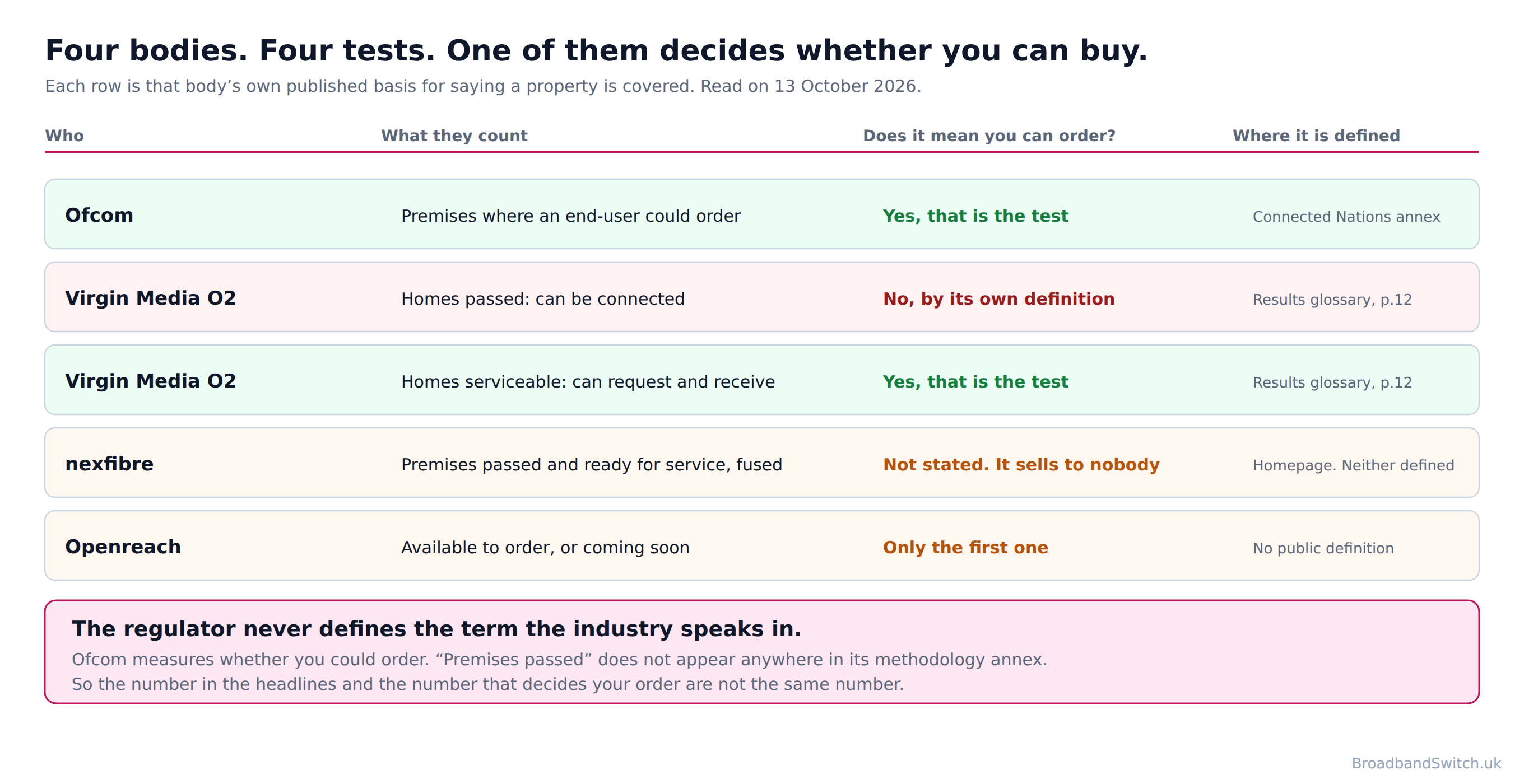
Start with Ofcom, because it sets the strictest test. When it asks providers for their coverage figures, it asks for the homes where somebody could actually buy a service. Not the homes the cable runs past. The homes where you could place an order today.
Here is the odd part. The phrase everybody else in the industry uses is premises passed, and Ofcom never explains the phrase anywhere in the notes behind its own coverage figures, glossary included. We read the whole thing, including the glossary at the back. So the regulator measures one thing and the industry talks about another, and nobody tells you which one you are looking at.
In their own words
- Ofcom, Connected Nations 2025 methodology annex
- “all premises where an end-user could order a fixed broadband service on their network”
Our guide to comparing by postcode shows you how to run the check itself. This page is about what the answer means.
Why one home gets three different answers
Direct answer: There are 30.5 million homes in Britain. Every company that lays cable publishes how many of them it has got to, and no two of them are counting the same thing.
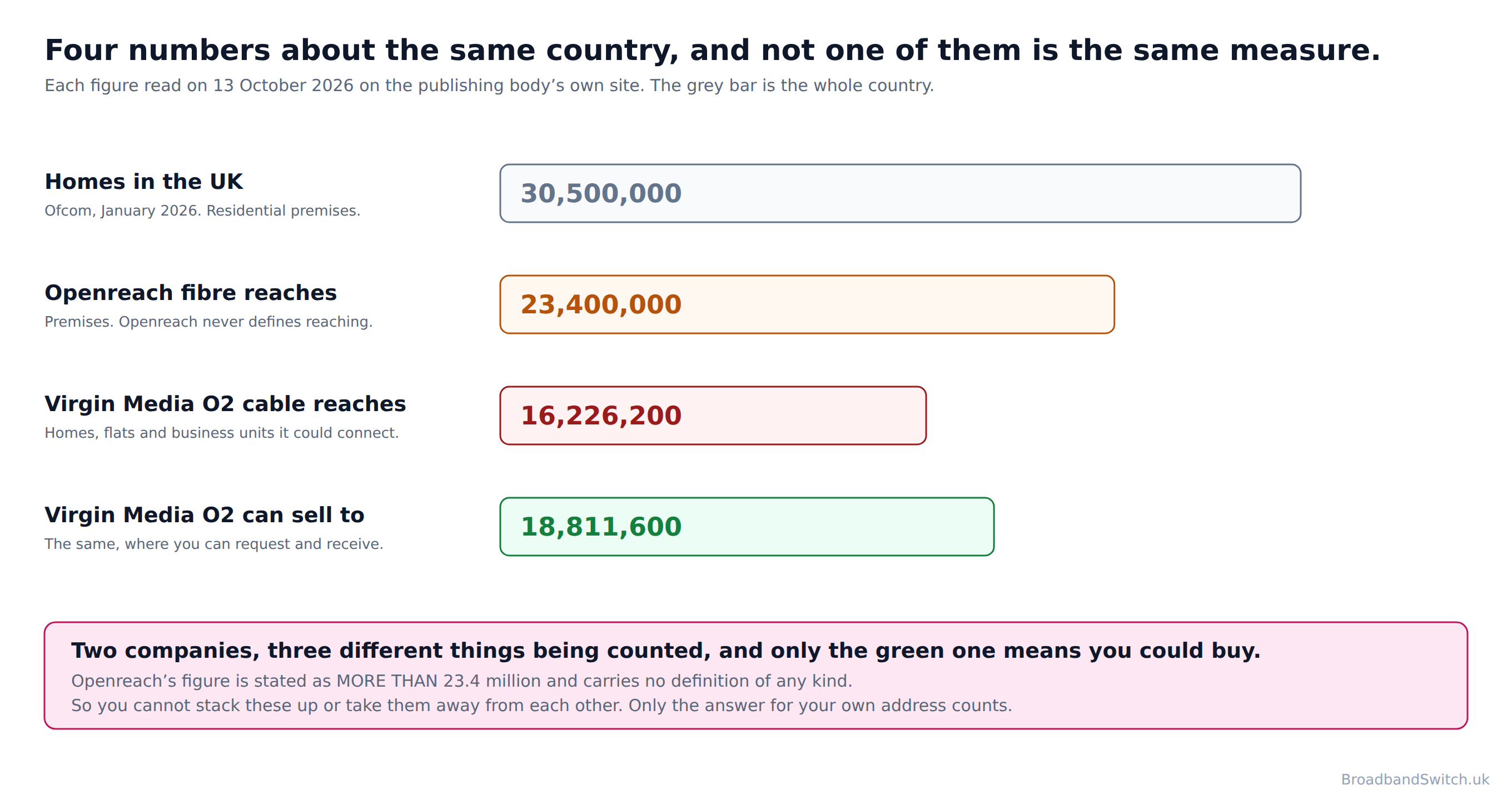
Start with the one that explains itself, because only one of them does. Virgin Media O2 counts homes two ways, and only one of those ways means you could buy. At 30 June 2026 its own cable reached 16,226,200 homes. 18,811,600 could actually order.
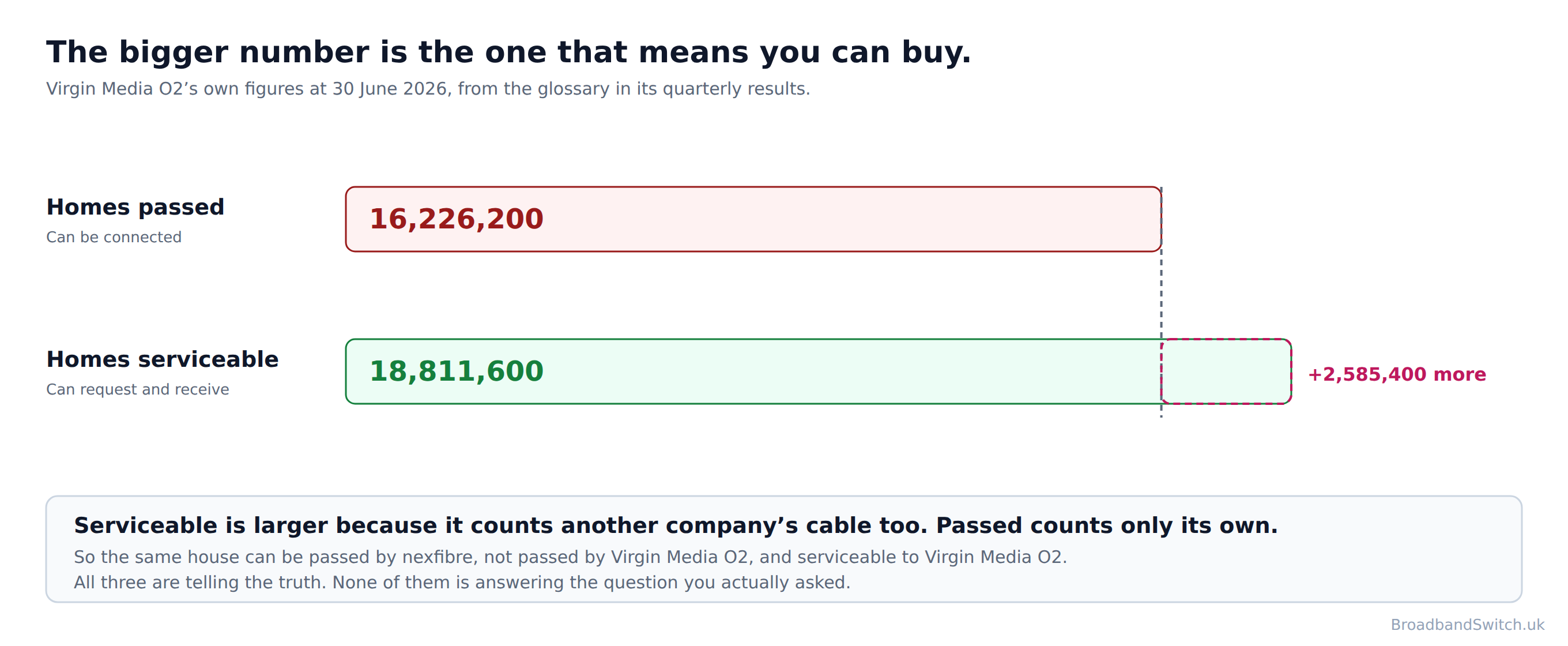
The company calls the first one homes passed and the second homes serviceable, and the difference between them is a single clause. Homes passed means the cable could reach you. Homes serviceable means you could ring up and buy something. In its own words, the first does not promise the second.
In their own words
- Virgin Media O2, Q2 2026 results, glossary
- “Homes, residential multiple dwelling units or commercial units that can be connected to our networks without materially extending the distribution plant.”
- “Homes, residential multiple dwelling units or commercial units that can be connected to our networks that are technologically capable of providing two-way services (including video, broadband internet and telephony services), or partner networks with which we have a service agreement, where customers can request and receive our services, without materially extending the distribution plant.”
Now the bit that catches everybody out. The number you can actually buy from is the BIGGER one, by 2,585,400 homes. Those extra homes are not on Virgin Media O2 cable at all. They are on another company’s cable, which Virgin Media O2 sells over but did not build. Most people assume the big figure is marketing and the small one is real. Here it is the other way round.
Which leads somewhere strange. nexfibre builds a lot of the cable Virgin Media O2 sells across, and it counts those same homes as its own: “more than 2,600,000 premises passed and ready for service (RFS) at 31 December 2025”. So one house can be counted by nexfibre, left out by Virgin Media O2, and still be a house you can order from. All three statements are true at once.
In their own words
- nexfibre
- “more than 2,600,000 premises passed and ready for service (RFS) at 31 December 2025”
- “a high quality, full-fibre wholesale network provider”
One more thing worth knowing about nexfibre: it does not sell to the public at all. It builds the cable and other companies sell over it. So its figure tells you the cable is there. It does not tell you anybody is willing to sell you a service on it.
So what about Openreach, the biggest one of the lot?
That is the first thing most people ask, and the answer is worth the detour. Openreach reaches more homes than anybody else in Britain. It simply never tells you what reaching one means.
Its news release of 19 August 2026 says its full fibre “now reaches more than 23.4m premises”. Its own availability page, which carries no date at all, says “we’ve already connected 19 million premises”. Two live statements from one company, two different verbs, more than 4.4 million apart.
In their own words
- Openreach, news release, 19 August 2026
- “now reaches more than 23.4m premises”
- Openreach, availability page, no date shown
- “we’ve already connected 19 million premises”
Neither figure comes with a definition. Openreach publishes no definition of premises passed, homes passed or ready for service anywhere in its consumer material. So on the biggest network in the country there is no published way to tell the two apart. A home the cable has got to, and a home you could order on, look exactly the same.
Which is why the figures further up are Virgin Media O2’s and not Openreach’s. Not because its network is the bigger one, because it is not. Because it is the only company in Britain that writes down what its own two numbers mean.
Why two checkers disagree about your address
Direct answer: Three reasons, and not one of them means a checker is broken. They cover different cables, they are updated at different times, and they look your address up in different lists.
Start with what each one can even see. A company that lays cable can only show you its own cable. A company that sells broadband can only show you the networks it buys from.
Ofcom sees the most, because it collects figures from a lot of providers. But it is working from a prediction rather than a visit, and it says so: “localised issues may mean that particular premises may not be able to receive a service despite being predicted to do so”
Then there is how old the answer is. Ofcom refreshes its data twice a year. A company laying cable updates its own within days of switching a street on. So on a street built last month the two can be miles apart, and both can be right about the day they are describing.
In their own words
- Ofcom, its own broadband checker
- “localised issues may mean that particular premises may not be able to receive a service despite being predicted to do so”
- “There may also be a delay between a provider deploying networks in an area and that service being available to consumers.”
Worth knowing before you trust any of it: Ofcom’s checker FAQ carries no publication or last-updated date at all. Every warning the regulator gives you about its own tool sits on a page with no date on it. We checked three times, in case we had missed it.
The four stages, and the one people misread
toob sets this out more clearly than anyone else in the country. It is worth borrowing, because every company goes through the same four stages under different names. Only the last one means you can buy.
| Stage | What it means | Can you order? |
|---|---|---|
| Future build | “These areas have been earmarked for full-fibre service in the future.” | No |
| In design | “An evaluation of the best way to deliver service is underway in the area.” | No |
| In build | “Varying stages of construction and quality-testing are in progress.” | No |
| Taking orders | “Service is available to order in these areas.” | Yes |
Stage three is the one that catches people out. The diggers are in the street, so it feels like days away. toob names the step hiding in that gap: “After any visible construction has taken place, we’ll complete extensive testing before we can invite you to join us.” And this is the sentence we wish every checker in the country printed at the top: “Availability will always be specific to your full address.”
In their own words
- toob
- “After any visible construction has taken place, we’ll complete extensive testing before we can invite you to join us.”
- “Availability will always be specific to your full address.”
The checker said yes and the provider said no
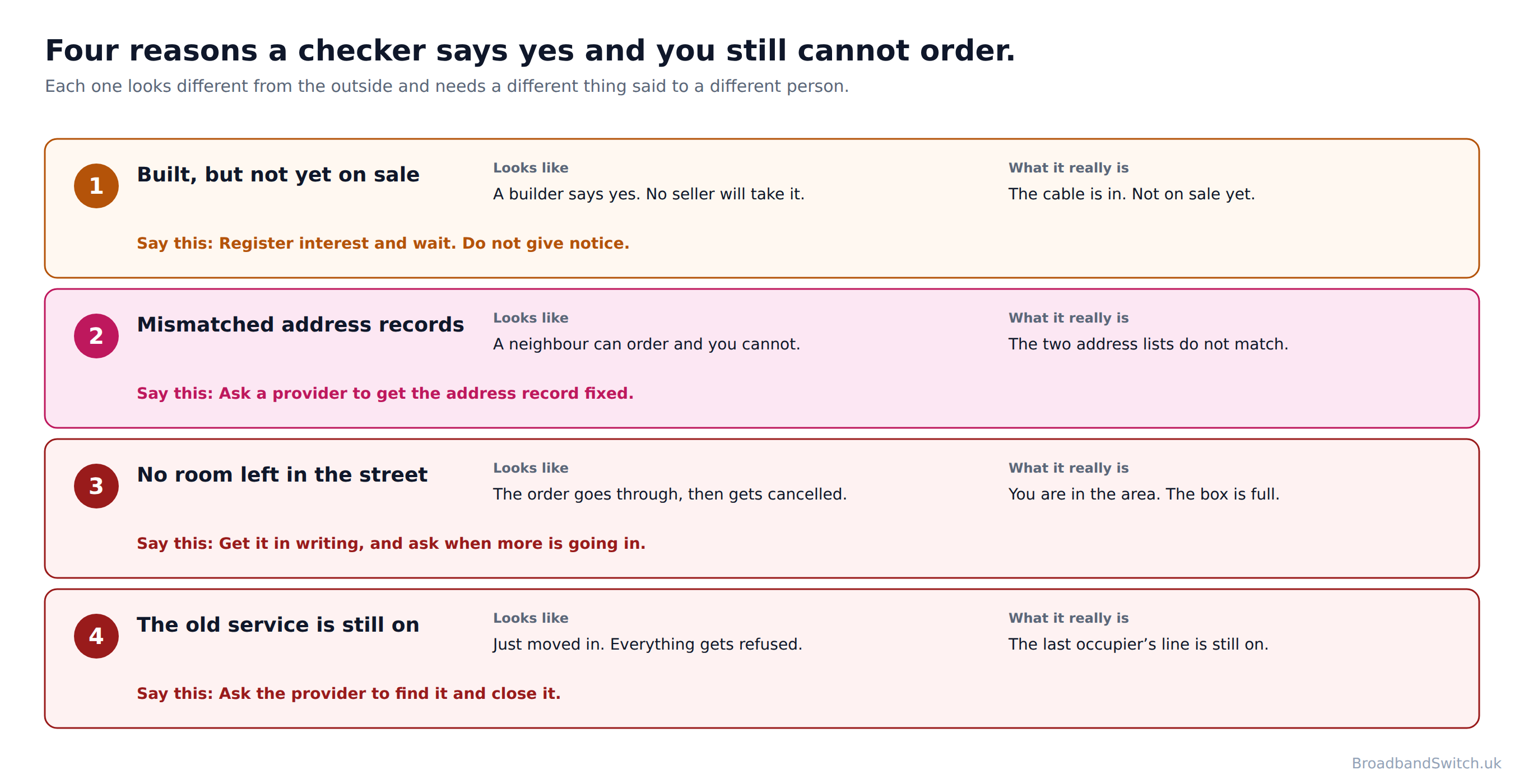
Direct answer: Four things cause that, and each one needs something different from you. Three are worth a phone call. One just needs a month.
This is the question we set out to answer, because we could not find it answered anywhere. Every checker tells you what it predicts. Not one of them tells you what to do when the prediction and the order desk disagree, which is exactly the moment you need help.
Two of the four are admitted in writing. Ofcom, about its own checker: “There may also be a delay between a provider deploying networks in an area and that service being available to consumers.” Openreach, about its own records: “Sometimes our systems show your neighbour as ready before your own address is updated.”
It is rare for a cable company to admit in public that its own data runs behind. If you have been told no, that is the most useful sentence on this page.
In their own words
- Openreach
- “Even within the same street, some addresses are connected before others.”
- “Sometimes our systems show your neighbour as ready before your own address is updated.”
- Ofcom, its own broadband checker
- “Services may not be available at specific locations and/or at specific times for operational reasons.”

Cause 1
Built, but not yet on sale
What it looks like. The company laying the cable says yes, and nobody will actually sell it to you.
What is really going on. The cable is in the ground, but the service has not been put on sale yet. Ofcom admits this happens with its own checker, and toob names the testing that goes on in the gap.
What to do. Register your interest with the company laying the cable rather than a provider, and try again in a month. Do not hand in notice on what you have got now.
Cause 2
Mismatched address records
What it looks like. A neighbour can order and you cannot, or your house name is missing or doubled up somewhere.
What is really going on. The cable company and the post office hold your address slightly differently, so the record exists but the provider’s computer cannot match it to your house.
What to do. Ask a provider to put in a request to get your address record corrected. You cannot do it yourself, which is exactly why this one sits there for months if nobody asks.
Cause 3
No room left in the street
What it looks like. Your order is accepted and then cancelled, or you are told there are no ports left.
What is really going on. Your house is inside the area that is covered, but the box in the street that would serve you is full. Being covered and there being room are two different things.
What to do. Ask the provider to confirm in writing that it is space rather than coverage, and ask when more is going in. A waiting list for space is real. A waiting list for coverage usually is not.
Cause 4
The old service is still on
What it looks like. You have just moved in, and every order you put in is turned down or cancelled.
What is really going on. The last occupier’s service has not been switched off. Two services cannot sit on one address, so yours keeps being refused until theirs is cancelled.
What to do. Ask the provider to look for a service already running at your address and get it closed. If you know who the last occupier was with, say so, because it speeds things up a lot.
Number two is the one that drags on longest, because nothing happens until somebody asks. You cannot get your own address record corrected directly; it has to go through a provider. So if a neighbour can order and you cannot, and there is no obvious reason why, say the words address record to whoever picks up the phone.
Work out what has actually gone wrong
Direct answer: Three questions about what you have been told so far. It will name the most likely cause and tell you what to say next. Nothing you choose leaves your browser.
Availability diagnostic
Nothing is sent anywhere. It runs in your browser.
Whatever it tells you, the company you actually want to buy from has the final word. Their system is the one that takes the order or turns it down. A cable company's checker tells you what has been built. Only the company selling it can tell you what you can have.
If you cannot get anything at all
Direct answer: You can make somebody build you a connection. If your share of the work comes to £3,400 or less, you pay nothing for it.
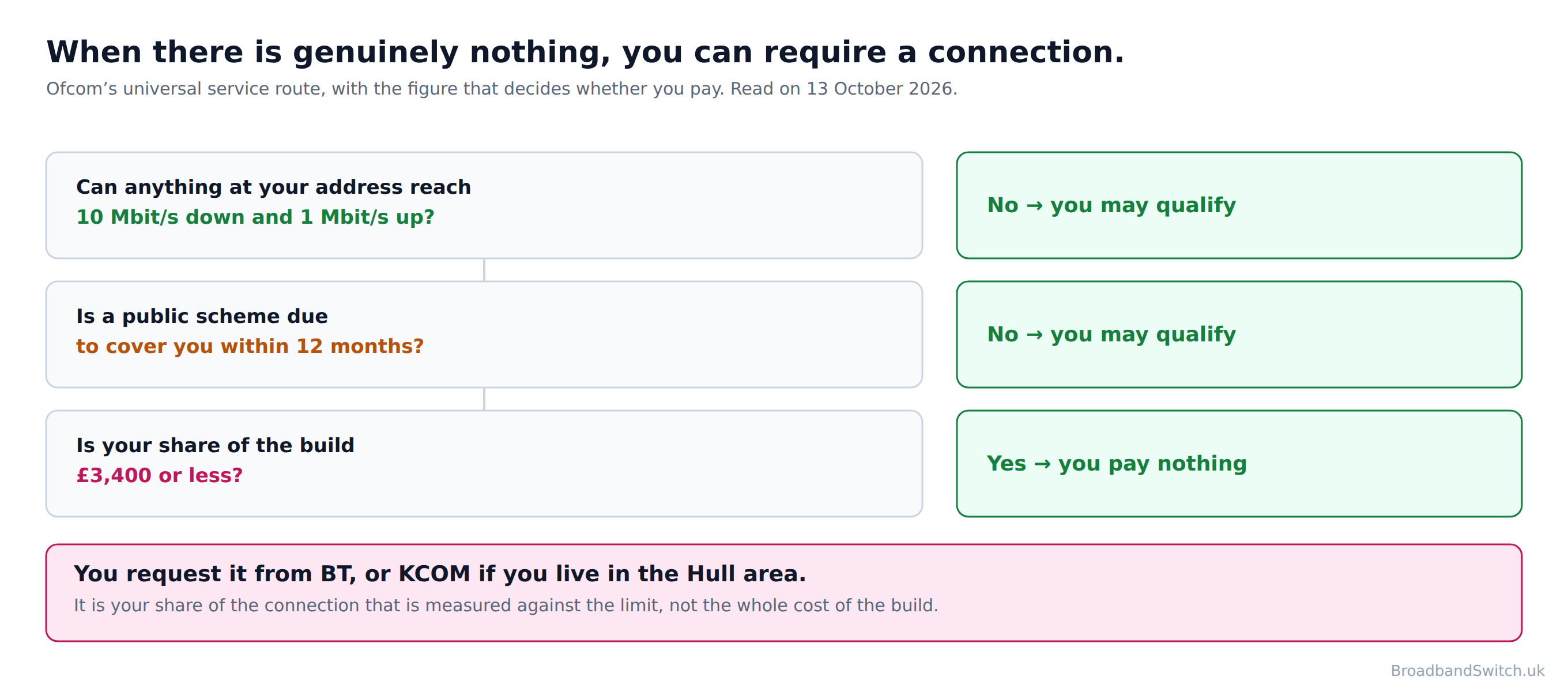
There is a legal minimum in the UK, and it is deliberately a low bar: 10 Mbit/s down and 1 Mbit/s up. If nothing at your address can reach it, you have the right to ask for a connection to be built. You ask BT, or KCOM if you live in the Hull area, and you do not need to be a customer already.
Two things have to be true. Nothing decent can already be available to you, and no publicly funded scheme can be due to reach you in the next twelve months. That second one trips up more people than you would think, because a scheme that has only been announced is still enough to block your request.
In their own words
- Ofcom, your right to request a decent broadband service
- “a download speed of at least 10 Mbit/s and an upload speed of at least 1 Mbit/s”
- “has no access to existing decent broadband; and”
- “will not be covered by a public broadband scheme offered by the UK or devolved governments in the next 12 months”
- “Most people will get a connection within 12 months, but it could take up to 24 months for some.”
Read the cost rule carefully, because it is kinder than it first looks. It is your share of the connection that counts towards the limit, not the whole cost of the job. If your share comes to more than £3,400 you can pay the difference or walk away. Do not expect speed: “Most people will get a connection within 12 months, but it could take up to 24 months for some.”

One place the regulator contradicts itself
There is a second way in, for people who can get a decent service but only at a silly price. Ofcom's current page puts that price at £59.60 a month. Another Ofcom page, still live, still in the same section of the same website, says £46.40. So two live Ofcom pages in the same section give two different affordability thresholds.
Most likely the figure goes up each year and the older page was never changed. Ofcom does not say that on either of them. We read both the same morning. Go with the higher number, and if anyone quotes the lower one at you, it is on the regulator's own website.
In their own words
- Ofcom, your right to request a decent broadband service
- “£59.60”
Flats, new builds and moving house
Direct answer: Three situations have an answer of their own, and each has its own guide here. This is how to tell which one you are in.
You live in a flat and the street has fibre. This is the most common hold-up of the lot, and it is not an engineering one. Openreach: “Openreach needs permission from the landlord or building owner before installation.” Someone has to sign a form first. Until they do, nothing happens at all, not even the survey.
Our guide to broadband for flats shows you how to get it moving, and what a landlord can and cannot refuse covers the permission itself.
You have just moved in. If every order is refused at a house that obviously has a line, suspect the last occupier’s service. It can still be switched on, still sitting on the address, and blocking yours. Our guide to moving home broadband covers what order to do things in.
It is a new build. A brand new address may not be on the lists the checkers read from yet, so you get nothing back rather than a no. That is a completely different problem from being out of reach, and it is fixed by getting the address added, not by waiting for anyone to dig. Our guide to new-build order delays covers who does that.
Your neighbour can order and you cannot. Usually that is the order the work is being done in, not a refusal. Openreach: “Even within the same street, some addresses are connected before others.” On how long you will wait, their answer is honest and no help at all: “There’s no fixed timescale.” Our guide to why one address can order and the next cannot goes through the reasons.
Out in the country, our rural broadband guide covers Project Gigabit, the vouchers and the wireless options in far more depth than belongs here.
What this page used to say
Direct answer: Four things. The page used the word in its own title without ever defining it, and it answered none of the questions people arrive with.
A page that routed instead of answering
What this page saidThis page ran to 150 words of body copy. It said to start with a postcode, pick the exact property, then compare full-term value, and it linked to five other guides. Every word of it was true and none of it answered the question in the title.
What it says now, and whyA person searching for an availability checker is not asking how to use one. They are asking what the answer means, and very often they are asking because they have already had two different answers. The page is now built around that.
No definition of the word in the title
What this page saidThe page used the word available four times and defined it once, circularly, as what you can get at your address.
What it says now, and whyOfcom measures coverage by whether an end-user could order. Virgin Media O2 publishes two different definitions and says they mean different things. nexfibre publishes a number and defines nothing. The page quotes all of them.
Nothing about what to do when the answer is wrong
What this page saidThree steps for reading results, all of which assumed the result was correct.
What it says now, and whyFour reasons a yes becomes a no, what each one looks like, and what to do about each. We could not find that question answered on any page in the competitive set.
No sources at all
What this page saidNo citations, no references, no dates, and a single review date with nothing attached to it.
What it says now, and whyEvery definition on the page is quoted from the body that published it, with the date we read it. Where two of a regulator’s own pages disagree, the page says so and shows both figures.
Corrections are published rather than quietly edited, with the date each source was read. If you think something here is still wrong, tell us and a person will check it against the source.
Broadband availability: frequently asked questions
What does "available" actually mean on a broadband checker?
It depends entirely who built the checker. Ofcom counts the homes where you could place an order: its rules ask providers for “all premises where an end-user could order a fixed broadband service on their network”. Companies laying cable usually count every home their cable has reached, which is a bigger number. A checker using the second one will show you a service you cannot actually buy yet.
The checker said I can get it but the provider says I cannot. Why?
Four common reasons, each needing something different from you. The cable is in but not on sale yet. Your address is written down two ways, so the computer cannot find it. The box in the street is full. Or the last occupier’s service is still on, blocking yours. Ofcom admits the first one: “There may also be a delay between a provider deploying networks in an area and that service being available to consumers.”
Why do two broadband checkers give different answers for my address?
Three reasons, and none of them means a checker is broken. They cover different cables, so one company cannot see another’s. They are updated at different times, and Ofcom refreshes its own only twice a year. And they look your address up in different lists, so one finds your flat or house name when another cannot. toob says the important bit better than anyone: “Availability will always be specific to your full address.”
What is the difference between "premises passed" and "ready for service"?
Premises passed usually means the cable has reached your property. Ready for service is supposed to mean you can buy something. The catch is that nobody agrees on the words. Virgin Media O2 keeps them apart. nexfibre squashes them into one figure and explains neither. toob uses ready for service to mean the testing is done. Gigaclear uses it for a physical connection point at your house. Openreach never says it to customers at all.
Does "coming soon" mean I can order soon?
Not reliably, and nobody will give you a date. toob describes its building stage as “Varying stages of construction and quality-testing are in progress.” Orders come after that, not during it. Openreach is blunter when asked how long you will wait: “There’s no fixed timescale.” Treat coming soon as a reason to look again in a month. Do not treat it as a reason to hand in notice on what you already have.
Which broadband availability checker is the most accurate?
The one belonging to the company you want to buy from, checked last. Ofcom’s covers the most ground, but it is a prediction rather than a visit: “localised issues may mean that particular premises may not be able to receive a service despite being predicted to do so” A cable company’s own checker is more current, but only shows its own cable. Your provider has the final word: theirs takes the order.
My neighbour can get full fibre and I cannot. Why?
Usually because the work is done house by house, not street by street. Openreach puts it plainly: “Even within the same street, some addresses are connected before others.” It then admits something you rarely hear: “Sometimes our systems show your neighbour as ready before your own address is updated.” So look again in a few weeks before you give up. Our guide to why one address can order and the next cannot covers the rest.
I live in a flat and the street has fibre. Can I get it?
Often yes, but somebody else has to sign a form first. Openreach: “Openreach needs permission from the landlord or building owner before installation.” That is your freeholder or managing agent, and until they sign, nothing happens at all, not even the survey. It is the most common reason a flat cannot get what the street already has. Our guides to broadband for flats and asking a landlord for permission show you how to chase it.
What if no decent broadband is available at my address at all?
Then you can make somebody build you one. The legal minimum is 10 Mbit/s down and 1 Mbit/s up. If nothing at your address reaches it, you can ask BT, or KCOM if you live in the Hull area for a connection. Two things have to be true: nothing decent is already available, and no public scheme is due within twelve months. More in our guide to the universal service obligation.
How much does that connection cost?
Nothing, up to a point. If your share of the work comes to £3,400 or less, you pay nothing at all. Above that you can pay the difference or walk away. Note that it is your share that counts towards the limit, not the whole cost of the job. Do not expect it quickly: “Most people will get a connection within 12 months, but it could take up to 24 months for some.”
I am moving house, or into a new build. Is it any different?
The four causes are the same, but two of them are far more likely. A brand new address may not be on the lists the checkers read yet, so you get nothing back rather than a no. And at an older property the last occupier’s service can still be switched on, blocking yours. Our guides to moving home broadband and new-build order delays cover both.
In short
- Ofcom counts the homes where you could actually place an order. Its own rules ask providers for “all premises where an end-user could order a fixed broadband service on their network”.
- The phrase the industry uses, premises passed, is one Ofcom never explains anywhere. Ofcom never explains the phrase anywhere in the notes behind its own coverage figures, glossary included.
- Virgin Media O2 uses two terms and only one of them means you can buy. At 30 June 2026 its cable reached 16,226,200 homes, and 18,811,600 could actually order, a gap of 2,585,400.
- Openreach reaches more homes than either of those, 23.4 million. It gives that figure in a dated news release, while an undated page of its own says 19 million.
- “Ready for service” means four different things to four different companies. To Openreach it means nothing at all, because it never uses the phrase with customers.
- Openreach admits its own records run behind: “Sometimes our systems show your neighbour as ready before your own address is updated.”
- Ofcom says much the same about its own checker: “There may also be a delay between a provider deploying networks in an area and that service being available to consumers.”
- If you cannot get a decent connection anywhere, you can ask for one to be built. You pay nothing if your share of the work comes to £3,400 or less.
Each line stands on its own and carries its date. Reviewed by a person at least quarterly, last on .
References
- OFCOM.ORG.UK
Ofcom. Connected Nations 2025: methodology annex. Published 19 November 2025. Paragraph 21 gives the basis for every coverage figure Ofcom publishes: premises where an end-user could order. The phrase premises passed appears nowhere in it.
- CHECKER.OFCOM.ORG.UK
Ofcom. About the mobile and broadband checker. No publication or last-updated date shown on the page. Every caveat Ofcom gives consumers about the accuracy of its own checker, including the delay between a network being deployed and a service being sellable.
- NEWS.VIRGINMEDIAO2.CO.UK
Virgin Media O2. Q2 2026 results release. Dated 24 July 2026, covering the period ended 30 June 2026. The glossary on page 12 is the only place in UK broadband where homes passed and homes serviceable are both defined properly.
- NEXFIBRE.CO.UK
nexfibre. Homepage. Figure stated as at 31 December 2025. Fuses premises passed and ready for service into a single number and defines neither.
- OPENREACH.COM
Openreach. Why can my neighbours order Full Fibre but I cannot? No publication or last-updated date shown. Four reasons, including the admission that its own systems can show a neighbour as ready before your address is updated.
- OPENREACH.COM
Openreach. Full fibre availability. No publication or last-updated date shown. States 19 million premises connected, against a news release of 19 August 2026 giving more than 23.4 million.
- OPENREACH.COM
Openreach. Openreach plans for wider UK rollout of next gen full fibre. Published 19 August 2026, 12:55. The dated statement that the full fibre network now reaches more than 23.4m premises, read twice, once looking only for a definition of the word reaches. There is none.
- TOOB.CO.UK
toob. Support. The clearest consumer-facing build ladder published by any UK network: future build, in design, in build, taking orders, with only the last orderable.
- OFCOM.ORG.UK
Ofcom. Your right to request a decent broadband service. Published 8 August 2023, last updated 19 June 2026. Eligibility, the 10 Mbit/s and 1 Mbit/s thresholds, and the cost limit.
- OFCOM.ORG.UK
Ofcom. How we are changing the rules for the broadband universal service. Published 11 November 2021, last updated 16 March 2023. Still live, and states a different monthly affordability threshold from the page above.
- OFCOM.ORG.UK
Ofcom. Connected Nations update: Spring 2026. Published 13 May 2026, covering January 2026. The current UK coverage baseline used on this page.
Ready to compare on the number instead of the adjective?
The words are inconsistent. The figures are not. One postcode shows every provider that reaches you, with the actual speed against each one and the cheapest first.
Compare at my postcode →