Free browser game · No signup · Your progress is saved
Fibre Tycoon: build Britain's full fibre network
It is 2010. The country runs on copper, the incumbent is still pushing fibre to street cabinets, and nobody has heard of an altnet. You have £45m of the bank's money, two build teams and a map of Britain. Everything after that is up to you.
Plays in any modern browser. Nothing to install and no account needed. Your game saves itself, so you can close the tab and pick it up later. Best on a big screen with the sound on, and it fits a phone if that is what you have.
Your progress is saved, and your score can go on the board
The two questions people asked most have both been answered.
You will not lose your company. The game saves your position automatically as you play, so closing the tab, a flat battery or a stray browser update will not cost you thirty years of building. There are also three named save slots, and you can export the whole thing to a file you keep.
There is a leaderboard, and it is permanent. Retire from any game and you can put your name and score on it. Every completed game stays there, with views for all time, this month, this week and the most recent runs. If you build networks for a living, we would genuinely like to know how much of the country you can connect.
What it actually looks like
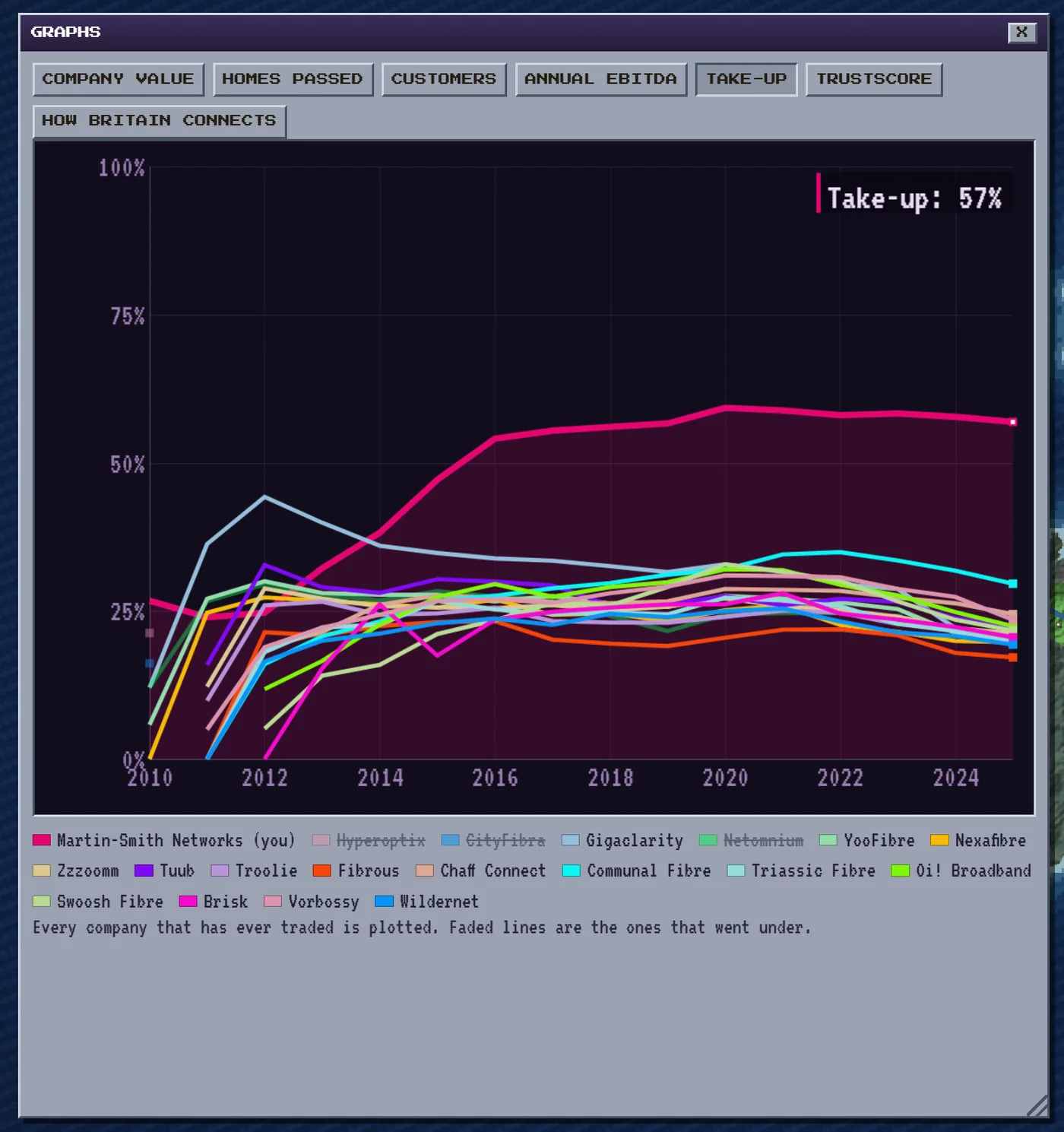
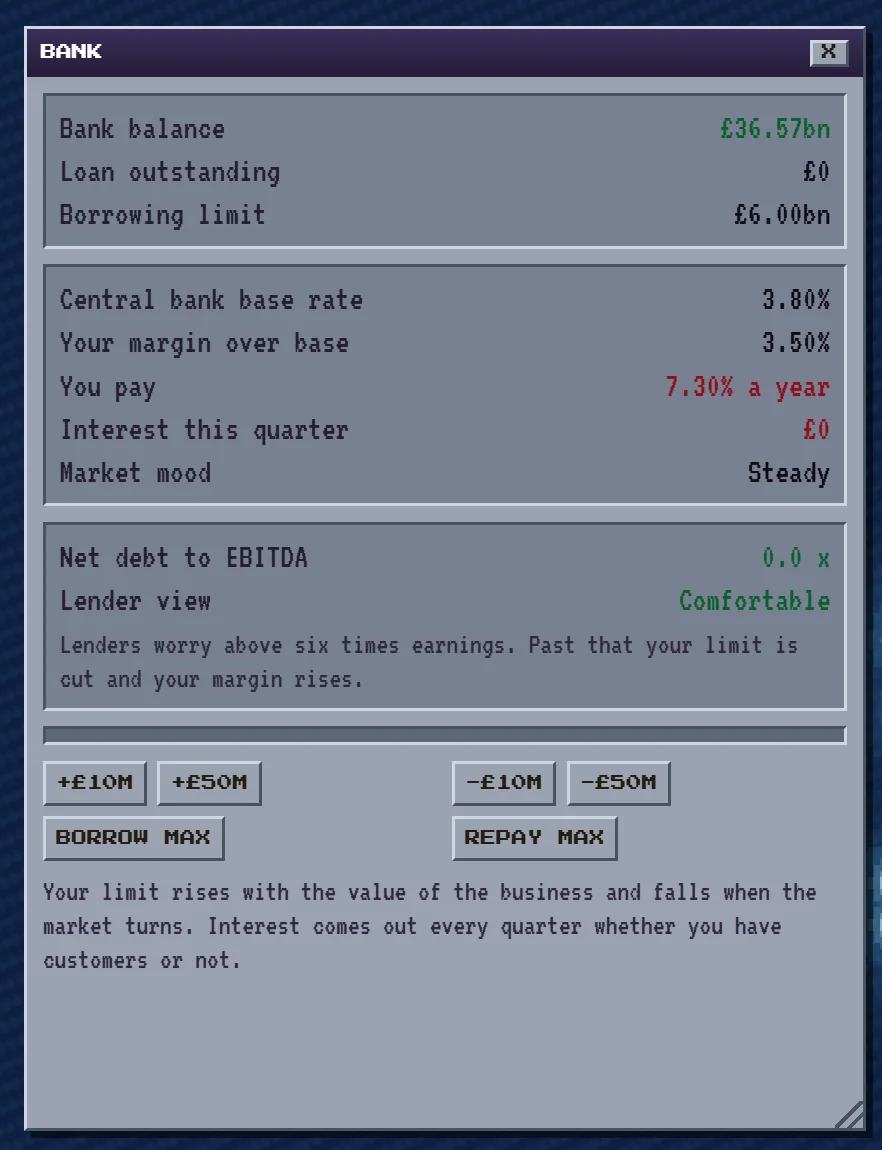
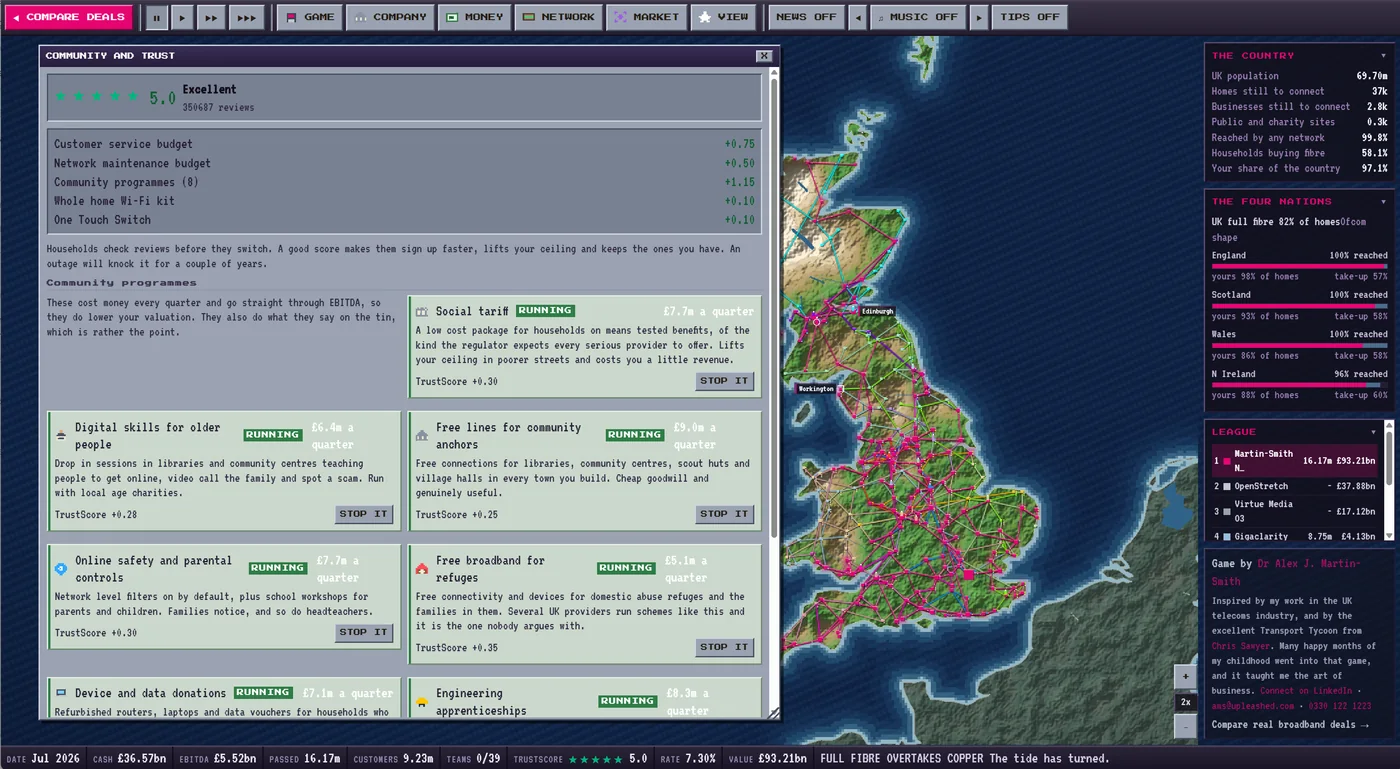
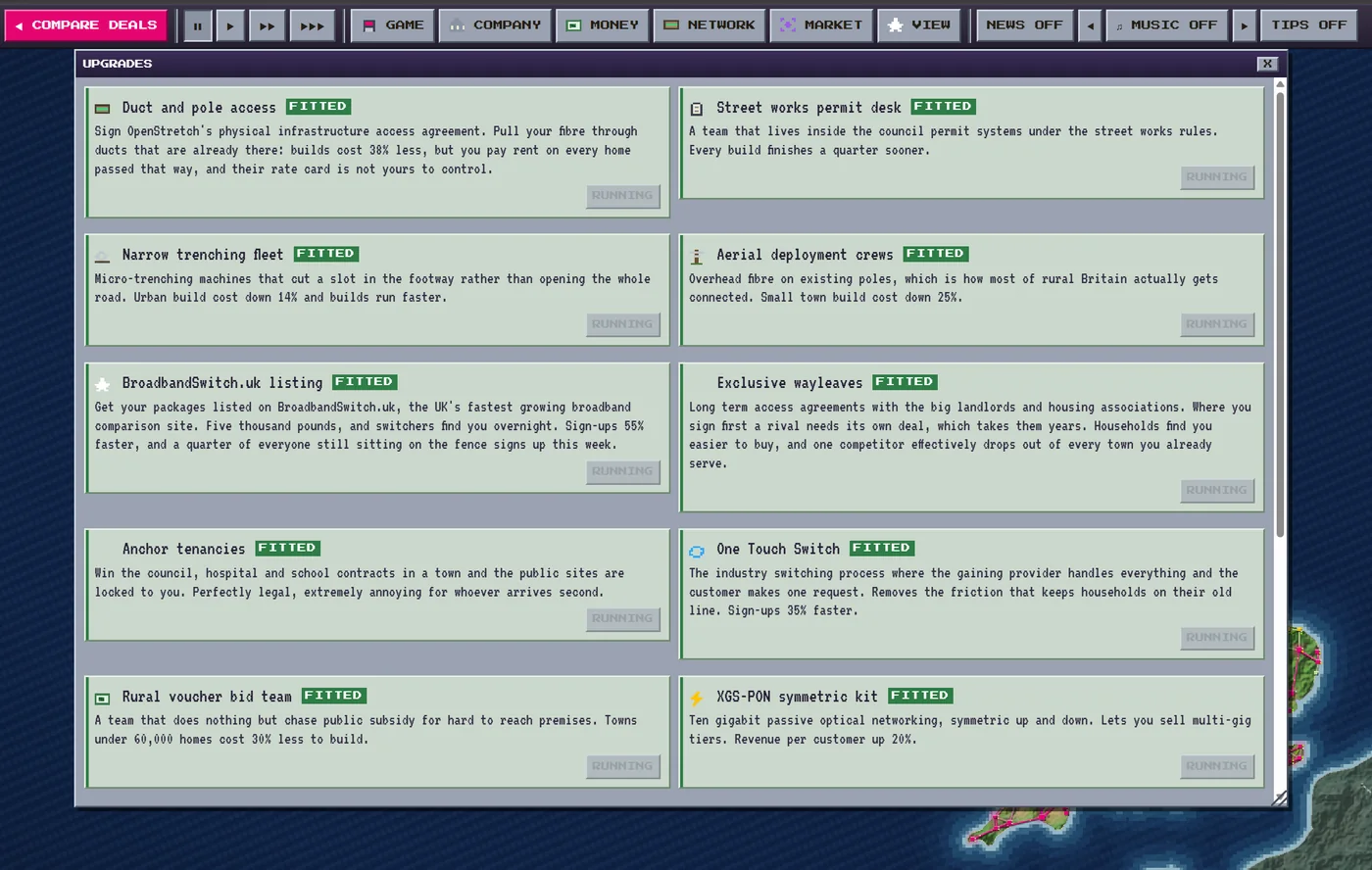
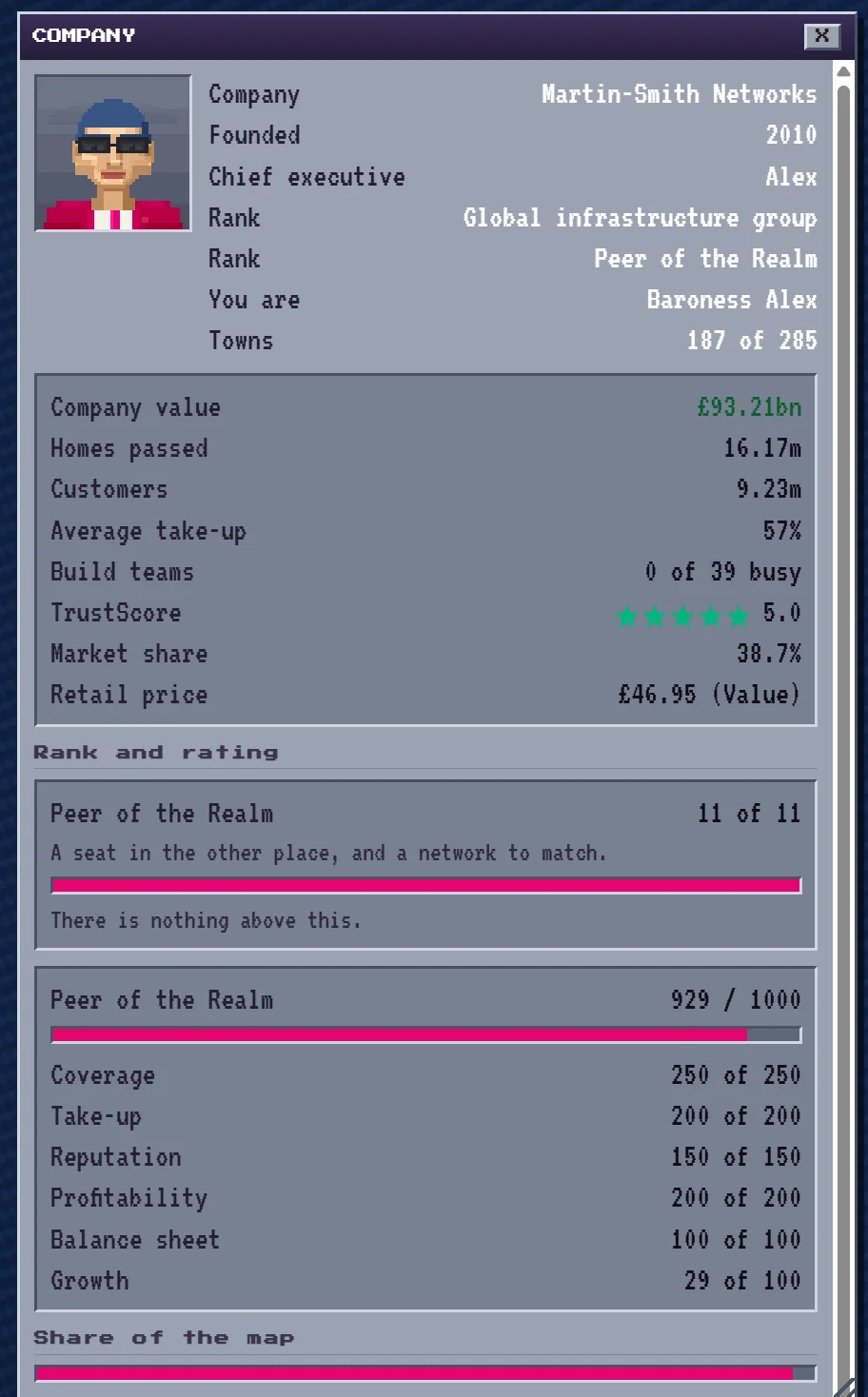
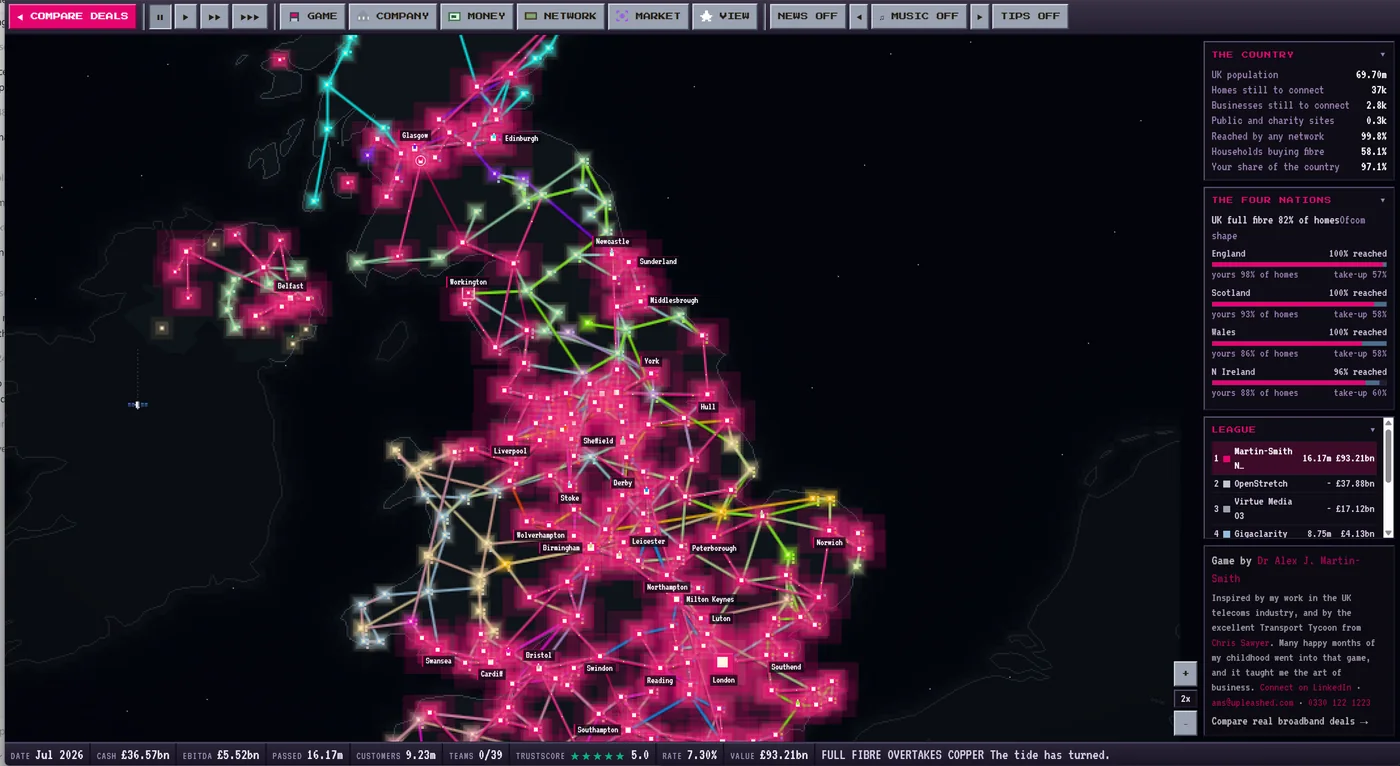
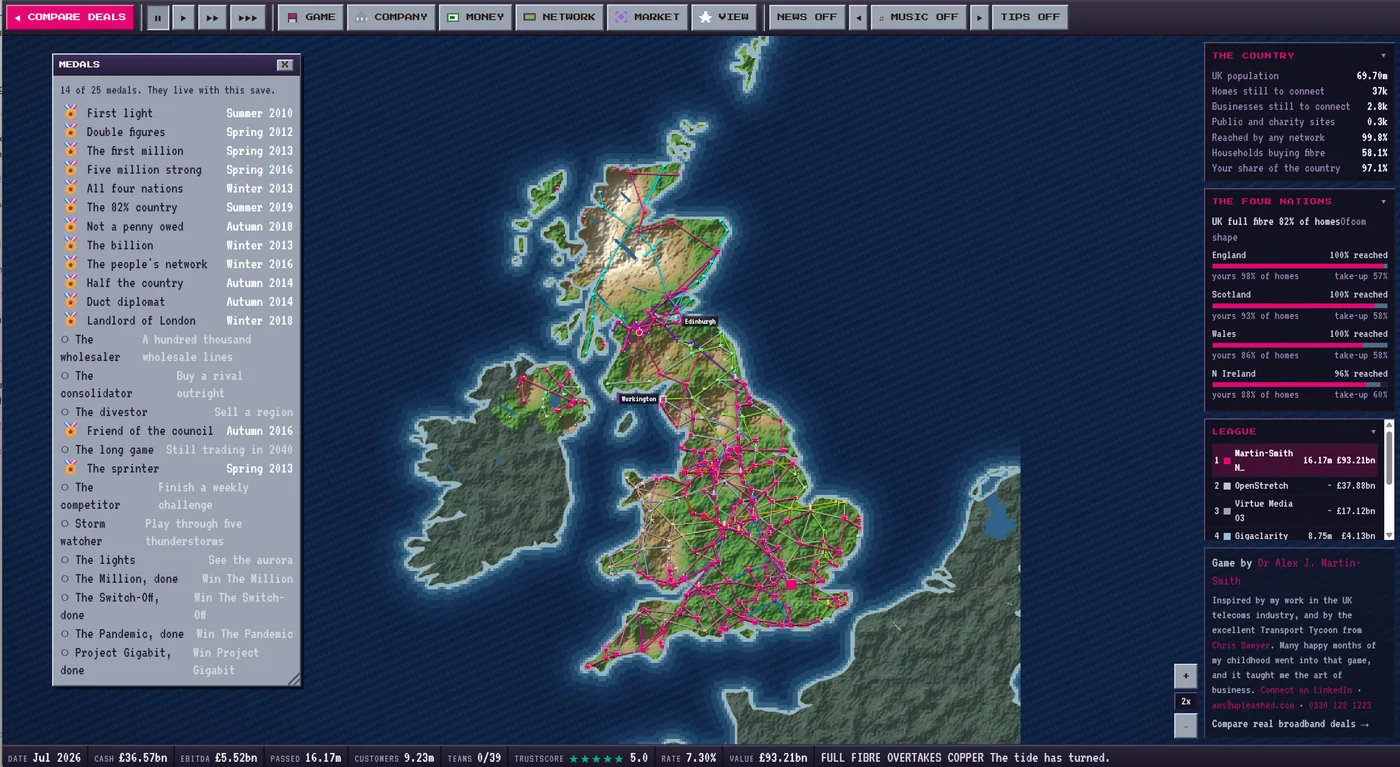
Every screen below is from a real run, finished in July 2026 after fifteen game years. Each one is doing a job that maps onto something real in UK telecoms, and between them they are the whole game.



How it has changed since July
The game launched on 26 July 2026. These three films are five weeks apart, and almost everything between them came from people who emailed, commented or reported a bug. It is the clearest way to see what a month of player feedback actually does to a piece of software.
Between those two films and this one: the interface now scales and respects your browser's font setting, you can price all four broadband tiers separately, sell add-ons, buy a rival out entirely, put your score on a permanent leaderboard, play offline, and hear a soundtrack that follows how your company is doing. Seven scenarios instead of three.
Your first ten minutes
Most people who give up do so in the first three years, because the money goes out long before it comes back. That is not a flaw in the game. It is the single truest thing about this industry, and it is worth knowing before you start.
- Pick one town and connect it properly. Click a town on the map, then Connect. A build team sets off and trenches the route. Resist the urge to start four towns at once with two teams: half-built towns earn nothing at all.
- Watch what happens when it goes live. Homes passed climbs immediately. Customers do not. Take-up builds over quarters, and that gap between the two is where altnets live or die.
- Do not touch the price yet. The temptation is to undercut everybody on day one. Every pound you take off is a pound off every bill for the rest of the game.
- Draw down debt deliberately. You start with a £70m facility and £45m already drawn. The rest is there to build with, and interest lands every quarter whether the customers arrive or not.
- Build a cluster, not a scatter. Trunk routes cost more the further you reach. Three neighbouring towns cost far less than three towns three hundred miles apart, and they defend each other when a rival turns up.
By 2013 or so you should have a handful of towns live, take-up climbing, and a nervous look at the bank. That is the game working correctly.
Five mistakes almost everyone makes
1. Confusing homes passed with customers
Passing a home earns you nothing. Nothing at all. You have spent the money to dig past the door and until somebody inside signs up you have bought a liability. Real altnets have been caught by exactly this, and the game will not let you forget it.
2. Cutting the price to win the street
Dropping your retail price does lift take-up, and it does it quickly, which makes it feel like the answer. But the margin goes for good, on every customer, including the ones who would have joined anyway. Try it late in a run and watch what it does to your valuation.
3. Treating customer service as a cost
Your TrustScore is what makes people switch to you, and it is built from service spend, network maintenance and community programmes. A network with furious customers stops growing no matter how much fibre it has in the ground. This is the mechanic people who work in the industry recognise fastest.
4. Borrowing right up to the limit
Debt is cheap and useful right up until it reaches six times earnings. At that point your facility gets cut and your margin rises, which is precisely when you can least afford either. Leave headroom before you need it, not after.
5. Covering too much of the country
Take a stake past half of a rival, or cover too much of the map, and the competition regulator starts asking how many towns you both already serve. You can divest a region to get out of it, but it is cheaper to see it coming.
What the numbers actually mean
Every figure in the game maps onto something real in UK telecoms. If you have ever wondered what these mean when they appear in a press release, this is a painless way to find out.
- Homes passed is how many properties your network runs past and could connect. It is the number operators lead with, because it is the flattering one.
- Take-up is the share of those homes actually buying from you. It is the number that pays the bills. Anything above 30% is respectable, and above 50% is very good indeed.
- ARPU is average revenue per user, which is what a typical customer pays you a month. Your price, your tier mix and your add-ons all move it.
- EBITDA is earnings before interest, tax, depreciation and amortisation. For a network builder it is the closest thing to "is this business working" before the cost of the money is counted.
- Leverage is debt divided by annual EBITDA. Six times is where lenders in this game start to lose patience, which is not far off the real thing.
- TrustScore is invented, but it stands in for something real: the reputation that decides whether a household will switch to a name they have not heard of.
If you want the real versions of these, our research reports use the same measures on actual UK data.
It is built on how UK broadband really works
- 285 real towns and cities, each at its true coordinates, with their own household counts, business premises and public sites. You can plot your own town anywhere on the map as well.
- Real economics. Cost per premises falls with density, wayleaves make cities expensive, trunk routes cost more the further you reach, and take-up is capped by how much of the town somebody has already built.
- Thirty years of real history, from the cabinet rollout and rural public funding, through the separation of the incumbent, the pandemic and home working, the rate shock, the AI build out, and the copper switch-off at the end of January 2027.
- Price the whole range if you want to. Sell all four broadband tiers at once and set a price for each. Student areas lean towards the cheap one, cities lean towards the fast one, and everybody drifts when you move a price. You can sell add-ons too, from a fixed IP to a business SLA.
- Valuation the way buyers do it, on a multiple of EBITDA or on the asset value per home passed, whichever is higher, with the multiple moving on market sentiment. A crash can halve your company without a single customer leaving.
- 68 rival networks, each with its own competence, appetite for risk, pricing and service quality. Some of them are very well run. Some of them will make a mess of it, run out of money, and come to you asking for rescue capital.
- Seven scenarios, including The Million, The Switch-Off, The Pandemic, Project Gigabit and The Highlands, plus the open game and a weekly challenge.
- Fifteen original soundtrack tracks that follow how your company is doing, and offline play so it works on a train.
What players asked for, and got
The game launched in July 2026. Almost everything added since came from the people playing it, who emailed, commented and reported bugs.
- You said the text was too small to play. The whole interface now scales, and it respects the font size you have set in your own browser.
- You wanted more towns. There are now 285, and you can plot your own.
- You wanted to price each broadband tier separately rather than pick one flagship. You can.
- You wanted a way out of merger remedies, and a way to buy a rival out outright. Both are in.
- You wanted to share your scores. There is a permanent leaderboard.
- You wanted it to work on a small screen. That took a while, but it is done.
- Several of you found real bugs, including a news story that named a real operator by mistake. All fixed.
Where it came from
Two things. The first is twenty years of working in UK telecoms and the broadband comparison business, and wanting to show people why their street got fibre in 2019 and the next village over is still waiting. The second is Chris Sawyer's Transport Tycoon, which took up a great many happy months of my childhood and taught me more about business than anything I read at university. The debt to it is obvious and entirely deliberate, right down to the bevelled windows and the performance rating out of a thousand.
How far can you get
There are eleven ranks, and each one needs three things at once: a good performance rating, real scale, and customers who do not resent you.
- Cable Puller
- Jointer
- Gang Foreman
- Works Supervisor
- Area Manager
- Regional Director
- Managing Director
- Chief Executive
- Group Chairman
- Knight of the Realm
- Peer of the Realm
Reach the top two and the game starts addressing your chief executive as Sir, Dame, Lord or Baroness. Services to digital infrastructure.
Questions
Is it free?
Completely. There is no signup, no account, no payment and no advertising inside the game. It is a thing we made because we wanted to.
Will I lose my game if I close the tab?
No. The game saves your position automatically as you play and picks it up when you come back. There are also three named save slots, and the Game menu will export your whole position to a file you keep.
Is there a leaderboard?
Yes, and it is permanent. Retire from any game and you can add your name and score. There are views for all time, this month, this week and the most recent games, and you can reach it from the Game menu at any point. You can leave a comment with your score if you like, which we read before it appears.
How long does a game take?
A first run to a decent network is about forty minutes at normal speed, and you can wind the clock faster once you know what you are doing. The scenarios are shorter and have a stated goal. The open game runs as long as you want it to, and some players have taken companies well past 2050.
Does it work on a phone?
Yes. Every panel was rebuilt in August 2026 to fit whatever screen you have, and it is tested at fourteen different sizes from a large desktop down to an iPhone. It is still a game about reading a map of Britain and juggling a dozen windows, so a laptop or a tablet in landscape gives you an easier time of it.
Are the figures real?
The geography is real, the towns are real, the sequence of events is real, and the UK population figures follow Ofcom and ONS estimates. Every financial number is tuned so the game is enjoyable rather than so it forecasts anything, and the game says so in two places. If you want our actual research, that lives in our reports.
Are the rival companies real?
No. Every competitor is invented, with a name chosen to raise a smile from anybody who works in this industry. Any resemblance to a network currently digging up your street is entirely affectionate.
Does it collect anything about me?
Almost nothing, and we would rather tell you exactly what than say "nothing" and be vague about it.
Anonymous counters. The game adds one to a daily tally when a company is created, when the first town goes into build, at three points in the timeline, and when somebody retires. It records the date and which version of the game you played. It does not record your IP address, your browser, any identifier, any session, or anything at all about your company. We use it to see whether people get past the first screen.
The leaderboard, only if you choose it. When you retire you can put your score on the board. That sends the name you type, your score and headline figures, and a comment if you write one. Nothing is sent unless you press the button.
Your saves stay on your device. The automatic save, the slots, your chosen text size and your own top ten runs are all held in your browser's storage. Clearing your browser data removes them. Nothing about your saved games is sent to us.
There is also a suggestion box that opens your own email client, which sends nothing until you press send.
Can I play it offline?
Yes. In the Game menu, choose Play offline and the game and its soundtrack are kept on your device, so it works on a train or anywhere else with no signal. It is about seventeen megabytes. The leaderboard still needs a connection.
Can I suggest something?
Please do. Most of what has been added since July came from players, and there is a suggestion box in the Game menu that reaches a human. Several people have had their idea in the game within a week of asking.
While you are here
The game is a bit of fun. If you want the real thing, these are the pages that actually save people money.
- Compare live deals at your postcode
- Test your real speed
- How One Touch Switch works, which is an upgrade in the game and a real process out here
- The copper switch-off in 2027, the event the game builds toward
- The Great Consolidation, Report No. 27, the real version of the merger mechanic
- The 82% Country, Report No. 29, where the coverage figures come from