SHEFFIELD · FIVE SEATS · TWENTY-EIGHT WARDS
Sheffield broadband: full fibre ward by ward, the city-centre gap, and how to choose at home
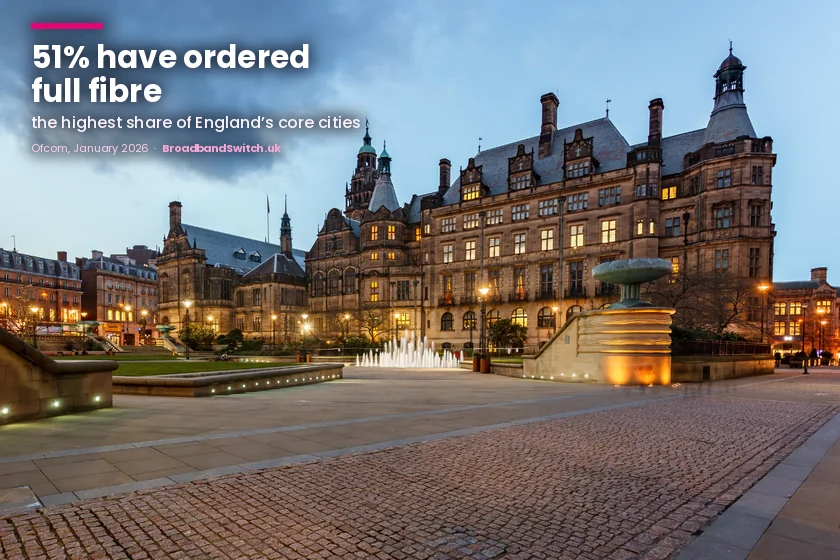
Sheffield is among England’s best-connected big cities, and its households are the quickest to take the new lines up. In January 2026 Ofcom found full fibre on offer to 92.2% of its 252,955 homes. Among the eight core cities, only Leeds did better, and England as a whole stood at 82%. Where Sheffield homes could order it, 51% already had, a higher share than in any other core city.
The gaps are easy to place. Ofcom counts 4,127 homes stuck below 30Mbit/s, and 82% of them sit in a single ward, City, at the heart of Sheffield. The western edge is next in line, with gigabit lines still filling in around Fulwood and Stannington. If the builders keep to their plans, 79.6% of homes will be able to pick between two gigabit networks or more by January 2029.
Every number here carries a date and a named source, from Ofcom and the 2021 census to Openreach and the networks themselves. You will find the five seats that carry Sheffield’s name, all 28 wards, the networks building here, the copper date for each exchange and what happens to phone lines in January 2027. For your own home, the postcode check decides. Living just outside the city? Barnsley and the Dearne Valley and Doncaster each have a page.
Looking for your own patch? Try the ward card, or see it among its neighbours on the tile map. Only after a deal? Go straight to the postcode check.
Start with your own front door
Direct answer: For most Sheffield homes there is more than one network to pick from, though the mix changes from street to street. In January, Ofcom counted 92.2% of homes with full fibre available and 94.2% with a gigabit-capable line, and by 2029 the plans give 79.6% of them two gigabit networks. The live check below shows what is on sale at your address today.
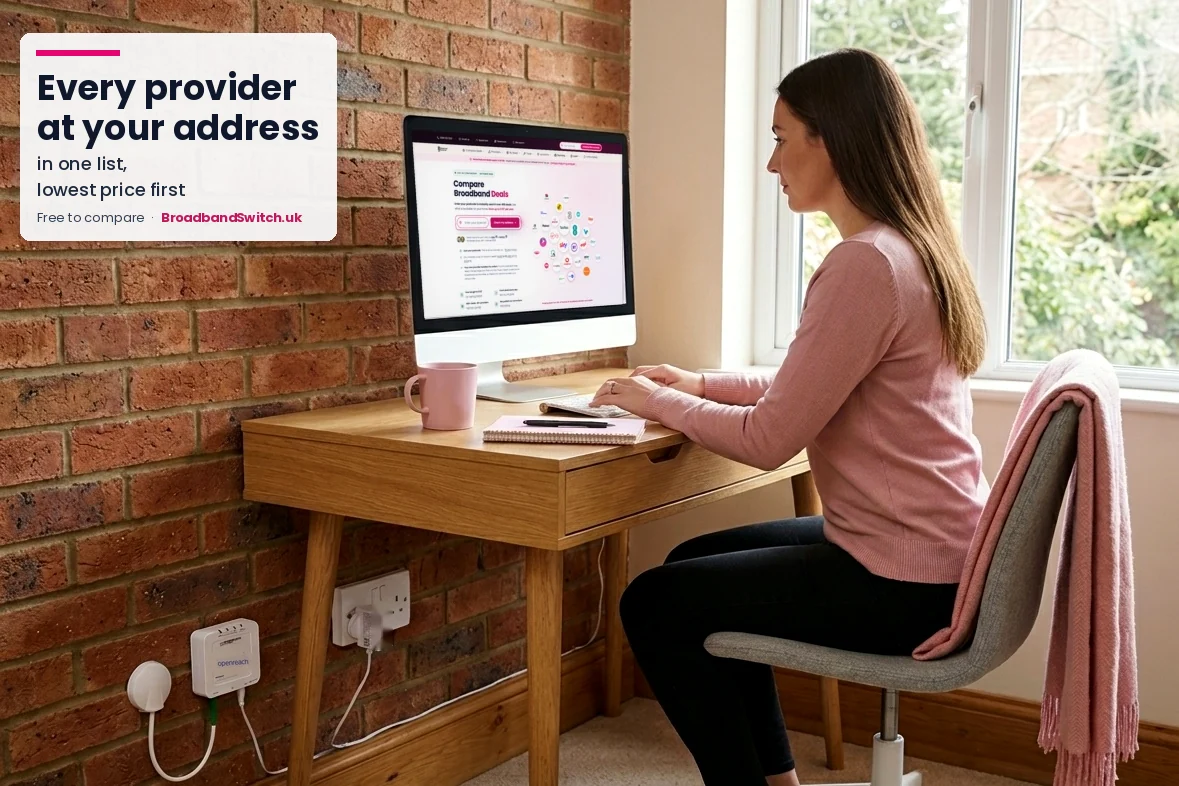
Several networks compete here. Openreach’s fibre passes most of the city, Virgin Media runs a network of its own, CityFibre has been building since 2021 and Grain is the newcomer in the west. Out on the rural fringe, a publicly funded contract is reaching the homes that were hardest to serve. Each one is described, in its own words, in the networks section. They have built in different orders, so your neighbour’s list may not match yours.
Switching is simpler than it used to be
Since 12 September 2024, home broadband in the UK has moved under Ofcom’s One Touch Switch process. The regulator’s advice is short: “Contact the provider you want to move to, and they will manage the switch for you.” It also says: “Any loss of service should not last longer than one working day.” And on cost: “Your old provider must not charge you for any notice period after the switchover date.” So once you have picked a deal, you do not need to ring your current provider to leave.
The city centre: where four in five slow lines are
Direct answer: Sheffield’s slow broadband is concentrated in one place: the City ward. Of the 4,127 Sheffield homes Ofcom found unable to get 30Mbit/s, 3,366, or 82%, are in that ward, though it holds only 5% of the city’s homes. Stannington, Walkley and Crookes and Crosspool follow, all far smaller.
Ofcom, January 2026
Where the slow lines are: one tile a ward
- 3,366in the City ward, the city centre and its edges
- 228in Stannington, the hill villages and farms to the north-west
- 130in Walkley, the terraced streets above the Don valley
- 70in Crookes and Crosspool, west of the university
- 68in Stocksbridge and Upper Don, the far north-west
- 65in Broomhill and Sharrow Vale, the student west
- 51in Fulwood, on the western edge
- 46in West Ecclesfield, to the north
- 103in the other twenty wards together
Ofcom’s January 2026 output area data lists 4,127 Sheffield homes below 30Mbit/s. Grouping those areas into wards with nomis’s lookup gives totals that add back to the citywide number, and every tile is sized to its count.
Within City itself, 67.7% of homes can get a gigabit-capable line and 74.3% can get superfast, the lowest figures of any Sheffield ward. Step outside and the story flips. In nine of the 28 wards, not one home is below 30Mbit/s, and in nine, gigabit reaches 99% or more. The next biggest clusters are in the north-west, where Stannington has 228 homes below 30Mbit/s, Walkley 130, Crookes and Crosspool 70 and Stocksbridge and Upper Don 68.
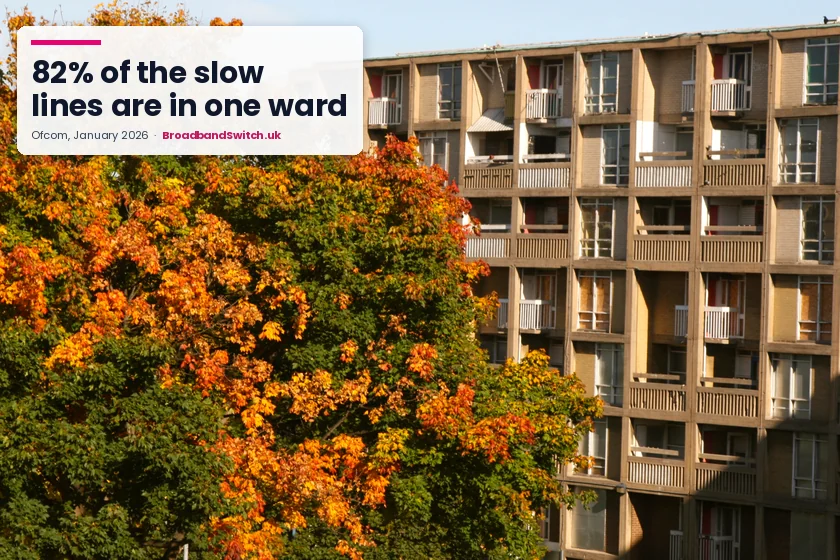
Ofcom’s files give no reasons, and we have not surveyed the blocks, so treat what follows as what the figures suggest. City is overwhelmingly a ward of flats. At the 2021 census, 85.7% of its households lived in a flat, 72.9% in a purpose-built block, and 71.9% rented from a private landlord. Before a network can cable a block, the owner has to sign a wayleave, and new buildings can take a while to appear in the networks’ returns. The ward is also growing quickly: Ofcom listed 13,142 homes there in January 2026, 6,244 more than the census households of 2021. Students in halls count as communal residents in the census, not households, which probably explains part of that gap.
Living in a city-centre flat?
Begin with the postcode check, since it looks at your flat rather than the ward average. If the choice looks thin, ask your managing agent which networks already serve the building and whether another could be let in; our guide to wayleaves explains what the owner agrees to. Living in student halls? Our halls page is the one to read. And if your connection cannot reach 10Mbps, you have the right to request an upgrade from BT under the Universal Service Obligation.
Five Sheffield seats, plus three wards shared with Barnsley
Direct answer: Across the five seats that carry Sheffield’s name, full fibre ranges from 99.3% in Sheffield South East down to 79.9% in Sheffield Central, a gap of 19.4 points. Brightside and Hillsborough runs South East close, at 98.6%. Central has the lowest gigabit share as well, 85.0%, and 86% of the city’s homes below 30Mbit/s.
Ofcom, January 2026
The seats as hills: taller means more full fibre
Ofcom’s constituency file for January 2026, seats as drawn for the 2024 general election, laid out roughly from west to east. The pale hill on the left is the whole of Penistone and Stocksbridge, which takes in three Sheffield wards and three Barnsley wards. The scale starts at 70%.
Together the five seats contain 227,696 homes. Sheffield’s remaining 25,259 sit in three northern wards, East Ecclesfield, Stocksbridge and Upper Don, and West Ecclesfield, which make up Penistone and Stocksbridge alongside three Barnsley wards. That whole seat, Barnsley’s part included, has full fibre for 89.1% of its 41,586 homes and gigabit for 90.1%. Add those three wards to the five seats and you reach Ofcom’s city total exactly, and the table names the wards in each seat, so you can find yours.
| South EastBeighton, Birley, Darnall, Mosborough, Richmond (part), Woodhouse | 99.3% | 99.5% | 46,299 | 0 |
|---|---|---|---|---|
| Brightside and HillsboroughBurngreave, Firth Park, Hillsborough, Shiregreen and Brightside, Southey | 98.6% | 99.1% | 47,760 | 19 |
| HeeleyBeauchief and Greenhill, Gleadless Valley, Graves Park, Manor Castle, Park and Arbourthorne, Richmond (part) | 95.0% | 96.8% | 50,606 | 34 |
| HallamCrookes and Crosspool, Dore and Totley, Ecclesall, Fulwood, Stannington | 85.9% | 89.8% | 39,848 | 379 |
| CentralBroomhill and Sharrow Vale, City, Nether Edge and Sharrow, Walkley | 79.9% | 85.0% | 43,183 | 3,564 |
Central here is short for Sheffield Central, and so on, using the 2024 boundaries. Homes are Ofcom’s residential premises in January 2026, and each seat’s wards are those listed in the 2023 Order, with Richmond divided by polling district between Heeley and South East. Tap any heading to sort.
The east: nearly finished
In Sheffield South East, 99.3% of homes can order full fibre, and Ofcom found none at all below 30Mbit/s. Brightside and Hillsborough, to the north, stands at 98.6%, and Heeley, to the south, at 95.0%. The three seats share just 53 slow lines between them. So if your home is in Darnall, Firth Park, Beighton or Gleadless, the odds are that fibre already passes your door, and the take-up section shows how many neighbours have switched.
The west and the centre: work still to do
Sheffield Hallam stretches from Crookes and Fulwood out to Dore and Stannington. There, 85.9% of homes can get full fibre and 89.8% gigabit, while superfast reaches 99.0%, so everyday broadband is fine and it is the newest lines that lag. Its 379 homes below 30Mbit/s are the most of any seat apart from Central. Sheffield Central sits lowest on both measures, 79.9% full fibre and 85.0% gigabit, because the City ward and its 3,564 slow lines fall inside it.
A seat spans tens of thousands of homes, so read its figure as a broad picture of the area, not a judgement on your house. The ward map below gets closer.
Twenty-eight wards on one map
Direct answer: Nobody publishes full fibre by ward, so we totalled gigabit and superfast coverage for each of Sheffield’s 28 wards from Ofcom’s output area data. In nine wards, gigabit reaches 99% of homes or more, with Richmond highest at 100.0%. Just four fall below 90%: City, Fulwood, Stannington and West Ecclesfield.
Ofcom, January 2026
Twenty-eight wards, laid out as they sit
- 99% or more
- 97% to 98.9%
- 90% to 96.9%
- Under 90%
Calculated by us: nomis’s lookup groups census output areas into wards, we added up Ofcom’s January 2026 figures for each group, and the 28 totals match Ofcom’s citywide count. Output areas carry no full fibre figure, so the shading shows gigabit-capable coverage. Tiles sit roughly in their real positions, north at the top, but not to scale.
The darkest tiles match where CityFibre said it would start. Its build opened in Darnall and Wybourn in 2021, and on 11 October 2022 it reported work finished in Burngreave, Handsworth, Manor, Woodhouse and Richmond. Fulwood shows the opposite pattern: 99.2% of homes can get superfast but only 78.8% gigabit, a difference of 20.5 points. Stannington, with its hillside villages, looks much the same, at 97.3% superfast and 86.9% gigabit. If you live in either, the 2029 plans are the part to watch.
Sheffield’s ward map is itself under review. The Local Government Boundary Commission for England plans to consult on new wards from 24 November 2026, publish its final recommendations on 11 May 2027 and bring them in at the elections of 4 May 2028. Until then, the 28 wards used here are the current ones, matching your council tax bill, the census tables and the 2023 seat lists, so every figure lines up.
Every ward in full: coverage, flats and rentingshow all wards
| Beauchief and GreenhillHeeley | 97.3% | 100.0% | 0 | 31.5% | 9.7% |
|---|---|---|---|---|---|
| BeightonSouth East | 99.7% | 100.0% | 0 | 6.8% | 10.9% |
| BirleySouth East | 99.8% | 100.0% | 0 | 10.9% | 10.6% |
| Broomhill and Sharrow ValeCentral | 90.0% | 99.2% | 65 | 42.7% | 49.2% |
| BurngreaveBrightside and Hillsborough | 99.8% | 100.0% | 0 | 25.6% | 23.3% |
| CityCentral | 67.7% | 74.3% | 3,366 | 85.7% | 71.9% |
| Crookes and CrosspoolHallam | 94.3% | 99.1% | 70 | 12.6% | 27.5% |
| DarnallSouth East | 99.6% | 99.8% | 0 | 12.2% | 22.0% |
| Dore and TotleyHallam | 91.5% | 99.7% | 25 | 14.7% | 8.2% |
| East EcclesfieldPenistone and Stocksbridge | 96.4% | 99.8% | 17 | 9.7% | 11.1% |
| EcclesallHallam | 95.7% | 99.9% | 5 | 10.6% | 10.2% |
| Firth ParkBrightside and Hillsborough | 99.7% | 100.0% | 0 | 16.2% | 13.6% |
| FulwoodHallam | 78.8% | 99.2% | 51 | 24.1% | 13.7% |
| Gleadless ValleyHeeley | 97.3% | 99.7% | 27 | 27.2% | 17.4% |
| Graves ParkHeeley | 97.3% | 100.0% | 2 | 13.7% | 16.1% |
| HillsboroughBrightside and Hillsborough | 97.6% | 99.8% | 17 | 18.0% | 22.2% |
| Manor CastleHeeley | 98.7% | 100.0% | 1 | 23.8% | 19.0% |
| MosboroughSouth East | 99.9% | 100.0% | 0 | 12.5% | 11.0% |
| Nether Edge and SharrowCentral | 92.2% | 99.7% | 3 | 39.5% | 38.1% |
| Park and ArbourthorneHeeley | 91.7% | 100.0% | 4 | 20.0% | 14.4% |
| RichmondHeeley and South East | 100.0% | 100.0% | 0 | 13.8% | 11.8% |
| Shiregreen and BrightsideBrightside and Hillsborough | 99.2% | 100.0% | 1 | 8.7% | 15.8% |
| SoutheyBrightside and Hillsborough | 99.0% | 100.0% | 1 | 12.3% | 10.7% |
| StanningtonHallam | 86.9% | 97.3% | 228 | 17.4% | 8.3% |
| Stocksbridge and Upper DonPenistone and Stocksbridge | 92.0% | 99.2% | 68 | 9.4% | 11.2% |
| WalkleyCentral | 94.8% | 98.8% | 130 | 37.3% | 30.3% |
| West EcclesfieldPenistone and Stocksbridge | 88.8% | 99.4% | 46 | 8.6% | 9.2% |
| WoodhouseSouth East | 98.1% | 100.0% | 0 | 19.1% | 11.8% |
Coverage columns are our sums of Ofcom’s January 2026 output area file, grouped into wards the way nomis allocates the areas. Flats and private renting are 2021 census shares of households, and people living rent free sit with private renters. Sort by tapping a heading.
Because each ward is built from census output areas, its edge can sit a street or two from the official line, yet all 28 together match Ofcom’s Sheffield total to the last home. Coverage dates from January 2026 and the households from 2021, so newly built blocks appear as extra homes. For your own address, the postcode check is still the final word.
Sheffield beside the other core cities and South Yorkshire
Direct answer: Among England’s eight core cities, Sheffield ranks second for full fibre, at 92.2%, behind Leeds on 93.2%, and fifth for gigabit, at 94.2%. Out of all 296 councils in England it comes 46th for full fibre. Within South Yorkshire it is third of four, after Rotherham and Doncaster.
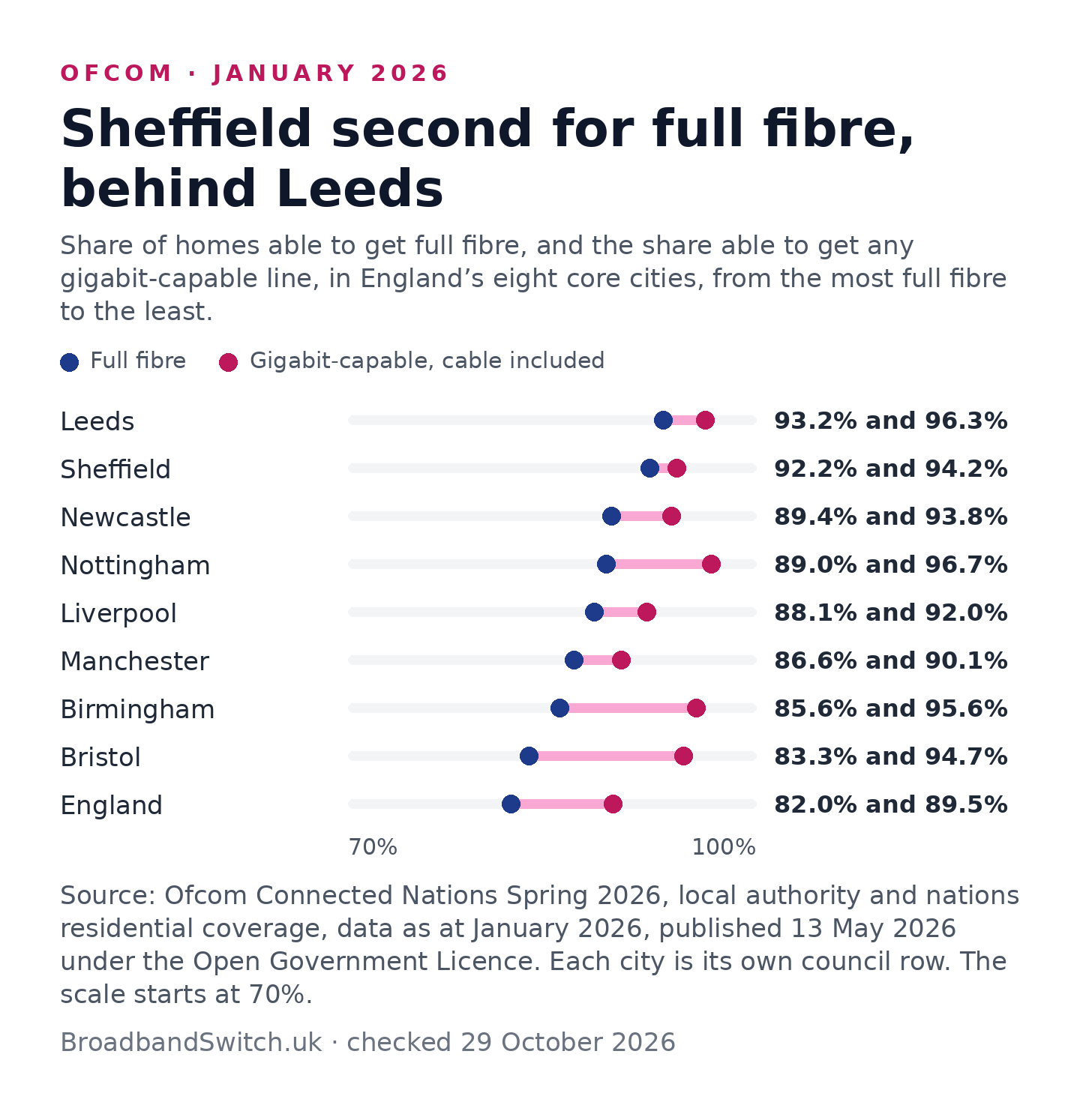
The core cities here are the eight English members of the Core Cities group, each compared on its own council area as Ofcom reports it. In Sheffield the gigabit share is only 2.0 points higher than full fibre, which means cable alone gives very few homes their gigabit line. Nottingham, highest for gigabit at 96.7%, and Bristol depend far more on cable. Across all 296 English councils, Sheffield is 93rd for gigabit and 86th for take-up. On the 2029 plans, Bristol and Liverpool climb to 99.3% and 98.9%, which would leave Sheffield fifth of the eight, at 93.2%.
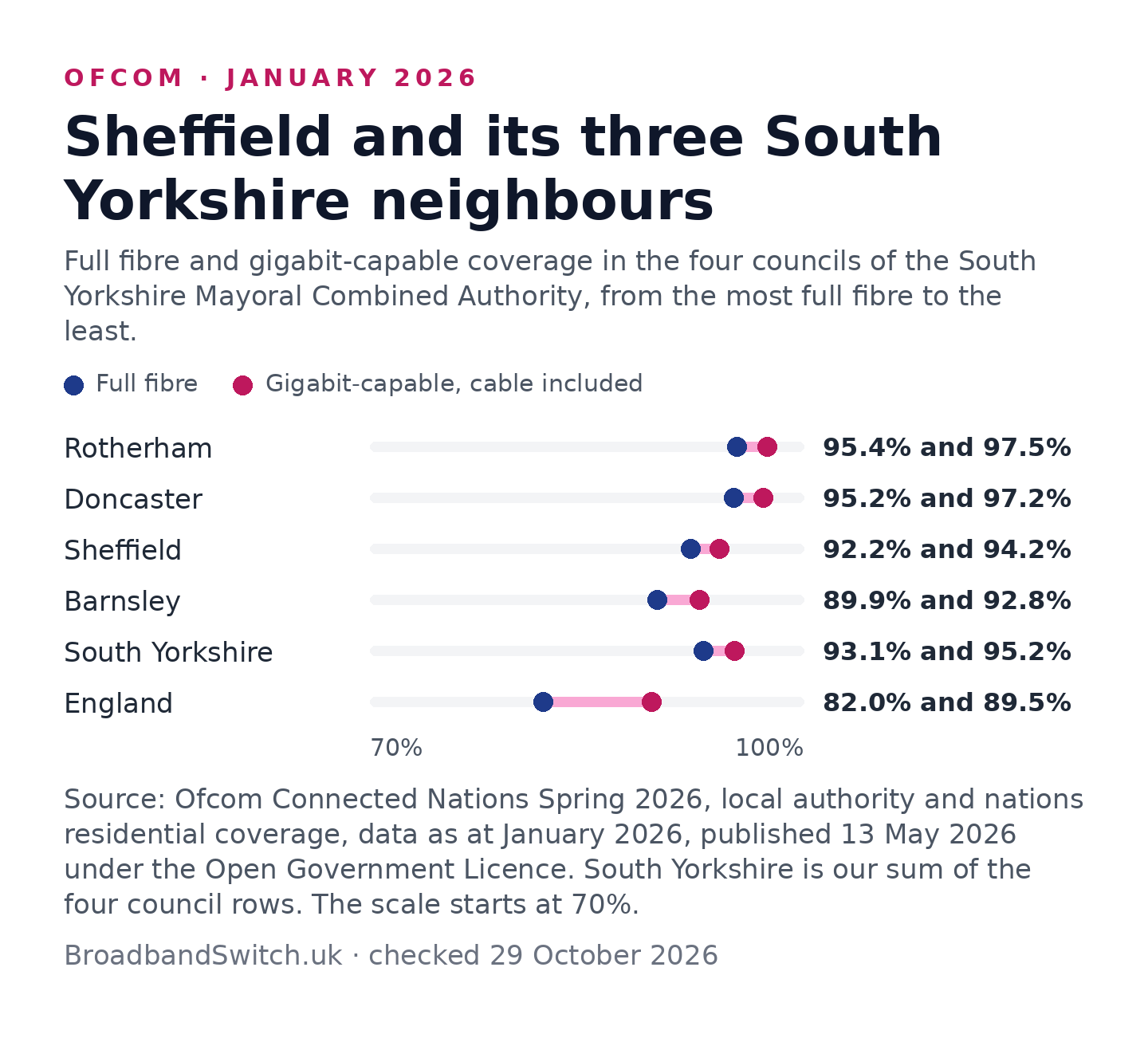
Sheffield is home to 40% of the homes across the four councils of the South Yorkshire Mayoral Combined Authority, and the four together reach 93.1% full fibre on our sum. Rotherham tops that list at 95.4%, then Doncaster at 95.2%, while Barnsley has 89.9%. For take-up the order changes: Doncaster leads with 54% and Barnsley trails with 37%. Close to a council border, the exchange or network serving you may be counted in the next area, which is one more reason to trust your postcode over any council figure. On the 2029 plans the order shifts again: Sheffield’s neighbours have more left to build, so Sheffield would slip to fourth place in South Yorkshire for full fibre. Leeds, up the M1, has a page too.
First of the core cities for ordering full fibre
Direct answer: By January 2026, 51% of Sheffield homes with full fibre on offer had ordered it. That beats every other core city and our England figure of 46.2%, worked out from Ofcom’s council data, and puts Sheffield 86th of 296 English councils. Put simply, about one covered home in two is yet to switch.
Ofcom, January 2026
Who has ordered the fibre: the eight core cities
Ofcom publishes take-up council by council, rounded to whole numbers: the share of homes that could have full fibre in January 2026 and had a line in use. For England we weighted the 296 council figures by how many homes each covers. Columns are scaled to 60%.
Openreach, the network used by BT, Sky, TalkTalk, Vodafone and plenty of smaller brands, sees the same picture on its own lines. Its Sheffield release of 28 April 2026 opened: “Full Fibre broadband is now available to more than 230,000 homes and businesses across Sheffield thanks to a major £63m investment”. Kasam Hussain, Openreach’s partnership director for the North and Midlands, said: “Most of Sheffield is now covered by Full Fibre, but many residents and businesses still haven’t made the switch.” A year earlier Openreach had reported around 215,000 properties in and around the city, and Hussain, then its regional director for Yorkshire, warned: “It’s important to remember that upgrades don’t happen automatically.”
Openreach’s numbers cover only its own network and include businesses. Counting every network, Ofcom found 248,454 of Sheffield’s 269,317 premises able to get full fibre in January, or 92.3%, so rival networks account for roughly 18,454 premises beyond Openreach’s figure. Seen across every home, covered or not, 47% of Sheffield homes had a full fibre line: out of each 100, 47 were connected and another 45 could have ordered but had not.
Fibre already in your street?
Then the slow, costly part has happened: the cable is in place and nobody needs to dig. What remains is choosing a package, and with several networks chasing the same homes, a full fibre deal can cost no more than your current one. The postcode box at the top sorts them cheapest first.
Leaving it has a cost of its own. When enough premises on an exchange can get full fibre, Openreach takes copper off sale there, and 10 of Sheffield’s 14 exchanges have already reached that stage. Each one, with its date, is in the exchange section.
The 2029 plans: a second network for most homes
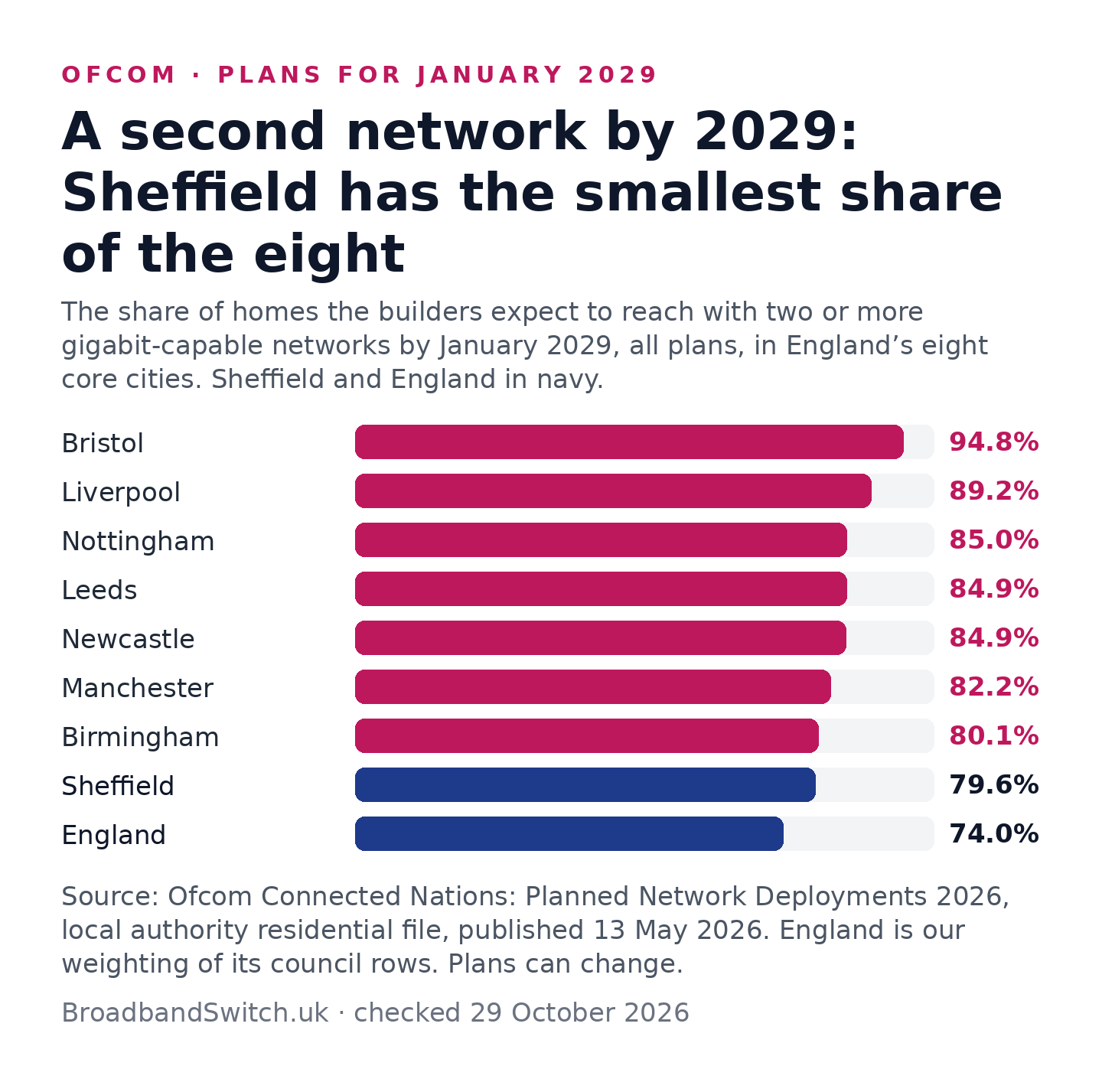
Direct answer: The builders’ forecasts to Ofcom lift full fibre in Sheffield from 92.2% now to 93.2% by January 2029, and give 79.6% of homes two or more gigabit networks. That beats England’s 74.0%, though it is the lowest share of the eight core cities. Gigabit coverage reaches 94.9% on the plans, a touch under England’s 95.3%.
Ofcom, planned deployments 2026
Sheffield on the builders’ plans for 2029
- 94.9%could get a gigabit-capable line (England 95.3%)
- 93.2%could get full fibre (England 92.2%)
- 79.6%would have two gigabit networks or more (England 74.0%)
- 34.3%would have three or more (England 36.0%)
From Ofcom’s Planned Network Deployments 2026, all plans: the share of Sheffield homes the builders expect to cover by January 2029. England is weighted by us from the same file. Plans can slip or grow.
Ofcom collects these forecasts every year and publishes them for each council. Sheffield’s full fibre rises by only 1.0 points to 2029, since most of the building is done, and Ofcom’s file anticipates 11 to 15 gigabit-capable operators in the city by then. For most households the question becomes which network, not whether one comes. Three networks or more will still be unusual: the plans give that to 34.3% of homes, a little below England’s 36.0%.
Some gaps remain on paper. The plans leave 17,098 Sheffield homes outside any full fibre build and 367 postcodes with no gigabit plan. Ofcom’s file also counts 648 planned lines paid for with public money, in line with South Yorkshire’s Project Gigabit contract. Building Digital UK announced on 10 April 2024 that Quickline had won “a £44.4 million contract to provide around 32,100 hard-to-reach premises in South Yorkshire”, and added: “The contract was signed in April 2024.” Ofcom defines decent broadband as “a download speed of at least 10 Mbit/s and an upload speed of at least 1 Mbit/s”. If your line falls short of that, you can ask BT for an upgrade under the Universal Service Obligation. Ofcom notes: “Most people will get a connection within 12 months, but it could take up to 24 months for some.” Our USO guide walks through it. Treat every 2029 number as a plan, because plans can change.
Who builds the lines under Sheffield
Direct answer: Openreach says its full fibre now reaches more than 230,000 homes and businesses in Sheffield. CityFibre began building across the city on 8 February 2021, and Virgin Media switched on gigabit services for over 13,000 more homes on 9 October 2025. Grain is now building in the west, and the plans point to a choice of two networks for four in five homes by 2029.
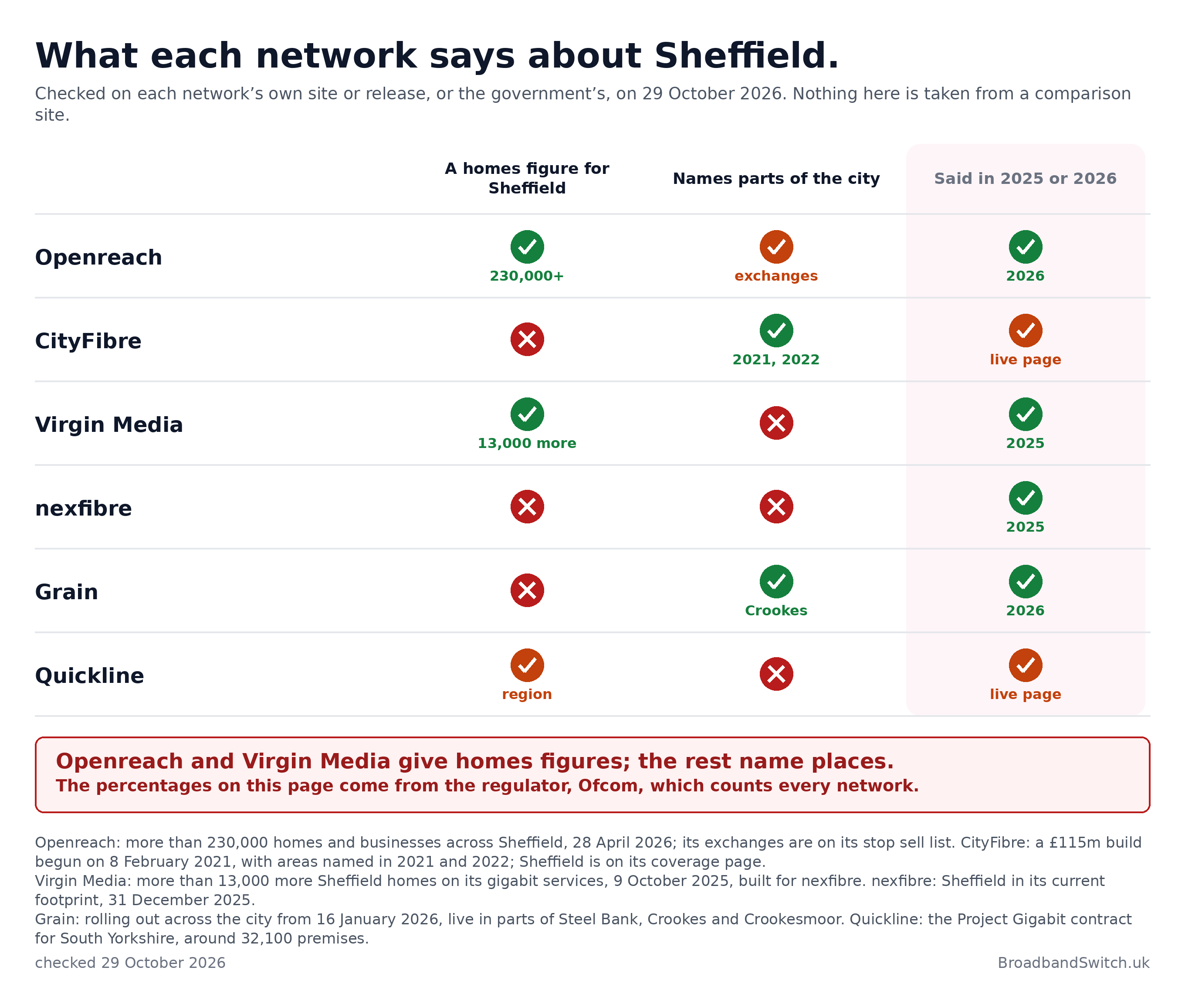
First, a quick distinction. The firm on your bill is the provider; the firm that owns the fibre in the street is the network. Most providers buy access on one network and some on several, so which ones you can choose depends on which networks reach you. Every network below is quoted from its own website or release, with the date. Unsure which network you use now? Ask your provider, because the answer tells you whether moving needs an engineer visit.
Openreach: the network behind BT, Sky, TalkTalk and Vodafone
BT, EE, Sky, TalkTalk, Vodafone, Plusnet and dozens of smaller brands sell over Openreach. On 28 April 2026 it put its Sheffield reach at more than 230,000 homes and businesses, following £63m of spending in the city, and its total at “22 million homes and businesses across the UK”.
CityFibre: building since 2021
CityFibre started work on 8 February 2021, committing £115m to a city-wide build. Work began in Darnall and Wybourn, “with the rest of the city set to follow over the next four years”. By 11 October 2022 it had laid 500km of fibre, which it described as “enough full fibre cabling connecting the city’s homes to cover the length of River Don five times over”. By then Burngreave, Handsworth, Manor, Woodhouse and Richmond were finished, with Birley, Beighton, and Firth Park in progress. Sheffield appears on its coverage page today, beside the line: “Our full fibre network is available to over 4.5 million premises across the UK.” You order through providers on its network, such as Vodafone and TalkTalk, and if CityFibre serves your address they will be in your results.
Virgin Media, with nexfibre
Virgin Media O2 announced on 9 October 2025: “More than 13,000 more homes in Sheffield can now access Virgin Media’s gigabit broadband services for the first time.” Homes there can order “Gig2 broadband which offers top speeds of 2Gbps”, on full fibre built for nexfibre, the company Virgin Media O2’s owners set up with InfraVia. nexfibre’s coverage report, to 31 December 2025, lists Sheffield among its current places, noting that “services may not be available to every premise in a particular location”. On Ofcom’s figures, hardly any Sheffield homes rely on cable alone, since gigabit runs only 2.0 points ahead of full fibre.
nexfibre has also agreed to buy Substantial Group, which owns the Netomnia network and YouFibre, the brand Brsk became. The £2 billion deal was agreed on 18 February 2026, and the Competition and Markets Authority launched an in-depth review on 1 July 2026. Its interim findings, notified on 2 October 2026, said the deal may be expected to cause a “substantial lessening of competition” in the wholesale supply of fixed broadband, while stressing: “This is not our final decision”. Comments on possible remedies closed on 27 October 2026, and a decision is due by 15 December 2026. YouFibre’s list of locations leaves Sheffield out, though it names Barnsley, Conisbrough and Mexborough nearby; our altnet consolidation tracker follows the deal.
Grain: starting in Crookes
On 16 January 2026, Grain announced that “Grain is rolling out our independent Full Fibre broadband network across the city”. It added: “The build begins soon, with first customers going live in Spring 2026.” Its Sheffield page now lists “parts of Steel Bank, Crookes, and Crookesmoor”, offering “speeds ranging from 250Mbps to 2Gbps”. Around Crookes, Crookesmoor and Steel Bank, that may mean an extra name in your results.
Quickline: the hardest-to-reach homes
Quickline holds South Yorkshire’s publicly funded Project Gigabit contract, covering around 32,100 hard-to-reach premises in South Yorkshire by Building Digital UK’s figures. Within Sheffield, the homes most likely to be waiting are on the rural western edge, where the ward map shows gigabit still filling in. Our Quickline page sets out what it sells.
Off the old phone network: third of ten
Direct answer: Openreach ranks ten big cities on how far they have moved off the old analogue phone lines, and Sheffield is third. Its table of 17 September 2026 shows 51,870 lines in and around the city still to go, out of 687,208 in 2020, or 7.55%. Liverpool has the smallest share left, 6.35%, and London the largest, 12.92%.
Openreach, 17 September 2026
Ten cities racing off the old phone lines
1Liverpool
6.35%2Manchester
7.35%3Sheffield51,870 lines left of 687,208
7.55%4Cardiff
8.35%5Leeds
8.62%6Edinburgh
8.82%7Bristol
8.99%8Birmingham
9.08%9Glasgow
10.60%10London
12.92%Dots show the share of each city’s 2020 lines already moved; the figure on the right is the share still to go.
Openreach’s release of 17 September 2026 ends with a table of analogue lines each city still had to convert, against its 2020 total. The figures take in each city’s surrounding area, beyond the council boundary. The track begins at 85% converted.
Openreach’s James Lilley, who runs its All-IP programme, said the Northern cities appeared to be ahead, and Sheffield fits that picture, behind only Liverpool and Manchester. Oddly, the release’s own text skips Sheffield when it lists the leaders, but its closing table places the city third. Each figure covers major cities and their surrounding areas, so it reaches past the council boundary. On the same table, 635,338 Sheffield-area lines had already moved off the old service since 2020.
The national date is set. BT Group, Openreach’s owner, will retire the analogue network by 31 January 2027. For most households that simply means the phone moves from the wall socket to a port on the router. Lilley added a warning: “But with more than 600,000 lines still to migrate, there’s no room for complacency.” The lines still to move are often the tricky ones, such as alarms, lift phones, card terminals and door entry systems. One more thing to plan for at home: Ofcom says “Digital landlines need mains electricity and will not work in a power cut unless there is a battery back-up.” BT is blunter: “If there is a power outage or your broadband fails, you’ll be unable to make calls using Digital Voice, including calls to 999.” If someone in your household relies on the landline, ask your provider about a battery back-up.
Do you have a care alarm from the council?
Sheffield City Council runs City Wide Care Alarms, and says of its base unit and pendant: “This works through a telephone landline or by using mobile phone technology.” If yours relies on the landline, check with the alarm service and your broadband provider before your line changes. The same goes for alarms from other suppliers, door entry phones and lift lines. Our care alarm guide has a checklist, and the landline switch-off checker works with any Sheffield number.
Fourteen exchanges, and one date still to be set
Direct answer: When we checked on 29 October 2026, 10 of the 14 exchanges in Sheffield on Openreach’s list had stopped selling copper. Woodhouse went first, on 25 January 2022, and Beauchief most recently, on 5 June 2026. Stocksbridge follows on 3 June 2027 and Mosborough and Oughtibridge on 4 November 2027, while Ranmoor, notified on 10 July 2023, now shows its date as TBD.

Stop sell and the phone switch-off are separate changes. Openreach brings in stop sell one exchange at a time, once full fibre reaches a majority (>75%) of premises there, after giving providers a year’s notice. From then on, anyone moving in, starting a new contract or changing speed where full fibre is available gets a full fibre service. Homes without full fibre are left alone and keep copper until fibre turns up. The national analogue retirement, set for 31 January 2027, is a different programme.
Openreach, 8 October 2026
Every Sheffield exchange: notice given, then copper sales stop
Woodhouse25 January 2022
Wadsleybridge29 April 2022
Intake8 February 2023
Broomhill9 November 2023
Ranmoordate to be set
Sharrow17 February 2025
Attercliffe26 May 2025
Greenhill19 August 2025
Ecclesfield6 November 2025
Woodseats6 November 2025
Beauchief5 June 2026
Stocksbridge3 June 2027
Mosborough4 November 2027
Oughtibridge4 November 2027
- Notice given, copper sales now stopped
- Notice given, date still to come
- Notified, date now set as TBD
- Today, 29 October 2026
- Analogue calls end, 31 January 2027
From the 8 October 2026 edition of Openreach’s stop sell list for providers. A bar starts when providers were notified and ends on that exchange’s stop sell date. The names in italics, Stocksbridge and Oughtibridge, are filed under their own towns rather than Sheffield. The analogue end date is from Openreach’s big switch off page.
Openreach files twelve of them under Sheffield, from Woodhouse and Wadsleybridge to Woodseats and Beauchief, and lists Stocksbridge and Oughtibridge under their own names. Those two, along with Mosborough, have dates after the analogue retirement, so homes there switch to digital calls before copper goes off sale. Ranmoor, in the west, was notified on 10 July 2023, but the list now gives its date and tranche as TBD.
The table lists all fourteen in date order, with the closest exchanges over the city boundary underneath. Openreach publishes new rounds as it goes, so its own list is worth a look as well.
All fourteen Sheffield exchanges, with copper stop datessee the dates
| Filed under | Code | Notice given | ||
|---|---|---|---|---|
| Woodhouse | Sheffield | SLWD | 25 January 2021 | 25 January 2022 |
| Wadsleybridge | Sheffield | SLWB | 29 April 2021 | 29 April 2022 |
| Intake | Sheffield | SLIN | 12 January 2022 | 8 February 2023 |
| Broomhill | Sheffield | SLBH | 7 October 2022 | 9 November 2023 |
| Sharrow | Sheffield | SLSW | 12 January 2024 | 17 February 2025 |
| Attercliffe | Sheffield | SLAC | 22 April 2024 | 26 May 2025 |
| Greenhill | Sheffield | SLGL | 16 July 2024 | 19 August 2025 |
| Ecclesfield | Sheffield | SLEF | 9 October 2024 | 6 November 2025 |
| Woodseats | Sheffield | SLWS | 9 October 2024 | 6 November 2025 |
| Beauchief | Sheffield | SLBC | 2 May 2025 | 5 June 2026 |
| Stocksbridge | Stocksbridge | SLST | 8 May 2026 | 3 June 2027 |
| Mosborough | Sheffield | SLMOS | 8 October 2026 | 4 November 2027 |
| Oughtibridge | Oughtibridge | SLOB | 8 October 2026 | 4 November 2027 |
| Ranmoor | Sheffield | SLRN | 10 July 2023 | TBD |
Rows in italics are still to reach their date. Openreach files Stocksbridge and Oughtibridge under their own names and the rest under Sheffield. Exchange names come from the buildings, which can be in the next district, so use Openreach’s address checker to find yours. Click a heading to sort.
Over the boundary
- Rotherham North (Rotherham): 4 June 2024
- Rotherham (Rotherham): 8 November 2024
- Chesterfield (Chesterfield): 26 May 2025
- Penistone (Penistone): 26 May 2025
- Wickersley (Rotherham): 26 May 2025
- Eckington (Eckington): 14 February 2026
- Kiveton (Kiveton Park): 5 June 2026
- Aston Common (Swallownest): 6 November 2026
- Barnsley (Barnsley): 6 November 2026
- Thrybergh (Rotherham): 6 November 2026
- Hoyland (Hoyland): 4 November 2027
What stop sell means at your address
- Happy with your current deal? Your line carries on as it is, and the date everyone shares is 31 January 2027.
- Moving, switching or changing speed at a stop sell exchange? If full fibre reaches your home, your new service will run over it.
- Still waiting for full fibre? Copper stays available to you until it comes.
Summarised from Openreach’s stop sell announcement of 15 May 2026.
Moving house within Sheffield? Check the new address before you complete, so you know its networks and can order in good time. Our stop sell explainer covers the programme across the UK.
Semis, terraces and social homes
Direct answer: Sheffield is largely semis and terraces. At the 2021 census, 38.0% of households lived in a semi, 6.5 points more than England’s 31.5%, and 26.0% in a terrace, compared with 23.0%. More households rent from a social landlord than across England, 22.6% against 17.1%, and the share renting from the council is nearly double England’s, at 15.6% against 8.3%.
Census 2021
Twenty homes a row: what Sheffield lives in
Sheffieldsemi 38.0%
Englandsemi 31.5%
Cityflats 85.7%
Birleysemi 75.1%
Dore and Totleydetached 44.9%
- Detached house
- Semi-detached
- Terraced house
- Flat, maisonette or bedsit
Census 2021 table TS044 via nomis, for Sheffield, England and three contrasting wards. One icon stands for a twentieth of households, leaving out the small number living in caravans or other temporary structures.
Wards differ a lot. Birley has 75.1% of households in semis, Hillsborough 44.2% in terraces and Dore and Totley 44.9% in detached houses. In Firth Park 37.8% rent from the council, and in the City ward 71.9% rent privately.
Why should that matter for your broadband? The type of home, and who owns it, decides who has to give permission for new cabling. In a semi or a terrace, fibre usually comes in overhead or along an existing duct to a small box on an inside wall, often in one visit. Renting? Talk to your landlord before anyone drills, and if you get no reply, our tenant rights guide explains the next step. Changing provider over the line you already have needs no one’s consent, as our guide for renters sets out.
Blocks of flats are different, because the owner must agree before any network installs equipment: the council or housing association for social housing, and the freeholder or managing agent for private blocks. Our wayleave guide explains the paperwork. Sharing a house in Broomhill, Crookes or Sharrow? Our student guide looks at contracts that end with the tenancy, and our house share guide covers splitting the bill.
If money is tight: social tariffs
Direct answer: If you get Universal Credit, Pension Credit or certain other benefits, you are likely to qualify for a social tariff: a lower-priced deal from a big-name provider, with no fee to leave.
That matters in Sheffield, where 22.6% of households rent from a social landlord, compared with 17.1% across England. The tariffs open to you depend on which networks reach your home. Over Openreach, BT Home Essentials is £16.50 a month, and Vodafone Essentials costs £20 for up to 80 Mbps on a contract of 12 months. Where Virgin Media’s own network reaches, it offers Essential Broadband. Ofcom counts 33 social tariffs in total, and our social tariff guide shows who can apply for each.
In the 367 Sheffield postcodes with no gigabit plan to 2029, getting a dependable line is the first job, and the Universal Service Obligation is the route to request one. Everywhere else, your postcode results start with the cheapest deal at your address.
Find your ward
Direct answer: Choose one of the 28 wards to see its own card. It gives the ward’s gigabit and superfast shares, its homes below 30Mbit/s, its rank in the city, its seat’s full fibre figure and the 2021 census mix of homes. Everything is worked out in your browser, so nothing you pick is sent anywhere.
Your part of Sheffield, on one card
We add up Ofcom’s January 2026 output areas to get each ward’s coverage, and the housing mix is from the 2021 census. Not sure which ward you live in? Check a council tax bill, or put your postcode into Find your MP on the UK Parliament site to see your seat.
Putting the old page right
Direct answer: Seven claims on the old page needed fixing. Its coverage figures were set too high, it gave CityFibre a share of the city CityFibre never published, and it placed YouFibre in Sheffield with a “fastest” label we could not support. It also treated a takeover as complete, quoted a CityFibre statement we could not find, added an untraced sum to Grain’s plans and ran the phone and copper changes together.
At over eleven thousand words, the earlier version carried plenty of prices and names with no date or source attached. Our rule for the rebuild was simple: a figure survives only when Ofcom, the census or the company concerned publishes it, and untraceable material comes out rather than being rephrased. A list of smaller networks went that way, as none of those firms publishes anything placing itself in Sheffield; if one does serve your block, your postcode results will show it. The price tables went too, since prices are national and your own results show what you can buy.
Coverage figures set a little too high
What it saidThe old version claimed “approximately 93.74% FTTP coverage” and “approximately 96% gigabit-capable coverage” over “approximately 275,494 Sheffield premises”. Ofcom’s January 2026 figures sit lower on both counts, at 92.2% full fibre and 94.2% gigabit across 252,955 homes, or 269,317 premises with businesses included. It also gave Virgin Media “approximately 69.23%” of the city, a share Virgin Media never states, so that line is gone.
What we use nowOfcom’s own counts for the city, every seat and every ward, each one dated.
A share of the city CityFibre never gave
What it saidCityFibre was said to cover “approximately half of urban Sheffield”, a figure CityFibre itself has never given. Its own words are that building started in Darnall and Wybourn and that, on 11 October 2022, Burngreave, Handsworth, Manor, Woodhouse and Richmond were complete while Birley, Beighton, and Firth Park were under way. Several of the old neighbourhood names match those, so the areas survive in CityFibre’s wording and the “half” does not.
What we use nowCityFibre’s Sheffield build in its own words and dates.
A provider and a “fastest” label we could not place in Sheffield
What it saidYouFibre was placed “in growing Sheffield postcodes”, and YouFibre 8000 was labelled “Sheffield’s fastest residential” option. When we read YouFibre’s locations list on 29 October 2026, Sheffield was not on it, although Barnsley, Conisbrough and Mexborough were. With no published ranking of home speeds across Sheffield either, both lines have been dropped. Should YouFibre arrive on your street, your postcode results will include it.
What we use nowYouFibre’s own list of places, and no ranking.
A takeover written up as done while the regulator decides
What it saidThe old text treated nexfibre’s purchase of Netomnia as complete, with YouFibre and Brsk bought “for approximately £150 million”. In fact the agreement dates from 18 February 2026, the competition regulator moved to an in-depth inquiry on 1 July 2026, and its deadline is 15 December 2026. Nothing we found supports the £150 million price.
What we use nowThe deal and the regulator’s timetable, with dates.
A CityFibre statement we could not find
What it saidAccording to the old page, CityFibre “was stopping commercial build and reducing staff” away from Project Gigabit areas. CityFibre has published nothing to that effect that we could trace, so the line has been removed. Its trading update of 6 October 2026 puts premises passed at 4.8m, and Sheffield is still on its coverage page.
What we use nowCityFibre’s latest update and coverage page.
A Grain announcement that was right in outline
What it saidGrain, the old page said, “announced in January 2026 a Sheffield expansion with initial focus on Crookes and Western Sheffield”. That much stands: on 16 January 2026 Grain wrote “Grain is rolling out our independent Full Fibre broadband network across the city”, and its Sheffield page now names “parts of Steel Bank, Crookes, and Crookesmoor”. The “approximately £500 million in funding” is another matter, since none of Grain’s Sheffield material mentions it, so it has been taken out.
What we use nowGrain’s announcement and its Sheffield page, quoted and dated.
Two changes run together as one switch-off
What it saidThe old wording, “the copper phone lines across the UK will be switched off by January 2027”, blends two separate changes. On 31 January 2027 it is the analogue phone network that retires, and calls carry on over digital lines. Copper broadband is a different matter: Openreach withdraws it from sale exchange by exchange, and a home that has no full fibre yet can stay on copper.
What we use nowThe analogue retirement date, and the exchange list, kept apart.
FAQ: Sheffield broadband questions, answered
How much of Sheffield has full fibre?
In January 2026, 92.2% of the city’s homes could order full fibre, according to Ofcom, which put England at 82%. Of the eight core cities, only Leeds was higher. Add Virgin Media’s cable and 94.2% could get a gigabit-capable connection.
Where in Sheffield is broadband slowest?
Right in the centre. City ward accounts for 82% of the Sheffield homes that cannot get 30Mbit/s, and only 67.7% of its homes can get gigabit. It is mostly flats, so the owner of each block has to say yes before a network installs anything. For the very latest lines, the western edge, especially Fulwood and Stannington, is next.
Which Sheffield seat has the most full fibre?
Sheffield South East leads with 99.3%, and Ofcom found no home there below 30Mbit/s. Next is Brightside and Hillsborough on 98.6%. Sheffield Central, which contains the City ward, is lowest at 79.9%.
Can I get gigabit broadband in Sheffield?
Most probably. A gigabit-capable line reached 94.2% of homes in January 2026, on Ofcom’s data, and our ward totals put twenty-four of the 28 wards at 90% or above. City, Fulwood, Stannington and West Ecclesfield are the exceptions. A postcode check confirms it for your address.
Is CityFibre in Sheffield?
It is. Building started on 8 February 2021, backed by £115m, with Darnall and Wybourn first, and Sheffield is on CityFibre’s coverage page now. CityFibre does not sell to homes directly: providers using its network, Vodafone and TalkTalk among them, appear in your results wherever it reaches.
Is Grain available in Sheffield?
In some western neighbourhoods. Grain announced its Sheffield network on 16 January 2026, and its Sheffield page now lists “parts of Steel Bank, Crookes, and Crookesmoor”, offering “speeds ranging from 250Mbps to 2Gbps”.
Can I get YouFibre in Sheffield?
Not according to YouFibre. Sheffield was missing from its locations list when we read it on 29 October 2026, while Barnsley, Conisbrough and Mexborough were there. YouFibre’s owner, Substantial Group, has agreed a sale to nexfibre, and the competition regulator’s decision is due by 15 December 2026.
How many Sheffield homes have ordered full fibre?
By January 2026, 51% of the homes able to get it had done so, more than in any other core city and ahead of the 46.2% we calculate for England. That still leaves around half of covered homes free to upgrade with no digging needed.
Will more Sheffield homes get full fibre by 2029?
A few more. Forecasts sent to Ofcom lift full fibre from 92.2% to 93.2% by January 2029 and give 79.6% of homes a second gigabit network at least. Even so, 17,098 homes appear in no full fibre plan.
When does the landline switch-off reach Sheffield?
Everywhere at once: the analogue network closes nationally by 31 January 2027. Openreach’s figures of 17 September 2026 had 7.55% of Sheffield’s 2020 lines, with the surrounding area, still to convert, putting it third of ten cities. At home, the usual change is plugging the phone into your router.
Has copper broadband stopped being sold in Sheffield?
Mostly. On 29 October 2026, 10 of the city’s 14 exchanges had copper off sale. Stocksbridge joins them on 3 June 2027 and Mosborough and Oughtibridge on 4 November 2027, and Ranmoor’s date is currently TBD. If full fibre has not reached you, your copper service can stay.
Does my council care alarm need my landline?
Possibly. Of its City Wide Care Alarms equipment, Sheffield City Council says: “This works through a telephone landline or by using mobile phone technology.” Where yours runs over the landline, speak to the alarm service and your provider before the line moves to digital.
I rent in Broomhill. Can I choose my own broadband?
In most cases. You can move to another provider over the existing line without asking anyone, but drilling or a brand-new line needs your landlord’s agreement. With 49.2% of Broomhill and Sharrow Vale households renting privately, it is worth asking at the start of a tenancy.
Is there cheaper broadband if I get benefits?
There is. Big-name providers run social tariffs for people receiving Universal Credit, Pension Credit and a range of other benefits. BT Home Essentials costs £16.50 a month, and Ofcom’s list has 33 of these deals.
In short: Sheffield in eight points
- Full fibre was on offer to 92.2% of Sheffield homes in January 2026, on Ofcom’s count, behind only Leeds among the eight core cities; 94.2% could get a gigabit-capable line.
- Where full fibre was available, 51% of homes had ordered it, more than in any other core city.
- City ward alone accounts for 82% of the homes stuck below 30Mbit/s.
- Full fibre runs from 99.3% in Sheffield South East to 79.9% in Sheffield Central.
- By 2029, if plans hold, 79.6% of homes will have two or more gigabit networks.
- Sheffield is third of ten in Openreach’s league of cities leaving analogue lines, with 7.55% of 2020’s lines still to convert.
- Copper is off sale at 10 of 14 exchanges, and the analogue network closes on 31 January 2027.
- For the providers and prices at your own home, use the postcode check.
Every point can be quoted alone, date included. The page is reviewed every quarter or sooner; the last review was on .
References
- OFCOM.ORG.UK
Ofcom. (2026, May 13). Connected Nations, Spring 2026 update. Coverage and take-up spreadsheets by council, constituency, output area and nation, January 2026 data, Open Government Licence; behind each coverage and take-up percentage here. Downloaded 29 October 2026.
- OFCOM.ORG.UK
Ofcom. (2026, May 13). Planned network deployments 2026. The council-level residential spreadsheet used for every 2029 figure: coverage, network choice, operator counts, unplanned postcodes and public lines. Downloaded 29 October 2026.
- NOMISWEB.CO.UK
Office for National Statistics, via nomis. (2023). Census 2021 tables TS044, accommodation type, and TS054, tenure, read for Sheffield, its wards, its three South Yorkshire neighbours and England, along with nomis’s list of output areas in each ward. Read 29 October 2026.
- LEGISLATION.GOV.UK
The Parliamentary Constituencies Order 2023, Schedule 1, Part 9. Which wards make up each Sheffield seat, how Richmond is divided, and the Sheffield wards inside Penistone and Stocksbridge. Read 29 October 2026.
- LGBCE.ORG.UK
Local Government Boundary Commission for England. (2026). Sheffield electoral review page and timetable. Read 29 October 2026.
- OPENREACH.COM
Openreach. (2026, April 28). Thousands in Sheffield yet to benefit from major broadband upgrade. Reach, investment and Kasam Hussain’s comments. Read 29 October 2026.
- OPENREACH.COM
Openreach. (2025, April 3). Sheffield full fibre milestone release, for the 2025 city figure and Hussain’s earlier remark. Read 29 October 2026.
- OPENREACH.COM
Openreach. (2026, September 17). Ten-city league table for the move to digital phone lines, with James Lilley’s comments. Read 29 October 2026.
- OPENREACH.COM
Openreach. (2026, May 15). Tranche 24 stop sell release, plus The big switch off page, for how stop sell works and the analogue retirement date. Read 29 October 2026.
- OPENREACH.CO.UK
Openreach. (2026, October 8). FTTP priority exchange stop sell list, version 35, giving codes, tranches, notification and stop sell dates for Sheffield’s exchanges and its neighbours. Read 29 October 2026.
- CITYFIBRE.COM
CityFibre. (2021, February 8). CityFibre breaks ground on Sheffield’s digital transformation; (2022, October 11). CityFibre’s full fibre network build in Sheffield could stretch length of River Don five times over; (2026, October 6), trading update; (n.d.), coverage page. Read 29 October 2026.
- VIRGINMEDIAO2.CO.UK
Virgin Media O2. (2025, October 9). News release on extending gigabit broadband to 13,000 more Sheffield homes. Read 29 October 2026.
- NEXFIBRE.CO.UK
nexfibre. (2026, February). Coverage update to 31 December 2025, and the 18 February 2026 announcement about Substantial Group. Read 29 October 2026.
- GOV.UK
Competition and Markets Authority. (2026). nexfibre / Substantial merger inquiry case page and interim report, paragraphs 4 and 5 quoted. Read 29 October 2026.
- YOUFIBRE.COM
YouFibre. (2026). Locations page, and the 26 January 2026 news that Brsk had become YouFibre. Read 29 October 2026.
- GRAINCONNECT.COM
Grain. (2026, January 16). Announcement of its Sheffield build, and its Sheffield page for areas and speeds. Read 29 October 2026.
- GOV.UK
Building Digital UK. (2024, April 10; updated 2026, October 23). Project Gigabit network build contract: South Yorkshire. Supplier, value and premises. Read 29 October 2026.
- SHEFFIELD.GOV.UK
Sheffield City Council. (n.d.). Care alarms. How City Wide Care Alarms equipment connects. Read 29 October 2026.
- PARLIAMENT.UK
UK Parliament. (n.d.). Find your MP. Seat lookup by postcode, used with the ward card. Read 29 October 2026.
How switching works
Switching in Sheffield: three steps
- Step 1Enter your postcode, choose your door
Two flats in one block can sit on different networks, so pick your exact address.
- Step 2See every deal side by side
Openreach, CityFibre, Virgin Media and newer networks appear together, cheapest first, and browsing is free.
- Step 3Order, and let the new provider do the rest
Under Ofcom’s One Touch Switch rules, the new provider arranges the move and your old service stops the day the new one begins.
One Touch Switch, Ofcom’s process for changing home broadband, works the same way in Walkley as in Woodhouse.
Find the deals for your Sheffield address
Type your Sheffield postcode, choose your address, and the list fills with every provider able to connect you, lowest price at the top. The rest of this page is about Sheffield as a whole; this bit is about where you live.
Compare at my postcode →