ADSL broadband: the honest last resort, checked properly
ADSL is the oldest UK broadband still on sale: pure copper from your home to the exchange, 5 to 24 Mbps down, 0.5 to 1 Mbps up, £25 to £32 a month. For a narrowing set of households it remains the only practical fixed line; for most, FTTC, FTTP or a 4G and 5G router now beats it at the same money. This page runs the five-question check that sorts your situation in under a minute, shows exactly what the same budget buys elsewhere, and compares live ADSL deals at your postcode with the alternatives alongside.


The live comparison further down is pre-filtered to ADSL, and the full check here shows every technology side by side, which for ADSL shoppers is the check that matters most.
Independent and free. Or jump to the ADSL deals below.- 5 to 24 Mbpstypical UK download, distance depending
- 0.5 to 1 Mbpstypical upload, ADSL's weakest point
- £25 to £32typical monthly range, rarely undercutting FTTC
- Copper onlyno fibre at any stage of the line
What ADSL actually is
Asymmetric Digital Subscriber Line: the UK's original broadband, rolled out widely in the early 2000s, running on the copper telephone line all the way from your home to the exchange with no fibre optic anywhere in the chain. The asymmetric part is the uneven split, a typical line offering 10 to 20 times more download than upload, which is why browsing and streaming hold up reasonably while large uploads, smooth video calls and cloud backup are noticeably limited. FTTC superseded it from around 2010 by upgrading the exchange-to-cabinet leg to fibre, delivering 3 to 8 times more speed on the very same phone line, which is exactly why the first question below is the one it is.
Should you be looking at ADSL in 2026?
For most UK households the honest answer is "probably not", and this five-question flow, the same one the router at the top of the page walks, sorts your situation in order. The first yes ends the search.
- 1. Is FTTC available at your address?If yes, choose FTTC: usually the same price or £2 to £5 more per month, and 3 to 8 times faster. See FTTC deals.
- 2. Is FTTP (full fibre) available?If yes, consider FTTP: entry plans often start at £22 to £28 per month for 100+ Mbps, beating ADSL on every dimension. See FTTP deals.
- 3. Is there 4G or 5G home broadband at your address?If yes, check mast coverage with Three, EE or Vodafone: where FTTC has not reached, 4G and 5G delivers 30 to 150 Mbps for a similar monthly price. See 4G and 5G home broadband.
- 4. Do you qualify for a social tariff?Receiving Universal Credit, Pension Credit, ESA, JSA or Income Support may make you eligible for a social tariff at £15 to £20 per month, usually on FTTC: cheaper than ADSL and faster. See social tariffs.
- 5. None of the above?Then ADSL is likely your best remaining fixed-line option, now relatively rare but still genuine in very rural or hard-to-reach areas. The rural broadband guide covers the specifics.
The single most common mistake on ADSL is staying on it when FTTC is already available at the same price. Always ask what your exact address qualifies for today, because the answer has often changed since you last looked.
Typical speeds, distance by distance
ADSL speed follows the length and condition of your copper line, which is why two otherwise identical homes can see very different results on the same product. The advertised ceiling is "up to 24 Mbps"; most UK lines deliver 5 to 17 in practice, and your provider will give an estimated range for your exact address at checkout. Believe the estimate, not the ceiling.
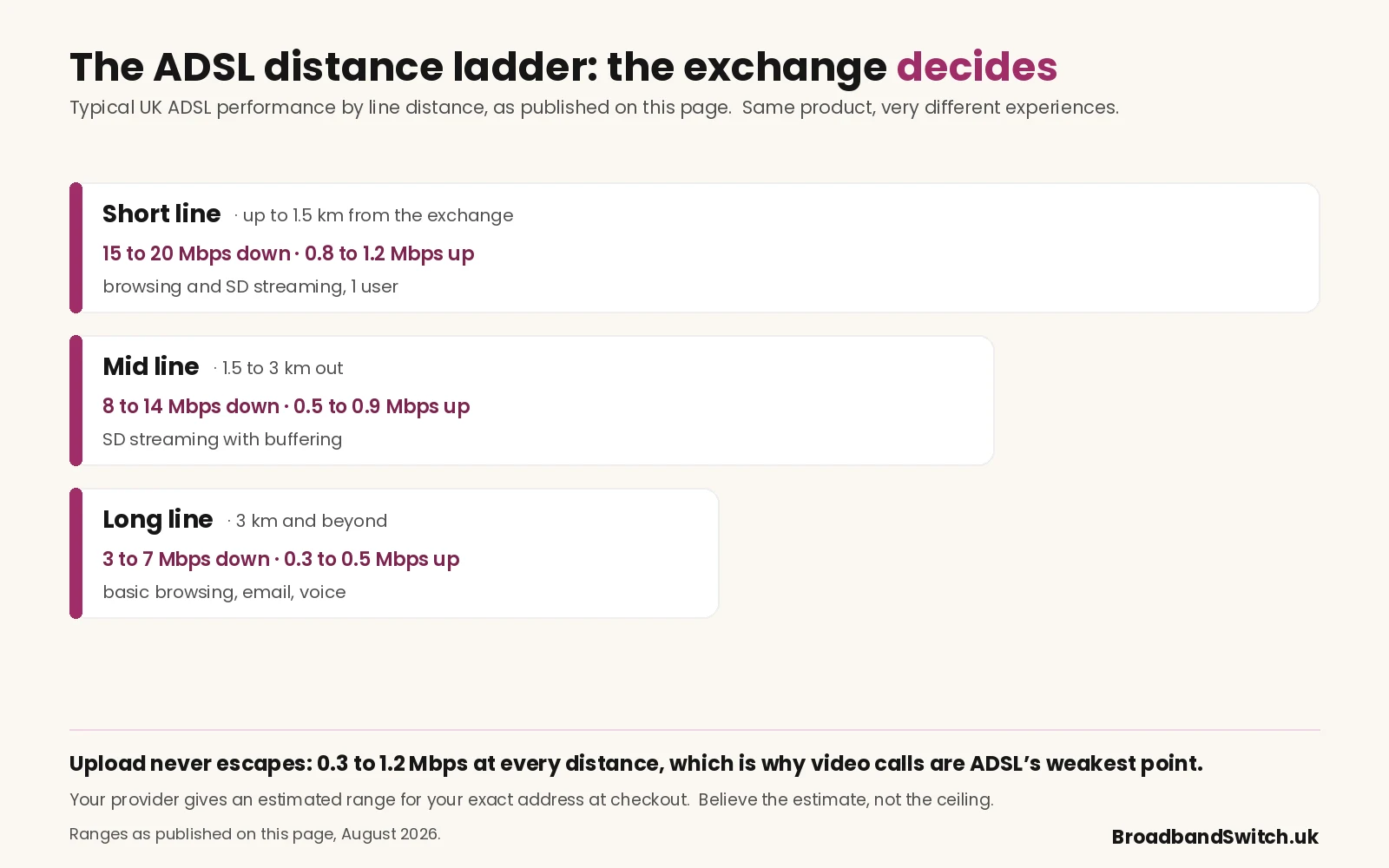
- Short line · up to 1.5 km15 to 20 Mbps down, 0.8 to 1.2 Mbps up: browsing and SD streaming for one user.
- Mid line · 1.5 to 3 km8 to 14 Mbps down, 0.5 to 0.9 Mbps up: browsing and SD streaming with buffering.
- Long line · 3 km and beyond3 to 7 Mbps down, 0.3 to 0.5 Mbps up: basic browsing, email and voice calls.
The same money, four ways
At the budget ADSL occupies, most addresses have meaningfully better options. Check each of these in order at your postcode, because availability, not preference, is what decides.
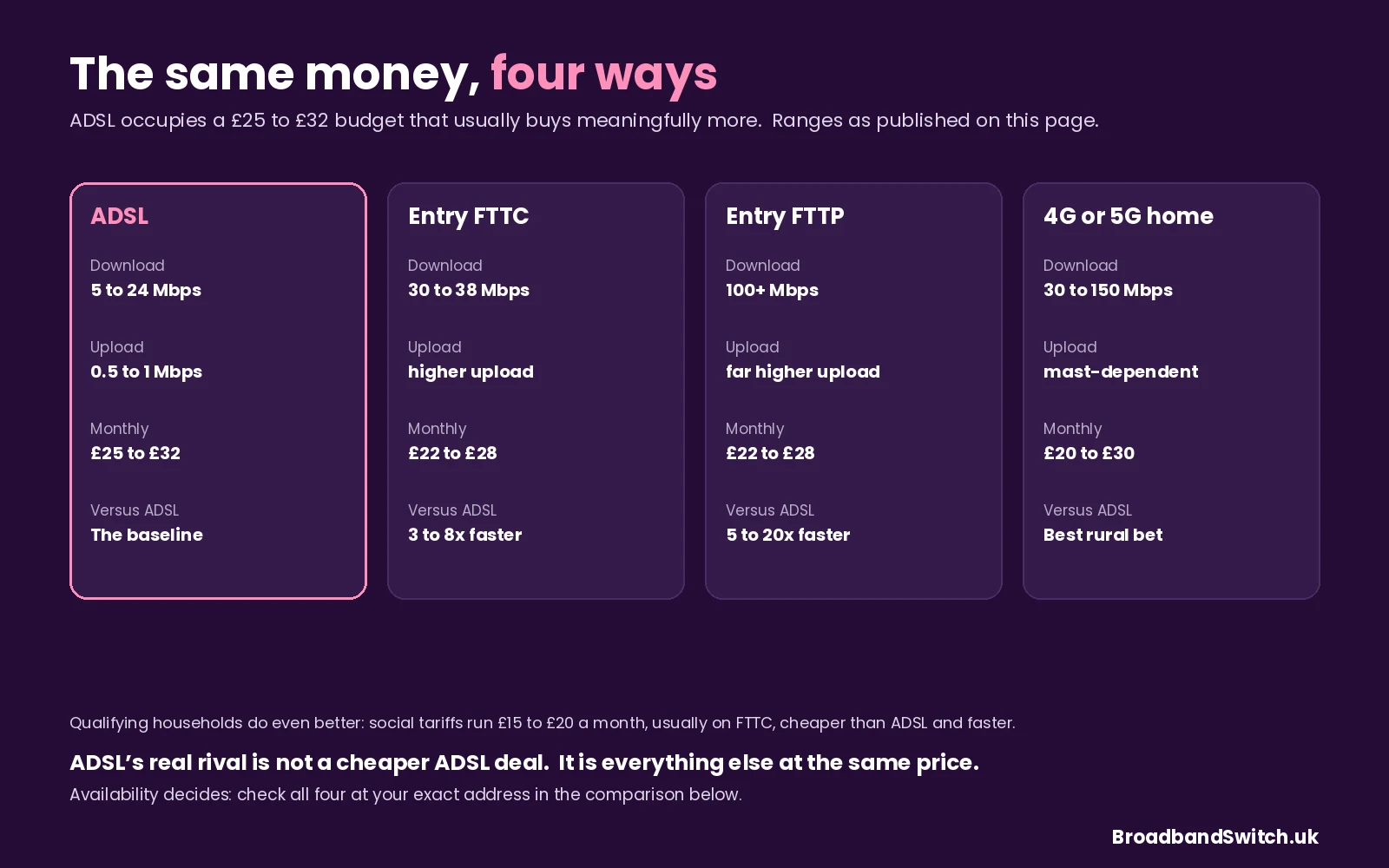
- Entry FTTP · fastest at similar priceFull fibre entry plans from altnets start at £22 to £28 a month for 100+ Mbps, 5 to 20 times faster than ADSL for the same spend. Check availability first: see FTTP deals.The leapfrog
- Entry FTTC · most widely availableEntry tiers typically sit at £22 to £28 for 30 to 38 Mbps, available at most UK addresses and 3 to 8 times faster at similar cost: see FTTC deals.The default upgrade
- 4G or 5G home broadband · best rural betWhere fixed lines are weak, a router often delivers 30 to 150 Mbps for £20 to £30 a month, depending entirely on local mast coverage: see 4G and 5G home broadband.The mast decides
- Social tariff · if budget is the reasonQualifying households start at £15 to £20 a month, usually on FTTC, cheaper than ADSL and faster. Check Ofcom's current list or the social tariffs guide.Cheaper and faster
The UK copper withdrawal, explained
The copper network ADSL runs on is being gradually retired as full fibre rolls out, under two separate programmes worth keeping apart.
- PSTN switch-off · 31 January 2027The old copper voice network ends on 31 January 2027 and home phones move to Digital Voice over broadband. ADSL broadband is technically separate and does not stop on that date, but the wider withdrawal continues around it. The Digital Voice guide covers the phone side, and the copper switch-off guide the timeline.
- Copper broadband retirement · rollingOpenreach withdraws copper broadband in phases as FTTP reaches each area: new ADSL orders stop at exchanges where FTTP is fully deployed, and existing lines are migrated to fibre ahead of final decommissioning, on timeframes that vary by area.
Nothing urgent is needed today, and your provider will contact you before any migration. But if you are on ADSL by choice rather than necessity, plan the next move now rather than after it is forced.
Live ADSL deals at your postcode
Everything below is limited to ADSL packages, copper-badged with each card carrying its average speed figure, 12-month terms, per-deal April rise amounts and support notes, sorted by monthly price. Enter your postcode to narrow to your address, and sense-check against the full comparison where FTTC, FTTP and 4G and 5G appear alongside, because at most addresses one of them wins.
Related ways to compare
ADSL broadband, asked and answered
What does ADSL stand for?
Asymmetric Digital Subscriber Line: the original UK consumer broadband, running on the copper telephone line from your home to the exchange with no fibre involved. The asymmetric part refers to the uneven split between download and upload, typically 10 to 20 times more download than upload, which shapes everything about how the technology feels to use.
What speeds can I expect on ADSL?
It depends on distance from the exchange: a short line under 1.5 km typically delivers 15 to 20 Mbps down, a mid-distance line at 1.5 to 3 km gives 8 to 14, and a long line beyond 3 km can drop to 3 to 7. Upload is consistently slow at 0.5 to 1 Mbps on most lines, and your provider gives an estimated range for your exact address at checkout, which is the number to believe.
Is ADSL usually cheaper than FTTC?
Not meaningfully: ADSL typically costs £25 to £32 a month against entry FTTC at £22 to £28, so FTTC is often the same price or only £2 to £5 more while being 3 to 8 times faster. The "ADSL is the cheap option" assumption is usually wrong in 2026, and comparing both at your exact address takes thirty seconds.
Does ADSL stop working when PSTN is switched off in January 2027?
No: the 31 January 2027 switch-off affects the old copper voice network, and ADSL broadband is technically separate, so it does not stop on that date. The broader copper withdrawal does continue alongside, with Openreach retiring copper broadband as FTTP reaches each area, and your provider will contact you in advance of any migration.
Can I still get new ADSL orders accepted?
In most UK areas, yes, but not everywhere: new ADSL orders have been stopped at exchanges where Openreach has fully deployed FTTP and is preparing to decommission copper. In those areas FTTC or FTTP remain available but fresh ADSL does not, so check your postcode in the comparison for the current position.
When should I still choose ADSL?
Rarely, honestly: it makes sense only after checking FTTC, FTTP, 4G and 5G home broadband and social tariffs at your exact address and finding none of them a better deal. That situation genuinely exists in some rural and hard-to-reach areas but has become uncommon, and the rural broadband guide covers the scenarios in depth.
Will ADSL support video calls?
Often poorly: typical ADSL upload of 0.5 to 1 Mbps sits below the 1.5 to 2 Mbps most platforms recommend for stable HD calls, so one-to-one voice is usually fine while HD video and group calls struggle. If you work from home, this is ADSL's weakest point, and FTTC doubles or triples the upload ceiling at a similar price.
Can I use One Touch Switch to move off ADSL?
Yes: One Touch Switch handles the move from ADSL to FTTC, FTTP or cable in a single step without a service gap, and where the new connection needs an engineer install, it still applies with an install date added. The One Touch Switch guide walks the process.
About this guide. Compiled by Adrian James and reviewed by Dr Alex J. Martin-Smith, with every range and figure stated as published at 6 August 2026, and the five-question router reading its verdicts from this page's own check cards so tool and text cannot drift. ADSL speeds depend on distance from the exchange and copper line condition, so treat the ranges as typical rather than promised. We earn commission when you order through the comparison, which never changes the price you pay: see how we rank deals, the editorial policy, the methodology and trust hub and the affiliate disclosure, or submit a correction and a human will read it.
References
- Ofcom. (2024, July 19). Ofcom bans mid-contract price rises linked to inflation. Office of Communications. https://www.ofcom.org.uk/phones-and-broadband/bills-and-charges/ofcom-bans-mid-contract-price-rises-linked-to-inflation
- Ofcom. (2024, September 12). Simpler and quicker broadband switching is here. Office of Communications. https://www.ofcom.org.uk/phones-and-broadband/switching-provider/simpler-broadband-switching-is-here
- Ofcom. (n.d.). Social tariffs: cheaper broadband and phone packages. Office of Communications. Retrieved August 6, 2026, from https://www.ofcom.org.uk/phones-and-broadband/saving-money/social-tariffs
Run the full postcode comparison and see ADSL alongside FTTC, FTTP and 4G and 5G, price and speed together, in thirty seconds.
Independent and free. Also worth a look: FTTC deals and social tariffs.