Switching broadband for an elderly parent: what the provider will actually let you do
Helping is not the same as taking over, and the providers draw that line in a different place from where families expect. Being named on a parent's account is free and worth doing: it lets you handle the bills and the faults. It does not let you change the contract.
Vodafone publishes a list of what an added person cannot do and the second item is “Sign any contract”. Plusnet publishes it in one sentence: “Authorised users cannot close the account, accept additional charges on your behalf or make any changes to your contract and they will not be liable for your account.” No provider read for this guide publishes a sentence saying an authorised third party may place a new order. Two publish that they may not, and the rest say nothing either way. The rung above is a registered power of attorney, and it is not a bigger version of the same thing: BT publishes “Once we're satisfied that someone's an attorney we'll treat them as the account holder.” And “the donor will no longer be able to manage their account.”
So the practical answer is the good one. You do the finding out, the comparing and the small print, and your parent spends four minutes on the phone saying yes.
Start with your postcode
Start where the work actually is. Check the exact address rather than the postcode, because what reaches it decides which options are real before anybody rings anybody.
Not sure what you are allowed to do? Answer three questions and see all five jobs sorted into what you can do and what only they can. Is there a care alarm in the house? Start there instead, because that call comes before everything.
The short version, before you ring anybody
Direct answer: Helping is not the same as taking over, and the providers draw that line in a different place from where families expect.

Most guides to this subject open with consent and authority. They set out a ladder of four levels, tell you the second rung is the practical one for a family helper, and send you off to arrange it. The version of this page we have just replaced did exactly that.
So we read what eight providers publish about somebody else on the account. The second rung is real, it is free, and it is worth having. It is also narrower than anybody says. It lets you deal with the bill and the faults. It does not let you change the contract, and two providers publish that in their own words.
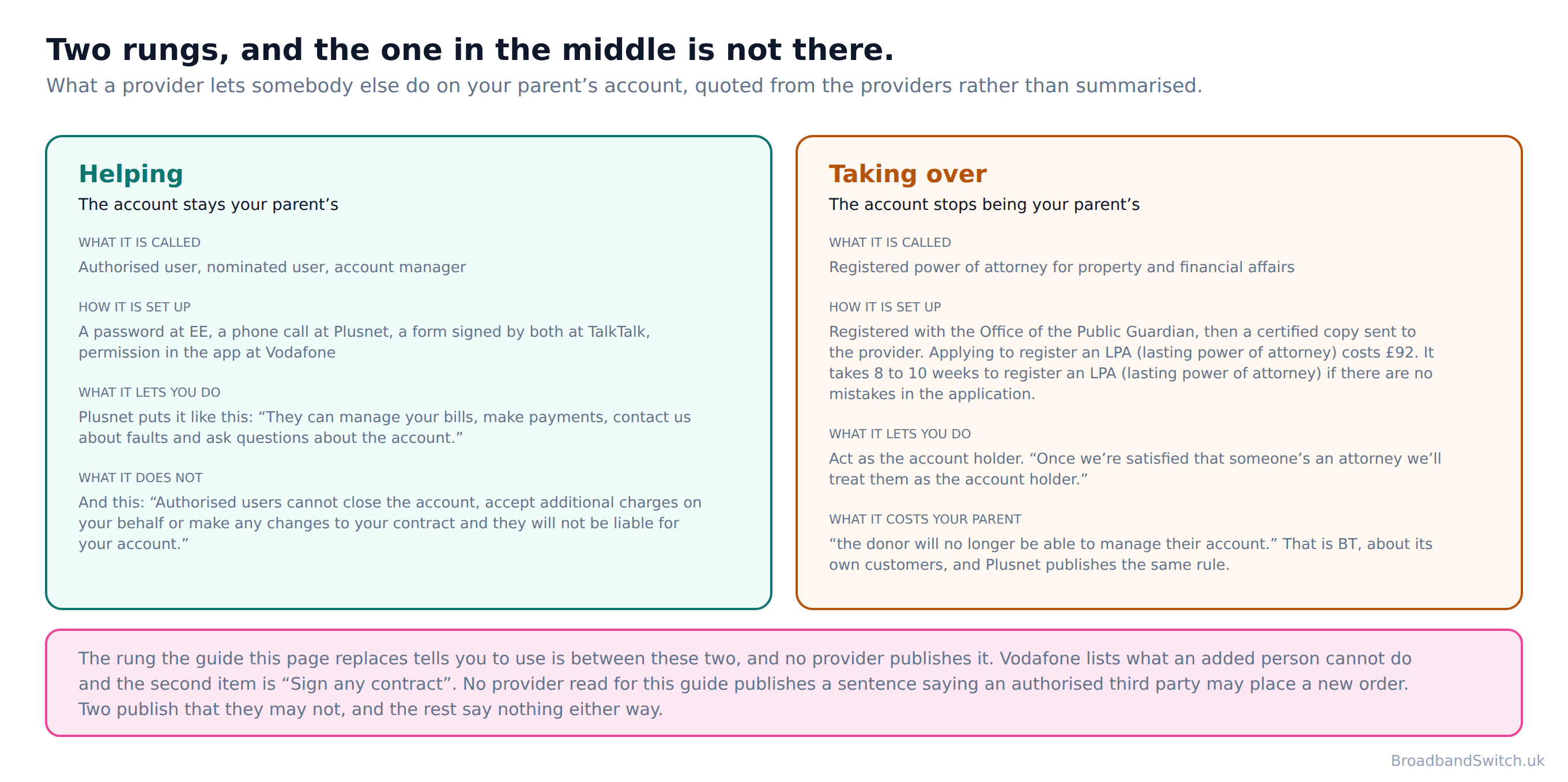
The rung above it is not a bigger version of the same thing. It is a different thing, and BT publishes the difference plainly. Above those two, where the account itself moves into somebody else’s name, is a job this page hands straight to our guide to changing the account holder.
Everything else a family asks about belongs to a neighbour and is handed to it by name. The landline switch-off is in our digital voice guide. Cheap tariffs for a household on Pension Credit are in our social tariffs guide. Broadband for an older household generally is in our pensioners guide, and what happens if the phone line goes altogether is in our guide to switching without a landline.
What is left, and what nothing else on this site covers, is the question a family helper actually has on the day: what will they let me do? That is this page.
What being named on the account gets you
Direct answer: “They can manage your bills, make payments, contact us about faults and ask questions about the account.”
That is Plusnet, describing what an authorised user on one of its accounts may do, and it is the clearest published scope of the eight we read. TalkTalk’s nominated user is scoped the same way: “Appointing a Nominated User enables someone to discuss various aspects of your account including balance enquires and call charges.” It adds “They can also make payments on your behalf.” NOW puts the whole arrangement in five words that say it better than any guide manages: “It'll still be your account, but your nominee can speak to us on your behalf and sort out things like bills.”
All of which is genuinely useful. A parent who finds half hour calls tiring, or who would rather somebody else chased a fault, gets exactly that, free, from one phone call. It is worth doing whether or not anybody is switching anything.
And then the sentence nobody quotes
Plusnet publishes the limit in the same breath: “Authorised users cannot close the account, accept additional charges on your behalf or make any changes to your contract and they will not be liable for your account.” Vodafone publishes a list of the things an added person cannot do, and the second item on it is “Sign any contract”. The same list carries “Upgrade a plan” and “Request a PAC”, which between them are the package change and the switch away. Vodafone then caps the whole arrangement: “When you add a person to your account, you won't be able to give them full permission.”
Vodafone writes that list in mobile language, and this page says so rather than presenting it as broadband-specific. Sign any contract is not a mobile term.
EE draws the line in a third place again. It describes its authorised user as having near full access and then names what is outside it: “They'll have near full access to your account, but for certain actions like changing ownership, closing the account or setting up a payment plan, they'll need a power of attorney.” Ordering is not on that list in either direction, which is the pattern across the whole market: “No provider read for this guide publishes a sentence saying an authorised third party may place a new order. Two publish that they may not, and the rest say nothing either way.”
Why the scope stops where it does
It is worth understanding rather than resenting, because once you see it the rest of the page stops feeling like an obstacle course. A contract is a promise to pay, and the person who makes that promise has to be the person who will be billed for it. Everything inside the published scope is about an agreement that already exists: what it costs this month, why the line is down, when the engineer is coming. Everything outside it creates a new agreement, or ends one, and that is the account holder’s to do.
Which is also why the scope is so consistent across companies that agree about almost nothing else. Plusnet, TalkTalk, EE, Vodafone and NOW describe the arrangement in five different vocabularies, set it up five different ways, and land in the same place: bills yes, faults yes, contract no. Where they differ is in how much of that they bother to write down, and the two that write it down plainly are the two this page quotes most.
There is one practical consequence worth planning for. A named person can usually do everything needed to keep a household running day to day, which means a family can go years without discovering the limit. It surfaces at the worst moment, which is the month somebody decides the bill is too high and rings up to change it. Finding out then costs an afternoon; finding out now costs nothing.
The one that writes down what happens without any of this
Virgin Media is the only one of the eight that publishes what happens when a relative rings with no authority at all: “If you want to make a change or access information on the account holder's behalf, we will need the account holder to authorise this so we can speak to you on the call.” And what to do about it: “If they can't do this, or you've talked to us without them, we recommend becoming a named appointee on the account.” That is the honest shape of it. Your parent authorising you on the call works once, on that call. Being named works every time.
The call that comes before everything
Direct answer: “Ofcom has today fined Virgin Media £23.8 million, after it disconnected telecare customers during its programme to migrate customers to digital landlines.”

That is Ofcom, on 1 December 2025. It is on this page, before the authority question and before anything about comparing, for two reasons.
The first is that it is the only thing on this page that can matter to somebody’s safety rather than to their bill. A care alarm, a pendant or a monitored burglar or fire alarm that works through the phone line stops working when the line changes, and it does not announce itself when it stops.
The second is the useful one, and no guide we read says it: of everything on this page, this is the only thing you can do today without anybody adding you to anything. The alarm is almost never supplied by the broadband provider. It belongs to whoever installed it, which in most households means the local authority or a telecare service, and that is a third organisation with no reason to know a broadband switch is coming.
Ask two questions. Does this device work without a phone line, and if it does not, what does it need instead and how long does that take. Then tell the broadband provider there is a telecare device in the house, because it changes what support is offered and it is worth having on the record.
What you can actually do
Direct answer: Three questions. Five jobs at stake, sorted into what you can do and what only the account holder can, with the rule behind each one quoted.
It sorts by who is asking rather than by what they want, because on this subject that is the thing that decides every answer. Four people can want the identical job done and get four different answers, and none of them is about how much anybody trusts anybody.
Where a provider publishes nothing, the checker says so rather than guessing. Guessing here is how a family ends up registering a power of attorney it did not need.
It runs entirely in your browser. There is no form to submit, nothing sent to any server and nothing stored: what you answer here is used on this page and gone when you close the tab. That matters more than usual, because the questions are about somebody else’s household. Every rule it quotes carries the date it was read, which is 30 September 2026 throughout.
Three questions, and five jobs sorted into what you can do and what only they can
The answers come from what each company publishes about somebody else on the account, quoted rather than summarised. Where nothing is published it says so. Nothing you answer here leaves your browser.
The order to do this in
Direct answer: Four of these are yours to do. The fifth one is your parent’s, and that is the whole point.
The sequence costs nothing and it puts the only irreversible thing first. It is also the opposite of how the subject is usually written, which starts with authority and ends with the care alarm.
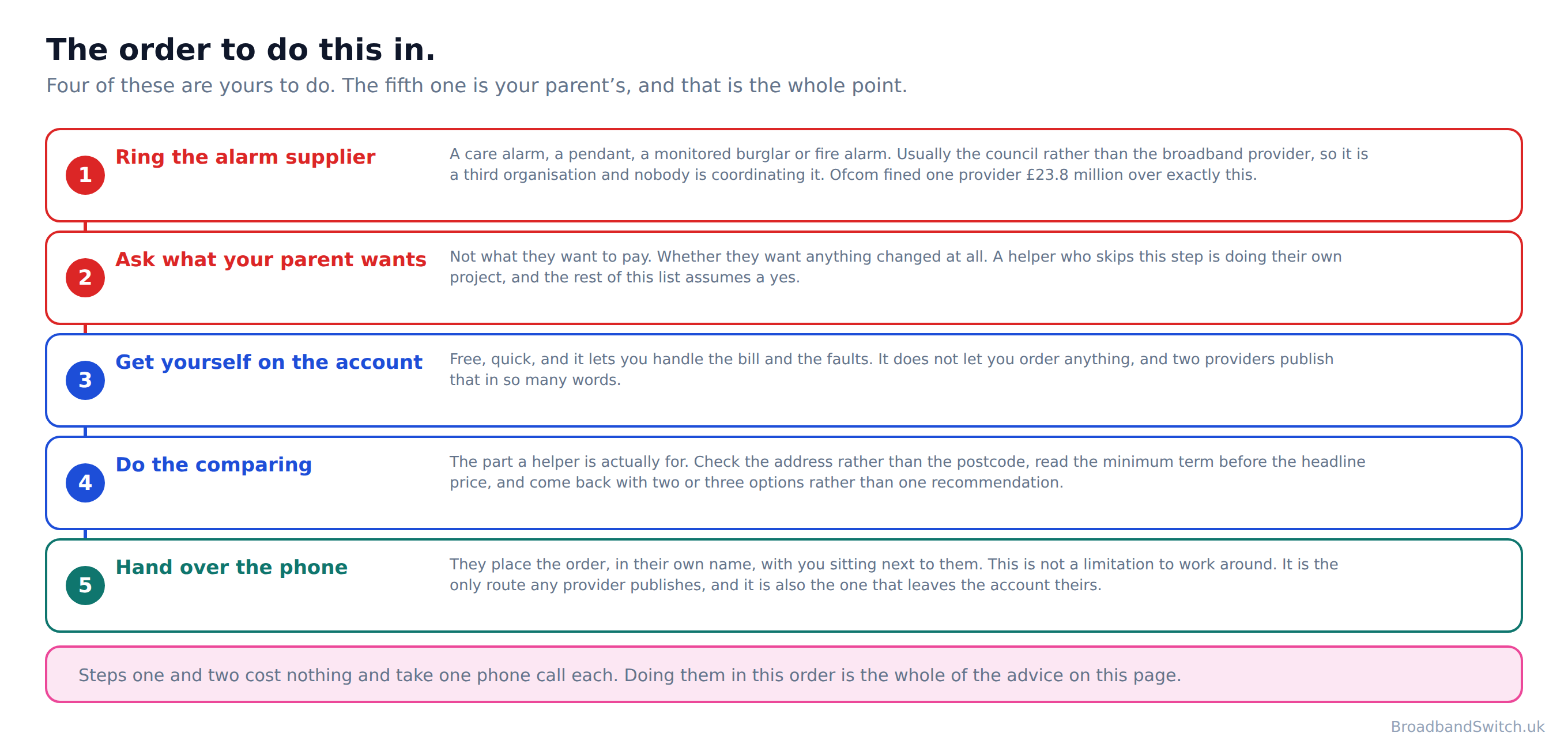
Step five is the one people expect to be a problem and it is not. Your parent spends about four minutes on the phone with you sitting next to them, answering the security questions and confirming the order. You can be on speaker. You can read the details off the screen. What you cannot do is be the person who says yes, and nothing on this page changes that.
Why that split is the good outcome
The work in a broadband switch is not the ordering. It is the checking of what reaches the address, the reading of the minimum term under the headline price, the working out of whether a social tariff beats the open market, and the finding out of what is plugged into the phone line. All of that is yours, and none of it needs anybody’s permission. The part that is theirs takes four minutes and leaves the account, the contract and the decision where they belong.
What to bring back from the comparing
Three things per option, written down, and nothing else: the monthly price for the whole minimum term rather than the first year, what happens to the phone service, and whether anything in the house depends on the line. A shortlist of two or three is easier to decide between than a single recommendation, and it leaves the decision genuinely open, which is the point. If a benefit is in payment it is worth checking a social tariff before anything else, because those tariffs usually beat the open market and they are not on comparison sites.
Resist the urge to tidy everything up at once. A switch that keeps the same router position, the same network name and the same password is a much smaller event than one that changes all three while the broadband provider is changing too. The things older households actually notice are the ones that were working yesterday and are not working today, and every one of those you avoid is worth more than the pound a month you might save by moving the router somewhere better.
The step families forget
Being named on the account does not move with them. There is no regulatory vulnerable customer register. Each provider runs its own additional support scheme and none of them travels with you when you switch. So the last step of a switch is the same as the first step of the next one: ring the new provider and set it up again. It is a small chore and it is easy to lose in the week everything else is changing.
What each provider publishes
Direct answer: The setup differs at every provider. The limit does not.
Eight companies were read for this section, on their own sites, on 30 September 2026. What follows is what each one publishes, in its own words, with the gaps left as gaps.

The setups are worth knowing because they decide how long this takes. EE publishes the lightest: “All you have to do is set a password and give it to them and they'll be able to help you with most things.” Your parent sets the password and gives it to you, which is a nice arrangement because the thing that grants the access is also the thing they can change.
Plusnet takes a phone call and publishes a number: “You can nominate up to two people to manage your account.” TalkTalk is the slowest and, for what it is worth, the hardest to do behind somebody’s back: “Once you receive the form, fill in your details and have your Nominated User complete their section.” Vodafone does it through permissions in the app. Virgin Media is the outlier here and publishes the appointee route rather than a lighter one.
The door BT publishes, and why it is on this page
BT is the outlier and it is worth reading carefully. Alongside the attorney route it publishes an Account manager role, described as “You have access to someone else's BT account and to some of the BT services they pay for.” To become one on somebody else’s account, BT publishes that “You need an email address and the BT account number of the account you want to manage”, and that “Once you're set up, the Account holder will see you as an Account manager on their accounts screen”
That is published by BT as a convenience, and it is one: it is why setting this up for a parent takes two minutes rather than a fortnight. It is here for the other reason as well. The account holder finds out afterwards rather than approving it beforehand, so the accounts screen is worth a look if anybody in a family is uneasy about who already has access. Look at it with your parent rather than for them.
What the differences actually cost you
The practical effect of seven different arrangements is that nothing you learn at one provider transfers to the next. A family who set this up at EE with a password will find TalkTalk wants a form signed by both of them and 28 days to process it. A family used to Plusnet’s phone call will find Virgin Media has no standing arrangement at this level at all and points them at the appointee route instead. None of that is unreasonable on its own. It just means the question has to be asked again every time, and it is a question worth asking before a switch rather than after.
It also means there is no such thing as a general answer to what a named person can do, and any guide that gives you one is describing a market that does not exist. What there is, is eight published positions, two of which are clear, one of which is about what happens when you have not set anything up, four of which describe a scope without naming a limit, and one of which cannot be read. That is the honest map, and it is the map this page draws.
One provider we quote nothing from
This page quotes nothing from Sky. Its third party assistance page publishes headings for appointees, power of attorney and deputies and renders the text under them after the page arrives, so the headings are all that can be read. That is different from Sky publishing nothing, and a table that turned the two into the same tick or the same cross would be inventing information. It is the third page in this programme where Sky’s help section has done this.
What a power of attorney does to your parent
Direct answer: “Once we're satisfied that someone's an attorney we'll treat them as the account holder.”
Read the next sentence on the same BT page before you decide that solves anything: “the donor will no longer be able to manage their account.” And then the one after it, which is addressed to your parent rather than to you: “please make sure you're ready to hand over control of your BT account to your attorney”
A provider warning a customer about the customer’s own attorney is unusual enough to be worth quoting. Plusnet publishes the same rule in one sentence: “If you have a PoA we'll treat them as the account holder, which means you'll no longer be able to manage your account.”
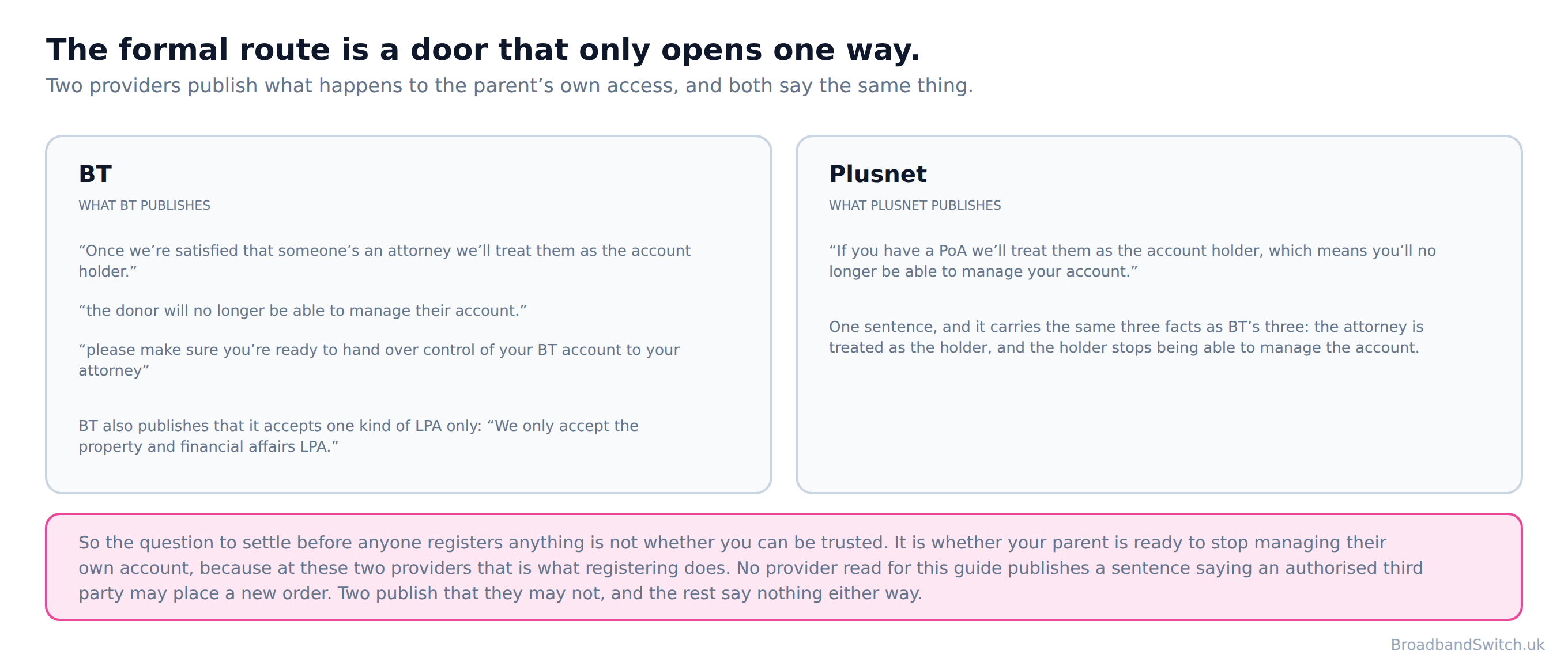
TalkTalk frames it the other way round, as somebody who is not the named holder but can make decisions on their behalf: “As Power of Attorney or Deputy, you won't be liable for any charges on your account, because you're not the named account holder, but you will be able to make decisions on behalf of the account holder.” Three providers, two answers, which is why this page quotes each one rather than generalising.
None of that is a reason not to register one. Where capacity has genuinely gone it is the right arrangement and the alternative is worse. It is a reason to do it deliberately, with your parent, as a decision about who manages their affairs, rather than as a way round an ordering rule. And there is one practical trap: BT publishes “We only accept the property and financial affairs LPA.” So a family that set up a health and welfare LPA and stopped there has the wrong one for this.
What the formal route costs
Direct answer: “Applying to register an LPA (lasting power of attorney) costs £92.”

One of the two was wrong in a way worth naming rather than merely correcting: the fee rose from £82 on 17 November 2025, so the figure the old page carried was ten months stale rather than roughly right.
The timescale matters more than the fee for a family planning anything: “It takes 8 to 10 weeks to register an LPA (lasting power of attorney) if there are no mistakes in the application.” The page we replaced omitted it entirely. The fee reduction is assessed on your parent rather than on you, which catches people out the other way round: “If the donor's income before tax is less than £12,000 a year, you'll only have to pay half”
Deputyship is the route that exists because the other one was not set up in time, and it is dearer in every direction. gov.uk publishes “You must pay a £432 application fee.” And separately: “You'll also need to pay a £100 assessment fee if you're a new deputy.” Then every year after that, “£320 for general supervision”, with a lower rate for some smaller property and affairs deputyships.
gov.uk publishes no processing time for a deputyship application on any page we could find, so this page gives none. The guide we replaced gave six to nine months and attributed it to nobody.

What the Ofcom fine was about
Direct answer: “Virgin Media's approach to disconnecting Telecare customers who did not engage in the migration process, despite being aware of the risks posed, put thousands of vulnerable customers at a direct risk of harm and prevented their devices from connecting to alarm monitoring centres while the disconnection was in place.”
The guide we replaced cited this penalty five times and described it, each time, as being about vulnerable customer migration handling. That is true in the way that a hospital being fined over patient safety is about administration. Ofcom’s own first sentence says what it was: “Ofcom has today fined Virgin Media £23.8 million, after it disconnected telecare customers during its programme to migrate customers to digital landlines.”
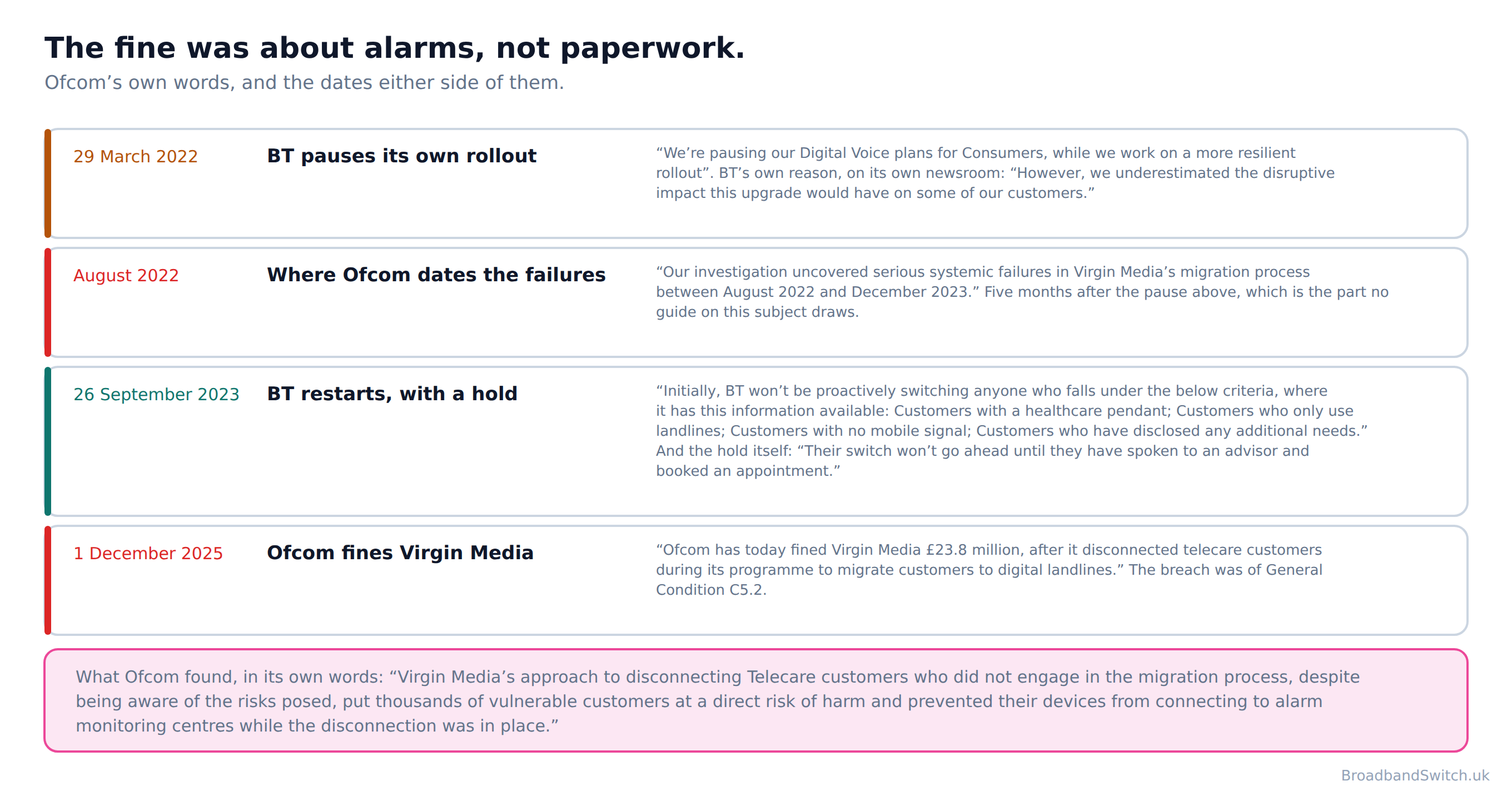
The breach was of General Condition C5.2, and the dates are the part worth sitting with: “Our investigation uncovered serious systemic failures in Virgin Media's migration process between August 2022 and December 2023.”
BT had already paused its own rollout five months before that period opens. On 29 March 2022 it published “We're pausing our Digital Voice plans for Consumers, while we work on a more resilient rollout”, and gave its own reason: “However, we underestimated the disruptive impact this upgrade would have on some of our customers.” When it restarted in 2023 it published a hold rather than a promise: “Initially, BT won't be proactively switching anyone who falls under the below criteria, where it has this information available: Customers with a healthcare pendant; Customers who only use landlines; Customers with no mobile signal; Customers who have disclosed any additional needs.” And the hold itself: “Their switch won't go ahead until they have spoken to an advisor and booked an appointment.”
So the industry knew. That is not an argument for panic, and the protections at BT are real and published. It is an argument for the first section of this page: ring whoever supplies the alarm yourself, before anything changes, rather than assuming the two companies are talking to each other.
The register that is not a register
Direct answer: “Regulated Providers must establish, publish and comply with clear and effective policies and procedures for the fair and appropriate treatment of Consumers whose circumstances may make them vulnerable.”
That is General Condition C5.2 in full, as Ofcom itself quotes it. It is a duty to have a policy, to publish it and to follow it. It is not a duty to keep a register, and nothing in it is conditional on a customer signing up to anything.
The guide we replaced said the opposite, twice: that the General Conditions include a duty to maintain a vulnerable customer register, and that the protections only operate once a customer is registered. A family helper who believed that would conclude their parent was unprotected until they had made a phone call, which is not what the rule says.
There is no regulatory vulnerable customer register. Each provider runs its own additional support scheme and none of them travels with you when you switch. So asking is still worth doing, and this page still says so, for a better reason than the one it used to give: it puts the circumstances on the account where an adviser can see them, and it is how you get told about things like a battery backup unit. It is just not the switch that turns the regulator’s protections on.
It also does not travel. Whatever you set up with the old provider stops at the old provider, which is one more thing for the list of what to redo on the other side of a switch.
What asking does get you
The most concrete thing published by any provider in this area is BT’s hold, and it is worth reading as a description of what telling a provider about your parent’s circumstances actually buys: “Initially, BT won't be proactively switching anyone who falls under the below criteria, where it has this information available: Customers with a healthcare pendant; Customers who only use landlines; Customers with no mobile signal; Customers who have disclosed any additional needs.” And then the hold itself: “Their switch won't go ahead until they have spoken to an advisor and booked an appointment.”
Read those two sentences carefully, because the first one carries a condition that is easy to miss. BT holds the switch for customers in those four categories where it has the information available. Nobody has the information unless somebody gives it to them. So the reason to ring is not that it turns on a regulatory protection, which it does not, and not that it puts your parent on a register, which does not exist. It is that it is the only way a company finds out there is a healthcare pendant in the house.
The same call is how a household gets told about a battery backup unit for a digital phone line, and how an adviser knows to slow down rather than read a script. All of that is worth five minutes. It is just not the mechanism the guide we replaced described.
One more thing about it is worth saying, because families hesitate over it. Asking a company to note that your parent is in their eighties, or lives alone, or has a device on the line, is not overstating anything and it is not asking for charity. Ofcom’s own wording is about circumstances that may make somebody vulnerable, which is a description of a situation rather than a judgement about a person, and almost every household in this position fits it on at least one count. The people who lose out are the ones who never mention it.
The questions that get useful answers
Direct answer: Narrow questions get answers you can rely on. Broad ones get reassurance.
Ask the provider your parent is with, with your parent on the call, and ask in a chat window or by email where you can, because the answer is the thing you may need to point at later.
What exactly can a named person on this account do, and what can they not? Two of the eight publish it; the other six will tell you on the phone, and what they tell you is worth writing down.
Does being named here carry over if we move to another provider? The answer is no everywhere we looked, and asking makes sure nobody is surprised by it later.
We have a telecare device in the house. What does that change about how you handle this account? This one changes who you are talking to, which is the point of asking it early rather than on the day.
And, if it applies: I have a registered power of attorney. Can I place an order on this account? Nobody publishes an answer to that, so the answer you get is worth keeping.
The question to avoid
Can I take over my mother’s account? It sounds like the efficient version of all of the above and it is a different question entirely, because taking the account over means the contract stops being hers. Ask it and you may well be routed to a process that does exactly that, which is fine if it is what the family decided and unfortunate if it is not. Ask the narrow questions instead and the answers land where you can use them.
It is also worth being straight about who is on the call. Every provider we read handles a relative differently depending on whether the account holder is in the room, and the difference is not a formality: it is the only thing standing between a polite conversation and somebody being given access to an account they should not have. Saying “my mother is here and can confirm” gets a call moving faster than any amount of explaining does.
Free routes that are actually free
Age UK: “We offer support through our free advice line on 0800 678 1602.” “Lines are open 8am-7pm, 365 days a year.” Citizens Advice runs an Adviceline on “Adviceline (England): 0800 144 8848”. Carers UK is on “0808 808 7777” and Independent Age on “0800 319 6789”. And Age UK’s own round-the-clock line: “Age UK's The Silver Line Helpline is a free, confidential telephone service that offers friendship, conversation and support to older people”. The guide we replaced listed The Silver Line as a fifth separate organisation alongside Age UK, which counts the same charity twice.
What we could not find out
Direct answer: Four questions a family would reasonably ask that nobody publishes an answer to.
Most guides on this subject fill gaps like these with a confident sentence about somebody else’s unpublished policy. Publishing the gaps instead is less satisfying and it is the version that is still true next quarter.
Whether an attorney can place a new order
Three providers publish that an attorney is treated as the account holder. Not one of them converts that into a sentence about placing an order, and BT’s attorney page contains no sentence about ordering or contract changes at all. Vodafone publishes its exclusion list for added people and is silent on whether an attorney sits outside it. So this page does not tell you it works and does not tell you it does not. Ask, in writing, and keep the answer.
What Sky lets a third party do
This page quotes nothing from Sky. Its third party assistance page publishes headings for appointees, power of attorney and deputies and renders the text under them after the page arrives, so the headings are all that can be read. Sky is the only one of the eight publishing a section specifically on general powers of attorney, judging by the heading, which makes it the most frustrating of the eight to be unable to read.
A statistic we went looking for and could not find
This page carries no figure for how many older households rely on a landline. The live version attributed one to Ofcom and two separate passes over Ofcom's site could not find it. The figure the live page gave was precise, quotable and attributed to a named regulator, which is the most dangerous kind of wrong claim because it is the one other people repeat.
What each BT Home Essentials tier costs, from BT
BT’s own page publishes “Home Essentials Fibre broadband plans start from £16.50 with no set-up fees.” It gives no per-tier prices at all. The tier figures on this page are Ofcom’s, from its own social tariff table, and they are labelled as Ofcom’s wherever they appear.
Broadband at their postcode
Direct answer: Check the exact address rather than the postcode, and check it before anybody rings anybody.
This is the part of the job that is entirely yours and needs nobody’s permission. Two or three options with the monthly price, the minimum term and what happens to the phone written next to each, and then a four minute phone call that your parent makes.

Every provider that reaches their address
One postcode shows every provider that reaches the address, lowest price first. Two or three of them, written down, is all your parent needs to choose from.
Show every provider at their postcode →What this page used to say, and why it changed
Direct answer: Five corrections. Four are factual and the fifth is the reason the page was rebuilt rather than edited.
Two of the four were already published as corrections on this site's rural guide three weeks ago, which is the uncomfortable part: the same two errors were live on two pages at once. Publishing them here rather than quietly editing is the only way somebody who acted on the old version can tell whether they acted on something wrong.
Pointing families at a rung that does not exist
What this page said
The page set out four authority levels and described the second, third-party authority on the account, as the step up that lets a family helper handle the switch: “Account holder calls the retailer, asks for third-party authority to be added, names you, and confirms the scope. Major UK retailers all support this.”
What it says now, and why
Eight providers were read on their own sites for this rebuild and not one publishes a sentence saying an authorised third party may place an order. Two publish the opposite. Vodafone lists what an added person cannot do and item two is “Sign any contract”. Plusnet publishes “Authorised users cannot close the account, accept additional charges on your behalf or make any changes to your contract and they will not be liable for your account.” No provider read for this guide publishes a sentence saying an authorised third party may place a new order. Two publish that they may not, and the rest say nothing either way. The page now says so, and says what to do instead.
Getting both formal fees wrong
What this page said
The page gave registering a lasting power of attorney as “£82 to register” and a deputyship application as “£371 application fee”, and said deputyship “typically takes 6 to 9 months to process”.
What it says now, and why
gov.uk publishes “Applying to register an LPA (lasting power of attorney) costs £92.” The fee rose from £82 on 17 November 2025, so the old figure was ten months out of date rather than merely approximate. For deputyship, gov.uk publishes “You must pay a £432 application fee.” And separately: “You'll also need to pay a £100 assessment fee if you're a new deputy.” The page carried neither. gov.uk publishes no processing time for a deputyship application at all, so this page gives none. It does now carry the one timescale gov.uk does publish, which is the one a family planning a switch actually needs: “It takes 8 to 10 weeks to register an LPA (lasting power of attorney) if there are no mistakes in the application.”
A statistic attributed to Ofcom that we could not find
What this page said
The page stated: “In a 2025 Ofcom communications usage report, around 70% of UK households aged 75 plus reported the home phone as their primary or only phone, compared with under 20% for households under 55.”
What it says now, and why
Two separate passes over Ofcom’s site found nothing of that shape: not in the landline research index, not in the consumer landline pages, not in the 2025 Technology Tracker outputs, not in Barriers to Household Connectivity. A precise, quotable figure attributed to a named regulator is the most dangerous kind of wrong claim, because it is the one other people repeat. This page carries no figure for how many older households rely on a landline. The live version attributed one to Ofcom and two separate passes over Ofcom's site could not find it.
Inventing a regulatory duty
What this page said
The page said Ofcom’s General Conditions include “a duty to maintain a vulnerable customer register” and that the protections “only operate if the customer is registered as vulnerable with the retailer”.
What it says now, and why
General Condition C5.2 requires providers to “Regulated Providers must establish, publish and comply with clear and effective policies and procedures for the fair and appropriate treatment of Consumers whose circumstances may make them vulnerable.” That is a duty to have a policy and it is not conditional on a customer signing up to anything. There is no regulatory vulnerable customer register. Each provider runs its own additional support scheme and none of them travels with you when you switch. Asking for a provider’s additional support arrangements is still worth doing, and the page still says so. What it no longer does is tell a reader that the regulator’s protections switch on when they register.
Dating BT's pause to the wrong year
What this page said
The page said “In April 2023 BT paused the rollout pending a comprehensive review of the vulnerable customer protections” and that it resumed in 2024.
What it says now, and why
BT published the pause on 29 March 2022, a year earlier: “We're pausing our Digital Voice plans for Consumers, while we work on a more resilient rollout”. Its own stated reason was resilience and disruption: “However, we underestimated the disruptive impact this upgrade would have on some of our customers.” BT restarted in 2023, not 2024, and published the protections as a hold rather than a promise: “Initially, BT won't be proactively switching anyone who falls under the below criteria, where it has this information available: Customers with a healthcare pendant; Customers who only use landlines; Customers with no mobile signal; Customers who have disclosed any additional needs.” The dates matter here more than they usually would, because the corrected ones put BT’s pause five months BEFORE the period Ofcom dates Virgin Media’s failures to.
Calling the switch-off a national deadline, and naming schemes that do not exist
What this page said
The page called 31 January 2027 “the UK PSTN switch-off” throughout, and listed provider schemes by name: “BT Consumer-First (formerly Here-To-Help)”, “Sky Accessibility programme”, “Virgin Media Accessibility services”, “EE Accessibility”. It also gave social tariffs as “typically £12.50 to £20”.
What it says now, and why
It is BT’s date for BT’s network. Ofcom attributes it to BT wherever it appears: “BT plans to retire its old landline network by 31 January 2027.” On the scheme names, this rebuild quotes what each provider publishes and calls each thing what that provider calls it, which is why no scheme name on this page is one we have supplied. And the social tariff range did not reach the top of the BT tariff it named: Ofcom’s own table puts BT Home Essentials Unlimited 67 Mbp/s at £25/month, while BT’s own page publishes only “Home Essentials Fibre broadband plans start from £16.50 with no set-up fees.”
Broadband without a landline: frequently asked questions
Can I switch my parent's broadband for them?
Not in your own right, and nothing any of the eight publishes says otherwise. You can do everything up to the order: compare at their exact address, read the minimum term, check what is on the phone line, and come back with two or three options. Then they place the order, with you sitting next to them. “No provider read for this guide publishes a sentence saying an authorised third party may place a new order. Two publish that they may not, and the rest say nothing either way.” Two of the eight publish the opposite in their own words: Vodafone lists “Sign any contract” among the things an added person cannot do, and Plusnet publishes “Authorised users cannot close the account, accept additional charges on your behalf or make any changes to your contract and they will not be liable for your account.”
What does being named on the account actually let me do?
Bills, payments, faults and questions. Plusnet's wording is the clearest of the eight: “They can manage your bills, make payments, contact us about faults and ask questions about the account.” TalkTalk scopes its nominated user to “Appointing a Nominated User enables someone to discuss various aspects of your account including balance enquires and call charges.” It adds “They can also make payments on your behalf.” NOW puts the whole thing in five words that say it better than any guide manages: “It'll still be your account, but your nominee can speak to us on your behalf and sort out things like bills.” It is free, it takes one call at most providers, and it is worth doing whether or not a switch is on the cards.
How do I get named on my parent's account?
It differs at every provider and your parent has to be the one to do it. EE publishes the lightest version: “All you have to do is set a password and give it to them and they'll be able to help you with most things.” Plusnet takes a call and allows “You can nominate up to two people to manage your account.” TalkTalk sends a form: “Once you receive the form, fill in your details and have your Nominated User complete their section.” Vodafone does it through permissions in the app, capped: “When you add a person to your account, you won't be able to give them full permission.” Virgin Media publishes what happens if you skip it altogether: “If you want to make a change or access information on the account holder's behalf, we will need the account holder to authorise this so we can speak to you on the call.”
Does being named on the account move with them if they switch?
No. There is no regulatory vulnerable customer register. Each provider runs its own additional support scheme and none of them travels with you when you switch. Whatever you set up with the old provider stops at the old provider, and so does any additional-support arrangement. So the last step of a switch is the same as the first step of the last one: ring the new provider and set it up again. It is a small chore and it is easy to forget in the week everything else is changing.
Do I need a power of attorney to help with broadband?
Almost certainly not, and it is worth knowing what one does before you start. BT and Plusnet both publish that a registered attorney replaces the account holder rather than joining them. BT: “Once we're satisfied that someone's an attorney we'll treat them as the account holder.” And the consequence: “the donor will no longer be able to manage their account.” BT says it to the parent directly: “please make sure you're ready to hand over control of your BT account to your attorney”. Plusnet publishes the same rule: “If you have a PoA we'll treat them as the account holder, which means you'll no longer be able to manage your account.” That is the right arrangement where capacity has genuinely gone. It is a heavy way to buy a cheaper broadband deal.
Can an attorney order new broadband in my parent's name?
Nobody publishes an answer, and this page is not going to invent one. Three providers publish that an attorney is treated as the account holder; not one of them turns that into a sentence about placing an order. BT's attorney page contains no sentence about ordering or contract changes at all. So the honest position is: it probably works, nobody has written it down, and if you are going to rely on it, ask in writing and keep the answer.
What is the one thing I should do first?
Ring whoever supplies any care alarm, pendant or monitored alarm in the house, before anything about the broadband changes. It is usually the council or a telecare service rather than the broadband provider, which means a third organisation and nobody coordinating the three of you. It is also the only job on this page that needs no authority over the broadband account at all, which makes it the one thing a helper can always do. Ofcom fined one provider £23.8 million over exactly this.
What was the Ofcom fine actually about?
Disconnected alarms. “Ofcom has today fined Virgin Media £23.8 million, after it disconnected telecare customers during its programme to migrate customers to digital landlines.” Ofcom's own second finding is the one worth reading twice: “Virgin Media's approach to disconnecting Telecare customers who did not engage in the migration process, despite being aware of the risks posed, put thousands of vulnerable customers at a direct risk of harm and prevented their devices from connecting to alarm monitoring centres while the disconnection was in place.” The breach was of General Condition C5.2 and Ofcom dates the failures to “Our investigation uncovered serious systemic failures in Virgin Media's migration process between August 2022 and December 2023.” That start date is five months after BT had already paused its own rollout over the same class of risk.
Should I register my parent as a vulnerable customer?
Ask for the provider's additional support arrangements by name, yes. But know what you are asking for. There is no regulatory vulnerable customer register. Each provider runs its own additional support scheme and none of them travels with you when you switch. Ofcom's General Condition C5.2 requires providers to “Regulated Providers must establish, publish and comply with clear and effective policies and procedures for the fair and appropriate treatment of Consumers whose circumstances may make them vulnerable.” That is a duty to have a policy, and it is not conditional on your parent signing up to anything. Asking still helps, because it puts the circumstances on the account where an adviser can see them. It is just not the switch that turns the protections on.
My parent is happy for me to deal with everything. Is that enough?
For bills and faults, once you are named on the account, yes. For the order itself, no, and their being happy about it does not change what the provider will accept. Virgin Media is the only one of the eight that writes down what happens without formal authority: “If you want to make a change or access information on the account holder's behalf, we will need the account holder to authorise this so we can speak to you on the call.” That works once, on that call. Being named works every time.
Is it cheaper to move them off their old package?
Often, and that is a reason to do the comparing rather than a reason to rush it. Two published prices for a household on a low income: Virgin Media's Essential Broadband at “£12.50 a month”, and BT publishes that “Home Essentials Fibre broadband plans start from £16.50 with no set-up fees.” Ofcom's own social tariff table puts the top of the BT range at £25/month. Our social tariffs guide covers eligibility properly, and it is worth checking before you compare anything else, because it usually beats the open market.
What if my parent cannot make the decision any more?
Then this page is the wrong one and that is worth saying plainly. Where capacity has gone, the question stops being how to help and becomes who holds the account, which is a different job with a different process. The formal routes and what they cost are set out here so you can see them, but the decision behind them is not a broadband decision. Age UK's free advice line is “We offer support through our free advice line on 0800 678 1602.” Open “Lines are open 8am-7pm, 365 days a year.”
Somebody else in the family is on my parent's account and I am worried about it.
Look at the account first. BT publishes that an Account manager can be set up with “You need an email address and the BT account number of the account you want to manage” and that “Once you're set up, the Account holder will see you as an Account manager on their accounts screen”, so the accounts screen shows who is on it. Ask your parent to check it, with them, rather than checking it for them. If what you find worries you, the Office of the Public Guardian investigates concerns about attorneys and deputies, and Age UK and Citizens Advice will talk it through with you first.
Does any of this apply if I just want to sit with them while they ring?
No, and that is the point. Sitting with your parent while they make the call needs no permission from anybody, works at every provider, and is what every published arrangement on this page is a slower substitute for. Put the phone on speaker, let them answer the security questions, and write down what was agreed.
In short
- Helping is not the same as taking over, and the providers draw that line in a different place from where families expect.
- Being named on a parent's account is free, quick and worth doing.
- Plusnet publishes what it covers: “They can manage your bills, make payments, contact us about faults and ask questions about the account.”
- And what it does not: “Authorised users cannot close the account, accept additional charges on your behalf or make any changes to your contract and they will not be liable for your account.”
- Vodafone publishes a list of what an added person cannot do. Item two: “Sign any contract”
- The same list carries “Upgrade a plan” and “Request a PAC”, which are the package change and the switch away.
- Vodafone caps the whole arrangement: “When you add a person to your account, you won't be able to give them full permission.”
- EE draws the line at three named actions: “They'll have near full access to your account, but for certain actions like changing ownership, closing the account or setting up a payment plan, they'll need a power of attorney.”
- TalkTalk scopes its nominated user to “Appointing a Nominated User enables someone to discuss various aspects of your account including balance enquires and call charges.”
- NOW puts the whole rung in five words: “It'll still be your account, but your nominee can speak to us on your behalf and sort out things like bills.”
- No provider read for this guide publishes a sentence saying an authorised third party may place a new order. Two publish that they may not, and the rest say nothing either way.
- Virgin Media publishes what happens with no authority at all: “If you want to make a change or access information on the account holder's behalf, we will need the account holder to authorise this so we can speak to you on the call.”
- The rung above is not a bigger version of the same thing. BT: “Once we're satisfied that someone's an attorney we'll treat them as the account holder.”
- And what that costs your parent: “the donor will no longer be able to manage their account.”
- BT says it to the parent directly: “please make sure you're ready to hand over control of your BT account to your attorney”.
- Plusnet publishes the same rule: “If you have a PoA we'll treat them as the account holder, which means you'll no longer be able to manage your account.”
- BT accepts one kind only: “We only accept the property and financial affairs LPA.”
- Registering one: “Applying to register an LPA (lasting power of attorney) costs £92.”
- And “It takes 8 to 10 weeks to register an LPA (lasting power of attorney) if there are no mistakes in the application.”
- The fee reduction is assessed on your parent rather than on you: “If the donor's income before tax is less than £12,000 a year, you'll only have to pay half”
- Deputyship, where no LPA was set up in time: “You must pay a £432 application fee.”
- Plus “You'll also need to pay a £100 assessment fee if you're a new deputy.”
- And every year after that, “£320 for general supervision”.
- The alarm call comes before all of it, and needs no authority over the broadband at all.
- Ofcom, on 1 December 2025: “Ofcom has today fined Virgin Media £23.8 million, after it disconnected telecare customers during its programme to migrate customers to digital landlines.”
- What it found: “Virgin Media's approach to disconnecting Telecare customers who did not engage in the migration process, despite being aware of the risks posed, put thousands of vulnerable customers at a direct risk of harm and prevented their devices from connecting to alarm monitoring centres while the disconnection was in place.”
- When: “Our investigation uncovered serious systemic failures in Virgin Media's migration process between August 2022 and December 2023.”
- Which is five months after BT had already stopped its own rollout: “We're pausing our Digital Voice plans for Consumers, while we work on a more resilient rollout”.
- BT's own reason: “However, we underestimated the disruptive impact this upgrade would have on some of our customers.”
- And the hold BT published when it restarted: “Initially, BT won't be proactively switching anyone who falls under the below criteria, where it has this information available: Customers with a healthcare pendant; Customers who only use landlines; Customers with no mobile signal; Customers who have disclosed any additional needs.”
- With the hold itself stated plainly: “Their switch won't go ahead until they have spoken to an advisor and booked an appointment.”
- General Condition C5.2 requires providers to “Regulated Providers must establish, publish and comply with clear and effective policies and procedures for the fair and appropriate treatment of Consumers whose circumstances may make them vulnerable.”
- There is no regulatory vulnerable customer register. Each provider runs its own additional support scheme and none of them travels with you when you switch.
- The switch-off date is BT's, not a national deadline: “BT plans to retire its old landline network by 31 January 2027.”
- Free help that is actually free: Age UK on “We offer support through our free advice line on 0800 678 1602.” Open “Lines are open 8am-7pm, 365 days a year.”
- Citizens Advice: “Adviceline (England): 0800 144 8848”. Carers UK: “0808 808 7777”. Independent Age: “0800 319 6789”.
- And Age UK's own round-the-clock line: “Age UK's The Silver Line Helpline is a free, confidential telephone service that offers friendship, conversation and support to older people”.
- This page quotes nothing from Sky. Its third party assistance page publishes headings for appointees, power of attorney and deputies and renders the text under them after the page arrives, so the headings are all that can be read.
- This page carries no figure for how many older households rely on a landline. The live version attributed one to Ofcom and two separate passes over Ofcom's site could not find it.
- If your parent can make the decision, the answer is the simple one: you do the work, and they place the order.
Each line stands on its own and carries its date. Reviewed by a person at least quarterly, last on .
References
- Vodafone
Vodafone. What permission level can I give someone when I add them to my account?, no date shown. The published list of what an added person cannot do, including signing any contract, upgrading a plan and requesting a PAC, and the cap that a person cannot be given full permission. This is the load-bearing source for the page. Note Vodafone writes the list in mobile language and does not publish it as broadband-specific. Read 30 September 2026. vodafone.co.uk
- Plusnet
Plusnet. Here for you, updated 9 September 2026. That authorised users can manage bills, make payments, report faults and ask questions; that they cannot close the account, accept charges or make any changes to the contract; that up to two people can be nominated; and that a power of attorney is treated as the account holder. The only provider of the eight publishing a recent date. Read 30 September 2026. plus.net
- BT
BT. What power of attorney (PoA) does BT accept?, no date shown. That an attorney is treated as the account holder, that the donor can then no longer manage their own account, the warning to the donor to be sure before applying, and that only the property and financial affairs LPA is accepted. Read 30 September 2026. bt.com
- BT
BT. What’s the difference between an account holder and an account manager?, no date shown. What an Account manager can reach, what is needed to become one, and that the account holder sees them on the accounts screen afterwards. Read 30 September 2026. bt.com
- EE
EE. Account support for vulnerable customers, no date shown. That a friend, family member or carer can be nominated as an authorised user with a password, that they have near full access, and that changing ownership, closing the account or setting up a payment plan need a power of attorney. Read 30 September 2026. ee.co.uk
- TalkTalk
TalkTalk. Nominated user, last updated 25 February 2026. The scope of a nominated user, that they can make payments, and the form completed by both parties. TalkTalk’s own spelling is reproduced as published. Read 30 September 2026. talktalk.co.uk
- TalkTalk
TalkTalk. Power of Attorney, Authority to Act and Deputyship, last updated 25 February 2026. That an attorney is not liable for charges but can make decisions on the account holder’s behalf, which is the opposite framing from BT’s and Plusnet’s. Read 30 September 2026. talktalk.co.uk
- Virgin Media
Virgin Media. Accessibility and extra support, no date shown. That the account holder must authorise a third party on the call, the recommendation to become a named appointee otherwise, and how court-appointed authority is submitted. Read 30 September 2026. virginmedia.com
- NOW
NOW. Additional accessibility support for broadband members, no date shown. That a third party can be nominated to deal with the membership and account, and that it will still be the member’s account. Read 30 September 2026. nowtv.com
- Sky
Sky. Third party assistance, power of attorney, no date shown. Headings for appointees, power of attorney, EPA, LPA, general powers of attorney and deputies. The text under them renders after the page arrives and is not in the source, so nothing is quoted from Sky on this page. Read 30 September 2026. sky.com
- Ofcom
Ofcom. Ofcom fines Virgin Media £23.8 million for putting vulnerable customers at risk of harm, published 1 December 2025. The penalty, what it was for, the two findings, the breach period and the General Condition breached. Read 30 September 2026. ofcom.org.uk
- Ofcom
Ofcom. Treating vulnerable customers fairly, published 23 July 2020 and updated 29 September 2022. The text of General Condition C5.2, which requires policies and procedures rather than a register. The same wording appears in the notes to the December 2025 penalty release above. Read 30 September 2026. ofcom.org.uk
- Ofcom
Ofcom. Your landline is going digital: what you need to know, published 7 February 2024 and last updated 26 August 2026. The retirement date and who Ofcom attributes it to. Read 30 September 2026. ofcom.org.uk
- Ofcom
Ofcom. Social tariffs: cheaper broadband and phone packages, published 6 March 2024 and last updated 17 August 2026. The published price of each BT Home Essentials tier, which BT’s own page does not give. Read 30 September 2026. ofcom.org.uk
- BT newsroom
BT. We’re pausing our Digital Voice plans for Consumers, while we work on a more resilient rollout, 29 March 2022, and BT announces regional rollout schedule for Digital Voice, 26 September 2023. The pause, BT’s own stated reason, and the four criteria and the hold published when it restarted. Read 30 September 2026. newsroom.bt.com
- gov.uk
Office of the Public Guardian. Register a lasting power of attorney and Power of attorney fees, the latter last updated 14 July 2026. The £92 registration fee, the eight to ten week timescale, and the fee reduction assessed on the donor’s income. Read 30 September 2026. gov.uk
- gov.uk
Ministry of Justice. Become a deputy: fees, last updated 2 December 2024. The £432 application fee, the £100 new deputy assessment fee and the annual supervision fees. gov.uk publishes no processing time, so this page gives none. Read 30 September 2026. gov.uk
- Age UK
Age UK. Information and advice, and The Silver Line Helpline, the latter last updated 24 November 2025. The free advice line and its hours, and that The Silver Line is Age UK’s own service rather than a separate organisation. Read 30 September 2026. ageuk.org.uk
- Citizens Advice, Carers UK, Independent Age
Citizens Advice. Contact us; Carers UK. Helpline and other support; Independent Age. The three remaining free routes and their published numbers and hours. Read 30 September 2026. citizensadvice.org.uk
Ready to see what reaches your address?
One postcode shows every provider that reaches it, lowest price first. It costs nothing to look, and looking is what the first four steps are for.
Compare at this postcode →