ABERDEEN · OBAR DHEATHAIN
Broadband in Aberdeen: two fibre networks, and how to choose between them
Aberdeen is one of the best-wired cities in Scotland. In January 2026 Ofcom counted 93.1% of homes in the city able to get full fibre, second of Scotland’s 32 councils and ahead of Glasgow, Edinburgh and Dundee. Scotland as a whole stood at 74.9% and the UK at 81.8%.
Aberdeen also orders it. 59% of the homes that could have full fibre were using it, joint fifth in Scotland and well clear of the other big cities. Every gigabit line in the city is full fibre, and on the builders’ plans 72.0% of homes should have two or more networks to choose from by 2029.
Cross into Aberdeenshire and the figure drops to 49.1%. Below, every number carries its date and its source: Ofcom, Scotland’s 2022 census, or the company that said it. You will find both Westminster seats and all thirteen wards, who builds the networks, which exchanges have stopped selling copper, and why a tenement flat sometimes needs a yes from the council, a housing association or the neighbours on the stair before anything else. The last word goes to your own postcode.
Looking for your own part of the city? Every ward is here. After the deals? Check your postcode.
Start with your stair and your street
Direct answer: There is no single Aberdeen answer. Ofcom puts full fibre within reach of 93.1% of homes in the city, and the builders’ plans give 72.0% two or more gigabit networks by 2029. Which of them pass your door depends on the street, and in a tenement on the stair, so the figure that counts is the one your postcode brings back.

Most Aberdeen homes sit on CityFibre, on Openreach or on both, and a handful of blocks are wired by Hyperoptic. Read on to see what each of those companies has said about the city and when, which helps make sense of the list your postcode produces, including the odd case where the flat across the landing gets a different one. CityFibre warns about exactly that on its coverage page: “Availability can occasionally vary between neighbouring properties due to network activation, address data or other property-specific factors.”
Aberdeen North, Aberdeen South and every ward
Direct answer: In January 2026 Ofcom put full fibre at 95.5% of homes in Aberdeen North and 90.7% in Aberdeen South. The two seats together are exactly the city council area, and in both the gigabit figure is the same as the full fibre one.
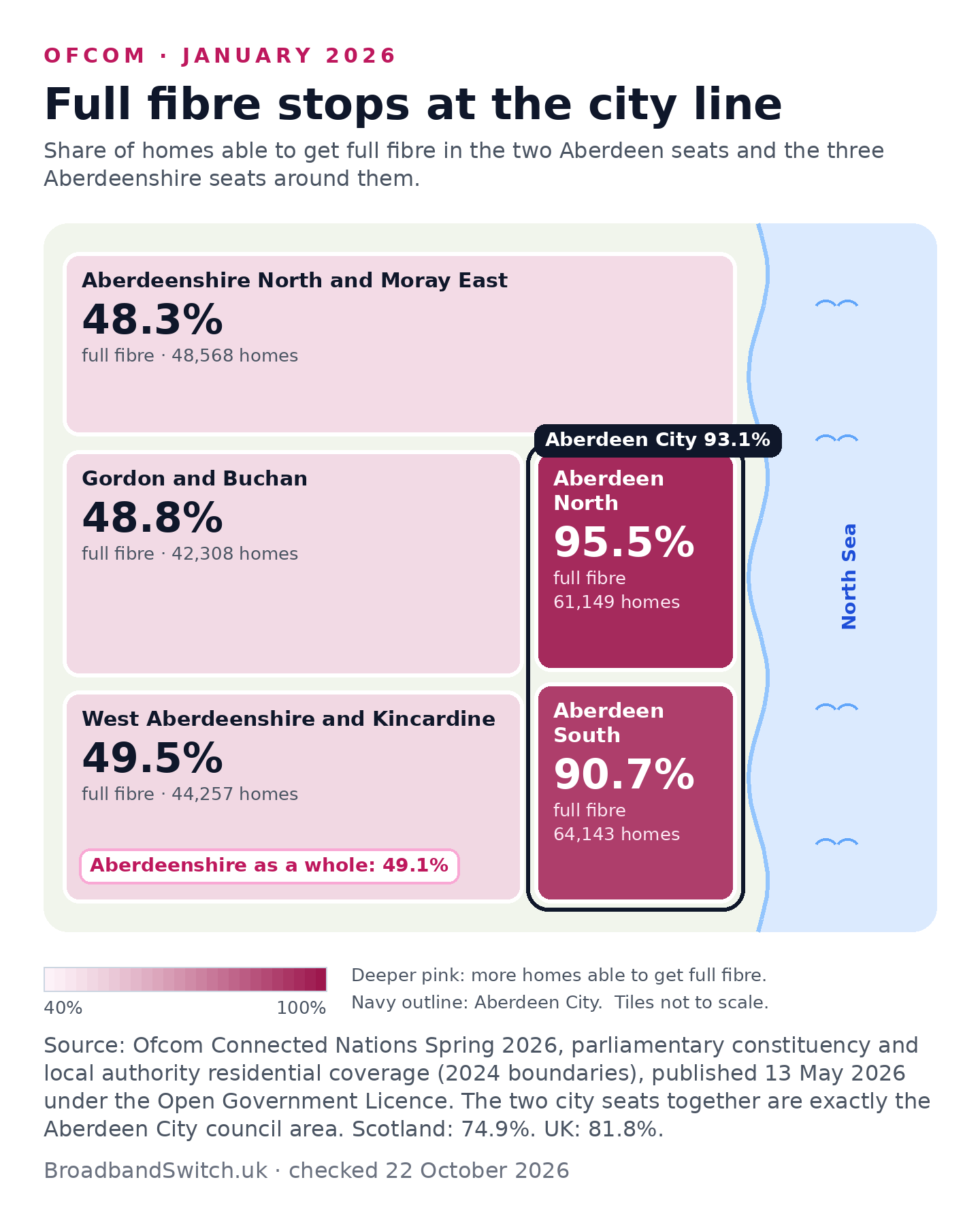
The figures are for residential premises as they stood in January 2026, released by Ofcom on 13 May. The regulator defines full fibre as “An access network structure in which an optical fibre runs all the way from customers’ premises to the local exchange or access node.” Gigabit-capable means “A network connection to a customer’s premises capable of delivering download speeds of 1 Gbit/s or more.” Across most of Britain the gigabit share is the bigger of the two, since cable can deliver a gigabit without fibre reaching the house. Not here: in Aberdeen, all 116,599 homes able to get a gigabit line can get it as full fibre.
Aberdeen South is the larger seat, with 64,143 homes, and the one with more left to reach: 5,950 homes without full fibre, against 2,743 in Aberdeen North, which has 61,149. Across Scotland the city is second of 32 councils for full fibre, behind only Midlothian at 93.4%, and 49th of the UK’s 361.
| Aberdeen Northwards 1 to 6 and most of Midstocket and Rosemount: Dyce, Bucksburn, Danestone, Bridge of Don, Kingswells, Sheddocksley, Summerhill, Northfield, Mastrick, Hilton, Woodside, Stockethill, Tillydrone, Seaton and Old Aberdeen | 95.5% | 61,149 | 43.9% |
|---|---|---|---|
| Aberdeen Souththe rest of Midstocket and Rosemount and wards 8 to 13: the city centre and harbour, Lower Deeside, Hazlehead, Queens Cross, Countesswells, Airyhall, Broomhill, Garthdee, Torry, Ferryhill, Kincorth, Nigg and Cove | 90.7% | 64,143 | 56.2% |
| Aberdeen City (both seats)the whole council area | 93.1% | 125,292 | 50.2% |
Seats follow the boundaries in use since the 2024 general election, and between them they make up the Aberdeen City council area exactly. The line under each name follows the Boundary Commission for Scotland’s ward list and is a guide, not a boundary. Full fibre and homes are Ofcom’s, of residential premises, January 2026; the gigabit figure is the same in every row, so it is left out. “In flats” is the census share of households. Press a heading to sort.
Aberdeen North: from Dyce and Bridge of Don to Old Aberdeen
The seat’s 95.5% full fibre is the higher of the two. Openreach named Bucksburn and Dyce in its build on 28 May 2024, and CityFibre says its primary build covered nearly the whole city. The seat holds the most owner-occupied ward in Aberdeen, Bridge of Don, at 84.0%, and the one with the most social renting, Tillydrone, Seaton and Old Aberdeen, at 54.7%.
Aberdeen South: the centre, the harbour, Deeside and Cove
The seat’s 90.7% covers the granite centre, Torry and Ferryhill, the suburbs out to Cults and Bieldside, and the newer streets at Cove and Countesswells. More of its homes share a building: 56.2% of households live in a flat, against 43.9% in Aberdeen North, and private renting reaches 25.6%. Openreach named Bieldside in the same 2024 build as Bucksburn and Dyce.
All thirteen wards
Seats are drawn from council wards, and most people know their ward by the places in its name. The Boundary Commission for Scotland put wards 1 to 6 and most of Midstocket and Rosemount in Aberdeen North; its paper says the line “followed ward boundaries, except by Rosemount”. On the census figures, about 79% of that ward’s households fall in Aberdeen North. Ofcom publishes no ward figures, so this table shows what the census does: how many households each ward has, and how many live in a flat or rent, the two things most likely to put a landlord or a stair between you and a new line.
| Ward | Seat | Households | In flats | Rented |
|---|---|---|---|---|
| 1Dyce, Bucksburn and Danestone | North | 10,581 | 32.0% | 29.5% |
| 2Bridge of Don | North | 8,542 | 13.5% | 15.0% |
| 3Kingswells, Sheddocksley and Summerhill | North | 6,777 | 22.8% | 36.8% |
| 4Northfield and Mastrick North | North | 6,915 | 27.9% | 51.1% |
| 5Hilton, Woodside and Stockethill | North | 7,645 | 72.0% | 54.1% |
| 6Tillydrone, Seaton and Old Aberdeen | North | 6,632 | 80.3% | 74.2% |
| 7Midstocket and Rosemount | North, part South | 8,541 | 75.9% | 51.3% |
| 8George Street and Harbour | South | 10,799 | 93.3% | 71.3% |
| 9Lower Deeside | South | 6,627 | 20.7% | 15.5% |
| 10Hazlehead, Queens Cross and Countesswells | South | 9,799 | 43.3% | 29.7% |
| 11Airyhall, Broomhill and Garthdee | South | 7,837 | 42.3% | 33.8% |
| 12Torry and Ferryhill | South | 11,170 | 77.1% | 55.9% |
| 13Kincorth, Nigg and Cove | South | 7,586 | 25.9% | 23.9% |
Wards are Aberdeen City Council’s thirteen wards as used in Scotland’s Census 2022, numbered as the Boundary Commission numbers them. Households, flats and renting are the census’s, via the UK Data Service; “rented” adds social and private renting. The share of Midstocket and Rosemount in each seat is our calculation from the census seat totals.
A seat figure is an average across more than sixty thousand homes, so treat it as the weather, not your forecast: two closes on one street can differ. And being able to get full fibre is not the same as having it, which is the part of the story where Aberdeen stands out.
Why Aberdeen leads Scotland’s cities on switching
Direct answer: In January 2026, 59% of the Aberdeen premises that could get full fibre had taken it, on Ofcom’s figures, joint fifth of Scotland’s 32 councils alongside East Ayrshire and West Lothian. Glasgow stood at 43%, Edinburgh at 40% and Dundee at 36%, and Scotland on our weighting of the council rows at 46.9%.
Ofcom, January 2026
Every 100 Aberdeen homes as windows in four granite tenements
- 55have full fibre now
- 38could order it and have not yet
- 7no full fibre or gigabit line yet
Ofcom Connected Nations Spring 2026, Aberdeen City residential row: full fibre 93.1%, gigabit-capable 93.1%, full fibre take-up 55% of all homes. One window per home in a hundred, drawn by us.
Counted against every home rather than only the covered ones, 55% of Aberdeen premises had a full fibre line, third in Scotland. For a city that is a high share, and it means the move is well under way. Ofcom does not say why Aberdeen orders more readily, and a guess would be only that, but two facts on this page fit it. The second network arrived early: Vodafone announced on 21 February 2018 that Aberdeen would become “Scotland’s first Gigabit-speed fibre broadband city”, with CityFibre building and Vodafone selling. And Ofcom finds no cable gigabit here, so few homes are sitting on a fast cable line with little reason to change.

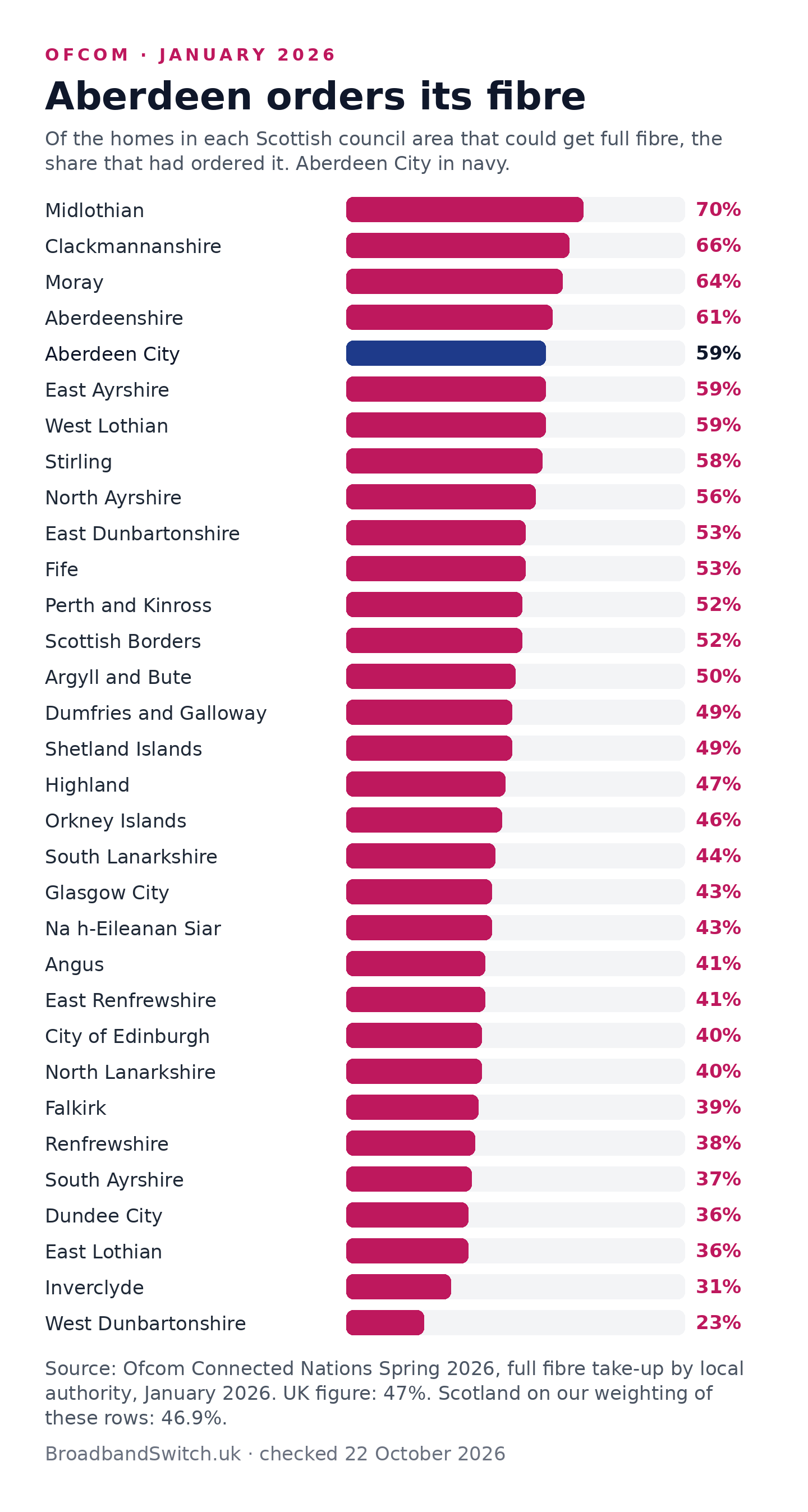
Midlothian leads Scotland at 70%. Out of town the north-east shows the same appetite: in Aberdeenshire, Openreach said on 30 January 2025, “More than 50 per cent of homes and businesses that can upgrade have already done so”, on its own network, and Ofcom’s shire figure, counting every network, is 61%. The north-east, it seems, orders full fibre soon after it arrives.
Room still to move
The other 41% of covered Aberdeen homes have not switched yet. If yours is one of them, the fibre is already in the street, so getting it is an order rather than a building job, and with two networks across much of the city the faster line can cost no more than you pay now. Put your postcode in at the top and the cheapest options are listed first.
There is a clock running too. When three in four homes on an exchange can get full fibre, Openreach stops selling copper broadband there, and on 31 January 2027 the analogue phone network closes for everyone. Four Aberdeen exchanges have already passed the first of those points; the exchange section lists them.
Two networks, and no cable
Direct answer: On the plans the builders gave Ofcom, 72.0% of Aberdeen homes should have two or more gigabit networks to choose from by January 2029, but only 52 homes three or more. Glasgow’s three-or-more share is 45.4%, Dundee’s 45.5% and Edinburgh’s 35.0%. Every gigabit line in Aberdeen is full fibre: Ofcom finds no home here that relies on cable for gigabit speeds.
Ofcom, planned network deployments 2026
Twenty homes a row: how many gigabit networks each should have by 2029
Aberdeentwo or more: 72.0%; three or more: 52 homes
Glasgowthree or more: 45.4%
Dundeethree or more: 45.5%
Edinburghthree or more: 35.0%
Aberdeenshiremostly one network or none
Scotland (all councils)three or more: 33.6%
- Three or more networks
- Two
- One
- None planned
From Ofcom’s Planned Network Deployments 2026 (local authority residential file, all plans): homes expected to have at least three, and at least two, gigabit-capable operators by January 2029, and homes expected to be gigabit-capable at all. One circle stands for a twentieth of the homes, rounded, and the dots inside count the networks. Scotland is our weighting of the council rows. Plans can change.
These are the builders’ own forecasts, gathered by Ofcom each year and added up council by council. For January 2029 they give Aberdeen 96.5% full fibre, or 95.8% if you keep only the ‘High Confidence’ plans, the ones already designed and paid for. Between 6 to 10 companies are expected to be building in the city, and still the plans leave nearly every home with two networks, not three. For most addresses, then, one comparison does the work: the providers on CityFibre against the providers on Openreach, side by side at your postcode.
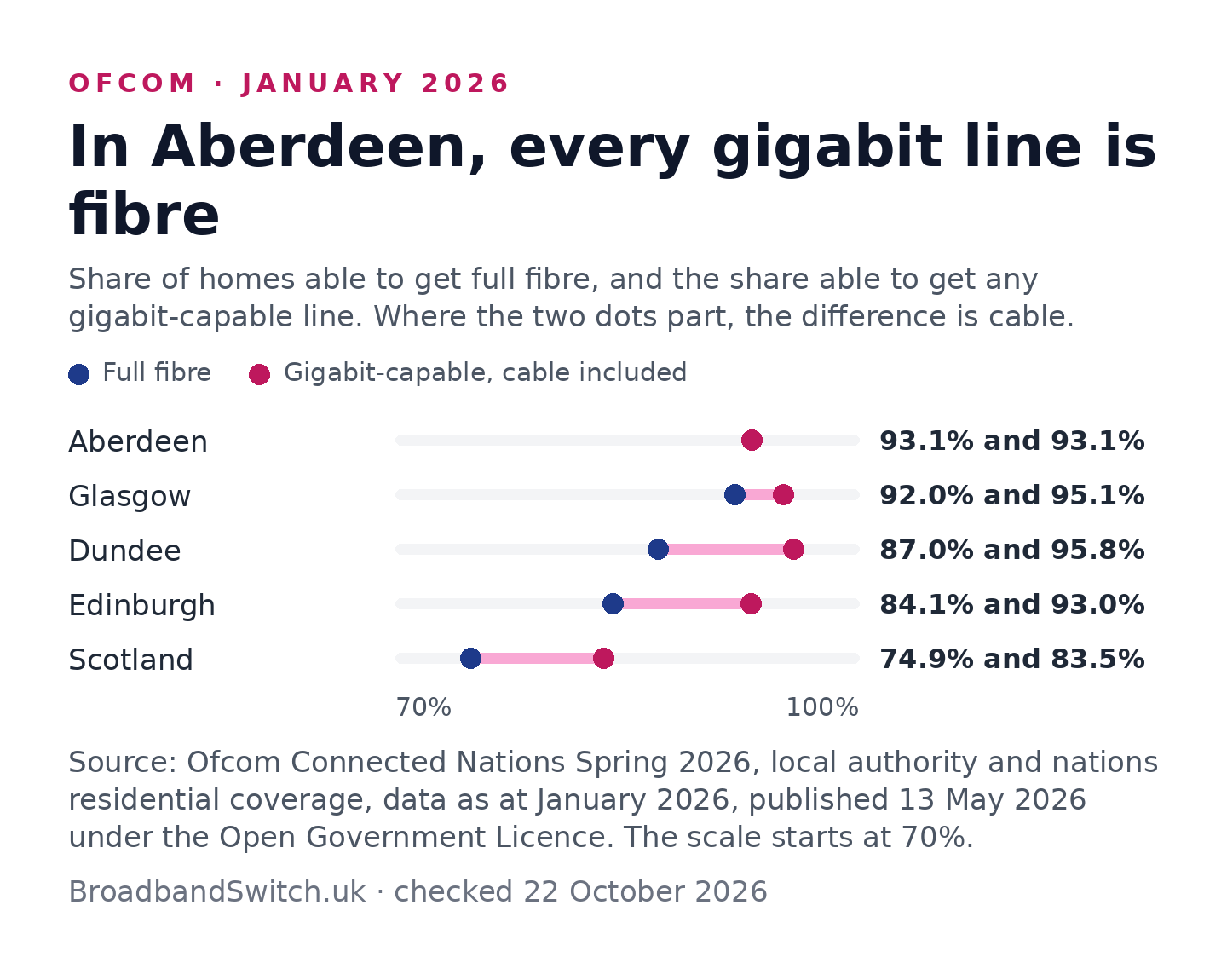
Where cable exists, a home can get gigabit speeds along Virgin Media’s coaxial line without fibre to the door, which is why gigabit runs ahead of full fibre in Glasgow (92.0% against 95.1%), Dundee and Edinburgh, and across Scotland (74.9% against 83.5%). In Aberdeen both figures are 93.1%. There is a practical upside: whichever network reaches your street, the line into the home is fibre, and the small box on the wall looks much the same.
The companies building Aberdeen’s broadband
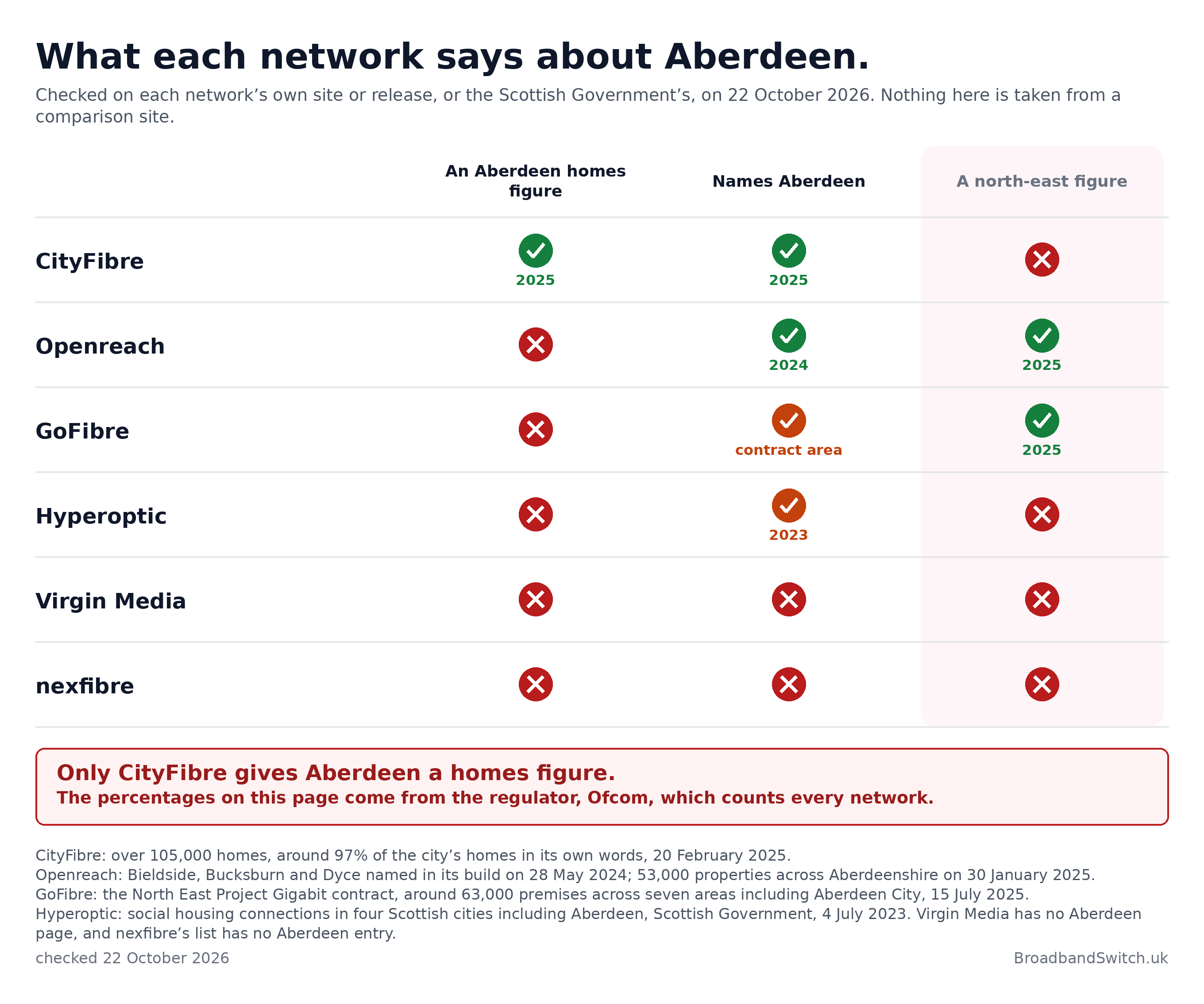
Direct answer: CityFibre says its Aberdeen network reaches “over 105,000 homes”, which it puts at “around 97%” of the city’s homes, and carries Vodafone, TalkTalk, IDNet and Zen among others. Openreach carries BT, Sky, EE, Plusnet and most other household names. GoFibre holds the public contract for hard-to-reach premises across the north-east, Hyperoptic has wired some social housing, and we found no sign of Virgin Media’s network in the city.
The name on your bill is the provider; the cable in the street belongs to a network, and here that is normally CityFibre or Openreach. Below, each network speaks for itself, in quotes from its own releases with their dates, since a promise from 2018 says less about your street today than a statement from 2025. Unsure which network you are on now? Your provider can tell you in one sentence, and the answer decides whether switching means a new line or the one you have.
CityFibre, and the providers that sell over it
CityFibre builds the network and other companies sell over it. Building began in 2018, after Vodafone said on 21 February 2018 that it would reach “nearly every home and business” with “at least £40 million of private funds”. On 20 February 2025 CityFibre said its primary build was complete: “over 105,000 homes”, which it put at “around 97%” of the city’s homes, “over 762km” of fibre and “more than 160 sites, including Aberdeen City Council offices, schools, libraries and leisure centres”. Paul Wakefield, its partnership manager, said: “We’re really excited to have finished our primary build in Aberdeen.” It named Vodafone, TalkTalk, IDNet and Zen as providers, with Sky to follow, and said it would keep looking at “flats, new-build homes, business parks and homes on private roads”, which is where the gaps are. Councillor Christian Allard, co-leader of Aberdeen City Council, said: “Digital infrastructure has provided game-changing technology for our businesses, schools and homes.”
CityFibre’s “around 97%” and Ofcom’s 93.1% are measured differently. CityFibre counts its own build against its own count of the city’s homes; Ofcom counts every residential premises in its database, every network together, from what the operators report. Neither is wrong, and neither tells you about your flat.
Openreach, under most of the household names
BT, Sky, EE, Plusnet and many smaller brands sell over Openreach, and Vodafone and TalkTalk sell over it as well as over CityFibre. Openreach publishes no figure for Aberdeen City. On 28 May 2024 it named the “Bieldside, Bucksburn and Dyce areas of Aberdeen” in its build, when its Scottish total was “1.2 million homes and businesses across Scotland”, and its partnership director for Scotland, Robert Thorburn, said: “Our rollout of full fibre broadband is a huge infrastructure success story.” The clearest public sign of its reach is the stop sell list: four exchanges listed at Aberdeen have stopped selling copper, which Openreach does only once three in four premises on an exchange can get its full fibre.
GoFibre and the public contract
On 15 July 2025 the Scottish Government announced a £105 million Project Gigabit contract with GoFibre, paid for by the UK Government, for “Around 63,000 more premises” across “Aberdeenshire, Aberdeen City, Angus, Dundee, Moray, Highland and parts of Perth and Kinross”. It said: “The first connections are due to be delivered by Summer 2026.” GoFibre’s chief executive, Neil Conaghan, called it “This Project Gigabit contract award is a hugely exciting development for the north east of Scotland”, and GoFibre now says “Our build started in January 2026”. The contract is for hard-to-reach premises, and in the city they are few: Ofcom’s Aberdeen row counts 314 planned lines paid from public funds.
Hyperoptic, in some blocks
Hyperoptic says “Hyperoptic is now live in 64 towns and cities, with more joining the network every year”, and it has no Aberdeen page. A Scottish Government case study of 4 July 2023 lists the cities where it has delivered social housing connections as Glasgow, Edinburgh, Dundee and Aberdeen. If your block is one of them, it shows up in the postcode check like any other network.
Virgin Media: no sign of it here
Virgin Media publishes no Aberdeen page, and the coverage report of nexfibre, which builds full fibre for Virgin Media to sell, has no Aberdeen entry. Ofcom’s figures point the same way: no Aberdeen home relies on cable for a gigabit line. That is strong evidence rather than proof, since a building or two could still be served, so the postcode check has the final word.
Aberdeen’s exchanges and the copper switch-off
Direct answer: Four exchanges listed at Aberdeen are on BT Wholesale’s November 2025 stop sell list: Aberdeen Balgownie from 9 May 2023, Aberdeen Ashgrove and Aberdeen Kincorth from 9 November 2023, and Aberdeen West from 26 May 2025. Openreach gave Aberdeen Kingswells, an exchange listed at Westhill, a year’s notice on 15 May 2026.
People often mix up the two dates. The national one is fixed, and in Openreach’s words: “By 31 January 2027, all UK providers must move from analogue to digital phone lines.” The local one, called stop sell, arrives exchange by exchange, and Openreach sets it off like this: “Stop Sell is triggered when a majority (75%) of premises connected to a particular exchange can get ultrafast Full Fibre”. From then on the exchange accepts no new copper orders. Lines already working are left alone, but a move, a switch or an upgrade puts you onto a digital service over fibre wherever your address can have it.
BT Wholesale and Openreach, 2023 to 2027
Aberdeen’s copper switch-off, exchange by exchange
- 9 May 2023Aberdeen Balgownie, the city’s first Tranche 8.
- 5 September 2023No more new copper phone lines anywhere BT Wholesale records that “a UK wide WLR Stop Sell commenced on 5 September 2023”.
- 9 November 2023Aberdeen Ashgrove and Aberdeen Kincorth Tranche 10, the same day as Inverurie.
- 17 February 2025Stonehaven, down the coast Tranche 15.
- 26 May 2025Aberdeen West, and Aberdeen Portlethen Tranche 16.
- 6 November 2025Ellon, to the north Tranche 18.
- 15 May 2026Notice for Aberdeen Kingswells An exchange listed at Westhill. Openreach gives a year’s notice, so copper sales there end around May 2027.
- 5 June 2026Peterhead Tranche 20.
- 8 October 2026Notice for Huntly In Aberdeenshire, the latest round to touch the north-east.
- 22 October 2026This page checked New rounds are announced on Openreach’s news pages first.
- 31 January 2027Analogue phone lines switched off Any analogue line still running moves to a digital service over broadband.
Dates and tranches from BT Wholesale’s “Product stop sells and FTTP exchange upgrades” (November 2025 edition), with Openreach’s notices of 15 May 2026 and 8 October 2026; every source read 22 October 2026.
The dates come from BT Wholesale’s document “Product stop sells and FTTP exchange upgrades”, in its November 2025 edition. Aberdeen got there early: Balgownie stopped selling copper on 9 May 2023, Ashgrove and Kincorth joined it before the year was out, and so did Inverurie up the A96. Aberdeen West and Aberdeen Portlethen came next, on 26 May 2025. In its announcement of 15 May 2026 Openreach gave Aberdeen Kingswells “a year’s notice”, and its round of 8 October 2026, which named Huntly, says that by 5 November 2026 “around 16.4 million premises are under active Stop Sell”.

| Exchange | Listed at | Code | Tranche | Stop sell from |
|---|---|---|---|---|
| Aberdeen Balgownie | Aberdeen | NSBLG | 8 | 9 May 2023 |
| Aberdeen Ashgrove | Aberdeen | NSASH | 10 | 9 November 2023 |
| Aberdeen Kincorth | Aberdeen | NSKNC | 10 | 9 November 2023 |
| Aberdeen West | Aberdeen | NSWES | 16 | 26 May 2025 |
| Aberdeen Portlethen | Portlethen | NSPRT | 16 | 26 May 2025 |
| Aberdeen Kingswells | Westhill | CPO | 24 | a year after notice on 15 May 2026 |
| Inverurie | Inverurie | NSIUR | 10 | 9 November 2023 |
| Stonehaven | Stonehaven | NSSVN | 15 | 17 February 2025 |
| Ellon | Ellon | NSELL | 18 | 6 November 2025 |
| Peterhead | Peterhead | NSPET | 20 | 5 June 2026 |
| Huntly | Huntly | HPJ | 26 | a year after notice on 8 October 2026 |
Exchange names follow the building, and the listed location can be somewhere else entirely: Aberdeen Kingswells is listed at Westhill. So the exchange serving you may not carry your area’s name; Openreach’s checker will say which it is. Stop sell only ends new copper orders, and a working line keeps working. From BT Wholesale’s November 2025 list and Openreach’s notices of 15 May 2026 and 8 October 2026, read 22 October 2026.
What stop sell means for your line
- Leave things as they are, and the service you have keeps working. The one fixed date is 31 January 2027, when landline calls move onto broadband everywhere.
- Switch, upgrade or move, and Openreach is clear: “Customers who then want to switch, upgrade or re-grade their broadband or phone service will have to take a new digital service over our new Full Fibre network.”
- No full fibre at your address yet? Openreach says you can keep the copper service until it arrives.
The second point quotes Openreach’s announcement of 15 May 2026; the first and third summarise the same announcement in our words.
In practice, the home phone ends up plugged into the router instead of the socket on the wall, and for most households that is the whole change. Anyone with a care alarm, a lift line or a security system on the phone line should speak to its supplier and to their broadband provider first; our care alarm guide has the questions. The landline switch-off checker works for any Aberdeen number. Moving into the city? Ask the letting agent or seller which networks already serve the flat, and the new connection can be booked before the keys change hands.
Over the city line: Aberdeenshire
Direct answer: Full fibre falls by almost half at the city boundary: Aberdeenshire stood at 49.1% in January 2026, twenty-seventh of Scotland’s 32 councils, against 93.1% in the city. On the builders’ plans the shire reaches 77.5% by January 2029, helped by 11,966 planned lines paid from public funds.
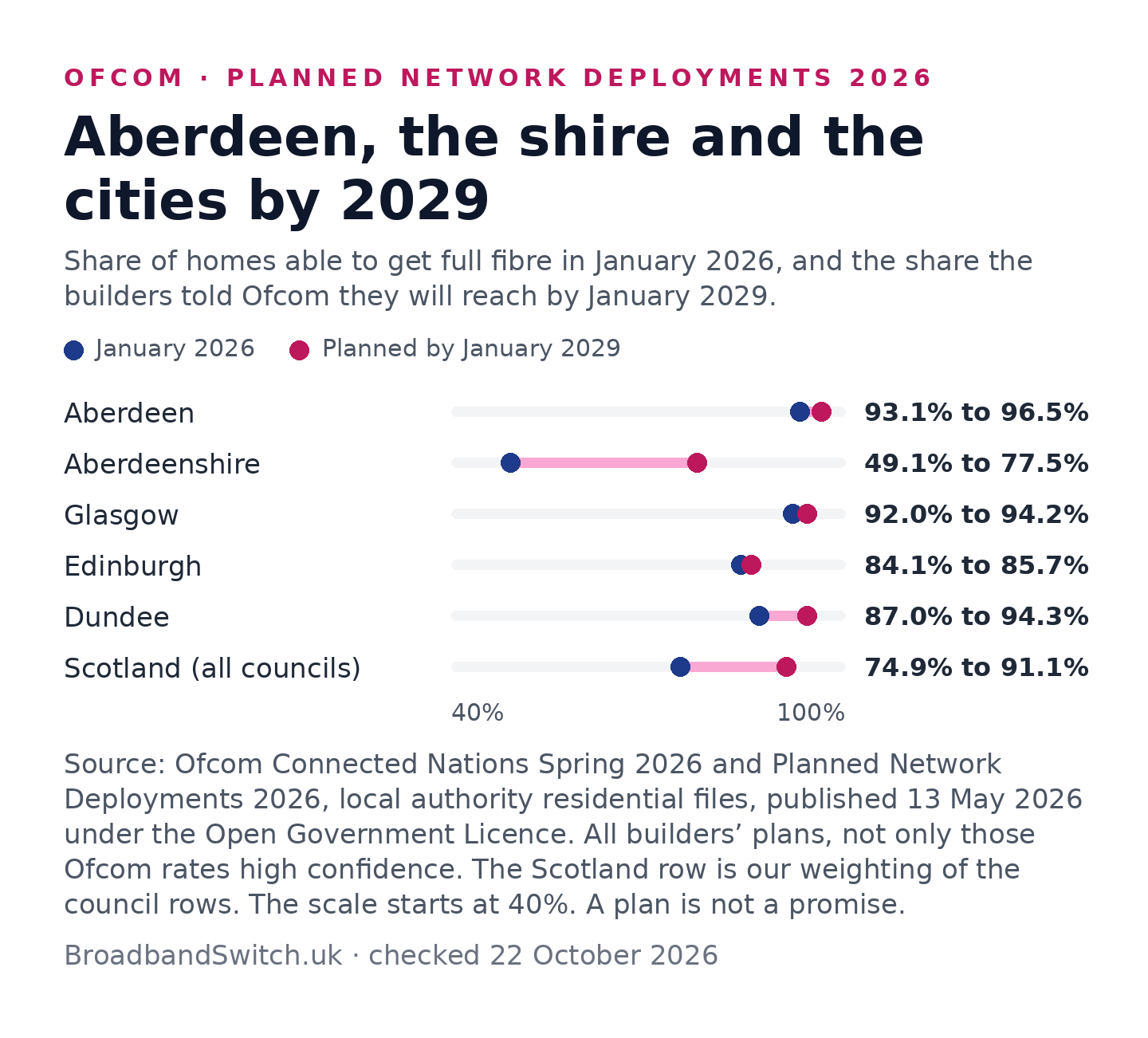
The three seats around the city sit within about a point of each other: 48.3% in Aberdeenshire North and Moray East, 48.8% in Gordon and Buchan and 49.5% in West Aberdeenshire and Kincardine. The towns are further on than the countryside. The exchanges at Inverurie, Stonehaven, Ellon and Peterhead have stopped selling copper, and Openreach said on 30 January 2025 that “53,000 properties across Aberdeenshire” could get its full fibre.
Help for the rest comes from three places. The Scottish Government’s Reaching 100% programme is a “£600+ million Scottish Government programme”, “around 113,000 connections in North, South and Central Scotland”. The GoFibre contract covers hard-to-reach premises the commercial builders will not reach on their own. And the Scottish Broadband Voucher Scheme says “The scheme currently provides a subsidy of up to £5,000 for eligible properties”, but it “will close to new applications on 20 November 2026”, so anyone eligible, in the shire or on the city’s edges, should apply before then. And if your line cannot manage 10Mbps, the broadband Universal Service Obligation gives you the right to request a connection from BT that meets Ofcom’s decent standard: a download speed of at least 10 Mbit/s and an upload speed of at least 1 Mbit/s.
Inside the city the gaps are small. Ofcom’s Aberdeen row has 147 postcodes with no gigabit plan for 2029, 1,764 homes unable to get 30Mbps and 26 unable to get a decent connection from a fixed or fixed wireless line. If you are one of them, the postcode check at the top shows anything new as soon as it can be ordered.
Granite tenements, the council and the landlord
Direct answer: Half of Aberdeen lives in a flat: 50.2% of households on Scotland’s 2022 census, against 34.4% across Scotland, almost all of them in tenements and purpose-built blocks. About one household in five rents from a social landlord and another one in five privately, so for many homes the go-ahead for a new line comes from someone else.
Scotland’s Census 2022
Aberdeen’s thirteen wards by their share of flats
George Street and HarbourAberdeen South
rented 71.3%Tillydrone, Seaton and Old AberdeenAberdeen North
rented 74.2%Torry and FerryhillAberdeen South
rented 55.9%Midstocket and Rosemountmostly Aberdeen North
rented 51.3%Hilton, Woodside and StockethillAberdeen North
rented 54.1%Hazlehead, Queens Cross and CountesswellsAberdeen South
rented 29.7%Airyhall, Broomhill and GarthdeeAberdeen South
rented 33.8%Dyce, Bucksburn and DanestoneAberdeen North
rented 29.5%Northfield and Mastrick NorthAberdeen North
rented 51.1%Kincorth, Nigg and CoveAberdeen South
rented 23.9%Kingswells, Sheddocksley and SummerhillAberdeen North
rented 36.8%Lower DeesideAberdeen South
rented 15.5%Bridge of DonAberdeen North
rented 15.0%Scotland as a whole: 34.4% of households in flats
Scotland’s Census 2022, National Records of Scotland, tables UV402 Accommodation type and UV404 Tenure, households, by 2022 electoral ward, via the UK Data Service. Flats count tenements, purpose-built blocks, converted houses and flats in commercial buildings. Rented adds social and private renting.
The census counts 109,450 occupied households in the city. Against Scotland, Aberdeen has more flats and fewer detached houses (12.6% against 23.9%), and fewer owner-occupiers (56.5% against 63.2%). Social renting is close to the Scottish level, 22.4% against 22.5%, but private renting, at 19.8% against 12.9%, is the third highest of Scotland’s 32 councils, after Edinburgh and Dundee. The ward figures run from 93.3% of households in flats in George Street and Harbour, where 47.7% rent privately, to 13.5% in Bridge of Don.
The housing associations saw this coming. When CityFibre announced blanket wayleave agreements with Scottish social landlords on 11 September 2019, it said “Agreements are already in place with Grampian Housing Association”, and Grampian’s chief executive, Neil Clapperton, said: “This approach is particularly important in Aberdeen, where the high proportion of flats could otherwise slow the rollout of full fibre internet.” The same release says “Aberdeen City Council are also in full support of the project”. The council is a large landlord in its own right: the Scottish Housing Regulator records that it owned 23,886 homes at 31 March 2026.
In a tenement or block, the network needs a signature before it can wire the building. Who gives it depends on who owns the common parts: the council or housing association in a social block, the owners together, often through a factor, on a privately owned stair. Our wayleave guide explains what that involves and why it is normally free for the owners. Inside the flat, the job is small: a little white box low on the wall near where the line comes in, the router plugged into it, and the visit is usually done in a morning or an afternoon. Thick granite walls are another matter for wi-fi, so if you have a big flat, a mesh system or a second access point can help.
If you rent, check with your landlord, council or housing association before anyone drills, and if the answer takes a while, a tenant’s rights to full fibre sets out your options. You do not need anyone’s permission to change provider over a line that is already in place; switching in a rented property covers that. Students in halls at the University of Aberdeen or Robert Gordon University should start with our page on student halls, and anyone sharing a flat with our student broadband guide.
Lower prices on certain benefits
Direct answer: Households on Universal Credit, Pension Credit and a number of other benefits can buy cheaper social tariffs from several providers in Aberdeen, and Ofcom is clear about leaving one: “It costs nothing to leave. You won't pay a fee to leave the tariff before the end of your contract.”
What you can get is set by the networks wired to your home. BT Home Essentials, sold over Openreach, costs £16.50 a month; Vodafone Essentials costs £20 a month for up to 80 Mbps, with a contract length of 12 months. Sky keeps its tariff for existing customers: “Our Sky Broadband Basics offer is only available if you already have Sky Broadband with us”. In a block Hyperoptic has wired, Fair Fibre begins at £13 a month. The full list, with who qualifies for each, is in our social tariffs guide. Living in a tenement? Find out which networks reach the flat first, since a tariff only helps if its network comes through the main door.
In the 147 Aberdeen postcodes with no gigabit plan at all, the help that matters is public money for a connection rather than a cheaper bill, and the Scottish Broadband Voucher Scheme stops taking applications on 20 November 2026. Everywhere else, the cheapest deal is simply the top line of your postcode search.
Find your ward
Direct answer: Pick your ward to see its seat, the seat’s Ofcom figure, and what the census says about flats and renting there. The lookup runs on your own device and sends nothing anywhere.
Your part of Aberdeen, in one card
Aberdeen’s thirteen wards, each with its Westminster seat, Ofcom’s January 2026 full fibre figure for that seat, and Scotland’s Census 2022 figures for the ward. Not sure which ward or seat you live in? The UK Parliament’s Find your MP page gives the seat from a postcode.
What the old version of this page got wrong
Direct answer: Five corrections: a CityFibre share that CityFibre does not give, Openreach shares that Openreach does not publish, a Virgin Media ranking we cannot check, GoFibre described before it won the north-east’s public contract, and a Hyperoptic footprint from an older count.
The previous Aberdeen page was long, over nine thousand words, and picked packages and prices on your behalf while quoting two crowd-sourced average speeds that contradicted each other. This rebuild keeps only what traces back to a primary source; the rest is gone rather than reworded, and where a company describes itself differently from the old page, the company’s words now stand. Price tables are gone as well, because providers price nationally and your postcode search shows the real figures. The old page did get one big thing right, and it stays: cable plays no part in Aberdeen’s gigabit coverage.
A CityFibre share that CityFibre does not give
What we saidThis page put CityFibre at “approximately 82%” of Aberdeen. CityFibre’s own statement of 20 February 2025 is “over 105,000 homes”, which it puts at “around 97%” of the city’s homes, and Ofcom, counting every network together, gives 93.1% full fibre for the city. We can find no source for 82%.
What we say now, and whyCityFibre in its own words and dated, beside Ofcom’s figure for every network.
Openreach shares for the city and the shire that Openreach does not publish
What we saidThis page gave Openreach full fibre as “approximately 60%” of Aberdeen city and “approximately 40%” of Aberdeenshire. Openreach publishes no city share. What it does publish is the stop sell list, where four exchanges listed at Aberdeen appear, and its Aberdeenshire release of 30 January 2025, which gives “53,000 properties across Aberdeenshire”.
What we say now, and whyOpenreach’s dated statements and the stop sell list, with Ofcom’s figures for every network.
No sign of Virgin Media, but a ranking we cannot check
What we saidThis page called Aberdeen “the largest UK city without Virgin Media coverage at all”. The evidence we can check agrees there is no sign of Virgin Media here: Ofcom’s gigabit and full fibre figures for the city are both 93.1%, and nexfibre’s coverage report has no Aberdeen entry. Virgin Media publishes no list of where it is absent, so the “largest city” part cannot be checked.
What we say now, and whyWhat the data shows, said as carefully as the data allows, and the postcode check as the final word.
GoFibre, now holder of the north-east’s public contract
What we saidThis page described GoFibre as having “limited coverage in Aberdeen city urban outskirts”. On 15 July 2025 the Scottish Government announced GoFibre as the supplier of a £105 million contract for “Around 63,000 more premises” across “Aberdeenshire, Aberdeen City, Angus, Dundee, Moray, Highland and parts of Perth and Kinross”, and GoFibre says “Our build started in January 2026”.
What we say now, and whyGoFibre’s public contract, dated, in the section on who builds Aberdeen’s broadband.
A Hyperoptic footprint from an older count
What we saidThis page gave Hyperoptic’s footprint as “approximately 600,000 properties across 50-plus UK cities” and called Aberdeen one of its smaller cities. Hyperoptic now says “Hyperoptic is now live in 64 towns and cities, with more joining the network every year”, and has no Aberdeen page. A Scottish Government case study of 4 July 2023 names Glasgow, Edinburgh, Dundee and Aberdeen as the cities where it has connected social housing.
What we say now, and whyHyperoptic in its own words, with the one Aberdeen statement we could find and its date.
Aberdeen broadband: frequently asked questions
What percentage of Aberdeen has full fibre broadband?
Ofcom’s January 2026 figure is 93.1% of homes, second of Scotland’s 32 councils behind only Midlothian; Scotland stands at 74.9% and the UK at 81.8%. The gigabit figure is the same, 93.1%, and on the builders’ plans full fibre reaches 96.5% by January 2029.
Which part of Aberdeen has the best full fibre coverage?
Aberdeen North, at 95.5% on Ofcom’s January 2026 figures, against 90.7% in Aberdeen South, which has more homes still to reach. Neither figure tells you about a particular stair or street, which is what the postcode check is for.
How many Aberdeen homes have switched to full fibre?
More than half of those that can. On Ofcom’s January 2026 figures, 59% of Aberdeen homes that could have full fibre had ordered it, joint fifth in Scotland and ahead of Glasgow (43%), Edinburgh (40%) and Dundee (36%). Counted against every home, 55% had a full fibre line.
Is CityFibre available in Aberdeen?
Yes, across most of the city. CityFibre said on 20 February 2025 that its Aberdeen network reached “over 105,000 homes”, which it put at “around 97%” of the city’s homes. You buy it through a provider such as Vodafone, TalkTalk, IDNet or Zen, and CityFibre says availability can vary between neighbouring properties, so check your own address.
Is Virgin Media available in Aberdeen?
We found no sign of it. Virgin Media has no Aberdeen page, nexfibre’s coverage report has no Aberdeen entry, and Ofcom’s figures show no Aberdeen home relying on cable for a gigabit line. The postcode check would show it if a building were served.
Is CityFibre or Openreach better in Aberdeen?
Neither in general: both bring full fibre to the home, and the difference you will notice is the provider and the price. CityFibre’s providers include Vodafone, TalkTalk, IDNet and Zen; Openreach’s include BT, Sky, EE and Plusnet, with Vodafone and TalkTalk on both. Where both reach your address, the postcode check lists them together, cheapest first.
Will Aberdeen homes get more choice of broadband network?
Mostly a choice of two. On the builders’ plans, 72.0% of Aberdeen homes should have two or more gigabit networks by January 2029, and only 52 homes three or more. A plan is not a promise, so the postcode check is the way to see what reaches you now.
Is Hyperoptic in Aberdeen?
In some blocks. A Scottish Government case study of 4 July 2023 names Aberdeen among the cities where Hyperoptic has delivered social housing connections, but Hyperoptic publishes no Aberdeen page or figure. If your building is wired, it appears in the postcode check.
Why can my neighbour get full fibre when my flat cannot?
Because reaching a street and wiring a building are two jobs. In a tenement or block the network needs a wayleave from whoever owns the common parts, the council, a housing association or the owners on the stair, before it can bring fibre to each flat. CityFibre’s own coverage page says: “Availability can occasionally vary between neighbouring properties due to network activation, address data or other property-specific factors.”
What is happening to landlines in Aberdeen?
Analogue phone lines are going digital across the UK: “By 31 January 2027, all UK providers must move from analogue to digital phone lines.” In the city, four exchanges listed at Aberdeen have already stopped selling copper, from Aberdeen Balgownie on 9 May 2023 to Aberdeen West on 26 May 2025, and Openreach has given Aberdeen Kingswells a year’s notice.
Is broadband good in Aberdeenshire?
Less so than in the city. Ofcom put Aberdeenshire at 49.1% full fibre in January 2026, against 93.1% in Aberdeen, and the builders’ plans take it to 77.5% by 2029. The Scottish Broadband Voucher Scheme will close to new applications on 20 November 2026, so eligible homes should apply before then.
Is broadband good in Dyce and Bucksburn?
Both are in Aberdeen North, which Ofcom puts at 95.5% full fibre, the higher of the city’s two seats, and Openreach named both in its build on 28 May 2024. For a particular street, run the postcode check.
Is there cheaper broadband in Aberdeen if I receive benefits?
Yes, for people on Universal Credit, Pension Credit and several other benefits. The tariff you can take depends on which network reaches you: BT Home Essentials at £16.50 and Vodafone Essentials at £20 over Openreach, and Hyperoptic’s Fair Fibre from £13 in buildings it has wired. Leaving early costs nothing on any of them.
How current is this page?
We last read every source on 22 October 2026. Ofcom’s data is a January 2026 snapshot published in May, the census is from 2022, and we rebuild the page when Ofcom next publishes. Each company quote shows when it was said, so its age is never hidden.
In short
- In January 2026 Ofcom counted 93.1% of Aberdeen homes able to get full fibre, second in Scotland, against 74.9% for Scotland and 81.8% for the UK.
- Every gigabit line in the city is full fibre: Ofcom finds no home relying on cable.
- 59% of homes able to get full fibre had ordered it, joint fifth in Scotland and ahead of the other three big cities.
- Aberdeen North (95.5%) is ahead of Aberdeen South (90.7%), and the street matters more than the seat.
- On the builders’ plans, 72.0% of homes should have two or more gigabit networks by 2029, but hardly any three.
- Aberdeen Balgownie stopped selling copper on 9 May 2023, three more city exchanges have followed, and analogue phone lines end on 31 January 2027.
- Half the city lives in a flat, so in a tenement the owners or the landlord may need to agree before a network can wire the building.
- Over the city line Aberdeenshire stands at 49.1%; only a postcode check can tell you what reaches your own door and what each provider charges there.
Every point can be read on its own, with its date. The page is reviewed at least once a quarter, most recently on .
References
- OFCOM.ORG.UK
Ofcom. (2026, May 13). Connected Nations update: Spring 2026. Data: “Fixed broadband coverage and full fibre take-up” (council, Westminster constituency and nation files; January 2026; Open Government Licence). Source of all coverage and take-up figures for Aberdeen, its seats, Aberdeenshire, Scotland’s other councils, Scotland and the UK. Downloaded 22 October 2026.
- OFCOM.ORG.UK
Ofcom. (2026, May 13). Connected Nations: Planned network deployments 2026. Data: “Planned network deployments for local and unitary authorities” (residential). Source of the 2029 forecasts, the two- and three-network counts, the builder range, the postcodes with no plan and the publicly funded lines. Downloaded 22 October 2026.
- OFCOM.ORG.UK
Ofcom. (2025, November 19). Connected Nations 2025: Methodology annex. Ofcom’s definitions of full fibre and gigabit-capable. Read 22 October 2026.
- CITYFIBRE.COM
CityFibre. (2025, February 20). Aberdeen becomes one of UK’s best connected cities as CityFibre’s primary-build completes. The 105,000 homes, the 97%, the £59m, the 762km, the 160 public sites, the providers named and the quotations from Paul Wakefield and Councillor Christian Allard. Read 22 October 2026.
- VODAFONE.CO.UK
Vodafone. (2018, February 21). Aberdeen to become Scotland’s first Gigabit-speed fibre broadband city. The £40 million and “nearly every home and business”. Read 22 October 2026.
- CITYFIBRE.COM
CityFibre. (2019, September 11). Scottish housing associations team with CityFibre to bring full fibre broadband to tenants. Grampian, Langstane and Castlehill housing associations, Aberdeen City Council’s support and Neil Clapperton’s quotation. Read 22 October 2026.
- CITYFIBRE.COM
CityFibre. (n.d.). Network availability and coverage. Aberdeen among the cities served, the 4.5 million premises, and the caveat on neighbouring properties. Read 22 October 2026.
- OPENREACH.COM
Openreach. (2024, May 28). Openreach expands Scottish national broadband upgrade. Bieldside, Bucksburn and Dyce, the Scottish total and Robert Thorburn’s quotation. Read 22 October 2026.
- OPENREACH.COM
Openreach. (2025, January 30). Full fibre broadband coming to more Aberdeenshire homes. The 53,000 Aberdeenshire properties and the share that had upgraded. Read 22 October 2026.
- OPENREACH.COM
Openreach. (2026, May 15). Openreach stops copper for another 1.69 million premises in bid to push customers to new digital lines. The Aberdeen Kingswells notice, the 75% trigger and the effect on switching. Read 22 October 2026.
- OPENREACH.COM
Openreach. (2026, October 8). Openreach accelerates copper retirement across 600,000 more UK premises. Huntly and the 16.4 million premises under stop sell by 5 November 2026. Read 22 October 2026; and Openreach. (n.d.). Switching off ISDN and PSTN, help page.
- BTWHOLESALE.COM
BT Wholesale. (2025, November). Product stop sells and FTTP exchange upgrades. The stop sell dates and tranches for the Aberdeen and north-east exchanges, and the national end of new copper phone lines. Read 22 October 2026.
- NEXFIBRE.CO.UK
nexfibre. (2026, February). Network coverage update, as at 31 December 2025. The existing footprint list, with no Aberdeen entry. Read 22 October 2026.
- HYPEROPTIC.COM
Hyperoptic. (2026). About us. The 64 towns and cities, with no Aberdeen page. Read 22 October 2026.
- GOV.SCOT
Scottish Government. (2023, July 4). Scotland’s Full Fibre Charter: Hyperoptic case study. The four cities with Hyperoptic social housing connections. Read 22 October 2026.
- GOV.SCOT
Scottish Government. (2025, July 15). Boosting broadband in the North East. The £105 million GoFibre contract, its 63,000 premises and seven areas, and the quotations. Read 22 October 2026; with GoFibre. (n.d.). Full fibre is coming to the North East.
- GOV.SCOT
Scottish Government. (n.d.). About R100; and Scottish Broadband Voucher Scheme: about. The programme’s size and connections, the £5,000 subsidy and the closing date of 20 November 2026. Read 22 October 2026.
- HOUSINGREGULATOR.GOV.SCOT
Scottish Housing Regulator. (2026). Aberdeen City Council: landlord report 2025/26. The 23,886 homes owned at 31 March 2026. Read 22 October 2026.
- BCOMM-SCOTLAND.INDEPENDENT.GOV.UK
Boundary Commission for Scotland. (2023). 2023 Review of UK Parliament constituencies: revised proposals; and Paper 2023/02, Aberdeen City. The wards in each Aberdeen seat and the line by Rosemount. Read 22 October 2026.
- SCOTLANDSCENSUS.GOV.UK
National Records of Scotland. (2024). Scotland’s Census 2022, tables UV402 Accommodation type and UV404 Tenure, households, by council area, 2024 Westminster constituency and 2022 electoral ward, via the UK Data Service; and (2023) Rounded population estimates. Every household, flat and tenure figure on this page. Read 22 October 2026.
- PARLIAMENT.UK
UK Parliament. (n.d.). Find your MP. The constituency finder the ward lookup points to. Read on 22 October 2026.
How switching works
Switching in Aberdeen: three steps
- Step 1Enter your postcode and pick the flat or house
In a tenement, the flat number matters: two doors on the same stair can have different networks.
- Step 2See both networks side by side
CityFibre and Openreach prices sit in one list, cheapest at the top, with no sign-up to look.
- Step 3Place the order and let them handle it
Your new provider contacts the old one for you. There is no cancellation call to make, and one service hands over to the other on the day.
Ofcom’s One Touch Switch rules for broadband and landlines, in force since September 2024, as they apply on BroadbandSwitch.uk; nothing about them differs in Aberdeen.
See what reaches your door
Type an Aberdeen postcode and pick your flat or house: you get every provider able to connect it, cheapest first, in around ten seconds. Everything above describes the city; this describes your home.
Compare at my postcode →