How we rank UK broadband deals: the methodology in full
This page explains how BroadbandSwitch.uk evaluates, ranks and recommends UK broadband deals. We publish it because we earn affiliate fees from some broadband switches, and you deserve to know exactly what sits behind the rankings you read. Four principles govern the work: consumer value first, regulatory accuracy, total contract cost transparency, and evenhanded treatment of every provider. Twelve factors across five categories produce the scores. The factors never change; their weighting shifts according to what you are actually asking. Everything below is documented so you can verify it, challenge it, or reject it.


The fastest way to test any of this is to use it. Enter your postcode and the comparison applies the twelve factors to whatever is genuinely available at your address, including providers we earn nothing from.
Independent, free, no signup. Or read how we earn first.- 12 factorsacross five categories, documented below
- 8 contextspublished weightings for different questions
- 90 daysmaximum age of any price data we use
- Zerorankings determined by commission
- Why we publish this
- Four principles
- The twelve factors
- Contextual weighting
- Data sources
- How we earn
- What we will not do
- Challenge us
- Update log
- FAQ
Why we publish our methodology
UK broadband comparison has a credibility problem. Many comparison services rank deals partly or wholly on commercial relationships rather than consumer value, and readers cannot easily tell the difference between an objective recommendation and a commission-driven one dressed up as objective. This page exists so you do not have to guess about ours.
- Provider marketing is sophisticatedUK providers spend substantial resources on marketing, including on how comparison sites present their products. A "best deal" badge does not tell you whether it reflects genuine value or paid placement.
- Affiliate economics shape the industryComparison sites typically earn £30 to £100 or more per successful signup, and different providers pay different rates. Without transparency you cannot tell whose interests a ranking serves.
- The product defeats simple rankingsCheapest is not one answer, because pricing varies by introductory rate, mid-contract rises, standard pricing and eligibility for social tariffs. Best speed depends on what you use it for. Honest rankings have to admit that.
- The regulatory framework mattersRankings that ignore Automatic Compensation, dispute resolution and price-rise rules can recommend deals that look cheap while exposing you to real risk. See our complaints and rights guide.
- Trust is earned slowly and lost quicklySites that put commission ahead of value are found out eventually, through poor recommendations and complaints. We would rather earn trust slowly than maximise short-term commission.
- You should be able to disagree with usIf you read this and conclude we weight things wrongly, that is a legitimate outcome. Documented reasoning lets you apply your own weights instead of trusting ours.
Our four core ranking principles
These principles guide every ranking we publish. On the rare occasions they conflict, consumer value comes first.
- Consumer value firstRankings reflect what is best for the person reading, not what earns us most. In practice: the editorial team makes ranking decisions using the twelve-factor model below, the commercial team handles affiliate relationships separately, and the editorial team does not see commission rates when ranking. You can verify this by comparing our rankings against independent sources such as Ofcom data and expert reviewers, and by noting where we recommend providers who pay us less.
- Regulatory accuracyWe use Ofcom data, provider Key Facts documents and verified industry sources rather than provider marketing. Speed claims use the Ofcom-mandated average peak-time standard. Pricing includes the standard rate after the introductory period, not just the headline. Customer service references Ofcom's annual customer experience report. You can verify this because we cite specific sources, and Ofcom's data is public.
- Total contract cost transparencyWe show the genuine cost across the full term, including the introductory price, the mid-contract rise in pounds and pence, and the standard pricing that follows. We do not pretend the introductory rate is what you will pay throughout. You can verify this against the provider's own Key Facts document, which Ofcom requires them to give you at sign-up.
- Evenhanded provider treatmentAlternative networks get the same scrutiny as major providers, smaller providers are not excluded for being small, and large providers are not favoured for having larger marketing budgets. Our comparison checks what is available at your specific address rather than defaulting to the major providers. You can verify this by checking whether providers with no affiliate relationship still appear in our results. They do.
The twelve factors in our scoring model
No single factor determines a ranking. Combinations produce the score, and the weighting adjusts by context. Here is the complete list.
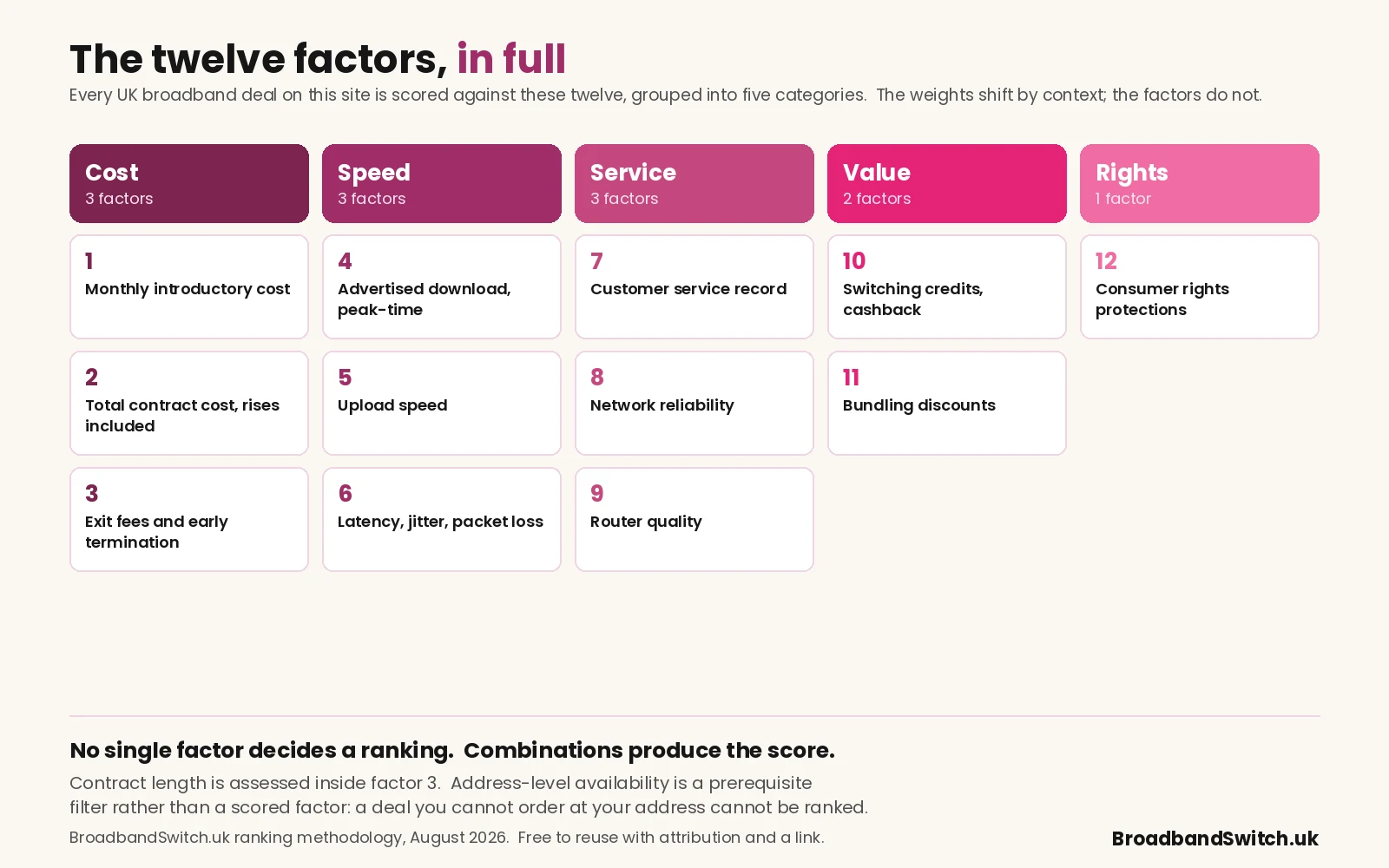
- Cost, three factors1. Monthly introductory cost. 2. Total contract cost including standard pricing and mid-contract rises. 3. Early termination charges and exit fees.Detailed below
- Speed, three factors4. Advertised download speed on the Ofcom average peak-time standard. 5. Upload speed. 6. Latency, jitter and packet loss where data exists.Detailed below
- Service, three factors7. Customer service track record. 8. Network reliability. 9. Router quality.Detailed below
- Value, two factors10. Switching credits and cashback offers. 11. Bundling discounts where applicable.Detailed below
- Rights, one factor12. Consumer rights protections, covering Automatic Compensation, dispute resolution, cooling-off terms and fixed-price guarantees.Detailed below
Two things that are not scored factors, and where they actually sit. Contract length is assessed inside Factor 3, because its practical consequence is the exit cost if your circumstances change. Address-level availability is applied as a prerequisite filter before scoring rather than as a factor, because a deal you cannot order at your address cannot sensibly be ranked against ones you can.
Cost: monthly price, total contract cost, exit fees
Cost is the most-cited factor in UK broadband decisions and the most commonly misrepresented. Ranking on the monthly introductory price alone misleads people about what they will actually pay.
- Factor 1 · Monthly introductory costThe headline price for new customers, applied for the introductory period. Important for short-term affordability and for cheapest-broadband questions, but never used alone. Introductory pricing typically rises 30 to 60% when the standard rate begins, and the April rise applies on top of whichever rate is active.
- Factor 2 · Total contract costThe realistic total across the full term: introductory price, the April mid-contract rise stated in pounds and pence under the rules in force since January 2025, any setup or activation fee, and any additional charges. This is the number that reveals a £30 introductory deal rising to £45 costing more overall than a £35 fixed-price alternative. See average monthly broadband cost.
- Factor 3 · Exit fees and early terminationThe charge for leaving mid-contract, typically the remaining monthly payments with a small discount applied, plus any equipment non-return charge. Weighted heavily for renters, students and anyone whose circumstances might change, and lightly for settled households. See exit and setup fees and router return charges.
Speed: download, upload, and the hidden metrics
Broadband marketing focuses on download speed, but real-world performance depends on more than that. We score three speed factors.
- Factor 4 · Advertised download speedThe Ofcom-mandated average peak-time figure, meaning the speed achieved by at least half of customers during peak hours, typically 8pm to 10pm on weekdays. Ofcom requires this rather than a theoretical maximum precisely because theoretical maximums mislead.
- Factor 5 · Upload speedIncreasingly decisive, and the number most often overlooked. Plenty of people discover their package gives 50 to 100 Mbps down but only 10 to 20 up when a video call starts breaking up. Where a symmetric full fibre package competes with an asymmetric one at a similar price, the symmetric package usually ranks higher for upload-heavy households. See upload versus download.
- Factor 6 · Latency, jitter and packet lossThe metrics that decide whether fast broadband actually feels smooth. Full fibre typically scores best, cable second, FTTC varies with line length, and 4G or 5G can suffer high jitter. Where Ofcom or independent test data exists we use it; provider claims alone are not sufficient. See latency, jitter and packet loss.
Service: support, reliability, router quality
Service quality matters substantially across a contract term but is harder to measure than price and speed. We use regulatory data, review platforms and complaint volumes rather than provider claims.
- Factor 7 · Customer service track recordOfcom's annual customer experience report, aggregate scores from Trustpilot, Reviews.io and Feefo, and complaint volumes reaching the Communications Ombudsman and CISAS. A £5 monthly saving from a poor-service provider frequently costs more in wasted time than it saves. Our complaints by provider report tracks the current picture.
- Factor 8 · Network reliabilityOfcom Connected Nations data, provider service status, documented outage history and independent speed-test data. Full fibre networks are generally more reliable than copper-based ones, cable can suffer localised peak congestion, established alternative networks are typically very reliable while some newer builds have teething issues, and mobile broadband varies with signal.
- Factor 9 · Router qualityWi-Fi standard supported, mesh capability, Ethernet ports, antenna design, independent review performance and any bundled extenders. Weighted heavily for multi-floor homes and device-heavy households, lightly where one router covers everything. Paid router upgrades at a few pounds a month are rarely worth it. See mesh versus extenders.
Value and rights: credits, bundles, protections
The last three factors cover what a deal adds beyond the monthly price, and what protects you when something goes wrong.
- Factor 10 · Switching credits and cashbackBill credits from providers and cashback through comparison routes both reduce the effective monthly cost materially: a £200 credit on a 24-month deal is worth £8.33 a month. We check the conditions, because claim windows and minimum terms mean headline values do not always translate into real savings. See switching credit and cashback and gifts.
- Factor 11 · Bundling discountsDiscounts for taking broadband alongside TV or mobile from the same provider, typically saving 5 to 10% against buying separately. Only counted where you would buy the bundled service anyway, because many households overspend on bundled TV they do not watch. See broadband and TV.
- Factor 12 · Consumer rights protectionsAutomatic Compensation participation, membership of a dispute resolution scheme, cooling-off terms, whether mid-contract rises are fixed in pounds and pence, and any fixed-price guarantee. Providers with stronger protections rank higher because you are better protected when things go wrong. See in-contract price rises.
The compensation rates we work from. Ofcom's Automatic Compensation scheme pays £6.46 per day for delayed activation, £32.31 for a missed engineer appointment and £10.34 per day for total loss of service beyond two working days. All major UK providers participate and several alternative networks do too; participation is part of Factor 12. Our compensation calculator works out what you are owed.
How rankings adapt to your question
Rankings cannot be one-size-fits-all, because a static list serves some readers well and others badly. We use the same twelve factors throughout and change how heavily each one counts. The explorer at the top of this page shows the same eight contexts interactively.
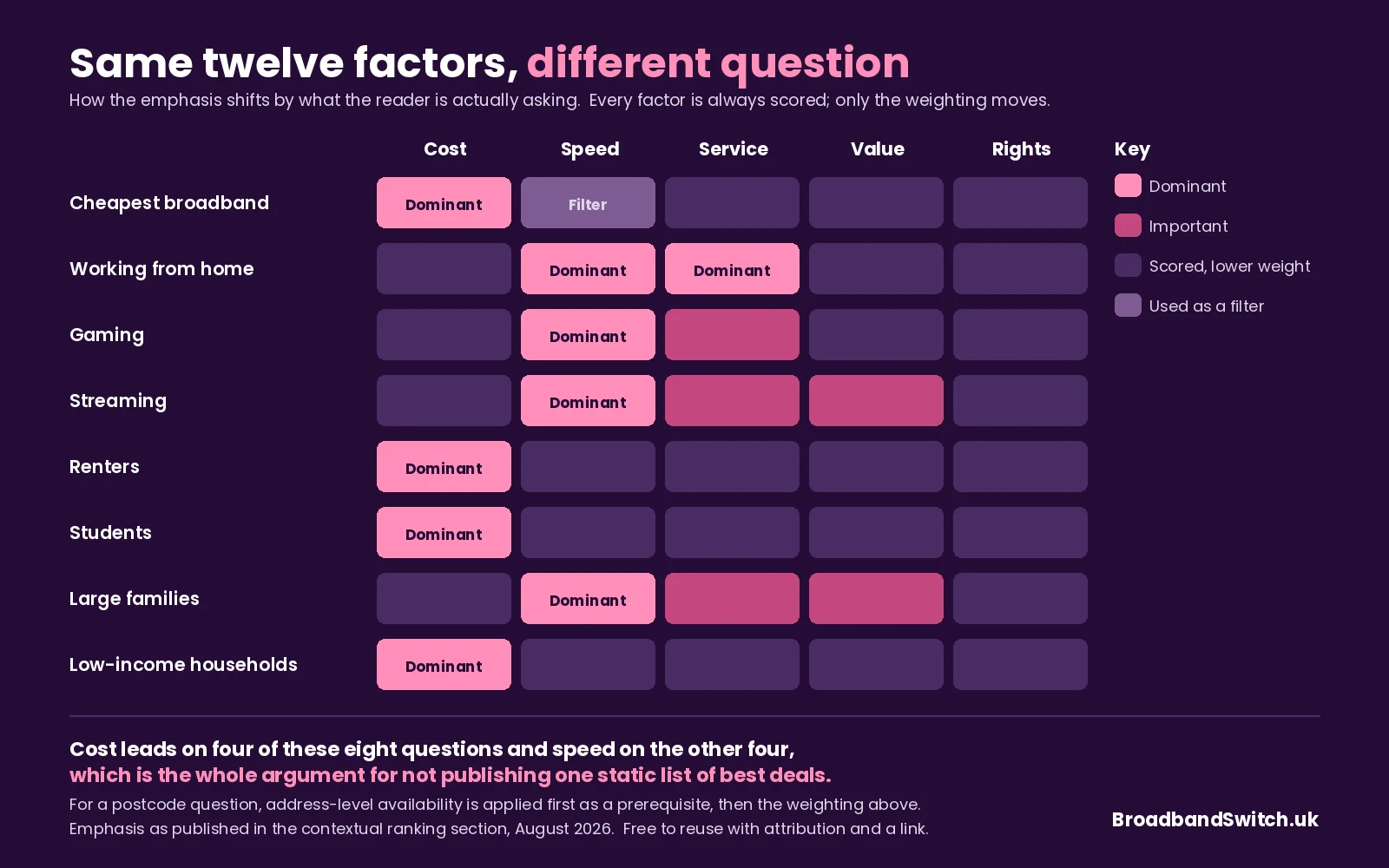
- Cheapest broadbandCost factors dominate. Speed is used to filter to acceptable performance. Service penalises poor providers but price stays primary.
- Working from homeUpload speed and network reliability dominate. Latency and jitter are important. Cost stays relevant but secondary to performance.
- GamingLatency, jitter and packet loss are critical. Full fibre typically ranks highest, cable competes, and router quality matters for wired play.
- StreamingDownload speed is primary. Reliability matters for buffering. Bundle integration with streaming services counts for some households.
- RentersContract flexibility is prioritised and early termination charges minimised. Setup costs and installation timelines are considered.
- StudentsCost factors dominate. Contract flexibility counts for term-time arrangements. Social tariff eligibility is highlighted where relevant.
- Large familiesSpeed factors are elevated for simultaneous use. Wi-Fi quality is important. TV bundle options may be relevant.
- Low-income householdsSocial tariff eligibility comes first. Standard pricing alternatives are evaluated for those above benefit thresholds. Cost is minimised across all factors.
For a postcode question, address-level availability is applied first as a prerequisite, and the weighting above then applies to whatever is genuinely orderable at your address. This contextual approach is part of the methodology rather than a workaround: different readers have genuinely different needs, and honest rankings should say so rather than pretend a single best answer exists.
Data sources and verification
Sources are prioritised by reliability, with verification processes to keep rankings grounded in current reality rather than marketing.
- Ofcom regulatory publicationsConnected Nations for coverage and performance, the annual telecoms customer experience report for service satisfaction, Automatic Compensation guidance, the voluntary code of practice on broadband speeds, social tariff guidance, and the pounds-and-pence price rise rules.Primary
- Provider Key Facts documentsRequired at sign-up under UK rules, showing monthly price, contract length, advertised speed, guaranteed minimum speed, price rise terms and applicable fees. Authoritative for what a package actually contains.Primary
- Customer review platformsTrustpilot, Reviews.io and Feefo aggregate scores, used for service patterns rather than individual reviews, which are often unrepresentative.Secondary
- Independent technical reviewersISPreview UK, Choose, Broadband.co.uk and ThinkBroadband for market analysis and router reviews, particularly useful for Factor 9.Secondary
- Direct provider verificationWhere data is unclear or contested, the editorial team contacts providers directly rather than guessing.As needed
- Our own researchOriginal analysis published in our reports series, including the UK broadband price index and market share tracking, feeds directly back into the model.Primary
- Ninety-day recency limitPricing data older than 90 days is flagged for re-verification. UK broadband prices change frequently and stale pricing is worse than none.
- Cross-source verificationImportant claims are checked against at least two independent sources where possible, and single-source claims are flagged as such.
- Provider claims tested, not acceptedMarketing claims are tested against Ofcom data, independent reviewers and customer experience reports rather than taken at face value.
- Editorial review before publicationThe editor and the reviewer both read each major page before it goes live, and significant pricing or factual claims are double-checked against source material.
- Reader feedback loops back inCorrections trigger review, and repeated feedback on the same issue is prioritised. See the corrections log for what has changed.
How affiliate fees work, and why they do not set rankings
We earn affiliate fees when readers click through and sign up with a new provider. Those relationships fund the editorial work. They do not determine rankings, and here is how the separation is structured.
- The standard industry modelProviders pay a commission, typically £30 to £100 or more, for each successful signup originating from a comparison site. This is how essentially every UK comparison platform is funded, including us.
- What we do not doWe do not accept payment in exchange for ranking placement, and we do not publish sponsored content disguised as objective ranking. Commercial content, where it exists, is labelled as such.
- The structural separationThe editorial team makes ranking decisions using the twelve-factor model and does not see commission rates while doing so. The commercial team handles affiliate relationships and does not review or influence editorial decisions before publication.
- The honest caveatNo comparison site can claim perfect immunity from commercial influence. Structural separation is a protection, not a guarantee. We would rather say that plainly than claim a purity nobody can evidence.
The test that actually proves it. The most reliable signal is whether a comparison site recommends lower-commission providers when those genuinely offer better value. We do: alternative networks and smaller providers frequently rank above major providers in their coverage areas despite often paying us less, and some appear in our results with no affiliate relationship at all. You can check this yourself by comparing our results against comparison sites that show only the major providers. Full detail in our affiliate disclosure.
What we will not do, under any circumstances
Transparency means being explicit about what we refuse to do, not only what we do. These commitments are not negotiable against commercial pressure.
- 1. Rank by commissionHigher-commission providers do not get higher rankings, lower-commission ones do not get lower rankings, and paid placement is not part of the model.
- 2. Hide the caveatsStandard pricing after the introductory period, April rises, exit charges, equipment return charges, availability limits and service records are all documented rather than buried.
- 3. Exclude providers who do not pay usWhere a provider offers better value in its coverage area, it appears in our rankings whether or not we have any commercial relationship with it.
- 4. Pretend alternative networks are not thereOur comparison checks what is available at your specific address rather than defaulting to the major providers, and alternative networks appear alongside them where they serve you.
- 5. Recommend a deal to someone who should not buy itIf a social tariff, a lower speed tier, or a different technology entirely would serve you better, we say so, even when saying so costs us the commission.
- 6. Move rankings for short-term gainTactical shifts towards high-commission deals during promotional periods would destroy the editorial integrity that makes long-term trust possible. We would rather earn less, consistently.
How to challenge or correct our rankings
Transparency without accountability is just marketing. If you think a ranking is wrong, whether on facts, on missing alternatives, or on the methodology itself, these are the routes.
- Submit a correctionEvery page links to our corrections process. Send specific factual corrections, such as incorrect pricing, outdated regulatory information or a missing provider, and we review and update where we are wrong. Typical resolution is two to five working days.
- Challenge the methodology itselfIf you disagree with how we weight factors, or with the model, the same process accepts that. Substantive challenges go to the editorial team. We update where a challenge identifies a genuine improvement, and explain our reasoning where we disagree.
- Providers use the same routeA provider wanting to challenge its position uses the same process and meets the same evidence standard as any reader. Claims about a provider's own service need verifying rather than accepting.
- External routes exist tooIf you think published information is misleading, the Advertising Standards Authority, Trading Standards and Ofcom are all available, and we engage constructively with each. For a dispute with a provider rather than with us, the Communications Ombudsman and CISAS provide free independent resolution.
- Corrections are published, not quietly patchedSignificant corrections are documented in the update log below and in the site-wide corrections log, so accountability is visible rather than silent.
When we will not change a ranking. A methodology disagreement is not necessarily an error. You may prefer more weight on price and less on service quality; that is a legitimate preference rather than a fault in the model, and we document our reasoning precisely so you can apply your own weights. Where a provider's marketing conflicts with Ofcom data, we side with Ofcom. Where customer reviews conflict with provider claims on service quality, we weight the reviews more heavily. Both of those are deliberate parts of the method.
Update log for this page
We promise that significant corrections appear in change-log format on the affected page. This is that log. Routine copy edits are not listed; changes to the model, to published figures, or to anything a reader might have relied on are.
-
Corrected the twelve-factor list, which previously appeared in three non-matching versions on this page. The numbered factor sections are canonical and the summary lists now match them. Clarified that contract length is assessed inside Factor 3 and that address-level availability is a prerequisite filter rather than a scored factor. Corrected a section that described three speed factors as four, and a heading that grouped two value factors under rights. Removed a Virgin Media switching credit offer whose stated deadline of 1 April 2026 had passed. Corrected the CISAS link to match the scheme's current address. Removed named-product prices that cannot be maintained between reviews, pointing to the live comparison instead. Added this update log.
-
Page first published, documenting the four principles, the twelve-factor model, contextual weighting, data sources, the affiliate relationship and the challenge process.
Our update cadence
- Pricing within 90 daysAny pricing data older than 90 days is flagged for re-verification, because UK broadband prices move constantly.
- Market news triggers updatesPrice rise announcements, which typically arrive in January and February for April increases, regulatory changes, and major package launches or withdrawals all trigger content updates.
- April rises, annually and earlyCoverage of each April's mid-contract rises is published before the effective dates so readers can budget rather than react.
- Provider changes, monthlyNew packages, withdrawn packages and speed or price changes are incorporated as they are announced.
- Regulatory updates as publishedOfcom's Connected Nations report, the annual customer experience report and Automatic Compensation rate changes are incorporated when Ofcom publishes them.
- Editorial review twice a yearMajor pages are reviewed at least twice annually for currency, and less time-sensitive content annually.
The last updated date in the byline reflects the most recent substantive content change rather than a formatting tweak, and the dateModified in our structured data matches it, so search engines and AI assistants can assess currency accurately.
Related documents
- Methodology and trust hub
- Why trust us
- Editorial policy
- Affiliate disclosure
- AI and automation disclosure
- Submit a correction
- Corrections log
- About BroadbandSwitch.uk
- Adrian James
- Dr Alex J. Martin-Smith
- Accessibility statement
- Contact the editorial team
- Our research reports
- How to compare deals yourself
- Broadband glossary
Our ranking methodology, asked and answered
How does BroadbandSwitch.uk make money if rankings are not determined by commission?
We earn affiliate commission when a reader clicks through and signs up with a provider, typically £30 to £100 or more per signup. That funds the editorial work without setting the rankings, because the editorial team scores deals against the twelve documented factors and does not see commission rates while doing so. The structural separation is a protection rather than a guarantee. The evidence that matters is whether we recommend providers who pay us less when they genuinely offer better value, and we do.
Why do your rankings sometimes differ from other comparison sites?
Four reasons. Methodology: we sort by cost per month, low to high, and we publish a Total Contract Value calculator so you can check the full-term cost, and we treat upload speed and service record as primary factors rather than footnotes. Coverage: some sites show only the major providers, while we check what is actually available at your address. Context: we weight the same factors differently depending on what you are asking. And commercial: some sites let commission shape rankings more than method does.
Can I trust your rankings when you earn affiliate fees?
Healthy scepticism is reasonable, so judge us on evidence rather than assurance. There is editorial and commercial separation, a fully documented model you can check our results against, named authors with a traceable record, cited regulatory sources rather than marketing claims, a corrections process anyone can use, and six published commitments we will not cross. None of that guarantees perfection. The most useful test is to compare our results against sites that exclude alternative networks, and against the provider's own site.
What if I disagree with how you have ranked a deal?
Use the corrections process, which accepts factual corrections and methodology challenges alike, with typical resolution in two to five working days. We update where we are wrong and explain our reasoning where we disagree. If you simply prefer different weightings, that is a legitimate preference rather than an error, which is exactly why the model is documented: you can apply your own weights. External routes through the Advertising Standards Authority, Trading Standards and Ofcom remain open.
Why not just rank by the cheapest monthly price?
Because the monthly introductory price is not what most people end up paying. It typically rises 30 to 60% when the standard rate begins, and the April rise applies on top. A £30 deal that becomes £45 can cost more across a term than a £35 fixed-price one. Cheapest also is not one answer: a renter should weight exit fees, a home worker should weight upload speed, and anyone on qualifying benefits should check social tariffs first.
Do alternative networks get fair treatment in your rankings?
Yes, and structurally so. Our comparison checks availability at your specific address rather than defaulting to the major providers, so where an alternative network serves you it appears alongside them. Smaller providers with no affiliate relationship still appear if they offer better value, which they frequently do on symmetric upload and gigabit-class packages. We document their limitations honestly too: coverage is patchy, bundling options are limited, and support organisations are smaller.
What data sources do you use to evaluate providers?
Ofcom publications first, covering coverage, customer experience, compensation and speed advertising rules. Then provider Key Facts documents, which are the authoritative record of what a package contains. Then aggregate scores from Trustpilot, Reviews.io and Feefo for service patterns, and independent reviewers including ISPreview UK and ThinkBroadband for technical analysis. Pricing older than 90 days is re-verified, important claims are cross-checked against at least two sources, and provider marketing is tested rather than accepted.
How often do you update the rankings?
Pricing data is re-verified within 90 days. Market events trigger immediate updates, including price rise announcements, regulatory changes and package launches or withdrawals. April rises are covered annually before they take effect. Provider package changes are tracked monthly and regulatory updates incorporated as Ofcom publishes them. Major pages get a full editorial review at least twice a year, and reader corrections trigger review whenever they arrive.
About this document. Written by Adrian James, broadband editor, and reviewed by Dr Alex J. Martin-Smith, head of editorial, with every rate and rule stated as published at 9 August 2026. BroadbandSwitch.uk is an independent UK broadband comparison service, a trading name of SearchSwitchSave, Isle of Man company 030828B, registered at Sycamore House, Glen Duff, Lezayre, IM7 2AT. We earn commission when you order through our comparison, which never changes the price you pay. This page is the methodology; the affiliate disclosure covers the commercial relationships, the editorial policy covers editorial standards, and the methodology and trust hub is the full operational reference. Spotted something wrong on this page? Submit a correction and a human will read it.
References
- Ofcom. (2025, November 19). Connected Nations 2025: UK report. Office of Communications. Retrieved August 9, 2026, from https://www.ofcom.org.uk/phones-and-broadband/coverage-and-speeds/nations-report-2025
- Ofcom. (2024, July 19). Ofcom bans mid-contract price rises linked to inflation. Office of Communications. Retrieved August 9, 2026, from https://www.ofcom.org.uk/phones-and-broadband/bills-and-charges/ofcom-bans-mid-contract-price-rises-linked-to-inflation
- Ofcom. (2024, September 12). Simpler and quicker broadband switching is here. Office of Communications. Retrieved August 9, 2026, from https://www.ofcom.org.uk/phones-and-broadband/switching-provider/simpler-broadband-switching-is-here
- Ofcom. (n.d.). Social tariffs: cheaper broadband and phone packages. Office of Communications. Retrieved August 9, 2026, from https://www.ofcom.org.uk/phones-and-broadband/saving-money/social-tariffs
- Communications Ombudsman. (n.d.). Free independent dispute resolution for communications complaints. Retrieved August 9, 2026, from https://www.commsombudsman.org/
- CEDR. (n.d.). CISAS: communications and internet services adjudication scheme. Centre for Effective Dispute Resolution. Retrieved August 9, 2026, from https://www.cedr.com/consumer/cisas/
The best check on any methodology is whether it produces sensible answers. Run your postcode and see what the twelve factors surface at your address, then compare it against the provider's own site.
Independent, free, no signup. Including providers we earn nothing from.