EDINBURGH · THE CITY OF EDINBURGH COUNCIL AREA
Broadband in Edinburgh: what reaches your address, and what you should pay
Edinburgh is better served than most of Scotland and the wrong unit to judge it by is the city. In January 2026, Ofcom’s figures put full fibre within reach of 84% of Edinburgh homes, against 75% for Scotland and 82% for the UK, but inside the city it ran from 70% in Edinburgh Central to 94% in Edinburgh Western. The tenements and the old streets in the middle are where the gaps are.
The second thing to know is that most of the fibre is lying unused. Only 40% of the Edinburgh premises that could get full fibre had taken it, which puts the city 24th out of Scotland’s 32 councils. Openreach put it this way in August 2026: “Most of Edinburgh is now covered by Full Fibre, but many residents and businesses still haven’t made the switch”.
So this page does two jobs. It puts the real figures for every part of the city side by side, from Ofcom’s own data and from what each network says on its own site. And it sends you to the one check that answers the question for your address, because in Edinburgh the answer changes from one stair to the next.
Want the figures for your part of the city? Jump to the area table. Ready to look? See what reaches your postcode.
Check your address first
Direct answer: 11 to 15 gigabit networks are expected in Edinburgh by 2029, on Ofcom’s count, and none of them reaches every street or every stair, so the only true answer is the one your own address returns.

The rest of the page is there to make sense of what the check returns, which is why the check comes first: until you know which networks reach your stair, you cannot know which of the sections below are about you.
Full fibre, area by area
Direct answer: In January 2026, full fibre reached 84% of homes across the City of Edinburgh, from 94% in Edinburgh Western down to 70% in Edinburgh Central, according to Ofcom.
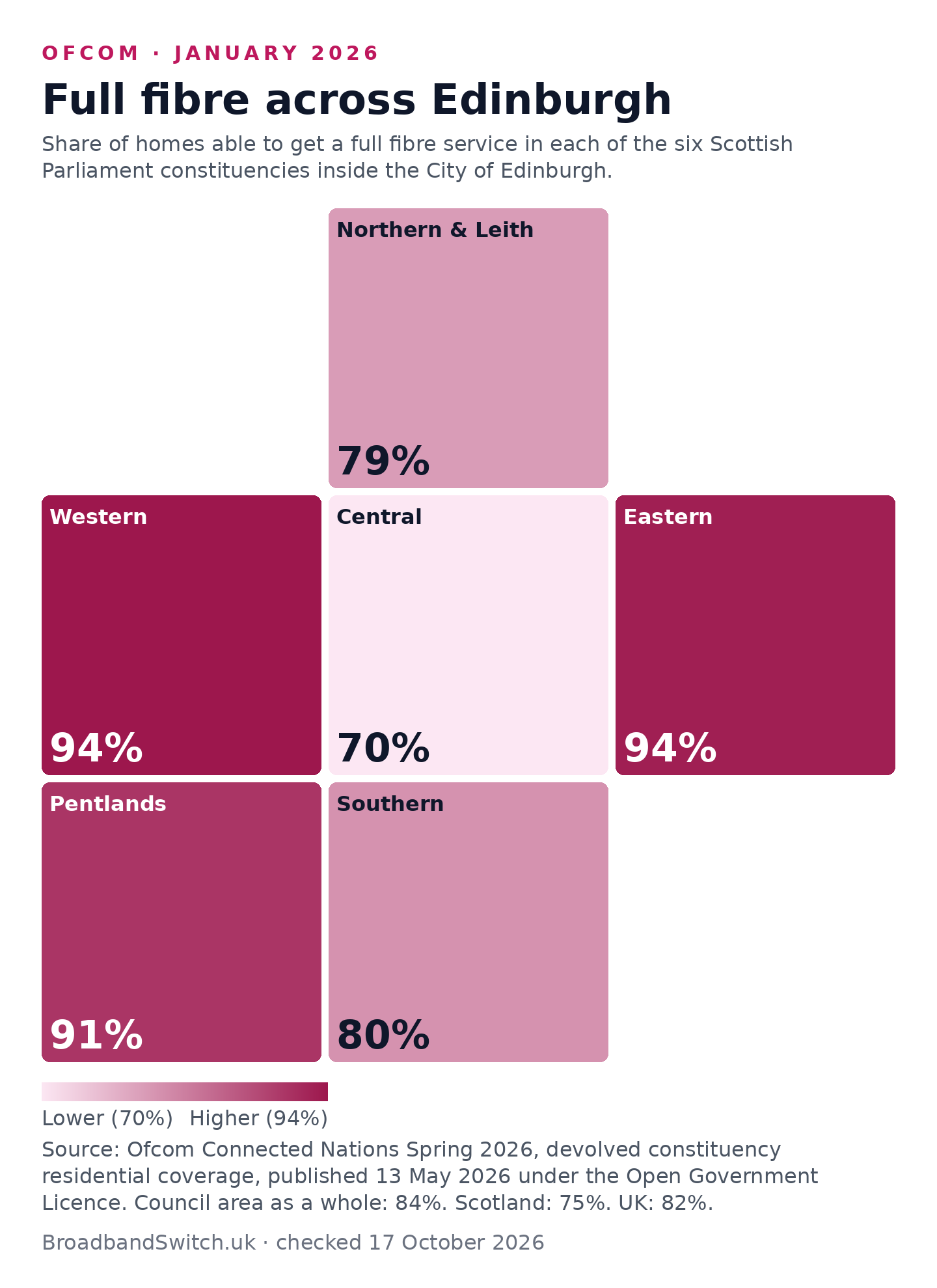
Twice a year Ofcom publishes a coverage figure for every council in the UK and, usefully for a city this size, for each parliamentary seat inside it. Edinburgh therefore comes in six pieces rather than one number. All of the figures here are from the Spring 2026 update of 13 May 2026, describing January 2026, and all of them count homes rather than business premises, which keeps them on the same base as the UK’s 82% and Scotland’s 75%. Two definitions matter. Full fibre, in Ofcom’s words, is “An access network structure in which an optical fibre runs all the way from customers’ premises to the local exchange or access node.” Gigabit-capable means “A network connection to a customer’s premises capable of delivering download speeds of 1 Gbit/s or more.” The second is the broader of the two, since Virgin Media’s cable counts towards it and towards nothing else on this page.
Two things stand out. The first is how far the centre lags: 70% could get full fibre in Edinburgh Central, against 94% in Edinburgh Western, and the two areas with the most tenements, Central and Northern and Leith, are the two lowest. The second is that the council area as a whole, at 84%, is only ninth of Scotland’s 32 councils. The leader, Midlothian, is just over the city bypass at 93%, and Glasgow is at 92%. Across the 361 councils in the UK, Edinburgh sits 154th. Good, then, but not the finished city the headline suggests.
| Which part of the city | ||||
|---|---|---|---|---|
| Edinburgh Western | the west of the city, out to the Forth | 94% | 97% | 42,080 |
| Edinburgh Eastern | the east of the city, Portobello included | 94% | 98% | 49,017 |
| Edinburgh Pentlands | the south west, out to the Pentland edge | 91% | 98% | 35,322 |
| Edinburgh Southern | the south of the city | 80% | 93% | 41,297 |
| Edinburgh Northern and Leith | Leith and the north of the city | 79% | 93% | 54,305 |
| Edinburgh Central | the city centre, with the Old Town and the New Town | 70% | 82% | 51,898 |
The six areas are the Scottish Parliament constituencies inside the City of Edinburgh council area, which is how Ofcom cuts the city. The descriptions are ours and only rough; Ofcom uses the constituency boundaries. Full fibre and gigabit are the share of homes (residential premises) able to get each, Ofcom, January 2026, published 13 May 2026. Tap a column heading to sort.Swipe the table sideways for the homes column.
Two cautions before you read your own area off that table. An area figure is an average over forty to fifty thousand homes, and the streets inside it vary far more than the areas do between themselves: one tenement stair can be wired while the next is not. And “can get” is not “has got”: the next section is about how many Edinburgh homes have actually taken what passes their door, and that is where the city’s story gets uncomfortable.
Built but not bought: Edinburgh’s take-up gap
Direct answer: In January 2026, 40% of the Edinburgh premises that could get full fibre had a full fibre line, Ofcom says, which ranks the city 24th of Scotland’s 32 councils and 276th of the UK’s 361. Everyone else on those streets is paying for something slower than what already passes the door.
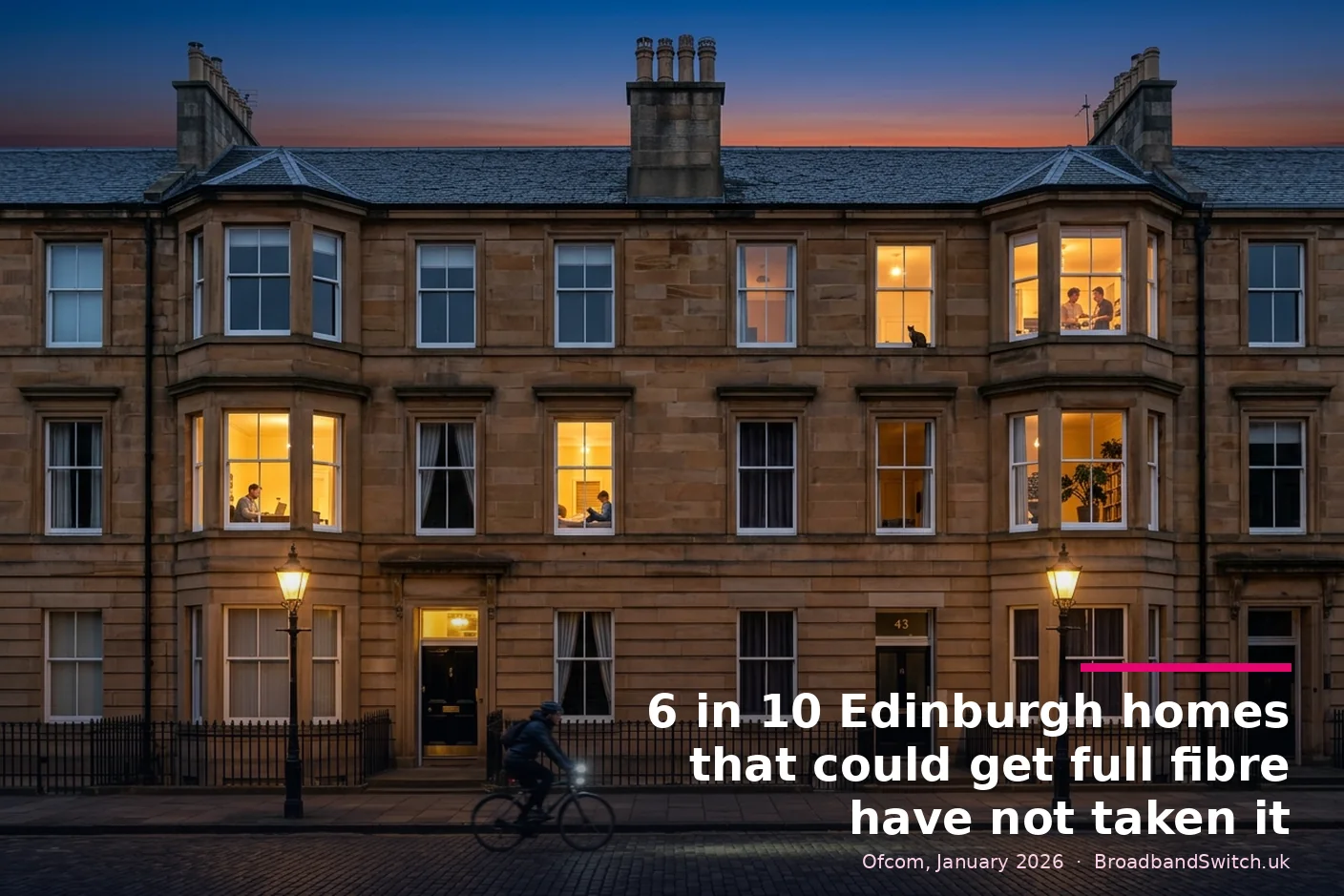
Ofcom, January 2026
Every 100 Edinburgh homes: what passes the door, and what is used
- 34have a full fibre line
- 50could get full fibre and have not taken it
- 9can get gigabit speeds over cable, not full fibre
- 7can get neither yet
Ofcom Connected Nations Spring 2026, City of Edinburgh residential row: full fibre 84%, gigabit-capable 93%, full fibre take-up 34% of all homes. Each house is one home in a hundred; our arrangement.
Openreach said it in its own release about the city on 3 August 2026, under a headline about people “yet to benefit”: “Most of Edinburgh is now covered by Full Fibre, but many residents and businesses still haven’t made the switch”. The same release puts the reach of its own network at “more than 75% of properties in the area now able to upgrade their broadband service”. Ofcom’s figures say the same thing with numbers: 40% of covered premises in Edinburgh had taken full fibre, against 47% across Scotland on our weighting of the council rows and “47% of all premises with access to full fibre” for the UK, in Ofcom’s words. Midlothian, next door, is the highest council in Scotland at 70%; West Dunbartonshire is the lowest at 23%.
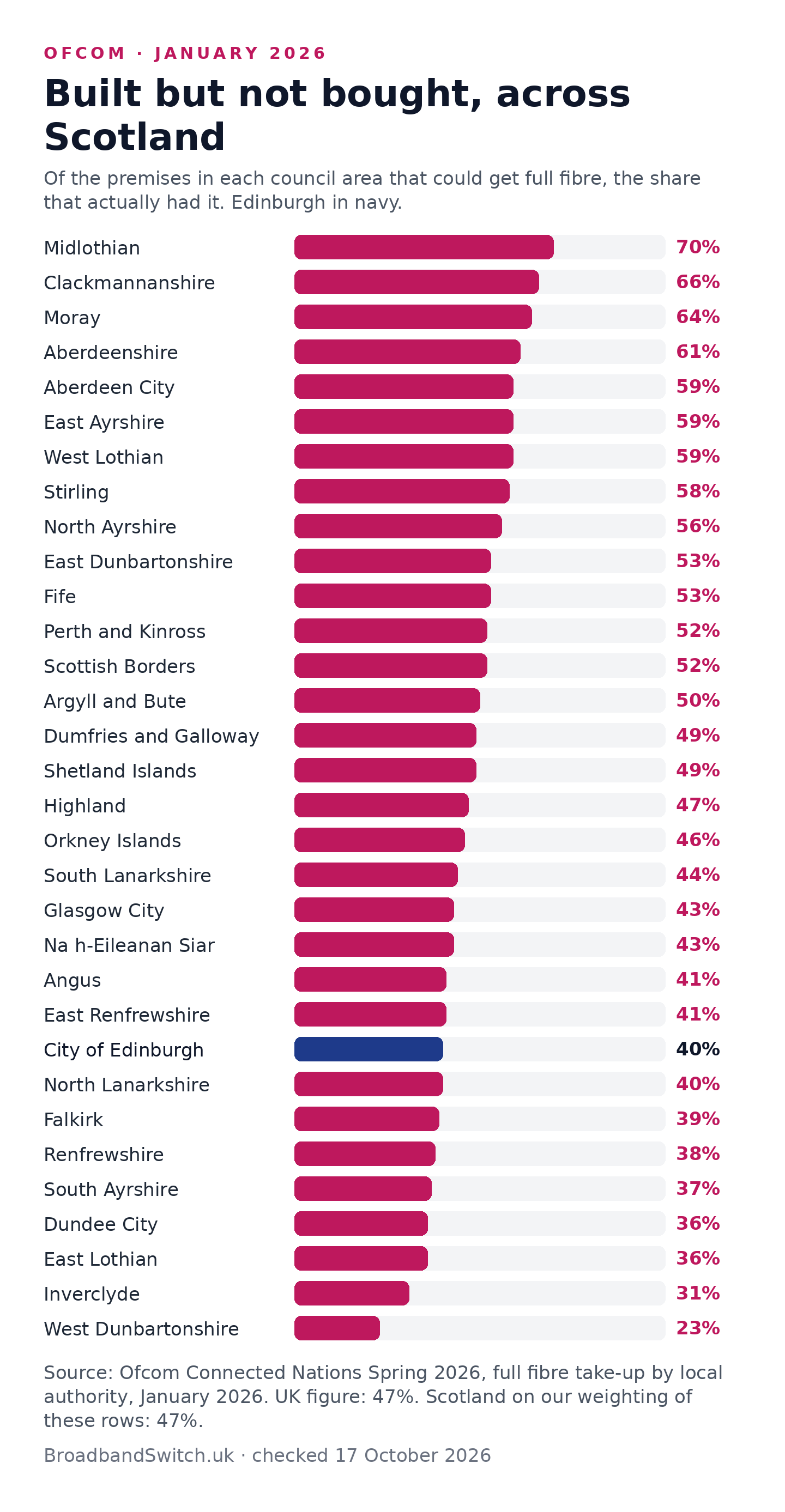
Why Edinburgh in particular? Ofcom publishes the figures and not the reasons, so this page does not guess. Two things on the page are at least consistent with it: more than half the city lives in flats, where the line into the building and the line into the home are two separate jobs, and nearly a quarter of households rent privately, where the broadband contract often outlives the tenancy. Both are covered further down.
What that gap means for you
Six in ten covered Edinburgh homes have not moved to fibre, so if your broadband has not changed in a couple of years there is a fair chance a faster line already runs past your door and nobody has mentioned it. Fibre need not cost more than the copper it replaces; where two or three networks are competing for one stair it frequently costs less. Run the postcode check at the top and the address answers for itself, cheapest first.
The take-up gap has a deadline attached. Once three quarters of an exchange area can get full fibre, Openreach stops selling copper broadband there, and the analogue phone network itself closes on 31 January 2027. Edinburgh is well into both, which is why they get their own section below.
The networks that build in Edinburgh
Direct answer: Openreach, CityFibre, Virgin Media with nexfibre, and Hyperoptic in some blocks of flats, with YouFibre and GoFibre building up to the city’s edges. Ofcom expects 11 to 15 gigabit-capable operators to be running in the council area by January 2029.
Behind every broadband bill there are two companies, and most people only ever meet one of them. The brand you pay rents space on a physical network, and in Edinburgh the big brands rent on more than one, which is how Vodafone or Sky can quote two prices on opposite sides of the same street. What follows is what each network itself says about the city, taken from its own website on the date shown.
Openreach, the network behind most of the big brands
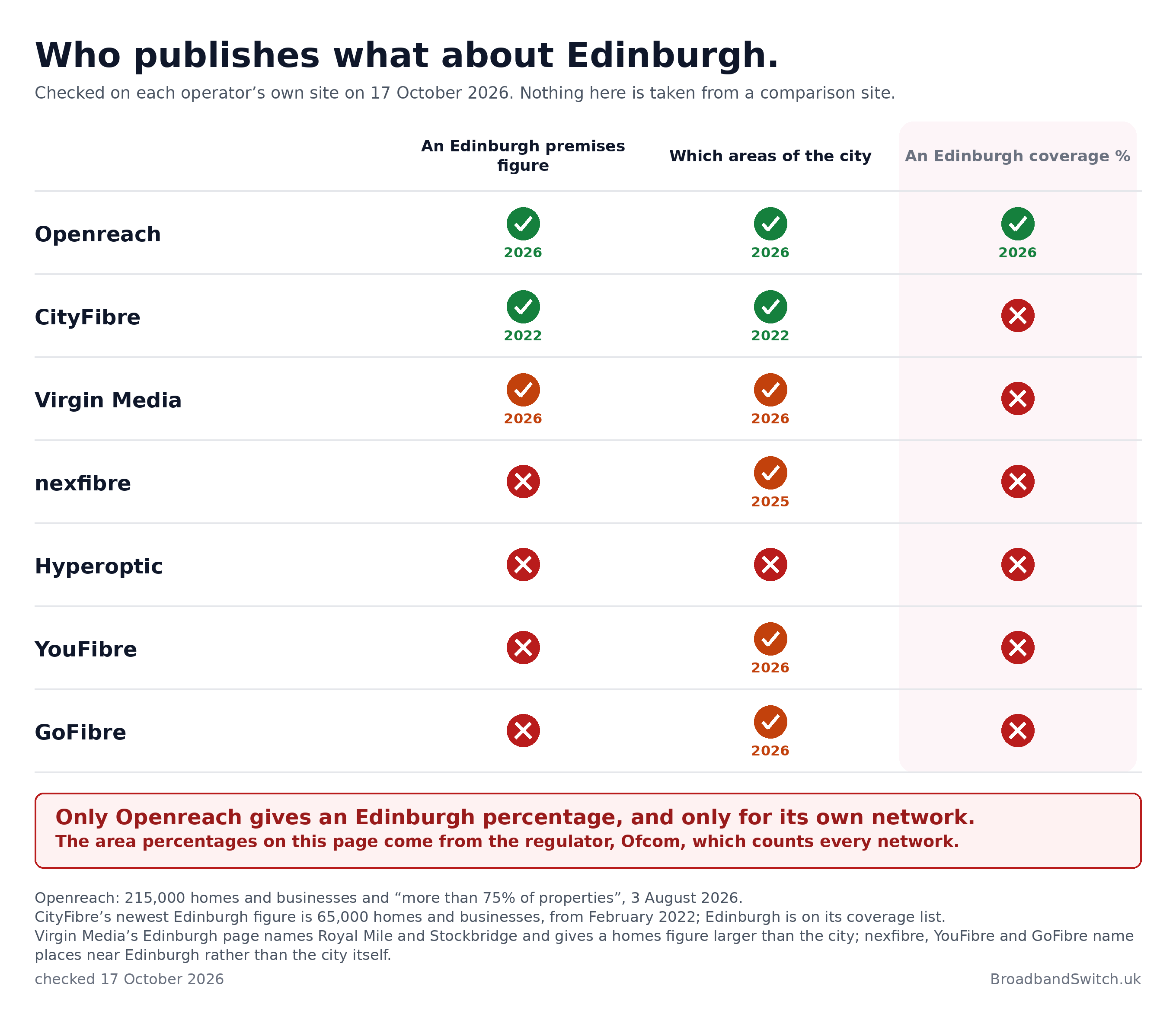
Whoever you pay, there is a fair chance the line is Openreach’s: BT, Sky, TalkTalk, Vodafone, EE, Plusnet and most of the smaller brands rent it. Openreach is also the only network that states an Edinburgh number and refreshes it. Its release of 3 August 2026 says “Full Fibre broadband is now available to over 215,000 homes and businesses across Edinburgh”, puts the spend at “around £64m”, and adds that there are “more than 75% of properties in the area now able to upgrade their broadband service”. Three quarters of the city on its own wires, by its own count; Ofcom’s 84% for the council area is every network added together.
Openreach also names the parts of Edinburgh it is working in, which is rare. Its Scottish release of 28 May 2024 opens its list of places next in line with “People living in Port Glasgow in Inverclyde, Possil in Glasgow, Wester Hailes in Edinburgh”, puts the Pentland exchange, which serves Currie and Balerno, in its table, and says of the new places: “They join 1.2 million homes and businesses across Scotland who already have access”. Nationally it says “Openreach’s Full Fibre network now reaches 23 million homes and businesses across the UK”, and that “The company plans to extend this to 25 million by the end of 2026, with the potential to reach 30 million by 2030 with the right investment conditions”.
CityFibre, the second wire under most of the city
CityFibre is the full fibre network that Vodafone, Sky, TalkTalk and Zen sell over, and in Edinburgh it is the reason so many addresses have two sets of prices. Edinburgh is on its coverage list under the heading “Cities served by our network”, with Aberdeen, Dundee, Edinburgh, Glasgow, Inverness and Stirling, and the list says the network is “available to over 4.5 million premises across the UK”. Its last Edinburgh-specific figure is older than you would like: on 28 February 2022 it said “More than 65,000 homes and businesses across Edinburgh can now access the best digital connectivity”, that “In Edinburgh alone, CityFibre has invested £100m”, and that “CityFibre has been making great progress in Edinburgh since 2019”. It named Currie and Balerno among the finished neighbourhoods and Redford, Craiglockhart, Portobello, Wester Hailes and Kingsknowe as next, and said that “Once the city-wide rollout reaches completion in 2024, almost every home and business locally will have access”. It has published no Edinburgh completion statement since, so whether that 2024 promise was met is something only the postcode check can tell you for your own street.
Two things to know before you order. The brands selling over CityFibre in the city were “launch partner Vodafone, plus TalkTalk and Zen” in 2022. Its national provider list now runs to 44 companies, including Sky, TalkTalk, Vodafone and Zen. Which of them serves your address only shows once you check it, because, in CityFibre’s words, “Availability can occasionally vary between neighbouring properties”. Nationally it reported 4.8m premises passed and 1,108k customer connections in its October 2026 trading update, and in June 2026 said it “has connected over one million premises”.
Virgin Media, on its own cable and on nexfibre’s fibre
Nobody sells on Virgin’s cable except Virgin, because Virgin built it and keeps it. The company has a second route into Edinburgh homes too: nexfibre, a separate fibre builder. The coverage report nexfibre published for the end of December 2025 puts Edinburgh in its current footprint, with Penicuik, Dunbar and West Calder close by. It warns that “locations listed as part of nexfibre’s existing footprint may or may not yet have services available and services may not be available to every premise in a particular location”. Virgin’s own Edinburgh page is candid about the patchiness: “What’s available to you will depend on where you live in Edinburgh and our speeds can vary street to street”, it says, naming the Royal Mile and Stockbridge by way of example.
One line on that page needs flagging, because it is the kind of number that ends up repeated elsewhere. It says “1.5 million homes in the Scottish capital can get gigabit speeds with our fastest widely available broadband”. Ofcom counts 273,911 homes in the whole council area, so the sentence cannot be describing Edinburgh, and Virgin publishes no Edinburgh coverage percentage anywhere we could find. Its newest dated Edinburgh announcement is from 2 July 2020, when it said “Edinburgh and Liverpool become the next cities to benefit from Gig1 offering average download speeds of 1,104Mbps”. Its page still makes the point that “Edinburgh was actually the first city in Scotland to get our Gig1 Fibre Broadband deals”. The standing caveat is “Virgin Media services are only available in eligible Virgin Media network areas”, and its social tariff is sold in the city: “social tariff broadband only deals in Edinburgh which start from £12.50 a month”.
Hyperoptic, which wires the building rather than the street
Hyperoptic builds to buildings, which in a tenement city is the whole point. “We only deal in full fibre broadband, which means we offer fibre all the way to your building”, it says, and “We focus exclusively on high density urban areas and cover 64 towns and cities in the UK”. One stair wired, the next not, is the normal pattern for a network like this, so its presence on a street tells you little about any flat on it. There is no Edinburgh page to consult: on 17 October 2026 the address where one would live answered “Sorry, we cannot find that page”. Its national line is “Our network now passes more than 2 million homes”, and in the blocks it serves its Fair Fibre social tariff costs £13 a month for 150 Mbps.
The builders at the edges
Two more networks reach the city boundary without crossing it on their own lists. YouFibre says “YouFibre is bringing 100% full-fibre broadband to homes across central Scotland”, and its Scotland list names Livingston and Musselburgh among its towns, with no Edinburgh entry. GoFibre says its fibre is in places “including Aberdeenshire, Angus, East Lothian, Fife, Scottish Borders, and beyond”, and its locations page names Dunbar, Haddington, North Berwick, Prestonpans in East Lothian but nothing in the City of Edinburgh. Both matter if you are in Musselburgh, Livingston or the East Lothian towns rather than the city itself. Ofcom’s count of 11 to 15 operators expected in the council area includes business networks and smaller builders that name no area at all, which is one more reason the address check beats any list, including this one.
What is coming by 2029
Direct answer: Not much more fibre, on the operators’ own plans: Ofcom’s planned deployments file puts Edinburgh at 86% of homes with full fibre by January 2029, up 1.6 points from January 2026, while Fife goes from 73% to 92%. What Edinburgh gets instead is choice: 72% of homes are expected to have two or more gigabit networks at the door.
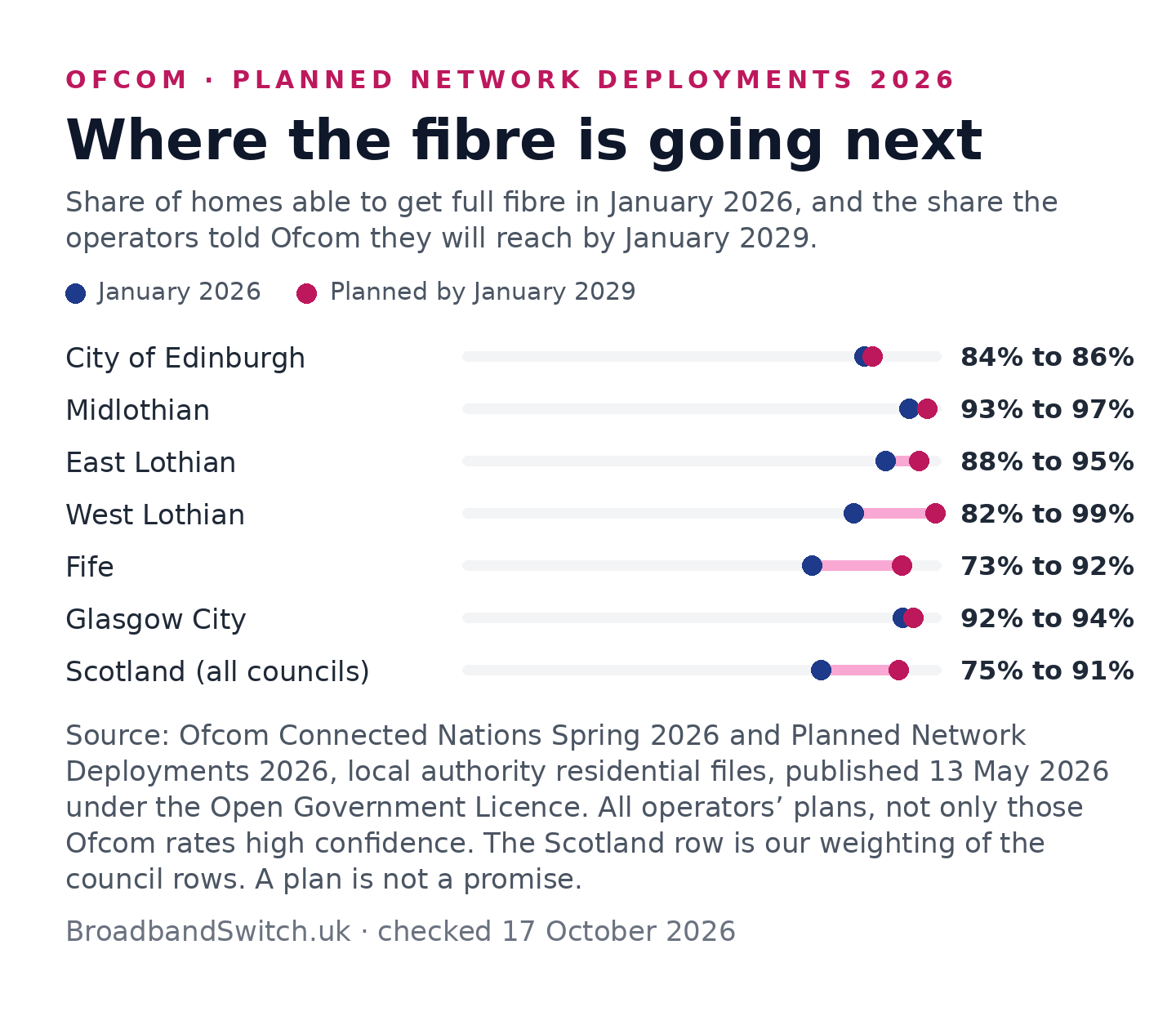
Once a year the builders tell Ofcom where they intend to be, and Ofcom adds the answers up for each council. Edinburgh’s January 2029 figure comes out at 86% for full fibre and 94% for gigabit-capable coverage; strip out everything except the plans Ofcom rates ‘High Confidence’, meaning those that “have reached both the low-level design stage and for which funding has been committed”, and the gigabit figure is still 94%. The plans are solid, then. There are simply few of them, because most of the city was wired years ago. The same file expects 11 to 15 gigabit-capable operators to be running in the council area by 2029, with 72% of homes able to pick between two or more and 35% between three or more. Scotland as a whole moves from 75% to 91% on the same plans, and the fastest risers on Edinburgh’s doorstep are Fife and West Lothian.
The number that matters most for someone in the centre is the one Ofcom gives for postcodes with no gigabit-capable plan at all by January 2029: 396 in the council area. That is a small share of a city with 238,900 homes, but if you live in one of them the next three years will not change it, and the voucher below is the route you should ask about. Openreach’s own national plan, in its words: “The company plans to extend this to 25 million by the end of 2026, with the potential to reach 30 million by 2030 with the right investment conditions”. CityFibre said in 2022 that “Once the city-wide rollout reaches completion in 2024, almost every home and business locally will have access”.
Public money does not reach the city’s build, and the files say so plainly. No Project Gigabit contract covers the City of Edinburgh: the two Scottish entries in the gov.uk contracts collection are North East Scotland and Borders and East Lothian, where the government “awarded broadband provider GoFibre a Project Gigabit contract” to “provide up to 10,700 premises across the Borders and East Lothian”. Ofcom’s row for Edinburgh counts 68 planned new lines funded from public money. The Scottish Government’s own programme is for the hardest places: “Reaching 100% (R100) is a £600+ million Scottish Government programme”, and “The R100 contracts are delivering around 113,000 connections”, delivered by Openreach. Two vouchers still apply to an Edinburgh address that cannot get a gigabit service. The UK scheme says “Eligible homes and businesses can access vouchers worth up to £4,500” if “existing available broadband download speeds are less than 1Gbps”, and lists Scotland (Central and North) as lot 39. The Scottish scheme is the other: “The scheme currently provides a subsidy of up to £5,000 for eligible properties”, and it “will close to new applications on 20 November 2026”.
Your exchange and the copper switch-off
Direct answer: Edinburgh had 39,132 telephone lines still to move off the old copper network in September 2026, 8.82% of its 443,783 lines, on Openreach’s count, and the old network goes dark at the end of January 2027. Two city exchanges, Colinton and Liberton, were named in Openreach’s 2025 and 2026 copper stop sell announcements.
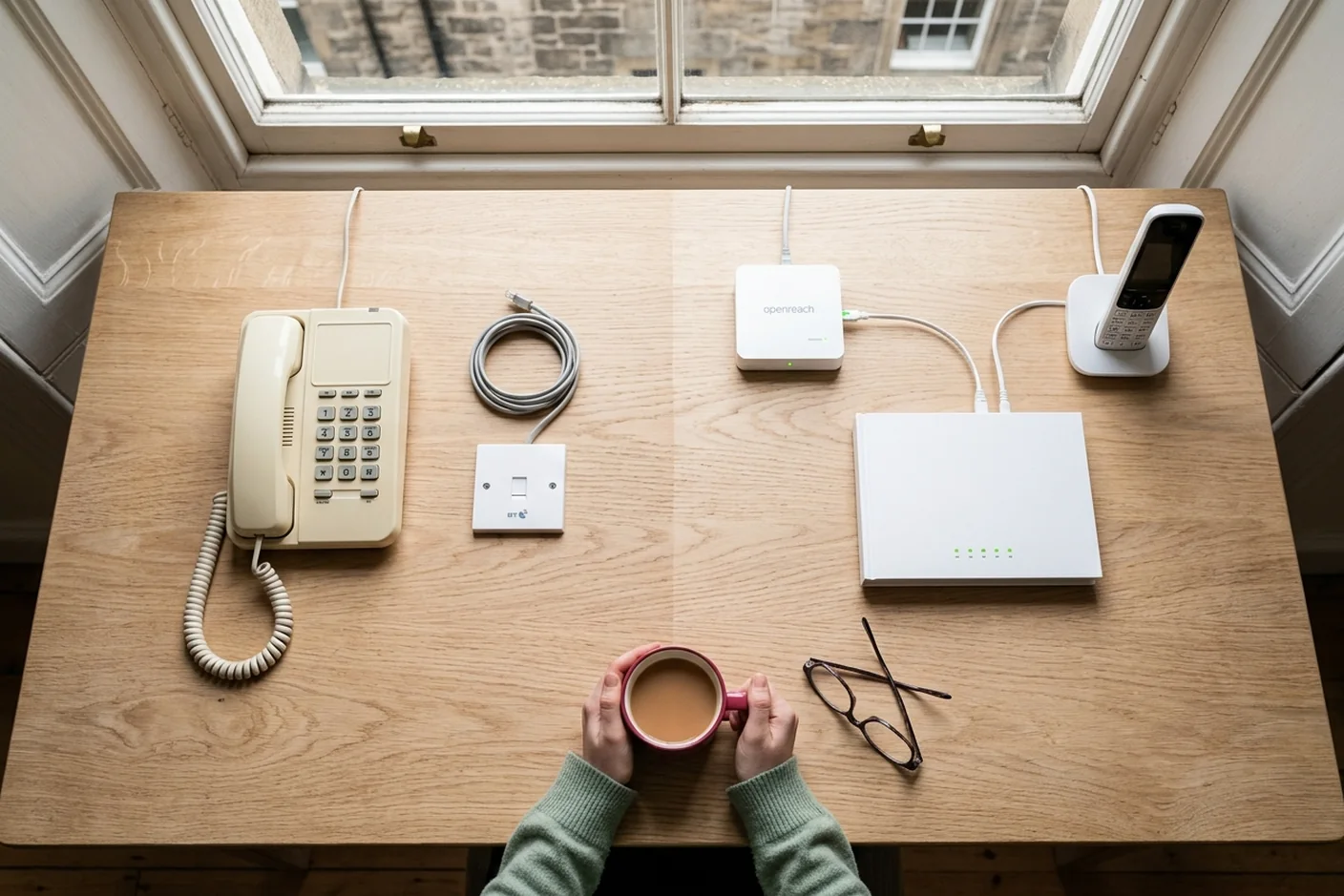
Edinburgh, like everywhere, has two separate changes running at once, and readers mix them up. One is the retirement of the analogue telephone network, a single national date that touches every landline. In Openreach’s words, “On 31 January 2027, all traditional phone lines will be going digital - so it’s important to switch now.” The other is “stop sell”, which happens exchange by exchange and changes what can be sold, not what you already have. Openreach defines the trigger this way: “Stop Sell is triggered when a majority (75%) of premises connected to a particular exchange can get ultrafast Full Fibre”. Once an exchange crosses that line, a mover, a switcher or an upgrader there is sold a digital line over fibre instead of a copper one.
Openreach announcements, 2025 to 2027
Edinburgh’s copper switch-off, step by step
- 25 July 2025Colinton exchange: copper stop sell Named in Openreach’s July 2025 list. From then on, a new order there comes as a digital line over fibre.
- 22 January 2026Liberton exchange, with Midcalder and Garvald nearby Openreach’s January 2026 list, which also spelled out the trigger: 75% of an exchange’s premises able to get full fibre.
- 27 July 2026Loanhead exchange, over the bypass In the July 2026 list of another half million premises.
- 17 September 202639,132 Edinburgh lines still to move 8.82% of the 443,783 lines in Openreach’s Edinburgh patch, behind Liverpool’s 6.35% but ahead of Glasgow’s 10.60% and London.
- 8 October 2026Dechmont joins the list The newest round: “a further 112 new exchange locations, covering more than 600,000 new premises”, with “rules will have been activated in 1663 exchanges across the UK” by 5 November.
- 19 October 2026This page’s last read The date every source here was read. Anything Openreach announced after it is not on this timeline yet.
- 31 January 2027The analogue phone network closes Every landline becomes a digital line carried over broadband. Openreach’s own phrase: “before the old legacy copper-based network is switched off at the end of January 2027”.
Openreach stop sell announcements of 25 July 2025, 22 January 2026, 27 July 2026 and 8 October 2026, its digital phone league table of 17 September 2026, and its switch-off page. Read 17 October 2026.
Edinburgh is further along than most big cities and not as far as some. Openreach’s league table of 17 September 2026 counted 39,132 lines left to convert in the Edinburgh area out of 443,783, which is 8.82%, behind Liverpool’s 6.35% but ahead of Glasgow’s 10.60% and London. The footnote matters: “Numbers calculated using Openreach regional patch data”, which takes in the wider postcode districts rather than the council area alone.
On stop sell, Openreach’s 2025 and 2026 announcements name two Edinburgh exchanges: Colinton on 25 July 2025 and Liberton on 22 January 2026. Around the city they name Loanhead on 27 July 2026, and Midcalder and Garvald on 22 January 2026. The newest list, on 8 October 2026, names Dechmont, Kirkcaldy and Newport-on-Tay; that release added “a further 112 new exchange locations, covering more than 600,000 new premises” and said that by 5 November “rules will have been activated in 1663 exchanges across the UK”, at which point “around 16.4 million premises are under active Stop Sell”. Most of Edinburgh’s exchanges were named in earlier years, which is why so few appear in the recent lists; the full list is on Openreach’s own stop sells page, and our landline switch-off checker tells you where your line stands.
| Exchange | Council area | Announced |
|---|---|---|
| Colinton | City of Edinburgh | 25 July 2025 |
| Liberton | City of Edinburgh | 22 January 2026 |
| Midcalder (East Calder) | West Lothian | 22 January 2026 |
| Garvald | East Lothian | 22 January 2026 |
| Loanhead | Midlothian | 27 July 2026 |
| Dechmont | West Lothian | 8 October 2026 |
Stop sell changes what can be sold at an exchange, not what you already have. Openreach’s own stop sells page carries every exchange named in every round, and our landline switch-off checker turns it into an answer for your line.
Seeing your exchange on one of those lists does not touch the service you have today. It means your next change of provider, package or address comes with a digital line over fibre, and your copper line retires with it. One household should act before then rather than after: anyone with a care alarm, a health pendant or a monitored security alarm on the phone line. Our care alarm guide explains what to test and whom to tell, because a digital line behaves differently in a power cut.
If you live in a tenement, the stair decides
Direct answer: In an Edinburgh flat the street is the wrong unit. The council’s Census summary says “55.96% of Edinburgh population live in flats or apartments”, and a network can pass the front of a stair without serving a single flat in it until the owners agree to let the cable in.

Edinburgh is where the flats are, and where the renters are. The City of Edinburgh Council’s summary of the 2022 Census puts it at “55.96% of Edinburgh population live in flats or apartments” and “23% of households in Edinburgh are privately rented: 55,000 of 239,000 occupied households”. A network can pass the front door of a stair and still not serve it, because getting a cable into a shared building needs the agreement of whoever owns it, which in a tenement means the owners together, usually through the factor. That is why Hyperoptic talks about buildings rather than streets, why CityFibre signed a deal in 2021 for “More than 900 social housing properties in Edinburgh” with Prospect Community Housing in Wester Hailes, and why the postcode checker will sometimes show your neighbour across the landing an option it does not show you.
How it reaches you
How full fibre gets from the pavement to a tenement flat
- Under the pavement The network’s fibre runs along the street in ducts and chambers. This is the part Ofcom’s “can get” figure counts, and it is the network’s job.
- Into the stair A cable needs the owners’ agreement, called a wayleave, to enter a shared building. One stair can have said yes while the next has not been asked.
- Up to your flat An engineer brings the fibre from the close to your door, usually in one visit. Flats on the same stair are connected one at a time, as each one orders.
- The small white box The fibre ends at a box the size of a paperback, low on the wall, and your router plugs into it. When the copper line is switched off, the phone handset plugs into the router instead of the wall.
A typical tenement install, drawn by BroadbandSwitch.uk. Every network does the street and the building first and the flats one by one as they order; Hyperoptic wires the whole building first and then connects flats as each one orders.
Renting does not stop you switching. Where a line already exists, changing the provider on it is your decision, and a landlord’s permission is only needed when something new has to be installed in the fabric of the building. Two of our guides take it from there: can you switch broadband in a rented property, and a tenant’s rights to full fibre for when the owner goes quiet. Owners on a stair have the opposite question, which is what the factor is being asked to sign; the wayleave guide answers it, and the short version is that saying yes costs the building nothing. Students in halls have a page of their own: broadband in student halls.
Cheaper broadband if you receive certain benefits
Direct answer: If you receive Universal Credit, Pension Credit or certain other benefits, four of the providers selling in Edinburgh run a social tariff, from £12.50 a month, and Ofcom’s rule for all of them is that “It costs nothing to leave. You won't pay a fee to leave the tariff before the end of your contract.”
Hyperoptic’s Fair Fibre Plan is £13 a month for 150 Mbps in the buildings it serves. Virgin Media’s Essential Broadband is £12.50 a month on a 30-day rolling contract, and its Edinburgh page says it sells “social tariff broadband only deals in Edinburgh which start from £12.50 a month”. BT Home Essentials, over Openreach, is £16.50 a month, and Vodafone Essentials, over Openreach or CityFibre, is £20 a month for up to 80 Mbps over 12 months. Sky’s is the exception for a new customer: “Our Sky Broadband Basics offer is only available if you already have Sky Broadband with us”. Every social tariff on Ofcom’s list, with who qualifies, is on our social tariffs guide, checked by hand.
Two pots of public money also apply to an Edinburgh address that cannot get a gigabit service. The UK Gigabit Broadband Voucher Scheme says “Eligible homes and businesses can access vouchers worth up to £4,500” where “existing available broadband download speeds are less than 1Gbps”. It lists Scotland (Central and North) as lot 39. The Scottish Broadband Voucher Scheme is the second pot: “The scheme currently provides a subsidy of up to £5,000 for eligible properties”, and it “will close to new applications on 20 November 2026”. If you are in one of the 396 postcodes Ofcom lists with no gigabit plan, ask about it before then. Both are paid to the builder, not to you.
Look up your part of the city
Direct answer: Pick your area and this shows its Ofcom figures and where it ranks out of six. It runs on your device and sends nothing anywhere.
Your part of Edinburgh, in one card
Ofcom’s January 2026 figures for the six Scottish Parliament constituencies inside the city. If you are not sure which is yours, the Scottish Parliament’s constituency finder takes a postcode.
What this page used to say
Direct answer: Four corrections, all to coverage numbers that had no source. The previous page overstated the city’s full fibre coverage by two points and its gigabit coverage by three, understated Openreach by ten, and gave CityFibre and Virgin Media figures that neither company has published.
The earlier version of this page, which some of you will have read, got things wrong. Across eight thousand words it recommended providers for named neighbourhoods, quoted an average speed from a crowd-sourced test, and gave typical prices street by street, and not one of those could be followed back to an operator or to Ofcom. Anything untraceable has been removed rather than tidied up, and wherever an operator’s own statement differs from ours, theirs is quoted and ours is withdrawn. The page also stops telling you which provider is “best” in Bruntsfield or Leith. That cannot be known without checking the address, so it says so and points you to the check.
Two Edinburgh coverage percentages with nothing behind them
What this page saidThis page said that approximately 86% of Edinburgh premises could access full fibre and 96% gigabit-capable broadband, across 288,350 premises. Neither percentage carried a source or a date. Ofcom’s residential figures for January 2026 put full fibre at 84% and gigabit at 93%, across 273,911 homes.
What it says now, and whyEvery coverage figure on the page is now Ofcom’s, for the council area and for the six areas inside it, with the date given and the method stated.
An Openreach figure ten points behind Openreach
What this page saidThis page said Openreach full fibre reached more than 65% of Edinburgh premises and was “rapidly expanding”. Openreach’s own words, from 3 August 2026, are that “Full Fibre broadband is now available to over 215,000 homes and businesses across Edinburgh” and that there are “more than 75% of properties in the area now able to upgrade their broadband service”.
What it says now, and whyOpenreach’s own figure, dated, and its own words on how much of the city is still to switch.
A CityFibre figure CityFibre has not published
What this page saidThis page said CityFibre passed approximately 70,000 Edinburgh addresses with continuing rollout. CityFibre’s own newest Edinburgh statement, from 28 February 2022, is “More than 65,000 homes and businesses across Edinburgh can now access the best digital connectivity”. It has published no Edinburgh count since.
What it says now, and whyCityFibre’s own 2022 figure, with the date, and the plain statement that nothing newer exists, so a reader knows to rely on the address check rather than a count.
A Virgin Media coverage figure nobody published
What this page saidThis page said Virgin Media’s cable network, with nexfibre’s fibre, covered approximately 80% of Edinburgh premises. Virgin Media publishes no such figure. Its own Edinburgh page says “1.5 million homes in the Scottish capital can get gigabit speeds with our fastest widely available broadband”, which is more homes than the council area has, and nexfibre lists Edinburgh in its footprint without a count.
What it says now, and whyVirgin’s own words, with the oddity pointed out, and the honest line that only the address check can tell you whether Virgin reaches you.
Edinburgh broadband: frequently asked questions
Which part of Edinburgh has the best full fibre coverage?
On Ofcom’s January 2026 figures, Edinburgh Western, where 94% of homes could get a full fibre service. The lowest was Edinburgh Central at 70%. Those are averages across whole constituencies, and the stairs inside each one vary far more than the areas do, so check your own address rather than your area.
What percentage of Edinburgh has full fibre broadband?
84% of homes in the City of Edinburgh council area could get full fibre in January 2026, according to Ofcom, against 75% for Scotland and 82% for the UK. That puts Edinburgh ninth of Scotland’s 32 councils. Gigabit-capable coverage, which adds Virgin Media’s cable, was 93%.
Is CityFibre available in Edinburgh?
Yes, in much of the city. Edinburgh is on CityFibre’s own coverage list, and in February 2022 it said “More than 65,000 homes and businesses across Edinburgh can now access the best digital connectivity” after a build that began in 2019. It has not published a newer Edinburgh figure, and it says “Availability can occasionally vary between neighbouring properties”, so the postcode check is the only way to know whether your street is on it. Vodafone, Sky, TalkTalk and Zen are among the companies that sell over it.
Does Virgin Media cover all of Edinburgh?
No, and it does not claim to. Its own Edinburgh page says “What’s available to you will depend on where you live in Edinburgh and our speeds can vary street to street”. It publishes no Edinburgh coverage percentage, and the homes figure on its page is larger than the city, so treat the page as a sales page and the address check as the answer. Virgin also sells over nexfibre’s fibre, which lists Edinburgh in its footprint.
Why does my neighbour across the stair have an option I cannot get?
In a tenement city the unit that matters is the stair, not the street. Hyperoptic says of itself that “We only deal in full fibre broadband, which means we offer fibre all the way to your building”. No network can bring a cable into a shared building until the owners agree to it, so one stair can be wired while the next is not, and two flats in the same block can see different results. That is why the check at the top asks for the full address.
How many Edinburgh homes have actually switched to full fibre?
Fewer than in almost any other Scottish council. Take-up was 40% of covered premises in January 2026 on Ofcom’s figures, 24th of the 32, and Openreach’s own release that August said “Most of Edinburgh is now covered by Full Fibre, but many residents and businesses still haven’t made the switch”. Nothing else on this page matters as much as that gap between what is built and what is bought.
Is Edinburgh getting more full fibre?
Only a little, because most of it is already built. On the plans the operators gave Ofcom, full fibre reaches 86% of Edinburgh homes by January 2029, up 1.6 points, while Midlothian, West Lothian and Fife all rise much faster. Ofcom counts 396 postcodes in the council area with no gigabit-capable plan at all by then.
Which networks are available in Edinburgh?
Openreach, which BT, Sky, TalkTalk, Vodafone, EE, Plusnet and most smaller brands sell over; CityFibre, which Vodafone, Sky, TalkTalk and Zen also sell over; Virgin Media on its own cable and on nexfibre’s fibre; and Hyperoptic in the blocks it has wired. YouFibre and GoFibre build up to the city’s edges. Ofcom expects 11 to 15 gigabit-capable operators in the council area by 2029.
What is happening to landlines in Edinburgh?
They are going digital on the same date as the rest of the country, and Edinburgh is further along than most big cities. Openreach’s wording is “On 31 January 2027, all traditional phone lines will be going digital - so it’s important to switch now.” Its September 2026 league table counted 39,132 lines in the Edinburgh area still on the old network, 8.82% of the total, a better position than Glasgow or London. Copper broadband is a separate matter: Openreach stops selling it exchange by exchange once “Stop Sell is triggered when a majority (75%) of premises connected to a particular exchange can get ultrafast Full Fibre”, and Colinton and Liberton are the two city exchanges in its 2025 and 2026 lists. A care alarm on the line changes the order you do things in; our care alarm guide sets it out.
Is there cheaper broadband in Edinburgh if I receive benefits?
Yes, from four networks. Anyone receiving Universal Credit, Pension Credit or certain other benefits can take Hyperoptic’s Fair Fibre Plan at £13 a month where its network is in the building, Virgin Media’s Essential Broadband at £12.50 a month, BT Home Essentials at £16.50, or Vodafone Essentials at £20. Our social tariffs guide lists every tariff on Ofcom’s register with who qualifies.
Can I get help paying for a fibre connection in Edinburgh?
Possibly, if your address cannot get a gigabit service. The UK Gigabit Broadband Voucher Scheme says “Eligible homes and businesses can access vouchers worth up to £4,500” where “existing available broadband download speeds are less than 1Gbps”, and of the Scottish Broadband Voucher Scheme its own page says “The scheme currently provides a subsidy of up to £5,000 for eligible properties” but that it “will close to new applications on 20 November 2026”. Neither pays you directly; both go to the builder. No Project Gigabit contract covers the City of Edinburgh itself.
Is broadband cheaper in Edinburgh than elsewhere?
Not in price, in choice. Each provider charges the same wherever it sells, so no package is cheaper in Edinburgh than in Dundee. What Edinburgh has more of is competition: Ofcom expects 72% of its homes to have two or more gigabit networks to choose between by 2029, and the cheapest of those only shows up when the address is checked.
How current is this page?
Everything cited here was read on 17 October 2026. Ofcom’s area and council figures describe January 2026 and were published on 13 May 2026; when Ofcom’s next update lands, they change with it. Every operator quotation keeps the date the operator gave it, and where that date is old, as with CityFibre’s 2022 figure for the city, the page says so rather than hiding it.
In short
- Edinburgh is one council and six very different pieces: full fibre ran from 70% in Edinburgh Central to 94% in Edinburgh Western in January 2026, on Ofcom’s figures.
- Across the council area, 84% of homes could get full fibre, against 75% for Scotland and 82% for the UK, which puts Edinburgh ninth of Scotland’s 32 councils.
- Take-up was 40% of covered premises, among the lowest in Scotland, so on most Edinburgh streets the fibre is in the pavement and not in the homes.
- Openreach’s own Edinburgh figure is 215,000 homes and businesses passed, as of August 2026, and its own words are that “Most of Edinburgh is now covered by Full Fibre, but many residents and businesses still haven’t made the switch”.
- CityFibre’s newest Edinburgh figure is 65,000 homes and businesses from February 2022; Virgin Media publishes no Edinburgh percentage; Hyperoptic has no Edinburgh page.
- On the plans the operators gave Ofcom, full fibre reaches 86% of Edinburgh homes by January 2029, up 1.6 points, while the neighbouring councils rise far faster.
- Edinburgh had 39,132 lines still to move off the old copper network in September 2026, and the whole telephone network goes digital on 31 January 2027.
- Only Openreach publishes an Edinburgh coverage percentage, and only for its own network. Every other figure on this page is the regulator’s, and the only one that is true for you is the one your own address returns.
Every line above can be quoted on its own with its date. A person re-reads this page at least once a quarter; the last read was on .
References
- OFCOM.ORG.UK
Ofcom. (2026, May 13). Connected Nations update: Spring 2026, with the data download “Fixed broadband coverage and full fibre take-up”, local and unitary authority and devolved constituency files, data as at January 2026, Open Government Licence. The council, area, Scotland and UK figures. Page read 15 October 2026; data files read 17 October 2026.
- OFCOM.ORG.UK
Ofcom. (2026, May 13). Connected Nations: Planned network deployments 2026, with the data download “Planned network deployments for local and unitary authorities”, residential file. The 2029 plans, the operator count, the postcodes with no plan and the publicly funded lines. Page read 15 October 2026; data file read 17 October 2026.
- OFCOM.ORG.UK
Ofcom. (2025, November 19). Connected Nations 2025: Methodology annex. The definitions of full fibre and gigabit-capable. Read 15 October 2026.
- OPENREACH.COM
Openreach. (2026, August 3). People in Edinburgh yet to benefit from major broadband upgrade. The 215,000 figure, the £64m, the 75% and the Robert Thorburn quotations. Read 17 October 2026.
- OPENREACH.COM
Openreach. (2026, September 17). Liverpool tops major UK city league table in move to digital phone services. The Edinburgh, Glasgow and Liverpool rows and the method footnote. Read 17 October 2026.
- OPENREACH.COM
Openreach. (2024, May 28). Openreach expands Scottish national broadband upgrade. Wester Hailes, the Pentland exchange and the 1.2 million Scotland figure. Read 17 October 2026.
- OPENREACH.COM
Openreach. (2025, July 25). Openreach to stop selling copper services in 137 more locations; (2026, January 22) Openreach stops copper for another million premises; (2026, July 27) Openreach puts a stop to copper for another half million premises; (2026, October 8) Openreach accelerates copper retirement across 600,000 more UK premises. Colinton, Liberton, Loanhead, Midcalder, Garvald, Dechmont, Kirkcaldy and Newport-on-Tay, the stop sell definition and the national totals. Read 17 October 2026.
- OPENREACH.COM
Openreach. (2026, August 3). Who’s winning the Full Fibre broadband race in East Lothian, and who’s not? The 43,000 and Tranent figures. Read 17 October 2026.
- OPENREACH.COM
Openreach. (n.d.). Switching off PSTN across the UK. The 31 January 2027 date. Read 15 October 2026.
- CITYFIBRE.COM
CityFibre. (n.d.). Network availability and coverage; Broadband providers; (2022, February 28) CityFibre celebrates latest milestone in Edinburgh’s Full Fibre rollout; (2021, April 13) CityFibre teams up with Prospect Community Housing to bring full fibre to Edinburgh tenants; (2026, June 3) CityFibre hits one million connections nationwide; and (2026, October 6) CityFibre delivering strong underlying performance. The coverage list, the 65,000 and £100m figures, the neighbourhoods, the ISPs and the national figures. Read 17 October 2026.
- VIRGINMEDIA.COM
Virgin Media. (2026, October). Broadband deals in Edinburgh. The 1.5 million line, the street-to-street caveat, the Gig1 claim and the social tariff line. Read 17 October 2026.
- VIRGINMEDIAO2.CO.UK
Virgin Media. (2020, July 2). Virgin Media gigabit revolution continues as services launch in Edinburgh and Liverpool. The Gig1 launch. Read 17 October 2026.
- NEXFIBRE.CO.UK
nexfibre. (2026, February). Network coverage update, as at 31 December 2025, and Our network. The Edinburgh, Penicuik, Dunbar and West Calder entries, the caveat and the national figure. Read 17 October 2026.
- HYPEROPTIC.COM
Hyperoptic. (2026). News and press; Why us; Fair Fibre Plan; and the address where an Edinburgh page would sit, which returned a 404. The two million and 64-city figures, the building model and the social tariff. Read 17 October 2026.
- YOUFIBRE.COM
YouFibre. (2026). Our locations, Scotland region. The central Scotland line and the town list. Read 17 October 2026.
- GOFIBRE.CO.UK
GoFibre. (2026). Homepage and Locations. The regions and the East Lothian and Fife towns. Read 17 October 2026.
- GOV.UK
Building Digital UK. (2025, December 17). Project Gigabit contracts; (2025, February 21) Project Gigabit network build contract: Borders and East Lothian; and (2026, March 16) Gigabit Broadband Voucher Scheme information. The two Scottish lots, the GoFibre contract and the voucher terms. Read 17 October 2026.
- GOV.SCOT
Scottish Government. (2026). About R100, and R100 Scottish Broadband Voucher Scheme. The programme value, the connections figure, the voucher amount and the closing date. Read 17 October 2026.
- SCOTLANDSCENSUS.GOV.UK
National Records of Scotland. (2023, September 14). Scotland’s Census 2022: Rounded population estimates, data download. The household and population counts for the City of Edinburgh and its neighbours. Read 17 October 2026.
- EDINBURGH.GOV.UK
The City of Edinburgh Council. (2026). Census 2022: housing summary. The flats and private renting figures. Read 17 October 2026.
- PARLIAMENT.SCOT
Scottish Parliament. (n.d.). MSPs by constituency. The constituency finder linked from the lookup. Read 17 October 2026.
How switching works
Three steps, and the new provider does the rest
- Step 1Type your postcode and pick your address
Every network that reaches the building shows up, down to the flat, where it matters.
- Step 2See every provider, cheapest first
No brand filter and no sign-up to look. An address on two networks shows two sets of prices.
- Step 3Order online
Your new provider arranges the switch. You do not have to ring the one you are leaving, and the old service ends when the new one starts.
The One Touch Switch process Ofcom brought in for home broadband in September 2024, as it runs on BroadbandSwitch.uk.
See what actually reaches your address
Type the postcode, pick the address, and every provider that reaches it is listed cheapest first. Ten seconds, and the one Edinburgh answer that is true for you.
Compare at my postcode →