Broadband for short lets, temporary stays and house sales

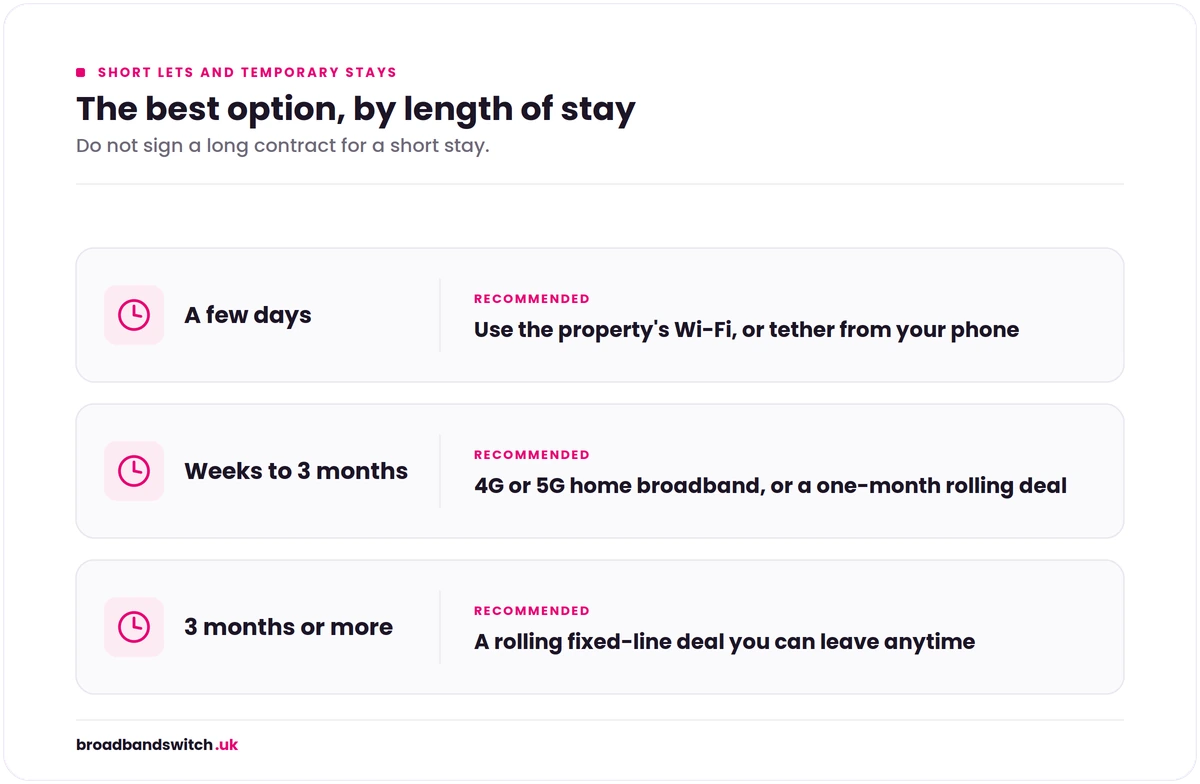
For a short or temporary stay, skip the long contract. The right choice comes down to how long you will be there. A few days, lean on the property's Wi-Fi or a mobile hotspot. A few weeks to a few months, a 4G or 5G deal or a one-month rolling plan. Longer than that, a rolling fixed line. Here is how to match the option to the stay and avoid a tie-in you will regret.
- Match the option to the length of stay, and avoid long contracts for short stays.
- A few days: use the property's Wi-Fi, or tether from your phone.
- Weeks to a few months: 4G or 5G home broadband, or a one-month rolling deal.
- Between homes mid-sale: bridge with 4G or 5G, then order at the new place.
The golden rule: match the option to the stay
Temporary living has one guiding principle for broadband: do not sign up for longer than you will be there. A standard 18 or 24 month contract is the wrong tool for a stay measured in weeks, and the exit fees can wipe out any headline saving. The good news is that there is a well-suited option for every length of stay, and picking the right one is simple once you see them side by side.
A few days to a couple of weeks
For very short stays, do not order anything fixed. If the place is furnished or serviced it will usually include Wi-Fi, so ask the host or agent for the details before you arrive. If it does not, tethering from your phone or using a mobile hotspot is the quickest fix, and a generous data plan or a data-only SIM will comfortably cover browsing, streaming and video calls for a week or two.
A couple of weeks to three months
This is the sweet spot for 4G and 5G home broadband. It plugs in and works with no engineer visit, typically runs on a 30-day rolling basis, and gives you proper home speeds without a long commitment. A one-month rolling fixed-line deal is the alternative where a line is already active. Our guides to 4G and 5G broadband deals, one-month broadband deals and mobile broadband as a temporary backup lay out the choices.
Three months or more
Once you are staying for a season or longer, a rolling or short fixed-line deal starts to make sense, since the lower monthly price begins to outweigh the flexibility premium of mobile. Look for a deal you can leave on 30 days' notice, and consider no-contract options for renters. If you receive certain benefits, a social tariff is contract-free and often the best value of all.
Between homes or mid house sale
Selling and buying rarely line up to the day, and a spell in temporary accommodation is common. The mistake to avoid is signing a long contract for what is really a stopgap. Bridge the gap with 4G or 5G, then, once you complete, order broadband at the new home or move an existing service across. Our moving home broadband guide covers transferring, switching and timing the changeover so you are never paying for two homes at once.
Avoiding the traps
Three things catch people out on temporary deals. Long contracts with early-exit fees, which defeat the point of a short stay. Setup or activation fees that only pay off over a full term. And router returns, since many providers charge if the box is not sent back. Choose rolling terms, check for upfront charges, and keep the router safe, and a temporary connection stays cheap and painless. For anything longer-term at your main home, start with our latest deals and the postcode comparison tool.
Short-let broadband FAQs
What is the best broadband for a short let or temporary stay?
Match it to the length of stay. A few days, use the property's Wi-Fi or a mobile hotspot. A few weeks to a few months, a 4G or 5G deal or a one-month rolling plan. Longer, a rolling fixed line.
Can I get broadband without a long contract?
Yes. 4G and 5G home broadband and one-month fixed-line deals run on rolling terms you can leave with about 30 days' notice, and social tariffs are contract-free for eligible households.
What broadband should I use while between homes during a house sale?
Bridge the gap with 4G or 5G home broadband, which needs no engineer, then order at your new home or move an existing service once you complete.
Do I need an engineer for temporary broadband?
Not for 4G or 5G home broadband or a mobile hotspot, which simply plug in and work. That is what makes them ideal for short and temporary stays.
Is a mobile hotspot enough for a short stay?
For a week or two, usually yes. A generous data plan or a data-only SIM handles browsing, streaming and video calls. For longer or heavier use, a 4G or 5G home broadband deal is more comfortable.
Will I be charged if I do not return the router?
Often yes. Many providers bill for a router that is not sent back, so keep the box and cables safe and return them when your temporary deal ends.
Related guides
References
- Ofcom. (2024). One Touch Switch. [Gaining-provider-led switching live from 12 September 2024; for changing provider at the same address, not house moves; Great Britain]. https://www.ofcom.org.uk/phones-and-broadband/switching-provider/
- Ofcom. (n.d.). Broadband universal service obligation. [Right to request a decent connection of at least 10 Mbit/s download; United Kingdom]. https://www.ofcom.org.uk/phones-and-broadband/broadband/broadband-universal-service-obligation/
Written by Adrian James, Broadband Editor, and reviewed by Dr Alex J. Martin-Smith. We update this guide as rules and deals change. BroadbandSwitch.uk is an independent UK comparison service and does not charge readers to use it. Figures are attributed to named sources with the date and scope shown above.