BROADBAND COMPLAINTS · ESCALATION HUB · RIGHTS GUIDE
Broadband Complaints and Your Rights: The Escalation Hub
When broadband goes wrong, the system is genuinely on your side, but only if you climb it in the right order. This is the exact escalation ladder, the money you are owed automatically without even asking, and the free ombudsman route whose decisions bind your provider, all updated for the new rules that took effect in April 2026.
Written by Dr Alex J. Martin-Smith · Reviewed by Adrian James · Published 11 June 2026 · Rules current as of the 8 April 2026 escalation change · ~9 minute read
Prefer to read offline? Download the free PDF guide: Broadband Complaints and Your Rights (6 pages, ~285KB). No signup, no email, just the guide.
The quick answer
Complain to your provider first, in writing, and keep the date. If it is not resolved within six weeks, or they issue a deadlock letter sooner, you can take it to a free, independent ombudsman scheme whose decision binds the provider. And for three specific failures, late repairs, missed engineer appointments and delayed starts, compensation is paid automatically, with no claim needed.
Key facts · verified June 2026
- Six weeks, not eight. For complaints raised on or after 8 April 2026, you can escalate to dispute resolution after six weeks, down from eight (Ofcom).
- The deadlock shortcut. A deadlock letter from your provider lets you escalate immediately, without waiting.
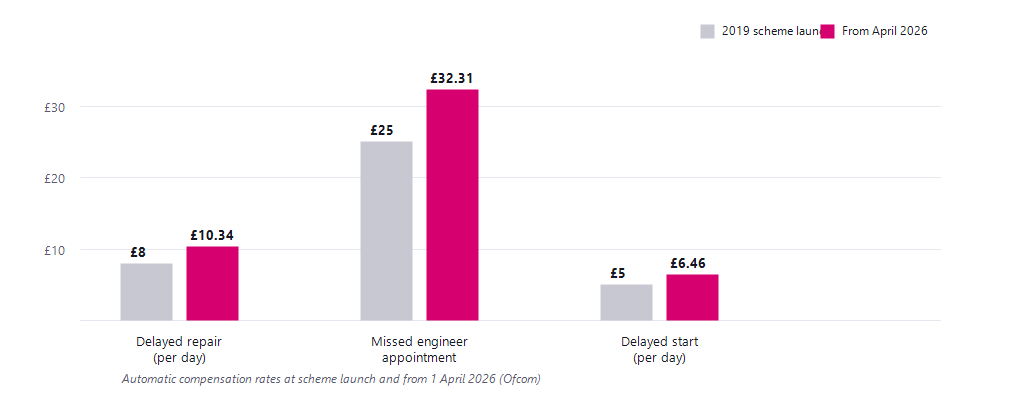
- Automatic compensation, from 1 April 2026: £10.34 per day for an unrepaired total loss of service after two working days; £32.31 per missed engineer appointment; £6.46 per day for a delayed start. Scheme rates rise each April.
- It is free and it binds them. The two Ofcom-approved schemes cost you nothing, and if you accept the decision, the provider must comply. Typical financial awards run £50 to £100, plus putting the problem right.
- Around £63 million was paid out under the automatic compensation scheme in 2024 alone, across roughly a million payments.
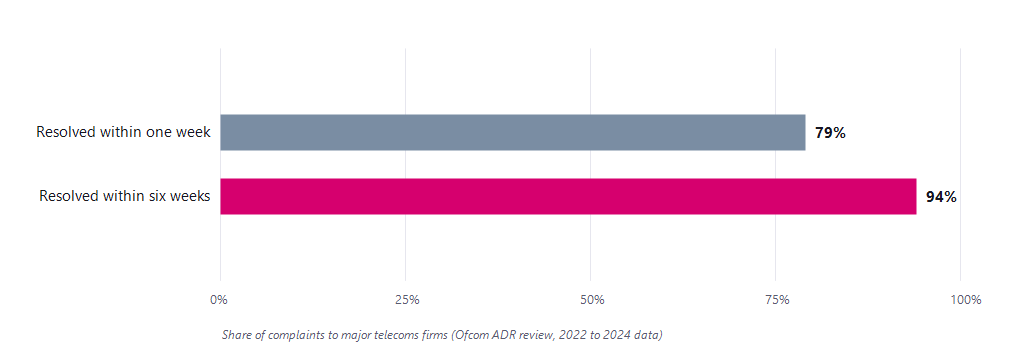
- Most complaints settle fast: Ofcom's review found 79% of complaints to the biggest telecoms firms are resolved within a week, and 94% within six weeks, which is exactly why the escalation window was shortened.
The escalation ladder, rung by rung
Before the ladder, one encouraging fact. Most complaints are settled quickly: in Ofcom's review of the biggest telecoms firms, 79% were resolved within a week and 94% within six weeks. A polite, well-documented complaint usually works on its own. The ladder below is for the minority that drag on, and each rung only opens if the one before it fails.
- Complain to your provider, in writing. Email or use their complaints form, say clearly what went wrong and what you want, and keep copies. Every provider must have a published complaints code, and the date you first complain starts every clock that follows, so record it.
- Give them six weeks, or get deadlock. For complaints raised on or after 8 April 2026, the provider has six weeks to put it right. If they conclude sooner that you cannot agree, ask for a deadlock letter, which unlocks the next rung immediately.
- Go to the free ombudsman scheme. Every provider belongs to one of two Ofcom-approved schemes, the Communications Ombudsman or CISAS. Your provider must tell you which. It is free, independent, and handled online.
- Accept or decline the decision. The scheme can order an apology, a fix, and a financial award, typically £50 to £100. If you accept, the provider is bound by it. If you decline, you keep your other legal routes.
What Ofcom does, and does not, do
Ofcom does not handle individual complaints, so writing to the regulator will not resolve yours. But registering your complaint with Ofcom still counts: the regulator logs every one, monitors patterns, and publishes the quarterly league tables that hold providers publicly to account. We track that league in full, including who attracts the most and fewest complaints and who is improving, in our latest complaints league: The Complaints Floor (Report No. 30), covering Ofcom's Q1 2026 data. The Q4 2025 edition remains at Ofcom complaints by provider. The rest of our data reports live on the insights hub.
Compensation that pays automatically
For three specific failures you do not need to complain at all. Under Ofcom's automatic compensation scheme, the money is credited to your bill within 30 days, without you asking.
| What went wrong | You get |
|---|---|
| Total loss of service not fixed within 2 working days of reporting it | £10.34 per day after that |
| Engineer misses an appointment, or cancels with under 24 hours' notice | £32.31 per appointment |
| Service not started on the promised date | £6.46 per day late |
The scheme is voluntary but covers the big names, including BT, EE, Plusnet, Sky, NOW, TalkTalk, Virgin Media, Vodafone, Utility Warehouse, Hyperoptic and Zen, together serving 91% of broadband customers, and it paid out around £63 million in 2024 alone. If the credit does not appear within 30 days, that itself is grounds for a complaint, and the ladder above applies. Worked examples, exclusions and the fine print are in our dedicated guide to compensation and service failure.
Winning at the ombudsman
The two schemes work the same way from your side: free, online, independent, and binding on the provider if you accept the outcome. What decides cases is evidence, so build yours from day one.
- Keep the paper trail. Save emails, web chats and letters, and note the date, time and name for every phone call. The date you first complained sets the six-week clock.
- Capture the problem. Screenshots of speed tests, your minimum guaranteed speed from the order confirmation, photos of missed appointment slots, and your bills.
- Say what you want. A fix, an apology, money, or release from contract. Schemes respond best to a clear, reasonable ask.
- Know the size of awards. Typical financial awards run £50 to £100, plus putting the actual problem right, so calibrate expectations accordingly.
If your complaint is really about something else
Some grievances have their own faster routes, already covered on BroadbandSwitch.uk. If your complaint is really about slow speeds, start with the broadband speed guide, because the Speeds Code gives you a separate fix-or-exit right. If a mid-contract price rise is the grievance, see in-contract price rises 2026, which covers exactly when a rise lets you leave penalty-free. And if you are simply done with your provider, switching is one contact under One Touch Switch, with the whole journey mapped in the switching hub.
And if the relationship is beyond saving, there are five legitimate ways out, mapped in can I leave my broadband contract early?
Questions people ask
How long before I can take a broadband complaint to the ombudsman?
Six weeks from the date you first complained, for complaints raised on or after 8 April 2026, down from the previous eight. You can go sooner if your provider issues a deadlock letter confirming you cannot agree, so always ask for one if talks stall.
Does the ombudsman cost anything, and is it worth it?
It is completely free to you, handled online, and if you accept the decision your provider is bound by it. Given that the schemes can order fixes, apologies, contract release and financial awards, there is no good reason to leave a deadlocked complaint unescalated.
How much compensation can I get for a broadband complaint?
Ombudsman awards typically run £50 to £100 plus putting the problem right. Separately, automatic compensation pays £10.34 per day for unrepaired loss of service, £32.31 per missed engineer appointment and £6.46 per day for late starts, credited within 30 days without a claim.
Which ombudsman scheme is my provider with?
Every provider belongs to one of two Ofcom-approved schemes, the Communications Ombudsman or CISAS, and must tell you which when asked or when issuing a deadlock letter. Both work the same way from the consumer's side: free, online and independent.
Should I complain to Ofcom about my broadband provider?
Ofcom will not resolve your individual case, so complain to your provider first and escalate to the ombudsman if needed. But logging the complaint with Ofcom too is worthwhile: it feeds the regulator's monitoring and the quarterly league tables that hold providers to account.
About this guide
This guide is part of the BroadbandSwitch.uk 2026 Guide Library, published by BroadbandSwitch.uk, the consumer arm of the SearchSwitchSave network. Our approach to evidence and corrections is documented in the methodology and trust hub, and every published correction appears in the corrections log.
Take it with you: download the free 6-page PDF guide, including the escalation ladder, compensation rates and full sources.
Citing this guide: BroadbandSwitch.uk. (2026, June 11). Broadband complaints and your rights: The escalation hub. SearchSwitchSave. https://broadbandswitch.uk/guides/complaints-and-your-rights/
Sources
- Ofcom. (2025, July 8). Quicker complaints resolution for telecoms customers, under new Ofcom rules. https://www.ofcom.org.uk/phones-and-broadband/service-quality/quicker-complaints-resolution-for-telecoms-customers-under-new-ofcom-rules
- Ofcom. (2025). Statement: Review of ADR in the telecoms sector. https://www.ofcom.org.uk/phones-and-broadband/service-quality/review-of-adr-in-the-telecoms-sector2
- Ofcom. (2026). Automatic compensation: What you need to know. https://www.ofcom.org.uk/phones-and-broadband/service-quality/automatic-compensation-need-know
- Communications Ombudsman. (2026). Ofcom reduces consumer wait time from 8 to 6 weeks. https://www.commsombudsman.org/news/ofcom-reduces-consumer-wait-time-from-8-to-6-weeks
- ISPreview UK. (2026, April). Ofcom raise UK consumer compensation payments for broadband ISP woes. https://www.ispreview.co.uk/index.php/2026/04/ofcom-raise-uk-consumer-compensation-payments-for-broadband-isp-woes.html
This guide is general consumer information, not legal advice. The six-week escalation window applies to complaints raised on or after 8 April 2026; automatic compensation rates apply to incidents from 1 April 2026 and rise each April; the compensation scheme is voluntary and the 2024 payout total is reported between £62.4m and just over £63m in Ofcom data.