Compare broadband by feature UK 2026: hub guide for feature-based broadband comparison
Feature-based comparison helps readers find UK broadband packages matching specific needs. Where postcode comparison reveals what's available at your address (the central comparison route documented at https://broadbandswitch.uk/compare-broadband-by-postcode.html), feature-based comparison narrows from available options to genuine fit. The dedicated speed and needs hub goes deep on speed selection alone (household tiers, Guaranteed Minimum Speed, technology limits, upload and peak time). This hub orients readers across the major feature-based comparison routes: speed comparison (advertised speed, Guaranteed Minimum Speed under the Voluntary Code of Practice on Broadband Speeds, real-world performance); contract length comparison (12-month, 18-month, 24-month, rolling monthly options); technology type comparison (full fibre to the premises FTTP versus fibre to the cabinet FTTC versus cable versus 4G/5G home broadband); price tier comparison (entry-level, mid-tier, premium, multi-gigabit); provider category comparison (major UK ISPs versus altnets versus community fibre); usage context comparison (working from home, streaming, gaming, low-income social tariff eligibility, renters); regulatory protection comparison (provider commitments to Voluntary Code of Practice on Broadband Speeds, Automatic Compensation scheme, Telecoms Consumer Charter, One Touch Switch). The documented 12-factor scoring model and four core ranking principles apply consistently across all feature comparisons - documented in detail at https://broadbandswitch.uk/how-we-rank-broadband-deals.html. Together with postcode-based comparison and the comprehensive UK provider directory at https://broadbandswitch.uk/directory-insights/, feature-based comparison supports comprehensive UK 2026 broadband decisions.
Compare broadband by feature in 60 seconds
Feature-based comparison narrows from available options (revealed by postcode checking) to genuine fit for your specific needs. Major feature comparison routes covered in this hub: speed comparison (advertised speed achievable for at least 50 percent of customers under Voluntary Code of Practice on Broadband Speeds, Guaranteed Minimum Speed address-specific estimate at sign-up, real-world performance from independent measurement); contract length comparison (24-month for lowest monthly cost; 18-month as common middle ground; 12-month for moderate flexibility; rolling monthly for maximum flexibility at slight price premium - all balanced against April 2026 mid-contract rises by major provider that affect total contract cost); technology type comparison (FTTP full fibre at speeds up to approximately 1.8 Gbps with symmetric upload at higher tiers; FTTC at typical speeds up to 80 Mbps; cable at typically up to approximately 1.1 Gbps where Virgin Media O2 reaches; ADSL2+ at up to 24 Mbps where neither FTTP nor FTTC available; 4G/5G home broadband as alternative including Three Broadband and others); price tier comparison (entry-level around £20-£25 per month introductory; mid-tier around £25-£35 per month; premium and multi-gigabit £35-£60+ per month); provider category comparison (major UK ISPs - BT, Sky, Virgin Media O2, EE, Plusnet, Vodafone, TalkTalk - versus altnets - CityFibre retail brands, Netomnia retail brands including YouFibre with multi-gigabit symmetric, Hyperoptic, Community Fibre, toob, Brsk, Trooli, BeFibre, Lit Fibre, Zen Internet - versus community fibre - Gigaclear rural focus, B4RN community-owned non-profit); usage context comparison (working from home prioritising symmetric upload; streaming prioritising peak-time reliability; gaming prioritising low latency; low-income households social tariff eligibility for £15-£20 per month tariffs; renters contract length flexibility; TV bundle preference); regulatory protection comparison (Voluntary Code of Practice on Broadband Speeds, Automatic Compensation scheme with April 2026 updated rates, Telecoms Consumer Charter introduced February 2026, One Touch Switch process, 14-day cooling-off period). The documented 12-factor scoring model and four core ranking principles apply consistently across all feature comparisons. Comprehensive UK altnet inclusion regardless of affiliate relationships documented in our affiliate disclosure. This hub points to specific implementation guides including specific UK 2026 deal rankings at https://broadbandswitch.uk/best-broadband-deals-uk-may-2026.html and the comprehensive UK provider directory.
Why feature-based comparison matters
Feature-based comparison narrows from available options to genuine fit for specific needs. Without feature filtering, choosing among 10+ available providers and packages becomes overwhelming; with feature filtering, the choice becomes manageable and decisions reflect what genuinely matters to the household.
Postcode comparison is the first step. Postcode availability checking surfaces what's actually orderable at your address - documented in detail at https://broadbandswitch.uk/compare-broadband-by-postcode.html.
Feature-based comparison is the second step. From the available options, feature-based comparison filters to genuine fit. A household working from home prioritises different features than a streaming-heavy household; a low-income household has different priorities than a household with discretionary income for premium options.
Together they support genuine decisions. Postcode-without-feature comparison surfaces options without helping choose; feature-without-postcode comparison risks recommending options not actually available. Used together, they support genuine UK 2026 broadband decisions.
BroadbandSwitch.uk applies the documented 12-factor scoring model consistently across all feature comparisons. Twelve factors covering cost (3): introductory monthly price; total contract cost over the term; switching credits and other monetary incentives. Speed (3): advertised speed; Guaranteed Minimum Speed; real-world performance. Service (3): customer service satisfaction; complaint frequency; automatic compensation track record. Value (2): contract length flexibility; package fit for user context. Rights (1): consumer rights handling. This consistency means comparing on speed doesn't ignore service; comparing on price doesn't ignore consumer rights; the 12 factors stay in scope across feature lenses.
Consumer value first. Where consumer-value answer differs from feature-headline answer (for example, fastest speed but worst service), consumer value wins.
Regulatory accuracy. Verify against current UK 2026 regulatory framework regardless of feature lens.
Total contract cost transparency. Calculate cost across the term including standard pricing and April mid-contract rises regardless of which feature comparison drives the choice.
Evenhanded provider treatment. Major ISPs and altnets compared on the same scoring model regardless of feature lens.
BroadbandSwitch.uk includes UK altnets across all feature comparison lenses regardless of affiliate relationships. Altnets often offer better consumer value than major-only options - for symmetric upload (working from home), for speed-per-pound (price tier), for clean pricing (no mid-contract rises in some altnets), for cleaner consumer rights handling. Comprehensive altnet inclusion is documented in our affiliate disclosure at https://broadbandswitch.uk/affiliate-disclosure.html.
Compare by speed
Speed comparison addresses one of the most common reader questions: "what speed do I need" and "what speed will I get". This section documents the speed comparison framework.
Advertised speed under Voluntary Code of Practice on Broadband Speeds. Major UK ISPs subscribe to Ofcom's Voluntary Code of Practice; advertised speed must be achievable for at least 50 percent of customers (some packages advertise the average speed). Advertised speed is the headline number on package marketing.
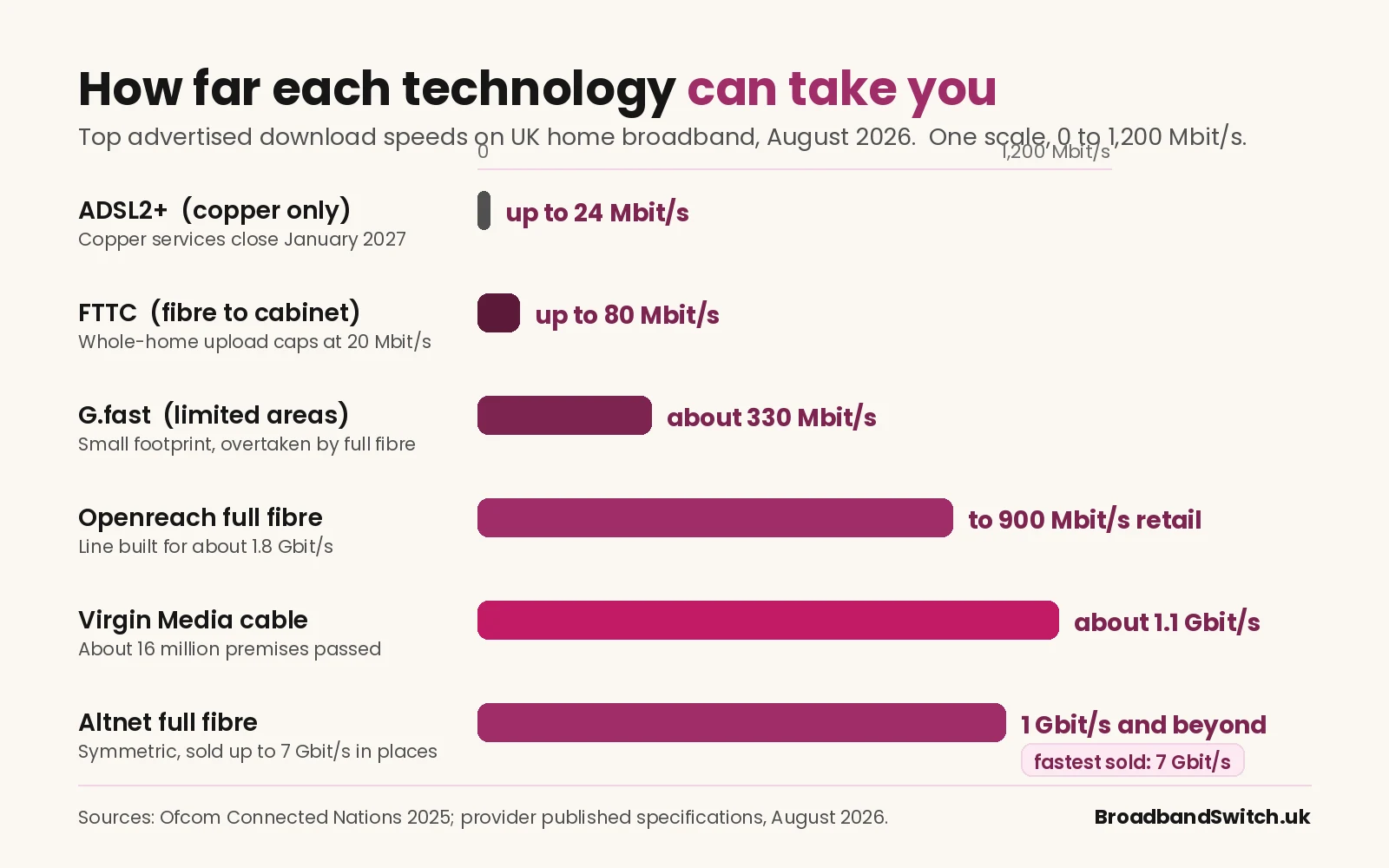
Advertised speed varies dramatically by package and technology. ADSL2+ packages advertise up to 24 Mbps; FTTC packages typically up to 80 Mbps; FTTP packages from 100 Mbps entry to approximately 1.8 Gbps; cable packages typically up to approximately 1.1 Gbps; multi-gigabit altnet packages up to 7 Gbps (YouFibre on Netomnia infrastructure).
Comparing advertised speeds across providers. Within a technology category, advertised speeds typically cluster (most FTTC packages advertise speeds in the 30-80 Mbps range; most FTTP entry packages advertise around 100-150 Mbps; most FTTP standard packages around 500-900 Mbps). Outside the cluster, package may have specific reasoning - either superior infrastructure or potentially overstated marketing.
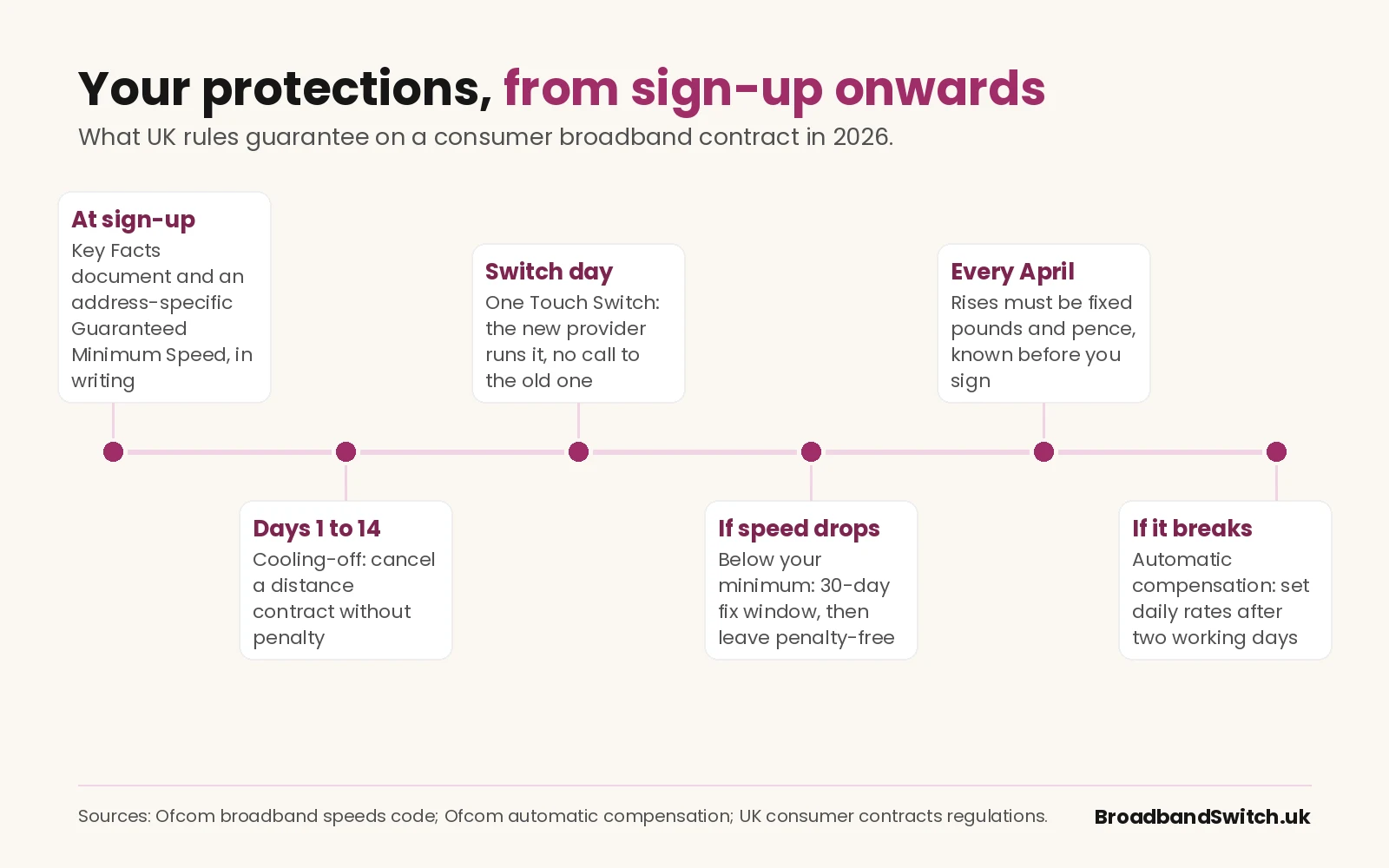
Address-specific Guaranteed Minimum Speed at sign-up. Major UK ISPs subscribing to the Voluntary Code of Practice on Broadband Speeds provide an address-specific GMS estimate at sign-up. GMS is the speed below which the provider's commitment kicks in.
If actual speeds fall below GMS, you have rights. Voluntary Code of Practice gives the right to terminate without penalty if speeds consistently fall below the GMS estimate after a 30-day fix window. This is a meaningful consumer protection.
GMS often differs from advertised speed. Particularly for FTTC and ADSL2+ where line length affects achievable speeds. GMS gives the realistic floor while advertised speed gives the marketing number.
Compare GMS rather than just advertised speed. For genuine speed expectations, GMS is more useful than advertised speed.
Independent measurement. Ofcom Connected Nations measurement and similar independent measurement organisations measure real-world performance. Real-world data includes peak-time speed (8pm-10pm), latency (response time), and consistency.
Real-world performance varies by network and provider. Some networks deliver consistent performance close to advertised speeds; some show significant peak-time degradation. Independent measurement reveals these patterns.
Where real-world performance matters. Working from home with video calls during business hours; streaming during evening peak; gaming where latency consistency matters; large household downloads. Where performance reliability matters more than peak speed, real-world data informs the decision.
Light usage. Email, web browsing, occasional video calls, single-user streaming - typically 30-60 Mbps adequate.
Standard household usage. Multiple devices, regular streaming including occasional 4K, working from home with video calls, gaming - typically 100-300 Mbps comfortable.
Heavy household usage. Multiple simultaneous 4K streams, extensive working from home with cloud syncing, content creation, large downloads, multiple gamers - 500+ Mbps comfortable.
Multi-gigabit usage. Content creation with regular large file uploads, multiple working-from-home users with heavy uploads simultaneously, technology enthusiasts wanting headroom for emerging applications - multi-gigabit packages (1 Gbps to 7 Gbps available depending on network).
Symmetric upload matters where upload is intensive. Working from home with large file syncing; content creation; cloud backup; streaming/broadcasting. Major UK ISPs traditionally offer asymmetric (download faster than upload); altnets often offer symmetric upload.
Compare by contract length
Contract length affects monthly pricing, total commitment, and switching flexibility. This section documents contract length comparison.
Lowest monthly cost typically. Longer contracts often have lower introductory monthly prices because providers can amortise customer acquisition costs over longer commitment.
Mid-contract rises across the longer commitment. April 2026 mid-contract rises (£3-£4 per month for major UK ISPs) apply more times across a 24-month contract than across a 12-month contract. Total contract cost calculation must include this.
Switching restricted for longer. Exiting a 24-month contract early triggers exit fees in most cases (proportional to remaining months) - documented at https://broadbandswitch.uk/exit-fees-and-setup-fees.html.
Where 24-month contracts work. Households confident in their package fit; households not anticipating moving; households prioritising lowest possible monthly cost.
Common middle ground. Many UK packages default to 18-month contracts as the standard option. Pricing typically slightly higher than 24-month and slightly lower than 12-month.
Reasonable balance of cost and flexibility. Cheaper monthly than 12-month while less commitment than 24-month. Often the default choice for general households.
Moderate flexibility. Allows annual switching consideration without major lock-in. Where the household anticipates potential changes (moving, different needs emerging), 12-month is a useful balance.
Modest price premium. Monthly pricing typically modestly higher than 18-month or 24-month for the same package. Price premium varies by provider.
Where 12-month contracts work. Households planning potential moves; households uncertain about long-term needs; households wanting annual review opportunity.
Maximum flexibility. Cancel any time with 30-day notice. Useful for short-term needs (for example, temporary accommodation, project-based usage).
Higher monthly price. Monthly pricing typically substantially higher than fixed-term contracts. The flexibility premium can be significant.
Limited availability. Not all providers offer rolling monthly; available where offered through specific packages.
Where rolling monthly works. Renters in short-term accommodation; project-based usage; households prioritising flexibility above all.
Calculate across the term, not just introductory price. Introductory price typically applies for first 12-24 months; standard pricing applies after. April 2026 mid-contract rises (£3-£4 per month for major UK ISPs) apply during the contract.
Example calculation framework. Take introductory monthly price multiplied by introductory months; add standard monthly price multiplied by remaining contract months; add expected mid-contract rises (proportional to time at each rate). This gives total contract cost over the term.
Compare total contract cost across providers and contract lengths. The cheapest introductory monthly price doesn't always have the cheapest total contract cost; longer contracts with lower introductory prices may have higher total cost due to mid-contract rises across more months.
Compare by technology type
Technology type comparison reflects the underlying network infrastructure delivering broadband to your address. This section documents the main UK 2026 technology options.
FTTP runs fibre directly to your premises. No copper component in the local connection. Speeds up to approximately 1.8 Gbps where Openreach FTTP available; symmetric upload at higher tiers. Most reliable performance because no copper bottleneck.
FTTP coverage growing. Ofcom Connected Nations 2025 shows 79 percent of English residential premises have full-fibre coverage; coverage continues to grow with active Openreach rollout and altnet expansion.
FTTP through major UK ISPs and altnets. Major UK ISPs (BT, Sky, EE, Plusnet, Vodafone, TalkTalk) offer FTTP packages where Openreach FTTP is available; altnets (CityFibre retail brands, Netomnia retail brands including YouFibre, Hyperoptic, Community Fibre, others) offer FTTP packages on their networks.
Where FTTP works. All household types where coverage exists; particularly valuable for working from home, gaming, multiple simultaneous heavy users.
FTTC runs fibre to the street cabinet then copper to your premises. Hybrid technology with copper component limiting maximum speed. Typical speeds up to 80 Mbps download and 20 Mbps upload, varying with line length from cabinet.
Wide UK availability. Most addresses without FTTP have FTTC. As Openreach FTTP rollout continues, FTTC footprint shrinks but remains substantial.
FTTC through major UK ISPs. All Openreach-using major UK ISPs offer FTTC packages where FTTC is the available technology.
Where FTTC works. Households where speeds up to 80 Mbps are adequate; households where FTTP not yet available. Less ideal for heavy upload usage because FTTC upload typically caps at 20 Mbps.
Virgin Media O2 DOCSIS cable network. Coaxial cable network covering approximately 16 million UK premises. Speeds typically up to approximately 1.1 Gbps where available with newer DOCSIS standards.
Asymmetric upload. Cable typically asymmetric (download faster than upload) like FTTC. Upload speeds vary by package.
Virgin Media O2 full fibre rollout. Virgin Media O2 rolling out full fibre (XGS-PON) to extend network beyond cable footprint with symmetric upload at full fibre tiers.
Where cable works. Households where Virgin Media O2 reaches the address; competitive pricing where Virgin Media's network is present.
Copper-only broadband. No fibre component; entirely on the copper telephone line. Speeds up to 24 Mbps download with significant degradation by distance from exchange.
Diminishing UK footprint. As Openreach FTTP rollout continues to areas previously served only by ADSL2+, the ADSL2+ footprint shrinks. PSTN switch-off targeted for January 2027 is driving FTTP rollout to ADSL2+ areas.
Where ADSL2+ remains. Some rural and semi-rural areas without FTTC or FTTP coverage; areas where rollout hasn't reached. Postcode checking surfaces whether ADSL2+ is the available technology.
What to consider with ADSL2+. PSTN switch-off January 2027 means migration to alternative technology necessary; FTTP rollout planned for many ADSL2+ areas; 4G/5G home broadband as alternative where fixed alternatives don't exist yet.
Wireless home broadband through mobile networks. Three Broadband, Vodafone, EE, and others offer 4G/5G home broadband as alternative to fixed broadband.
Where 4G/5G home broadband works. Areas with strong mobile signal but limited fixed broadband options; temporary accommodation; rapid setup needs without engineer visit; rural areas where fixed broadband not yet available.
Performance varies with mobile signal. Speed depends on mobile network coverage at the specific address. 4G typically delivers 30-100 Mbps where signal is strong; 5G can deliver 200-500+ Mbps where 5G coverage and signal are strong.
Comparison with fixed broadband. Where fixed broadband is available, fixed typically more reliable for working from home and consistent performance. Where fixed isn't available, 4G/5G provides alternative.
Hybrid technology Openreach deployed in some areas. Combines copper with vectoring technology for speeds up to approximately 330 Mbps where available.
Limited footprint compared to FTTP. Openreach prioritised FTTP over G.fast expansion; G.fast remains in selected areas.
Where G.fast remains. Some addresses without FTTP have G.fast; these may upgrade to FTTP as rollout reaches them.
Compare by price tier
Price tier comparison helps readers understand what to expect at each price point. This section documents the UK 2026 price tier landscape.
What entry-level packages typically offer. ADSL2+ or basic FTTC packages from major UK ISPs; basic altnet entry packages; speeds typically 30-100 Mbps; standard service levels.
Provider examples. Plusnet entry packages; TalkTalk entry packages; Now Broadband entry; some altnet entry packages.
What to watch for. Total contract cost calculation matters most at this tier because the difference between £22 introductory and £35 standard pricing across 24 months is significant; April 2026 mid-contract rises affect total cost; sometimes setup fees or router costs add to total.
Where entry-level works. Light usage households; budget-conscious households where lowest cost matters most; households where speed needs are modest.
What mid-tier packages typically offer. Standard FTTP packages around 100-300 Mbps; standard cable packages where Virgin Media O2 reaches; standard altnet packages.
Provider examples. BT Standard FTTP; Sky standard FTTP; Virgin Media O2 standard cable; CityFibre retail brands standard packages; YouFibre standard packages; Hyperoptic standard packages.
What to watch for. This tier offers the best speed-per-pound for most households; symmetric upload often available through altnets at this tier; total contract cost calculation still important.
Where mid-tier works. Standard household usage; working from home; streaming households; gaming; the most common household choice.
What premium packages typically offer. Faster FTTP packages around 500-900 Mbps; premium cable packages from Virgin Media O2; premium altnet packages with symmetric upload at all tiers.
Provider examples. BT Full Fibre 500/900; Sky Gigafast; Virgin Media O2 Gig1; CityFibre retail brand 1 Gbps options; YouFibre 1 Gbps; Hyperoptic 1 Gbps; Community Fibre 1 Gbps.
Where premium works. Heavy household usage with multiple simultaneous heavy users; working from home with cloud syncing; large downloads; multi-device streaming; gamers wanting headroom.
What multi-gigabit packages offer. Speeds above 1 Gbps; some up to multi-gigabit symmetric.
Provider examples. Virgin Media O2 Gig2 (cable network); altnets with multi-gigabit symmetric including YouFibre on Netomnia (up to 7 Gbps), Community Fibre (up to 3 Gbps); some CityFibre retail brand multi-gigabit options.
Where multi-gigabit works. Content creation with regular large file uploads; multiple working-from-home users with heavy uploads simultaneously; technology enthusiasts wanting headroom for emerging applications; household servers and similar advanced usage.
What to consider. Most current household devices and applications don't fully utilise multi-gigabit speeds; future-proofing value depends on anticipated future usage; symmetric upload often the more valuable feature than peak download.
Social tariffs available for eligible low-income households. Households on Universal Credit, Pension Credit, Income Support, similar benefits typically eligible.
Provider examples. BT Home Essentials (£15 per month for 36 Mbps; £20 per month for 67 Mbps); Sky Broadband Basics (£20 per month for 36 Mbps); Vodafone Pro Voucher Scheme; Virgin Media Essentials Broadband; Now Broadband Basics; others.
Eligibility verification. Most providers verify eligibility through the Department for Work and Pensions or similar. Process typically takes a few days to verify.
Why social tariffs matter. Citizens Advice research shows £113 per customer per year average loyalty penalty with £451 million cumulative annual UK impact; older customers and lower-income households disproportionately affected. Social tariffs address this for eligible households.
Where to find social tariff information. Provider websites; Ofcom social tariff guidance; https://broadbandswitch.uk/social-tariffs-uk-2026.html for comprehensive guidance.
Compare by provider category
Provider category comparison helps readers understand the UK 2026 provider landscape. This section documents the main UK provider categories.
BT Group brands. BT (main consumer brand with broadest TV bundling); EE (mobile-broadband bundling for existing EE mobile customers; relaunched as broadband brand); Plusnet (BT Group value brand often with lowest entry-level pricing). All three brands use Openreach infrastructure with shared technology availability. £4 per month flat April 2026 mid-contract rises from 31 March 2026.
Sky. TV bundling distinctive where TV is genuinely useful; primarily Openreach infrastructure with some altnet wholesale relationships. £3 flat per month April 2026 rises from 1 April 2026.
Virgin Media O2. Own DOCSIS cable network covering approximately 16 million UK premises plus full fibre rollout extending coverage. £4 new contracts and £3.50 in-contract April 2026 rises.
Vodafone. Mostly Openreach plus CityFibre wholesale in some areas; mobile bundling for existing Vodafone mobile customers. £3.50 per month rises for contracts post 2 July 2024.
TalkTalk. Primarily Openreach; traditional value positioning. £3 per month rises for contracts post 12 August 2024.
Three Broadband. Mobile-network-based 4G/5G home broadband plus growing fixed broadband. £3 per month rises for contracts post 1 September 2024.
Where major UK ISPs work. Wide availability across UK; established customer service infrastructure; bundling options where mobile or TV bundling adds genuine value; standardised consumer rights handling.
CityFibre wholesale infrastructure. Approximately 60 UK cities; wholesale-only model.
Retail brands using CityFibre. Cuckoo (focus on simplicity and customer service); Vodafone in some CityFibre cities; other retail partners.
Typical packages. Symmetric upload available at higher tiers; speeds up to approximately 1 Gbps with multi-gigabit options; pricing typically competitive with Openreach FTTP options.
Where CityFibre retail works. Cities with CityFibre coverage; readers prioritising speed-per-pound; symmetric upload value.
Netomnia wholesale infrastructure. Growing UK coverage with multi-gigabit symmetric capability up to 7 Gbps.
Retail brands. YouFibre as major retail brand offering symmetric upload at all tiers including multi-gigabit at top tier; Brsk on Netomnia in some areas.
Where Netomnia retail works. Areas with Netomnia coverage; working from home with heavy upload; content creation; technology enthusiasts wanting multi-gigabit symmetric.
Hyperoptic. Concentrating on multi-dwelling units in major UK cities (London, Manchester, Birmingham, Bristol, Liverpool, Cardiff, Edinburgh, others); symmetric upload across tiers; speeds up to 1 Gbps with multi-gigabit options.
Community Fibre. London-focused; multi-gigabit symmetric up to 3 Gbps; competitive pricing especially for symmetric upload value.
Geographic altnets. toob (south coast England); Brsk (London, Birmingham, Coventry); Trooli (Kent, Essex, Surrey, Sussex); BeFibre (selected areas); Lit Fibre (selected areas). Each with geographic concentration.
Where own-infrastructure altnets work. Areas covered by the specific altnet; readers prioritising symmetric upload, speed-per-pound, or local provider preference.
Zen Internet. UK customer service satisfaction leader; various wholesale relationships including Openreach. Where customer service quality matters most, Zen distinctive in UK 2026 customer satisfaction rankings.
Now Broadband. Sky-owned brand on Openreach; positioning as accessible Sky alternative.
Smaller specialist ISPs. Various smaller national ISPs with specific positioning.
Gigaclear. Rural-focused altnet operating in selected rural and semi-rural areas including parts of Oxfordshire, Gloucestershire, Devon, others.
B4RN. Community-owned non-profit fibre cooperative serving Lancashire and adjacent rural areas (parts of Cumbria, Yorkshire); symmetric gigabit at flat pricing; community ownership model.
Where community fibre works. Rural areas with community fibre coverage; readers valuing community ownership model; areas where major ISPs and standard altnets haven't reached.
Compare by usage context
Usage context comparison adapts package recommendations to specific household needs. This section documents the main usage contexts.
Symmetric upload matters significantly. Video calls, cloud syncing, file uploads to work systems all benefit from upload speed equal to download speed.
Where altnets often shine. CityFibre retail brands; Netomnia retail brands including YouFibre with multi-gigabit symmetric; Hyperoptic; Community Fibre; toob; Trooli; B4RN. Symmetric upload at all tiers or higher tiers.
Major UK ISP options. BT FTTP higher tiers offer symmetric upload; Sky FTTP higher tiers; Virgin Media O2 full fibre tiers symmetric. Standard major UK ISP packages typically asymmetric.
Reliability matters during business hours. Customer service responsiveness during business hours; complaint handling; automatic compensation for outages. Service-related factors matter more than peak speed for working from home.
Peak-time reliability matters most. Streaming during 8pm-10pm peak; multiple simultaneous 4K streams. Real-world performance during peak hours matters more than theoretical advertised speed.
What speeds are adequate. 4K streaming uses approximately 25-30 Mbps per stream; multiple simultaneous 4K streams plus other usage typically comfortable on 200+ Mbps; entry-level FTTP comfortably handles most streaming households.
Network reliability matters. Networks with consistent peak-time performance better than networks with significant peak-time degradation. Independent measurement reveals these patterns.
Low latency and stable speeds matter most. Latency (response time, ping) more important than peak speed for gaming. Stable consistent speeds more important than maximum speed.
Full fibre typically better than FTTC for gaming. FTTP and altnet full fibre networks typically deliver lower latency than FTTC. Cable networks (Virgin Media O2) competitive for gaming with full fibre.
Independent latency measurement. Independent technical reviewers including ThinkBroadband measure latency; this informs gaming-focused decisions.
Social tariff eligibility matters most. Eligible households can access tariffs at £15-£20 per month including BT Home Essentials, Sky Broadband Basics, Vodafone Pro Voucher Scheme, Virgin Media Essentials, Now Broadband Basics, others.
Eligibility criteria. Universal Credit, Pension Credit, Income Support, Income-based Jobseeker's Allowance, Income-related Employment and Support Allowance, similar benefits typically eligible.
Why social tariffs matter. Citizens Advice research shows £113 average loyalty penalty per customer per year and £451 million cumulative annual UK impact disproportionately affecting older customers and lower-income households; social tariffs address this for eligible households.
Comprehensive social tariff guidance. Available at https://broadbandswitch.uk/social-tariffs-uk-2026.html.
Contract length flexibility matters. Anticipating moves favours 12-month or rolling monthly contracts over 24-month commitments.
Minimal setup costs matter. Some providers charge setup fees that compound across moves; rolling monthly with no setup fee preferable for short-term accommodation.
Cooling-off period. 14 days under UK consumer regulation allows reconsideration if circumstances change shortly after sign-up.
Where renters-friendly options exist. Some altnets and major UK ISPs offer 12-month or shorter options; rolling monthly options at slight price premium.
Where TV bundle offers genuine value. Households where the TV element is genuinely useful and would be paid for separately if not bundled. Sky TV bundling; BT TV; Virgin Media O2 TV bundling.
Where TV bundle is added cost. Households where the TV element isn't genuinely useful (streaming-only households, households without significant TV viewing); broadband-only options often offer better consumer value than TV-bundled options.
Comparing bundle value. Calculate the cost of broadband-only versus broadband-plus-TV bundle; calculate the value of the TV element if paid separately; compare to determine whether bundle offers genuine value.
Compare by regulatory protection
Regulatory protection comparison surfaces consumer rights handling that varies by provider and matters significantly when things go wrong. This section documents the UK 2026 regulatory framework as it applies across providers.
Major UK ISPs subscribe to Ofcom's Voluntary Code. BT, EE, Plusnet, Sky, Virgin Media O2, Vodafone, TalkTalk, Now Broadband, Three Broadband, and others all subscribe.
Address-specific Guaranteed Minimum Speed at sign-up. Subscribed providers must give an address-specific GMS estimate during sign-up. This is a meaningful consumer protection.
Right to terminate without penalty. If actual speeds consistently fall below the GMS after a 30-day fix window, the customer has the right to terminate without exit fees.
Why this matters when comparing. All major UK ISPs subscribed; some altnets subscribed; checking subscription status helps compare consumer rights handling across providers.
Major UK ISPs participate. BT, EE, Plusnet, Sky, Virgin Media O2, Vodafone, TalkTalk, Now Broadband all participate in Ofcom's Automatic Compensation scheme.
Compensation triggered automatically. For delayed repairs (compensation per day after 2 working days); missed appointments (compensation per missed appointment); delayed installations (compensation per day after the agreed start date).
Updated rates from April 2026. Ofcom updated the per-day, per-appointment, and per-missed-engineer-visit rates from April 2026 to keep pace with inflation.
Why this matters when comparing. Automatic compensation removes the burden of having to claim; some altnets participate, some don't. Where reliability matters, automatic compensation is meaningful.
Sector-wide consumer protection commitments. The Telecoms Consumer Charter introduced February 2026 articulates sector-wide commitments around accurate information at sign-up, fair contract terms, transparent pricing, accessible customer service, and consumer protection.
Covers UK ISPs broadly. Major UK ISPs subscribe to Charter principles; many altnets also subscribe. Charter framework supports consistent consumer protection across providers.
Why this matters when comparing. Charter subscription signals provider commitment to UK 2026 consumer protection standards; aligns with broader regulatory framework.
Most UK ISPs participate. Switch initiated through the new provider; old provider notified automatically; no break in service in most cases.
Some altnets and smaller providers may not yet be in One Touch Switch. Where switching to or from a provider not yet in One Touch Switch, the switch may require manual coordination including potential service overlap or break.
Why this matters when comparing. One Touch Switch participation simplifies switching; non-participation adds complexity. For households planning future switching, One Touch Switch participation matters.
UK consumer regulation requires 14-day cooling-off for distance contracts. Applies to broadband sign-ups completed online, by phone, or other distance methods. Customer can cancel within 14 days of contract start without penalty (though may be liable for service used).
Universal across UK providers. All UK providers must comply with the 14-day cooling-off requirement under UK consumer regulation.
Why this matters when comparing. Allows reconsideration if circumstances change shortly after sign-up; reduces risk of major commitment without trying the service.
Ofcom January 2025 fixed pounds-and-pence rule. Mid-contract rises must be expressed as fixed pounds-and-pence amounts rather than CPI-linked or RPI-linked formulas. This requires providers to be specific about rise amounts at sign-up.
April 2026 mid-contract rises by major provider. BT, EE, Plusnet £4 per month flat from 31 March 2026; Virgin Media O2 £4 new contracts and £3.50 in-contract from April 2026; Sky £3 flat from 1 April 2026; Vodafone £3.50 from April 2026 for contracts post 2 July 2024; TalkTalk £3 for contracts post 12 August 2024; Three Broadband £3 for contracts post 1 September 2024.
Some altnets don't have mid-contract rises. Some altnets including B4RN community fibre offer flat pricing without mid-contract rises. This can be meaningful difference in total contract cost.
Why this matters when comparing. Total contract cost calculation must include mid-contract rises; providers without rises offer cleaner total cost certainty.
Ofcom social tariff guidance. Provides guidance on which providers offer social tariffs and eligibility criteria. Encourages broader provider participation.
Provider participation varies. BT, Sky, Vodafone, Virgin Media O2, Now Broadband all offer social tariffs; some altnets and smaller providers offer social tariffs; some don't.
Why this matters when comparing. For eligible low-income households, social tariff availability is the most important comparison factor; provider participation is a meaningful differentiator.
Applying the framework consistently
Feature-based comparison works best when the documented framework is applied consistently across feature lenses rather than each lens being treated in isolation. This section documents how to combine feature comparisons into genuine decisions.
Postcode reveals options first. Use postcode comparison documented at https://broadbandswitch.uk/compare-broadband-by-postcode.html to surface options at your address.
Apply primary feature lens to narrow. The most important feature for your context (working from home favouring symmetric upload; low income favouring social tariffs; gaming favouring low latency) narrows from many options to fewer candidates.
Apply secondary feature lenses to refine. Among narrowed candidates, secondary considerations (price tier fit, contract length flexibility, regulatory protection level) refine to genuine fit.
Apply 12-factor scoring model to rank candidates. The documented 12-factor scoring model gives a consistent way to rank narrowed candidates rather than relying on intuition or marketing.
Apply four core ranking principles to validate. Consumer value first; regulatory accuracy; total contract cost transparency; evenhanded provider treatment. Where ranking output doesn't reflect these principles, something has gone wrong - typically because a single feature has dominated when balance was needed.
The 12-factor scoring model provides consistency across feature comparisons. When comparing on speed alone, service factors stay in scope. When comparing on price alone, consumer rights stay in scope. When comparing on technology alone, contract length stays in scope. This consistency means the comparison output reflects the full landscape rather than just one lens. Documented in detail at https://broadbandswitch.uk/how-we-rank-broadband-deals.html.
Total contract cost calculation matters across every feature lens. When comparing on speed, total cost determines genuine value. When comparing on contract length, total cost is the primary metric. When comparing on price tier, total cost is more relevant than introductory price. Always include introductory pricing multiplied by introductory months plus standard pricing multiplied by remaining contract months plus expected mid-contract rises proportional to time. This is a foundational discipline regardless of which feature lens is in primary use.
Where feature-headline answer differs from consumer-value answer, consumer value wins. Fastest speed isn't best if service is worst; cheapest price isn't best if reliability is worst; longest contract isn't best if it traps in inferior service. The "consumer value first" principle reframes feature comparisons toward genuine fit rather than feature-headline winners.
BroadbandSwitch.uk includes UK altnets across all feature comparison lenses regardless of affiliate relationships. Altnets often offer better consumer value than major-only options - for symmetric upload (working from home), for speed-per-pound (price tier), for clean pricing (no mid-contract rises in some altnets like B4RN), for cleaner consumer rights handling. Where comparison output doesn't include relevant altnets, that comparison is incomplete. Comprehensive altnet inclusion is documented in our affiliate disclosure at https://broadbandswitch.uk/affiliate-disclosure.html.
Best deals analytics. Live monthly best deals analytics deep-dive at https://broadbandswitch.uk/best-broadband-deals-uk-may-2026.html applies the framework to identify current best deals.
Postcode comparison hub. Postcode-based comparison companion at https://broadbandswitch.uk/compare-broadband-by-postcode.html for the postcode-first comparison route.
Detailed location pages. 43 UK city pages at https://broadbandswitch.uk/locations/ apply the framework to specific UK cities.
UK provider directory. Comprehensive directory analysis at https://broadbandswitch.uk/directory-insights/.
Connected Nations 2025 analysis. Independent analysis at https://broadbandswitch.uk/reports/connected-nations-2025/.
Authoritative UK sources informing this feature-comparison hub
Independent third-party sources informing BroadbandSwitch.uk's feature-based comparison guidance.
- Ofcom Voluntary Code of Practice on Broadband Speeds: Address-specific Guaranteed Minimum Speed at sign-up. Available at ofcom.org.uk.
- Ofcom Automatic Compensation scheme: Updated April 2026 rates for delayed repairs, missed appointments, delayed installations. Available at ofcom.org.uk.
- Telecoms Consumer Charter (February 2026): Sector-wide consumer protection commitments. Available at ofcom.org.uk.
- Ofcom Connected Nations 2025 report: Published 19 November 2025 with UK coverage figures. Available at ofcom.org.uk.
- Ofcom social tariff guidance: Eligibility and provider participation. Available at ofcom.org.uk.
- Citizens Advice loyalty penalty research: £113 per customer per year average loyalty penalty; £451 million cumulative annual UK impact. Available at citizensadvice.org.uk.
- BroadbandSwitch.uk best UK broadband deals (May 2026): Live monthly analytics deep-dive. Available at broadbandswitch.uk/best-broadband-deals-uk-may-2026.html.
- BroadbandSwitch.uk directory insights: UK provider directory analysis. Available at broadbandswitch.uk/directory-insights/.
- BroadbandSwitch.uk Connected Nations 2025 analysis: Independent analysis. Available at broadbandswitch.uk/reports/connected-nations-2025/.
- BroadbandSwitch.uk compare by postcode hub: Postcode-based comparison companion. Available at broadbandswitch.uk/compare-broadband-by-postcode.html.
- BroadbandSwitch.uk locations cluster: 43 UK cities with city-specific guidance. Available at broadbandswitch.uk/locations/.
- BroadbandSwitch.uk how we rank broadband deals: Focused 12-factor ranking methodology. Available at broadbandswitch.uk/how-we-rank-broadband-deals.html.
- BroadbandSwitch.uk methodology and trust hub: Comprehensive operational reference. Available at broadbandswitch.uk/methodology-and-trust-hub.html.
- BroadbandSwitch.uk why trust BroadbandSwitch.uk: Quick-reference summary. Available at broadbandswitch.uk/why-trust-broadbandswitch.html.
- BroadbandSwitch.uk affiliate disclosure: Detailed commercial relationship disclosure. Available at broadbandswitch.uk/affiliate-disclosure.html.
- BroadbandSwitch.uk editorial policy: Detailed editorial standards. Available at broadbandswitch.uk/editorial-policy.html.
- BroadbandSwitch.uk corrections process: Engagement path for corrections. Available at broadbandswitch.uk/corrections/.
- BroadbandSwitch.uk corrections log: Public record of substantive corrections. Available at broadbandswitch.uk/corrections-log.html.
- BroadbandSwitch.uk glossary: 152 UK 2026 broadband terms with definitions. Available at broadbandswitch.uk/glossary.html.
- BroadbandSwitch.uk social tariffs UK 2026: Comprehensive social tariff guidance. Available at broadbandswitch.uk/social-tariffs-uk-2026.html.
How we put this feature-comparison hub together
This compare broadband by feature hub guide documents the genuine UK 2026 feature-based comparison landscape rather than aspirational claims. Verified facts include the documented 12-factor scoring model covering cost factors (introductory monthly price, total contract cost over the term, switching credits and other monetary incentives), speed factors (advertised speed, Guaranteed Minimum Speed, real-world performance from independent measurement), service factors (customer service satisfaction from Ofcom Telecoms Customer Experience reports and customer review platforms, complaint frequency, automatic compensation track record), value factors (contract length flexibility, package fit for user context), and rights factors (consumer rights handling including cooling-off period, mid-contract rises, dispute resolution); the four core ranking principles of consumer value first (where consumer-value answer differs from feature-headline answer, consumer value wins), regulatory accuracy (verify against current UK 2026 regulatory framework regardless of feature lens), total contract cost transparency (calculate cost across the term including standard pricing and April mid-contract rises regardless of which feature comparison drives the choice), and evenhanded provider treatment (major ISPs and altnets compared on the same scoring model regardless of feature lens); the speed comparison framework across advertised speed (achievable for at least 50 percent of customers under Voluntary Code of Practice on Broadband Speeds), Guaranteed Minimum Speed (address-specific estimate at sign-up with right to terminate without penalty if speeds consistently fall below GMS after 30-day fix window), and real-world performance from independent measurement; the contract length comparison across 24-month (lowest monthly cost typically), 18-month (common middle ground), 12-month (moderate flexibility for annual switching), and rolling monthly (maximum flexibility cancellable with 30-day notice) with total contract cost calculation including introductory pricing multiplied by introductory months plus standard pricing multiplied by remaining contract months plus expected April 2026 mid-contract rises; the technology type comparison covering full fibre to the premises FTTP at speeds up to approximately 1.8 Gbps with symmetric upload at higher tiers, fibre to the cabinet FTTC at typical speeds up to 80 Mbps download and 20 Mbps upload, cable through Virgin Media O2 DOCSIS at speeds typically up to approximately 1.1 Gbps with full fibre rollout extending coverage, ADSL2+ copper-only at speeds up to 24 Mbps with diminishing footprint as PSTN switch-off targeted for January 2027 drives FTTP rollout, 4G/5G home broadband through Three Broadband and Vodafone and EE and others, and G.fast at speeds up to approximately 330 Mbps in limited areas; the price tier comparison covering entry-level around £20-£25 per month introductory, mid-tier around £25-£35 per month, premium around £35-£45 per month, multi-gigabit around £45-£60 plus per month including up to 7 Gbps symmetric on YouFibre via Netomnia infrastructure, and social tariffs around £15-£20 per month for eligible low-income households on Universal Credit, Pension Credit, Income Support, and similar benefits; the provider category comparison covering major UK ISPs including BT Group brands BT EE Plusnet using Openreach with £4 per month flat April 2026 mid-contract rises from 31 March 2026, Sky with £3 flat from 1 April 2026, Virgin Media O2 with £4 new contracts and £3.50 in-contract from April 2026, Vodafone with £3.50 from April 2026 for contracts post 2 July 2024, TalkTalk with £3 for contracts post 12 August 2024, Three Broadband with £3 for contracts post 1 September 2024 and Now Broadband as Sky-owned brand on Openreach, plus altnets including CityFibre wholesale infrastructure in approximately 60 UK cities with retail brands Cuckoo and Vodafone in some areas and others, Netomnia retail brands including YouFibre with multi-gigabit symmetric capability up to 7 Gbps and Brsk on Netomnia in some areas, Hyperoptic concentrating on multi-dwelling units in major UK cities including London Manchester Birmingham Bristol Liverpool Cardiff Edinburgh, Community Fibre London-focused with multi-gigabit symmetric up to 3 Gbps, geographic altnets toob in south coast England and Brsk in London Birmingham Coventry and Trooli in Kent Essex Surrey Sussex and BeFibre and Lit Fibre, plus specialist providers including Zen Internet UK customer service satisfaction leader with various wholesale relationships and smaller specialist ISPs, plus community fibre including Gigaclear with rural focus and B4RN community-owned non-profit fibre cooperative serving Lancashire and adjacent rural areas with symmetric gigabit at flat pricing without mid-contract rises; the usage context comparison covering working from home with symmetric upload prioritisation, streaming-heavy households with peak-time reliability prioritisation, gaming households with low latency prioritisation, low-income households with social tariff eligibility for £15-£20 per month tariffs including BT Home Essentials Sky Broadband Basics Vodafone Pro Voucher Scheme Virgin Media Essentials Now Broadband Basics with eligibility for households on Universal Credit Pension Credit Income Support and similar benefits, renters with contract length flexibility and minimal setup costs, and TV bundle preference with calculation of broadband-only versus bundled to determine genuine value; the regulatory protection framework covering the Voluntary Code of Practice on Broadband Speeds with major UK ISPs subscribed and address-specific Guaranteed Minimum Speed at sign-up and right to terminate without penalty if speeds consistently fall below GMS after 30-day fix window, the Automatic Compensation scheme with major UK ISPs participating and updated April 2026 rates, the Telecoms Consumer Charter introduced February 2026 with sector-wide commitments around accurate information and fair contract terms and transparent pricing, the One Touch Switch process with most UK ISPs participating, the 14-day cooling-off period universal across UK providers under UK consumer regulation, the mid-contract price rise rules including Ofcom January 2025 fixed pounds-and-pence rule and April 2026 rises by major provider with some altnets including B4RN not having mid-contract rises, and the Ofcom social tariff guidance with provider participation varying; the framework application combining feature lenses through postcode reveals options first followed by primary feature lens narrows then secondary feature lenses refine then 12-factor scoring model ranks candidates then four core ranking principles validate; and the comprehensive UK altnet inclusion regardless of affiliate relationships documented in the affiliate disclosure. The named credentialled editorial team comprising Dr Alex J. Martin-Smith (head of editorial, founder, holding CMgr MBA LLM DBA credentials reflecting management qualifications, legal training, and doctoral-level research) and Adrian James (broadband editor with editorial background combined with sustained focus on UK telecoms, regulatory frameworks, and consumer journalism) operate under the documented two-stage editorial workflow where Adrian writes and Alex reviews; the Citizens Advice loyalty penalty research figures of £113 per customer per year average and £451 million cumulative annual UK impact disproportionately affecting older customers and lower-income households inform the social tariff and price tier sections; and customer review platforms (Trustpilot, Reviews.io, Feefo) and independent technical reviewers (ISPreview UK, Choose, Broadband.co.uk, ThinkBroadband.com) all inform the editorial work that supports feature-based comparison.
Editorial: Written by Adrian James, broadband editor. Reviewed by Dr Alex J. Martin-Smith, head of editorial. Last updated 28 April 2026; next review within 90 days. Corrections welcome via our corrections process.
How we earn: BroadbandSwitch.uk is independent. We sometimes earn affiliate fees from broadband switching deals; this never affects which providers we cover or how we describe them. See our affiliate disclosure and editorial policy.
Frequently asked questions about comparing broadband by feature
Why does feature-based comparison matter for UK broadband?
Feature-based comparison narrows from available options to genuine fit for specific needs. Without feature filtering, choosing among 10 plus available providers and packages becomes overwhelming; with feature filtering, the choice becomes manageable and decisions reflect what genuinely matters to the household. Postcode comparison is the first step: postcode availability checking surfaces what's actually orderable at your address documented in detail at https://broadbandswitch.uk/compare-broadband-by-postcode.html. Feature-based comparison is the second step: from the available options, feature-based comparison filters to genuine fit because a household working from home prioritises different features than a streaming-heavy household and a low-income household has different priorities than a household with discretionary income for premium options. Together they support genuine decisions: postcode-without-feature comparison surfaces options without helping choose; feature-without-postcode comparison risks recommending options not actually available; used together they support genuine UK 2026 broadband decisions. BroadbandSwitch.uk applies the documented 12-factor scoring model consistently across all feature comparisons covering cost factors (introductory monthly price, total contract cost over the term, switching credits and other monetary incentives), speed factors (advertised speed, Guaranteed Minimum Speed, real-world performance), service factors (customer service satisfaction, complaint frequency, automatic compensation track record), value factors (contract length flexibility, package fit for user context), and rights factors (consumer rights handling). This consistency means comparing on speed doesn't ignore service; comparing on price doesn't ignore consumer rights; the 12 factors stay in scope across feature lenses. Four core ranking principles applied consistently: consumer value first; regulatory accuracy; total contract cost transparency; evenhanded provider treatment. Comprehensive UK altnet inclusion across feature comparisons regardless of affiliate relationships because altnets often offer better consumer value than major-only options for symmetric upload, speed-per-pound, clean pricing without mid-contract rises in some altnets, and cleaner consumer rights handling.
How should I compare UK broadband by speed?
Compare by speed across three dimensions. Advertised speed under Voluntary Code of Practice on Broadband Speeds: major UK ISPs subscribe; advertised speed must be achievable for at least 50 percent of customers; advertised speed varies dramatically by package and technology from ADSL2+ packages advertising up to 24 Mbps through FTTC packages typically up to 80 Mbps to FTTP packages from 100 Mbps entry to approximately 1.8 Gbps to cable packages typically up to approximately 1.1 Gbps to multi-gigabit altnet packages up to 7 Gbps on YouFibre via Netomnia infrastructure; comparing advertised speeds across providers within a technology category typically shows clusters with packages outside the cluster having specific reasoning. Guaranteed Minimum Speed (GMS): address-specific Guaranteed Minimum Speed at sign-up; major UK ISPs subscribing to the Voluntary Code provide an address-specific GMS estimate; if actual speeds consistently fall below GMS after a 30-day fix window the customer has the right to terminate without penalty - a meaningful consumer protection; GMS often differs from advertised speed particularly for FTTC and ADSL2+ where line length affects achievable speeds; for genuine speed expectations GMS is more useful than advertised speed. Real-world performance: independent measurement including Ofcom Connected Nations measurement and similar; real-world data includes peak-time speed (8pm-10pm), latency, consistency; real-world performance varies by network and provider with some delivering consistent performance close to advertised speeds and some showing significant peak-time degradation; matters for working from home with video calls during business hours, streaming during evening peak, gaming where latency consistency matters, large household downloads. What speed do I actually need: light usage typically 30-60 Mbps adequate for email, web browsing, occasional video calls, single-user streaming; standard household usage typically 100-300 Mbps comfortable for multiple devices, regular streaming including occasional 4K, working from home with video calls, gaming; heavy household usage 500 plus Mbps comfortable for multiple simultaneous 4K streams, extensive working from home with cloud syncing, content creation; multi-gigabit usage for content creation with regular large file uploads, multiple working-from-home users with heavy uploads simultaneously, technology enthusiasts wanting headroom. Symmetric upload matters where upload is intensive (working from home with large file syncing, content creation, cloud backup) - major UK ISPs traditionally offer asymmetric while altnets often offer symmetric upload.
How does contract length affect total UK broadband cost?
Contract length affects monthly pricing, total commitment, and switching flexibility across four main options. 24-month contracts: lowest monthly cost typically because longer contracts often have lower introductory monthly prices as providers can amortise customer acquisition costs over longer commitment; April 2026 mid-contract rises (£3-£4 per month for major UK ISPs) apply more times across a 24-month contract than across a 12-month contract so total contract cost calculation must include this; switching restricted for longer with exit fees triggered for early exit proportional to remaining months; works for households confident in their package fit, households not anticipating moving, households prioritising lowest possible monthly cost. 18-month contracts: common middle ground with many UK packages defaulting to 18-month as the standard option; pricing typically slightly higher than 24-month and slightly lower than 12-month; reasonable balance of cost and flexibility - cheaper monthly than 12-month while less commitment than 24-month; often the default choice for general households. 12-month contracts: moderate flexibility allowing annual switching consideration without major lock-in - useful where the household anticipates potential changes; modest price premium over longer contracts; works for households planning potential moves, households uncertain about long-term needs, households wanting annual review opportunity. Rolling monthly options: maximum flexibility cancellable any time with 30-day notice; useful for short-term needs like temporary accommodation, project-based usage; higher monthly price typically substantially higher than fixed-term contracts as the flexibility premium can be significant; limited availability not all providers offer rolling monthly; works for renters in short-term accommodation, project-based usage, households prioritising flexibility above all. Total contract cost calculation: calculate across the term not just introductory price; introductory price typically applies for first 12-24 months with standard pricing applying after; April 2026 mid-contract rises apply during the contract; example calculation framework takes introductory monthly price multiplied by introductory months plus standard monthly price multiplied by remaining contract months plus expected mid-contract rises proportional to time at each rate giving total contract cost over the term; the cheapest introductory monthly price doesn't always have the cheapest total contract cost as longer contracts with lower introductory prices may have higher total cost due to mid-contract rises across more months.
How do UK 2026 broadband technology types compare?
Compare by technology type across UK 2026 options. Full fibre to the premises (FTTP): runs fibre directly to your premises with no copper component in the local connection; speeds up to approximately 1.8 Gbps where Openreach FTTP available with symmetric upload at higher tiers; most reliable performance because no copper bottleneck; FTTP coverage growing with Ofcom Connected Nations 2025 showing 79 percent of English residential premises have full-fibre coverage; available through major UK ISPs (BT, Sky, EE, Plusnet, Vodafone, TalkTalk) where Openreach FTTP available and through altnets including CityFibre retail brands, Netomnia retail brands including YouFibre, Hyperoptic, Community Fibre, others; works for all household types where coverage exists particularly valuable for working from home, gaming, multiple simultaneous heavy users. Fibre to the cabinet (FTTC): runs fibre to the street cabinet then copper to your premises - hybrid technology with copper component limiting maximum speed; typical speeds up to 80 Mbps download and 20 Mbps upload varying with line length from cabinet; wide UK availability with most addresses without FTTP having FTTC; available through all Openreach-using major UK ISPs; works for households where speeds up to 80 Mbps adequate; less ideal for heavy upload usage because FTTC upload typically caps at 20 Mbps. Cable: Virgin Media O2 DOCSIS cable network covering approximately 16 million UK premises with speeds typically up to approximately 1.1 Gbps where available; asymmetric upload like FTTC; Virgin Media O2 rolling out full fibre (XGS-PON) extending network beyond cable footprint with symmetric upload at full fibre tiers; works where Virgin Media O2 reaches the address with competitive pricing. ADSL2+ (copper-only): no fibre component entirely on the copper telephone line; speeds up to 24 Mbps download with significant degradation by distance from exchange; diminishing UK footprint as Openreach FTTP rollout continues; PSTN switch-off targeted for January 2027 driving FTTP rollout to ADSL2+ areas; remaining in some rural and semi-rural areas. 4G/5G home broadband: wireless home broadband through mobile networks - Three Broadband, Vodafone, EE, others; works in areas with strong mobile signal but limited fixed broadband options, temporary accommodation, rapid setup needs without engineer visit, rural areas where fixed broadband not yet available; performance varies with mobile signal with 4G typically delivering 30-100 Mbps and 5G delivering 200-500 plus Mbps where coverage and signal strong. G.fast: hybrid technology Openreach deployed in some areas combining copper with vectoring for speeds up to approximately 330 Mbps; limited footprint compared to FTTP.
What UK 2026 broadband price tiers exist?
Compare by price tier across UK 2026 landscape. Entry-level tier (around £20-£25 per month introductory): ADSL2+ or basic FTTC packages from major UK ISPs; basic altnet entry packages; speeds typically 30-100 Mbps; standard service levels; provider examples include Plusnet entry packages, TalkTalk entry packages, Now Broadband entry, some altnet entry packages; total contract cost calculation matters most at this tier because the difference between £22 introductory and £35 standard pricing across 24 months is significant; April 2026 mid-contract rises affect total cost; works for light usage households, budget-conscious households where lowest cost matters most, households where speed needs are modest. Mid-tier (around £25-£35 per month introductory): standard FTTP packages around 100-300 Mbps; standard cable packages where Virgin Media O2 reaches; standard altnet packages; provider examples include BT Standard FTTP, Sky standard FTTP, Virgin Media O2 standard cable, CityFibre retail brands, YouFibre standard packages, Hyperoptic standard packages; offers best speed-per-pound for most households; symmetric upload often available through altnets at this tier; works for standard household usage, working from home, streaming households, gaming - the most common household choice. Premium tier (around £35-£45 per month introductory): faster FTTP packages around 500-900 Mbps; premium cable packages; premium altnet packages with symmetric upload at all tiers; provider examples include BT Full Fibre 500/900, Sky Gigafast, Virgin Media O2 Gig1, CityFibre retail brand 1 Gbps options, YouFibre 1 Gbps, Hyperoptic 1 Gbps, Community Fibre 1 Gbps; works for heavy household usage with multiple simultaneous heavy users, working from home with cloud syncing, multi-device streaming, gamers wanting headroom. Multi-gigabit tier (around £45-£60 plus per month introductory): speeds above 1 Gbps with some up to multi-gigabit symmetric; provider examples include Virgin Media O2 Gig2, altnets with multi-gigabit symmetric including YouFibre on Netomnia up to 7 Gbps and Community Fibre up to 3 Gbps, some CityFibre retail brand multi-gigabit options; works for content creation with regular large file uploads, multiple working-from-home users with heavy uploads simultaneously, technology enthusiasts wanting headroom for emerging applications, household servers; most current household devices and applications don't fully utilise multi-gigabit speeds with symmetric upload often the more valuable feature than peak download. Social tariffs (around £15-£20 per month for eligible households): households on Universal Credit, Pension Credit, Income Support, similar benefits typically eligible; provider examples include BT Home Essentials (£15 per month for 36 Mbps; £20 per month for 67 Mbps), Sky Broadband Basics (£20 per month for 36 Mbps), Vodafone Pro Voucher Scheme, Virgin Media Essentials Broadband, Now Broadband Basics; eligibility verification through DWP or similar typically takes a few days; addresses Citizens Advice research showing £113 per customer per year average loyalty penalty disproportionately affecting lower-income households.
How do UK provider categories compare?
Compare by provider category across UK 2026 landscape. Major UK ISPs: BT Group brands BT (main consumer brand with broadest TV bundling), EE (mobile-broadband bundling for existing EE mobile customers, relaunched as broadband brand), Plusnet (BT Group value brand often with lowest entry-level pricing) - all three using Openreach infrastructure with shared technology availability and £4 per month flat April 2026 mid-contract rises from 31 March 2026; Sky with TV bundling distinctive where TV is genuinely useful, primarily Openreach infrastructure with some altnet wholesale relationships, £3 flat per month April 2026 rises from 1 April 2026; Virgin Media O2 with own DOCSIS cable network covering approximately 16 million UK premises plus full fibre rollout, £4 new contracts and £3.50 in-contract April 2026 rises; Vodafone with mostly Openreach plus CityFibre wholesale in some areas, mobile bundling for existing Vodafone mobile customers, £3.50 per month rises for contracts post 2 July 2024; TalkTalk with primarily Openreach traditional value positioning, £3 per month rises for contracts post 12 August 2024; Three Broadband with mobile-network-based 4G/5G home broadband plus growing fixed broadband, £3 per month rises for contracts post 1 September 2024; works for wide UK availability, established customer service infrastructure, bundling options where mobile or TV bundling adds genuine value, standardised consumer rights handling. Altnets (CityFibre wholesale and retail): CityFibre wholesale infrastructure approximately 60 UK cities wholesale-only model; retail brands using CityFibre including Cuckoo (focus on simplicity and customer service), Vodafone in some CityFibre cities, other retail partners; symmetric upload available at higher tiers, speeds up to approximately 1 Gbps with multi-gigabit options, pricing typically competitive with Openreach FTTP options; works for cities with CityFibre coverage, readers prioritising speed-per-pound, symmetric upload value. Altnets (Netomnia wholesale and retail): Netomnia wholesale infrastructure with growing UK coverage and multi-gigabit symmetric capability up to 7 Gbps; retail brands including YouFibre as major retail brand offering symmetric upload at all tiers including multi-gigabit at top tier and Brsk on Netomnia in some areas; works for areas with Netomnia coverage, working from home with heavy upload, content creation, technology enthusiasts wanting multi-gigabit symmetric. Altnets (own infrastructure): Hyperoptic concentrating on multi-dwelling units in major UK cities (London, Manchester, Birmingham, Bristol, Liverpool, Cardiff, Edinburgh, others); Community Fibre London-focused with multi-gigabit symmetric up to 3 Gbps; geographic altnets toob (south coast England), Brsk (London, Birmingham, Coventry), Trooli (Kent, Essex, Surrey, Sussex), BeFibre (selected areas), Lit Fibre (selected areas); works for areas covered by the specific altnet, readers prioritising symmetric upload, speed-per-pound, or local provider preference. Specialist providers: Zen Internet (UK customer service satisfaction leader with various wholesale relationships including Openreach) where customer service quality matters most; Now Broadband (Sky-owned brand on Openreach); smaller specialist ISPs. Community fibre: Gigaclear (rural-focused altnet operating in selected rural and semi-rural areas including parts of Oxfordshire, Gloucestershire, Devon); B4RN (community-owned non-profit fibre cooperative serving Lancashire and adjacent rural areas including parts of Cumbria, Yorkshire with symmetric gigabit at flat pricing without mid-contract rises and community ownership model).
How should usage context shape UK broadband choice?
Compare by usage context across major household types. Working from home: symmetric upload matters significantly because video calls, cloud syncing, and file uploads to work systems all benefit from upload speed equal to download speed; altnets often shine including CityFibre retail brands, Netomnia retail brands including YouFibre with multi-gigabit symmetric, Hyperoptic, Community Fibre, toob, Trooli, B4RN with symmetric upload at all tiers or higher tiers; major UK ISP options at higher FTTP tiers (BT FTTP higher tiers, Sky FTTP higher tiers, Virgin Media O2 full fibre tiers symmetric) while standard major UK ISP packages typically asymmetric; reliability matters during business hours including customer service responsiveness, complaint handling, automatic compensation for outages with service-related factors mattering more than peak speed. Streaming-heavy households: peak-time reliability matters most during 8pm-10pm peak with multiple simultaneous 4K streams; 4K streaming uses approximately 25-30 Mbps per stream so multiple simultaneous 4K streams plus other usage typically comfortable on 200 plus Mbps; entry-level FTTP comfortably handles most streaming households; networks with consistent peak-time performance better than networks with significant peak-time degradation. Gaming households: low latency and stable speeds matter most because latency (response time, ping) is more important than peak speed for gaming and stable consistent speeds are more important than maximum speed; full fibre typically better than FTTC for gaming with FTTP and altnet full fibre networks delivering lower latency than FTTC; cable networks competitive for gaming with full fibre; independent latency measurement from technical reviewers including ThinkBroadband informs gaming-focused decisions. Low-income households: social tariff eligibility matters most with eligible households accessing tariffs at £15-£20 per month including BT Home Essentials, Sky Broadband Basics, Vodafone Pro Voucher Scheme, Virgin Media Essentials, Now Broadband Basics; eligibility criteria include Universal Credit, Pension Credit, Income Support, Income-based Jobseeker's Allowance, Income-related Employment and Support Allowance, similar benefits; addresses Citizens Advice research showing £113 average loyalty penalty per customer per year and £451 million cumulative annual UK impact disproportionately affecting older customers and lower-income households. Renters: contract length flexibility matters with anticipating moves favouring 12-month or rolling monthly contracts over 24-month commitments; minimal setup costs matter as some providers charge setup fees that compound across moves; 14-day cooling-off period under UK consumer regulation allows reconsideration if circumstances change shortly after sign-up; some altnets and major UK ISPs offer 12-month or shorter options with rolling monthly options at slight price premium. TV bundle preference: where TV bundle offers genuine value (households where TV element is genuinely useful and would be paid for separately), Sky TV bundling, BT TV, Virgin Media O2 TV bundling can offer combined value; where TV bundle is added cost (streaming-only households, households without significant TV viewing), broadband-only options often offer better consumer value than TV-bundled options; calculate broadband-only versus broadband-plus-TV bundle and the value of the TV element if paid separately to determine genuine value.
What UK 2026 regulatory protections should I compare?
Compare by regulatory protection across UK 2026 framework. Voluntary Code of Practice on Broadband Speeds: major UK ISPs subscribe including BT, EE, Plusnet, Sky, Virgin Media O2, Vodafone, TalkTalk, Now Broadband, Three Broadband and others; subscribed providers must give an address-specific Guaranteed Minimum Speed estimate during sign-up - a meaningful consumer protection; if actual speeds consistently fall below the GMS after a 30-day fix window the customer has the right to terminate without exit fees; some altnets subscribed and checking subscription status helps compare consumer rights handling. Automatic Compensation scheme: major UK ISPs participate including BT, EE, Plusnet, Sky, Virgin Media O2, Vodafone, TalkTalk, Now Broadband; compensation triggered automatically for delayed repairs (compensation per day after 2 working days), missed appointments (compensation per missed appointment), delayed installations (compensation per day after agreed start date); updated rates from April 2026 to keep pace with inflation; automatic compensation removes the burden of having to claim with some altnets participating and some not. Telecoms Consumer Charter (introduced February 2026): sector-wide consumer protection commitments around accurate information at sign-up, fair contract terms, transparent pricing, accessible customer service, and consumer protection; covers UK ISPs broadly with major UK ISPs subscribing to Charter principles and many altnets also subscribing; supports consistent consumer protection across providers. One Touch Switch process: most UK ISPs participate; switch initiated through the new provider with old provider notified automatically and no break in service in most cases; some altnets and smaller providers may not yet be in One Touch Switch with switching to or from non-participating providers requiring manual coordination including potential service overlap or break; One Touch Switch participation simplifies switching - matters for households planning future switching. 14-day cooling-off period: UK consumer regulation requires 14-day cooling-off for distance contracts applying to broadband sign-ups completed online, by phone, or other distance methods; customer can cancel within 14 days of contract start without penalty though may be liable for service used; universal across UK providers under UK consumer regulation; allows reconsideration if circumstances change shortly after sign-up. Mid-contract price rise rules: Ofcom January 2025 fixed pounds-and-pence rule requiring mid-contract rises to be expressed as fixed pounds-and-pence amounts rather than CPI-linked or RPI-linked formulas requiring providers to be specific about rise amounts at sign-up; April 2026 mid-contract rises by major provider; some altnets including B4RN community fibre offer flat pricing without mid-contract rises - meaningful difference in total contract cost. Social tariff guidance: Ofcom social tariff guidance provides guidance on which providers offer social tariffs and eligibility criteria; provider participation varies with BT, Sky, Vodafone, Virgin Media O2, Now Broadband all offering social tariffs and some altnets and smaller providers offering them; for eligible low-income households social tariff availability is the most important comparison factor.
References
- Ofcom. (n.d.). Voluntary Code of Practice on Broadband Speeds. Office of Communications. https://www.ofcom.org.uk/phones-and-broadband/quality-of-service/voluntary-codes-of-practice
- Ofcom. (n.d.). Automatic compensation for landline and broadband customers. Office of Communications. https://www.ofcom.org.uk/phones-and-broadband/saving-money/automatic-compensation
- Citizens Advice. (2023). The real cost of hidden deals: loyalty penalty in essential markets. Citizens Advice. https://www.citizensadvice.org.uk/about-us/media-centre/press-releases/mobile-and-broadband-companies-not-being-upfront-about-better-renewal-deals/