Cheapest broadband deals: compare low-cost UK deals by postcode
The cheapest broadband in Britain is the one almost nobody claims. Ofcom counts 532,000 UK households on a social tariff against 6.2 million on Universal Credit, a take-up rate of 8.6%, and 70% of eligible households do not know the tariffs exist. If you claim a qualifying benefit, that is your cheapest route by a distance, at £12.50 to £24 a month. If you do not, entry full fibre at roughly £20 to £25 is usually the cheapest credible open-market deal, and this page ranks every route by what it actually costs across a year.


Live prices across 30+ UK providers, sorted cheapest first. Availability decides everything at the bottom of the market, so the postcode check is the shortlist rather than a formality. For our hand-checked view of every major provider, see this month's verified broadband deals.
Independent, free, no signup. Or jump to the cheapest deals below.Quick answer. The cheapest UK broadband falls into three bands. Social tariffs are the cheapest of all, at £12.50 to £24 a month for people on Universal Credit, Pension Credit and similar benefits, and Ofcom counts more than 30 such tariffs as at December 2025. Entry-level full fibre sits at roughly £20 to £25 a month at many addresses, and is usually the cheapest credible open-market route. Rolling 1-month deals cost more per month, typically £30 to £40, but carry no early-exit fee. Your real options depend on your postcode, because availability at the bottom of the market changes street by street.
- £12.50a month, the cheapest UK social tariff floor
- 8.6%of eligible households have claimed one
- £20 to £25typical cheapest open-market full fibre
- £200+a year, the typical social tariff saving
- What counts as cheap
- Social tariffs
- Open-market routes
- Why cheapest can mislead
- Every route ranked
- How to find it
- Live deals
- FAQ
What counts as cheap broadband in the UK right now
For most UK households at typical addresses, an entry-level broadband deal sits somewhere between £20 and £30 a month at the headline price. Below that range, you are usually either on a social tariff, a short introductory offer, or a rolling 1-month deal. Drawing on Ofcom's pricing and consumer engagement reporting, average household broadband spend runs a little above that range once add-ons, phone lines and mid-contract rises are factored in, and our average monthly broadband cost guide has the full breakdown.
- Qualify for a social tariffThe cheapest route in the UK by a distance if anyone in the household claims a qualifying benefit, and the one most people miss. Ofcom puts take-up at 8.6% of eligible households.Way one
- Pick an altnet or challenger providerAt a postcode where they have coverage, alternative network builders often undercut the big brands on entry full fibre, typically at £20 to £25 a month with no setup fee.Way two
- Switch at the right momentA few weeks before your existing contract ends, so you avoid both early-exit fees and the out-of-contract rate. The switching hub covers notice periods and cooling-off in plain English.Way three
For more ways to trim bills without guessing at speeds, read how to save money on broadband, and the compare by feature hub lists every filter-led route we publish.
The cheapest deals on the open market
If you are not eligible for a social tariff, your cheapest realistic route depends on what is live at your postcode, which is why an address-level check beats any national cheapest list.
- Altnet full fibre · £20 to £25At many addresses covered by an alternative network builder, entry-level full fibre undercuts the big-brand providers, with some leading in at around £20 to £25 a month with zero setup and no landline. Worth checking at your postcode: Community Fibre, Hyperoptic, YouFibre, Gigaclear, Connect Fibre, Brsk and Toob.Usually the cheapest
- Challenger ISPs on OpenreachProviders such as NOW Broadband and Plusnet often compete hard on price using the Openreach network, and their deal set shifts week to week, so a check today can beat a check last month.Widely available
- Rolling 1-month deals · £30 to £40For short stays or temporary setups, a 1-month rolling contract avoids early-exit fees but carries a higher headline monthly cost. Useful, and rarely the cheapest over a year.Flexible, not cheap
- FTTC where it is still soldStandard fibre plans remain available at many addresses and are genuinely cheap in some areas. The copper platform supporting legacy voice is being withdrawn industry-wide ahead of the 31 January 2027 switch-off, so where full fibre is available it is almost always the better long-term choice, often at a similar monthly cost.Check the horizon
Why cheapest per month can mislead you
A headline monthly price is one number. What you actually pay over 24 months can look quite different, and three things are worth checking every time.
- The setup feeA £30 or £60 setup fee spread over 24 months adds roughly £1.25 to £2.50 a month of hidden cost, which is often more than the gap between the two deals you are comparing.
- Mid-contract price risesUnder Ofcom rules since 17 January 2025, any in-contract price increase must be stated at sign-up in pounds and pence rather than as CPI plus a percentage. Read it before you sign: the rises explainer tracks the current numbers.
- Router return chargesSome providers charge for the router if you do not return it after switching away. Small but real, and covered in our return charges guide.
A quick worked example. £22 a month with a £49 setup and a stated £3 rise after 12 months comes to £612 over 24 months. £25 a month with no setup and no rise comes to £600. The higher headline price is the cheaper deal. Always check the total cost of the term before you pick, and use lowest total cost broadband deals when whole-contract spend is what matters.
Every cheap route, ranked
Indicative UK monthly ranges for each cheap broadband route, ordered by what they cost across a year at the midpoint of the range. Always check your postcode for real deals at your address.
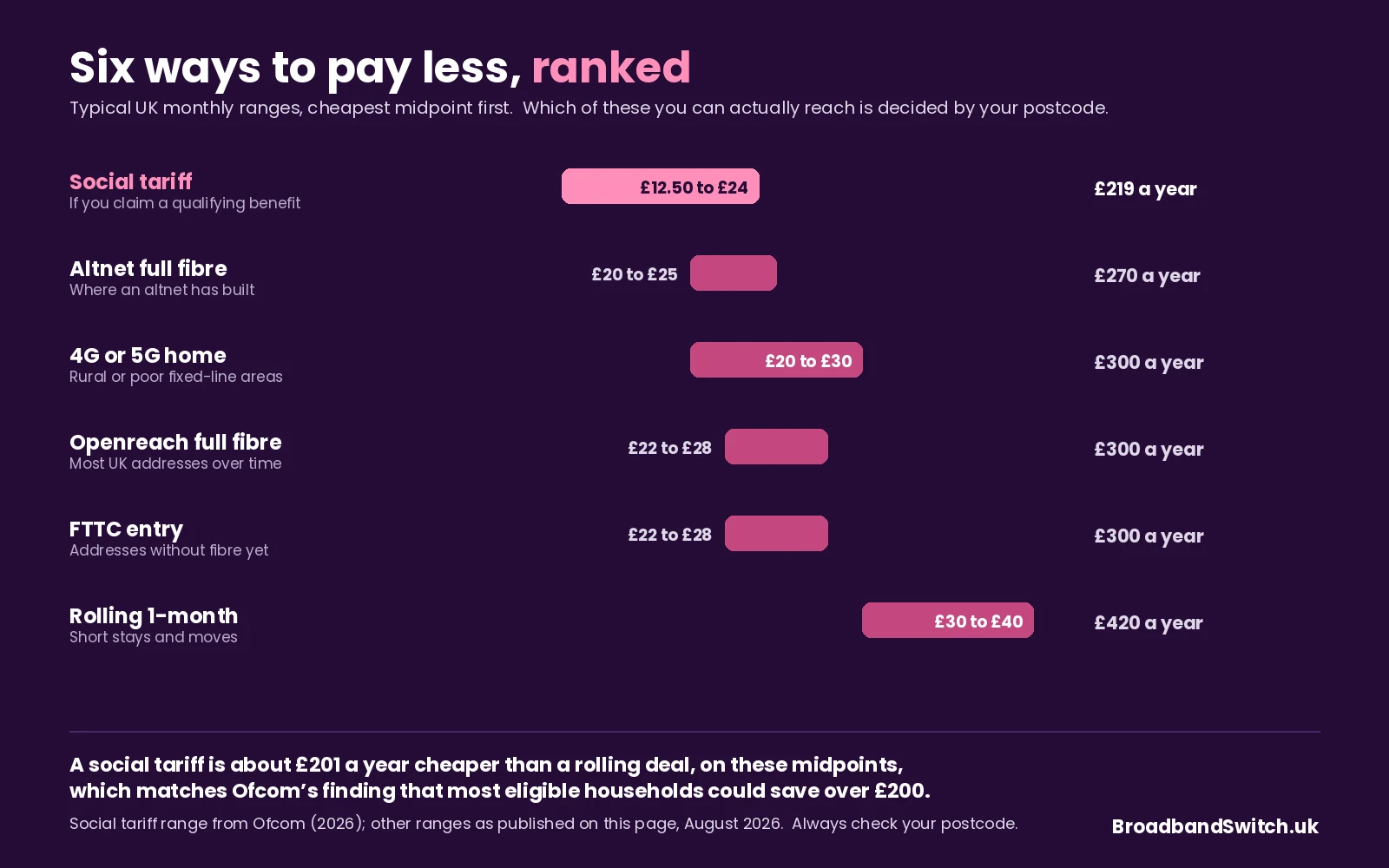
- 1. Social tariff · £12.50 to £24 a monthRoughly £219 a year at the midpoint. Best for eligible benefit claimants. Honest watch-out: check eligibility and that the speed fits your household.
- 2. Altnet full fibre · £20 to £25Roughly £270 a year. Best for addresses with altnet coverage. Honest watch-out: not every postcode, and build dates vary.
- 3. 4G or 5G home broadband · £20 to £30Roughly £300 a year. Best for rural addresses or poor fixed-line coverage. Honest watch-out: variable speeds, and check the data policy.
- 4. Openreach full fibre entry · £22 to £28Roughly £300 a year. Best for most UK addresses over time. Honest watch-out: mid-contract rises on some deals.
- 5. FTTC entry · £22 to £28Roughly £300 a year. Best for addresses without fibre yet. Honest watch-out: being retired, so plan the move to fibre.
- 6. Rolling 1-month · £30 to £40Roughly £420 a year. Best for short stays, moves and temporary setups. Honest watch-out: higher monthly cost, though no term lock.
Ranges are indicative UK-wide at time of publication, and actual prices vary by address and provider coverage, so always confirm by checking your postcode before ordering. The gap between the top and bottom of that list is about £201 a year, which is why the ranker at the top of this page starts with your circumstances rather than a national league table.
How to find the cheapest deal at your address
- Enter your postcodeSee real availability from 30+ providers at your exact address, because the cheapest route nationally is frequently not available on your street.
- Filter by the contract length that suits you12 or 24-month contracts are usually cheapest per month, and rolling deals cost more for the flexibility.
- Sort by total contract cost, not headline monthly priceThe worked example above shows why: a £22 deal can cost more across the term than a £25 one.
- Check the in-contract price rise detail on each dealStated in pounds and pence at sign-up since January 2025, so the number is there to find.
- If you receive qualifying benefits, compare social tariffs separatelyThey rarely appear in standard comparison tables, and on Ofcom's figures they beat almost everything else. See social tariff options.
- Order through One Touch SwitchOne Touch Switch, live since 12 September 2024, handles the move from your old provider without a service gap.
- Check the speed still fitsRead how broadband speeds are advertised and tested so the cheapest sync speed still covers streaming and uploads.
What cheap broadband does not usually include. Unlimited data is standard on home broadband, though always confirm it on 4G or 5G packages. Free public Wi-Fi extras are often bundled with pricier plans rather than the cheapest. Top-tier parental controls and security suites are more common on mid-tier plans. Landline call bundles vary, and cheap deals are typically broadband-only. None of these omissions make a deal a bad choice: they help explain the price difference.
The cheapest deals at your postcode
Enter your postcode to see live, address-level availability across 30+ UK providers, sorted by monthly price with setup fees, contract length and stated April rise amounts on each card. Availability is postcode and address specific, so pick your exact address where prompted, then sort by total contract cost before you decide.
If anyone in the household claims a qualifying benefit, check social tariffs before anything in that list, because on Ofcom's figures they are cheaper than almost every open-market deal and 91% of eligible households are missing them.
Related ways to find a cheap deal
- Social tariffs
- Deals under £25
- Deals under £30
- Lowest total cost
- Lowest upfront cost
- Best value deals
- Broadband-only deals
- Rolling 1-month deals
- Full fibre deals
- FTTC deals
- 4G and 5G home broadband
- Cashback and gifts
- Save money on broadband
- One Touch Switch
- In-contract price rises
- Average UK broadband cost
Cheapest broadband deals, asked and answered
What is the cheapest broadband deal in the UK?
For eligible benefit claimants, social tariffs are cheapest, at £12.50 to £24 a month on Ofcom's December 2025 figures, with more than 30 options now available. On the open market, entry-level altnet full fibre at around £20 to £25 a month is typically the cheapest credible deal at addresses with altnet coverage. Check your postcode to see which providers serve your address, because availability varies street by street across the UK.
How many people actually claim a social tariff?
Very few. Ofcom counted 532,000 UK customers on a fixed or mobile social tariff in June 2025, an annual increase of 26,000, against roughly 6.2 million households on Universal Credit. That is a take-up rate of 8.6%, and 70% of eligible households told Ofcom they were unaware the tariffs existed. If anyone in your household claims a qualifying benefit, checking takes minutes and typically saves more than £200 a year.
Can I get cheap broadband without a contract?
Yes. Rolling 1-month deals are available from several UK providers, typically at £30 to £40 a month. The monthly price is higher than a 12 or 24-month contract, but there is no early-exit fee, so they suit short stays, moves and temporary setups rather than long-term saving.
Do cheap broadband deals include Wi-Fi?
Yes. Every modern UK home broadband deal includes a Wi-Fi router, and cheaper deals tend to ship a more basic model. For larger homes, a small router upgrade or a separate mesh system often matters more than the headline deal price for real-world coverage.
Are cheap broadband deals slower?
Sometimes, but not always. A social tariff at 67 Mbps is faster than a non-social ADSL line at 10 Mbps, and entry full fibre at £22 a month can deliver 100 Mbps to 150 Mbps. Check the advertised average speed alongside the monthly price, not the price on its own.
How do I avoid mid-contract price rises on a cheap deal?
Read the price rise clause before you sign. Since 17 January 2025, Ofcom requires providers to state any in-contract increase in pounds and pence at the point of sale. Some social tariffs and some altnet deals commit to no in-contract rises at all, and those are the safest choice if a predictable bill matters to you.
What if my cheapest option is ADSL or FTTC?
ADSL and FTTC are being phased out as the UK's PSTN switch-off progresses, now scheduled for 31 January 2027. If full fibre is available at your address, it is almost always the better long-term choice, often at a similar monthly cost. Where only ADSL or FTTC is available, 4G or 5G home broadband is sometimes a cheaper or faster alternative worth considering.
How do I switch to a cheaper provider without losing service?
Use One Touch Switch, introduced on 12 September 2024. You order with the new provider, they handle the move with your existing one, and in most cases there is no service gap, with your old contract ending automatically. Early-exit fees may still apply if you are inside your minimum term, though switching to a social tariff normally avoids them if you qualify.
About this guide. Compiled by Adrian James and reviewed by Dr Alex J. Martin-Smith, with every price and figure stated as published at 8 August 2026, and the route ranker reading its ranges from this page's own markup so tool and text cannot drift. BroadbandSwitch is an independent UK broadband comparison service. Social tariff eligibility, prices and availability vary by provider and change regularly, so always verify with the provider and against Ofcom's current list before ordering. We earn commission when you order via our comparison, which does not change the price you pay: read how we rank deals, our editorial policy, the methodology and trust hub and our affiliate disclosure. Spotted something wrong? Submit a correction and a human will read it.
References
- Ofcom. (2026). Pricing and consumer engagement: trends in the UK communications sector. Office of Communications. Retrieved August 8, 2026, from https://www.ofcom.org.uk/phones-and-broadband/bills-and-charges/pricing
- Ofcom. (n.d.). Social tariffs: cheaper broadband and phone packages. Office of Communications. Retrieved August 8, 2026, from https://www.ofcom.org.uk/phones-and-broadband/saving-money/social-tariffs
- Ofcom. (2024, July 19). Ofcom bans mid-contract price rises linked to inflation. Office of Communications. Retrieved August 8, 2026, from https://www.ofcom.org.uk/phones-and-broadband/bills-and-charges/ofcom-bans-mid-contract-price-rises-linked-to-inflation
- Ofcom. (2024, September 12). Simpler and quicker broadband switching is here. Office of Communications. Retrieved August 8, 2026, from https://www.ofcom.org.uk/phones-and-broadband/switching-provider/simpler-broadband-switching-is-here
Know your budget? Try deals under £25 or under £30, or sort by total contract cost. Not sure on speed first? Work out what speed you need.
Independent, free, no signup. 30+ providers, cheapest first.
Social tariffs: the cheapest broadband if you qualify
Social tariffs are discounted broadband plans offered by larger UK providers to people receiving certain benefits. They are the single biggest saving available on this page, and the single most under-claimed. Ofcom counted 532,000 customers on a fixed or mobile social tariff in June 2025, an annual increase of 26,000, against roughly 6.2 million households on Universal Credit. That is a take-up rate of 8.6%, and 70% of eligible households told Ofcom they did not know the tariffs existed.
Eligibility commonly includes Universal Credit, Pension Credit, Employment and Support Allowance, Jobseeker's Allowance and Income Support, though rules differ by provider. The choice has widened sharply: Ofcom counts more than 30 broadband social tariff options as at December 2025, up from just three in 2020, priced at £12.50 to £24 a month. Schemes you will likely recognise include BT Home Essentials, Sky Broadband Basics, Virgin Media Essential Broadband, Vodafone Essentials Broadband and NOW Broadband Basics, alongside regional altnet schemes that may not appear in national comparison tools.
If you qualify, this is almost certainly your cheapest route. See our full social tariffs guide for eligibility, speeds and how to apply. If you are not eligible, keep the monthly cap explicit with deals under £25 or deals under £30, then confirm totals against lowest total contract cost deals.