Broadband for renters: the tenancy law changed in May and broadband did not, what your landlord actually has to allow, and the request that gets a reply
The law made renting maximally flexible on 1 May 2026, and broadband did not move. On 1 May 2026 the Renters' Rights Act 2025 took effect and gov.uk records what happened: “Most existing assured shorthold tenancies automatically became assured periodic tenancies on 1 May 2026.” And then the sentence that changes this page: “It is no longer possible to have an assured tenancy agreement with an end date.” And on how you leave: “If you want to end an assured periodic tenancy after 1 May 2026, you can end it by giving 2 months' notice”. Meanwhile the shortest broadband contract most providers sell is twelve months, and the one carrying the headline price is usually twenty four. No landlord has to give you broadband, or keep an existing line working. The implied repairing covenant requires a landlord “to keep in repair and proper working order the installations in the dwelling-house for the supply of water, gas and electricity and for sanitation”. The words telecommunications, telephone, internet and broadband appear nowhere in section 11 of the Landlord and Tenant Act 1985. So a connection is something you ask for rather than something you are owed, and the good news is how small the ask is. Openreach: “Full Fibre installation is completely free of charge.” “We'll need to drill a 12mm hole through the wall to connect the two boxes.” “The installation is free of cost with no ongoing obligations.” The permission problem is silence rather than refusal, and the thing being asked for is a 12mm hole. The Government's own memorandum on why the law needed changing: “Data suggests that 40% of industry requests to required grantors go without any response.” None of this is a landlord problem or a tenant problem. It is an information problem: the rules changed in May, the repairing covenant was written in 1985, and nobody sends the landlord the one paragraph that would let them say yes. The letter below writes the request in your browser, and the panel under it answers the landlord's questions in the operators' own words.
See what your postcode can actually get
One postcode, every provider we can switch you to, sorted by price with the lowest first. Check the exact address rather than the street: two doors on one road can sit on different networks, and in a block two flats can too.
Need the letter rather than the argument? Jump to the permission request generator. Are you the landlord or the agent? Your six questions are answered here.
The short version, and what it does not claim
Direct answer: The law made renting maximally flexible on 1 May 2026, and broadband did not move.

Start with the good news, because it is genuinely good and it is four months old. The Renters' Rights Act 2025 received Royal Assent on 27 October 2025. On 1 May 2026 it took effect, and gov.uk records the result: “Most existing assured shorthold tenancies automatically became assured periodic tenancies on 1 May 2026.” Those tenancies run differently now: “Assured periodic tenancies run on a rolling basis, for example, weekly or monthly.” And most importantly, “It is no longer possible to have an assured tenancy agreement with an end date.”
Which means a private renter in England is freer than at any point in living memory. gov.uk sets out how: “If you want to end an assured periodic tenancy after 1 May 2026, you can end it by giving 2 months' notice”. No fixed term to sit out, no break clause to negotiate, no waiting for a date on a piece of paper.
Now look at what you sign for the broadband. Every assured tenancy in England now runs with no end date and can be ended on two months' notice. The shortest broadband contract most providers sell is twelve months. The one carrying the cheapest headline price is usually twenty four, and not one of those numbers moved in May. The mismatch that used to be a student problem on a nine month let now sits under the whole private rented sector, which is not small: “In 2024-25, the private rented sector accounted for 4.7 million or 19% of households.”
The second thing this page is about is the asking, and the finding there is more cheerful than you would expect. The permission problem is silence rather than refusal, and the thing being asked for is a 12mm hole. None of this is a landlord problem or a tenant problem. It is an information problem: the rules changed in May, the repairing covenant was written in 1985, and nobody sends the landlord the one paragraph that would let them say yes.
So this page does two things. It gives you a letter that answers the landlord's questions before they ask them, and it gives the landlord a panel of their own, quoted from the people who would actually do the work. If somebody sent you this link and you are the one being asked, start there.
Write your permission request
Direct answer: Ask in writing, and lead with what it actually is: free, a 12mm hole, and no ongoing obligation for the landlord. A request that answers the landlord's questions before they ask them is the one that gets answered.
The generator runs entirely in your browser. There is no form to submit, no address sent to any server and nothing stored: what you type is assembled on this page and gone when you close the tab. Every quoted line inside the letter is the operator's own published wording, so a landlord who checks it will find it says exactly what you said it says.
Write the permission request
Two in five requests to a landlord are never answered. This writes one that leads with the three things they actually want to know: it is free, it is a 12mm hole, and it obliges them to nothing. Every quoted line in it is the operator’s own published wording. Nothing you type here leaves your browser.
Send it to the person who can actually say yes. In a rented house that is normally your landlord. In a block of flats it is usually the freeholder or the managing agent instead: “In some cases, we may need your consent by signing a wayleave before we can build Full Fibre.” Send it to both, and say in the first line that you have.
And keep the reply
Shelter's advice on any improvement to a rented home applies exactly here: “Get your landlord's agreement in writing before you start.” An email saying yes is enough. Keep it, because the person who lets you the property is often not the person who manages it a year later, and the work will still be on the wall.
Your tenancy got shorter. Your contract did not
Direct answer: Every assured tenancy in England now runs with no end date and can be ended on two months' notice. The shortest broadband contract most providers sell is twelve months.
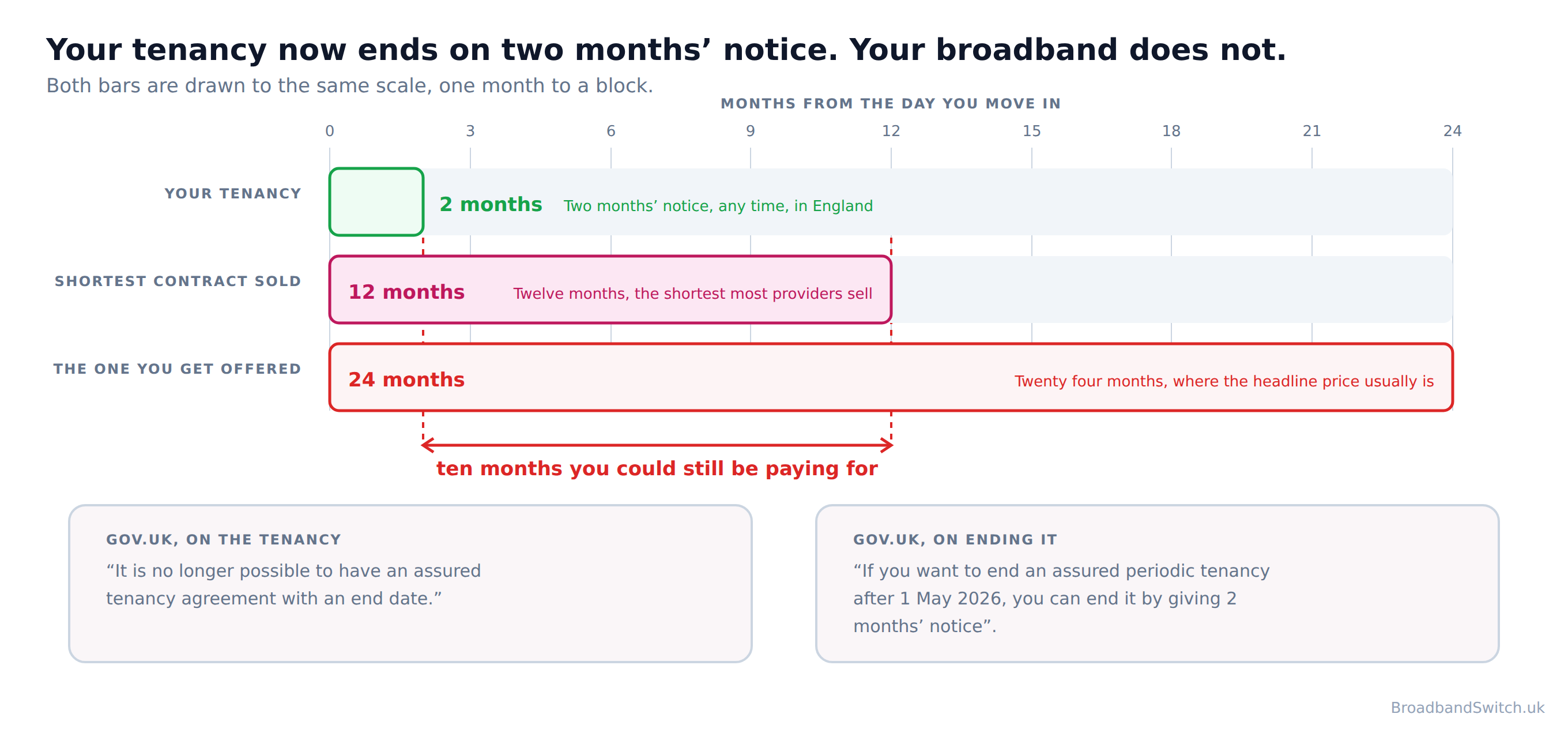
Both halves of that are published and neither is in dispute. On the tenancy, gov.uk: “It is no longer possible to have an assured tenancy agreement with an end date.” On ending it: “If you want to end an assured periodic tenancy after 1 May 2026, you can end it by giving 2 months' notice”. On the broadband, look at what a provider will actually sell you. Plusnet publishes the choice in plain words: “choose between a contract with a minimum term (normally lasting 12 or 18 months) or take a contract without a minimum term”. BT is blunter about where its prices live: “Most of our contracts are 24 months, but we do have some that are 18”.
So the arithmetic is simple and unpleasant. Sign twenty four months, give notice on your tenancy in month three, and you have twenty one months of a contract at an address you no longer live at. You can move it, if the new place can take it, and that is often the right answer. What you cannot do is assume it will be free.
What leaving early actually costs
Every provider publishes a method and they differ. TalkTalk: “This charge is set at £11.25 per month for the remaining duration of your contract term.” BT: “We take your monthly price, multiply it by the number of months left on each service contract, and add VAT.” Vodafone publishes a formula: “Monthly cost x 0.8 x number of months left on your contract”. Ofcom caps the principle rather than the amount, requiring that a charge is “never greater than the amount of the (usually monthly) contractual retail payments remaining due at the date of termination”, and says plainly that “These charges could be substantial, and you should check your contract terms.”
The fix is not to avoid long contracts on principle. Plenty of renters stay five years in the same flat and a twenty four month price is the right buy for them. The fix is to make the decision knowingly: count the months you are reasonably confident of, then price the freedom to leave against the discount for staying. The section further down does that arithmetic with published numbers.
Nobody has to give you broadband
Direct answer: No landlord has to give you broadband, or keep an existing line working.
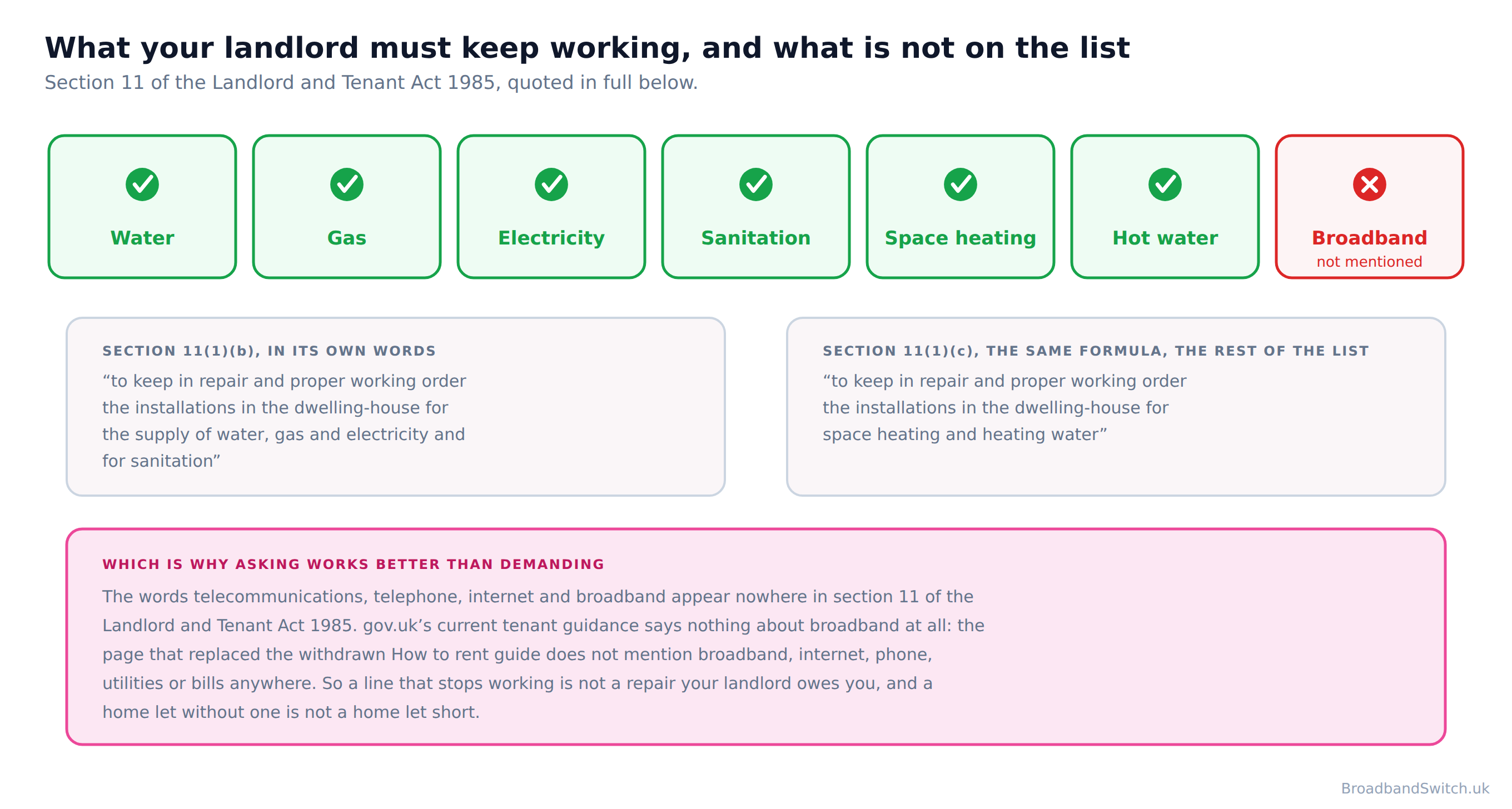
This surprises people, so it is worth reading the statute rather than a summary of it. Section 11 of the Landlord and Tenant Act 1985 implies a repairing covenant into almost every residential tenancy, and the relevant limb requires a landlord “to keep in repair and proper working order the installations in the dwelling-house for the supply of water, gas and electricity and for sanitation”. The next limb adds “to keep in repair and proper working order the installations in the dwelling-house for space heating and heating water”.
That is the whole list. The words telecommunications, telephone, internet and broadband appear nowhere in section 11 of the Landlord and Tenant Act 1985. Nor is the gap filled by guidance: gov.uk's current tenant guidance says nothing about broadband at all: the page that replaced the withdrawn How to rent guide does not mention broadband, internet, phone, utilities or bills anywhere.
Shelter states the practical consequence for the bills: “If your agreement does not mention bills, you are probably responsible for paying bills yourself.” So unless your agreement says otherwise, the broadband is yours to arrange, yours to pay for and yours to cancel, and a line that stops working is not a repair anybody owes you.
Which is better news than it sounds
An absent duty cuts both ways. It means nobody is going to force a connection into the property for you, and it also means nobody controls your choice of provider by default. You are the account holder, you pick the deal, and the only moment a landlord enters the picture is if physical work is needed on the building. Most of the time it is not: if a working line already reaches the property, ordering a service over it needs nothing from anybody.
One thing to check before you sign anything, because it is the exception. Citizens Advice: “Check your tenancy agreement - it might say you can't switch internet, landline or TV provider.” And specifically on the work: “They might say you can't switch TV providers if it involves drilling holes for cables or putting up a satellite dish.” Nothing published by gov.uk or Ofcom prohibits a tenancy term that ties a tenant to a named broadband supplier, and nothing treats such a term as unfair. Find that clause before you sign rather than after, when you still have something to negotiate with.
The problem is silence, not refusal
Direct answer: The permission problem is silence rather than refusal, and the thing being asked for is a 12mm hole.
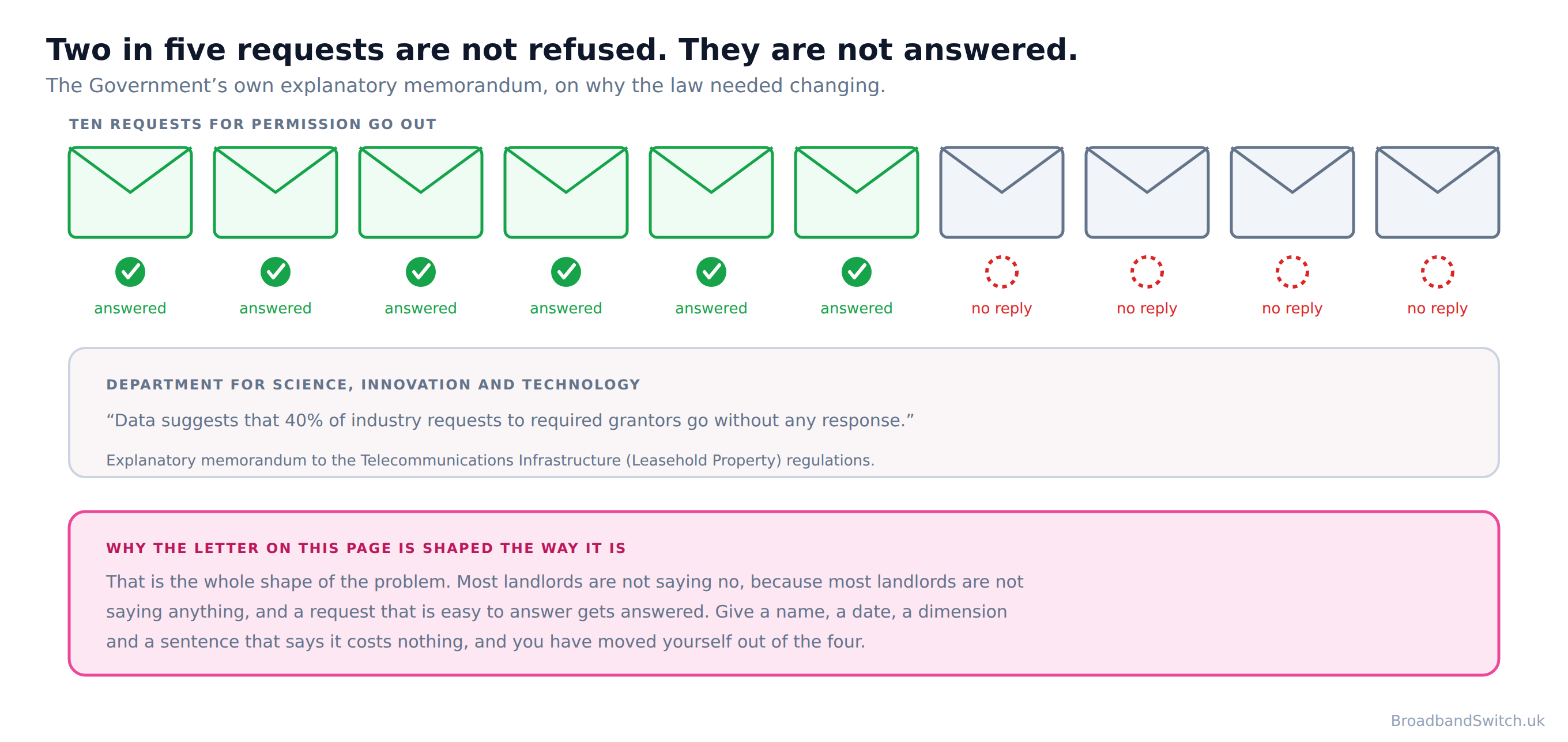
Everybody assumes the obstacle is a landlord who says no. The Government's own paperwork says otherwise. Explaining why the Part 4A route had to exist at all, the explanatory memorandum to the 2022 regulations records: “Data suggests that 40% of industry requests to required grantors go without any response.”
Two in five. Not refused, not argued over, just never answered. And once you know that, the whole problem changes shape: you are not trying to win an argument, you are trying to get a reply.
There is a legal route, and it is worth knowing its limits before you rely on it. The Telecommunications Infrastructure (Leasehold Property) Act 2021 created “a fasttrack route by which a telecommunications operator may apply to a court for an order (a 'Part 4A order') granting rights to access to a 'multiple-dwelling unit'”, and the Government's guidance sets out when it bites: “Operators can use the Part 4A process to access blocks of flats and apartments if a service has been requested by a tenant, but a landlord of connected land is repeatedly unresponsive to requests for access.”
Read who holds that right
There is no statutory right for a tenant to have fibre installed. The law passed in 2021 gives operators a route through the courts where a landlord will not answer; it gives the tenant nothing to enforce. The operator applies to the court, not you. It reaches blocks of flats, not a rented house. And it is for a landlord who does not answer, not one who answers and says no. No operator publishes a target or a typical time for getting landlord consent or a wayleave agreed. Which is exactly why the practical answer on this page is a good letter rather than a legal threat.
The good news is what it takes to move yourself out of the four in ten. Name yourself and the property. Say what the work is in one line. Say what it costs them, which is nothing. Give them a date you would like an answer by and a link to the operator's own landlord page. A request that can be answered in a minute usually is.
What your landlord is actually agreeing to
Direct answer: A 12mm hole, two small boxes, no charge and no ongoing obligation, in Openreach's own published words.
Permission is genuinely needed, and Openreach says so without hedging: “Yes. As the property owner, your consent is required before any work begins.” So the question is not whether to ask. It is what you are asking for, and the answer is smaller than most people picture.
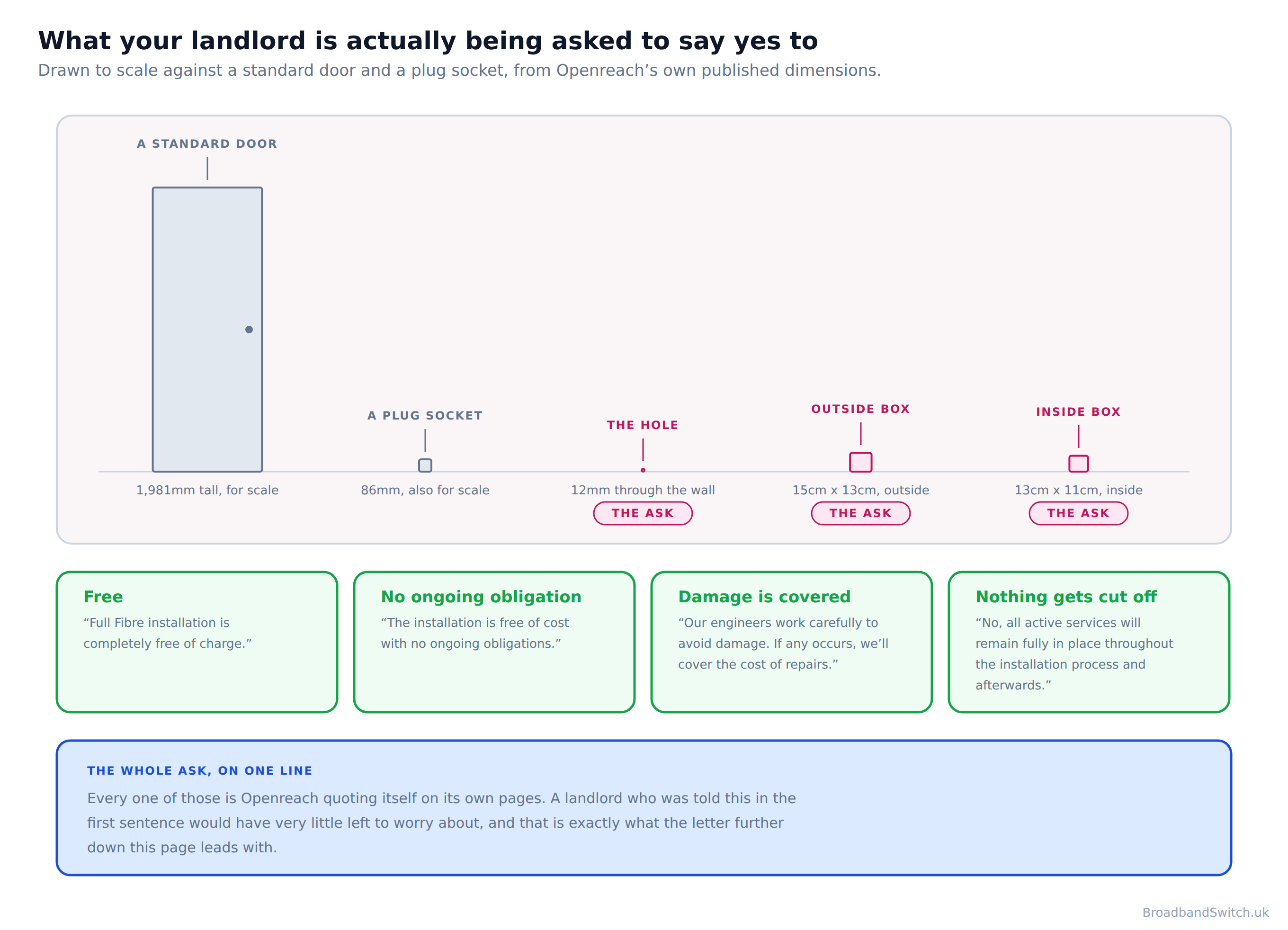
On cost, Openreach publishes “Full Fibre installation is completely free of charge.” For a block it goes further: “We want to survey and connect your multi-dwelling properties to our Full Fibre network at no cost to you.” And on what the owner is signing up to afterwards: “The installation is free of cost with no ongoing obligations.”
On the physical work, the numbers are published too. “We'll need to drill a 12mm hole through the wall to connect the two boxes.” What is left is a “15cm x 13cm external junction box installed on the outside of your property.” and an “Internal box around 13cm x 11cm installed inside the property.” Drawn against a standard door, as above, that is about the footprint of two plug sockets.
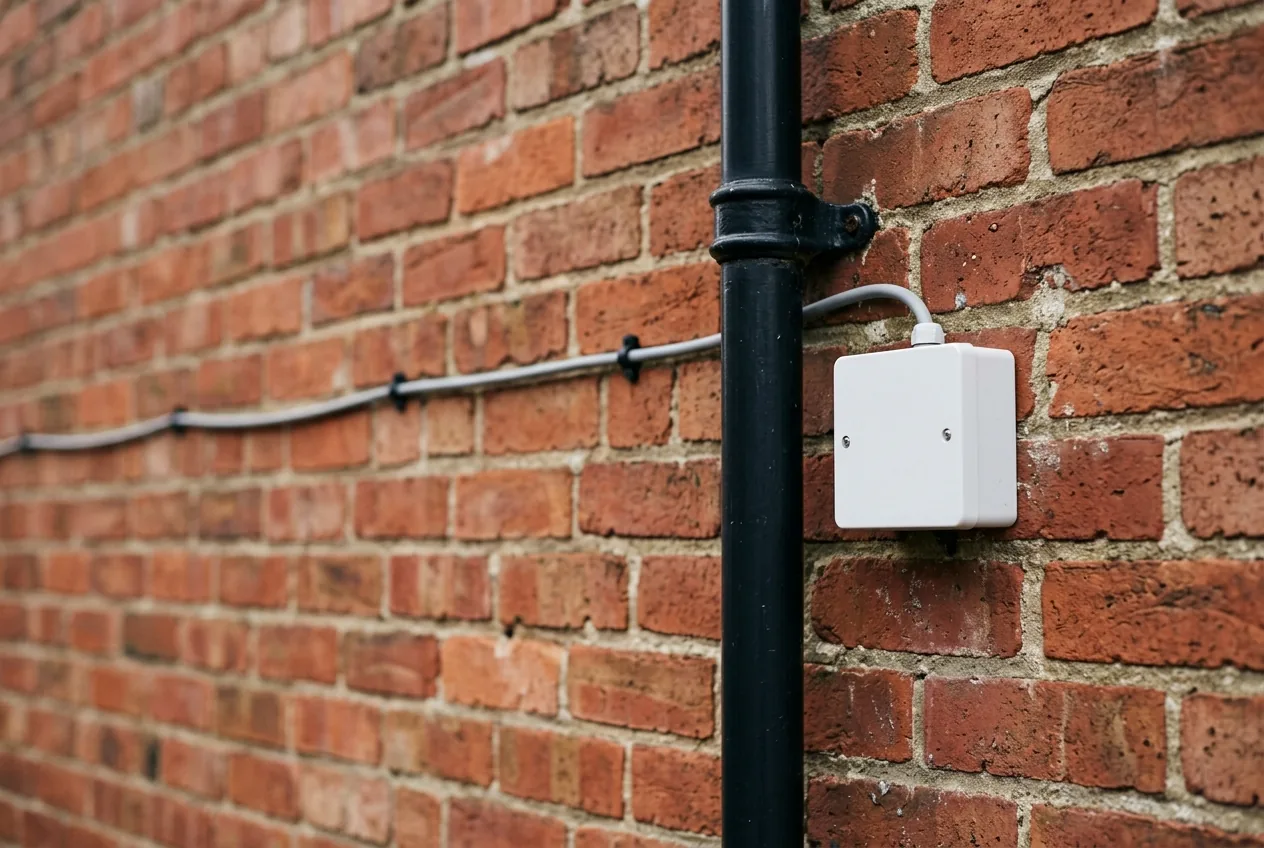
And on the things a landlord actually worries about, Openreach commits in writing. On damage: “Our engineers work carefully to avoid damage. If any occurs, we'll cover the cost of repairs.” On tidiness: “The engineer will fill the holes when they're done and leave it neat and tidy.” On whether anything gets cut off while the work happens: “No, all active services will remain fully in place throughout the installation process and afterwards.”
Two things that are different in a block
First, the signature: “In some cases, we may need your consent by signing a wayleave before we can build Full Fibre.” A wayleave is “A written legal agreement between us and the land or property owner. It gives us permission to install, maintain or repair the network equipment that's on their property.” The person who signs one owns the building rather than your flat. Second, the paperwork: “For buildings built before 2000, an asbestos register/report is required.” Having that register to hand is the commonest reason one building moves faster than another.
One honest gap belongs here rather than buried at the bottom. No operator publishes what happens to the equipment at the end of an agreement, or any commitment to remove it. What CityFibre does publish about the agreement itself is that “A wayleave is indefinite. That's because it's an ongoing agreement that allows us to maintain the apparatus.” If you are the person signing, ask what happens at the end and get the answer in writing, because nothing published will tell you.
For landlords and letting agents
Direct answer: If a tenant has sent you this page, the short version is that the work is free to you, it is a 12mm hole, and Openreach publishes that it carries no ongoing obligations.

This section is written for you rather than about you, and it is quoted rather than argued. Every answer below is the operator's own published wording, and where nothing is published this page says so instead of filling the gap.
Six questions, answered in the operators’ own published words
If a tenant has sent you this page, they are asking permission for a full fibre installation. These are the answers to what you are probably about to ask, quoted from the people who would actually do the work. Where nothing is published, this page says so rather than filling the gap.
Does it cost me anything?
No, on the operator’s own published terms. Openreach: “Full Fibre installation is completely free of charge.” and “The installation is free of cost with no ongoing obligations.” Your tenant pays their own provider for the broadband service itself; Openreach publishes that “No, all active services will remain fully in place throughout the installation process and afterwards.” Nobody loses service during the work.
What actually gets installed, and how much drilling?
One hole. Openreach: “We'll need to drill a 12mm hole through the wall to connect the two boxes.” What is left behind is a “15cm x 13cm external junction box installed on the outside of your property.” and an “Internal box around 13cm x 11cm installed inside the property.” If anything is damaged, “Our engineers work carefully to avoid damage. If any occurs, we'll cover the cost of repairs.”
Am I signing up to anything ongoing?
For a single rented house, Openreach publishes that there are “The installation is free of cost with no ongoing obligations.” For a block of flats it is different and you should know it before you sign: a wayleave is the agreement that lets the operator maintain the equipment, and CityFibre publishes that “A wayleave is indefinite. That's because it's an ongoing agreement that allows us to maintain the apparatus.” No operator publishes what happens to the equipment at the end of an agreement, or any commitment to remove it. Ask what happens at the end before you sign, because the published material does not tell you.
What if the property is a flat, or an older building?
In a block the person who signs is usually the freeholder or managing agent rather than the landlord: Openreach publishes that “In some cases, we may need your consent by signing a wayleave before we can build Full Fibre.” And for older blocks there is one thing you will be asked to supply: “For buildings built before 2000, an asbestos register/report is required.” Having the register to hand is the commonest reason one building moves faster than another.
Will it let the property faster, or for more?
Nobody has published a number, and this page is not going to invent one. No operator and no government source publishes a figure for what fibre does to rent, to void periods or to how fast a property lets. The claims in circulation are marketing rather than measurement, so none is repeated here. What Openreach does claim is narrower and is the honest version: “Upgrading to Full Fibre helps future-proof your property and ensures tenants are connected.”
What happens if I just do not reply?
Mostly nothing, and that is the problem this page is about. The Government’s own explanatory memorandum to the Part 4A regulations records why that route had to be created: “Data suggests that 40% of industry requests to required grantors go without any response.” Two in five requests are not refused, they are simply never answered. A tenant in a block has a slow court route through an operator and a tenant in a house has nothing at all, so a reply either way is worth more to them than you might think.
Openreach publishes its own landlord pages at openreach.com/broadband-for-landlords, and they are worth two minutes before you reply. BroadbandSwitch has no commercial relationship with Openreach and earns nothing from an installation.
What we are not going to tell you
No operator and no government source publishes a figure for what fibre does to rent, to void periods or to how fast a property lets. The claims in circulation are marketing rather than measurement, so none is repeated here. The claim you will have seen, that fibre lets a property faster or supports a higher rent, may well be true. What it is not is published by anybody whose figures we could check, so it is not on this page. No operator publishes a target or a typical time for getting landlord consent or a wayleave agreed. What is published is narrower and more useful: the work costs you nothing, it obliges you to nothing in a single dwelling, and your tenant wants it.
If you would rather hear it from the people doing the work, Openreach publishes its own landlord material, and a tenant's request is easier to judge with two minutes of that behind it. For a new build the question does not usually arise at all: building regulations already require that “Each dwelling must in addition be provided with a connection to a gigabit-capable public electronic communications network.” There is a limit on that duty: “The cost cap of £2,000 per dwelling applies to the installation of a functional connection.”
England, Scotland, Wales, and council tenants
Direct answer: The Renters' Rights Act changes are England only. Scotland's private residential tenancy already had no end date and takes 28 days' notice from the tenant; Wales has occupation contracts under the Renting Homes (Wales) Act 2016 with a four-week minimum.
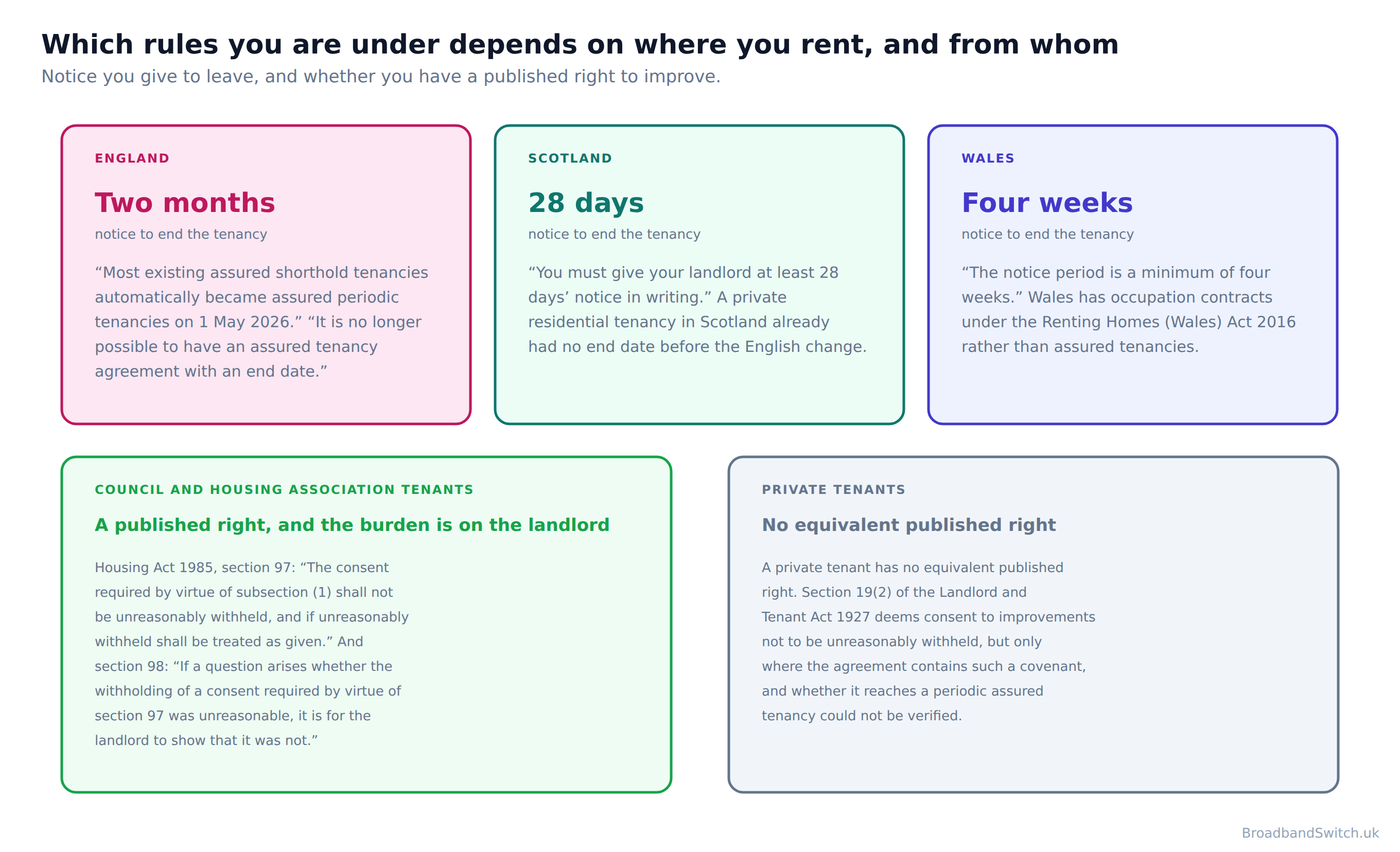
The May change is an England change, and saying England while meaning the UK is how guidance goes wrong. In Scotland the private residential tenancy already had no end date, and the notice a tenant gives is shorter: “You must give your landlord at least 28 days' notice in writing.” In Wales renters hold occupation contracts under the Renting Homes (Wales) Act 2016, and “The notice period is a minimum of four weeks.”
Shorter notice makes the broadband mismatch sharper rather than softer. A Scottish renter can be gone in four weeks and still owe eleven months of a twelve month contract.
Who you rent from matters as much as where. If you are a council or housing association tenant, gov.uk states the position: “If you're a secure tenant, you have the right to carry out improvements to your property.” Section 97 of the Housing Act 1985 makes written consent a term of every secure tenancy and covers “any addition or alteration connected with the provision of services to the dwelling-house”, which is what a connection is. Then the sentence that does the work: “The consent required by virtue of subsection (1) shall not be unreasonably withheld, and if unreasonably withheld shall be treated as given.”
And section 98 puts the burden where it belongs: “If a question arises whether the withholding of a consent required by virtue of section 97 was unreasonable, it is for the landlord to show that it was not.” A secure tenant therefore asks with the law behind them, and a refusal has to be justified rather than simply issued.
The private position, honestly
A private tenant has no equivalent published right. Section 19(2) of the Landlord and Tenant Act 1927 deems consent to improvements not to be unreasonably withheld, but only where the agreement contains such a covenant, and whether it reaches a periodic assured tenancy could not be verified. So this page does not tell a private renter they have a right they may not have. What a private renter has is a very strong practical case, and the letter above is built to make it.
Picking a contract that fits a tenancy
Direct answer: Count the months you are actually confident of, then price the freedom to leave against the discount for staying.

A rolling or no-minimum-term package costs more every month and owes nothing when you go. Several providers publish both, which makes the trade easy to see. Plusnet: “choose between a contract with a minimum term (normally lasting 12 or 18 months) or take a contract without a minimum term”. Virgin Media: “Cancelling our no contract broadband is as straight forward as giving just 30 days' notice. There's no waiting for a 24 month contract to end and you can forget about paying any early exit fees (there are none!)”, and to its credit it also publishes the cost of that freedom: “if you're on a budget, see if you can get the same Virgin Media speed for a lower monthly price on a longer term contract”.
NOW sells the same shape with a longer notice period: “you'll just need to let us know 31 days in advance if you want to cancel, and you won't need to pay any early termination charges”. Hyperoptic publishes “1Gb full fibre. £29/m. Rolling monthly”. None of those is the cheapest per month, and none of them can bill you for an address you left.
How to do the sum in about a minute
Take the monthly difference between the rolling price and the fixed price, and multiply it by the months you expect to stay. That is what the freedom costs you. Then take the fixed contract's published exit method and work out what you would owe if you left at the point you think most likely. Whichever number is smaller is your answer, and it is different for a renter who has just started a three year job in the same city than for one whose tenancy is the only thing keeping them there.
Two protections apply whichever you choose, and both are Ofcom's. Before you are bound you must be given “a one-page (or three-page for bundled services) contract summary in writing, that includes key information, such as charges, the length of the contract and the process for cancelling”, which is where a minimum term appears, and it takes ten seconds to read. And on a mid-contract price rise, Ofcom's rule is that “companies that include specified price rises in their contracts must set these out clearly, in pounds and pence, before you sign up”.
If you are renting with other people, settle one thing before anybody orders anything: no UK provider publishes a way to put two people on a single broadband account, so whoever signs owes the whole bill and the whole exit charge. Our house shares guide covers the arrangements that work, and the moving and renting hub works out your notice deadline when you do leave.

One last thing worth knowing if the line is late. Ofcom's automatic compensation publishes “£6.46 for each calendar day of delay” where a service does not start on the promised date and “£32.31 per missed appointment” for a missed engineer appointment. The scheme is not universal, though: BT, EE, Hyperoptic, Plusnet, Sky (including NOW Broadband), TalkTalk, Utility Warehouse, Virgin Media, Vodafone and Zen Internet are signed up to Ofcom's automatic compensation scheme. It is voluntary, so a provider outside that list owes none of it. Keep the promised date in writing, because that is the whole of what a claim rests on.
Broadband at your postcode
See what your postcode can actually get
One postcode shows every provider we can switch you to, lowest price first, across full fibre, FTTC, cable and 5G home broadband. If a full fibre line would need permission you have not got yet, a 5G package needs nothing from anybody and can be cancelled when the real thing arrives.
Show every provider at my postcode →Broadband and renting: frequently asked questions
Can I get broadband if I am renting?
Yes, and in your own name. You are the account holder, you choose the provider and you are the person the contract binds. Where the difficulty comes in is not the account, it is the line. If a working line already reaches the property, ordering a service over it normally needs nothing from your landlord at all. If no line reaches it, or the line is copper and you want full fibre, somebody has to agree to a small piece of work on the building, and that somebody is the owner. Openreach puts it in one sentence: “Yes. As the property owner, your consent is required before any work begins.” That is a consent question rather than a legal fight, which is why the request matters more than the rights do.
Does my landlord have to provide broadband?
No. The implied repairing covenant in section 11 of the Landlord and Tenant Act 1985 makes a landlord “to keep in repair and proper working order the installations in the dwelling-house for the supply of water, gas and electricity and for sanitation”, and separately “to keep in repair and proper working order the installations in the dwelling-house for space heating and heating water”. Read the list. The words telecommunications, telephone, internet and broadband appear nowhere in section 11 of the Landlord and Tenant Act 1985. Nor does the guidance fill the gap: gov.uk's current tenant guidance says nothing about broadband at all: the page that replaced the withdrawn How to rent guide does not mention broadband, internet, phone, utilities or bills anywhere. So a broadband line that stops working is not a repair your landlord owes you, and a property advertised without a connection is not being let short of a legal duty. Shelter's position on the bills follows from the same place: “If your agreement does not mention bills, you are probably responsible for paying bills yourself.” None of that makes a landlord unreasonable for saying yes, and most do.
How do I ask permission, and what do I say?
In writing, and lead with the three things they actually want to know. Ask in writing, and lead with what it actually is: free, a 12mm hole, and no ongoing obligation for the landlord. A request that answers the landlord's questions before they ask them is the one that gets answered. The generator further up this page assembles it for you, but the shape is simple enough to write by hand: say who you are and which property, say what the work is, quote Openreach that “Full Fibre installation is completely free of charge.” and “The installation is free of cost with no ongoing obligations.” Say what the work is: “We'll need to drill a 12mm hole through the wall to connect the two boxes.” Then offer them the operator's own landlord page. Shelter's advice on any improvement to a rented home applies here too: “Get your landlord's agreement in writing before you start.” Written consent is worth having even when the conversation was friendly, because the person who let you the property may not be the person who manages it next year.
What if my landlord never replies?
That is the commonest outcome, and it has a published figure attached. The Government's explanatory memorandum to the Part 4A regulations says “Data suggests that 40% of industry requests to required grantors go without any response.” Two in five requests are not refused. They are never answered. If you live in a block of flats there is a slow route: the Telecommunications Infrastructure (Leasehold Property) Act 2021 created “a fasttrack route by which a telecommunications operator may apply to a court for an order (a 'Part 4A order') granting rights to access to a 'multiple-dwelling unit'”, and the Government's guidance says it applies where “Operators can use the Part 4A process to access blocks of flats and apartments if a service has been requested by a tenant, but a landlord of connected land is repeatedly unresponsive to requests for access.”. Note who holds it: the operator applies, not you. If you rent a house rather than a flat, that route does not exist at all. Which is why a request that is easy to answer is worth more than a right you cannot enforce.
Can my tenancy agreement stop me switching provider?
It can try, and you should read yours before you order anything. Citizens Advice: “Check your tenancy agreement - it might say you can't switch internet, landline or TV provider.” And on the physical work specifically: “They might say you can't switch TV providers if it involves drilling holes for cables or putting up a satellite dish.” Nothing published by gov.uk or Ofcom prohibits a tenancy term that ties a tenant to a named broadband supplier, and nothing treats such a term as unfair. A term like that is not automatically void, so the practical move is to find it before you sign rather than after, and to ask for it to be changed while you still have the leverage of not having signed. If a term ties you to a named supplier, price that supplier's contract as part of the rent, because that is effectively what it is.
I am a council or housing association tenant. Is it different?
Yes, and better. gov.uk: “If you're a secure tenant, you have the right to carry out improvements to your property.” Section 97 of the Housing Act 1985 makes written consent a term of every secure tenancy, and covers “any addition or alteration connected with the provision of services to the dwelling-house”, which is what a broadband connection is. Then the part that matters: “The consent required by virtue of subsection (1) shall not be unreasonably withheld, and if unreasonably withheld shall be treated as given.” And section 98 puts the burden in the right place: “If a question arises whether the withholding of a consent required by virtue of section 97 was unreasonable, it is for the landlord to show that it was not.” A private tenant has no equivalent published right. Section 19(2) of the Landlord and Tenant Act 1927 deems consent to improvements not to be unreasonably withheld, but only where the agreement contains such a covenant, and whether it reaches a periodic assured tenancy could not be verified. So a secure tenant asks with the law behind them, and a private tenant asks on the merits.
How long should my broadband contract be if my tenancy could end on two months' notice?
Shorter than you are being sold, and the arithmetic is worth doing before you sign. Every assured tenancy in England now runs with no end date and can be ended on two months' notice. The shortest broadband contract most providers sell is twelve months. A rolling or no-minimum-term package costs more each month and owes nothing when you leave. Plusnet publishes the choice plainly: “choose between a contract with a minimum term (normally lasting 12 or 18 months) or take a contract without a minimum term”. Virgin Media: “Cancelling our no contract broadband is as straight forward as giving just 30 days' notice. There's no waiting for a 24 month contract to end and you can forget about paying any early exit fees (there are none!)”, while also publishing the trade “if you're on a budget, see if you can get the same Virgin Media speed for a lower monthly price on a longer term contract”. NOW: “you'll just need to let us know 31 days in advance if you want to cancel, and you won't need to pay any early termination charges”. Hyperoptic publishes “1Gb full fibre. £29/m. Rolling monthly”. The right answer depends on how likely you are to move, and only you know that. What you should not do is sign twenty four months because the monthly number was smaller without checking what leaving early costs.
What does it cost me to leave a contract early?
Every provider publishes a method, and they are not the same. TalkTalk: “This charge is set at £11.25 per month for the remaining duration of your contract term.” BT: “We take your monthly price, multiply it by the number of months left on each service contract, and add VAT.” Vodafone publishes a formula: “Monthly cost x 0.8 x number of months left on your contract”. Ofcom caps the principle rather than the amount, requiring the charge be “never greater than the amount of the (usually monthly) contractual retail payments remaining due at the date of termination”, and warns plainly that “These charges could be substantial, and you should check your contract terms.” Work out your own number before you commit: monthly price times months remaining is the worst case, and several providers charge less than that.
Who has to give permission in a block of flats?
Usually not the person you rent from. Openreach: “In some cases, we may need your consent by signing a wayleave before we can build Full Fibre.” A wayleave is “A written legal agreement between us and the land or property owner. It gives us permission to install, maintain or repair the network equipment that's on their property.” It is signed by whoever owns the building, which is normally the freeholder or the managing agent. Two things are worth knowing before you start. For older buildings, “For buildings built before 2000, an asbestos register/report is required.” And a wayleave does not expire: CityFibre publishes that “A wayleave is indefinite. That's because it's an ongoing agreement that allows us to maintain the apparatus.” If you rent a flat, the fastest thing you can do is find out who the managing agent is and send the request to them as well as to your landlord.
Will fibre make the property easier to let, or worth more rent?
Nobody has published a number, so this page does not offer one. No operator and no government source publishes a figure for what fibre does to rent, to void periods or to how fast a property lets. The claims in circulation are marketing rather than measurement, so none is repeated here. The only claim an operator makes on its own landlord pages is narrower, and it is the honest version: “Upgrading to Full Fibre helps future-proof your property and ensures tenants are connected.” If you are a landlord weighing this up, weigh it on what is published: the work is free, it leaves two small boxes, and your tenant wants it.
What happens to the equipment when the tenancy or the agreement ends?
This is the one question on this page with no published answer, and it is worth saying so rather than guessing. No operator publishes what happens to the equipment at the end of an agreement, or any commitment to remove it. For a single house the commitment Openreach does publish is about the work itself: “Our engineers work carefully to avoid damage. If any occurs, we'll cover the cost of repairs.” and “The engineer will fill the holes when they're done and leave it neat and tidy.” For a block, the wayleave runs on: “A wayleave is indefinite. That's because it's an ongoing agreement that allows us to maintain the apparatus.” If you are the person signing, ask what happens at the end and get the answer in writing, because the published material will not tell you.
I am moving out. What do I do about the broadband?
Give notice in time, and count backwards rather than forwards. Notice periods are published and they differ: Plusnet's is the shortest in this research: “We require 14 days' notice in order to cancel a residential account and 28 days' notice to cancel a business account.” NOW requires that “you must either give us at least 31 days' notice or place an order with another provider who can provide broadband and home telephone calls on your existing Line”. Moving out is not switching, whatever you have heard: One Touch Switch is about arriving somewhere, and Ofcom's own guidance for movers says only “If you're changing broadband provider, you'll need to cancel your current contract and arrange a start date for your new service in time for when you move.” Our moving and renting hub works out the deadline and what each route costs, and if you are leaving a house share, remember that the name on the account owes the whole of the exit charge.
Does anything protect me if the new line is late?
Yes, if your provider is in the scheme. Ofcom's automatic compensation publishes “£6.46 for each calendar day of delay” where a service does not start on the date promised, “£32.31 per missed appointment” for an engineer who does not turn up, and “£10.34 for each calendar day the service is not repaired” for each day of total loss once two working days have passed. It is not universal, though: BT, EE, Hyperoptic, Plusnet, Sky (including NOW Broadband), TalkTalk, Utility Warehouse, Virgin Media, Vodafone and Zen Internet are signed up to Ofcom's automatic compensation scheme. It is voluntary, so a provider outside that list owes none of it. Keep the promised date in writing, because that is what a claim rests on, and it is the thing nobody has when they need it.
Do new builds have to have a gigabit connection?
New ones in England do, which is why this comes up when renting somewhere recently built. Building regulations Part R require that “Each dwelling must in addition be provided with a connection to a gigabit-capable public electronic communications network.” And the Government publishes the limit on that duty: “The cost cap of £2,000 per dwelling applies to the installation of a functional connection.” So a new-build flat should already have the connection in place and the permission question does not arise. An older building is the one where it does.
In short
- The law made renting maximally flexible on 1 May 2026, and broadband did not move.
- gov.uk: “Most existing assured shorthold tenancies automatically became assured periodic tenancies on 1 May 2026.”
- And: “It is no longer possible to have an assured tenancy agreement with an end date.”
- And on leaving: “If you want to end an assured periodic tenancy after 1 May 2026, you can end it by giving 2 months' notice”. The shortest broadband contract most providers sell is twelve months.
- The Renters' Rights Act 2025 received Royal Assent on 27 October 2025.
- No landlord has to give you broadband, or keep an existing line working.
- Section 11 covers “to keep in repair and proper working order the installations in the dwelling-house for the supply of water, gas and electricity and for sanitation” and “to keep in repair and proper working order the installations in the dwelling-house for space heating and heating water”.
- The words telecommunications, telephone, internet and broadband appear nowhere in section 11 of the Landlord and Tenant Act 1985.
- gov.uk's current tenant guidance says nothing about broadband at all: the page that replaced the withdrawn How to rent guide does not mention broadband, internet, phone, utilities or bills anywhere.
- The permission problem is silence rather than refusal, and the thing being asked for is a 12mm hole.
- The Government's own memorandum: “Data suggests that 40% of industry requests to required grantors go without any response.”
- Openreach: “Full Fibre installation is completely free of charge.” And “The installation is free of cost with no ongoing obligations.”
- The work is “We'll need to drill a 12mm hole through the wall to connect the two boxes.” It leaves a “15cm x 13cm external junction box installed on the outside of your property.” and an “Internal box around 13cm x 11cm installed inside the property.”
- If anything is damaged, “Our engineers work carefully to avoid damage. If any occurs, we'll cover the cost of repairs.”
- Nothing is cut off: “No, all active services will remain fully in place throughout the installation process and afterwards.”
- Permission is still needed: “Yes. As the property owner, your consent is required before any work begins.”
- In a block, “In some cases, we may need your consent by signing a wayleave before we can build Full Fibre.” And “A wayleave is indefinite. That's because it's an ongoing agreement that allows us to maintain the apparatus.”
- Secure tenants have a right: “The consent required by virtue of subsection (1) shall not be unreasonably withheld, and if unreasonably withheld shall be treated as given.”
- And the burden sits with the landlord: “If a question arises whether the withholding of a consent required by virtue of section 97 was unreasonable, it is for the landlord to show that it was not.”
- A private tenant has no equivalent published right. Section 19(2) of the Landlord and Tenant Act 1927 deems consent to improvements not to be unreasonably withheld, but only where the agreement contains such a covenant, and whether it reaches a periodic assured tenancy could not be verified.
- The Renters' Rights Act changes are England only. Scotland's private residential tenancy already had no end date and takes 28 days' notice from the tenant; Wales has occupation contracts under the Renting Homes (Wales) Act 2016 with a four-week minimum.
- Your agreement may restrict you: “Check your tenancy agreement - it might say you can't switch internet, landline or TV provider.”
- Nothing published by gov.uk or Ofcom prohibits a tenancy term that ties a tenant to a named broadband supplier, and nothing treats such a term as unfair.
- No operator and no government source publishes a figure for what fibre does to rent, to void periods or to how fast a property lets. The claims in circulation are marketing rather than measurement, so none is repeated here.
- No operator publishes what happens to the equipment at the end of an agreement, or any commitment to remove it.
- No operator publishes a target or a typical time for getting landlord consent or a wayleave agreed.
- None of this is a landlord problem or a tenant problem. It is an information problem: the rules changed in May, the repairing covenant was written in 1985, and nobody sends the landlord the one paragraph that would let them say yes.
- Ask in writing, and lead with what it actually is: free, a 12mm hole, and no ongoing obligation for the landlord. A request that answers the landlord's questions before they ask them is the one that gets answered.
Each line stands on its own and carries its date. Reviewed by a person at least quarterly, last on 25 September 2026.
References
- Government
Ministry of Housing, Communities and Local Government. (2026). Renters’ Rights Act: overview for tenants, the conversion of most existing assured shorthold tenancies to assured periodic tenancies on 1 May 2026, the end of assured tenancy agreements with an end date, the rolling basis on which periodic tenancies run, and the two months’ notice a tenant gives to end one. England only. gov.uk
- Legislation
Renters’ Rights Act 2025. The Act itself, as enacted. legislation.gov.uk
- Parliament
House of Commons Library. Renters’ Rights Act 2025 research briefing CBP-10669, recording Royal Assent on 27 October 2025. parliament.uk
- Government
Ministry of Housing, Communities and Local Government. Assured periodic tenancies: tenants, the gov.uk guidance that replaced the withdrawn How to rent guide. It mentions broadband, internet, phone, utilities and bills nowhere, which is why this page had to be built from statute rather than from guidance. gov.uk
- Government
Ministry of Housing, Communities and Local Government. How to rent: the checklist for renting in England, withdrawn on 1 May 2026. gov.uk
- Legislation
Landlord and Tenant Act 1985, section 11, the implied repairing covenant: the installations for the supply of water, gas and electricity and for sanitation, and those for space heating and heating water. The words telecommunications, telephone, internet and broadband appear nowhere in the section. legislation.gov.uk
- Legislation
Housing Act 1985, sections 97 and 98, the secure tenant’s right to make improvements including any addition or alteration connected with the provision of services to the dwelling-house, the rule that consent shall not be unreasonably withheld and if unreasonably withheld shall be treated as given, and the placing of the burden on the landlord to show that withholding it was reasonable. legislation.gov.uk
- Government
Ministry of Housing, Communities and Local Government. Council housing: repairs and maintenance, the right of a secure tenant to carry out improvements. gov.uk
- Legislation
Explanatory Memorandum to SI 2022/1323, on the Telecommunications Infrastructure (Leasehold Property) Act 2021, recording that data suggests 40% of industry requests to required grantors go without any response. This is the only published figure for the scale of the permission problem and it is the Government’s own. legislation.gov.uk
- Government
Department for Science, Innovation and Technology. (2022, December 26). Electronic Communications Code: Part 4A guidance, the fast-track route by which an operator may apply to a court for a Part 4A order over a multiple-dwelling unit, and the limit that it applies where a service has been requested by a tenant and a landlord is repeatedly unresponsive. The route belongs to the operator rather than to the tenant, and it does not reach a rented house. gov.uk
- Openreach
Openreach. Landlords: single dwelling and Broadband for landlords, the statement that full fibre installation is completely free of charge and carries no ongoing obligations, that the property owner’s consent is required before any work begins, the 12mm hole, the 15cm by 13cm external junction box and the internal box around 13cm by 11cm, the undertaking to cover the cost of any damage and to leave the work neat and tidy, the confirmation that all active services remain in place throughout, the asbestos register required for buildings built before 2000, and the wayleave that may be needed. Neither page carries a visible publication date, so both were read on 25 September 2026. openreach.com
- CityFibre
CityFibre. Landlords, the statement that a wayleave is indefinite because it is an ongoing agreement allowing the operator to maintain the apparatus. CityFibre publishes nothing about what happens to the equipment at the end. cityfibre.com
- Shelter
Shelter England. Rent, bills and council tax and Home improvements by tenants, the position that a tenant is probably responsible for bills where the agreement does not mention them, and the advice to get a landlord’s agreement in writing before starting any improvement. shelter.org.uk
- Shelter
Shelter Scotland. Private residential tenancy, the requirement that a tenant give the landlord at least 28 days’ notice in writing, and that a private residential tenancy in Scotland has no end date. shelter.org.uk
- Welsh Government
Welsh Government. Renting Homes: frequently asked questions for tenants, occupation contracts under the Renting Homes (Wales) Act 2016 and the four-week minimum notice period. gov.wales
- Citizens Advice
Citizens Advice. Switch broadband, phone or TV provider, the warning that a tenancy agreement might say a tenant cannot switch internet, landline or TV provider, and might restrict switching that involves drilling holes for cables or putting up a satellite dish. citizensadvice.org.uk
- Government
Ministry of Housing, Communities and Local Government. Approved Document R: physical infrastructure for high-speed electronic communications networks requirement RA2, that each dwelling must be provided with a connection to a gigabit-capable network, and the gov.uk new-build connectivity guidance setting the cost cap at £2,000 per dwelling. gov.uk
- Government
Ministry of Housing, Communities and Local Government. (2026, July 9). English Housing Survey 2024 to 2025, Chapter 1, the private rented sector at 4.7 million or 19% of households, and 28% of London households. England rather than the UK. gov.uk
- Ofcom
Ofcom. (2026). Automatic compensation: what you need to know, the published rates for a delayed start, a missed engineer appointment and a total loss of service, and the list of providers signed up to the voluntary scheme. Last updated 20 July 2026. ofcom.org.uk
- Ofcom
Ofcom. General Conditions and Treating customers fairly, the requirement that an early termination charge be no greater than the contractual retail payments remaining due at the date of termination, and the warning that such charges could be substantial. ofcom.org.uk
- Providers
Plusnet Contract options, Virgin Media No contract broadband, NOW Broadband contracts, Hyperoptic Packages, TalkTalk Early termination charges, BT Early termination charges and Vodafone How is my early termination fee calculated?, the published minimum terms, rolling monthly options, notice periods and early termination methods quoted on this page. Every one read on its own site. plus.net
Ready to see what your postcode can get?
Send the permission request first if you need one, because that is the part with somebody else in it. Then compare: one postcode shows every provider that can reach your address, lowest price first.
Compare at your postcode →