CONTRACT EXITS · 2026 RIGHTS · PENALTY-FREE LEAVING
Can I Leave My Broadband Contract Early? Your 2026 Rights
Locked into a broadband contract that no longer suits? There are more legitimate exits than most people realise, from the 30-day price-rise window to the fix-or-exit right on slow speeds. Here is every route out in 2026, and an honest look at when you really are stuck, and what leaving would cost.
Written by Dr Alex J. Martin-Smith · Reviewed by Adrian James · Published 11 June 2026 · Reflects the rules in force after the 17 January 2025 pricing changes · ~9 minute read
Prefer to read offline? Download the free PDF guide: Can I Leave My Broadband Contract Early? (6 pages, ~230KB). No signup, no email, just the guide.
The quick answer
Yes, in five situations you can leave penalty-free: your minimum term has ended, you are inside the 14-day cooling-off window, your provider raises the price unexpectedly, a signed-up provider fails to fix slow speeds within 30 days, or the provider changes the deal to your detriment. Outside those five, early termination charges usually apply, and this guide is honest about that too.
Key facts · verified June 2026
- Out of contract means free to leave, any time, no penalty. Most minimum terms run 12 to 24 months.
- 14 days cooling-off applies to online and phone orders under consumer contract law.
- Unexpected price rise = 30 days to walk. If a mid-contract rise was not clearly set out in pounds and pence when you signed, Ofcom's rules give you 30 days from notification to exit penalty-free.
- Since 17 January 2025, inflation-linked rises are banned in new contracts; any rise must be stated upfront in pounds and pence, and a rise stated upfront is an agreed term you cannot escape.
- Sky is the exception: it does not write rises into broadband contracts, so every Sky rise is "unexpected", and every Sky customer gets the 30-day exit.
- Slow speeds: providers signed to Ofcom's Speeds Code must fix speeds below your guaranteed minimum within 30 days, or release you penalty-free, including linked landline and TV.
The five legitimate escape routes
- Your minimum term has ended. Once the 12, 18 or 24 months are up, you can leave any time without penalty. Out-of-contract prices are usually the worst on the market, so this is also the moment you are overpaying most.
- You are within 14 days of ordering. Online and phone orders carry a 14-day cooling-off period under consumer contract law. Cancel in that window and you walk away, though you may pay for any service already used. The detail, including how the window is counted, is in our guide to the broadband cooling-off period.
- The price rose unexpectedly. If the rise was not clearly stated in pounds and pence when you signed up, you have 30 days from the notification to leave penalty-free under Ofcom's rules. Sky customers get this on every rise, because Sky does not put rises in its contracts.
- Slow speeds, not fixed in 30 days. Providers signed to Ofcom's Broadband Speeds Code must give you a guaranteed minimum speed at the point of sale. Fall below it, report it, and if it is not fixed within 30 days you can exit penalty-free, including linked landline and TV bought at the same time. Note that the code is voluntary, and Vodafone is notably not a signatory. Start with the broadband speed guide to evidence the problem properly.
- The provider changed the deal. If your provider changes the contract to your material detriment, beyond what you agreed, it must notify you and give you the right to leave without penalty.
One thread runs through all five: if a provider refuses a right you genuinely hold, that refusal is itself a complaint, and the six-week escalation ladder applies. We map every rung in Broadband complaints and your rights: the Escalation Hub.
The price-rise picture in 2026
Price rises are the exit route people ask about most, so here is the 2026 lie of the land. This April, the big providers added these amounts to monthly bills.
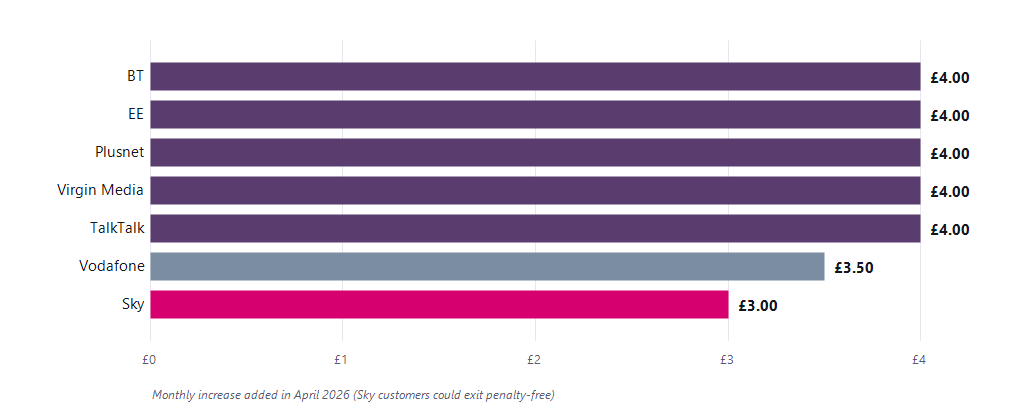
- Two tracks are running. Contracts signed since 17 January 2025 carry fixed pounds-and-pence rises stated upfront. Older contracts can still carry inflation-linked formulas such as CPI plus 3.9%.
- Transparency is not a cap. The rules make rises clear, but they do not limit how big a stated rise can be, so always check the contract summary before signing.
- Change may be coming for older contracts. Under the voluntary Telecoms Consumer Charter signed in February 2026, the major providers have pledged that April 2026 is the final inflation-linked increase, with legacy contracts then moving to pounds and pence. A pledge, though, is not a law.
- Social tariffs are typically exempt from mid-contract rises, with the full picture at social tariffs UK, and several smaller full-fibre providers advertise no in-contract rises at all.
Our provider-by-provider breakdown, updated as the rules and amounts change, lives at in-contract price rises 2026.
When you really are tied in
Honesty matters here: outside the five routes, leaving early usually costs money. Know the score before you act.
- Early termination charges are real. Expect to pay for the months left on your minimum term, less the costs your provider saves. On a long contract that can run to hundreds of pounds, so always get the exact figure from your provider first. The fee landscape: exit fees and setup fees.
- Moving home is not an automatic escape. Even if your provider cannot serve the new address, you may still owe termination charges depending on its policy. Plan the move first with our guide to moving home with broadband.
- A rise you agreed to is binding. If the pounds-and-pence increase was clearly in your contract summary at sign-up, it is an agreed term, and there is no exit right on those grounds.
- Sometimes paying to leave still pays. If the fee is small and the saving is large, do the sums. Our guide to switching before your contract ends walks the maths.
How to actually leave
Whatever your route out, the leaving itself is now the easy part. Under One Touch Switch, your new provider arranges everything in one contact, including the goodbye to your old one, and your number comes with you, as covered in what happens to my number when I switch. Time it so the new service starts as the old one ends, and note that if your new service starts late, automatic compensation applies at £6.46 per day, with the full rates in our companion guide: Ofcom automatic compensation rates 2026. The whole journey, checklist included, is mapped in the switching hub.
Leaving early to take a bundle deal? Read our companion guide: broadband and mobile bundles: worth it in 2026?
Questions people ask
Can I cancel my broadband contract without paying a fee?
Yes, in five situations: your minimum term has ended, you are within the 14-day cooling-off period, the price rose in a way not clearly stated at sign-up (30 days to exit), a Speeds Code provider failed to fix speeds below your guaranteed minimum within 30 days, or the provider changed the deal to your detriment. Otherwise early termination charges usually apply.
Does a price rise let me leave my broadband contract?
Only if the rise was not clearly set out in pounds and pence when you signed, in which case you have 30 days from the notification to leave penalty-free. Rises stated upfront in post-January-2025 contracts are agreed terms. Sky is the exception: it does not write rises into broadband contracts, so every Sky rise carries the 30-day exit.
What is the broadband cooling-off period?
14 days from an online or phone order, under consumer contract law. Cancel within it and you can walk away from the contract, though you may be charged for any service already used during the window.
Can I leave my broadband contract because of slow speeds?
If your provider is signed to Ofcom's Broadband Speeds Code, yes: report speeds below the guaranteed minimum on your order, and if it is not fixed within 30 days you can exit penalty-free, including linked landline and TV. The code is voluntary, and Vodafone is notably not a signatory.
How much are broadband early termination charges?
Typically the remaining months of your minimum term, less the costs your provider saves by not serving you, which on a long contract can reach hundreds of pounds. Always ask your provider for the exact figure first, then weigh it against the saving from switching; sometimes paying to leave still pays.
About this guide
This guide is part of the BroadbandSwitch.uk 2026 Guide Library, published by BroadbandSwitch.uk, the consumer arm of the SearchSwitchSave network. Our approach to evidence and corrections is documented in the methodology and trust hub, and every published correction appears in the corrections log.
Take it with you: download the free 6-page PDF guide, including the five routes, the April 2026 rises chart and full sources.
Citing this guide: BroadbandSwitch.uk. (2026, June 11). Can I leave my broadband contract early? Your 2026 rights. SearchSwitchSave. https://broadbandswitch.uk/guides/leave-broadband-contract-early/
Sources
- Ofcom. (n.d.). Switching broadband, phone or pay-TV provider. https://www.ofcom.org.uk/phones-and-broadband/switching-provider
- Money to the Masses. (2026, February 23). Sky to hike prices in April: How to cancel for free. https://moneytothemasses.com/news/sky-to-hike-prices-in-april-how-to-cancel-for-free
- Broadband Genie. (2026, April). STOP broadband price rises. https://www.broadband.co.uk/broadband/help/stop-broadband-price-rises
- GB News. (2026, February 27). Sky confirms TV and broadband price rises for April 2026. https://www.gbnews.com/tech/sky-tv-broadband-price-rise-april-2026
This guide is general consumer information, not legal advice. Exit rights depend on your contract terms and sign-up date; the Speeds Code and the Telecoms Consumer Charter are voluntary commitments, not legislation; April 2026 rise amounts vary by plan and sign-up date. Always confirm your own position with your provider before acting.