UK broadband switching hub 2026: One Touch Switch, mid-contract rises, compensation, and your rights

Switching UK broadband in 2026 is fundamentally simpler than it has ever been thanks to One Touch Switch (OTS), the Ofcom-mandated process that launched on 12 September 2024 and has now moved over 1.625 million UK consumers between providers in its first year, plus the January 2025 ban on inflation-linked mid-contract price rises in new contracts, plus the February 2026 Telecoms Consumer Charter signed by major providers, plus Ofcom's automatic compensation regime that pays customers when switches go wrong. This hub is the comprehensive 2026 UK switching reference covering every step from what you can leave penalty-free, through the practical mechanics of the TOTSCo Hub, to the new business OTS due to launch fully in 2026.

1.625M+UK consumers switched under OTS by Sep 2025
22M+TOTSCo Hub messages processed
14 daysStandard cooling-off period
£6.24Daily Ofcom compensation for delayed activation
£31.19Ofcom compensation per missed engineer
£3-£4Typical April 2026 monthly price rise
The 60-second answer

The 2026 UK switching answer in 60 seconds

To switch UK broadband in 2026, contact only the new provider; under One Touch Switch the new (gaining) provider handles everything via the TOTSCo Hub, including notifying the old (losing) provider and coordinating the activation date. Most UK switches now complete within 10-14 working days; same-network switches (BT to Sky on Openreach, or Vodafone to TalkTalk on CityFibre) can be as quick as one working day with very brief downtime. You have a 14-day cooling-off period (Sky offers 31 days for broadband) to cancel without penalty, and you can leave penalty-free in four other scenarios: out-of-contract; speeds consistently below the guaranteed minimum (under Ofcom's Voluntary Code of Practice); a mid-contract price rise that wasn't clearly stated in pounds and pence in your original contract; or following Ofcom-mandated compensation triggers. OTS doesn't apply to mobile broadband, some bundled services, or moving home (in those cases you contact the old provider). Ofcom's automatic compensation pays £6.24 per day delayed activation, £6.24-£9.33 per day total loss of service, and £31.19 per missed engineer appointment. Always start with a postcode check.

UK broadband switching overview 2026: what changed

UK broadband switching in 2026 is governed by a substantial body of Ofcom regulation that has evolved meaningfully since 2023. Three changes in particular have shaped the present-day picture: the launch of One Touch Switch on 12 September 2024 (which made the new provider responsible for the entire switch process via the central TOTSCo Hub), the 17 January 2025 ban on inflation-linked mid-contract price rises in new contracts (which means new contracts must state any future rises in pounds and pence at the point of sale), and the February 2026 Telecoms Consumer Charter signed by BT, Virgin Media O2, Sky, TalkTalk, and other major providers committing to eliminate unexpected mid-contract price increases and to make social tariffs easier to access.

By September 2025 over 1.625 million UK consumers had switched broadband or landline provider under OTS, with the TOTSCo Hub having processed approximately 22 million messages. TOTSCo's CEO Paul Bradbury reported in 2025 that the address-match rate had risen from 60 percent at launch to approximately 67 percent as the system matured. By April 2026 the OTS volume had reached approximately 1.8 million annual switches per Ofcom and TOTSCo updates, with most major UK broadband brands fully integrated and only a small number of smaller outfits still lagging on full TOTSCo Hub integration.

Quick switching summary 2026

One Touch Switch: Launched 12 September 2024. Customer contacts only the new provider; new provider handles the rest via the central TOTSCo Hub. Applies to all UK fixed-line residential broadband and voice services.

Cooling-off period: 14 days standard (Consumer Contracts Regulations 2013); Sky offers a 31-day cooling-off period for broadband.

Mid-contract price rises: From 17 January 2025, new contracts must state any future rises in pounds and pence (no more CPI/RPI plus margin). Typical April 2026 fixed rises: BT/EE/Plusnet £4 per month; Virgin Media £4 per month; Sky £3 per month; Vodafone £3.50 per month; TalkTalk £4 per month for contracts from 16 November 2025.

Penalty-free exit: During the cooling-off period; once out of contract; speeds consistently below the guaranteed minimum (under Ofcom's Voluntary Code of Practice on Speeds); a mid-contract price rise that wasn't clearly stated in your original contract; following 30 days of unresolved fault per Ofcom Code of Practice.

Automatic compensation 2026: £6.24 per day delayed activation, £6.24-£9.33 per day total loss of service, £31.19 per missed engineer appointment.

Notice required: Ofcom requires providers to send an end-of-contract notification 10-40 days before the deal ends; providers must give 30 days' notice of any mid-contract price rise.

Out-of-contract penalty: Out-of-contract customers typically pay £5-£20 per month more than new-customer rates - the single biggest avoidable UK broadband cost.

The combined effect of these changes is that 2026 is the most consumer-friendly year for UK broadband switching that Ofcom has ever delivered. The practical implication is straightforward: if you have not actively reviewed your broadband in the last 18 months, you are very likely overpaying. The single biggest avoidable cost is sitting out-of-contract on a tariff that has rolled forward without you switching, where you typically pay £5-£20 per month more than a new customer would for the same speed. The combination of OTS plus the January 2025 transparency rule plus the Charter means that actively reviewing your broadband annually now takes minutes rather than hours, with strong consumer protections if anything goes wrong.

Key fact: Ofcom's September 2025 OTS update reported that the system had moved 1.625 million UK consumers between providers in its first year, with TOTSCo's central Hub processing 22 million messages. The address-match rate rose from 60 percent at launch to approximately 67 percent through the first year, and the system is expected to handle approximately 1.8 million annual switches once fully mature.

One Touch Switch step-by-step

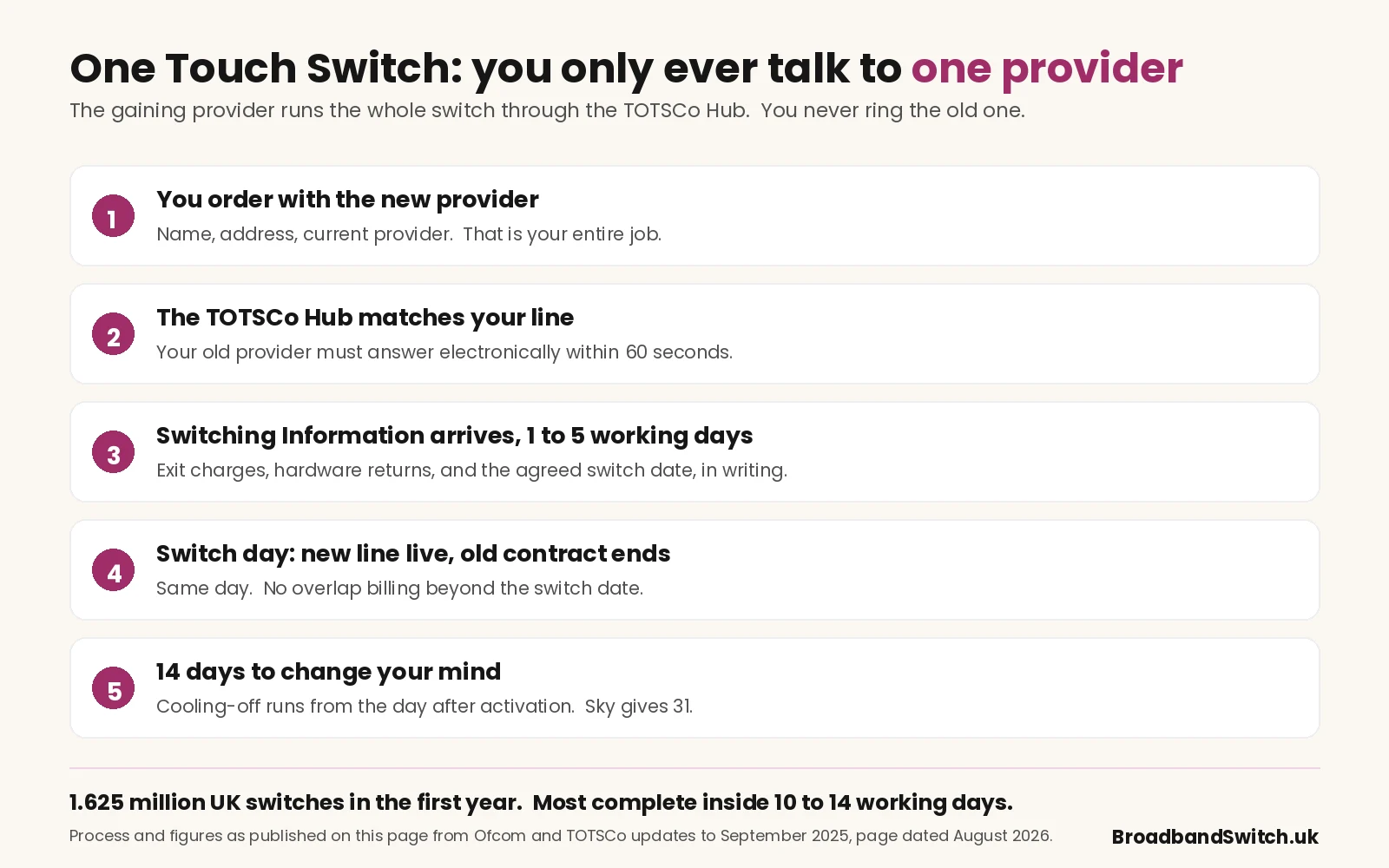
The One Touch Switch process is gaining-provider-led, meaning the new (gaining) provider takes responsibility for the switch end-to-end and the customer never needs to contact the losing provider. This is a fundamental change from the previous Notification of Transfer (NoT+) process where customers had to coordinate with both providers. Under OTS, the practical workflow for a typical UK residential broadband switch in 2026 is straightforward:

  1. Choose your new provider and package. Run a postcode check to see what is available at your specific address (CityFibre, Openreach, Virgin Media plus Nexfibre, Netomnia/YouFibre, Hyperoptic, plus any local altnets). Compare deals across speed, price, contract length, and crucially the mid-contract price rise schedule and the price-rise policy (some altnets including toob, Zen Internet, YouFibre, Cuckoo, and selected Plusnet tiers offer no in-contract price rises).
  2. Place the order with the new provider only. Provide your name, address, and current provider. You do not need to contact the old provider. The new provider sends a switching request to the TOTSCo Hub.
  3. Receive the Switching Information Notification within 1-5 working days. This document, sent by the losing provider via the gaining provider, sets out: the identity of the gaining provider; any early-termination charges that would apply; information on hardware returns and the final invoice; an explanation of any bundled services that may need separate cancellation; and the agreed switch (activation) date. The losing provider must respond to the match request within 60 seconds electronically (24 hours by post if you've requested postal communication).
  4. Review and consent. You sign the new contract and confirm the switch. You have 14 days from contract signing or service activation (whichever is later) to cancel under your cooling-off rights.
  5. Switch happens automatically on the agreed date. The new service activates on that date; the old service is disconnected on the same day. No notice charges apply beyond the switch date - this is a key change from the previous regime where customers often paid two providers during the handover.
  6. Old equipment return (if required). Some providers require return of routers, set-top boxes, and other equipment; the Switching Information Notification specifies what (if anything) must be returned and how (typically prepaid packaging or designated drop-off points). Keep tracking numbers and proof of postage.
Typical 2026 switching timelines by switch type

Same-network Openreach to Openreach (BT to Sky, TalkTalk to Vodafone, Plusnet to Zen, EE to NOW Broadband): Typically 10 working days, with 1-2 hours of brief downtime during the handover window. Sometimes as quick as one working day if both providers fast-track.

Same-network CityFibre to CityFibre (Vodafone CityFibre to Sky CityFibre, TalkTalk to toob, Lit Fibre to Cuckoo): Typically 10 working days with very brief downtime. CityFibre claims homes passed by its network can schedule a full fibre install within five working days.

Cross-network switches (Openreach to Virgin Media, Openreach to CityFibre, Virgin Media to YouFibre on Netomnia, Hyperoptic to Openreach): Typically 10-20 working days with engineer install at the property. Both lines often run in parallel during install, so cutover-day downtime is often zero - particularly important for households where home working depends on continuous connectivity.

Hyperoptic in already-wired MDU buildings: Sometimes same-day (when the building has wayleave-confirmed Hyperoptic infrastructure already installed).

Cross-network switches between Virgin Media's cable network and Openreach (or vice versa) are sometimes the most complex because Virgin Media has historically operated separately from the OTS process for some scenarios; under 2026 rules these are now fully OTS-supported but typically require slightly longer engineer-install windows than same-network switches. CityFibre's Reading and Cambridge primary-build-complete footprints, plus its many other Gigabit City completions, mean that CityFibre cross-network switches are now genuinely fast across most CityFibre cities thanks to the 5-working-day install claim.

Key fact: Under OTS the losing provider must respond electronically to the gaining provider's match request within 60 seconds via the TOTSCo Hub (or within 24 hours if the customer has requested postal communication). Notice charges no longer apply beyond the agreed switch date - customers no longer pay two providers during the handover, which is one of the most significant practical improvements over the pre-September-2024 regime.

The TOTSCo Hub explained

The One Touch Switching Company (TOTSCo) is the industry-funded not-for-profit organisation that operates the TOTSCo Hub, the central messaging platform that all UK residential fixed-line broadband and voice providers use to coordinate switching messages. TOTSCo sits behind the scenes - customers never interact with it directly - but understanding how it works helps explain why some switches are quick and smooth while others are slower or more error-prone.

When you place an order with a new (gaining) provider, the gaining provider's system sends an electronic match request to the TOTSCo Hub. The Hub identifies which losing provider serves your address and forwards the request. The losing provider must respond within 60 seconds electronically with the Switching Information needed: confirmation of your identity at the address, any early-termination charges, hardware return requirements, the final invoice arrangements, and any bundled-service implications. TOTSCo's Hub then returns this information to the gaining provider, which presents it to you as the Switching Information Notification. The whole exchange typically completes within 1-5 working days end-to-end, including any postal-only customer correspondence requirements.

TOTSCo 2026 performance and outlook

Volume: 1.625 million successful UK switches by September 2025 (TOTSCo expects 1.8 million by end-2025 and approximately 1.8 million per year ongoing). 22 million Hub messages processed in the first year.

Match rate: Rose from 60 percent at launch to approximately 67 percent by mid-2025 per TOTSCo CEO Paul Bradbury, as providers refine their address-matching logic and customer-detail validation.

Service Level Agreement: Hub has consistently met its SLA and latency targets per TOTSCo's regular updates.

Coverage: All major UK broadband brands now participate; a small number of smaller outfits still lag on full integration, which Ofcom can intervene on if it blocks consumer switching.

Business OTS: TOTSCo is developing a separate solution for switching between business connectivity providers, currently in testing and due to launch fully in early-to-mid 2026 (see the dedicated business-switching section below).

For consumers the practical implication of the TOTSCo Hub is that switches now happen behind the scenes through automated electronic messaging rather than depending on customer-service phone calls between two providers. This automation is the main reason switches are faster and more reliable than under the pre-2024 regime, but it also means that mismatched address details, incorrect current-provider names, or other data errors can occasionally cause delays. When errors occur, TOTSCo's Hub provides evidence of what went wrong and when, which is useful if you need to escalate to Ofcom or claim automatic compensation.

Ofcom has stated that it will consider opening investigations into providers whose OTS performance is materially below industry norms. Compensation obligations apply to the OTS process under Ofcom General Conditions C7.47-C7.49: if a provider fails to comply with OTS obligations, the customer is entitled to reasonable compensation. This means, for example, that if you had to contact the losing provider directly to action a switch (because the gaining provider's TOTSCo Hub integration was broken), you would typically be entitled to compensation.

Key fact: The TOTSCo Hub is the central messaging system that makes One Touch Switch work behind the scenes. Customers never interact with it directly, but every UK residential fixed-line broadband or voice switch under OTS passes through the Hub. TOTSCo is industry-funded and not-for-profit, with the Hub now processing approximately 22 million switching messages per year on behalf of UK consumers.

Switching by network: Openreach, CityFibre, Virgin Media, Netomnia, Hyperoptic

UK broadband retail brands run on five major physical networks (plus a long tail of smaller altnets), and the practical mechanics of switching depend partly on which networks your old and new providers use. Same-network switches (where both providers use the same physical infrastructure) are typically faster because no engineer install is required at the property; cross-network switches typically take 10-20 working days because a new physical connection has to be activated. The following summary covers the typical 2026 mechanics for each major UK network.

Switch typeTypical timelineEngineer requiredTypical downtime
Openreach to Openreach (BT to Sky, TalkTalk to Vodafone, Plusnet to Zen, EE to NOW)10 working days, sometimes 1-2 daysUsually no1-2 hours during handover window
CityFibre to CityFibre (Vodafone CityFibre to TalkTalk to toob to Cuckoo)10 working days; CityFibre claims 5 working daysUsually noVery brief (often minutes)
Virgin Media to Virgin Media within own retail10-14 working daysSometimes for tier upgradeBrief
Openreach to CityFibre cross-network10-20 working daysYes (CityFibre install)Often zero (parallel running)
Openreach to Virgin Media cross-network10-20 working daysYes (Virgin Media install)Often zero (parallel running)
Openreach to YouFibre on Netomnia10-20 working daysYes (Netomnia install)Often zero (parallel running)
Any to Hyperoptic in already-wired MDU buildingOften same-day or 5 working daysNo (in-building only)Brief
Any to Hyperoptic in non-wired buildingMonths (wayleave required first)Substantial building-wide installSignificant during build

Openreach to Openreach covers the largest share of UK switches because Openreach hosts the broadest range of major UK retail Internet Service Providers (BT, Sky, Vodafone, TalkTalk, EE, Plusnet, NOW Broadband, Zen, Earth Broadband, Onestream, plus many smaller ISPs). These switches are usually fast and smooth because no physical infrastructure changes - the line stays the same, only the retail provider changes. OTS handles these switches very reliably.

CityFibre to CityFibre switches across CityFibre's Gigabit City footprints (now including Reading, Cambridge, Newcastle, Bristol, Leeds, Sheffield, Edinburgh, Glasgow, Cardiff, Aberdeen, Belfast, Brighton & Hove, Plymouth, Manchester, Birmingham, Liverpool, Stockton-on-Tees, Middlesbrough, Hartlepool, plus the Project Gigabit subsidised areas) work similarly to Openreach-to-Openreach: same physical line, different retail brand. CityFibre's claim of 5-working-day install timelines applies primarily to these same-network and cross-network-into-CityFibre cases.

Cross-network switches require a new physical connection to be activated at the property, which means an engineer install is usually needed. In most cases the old service can run in parallel with the new install, so cutover-day downtime is zero. This is particularly important for households that depend on continuous connectivity for home working or video conferencing. Always confirm with the gaining provider before placing the order whether parallel running is supported for your specific switch.

Virgin Media plus Nexfibre cross-network switches have historically been the most complex because Virgin Media's cable network operates separately from Openreach. Under OTS these switches are now fully supported but typically require Virgin Media installer visits where moving onto the cable network for the first time. The February 2026 acquisition of Netomnia by Virgin Media O2 (and the YouFibre and Brsk retail brand acquisitions) means Virgin Media O2 now has a broader UK altnet footprint, which is gradually simplifying multi-network switches within the Virgin Media O2 group.

Hyperoptic switches in MDU (multi-dwelling unit) buildings are very fast where the building already has Hyperoptic in-building wiring under a wayleave agreement. Where Hyperoptic is not yet in the building, the building owner needs a wayleave agreement with Hyperoptic before installation can proceed - this can take weeks or months and is the major practical constraint on Hyperoptic switches. See our wayleave guide for flats and apartment blocks for the full picture.

Honest take: The fastest 2026 UK switches are typically same-network Openreach to Openreach (often 1-2 working days end-to-end) or same-network CityFibre to CityFibre. The slowest are typically Hyperoptic switches into buildings without existing wayleave agreements, where the building owner has to authorise Hyperoptic to install in-building wiring before any individual flat can take service. Plan accordingly: if you need a fast switch, prioritise same-network options at your specific address.

Key fact: Most UK 2026 broadband switches are now resolved within 10-14 working days under OTS, with same-network switches sometimes completing within one working day. Engineer install for cross-network switches typically allows parallel running of old and new services so cutover-day downtime is often zero - significantly better than the pre-September-2024 regime where customers were often without service for days during cross-network changes.

Cooling-off period: your 14-day right to cancel

Every UK broadband contract signed at distance (online, by phone, or via a comparison site) includes a 14-day cooling-off period under the Consumer Contracts Regulations 2013. This period starts the day after your service is activated, not the day you signed the contract. During the cooling-off window you can cancel for any reason and receive a full refund of any service charges paid, with no early-termination fee. This is a statutory right that applies regardless of what your contract terms say, and applies even if you've signed up for the cheapest introductory deal.

Sky Broadband offers a more generous 31-day cooling-off period for broadband, significantly longer than the standard 14 days. This extended window is voluntary on Sky's part and gives Sky customers more time to test speeds, check reliability, and compare against alternatives before committing. NOW Broadband (which is part of the Sky group) offers similar extended-period flexibility. No other major UK broadband brand currently exceeds the statutory 14-day floor.

Cooling-off period in practice

The 14-day clock starts the day after your service is activated, not the day you signed the contract. This means: (1) If you sign up online today and the service activates in two weeks' time, your cooling-off period runs for 14 days from the activation date. (2) If you sign up online and the service activates the same day (rare for broadband, more common for mobile), the cooling-off period runs from the day after activation. (3) If you signed up in person (door-to-door sales or in a shop), you may technically waive your automatic right to the cooling-off period under some circumstances, although many providers offer a goodwill cooling-off window even for in-person sign-ups. (4) Even if cancellation is accepted, you'll still pay for any portion of the service you've already used on a pro rata basis.

Cooling-off rights cover the full broadband service: you can cancel for any reason during the window, including changing your mind, finding a better deal elsewhere, or unsatisfactory speeds during the testing period. To exercise the right, contact the new provider directly (in writing or by phone) and confirm you're cancelling under your cooling-off rights. Keep records of the communication; if you cancel within 14 days, the provider must refund any service charges paid and stop billing future charges.

For new-build properties, properties moving from full fibre to 5G home broadband, or properties where the previous service was unreliable, the cooling-off period is your protection against switching to a new service that turns out not to perform as advertised. Always run speed tests during the cooling-off window if possible (broadband speed testers from Ofcom, Speedtest by Ookla, or thinkbroadband are all reliable), and document any speed shortfall against the guaranteed minimum stated in your contract.

Key fact: The 14-day cooling-off period under Consumer Contracts Regulations 2013 starts the day after service activation, not the day of contract signing. Sky Broadband offers a more generous 31-day cooling-off period for broadband; no other major UK provider currently exceeds the statutory 14-day floor. This statutory right applies regardless of contract terms and is independent of any other cancellation rights you may have.

Mid-contract price rises 2026: when you can leave penalty-free

Mid-contract price rises are the single most controversial UK broadband regulatory topic of recent years, and 2026 is a transitional year where two parallel regimes apply depending on when your contract started. On 17 January 2025, Ofcom banned inflation-linked (CPI/RPI) or percentage-based mid-contract price-rise terms in new contracts; any future change to a contract signed from that date onwards must be expressed in pounds and pence at the point of sale, not as a CPI-plus-margin formula. Contracts signed before that date can still use the old inflation-linked formula until the end of their minimum term.

Typical April 2026 fixed mid-contract price rises by major provider

BT and EE: £4 per month from April 2026 (£48 per year). All BT, EE, and Plusnet customers (BT Group) will see a fixed price increase from 2026; those out of contract are being moved from the old inflation-based to the fixed pounds-and-pence plan.

Plusnet: £4 per month from April 2026.

Virgin Media: £4 per month from April 2026 across broadband, TV, and phone packages. Customers who joined before 9 January 2025 may still be on the older RPI-based formula for one final year.

Sky: £3 per month from April 2026 (£36 per year). Sky offers a 30-day cancellation window for any price rise, regardless of contract terms - a customer-friendly position that other major providers have not matched.

Vodafone: £3.50 per month from April 2026 (£42 per year). Contracts started on or after 2 July 2024 are on the fixed-rise model; earlier contracts may still be CPI plus 3.9 percent for one final year.

TalkTalk: Fixed rise increased from £3 to £4 per month for contracts from 16 November 2025 (applied each April).

NOW Broadband: £2 per month for contracts between 8 September 2024 and 8 November 2025 (applied each July rather than April); for older contracts the formula was CPI plus 3.9 percent.

Three Broadband: Contracts from 1 September 2024 onwards are on fixed pounds-and-pence rises.

Providers with no in-contract price rises (2026): A small but growing group of UK broadband providers offer explicit no in-contract price rises policies as a core differentiator. These include Zen Internet (Contract Price Promise: the price you agree is the price you pay for your minimum term); Cuckoo (no mid-contract rises); toob (no in-contract price rises across all its CityFibre footprint including the April 2025 Berkshire expansion); YouFibre ("No surprise price rises" during the contract); Brsk (fixed prices on fixed-term plans); Trooli (prices locked for the 24-month term); plus selected Community Fibre plans and selected Plusnet tiers. Note that Hyperoptic, long associated with no mid-contract rises, moved in 2025/26 to a fixed annual increase model for new customers, aligning with big-brand practice - this was a notable pivot in the UK altnet market.

When you can exit penalty-free on a mid-contract price rise

If the rise was clearly stated in your original contract (most contracts signed from January 2025 onwards), you generally cannot exit penalty-free - you've effectively agreed to the rise upfront. Exception: Sky and NOW Broadband still allow penalty-free exit on any price rise even if disclosed in the original contract terms, which is genuinely customer-friendly.

If the rise was NOT clearly stated in your original contract (some legacy contracts signed before January 2025 used inflation-linked formulas, and some 2025/26 contracts had unclear pounds-and-pence disclosure), Ofcom General Conditions give you the right to exit within 30 days of receiving the price-rise notification, with no early-termination charge.

If the rise applies on a different date or by a different amount than originally stated, you have penalty-free exit rights regardless of contract terms.

Providers must give at least 30 days' notice before applying a mid-contract price rise. You typically have 30 days from receiving the notice to decide whether to accept the new price or exit your contract. In practice, Ofcom's regime is that the rises themselves are still legal (Ofcom did not ban mid-contract rises - it only banned inflation-linked formulas in new contracts and required transparency for any future changes), but if your contract didn't clearly disclose the rise, you have a clear right to exit. Always read the price-rise notification carefully and check whether the disclosed rise matches the pounds-and-pence figure stated in your original contract.

Honest take: The single biggest practical implication of the 2025/26 mid-contract price rise regime is that the headline introductory price you see at sign-up is rarely the price you'll pay throughout the contract. A 24-month deal at £25 per month with a £4 April rise costs £600 over the term, not £600 - it's actually £25 x 17 + £29 x 7 = £628 if the rise applies once, or more if you're caught by two April rises in a 24-month term. When comparing deals always factor in the full multi-year cost including any disclosed rises, not just the introductory price. Providers that explicitly offer no in-contract price rises (toob, Zen, YouFibre, Cuckoo, Brsk, Trooli, selected Community Fibre and Plusnet tiers) are a meaningfully different value proposition - the price you sign up for is the price you pay for the full minimum term.

Key fact: Ofcom's 17 January 2025 ban on inflation-linked mid-contract price rises in new contracts means that contracts signed from that date forward must state any future rise as a fixed pounds-and-pence figure at the point of sale, with the date of any rise also clearly disclosed. Typical April 2026 fixed monthly rises are: BT/EE/Plusnet £4, Virgin Media £4, Sky £3, Vodafone £3.50, TalkTalk £4 from contracts from 16 November 2025.

End-of-contract notifications: how to time your switch

Ofcom requires UK broadband providers to send an end-of-contract notification 10-40 days before your minimum contract term expires. This notification must tell you: that your contract is about to end; the price you'll pay if you do nothing (typically your existing in-contract price for a brief period before rolling onto the higher out-of-contract tariff); and the best deals the provider can offer you if you renew or stay. This is often the most useful single piece of switching information you receive in any year because it puts the deadline in front of you with enough time to act.

The single biggest avoidable UK broadband cost in 2026 is sitting out-of-contract on a tariff that has rolled forward without you actively switching or renegotiating. Out-of-contract customers typically pay £5-£20 per month more than new-customer rates for the same speed - over a year that is £60-£240 of avoidable cost, and most UK households who haven't actively switched in the last 18 months are likely paying more than they need to. The end-of-contract notification is your cue to act.

What to do when you receive an end-of-contract notification

Step 1. Read the notification carefully. Note the contract end date, the price you'll pay if you do nothing, and the best deals the provider is offering you to renew.

Step 2. Run a postcode check on a price comparison site. Compare what you could get from other providers at your specific address: speed, price, contract length, mid-contract price rise schedule, and price-rise policy. Use Ofcom's broadband and mobile coverage checker to confirm what's actually available, plus the provider's own checkers.

Step 3. Decide whether to switch or renew. If a competing provider offers genuinely better value for your needs, place the order with the new provider before the contract end date. Under OTS the new provider handles the rest. If your existing provider is competitive, call retentions and ask for the new-customer equivalent deal - retentions teams often have unpublished offers.

Step 4. Time the switch. Most providers require 30 days' notice to cancel, even if you're out-of-contract. This means you should start comparing deals 30-40 days before your contract ends to ensure your new service is ready when your old one expires. If you wait until after your contract ends, you'll pay the higher out-of-contract rate while the new service is being set up.

Setting a calendar reminder for 30-40 days before your contract end date is the single most useful broadband admin task you can do. Use the broadband availability checker to see which providers and speeds are available at your address, read independent broadband reviews, and book the new contract to activate around your old contract's end date. Under OTS the new provider takes care of the cancellation; under the pre-2024 regime you used to need to coordinate this yourself, which is one of the practical reasons OTS is such a meaningful improvement.

Note that some end-of-contract notifications include a "best deals" offer from the existing provider that can be genuinely competitive, particularly for households with multiple bundled services (broadband plus TV plus mobile). Always compare the renewal offer against external alternatives before deciding. If you're staying with the same provider, ensure the new contract has a clearly stated price-rise schedule (so you know exactly what you'll pay across the new term) and a clearly stated minimum term (so you know when the next end-of-contract notification will arrive).

Key fact: Ofcom requires end-of-contract notifications 10-40 days before contract expiry. Out-of-contract customers typically pay £5-£20 per month more than new-customer rates - so actively reviewing your broadband annually around your contract end date is the single highest-value broadband admin task most UK households can do in 2026. Set a calendar reminder for 30-40 days before each contract end date.

Ofcom automatic compensation rates 2026

Ofcom's automatic compensation regime requires UK broadband providers to compensate customers automatically (without a customer claim being required) when service standards are not met during the switching, repair, or installation processes. The 2026 compensation rates are uprated annually with inflation, with the current figures published by Ofcom on its compensation pages. These rates are statutory minimums; some providers offer enhanced compensation as a customer-friendly differentiator.

Compensation trigger2026 amountNotes
Delayed activation of new service£6.24 per day delayedApplies from the day after the agreed activation date until the day the service goes live
Total loss of service£6.24-£9.33 per dayApplies from the third day after the loss is reported (first two days are treated as repair time)
Missed engineer appointment£31.19 per missed appointmentApplies if the engineer fails to attend a confirmed appointment, and is paid per missed appointment

Compensation under the Ofcom regime is automatic - you do not need to claim it, and the provider must pay it without prompting. Compensation is typically applied as a credit on your next bill rather than as a cash refund. If your provider fails to pay compensation that is due to you, you can complain through the provider's formal complaints process and (if not resolved within 6 weeks under the new April 2026 deadlock window, reduced from the previous 8 weeks) escalate to either the Communications Ombudsman or CISAS, depending on which scheme your provider is signed up to.

When compensation applies in switching scenarios

OTS-related delays: If a switch is delayed past the agreed activation date due to OTS-process issues (TOTSCo Hub mismatches, losing-provider non-response, or gaining-provider error), the £6.24 per day delayed activation compensation typically applies.

Service loss during switch: If your new service activates after your old service is disconnected, leading to total loss of service, the £6.24-£9.33 per day compensation typically applies after the standard repair-time threshold.

Missed install engineer: If the engineer fails to attend a confirmed cross-network install appointment, the £31.19 missed appointment compensation typically applies.

Pre-OTS legacy issues: Under Ofcom General Conditions C7.47-C7.49, if a provider's failure to comply with OTS obligations forced a customer to contact the losing provider directly to action a switch, that customer is typically entitled to reasonable compensation.

Beyond Ofcom's automatic compensation regime, Ofcom General Conditions also include the requirement that providers reimburse customers reasonably where their failure to comply with switching obligations causes consumer harm. This is a wider safety net than the automatic regime and typically requires a customer complaint to trigger. In practice, Ofcom's automatic compensation handles the most common switching-day issues; the wider reimbursement requirement is most relevant where a switch fails altogether or where multiple service standards are breached during a switch.

Honest take: Most 2026 UK broadband switches under OTS do not trigger any compensation because they go through smoothly within the agreed timeline. When compensation does apply, the daily rates can add up quickly: a delayed activation by 5 working days plus a missed engineer appointment is approximately £62.39 of compensation, which is meaningful for households that have already been inconvenienced by the delay. Always document the exact dates of agreed activation, actual activation, any periods of total service loss, and any missed engineer appointments - this evidence is what enables compensation claims if the provider doesn't apply it automatically.

Key fact: Ofcom's 2026 automatic compensation rates are £6.24 per day delayed activation, £6.24-£9.33 per day total loss of service, and £31.19 per missed engineer appointment. Compensation is automatic (no customer claim required) and is typically credited to the next bill. These rates are statutory minimums - some providers offer enhanced compensation as a customer-friendly differentiator.

Cancelling without fees: the five legitimate scenarios

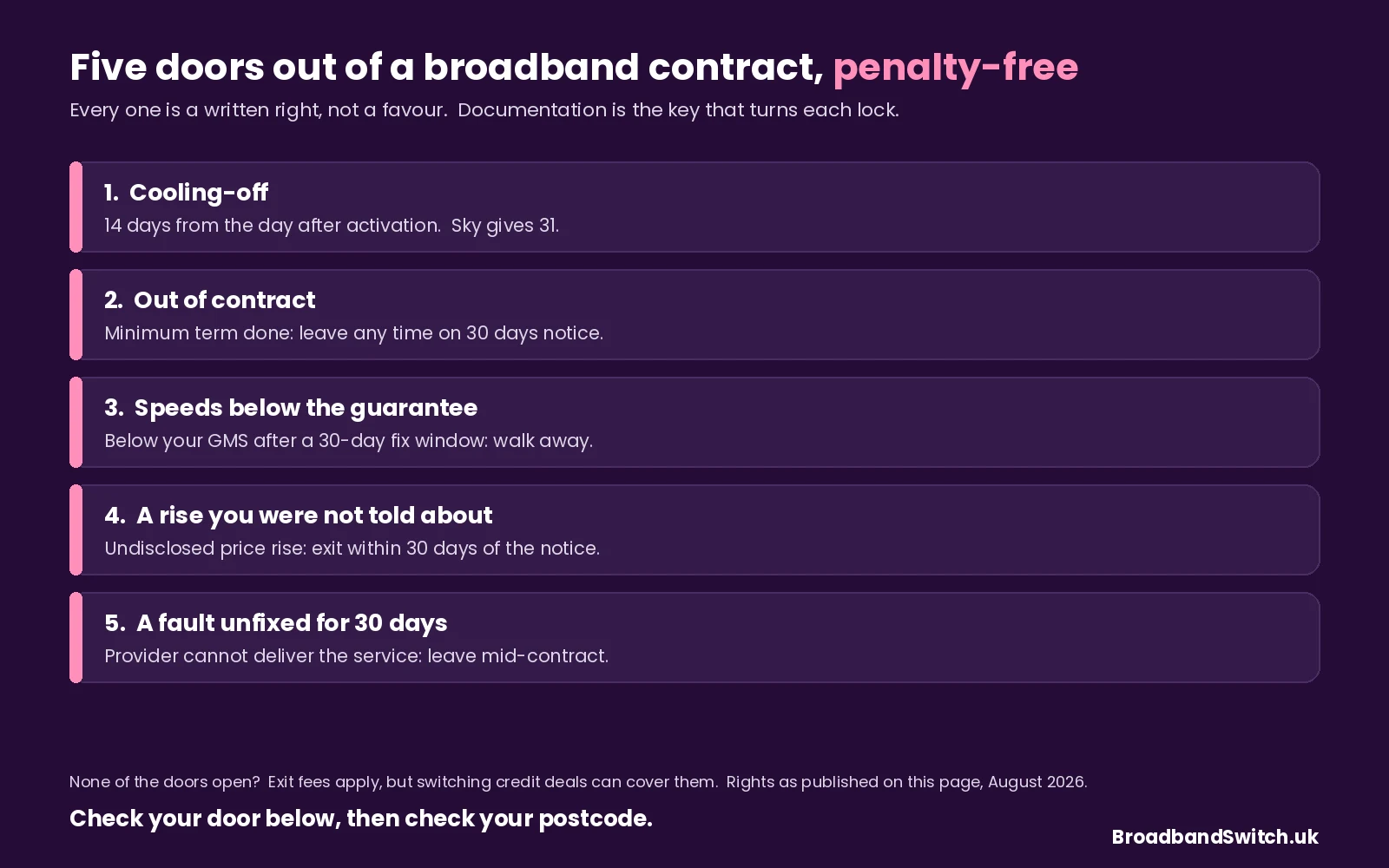
UK broadband contracts in 2026 typically include early-termination fees calculated as the outstanding monthly payments multiplied by a discount factor (often 90 percent or so of the remaining contract value, since the provider has saved on the supply costs of the months you're not consuming). However, there are five well-defined legitimate scenarios where you can leave penalty-free, and understanding them is fundamental to navigating the UK broadband market well.

  1. During the 14-day cooling-off period (Sky offers 31 days for broadband). Statutory right under Consumer Contracts Regulations 2013. Cancel for any reason within 14 days of service activation; the provider must refund any service charges paid pro rata for any usage. See the cooling-off section above.
  2. Once your minimum contract term ends. Out-of-contract customers can cancel at any time with 30 days' notice and zero penalty. This is also when you can switch via OTS without any early-termination concern. Most providers send an end-of-contract notification 10-40 days before contract expiry to remind you.
  3. If your speeds are consistently below the guaranteed minimum stated in your contract. Under Ofcom's Voluntary Code of Practice on Speeds, signed by all major UK providers (BT, Sky, Plusnet, Virgin Media, EE, Vodafone, TalkTalk, and others), you have the right to cancel without penalty if your provider's speeds consistently fall below the contractual minimum and the provider has been given a reasonable opportunity to fix the issue. Document speeds across multiple days and at different times using Ofcom-recognised testers (Ofcom's official tester, Speedtest by Ookla, thinkbroadband Speed Test). Save screenshots and detailed records.
  4. If your provider raises prices in a way that wasn't clearly stated in your original contract terms. Under Ofcom General Conditions, you have the right to exit within 30 days of receiving the price-rise notification, with no early-termination charge, where the rise was not clearly disclosed at sign-up. Sky and NOW Broadband go further and offer penalty-free exit on any price rise even where disclosed in the original contract.
  5. If your provider fails to fix a fault within 30 days under Ofcom Code of Practice. Once you've logged a fault, your provider must investigate and attempt to fix the issue within 30 days. If they can't resolve the problem within this timeframe, you can leave penalty-free even if you're mid-contract because the provider has failed to deliver the contracted service. Keep detailed records of fault reports, all communication dates, names of customer-service representatives, and any provider commitments to fix.
Documentation that supports a penalty-free exit claim

If you're planning to invoke any of the penalty-free exit scenarios above, the strength of your claim depends on the documentation you've kept. Useful records include: speed test screenshots showing actual speeds against the contractual minimum (over multiple days, multiple times of day, on a wired connection); fault report references with dates and times; email logs of all customer-service correspondence; provider commitments and missed deadlines for fault resolution; copies of the original contract Key Facts document showing the originally disclosed price-rise schedule (or its absence); copies of any price-rise notifications received showing the proposed new price and effective date.

If your provider refuses to accept a penalty-free exit claim that you believe is legitimate, the next step is to make a formal complaint via the provider's complaints process. If the complaint is not resolved within 6 weeks (reduced from the previous 8 weeks under the April 2026 Telecoms Consumer Charter and supporting Ofcom changes), or if the provider issues a deadlock letter, you can escalate to the Communications Ombudsman or CISAS depending on which scheme your provider is signed up to. Both are free to use and their decisions are legally binding on the provider.

Key fact: Five legitimate UK 2026 scenarios allow you to cancel broadband penalty-free: during the 14-day cooling-off period; once you're out of contract; speeds consistently below the contractual minimum (Voluntary Code of Practice); a price rise not clearly disclosed in the original contract; an unresolved fault for more than 30 days under Ofcom Code of Practice. Outside these scenarios, expect to pay early-termination fees calculated as the outstanding monthly payments multiplied by a discount factor.

When OTS doesn't apply: mobile, bundles, moving home

One Touch Switch covers all UK fixed-line residential broadband and voice services, but there are three notable categories where OTS does NOT apply, and customers in those categories still need to manage the switch directly with the old provider. Knowing which scenarios fall outside OTS helps you plan accordingly and avoid frustrating delays where you assumed the new provider would handle everything.

Three scenarios where OTS does NOT apply

Mobile broadband (4G and 5G home broadband): OTS covers fixed-line broadband only. If you're switching from or to a mobile broadband service (Three 5G Home Broadband, EE 5G Home, Vodafone 5G Home, or any 4G mobile broadband router setup), you'll need to contact the losing provider directly to cancel and return any equipment. This is a meaningful exception because 5G home broadband is one of the fastest-growing UK broadband segments, particularly for short-term tenancies and rural locations.

Bundled services where broadband is part of a wider package: If your broadband is bundled with TV, mobile, or phone services and you only want to switch the broadband element, OTS may not handle the bundle separately. Contact the losing provider to understand which elements OTS will cancel and which you'll need to cancel manually. Common cases: Sky Glass plus Sky Stream plus Sky Broadband bundles; Virgin Media Volt bundles with mobile and TV; BT Halo bundles with mobile.

Moving home (property change): OTS does NOT apply when you're moving to a new property, even if you're changing provider in the process. You need to contact the old provider to cancel the existing service at the old address and set up new service at the new address (either with the same or a different provider). Some providers offer free home-move services to retain customers; others apply early-termination charges if the new property cannot be served on the existing contract.

For mobile broadband switches, the practical workflow is: place the order with the new provider; receive any router or SIM by post; contact the losing provider directly to confirm cancellation date and any equipment-return requirements; ensure the cancellation aligns with the new service activation to avoid double-billing. Ofcom's switching protections including automatic compensation for switching delays apply differently to mobile broadband than to fixed-line; refer to your specific provider's mobile broadband terms for details.

For bundled-service switches, the key practical point is to read the Switching Information Notification carefully. The notification will list which services are being switched under OTS and which require separate cancellation with the losing provider. Common gotchas: customers switching their broadband under OTS but assuming their TV bundle would also cancel, only to find they're still being billed for the TV element; customers switching their landline under OTS but keeping their mobile bundle on a separate contract. Always check the bill the month after a switch to confirm everything has been cancelled correctly.

For property moves, Ofcom recommends contacting the existing provider as soon as you have a confirmed new address and move-in date. Ask whether the existing service can be moved (technically transferred to the new property) or whether it must be cancelled and a new service set up. Most providers will move services where technical infrastructure supports it; where it doesn't (for example, moving from a Virgin Media cabled property to a non-cabled new address), the old contract may have to be terminated with applicable early-termination charges, and a new contract started at the new address. Some providers offer waivers of early-termination charges for genuine home moves; this varies by provider and is worth asking about explicitly.

Honest take: The home-moves exception to OTS is the single most common practical surprise for UK broadband customers in 2026. Many people assume that switching providers when moving home will work the same way as a switch within an existing property, but it doesn't - moving home requires direct cancellation with the old provider and a fresh order with the new (or same) provider at the new address. Plan ahead: contact your current provider 4-6 weeks before move-in to discuss options, and place any new order in advance so the new service can activate within a few days of moving in.

Key fact: One Touch Switch does NOT apply to mobile broadband (4G or 5G home broadband), some bundled services where only part of the bundle is being switched, or property moves (where the customer is moving to a new address). In these cases, contact the losing provider directly. Ofcom's automatic compensation regime applies differently in these scenarios; check your specific provider's terms.

Switching for flats, new-builds, and wayleaves

Switching broadband in flats, apartment blocks, and new-build properties has its own distinctive considerations that go beyond standard OTS mechanics. The fundamental issue is that altnet and full fibre providers (CityFibre, Hyperoptic, Community Fibre, YouFibre on Netomnia, Brsk, Lit Fibre, 4th Utility, and others) typically need a wayleave agreement with the building owner before they can install in-building wiring, and many UK flats simply do not have wayleaves with the altnet you want to switch to.

What a wayleave is and why it matters

A wayleave is a legal agreement between a network operator and a property owner that grants the network operator the right to install and maintain telecoms infrastructure on the property. For flats and apartment blocks, the wayleave is typically signed between the altnet (Hyperoptic, Community Fibre, etc.) and the freeholder, building managing agent, or housing association. Without a wayleave, the altnet cannot install in-building fibre, which means individual flat residents cannot take service from that altnet regardless of how much they want it. Openreach has a different legal framework (the Electronic Communications Code) that provides limited statutory rights, but altnets typically rely on commercial wayleave agreements.

If your flat already has wayleaves for multiple altnets (for example, both Openreach FTTP and Hyperoptic), switching between them is straightforward under OTS. If your flat only has one wayleave, your effective broadband choice is constrained by which altnet has signed with your building owner, plus Openreach (which has broader statutory rights), plus Virgin Media (where its cable network reaches the building), plus any 5G home broadband options. This is a substantial practical limitation in some UK flat blocks.

For tenants and leaseholders facing wayleave constraints: the practical options are (1) take service from one of the altnets that already has a wayleave with your building (usually one or two altnets in addition to Openreach); (2) ask your building owner or managing agent to consider signing a wayleave with the altnet you want; or (3) take service over Openreach FTTP or FTTC, Virgin Media, or 5G home broadband instead. Hyperoptic in particular has been very active in pursuing UK MDU wayleaves, with many UK flats now connected; Community Fibre is similarly active across London; CityFibre is more focused on civic-area builds rather than individual MDU wayleaves.

New-build property considerations

Builder partnerships: Many UK new-build estates have exclusive or preferred-supplier arrangements between the housebuilder and a specific altnet (commonly Openreach FTTP, Virgin Media plus Nexfibre, or Hyperoptic). Check with your housebuilder before completion which altnet has been pre-installed; this affects both the speed of activation after move-in and the choice of retail brands available.

Pre-installed routers: Some new-build properties come with a pre-installed router from the builder's preferred altnet partner. You don't have to use this provider - you can switch under OTS to any other compatible retail brand on the same network, or to a different network if available - but the pre-installed setup makes day-one connectivity very simple if you're happy with the default.

Activation timing: Place orders for new-build broadband as soon as you have a confirmed completion date. Some altnets can activate same-day if the in-building infrastructure is already live; others need a few working days. Avoid placing orders that activate before move-in, as you'll be paying for service you can't use.

Rural new-builds: Project Gigabit subsidised builds across rural England and Wales (delivered by CityFibre, Gigaclear, Openreach, Wessex Internet, and others) have substantially improved rural new-build broadband options. Always check what's actually available at your specific new-build address before assuming altnet coverage.

For more on wayleaves and flat-specific broadband choice, see our dedicated guide on wayleave explained for flats and apartment blocks and our broadband for flats and apartments overview. For new-build properties our broadband for new-build properties guide covers the developer-partnership and activation-timing considerations in more detail.

Key fact: Wayleave constraints are the single biggest practical limit on broadband choice in UK flats and apartment blocks. If your building doesn't have a wayleave with the altnet you want, you cannot take service from that altnet regardless of OTS or any other regulation. Openreach's broader statutory rights mean Openreach FTTP and FTTC are usually available; Virgin Media's cable network reaches many UK flat blocks; altnet choice depends on which providers have signed wayleaves with your building owner.

Business broadband switching and the 2026 OTS launch

UK business broadband switching has historically been more complex than residential switching because business connections often have different speed tiers, contract lengths, hardware bundles, service level agreements, and other complexities that make a straightforward residential-style switch process challenging. However, that is changing in 2026: TOTSCo's separate business-OTS solution has been in trial since mid-2025 and is expected to launch fully during 2026, bringing the residential OTS benefits to UK businesses for the first time.

TOTSCo business OTS in 2026

Launch timing: TOTSCo's business OTS is currently in trial. First connection tests for the new directional process started at the end of May 2025 per TOTSCo updates; the goal is full launch in early-to-mid 2026 once every element (from address matching to billing) passes formal testing.

Pricing: TOTSCo confirmed in April 2026 that the unit price for business switching is reducing from £1.70 to £1.60 per business customer. No charges apply for Communication Providers with fewer than 20,000 customers "until live operations begin" (the trial solution is currently free for smaller providers).

2026/2027 outlook: Pricing will not change again during 2026. TOTSCo expects the 2027 unit price to be "no higher than £1.60" (to be confirmed in Q3 2026). As more providers opt in, costs are shared across a wider group of users, improving affordability. From 2028 onwards the unit price could reduce indicatively by approximately 50 percent, reflecting the recovery of TOTSCo's business switching development costs by the end of 2027.

Process design: Unlike residential OTS, Ofcom has NOT specified a single mandated method for business switching. TOTSCo is building a solution alongside a separate "gaining-supplier-led" business process overseen by industry stakeholders. This reflects the greater complexity of business connectivity products versus residential broadband.

Until business OTS launches fully, UK businesses switching broadband still need to manage the switch with both the old and new providers - contacting the losing provider to confirm cancellation arrangements, hardware return, and any early-termination obligations, while placing the order and arranging install with the gaining provider. Business broadband contracts are often longer (24, 36, or 60 months for ethernet leased lines and similar) with more substantial early-termination charges than residential contracts, so the practical advice for businesses is to start the switching process well before contract end and to read the existing contract carefully for any specific termination notice requirements.

For UK businesses with multiple sites, the multi-site switching process can be particularly complex. Some larger enterprise broadband providers (BT Business, Vodafone Business, Virgin Media Business, Sky Business, TalkTalk Business, Daisy, Onecom, Gamma) offer multi-site account-management teams that coordinate switches across an entire estate; this is often more practical than treating each site as an individual switch. Smaller business broadband providers (Cuckoo for Business, toob Business, Zen Business, Hyperoptic Business) may not have the same multi-site capability but typically offer more competitive single-site pricing.

The category of "business broadband" itself spans a wide range of products: residential-grade broadband used for business purposes (where the technical product is the same as a residential connection but billed to a business); business-grade broadband with enhanced support and SLAs (typically 12-hour or 4-hour fault response, dedicated business customer service); and ethernet leased lines (genuine dedicated, symmetric, uncontended business connections at substantially higher monthly cost). OTS will primarily address the first two categories; ethernet leased lines remain on bespoke business processes.

Honest take: Until TOTSCo's business OTS launches fully, business broadband switching in 2026 still requires direct coordination with both providers. This is more complex than residential OTS but is being actively addressed by industry, and the trial pricing reductions (from £1.70 to £1.60 per business customer in 2026, with further reductions expected in 2028) suggest that business OTS will become a meaningfully cheaper switching mechanism over the next two years. For UK businesses planning to switch in 2026, the practical advice is: read your existing contract; start the process 60-90 days before your preferred switch date; ask the new provider whether they can run parallel services during the cutover; and confirm any multi-site implications before placing the order.

Key fact: TOTSCo's business OTS solution is currently in trial and is expected to launch fully during 2026. The unit price reduces from £1.70 to £1.60 per business customer for 2026, with no charges for Communication Providers with fewer than 20,000 customers until live operations begin. By 2028 the unit price could reduce by approximately 50 percent as TOTSCo's business switching development costs are recovered.

The February 2026 Telecoms Consumer Charter

In February 2026, the UK government introduced a new Telecoms Consumer Charter signed by the major UK broadband and mobile providers including BT, Virgin Media O2, Sky, and TalkTalk. The Charter is voluntary (it does not impose legal penalties on providers that fail to comply) and complements the binding Ofcom regulatory regime already in force. It commits signatories to a set of customer-friendly behaviours, with the aim of strengthening UK consumer protections beyond the regulatory baseline.

Telecoms Consumer Charter key commitments (February 2026)

Eliminate unexpected mid-contract price increases: Signatories commit that all mid-contract price changes will be clearly disclosed in pounds and pence at the point of sale, going further than the Ofcom transparency rule that already applies to all new contracts from 17 January 2025. April 2026 will be the final increase expressed in legacy inflation-linked terms (CPI plus margin); after that all such contracts must move to the clearer pounds-and-pence system.

Easier social tariff access: Signatories commit to making social tariffs (BT Home Essentials, Virgin Media Essential Broadband, Vodafone Essentials Broadband, toob Essentials, NOW Broadband Basic, Sky Basics, and others) easier to access and apply for, including more proactive customer communication about eligibility for households on Universal Credit, Pension Credit, PIP, and other qualifying benefits.

Faster complaint resolution: The deadlock window before customers can escalate to the Communications Ombudsman or CISAS is reducing from 8 weeks to 6 weeks from April 2026, allowing faster ombudsman recourse where complaints are not resolved at the provider level.

Clearer end-of-contract messaging: Stronger commitments on end-of-contract notifications, including clearer presentation of the renewal options against external alternatives.

It's important to note that the Charter is voluntary and not legally binding. Providers that do not comply with Charter commitments are not subject to legal penalties, but Ofcom can use Charter performance as part of its broader regulatory oversight and customer-experience monitoring. In practice the Charter is most useful as a public-facing reference point for customers - if a provider claims to be a Charter signatory but is not delivering on Charter commitments, that's a basis for a formal complaint and (if unresolved) ombudsman escalation.

The Charter sits alongside (and does not replace) the binding Ofcom regulatory regime including the General Conditions of Entitlement (which mandate OTS, automatic compensation, end-of-contract notifications, and many other consumer protections), the Voluntary Code of Practice on Speeds (signed by all major providers), the January 2025 ban on inflation-linked mid-contract rises in new contracts, and the wider consumer law framework including the Consumer Contracts Regulations 2013 (which provides the 14-day cooling-off period). Customers can rely on the binding regulatory regime for their core protections; the Charter adds voluntary commitments on top.

Key fact: The February 2026 Telecoms Consumer Charter is voluntary - it does not impose legal penalties on providers that fail to comply - but it commits BT, Virgin Media O2, Sky, TalkTalk, and other major signatories to eliminate unexpected mid-contract price increases, make social tariffs easier to access, and reduce the complaint deadlock window from 8 to 6 weeks from April 2026. It complements the binding Ofcom regulatory regime that mandates OTS, automatic compensation, and other core protections.

Common switching problems and how to resolve them

The vast majority of UK 2026 broadband switches under OTS go smoothly and complete within the agreed timeline. However, problems do occur, and knowing how to recognise and resolve them quickly avoids unnecessary frustration and ensures you receive any automatic compensation that may be due.

Problem 1: Switching Information Notification not received within 5 working days

The losing provider must respond to the gaining provider's TOTSCo Hub match request within 60 seconds electronically, and the gaining provider must present the Switching Information Notification to you typically within 1-5 working days. If you haven't received the Switching Information Notification within 5 working days of placing your order, contact the gaining provider to chase. Common causes: address-matching errors at the TOTSCo Hub (where your address details don't match the losing provider's records); incorrect current-provider name on the order; technical TOTSCo Hub integration issues with smaller providers. Resolution: provide updated address details to the gaining provider; allow another 1-2 working days for re-matching; if still unresolved, complain via the gaining provider's complaints process.

Problem 2: New service activates but old service does not disconnect

Under OTS the losing provider should disconnect the old service on the same day the new service activates, so customers don't pay two providers in parallel. If your new service is live but the old service is still being billed, this is an OTS process failure that typically entitles you to compensation under General Conditions C7.47-C7.49. Contact the losing provider directly with proof of new service activation; insist on backdated cancellation to the new service activation date; document all communication for any subsequent compensation claim.

Problem 3: Cross-network engineer install missed or delayed

For cross-network switches (Openreach to Virgin Media, Openreach to CityFibre, Virgin Media to YouFibre on Netomnia, any to Hyperoptic in non-wired buildings), an engineer install is typically required. If the engineer misses the agreed appointment, automatic compensation of £31.19 per missed appointment applies under Ofcom rules. If the install is delayed past the originally agreed activation date, automatic compensation of £6.24 per day delayed activation applies until the service goes live. Document the originally agreed dates, the actual dates, and any communication from the provider.

Problem 4: Total loss of service during switch

Under OTS most cross-network switches support parallel running of old and new services, so cutover-day downtime is often zero. If the switch results in total loss of service for more than the standard repair-time threshold (typically the third day onwards), automatic compensation of £6.24-£9.33 per day total loss of service applies. Contact the gaining provider immediately to expedite resolution; document the start and end times of the service loss for any compensation claim.

Problem 5: Speeds substantially lower on new service than expected

If your new service activates but the speeds are substantially lower than the contractual minimum, this triggers the Voluntary Code of Practice on Speeds (signed by all major UK providers). You typically have a 30-day window to give the provider an opportunity to fix the issue (line tests, router replacement, cabinet investigation). If the issue is not resolved and speeds remain consistently below the contractual minimum, you have the right to leave the contract penalty-free under the Code of Practice. Document speed tests across multiple days and times using Ofcom-recognised testers; keep screenshots and detailed records.

Problem 6: Provider doesn't accept a penalty-free exit claim

If you believe you have a legitimate penalty-free exit right (cooling-off, out-of-contract, undisclosed price rise, speed below minimum, unresolved fault) but the provider refuses to accept the claim, the next step is the provider's formal complaints process. If the complaint is not resolved within 6 weeks (April 2026 onwards; previously 8 weeks), or if the provider issues a deadlock letter, escalate to either the Communications Ombudsman or CISAS depending on which scheme your provider is signed up to. Both are free to use and their decisions are legally binding on the provider. Keep all documentation throughout.

Honest take: The single most useful habit for navigating any switching problem in 2026 is documentation. Save copies of your original contract Key Facts document; save Switching Information Notifications; save speed test screenshots; save email logs of all customer-service correspondence; note dates, times, and names for any phone calls. Most provider customer-service teams will resolve issues quickly when presented with clear documentation; most refuse to engage productively when the customer's recall is vague. If you ever need to escalate to Ofcom, the Communications Ombudsman, or CISAS, the strength of your case is built on the documentation you've kept along the way.

Key fact: Most UK 2026 broadband switches go smoothly under OTS, but when problems do occur, Ofcom's automatic compensation regime pays £6.24 per day delayed activation, £6.24-£9.33 per day total loss of service, and £31.19 per missed engineer appointment. If a provider refuses to apply compensation that you believe is due, the formal complaints process plus eventual ombudsman escalation (Communications Ombudsman or CISAS) is the route to resolution.

Free help and where to verify your switching rights

Independent third-party tools and authoritative regulatory sources to confirm your rights and check what is actually available at your address before switching.

  • Ofcom broadband and mobile coverage checker: Authoritative UK regulator availability data including FTTP, FTTC, and gigabit-capable coverage by postcode and address, plus 4G and 5G mobile coverage from EE, Three, Vodafone, and O2. Available at ofcom.org.uk.
  • Ofcom switching guidance: Authoritative guidance on One Touch Switch, automatic compensation, mid-contract price rises, and consumer rights, available at ofcom.org.uk/phones-and-broadband/switching-provider/switching-broadband-provider/.
  • BroadbandSwitch.uk postcode comparison: Multi-provider comparison across Openreach (BT, Sky, Vodafone, TalkTalk, EE, Plusnet, NOW Broadband, Zen, and others), Virgin Media plus Nexfibre, CityFibre retail brands (Vodafone, TalkTalk, Giganet, Zen, toob, Cuckoo, Lit Fibre, 4th Utility, and more), Hyperoptic, YouFibre on Netomnia, plus 4G and 5G home broadband options.
  • TOTSCo (One Touch Switching Company): Public information on the TOTSCo Hub and OTS process at totsco.org.uk, plus regular updates on industry performance and the upcoming business-OTS launch.
  • Communications Ombudsman: Free, independent, government-approved ombudsman scheme for broadband complaints from customers of providers signed up to the Communications Ombudsman scheme. Available at commsombudsman.org.
  • CISAS: Free, independent, government-approved ombudsman scheme for broadband complaints from customers of providers signed up to CISAS rather than Communications Ombudsman. Available at cisas.org.uk.
  • Ofcom's Voluntary Code of Practice on Speeds: Lists which providers have signed up and the customer protections that apply, including the right to leave penalty-free if speeds consistently fall below the guaranteed minimum.
  • Citizens Advice: Free advice on consumer broadband rights, including help with disputes, contract reviews, and complaints escalation. Available at citizensadvice.org.uk.
  • Provider checkers: Direct availability checks at openreach.com (FTTP and FTTC), virginmedia.com (cable and Nexfibre), cityfibre.com (CityFibre coverage), youfibre.com and netomnia.com (YouFibre on Netomnia), hyperoptic.com (MDU buildings), toob.co.uk (CityFibre Berkshire and other footprints), gigaclear.com (rural full fibre), plus brsk.co.uk for the Brsk altnet footprint.
  • ThinkBroadband Labs: Independent UK broadband coverage analysis with postcode-level FTTP and gigabit availability data, useful as a cross-reference against provider checkers.

How we put this guide together

This switching hub draws on Ofcom's Connected Nations 2025 (UK-wide coverage data, published 19 November 2025); Ofcom's General Conditions of Entitlement, particularly C7.18-C7.27 (switching obligations including OTS) and C7.47-C7.49 (compensation obligations); Ofcom's Voluntary Code of Practice on Speeds signed by all major UK providers; the Consumer Contracts Regulations 2013 establishing the 14-day cooling-off period; Ofcom's 17 January 2025 statement banning inflation-linked mid-contract price rises in new contracts and requiring all future rises to be expressed in pounds and pence at the point of sale; TOTSCo (One Touch Switching Company) updates including the September 2025 milestone of 1.625 million UK consumers switched and 22 million Hub messages processed in the first year, plus TOTSCo CEO Paul Bradbury's reporting on the rise in match rate from 60 percent at launch to approximately 67 percent by mid-2025; ISPreview UK April 2026 reporting on TOTSCo's confirmation of cheaper UK business broadband ISP switching pricing reducing from £1.70 to £1.60 per business customer for 2026 with no charges for Communication Providers under 20,000 customers until live operations; Brodies LLP and Lexology coverage of the legal framework around OTS including the specific obligations under General Conditions C7.18-C7.27 and C7.47-C7.49; Uswitch March 2026 coverage of mid-contract price rises confirming the typical April 2026 fixed monthly increases of BT/EE/Plusnet £4, Virgin Media £4, Sky £3, Vodafone £3.50, TalkTalk £4 (from contracts from 16 November 2025); CompareFibre 2026 guides on switching, contract lengths, mid-contract price rises, and cancelling without fees; GoCompare 2026 guides on broadband price rises and cancellation rights; Voneus's January 2026 analysis of UK broadband pricing 2026 covering the transition from inflation-linked to fixed pounds-and-pence rises and identifying the small group of UK providers retaining no in-contract rises (Zen, Cuckoo, toob, YouFibre, Brsk on fixed terms, Trooli, selected Community Fibre and Plusnet tiers) plus Hyperoptic's notable 2025/26 pivot away from no-mid-rises to fixed annual increases for new customers; broadbandproviders.co.uk March 2026 coverage of the February 2026 Telecoms Consumer Charter signed by BT, Virgin Media O2, Sky, and TalkTalk pledging to eliminate unexpected mid-contract price rises, make social tariffs easier to access, and (under supporting Ofcom changes) reduce the deadlock window from 8 weeks to 6 weeks from April 2026; Ofcom's automatic compensation rates for 2026 of £6.24 per day delayed activation, £6.24-£9.33 per day total loss of service, and £31.19 per missed engineer appointment; the Communications Ombudsman and CISAS websites confirming free, independent, government-approved ombudsman schemes for broadband complaints with legally binding decisions on providers; plus published 2026 contract terms and Switching Information Notification examples from BT, Sky, Virgin Media, Vodafone, TalkTalk, EE, Plusnet, NOW Broadband, Zen Internet, toob, YouFibre on Netomnia, Cuckoo, Hyperoptic, Community Fibre, Brsk, Trooli, Onestream, and Earth Broadband.

Editorial: Written by Adrian James, broadband editor. Reviewed by Dr Alex J. Martin-Smith, head of editorial. Last updated 28 April 2026; next review within 90 days. Corrections welcome via our corrections process.

How we earn: BroadbandSwitch.uk is independent. We sometimes earn affiliate fees from broadband switching deals, including some products mentioned in this guide; this never affects which providers we cover or how we describe them. See our affiliate disclosure and editorial policy.

Legal note: This guide provides general information on UK consumer broadband switching rights and is not legal advice. For specific legal questions about your contract or switching dispute, contact Citizens Advice, your provider's complaints team, or (where appropriate) the Communications Ombudsman or CISAS. Ofcom is the UK regulator for telecoms; the Office of Communications acts as the binding source for the regulatory regime referenced in this guide.

Frequently asked questions about UK broadband switching

How does One Touch Switch work in 2026?

Under One Touch Switch (OTS) in 2026, you contact only the new (gaining) provider; the new provider handles cancellation of the old contract and coordinates the switch via the central TOTSCo Hub messaging platform. The basic workflow: choose your new provider and package; place the order; receive Switching Information Notification within 1-5 working days confirming the activation date plus any early-termination charges, hardware return requirements, and final invoice arrangements; the switch proceeds automatically on the agreed date unless you cancel within the cooling-off period. Same-network Openreach to Openreach switches typically complete within 10 working days (sometimes within 1-2 days) with 1-2 hours of brief downtime; same-network CityFibre to CityFibre switches similarly complete within 10 working days with very brief downtime. Cross-network switches typically take 10-20 working days with engineer install at the property; both lines often run in parallel during install, so cutover-day downtime is often zero. By September 2025 over 1.625 million UK consumers had switched broadband or landline provider under OTS, with TOTSCo's central Hub processing 22 million messages in the first year. The match rate rose from 60 percent at launch to approximately 67 percent by mid-2025 per TOTSCo CEO Paul Bradbury, and the system is expected to handle approximately 1.8 million annual switches once fully mature. OTS is governed by Ofcom General Conditions C7.18-C7.27 (switching obligations) and C7.47-C7.49 (compensation obligations).

What is the cooling-off period for UK broadband?

Every UK broadband contract signed at distance (online, by phone, or via a comparison site) includes a 14-day cooling-off period under the Consumer Contracts Regulations 2013. This period starts the day after your service is activated, not the day you signed the contract. During the cooling-off window you can cancel for any reason and receive a full refund of any service charges paid (pro rata for any usage), with no early-termination fee. Sky Broadband offers a more generous 31-day cooling-off period for broadband, significantly longer than the standard 14 days; this is voluntary on Sky's part. NOW Broadband (which is part of the Sky group) offers similar extended-period flexibility. No other major UK broadband brand currently exceeds the statutory 14-day floor. If you signed up in person (door-to-door sales or in a shop), you may technically waive your automatic right to the cooling-off period under some circumstances, although many providers still offer a goodwill cooling-off window even for in-person sign-ups. Even if cancellation is accepted, you'll still pay for any portion of the service you've already used on a pro rata basis. To exercise the right, contact the new provider directly (in writing or by phone) and confirm you're cancelling under your cooling-off rights; keep records of the communication.

Can I leave my broadband contract penalty-free if prices rise?

It depends on whether the rise was clearly stated in your original contract. Under Ofcom's 17 January 2025 ban on inflation-linked mid-contract price rises in new contracts, all rises in contracts signed from that date onwards must be expressed in pounds and pence at the point of sale. If the rise was clearly disclosed in your original contract terms, you generally cannot exit penalty-free - you've effectively agreed to it upfront. However, two important exceptions: (1) Sky and NOW Broadband still allow penalty-free exit on any price rise even where disclosed in the original contract terms. (2) If your provider applies an increase that was NOT in your original contract terms, or applies the rise on a different date or by a different amount than originally stated, Ofcom General Conditions give you the right to exit within 30 days of receiving the price-rise notification, with no early-termination charge. Providers must give at least 30 days' notice before applying a mid-contract price rise. Typical April 2026 fixed monthly rises by major provider: BT and EE £4 per month, Plusnet £4 per month, Virgin Media £4 per month, Sky £3 per month, Vodafone £3.50 per month, TalkTalk £4 per month for contracts from 16 November 2025. Providers with no in-contract price rises in 2026 include Zen Internet, Cuckoo, toob, YouFibre, Brsk on fixed terms, Trooli, selected Community Fibre plans, and selected Plusnet tiers. Hyperoptic notably moved away from no-mid-rises in 2025/26 to fixed annual increases for new customers, aligning with big-brand practice. Social tariffs are typically exempt from mid-contract price rises altogether.

How much compensation does Ofcom give if a switch goes wrong?

Ofcom's automatic compensation regime in 2026 pays £6.24 per day for delayed activation of a new service (applies from the day after the agreed activation date until the day the service goes live); £6.24-£9.33 per day for total loss of service (applies from the third day after the loss is reported, with the first two days treated as repair time); and £31.19 per missed engineer appointment (applies if the engineer fails to attend a confirmed appointment, paid per missed appointment). Compensation under the Ofcom regime is automatic - you do not need to claim it, and the provider must pay it without prompting - and is typically applied as a credit on your next bill rather than as a cash refund. These rates are statutory minimums; some providers offer enhanced compensation as a customer-friendly differentiator. Beyond the automatic regime, Ofcom General Conditions C7.47-C7.49 also require providers to reimburse customers reasonably where their failure to comply with switching obligations causes consumer harm; this wider reimbursement requirement typically requires a customer complaint to trigger. If your provider fails to pay compensation that is due to you, complain through the provider's formal complaints process and (if not resolved within 6 weeks under the new April 2026 deadlock window, reduced from the previous 8 weeks) escalate to either the Communications Ombudsman or CISAS, depending on which scheme your provider is signed up to. Both schemes are free to use and their decisions are legally binding on the provider.

Does One Touch Switch apply to all UK broadband types?

OTS covers all UK fixed-line residential broadband and voice services, but there are three notable categories where OTS does NOT apply. (1) Mobile broadband (4G and 5G home broadband from Three, EE, Vodafone, O2, and others): OTS covers fixed-line broadband only, so for mobile broadband switches you need to contact the losing provider directly to cancel and return any equipment. This is a meaningful exception because 5G home broadband is one of the fastest-growing UK broadband segments. (2) Bundled services where broadband is part of a wider package: if your broadband is bundled with TV, mobile, or phone services and you only want to switch the broadband element, OTS may not handle the bundle separately. Common cases include Sky Glass plus Sky Stream plus Sky Broadband bundles; Virgin Media Volt bundles with mobile and TV; BT Halo bundles with mobile. Contact the losing provider to understand which elements OTS will cancel and which require separate cancellation. (3) Moving home (property change): OTS does NOT apply when you're moving to a new property, even if you're changing provider in the process. You need to contact the old provider to cancel the existing service at the old address and set up new service at the new address. Some providers offer free home-move services to retain customers; others apply early-termination charges if the new property cannot be served on the existing contract. Always read your Switching Information Notification carefully; the notification will list which services are being switched under OTS and which require separate cancellation.

How do I switch broadband when moving home?

Moving home is one of the three scenarios where One Touch Switch does NOT apply, so you need to manage the switch with both the old and new providers directly. The practical workflow: (1) Contact your existing provider as soon as you have a confirmed new address and move-in date. Ask whether the existing service can be moved (technically transferred to the new property) or whether it must be cancelled and a new service set up. Most providers will move services where the technical infrastructure supports it; where it doesn't (for example, moving from a Virgin Media cabled property to a non-cabled new address), the old contract may have to be terminated with applicable early-termination charges, and a new contract started at the new address. (2) Some providers offer waivers of early-termination charges for genuine home moves; this varies by provider and is worth asking about explicitly. (3) Run a postcode check on your new address to see what's actually available there before committing to a specific provider. Use Ofcom's broadband and mobile coverage checker plus individual provider checkers (Openreach, CityFibre, Virgin Media, YouFibre on Netomnia, Hyperoptic, plus any local altnets). (4) Place any new order in advance so the new service can activate within a few days of moving in - typical install timelines are 10-14 working days for cross-network switches, so place the order at least 2-3 weeks before move-in date. (5) Confirm the cancellation date of the old service with the old provider; ensure it aligns with the new service activation to avoid double-billing. For Reading addresses moving home see our Reading broadband guide; for other UK locations see our location hub.

When can I cancel broadband without paying exit fees?

Five UK 2026 scenarios allow you to cancel broadband penalty-free. (1) During the 14-day cooling-off period (Sky offers 31 days for broadband): statutory right under Consumer Contracts Regulations 2013, cancel for any reason within 14 days of service activation. (2) Once your minimum contract term ends: out-of-contract customers can cancel at any time with 30 days' notice and zero penalty. Most providers send an end-of-contract notification 10-40 days before contract expiry to remind you. (3) If your speeds are consistently below the guaranteed minimum stated in your contract under Ofcom's Voluntary Code of Practice on Speeds (signed by all major UK providers). Document speeds across multiple days and times using Ofcom-recognised testers; save screenshots and detailed records. (4) If your provider raises prices in a way that wasn't clearly stated in your original contract terms: you have the right to exit within 30 days of receiving the price-rise notification with no early-termination charge. Sky and NOW Broadband go further and offer penalty-free exit on any price rise even where disclosed in the original contract. (5) If your provider fails to fix a fault within 30 days under Ofcom Code of Practice: once you've logged a fault, your provider must investigate and attempt to fix the issue within 30 days. If they can't resolve the problem, you can leave penalty-free even if you're mid-contract. Outside these scenarios, expect to pay early-termination fees calculated as the outstanding monthly payments multiplied by a discount factor. If your provider refuses to accept a penalty-free exit claim that you believe is legitimate, complain via the provider's complaints process and (if not resolved within 6 weeks under the new April 2026 deadlock window) escalate to the Communications Ombudsman or CISAS.

When will One Touch Switch be available for business broadband?

TOTSCo's separate business OTS solution has been in trial since mid-2025 and is expected to launch fully during 2026, bringing the residential OTS benefits to UK businesses for the first time. First connection tests for the new directional process started at the end of May 2025 per TOTSCo updates; the goal is full launch in early-to-mid 2026 once every element (from address matching to billing) passes formal testing. TOTSCo confirmed in April 2026 that the unit price for business switching is reducing from £1.70 to £1.60 per business customer. No charges apply for Communication Providers with fewer than 20,000 customers "until live operations begin" (the trial solution is currently free for smaller providers). Pricing will not change again during 2026. TOTSCo expects the 2027 unit price to be "no higher than £1.60" (to be confirmed in Q3 2026). As more providers opt in, costs are shared across a wider group of users, improving affordability. From 2028 onwards the unit price could reduce indicatively by approximately 50 percent, reflecting the recovery of TOTSCo's business switching development costs by the end of 2027. Unlike residential OTS, Ofcom has NOT specified a single mandated method for business switching; TOTSCo is building a solution alongside a separate "gaining-supplier-led" business process overseen by industry stakeholders. This reflects the greater complexity of business connectivity products versus residential broadband. Until business OTS launches fully, UK businesses switching broadband still need to manage the switch with both the old and new providers - contacting the losing provider to confirm cancellation arrangements while placing the order with the gaining provider. For UK businesses planning to switch in 2026, start the process 60-90 days before your preferred switch date; ask the new provider whether they can run parallel services during the cutover; and confirm any multi-site implications before placing the order.

References

  1. Ofcom. (2025, September 12). Ofcom celebrate as 1.6 million UK people switch broadband or phone via OTS. Office of Communications. https://www.ofcom.org.uk/phones-and-broadband/switching-provider/
  2. ISPreview UK. (2026, April). TOTSCo confirm cheaper UK business broadband ISP switching. Mark Jackson, ISPreview UK. https://www.ispreview.co.uk/index.php/2026/04/totsco-confirm-cheaper-uk-business-broadband-isp-switching.html
  3. Ofcom. (2025, January 17). Statement prohibiting inflation-linked price rises. Office of Communications. https://www.ofcom.org.uk/siteassets/resources/documents/consultations/category-1-10-weeks/272754-consultation-review-of-inflation-linked-telecoms-price-rises/