BROADBAND SPEED · PEAK TIME · CONGESTION GUIDE
Why Is My Broadband Slow at Night?
Peak-time congestion, explained. Why evening speeds dip, which connections suffer most, how to tell a real fault from the normal busy-hour slowdown, and the fixes that actually work, from a free Wi-Fi change tonight to the line upgrade that ends it for good.
Written by Dr Alex J. Martin-Smith · Reviewed by Adrian James · Published 11 June 2026 · Figures verified June 2026 · ~9 minute read
Prefer to read offline? Download the free PDF guide: Why Is My Broadband Slow at Night? (6 pages, ~280KB). No signup, no email, just the guide.
The quick answer
Most evening slowdowns are peak-time congestion, your home Wi-Fi, or both. UK broadband is busiest between 8pm and 10pm, when streaming, gaming and video calls all peak at once. Ofcom's last measurements found speeds were lowest around 9pm and highest overnight, but the average dip was modest, around 95% of top speed at peak, and full fibre held up best.
Key facts · verified June 2026
- The UK peak window is 8pm to 10pm, with measured speeds at their lowest around 9pm and highest overnight (Ofcom).
- The average peak dip is modest: about 95% of maximum speed across all connections in Ofcom's last published measurements.
- Technology decides how much you feel it: busy-period congestion was lowest for full fibre, while older copper and cable connections showed the largest proportional dips.
- The most common cause is not the line at all: evening Wi-Fi congestion inside and around your home is the usual culprit, especially on the crowded 2.4GHz band.
- Your rights still apply at peak: if speeds fall below your guaranteed minimum and your provider cannot fix it within 30 days, Speeds Code signatories must release you penalty-free.
The evening rush, measured
Broadband is a shared service. In the evening, far more people are online in your area and across the wider internet, so the busiest links slow a little. The chart below shows the typical shape of the day: steady overnight, dipping to its lowest around 9pm.
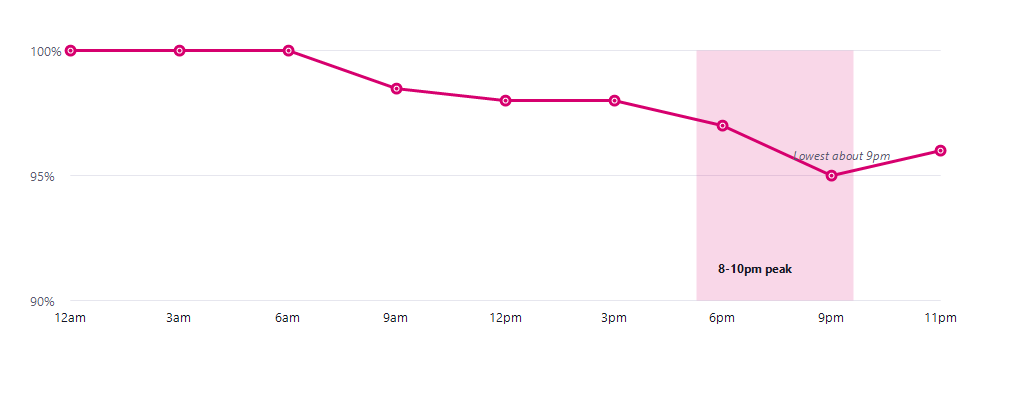
So a small evening dip is normal and expected. The questions worth asking are how big the dip is, whether it is your line or your Wi-Fi, and whether your connection type is one that suffers more than others. The rest of this guide answers each.
A note on the data: the most detailed UK peak-time figures come from Ofcom's Home Broadband Performance report using March 2023 data. Ofcom has since paused that report, noting the variation across the day had become small, so these remain the best published figures rather than the very latest.
Why your connection type matters
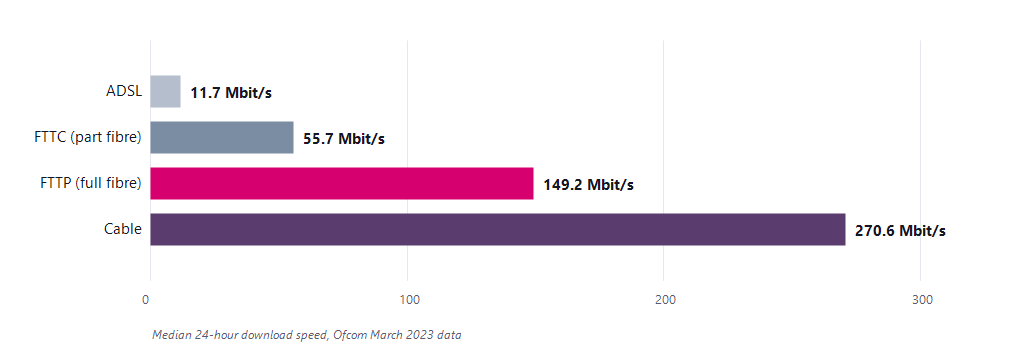
How much your connection slows at peak depends heavily on the technology it uses, because each type shares capacity in a different way and at a different point in the network.
| Technology | How it shares | Peak behaviour |
|---|---|---|
| Full fibre (FTTP) | Fibre shared among a few dozen homes, deep in the network | Huge headroom, so dips the least |
| Cable (DOCSIS) | Coax shared among hundreds of nearby homes | Among the most affected at peak; node splits help |
| Part fibre (FTTC) | Fibre to the cabinet, copper to your door | Limited by distance and cabinet sharing |
| Old copper (ADSL) | Copper all the way to the exchange | Slowest overall; copper and cable dip most in proportion |
What "contention" really means. Contention is simply the sharing of capacity between homes. Older networks used fixed ratios, often quoted as 50 homes to one line for residential broadband. Modern full fibre works differently: an Openreach fibre splitter typically serves up to around 30 premises, often with only a handful active at once, and faster tiers carry a minimum guaranteed speed. That headroom is why full fibre barely notices the evening rush. The full technology comparison lives at full fibre vs FTTC vs cable vs 4G/5G.
Is it the network, or your Wi-Fi?
Before blaming your provider, it is worth knowing that the most common cause of evening slowdowns is not the line at all, it is home Wi-Fi. There are three places a slowdown can happen, and a simple test tells them apart.
- Your home Wi-Fi. The usual culprit. In the evening, neighbouring networks and your own devices crowd the airwaves, especially on the older 2.4GHz band.
- The access network. The shared link back to the exchange or cable node. This is true peak-time contention, and it is what full fibre handles best.
- The wider internet. Occasionally the streaming or game server itself is busy, which no change at your end can fix.
The one test that tells them apart: run a speed test plugged directly into your router with an ethernet cable, then run one on Wi-Fi in the same spot. Do both at peak (around 9pm) and again off-peak (early morning), at ukspeedtest.co.uk.
| What you see | What it means |
|---|---|
| Wired is fast, Wi-Fi is slow | A Wi-Fi problem, not your line |
| Wired dips only at peak | Normal peak-time contention |
| Wired is slow at all hours | Possible line fault, contact your provider |
Wi-Fi bands, quickly: 2.4GHz reaches furthest but is the most crowded, so use only channels 1, 6 or 11. 5GHz is faster over shorter range. 6GHz, on Wi-Fi 6E and Wi-Fi 7, is the cleanest but shortest range. For reference, Virgin Media's Hub 5 is a Wi-Fi 6 router, which uses the 2.4 and 5GHz bands, not 6GHz.
Your rights, and the fixes that work
Your right to a minimum speed. Under Ofcom's voluntary Broadband Speeds Code of Practice, signed-up providers must give you a minimum guaranteed download speed when you sign up. If your speed falls below it and they cannot fix it, usually within 30 days, you have the right to leave penalty-free, including any phone or TV bundled with it. Most major providers have signed up, though it is voluntary and Vodafone is a notable exception. The full diagnosis of a line undershooting its promise, including the exact script for invoking the code, is in our companion guide: why are my speeds lower than advertised?
- Move to the 5GHz or 6GHz band. On a dual-band router, connecting nearby devices to the 5GHz network avoids the crowded 2.4GHz band and usually gives an instant lift in the evening.
- Wire up what you can. Plug TVs, consoles and desktops into the router with ethernet. It takes them off Wi-Fi entirely and frees the airwaves for everything else.
- Improve placement, or add mesh. Get the router out in the open, not in a cupboard. For larger homes, a mesh system carries a strong signal to every room.
- If it is the line, upgrade to full fibre. Where a congested cable or copper line slows every evening, full fibre is the real fix. Its headroom means peak hour barely registers: see full fibre deals at your address.
The lasting fix for evening sag is headroom, which is exactly what full fibre brings: what is FTTP? Full fibre explained.
Evening slowdowns that break video calls have a related guide: why broadband drops on video calls.
Questions people ask
Why does my internet slow down at night?
Because UK broadband is busiest between 8pm and 10pm, when streaming, gaming and calls peak together, and because evening Wi-Fi congestion crowds your home's airwaves at the same time. Ofcom's measurements put the average peak dip at a modest level, about 95% of top speed, so a dramatic nightly slowdown usually points to Wi-Fi or an overloaded cable or copper line rather than the internet itself.
What time is broadband slowest in the UK?
Around 9pm. Ofcom's last published measurements found download speeds were at their lowest at about 9pm, within the 8pm to 10pm peak window, and at their highest overnight.
Which broadband type is least affected by peak-time slowdown?
Full fibre (FTTP). Ofcom found busy-period congestion was lowest for full-fibre lines, because each fibre is shared among only a few dozen homes with substantial headroom, while older copper and cable connections showed the largest proportional peak-time dips.
How do I tell if it is congestion or a fault?
Run wired speed tests at the router at peak (around 9pm) and off-peak. Wired fast but Wi-Fi slow means a Wi-Fi problem; wired dipping only at peak is normal contention; wired slow at all hours suggests a line fault worth reporting, and below your guaranteed minimum it triggers the 30-day fix-or-exit right.
Can I leave my provider because of slow evening speeds?
If your provider is signed to Ofcom's Speeds Code and your wired speeds fall below your guaranteed minimum, yes: report it, and if it is not fixed within around 30 days you can exit penalty-free, including bundled phone and TV. The code is voluntary, and Vodafone is a notable non-signatory.
About this guide
This guide is part of the BroadbandSwitch.uk 2026 Guide Library, published by BroadbandSwitch.uk, the consumer arm of the SearchSwitchSave network. Our approach to evidence and corrections is documented in the methodology and trust hub, and every published correction appears in the corrections log.
Take it with you: download the free 6-page PDF guide, including both charts, the diagnosis table and full sources.
Citing this guide: BroadbandSwitch.uk. (2026, June 11). Why is my broadband slow at night? SearchSwitchSave. https://broadbandswitch.uk/guides/broadband-slow-at-night/
Sources
- Ofcom. (2023, September 14). UK home broadband performance (March 2023 data). https://www.ofcom.org.uk/phones-and-broadband/coverage-and-speeds/latest-home-broadband-performance-trends-revealed
- Ofcom. (2023, September 14). Latest trends in home broadband performance revealed. https://www.ofcom.org.uk/phones-and-broadband/coverage-and-speeds/latest-trends-in-home-broadband-performance-revealed
- Ofcom. (2025, November 19). Connected Nations UK report 2025. https://www.ofcom.org.uk/phones-and-broadband/coverage-and-speeds/connected-nations-20252
- Ofcom. (n.d.). Broadband speeds: Codes of practice. https://www.ofcom.org.uk/phones-and-broadband/service-quality/broadband-speeds/
- Ofcom. (2022, December). Updating and clarifying customers' right to exit contracts for broadband services. https://www.ofcom.org.uk/phones-and-broadband/service-quality/updating-and-clarifying-customers-right-to-exit-contracts-for-broadband-services
- Virgin Media. (n.d.). Hub 5: Features and specifications. https://www.virginmedia.com/broadband/wifi/hub-5
- Wi-Fi Alliance. (2024). Wi-Fi 6, Wi-Fi 6E and Wi-Fi 7. https://www.wi-fi.org/discover-wi-fi
This guide is general consumer information. Peak-time figures are from Ofcom's March 2023 measurements, the most recent published before that report was paused; individual lines vary with technology, distance and local load; the Speeds Code is voluntary and its exit right applies to signatory providers.