Broadband for new builds: which network was actually built to your plot, why one company saying no is not your answer, and how to find out in writing
One network saying no is not the same as your plot having nothing. It is one company's answer about one network, and there are usually others. The rules promise a gigabit connection from some network. They do not promise a particular company, and they never mention one. So the question worth asking at a new build is not whether your home is allowed fibre. It is what is in the ground outside it, and the developer is the only party who can tell you. A checker that says no at a brand new address means one of three unrelated things, and the fix is different in each case. The address: Royal Mail publishes that with a new build “If the property you're looking for is a new build (or for example a house recently converted into flats), the postcode might not have been added to our database yet.” The network: Openreach publishes “There's no fixed timescale. It could be a matter of weeks or longer depending on the engineering work required.” And the one almost nobody names, the road: CityFibre publishes that “Unfortunately, we are unable to install to new estates until the highways have been released to the council.” Until a road is adopted it belongs to the developer, so an operator wanting to dig in it is asking a private landowner rather than a highway authority. That is a different conversation and it can take a great deal longer. Telling those three apart is what this page does, because only one of them is worth chasing a broadband company about. Not one of the six operators building to UK new-build developments publishes any claim to be the only network allowed on a site. Hyperoptic puts it in six words: “Our infrastructure can coexist alongside other network providers.” The good news is that all three causes are temporary, all three are knowable, and two of the three you can do something about this week. Find out which network was actually built to your plot, in writing, from the developer. Everything else follows from the answer.
Start with your postcode, then read on
Use the final postal address rather than the plot number if you have it. If the checker returns something, the ducting is in and the network is built, and the rest of this page is about choosing rather than waiting.
Checker returning nothing at your address? Four questions tell you which of the three causes it is, and write the email that gets the answer. Want the legal position in all four nations instead? Our law hub sets out what the rules actually guarantee.
The short version, for somebody looking at a checker that says no
Direct answer: One network saying no is not the same as your plot having nothing. It is one company's answer about one network, and there are usually others.
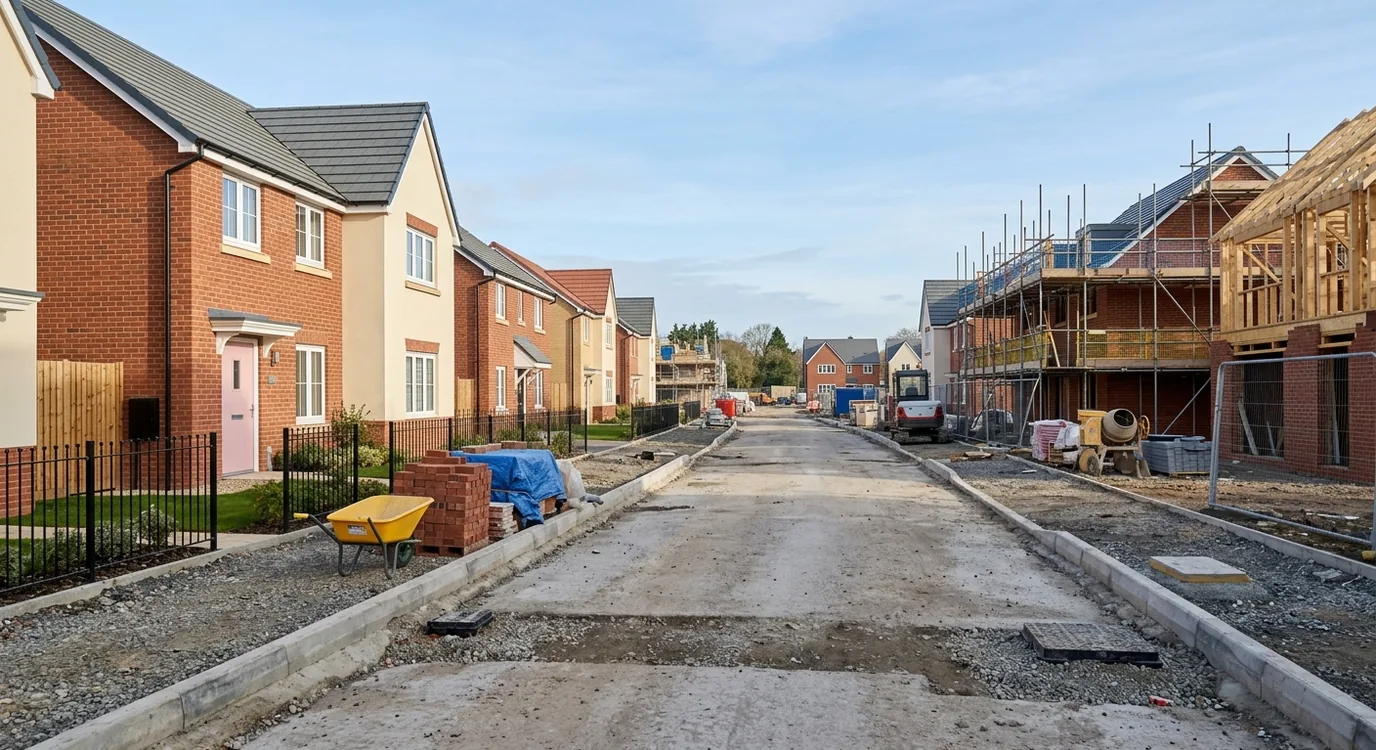
Almost everything written about new-build broadband answers a question the buyer did not ask. It explains the building regulations, which are not in doubt, and then hands the reader a vague wait. What a buyer standing in a finished house with a dead checker actually wants to know is narrower than that, and it is answerable: what is in the ground at my plot, and who will tell me.
Start with the thing that causes most of the confusion. The rules promise a gigabit connection from some network. They do not promise a particular company, and they never mention one. So a particular operator telling you its fibre does not reach your property is entirely consistent with the rules being satisfied by somebody else, or with the developer having arranged nothing yet, or with your address simply not existing in the file the checkers read. Three different situations. One identical symptom.
Telling those three apart takes four questions, which is the tool below, and the answer decides who you should be talking to. For one of them the honest advice is to stop chasing broadband companies altogether this month, because nothing any of them can do will move it. For another, the fix is yours and it takes a week.
None of this means anybody has done anything wrong. A new estate is a building site with a postcode, and the paperwork behind it moves at a different speed from the bricks. Several organisations have to do things in a particular order and each of them is getting on with it. The only real failure here is that nothing tells the buyer where in that order their own plot currently sits, which is the gap this page is trying to close.
If what you want is the legal position rather than the practical one, that belongs on its own page and it is written: what the new-build broadband rules actually guarantee, nation by nation, with the instrument behind each. This page picks up where that one ends.
The three things a no can mean
Direct answer: A checker that says no at a brand new address means one of three unrelated things, and the fix is different in each case.
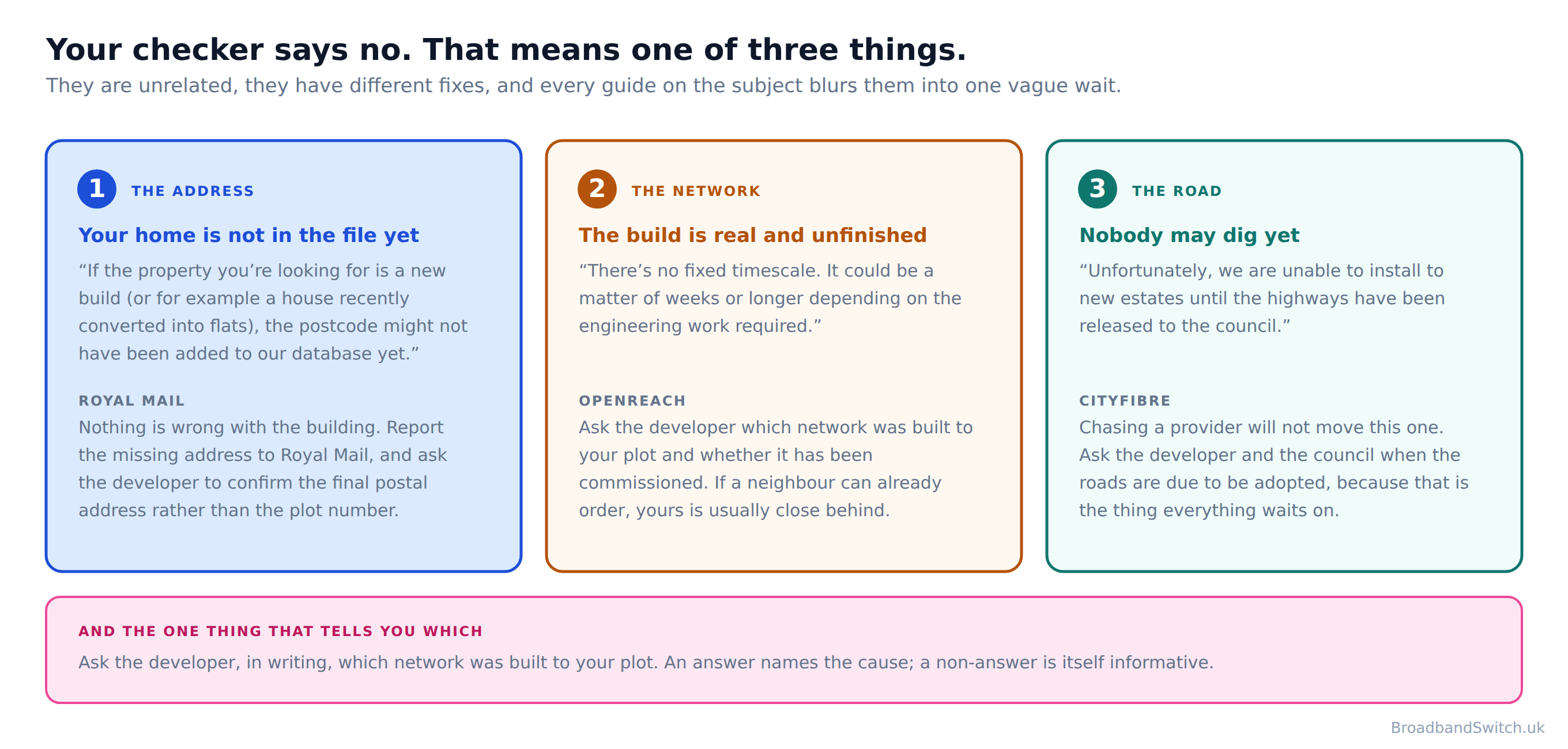
The first is your address, and it is the one most people never consider because it does not feel like it could possibly be the problem. Every provider's checker reads the same address file. Royal Mail publishes what happens with a brand new one: “If the property you're looking for is a new build (or for example a house recently converted into flats), the postcode might not have been added to our database yet.” Nothing is wrong with the building, the ducting or the network. Your home is simply not yet in the list the checkers read. “Our address and postcode information is held in the Postcode Address File (PAF). PAF is regulated in the UK by Ofcom.”
The second is the network build, which is real work and genuinely unfinished. Openreach is straightforward about this and about what it cannot tell you: “There's no fixed timescale. It could be a matter of weeks or longer depending on the engineering work required.” It names why one house goes before another: “Network build in phases - Even within the same street, some addresses are connected before others.” Why the systems lag behind the work: “Records still updating - Sometimes our systems show your neighbour as ready before your own address is updated.” And what the work itself can involve: “Engineering challenges - Specialist work may be needed to connect your home, such as digging ducts, replacing poles, or overcoming blocked routes.”
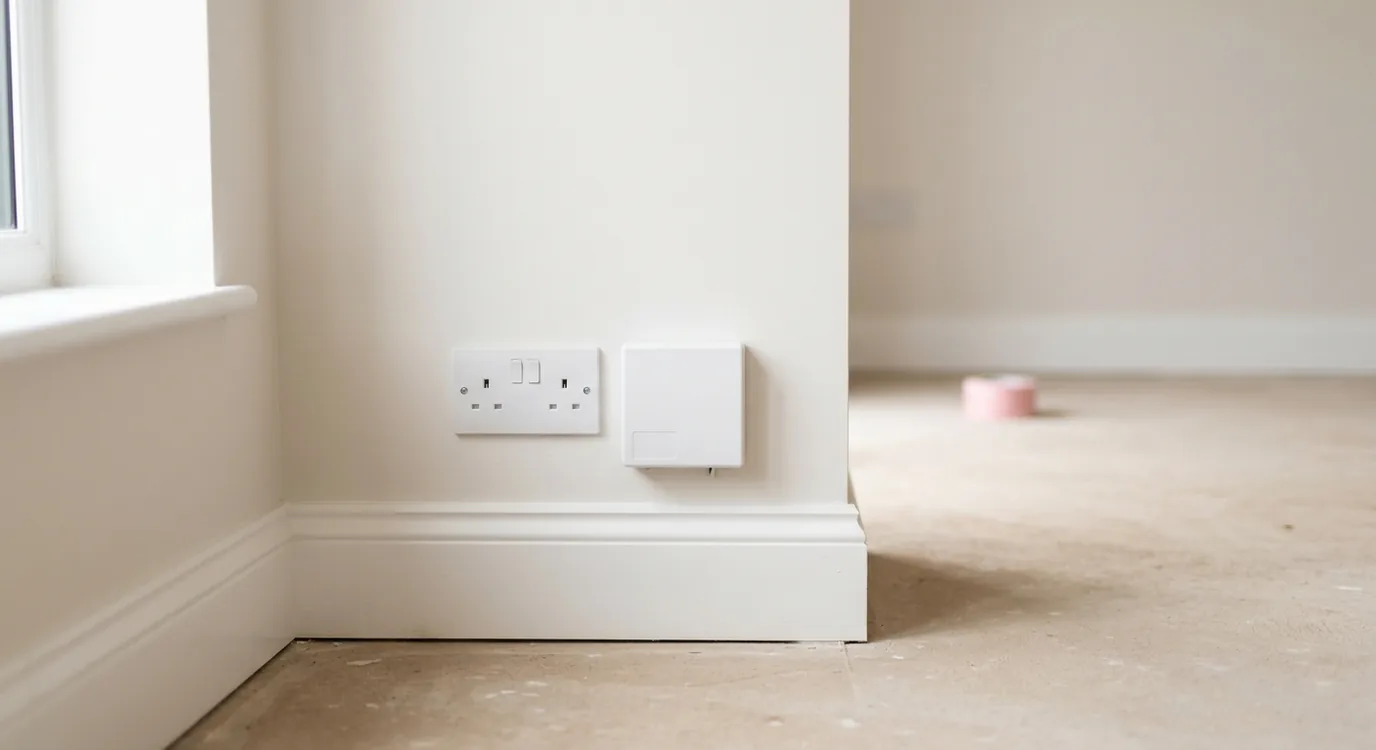
The third is the road, and it is the one almost nobody names. CityFibre is the only operator we found that publishes it at all: “Unfortunately, we are unable to install to new estates until the highways have been released to the council.” Until a road is adopted it belongs to the developer, so an operator wanting to dig in it is asking a private landowner rather than a highway authority. That is a different conversation and it can take a great deal longer. Its advice on who to ask is short and correct: “To understand who owns the road on your street, please contact your local council.”
Why the third one matters more than the other two
Because it blocks them. Where an estate road has not been released, no amount of chasing an operator changes anything, and the month a buyer spends doing it is a month they could have spent on a connection that needs no engineer. It is also the cause most often mistaken for a broadband problem, because from inside the house every one of the three looks identical.
The address cause has a page of its own, because the chasing is fiddly and worth setting out properly: new-build broadband delays, when your address cannot order yet. This page is about telling the three apart in the first place, and about the one question that settles it.
Work out which one it is, and write the email that gets the answer
Direct answer: Find out which network was actually built to your plot, in writing, from the developer. Everything else follows from the answer.
Four questions. Three of them decide which of the three causes you are most likely looking at, and the fourth changes what is worth asking the developer rather than which cause it is. Then the tool writes the email, because the developer is the only party who holds the plot-level answer and almost nobody asks them in a way that makes it easy to give.
It runs entirely in your browser. There is no form to submit, nothing sent to any server and nothing stored: what you choose and type is assembled on this page and gone when you close the tab. Every quoted line inside it is published wording from the operator named, and where nobody publishes a timescale it says so rather than estimating one.
Work out why you cannot order yet, and write the email that gets the answer
Four questions. A no at a new-build address means one of three unrelated things, and only one of them is worth chasing a broadband company about. Nothing you choose or type here leaves your browser.
Why one network's no is not your plot's answer
Direct answer: One network saying no is not the same as your plot having nothing. It is one company's answer about one network, and there are usually others.
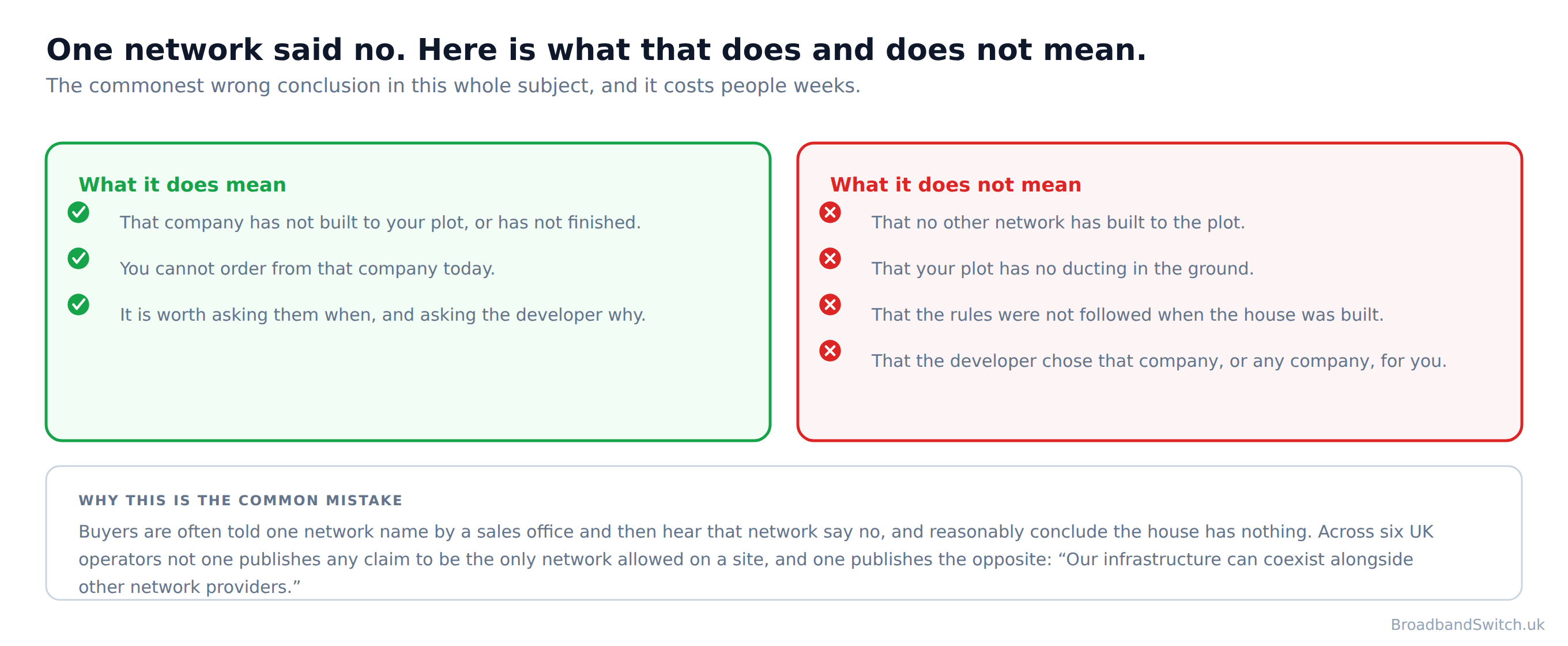
This is the commonest wrong conclusion in the whole subject, and it is an entirely reasonable one to draw. You ask a broadband company whether they can serve your new home, they check and say no, and the natural reading is that your home has nothing. What you have actually been told is narrower: that one operator has not built to your plot, or has built and not commissioned it, or cannot find your address in the file.
Here is the check behind that, because a claim like this should be checkable rather than asserted. Not one of the six operators building to UK new-build developments publishes any claim to be the only network allowed on a site. That is every developer-facing and new-build page the six of them publish, read in full, on the dates in the references. One goes further and states the position outright. Hyperoptic: “Our infrastructure can coexist alongside other network providers.”
What to do with a no, in one line
Take it back to the developer rather than to another provider. A second checker returning nothing tells you no more than the first one did, and one email turns a guess into a fact. Find out which network was actually built to your plot, in writing, from the developer. Everything else follows from the answer.
One honest caveat, because the encouraging version of this can be oversold. A second network being able to serve you is common, not guaranteed, and on a small rural site it may genuinely be that nothing has been built yet by anybody. That is still worth knowing, because it is a different situation from a wait, and it is a question the developer can answer today.
Who does what, and who knows what
Direct answer: The developer arranges the network and knows which one reached your plot. The operator builds it. You order the service, and nobody does that part for you.
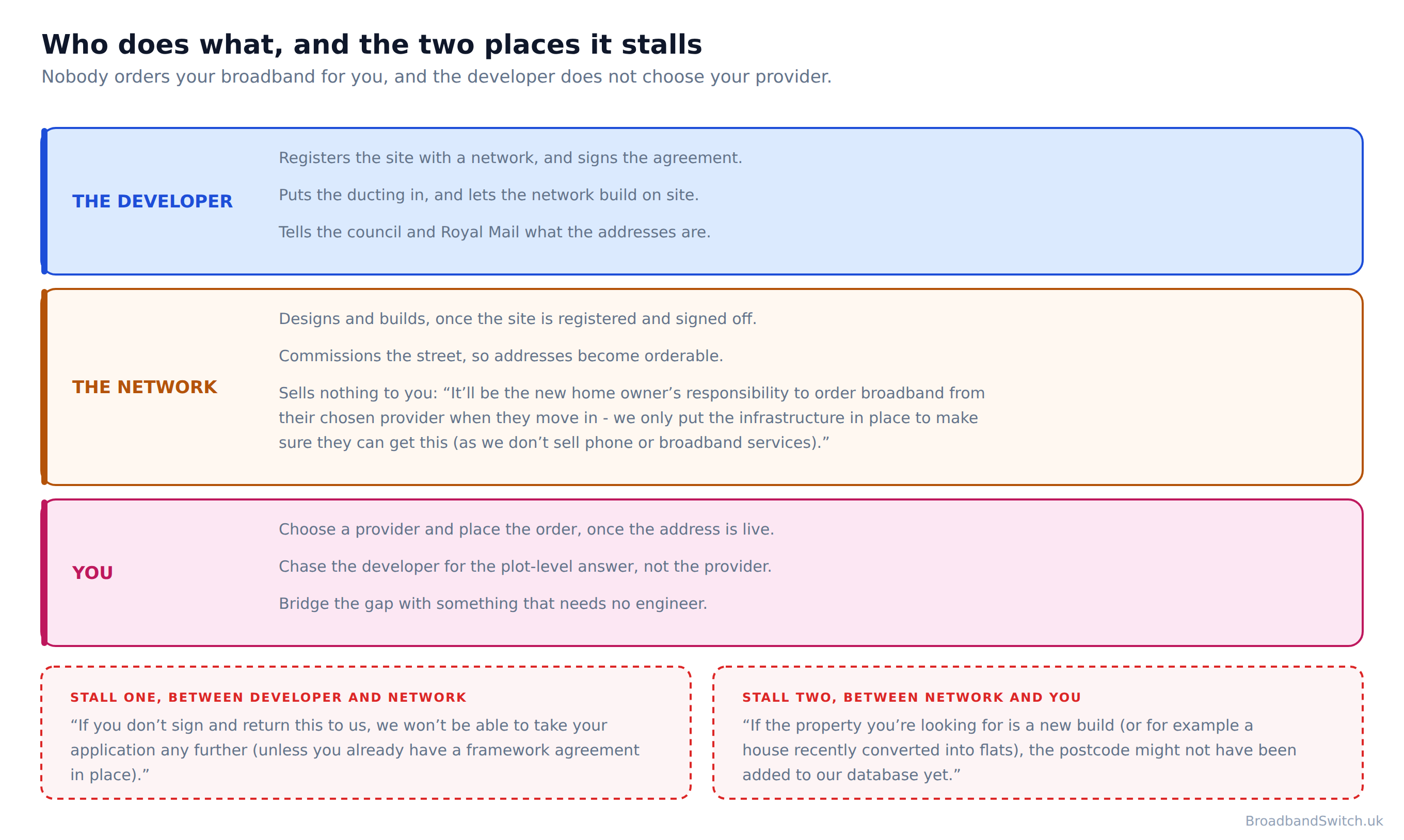
Openreach states the division in one sentence, and it is worth reading carefully because the second half is where buyers are most often surprised: “It'll be the new home owner's responsibility to order broadband from their chosen provider when they move in - we only put the infrastructure in place to make sure they can get this (as we don't sell phone or broadband services).” So the infrastructure is arranged between the developer and an operator, and the service is a separate transaction that begins with you.
The developer's side has published timings, which is useful to a buyer because it tells you how early this was decided. Openreach asks developers to register a site well ahead: “Please register your site at least eight weeks ahead of your site start date and/or six months before the date you want broadband available at your first property.” And it is careful not to promise the date back: “We don't guarantee that we'll meet this date, but it helps us to schedule our works.” Virgin Media's equivalent recommendation is longer still: “We recommend doing this 9 months before you expect homebuyers to move in.” And it publishes that “Our site request service is at no extra cost to you (although further requests for the same site may be charged).”
Which means that by the time you are standing in the house, the decision that governs your broadband was taken months or years earlier by somebody you can email. That is the whole argument for asking them rather than asking another comparison site.
Two things to ask the developer before you complete, not after
Openreach suggests the first itself: “It's worth checking with them that they've finished installing the Openreach equipment, and that nothing's missing or damaged.” The second is your final postal address in writing, because a plot number is not an address and the two are often different. Both cost one line in an email and both get much harder to chase once the sales office has moved on to the next phase.
How to get the plot-level answer
Direct answer: Ask the developer, in writing, which network was built to your plot and what your final postal address is.

There is no register you can look this up in. The operators publish what they are building at a regional level and none of them publishes a plot-by-plot map, so the developer or the site sales office is not merely the best source, it is the only one. They are not being difficult about it either: in most cases nobody has ever asked them in a way that made the answer easy to give.
So ask four things and ask them together. Which network or networks were built to this plot, and has the street been commissioned. What the final postal address is, and whether it has been registered with Royal Mail. When the estate roads go to the council for adoption. And, if the answer to the first is nothing, what the plan is. Four answers, one reply, and every one of them turns a guess into a fact.
The tool above writes that email, tailored to what you have already found out, and you can edit every word of it before it goes. If you would rather write your own, the four questions in the paragraph above are the whole of it.
If a provider tells you the address cannot be ordered
Go to the network behind it rather than stopping. Openreach invites exactly this: “If you've spoken to a phone or broadband provider and they've said you can't order this, please get in touch with us. We'll do what we can to help.” And it is equally clear about the different case, where a service exists and is not working: “Get in touch with them - unfortunately we can't help you with this. They'll run tests to find the problem, and get in touch with us if they need to.” Two problems, two places, and sending one to the other is how a fortnight disappears.
What the developer pays, and why you should know
Direct answer: Openreach publishes it, the threshold sits at twenty plots, and it tells a buyer how likely it was that anything was arranged.
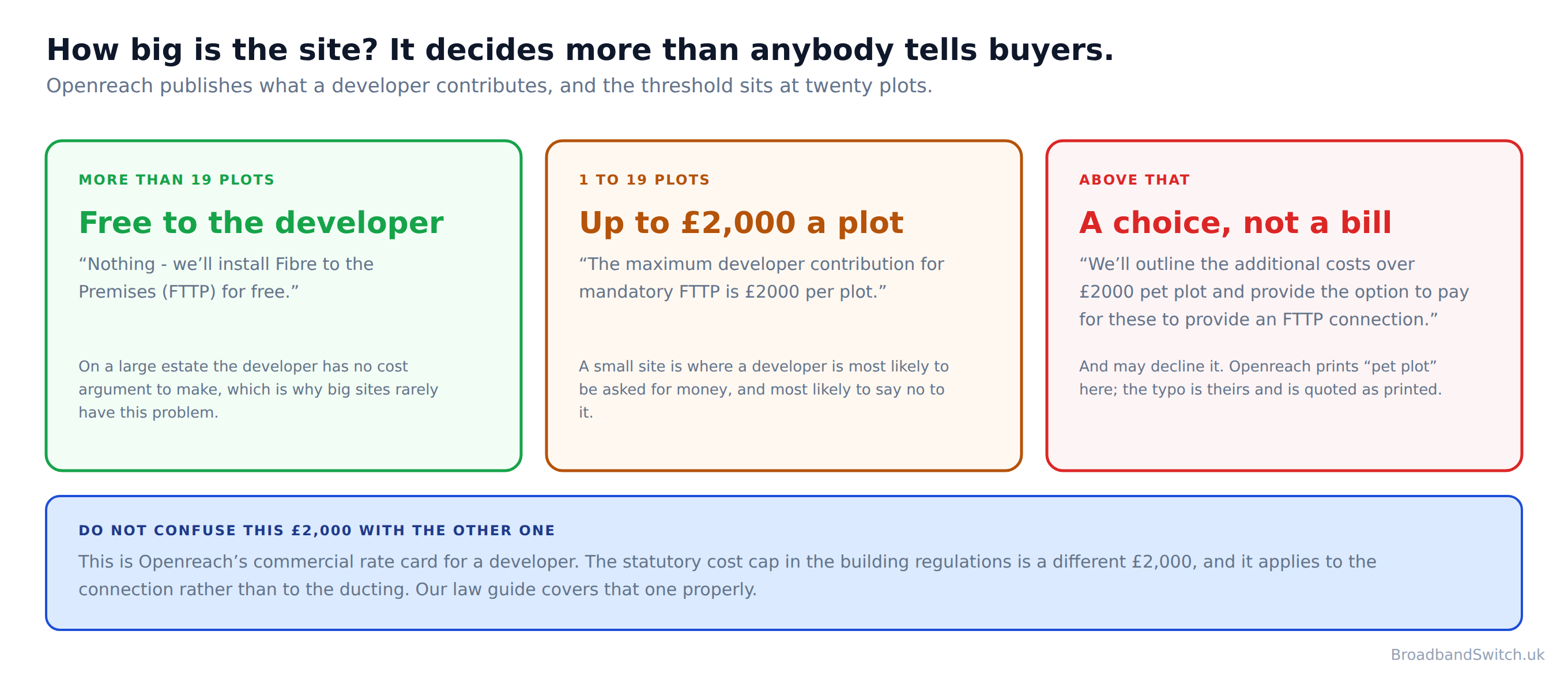
On a residential development of more than 19 plots, Openreach publishes what the developer contributes towards a full fibre build: “Nothing - we'll install Fibre to the Premises (FTTP) for free.” At 19 plots or fewer there is a contribution, and it is capped: “The maximum developer contribution for mandatory FTTP is £2000 per plot.” Above the cap the developer gets a choice rather than a bill: “We'll outline the additional costs over £2000 pet plot and provide the option to pay for these to provide an FTTP connection.”
Hyperoptic's published developer terms run in the opposite direction, which is worth knowing is possible at all: “Hyperoptic provides equipment and pays a rebate per plot.” So on some sites the money moves towards the developer rather than away. And on the timing it claims for residents: “Residents can get online as soon as they receive their keys.” We have not been able to check either against a real site, so both are quoted as what that operator publishes rather than as a finding of ours.
What a buyer should take from a page about developer costs
That the twenty-plot threshold is the interesting line. Above it, fibre from that operator costs the developer nothing, so the question is whether they registered the site rather than whether they could afford it. Below it, there was a decision to make, and a small development is exactly where a buyer should ask what was decided. None of this is secret and none of it is hard to ask about. It is simply never mentioned to buyers.
One correction of our own belongs here rather than in the list at the foot of the page, because it is the very page these figures come from that carries it. Openreach's own developer page gives the date the England requirement began as 26 December 2026. The instrument says 26 December 2022, and this page uses the instrument.
What the rules promise, and what they do not
Direct answer: The rules promise a gigabit connection from some network. They do not promise a particular company, and they never mention one.
This page deliberately does not set out the building regulations, because doing it properly takes a page of its own and doing it badly is what caused the confusion this page exists to clear up. What belongs here is the single distinction a buyer needs, and it is this: the rules are about what a developer must install. They are not a promise from any company, they do not name one, and a particular operator's answer about a particular plot is a different question entirely.
One point of detail does belong here, because the version of this page being replaced got it wrong and a buyer could act on it. The cost cap is often reported as sitting over the whole requirement. It does not. gov.uk: “The cost cap of £2,000 per dwelling applies to the installation of a functional connection such as optical fibre to the home (i.e. Requirement RA2), but not to the installation of gigabit-ready physical infrastructure (i.e. Requirement RA1).” The ducting is required without a cap; the connection is the part the cap reaches.
And the geography matters more than most pages admit, because a rule quoted without its country is how a reader in the wrong one ends up expecting something nobody owes them. The gigabit requirement in Part R is a Building Regulation for England. Scotland, Wales and Northern Ireland each went their own way, at their own date, and one of the four nations has no gigabit requirement at all.
Where the full legal position lives
On its own page, set out nation by nation with the statutory instrument behind each, including the dates, the cost caps where there are any and the one nation with no requirement: what the new-build broadband rules actually guarantee. If you have been told your new home must have fibre by law, that is the page that tells you exactly what was promised and by whom.
Getting online on the day you move in
Direct answer: Something that needs no engineer covers the gap completely, which is why the broadband is never a reason to move a completion date.
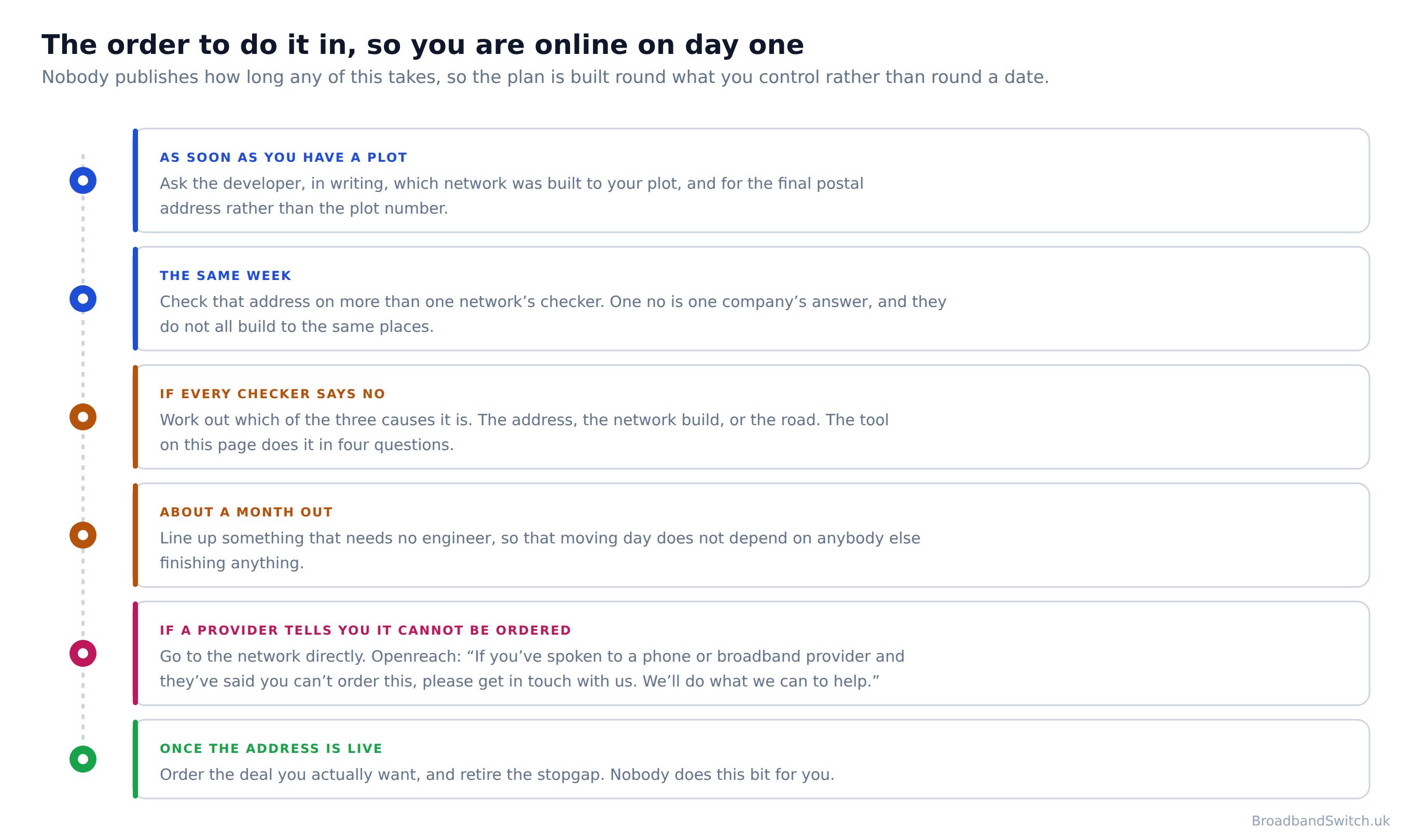
The plan above is ordered by when to do each thing rather than by a date, and that is deliberate. Nobody publishes how long any of this takes. Not the operators, not Royal Mail, not Ofcom. The figures that circulate, including the one this page used to carry, have no published source. An order built round a timescale nobody publishes falls over the first time the timescale slips. An order built round what you control does not.

A 4G or 5G home broadband package needs no ducting, no street works and no engineer, which makes it the only part of a move that can absorb a delay in somebody else's programme. It arrives in a box, it works the same afternoon, and you retire it when the fixed line is ready. Our 5G home broadband deals and 4G home broadband deals are the short lists, and mobile broadband as a temporary bridge covers the same gap for a single laptop.

The one thing to get right before completion
Your final postal address, in writing, from the developer. Everything downstream depends on it: the checkers read it, the order uses it, and an order placed against a plot number can bounce weeks later. It is one line in an email and it is the cheapest thing on this page to get right.
If you are renting the new build rather than buying it, the ordering is the same and the permissions are not. Our renters guide covers what you may arrange in your own name, and switching in a new build before the line is live covers the contract side.
Broadband at your postcode
Every provider that reaches your new address
One postcode shows every provider we can switch you to, lowest price first, across full fibre, FTTC, cable and 5G home broadband. If the fixed line is not ready, the 5G packages need nothing from the street at all.
Show every provider at my postcode →What this page used to say, and why it changed
Direct answer: Five corrections. One is the reason the page was rebuilt, one is a timescale with no source, one is a cause the page never named, one misreads the scope of the cost cap, and one treated England as the whole United Kingdom.
Naming a correction rather than quietly making it is the house rule here. The version being replaced was a clear and readable page, and its problem was not carelessness: it was built from the regulations and a developer-facing summary rather than from what the operators publish about the thing a buyer is actually looking at.
Who decides which providers you can use
What it saidThis page said that “the developer chooses which network is installed at the site, and that determines your choice of providers”, and said in the body that the developer's network “tells you which providers you can choose from”.
What it says nowThe first half is right and the second half is not. A development can carry more than one network. Not one of the six operators building to UK new-build developments publishes any claim to be the only network allowed on a site. Hyperoptic publishes the opposite in six words: “Our infrastructure can coexist alongside other network providers.” The practical damage this does is specific: a buyer told no by one operator concludes the plot has nothing, when what they have is one company's answer about one network.
How long a new-build connection takes
What it saidThe page said a delay is “normally weeks, not months”, and repeated it in the FAQ.
What it says nowNobody publishes how long any of this takes. Not the operators, not Royal Mail, not Ofcom. The figures that circulate, including the one this page used to carry, have no published source. Openreach, the only operator that addresses it, publishes: “There's no fixed timescale. It could be a matter of weeks or longer depending on the engineering work required.” The figure was not wrong so much as unsourced, and an unsourced number in this subject is worse than none: a buyer who plans around it and misses it has been set up to be disappointed by a process that was never late.
Why an address cannot order yet
What it saidThe page gave two reasons: that the address had not reached the ordering and postcode systems, or that the network had not finished commissioning the street.
What it says nowBoth are real and there is a third the page never mentioned, which nothing else can move past while it applies. CityFibre publishes: “Unfortunately, we are unable to install to new estates until the highways have been released to the council.” A buyer in that position who spends a month chasing providers is chasing the wrong party, and no page we found anywhere else names road adoption as a cause at all.
What the £2,000 cap covers
What it saidThe page said new homes must be built with gigabit-ready infrastructure and a gigabit-capable connection “subject to a £2,000 per-dwelling cost cap”, as though one cap sat over the whole requirement.
What it says nowIt sits over one half of it. gov.uk: “The cost cap of £2,000 per dwelling applies to the installation of a functional connection such as optical fibre to the home (i.e. Requirement RA2), but not to the installation of gigabit-ready physical infrastructure (i.e. Requirement RA1).” So the ducting requirement is not capped and the connection requirement is, which is a distinction that decides what a buyer can reasonably expect on a difficult site.
Which country the page was about
What it saidThe page described the rules for England throughout, under headings and a title that read as United Kingdom guidance, and never said what applies anywhere else.
What it says nowThe gigabit requirement in Part R is a Building Regulation for England. Scotland, Wales and Northern Ireland each went their own way, at their own date, and one of the four nations has no gigabit requirement at all. Rather than summarise four sets of rules badly here, this page keeps to what is in the ground at your plot and the law hub sets out each nation separately with the instrument behind it.
If you read the old version and acted on it, the one that mattered most is the first. A buyer who concluded from a single no that their plot had nothing may have spent months waiting for a network that was never coming, when a different one had already built to the street.
New-build broadband: frequently asked questions
Why can I not order broadband at my new-build address?
One of three unrelated things, and they need different responses. Your postal address may not be in the file every checker reads: Royal Mail publishes that with a new build “If the property you're looking for is a new build (or for example a house recently converted into flats), the postcode might not have been added to our database yet.” The network may not have finished: Openreach publishes “There's no fixed timescale. It could be a matter of weeks or longer depending on the engineering work required.” and that “Network build in phases - Even within the same street, some addresses are connected before others.” Or the road may not be adopted, which blocks the network work rather than being caused by it: CityFibre publishes that “Unfortunately, we are unable to install to new estates until the highways have been released to the council.” The check on this page tells them apart in four questions and writes the email that gets you the answer.
One network told me its fibre does not reach my property. Is that the answer?
No, and it is worth being precise about what you have just been told. One network saying no is not the same as your plot having nothing. It is one company's answer about one network, and there are usually others. A site can carry more than one network. Not one of the six operators building to UK new-build developments publishes any claim to be the only network allowed on a site. Hyperoptic states the position in six words: “Our infrastructure can coexist alongside other network providers.” So the next step after a no is not to give up and it is not to argue. It is to ask the developer which network was built to your plot, because that is the question the no did not answer.
Does the developer decide which broadband provider I can use?
No, and this page used to say something close to it, which is corrected below. The developer decides which network or networks are built to the site. Who you buy the service from is yours, and over a network like Openreach that is a long list of providers. Openreach puts the division plainly: “It'll be the new home owner's responsibility to order broadband from their chosen provider when they move in - we only put the infrastructure in place to make sure they can get this (as we don't sell phone or broadband services).”
How long does a new-build connection take?
Nobody publishes how long any of this takes. Not the operators, not Royal Mail, not Ofcom. The figures that circulate, including the one this page used to carry, have no published source. Openreach, which is the only operator to address it directly, publishes: “There's no fixed timescale. It could be a matter of weeks or longer depending on the engineering work required.” It also names why the work varies: “Engineering challenges - Specialist work may be needed to connect your home, such as digging ducts, replacing poles, or overcoming blocked routes.” A number with no published source is worse than no number, because a buyer who plans around it and misses it has been set up to be disappointed by a process that was never late.
My neighbours can order and I cannot. What does that mean?
It is the most encouraging version of this problem. Openreach publishes: “If your neighbour can already order Full Fibre, it's a strong sign that your address could be connected soon.” It also publishes the two ordinary reasons for the gap: “Network build in phases - Even within the same street, some addresses are connected before others.” And: “Records still updating - Sometimes our systems show your neighbour as ready before your own address is updated.” A part-finished street is a street where the build reached the road, which rules out the cause that takes longest.
Who do I actually ask, and what do I ask them?
The developer or the site sales office, because they are the only party who knows which network reached your plot. Ask which network or networks were built to it, whether the street has been commissioned, what your final postal address is, and when the estate roads go to the council for adoption. The tool on this page writes that email for you, tailored to your answers, and nothing you type into it leaves your browser.
What if my address cannot be found at all?
Then it is the address rather than the network, and it is the one cause you can push along yourself. Royal Mail publishes: “If your address isn't listed please let us know. We'll try to get this fixed as quickly as possible.” Get the final postal address from the developer in writing first, because a plot number is not an address and the two are often different. Royal Mail publishes no timescale for a new address being added, only that it will try to fix it as quickly as possible. Our guide to new-build addresses that cannot order yet goes through the chasing in detail.
A provider says it cannot take my order. Is that the end of it?
No, and Openreach invites the next step in terms: “If you've spoken to a phone or broadband provider and they've said you can't order this, please get in touch with us. We'll do what we can to help.” So a no from a reseller is worth taking to the network behind it. Openreach is equally clear about the reverse case, where you already have a service and it is not working: “Get in touch with them - unfortunately we can't help you with this. They'll run tests to find the problem, and get in touch with us if they need to.” Those are two different problems and they go to two different places.
What does the developer pay for the fibre, and why does it matter to me?
It matters because it tells you what was likely to have been arranged, and it is knowable before you exchange. Openreach publishes that on a residential development of more than 19 plots the developer pays “Nothing - we'll install Fibre to the Premises (FTTP) for free.” Below that threshold: “The maximum developer contribution for mandatory FTTP is £2000 per plot.” And over the cap it publishes: “We'll outline the additional costs over £2000 pet plot and provide the option to pay for these to provide an FTTP connection.” A small site is where a developer has a decision to make, which is exactly where a buyer should ask the question.
Do the rules not guarantee my new home has fibre?
They guarantee something, and it is not a company. The rules promise a gigabit connection from some network. They do not promise a particular company, and they never mention one. The detail differs by nation and by date, and rather than summarise it badly here, our guide to what the new-build rules actually guarantee sets out each nation separately with the instrument behind it. What this page adds is the practical half: the rules tell you what should be there, and the developer tells you what is.
Should I move my completion date because the broadband is not ready?
No. A fixed line is the one part of a move that something else can cover completely, and nothing else about a completion date is that flexible. A 4G or 5G package needs no engineer, no ducting and no street works, so it turns a waiting period into a working week. The plan on this page is built round it, and our 5G home broadband deals are the short list.
Is anything on this page not published anywhere?
Three things a reader might expect, and their absence is deliberate. Nobody publishes how long any of this takes. Not the operators, not Royal Mail, not Ofcom. The figures that circulate, including the one this page used to carry, have no published source. Royal Mail publishes no timescale for a new address being added, only that it will try to fix it as quickly as possible. Ofcom publishes no consumer guidance on new-build connectivity at all. nexfibre publishes no developer-facing or new-build material of any kind. Where nobody publishes a figure, this page says so rather than estimating one, and every quotation here carries the date it was read.
In short
- One network saying no is not the same as your plot having nothing. It is one company's answer about one network, and there are usually others.
- The rules promise a gigabit connection from some network. They do not promise a particular company, and they never mention one.
- A checker that says no at a brand new address means one of three unrelated things, and the fix is different in each case.
- The address: Royal Mail publishes “If the property you're looking for is a new build (or for example a house recently converted into flats), the postcode might not have been added to our database yet.”
- And how to fix it: “If your address isn't listed please let us know. We'll try to get this fixed as quickly as possible.” Royal Mail publishes no timescale for a new address being added, only that it will try to fix it as quickly as possible.
- Where the checkers read it from: “Our address and postcode information is held in the Postcode Address File (PAF). PAF is regulated in the UK by Ofcom.”
- The network: Openreach publishes “There's no fixed timescale. It could be a matter of weeks or longer depending on the engineering work required.”
- Why one house goes before another: “Network build in phases - Even within the same street, some addresses are connected before others.”
- And why records lag: “Records still updating - Sometimes our systems show your neighbour as ready before your own address is updated.”
- What the work can involve: “Engineering challenges - Specialist work may be needed to connect your home, such as digging ducts, replacing poles, or overcoming blocked routes.”
- The encouraging case: “If your neighbour can already order Full Fibre, it's a strong sign that your address could be connected soon.”
- The road, which almost nobody names: CityFibre publishes “Unfortunately, we are unable to install to new estates until the highways have been released to the council.”
- Who to ask about it: “To understand who owns the road on your street, please contact your local council.”
- Until a road is adopted it belongs to the developer, so an operator wanting to dig in it is asking a private landowner rather than a highway authority. That is a different conversation and it can take a great deal longer.
- Not one of the six operators building to UK new-build developments publishes any claim to be the only network allowed on a site. Hyperoptic: “Our infrastructure can coexist alongside other network providers.”
- And on timing from that operator: “Residents can get online as soon as they receive their keys.” With “Hyperoptic provides equipment and pays a rebate per plot.”
- Who does what: Openreach publishes “It'll be the new home owner's responsibility to order broadband from their chosen provider when they move in - we only put the infrastructure in place to make sure they can get this (as we don't sell phone or broadband services).”
- If a provider says no: “If you've spoken to a phone or broadband provider and they've said you can't order this, please get in touch with us. We'll do what we can to help.”
- If a service exists and fails: “Get in touch with them - unfortunately we can't help you with this. They'll run tests to find the problem, and get in touch with us if they need to.”
- Before you complete: “It's worth checking with them that they've finished installing the Openreach equipment, and that nothing's missing or damaged.”
- What a developer pays above 19 plots: “Nothing - we'll install Fibre to the Premises (FTTP) for free.”
- At 19 plots or fewer: “The maximum developer contribution for mandatory FTTP is £2000 per plot.”
- And above the cap: “We'll outline the additional costs over £2000 pet plot and provide the option to pay for these to provide an FTTP connection.”
- When a developer should register the site: “Please register your site at least eight weeks ahead of your site start date and/or six months before the date you want broadband available at your first property.”
- With no promise attached: “We don't guarantee that we'll meet this date, but it helps us to schedule our works.”
- Virgin Media's equivalent: “We recommend doing this 9 months before you expect homebuyers to move in.” And “Our site request service is at no extra cost to you (although further requests for the same site may be charged).”
- The cap's real scope: “The cost cap of £2,000 per dwelling applies to the installation of a functional connection such as optical fibre to the home (i.e. Requirement RA2), but not to the installation of gigabit-ready physical infrastructure (i.e. Requirement RA1).”
- Openreach's own developer page gives the date the England requirement began as 26 December 2026. The instrument says 26 December 2022, and this page uses the instrument.
- Nobody publishes how long any of this takes. Not the operators, not Royal Mail, not Ofcom. The figures that circulate, including the one this page used to carry, have no published source. Royal Mail publishes no timescale for a new address being added, only that it will try to fix it as quickly as possible.
- Ofcom publishes no consumer guidance on new-build connectivity at all. nexfibre publishes no developer-facing or new-build material of any kind.
- None of this means anybody has done anything wrong. A new estate is a building site with a postcode, and the paperwork behind it moves at a different speed from the bricks.
- The good news is that all three causes are temporary, all three are knowable, and two of the three you can do something about this week.
- Find out which network was actually built to your plot, in writing, from the developer. Everything else follows from the answer.
Each line stands on its own and carries its date. Reviewed by a person at least quarterly, last on 28 September 2026.
References
- Openreach
Openreach. Why can my neighbours order Full Fibre but I cannot?, the statement that there is no fixed timescale and that it could be a matter of weeks or longer depending on the engineering work required, and the four named reasons for the gap: network build in phases, records still updating, engineering challenges, and that a neighbour being able to order is a strong sign an address could be connected soon. The page carries no publication or last-updated date, so it was read on 28 September 2026. openreach.com
- Openreach
Openreach. Broadband in new build homes, the statement that it is the new home owner’s responsibility to order broadband from their chosen provider and that Openreach only puts the infrastructure in place, the invitation to get in touch where a provider has said an address cannot be ordered, the direction to the provider where a service exists and is not working, and the suggestion to check with the developer that the Openreach equipment has been installed and that nothing is missing or damaged. Undated, read 28 September 2026. openreach.com
- Openreach
Openreach. Registering your site, the developer-facing page: what a developer contributes on a residential development of more than 19 plots, the £2,000 per plot maximum below that threshold, the treatment of costs above it, the request to register a site at least eight weeks before site start and six months before broadband is wanted at the first property, the statement that meeting that date is not guaranteed, and the new sites agreement. This page also gives the date the England requirement began as 26 December 2026, which is a year out: the instrument came into force on 26 December 2022 and this page uses the instrument. Read 28 September 2026. openreach.com
- CityFibre
CityFibre. I live on a new build estate, can I connect to CityFibre?, the statement that it is unable to install to new estates until the highways have been released to the council, and the direction to contact the local council to understand who owns the road. This is the only published operator material found that names road adoption as a cause at all. Undated, read 28 September 2026. cityfibre.com
- Royal Mail
Royal Mail. Find a postcode, the statement that with a new build, or a house recently converted into flats, the postcode might not have been added to the database yet, the invitation to report an address that is not listed together with the undertaking to try to fix it as quickly as possible, and the statement that address and postcode information is held in the Postcode Address File, which is regulated in the UK by Ofcom. No timescale for an addition is published anywhere on the site. Read 28 September 2026. royalmail.com
- Hyperoptic
Hyperoptic. New buildings, the developer-facing page, the statement that its infrastructure can coexist alongside other network providers, that residents can get online as soon as they receive their keys, and that Hyperoptic provides equipment and pays a rebate per plot. This is the only published statement found from any of the six operators on whether more than one network may serve a development. Undated, read 28 September 2026. hyperoptic.com
- Virgin Media
Virgin Media. Property developers, the recommendation to make a site request nine months before homebuyers are expected to move in, and the statement that the site request service is at no extra cost although further requests for the same site may be charged. Undated, read 28 September 2026. virginmedia.com
- Government
Department for Science, Innovation and Technology. New build connectivity: information for developers, the statement that the £2,000 per dwelling cost cap applies to the installation of a functional connection such as optical fibre to the home, being Requirement RA2, but not to the installation of gigabit-ready physical infrastructure, being Requirement RA1. Read 28 September 2026. gov.uk
- Legislation
The Building etc. (Amendment) (England) (No. 2) Regulations 2022, SI 2022/984, which inserted Part R requirement RA1 and RA2 into Schedule 1 to the Building Regulations 2010 and came into force on 26 December 2022. The commencement provision is the source for the date used on this page, in preference to the operator page that gives it as 2026. Read 28 September 2026. legislation.gov.uk
- Ofcom
Ofcom. Moving home: tips for keeping connected, checked on 28 September 2026 for consumer guidance on new-build connectivity. The page addresses moving home generally and does not deal with new builds, and no consumer-facing new-build guidance was found elsewhere on the site, so nothing from Ofcom is quoted on this page. ofcom.org.uk
- nexfibre
nexfibre. Our network, checked on 28 September 2026 for developer-facing or new-build material. None was found anywhere on the site, so although nexfibre is one of the six operators building to UK developments, nothing from it is quoted on this page. nexfibre.co.uk
Ready to see what your plot can actually get?
One postcode shows every provider that can reach your exact address, lowest price first. If nothing comes back, that is information rather than a dead end, and the check further up this page tells you which of the three causes it is.
Compare at your postcode →