By Dr Alex J Martin-Smith, Strategic Lead
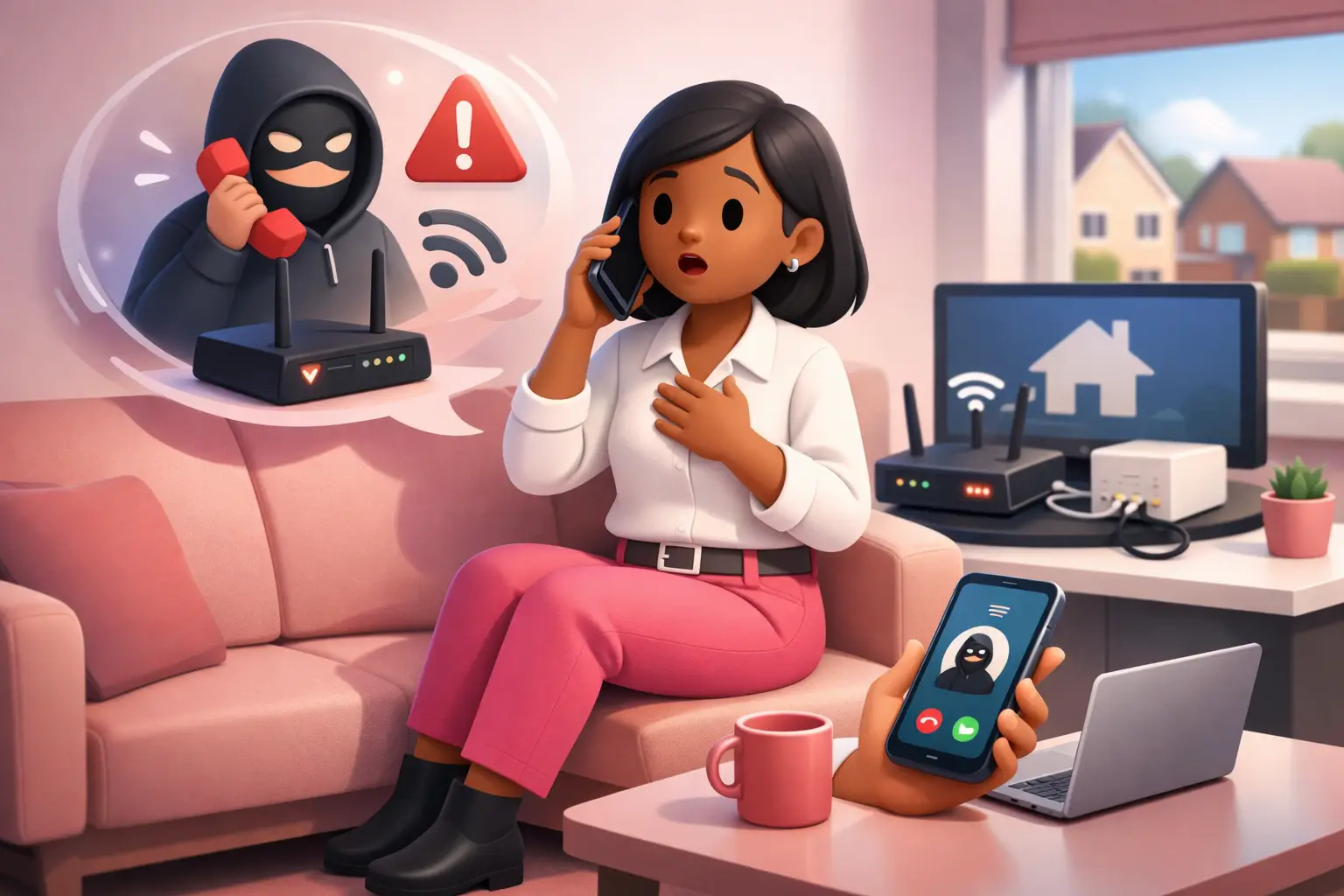
Direct answer: Scam calls pretending to be your broadband provider in the UK are designed to rush you into sharing details, allowing remote access or accepting a new contract. End an unexpected call, do not use a number the caller gives you, and contact your provider through a trusted number from your bill or official account.
- A genuine provider should not object if you end the call and verify it independently.
- Never share passwords, bank details or one-time security codes with an unsolicited caller.
- A price change, slow connection or contract renewal can be used as a convincing reason to call, but it does not prove the caller is genuine.
- Check the full contract cost, setup charges and agreed installation arrangements before approving any broadband switch.
How do broadband provider scam calls work?
Scammers commonly claim there is a fault on your line, a problem with your Wi-Fi, an urgent price rise or a better deal that expires today. Their aim is usually to gain information, take payment details, persuade you to install remote access software, or move you into an unwanted agreement.
The call can sound credible because the caller may know your name, address or the name of a provider you use. Treat that information as a prompt to verify, not proof of identity. Citizens Advice advises consumers to stop engaging with suspected scammers and use trusted contact details to check claims independently (Citizens Advice, 2025).
A real broadband issue can happen at the same time as a scam call. That is why the safest response is not to diagnose the caller's motive during the call. Hang up, wait a short time if you are concerned about the line remaining open, then contact the provider yourself using a trusted route.
What should I do if a caller says my broadband will be cut off?
Do not make a payment, give a security code or agree to an immediate switch because an unexpected caller threatens disconnection. A pressure tactic is a warning sign, especially if the caller says you must act before you can check your account.
Ask for no further details and end the call. Then look at your latest bill, provider account or a previously saved official contact number. Explain exactly what was said and ask whether there is a genuine fault, account issue or planned change. Keep a note of the date, time, number displayed and any information you gave, as this helps if you need to report the attempt.
If you have already shared bank details, contact your bank without delay. If you gave the caller a password, change it from a device you trust. If remote access was installed, disconnect the device from your home network and seek appropriate technical support before using it for sensitive activity.
Which signs separate a genuine call from a broadband scam?
The clearest test is whether you can independently verify the proposal before agreeing to anything. A legitimate sales or service call may still be unexpected, so the caller's confidence, a familiar script or knowledge of your address is not enough.
| What you hear | Why it needs checking | Safer response |
|---|---|---|
| “Your router is causing a security problem.” | It creates urgency and may lead to a request for remote access. | End the call and check any fault through your provider independently. |
| “This offer ends while we are on the phone.” | Pressure reduces the chance that you will read the contract terms. | Ask for written terms, then compare after the call. |
| “Give me the code we have just sent you.” | Security codes can be used to access or approve changes to an account. | Do not read out the code, even if the caller sounds convincing. |
| “We need your bank details to prevent disconnection.” | Unexpected payment requests may be an attempt to take money or data. | Use a trusted account route to check whether any payment is due. |
No single sign proves fraud. The decisive safeguard is taking control of the contact method yourself.
Can a scammer switch my broadband without my permission?
A switch should involve clear customer consent, but you should act quickly if you receive unexpected confirmation emails, letters or account messages. Contact the provider named in the communication through independently found contact details and say that you did not authorise the change.
One Touch Switch went live on 12 September 2024 and is run by TOTSCo. Under this process, a customer contacts only the new provider when switching between participating residential broadband providers (TOTSCo, 2024). That simpler process is useful, but it also means you should scrutinise any message saying a new order has been placed in your name.
Do not rely on a callback number in a suspicious email, text or letter. Ask the provider to check the address, order date, contact details and any installation appointment attached to the order. If you are moving home, be especially careful because a genuine move can make an unexpected activation message seem plausible.
Does a genuine broadband deal need to be accepted on the call?
No. A deal worth taking will still need clear terms that you can consider away from the pressure of a live call. Check the monthly price, the full minimum term, setup fees, delivery or installation costs, any early exit charges and the total amount payable over the contract.
For new contracts from 17 January 2025, Ofcom requires any mid contract price rises to be stated in pounds and pence at the point of sale, rather than linked to inflation (Ofcom, 2024). This gives you a practical question to ask before accepting a genuine offer: exactly how much could the monthly price rise, and when?
Prices, speeds and availability vary by postcode and exact address. Full fibre, FTTC, cable, altnets and 4G or 5G home broadband can have different installation requirements and contract terms. Compare written offers on total cost rather than accepting a claimed saving from an unsolicited caller.
How can I check a broadband offer safely?
Start again from a trusted source rather than continuing the original call. Use your current bill or account to confirm whether you are in contract, then compare offers based on your address and the broadband technology actually available there.
For a household that works from home, installation timing and reliability may matter more than the lowest advertised monthly figure. For a budget focused household, a lower monthly price can be less attractive once setup fees, future stated rises and the minimum term are included. There is no universal best choice, because availability and usage differ from one address to another.
If you decide to switch, keep the order confirmation and note the agreed activation date. Ask what happens to your existing service, whether an engineer visit is needed and whether equipment must be returned. Those steps reduce the risk of both accidental duplicate orders and confusion caused by scam follow ups.
What should I do if I gave details to a broadband scammer?
Act promptly, but do not assume the worst before checking what was shared. The right next step depends on whether the caller obtained account details, payment information, passwords, a security code or access to a device.
Contact your bank immediately if payment details were disclosed. Contact your broadband provider through a trusted number if you gave account information or think an order may have been placed. Change any password you shared and do not reuse that password elsewhere. Citizens Advice provides guidance on reporting scams and seeking further help where money or personal data may be at risk (Citizens Advice, 2025).
Can my provider call me about a real fault?
Yes, a provider may contact you about service, billing or an order. However, an unexpected call should still be verified independently. End the call politely, then use a trusted contact method to ask whether the issue and the caller's request are genuine.
Should I let a caller remotely access my computer to fix broadband?
Not following an unsolicited call. Remote access can expose personal information and allow changes that are difficult to undo. If support is genuinely needed, arrange it through your provider using contact details you found independently and confirm exactly what access is required.
What if the caller knows my provider and address?
That information does not confirm the caller is legitimate. Personal details can be obtained from different sources or guessed from previous information. Do not provide extra details to correct or confirm the caller. Verify the claimed issue directly with your provider instead.
Can I cancel a broadband order I did not make?
Contact the provider connected to the unexpected order as soon as possible and state that you did not authorise it. Ask for written confirmation of the action taken. Keep records of calls and messages, particularly if an installation date or account change has been created.
A calm pause is usually the best defence against a convincing broadband scam call. Before making any planned change, enter your postcode on BroadbandSwitch.uk's comparison page to review available options by address, assess the total contract cost and switch on terms you have had time to check.
Last reviewed: July 2026