Rural broadband when full fibre has not arrived: which routes are actually open to you
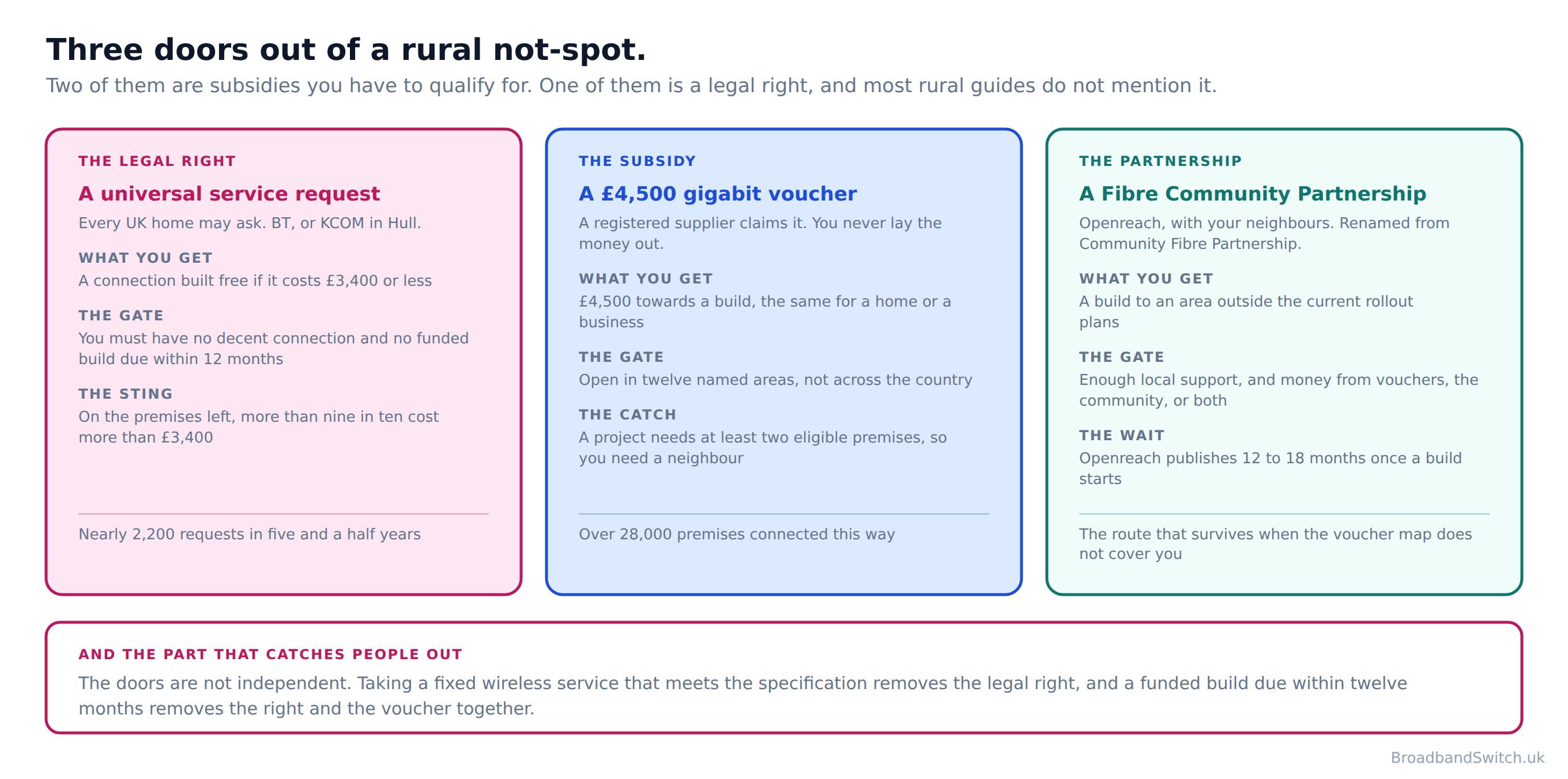
A rural address has three routes that are subsidised or legally owed to it, and each one is shut by a different gate. Knowing which gate applies to you takes about twenty minutes and decides everything else. Two of the three are subsidies and one is a legal right. The voucher is worth £4,500, the same for a home and for a business, and it is open in twelve named areas rather than across the country, so for most rural addresses the honest answer today is no. The Openreach scheme is still there and has been renamed: it is a Fibre Community Partnership now. And the third route is the one the guide this page replaces never mentioned: “Every home and business in the UK has the legal right to request a decent, affordable broadband connection.” That right is free to exercise and it has a sting Ofcom publishes and no consumer page does, which is that “the cost of connecting more than nine out of ten of the remaining premises without access to decent broadband is likely to exceed the £3,400 threshold”. It also closes quietly: a fixed wireless service that meets the specification counts as a decent connection, so improving your connection this afternoon can shut the only door you had a legal right to. Ask BT for a universal service quote before you spend anything, because it is free to ask, it is the only route you have a legal right to, and the answer tells you what every other route is worth.
Start with your postcode
What reaches the address decides which of the five routes below are even open to you, and in a rural postcode two houses a few hundred metres apart can get completely different answers.
Want to know which doors are open at your address? Answer three questions and see all five sorted into open and shut. Never heard of the universal service obligation? That is the route nobody mentions, and it is a legal right.
The short version, for somebody with no full fibre
Direct answer: A rural address has three routes that are subsidised or legally owed to it, and each one is shut by a different gate. Knowing which gate applies to you takes about twenty minutes and decides everything else.
Most rural broadband guides, including the version of this one we have just replaced, sort the options by technology and then tell you which suits which situation. That is a reasonable way to organise a page, and it skips the question that actually decides what happens to you, which is not what the options are but which of them you are allowed to use.
Three routes are subsidised or legally owed to a rural household, and each is shut by a different rule. The gigabit voucher is worth £4,500 and is open in twelve named areas. The Openreach partnership is open to anybody with enough neighbours and enough patience. And the third is a legal right that every UK home has and that almost nobody uses.
That third one is the reason this page was rebuilt rather than edited. The guide this page replaces ran to 13,834 words about rural broadband and did not mention the universal service obligation once, which is the only legal right in the subject. Ofcom's own words are “Every home and business in the UK has the legal right to request a decent, affordable broadband connection.” You do not have to be a BT customer to use it, the answer comes inside thirty days, and it costs nothing to ask.
It is also a disappointing story, which is probably why so few guides carry it. “the cost of connecting more than nine out of ten of the remaining premises without access to decent broadband is likely to exceed the £3,400 threshold”. And “As of September 2025, BT had received nearly 2,200 USO orders since the launch of the USO in March 2020”. A right that usually produces a quote rather than a connection is not the clean answer anybody wants. It is still worth more than a scheme you do not qualify for, and the quote itself is the most useful number anyone will give you about your own address.
If you are simply waiting for an installation at an address that can already order one, this is the wrong page and there is a better one: our guide to bridging the gap while you wait covers that case properly. This page is for an address where the answer is still no.
See what the address can actually get
Direct answer: Measure the line you have before anything else, because the one number it gives you opens or shuts every route below.
The universal service right exists only where you cannot already get a decent connection, and decent has a published meaning that turns on measured speed. So the speed your address actually achieves is the first gate, and until you know it nothing else on this page can be settled.
Run a test on the connection you have, wired rather than over Wi-Fi if you can, once at a quiet hour and once at about eight in the evening, and write the download and the upload down separately. Our own speed test is free and stores nothing. The upload is the figure that decides whether video calls work and it is the one almost nobody records.
Then check the exact address rather than the postcode. In a rural postcode covering several square miles, one property can be on full fibre from a regional network while another eight hundred metres away is on a long copper line, and a postcode level check averages the two into an answer that is true of neither.
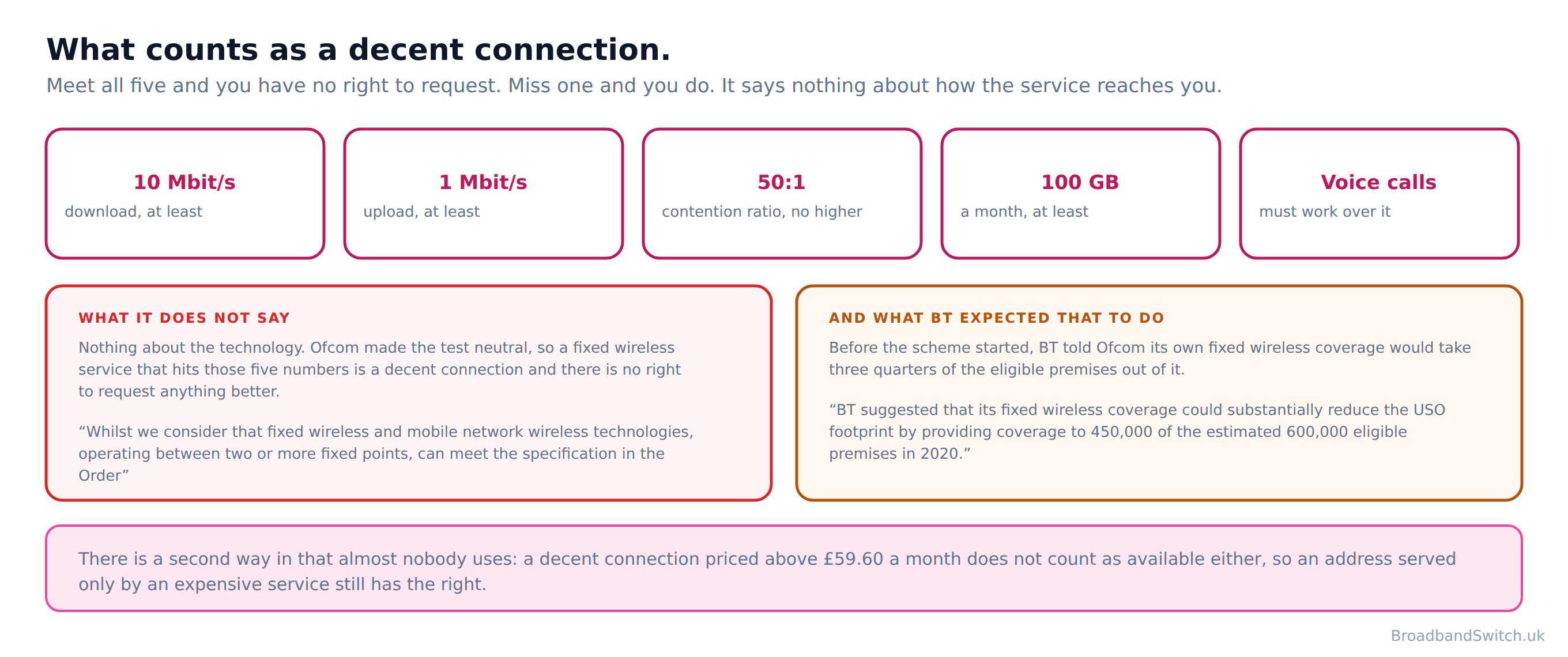
Decent is five things rather than one. Ofcom's designating statement of 6 June 2019 sets it out as “download sync speed of at least 10 megabits per second; upload sync speed of at least 1 megabit per second; contention ratio of no higher than 50:1; latency which is capable of allowing the end-user to make and receive voice calls; capability to allow data usage of at least 100 gigabytes per month”. Note that the latency requirement is functional rather than a number of milliseconds, so a guide quoting a millisecond figure for it is quoting something Ofcom has not published.
The route nobody mentions
Direct answer: Every home and business in the UK has the legal right to request a decent, affordable broadband connection.
That sentence is Ofcom's, from its own consumer page, and it is the whole of the case for reading this section. It is not a scheme with a budget, a map or a closing date. It is a right, it applies to every home and business in the United Kingdom, and the guide this page replaces did not mention it in 13,834 words.
You ask BT, or KCOM if you are in Hull. “you may be able to request an upgraded connection from BT, or KCOM if you live in the Hull area. You don't need to be an existing customer of BT or KCOM to apply.” Two conditions decide whether you qualify, and they are short: your premises “has no access to existing decent broadband; and will not be covered by a public broadband scheme offered by the UK or devolved governments in the next 12 months”. If you pass both, BT surveys what it would cost to build a connection to you.
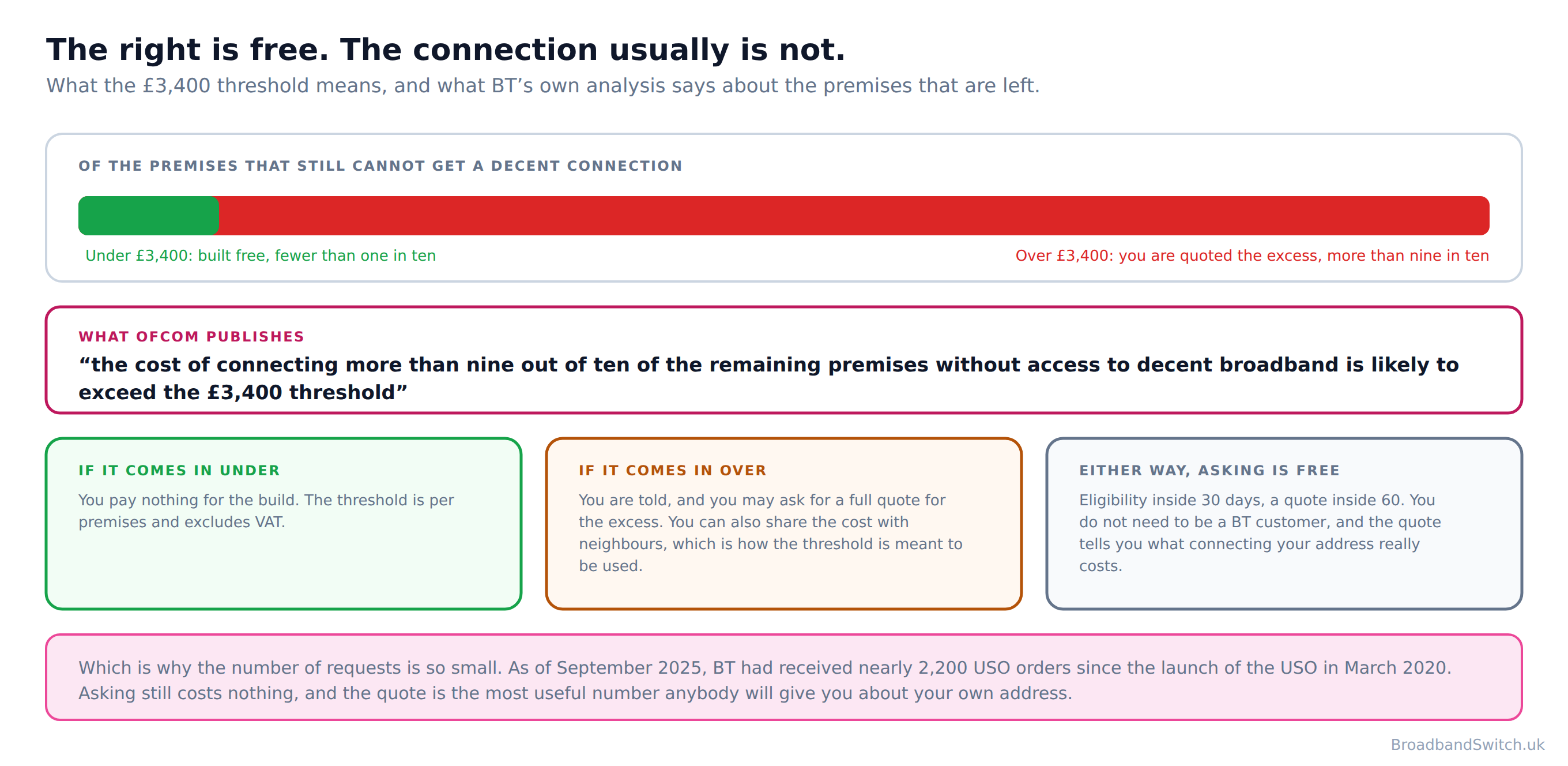
Then the threshold does its work. “If the cost of building or upgrading your share of the network connection is £3,400 or less, you won't have to pay for this work to be done.” And “If it will cost more than £3,400 to connect your home, and you still want a connection, you will have to pay the excess costs.” The threshold is per premises and excludes VAT.
What almost nobody explains is how the cost gets attributed, and it is the part a rural reader can actually use. Ofcom's rules say: “Where network can be shared by multiple premises that are eligible for the USO, the provider must calculate the cost that is attributed to an individual premises by dividing the total cost of the infrastructure which is capable of being shared by the number of relevant premises.” So a single track that would serve eleven houses is not charged to whichever one asked first. It is divided.
And the divisor is generous. “The conditions require that the number of relevant premises is the higher of: 70% of the total number of eligible premises that are capable of being served by the shared infrastructure; or the actual number of eligible premises that can be served by the shared infrastructure that have requested a USO service.” Read that twice, because it means the quote is worked out as though seventy per hundred of the eligible premises had applied even when only you have. A quote that comes back over the threshold for one house can come back under it once the arithmetic is done properly, which is why the first thing to do after a disappointing quote is to ask how the shared infrastructure was divided.
Here is the part no consumer page states and every rural reader deserves. Ofcom reports BT's own analysis that “the cost of connecting more than nine out of ten of the remaining premises without access to decent broadband is likely to exceed the £3,400 threshold”. So for most addresses still in this position the realistic outcome is a quote rather than a free connection. That is worth knowing before you ask rather than after.
How to actually make the request
BT's own terms give the route in one line: “You should make a Request via our Universal Service Helpdesk by telephone on 0800 783 0223.” Email and post are offered as alternatives in the same clause. In Hull it is KCOM instead, and its page says “please contact us on 01482 602555”. Neither requires you to be an existing customer.
One condition stalls more requests than anything else and is worth settling before you ring. BT requires that you are “the freeholder of the address or you have the written consent of the freeholder to make the Request”. A tenant can make the request, but not without the freeholder's written consent, so on a rented farmhouse the first conversation is with the landlord rather than with BT.
Be ready for the numbers to look bigger than the threshold suggests, because BT's definition is “the threshold up to which we will cover the costs of Network, being £3,400 exclusive of VAT” And be ready for the build to take a while: “We will aim to build Network as soon as possible and within 24 months of the relevant Request where we can. However, building a network infrastructure can sometimes be delayed due to matters beyond our reasonable control.” That is longer than the twelve months Ofcom's consumer page leads with, and it is BT's own wording rather than a pessimistic reading of it.
The sentence on KCOM's page that nobody else publishes
“If the cost of a connection exceeds a threshold of £3,400 customers can pay the excess costs we incur or do some of the work themselves to help bring costs down.” Doing some of the work yourself is not mentioned on Ofcom's consumer page or in BT's terms, and on a farm or a smallholding with a trencher and a field of your own it is the difference between a quote you cannot meet and one you can. It is worth asking BT the same question even though BT does not publish the option.
Why it is still the first thing to do
Asking is free, you do not have to be a BT customer, “When you contact BT or KCOM they will have 30 days to confirm if you are eligible, and how much it will cost to build your connection.”, and if a build is needed “Most people will get a connection within 12 months, but it could take up to 24 months for some.” Whatever comes back you end up holding a surveyed figure for what connecting your address really costs, which is the number every other route on this page is secretly about. And there is a second way in that almost nobody uses: a decent connection priced above £59.60 a month does not count as available either, so an address served only by an expensive service still has the right.
The way it closes is the part to be careful about. The specification says nothing about how the service reaches you, and Ofcom made that deliberate: “Whilst we consider that fixed wireless and mobile network wireless technologies, operating between two or more fixed points, can meet the specification in the Order”. A fixed wireless service that meets the five numbers is a decent connection, and there is then no right to request anything better.
Ofcom knew what that would do before the scheme started. “BT suggested that its fixed wireless coverage could substantially reduce the USO footprint by providing coverage to 450,000 of the estimated 600,000 eligible premises in 2020.” Three quarters of the households the universal service was designed for were expected to be taken out of it by a service most of them would have been pleased to get. Nobody is doing anything wrong in that sentence. It simply means the order you do things in decides what you are entitled to, and nothing tells you so at the time.
Ofcom's published assessment of satellite and the universal service dates from June 2019 and is expressly premised on low earth orbit services being unavailable. Nothing on Ofcom's site updates it. So this page does not assert either way whether a modern satellite connection removes the right. If you are in that position, apply and let the eligibility check answer it rather than assuming you are excluded.
Which doors are open at your address
Direct answer: Three questions. Five routes, sorted into open, shut and check that first, with the rule behind each one quoted.
Three of the five routes are shut by a rule rather than by price, and the rules interact, so a table is the honest output rather than a single recommendation. Where an answer is not known the checker says to establish it rather than guessing, because guessing here is how somebody spends money they did not have to.
It runs entirely in your browser. There is no form to submit, nothing sent to any server and nothing stored: what you answer about your own address is used on this page and gone when you close the tab. Every rule it quotes was read on the publishing body's own site on 29 September 2026.
Three questions, and five routes sorted into open and shut
Three of the five routes are shut by a rule rather than by price, and the rules interact, so the order you do things in matters more than which provider you pick. Nothing you answer here leaves your browser.
Five routes, and what shuts each one
Direct answer: The routes are not independent, and the one that catches people out is the one that closes by itself.
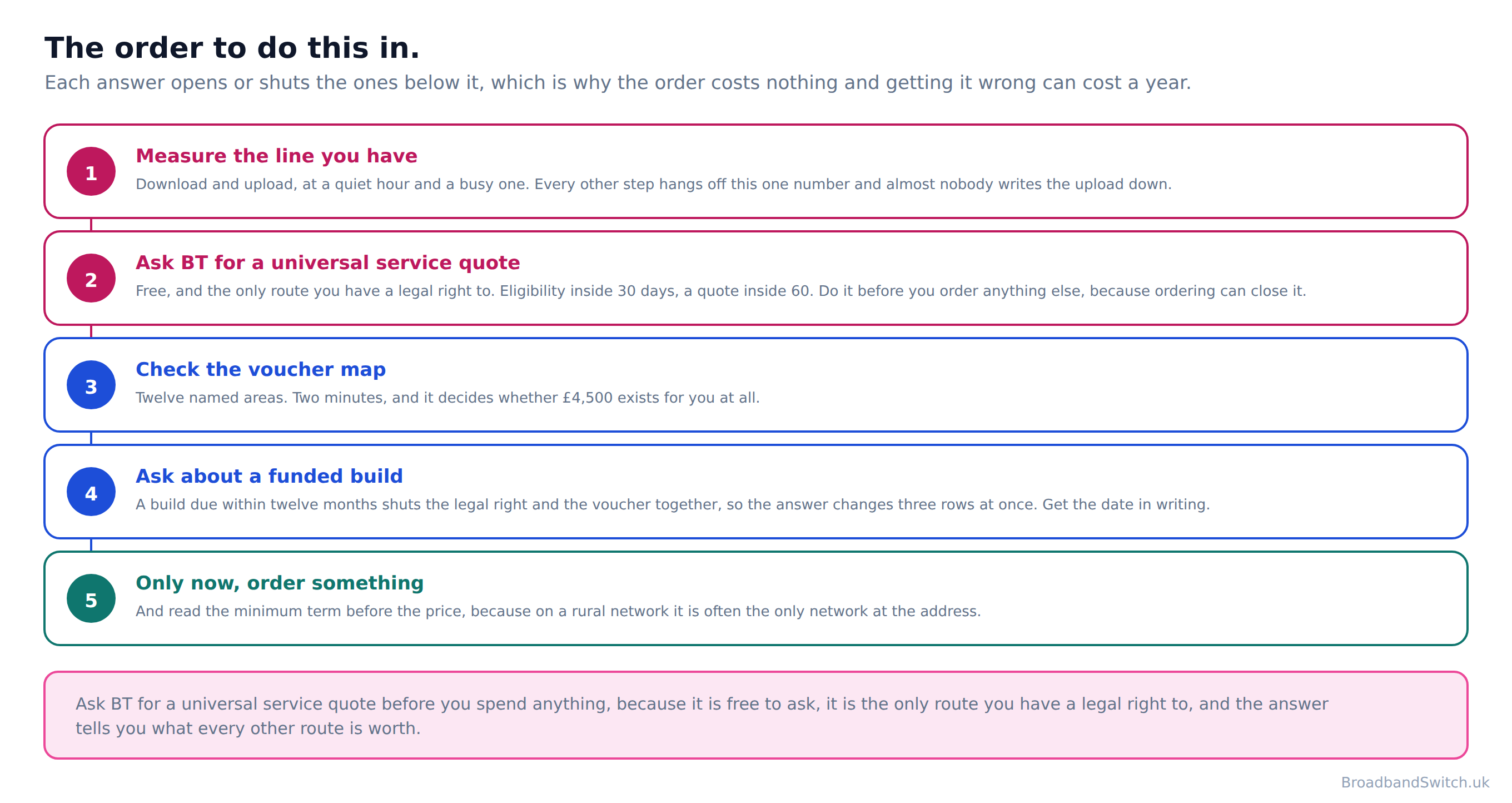
Taking a fixed wireless service that meets the specification removes the universal service right. A publicly funded build due within twelve months removes the right and the voucher together. Being outside the twelve open voucher areas removes the voucher whatever else is true. So it is possible to improve your connection on a Tuesday afternoon and close the only door you had a legal right to, and nothing in the ordering process mentions it.
None of that makes any of it a trap in the ordinary sense. A notice on a checkout page saying you may be giving up a statutory right would be a strange thing to write, and the rules are published where rules are usually published. It does mean the sequence matters, and the sequence costs nothing: ask first, order second.
A funded build is the one answer that changes three rows at once, so it is worth ten minutes. If a scheme is due, get the expected date in writing and cover the gap on the shortest term you can find rather than an eighteen month one. Re-check every six months, because if the scheme falls away the universal service door opens again and your correspondence is what makes that request straightforward. Our community fibre playbook covers organising a village build in detail.
The £4,500 voucher, and the twelve areas
Direct answer: The voucher value is £4,500 for both residential and SME beneficiaries.
That one sentence, from the scheme's own beneficiary terms, disposes of the tier structure that almost every rural guide publishes. There is no residential figure and no separate business figure. The £4,500 that appears in most guides as a maximum for priority rural areas is simply the amount, and the phrase priority rural appears nowhere on gov.uk in connection with the scheme.
The £1,500 and £3,500 figures that circulate are not invented. They are the rates set when the scheme launched in 2021, and they have been superseded. The version of this page we have just replaced carried them alongside the current figure and presented the difference as a rural premium, which is a tidier story than the truth and is not the truth.
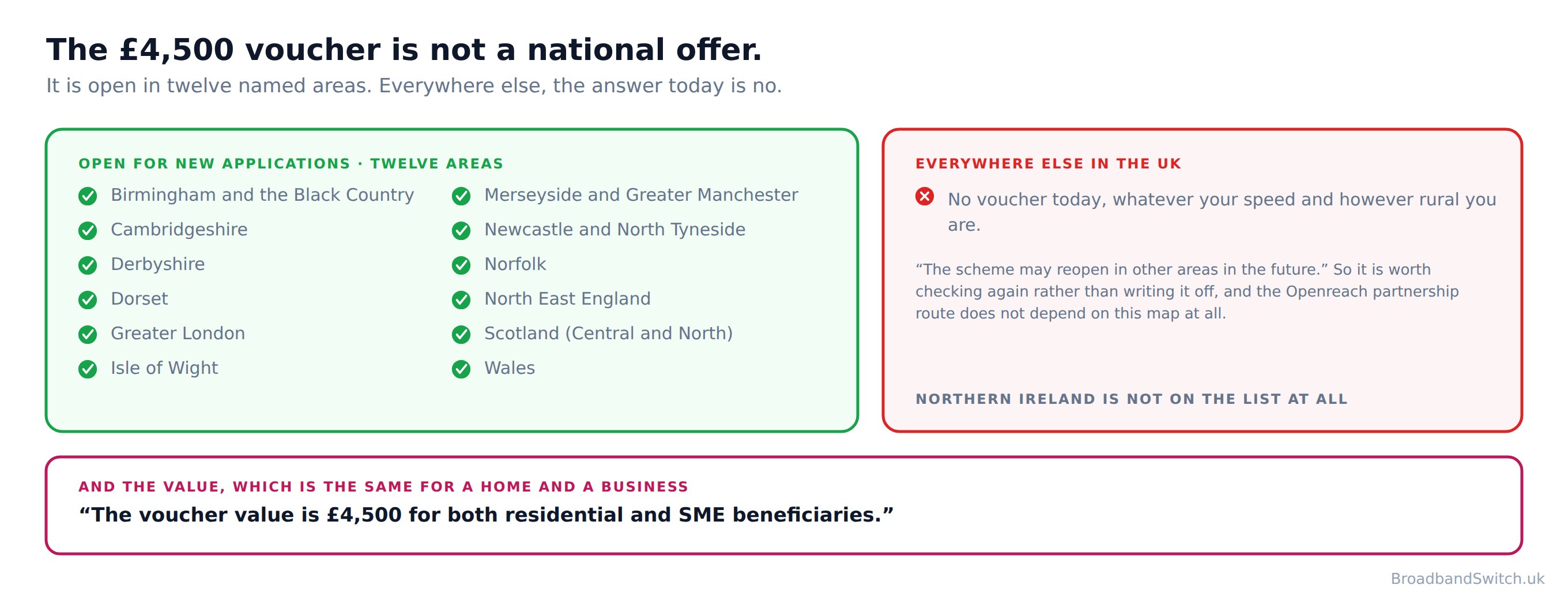
The gate nobody publishes is geographic. gov.uk says: “The table below lists the areas where the Gigabit Broadband Voucher Scheme is currently open for new applications, as shown on the map above.” Twelve are listed: Birmingham and the Black Country, Cambridgeshire, Derbyshire, Dorset, Greater London, Isle of Wight, Merseyside and Greater Manchester, Newcastle and North Tyneside, Norfolk, North East England, Scotland (Central and North), and Wales. Northern Ireland does not appear on the page at all. If your area is not on that list, there is no voucher for you today, however rural you are and however slow your connection is.
gov.uk does add that “The scheme may reopen in other areas in the future.” So the honest advice is to check the map now, and again in a few months, rather than writing the scheme off permanently or assuming it covers you.
Two more gates are worth knowing before you start organising anything. The scheme “The voucher scheme is only open for new projects to cover premises which are not included within a Project Gigabit procurement or contract and which are not covered by existing or planned commercial coverage.”, so being inside a funded contract disqualifies you as surely as being outside an open area. And a project “A project must cover at least two eligible premises, with two or more eligible residents and/or businesses”, which is why a single remote house cannot use the scheme alone and why the first useful conversation is with a neighbour rather than with a supplier.
Two things about the money that rural guides leave out
There is a floor as well as a ceiling: “If the construction and installation charges for SME and residential beneficiaries are below £500 your connection will not be eligible for voucher funding.” And the voucher is never paid to you. It goes to the registered supplier that built the connection, so you do not lay the money out and reclaim it; you pay only whatever the build costs above the voucher. gov.uk reports that “over 28,000 premises have also received a gigabit-capable connection through voucher-funded delivery”
The four nations do not pay the same
Direct answer: The four UK nations do not run the same scheme and do not pay the same amount. A rural household in Scotland can be offered £5,000, one in Wales up to £800, and the England-led voucher pays £4,500 in the twelve areas where it is open.
Almost every rural broadband guide, including the one this page replaces, describes the England-led voucher and then adds a sentence saying that Scotland, Wales and Northern Ireland have their own arrangements. That is true and it is not much use, because the arrangements are not variations on a theme. They are different schemes with different money, different speed thresholds and different current states, and the gap between the most and least generous is more than six times.
Scotland
The Scottish Broadband Voucher Scheme is the most generous of the four: “The scheme provides a subsidy of up to £5,000 for eligible properties”, and it “covers all direct installation costs carried out by a registered supplier”. The eligibility threshold is different too, and higher: “your current broadband connection speed is less than 30 Megabits per second”, which is three times the ten megabits the UK universal service turns on. One restriction is live and is easy to miss: “Applications for multiple properties with a gigabit-capable broadband solution have been temporarily paused.” That took effect on 19 August 2024 and applies to multiple property gigabit applications only, so a single property can still apply.
Behind it sits the larger programme. “Reaching 100% (R100) is a £600+ million Scottish Government programme that has been bringing faster broadband to thousands of homes and businesses across Scotland.” And the timing matters for the universal service test rather than only as background, because a funded scheme due within twelve months disqualifies you while one due later does not: “R100 contract build is expected to be completed in 2028.” Scotland is also on the England-led voucher map, as Scotland (Central and North), so parts of the country have both routes open at once.
Wales
Access Broadband Cymru is a grant rather than a voucher and it is an order of magnitude smaller: “Funding of up to £800 per premises is available.” The Welsh Government's own guidance splits that into £550 for equipment and £250 for installation, which tells you what it is designed for: it funds a connection using an existing technology rather than a new build to the property. Wales is also on the England-led voucher map, so a Welsh household outside a funded contract may have the £4,500 route as well and should check both.
Northern Ireland
Project Stratum, which most guides still describe as running, is finished: “the Project was finished in June 2025”. It “extended Next Generation Access (NGA) broadband infrastructure to over 81,000 premises”. Northern Ireland does not appear on the gigabit voucher map at all, so a Northern Irish household outside the areas Stratum reached is looking at the universal service route, a Project Gigabit contract build, or a commercial service, rather than at a voucher.
What to take from this
Check your own nation's scheme before the UK one, because the eligibility threshold may be higher and the money may be better, and check both where they overlap. And do not let a devolved scheme lull you out of the universal service request: it is a UK-wide right and it applies in all four nations, whatever else is available.
The Openreach route, under its new name
Direct answer: A Fibre Community Partnership is how we offer Full Fibre broadband to areas which aren't part of our current rollout plans.
Searching for this scheme under the name every guide uses will make it look as though it has been withdrawn. It has been renamed. Openreach calls it a Fibre Community Partnership, and the string Community Fibre Partnership does not appear on its page at all, though the web address still carries the old word order. The replaced version of this page named the old form four times.
It matters because this is the route that survives when the voucher map does not cover you. A partnership is not a scheme with a boundary: it is a way of building to an area that is not in the rollout plans, funded by vouchers where they exist, by community money where they do not, or by both together. Openreach publishes the same figure the government does: “Eligible properties can get a voucher worth up to £4,500.”
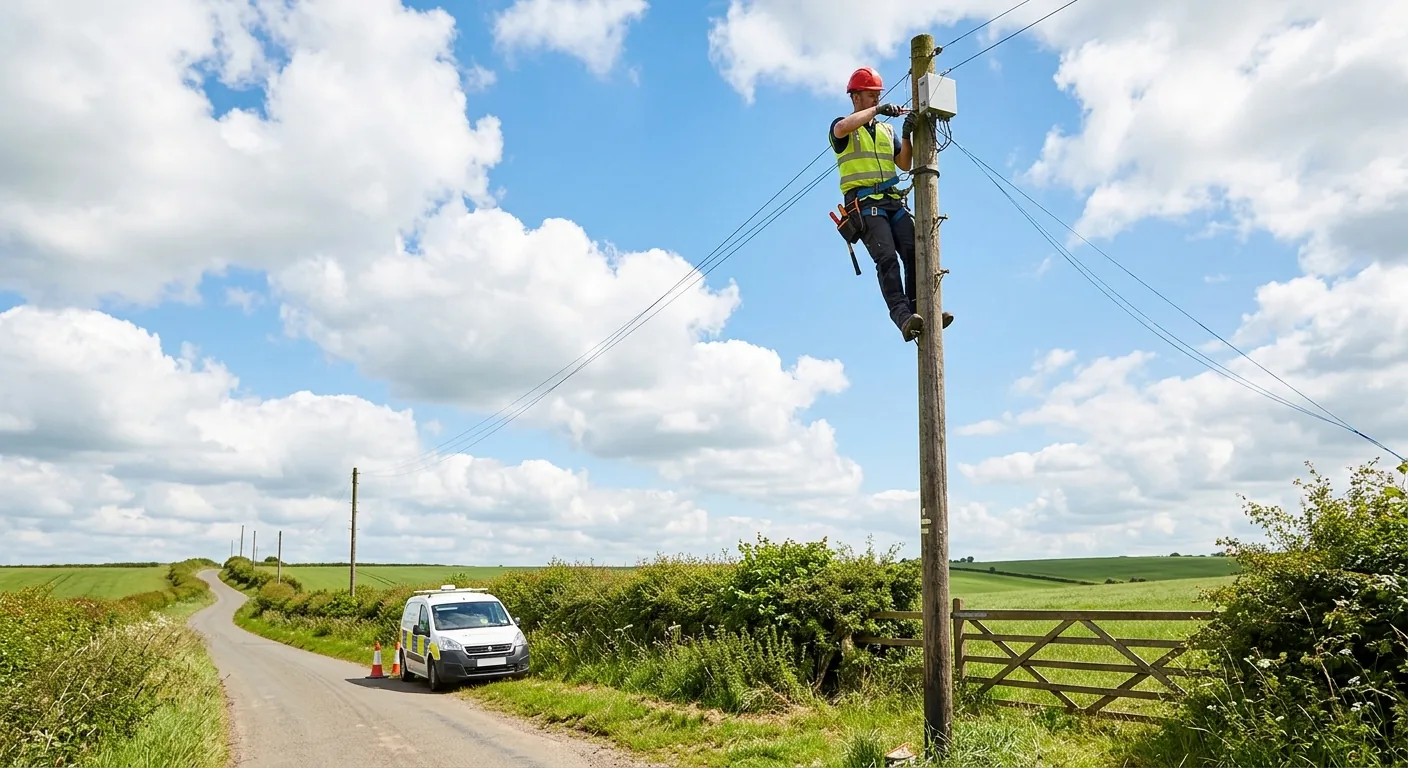
Openreach is also honest about the timescale in a way that is worth quoting in full: “Once the build starts it will take 12-18 months to complete, and prices and contracts may change by the time you can place your order.” The second half of that sentence is the part to read twice. A community that agrees a price at the start of a build is not necessarily buying at that price at the end of it.
The practical sequence is the same as the voucher one and starts in the same place. Express an interest, find out how many of your neighbours will, and only then talk about money. A build that looks impossible with one household is often straightforward with fifteen, and the community fibre playbook on this site works through how villages have actually done it.
What a rural network ties you into
Direct answer: A rural network is often the only network at the address, so the contract length matters more there than anywhere else, and it is the thing rural guides publish least.
In a town a long contract is a price decision, because if the service disappoints there is another network at the same address. In a village there often is not. That makes the minimum term the most important line in a rural broadband contract and it is the line rural guides publish least, so here are the four we could read, quoted from each company's own site on 29 September 2026.
Gigaclear's residential terms, dated July 2026, say “Minimum 18-month contract applies.” Wessex Internet publishes eighteen months as well, at clause 1.4 of its residential terms effective 1 October 2025. Quickline maintains a dated residential terms document that we could not read and publishes no minimum term on its site, so we quote none for it rather than guessing.
The one that publishes something different
B4RN: “The minimum period of contract is one year from your live date, but there is currently no early exit penalty.” A minimum term with no charge for leaving inside it is a materially different proposition from a minimum term with one, and B4RN is the only one of the four that publishes it that way. It is a community benefit society rather than a conventional operator, which is part of why, but the wording is the wording and it is worth knowing when you are comparing.
Two product corrections belong here too, because the replaced page recommended both with prices. O2's own broadband page says “We don't offer home broadband as O2.” Vodafone's own page says “We're no longer selling Gigacube, but you can still get all the help and support you need with your Gigacube from us.”, and the product is now sold as 5G Broadband. Worth noting that Vodafone's marketing page advertises a twelve month option that its own May 2026 terms do not list, which is the same sort of disagreement we found on NOW's site while writing the short lets guide.
And geostationary satellite is no longer an option for a new UK home at all. Konnect's own UK page says “We are no longer taking on new home broadband customers in the UK.” The replaced page offered it as a live choice.
What rural coverage actually is
Direct answer: Full fibre is available to 61% of rural UK premises against 81% of urban ones, and gigabit-capable broadband to 62% against 91%.
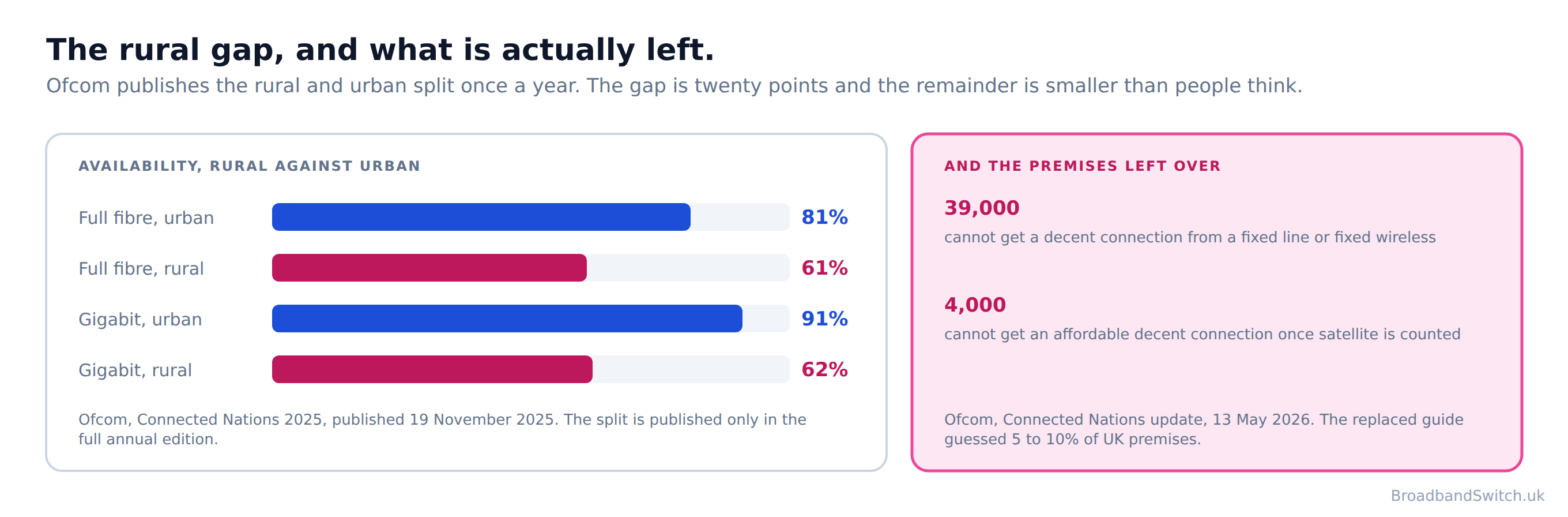
A twenty point gap is a real gap and it is also much better than it was. What is worth correcting is the other end of the distribution, because rural guides routinely describe a large stranded remainder and the published figure is small: “The number of premises unable to access decent broadband from a fixed line or fixed wireless access network has dropped to 39,000, down from 44,000 in July 2025.” Once satellite is counted it falls again: “The number of premises without access to affordable decent broadband has fallen to only 4,000, mainly due to the availability of lower priced satellite services.”
Those two numbers measure different things and must not be run together. The first counts what a fixed line or a fixed wireless network can reach. The second counts what is reachable and affordable once satellite is included, which is why it is so much smaller. The replaced page guessed that between five and ten in every hundred UK premises were in challenging locations, which is between a hundred and fifty and three hundred times the published figure.
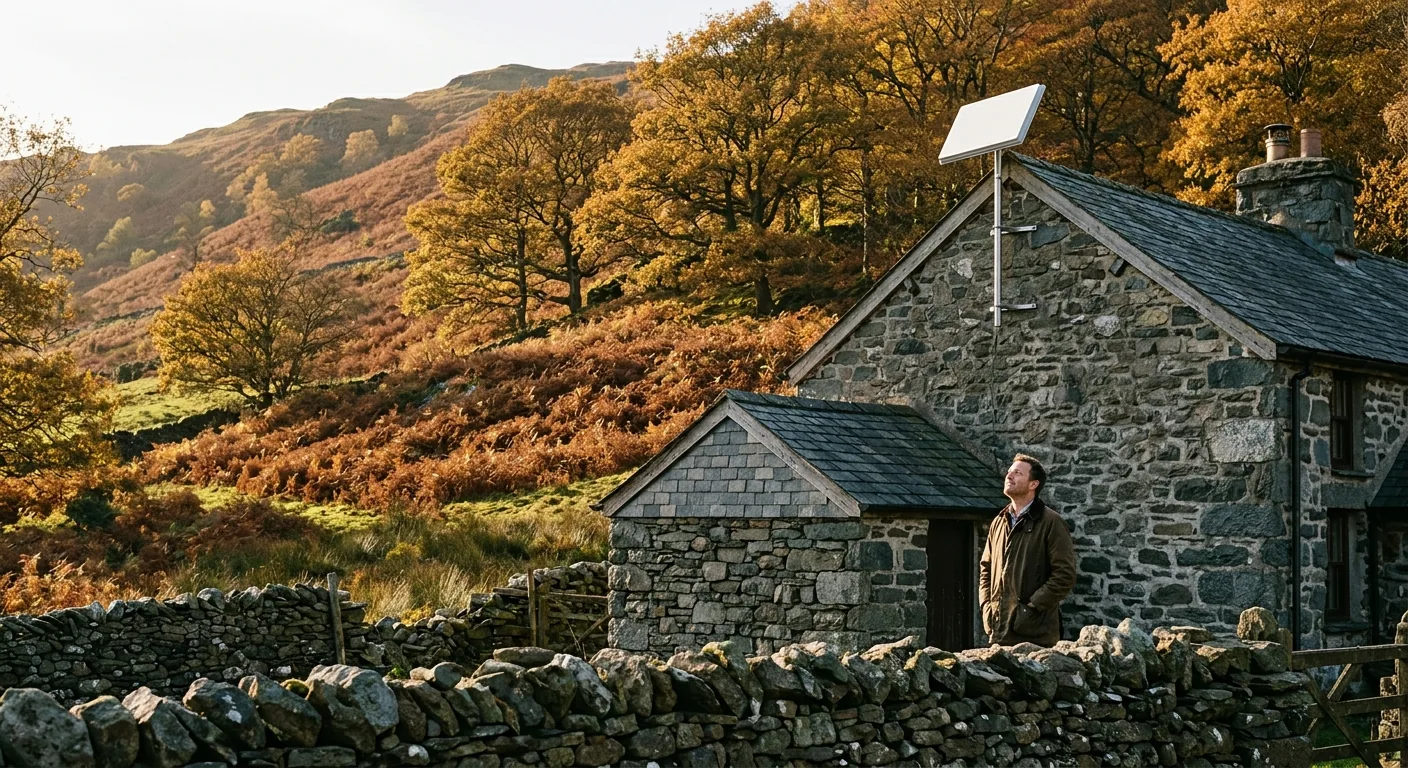
We are not going to quote you a price for satellite, and we would rather say why than invent one. Starlink's UK pricing pages render in the browser rather than in the page source and returned no readable text, and the one Starlink document that could be read is the Australian summary priced in Australian dollars. This guide therefore quotes no Starlink price. What can be quoted is the regulator: “Take-up of LEO satellite broadband offered by Starlink in the UK continues to increase, with over 110,000 active connections in 2025, up from around 87,000 reported last year.” At “Starlink indicate average download speeds of around 210 Mbit/s, up from 160 Mbit/s in 2024.” And the sentence that explains the four thousand: “Since we published CN2025, Starlink has introduced cheaper plans in selected parts of the UK, meaning that a significant number of premises unable to access a decent broadband service from a fixed line or fixed wireless access network can now access affordable decent broadband through Starlink's Low Earth Orbit satellite broadband services.” Our Starlink guide goes further into what it is like to live with.
On the build itself, one number on the replaced page was not a number anybody publishes. Openreach states a premises count rather than a share of UK premises: “deliver Full Fibre broadband to 25 million homes and businesses by 2026”. BT's trading update for the quarter to 30 June 2026 gives the position as “FTTP footprint increased to 23.4m, an increase of 514k in the quarter, on track to achieve our 25m FTTP build target by December 2026”. Nationally, gov.uk reports that “gigabit-capable broadband is now available to more than 88% of homes and businesses”, with “approximately 4 million premises remaining without coverage”, and a target of “making gigabit-capable broadband available to 99% of homes and businesses by 2032”. Our Connected Nations summary carries the rest.
Mobile coverage is its own subject and has its own page: what the Shared Rural Network changed covers the rural signal picture properly, and our guide to 4G and 5G as a stopgap covers choosing and siting a hub. The one thing to carry from this page into those is that the hub you order can close the door behind you, so ask for the universal service quote first.
Broadband at your postcode
Direct answer: Worth checking even where the answer has been no for years, because rural availability moves and most people check once.
A rural address that was copper only in 2022 may be on a regional full fibre network now, and the only way to find out is to look. Check the exact address rather than the postcode, and check again once a year: gigabit-capable broadband is now available to more than 88% of homes and businesses, and the ones being added are by definition the harder ones.
Every provider that reaches your address
One postcode shows every provider that reaches the address, lowest price first, across full fibre, FTTC, cable and 5G home broadband. In the countryside, read the minimum term before the price.
Show every provider at my postcode →What this page used to say, and why it changed
Direct answer: Five corrections. Four are factual and the fifth is an absence, which is the reason the page was rebuilt rather than edited.
Four of these would have cost a reader time and one of them could have cost a reader money. Publishing them rather than quietly editing is the only way somebody who acted on the old version can tell whether they acted on something wrong.
Inventing a voucher tier that does not exist
What this page said
The page said the Project Gigabit voucher was worth “up to £4,500 (£1,500 for residential and £3,500 for businesses, sometimes higher in priority areas)” and repeated the figure nine times, including in a heading and in the page’s headline statistics.
What it says now, and why
The £4,500 is right. Everything around it was wrong. The scheme’s own beneficiary terms, version 10.1 dated 5 June 2025, say: “The voucher value is £4,500 for both residential and SME beneficiaries.” There is no residential and SME split and no priority rural tier; the phrase priority rural appears nowhere on gov.uk in connection with the scheme. The £1,500 and £3,500 figures are the 2021 rates and have been superseded. A reader quoting the old split to a supplier would have been told, correctly, that it is not how the scheme works.
Describing the voucher as a national scheme
What this page said
The page said the voucher “is available for many rural homes and small businesses in England, Scotland, Wales, and Northern Ireland” and told readers to check their eligibility, without ever mentioning a geographic limit.
What it says now, and why
gov.uk says: “The table below lists the areas where the Gigabit Broadband Voucher Scheme is currently open for new applications, as shown on the map above.” Twelve areas are listed and Northern Ireland is not among them. For most rural addresses in the UK the answer today is that no voucher exists, which is a very different message from the one the page was giving. It is a real omission rather than a quibble: a household could spend months organising neighbours for a scheme that was never open to them.
Quoting a build target Openreach does not publish
What this page said
The page said “UK FTTP availability is at approximately 85% of premises by end 2026 per Openreach’s own published targets”, and carried 85% as a headline statistic.
What it says now, and why
Openreach publishes a premises count and not a percentage of UK premises: “deliver Full Fibre broadband to 25 million homes and businesses by 2026”. The 85% figure appears nowhere on Openreach’s site in that sense, and it is not an Ofcom figure either. BT’s own trading update for the quarter to 30 June 2026 gives the position as “FTTP footprint increased to 23.4m, an increase of 514k in the quarter, on track to achieve our 25m FTTP build target by December 2026”. gov.uk puts gigabit-capable availability at “gigabit-capable broadband is now available to more than 88% of homes and businesses”, which is a different measure again and is the one most readers actually want.
Recommending three products that are no longer sold
What this page said
The page listed O2 Home Wireless and Vodafone GigaCube as current rural options, each with a price, told readers to check O2’s coverage before ordering, offered Smarty as a home route, and gave Eutelsat-Konnect as a live geostationary satellite option.
What it says now, and why
O2’s own broadband page says “We don't offer home broadband as O2.” Vodafone’s own page says “We're no longer selling Gigacube, but you can still get all the help and support you need with your Gigacube from us.” Smarty publishes no home broadband product at all. And Konnect’s own UK page says “We are no longer taking on new home broadband customers in the UK.” Four recommendations that could not be acted on, which is the kind of error that costs a reader an afternoon rather than money, and still should not have been there.
Never mentioning the universal service obligation
What this page said
The page ran to 13,834 words about rural broadband options and did not mention the universal service obligation, the 10 Mbit/s and 1 Mbit/s specification, the £3,400 threshold or the right to request, once.
What it says now, and why
This is the reason the page was rebuilt rather than edited. The guide this page replaces ran to 13,834 words about rural broadband and did not mention the universal service obligation once, which is the only legal right in the subject. Ofcom’s own words are “Every home and business in the UK has the legal right to request a decent, affordable broadband connection.”, and that right is free to exercise, carries a thirty day answer, and does not require you to be a BT customer. It is also a disappointing story, which may be why so few guides carry it: “the cost of connecting more than nine out of ten of the remaining premises without access to decent broadband is likely to exceed the £3,400 threshold”, and “As of September 2025, BT had received nearly 2,200 USO orders since the launch of the USO in March 2020”. A disappointing right a reader knows about beats an encouraging scheme they do not qualify for, so the page now leads with it.
Rural broadband: frequently asked questions
Can I really demand a broadband connection if I live somewhere remote?
You can request one, which is not quite the same thing. Ofcom puts it plainly: “Every home and business in the UK has the legal right to request a decent, affordable broadband connection.” The request goes to BT, or to KCOM if you are in Hull, and “you may be able to request an upgraded connection from BT, or KCOM if you live in the Hull area. You don't need to be an existing customer of BT or KCOM to apply.” Two conditions decide whether you qualify: your premises “has no access to existing decent broadband; and will not be covered by a public broadband scheme offered by the UK or devolved governments in the next 12 months”. If you pass both, BT surveys the build. Where it comes to £3,400 or less you pay nothing for the work; above that you are quoted the excess. The part nobody tells you is how often it comes in above: Ofcom reports BT's analysis that “the cost of connecting more than nine out of ten of the remaining premises without access to decent broadband is likely to exceed the £3,400 threshold”. It is still worth asking, because asking is free and the quote is the most useful number anybody will ever give you about your own address.
How much is the Project Gigabit voucher, and is it different for a business?
It is £4,500 and it is not different for a business. The scheme's own beneficiary terms say it in one line: “The voucher value is £4,500 for both residential and SME beneficiaries.” The £1,500 and £3,500 figures that appear in most rural guides, including the version of this one we have just replaced, are the rates set when the scheme launched in 2021 and they have been superseded. There is also a floor as well as a ceiling, which almost nobody mentions: “If the construction and installation charges for SME and residential beneficiaries are below £500 your connection will not be eligible for voucher funding.”
Is the gigabit voucher available everywhere in the UK?
No, and this is the single most important thing on this page about the voucher. gov.uk says: “The table below lists the areas where the Gigabit Broadband Voucher Scheme is currently open for new applications, as shown on the map above.” Twelve areas are listed: Birmingham and the Black Country, Cambridgeshire, Derbyshire, Dorset, Greater London, Isle of Wight, Merseyside and Greater Manchester, Newcastle and North Tyneside, Norfolk, North East England, Scotland (Central and North), and Wales. Northern Ireland does not appear on the page at all. If your area is not on that list there is no voucher for you today, however rural you are and however slow your connection is. gov.uk does add that “The scheme may reopen in other areas in the future.”, so it is worth re-checking rather than writing it off for good, and the Openreach partnership route does not depend on that map.
What is a Community Fibre Partnership, and does it still exist?
It exists and it has been renamed, which is why searching for the old name can make it look as though it has gone. Openreach's own page says: “A Fibre Community Partnership is how we offer Full Fibre broadband to areas which aren't part of our current rollout plans.” The string Community Fibre Partnership does not appear on that page at all, although the web address still carries the old word order. It is the route that survives when the voucher map does not cover you, because it is a partnership rather than a scheme with a boundary. Openreach publishes the same voucher figure the government does, “Eligible properties can get a voucher worth up to £4,500.”, and is honest about the timescale: “Once the build starts it will take 12-18 months to complete, and prices and contracts may change by the time you can place your order.”
Will getting a 4G, 5G or fixed wireless service stop me getting anything better?
It can, and this is the trap on the page. The universal service specification is technology neutral: Ofcom considered that “Whilst we consider that fixed wireless and mobile network wireless technologies, operating between two or more fixed points, can meet the specification in the Order”. So a fixed wireless service that meets the specification is a decent connection, and there is no right to request anything better. Ofcom recorded before the scheme even started that “BT suggested that its fixed wireless coverage could substantially reduce the USO footprint by providing coverage to 450,000 of the estimated 600,000 eligible premises in 2020.” Whether mobile home broadband is treated the same way has never been published, so the practical advice is not to assume either way: ask BT for the universal service quote first, let its eligibility check give you the answer, and order the interim service afterwards.
What does a decent broadband connection actually mean?
Five things, not one. Ofcom's designating statement sets the specification as “download sync speed of at least 10 megabits per second; upload sync speed of at least 1 megabit per second; contention ratio of no higher than 50:1; latency which is capable of allowing the end-user to make and receive voice calls; capability to allow data usage of at least 100 gigabytes per month”. Note that the latency requirement is functional rather than a number of milliseconds, so any guide quoting a millisecond figure for it is quoting something Ofcom has not published. There is a second way in that almost nobody uses: a decent connection priced above £59.60 a month does not count as available either, so an address served only by an expensive service still has the right.
Is Starlink worth it for a rural UK home?
We are not going to quote you a price for it, and we would rather say why than make one up. Starlink's UK pricing pages render in the browser rather than in the page source and returned no readable text, and the one Starlink document that could be read is the Australian summary priced in Australian dollars. This guide therefore quotes no Starlink price. What can be quoted is the regulator. Ofcom reports that “Take-up of LEO satellite broadband offered by Starlink in the UK continues to increase, with over 110,000 active connections in 2025, up from around 87,000 reported last year.”, that “Starlink indicate average download speeds of around 210 Mbit/s, up from 160 Mbit/s in 2024.”, and that “Since we published CN2025, Starlink has introduced cheaper plans in selected parts of the UK, meaning that a significant number of premises unable to access a decent broadband service from a fixed line or fixed wireless access network can now access affordable decent broadband through Starlink's Low Earth Orbit satellite broadband services.” That last sentence is the reason the number of UK premises without an affordable decent connection has fallen to 4,000. Our own guide at is Starlink any good for rural UK broadband goes further into the day to day experience.
How many rural homes are actually stuck with nothing?
Far fewer than rural guides usually claim, and the replaced version of this page was among the offenders with its guess of five to ten in every hundred UK premises. Ofcom's published figure is “The number of premises unable to access decent broadband from a fixed line or fixed wireless access network has dropped to 39,000, down from 44,000 in July 2025.” Once satellite is counted the figure falls again: “The number of premises without access to affordable decent broadband has fallen to only 4,000, mainly due to the availability of lower priced satellite services.” Those two numbers measure different things and must not be run together. The wider gap is real though: Full fibre is available to 61% of rural UK premises against 81% of urban ones, and gigabit-capable broadband to 62% against 91%.
What happens if a funded build is coming to my area?
It is good news, and it shuts two doors while it runs. A publicly funded scheme due within twelve months fails Ofcom's second eligibility condition, so the universal service right goes. And the voucher scheme “The voucher scheme is only open for new projects to cover premises which are not included within a Project Gigabit procurement or contract and which are not covered by existing or planned commercial coverage.”, so premises inside a Project Gigabit contract are outside the voucher. Neither of those matters if the build arrives, so the job is to pin the date down in writing and cover the gap without signing anything that outlasts it. Re-check every six months: if the scheme falls away, the universal service door opens again and your correspondence is what makes that request straightforward.
Which rural network ties me in for longest?
A rural network is often the only network at the address, so the contract length matters more there than anywhere else, and it is the thing rural guides publish least. Of the four checked on their own sites, Gigaclear publishes “Minimum 18-month contract applies.” and Wessex Internet publishes eighteen months as well. B4RN is the one worth knowing about: “The minimum period of contract is one year from your live date, but there is currently no early exit penalty.” A minimum term with no charge for leaving inside it is a different proposition from a minimum term with one, and B4RN is the only one of the four that publishes it that way. Quickline maintains a dated residential terms document that we could not read and publishes no minimum term on its site, so we quote none for it.
Is 4G or 5G home broadband a sensible primary connection in the countryside?
Often yes, and the honest caveat is that it depends on the signal at the hub's position rather than at your postcode. Two things on the replaced page were wrong and are worth correcting here. O2 was listed as a rural option with a price; O2's own broadband page says “We don't offer home broadband as O2.” Vodafone's GigaCube was listed with a price too; Vodafone's own page says “We're no longer selling Gigacube, but you can still get all the help and support you need with your Gigacube from us.” The product is now sold as 5G Broadband. Our 4G and 5G stopgap guide covers the hardware and the signal testing properly.
What is the single most useful thing I can do?
Ask BT for a universal service quote before you spend anything, because it is free to ask, it is the only route you have a legal right to, and the answer tells you what every other route is worth. It is thirty days to an eligibility answer and sixty to a quote, you do not have to be a BT customer, and whatever comes back you will know something about your address that no comparison table can tell you. Do it before you order anything else, because ordering can close it.
In short
- A rural address has three routes that are subsidised or legally owed to it, and each one is shut by a different gate. Knowing which gate applies to you takes about twenty minutes and decides everything else.
- The right itself: “Every home and business in the UK has the legal right to request a decent, affordable broadband connection.”
- What decent means: “download sync speed of at least 10 megabits per second; upload sync speed of at least 1 megabit per second; contention ratio of no higher than 50:1; latency which is capable of allowing the end-user to make and receive voice calls; capability to allow data usage of at least 100 gigabytes per month”
- The latency requirement is functional rather than a millisecond figure.
- Who you ask: “you may be able to request an upgraded connection from BT, or KCOM if you live in the Hull area. You don't need to be an existing customer of BT or KCOM to apply.”
- The two conditions: “has no access to existing decent broadband; and will not be covered by a public broadband scheme offered by the UK or devolved governments in the next 12 months”
- Free under the threshold: “If the cost of building or upgrading your share of the network connection is £3,400 or less, you won't have to pay for this work to be done.”
- And above it: “If it will cost more than £3,400 to connect your home, and you still want a connection, you will have to pay the excess costs.”
- How often it lands above: “the cost of connecting more than nine out of ten of the remaining premises without access to decent broadband is likely to exceed the £3,400 threshold”
- How little the right is used: “As of September 2025, BT had received nearly 2,200 USO orders since the launch of the USO in March 2020”
- Timescales: “When you contact BT or KCOM they will have 30 days to confirm if you are eligible, and how much it will cost to build your connection.” “Most people will get a connection within 12 months, but it could take up to 24 months for some.”
- The second way in, which almost nobody uses: a decent connection priced above £59.60 a month does not count as available.
- The technology trap: “Whilst we consider that fixed wireless and mobile network wireless technologies, operating between two or more fixed points, can meet the specification in the Order”
- What BT expected that to do: “BT suggested that its fixed wireless coverage could substantially reduce the USO footprint by providing coverage to 450,000 of the estimated 600,000 eligible premises in 2020.”
- Ofcom's published assessment of satellite and the universal service dates from June 2019 and is expressly premised on low earth orbit services being unavailable. Nothing on Ofcom's site updates it.
- The voucher value: “The voucher value is £4,500 for both residential and SME beneficiaries.”
- gov.uk's headline: “Eligible homes and businesses can access vouchers worth up to £4,500 to help towards the costs of installing a gigabit-capable broadband connection.”
- Where it is open: “The table below lists the areas where the Gigabit Broadband Voucher Scheme is currently open for new applications, as shown on the map above.”
- The twelve: Birmingham and the Black Country, Cambridgeshire, Derbyshire, Dorset, Greater London, Isle of Wight, Merseyside and Greater Manchester, Newcastle and North Tyneside, Norfolk, North East England, Scotland (Central and North), and Wales
- And it may change: “The scheme may reopen in other areas in the future.”
- The second gate on it: “The voucher scheme is only open for new projects to cover premises which are not included within a Project Gigabit procurement or contract and which are not covered by existing or planned commercial coverage.”
- The third: “A project must cover at least two eligible premises, with two or more eligible residents and/or businesses”
- A floor as well as a ceiling: “If the construction and installation charges for SME and residential beneficiaries are below £500 your connection will not be eligible for voucher funding.”
- Delivered so far: “over 28,000 premises have also received a gigabit-capable connection through voucher-funded delivery”
- The four UK nations do not run the same scheme and do not pay the same amount. A rural household in Scotland can be offered £5,000, one in Wales up to £800, and the England-led voucher pays £4,500 in the twelve areas where it is open.
- Scotland: “The scheme provides a subsidy of up to £5,000 for eligible properties”, at a threshold of “your current broadband connection speed is less than 30 Megabits per second”
- And one restriction: “Applications for multiple properties with a gigabit-capable broadband solution have been temporarily paused.”
- The programme behind it: “Reaching 100% (R100) is a £600+ million Scottish Government programme that has been bringing faster broadband to thousands of homes and businesses across Scotland.” “R100 contract build is expected to be completed in 2028.”
- Wales: “Funding of up to £800 per premises is available.”
- Northern Ireland: Project Stratum “the Project was finished in June 2025”, having “extended Next Generation Access (NGA) broadband infrastructure to over 81,000 premises”
- How to ask: “You should make a Request via our Universal Service Helpdesk by telephone on 0800 783 0223.” In Hull, “please contact us on 01482 602555”
- Who may ask: “the freeholder of the address or you have the written consent of the freeholder to make the Request”
- BT's own build timescale: “We will aim to build Network as soon as possible and within 24 months of the relevant Request where we can. However, building a network infrastructure can sometimes be delayed due to matters beyond our reasonable control.”
- And the option only KCOM publishes: “If the cost of a connection exceeds a threshold of £3,400 customers can pay the excess costs we incur or do some of the work themselves to help bring costs down.”
- How the excess is divided: “Where network can be shared by multiple premises that are eligible for the USO, the provider must calculate the cost that is attributed to an individual premises by dividing the total cost of the infrastructure which is capable of being shared by the number of relevant premises.”
- And the divisor: “The conditions require that the number of relevant premises is the higher of: 70% of the total number of eligible premises that are capable of being served by the shared infrastructure; or the actual number of eligible premises that can be served by the shared infrastructure that have requested a USO service.”
- The Openreach route, renamed: “A Fibre Community Partnership is how we offer Full Fibre broadband to areas which aren't part of our current rollout plans.”
- Its voucher figure agrees with gov.uk: “Eligible properties can get a voucher worth up to £4,500.”
- And its timescale: “Once the build starts it will take 12-18 months to complete, and prices and contracts may change by the time you can place your order.”
- Full fibre is available to 61% of rural UK premises against 81% of urban ones, and gigabit-capable broadband to 62% against 91%.
- What is left: “The number of premises unable to access decent broadband from a fixed line or fixed wireless access network has dropped to 39,000, down from 44,000 in July 2025.”
- And once satellite counts: “The number of premises without access to affordable decent broadband has fallen to only 4,000, mainly due to the availability of lower priced satellite services.”
- Satellite take-up: “Take-up of LEO satellite broadband offered by Starlink in the UK continues to increase, with over 110,000 active connections in 2025, up from around 87,000 reported last year.”
- At “Starlink indicate average download speeds of around 210 Mbit/s, up from 160 Mbit/s in 2024.”
- Why the affordable figure moved: “Since we published CN2025, Starlink has introduced cheaper plans in selected parts of the UK, meaning that a significant number of premises unable to access a decent broadband service from a fixed line or fixed wireless access network can now access affordable decent broadband through Starlink's Low Earth Orbit satellite broadband services.”
- Starlink's UK pricing pages render in the browser rather than in the page source and returned no readable text, and the one Starlink document that could be read is the Australian summary priced in Australian dollars. This guide therefore quotes no Starlink price.
- What Openreach actually publishes: “deliver Full Fibre broadband to 25 million homes and businesses by 2026”
- And where it had got to: “FTTP footprint increased to 23.4m, an increase of 514k in the quarter, on track to achieve our 25m FTTP build target by December 2026”
- Nationally: “gigabit-capable broadband is now available to more than 88% of homes and businesses”, with “approximately 4 million premises remaining without coverage”
- The target: “making gigabit-capable broadband available to 99% of homes and businesses by 2032”
- O2 does not sell home broadband: “We don't offer home broadband as O2.”
- Nor is GigaCube still sold: “We're no longer selling Gigacube, but you can still get all the help and support you need with your Gigacube from us.”
- Nor is geostationary satellite, to new UK homes: “We are no longer taking on new home broadband customers in the UK.”
- A rural network is often the only network at the address, so the contract length matters more there than anywhere else, and it is the thing rural guides publish least.
- Gigaclear: “Minimum 18-month contract applies.”
- B4RN: “The minimum period of contract is one year from your live date, but there is currently no early exit penalty.”
- Ask BT for a universal service quote before you spend anything, because it is free to ask, it is the only route you have a legal right to, and the answer tells you what every other route is worth.
Each line stands on its own and carries its date. Reviewed by a person at least quarterly, last on .
References
- Ofcom
Ofcom. Your right to request a decent broadband service: What you need to know, published 8 August 2023 and last updated 19 June 2026. The legal right, the 10 Mbit/s and 1 Mbit/s specification, the £3,400 threshold and what happens above it, the £59.60 affordability figure, the two eligibility conditions, the designated providers and the 30 and 60 day timescales. Read 29 September 2026. ofcom.org.uk
- Ofcom
Ofcom. Statement: Delivering the Broadband Universal Service, published 6 June 2019. Paragraph 3.23 for the full technical specification including the functional latency requirement, paragraph 3.31 that fixed wireless and mobile network wireless technologies can meet it, paragraph 3.36 for BT’s estimate of the effect on the footprint, and paragraphs 3.43 to 3.45 on satellite latency, which are expressly premised on low earth orbit services being unavailable and which nothing on Ofcom’s site updates. Read 29 September 2026. ofcom.org.uk
- Ofcom
Ofcom. Connected Nations UK Report 2025, published 19 November 2025. Table 2.1 for the rural and urban availability split, and the passages reporting BT’s analysis of the £3,400 threshold, the number of universal service orders received, and Starlink take-up and average speed. Note the publication date: the replaced guide gave it as December 2025. Read 29 September 2026. ofcom.org.uk
- Ofcom
Ofcom. Connected Nations update: Spring 2026, published 13 May 2026, data as at January 2026. The current figures for premises unable to access decent broadband and unable to access affordable decent broadband, and the statement about cheaper satellite plans. This supersedes the 2025 edition on UK-wide totals, though the rural and urban split is published only annually. Read 29 September 2026. ofcom.org.uk
- gov.uk
UK Government. Gigabit Broadband Voucher Scheme information, first published 6 February 2024 and last updated 16 March 2026. The £4,500 figure, the statement that the scheme is open in named areas, the list of twelve open areas, the statement that it may reopen elsewhere, and the two-premises minimum. Searched for the phrase priority rural, which does not appear, and for £1,500 and £3,500, which do not appear either. Read 29 September 2026. gov.uk
- gov.uk
UK Government. GBVS Beneficiary Terms and Conditions, version 10.1, dated 5 June 2025. The single sentence establishing that the voucher value is the same for residential and SME beneficiaries, and the £500 floor below which a connection is not eligible. Read 29 September 2026. gov.uk
- gov.uk
UK Government. Project Gigabit, published 1 April 2022 and last updated 26 November 2025, and Project Gigabit progress update: September 2026, published 22 September 2026. The scope limit on the voucher scheme, current gigabit availability, the premises remaining, the 2032 target and the premises connected through voucher-funded delivery. Read 29 September 2026. gov.uk
- Openreach
Openreach. Fibre Community Partnership and Where and when we’re building Full Fibre Broadband, no dates shown, footer marked 2026. The scheme’s current name, its voucher figure, the twelve to eighteen month build statement, and the 25 million premises build target, which is a premises count rather than a percentage of UK premises. Read 29 September 2026. openreach.com
- BT Group
BT Group plc. Trading update for the three months to 30 June 2026, published 23 July 2026. The Openreach full fibre footprint of 23.4 million premises and the statement that the 25 million target by December 2026 remains on track. Read 29 September 2026. bt.com
- O2, Vodafone and Konnect
Virgin Media O2. Broadband, no date shown, stating that O2 does not offer home broadband. Vodafone. 5G Home Broadband, no date shown, stating that Gigacube is no longer sold, and its 5G Broadband Terms and Conditions version May 2026. Note that Vodafone’s marketing page advertises a twelve month option its May 2026 terms do not list. Konnect. Home, no date shown, stating that it is no longer taking new UK home broadband customers. All read 29 September 2026. o2.co.uk
- The devolved schemes
Scottish Government. Scottish Broadband Voucher Scheme and About Reaching 100%, no dates shown, for the £5,000 subsidy, the 30 Mbit/s eligibility threshold, the pause on multiple-property gigabit applications from 19 August 2024, and the R100 build completing in 2028. Welsh Government. Access Broadband Cymru Grant scheme: guidance, first published 7 May 2025 and last updated 12 June 2026, for the £800 per premises grant and its split. Northern Ireland Department for the Economy. Project Stratum, published 27 January 2021 and last modified 5 December 2025, for the project finishing in June 2025 and the premises it reached. All read 29 September 2026. gov.scot
- Ofcom
Ofcom. Approach to high excess costs under the broadband universal service, published 11 November 2021. Paragraph 2.11 on dividing the cost of shared infrastructure between the premises it can serve, and paragraph 2.12 on the number of relevant premises being the higher of 70% of those capable of being served or the number that have actually requested a connection. Read 29 September 2026. ofcom.org.uk
- Gigaclear and B4RN
Gigaclear. Terms and Conditions July 2026, for the eighteen month minimum term. B4RN. How long is my contract with B4RN?, no date shown, for the one year minimum period with no early exit penalty. Wessex Internet. Terms and Conditions for Residential Customers, effective 1 October 2025, clause 1.4 for its eighteen month minimum term. Quickline publishes a dated residential terms document that could not be read and states no minimum term on its site, so none is quoted here. Read 29 September 2026. gigaclear.com
Ready to see what the address can get?
One postcode shows every provider that reaches it, lowest price first. On a short stay, check the notice clause before the headline price: it is the larger number.
Compare at this postcode →