GREATER MANCHESTER · TEN BOROUGHS
Broadband in Greater Manchester: full fibre borough by borough, and how to check your street
Greater Manchester is one of the best-wired city regions in England. In January 2026 Ofcom counted 90.0% of the 1.28 million homes in the ten boroughs able to get full fibre, against 82% for England, and 94.7% able to get a gigabit-capable line. Every borough is above the England figure, from 94.6% in Oldham to 86.6% in Manchester, and the region as a whole stood 12 points clear of Greater London.
The fibre is mostly in the street already; getting it into the house is the part still under way. 45.1% of the homes that could have full fibre were using it, and on the builders’ plans 84.8% of homes should have two or more gigabit networks to choose from by 2029. Openreach has stopped selling copper at 54 of the 65 exchanges on its list for the region.
Below, every number carries its date and its source: Ofcom, the 2021 census, Openreach, or the company that said it. You will find all ten boroughs and all 27 Westminster seats, who builds the networks, every exchange with its date, why a city-centre flat can be harder to wire than a terrace in Oldham, and what the 2029 plans promise. The last word goes to your own postcode. Living in the city of Manchester itself? Our Manchester page is organised by M postcode.
Looking for your own borough? All ten are here, and one card sums up yours. After the deals? Check your postcode.
Start with your street, not your borough
Direct answer: No one figure covers Greater Manchester. Across the ten boroughs Ofcom puts full fibre in reach of 90.0% of homes, and the builders plan two gigabit networks or more for 84.8% by 2029. Whether they reach you comes down to your street, or in a block to the building itself, which is why the answer that matters is the one for your postcode.
Most homes in the region sit on Openreach, on Virgin Media’s network or on both, and many streets now have a third: CityFibre in Bolton, Rochdale and Wigan, or the Netomnia network, sold as YouFibre, which has town pages in every borough. Hyperoptic has been in Manchester since 2014, by its own account. Read on to see what each company has said about the region, and when; it explains the list your postcode brings back, even the occasional surprise where next door is on a different network.
All ten boroughs, side by side
Direct answer: In January 2026 Ofcom put full fibre at between 86.6% of homes in Manchester and 94.6% in Oldham, and every one of the ten boroughs was above England’s 82%. Gigabit-capable lines, which include Virgin Media’s cable, reached between 90.1% in Manchester and 97.9% in Oldham.

Ofcom’s figures count residential premises as at January 2026 and were published on 13 May. Its definition of full fibre is “An access network structure in which an optical fibre runs all the way from customers’ premises to the local exchange or access node.” A gigabit-capable line is “A network connection to a customer’s premises capable of delivering download speeds of 1 Gbit/s or more.” The two differ because of cable: Virgin Media’s network can carry a gigabit without fibre to the door, which is why the region’s gigabit share, 94.7%, sits 4.8 points above its full fibre share, 90.0%. Wigan shows the gap most clearly, 97.3% gigabit against 88.1% full fibre, which leaves roughly 9 Wigan homes in every hundred with fast cable and no full fibre so far.
| Oldham | 94.6% | 97.9% | 51% | 94,952 |
|---|---|---|---|---|
| Bury | 93.4% | 94.9% | 58% | 85,832 |
| Tameside | 93.1% | 96.3% | 50% | 106,382 |
| Trafford | 92.8% | 94.4% | 43% | 104,079 |
| Salford | 90.6% | 94.5% | 51% | 131,813 |
| Bolton | 90.0% | 97.2% | 36% | 128,263 |
| Rochdale | 88.9% | 93.3% | 41% | 98,290 |
| Stockport | 88.1% | 95.9% | 41% | 132,904 |
| Wigan | 88.1% | 97.3% | 40% | 152,813 |
| Manchester | 86.6% | 90.1% | 45% | 244,769 |
| Greater Manchester | 90.0% | 94.7% | 45.1% | 1,280,097 |
Full fibre, gigabit and homes are Ofcom’s, of residential premises, January 2026. Take-up is the share of homes able to get full fibre that had ordered it. The Greater Manchester row is our sum of the ten borough rows, with take-up weighted by the homes each borough can serve. Press a heading to sort.
Against England’s 296 councils, Oldham is 22nd for full fibre and 10th for gigabit, and Bury 27th for take-up. Manchester, the biggest borough by far with 244,769 homes, 19% of the region’s total, comes 94th for full fibre: still inside England’s top third, and the reasons it trails its neighbours are mostly in the city centre, which has a section of its own.
Bolton
Bolton has 90.0% full fibre and 97.2% gigabit, 28th in England on gigabit, but the lowest take-up of the ten, 36%, so plenty of homes have fibre outside and the old line inside. CityFibre took over a project in the town in 2020, noting that “The project was formerly led by FibreNation”, and committed £37m on 18 November 2020, saying that “Nearly every home and business in Bolton will gain access to next-generation broadband”. Bolton’s own exchange stopped selling copper on 14 February 2026, and Daubhill and Farnworth follow on 12 February 2027 and 3 June 2027. Ofcom’s planned-network file shows 65 new lines here paid from public funds, the most of any borough.
Bury
Bury leads the region on take-up: 58% of homes that can get full fibre have ordered it, 27th of England’s 296 councils. Full fibre reaches 93.4% of homes. Prestwich, Whitefield and Radcliffe were among the first exchanges in Greater Manchester to stop selling copper, on 13 October 2021, and Bury’s own followed on 8 February 2023. Ramsbottom is next, on 3 June 2027. Bury is also one of the places nexfibre lists in its coverage report, and YouFibre has pages for Bury and Whitefield.
Manchester
The city of Manchester is the largest borough, with 244,769 homes, and on full fibre the lowest of the ten at 86.6%, with gigabit at 90.1%. Openreach named Cheetham, Didsbury, Ardwick, Rusholme and Moss Side among the places where it was working on 27 August 2025. Wythenshawe was one of the first exchanges to stop selling copper, Moss Side followed on 5 June 2026, Didsbury and Rusholme are due on 6 November 2026, and Cheetham and Collyhurst on 3 June 2027. For a street-by-street view, the Manchester page works by M postcode.
Oldham
Oldham has the most full fibre of the ten, 94.6%, and the most gigabit, 97.9%: 22nd and 10th in England. Of the homes that can get full fibre, 51% have taken it. ISPreview reported on 25 February 2026 that Netomnia’s network in Oldham had reached 35,000 premises. Failsworth was among the first exchanges to stop selling copper, Shaw and Saddleworth followed on 4 June 2024, and Oldham’s own on 26 May 2025. On the builders’ plans the borough reaches 99.5% full fibre by 2029, with 79.5% of homes on three or more networks.
Rochdale
Rochdale has 88.9% full fibre and 93.3% gigabit. CityFibre began a £30m build there on 9 August 2022, and the council leader, Councillor Neil Emmott, said that “CityFibre’s delivery of its £30m infrastructure investment programme in Rochdale is a once in a generation upgrade”. Rochdale is also where Zen is based: its founder Richard Tang wrote of CityFibre’s build “here in our hometown of Rochdale”. The town exchange stopped selling copper on 5 June 2026, and Middleton, which Openreach lists in Rochdale, and Littleborough follow on 12 February 2027. Take-up, at 41%, leaves room to grow.
Salford
Salford has 90.6% full fibre, 94.5% gigabit and 51% take-up. Three of the first exchanges to stop selling copper, Eccles, Swinton and Walkden, are in the borough, all on 13 October 2021, and Irlam followed on 9 May 2023. Pendleton, on 4 November 2027, is the last dated exchange on the whole Greater Manchester list. Salford is in nexfibre’s coverage report, and the Salford seat has 2,698 homes unable to get 30Mbit/s, which the city-centre section explains.
Stockport
Stockport has 88.1% full fibre but 95.9% gigabit, with cable filling much of the difference, and 72.3% of its households own their home, the most of the ten. The Hazel Grove seat, at 82.8%, is the second lowest of the region’s 27 seats. Woodley was the borough’s first exchange to stop selling copper, on 1 November 2022, and Stockport’s own followed on 14 February 2026; Marple’s date is not yet set. Ofcom counts 37 planned lines here paid from public funds.
Tameside
Tameside has 93.1% full fibre and 96.3% gigabit. Hyde was its first exchange to stop selling copper, on 16 February 2024, and Denton, Stalybridge, Mottram, Droylsden, Mossley and Ashton have all followed, so all 7 Tameside exchanges on the list have passed the date. Openreach named Droylsden in its 2025 build, nexfibre lists a place it calls Ashton, and YouFibre has an Ashton-under-Lyne page. Half the homes that can get full fibre have it: 50%.
Trafford
Trafford has 92.8% full fibre and 94.4% gigabit. ISPreview reported on 18 June 2026 that Netomnia’s network in Sale had reached 40,000 premises, and nexfibre’s report lists Partington and Stretford. Altrincham stopped selling copper on 4 June 2024, Urmston on 19 August 2025 and Longford on 14 February 2026, and Sale and Ringway followed on 19 August 2026, so every Trafford exchange on the list has now passed the date.
Wigan
Wigan has more exchanges on the list than any other borough, and all 11 have now stopped selling copper, the last of them Appley Bridge on 19 August 2026. Openreach said on 14 October 2025 that “More than 40,000 homes and businesses in the town can already upgrade to Full Fibre”, and that “less than 40 per cent” had upgraded. CityFibre began a £30m build on 12 December 2022 that would put full fibre “within reach of almost every home and business in Wigan”. Full fibre is at 88.1% and gigabit at 97.3%, and on the builders’ plans Wigan has the fewest homes heading for three networks, 23.9%. The Wigan page goes into the town in more detail.
A borough figure averages tens of thousands of homes, so read it as a climate rather than a forecast for your street. It also measures what can be ordered, not what has been, and on that second count the region has most to gain.
The 27 seats, from Worsley to Rusholme
Direct answer: The 27 Westminster seats run from 96.6% full fibre in Worsley and Eccles to 77.5% in Manchester Rusholme. Rusholme’s low figure is partly a matter of counting: Ofcom could not match 4,655 of its premises, 10%, to its coverage data, and they count in the seat’s total but not among its covered homes. Over the matched premises alone the seat stands at 86.2%.
| Worsley and EcclesSalford, Wigan | 96.6% | 98.5% | 48,949 | 232 |
|---|---|---|---|---|
| Oldham East and SaddleworthOldham | 94.7% | 97.3% | 43,046 | 294 |
| Stalybridge and HydeTameside | 94.4% | 95.3% | 44,741 | 253 |
| Wythenshawe and Sale EastManchester, Trafford | 94.1% | 97.5% | 48,738 | 140 |
| Bolton South and WalkdenBolton, Salford | 93.7% | 98.0% | 50,504 | 92 |
| Oldham West, Chadderton and RoytonOldham | 93.7% | 98.3% | 42,253 | 44 |
| Ashton-under-LyneTameside | 93.5% | 96.6% | 45,600 | 167 |
| Altrincham and Sale WestTrafford | 93.2% | 94.2% | 42,987 | 326 |
| Bury NorthBury | 92.6% | 93.9% | 46,158 | 322 |
| Gorton and DentonManchester, Tameside | 92.6% | 97.8% | 46,323 | 84 |
| Stretford and UrmstonTrafford | 92.2% | 93.7% | 46,700 | 447 |
| Leigh and AthertonWigan | 91.7% | 97.0% | 51,196 | 198 |
| Bolton WestBolton | 91.1% | 96.7% | 44,900 | 329 |
| CheadleStockport | 91.1% | 96.5% | 41,168 | 238 |
| Bury SouthBury, Salford | 90.3% | 94.7% | 45,413 | 129 |
| Manchester WithingtonManchester | 90.2% | 94.8% | 39,193 | 65 |
| StockportStockport | 90.1% | 95.7% | 49,111 | 194 |
| RochdaleRochdale | 89.7% | 92.6% | 43,180 | 326 |
| Blackley and Middleton SouthManchester, Rochdale | 89.4% | 95.0% | 46,285 | 229 |
| Heywood and Middleton NorthRochdale | 88.6% | 93.8% | 45,438 | 360 |
| MakerfieldWigan | 87.5% | 98.2% | 46,280 | 140 |
| SalfordSalford | 87.5% | 91.5% | 65,174 | 2,698 |
| Bolton North EastBolton | 87.1% | 97.4% | 50,981 | 208 |
| WiganWigan | 84.5% | 96.7% | 49,166 | 236 |
| Manchester CentralManchester, Oldham | 82.9% | 86.7% | 67,738 | 2,778 |
| Hazel GroveStockport | 82.8% | 95.5% | 42,625 | 451 |
| Manchester RusholmeManchester | 77.5% | 78.2% | 46,250 | 396 |
Seats follow the boundaries in use since the 2024 general election. Full fibre, gigabit, homes and the number of homes unable to get 30Mbit/s are Ofcom’s, of residential premises, January 2026. The borough line under each seat is taken from the seat’s ward list and is a guide, not a boundary. Press a heading to sort.
Between them the 27 seats make up the ten boroughs exactly: Ofcom’s seat rows add up to the same 1,280,097 homes as its borough rows. Some cross a borough line, so Worsley and Eccles takes in part of Wigan and Manchester Central part of Oldham, and the borough named under each seat says where its wards are, not where its edges run.
The seats with most to do
After Rusholme, the lowest are Hazel Grove, at 82.8%, and Manchester Central, at 82.9%. They are very different places. Hazel Grove is suburban Stockport out to Marple, where gigabit reaches 95.5%, so cable covers much of the gap. Manchester Central is the city centre and its edges, where 2,778 homes cannot get even 30Mbit/s; the section on the centre looks at why. Every seat in the region except Rusholme is above England’s 82%.
The seats furthest ahead
Worsley and Eccles leads at 96.6%, followed by Oldham East and Saddleworth at 94.7% and Stalybridge and Hyde at 94.4%. In seats like these the job is close to done, and what matters is whether a home has ordered the fibre that is already outside. A seat figure is an average across nearly forty thousand homes or more, so check your street rather than the seat.
Greater Manchester against England’s other city regions
Direct answer: Greater Manchester is fourth of England’s seven big city regions for full fibre, at 90.0%: close behind Liverpool City Region, at 90.4%, and a few points behind South and West Yorkshire, at 93.1% and 93.0%, but 12 points ahead of Greater London, at 78.1%. The West Midlands, at 88.8%, and Tyne and Wear, at 82.0%, are behind it too.
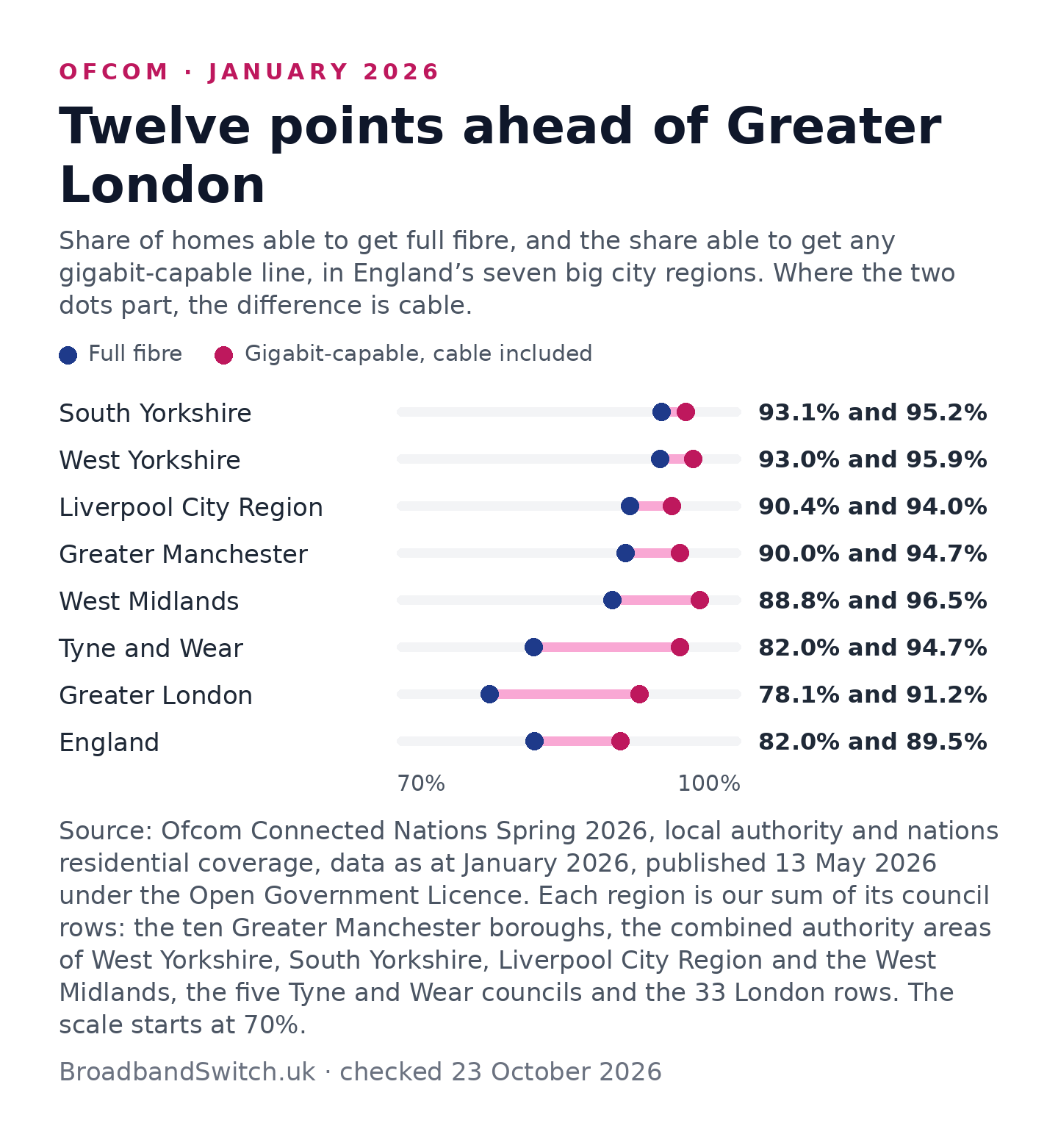
Each region here is the sum of its councils’ rows in Ofcom’s file, so the comparison is like for like: the ten boroughs against the combined authority areas of West Yorkshire, South Yorkshire, Liverpool City Region and the West Midlands, the five Tyne and Wear councils, and the 33 rows for London. On gigabit, which includes cable, Greater Manchester reaches 94.7%, against 89.5% for England. On take-up it is fourth of the seven, with 45.1% of covered homes using full fibre, against 47.9% in South Yorkshire, the highest, and 39.9% in the West Midlands, the lowest.
If you have moved here from London, the gap may surprise you. Ofcom does not give a reason, and we will not invent one, but the rest of this page points to a likely part of it: full fibre arrives most easily in streets of houses, and a block of flats needs its owner’s agreement before a network can wire it. Greater Manchester is a region of terraces and semis, as the census section shows, and its own figures are lowest where the flats are, in the middle of Manchester and Salford. For the capital’s own story, the Greater London page has it borough by borough, and Liverpool and Leeds have pages of their own.
Fibre in the street, not yet in the house
Direct answer: In January 2026, 45.1% of Greater Manchester homes that could get full fibre had taken it, on our weighting of Ofcom’s borough figures, against 46.2% for England on the same weighting. Bury led at 58%; Bolton, at 36%, had the most room to grow.
Ofcom, January 2026
Every 100 Greater Manchester homes as the windows of a cotton mill
- 40have full fibre now
- 50could order it and have not yet
- 10cannot get full fibre yet
Ofcom Connected Nations Spring 2026, the ten borough rows added together: full fibre 90.0% of homes, full fibre lines 40% of all homes. One window per home in a hundred, drawn by us. About half of the last group can already get a gigabit line over cable.
Measured against all homes, covered or not, 40% across the region had a full fibre line. Openreach, writing about its own network on 27 August 2025, said that “More than one million homes and businesses in the region can already upgrade to Full Fibre”, and that “less than 35%” of those able to had upgraded. Its partnership director for Greater Manchester, Kasam Hussain, put it plainly: “But it’s important to remember that upgrades don’t happen automatically.” He also said: “People need to order it to take advantage of the technology.”

The pattern is not simply about how long the fibre has been there. Bury, with three of the first exchanges to stop selling copper, leads; but Salford, which had three as well, sits at 51%, and Oldham, with the most full fibre in the region, at 51%. In Wigan, Openreach said on 14 October 2025 that “less than 40 per cent” had upgraded on its network, and Ofcom’s count of every network puts the borough at 40%.
Already in the street
That leaves 55% of covered homes in the region still on an older line. If you are in that group, nobody needs to dig up the road: the fibre is outside, so it is a matter of placing an order, and where two or three networks compete the fibre deal may be no dearer than your current bill. The postcode box at the top lists the cheapest first.
Two deadlines also apply. Once three premises in four on an exchange can get full fibre, Openreach stops taking copper orders there, and from 31 January 2027 analogue phone lines end everywhere. The first has already arrived at 54 of the 65 exchanges on Openreach’s list for the region, and the exchange section names every one.
How much choice by 2029
Direct answer: On the builders’ plans, 84.8% of homes in the ten boroughs should have two or more gigabit networks by January 2029, and 52.6% three or more, against 74.0% and 36.0% across England. Oldham is heading furthest, with 79.5% of homes on three or more networks; Wigan, at 23.9%, has the fewest.
Ofcom, planned network deployments 2026
Twenty cells a row: how many gigabit networks each home should have by 2029
Greater Manchestertwo or more: 84.8%; three or more: 52.6%
England (all councils)three or more: 36.0%
Oldhamthree or more: 79.5%
Manchesterthree or more: 61.5%
Stockportthree or more: 60.5%
Traffordthree or more: 60.2%
Boltonthree or more: 54.7%
Tamesidethree or more: 54.4%
Rochdalethree or more: 53.5%
Salfordthree or more: 40.1%
Burythree or more: 40.0%
Wiganthree or more: 23.9%
- Three networks or more
- Two networks
- One network
- No plan yet
Ofcom, Planned Network Deployments 2026, residential file by local authority, all plans. For each area: the share of homes expected to have three or more gigabit-capable operators by January 2029, two or more, and any gigabit-capable line at all. Each cell is one twentieth of the area’s homes, rounded, and its dots are the number of networks. We weighted the council rows for Greater Manchester and England. Plans change.
Ofcom collects these forecasts from the builders every year and publishes them council by council. Taken together, for January 2029 they give the region 94.2% full fibre and 97.0% gigabit, against 92.2% and 95.3% for England. Ofcom expects from 11 to 15 gigabit builders to be at work in each of Manchester, Salford and Wigan, and from 6 to 10 in each of the other seven boroughs. For most addresses that means the comparison is no longer one network against another, but three or four sets of providers in one list.

Wigan moves from 88.1% to 89.5%, Stockport from 88.1% to 92.2% and Manchester from 86.6% to 92.5%, while Oldham, already at 94.6%, is heading for 99.5%. A plan is not a promise, though: builders change course, and the 2029 figure can rise or fall from one year’s file to the next.
The gaps are small, and mostly in the towns and the city. Ofcom counts 1,369 postcodes in the region with no gigabit plan at all for 2029, 256 of them in Manchester and 231 in Wigan, and only 129 planned lines paid for with public money, because almost all of the building here is commercial. Where a line cannot reach 10Mbps, the broadband Universal Service Obligation lets you ask BT for a connection that meets the decent standard Ofcom sets: a download speed of at least 10 Mbit/s and an upload speed of at least 1 Mbit/s.
The companies building Greater Manchester’s broadband
Direct answer: Openreach says more than one million homes and businesses in the region can upgrade to its full fibre, and Virgin Media O2 that nearly one million can get its gigabit services, so many homes can get both. CityFibre has built in Bolton, Rochdale and Wigan, the Netomnia network, sold as YouFibre, has town pages in every borough, and Hyperoptic has been in Manchester since 2014.
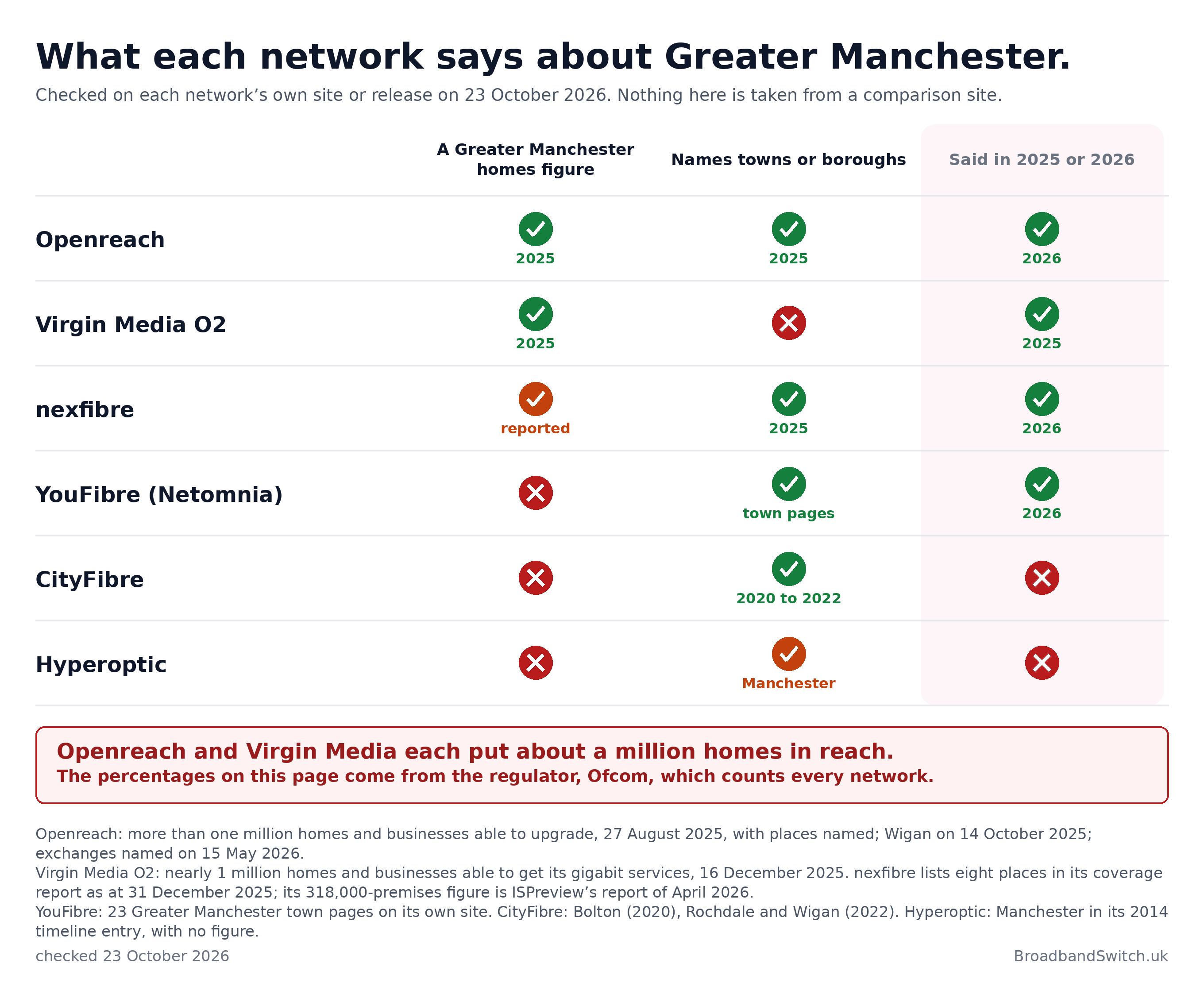
Your bill carries the provider’s name, but the fibre or cable outside belongs to a network company. Here each network is quoted from its own releases, each with its date, because what a company said in 2020 tells you less about your road than what it said this year. Not sure which network you use? Ask your provider: one question settles whether a switch means a new line or keeps the one you have.
Openreach, under most of the household names
BT, Sky, EE, Plusnet, Vodafone, TalkTalk and many smaller brands sell over Openreach. On 27 August 2025 it said that “More than one million homes and businesses in the region can already upgrade to Full Fibre”. It also said: “Openreach has invested £300m in the new Full Fibre network for Greater Manchester, reaching over 70 per cent of properties.” It named Cheetham, Middleton, Didsbury, Trafford, Ardwick, Droylsden, Rusholme, Moss Side and Sale among the areas where its engineers were working or about to start. Across the UK, it said on 15 May 2026, its full fibre passes “more than 22 million premises, around 60 per cent of the UK”.
Virgin Media O2, and nexfibre
On 16 December 2025, opening its new Manchester headquarters, Virgin Media O2 said there were “nearly 1 million homes and businesses in Greater Manchester now able to benefit from its gigabit services”. It put its investment in the region at “more than £100m” and its workforce there at “approximately 1,100 staff”, and its chief operating officer, Rob Orr, said: “Manchester is a thriving hub for innovation and creativity, and we’re proud to deepen our connection to the region”. nexfibre, the company that builds full fibre for Virgin Media to sell, lists Ashton, Bury, Greenfield, Manchester, Partington, Salford, South Manchester and Stretford in its coverage report as at 31 December 2025. ISPreview reported on 9 April 2026 that nexfibre would spend £44m upgrading 318,000 premises in Greater Manchester to full fibre.
Netomnia, YouFibre and Brsk, and a deal under review
Netomnia builds the network and YouFibre sells over it, and the Brsk name has been folded in: the old Brsk site now says “Brsk is now YouFibre.” YouFibre has its own pages for 23 Greater Manchester towns: Altrincham, Ashton-in-Makerfield, Ashton-under-Lyne, Bolton, Bury, Cheetham Hill, Golborne, Horwich, Marple, Middleton, Milnrow, Oldham, Rochdale, Sale, Salford, Shaw, Stockport, Stretford, Swinton, Urmston, Walkden, Whitefield and Wythenshawe. ISPreview has followed Netomnia town by town, reporting 35,000 premises in Oldham on 25 February 2026 and 40,000 in Sale on 18 June 2026.
The ownership is changing. On 18 February 2026 nexfibre announced a £2 billion deal to buy Substantial Group, Netomnia’s parent, and said that “nexfibre will sell Substantial Group’s retail business, including the YouFibre and Brsk brands”. Its chief executive, Rajiv Datta, said: “This transaction creates the largest alternative fibre platform in the UK”. At the time it said: “Completion of the transaction is subject to customary regulatory approvals and is expected by Q3 2026.” The Competition and Markets Authority then opened an in-depth Phase 2 inquiry on 1 July 2026 into the deal between nexfibre and “Substantial (including Netomnia, Brsk, Brsk ISP and YouFibre)”, and its interim report of 2 October 2026 said that “The CMA has provisionally found competition concerns in the wholesale supply of wholesale fixed broadband services”. The deadline for its decision is 15 December 2026.
For a household, nothing changes today: a YouFibre or Virgin Media contract runs as before, and the postcode check lists whichever networks reach you. Our altnet consolidation tracker follows the case, and our YouFibre page and our Virgin Media page cover each provider.
CityFibre in Bolton, Rochdale and Wigan
CityFibre builds its network and other companies sell over it. In Bolton it took over an earlier project, noting that “The project was formerly led by FibreNation”, and committed £37m on 18 November 2020. In Rochdale it began a £30m build on 9 August 2022, and in Wigan another £30m on 12 December 2022. We found no CityFibre build in the city of Manchester itself, which is one of the corrections at the foot of this page.
Hyperoptic, since 2014
Hyperoptic’s own timeline for 2014 reads: “We launch in Cardiff, Bristol, Liverpool and Manchester.” It now says that “Hyperoptic is now live in 64 towns and cities, with more joining the network every year”, but publishes no figure for Greater Manchester. If your building is wired, it appears in the postcode check like any other network, and our Hyperoptic page covers its packages.
Zen, and the public sector’s own network
Zen is a provider rather than a network, and a local one: writing on 18 January 2023, its founder Richard Tang marked CityFibre’s build “here in our hometown of Rochdale”. Our Zen page has its packages. The region’s public buildings have a network of their own. On 16 March 2020 the combined authority announced a full fibre programme for public sites, with Virgin Media Business as supplier, and the then broadband minister, Matt Warman, said that “our £23 million investment in Greater Manchester will give hundreds of public buildings the fastest broadband available”. The mayor, Andy Burnham, said: “This is a huge achievement for Greater Manchester’s public sector and really demonstrates the value of collaboration.”
Sixty-five exchanges and the copper switch-off
Direct answer: 54 of the 65 Greater Manchester exchanges on Openreach’s stop sell list had stopped selling copper by 23 October 2026, from the first eight on 13 October 2021 to Sale, Ringway and three others on 19 August 2026. Another 10 have dates, from Didsbury and Rusholme on 6 November 2026 to Pendleton on 4 November 2027, and Marple’s is not yet set.
Two different switch-offs get confused. One is national and fixed, and Openreach puts it like this: “By 31 January 2027, all UK providers must move from analogue to digital phone lines.” The other, stop sell, comes exchange by exchange: “Stop Sell is triggered when a majority (75%) of premises connected to a particular exchange can get ultrafast Full Fibre”. Openreach’s stop sell page says: “Openreach will provide 12 months’ notice for any exchange that will be impacted by this Stop Sell programme.” It adds that “any end customer who already has the product will be able to continue using it (until it is withdrawn)”. What stop sell changes is your next order: move home, change provider or change speed, and if fibre reaches you, the new service runs over it.
Openreach, 8 October 2026
Exchanges that have stopped selling copper, year by year
- Copper sales already stopped
- Date set, still to come
Openreach, “FTTP Priority Exchanges: List of Exchanges where order restrictions will be / are applied”, version of 8 October 2026, every exchange whose location is given as Greater Manchester, counted by the year its order restriction date falls in. Marple, whose date is not yet set, is the 65th on the list and is not drawn.
Greater Manchester got there early. When the first round went live, BT Wholesale recorded: “Due to delays caused by the coronavirus pandemic the first tranche of upgrades was split in two.” And: “The rest went live on 13 October 2021, along with Tranche 2.” Greater Manchester has eight exchanges in that round of 13 October 2021: Failsworth, Walkden, Eccles, Swinton, Prestwich, Whitefield and Radcliffe in Tranche 1b, and Wythenshawe in Tranche 2. Wigan has more exchanges on the list than any other borough, 11, and every one of them has now passed its date.
Openreach and BT Wholesale, 2021 to 2027
Greater Manchester’s copper switch-off, from the first exchanges to the last
- 13 October 2021The first eight Failsworth, Walkden, Eccles, Swinton, Prestwich, Whitefield, Radcliffe and Wythenshawe, among the first in the UK.
- 4 June 2024Seven in one day Altrincham, Denton, Mercury, Saddleworth, Shaw, Stalybridge and Upholland.
- 14 February 2026The big town exchanges Bolton, Stockport and Wigan, with Chorlton, Gatley and Longford.
- 19 August 2026Sale, Ringway and three more Tottington, Appley Bridge and Higher Bolton, which took the region to 54.
- 23 October 2026This page checked Openreach updates its list as each round is announced.
- 6 November 2026Didsbury and Rusholme Both in the city of Manchester.
- 31 January 2027The end of analogue phone lines Calls on any remaining analogue line move to a digital service carried over broadband.
- 12 February 2027Middleton, Littleborough and Daubhill
- 3 June 2027Cheetham, Collyhurst, Farnworth and Ramsbottom Named in Openreach’s round of 15 May 2026.
- 4 November 2027Pendleton, the last date on the list Marple’s date is not yet set.
Dates from Openreach’s “FTTP Priority Exchanges: List of Exchanges where order restrictions will be / are applied”, version of 8 October 2026, and its announcement of 15 May 2026; the first round as BT Wholesale’s November 2025 list describes it. Every source read 23 October 2026.
The full list is below, from the first date to the last. Openreach’s list is the source to trust: it is updated as each round is announced, and BT Wholesale’s copy of November 2025 carries the same dates up to the November 2026 round.
All 65 exchanges, by dateopen the list
| Code | Tranche | |||
|---|---|---|---|---|
| Prestwich | Bury | MRPRE | 1b | 13 October 2021 |
| Radcliffe | Bury | MRRAD | 1b | 13 October 2021 |
| Whitefield | Bury | MRWHI | 1b | 13 October 2021 |
| Wythenshawe | Manchester | MRWYT | 2 | 13 October 2021 |
| Failsworth | Oldham | MRFAI | 1b | 13 October 2021 |
| Eccles | Salford | MRECC | 1b | 13 October 2021 |
| Swinton | Salford | MRSWI | 1b | 13 October 2021 |
| Walkden | Salford | MRWAL | 1b | 13 October 2021 |
| Woodley | Stockport | MRWOO | 6 | 1 November 2022 |
| Bury | Bury | MRBUR | 7 | 8 February 2023 |
| Irlam | Salford | MRIRL | 8 | 9 May 2023 |
| Hulme Hall | Stockport | MRHUL | 8 | 9 May 2023 |
| Bramhall | Stockport | MRBRA | 10 | 9 November 2023 |
| Hyde | Tameside | MRHYD | 11 | 16 February 2024 |
| Mercury | Manchester | MRMER | 12 | 4 June 2024 |
| Saddleworth | Oldham | MRSAD | 12 | 4 June 2024 |
| Shaw | Oldham | LCSHW | 12 | 4 June 2024 |
| Denton | Tameside | MRDEN | 12 | 4 June 2024 |
| Stalybridge | Tameside | MRSTA | 12 | 4 June 2024 |
| Altrincham | Trafford | MRALT | 12 | 4 June 2024 |
| Upholland | Wigan | LVUPH | 12 | 4 June 2024 |
| Horwich | Bolton | LCHOR | 13 | 16 August 2024 |
| Heywood | Rochdale | LCHEW | 13 | 16 August 2024 |
| Heaton Moor | Stockport | MRHEA | 13 | 16 August 2024 |
| Mottram | Tameside | MRMOT | 14 | 8 November 2024 |
| Droylsden | Tameside | MRDRO | 15 | 17 February 2025 |
| Platt Bridge | Wigan | LCPLB | 15 | 17 February 2025 |
| East | Manchester | MREAS | 16 | 26 May 2025 |
| Oldham | Oldham | MROLD | 16 | 26 May 2025 |
| Mossley | Tameside | MRMSL | 16 | 26 May 2025 |
| Aspull | Wigan | LCASL | 16 | 26 May 2025 |
| Atherton | Wigan | LCATH | 16 | 26 May 2025 |
| Leigh | Wigan | LCLEI | 16 | 26 May 2025 |
| Astley Bridge | Bolton | LCASB | 17 | 19 August 2025 |
| Urmston | Trafford | MRURM | 17 | 19 August 2025 |
| Hindley | Wigan | LCHIN | 17 | 19 August 2025 |
| Westhoughton | Bolton | LCWES | 18 | 6 November 2025 |
| Bolton | Bolton | LCBOL | 19 | 14 February 2026 |
| Chorlton | Manchester | MRCHO | 19 | 14 February 2026 |
| Gatley | Stockport | MRGAT | 19 | 14 February 2026 |
| Stockport | Stockport | MRSTO | 19 | 14 February 2026 |
| Longford | Trafford | MRLON | 19 | 14 February 2026 |
| Wigan | Wigan | LCWIG | 19 | 14 February 2026 |
| Moss Side | Manchester | MRMOS | 20 | 5 June 2026 |
| Rochdale | Rochdale | LCROC | 20 | 5 June 2026 |
| Ashton | Tameside | MRASH | 20 | 5 June 2026 |
| Ashton-in-Makerfield | Wigan | LCAIM | 20 | 5 June 2026 |
| Orrell | Wigan | LCORR | 20 | 5 June 2026 |
| Standish | Wigan | LCSTD | 20 | 5 June 2026 |
| Higher Bolton | Bolton | LCHIG | 21 | 19 August 2026 |
| Tottington | Bury | LCTOT | 21 | 19 August 2026 |
| Ringway | Trafford | MRRIN | 21 | 19 August 2026 |
| Sale | Trafford | MRSAL | 21 | 19 August 2026 |
| Appley Bridge | Wigan | LCAPB | 21 | 19 August 2026 |
| Didsbury | Manchester | MRDID | 22 | 6 November 2026 |
| Rusholme | Manchester | MRRUS | 22 | 6 November 2026 |
| Daubhill | Bolton | LCDAU | 23 | 12 February 2027 |
| Littleborough | Rochdale | LCLIT | 23 | 12 February 2027 |
| Middleton | Rochdale | MRMID | 23 | 12 February 2027 |
| Farnworth | Bolton | LCFAR | 24 | 3 June 2027 |
| Ramsbottom | Bury | LCRAM | 24 | 3 June 2027 |
| Cheetham | Manchester | MRCHE | 24 | 3 June 2027 |
| Collyhurst | Manchester | MRCOL | 24 | 3 June 2027 |
| Pendleton | Salford | MRPEN | 26 | 4 November 2027 |
| Marple | Stockport | MRMAR | to be set | not yet set |
Italic rows are still to come. An exchange is named after its building rather than the area it serves, and Openreach files each one under the borough where it stands, so yours may carry another place’s name; Openreach’s own checker tells you which exchange you are on. Stop sell ends new copper orders only: a line that works today keeps working. Source: Openreach’s list of 8 October 2026, read 23 October 2026. Press a heading to sort.
Stop sell and your own line
- Staying put on the same deal? Nothing has to change yet. Your copper service carries on, and the only date that applies to everyone is 31 January 2027, the end of analogue calls.
- Changing provider, speed or address? That is when stop sell bites, in Openreach’s words: “Customers who then want to switch, upgrade or re-grade their broadband or phone service will have to take a new digital service over our new Full Fibre network.”
- Fibre not at your address yet? Then the copper service stays on sale to you until it arrives, Openreach says.
Openreach’s announcement of 15 May 2026 is quoted in the middle point and paraphrased by us in the other two.
For most homes the change comes down to a phone that plugs into the router rather than the wall socket. If a care alarm, a lift line or a burglar alarm uses your phone line, talk to whoever supplies it, and to your broadband provider, before anything changes; our care alarm guide lists what to ask. The landline switch-off checker works for any number here, and our explainer on Openreach’s stop sell exchanges covers the national programme. If you are moving, ask the agent or seller which networks already serve the home, so the connection can be booked ahead of moving day.
The city centre’s slow-line puzzle
Direct answer: Nearly half of the region’s homes that cannot get 30Mbit/s are in two seats in the middle of the conurbation: 2,778 in Manchester Central and 2,698 in Salford, 5,476 together, or 48% of the 11,376 across the ten boroughs. These are the seats with the centres of Manchester and Salford in them, not remote farmland.
Across the region as a whole, 0.9% of homes cannot get 30Mbit/s, so the central figure stands out. Ofcom’s seat file does not say why, and we have not surveyed the buildings. Three explanations are possible, and none can be checked from the data: blocks wired by a single network under a deal with the building’s owner, new buildings whose network has not yet shown up in what operators report to Ofcom, and blocks where nobody has yet signed the agreement that lets a network in. What the data does show is that superfast availability in the Salford seat, 95.8%, and Manchester Central, 95.9%, is lower than in any other seat but Rusholme, whose figure is pulled down by counting.
Manchester Rusholme has a different problem, one of counting. Ofcom could not match 4,655 of its premises to its coverage data, 10% of the seat, against 4,840 across the whole of Manchester, and in its percentages an unmatched home counts in the total but not among the covered. Over the matched premises alone, Rusholme’s full fibre is 86.2% rather than 77.5%. Some of those homes may well have a good line; the data simply cannot say. The seat also has 396 homes that cannot get 30Mbit/s.
If you live in a city-centre block
Start with the postcode check, which looks at the address rather than the seat. If it shows a short list, or none of the fast lines, ask the building manager or managing agent which networks are installed and whether another can be let in. A network needs the building owner’s permission, called a wayleave, to wire a block, and our wayleave guide explains what the owner is being asked to sign. Students in halls should start with our page on student halls. And if even 10Mbps is out of reach, the Universal Service Obligation described above applies to a flat as much as a house.
Terraces, flats and whose permission you need
Direct answer: Greater Manchester is a region of terraces and semis. On the 2021 census 28.5% of households lived in a terraced house and 37.9% in a semi, against 23.0% and 31.5% across England, and fewer lived in flats, 19.3% against 22.2%. The city of Manchester is the exception, with 34.6% of households in flats.
Census 2021
What kind of home, borough by borough
Greater Manchester
owned 58.6%England
owned 62.3%Manchester
owned 38.0%Salford
owned 47.5%Trafford
owned 69.6%Stockport
owned 72.3%Tameside
owned 61.1%Bury
owned 67.3%Bolton
owned 61.9%Rochdale
owned 60.6%Oldham
owned 60.8%Wigan
owned 66.8%- Terraced
- Semi-detached
- Detached
- Flat
ONS Census 2021, tables TS044 Accommodation type and TS054 Tenure, households, via nomis. Flats count purpose-built blocks, converted houses and flats in commercial buildings. Caravans and other mobile homes, well under 1% everywhere here, are left out, so a bar can stop just short of the end. “Owned” includes shared ownership. Boroughs run from most flats to fewest.
The census counts 1,178,244 households in the ten boroughs. Oldham has the most terraced houses, 38.5% of its households, and Wigan the fewest flats, 9.1%. Ownership follows the same lines: 58.6% of households across the region own their home, against 62.3% in England, from 72.3% in Stockport to 38.0% in Manchester, where 32.5% rent privately. Social renting, at 20.7% against 17.1% for England, is a bigger part of the region’s story, which makes councils and housing associations important gatekeepers for new lines.
In a terrace or a semi there is usually little to it: the fibre arrives from a pole or an underground duct, the engineer fits a small white box low on an inside wall, and the router connects to that, usually in one visit. Renting? Ask the landlord before any drilling, and if the reply is slow, a tenant’s rights to full fibre explains what you can do. Moving to a new provider over the line you already have needs no one’s say-so, as switching in a rented property explains.
In a block of flats, the network needs a signature before it can wire the building: from the council or housing association in a social block, or the freeholder or managing agent in a private one. Our wayleave guide covers what the paperwork asks for and why owners are not normally charged. Sharing a house or a flat near one of the universities? Our student broadband guide is the place to start.
Lower prices on certain benefits
Direct answer: If you claim Universal Credit, Pension Credit or one of several other benefits, many providers in Greater Manchester will sell you a cheaper social tariff, and Ofcom spells out the exit terms: “It costs nothing to leave. You won't pay a fee to leave the tariff before the end of your contract.”
What you can get depends on the networks at your address. Where Virgin Media reaches you, the offer is simple: Essential Broadband is £12.50 a month for 15 Mbps and Essential Broadband Plus £20 for 54 Mbps, both on a rolling 30-day contract, and both are open to new and existing customers on the qualifying benefits. Over Openreach, BT Home Essentials is £16.50 a month, while Vodafone Essentials is £20 a month for up to 80 Mbps on a 12 months contract. Sky’s tariff is for people already with Sky: “Our Sky Broadband Basics offer is only available if you already have Sky Broadband with us”. In buildings wired by Hyperoptic, its Fair Fibre 150Mb plan is £13 a month. Ofcom’s own list ran to 33 social tariffs when we last read it, and our social tariffs guide has them all, with who qualifies for each.
In the 1,369 postcodes in the region with no gigabit plan for 2029, the help that matters is a connection rather than a cheaper bill, and the Universal Service Obligation is the route. Everywhere else, the cheapest deal is simply the top line of your postcode search.
Your borough in one card
Direct answer: Pick your borough to see its Ofcom figures, its 2029 plans, its seats and every exchange on the stop sell list, in one card. The lookup runs on your own device and sends nothing anywhere.
Your part of Greater Manchester, in one card
The ten boroughs, each with Ofcom’s January 2026 figures, the builders’ plans for 2029, the 2021 census, its Westminster seats and its exchanges. Don’t know your seat? Put your postcode into the UK Parliament’s Find your MP page and it will tell you.
What the old version of this page got wrong
Direct answer: Five corrections: coverage figures from third-party sites in place of Ofcom’s, a Virgin Media share Virgin Media does not give, Brsk described after it became YouFibre, CityFibre placed in a city where we found no build, and a Hyperoptic share with no source.
The old page ran to more than ten thousand words, presented itself as a Manchester page while claiming to cover all ten boroughs, and recommended packages and prices, few of them dated or sourced. It also leaned on a crowd-sourced average speed, which nobody can audit. In this version a figure stays only if a primary source stands behind it; anything else has been removed rather than rephrased, and when a company’s own description differs from what the old page said, we use the company’s. We have also dropped the price tables: providers set prices nationally, so the place to see them is your own postcode search. One thing the old page had right survives: Hyperoptic has been in Manchester since 2014.
Coverage figures from a third party, and an altnet share nobody publishes
What we saidThis page gave Manchester “approximately 87.84% FTTP”, “approximately 92% gigabit-capable” and “approximately 67% altnet coverage”, figures it credited to ThinkBroadband and Switchity rather than to the regulator. Ofcom’s figures for the city in January 2026 are 86.6% full fibre and 90.1% gigabit, and Ofcom publishes no share for alternative networks.
What we say now, and whyOfcom’s figures for every borough and every seat, dated, with the region and England beside them.
A Virgin Media share Virgin Media does not give
What we saidThis page said Virgin Media covered “approximately 62% of Manchester city premises”, “lower than many comparable UK cities”. Virgin Media O2 gives no city share. On 16 December 2025 it said there were “nearly 1 million homes and businesses in Greater Manchester now able to benefit from its gigabit services”, and Ofcom’s gigabit figure for Manchester, which counts cable, is 90.1%.
What we say now, and whyVirgin Media O2 in its own words and dated, with nexfibre’s list of places and Ofcom’s gigabit figures.
Brsk, which is now YouFibre
What we saidThis page said “Brsk dominates parts of South Manchester and Stretford” and named a “BetterNet2000” package. The old Brsk site now says “Brsk is now YouFibre.” The network is Netomnia’s, YouFibre has pages for 23 Greater Manchester towns, and nexfibre’s deal for the group is with the Competition and Markets Authority, whose deadline is 15 December 2026. We found no source for “dominates”.
What we say now, and whyYouFibre and Netomnia as they now stand, with the deal and the review dated.
CityFibre placed in the wrong city
What we saidThis page called CityFibre “particularly strong in Manchester”. CityFibre’s own releases describe builds in Bolton (£37m, 18 November 2020), Rochdale (£30m, 9 August 2022) and Wigan (£30m, 12 December 2022). We found none for the city of Manchester.
What we say now, and whyCityFibre’s three Greater Manchester towns, each with its release and date.
A Hyperoptic share with no source behind it
What we saidThis page said Hyperoptic had operated in Manchester since 2014, which its own timeline confirms: “We launch in Cardiff, Bristol, Liverpool and Manchester.” It also put Hyperoptic at “approximately 25% of the city”. Hyperoptic publishes no such figure; it says that “Hyperoptic is now live in 64 towns and cities, with more joining the network every year”.
What we say now, and whyHyperoptic in its own words, with the date it gives and no share it does not.
Greater Manchester broadband: frequently asked questions
What percentage of Greater Manchester has full fibre broadband?
Ofcom’s January 2026 figure for the ten boroughs together is 90.0% of homes, against 82% for England and 81.8% for the UK. The gigabit figure, which includes cable, is 94.7%, and on the builders’ plans full fibre reaches 94.2% by January 2029.
Which Greater Manchester borough has the best broadband?
Oldham, on Ofcom’s January 2026 figures: 94.6% full fibre and 97.9% gigabit, 22nd and 10th of England’s 296 councils. Bury has the highest take-up, 58%, and Manchester the lowest full fibre of the ten, 86.6%, though still above England.
Why is full fibre lower in the city of Manchester?
Mostly because of the centre. Manchester Central and the Salford seat hold 48% of the region’s homes that cannot get 30Mbit/s, and in Manchester Rusholme Ofcom could not match 4,655 premises to its data, which pulls the seat’s figure down to 77.5%. The city is still 94th of England’s 296 councils for full fibre.
How many Greater Manchester homes have switched to full fibre?
On our weighting of Ofcom’s January 2026 borough figures, 45.1% of the homes that could have full fibre had ordered it, from 58% in Bury to 36% in Bolton. Counted against every home, 40% had a full fibre line.
Is broadband better in Greater Manchester than in London?
On full fibre, yes, by a distance: 90.0% across the ten boroughs against 78.1% across Greater London in January 2026, on Ofcom’s figures added up by council. Greater Manchester is fourth of England’s seven big city regions, behind South and West Yorkshire and Liverpool City Region.
Is Virgin Media available across Greater Manchester?
Across much of it. Virgin Media O2 said on 16 December 2025 that there were “nearly 1 million homes and businesses in Greater Manchester now able to benefit from its gigabit services”, and Ofcom’s gigabit figure for the region, which counts cable, is 94.7%. Whether your street has it is a question for the postcode check.
Is CityFibre available in Manchester?
CityFibre’s Greater Manchester builds are in Bolton, Rochdale and Wigan, announced between 18 November 2020 and 12 December 2022. We found no CityFibre build in the city of Manchester itself, so in the city the choice is usually Openreach, Virgin Media and the newer networks such as Netomnia’s.
What happened to Brsk?
Brsk is now part of YouFibre, which sells over the Netomnia network; the old Brsk site says “Brsk is now YouFibre.” The group that owns them is being bought by nexfibre, and the Competition and Markets Authority’s deadline for a decision on the deal is 15 December 2026. Existing contracts carry on as before.
Which Greater Manchester exchanges have stopped selling copper?
54 of the 65 on Openreach’s list for the region, as at 23 October 2026. The first eight stopped on 13 October 2021, and the next are Didsbury and Rusholme on 6 November 2026. The full list, with every date, is in the exchange section.
What is happening to landlines in Greater Manchester?
Analogue phone lines are going digital across the UK: “By 31 January 2027, all UK providers must move from analogue to digital phone lines.” Where an exchange has reached stop sell, a move, a switch or an upgrade puts you onto a digital service over fibre, and a working line keeps working until then. Anyone with a care alarm on the line should talk to its supplier first.
Will I have more choice of broadband network by 2029?
Very likely. On the builders’ plans, 84.8% of homes in the ten boroughs should have two or more gigabit networks by January 2029 and 52.6% three or more, against 74.0% and 36.0% across England. Plans can change, so check what reaches you today with the postcode check.
Do I need permission to get full fibre in a flat or a rented home?
To wire a block, the network needs a wayleave from whoever owns it, the council, a housing association or the freeholder, and a tenant should check with the landlord before anyone drills. Changing provider over a line that is already in place needs nobody’s permission.
Is there cheaper broadband in Greater Manchester if I receive benefits?
Yes, for people on Universal Credit, Pension Credit and several other benefits. Virgin Media’s Essential Broadband, BT Home Essentials at £16.50 and Vodafone Essentials at £20 are among the social tariffs, and which you can take depends on the networks at your address. None of them charges you to leave early.
How current is this page?
All sources were last read on 23 October 2026. Ofcom’s figures describe January 2026 and came out in May, the census was taken in 2021, and the exchange dates come from Openreach’s list of 8 October 2026. Every quotation from a company is dated, so you can judge how fresh it is.
In short
- In January 2026 Ofcom counted 90.0% of homes in the ten boroughs able to get full fibre, against 82% for England, and every borough was above the England figure.
- Oldham leads at 94.6% and Manchester trails at 86.6%, held back mostly by the city centre.
- The region is 12 points ahead of Greater London and fourth of England’s seven big city regions.
- 45.1% of homes able to get full fibre had ordered it, from 58% in Bury to 36% in Bolton, so for many homes the upgrade is an order away.
- On the builders’ plans, 84.8% of homes should have two or more gigabit networks by 2029, and 52.6% three or more.
- Openreach has stopped selling copper at 54 of the region’s 65 exchanges on its list, and analogue phone lines end on 31 January 2027.
- Most homes are on Openreach, Virgin Media or both; CityFibre, YouFibre on Netomnia and Hyperoptic add a third network in many places, and the Netomnia deal is with the competition regulator.
- None of this replaces your own address: the postcode check shows which providers reach you and what they charge.
Each point stands on its own and carries its date. We review the page every quarter at least; the last review was on .
References
- OFCOM.ORG.UK
Ofcom. (2026, May 13). Connected Nations update: Spring 2026, with its open data on fixed broadband coverage and full fibre take-up by council, Westminster seat and nation, as at January 2026, under the Open Government Licence. Every coverage and take-up figure here for the boroughs, seats, city regions, England and the UK. Downloaded 23 October 2026.
- OFCOM.ORG.UK
Ofcom. (2026, May 13). Connected Nations: Planned network deployments 2026, residential file for local and unitary authorities. The 2029 forecasts, the counts of homes with two and three networks, the builder ranges, the postcodes without a plan and the lines paid for with public money. Downloaded 23 October 2026.
- OFCOM.ORG.UK
Ofcom. (2025, November 19). Connected Nations 2025: Methodology annex, where the definitions of full fibre and gigabit-capable quoted here come from. Read 23 October 2026.
- NOMISWEB.CO.UK
Office for National Statistics. (2023). Census 2021, tables TS044 Accommodation type and TS054 Tenure, households, by local authority and for England, via nomis. Every household, home type and tenure figure on this page. Read 23 October 2026.
- OPENREACH.COM
Openreach. (2025, August 27). Full fibre broadband boost for one million Greater Manchester homes and businesses. The one million, the take-up figure, the £300m, the areas named and Kasam Hussain’s quotations. Read 23 October 2026.
- OPENREACH.COM
Openreach. (2025, October 14). Broadband boost for Wigan. The 40,000 homes and businesses, the take-up figure and the £12m. Read 23 October 2026.
- OPENREACH.COM
Openreach. (2026, May 15). Openreach stops copper for another 1.69 million premises in bid to push customers to new digital lines. The stop sell trigger, what it means for switching, the size of the national footprint, and the notices for Cheetham, Collyhurst, Farnworth and Ramsbottom. Read 23 October 2026.
- OPENREACH.CO.UK
Openreach. (2026, October 8). FTTP Priority Exchanges: List of Exchanges where order restrictions will be / are applied, version 35, communications provider portal; with Stop sell and Switching off ISDN and PSTN, help pages. Every Greater Manchester exchange, code, tranche and date, the 12 months’ notice and the analogue switch-off date. Read 23 October 2026.
- BTWHOLESALE.COM
BT Wholesale. (2025, November). Product stop sells and FTTP exchange upgrades. The split first round of 2021, cross-checked against Openreach’s list. Read 23 October 2026.
- VIRGINMEDIAO2.CO.UK
Virgin Media O2. (2025, December 16). Virgin Media O2 opens doors to new Manchester HQ as part of major investment in the region. The nearly 1 million homes and businesses, the investment, the staff and Rob Orr’s quotation. Read 23 October 2026.
- NEXFIBRE.CO.UK
nexfibre. (2026, February). Network coverage update, as at 31 December 2025; and nexfibre. (2026, February 18). Netomnia news. The Greater Manchester places in the footprint, the £2 billion deal, the sale of the retail brands, Rajiv Datta’s quotation and the expected completion. Read 23 October 2026.
- ISPREVIEW.CO.UK
ISPreview. (2026, February 25; April 9; June 18). Reports of Netomnia’s coverage in Oldham and in Sale, and of nexfibre’s £44m plan for 318,000 Greater Manchester premises. Read 23 October 2026.
- GOV.UK
Competition and Markets Authority. (2026). nexfibre / Substantial merger inquiry, case page. The Phase 2 reference, the interim report of 2 October 2026 and the statutory deadline. Read 23 October 2026.
- YOUFIBRE.COM
YouFibre. (n.d.). Brsk, and Locations town pages. “Brsk is now YouFibre” and the 23 Greater Manchester towns with a page. Read 23 October 2026.
- CITYFIBRE.COM
CityFibre. (2020, November 18). CityFibre continues to accelerate Bolton’s digital transformation; (2022, August 9). CityFibre breaks new ground in Rochdale with £30m full fibre investment; and (2022, December 12). CityFibre gets to work on future-proofing Wigan’s digital foundations with £30m full fibre investment. The three builds and the quotations. Read 23 October 2026.
- HYPEROPTIC.COM
Hyperoptic. (2026). About us. The 2014 timeline entry and the 64 towns and cities. Read 23 October 2026.
- ZEN.CO.UK
Zen Internet. (2023, January 18). Rochdale-based Zen and CityFibre celebrate ‘once in a generation internet’ coming to town, blog post by Richard Tang. Read 23 October 2026.
- GREATERMANCHESTER-CA.GOV.UK
Greater Manchester Combined Authority. (2020, March 16). Greater Manchester commits to world-class digital infrastructure. The public sector full fibre programme and the quotations from Matt Warman and Andy Burnham. Read 23 October 2026.
- WIKIPEDIA.ORG
Wikipedia. (n.d.). Articles on the 27 Greater Manchester constituencies of 2024, for their ward lists, which follow the Boundary Commission for England’s 2023 review. Used only for the borough line under each seat. Read 23 October 2026.
- PARLIAMENT.UK
UK Parliament. (n.d.). Find your MP. The constituency finder the borough lookup points to. Read 23 October 2026.
How switching works
Switching in Greater Manchester: three steps
- Step 1Type the postcode, then choose your home
Flats in one block, or houses on one terrace, are not always on the same network, so the exact address matters.
- Step 2Compare every network in one list
Openreach, Virgin Media and any newer network at the address appear together, lowest price first, and looking costs nothing.
- Step 3Order, and the switch is arranged for you
The provider you are joining tells the one you are leaving. You make no call to cancel, and the old service stops as the new one starts.
How switching works under Ofcom’s One Touch Switch rules, in place since September 2024; the process is the same in every borough.
Your address, every provider
Enter a Greater Manchester postcode, choose the address, and within seconds you see each provider that can connect it, cheapest at the top. The rest of this page is about the region; this part is about your home.
Compare at my postcode →