PLYMOUTH · THREE SEATS · 20 WARDS
Plymouth broadband: gigabit in most streets, ward by ward
Plymouth is a gigabit city. Ofcom’s January 2026 count found a gigabit-capable line on offer to 94.9% of its 122,511 homes, against 89.5% across England. That ranks it 75th of England’s 296 councils.
Cable does a big share of that work. For 20,007 homes, Virgin Media’s cable is the only gigabit route, while full fibre reached 78.6%. The other story is orders: only 32% of homes that could get full fibre had one, the lowest share in Devon.
The builders plan full fibre for 95.5% of homes by January 2029. Further down are all 20 wards, the three seats, a simple guide to cable and fibre, the five exchanges stopping copper sales and the landline change due on 31 January 2027. For your own home, the postcode check has the last word.
Looking for your own neighbourhood? Open the ward card or run down the ward ladder. Just after a better price? Jump to the live deals.
Start with your own street
Direct answer: Almost every home in Plymouth can get a fast line, and the networks on offer change from one road to the next. In January 2026, Ofcom counted 94.9% of homes able to get gigabit and 78.6% able to get full fibre. The live list below works out your own address.
Three networks do the heavy lifting. Openreach carries BT, Sky, TalkTalk, Vodafone, EE and plenty of smaller providers. CityFibre has been building its own full fibre across the city since 2021, and Virgin Media’s cable runs under many streets as well. Further down, each network speaks for itself, quoted from its own announcements.
Before you pick a deal
- Add up the whole contract. The opening price is only part of the story, because most deals rise every April, so a quick sum over the full term shows the real cost.
- Look at the upload figure. Full fibre usually sends as fast as it receives, which helps with video calls, cloud backups and sharing big files. Cable tends to upload far more slowly than it downloads.
- Weigh the contract length. If you rent or move often, a shorter term can be worth a few pounds more each month.
- Think about the Wi-Fi. Solid stone walls and tall terraces can block a signal between floors, so a mesh kit or a second access point may help.
Working from home?
Video calls lean on a steady upload more than a huge download. If two of you work from home, look for a package with a strong upload, and keep the router somewhere central and in the open rather than tucked in a cupboard.
Switching takes one order
Ofcom’s One Touch Switch rules have covered home broadband since 12 September 2024. You place one order with the new provider, it lets the old one know, and the changeover happens on an agreed day, so you never pay twice for the same line.
Fibre, cable and copper under the city
Direct answer: Homes in Plymouth are served by three kinds of line: full fibre, Virgin Media’s cable and older copper. In January 2026, 96,239 homes could order full fibre, and a further 20,007 could get gigabit only over cable.
Ofcom, January 2026
A hundred portholes, one for every home
- 25are on full fibre now
- 54could order full fibre today
- 16reach gigabit only through cable
- 5have no gigabit line yet
Built from three of Ofcom’s January 2026 measures for Plymouth: full fibre lines in use as a share of all homes, full fibre coverage and gigabit coverage. The groups are rounded so the portholes total exactly 100.
Start at the waterline and count upwards. In every 100 homes, 25 already use full fibre and 54 could order it today. Another 16 get gigabit only through cable, and 5 have no gigabit-capable line yet. Altogether that leaves 6,265 of the city’s 122,511 homes without gigabit.
A quick word on the jargon. A gigabit-capable line can carry a thousand megabits a second, enough for a full house to stream, game and join video calls at once. Full fibre brings glass all the way to your home. Cable reaches gigabit downloads by mixing fibre in the street with copper coaxial wire into the house.
Cable matters more here than in most places. It adds 16.3 points to Plymouth’s gigabit figure, against 7.5 points across England, which puts the city 40th of England’s 296 councils for cable’s extra reach. So if your street has no full fibre yet, gigabit may still be one order away.
Full fibre is still catching up. The city’s 78.6% sits 3.4 points below England’s 82%, while its gigabit share is 5.4 points above. Ofcom also counted the slowest lines. 1,116 homes, 0.9% of the city, could not get 30Mbit/s. Once fixed wireless was included, none fell below its decent broadband bar: “a download speed of at least 10 Mbit/s and an upload speed of at least 1 Mbit/s”.
Twenty wards, ranked
Direct answer: Ofcom’s ward-level picture has to be built by hand: it counts gigabit lines in tiny census areas, which we totalled for all 20 wards. In fourteen of them, at least 95% of homes can get gigabit, and Peverell leads on 99.5%.
Ofcom, January 2026
All 20 wards, ranked by gigabit coverage
- Plymouth, 94.9%
- England, 89.5%
- Share of the ward’s homes with a gigabit line, January 2026
Each bar sums Ofcom’s January 2026 output area counts for one ward, placed by ONS’s lookup. The scale starts at 70%, so even the shortest bar, Drake, stands for three in four homes.
These are long-standing wards. The City of Plymouth (Electoral Changes) Order 2002 says: “Article 3 abolishes the existing wards of the city and provides for the creation of 20 new wards.” The new map applied from the elections of 1 May 2003, so a ward name you know from years ago almost certainly still fits.
Close behind Peverell come Plympton Chaddlewood on 98.8%, Moor View on 98.5% and Honicknowle on 98.4%. Twelve wards reach 97% or more. At the other end, two wards fall below 90%: St Peter and the Waterfront on 85.8%, and Drake on 75.2%.
Drake’s low figure needs a footnote. Ofcom could not match 907 of its 5,123 homes to any network’s records, 18% of the ward. Ofcom counts such homes as having no gigabit line, and among the homes it could match, gigabit reaches 91.4%. The city centre ward includes many purpose-built student blocks, where records can lag behind.
All 20 wards in one tableshow the wards
| BudsheadMoor View | 97.3% | 23 | 6,130 | 27.6% | 22.7% |
|---|---|---|---|---|---|
| ComptonSutton and Devonport | 97.2% | 2 | 5,502 | 25.5% | 26.8% |
| DevonportSutton and Devonport | 94.7% | 152 | 7,941 | 40.2% | 48.9% |
| DrakeSutton and Devonport | 75.2% | 57 | 5,123 | 36.1% | 56.7% |
| Efford and LipsonSutton and Devonport | 97.2% | 37 | 6,313 | 41.4% | 20.3% |
| EggbucklandMoor View | 97.4% | 1 | 5,896 | 34.4% | 11.1% |
| HamMoor View | 97.6% | 20 | 6,603 | 29.7% | 12.1% |
| HonicknowleMoor View | 98.4% | 64 | 6,384 | 32.9% | 18.5% |
| Moor ViewMoor View | 98.5% | 13 | 6,066 | 48.4% | 8.9% |
| PeverellSutton and Devonport and Moor View (split) | 99.5% | 3 | 5,873 | 46.1% | 16.2% |
| Plympton ChaddlewoodSouth West Devon | 98.8% | 1 | 3,561 | 34.4% | 5.4% |
| Plympton ErleSouth West Devon | 92.8% | 50 | 3,933 | 20.6% | 9.7% |
| Plympton St MarySouth West Devon | 95.1% | 20 | 5,423 | 10.1% | 7.9% |
| Plymstock DunstoneSouth West Devon | 97.9% | 25 | 5,753 | 16.9% | 4.3% |
| Plymstock RadfordSouth West Devon | 93.5% | 51 | 6,491 | 15.2% | 10.5% |
| SouthwayMoor View | 93.1% | 18 | 6,049 | 50.4% | 10.4% |
| St BudeauxMoor View | 95.7% | 12 | 5,840 | 34.5% | 13.8% |
| St Peter and the WaterfrontSutton and Devonport | 85.8% | 548 | 10,583 | 12.3% | 83.6% |
| StokeSutton and Devonport | 98.3% | 0 | 6,465 | 51.0% | 36.5% |
| Sutton and Mount GouldSutton and Devonport | 97.8% | 19 | 6,582 | 51.0% | 39.4% |
Coverage and home counts total Ofcom’s January 2026 output areas in each ward, using ONS’s lookup; the housing columns total the 2021 census the same way. The seats shown are Sutton and Devonport, Moor View and South West Devon. Use the headings to re-sort.
From top to bottom, the gap is 24.3 points. Read your ward’s figure as a picture of the neighbourhood rather than a verdict on your front door, since fibre can reach one terrace months before the next. The ward card pulls up any ward in a tap, and the postcode check settles your own street.
Where the slow lines are left
Direct answer: Ofcom found 1,116 homes in the city unable to get 30Mbit/s in January 2026. St Peter and the Waterfront held 548 of them, 49% of the total, while Stoke ward had not a single one.
Ofcom, January 2026
One dot for each slow line in the city
- 548St Peter and the Waterfront
- 152Devonport
- 64Honicknowle
- 57Drake
- 51Plymstock Radford
- 244The other 15 wards
Every dot is a home under 30Mbit/s in Ofcom’s January 2026 output area file, sorted by ward. The five wards with the most have a colour each; grey covers the other fifteen.
St Peter and the Waterfront takes in the Barbican and the Hoe. It is a ward of flats: 83.6% of households live in one, the highest share in the city. It is also the largest ward by homes, 10,583, and 1,502 of them have no gigabit line.
Blocks of flats are often the last place a network reaches, because it has to run fibre through shared corridors to every front door, and the building owner has to sign a wayleave first. Renting a flat on the waterfront or in the centre? Your landlord or managing agent should know if any network has asked for access.
Devonport comes next with 152 slow lines, then Honicknowle with 64 and Drake with 57. Together, Drake and St Peter and the Waterfront hold 44% of the city’s homes without a gigabit line. Across the other wards, slow lines are scattered: a handful here and there.
Stuck on a slow line?
Run the postcode check first, because a network may have reached you since Ofcom’s count. If nothing faster turns up, the Universal Service Obligation lets you ask BT for a connection that reaches Ofcom’s decent broadband level. In the meantime, a 4G or 5G router can tide you over, as our guide to temporary broadband explains.
Around the city, area by area
Direct answer: Plymouth’s 20 wards fall into six broad areas, each with its own broadband story. Most of the north and the eastern suburbs are close to full gigabit cover, while the city centre and the waterfront have the most catching up to do.
The city centre and the waterfront
St Peter and the Waterfront and Drake are the two wards where gigabit falls below 90%, at 85.8% and 75.2%. Both are full of flats: 83.6% and 56.7% of households live in one. If you live in a block here, the building’s owner is often the key to getting fibre in, so it is worth asking.
Devonport and Stoke
West of the centre, Stoke reaches 98.3% gigabit and has no homes below 30Mbit/s at all. Devonport stands at 94.7%, with 152 slow lines, the second most in the city. Devonport’s exchange was the first in Plymouth to stop selling copper, on 19 August 2025.
From Peverell to Mount Gould
Peverell tops the city on 99.5%, with Sutton and Mount Gould on 97.8%, Compton on 97.2% and Efford and Lipson on 97.2%. These are mostly streets of terraces and semis, where fibre usually runs straight to the front door. Sutton and Mount Gould is one of the two most terraced wards, at 51.0%.
The northern estates
Honicknowle on 98.4%, Moor View on 98.5%, Ham on 97.6%, Eggbuckland on 97.4% and Budshead on 97.3% all sit above 97%. St Budeaux reaches 95.7% and Southway 93.1%. The St Budeaux exchange stopped selling copper on 14 February 2026, so a new order there is likely to be on fibre.
Social renting is a big part of life here. Honicknowle has the highest share in the city, 35.5%, and Budshead and St Budeaux are not far behind. If you rent from a housing association, ask whether it has an agreement with a network for your block or street.
Plympton
Plympton Chaddlewood is second in the city on 98.8%. Plympton St Mary reaches 95.1% and Plympton Erle 92.8%, with 50 slow lines. The Plympton exchange is on Openreach’s list with no date yet, so copper is still on sale there for now.
Plymstock
Plymstock Dunstone reaches 97.9% and Plymstock Radford 93.5%. This is the city’s most detached corner: 37.1% of Dunstone’s households live in a detached house. The Plymstock exchange stopped selling copper on 19 August 2026.
Whichever part of the city you call home, these figures describe the neighbourhood rather than your house. The ward card brings up every number for one ward, and the postcode check lists the deals at your own front door.
The city’s three constituencies
Direct answer: Plymouth Moor View leads the three seats on full fibre with 83.0%, and South West Devon is lowest on 69.1%. The gap comes from the South Hams villages in South West Devon; inside the city, its gigabit share is 95.5%.
Ofcom, January 2026
Three lighthouses, lit with fibre and then cable
69.1% full fibre+17.3 by cable
South West Devon19,372 homes in South Hams
81.3% full fibre+11.4 by cable
Plymouth Sutton and Devonportwholly inside the city
83.0% full fibre+14.0 by cable
Plymouth Moor Viewwholly inside the city
- Full fibre
- Added by cable alone
From Ofcom’s January 2026 figures for each constituency as a whole. Moor View and Sutton and Devonport are entirely within Plymouth; South West Devon reaches well into South Hams. The towers measure from 50% at the door to 100% at the lantern.
Plymouth Moor View covers the north of the city: Budshead, Eggbuckland, Ham, Honicknowle, Moor View, Southway, St Budeaux and part of Peverell. It reaches 83.0% full fibre and 97.0% gigabit, the best of the three on both.
Plymouth Sutton and Devonport runs from Devonport and Stoke through the city centre to Mount Gould, Efford and Lipson. It holds the city’s flats and student streets, with 81.3% full fibre and 92.7% gigabit, and 818 of its homes below 30Mbit/s.
South West Devon takes the Plympton and Plymstock wards and then heads into South Hams, adding another 19,372 homes. Out there only 74.6% can get gigabit, which pulls the whole seat down to 86.4%. The city part, at 95.5%, is close to the other two.
| Plymouth Moor Viewwholly inside the city | 83.0% | 97.0% | 97.0% | 45,322 | 151 |
|---|---|---|---|---|---|
| Plymouth Sutton and Devonportwholly inside the city | 81.3% | 92.7% | 92.7% | 52,028 | 818 |
| South West Devon19,372 homes in South Hams | 69.1% | 86.4% | 95.5% | 44,533 | 1,874 |
The seats are the 2024 constituencies, counted whole by Ofcom. The city-part column totals just the output areas within Plymouth, so it matches the whole-seat figure for Moor View and Sutton and Devonport. Use the headings to re-sort.
One ward straddles a seat line: ONS’s lookup splits Peverell between Moor View and Sutton and Devonport. Add the three city parts together and you arrive at Ofcom’s city total exactly.
For you, the seat figures mostly confirm the wider story: inside the city, gigabit is the norm, and the gaps sit in a few central wards and in the villages beyond the boundary.
Treat the seats as the wide-angle view and the wards as the close-up. Your postcode is all the UK Parliament’s Find your MP service needs to name your constituency.
Plymouth among its Devon neighbours
Direct answer: Of the ten Devon councils, Plymouth comes first for gigabit, at 94.9%, and third for full fibre, at 78.6%. Torbay leads Devon on full fibre with 85.4%. Across the South West’s twenty-seven councils, Plymouth is 2nd for gigabit.
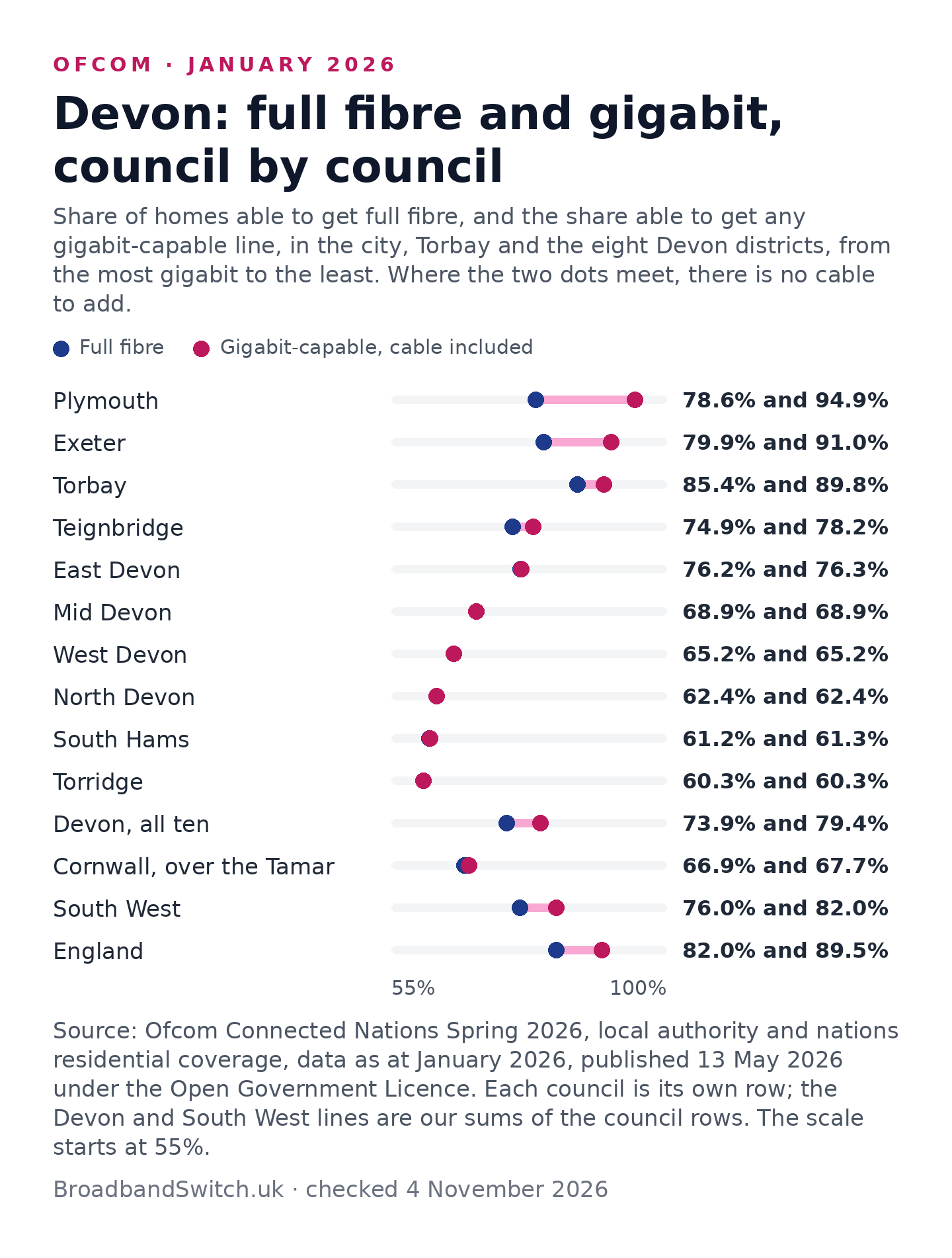
Devon’s ten councils together reach 73.9% full fibre and 79.4% gigabit, and the South West region 76.0% and 82.0%. Plymouth sits well ahead of both on gigabit and a little ahead on full fibre, coming 10th in the region for full fibre.
The city’s land neighbours are rural. South Hams has 61.2% full fibre and West Devon 65.2%, where long country lanes make homes costlier to reach. Across the Tamar, Cornwall stands at 66.9%. Exeter, the other big Devon city, has 79.9% full fibre and 91.0% gigabit.
Torbay is the mirror image of Plymouth. It has more full fibre, 85.4%, but less gigabit overall, 89.8%, because far less of its gigabit comes from cable. Both cities give you a good chance of a fast line, through different networks.
Across all 296 English councils, Plymouth ranks 75th for gigabit and 180th for full fibre. Among the 84 councils with more than 100,000 homes, it is 33rd for gigabit. For you, that means a gigabit line is more likely here than in most of England, even where full fibre has not yet arrived.
Moving within Devon? The jump from city to countryside can be steep. A home in South Hams or West Devon is far less likely to have gigabit than one in Plymouth, so check a rural address before you commit to a move.
Rankings only go so far, of course. What counts is your own address: the networks that reach it, the speeds they offer and the prices on the table. The postcode check shows all three in a few seconds.
The 2029 plans: a tide gauge for every council
Direct answer: The builders’ own plans, as Ofcom publishes them, take Plymouth from 78.6% full fibre today to 95.5% by January 2029, the highest in Devon. England’s forecast is 92.2%. That would leave 5,460 homes outside every full fibre plan.
Ofcom coverage now, builders’ plans to 2029
The tide to 2029: one gauge per council
78.6%95.5%
Plymouth
76.2%93.3%
East Devon
62.4%91.1%
North Devon
68.9%90.4%
Mid Devon
74.9%89.5%
Teignbridge
85.4%87.2%
Torbay
60.3%84.0%
Torridge
79.9%80.8%
Exeter
61.2%78.9%
South Hams
65.2%77.2%
West Devon
82.0%92.2%
England
- Full fibre, January 2026
- Tide mark: the builders’ forecast for January 2029
Water level: full fibre in January 2026, from Ofcom. Pink tide mark: the share the networks expect to reach by January 2029 on all their plans, as Ofcom reported on 13 May 2026. England is our weighting of all its councils, and each board reads 50% to 100%.
Counted in homes, the plans bring full fibre to 20,812 more. Gigabit, cable included, would rise to 98.0%, against 95.3% for England, and Ofcom’s file expects 11 to 15 gigabit operators in the city by then.
Competition is the good news. By 2029, the plans give 85.1% of homes a choice of at least two gigabit networks (England: 74.0%), putting Plymouth first in Devon and 22nd among England’s big councils. Three or more is rarer: 20.8%, against 36.0% for England.
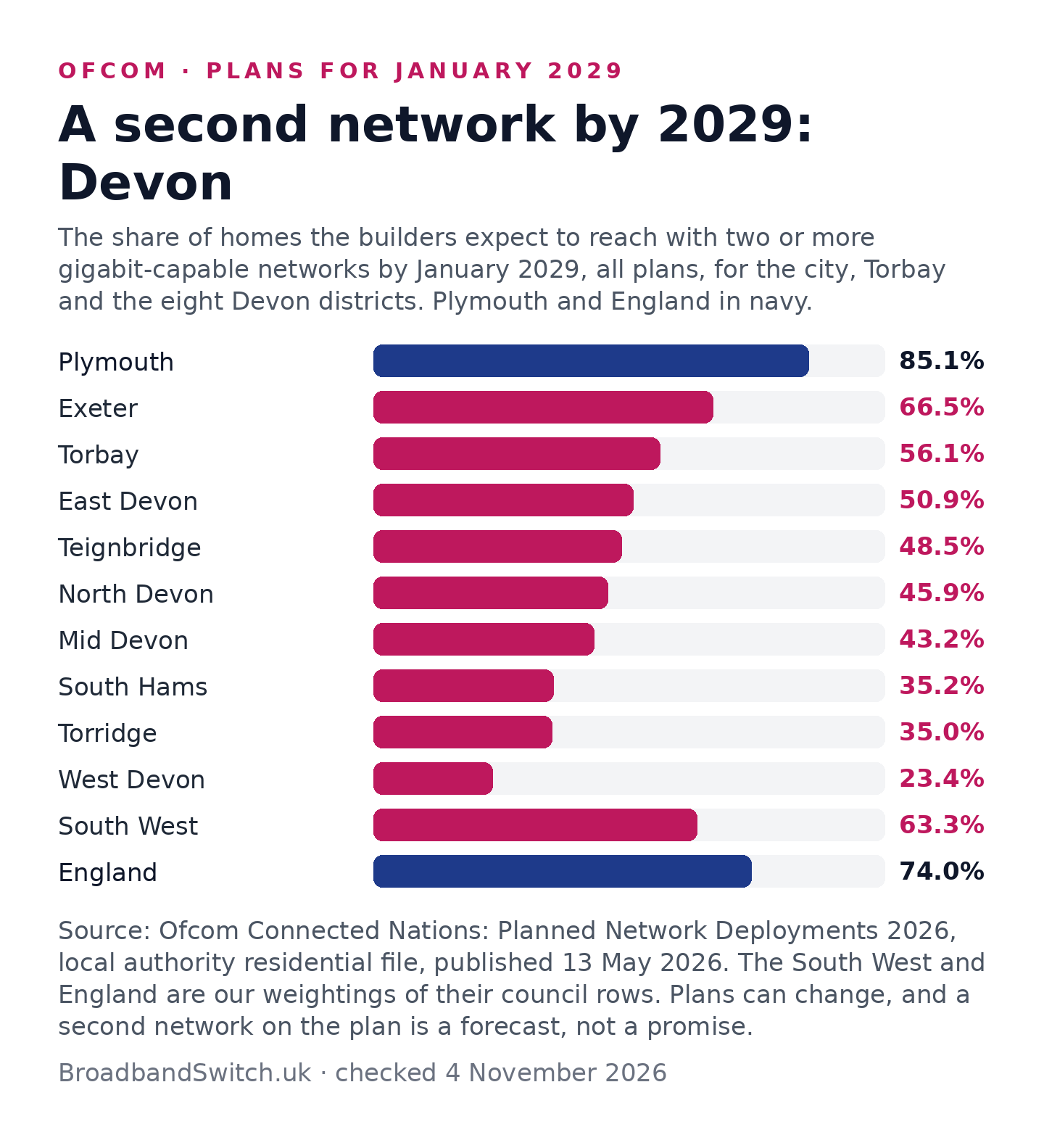
Across the Tamar, Cornwall’s plans are even bolder, at 96.3%. Inside Devon, North Devon has the furthest to climb, from 62.4% today to 91.1%.
When the builders reach your road
A full fibre build usually starts with a letter or leaflet, then short works in the pavement or on the poles. Connecting your home is a separate step: once the network is outside, you order a fibre deal and an engineer fits a small box inside, often in a single visit.
Still waiting for fibre in your road? Tell the networks, because interest from residents helps them pick the next streets. Openreach has a sign-up for build news, and your current provider can tell you what is planned for your street.
Public funding barely features in Plymouth. Ofcom’s file shows only 7 planned new lines here paid for by the taxpayer, and 30 postcodes with no gigabit plan at all. Each forecast is the builder’s own, which makes it a plan you can watch rather than a promise.
Ordering the upgrade: room to catch up
Direct answer: In January 2026, 32% of the Plymouth homes offered full fibre were using it. Across England the figure is 46.2%, weighting each council by its homes with full fibre. Put another way, around 65,400 homes could order fibre today and have not.
Ofcom, January 2026
Sails up: who has ordered full fibre?
62%
East Devon
56%
West Devon
51%
Teignbridge
51%
Torbay
50%
Torridge
49%
Exeter
49%
Mid Devon
47%
South Hams
44%
North Devon
32%
Plymouth
46%
England
The dashed line across every mast marks England, 46.2%.
Sail height shows take-up in January 2026: among homes able to order full fibre, how many had. Ofcom rounds each council to a whole number; the dashed England line is our own weighting.
That puts the city tenth of the ten Devon councils for take-up, 25th of the South West’s twenty-seven, and 273rd of England’s 296. East Devon leads the county on 62%. Devon as a whole, weighted the same way, stands at 47.2%.
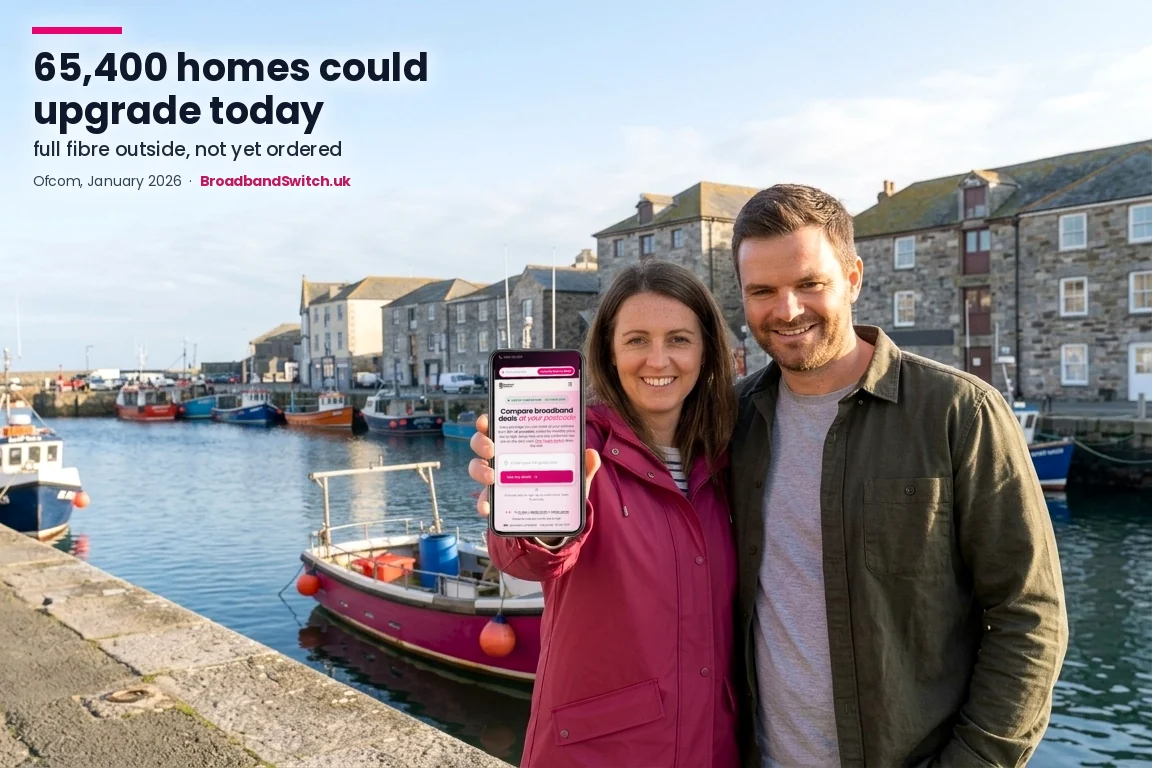
Openreach spotted the pattern early. In August 2024 it said fibre in Plymouth was going unused, “just 21 per cent of people adopting the service where it’s available, lagging behind the UK average of 34 per cent”. Martin Williams, its Partnership Director for the South West, added: “Ultrafast broadband can have a huge impact on people’s lives and it’s great for the economy but upgrades aren’t automatic.”
Cable is part of the reason here. Thousands of homes already get fast downloads over Virgin Media and see little cause to move. Others are in contract, or have not heard that fibre has reached their road. Nobody upgrades you automatically, so the faster line waits until you ask.
Happy on cable? Then you already have a gigabit-capable line, and there is no need to change for the sake of it. A comparison still helps, because the same speed can cost quite different amounts from one provider to the next.
Is fibre already in your road?
Then the hard work is done, and connecting can take a single visit. Set a full fibre deal from your postcode results beside your current bill. Plenty match what you pay, and some come in cheaper.
Is full fibre worth ordering?
For most homes, yes. It keeps its speed in the evening rush, copes when everyone is online at once and tends to fault less than copper. Many entry-level fibre deals cost much the same as the copper deals they replace, and a light user can pick a modest speed and keep the bill low.
Past your minimum term? Your monthly price has probably crept above what new customers pay, so a quick comparison is worth it even if you decide to stay. Still in contract? Put the end date in your diary and compare a month or so ahead.
Cable or full fibre: which suits you?
Direct answer: In much of Plymouth you can choose between Virgin Media’s cable and full fibre. Both can reach gigabit download speeds. The differences that matter most are upload speed, which providers you can pick from, and price.
Virgin Media O2 said on 7 December 2021: “Virgin Media O2 has today completed the upgrade of its entire national network to gigabit speeds”. Its Gig1 service then averaged 1,130Mbps downloads. In Plymouth, Ofcom counts 20,007 homes where cable is the only gigabit option, so for them the choice today is cable or a slower line.
Where full fibre has the edge
- Uploads. Many full fibre packages upload as fast as they download, which helps if you work from home, stream games or back up photos.
- Choice of provider. Openreach full fibre is sold by dozens of providers, and CityFibre by a growing list, so you can shop around on the same line.
- Room to grow. Glass to the home has plenty of headroom, and some networks already sell speeds above a gigabit.
Where cable can make sense
- It may already be in the house. If your home has a Virgin Media socket, getting connected can be quick.
- TV bundles. If you want broadband, TV and phone from one company, cable bundles are worth pricing.
- It is gigabit today. Where full fibre has not reached your street, cable may be the fastest line you can order now.
Questions to ask before you choose
- What upload speed will I get? Ask for the typical upload as well as the download.
- What will it cost after the first year? Check the yearly price rises written into the contract.
- Is the bundle worth it? Price the broadband on its own too, so you can see what the TV or phone extras really cost.
- How long is the contract? Make sure it fits your plans, especially if you rent or expect to move.
Whichever you pick, the price you pay matters as much as the technology. Your postcode results show cable and full fibre deals side by side, so you can see the monthly cost, the contract length and the speeds for your own address in one place.
A tip for renters and students: ask what is already installed before you order. A home with a cable socket or a fibre box on the wall can often be connected sooner, and your landlord may already know which networks reach the building.
Who builds the lines
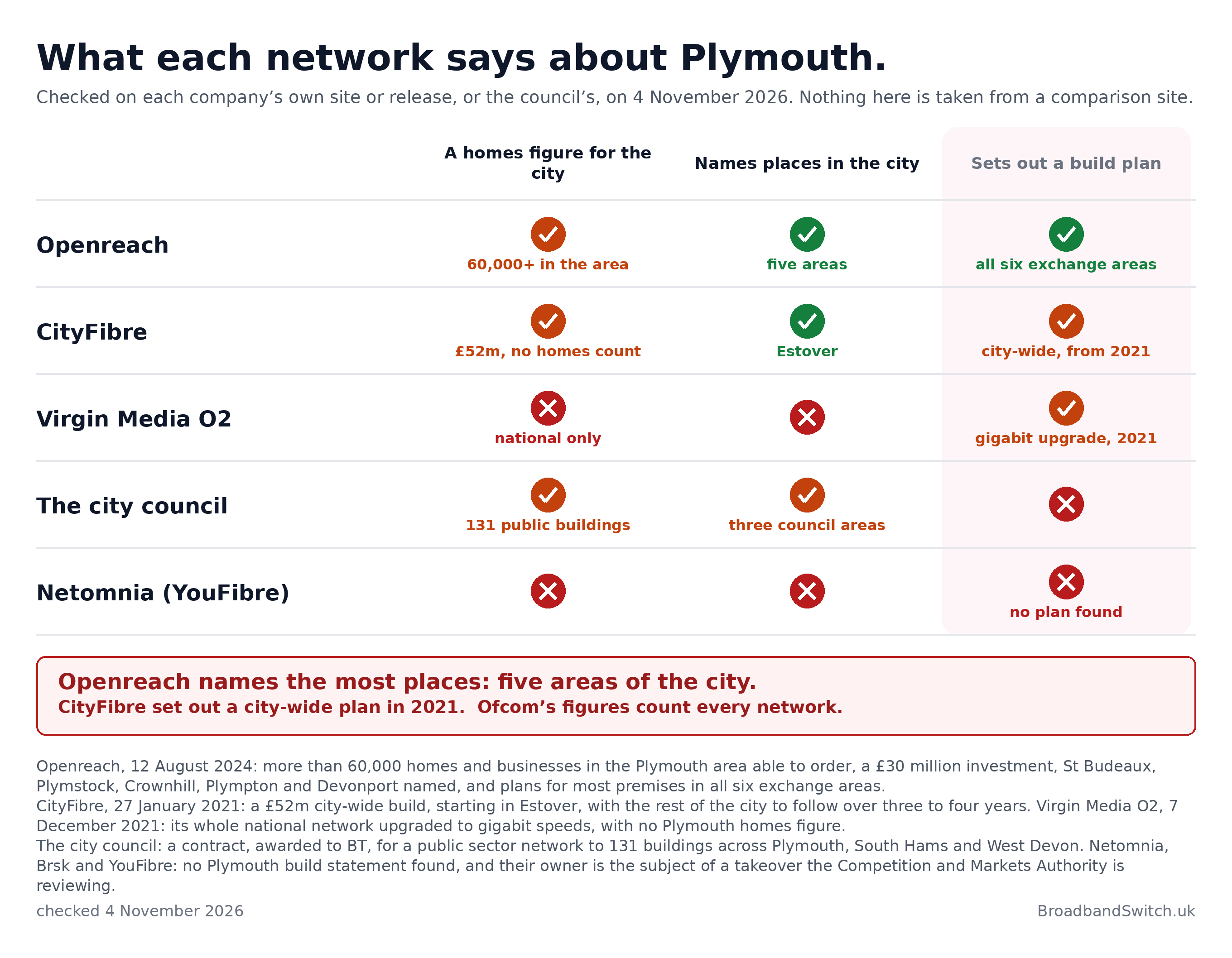
Direct answer: Openreach and CityFibre both build full fibre in Plymouth, and Virgin Media’s cable adds gigabit in many streets. Openreach said on 12 August 2024 that more than 60,000 homes and businesses in the Plymouth area could already order its full fibre.
Openreach
On 12 August 2024, Openreach said: “More than 60,000 homes and businesses in the Plymouth area can already order some of the fastest, most reliable broadband in Europe thanks to a £30 million commercial investment by Openreach.” It named the next areas: “Thousands more properties across the city will soon be able to upgrade to ultrafast broadband in areas like St Budeaux, Plymstock, Crownhill, Plympton and Devonport.” And it set out its aim: “Openreach has announced plans to invest in Full Fibre broadband for the majority of premises in all six telephone exchange areas of the City.”
Openreach was clear that nothing happens on its own. In Martin Williams’s words: “People need to place an order with their chosen provider to get connected and we’ll do the rest.” So if fibre has reached your street, the upgrade starts with an order from you.
Luke Pollard, MP for Plymouth Sutton and Devonport, joined the engineers on that visit and said: “Faster internet is good for everyone, and Plymouth needs faster internet.” Openreach’s full fibre now reaches more than 23.5 million premises across the UK, by its own count of 8 October 2026.
CityFibre
CityFibre began its Plymouth build on 27 January 2021. In its words: “As part of a £52m private investment from CityFibre, Plymouth will benefit from a city-wide full fibre network”. It added: “Construction work has officially commenced in Plymouth’s Estover area, with the rest of the city set to follow over the next three to four years.” The construction partner was local: “Oakway Limited is delivering the construction programme on CityFibre’s behalf”.
CityFibre has published no Plymouth homes figure since, so we cannot say how much of the city it reaches today. It sells through partner providers rather than under its own name, and where it reaches your address, those providers appear in your postcode results.
Virgin Media O2
Virgin Media’s cable is the reason Plymouth’s gigabit figure runs so far ahead of its full fibre. The company gives national figures rather than a Plymouth count, but Ofcom’s numbers show the effect: 20,007 homes reach gigabit through cable alone. If you are one of them, Virgin Media is your gigabit route for now.
The city council
The council’s own fibre project served public buildings rather than homes. Its page describes a fibre connection to 131 public sector buildings in Plymouth, South Hams and West Devon, paid for by a £2.2 million government grant. It adds: “The contract to install the network has been awarded to BT.”
Netomnia, Brsk and YouFibre
We found no statement from Netomnia, Brsk or YouFibre about building in Plymouth. All three belong to Substantial Group, and nexfibre agreed on 18 February 2026 to buy that group for £2 billion. The Competition and Markets Authority moved its review to Phase 2 on 1 July 2026 and set out provisional findings on 2 October 2026. Its decision is due by 15 December 2026.
Which providers use which network
The company on your bill is often not the one that owns the line, which is why a single road can offer dozens of deals.
- Openreach: BT, Sky, TalkTalk, EE, Vodafone, Plusnet and a long list of smaller providers.
- CityFibre: partner providers that sell over its network; your postcode results name the ones available to you.
- Virgin Media’s cable: Virgin Media itself.
CityFibre, Virgin Media O2, Openreach, Ofcom
Plymouth’s road to full fibre
- 27 January 2021CityFibre starts in EstoverA city-wide build begins, with the rest of the city due to follow over three to four years.
- 7 December 2021Cable goes gigabitVirgin Media O2 finishes upgrading its whole national cable network to gigabit speeds.
- 12 August 2024Openreach across the cityMore than 60,000 homes and businesses in the Plymouth area can order, with plans for most premises in all six exchange areas.
- 19 August 2025Devonport goes firstCopper comes off sale at Devonport, the first exchange in the city to reach its date on Openreach’s list.
- January 2026Ofcom’s snapshot78.6% of homes could get full fibre and 94.9% could get gigabit.
- 14 February 2026St BudeauxA second city exchange stops selling copper where full fibre is in.
- 19 August 2026PlymstockThe third, across the Plym.
- 31 January 2027The analogue network closesOpenreach’s date for closing the old phone network, with home phones moving to digital lines.
- 12 February 2027Plymouth (PY)The city-centre exchange, the last in Plymouth with a date on the list.
- January 2029The plansFull fibre for 95.5% of homes, provided the builders deliver what they forecast.
Sources: releases from CityFibre, Virgin Media O2 and Openreach, the Openreach stop sell list, and Ofcom. The navy dot is Ofcom’s January 2026 count, and the last three entries are still to come.
Add businesses to the count and the January 2026 picture is 78.2% of all premises with full fibre on offer and 93.8% with gigabit. For your home, the brand on the van matters less than which of these networks actually reaches your door.
Home phones move to digital
Direct answer: Openreach plans to close the old analogue phone network on 31 January 2027, and its count on 30 October 2026 found approximately one million copper-based lines remain active across the UK. For most Plymouth homes, the change means a phone plugged into the router instead of the wall.
Openreach, 30 October 2026
From the wall socket to the router
Today, on the old analogue network
- Your home phone
- The phone socket on the wall
- A copper line to the exchange
After the move to digital
- Your home phone
- Plugged into your broadband router
- Calls carried over your broadband
How a home phone changes when the old analogue network closes. Your provider arranges the move; ask it what your phone and anything else on the line will need.
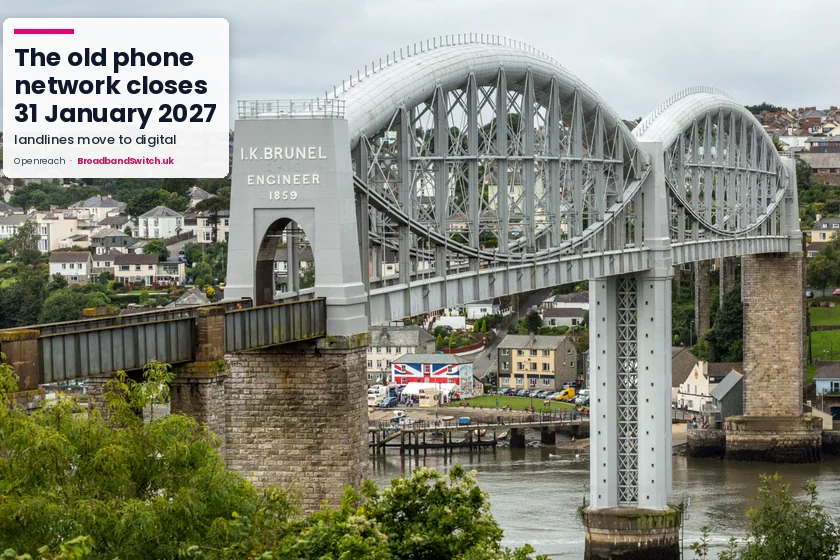
James Lilley, Openreach’s Director of All-IP, said on 30 October 2026: “The straightforward migrations have largely been completed.” Many of the lines left are tricky cases, and Openreach names two: “Lift emergency telephones and auto-diallers”, and “Fire alarm communication panels and security monitoring systems”. Live in a block with a lift, or rely on a warden alarm? Your landlord or managing agent should know the plan.
Lines that have not moved by the closing date may be transferred automatically to EVAc, a temporary, last-resort service for essential calls. Openreach also says: “Where technically possible, Openreach will keep linked broadband services running.” For most households the real job is small: the provider organises the change and the phone plugs into the router.
Your provider should contact you before your own line moves, and many homes have already switched without noticing much change. If you have not heard anything and still use a home phone, it is worth asking your provider when your turn comes.
Before the change: a short checklist
- Still using the landline? Your provider can explain how calls will work afterwards, and you can usually keep your number.
- Something else on the phone line? Alarms, door entry panels and some card machines may depend on it, so contact the company that looks after them.
- Worried about power cuts? A digital phone needs mains power, so keep a charged mobile handy or ask about battery backup.
Have a telecare alarm?
Let your provider know early so the alarm can be checked once the line is digital. Our landline switch-off checker takes you through it, and the Digital Voice guide covers your phone when you switch provider.
Five exchanges stopping copper sales
Direct answer: Openreach’s stop sell list includes five exchanges in Plymouth. Copper broadband is already off sale at three of them: Devonport from 19 August 2025, St Budeaux from 14 February 2026 and Plymstock from 19 August 2026. Plymouth (PY) follows on 12 February 2027, and Plympton is listed with no date yet.
Openreach, 8 October 2026
The copper switch-off as channel buoys
- Devonport19 August 2025Off sale
- St Budeaux14 February 2026Off sale
- Plymstock19 August 2026Off sale
- Today: 4 November 2026
- Plymouth (PY)12 February 2027Due
- Plymptonno date yetNo date yet
- Stop sell in force
- Date set, still to come
- On the list, no date set
One buoy for each Plymouth exchange on Openreach’s list, version 35 of 8 October 2026, ordered by date. The spacing is even and is not a timescale.
Stop sell and the phone switch-off run on separate timetables. Openreach explained the trigger on 8 October 2026: “Stop Sell is triggered when 75% of premises served by an exchange can access Full Fibre broadband.” Homes without fibre yet can relax. Openreach says: “Customers in these exchanges not yet able to get Ultrafast Full Fibre at their premises won’t be impacted and can stay on their existing copper-based service until Full Fibre does become available.”
Plymouth (PY), the city-centre exchange, joined the list in tranche 23; its row was last changed on 16 January 2026. Plympton’s row has shown TBD for both its date and its tranche since 20 July 2022. Plymstock appears on the list under its own name, but its two wards are part of the city.
Around the city, four of the six nearby exchanges we list are already past their copper stop sell date, from Liskeard and Landrake in Cornwall to Tavistock and Kingsbridge in Devon. An exchange takes its name from its building, so the one serving your home may carry the name of the next district. Your provider, or Openreach’s address checker, can tell you which it is.
All eleven exchanges, with datesopen the list
| Code | Tranche | Row updated | ||
|---|---|---|---|---|
| Devonportfiled under Plymouth | WWDPRT | 17 | 16 July 2024 | 19 August 2025 |
| St Budeauxfiled under Plymouth | WWSBUD | 19 | 17 January 2025 | 14 February 2026 |
| Plymstockfiled under Plymstock | WWPSTK | 21 | 18 July 2025 | 19 August 2026 |
| Plymouth (PY)filed under Plymouth | WWPYTH | 23 | 16 January 2026 | 12 February 2027 |
| Plymptonfiled under Plymouth | WWPTON | TBD | 20 July 2022 | no date yet |
| Liskeardfiled under Liskeard | WWLISK | 4 | 29 April 2021 | 29 April 2022 |
| Tavistockfiled under Tavistock | WWTAVI | 6 | 19 October 2021 | 1 November 2022 |
| Landrakefiled under Landrake | WWLAND | 14 | 6 October 2023 | 8 November 2024 |
| Kingsbridgefiled under Kingsbridge | WWKNGB | 15 | 12 January 2024 | 17 February 2025 |
| Mary Tavy (MYY)filed under Tavistock | WWMTVY | 25 | 23 August 2026 | 20 August 2027 |
| Ivybridgefiled under Ivybridge | WWIVYB | TBD | 20 July 2022 | no date yet |
The pink rows are Plymouth’s own exchanges; the others serve nearby towns in Devon and over the Tamar in Cornwall. Italic dates have not arrived yet, and “no date yet” marks a row Openreach lists as TBD. “Row updated” is the list’s “Last amended date”, the last time that row changed. An exchange is named after its building rather than the streets it serves, so check your own address with your provider. Headings with arrows re-sort the list.
Two questions for your provider
Not sure where you stand? Ask which exchange your line runs from, and whether full fibre is available at your exact address. The answers tell you whether stop sell affects you and what an upgrade would involve, and they take a minute on the phone or in an online chat.
Stop sell in practice
- Staying put? Nothing changes for you, apart from the national landline move by 31 January 2027.
- Ordering at a listed exchange? Where your home has fibre, a new order goes onto it.
- No fibre at home yet? Your copper service carries on as before.
Sources: the Tranche 26 announcement from Openreach on 8 October 2026, the Tranche 25 announcement of 27 July 2026, and the stop sell list in version 35, issued 8 October 2026.
Planning a move? Look up the new address early so the line is live on day one; our moving checklist has the steps, and the stop sell explainer lists exchanges nationwide.
A city of terraces and flats
Direct answer: Terraces are Plymouth’s classic home: 32.8% of its 114,558 households lived in one at the 2021 census, against 23.0% across England, the 28th highest share of England’s 296 councils. Flats make up another 25.4%, the 63rd highest.
Census 2021
The city’s homes as a waterfront skyline
Plymouth
- 32.8%Terraced
- 30.1%Semi-detached
- 11.4%Detached
- 25.7%Flat or other
England
- 23.0%Terraced
- 31.5%Semi-detached
- 22.9%Detached
- 22.6%Flat or other
Census 2021 table TS044, through nomis. The width of each stretch matches that type’s share of households, and the flats stretch includes converted flats and other homes.
Semis account for 30.1% of homes, close to England’s 31.5%, while detached houses are much rarer, 11.4% against 22.9%. Stoke and Sutton and Mount Gould are the most terraced wards, both at 51.0%, and St Peter and the Waterfront is mostly flats, at 83.6%.
Renting is common. 21,111 households, 18.4%, rent from a social landlord, the 75th highest share in England, against 17.1% nationally. Private renting, including rent-free homes, stands at 22.7%, and 58.8% own their home. Drake, which holds the University of Plymouth’s main campus, is the private renting capital, at 63.1%.
The suburbs look different again. Plymstock Dunstone has the most detached houses, 37.1%, and Plympton St Mary the most semis, 62.5%, and the highest share of home owners, 84.9%. Honicknowle has the most social renting, at 35.5%.
What your type of home means for an upgrade
For a house, the usual job is one visit: fibre comes from the nearest pole or underground duct to a small box fixed low on an inside wall. Terraces with a door to the street are among the easiest installs, and a mesh kit can carry Wi-Fi to the top of a tall one.
Flats take a little longer, because the network needs the freeholder’s permission to run fibre through the building. If you live in a block, ask the managing agent which networks have been in touch. Once one network is in, every flat can usually order it.
Not sure what is in your home already? Look for a small white box on a wall near a socket, which usually means full fibre has been fitted, or a cable socket on the skirting, which points to Virgin Media. Either can mean a quicker connection.
Students, renters and people on the move
Direct answer: Many Plymouth households rent, and many move often: 22.7% rent privately and 18.4% rent from a social landlord. If that is you, the right contract length and a quick look at what is already installed can save you time and money.
Students in shared houses
In a shared house, one person usually holds the account, so agree in writing who that is and how the bill will be split. Check the contract length against the tenancy, because a deal that runs past the end of the lease can leave someone paying for a line nobody uses.
Halls of residence often include internet in the rent, so read your accommodation agreement before you order anything. In a shared house, a single good deal split four or five ways usually works out cheaper than several separate ones.
Renting privately
You can usually switch provider on the line already in the property without needing anyone’s permission. A new connection that needs drilling or new cabling usually needs your landlord’s agreement; if the reply is slow, our guide to tenants’ rights sets out the options.
Moving to or around the city
Order your new line a few weeks before you move if you can, because a new connection can take time to arrange. Moving for work, including a forces posting? Check the new address as soon as you have it, because the postcode check shows what is available before you sign anything.
If your stay is short, a rolling contract, or a 4G or 5G router for the first few weeks, may suit you better than a long deal. Either way, set the full cost over your time in the home against the monthly price.
Paying less: social tariffs and cheaper deals
Direct answer: A social tariff could bring your bill below a standard deal if you get Universal Credit, Pension Credit or one of several other benefits. Renters qualify as well as owners, and you will find options on most networks.
BT Home Essentials, on Openreach lines, costs from £16.50 a month. Vodafone Essentials costs £20 a month, gives up to 80 Mbps and runs for 12 months. Virgin Media and several full fibre networks run their own social tariffs too, and each sets its own rules on who qualifies.
Before you switch, look at three things on your current bill: the monthly price once any discount ends, the date your minimum term finishes, and any yearly price rise written into the contract. With those to hand, you can compare like for like when your postcode results appear, and spot whether a new deal really saves you money over the full term.
With 21,111 households renting from a social landlord, many Plymouth homes may qualify. Ofcom lists 33 social tariffs, and the social tariff guide explains who can apply for each one.
Three ways to trim the bill on any network
- Pick the speed you need. A couple who stream and browse rarely need the top package, so a mid-range speed can cut the bill with no noticeable difference.
- Check the extras. Boosters, TV add-ons and call packages you no longer use can quietly add to each month.
- Talk to your provider at renewal. A cheaper quote from the postcode results gives you something concrete to point to.
Not eligible? You can still pay less. Out-of-contract customers often pay more than new ones for the same line, so the quickest saving can be a switch, or a call to your provider armed with a cheaper quote. Your postcode results open with the lowest price, which makes it easy to set a social tariff and an ordinary deal side by side.
Look up your ward
Direct answer: Choose one of the 20 wards and a card appears, comparing its coverage with the city figure, naming the seat it sits in and describing its homes at the 2021 census. The card is built in your browser, so your choice stays on your device.
Ward finder for Plymouth
Coverage is totalled from Ofcom’s January 2026 output areas, and housing from the 2021 census. If you are unsure of your ward, Plymouth City Council’s website finds it from an address, and Find your MP on the UK Parliament site names your seat.
A short glossary of broadband words
Direct answer: Broadband comes with its own jargon. Here is what the terms on this page mean, in a sentence or two each, so you can read any deal with confidence.
- Full fibre
- A line made of glass fibre all the way from the network to your home. It is often written FTTP, fibre to the premises.
- Gigabit-capable
- A line that can carry a thousand megabits a second. In Plymouth that means full fibre or Virgin Media’s cable.
- Cable
- Virgin Media’s network, which uses fibre in the street and copper coaxial wire into the home.
- Superfast
- Ofcom’s term for a download speed of at least 30Mbit/s.
- Take-up
- Of the homes that can order full fibre, the share that have.
- Stop sell
- When Openreach stops selling copper broadband at an exchange, so new orders go onto fibre where it is available.
- Fibre box
- The small white box an engineer fits inside your home, where the fibre line ends. Openreach calls it an optical network terminal.
- Wayleave
- Permission from a landowner or freeholder for a network to run its cables across or through their property, which blocks of flats often need.
- One Touch Switch
- Ofcom’s process that lets you switch broadband by contacting only your new provider.
- Social tariff
- A lower-priced broadband package for households on certain benefits.
- Digital landline
- A home phone that carries calls over your broadband line rather than the old analogue network.
Spotted a term in a deal that is not here? The provider has to explain it before you sign, so you can always ask what it means for you.
How we worked out these figures
Direct answer: Every figure on this page comes from a published file, and you can check each one. City, council and seat figures are Ofcom’s own, ward figures are our sums of Ofcom’s smallest areas, and housing comes from the 2021 census.
Ofcom publishes coverage for very small census areas, called output areas. ONS publishes a lookup that places each output area in a ward and in a Westminster seat. We added up the 866 output areas in Plymouth ward by ward, and the totals match Ofcom’s city row exactly.
Two limits are worth knowing. Ofcom’s output area file has no full fibre column, so ward cards show gigabit and use the seat’s full fibre share instead. And Ofcom counts homes it cannot match to any network’s records as having no gigabit line, which pulls Drake down, as the ward section explains.
Take-up comes from Ofcom’s council file, which rounds to whole numbers. Where we give a figure for Devon, the South West or England, we weight each council by its covered homes. The 2029 figures are the builders’ own forecasts, gathered and published by Ofcom, so read them as plans.
Census figures are counts of households in 2021, added up the same way. ONS adjusts very small counts slightly to protect privacy, so our ward totals can differ by a few households from the city row. If you spot something that looks wrong, tell us, and the corrections section shows how we put mistakes right.
Where the old page went wrong
Direct answer: Twelve statements on the previous version failed our checks. Coverage figures appeared without a source, a takeover still under review was described as done, and provider counts and market shares came from comparison sites. One sentence even gave a Bristol postcode.
Much of the old page’s length came from undated prices and provider lists lifted from comparison sites. Here, a figure stays only if Ofcom, the census, Plymouth City Council or the company itself published it. Prices are set nationally and move often, which is why your postcode search is where you will see today’s.
Coverage figures with no source behind them
What it said, and what we foundThe old page put full fibre at “approximately 79.19%” and gigabit at “approximately 95%”, with no source and no date, a fortnight before Ofcom’s Spring 2026 update. Ofcom’s January 2026 figures give 78.6% and 94.9%.
Where we checkedOfcom’s January 2026 coverage files.
A cable share nobody publishes
What it said, and what we foundThe old page said “approximately 87.04%” of premises had Virgin Media cable. We found no published source: Ofcom does not count coverage by company, and Virgin Media O2 gives national figures. Ofcom does show 20,007 homes with gigabit through cable alone.
Where we checkedOfcom’s coverage files.
A takeover reported as done
What it said, and what we foundThe old page spoke of “the February 2026 Nexfibre/Virgin Media O2 acquisition of Netomnia” as if it were complete. It is not: nexfibre agreed the deal on 18 February 2026, and the Competition and Markets Authority, which raised provisional concerns on 2 October 2026, has until 15 December 2026 to decide.
Where we checkedThe CMA’s case page for the deal.
A price tag with no source
What it said, and what we foundThe old page said Virgin Media O2 was buying the YouFibre and Brsk brands “for approximately £150 million”. We could not find that figure in anything the companies have published, so it has gone.
Where we checkedThe CMA case page and nexfibre’s announcement.
One company, two owners
What it said, and what we foundIn one place the old page called Cuckoo “now Vodafone-owned”; in another it placed Cuckoo in a group “consolidated under Fern Trading”. Both cannot be right, and we could not confirm either from the companies, so neither appears.
Where we checkedEach company’s own site.
A CityFibre share with no source
What it said, and what we foundThe old page said CityFibre’s build covered “approximately 25% of Plymouth”. CityFibre’s release of 27 January 2021 sets out a £52m city-wide plan, but we found no coverage share from the company.
Where we checkedCityFibre’s release of January 2021.
The wrong start for CityFibre
What it said, and what we foundThe old page named Mainstone as CityFibre’s original roll-out area “from 2022”. CityFibre’s own release of 27 January 2021 says: “Construction work has officially commenced in Plymouth’s Estover area, with the rest of the city set to follow over the next three to four years.”
Where we checkedCityFibre’s release.
A Bristol postcode in a Plymouth guide
What it said, and what we foundThe old page warned that “some BS1 conservation areas” could need extra work for cabling. BS1 is central Bristol, and Plymouth’s postcodes begin with PL, so the line has gone.
Where we checkedThe postcode itself.
Provider counts nobody could check
What it said, and what we foundThe old page said “17 different providers” served one PL6 postcode and put altnet competition at “approximately 22%”. Neither has a source we could find. Ofcom’s plans file expects 11 to 15 gigabit operators in the city by 2029.
Where we checkedOfcom’s plans file, and the postcode check for your address.
An Openreach figure well behind the times
What it said, and what we foundThe old page said Openreach had reached “more than 17 million UK properties”. Openreach’s own release of 8 October 2026 puts the figure at more than 23.5 million premises.
Where we checkedOpenreach’s release of October 2026.
The phone switch-off and copper broadband mixed up
What it said, and what we foundThe old page said copper phone lines would be “switched off by January 2027, so older ADSL services in Plymouth are being phased out”. The 31 January 2027 date closes the analogue phone network, and in Openreach’s words: “Where technically possible, Openreach will keep linked broadband services running.”
Where we checkedOpenreach’s releases of July and October 2026.
A public sector contract told as finished
What it said, and what we foundThe old page said the council’s network “connected 131 public sector buildings”. The council’s page describes the contract, paid for by a £2.2 million grant and awarded to BT, in future terms, and its buildings span Plymouth, South Hams and West Devon.
Where we checkedPlymouth City Council’s own page.
FAQ: Plymouth broadband questions, answered
How good is broadband in Plymouth?
Good, and better than most of England for gigabit. Ofcom’s January 2026 figures put gigabit at 94.9% of homes, against England’s 89.5%, and full fibre at 78.6%. Slow lines are rare: 1,116 homes in the whole city were below 30Mbit/s.
Can I get full fibre at my address?
Quite possibly. In January 2026, 96,239 homes in Plymouth could order full fibre, and 20,007 more could get gigabit over cable. Put your postcode in the box at the top and choose your address to see what reaches you.
Does Virgin Media cover Plymouth?
Yes, in many streets. Virgin Media gives no Plymouth figure, but Ofcom counts 20,007 homes whose only gigabit line is cable, and cable adds 16.3 points to the city’s gigabit share.
Is cable as good as full fibre?
Both can reach gigabit downloads. Full fibre usually uploads faster and is sold by more providers, while cable may already be installed in your home. Your postcode results show both side by side.
Which ward has the slowest broadband?
St Peter and the Waterfront has the most homes below 30Mbit/s, 548, about half the city’s. Drake has the lowest gigabit share, 75.2%, though Ofcom could not match 907 of its homes to any network’s records.
Why have so few Plymouth homes ordered full fibre?
Ofcom’s take-up figure for the city was 32% in January 2026, against 46.2% for England. Many homes already have gigabit cable, some are mid-contract, and fibre outside the house stays unused until someone orders it.
Why does Drake show such a low gigabit figure?
Partly because of missing records. Ofcom could not match 907 of Drake’s 5,123 homes to any network, and counts them as having no gigabit line. Among the homes it could match, gigabit reaches 91.4%.
Is CityFibre in Plymouth?
Yes. CityFibre started building a city-wide full fibre network in Estover on 27 January 2021. It sells through partner providers, and where it reaches your address, they appear in your postcode results.
Are YouFibre, Netomnia and Brsk now one company?
No. They remain separate companies under one parent, Substantial Group, and nexfibre agreed on 18 February 2026 to buy that parent. A ruling from the Competition and Markets Authority is due by 15 December 2026.
Which Plymouth exchanges have stopped selling copper?
Devonport, St Budeaux and Plymstock already have. Plymouth (PY) follows on 12 February 2027, and Plympton is on the list with no date set. Your provider can tell you which exchange serves your line.
What will happen to my home phone?
It switches to a digital line. Openreach plans to close the analogue network on 31 January 2027, and for most homes the change means plugging the handset into the router.
Will more homes get full fibre soon?
Yes. The builders expect 95.5% of Plymouth homes to have full fibre on offer by January 2029, the highest share in Devon, though 5,460 sit outside every plan.
Can I get cheaper broadband if I am on benefits?
Often, yes. Ofcom lists 33 social tariffs, cheaper packages for people who get Universal Credit, Pension Credit and a range of other benefits. BT Home Essentials starts at £16.50 a month.
Do I have to cancel my current broadband myself?
No. Ofcom’s One Touch Switch rules have applied since 12 September 2024: you sign up with the new provider, which contacts the old one, and the two services swap over on an agreed date.
In short: the city’s broadband in eight lines
- Gigabit reached 94.9% of Plymouth homes in January 2026, against England’s 89.5%, and full fibre 78.6% (Ofcom).
- That makes the city 75th of England’s 296 councils for gigabit and first in Devon, with cable adding 16.3 points.
- Take-up is the weak spot: just 32% of homes offered full fibre had taken it, the lowest in Devon, against 46.2% across England.
- Gigabit coverage tops 95% in fourteen of the 20 wards, while Drake and St Peter and the Waterfront trail.
- Openreach and CityFibre both build full fibre here, and Virgin Media’s cable gives 20,007 homes their only gigabit option.
- The builders’ plans would take full fibre to 95.5% of homes by January 2029, with two or more gigabit networks for 85.1%.
- Copper is off sale at three of the city’s five exchanges; Plymouth (PY) follows on 12 February 2027, and the analogue phone network closes on 31 January 2027.
- An average for a whole city cannot speak for one house, so your postcode is the way to see the networks and prices at your door.
Each line is dated and sourced, so you can lift any single one into your own writing. We recheck the page at least once a quarter, and the latest review was on .
References
- OFCOM.ORG.UK
Ofcom. (2026, May 13). Connected Nations, Spring 2026 update. Fixed coverage at January 2026 for every council, Westminster seat, output area and UK nation, with full fibre take-up for each council, under the Open Government Licence. Downloaded 4 November 2026.
- OFCOM.ORG.UK
Ofcom. (2026, May 13). Planned network deployments 2026. Build forecasts to January 2029 for each council, as the networks reported them, covering full fibre, gigabit, a second and third network, the number of operators, excluded postcodes and publicly funded lines. Downloaded 4 November 2026.
- NOMISWEB.CO.UK
Census 2021 through nomis. (2023). Table TS044, the kind of home, and TS054, owned or rented, for all 866 Plymouth output areas and for Torbay, the eight Devon districts, Cornwall, the South West, England and each English council. Retrieved 4 November 2026.
- ONS.GOV.UK
Office for National Statistics. (2023, January 19). How life has changed in Plymouth: Census 2021. The source for the city’s population and density. Read 4 November 2026.
- STATISTICS.GOV.UK
ONS Open Geography Portal. (2026). Best-fit tables linking 2021 output areas to the WD26 wards and to the PCON25 Westminster seats, run for Plymouth on 4 November 2026.
- LEGISLATION.GOV.UK
Statutory Instrument 2002/2236, the City of Plymouth (Electoral Changes) Order 2002: the 20 wards used since the elections of 2003. Read 4 November 2026.
- OPENREACH.COM
Openreach. (2024, August 12). Plymouth MP welcomes ultrafast broadband upgrade. Read 4 November 2026.
- OPENREACH.COM
Openreach. (2026, October 8). Its Tranche 26 announcement, giving the stop sell trigger and the UK full fibre total; plus the Tranche 25 announcement (2026, July 27) and the countdown release of 30 October 2026, issued with under 100 days left. Read 3 and 4 November 2026.
- OPENREACH.CO.UK
Openreach. (2026, October 8). FTTP Priority Exchanges, version 35: the code, tranche, date last changed and copper stop sell date for every listed exchange. Parsed 4 November 2026.
- CITYFIBRE.COM
CityFibre. (2021, January 27). CityFibre kick starts Plymouth’s Full Fibre future. Read 4 November 2026.
- VIRGINMEDIAO2.CO.UK
Virgin Media O2. (2021, December 7). Virgin Media O2 completes gigabit upgrade in boost for Britain’s broadband target. Read 4 November 2026.
- PLYMOUTH.GOV.UK
Plymouth City Council. Local Full Fibre Network, the page on the public sector network for 131 buildings. Read 4 November 2026.
- GOV.UK
Competition and Markets Authority. (2026, last updated October 20). The CMA’s case page for the deal, nexfibre’s proposed purchase of Substantial Group. Seen 4 November 2026.
- NEXFIBRE.CO.UK
nexfibre. (2026, February). Its news release on agreeing to acquire Substantial Group. Seen 29 October 2026.
- MEMBERS.PARLIAMENT.UK
UK Parliament. Find your MP, the search that matches a postcode to its constituency. Seen 4 November 2026.
How switching works
Three steps to a new provider
- Step 1Enter your postcode and pick your house
Two neighbours can be on different networks, so the exact address matters.
- Step 2Compare the deals, cheapest first
Fibre from Openreach and CityFibre providers and Virgin Media’s cable all appear together, and browsing costs nothing.
- Step 3Order once, and the switch is arranged for you
Your new provider tells the old one and sets the changeover day, so the line stays live and you are not billed twice.
One Touch Switch applies to homes right across Plymouth, from Devonport to Plympton.
What can your Plymouth address get?
Type a postcode, tap your house, and every provider able to connect you appears, fibre and cable together, lowest price first. Everything above describes the city; this step is about your own home.
Find deals for my home →