Broadband deals under £30 a month: the UK sweet spot, checked properly
Under £30 is where entry full fibre from big-brand providers becomes realistic and altnet fibre often gives meaningful speed headroom without jumping to premium tiers. It is also where the fine print gets cleverest: a deal advertised at £27 that reverts to a £36 standard rate halfway through a 24-month term averages £31.50, so it was never an under-£30 deal at all. This page keeps every check that matters, puts real numbers against each route rather than the usual vague ranges, and gives you a calculator that prices the intro cliff before you sign for it.


Which routes exist at your door is decided street by street, so the postcode check is the shortlist rather than a formality. Every entry deal also sits side by side in our hand-checked deals review.
Independent and free. Or jump to the deals under £30.- Entry full fibrebecomes realistic in this band at many addresses
- 100+ Mbpstypical entry FTTP, against 36 to 67 on entry FTTC
- 17 Jan 2025since when in-contract rises must be in pounds and pence
- 12 Sep 2024One Touch Switch applies to most home moves
- What £30 buys
- The routes, with numbers
- Why it is the sweet spot
- Who offers it
- Honest watch-outs
- Keep it under £30
- Live deals
- FAQ
What £30 a month actually buys you
At this budget you are usually shopping for reliable home use: several devices, video calls, HD or 4K streaming in small bursts, and background updates. The technology can range from faster part-fibre on Openreach networks to entry or mid-tier full fibre where newer networks exist. The important shift against tighter budgets is speed headroom, because where full fibre is available, deals in this band often advertise materially higher average downloads than basic copper or entry FTTC. Always read the provider card for the advertised averages at your line, since two packages both labelled "under £30" can sit on entirely different underlying networks.
Think about what enough speed feels like rather than chasing a glossy number. A modest full-fibre headline can still outperform older technologies on busy evenings, because the underlying network carries less congestion between you and the cabinet or exchange path you used before. Add one video call and one HD stream at the same time, then allow margin for backups and software updates running quietly in the background: if those everyday moments stay smooth, your under-£30 tier is doing its job. And read the upload column, not only the download one, because symmetric workloads reward upload headroom even when the marketing still talks about superfast.
For vocabulary matching how UK networks are named on checker tools, pair this page with the broadband speed guide and the full fibre deals hub when you want to stay inside fibre-to-the-premises options.
The under-£30 routes, with numbers attached
Live prices and averages vary by address and campaign, so treat these as typical patterns and confirm with the postcode tool below. The ranges come from the technology pages across this site rather than from marketing, which is what makes the routes genuinely comparable.
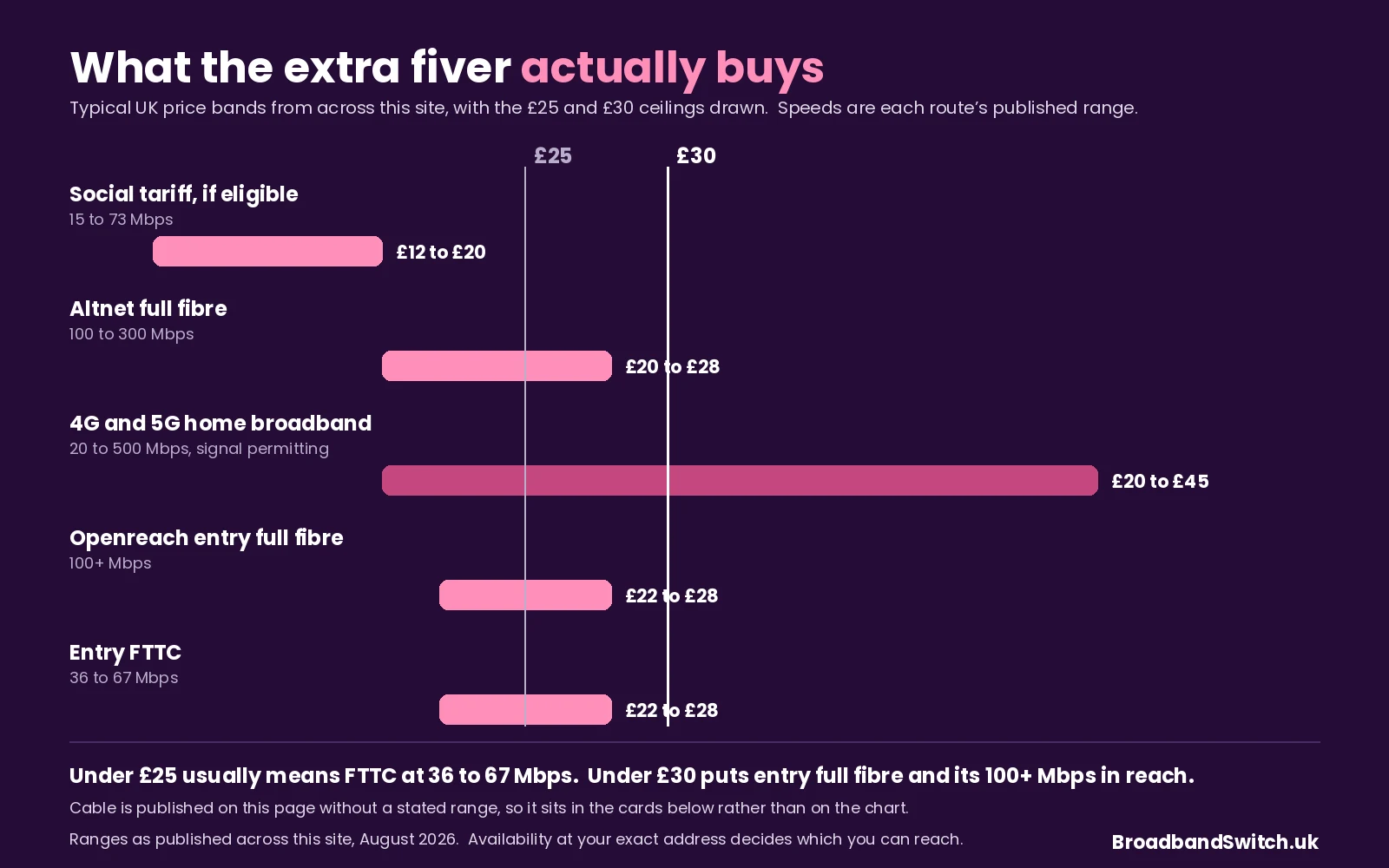
- Social tariff, if eligible · £12 to £2015 to 73 Mbps depending on scheme, comfortably below £30 for qualifying households. Watch-out as published: proof of benefit status applies and eligibility rules vary by provider. See social tariffs.
- Openreach-based entry full fibre · £22 to £28Entry FTTP averages of 100+ Mbps shown on the card at your line. Watch-out as published: intro discounts may step up later in the minimum term, which is exactly what the calculator above prices. See full fibre deals.
- Altnet full fibre · £20 to £28100 to 300 Mbps where an overlay network has been built, often higher averages than FTTC for the same sticker price. Watch-out as published: build coverage is street-specific and rural pockets vary.
- Cable, DOCSISAverages vary by network generation, and this site publishes no single range for cable, so we are not going to invent one. Watch-out as published: upload profiles and hub policies differ from the FTTP alternatives. See Virgin Media deals.
- FTTC, superfast part-fibre · £22 to £2836 to 67 Mbps per cabinet, and the common answer where FTTP has not arrived. Watch-out as published: Digital Voice and PSTN switch-off planning still matter for some homes. See FTTC deals.
- 4G and 5G home broadband · £20 to £454G runs £20 to £35 for 20 to 100 Mbps and 5G £25 to £45 for 100 to 500, both highly variable with signal and mast load. Watch-out as published: latency, data policies and indoor coverage need a careful read. See 4G and 5G home broadband.
Why this is the UK broadband sweet spot
This is the band where many households first touch credible full fibre from household-name brands, while competitive altnet footprints can push average speeds higher without jumping straight to premium gigabit marketing. Compared with searching only for the absolute floor of the market, staying near £30 often buys breathing room on upload speeds, which matters the moment someone works from home, shares large files or uses cloud backup, and it keeps headroom if a child starts gaming online or the street's demand profile grows. It is not a guarantee at every rural or in-fill address, because the UK is a mosaic of copper, part-fibre and full-fibre footprints: sweet spot describes the pattern most readers see on a fair day, not a promise for every property.
- Big-brand entry fibreNational retailers often anchor introductory full fibre promotions around this monthly level where Openreach FTTP exists, which helps renters and families who want straightforward Wi-Fi without niche brands.Familiar names
- Altnet speed headroomWhere an altnet has built past you, advertised averages can leap ahead of copper or FTTC for similar money, giving busy homes upload and download space for homeworking.More Mbps, same price
- Sensible upgrade pathStaying near £30 leaves room to step up later if you move from streaming on a tablet to heavier creative uploads, without paying for gigabit you do not yet use. The gigabit page makes that case honestly.Room to grow
Who offers deals under £30 right now
Retail brands change promotions frequently, so these are categories rather than a pinned best offer. At many postcodes you will see Openreach-based providers marketing entry full fibre inside this band when introductory pricing is live, while cable networks can place promo bundles near the same monthly figure with different upload behaviour and router policies. Altnet full fibre operators often compete aggressively on average speed for a sub-£30 headline where they have overlay coverage, which can mean more Mbps for the same sticker price than a legacy technology at the same address.
Retail creativity moves quickly: cashback, bill credit, shorter trials and seasonal campaigns can move a basket from just above £30 to just below it without changing the underlying network at all. Treat those incentives as cash-flow help, then model the plain monthly price that applies once the credits stop, because that steady-state figure is what you live with for most of the contract. None of it replaces reading the checkout summary where setup pricing, recurring charges and optional extras such as anytime calls are listed line by line, and if anything looks ambiguous, pause and save the PDF or email confirmation before agreeing to installation dates.
For a neutral map of the larger providers before you dive into filters, start from the providers directory, then come back here with the £30 ceiling applied.
Honest watch-outs at this budget
Under £30 is appealing on paper, yet four things catch readers out when they focus only on the headline monthly figure. The same four checks apply whether a deal is labelled full fibre, cable or wireless, because the label does not make the economics simple. The first one deserves its own arithmetic.
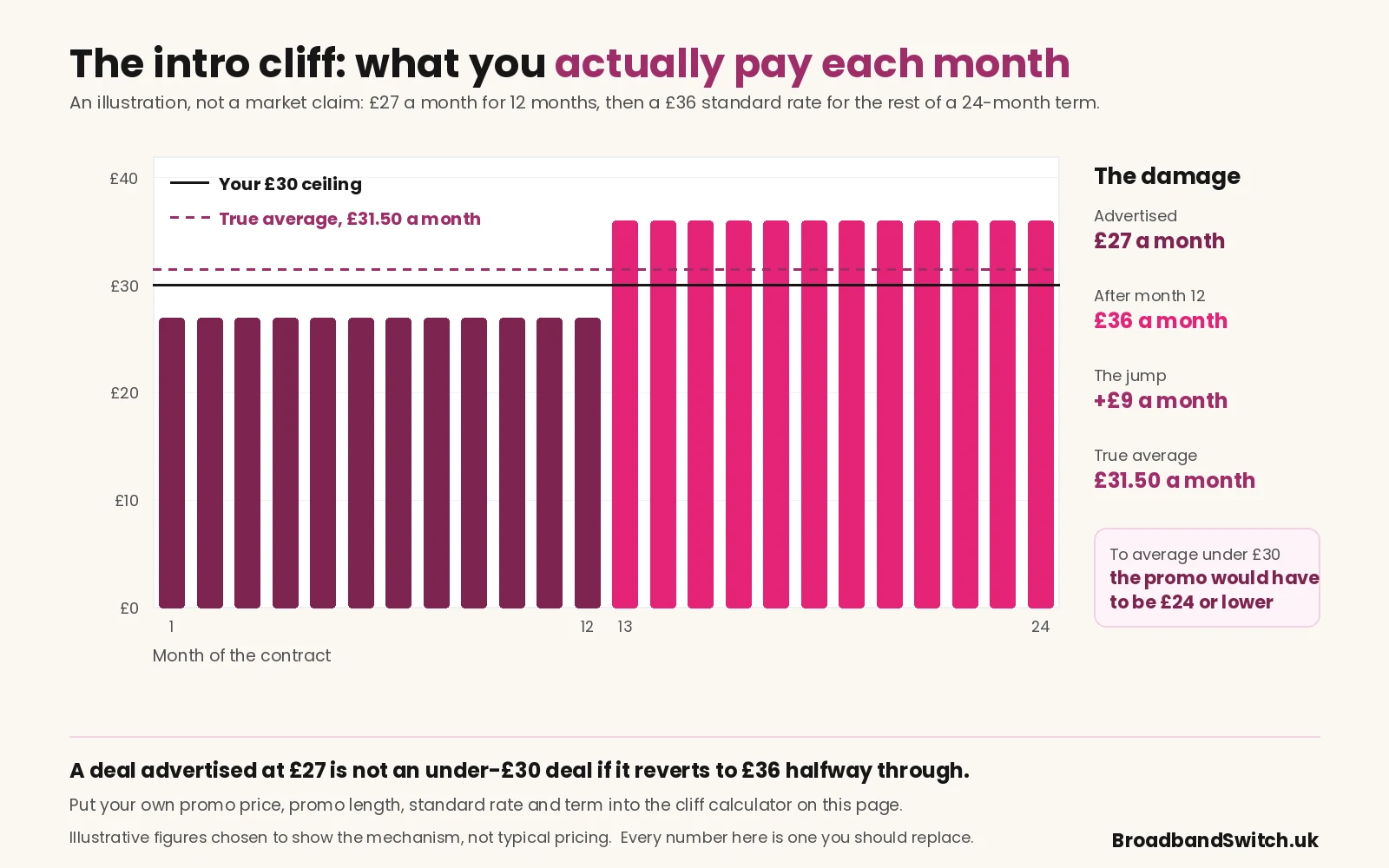
- Intro pricing cliffsDiscounted months can revert to a higher standard monthly rate mid-contract unless you renegotiate or switch again, so note the month any offer ends and put both rates through the calculator above. The average across the term is the number that decides whether it was ever an under-£30 deal.Watch out
- Setup and router costsActivation, installation or premium router hire can outweigh a small monthly saving when spread across short stays, so check the one-off lines on the basket before you confirm. See exit and setup fees.Watch out
- Upload and latency needsA deal under £30 on one technology might lag another on upload speed or jitter, so match the line to homeworking or gaming needs rather than download averages alone. The upload versus download guide covers what to compare.Watch out
- Availability realityStreet databases change, and a neighbour's viable fibre route may differ from yours if you are on a cabinet-heavy estate or a new build still being linked, so always run an address-level check.Watch out
How to keep your deal under £30 for the full term
Use this sequence whenever you filter for a £30 ceiling. It keeps the monthly number honest across the minimum term you actually sign.
- Enter your postcode and choose your exact addressWait for every eligible row to load before judging the market, because partial results at street level are how people talk themselves into the wrong technology.
- Apply the £30 filter, then sort by total spendMonthly price first, then upfront plus recurring across the term wherever the tool allows, since those two orderings rarely produce the same winner.
- Open two comparable lines on different technologiesNote the advertised average download and upload side by side, because that is where an altnet at the same price often pulls clear of FTTC.
- Add setup, delivery and installation into a single totalOne notebook figure per shortlisted option, so the comparison is like for like rather than headline against headline.
- Read how any in-contract increase is expressedIn pounds and pence, consistent with Ofcom's sale-stage disclosure expectations since early 2025, and note whether a promotional rate reverts as well, which is a separate thing from a stated rise.
- Confirm switch mechanics and cooling-off rightsIncluding whether you need to cancel an old bundle before the new order completes. Mid-contract today? Read the switching hub before assuming you can hop straight to a fresh intro price.
When you keep a diary of predicted bills, include any TV or mobile bolt-ons sold alongside the broadband, because they lift the visible total even while the broadband line item stays under £30. Breaking those apart in the basket sometimes clarifies whether you are financing entertainment through the same contract you rely on for work.
Compare deals under £30 at your postcode
Enter your postcode and choose your exact address to see live availability across 30+ providers, each card carrying its monthly price, contract length, average speed and its stated April rise amounts in pounds and pence. Availability is postcode and address specific, so pick your exact address in the widget where prompted, then put any serious contender through the cliff calculator above.
Budget tighter than this? Deals under £25 covers the trade-offs at that ceiling. Outgrown it already? Gigabit deals and the speed-needs guide settle whether the step up is worth it.
Related ways to find a deal under £30
Broadband under £30, asked and answered
What does broadband under £30 a month mean in the UK?
It is a headline monthly price band, not a speed guarantee. At many addresses you can find entry-level or mid-tier full fibre, cable, or faster part-fibre inside this budget, but the exact package depends on your postcode and on the offers live on the day you compare, and a promotional rate that reverts partway through the term can put the real average above the line.
Is £30 a month enough for full fibre?
Often yes where full fibre is available: entry-tier full fibre from national brands and many altnets frequently appears around or below £30 at competitive addresses, typically at 100+ Mbps against the 36 to 67 Mbps an entry FTTC line gives for similar money. Compare the advertised average download and upload speeds rather than the monthly price alone.
Why is £30 a month often the UK broadband sweet spot?
It is where entry full fibre from big-brand providers becomes common and where altnet full fibre can offer higher average speeds without jumping to premium pricing. You still need to validate price rises, setup fees and contract length at your address, because the band is also where introductory pricing is most aggressive.
What is an intro pricing cliff and how much does it cost?
It is a promotional monthly rate that reverts to a higher standard rate partway through the minimum term, which is different from a stated in-contract rise and often larger. As an illustration, £27 a month for 12 months followed by £36 for the remaining 12 of a 24-month term averages £31.50, so the deal was never under £30, and the promo would have had to be £24 or lower for it to average under the line. The calculator on this page runs your own figures.
How do I compare deals under £30 at my postcode?
Enter your postcode in the comparison tool, pick your exact address when prompted, then compare average speeds, upfront costs and total spend across the minimum term. Availability is address-specific, so the shortlist changes street by street and a neighbour's options are not reliably yours.
Are broadband deals under £30 slower than £40 deals?
Sometimes, but not always: at some postcodes an altnet deal under £30 can beat a higher-priced legacy technology on speed, because the underlying network matters more than the price tag. Read the advertised average speeds for each row in your results rather than assuming price equals performance.
What should I check besides the monthly price?
Setup and activation fees, hub delivery charges, contract length, exit fees, how any in-contract price increase is expressed, and separately whether a promotional rate reverts before the term ends. Since 17 January 2025 Ofcom expects clear pounds-and-pence disclosure for in-contract rises at the point of sale, which makes that half of the arithmetic straightforward to find.
Can I use One Touch Switch on an under-£30 deal?
For most fixed-line residential switches the One Touch Switch process has applied since 12 September 2024, with your new provider coordinating the move. You still need to check early-exit rules if you are inside a minimum term, and note that moving onto a 4G or 5G router sits outside the fixed-line switching system and needs cancelling and ordering separately.
About this guide. Compiled by Adrian James and reviewed by Dr Alex J. Martin-Smith, with every price and range stated as published at 6 August 2026, and the cliff calculator running the same true-cost method used across this site from figures carried in its own markup. Prices, availability and bundle structure vary by exact address and change with every campaign, so confirm the promotional rate, the standard rate and any stated rise in the provider's own order summary before ordering. We earn commission when you order through the comparison, which never changes the price you pay: see how we rank deals, the editorial policy, the methodology and trust hub and the affiliate disclosure, or submit a correction and a human will read it.
References
- Ofcom. (2024, July 19). Ofcom bans mid-contract price rises linked to inflation. Office of Communications. https://www.ofcom.org.uk/phones-and-broadband/bills-and-charges/ofcom-bans-mid-contract-price-rises-linked-to-inflation
- Ofcom. (2024, September 12). Simpler and quicker broadband switching is here. Office of Communications. https://www.ofcom.org.uk/phones-and-broadband/switching-provider/simpler-broadband-switching-is-here
- Ofcom. (n.d.). Social tariffs: cheaper broadband and phone packages. Office of Communications. Retrieved August 6, 2026, from https://www.ofcom.org.uk/phones-and-broadband/saving-money/social-tariffs
Move up to gigabit deals when you outgrow this budget, bundle entertainment via broadband and TV, or sanity-check with what speed do I need before you commit.
Independent and free. 30+ providers, true averages not headlines.