What Is SoGEA? The Broadband Line Millions Are Being Moved Onto
If the word SoGEA has just appeared on your broadband order, a switch confirmation or a letter from your provider, here is the short version: it is the broadband you very probably already have, minus the old-fashioned phone line, and the move is routine. This guide explains what SoGEA is, how to tell whether you are already on it, what physically changes at home, how it compares with FTTC and full fibre, what happens to your phone, your alarm and your number, what it costs, and the one check worth doing before you accept it.
The short version
- SoGEA is FTTC broadband without a phone line. Fibre to the street cabinet, copper to your door, and any phone service runs over the internet.
- It exists because the analogue phone network closes on 31 January 2027. Openreach's own guidance: all UK providers must move from analogue to digital phone lines by that date, and it warned on 31 July that around 1.5 million analogue lines still need to move, as reported by ISPreview.
- Speeds are the same as FTTC, up to 80Mbps down and 20Mbps up on the top tier, and moving across usually needs no engineer visit.
- Your handset moves from the wall socket to the router. So does anything else plugged into the phone socket, which is why care alarms need flagging first.
- The switch is a natural moment to compare what is available at your postcode. If full fibre has reached your address, it is usually the better buy at a similar price.
What is SoGEA?
Direct answer: SoGEA stands for Single Order Generic Ethernet Access. It is Openreach's product name for fibre-to-the-cabinet broadband sold on its own, with no traditional phone line attached.
Openreach's own description is admirably plain: "Today's customers don't always want a home phone line with their broadband, but traditionally they've had to install both." SoGEA removes the "both". In Openreach's words, it is "a standalone hybrid fibre broadband line (VDSL or Gfast), without the voice service". Plusnet translates for households: "SoGEA stands for Single order Generic Ethernet Access. It's referred to as single order, as you get everything you need in your package in one single order." And then the sentence that should have been the industry's slogan from the start: "Simply put, SoGEA is Fibre broadband without a landline."
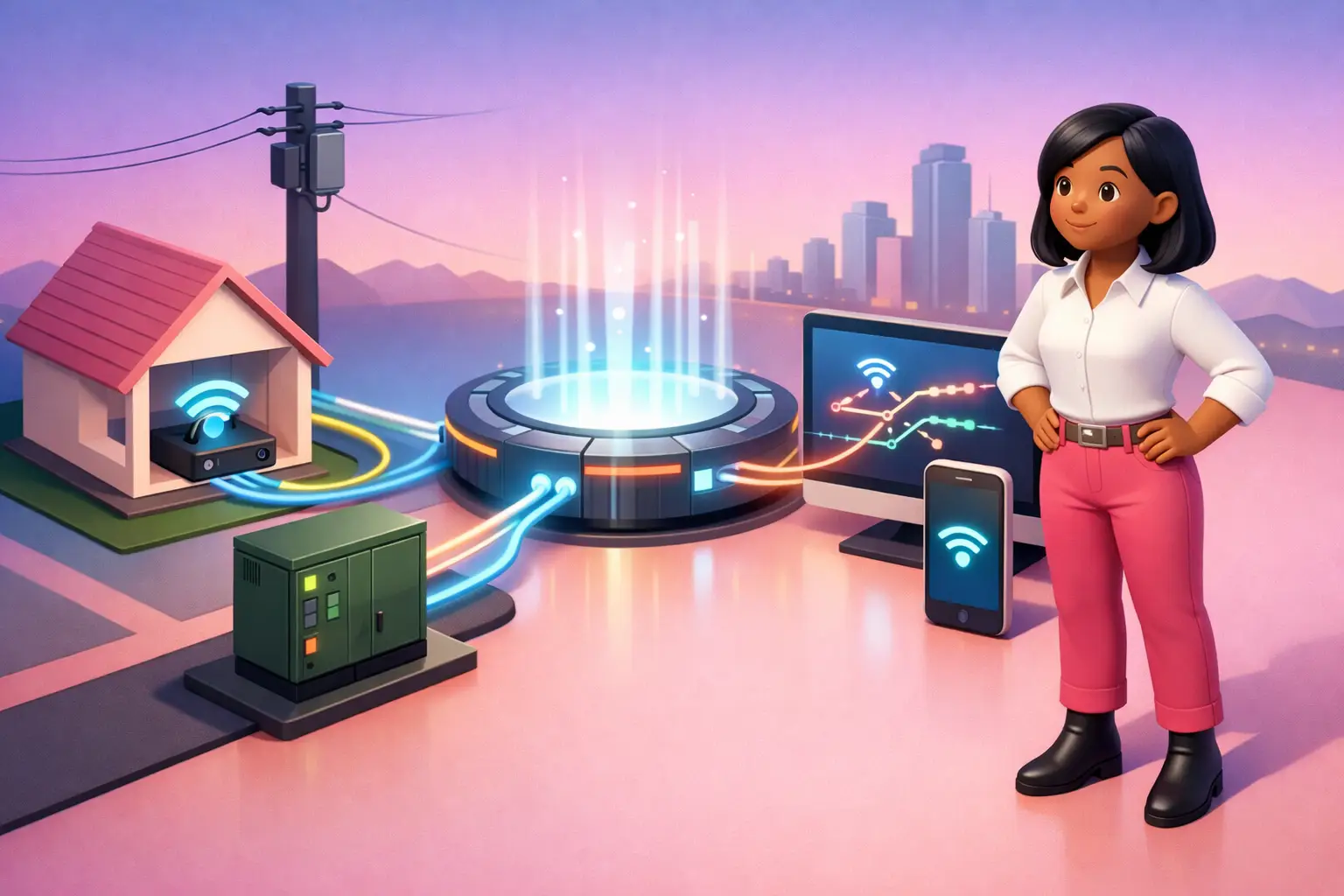
The wiring is the fibre-to-the-cabinet arrangement most of the country has used for years. Vodafone's glossary: "SoGEA (Single Order Generic Ethernet Access) is a type of part-fibre broadband connection, which means it uses both fibre optic cables and copper cables." Fibre runs from the telephone exchange to the green cabinet on your street, and the existing copper pair covers the final stretch to your home. Openreach's technical FAQ adds one detail worth knowing: "Unlike with FTTC, the copper line from the green street cabinet to the telephone exchange is no longer used with SOGEA." The copper that remains is only the piece between the cabinet and your door.
SoGEA launched commercially in March 2020, as reported at the time by ISPreview and The Register, and it has quietly become one of the most widely available broadband products in Britain. Openreach stated in November 2025 that "SOGEA is available to 98.5% of UK premises".
You will see the name spelled SoGEA, SOGEA and Sogea. They are all the same product, and Openreach itself uses more than one spelling.
How do I know if I am already on SoGEA?
Direct answer: check the wall socket, the bill, the paperwork and the date. Any one of the four can settle it, and your provider can confirm in a sentence.
This is the question the search results never answer, and millions of households have been moved without ever hearing the product name. Four signs, from most physical to most administrative.
| The sign | What it tells you |
|---|---|
| Your phone only works plugged into the router, and the old wall socket is dead | Your voice service is digital, which is how SoGEA and full fibre lines carry calls. If your broadband is part fibre, SoGEA is the near-certain answer |
| No separate line rental on the bill, and no analogue call plan | The two-product structure (line plus broadband) is what SoGEA replaced. A single broadband charge points to a single-order product |
| The paperwork says so: SoGEA, "single order" or "broadband without a phone line" on an order confirmation or contract | Definitive. Providers rarely say the name out loud, but it is usually in the documents |
| You signed a new part-fibre deal from around 2023 onwards | Very likely SoGEA. As the analogue network wound down, new part-fibre sales moved to the single-order product, and Openreach's national stop sell on the old line products has been rolling since September 2023 |
Why it matters: if you are already on SoGEA, the 2027 switch-off is largely done for you, and the letters about digital phone lines are about your neighbours. Your remaining decisions are about speed and price, not survival, which is exactly where this page ends up.
What actually changes at home?
Direct answer: for your broadband, usually nothing. For your phone, the wall socket stops being the way in, and the router takes over.
If you already have fibre-to-the-cabinet broadband, SoGEA runs over the same pair of wires at the same speeds. Openreach's guidance on the wider digital phone switchover says access to your home is "Usually not" needed, "unless you request help. If you're upgrading your broadband at the same time an engineer may need to access the phone sockets." BT says the same about its own migration: "For most BT customers, it is a simple and completely free transition to Digital Voice with no home installation work required."
The change is what happens to voice. There is no analogue dial tone on a SoGEA line. Openreach's FAQ puts it directly: "The only way to make a voice call once the CP has migrated its customers on to either FTTP or SoGEA, will be through a router provided by the CP and will be made over the internet (VoIP)." In practice that means your handset plugs into a phone port on the router, and your provider sells the phone element as a digital voice add-on. BT's description of its version: "Digital Voice is BT's new home phone service, powered by your broadband connection".
Openreach's FAQ carries the sentence that matters for every other gadget in the hallway: "If you have FTTP or SOGEA, you will need to connect any devices that currently are plugged into the telephony wall socket in the premises, into the router." For most homes that is one cordless phone base station. For some homes it is a care pendant, a monitored burglar alarm or a telecare unit, and those need a conversation with your provider before the migration, not after. Ofcom's consumer guidance asks you to tell your provider before you change to a digital landline if "you have a care alarm, health pendant or security alarm that uses the telephone line", if you have no mobile phone or signal at home to reach the emergency services in a power cut, or if a disability means you need extra help with the installation. Our guide to switching with a care alarm, health pendant or monitored alarm covers exactly what to say, and what happens to your phone number answers the question people worry about most.
On the number itself, three sources, in descending order of cheer. Ofcom: "Number portability is a regulated facility which allows customers to keep their numbers when changing provider." BT: "And you can keep your current phone number." Openreach, asked whether your number will change: "It may do. This depends on the services offered by your service provider." The practical reading: keeping the number is normal and protected, and it is still worth stating as an explicit instruction rather than an assumption, especially if you change provider at the same time.
SoGEA vs FTTC vs full fibre: the three-line table
Direct answer: SoGEA and FTTC are the same wires with different paperwork. Full fibre is a different wire altogether.
| FTTC (the old way) | SoGEA | Full fibre (FTTP) | |
|---|---|---|---|
| The line to your home | Fibre to the cabinet, copper to the door | Fibre to the cabinet, copper to the door | Fibre optic all the way |
| Analogue phone line | Yes, underneath the broadband | No. Voice runs over the internet if you want it | No. Voice runs over the internet if you want it |
| Typical advertised speeds | Up to 40/10 or 80/20Mbps | The same. Vodafone: "the same download speeds of up to 80 Mbps and upload speeds of 20 Mbps" | Commonly 150Mbps to 1Gbps and above |
| Distance sensitivity | Speed falls with distance from the cabinet | Identical, same copper physics | No degradation with distance |
| Survives 31 January 2027? | No. The analogue line underneath is being retired | Yes. It is the post-switch-off form of FTTC | Yes. It is the destination network |
| Who it is for | Nobody, for much longer. New sales are ending area by area | Homes where full fibre has not yet arrived | Anyone whose address it has reached |
One honest speed note, because "up to 80" and the number in the adverts differ. Advertised average speeds must reflect what at least half of customers actually get at peak time, so the top SoGEA tier is typically marketed at around 67Mbps average, as in Zen's consumer explainer, with the 80 as the ceiling. Where your home sits under that ceiling depends on the copper distance to the cabinet, which is the same physics behind most "why is my broadband slower than next door" mysteries. Our new guide to why your neighbour's broadband can be faster than yours covers the distance effect and the fixes, the average UK broadband speed puts your number in national context, and full fibre versus part fibre goes deeper on the technology.
The family of names on your paperwork: a decoder
Direct answer: six product names cover the whole transition. Here is each one in a sentence, so no letter can ambush you.
| Name | What it is | Speeds |
|---|---|---|
| SoGEA | Fibre-to-the-cabinet broadband with no phone line. This page's subject, and the standard destination for part-fibre homes | Up to 40/10 or 80/20Mbps |
| SOGfast | The same idea over G.fast, an interim faster-copper technology that peaked at around 2.8 million premises; BT is now reported to be moving its remaining G.fast customers onto the SoGEA platform | Up to around 330Mbps, as reported by ISPreview |
| SoTAP | The single-order product for ADSL-only lines, where neither fibre to the cabinet nor full fibre exists. Openreach calls it transitional | ADSL speeds |
| SOTAP for Analogue | An exchange-based product that keeps an ordinary analogue handset working with no broadband, no new equipment and no engineer visit. Launched commercially on 28 October 2025, as reported by ISPreview from an Openreach briefing. Aimed at telecare and edge cases; ask for it by name | Voice only |
| FTTP (full fibre) | Fibre the whole way to your home. The destination network, now available to 82% of UK homes on Ofcom's January 2026 data | Commonly 150Mbps to 1Gbps and above |
| WLR | Wholesale Line Rental, the old analogue phone line product underneath traditional setups. Being retired, and its wholesale price is rising steeply on the way out | Not a broadband product |
Why is everyone suddenly being moved to SoGEA?
Direct answer: because the analogue phone network is being retired by 31 January 2027, and SoGEA is the official landing spot for broadband lines that cannot yet get full fibre.
The old public switched telephone network, the PSTN, is closing. Openreach's guidance is unambiguous: "By 31 January 2027, all UK providers must move from analogue to digital phone lines." Every FTTC line has an analogue phone line underneath it, so every FTTC line has to move somewhere. Ofcom's consumer guidance frames the same change gently: "The technology that we currently use to make landline phone calls is being upgraded over the next few years", and, for the nervous, "Once you have moved to a VoIP service, your landline phone will work in much the same way as it always has."
Where full fibre has reached your address, the natural move is full fibre. Where it has not, Openreach's own help pages carry the reassurance: "If you don't have access to our digital broadband network by January 2027, the good news is you'll still be able to add a digital phone line to your existing broadband service." In November 2025 Openreach went further and started "providing free or discounted connection for Communication Providers (CPs) who upgrade their customers to SOGEA", describing it in the same release as an alternative service providing a digital line where full fibre is not yet available.
The clock is real and running down. On 31 July 2026, ISPreview reported Openreach warning that some 1.5 million UK lines were still operating on legacy copper, down from 1.9 million in June. That is the migration happening at pace, and it is why the letters are arriving now rather than next January.
Openreach, Nov 2025
Ofcom, Q1 2026
Ofcom, Q1 2026
Openreach warning, reported by ISPreview, 31 Jul 2026
How SoGEA fits the copper wind-down
SoGEA launches commercially, as reported by ISPreview and The Register on 3 March 2020.
Openreach's national stop sell on the old analogue line products begins; new part-fibre sales move to single-order products.
Openreach names 112 more exchanges for Stop Sell and says that "By August (August 20th)" its stop sell rules will have been activated in 1,572 exchanges, around 15.4 million premises. The release names no year for that milestone and reports differ, so we attribute the figure to the release rather than to a date.
The analogue phone network is retired. SoGEA carries on: it is the post-switch-off way of delivering part-fibre broadband.
SoGEA retires address by address as full fibre arrives, not on any national date Openreach has published.
Three stale claims are still in circulation, and all three are worth correcting gently, because together they teach the real lesson: check the date on anything you read about the switch-off. Vodafone's SoGEA glossary page, still live when we checked on 8 August 2026, states "By the end of 2030, the Public Switch Telephone Network (PSTN) will be switched off." Zen's 2023 explainer says the copper network "is going to be switched off by 2025." And Openreach's own 2021 FAQ told providers to migrate customers "by the end of 2025", the original target. The date that governs is the network owner's current one: 31 January 2027. Our report The Last Dial Tone tells the full switch-off story, and the landline switch-off checker tells you in six questions whether you are ready.
Does Stop Sell block SoGEA?
Direct answer: only at addresses where full fibre is actually available. This is the nuance almost every summary gets wrong.
Openreach's Stop Sell programme halts new copper-based orders at an exchange once "a majority (75%) of premises connected to a particular exchange can get ultrafast Full Fibre". SoGEA is explicitly on the stopped list: Openreach names "WLR3 Analogue, ISDN 2, ISDN 30, SMPF, MPF, FTTC, Narrowband Line Share, Classic, Gfast, SOGfast, SOGEA and SOTAP" as the products affected.
But the test is applied address by address, not exchange by exchange. Openreach's rule, verbatim: "If FTTP is available at that premises, it'll be the main valid product you can buy", and crucially, "If FTTP is not available at the premises, then the stop sell will not be applied."
So if your exchange is under Stop Sell but the fibre build has not reached your door, you can still order SoGEA, and for many homes it is the only sensible order. If full fibre has reached your door, any switch, upgrade or re-grade moves you onto it. You can check whether your exchange is affected on our Openreach Stop Sell exchange list, and the copper switch-off explained covers the wider programme.
What about my phone, my alarm and a power cut?
Direct answer: the phone moves to the router, the number can move with it, and battery back-up is the thing to ask about.
A digital phone line needs mains power. Ofcom's guidance is blunt about why that matters: "In the absence of other measures, calls made over broadband using VoIP-based technology will not function in a power cut, as the broadband equipment at the premises requires mains power to work." The standing requirement, set in Ofcom's 2018 guidance and cited as current in a House of Commons Library briefing of April 2026, is that providers must have a solution that "enables access to emergency organisations for a minimum of one hour in the event of a power outage in the premises", offered "free of charge to those who are at risk as they are dependent on their landline".
Ofcom's consumer guide, last updated 19 February 2026, adds the practical version. For anyone dependent on their landline, for instance with no mobile phone or no mobile signal at home, it says "your provider must offer you a solution to make sure you can contact the emergency services when a power cut occurs. For example, a mobile phone (if you have signal), or a battery back-up unit for your landline phone. This solution should be provided free of charge to people who are dependent on their landline." If you are not eligible for a free solution, Ofcom notes you may be able to purchase one; BT, for instance, tells customers "If your area has power cuts, you can buy a battery back-up unit (BBU) to maintain your service." So when your provider confirms the move, ask two direct questions: what back-up will you give me, and is it free? Our guide on whether your phone will work in a power cut sets out the position by provider, and digital voice and the PSTN switch-off is the full landline migration guide.
If anyone in the household uses a care alarm or telecare pendant, say so before any migration is arranged. There are formal protections under the PSTN Charter, and they are triggered by your provider knowing. For households that genuinely cannot move to a router-based phone, the exchange-based SOTAP for Analogue product launched commercially on 28 October 2025, as reported by ISPreview; it keeps an ordinary analogue handset working with no broadband, no new equipment and no engineer visit, and you have to ask for it by name.
Will SoGEA cost more?
Direct answer: structurally it should not, because there is no separate phone line product underneath it, and the old copper products are getting more expensive on the way out.
At the wholesale level, BT Wholesale's pitch to providers is explicit: "because you no longer need a PSTN line, you save money too", adding "As there's only one line, you'll be able to deliver your services quicker and cheaper." Meanwhile the legacy analogue line rental that FTTC sits on is being priced off the network: Openreach announced in November 2025 that basic WLR rental "will increase by 20 per cent from April 1st next year, followed by a 40 per cent rise, on the current price, in July, and rising by a further 40 per cent in October, double the current rental price." Copper is not just going away, it is getting dearer as it goes; our copper price rise tracker follows each step.
Retail prices are set by your provider, not by Openreach, so the honest answer is: compare what your postcode offers today. What we can say with Ofcom's numbers behind it is that the expensive place to be is out of contract. Ofcom research published on 26 February 2026 found that "customers who are in contract spend between £7 and £9 a month less than out-of-contract customers". If your provider is writing to you about the digital switchover anyway, that letter is a free prompt to check what the market would charge you for the same speed, or a faster one; our new guide to broadband deals for existing customers covers the renegotiation route if you would rather not move.
What should I do if I am being moved to SoGEA? The three-question decision
Direct answer: one availability check and one household question settle what to do with a SoGEA letter.
If yes, that call comes first, before any migration is arranged. Tell your provider and the alarm supplier, and ask about SOTAP for Analogue by name if a router-based phone will not work for you.
Thirty seconds on the postcode comparison answers it. If yes, full fibre is usually the better buy at a similar price, and the SoGEA letter just became an upgrade prompt. Ofcom's Spring 2026 update put availability at 82% of homes and moving fast: 1.2 million homes added in six months, so re-check even if you looked last year.
It is the right product for your address, the move is routine, and the letter is still a pricing prompt: check you are not paying the out-of-contract premium for the speed you already have. Then diarise an availability re-check for next year.
Free and independent. Takes about thirty seconds, and shows full fibre where it has reached you.
Adrian's take
SoGEA is what happens when an industry renames the thing you already have and forgets to tell you. Readers write to us convinced it is a downgrade, a con or a new charge, and it is none of those. It is your existing broadband with the dead weight of a 1980s phone product removed, and half the people asking about it turn out to have been on it for a year already. The only mistake you can make with SoGEA is accepting it without looking up, because the same letter that moves you is the perfect moment to ask whether full fibre has quietly arrived on your street, and whether you are one of the millions paying the out-of-contract premium for the privilege of not checking.
If somebody you look after gets this letter
Direct answer: the phone will feel the same afterwards, the number can stay, and the one urgent step is flagging any alarm before the move.
Much of the worry around SoGEA letters lands on people helping parents and relatives through the change. Three sentences to pass on, each from the source. Ofcom: "Once you have moved to a VoIP service, your landline phone will work in much the same way as it always has." BT: "you can keep your current phone number." And the ask: tell the provider about any care alarm, health pendant or security alarm before anything is booked, which is Ofcom's own checklist item. Our guides to switching on behalf of an elderly parent or relative and care alarm compatibility take it from there.
Frequently asked questions
What is SoGEA broadband?
SoGEA stands for Single Order Generic Ethernet Access. It is Openreach's name for fibre-to-the-cabinet broadband sold on its own, without a traditional analogue phone line attached. Plusnet's consumer explanation is the plainest: simply put, SoGEA is fibre broadband without a landline. Fibre runs to the green street cabinet and copper covers the last stretch to your home, exactly as with FTTC, and any home phone service runs over the broadband instead. Openreach says SoGEA is available to 98.5% of UK premises.
What does SoGEA stand for?
Single Order Generic Ethernet Access. The single order part is the point: previously a household ordering fibre-to-the-cabinet broadband needed two products, a phone line and broadband on top of it. Plusnet explains it is referred to as single order because you get everything you need in your package in one single order, with no analogue phone line underneath.
How do I know if I am already on SoGEA?
Four signs. A phone that only works plugged into the router, with a dead wall socket, means your voice is digital, which is how SoGEA and full fibre lines carry calls. A bill with no separate line rental and no call plan tied to an analogue line points the same way. An order confirmation or contract mentioning SoGEA, single order or broadband without a phone line is definitive. And if you took a new part-fibre deal from around 2023 onwards, it was very likely sold as SoGEA, because providers stopped selling the old two-product setup as the analogue network wound down. Your provider can confirm in one question.
Is SoGEA fibre or copper?
Both, which is why it is often called part fibre or hybrid fibre. Openreach describes it as a standalone hybrid fibre broadband line, and Vodafone's glossary puts it plainly: it uses both fibre optic cables and copper cables. Fibre runs from the exchange to the street cabinet, and the existing copper pair runs from the cabinet to your home. Full fibre (FTTP), by contrast, is fibre the whole way.
What speeds can I get on SoGEA?
The same as FTTC. Openreach states that SoGEA gives downloads of up to 80Mbps using the same technology as FTTC, and Vodafone confirms both SoGEA and FTTC offer the same download speeds of up to 80 Mbps and upload speeds of 20 Mbps. It is sold in the familiar tiers, typically up to 40Mbps down with 10Mbps up, or up to 80Mbps down with 20Mbps up, and advertised average speeds sit a little under the maximums, around 67Mbps on the top tier. As with all fibre-to-the-cabinet products, your real speed depends on how far your home is from the street cabinet.
What is SOGfast?
The G.fast version of the same idea: single-order broadband over Openreach's G.fast technology, which ISPreview describes as capable of speeds up to 330Mbps and which reached around 2.8 million premises at its peak. G.fast was an interim technology and much of its footprint has since been overbuilt by full fibre; ISPreview reported in May 2026 that BT is moving its remaining G.fast customers across to the SoGEA platform.
Do I need a phone line for broadband any more?
No. SoGEA exists precisely so that broadband can be sold without a phone line. If you still want a home phone, it runs over the broadband as a digital voice service and your handset plugs into the router rather than the wall socket.
Can I keep my phone number when I move to SoGEA?
Usually, and it is worth confirming rather than assuming. Number portability is a regulated facility which allows customers to keep their numbers when changing provider, in Ofcom's words, and BT's Digital Voice guide states plainly that you can keep your current phone number. Openreach is more cautious, noting the answer depends on the services your provider offers. So make keeping the number an explicit instruction when the digital phone service is set up, especially if you are changing provider at the same time.
Will my phone work in a power cut on SoGEA?
Not on its own. Ofcom states that calls made over broadband will not function in a power cut without other measures, because the equipment needs mains power. Ofcom requires providers to offer a solution giving access to emergency organisations for at least one hour in a power cut, free of charge to those dependent on their landline, and its consumer guidance adds that if you are not eligible for a free solution you may be able to purchase one. Tell your provider if you have no mobile signal at home; that changes what they should offer you.
Do I need an engineer visit to move to SoGEA?
Usually not, if you already have fibre-to-the-cabinet broadband on the same line. Openreach's guidance on the digital phone switchover is that providers usually will not need access to your home unless you ask for help or upgrade your broadband at the same time, and BT describes the move to Digital Voice for most of its customers as a simple and completely free transition with no home installation work required. If your property has no active line, an installation is arranged as part of the order.
Do I need a new router for SoGEA?
Often not for the broadband itself, since SoGEA uses the same VDSL technology as FTTC, but the phone side matters: handsets and anything else plugged into the telephone wall socket must move to the router, so you need a router with a phone port and a provider service that supports digital voice. Providers typically supply or reconfigure the router as part of the migration. Ask your provider rather than buying anything.
Is SoGEA being phased out?
It survives the 31 January 2027 analogue switch-off, because it is the post-switch-off way of delivering fibre-to-the-cabinet broadband. But it is a copper-based product, so wherever Openreach's full fibre reaches your specific address and your exchange is under Stop Sell, new SoGEA orders end and any change moves you to full fibre. Openreach has published no national retirement date for SoGEA itself.
Does Openreach Stop Sell block SoGEA?
Only where full fibre is actually available at your address. SoGEA is on Openreach's list of products that stop being sold once an exchange passes the 75% full fibre threshold, but Openreach's own rule is that if FTTP is not available at the premises, then the stop sell will not be applied. Living in a Stop Sell exchange does not block SoGEA at an address full fibre has not reached.
Is SoGEA the same as full fibre?
No. SoGEA still uses copper for the final stretch from the street cabinet to your home, so top speeds are around 80Mbps. Full fibre (FTTP) is fibre optic cable the whole way and supports gigabit speeds. If full fibre is available at your address it is usually the better buy, and often costs about the same as SoGEA.
Will SoGEA cost more than my current broadband and phone deal?
There is no separate line rental product underneath SoGEA, and at wholesale level BT states that because you no longer need a PSTN line, you save money. Meanwhile Openreach is raising the wholesale rental on the old analogue line product in steps, 20% then 40% then a further 40%, so the legacy setup is getting dearer as it retires. Retail prices are set by providers, so compare deals rather than assuming. The bigger risk to your bill is being out of contract: Ofcom research published in February 2026 found in-contract customers spend £7 to £9 a month less than out-of-contract customers.
References
- BT. (n.d.). A guide to Digital Voice. https://www.bt.com/bt-plc/assets/documents/about-bt/all-ip/a-guide-to-digital-voice.pdf
- BT. (n.d.). Digital Voice. https://www.bt.com/help/landline/digital-voice
- BT Wholesale. (n.d.). Single order Generic Ethernet Access (SoGEA). https://www.btwholesale.com/products-and-services/data/sogea.html
- House of Commons Library. (2026, April 1). The Public Switched Telephone Network (PSTN) switch-off. https://commonslibrary.parliament.uk/research-briefings/cbp-9471/
- Hughes, M. (2020, March 3). Openreach to heap admin burden on UK ISPs with launch of new wholesale services. The Register. https://www.theregister.com/2020/03/03/openreach_ip_voice_network/
- Jackson, M. (2020, March 3). Openreach formally launch "naked broadband" via SOGEA. ISPreview UK. https://www.ispreview.co.uk/index.php/2020/03/openreach-formally-launch-naked-broadband-via-sogea.html
- Jackson, M. (2025, September 29). Openreach launches alternative UK analogue phone line product. ISPreview UK. https://www.ispreview.co.uk/index.php/2025/09/openreach-launches-alternative-uk-analogue-phone-line-product.html
- Jackson, M. (2026, May 16). BT set to move G.fast UK broadband customers to SOGEA platform. ISPreview UK. https://www.ispreview.co.uk/index.php/2026/05/bt-set-to-move-g-fast-uk-broadband-customers-to-sogea-platform.html
- Jackson, M. (2026, July 31). Openreach warn 1.5 million UK analogue phone lines yet to make digital switch. ISPreview UK. https://www.ispreview.co.uk/index.php/2026/07/openreach-warn-1-5-million-uk-analogue-phone-lines-yet-to-make-digital-switch.html
- Ofcom. (2018, October 10). Protecting access to emergency organisations when there is a power cut at the customer's premises. https://www.ofcom.org.uk/phones-and-broadband/telecoms-infrastructure/access-emergency-organisations-power-cut
- Ofcom. (2023, April 3). Number portability. https://www.ofcom.org.uk/phones-and-broadband/phone-numbers/number-portability-info
- Ofcom. (2026, February 19, last updated). Moving landline phones to digital technology: what you need to know. https://www.ofcom.org.uk/phones-and-broadband/landline-phones/future-of-landline-calls
- Ofcom. (2026, February 26). New Ofcom research reveals how to cut phone and internet bills. https://www.ofcom.org.uk/phones-and-broadband/bills-and-charges/new-ofcom-research-reveals-how-to-cut-phone-and-internet-bills
- Ofcom. (2026, May 13). Connected Nations update: Spring 2026. https://www.ofcom.org.uk/phones-and-broadband/coverage-and-speeds/connected-nations-update-spring-2026
- Ofcom. (2026, July 23). Telecommunications market data update Q1 2026. https://www.ofcom.org.uk/siteassets/resources/documents/research-and-data/telecoms-research/telecoms-data-updates/telecommunications-market-data/telecommunications-market-data-update-q1-2026.pdf
- Openreach. (n.d.). Single Order Generic Ethernet Access (SOGEA), broadband without the landline. https://www.openreach.co.uk/cpportal/products/fibre-broadband/sogea
- Openreach. (n.d.). Stop sell updates. https://www.openreach.co.uk/cpportal/products/product-withdrawal/stop-sells-updates
- Openreach. (n.d.). Upgrading the UK to digital phone lines for my home or business. https://www.openreach.com/help-and-support/Upgrading-the-UK-to-digital-phone-lines-for-my-home-or-business
- Openreach. (2021, February). All IP FAQs, version 1.7. https://www.openreach.com/content/dam/openreach/openreach-dam-files/images/upgrading-the-UK-to-digital-phone-lines/industry/openreach%20ALL%20IP%20FAQs%20v1.7.pdf
- Openreach. (2025, November 12). Openreach announces price changes to encourage digital adoption of newer, more reliable and better value technology. https://www.openreach.com/news/openreach-announces-price-changes-to-encourage-digital-adoption-of-newer-more-reliable-and-better-value-technology/
- Openreach. (2026, July 27). Openreach puts a stop to copper for another half million premises in bid to push customers to new digital lines. https://www.openreach.com/news/openreach-puts-a-stop-to-copper-for-another-half-million-premises-in-bid-to-push-customers-to-new-digital-lines/
- Plusnet. (2025, August 14, updated). What is SoGEA? https://www.plus.net/broadband/discover/what-is-sogea/
- Vodafone. (n.d.). SoGEA broadband. https://www.vodafone.co.uk/mobile/best-for/glossary/sogea-broadband
- Zen Internet. (2023, November 15). Full fibre not available in your area? Stay connected with SoGEA. https://www.zen.co.uk/blog/posts/zen-blog/2023/11/15/full-fibre-not-available-in-your-area-stay-connected-with-sogea/
Written by Adrian James, Broadband Editor at BroadbandSwitch.uk (LinkedIn). Reviewed by Dr Alex J. Martin-Smith (LinkedIn). Published 9 August 2026, facts last verified 8 August 2026 and re-checked before publication. Product availability and dates are set by Openreach and providers and can change. This guide is information, not advice.