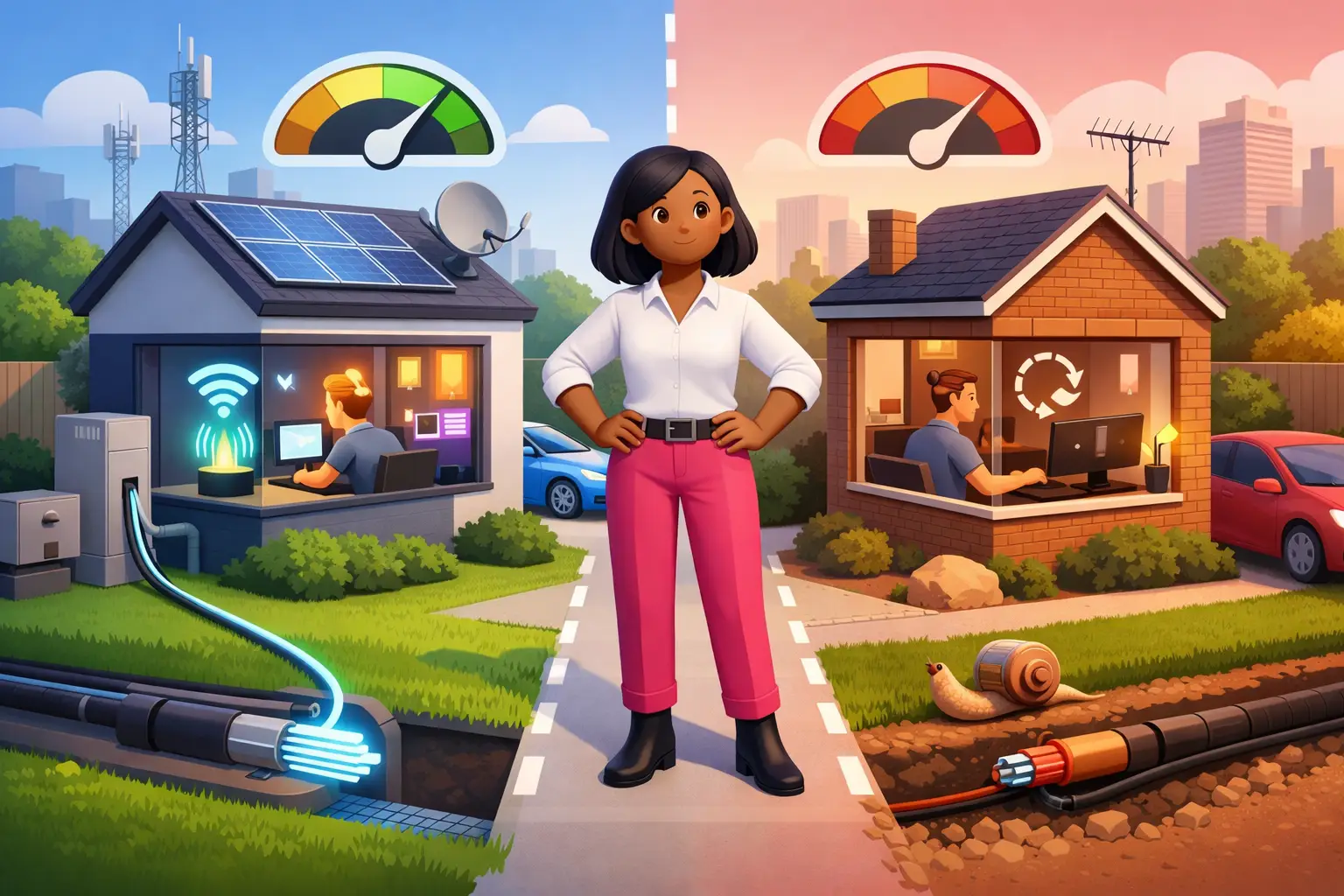
Why Can Your Neighbour Get Faster Broadband Than You? Five Causes, Six Fixes
The Openreach van has been up and down your road, next door is boasting about gigabit, and your checker still says no. Or you both have "the same broadband" and their speed test doubles yours. Same-street gaps are so common that Openreach runs a dedicated FAQ titled "Why can my neighbours order Full Fibre but I cannot?" This guide explains the five causes in order of likelihood, using Openreach's, Ofcom's and the government's own words, then gives you the six-step ladder for closing the gap, from a free registration to a legal right with a £3,400 budget attached, and finishes with the twist: sometimes the network was never the problem, the deal was.
The five causes, at a glance
- Builds are phased. Openreach: "Even within the same street, some addresses are connected before others."
- Permissions stall flats and private land. "We can't do any work until we've got your signed document" is Openreach's wayleave rule, and the government now says the court workaround cannot scale to the suggested 1.2 million flats still waiting, so reform is under consultation.
- Records lag reality. Openreach admits its systems sometimes show a neighbour as ready before your address is updated.
- Networks are a patchwork. Independent networks, the altnets, passed 19.7 million premises by end 2025, are the only full fibre at over 5.4 million of them as reported by ISPreview, and 32% of premises now have two or more full fibre networks on thinkbroadband's April 2026 data.
- Sometimes it is just the deal. Full fibre reaches 82% of homes but under half of those have taken it. Check the address before envying the neighbour.
Why can your neighbour order full fibre when you cannot?
Direct answer: because fibre arrives address by address, not street by street, and Openreach says so itself.
Openreach builds by exchange area, and inside each area the work rolls out in phases. Its own explanation of build priorities: "There are several factors we have to balance. This includes things like operational challenges, how much it costs to build there, and the commercial conditions such as potential demand." When an exchange makes the plan, "we aim to build to as much of that exchange area as possible, taking into consideration operational complexities and investment conditions", and, the honest kicker, "Some properties are just too difficult or complex to upgrade commercially, but they may be covered by another one of our programmes or through public funding."
On the ground that translates to duct on one side of the road cleared and blocked on the other, one pole replaced and the next awaiting a permit, and Openreach's specialist work list for the stragglers: digging ducts, replacing poles, or overcoming blocked routes. On timing, Openreach commits to nothing at address level: "There's no fixed timescale. It could be a matter of weeks or longer depending on the engineering work required, but it usually means your area is close to being fully upgraded."
One vocabulary note, because the headlines use a term the checkers do not. BT reports its build in "premises passed", as in its full-year results line "Record FTTP build of 4.8m premises passed in the year". Passed means built past; it does not always mean orderable today, which is why the checker keeps a separate status, Full Fibre is coming soon, meaning "we're already working in your area, but it's not quite ready to order yet". Openreach publishes no formal public definition of premises passed, so treat the checker, not the build headline, as the truth about your address.
So the first diagnostic question is not "why me?" but "which of the five causes is mine?" Here they are, most common first.
The five causes, in order of likelihood
1. The build simply has not reached your address yet. The default explanation, the one the Coming Soon status exists for, and the cause that fixes itself with time. Step one of the ladder below makes sure you hear as soon as it does.
2. A permission is missing: wayleaves, flats and private land. A wayleave is, in Openreach's definition, "A written legal agreement between us and the land or property owner. It gives us permission to install, maintain or repair the network equipment that's on their property." And it is a hard blocker: "We can't do any work until we've got your signed document." For flats, "We need permission from the Landlord, Freeholder or Managing Agent of your property to go ahead with an installation." A terrace of houses needs none of that; the block of flats opposite needs all of it, which is how a building full of people ends up years behind its own postcode, and why the government is now consulting on stronger rules (more under fix 3 below). Our guide to wayleaves for flats and apartment blocks covers the process, and tenants' rights to full fibre covers the landlord conversation.
3. The records have not caught up with the street. Openreach again: "Sometimes our systems show your neighbour as ready before your own address is updated." Ofcom's national checker carries the same health warning about all coverage data: "The coverage information is based on operators' predictive modelling tools and localised issues may mean that particular premises may not be able to receive a service despite being predicted to do so." Checkers predict; orders confirm. If reality and the checker disagree, ask a provider to run an address-level order check rather than trusting the postcode view.
4. Your neighbour is on a different network entirely. Britain's fibre map is now a patchwork of independent builders on top of Openreach and Virgin Media. INCA's State of the Altnets 2026 reports: "Altnet network coverage increased 20% year-on-year to reach 19.7m premises by the end of 2025." Each altnet chose its own streets. ISPreview's analysis of the INCA data found that "altnets now provide exclusive FTTP/B coverage to over 5.4m premises", meaning the altnet is the only full fibre there. Overlap is now normal too: thinkbroadband's State of Broadband report finds that "32% of UK premises can now access two or more FTTP networks" on April 2026 data, and its monthly tracker's wider two-or-more-options measure stood at 40.98% in July 2026. The map is also consolidating under your feet: ISPreview reported on 4 August 2026 that nexfibre has agreed "a £2bn deal to acquire alternative network rival Netomnia", with a combined footprint reaching 8 million premises by end 2027, and Sky arguing to the regulator that in overlap areas the merger will, in thinkbroadband's rendering, "reduce the number of infrastructure networks from three down to two". The practical upshot for households is unchanged: the gigabit next door may come from a provider whose network stops at their wall, so check who actually serves your address. Our explainer on Openreach versus altnet broadband covers how to tell who serves whom, and which providers use the Openreach network decodes the brands.
5. The network is identical and the deal is not. The quiet, common one. Full fibre is available to 82% of UK homes, and by January 2026 only 47% of premises with access had taken it, so streets everywhere hold both gigabit households and copper households on the same duct. If your neighbour's speed advantage survives all four checks above, the difference is probably a package, and packages are the easiest thing in this entire article to change.
Same product, different speeds: distance, metal and the last few metres
Direct answer: on part-fibre lines, the copper run to the cabinet sets your ceiling, the line's material and quality nudge it, and inside the house Wi-Fi decides how much of it you keep.
If you and the neighbour are both on fibre-to-the-cabinet broadband, geography is a suspect. Openreach's consumer page explains that "your speed can vary slightly depending on the distance between your home and the cabinet - the closer you are, the faster your connection is likely to be", and its guidance is that speeds can start to drop noticeably beyond roughly 300 to 400 metres from the cabinet. The wire itself matters too: Ofcom's technical advice to government on broadband service notes that the primary reason a premises cannot get decent speeds "is that they are served by a long copper line", adding in the same passage that "Other factors include the material of the telephone line (e.g. aluminium), its thickness (or gauge) and its general quality (including the quality of joints and interconnects)." That report dates from 2016 and does not quantify the aluminium effect, but it is the regulator confirming what line engineers have always said: two lines of the same length are not always the same line. Two houses ten doors apart can therefore sit at meaningfully different points on the curve, and no provider change fixes physics; only moving off part fibre does. Full fibre, by contrast, is in Openreach's words "a connection that won't degrade based on how far your home is from the nearest street cabinet".
Inside the house, the gap is usually Wi-Fi. Ofcom's practical advice: "Use an Ethernet cable to connect your computer directly to your router rather than using WiFi", keep the router away from other electrical devices, and place it centrally and off the floor. Before concluding your line is worse than next door's, test wired at the router; our guides to free Wi-Fi improvements and accurate speed testing take ten minutes and settle most street rivalries.
The availability picture, and the rural gap inside it
Ofcom data. Top two bars: share of the UK's 30.5 million homes, January 2026 (Spring update). Bottom two: residential full fibre availability by rurality, July 2025 data (Connected Nations 2025).
The 61% against 81% rural gap is the one public money is aimed at: BDUK reports 90% of last year's subsidised delivery was rural. Where fibre has reached the countryside it gets bought faster than in cities, 56% rural take-up against 40% urban per Connected Nations 2025.
How to find out what your address can really get
Direct answer: check at address level, across every network, and treat postcode-level results as a rumour.
Three checks, in order. First, a whole-of-market address check through our postcode comparison, which shows the deals actually orderable at your address across networks, or our availability checker for the technology picture. Second, Openreach's own fibre checker for build status at your address, including the Coming Soon flag. Third, if a checker says yes but ordering fails, or says no while the neighbour's install proves otherwise, remember cause three: predictive data. An order attempt with a provider forces an address-level answer, and our guide to whether full fibre has reached your street explains why 2026 is the year to re-check even if you looked last year, with availability moving by 1.2 million homes in six months.
The escalation ladder: six ways to close the gap
Direct answer: start free and passive, end legal and funded. Here is the ladder, weakest to strongest.
Free and thirty seconds. Openreach's checker offers "Keep me updated", and Openreach says registering interest "helps providers understand demand in your area and may support future rollout plans". Do the same on any altnet building nearby. Weak individually, and it is the demand signal planners actually count.
Cause four cuts both ways: an altnet may already serve your address while the big-name checkers say no. A whole-of-market address check surfaces them. One product you may read about, FTTP on Demand, is best left out of your plans: ISPreview reports: "The costs, delays and complexities of this product meant that only a very few ISPs ever ended up offering it and the service has now largely been sidelined".
Tell the landlord, freeholder or managing agent you want full fibre, and give the building's details to the network; Openreach explicitly asks residents to do this to speed the process. The legal backstop exists, a court route for unresponsive landlords under the Telecommunications Infrastructure (Leasehold Property) Act, but the government's own December 2025 consultation is blunt about its limits: "we do not believe this to be a viable option given the scale of the suggested 1.2 million flats that require a gigabit-capable broadband connection, and the time it takes for a decision to be reached", which is why stronger rules are under consultation. Translation for residents: the polite, persistent route through the landlord, backed by a placed order, is not the fallback, it is the fast lane.
For under-served areas, Openreach's Connect My Community route pairs group pledges with the government's Gigabit Broadband Voucher Scheme, aimed where "Existing broadband speeds are less than 100Mbps" and a gigabit network "isn't likely to be built to that area commercially in the near future". Carry the caveat: "Reaching the pledge target for your scheme is not a commitment to build." The machine behind it is GOV.UK's "record £5 billion scheme", Project Gigabit, targeting 99% of premises with gigabit access by 2032, and it is delivering: BDUK's June 2026 bulletin estimates 192,570 premises gained subsidised gigabit-capable coverage in 2025 to 2026, up 28% on the year, an estimated cumulative 1,418,410 since launch, and 90% of last year's delivery rural.
The Universal Service Obligation "gives eligible homes and businesses the legal right to request an upgraded connection if they can't get a download speed of 10 Mbit/s and an upload speed of 1 Mbit/s". BT handles requests (KCOM in Hull), and "If the cost of getting your property connected is £3,400 or less, BT or KCOM will pay for this work to be carried out." Only 39,000 premises remained below the decent-broadband line from fixed and fixed wireless networks by January 2026, so if you are one of them, the system is genuinely built for you; our rural broadband guide walks through it.
Mobile-network broadband needs no installation and no landline; Three, for instance, sells its hub as "an alternative to Home Broadband that uses a landline". Speeds depend on local signal, so treat provider descriptions as claims and check coverage first. Our 4G and 5G home broadband pages list current deals, and our Starlink assessment covers the satellite option for the hardest addresses.
One more cause of two-speed streets deserves its own line: new builds. Since 26 December 2022, building regulations in England, under Part R of Schedule 1 with guidance in "Infrastructure for electronic communications: Approved Document R", require new homes to be fitted with gigabit-ready infrastructure, with connection costs "capped at £2,000 per home for developers", and gigabit-ready ducting required even where a live connection misses the cap. A 2023 estate and a 1993 estate across the road can therefore live in different broadband decades; broadband for new builds and new-build ordering delays cover both sides of that story.
And if the network was never the problem?
Direct answer: then you are cause five, the lucky one, because your fix is a purchase, not a civil engineering project.
Run the honest audit. If your address can order what the neighbour has, the entire speed gap is a shopping decision: a faster tier on your current network, or a different network at your door. With gigabit-capable broadband available to 89% of homes and less than half of full-fibre-enabled homes having taken any of it, the statistically ordinary situation on a UK street in 2026 is a household sitting under a faster line than the one they are paying for. Being the fast house on the street is, for most readers of this page, thirty seconds and a click away.
Free and independent. Address-level, all networks, ranked by total contract cost.
Adrian's take
Broadband envy is the most productive emotion in telecoms, and I mean that sincerely. Nobody rings their provider because a national average moved, but a neighbour's casual gigabit boast has powered more upgrades than any advertising campaign ever will. The trick is to aim it well. Half the readers who write to us about this turn out to be cause five: the fibre was already under their feet, unordered, sometimes for years. The other half have a genuine blocker, and the ladder above exists because polite, specific, correctly-addressed pressure genuinely moves builds: wayleaves get signed, pledges hit targets, and records get fixed for the person who asks. Even Whitehall has come round to the residents' side of this, admitting the court route for stubborn landlords cannot carry the suggested 1.2 million flats. Envy the neighbour today, audit the address tonight, and with any luck it is their turn to envy you by autumn.
Frequently asked questions
Why can my neighbour get full fibre but I can't?
Openreach's own answer is that there is almost always a valid reason, and it may be just a matter of time. Builds happen in phases, so even within the same street some addresses are connected before others. The usual causes are outstanding engineering work, a missing wayleave or landlord permission, address records lagging behind the physical build, or a different network entirely serving your neighbour's side of the street.
Why is my neighbour's internet faster than mine on the same street?
If you can both order the same products, the difference is usually the package they chose, the technology they are on, or their home setup. On part-fibre FTTC lines, where fibre reaches the street cabinet and copper carries the signal the rest of the way to your home, Openreach's guidance is that speed falls with distance from the cabinet, with drops becoming noticeable beyond roughly 300 to 400 metres, and Ofcom's technical work adds that the line's material, aluminium rather than copper for instance, its thickness and its quality also play a part. Wi-Fi placement and interference then decide how much of the line's speed each home actually sees.
When will full fibre reach my address?
Openreach publishes no per-address timetable and says there is no fixed timescale once an area is in build, with completion depending on the engineering work required. Its fibre checker shows the status Full Fibre is coming soon when work has started but ordering is not yet open. Registering for updates through the checker means you are notified as soon as full fibre becomes available in your area.
What does premises passed actually mean?
It is the industry's build count: BT reports figures like a record FTTP build of 4.8 million premises passed in a year, meaning the network has been built past those addresses. Openreach publishes no formal public definition, and passed does not always mean orderable today: its checker uses a separate status, Full Fibre is coming soon, for addresses where work has started but orders are not yet open. The checker, not the headline build number, tells you whether you can buy.
What is a wayleave?
Openreach defines a wayleave as a written legal agreement between it and the land or property owner giving permission to install, maintain or repair network equipment on their property. Openreach states it cannot do any work until the signed document is in place, which is why flats, private roads and land crossed by third-party property often wait longer than neighbouring houses.
Can my landlord block full fibre installation?
A landlord's permission is needed, and an unresponsive landlord used to be a dead end. The Telecommunications Infrastructure (Leasehold Property) Act gives providers in England and Wales a court route when the person required to grant access is unresponsive, but the government's December 2025 consultation says it does not believe the court route is viable at the scale of the suggested 1.2 million flats still needing a gigabit connection, and it is consulting on stronger rules. In practice the fastest route remains a resident asking the landlord directly, then ordering a service so a provider has a reason to pursue access.
How do I get Openreach to install fibre in my area?
You cannot place an individual order for a build, but you can register interest through the fibre checker's Keep me updated option, which Openreach says helps providers understand demand and may support future rollout plans. For communities, the Connect My Community route pairs group demand with the government's Gigabit Broadband Voucher Scheme, though Openreach cautions that reaching a pledge target is not a commitment to build.
What is Project Gigabit and how much money is behind it?
GOV.UK has described Project Gigabit as the government's record £5 billion scheme for areas considered too difficult or expensive to connect commercially, targeting gigabit access for 99% of premises by 2032. Delivery is real and accelerating: BDUK's June 2026 bulletin estimates that subsidy delivered gigabit-capable coverage to 192,570 premises in 2025 to 2026, up 28% on the year, with an estimated cumulative 1,418,410 premises reached since its gigabit programmes launched, and 90% of last year's delivery in rural areas.
What is the £3,400 broadband rule?
Under the broadband Universal Service Obligation, eligible homes and businesses that cannot get a download speed of at least 10 Mbit/s and an upload of 1 Mbit/s have a legal right to request an upgraded connection from BT, or KCOM in Hull. If the cost of connecting the property is £3,400 or less, BT or KCOM pays for the work; above that, you can choose to pay the difference.
Why can my neighbour get a broadband provider that I can't?
Because different networks cover different streets, and increasingly different sides of the same street. Independent full fibre networks reached 19.7 million premises by the end of 2025 according to INCA, each network with its own footprint, and ISPreview's analysis found altnets provide the only full fibre at over 5.4 million premises. thinkbroadband's State of Broadband report puts premises with two or more full fibre networks at 32% on April 2026 data. Your neighbour's provider may literally not exist at your address, which is why an address-level check beats any provider's own checker.
Why does a checker say fibre is available but I cannot order it?
Coverage checkers run on predictive data. Ofcom's own checker caveat says the information is based on operators' predictive modelling tools and localised issues may mean particular premises cannot receive a service despite being predicted to. Openreach also acknowledges its systems sometimes show a neighbour as ready before your own address record is updated. If a checker and reality disagree, ask a provider to run an address-level order check.
Can I get a government voucher for faster broadband?
Possibly, if you are in an eligible area. The Gigabit Broadband Voucher Scheme contributes towards community full fibre builds where existing speeds are less than 100Mbps and a gigabit-capable network is not likely to be built commercially in the near future. It is a community mechanism rather than an individual one, and pledges only convert to a build when the scheme's targets are met.
Do new build homes get full fibre automatically?
Since 26 December 2022, building regulations in England, under Part R with guidance in Approved Document R, require new homes to be built with gigabit-ready infrastructure and, where it can be done within a £2,000 per-home cost cap, a live gigabit-capable connection. Older new-builds and developments that hit the cost cap can still have gaps, which is one more way two nearby streets end up with different broadband.
Is 4G or 5G home broadband a good stopgap while I wait for fibre?
Often, yes. It uses the mobile network instead of a fixed line, needs no installation, and providers sell it as an alternative to landline-based broadband. Speeds depend on local signal, so treat provider claims as claims and check coverage at your address. It can bridge the gap between now and your street's build date without locking you into a long fixed-line contract.
References
- BT Group. (2026, May 21). Results for the full year to 31 March 2026. https://www.bt.com/content/dam/bt-plc/assets/documents/investors/financial-reporting-and-news/quarterly-results/fy26/h2/fy26-release.pdf
- Building Digital UK. (2022, August 30). Work begins on first major broadband upgrade under £5 billion Project Gigabit. GOV.UK. https://www.gov.uk/government/news/work-begins-on-first-major-broadband-upgrade-under-5-billion-project-gigabit
- Building Digital UK. (2025, November 26, last updated). Project Gigabit: UK gigabit programme. GOV.UK. https://www.gov.uk/guidance/project-gigabit-uk-gigabit-programme
- Building Digital UK. (2026, June 11). Bulletin: BDUK delivery performance, annual: April 2025 to March 2026. GOV.UK. https://www.gov.uk/government/statistics/bduk-delivery-performance-annual-april-2025-to-march-2026/bulletin-bduk-delivery-performance-annual-april-2025-to-march-2026
- Building Digital UK. (2026, July 20). July 2026: Premises contracted and built under Project Gigabit contracts. GOV.UK. https://www.gov.uk/government/publications/premises-contracted-and-built-project-gigabit-contracts/july-2026-premises-contracted-and-built-under-project-gigabit-contracts
- Department for Digital, Culture, Media and Sport. (2023, January 6). Millions of homeowners and tenants to get better access to faster broadband. GOV.UK. https://www.gov.uk/government/news/millions-of-homeowners-and-tenants-to-get-better-access-to-faster-broadband
- Department for Science, Innovation and Technology. (2025, December 15). Legislative proposals to address broadband rollout in leasehold flats. GOV.UK. https://www.gov.uk/government/consultations/legislative-proposals-to-address-broadband-rollout-in-leasehold-flats/legislative-proposals-to-address-broadband-rollout-in-leasehold-flats
- Independent Networks Co-operative Association. (2026, March). State of the altnets 2026. https://inca.coop/state-of-the-altnets-2026/
- Jackson, M. (2026, March 11). INCA: Alternative full fibre broadband networks cover 19.7 million UK premises. ISPreview UK. https://www.ispreview.co.uk/index.php/2026/03/inca-alternative-uk-full-fibre-networks-cover-19-7-million-premises.html
- Jackson, M. (2026, May 1). Openreach near-net FTTP trial to reach UK businesses outside build plan. ISPreview UK. https://www.ispreview.co.uk/index.php/2026/05/openreach-near-tem-fttp-trial-to-reach-uk-businesses-outside-build-plan.html
- Jackson, M. (2026, August 4). BT, Sky, Grain and Hyperoptic comment on nexfibre's £2bn move to buy Netomnia. ISPreview UK. https://www.ispreview.co.uk/index.php/2026/08/bt-sky-grain-and-hyperoptic-comment-on-nexfibres-2bn-move-to-buy-netomnia.html
- Hunt, J. (2026, July 31). State of Broadband report, July 2026. thinkbroadband. https://www.thinkbroadband.com/news/state-of-broadband-report-july-2026
- Hunt, J. (2026, August 5). Sky challenges £2bn nexfibre Netomnia deal as broadband rivals split over Virgin Media wholesale plans. thinkbroadband. https://www.thinkbroadband.com/news/sky-challenges-2bn-nexfibre-netomnia-deal-as-broadband-rivals-split-over-virgin-media-wholesale-plans
- Ferguson, A. (2026, August 7). July 2026 update on broadband availability across the UK nations and regions. thinkbroadband. https://www.thinkbroadband.com/news/exclusive-july-2026-update-on-broadband-availability-across-the-uk-nations-and-regions
- Ministry of Housing, Communities and Local Government. (2022, October 4). Infrastructure for electronic communications: Approved Document R. GOV.UK. https://www.gov.uk/government/publications/infrastructure-for-electronic-communications-approved-document-r
- Ofcom. (n.d.). About the Ofcom checker. https://checker.ofcom.org.uk/en-gb/about-checker
- Ofcom. (2016, December 16). Achieving decent broadband connectivity for everyone: Technical advice to UK Government on broadband universal service. https://www.ofcom.org.uk/siteassets/resources/documents/consultations/7798-broadband-uso-cfi/associated-documents/final-report.pdf?v=392039
- Ofcom. (2020, March 20). Broadband universal service goes live: advice for customers. https://www.ofcom.org.uk/phones-and-broadband/access-to-decent-broadband/broadband-uso-advice/
- Ofcom. (2024, September 24, last updated). Practical tips for improving your broadband speed. https://www.ofcom.org.uk/phones-and-broadband/coverage-and-speeds/broadband-speeds
- Ofcom. (2025, November 19). Connected Nations UK report 2025. https://www.ofcom.org.uk/siteassets/resources/documents/research-and-data/multi-sector/infrastructure-research/connected-nations-2025/connected-nations-uk-report-2025.pdf?v=407947
- Ofcom. (2026, May 13). Connected Nations update: Spring 2026. https://www.ofcom.org.uk/phones-and-broadband/coverage-and-speeds/connected-nations-update-spring-2026
- Openreach. (n.d.). Why can my neighbours order Full Fibre but I cannot? https://www.openreach.com/help-and-support/why-can-my-neighbours-order-full-fibre-but-i-cannot
- Openreach. (n.d.). Where and when we're building ultrafast Full Fibre broadband. https://www.openreach.com/fibre-broadband/where-when-building-ultrafast-full-fibre-broadband
- Openreach. (n.d.). Obtaining access and wayleaves. https://www.openreach.com/help-and-support/obtaining-wayleaves
- Openreach. (n.d.). Full Fibre broadband to your apartment. https://www.openreach.com/fibre-broadband/fibre-for-home/ultrafast-full-fibre-broadband-to-your-apartment
- Openreach. (n.d.). Full Fibre Broadband. https://www.openreach.com/fibre-broadband/ultrafast-full-fibre-broadband
- Openreach. (n.d.). Fibre to the Cabinet broadband. https://www.openreach.com/fibre-broadband/superfast-fibre-broadband
- Openreach. (n.d.). What does my Fibre checker result mean? https://www.openreach.com/help-and-support/what-does-my-fibre-checker-result-mean
- Openreach. (n.d.). Can I express my interest in Full Fibre and get regular updates? https://www.openreach.com/help-and-support/express-interest-in-full-fibre
- Openreach. (n.d.). Connect my community. https://www.openreach.com/fibre-broadband/fibre-community-partnership/connect-my-community
- Three. (n.d.). Broadband. https://www.three.co.uk/broadband
Written by Adrian James, Broadband Editor at BroadbandSwitch.uk (LinkedIn). Reviewed by Dr Alex J. Martin-Smith (LinkedIn). Published 8 August 2026, sources last verified 8 August 2026. Build plans, coverage and schemes change; undated Openreach help pages were accessed 8 August 2026. This guide is information, not advice.