By Adrian James, Broadband Editor (LinkedIn) · Reviewed by Dr Alex J. Martin-Smith, Head of Editorial (LinkedIn) · Last updated 30 June 2026
In short: a digital phone line runs over your broadband router, so unlike the old analogue line it will not work in a power cut at your home. Ofcom requires your provider to give you at least one hour of access to the emergency services during a power cut, and that solution, usually a battery backup unit or a mobile phone, must be free of charge to anyone who depends on their landline. If you or someone you care for has no mobile, no mobile signal at home, or a telecare alarm, tell your provider before you are moved across. You may be entitled to free protection, and providers have agreed not to migrate telecare users until a working solution is in place.
What is actually changing, and when
The UK's old analogue telephone network, the Public Switched Telephone Network or PSTN, is being retired. The Openreach network that covers most of the country is scheduled to switch it off on 31 January 2027 (House of Commons Library, briefing CBP-9471, 1 April 2026). The original industry date was 31 December 2025, but the migration was paused twice after concerns about customers who rely on their landline or on devices such as telecare alarms, and the deadline moved to 31 January 2027 (House of Commons Library, 1 April 2026). Two parts of the British Isles sit outside that date and run their own timetables: Hull, served by KCOM rather than Openreach, and the Crown Dependencies of the Isle of Man, Jersey and Guernsey, each retiring copper on its own schedule.
The change is well underway. Ofcom reported that the number of landline customers still on the PSTN fell from 5.2 million in July 2024 to 3.2 million in July 2025 (Ofcom, cited in House of Commons Library CBP-9471, 1 April 2026), and by 11 June 2026 the broader count of lines still to move had fallen to around 1.9 million (Openreach, reported June 2026). As people are moved across, the analogue line into the home is replaced by a digital phone service, often called Digital Voice, that plugs into your broadband router instead of the wall socket. Two reassurances are worth stating plainly. Your broadband itself is not changing: this is the retirement of the analogue voice service, not an internet switch-off, so if you have broadband today you will still have it afterwards. And if a line has not moved by the deadline, it is moved onto an emergency calling service that keeps ordinary calls and 999 working rather than being cut off (Openreach, June 2026), so the switch-off is designed to be inconvenient for stragglers, not dangerous.
Why a digital phone will not work in a power cut
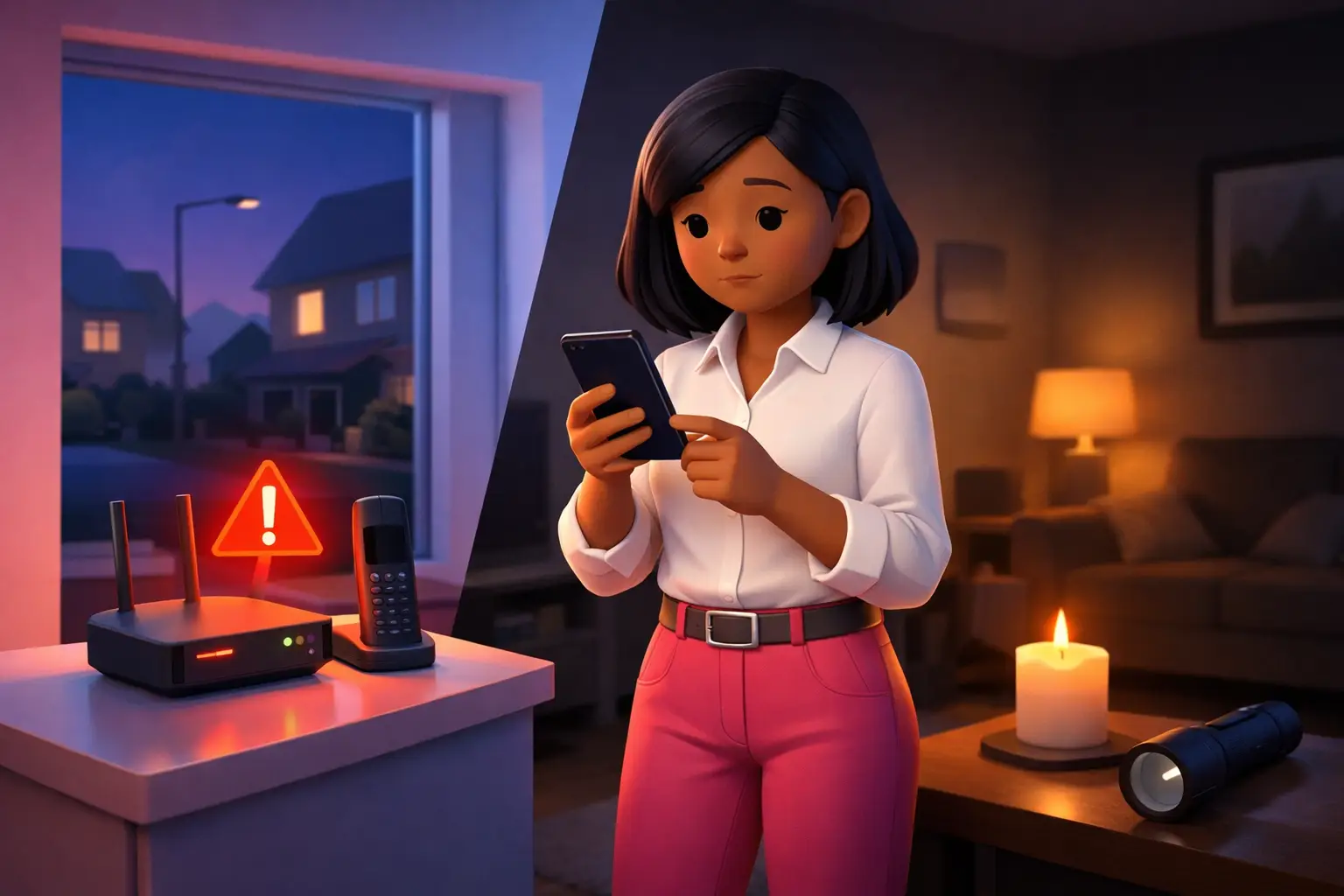
The old copper line carried a small amount of power from the exchange, so a basic corded phone kept working even when your house lost electricity. A digital phone does not work that way. It depends on your broadband router and equipment in your home, all of which need mains power, so when the power goes off, the phone goes off too (Ofcom, Moving landline phones to digital technology, accessed 30 June 2026). Cordless DECT handsets will not work either, because their base station needs mains power.
For most households this is a minor inconvenience, because a mobile phone is the obvious fallback. A 999 call from any mobile connects to whichever network is available at the time, regardless of who your provider is. The risk sits with people who do not have a mobile, who have no usable mobile signal at home, or who rely on a connected device such as a personal alarm.
Your protection: the one-hour rule and who gets it free
Ofcom published guidance in October 2018 that still applies: providers must have at least one solution that gives access to the emergency organisations for a minimum of one hour in the event of a power cut at the premises (Ofcom, accessed 30 June 2026). In practice that solution is usually a battery backup unit for the phone, or a mobile phone where there is signal. That one-hour minimum has been criticised as too low. A cross-party group of MPs argued in March 2025 that it should be at least four hours in the home, and longer across the wider network (Digital Communities All-Party Parliamentary Group, March 2025). The legal minimum in force as of mid-2026 is still one hour, so if you think you would need longer in an outage, it is worth asking your provider directly what it can offer.
The key point that catches people out is eligibility. The free solution is guaranteed to people who are dependent on their landline, for example because they do not have a mobile phone, or do not have mobile signal at home (Ofcom, Future of landline calls, accessed 30 June 2026). If you are not in that group, your provider may still offer you a backup unit, but you may have to buy it. So the single most useful thing you can do is to tell your provider about your circumstances before you are migrated.
If you rely on your landline, do this before you are switched:
- Contact your provider and tell them you depend on your landline, or that you have no mobile or no mobile signal at home, and ask to be added to its priority services or vulnerable customer register. BT customers can do this by dialling 150.
- Ask what free power-cut protection you qualify for, such as a battery backup unit or a hybrid phone that can also use the mobile network.
- If anyone in the home uses a telecare alarm, careline pendant, or other connected medical device, say so clearly. Providers have agreed not to move telecare users to a digital line until they are confident a compatible, working solution is in place, and the engineer-checked process now tests the alarm with its monitoring centre before completing the switch, reverting to the old line if it fails.
- Keep a charged mobile phone to hand where you can, and agree a backup plan with a neighbour or family member.
Telecare alarms and other connected devices
Personal alarms, fall pendants, some burglar alarms, certain care monitors and similar equipment were often designed to work over the old analogue line. These do not always work on a digital line, and they will not work in a power cut unless they have their own backup. All UK providers have agreed not to force customers with telecare devices onto digital phone services unless they are confident the customer will be left with a compatible and functional telecare solution (Which?, citing the industry agreement, March 2026). If a device in your home depends on the phone line, contact both your phone provider and the company that supplies the device before any switchover.
What about the mobile mast losing power too?
A fair question, because if your fallback is a mobile and the local mast also loses power, you could still be cut off. This is a separate issue from the in-home one-hour rule, and it is about network resilience rather than your own equipment. Ofcom published a revised Network and Service Resilience Guidance for providers on 16 June 2026 that sets out its expectations for backup power at mast and cabinet sites (Ofcom, 16 June 2026). That guidance is about the network, and it does not change the protection you are entitled to at home, which remains the minimum one hour described above. It is one more reason to keep a simple backup plan in place rather than relying on a single method.
The bottom line
Nobody needs to panic about this, but a small number of households genuinely need to act, and they are exactly the people least likely to hear about it. If you, a parent, or a neighbour relies on the landline, has patchy mobile signal, or uses a care alarm, raise it with the provider now rather than on the day the engineer arrives. Ofcom wrote to the industry in January 2026 setting its expectations for migrating customers safely ahead of the switch-off (Ofcom, January 2026), but the protections work best when you flag your needs early. For the complete picture, including who is genuinely at risk and our forecast of how the final months play out, see our in-depth report, The Last Dial Tone.
Compare broadband and phone options at your postcode
Frequently asked questions
When is the landline switch-off happening?
The Openreach analogue PSTN network is currently scheduled to be switched off on 31 January 2027. The original target was 31 December 2025, but it was paused twice and moved to 31 January 2027 to give vulnerable customers more support (House of Commons Library, 1 April 2026). Hull (served by KCOM) and the Crown Dependencies of the Isle of Man, Jersey and Guernsey run their own separate timetables. Many people are being moved across gradually before then.
Will my broadband still work in a power cut?
No. Your broadband router needs mains power, so your internet and any phone service that runs through it will stop during a power cut at your home. Only a battery backup unit or a charged mobile would keep you connected for emergency calls.
Who qualifies for a free battery backup?
Ofcom requires providers to offer a free power-cut solution to people who depend on their landline, for example because they have no mobile phone or no mobile signal at home. If you are not in that group you can usually still buy a backup unit from your provider. Tell your provider about your circumstances before you are migrated.
I have a careline pendant or medical alarm. What should I do?
Contact both your phone provider and the company that supplies the device before any switchover. Providers have agreed not to move telecare users to a digital line until a compatible, working solution is confirmed. Make sure both companies know the device depends on your phone line.
Can I still call 999 from my mobile if my provider has no signal?
Yes. A 999 call from a mobile connects to whichever network is available at that moment, not just your own provider's network, so it can use another operator's signal if yours is unavailable.
Do I have to switch to digital, or can I keep my old landline?
The analogue network is being retired, so in time every line moves to digital. You cannot keep the old analogue service indefinitely, but you can ask your provider how the new service will work for your circumstances and what support is available.
Sources
- House of Commons Library. (2026, 1 April). The switch to digital landlines (Briefing CBP-9471). Retrieved 30 June 2026.
- Ofcom. (2018, October; guidance current). Protecting access to emergency organisations when there is a power cut at the customer's premises. Retrieved 30 June 2026.
- Ofcom. Moving landline phones to digital technology: what you need to know; The future of landline calls. Retrieved 30 June 2026.
- Ofcom. (2026, 16 June). Network and Service Resilience Guidance for Communications Providers (revised). Retrieved 30 June 2026.
- Digital Communities All-Party Parliamentary Group. (2025, March). Care to Connect: PSTN migration report (recommendation of at least four hours of in-home power resilience). Retrieved 30 June 2026.
- Department for Science, Innovation and Technology. (2023, 18 December). Public Switched Telephone Network Charter (no forced migration without confirmed telecare protection). Retrieved 30 June 2026.
- Openreach, reported June 2026. Migration status (approximately 1.9 million lines remaining on 11 June 2026) and the gating of unmigrated voice lines onto an emergency calling service rather than disconnection. Retrieved 30 June 2026.
- BroadbandSwitch.uk. (2026, 16 June). The Last Dial Tone (Report No. 26). Retrieved 30 June 2026.
General consumer information, accurate at the date shown. Provider policies and regulatory dates can change. If you rely on your landline or a connected medical device, confirm your arrangements directly with your provider.