FIBRE GUIDE · FULL FIBRE · FTTP EXPLAINED
What Is FTTP? Full Fibre Explained
Full fibre, in plain English. What FTTP actually is, how it differs from the broadband most of us grew up with, why it is faster and steadier, where the rollout has reached, and exactly what to expect when you switch to it.
Written by Dr Alex J. Martin-Smith · Reviewed by Adrian James · Published 11 June 2026 · Coverage figures are Ofcom's January 2026 snapshot · ~9 minute read
Prefer to read offline? Download the free PDF guide: What Is FTTP? Full Fibre Explained (6 pages, ~280KB). No signup, no email, just the guide.
The quick answer
FTTP, fibre to the premises, is a full fibre-optic line running all the way from the exchange to your home, with no old copper in the final stretch. That single change, fibre instead of copper to your door, is what makes it faster, steadier and quieter than older broadband. It now reaches 82% of UK homes, and with the copper phone network retiring in January 2027, it is fast becoming the normal way the UK connects.
Key facts · verified June 2026
- 82% of homes, 24.9 million premises, can now get full fibre, and gigabit-capable broadband reaches 89% once cable is counted (Ofcom, January 2026).
- Take-up is 47%: far more homes can get full fibre than have switched to it, so most people reading this can probably already order it.
- Openreach has reached 23 million premises and is targeting 25 million by the end of 2026, with other networks adding millions more.
- Tiers run from around 40Mbps to 1.8Gbps today, with 2Gbps and beyond already arriving; entry full fibre often starts in the low £20s a month.
- The copper phone network switches off on 31 January 2027, and where full fibre is widely available providers already stop selling new copper services.
What full fibre actually is
Older broadband mixes fibre with copper, or uses copper alone. The difference is simply how far the fibre runs before the signal hops onto something slower.
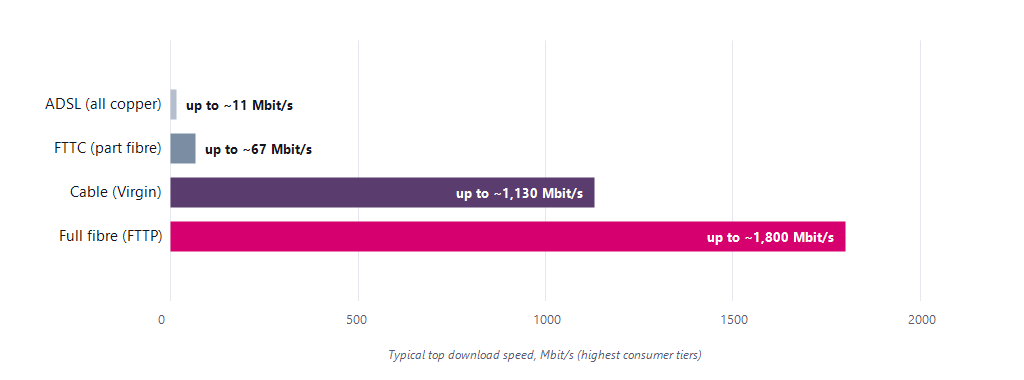
| Type | What reaches your home |
|---|---|
| Full fibre (FTTP) | Fibre, all the way |
| Part fibre (FTTC) | Fibre to the street cabinet, then copper |
| Cable (Virgin) | Fibre to a local box, then coaxial copper |
| ADSL | Copper all the way from the exchange |
With FTTP, the fibre ends at a small box on your wall called an optical network terminal (ONT), which feeds your router. Because it is light down glass rather than electricity down copper, distance barely weakens it. The end-to-end comparison across every technology, 4G and 5G included, lives at full fibre vs FTTC vs cable vs 4G/5G.
Why full fibre wins
Full fibre is not just about a bigger headline speed. Its real strengths are the ones you feel every day: a strong upload, steadiness, and a connection that does not fade with distance.
- Much stronger upload. Older copper and cable give you far less upload than download. Full fibre offers high, often near-symmetric upload, which is what video calls, cloud backups and working from home depend on.
- More reliable. Fibre shrugs off the distance, weather and electrical interference that trouble copper, and it cannot corrode, so faults are rarer.
- Lower latency. Signals travel with less delay, which makes calls and gaming feel sharper.
- Steady at peak times. Full fibre has vast headroom, so it holds up in the busy evening hours when older lines can sag, the story told in full in our companion guide: why is my broadband slow at night?
- It does not fade with distance. Copper weakens the further you are from the cabinet; fibre barely changes whether you are near or far.
Speeds you can choose: full fibre comes in a wide range of tiers, from modest everyday plans of around 40Mbps up to 1.8Gbps today, and multi-gigabit plans of 2Gbps and beyond are already arriving. Most homes are very well served well below the top tier, so there is no need to overbuy.
Where it is, and the copper switch-off
Full fibre has gone from just over a quarter of UK homes in 2021 to more than four in five today, one of the fastest infrastructure rollouts the country has seen.
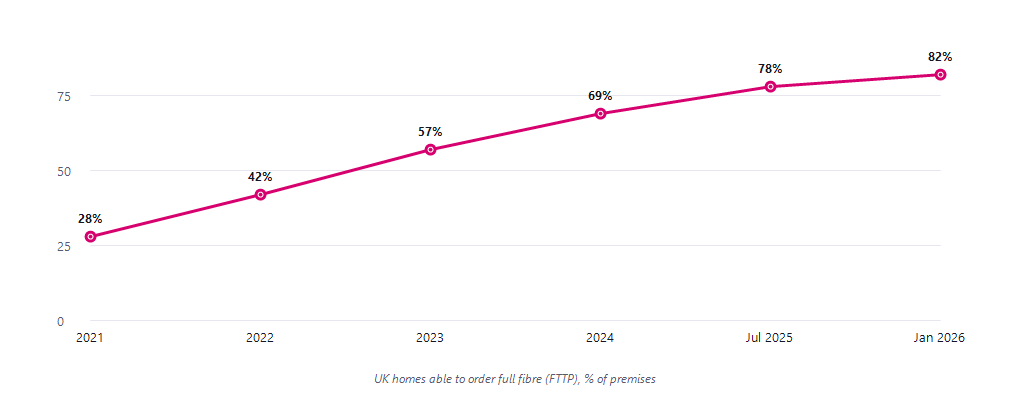
- 82% of homes, 24.9 million premises, can now get full fibre, and gigabit-capable broadband reaches 89% once cable is counted (Ofcom, January 2026).
- Take-up is 47%. Far more homes can get full fibre than have switched to it, so most people reading this can probably already order it.
- Openreach has reached 23 million premises and is targeting 25 million by the end of 2026, with other networks adding millions more.
The old copper network is closing. The UK's traditional copper phone network is being switched off, with the national deadline set for 31 January 2027. Where full fibre is widely available, providers already stop selling new copper services. This is the main reason full fibre is moving from a nice-to-have to the normal way the UK connects, and what it means for your landline is covered at digital voice and broadband switching.
Switching to full fibre, step by step
Moving to full fibre is straightforward, and switching is simpler than it used to be. Since 2024, under One Touch Switch, you only need to contact your new provider, who arranges everything with the old one and can keep your phone number.
- Check your address. Run a postcode check to see which full fibre networks and deals reach you. Entry full fibre often starts in the low £20s a month, with gigabit around £25 to £40: full fibre deals and gigabit deals.
- Book the install. A new full fibre line usually needs a short engineer visit, so allow a week or two from ordering.
- Meet your new kit. The engineer fits a small optical network terminal on an inside wall and sets up a new router. That is the whole change inside your home, with the room-by-room detail at switching to full fibre from FTTC: what changes at home.
- Say goodbye to the old phone line. Full fibre does not need a traditional landline; if you want a home phone, it simply plugs into the router as digital voice.
One thing worth knowing about power cuts: unlike the old copper phone, full fibre needs mains power at home, so a power cut will take out your phone unless you have a backup. Providers must offer a free battery backup to customers who rely on their landline, such as vulnerable users, so do tell your provider if that is you.
Choosing between full fibre and cable? Read FTTP vs Virgin Media cable, head to head, plus ten full fibre myths, debunked, why can't I get full fibre when next door can? and the copper switch-off 2027, explained.
Questions people ask
What does FTTP mean?
Fibre to the premises: a fibre-optic line running all the way from the exchange to your home, ending at a small optical network terminal on your wall that feeds your router. There is no copper in the final stretch, which is what separates it from FTTC, cable and ADSL.
What is the difference between FTTC and FTTP?
FTTC runs fibre to the street cabinet and copper the rest of the way, so speed fades with every metre of copper and tops out around 67 to 80 Mbps. FTTP runs fibre all the way to your home, barely fades with distance, and offers tiers up to 1.8Gbps with far stronger upload.
Is full fibre worth it?
For most homes, yes, and not mainly for the headline speed: the everyday wins are stronger upload for calls and backups, lower latency, fewer faults, and steadiness at peak times. Entry full fibre often starts in the low £20s a month, frequently beating older lines on price as well as performance.
Do I need a landline for full fibre broadband?
No. Full fibre does not use the traditional phone network at all; if you want a home phone, the handset plugs into your router as a digital voice service, and your number can come with you when you switch. Note that unlike old copper phones, it needs mains power, so providers must offer a free battery backup to customers who rely on their landline.
How do I get FTTP installed?
Check which networks reach your address, order through your chosen provider, and allow a week or two for a short engineer visit, where the engineer fits a small optical network terminal on an inside wall and sets up the router. Under One Touch Switch your new provider handles the entire switch, including keeping your number.
About this guide
This guide is part of the BroadbandSwitch.uk 2026 Guide Library, published by BroadbandSwitch.uk, the consumer arm of the SearchSwitchSave network. Coverage figures are Ofcom's January 2026 snapshot; rollout targets are providers' own stated goals. Our approach to evidence and corrections is documented in the methodology and trust hub, and every published correction appears in the corrections log.
Take it with you: download the free 6-page PDF guide, including the availability climb, the switching steps and full sources.
Citing this guide: BroadbandSwitch.uk. (2026, June 11). What is FTTP? Full fibre explained. SearchSwitchSave. https://broadbandswitch.uk/guides/what-is-fttp/
Sources
- BT Group. (2026, May 21). Results for the full year to 31 March 2026. https://www.bt.com/content/dam/bt-plc/assets/documents/investors/financial-reporting-and-news/quarterly-results/fy26/h2/fy26-release.pdf
- Independent Networks Co-operative Association. (2026, March 11). State of the altnets 2026. https://inca.coop/state-of-the-altnets-2026/
- Ofcom. (2025, November 19). Connected Nations 2025: UK report. https://www.ofcom.org.uk/phones-and-broadband/coverage-and-speeds/connected-nations-20252
- Ofcom. (2026). Connected Nations update: Spring 2026. https://www.ofcom.org.uk/phones-and-broadband/coverage-and-speeds/connected-nations-update-spring-2026
- Ofcom. (2024). Protecting customers during the migration to digital landlines. https://www.ofcom.org.uk/phones-and-broadband/landline-phones/protecting-customers-during-the-migration-to-digital-landlines
- Openreach. (2026). Time for a big switch-up as PSTN switch-off looms. https://www.openreach.com/news/time-for-a-big-switch-up-as-pstn-switch-off-looms/
This guide is general consumer information. Coverage and take-up figures are Ofcom's January 2026 snapshot and change as the rollout continues; speeds are providers' published top tiers; prices are indicative and postcode-dependent.