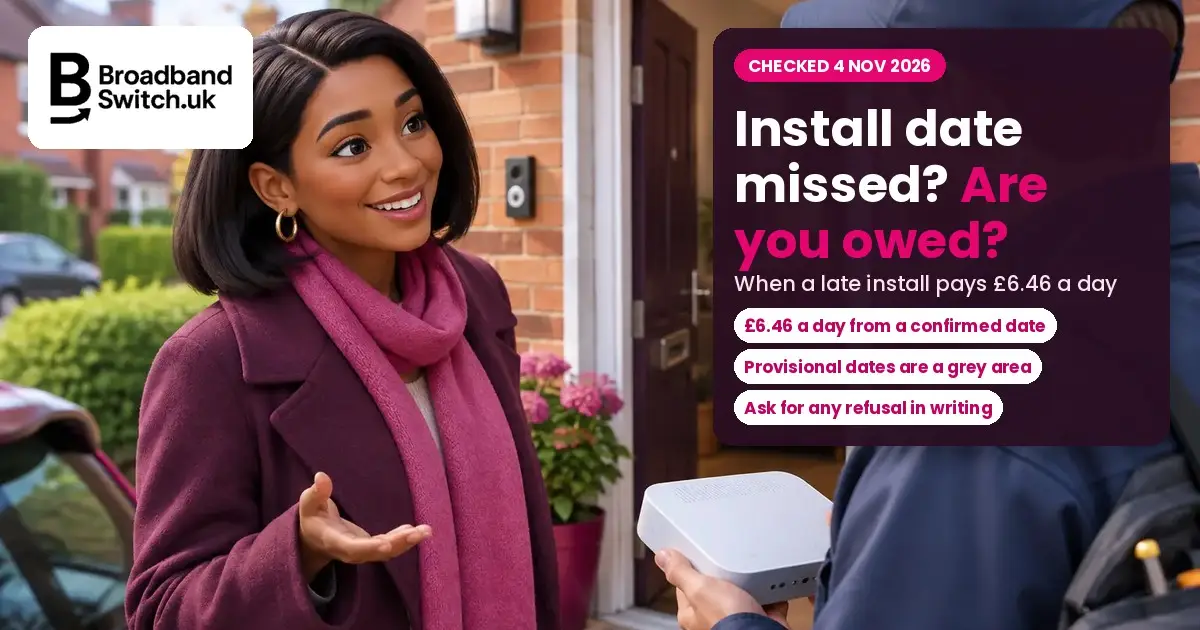
Your broadband install date came and went? Here's when you're owed £6.46 a day, and what to do if your provider says there was no order
Checked 4 November 2026
Install date missed? Four situations, four answers
£6.46
a day, from the missed date
Scheme members should pay for the missed day and each full day after, without you asking.
It depends
on what was confirmed
Ofcom says it depends on the circumstances, including what the provider confirmed. Ask for its reasons in writing.
In writing
ask for the reasons
Ofcom says providers should clearly explain why you're not eligible. Keep your emails.
Switch rules
apply as well
Ofcom's switching guidance says a missed switch date should be compensated.
Missed broadband install date? If your provider is in Ofcom's automatic compensation scheme and confirmed the date in writing, it should pay you £6.46 for the missed day and each full day after, without you asking. Whether a date marked only as provisional counts isn't settled: Ofcom says it depends on the circumstances, including what your provider confirmed to you. Keep every email and screenshot, ask your provider to explain any refusal in writing, and after six weeks take it free to the ombudsman.
Still waiting, or ready to try someone else?
If your install keeps slipping, see which providers can reach your address, how soon, and what you'd pay over the whole contract.
- ✓Every provider at your postcode, side by side
- ✓Set-up fees and price rises shown upfront
- ✓Your new provider handles the switch
Prefer to talk it through? Call us on 0330 122 1223
Key facts, verified 4 November 2026
- Providers in Ofcom's automatic compensation scheme pay £6.46 for each calendar day a new broadband or landline service starts late, at the rate in force since 1 April 2026 (Ofcom, 8 April 2026).
- The payment is due if your service isn't working by 11.59pm on the date your provider "initially confirmed in writing" (Ofcom automatic compensation code, checked 4 November 2026).
- You're paid for the missed date, plus each full day after it until the first new date your provider offers, or until the service is cancelled (Ofcom automatic compensation code, checked 4 November 2026).
- Your provider should tell you you're eligible when the delay happens, and pay within 30 calendar days of the delay ending (Ofcom, checked 4 November 2026).
- Ten providers are in the scheme: BT, EE, Hyperoptic, Plusnet, Sky (including NOW Broadband), TalkTalk, Utility Warehouse, Virgin Media, Vodafone and Zen Internet (Ofcom, checked 4 November 2026).
- Ofcom told ISPreview that whether the written-confirmation requirement has been met in an individual case "will depend on the particular circumstances, including what information the provider confirmed to the customer" (ISPreview, 3 November 2026).
- When you switch, Ofcom's guidance says you should be compensated if the switch doesn't happen on or by the date in your Contract Information (Ofcom switching guidance, checked 4 November 2026).
- What a provider tells you about a service, and pre-contract information it must give you, can count as part of your contract under the Consumer Rights Act (legislation.gov.uk, 2015).
- If a complaint isn't sorted within six weeks, you can take it free to your provider's ombudsman scheme, down from eight weeks before April 2026 (Ofcom, 8 April 2026).
- Every scheme member whose page we could read ties the late start payment to a date it confirmed or promised, and Sky, NOW Broadband and Virgin Media say a provisional date isn't enough on its own (BroadbandSwitch.uk check, 4 November 2026).
Who this is for: anyone whose broadband or landline install date has been missed, anyone told by their provider that an order "never went through", and anyone ordering a new deal over Black Friday who wants to be ready if the date slips. We'll follow Priya, an example built from the calls we take, not a real customer. Priya ordered full fibre online, got an email with a "provisional" date, heard nothing more, and no engineer came.
Am I owed compensation if my broadband install date is missed?
Direct answer: Usually, yes, if your provider is in Ofcom's automatic compensation scheme and it confirmed the date in writing. It should pay £6.46 for the missed day and each full day after, without you having to ask.
The scheme is voluntary, but ten providers have signed up. Ofcom's own summary is simple: if your provider promises to start a new service on a particular date but fails to, you're paid for each calendar day of delay.
The amounts rise with inflation every April. Since 1 April 2026 they've been £6.46 a day for a late start, £32.31 for a missed engineer appointment and £10.34 a day for a repair that takes too long.
Our guide to the compensation rates covers all three payments. This guide is about the question that trips people up when an install goes wrong: which date counts, and what happens when there's no confirmed date at all.
Automatic compensation, from 1 April 2026
Which date starts the compensation clock?
Direct answer: The date your provider first confirmed to you in writing. Ofcom's code says the payment is due if your service isn't working by 11.59pm on "the date initially confirmed in writing", so an email, text or letter with your date is what counts.
The providers' voluntary code, published by Ofcom, covers new connections, upgrades and switches from another provider. The word "initially" matters: if your provider later moves the date, you're still paid from the first date it confirmed.
A date someone mentions on the phone isn't "in writing". If you agree a date on a call, ask the provider to email or text it to you, and check your order tracking page for the same date.
Which date counts?
Confirmed in writing
The clock runs
An email, text or letter with your date. Missed by 11.59pm? If your provider is in the scheme, you should be owed.
Provisional only
It depends
Ofcom says it depends on the circumstances, including what was confirmed. Ask for reasons in writing.
No date at all
Reasonable time
The automatic payment can't start, but the law expects the service within a reasonable time.
Does a provisional installation date count?
Direct answer: It isn't settled. Ofcom says whether the written-confirmation rule is met "will depend on the particular circumstances, including what information the provider confirmed to the customer". A date your provider promised to confirm but never did is the hardest case.
Some providers, including Sky and NOW Broadband, give you a provisional date when you order, then confirm it later. If the confirmation arrives, that confirmed date is the one that counts. If it never arrives, you're in the grey area this guide is about.
General consumer law may still help you. Under the Consumer Rights Act, things a provider says or writes about a service can become part of your contract if you took them into account when you signed up or made a later decision about the service. Pre-contract information it has to give you, which includes when it will provide the service, counts too.
But anything the provider said at the same time to qualify those words counts as well, and calling a date "provisional" may be exactly that kind of qualification. So a date clearly labelled provisional is harder to rely on than one that was confirmed.
And where no time is fixed at all, the same Act says the service must be provided within a reasonable time. Those are your rights in law, separate from the automatic scheme, so they don't pay a fixed amount. This is general information, not legal advice.
Confirmed or provisional: what changes
Confirmed in writing
The scheme pays
£6.46 for the missed day and each full day after.
No claim needed
Your provider should tell you and credit you within 30 days.
Keep it anyway
Screenshot the email or text in case you need it.
Provisional only
It depends
Ofcom says it depends on the circumstances, including what was confirmed.
Ask in writing
If you're refused, ask your provider to explain why.
Consumer law still applies
What you were told may form part of your contract.
What if my provider says my order was never placed?
Direct answer: Ask it to put that in writing, with the reasons, and send it what you have: order emails, screenshots and call notes. Ofcom says where a customer isn't eligible, "providers should clearly explain why".
This is what ISPreview reported on 3 November. An EE customer said he ordered full fibre on 25 September 2026 and got an email, marked "PRE-CONTRACT INFORMATION", with a provisional installation date of 6 October and a promise to confirm it within five working days.
He says no further updates came. When he rang on 5 October, the day before his provisional date, he says an agent told him the original order had apparently been lost or not processed properly, and re-did it. His broadband went live on 13 October, a week after the provisional date.
EE's position, as ISPreview reported it, is that no order was placed on 25 September, because an online order was started but not finished. EE says eligibility depends on dates recorded once an order is accepted into its provisioning system, that there's no evidence it made an error, and that the new order was fast-tracked and installed within its committed timeframe.
We haven't seen the emails, and EE disputes the customer's account, so we're not saying who's right. The case matters to you because it shows how much rests on paperwork. ISPreview suggested the question may only be settled if the customer takes it to the ombudsman.
The EE case, as reported
Some providers spell this out. Sky's compensation page says it won't pay if an order "failed before the activation date was confirmed and we need to place a new order". We look at what every scheme member says further down.
If it happens to you, don't get stuck arguing about what happened to the order. Ask for the reasons in writing, send your evidence, and let the provider, then the ombudsman, weigh it.
How much will I get for a late installation?
Direct answer: £6.46 for the missed date, plus £6.46 for each full day after it until the first new date your provider offers. So if your confirmed date is missed and the next date offered is a week later, you get seven payments: £45.22.
Ofcom's code gives its own example. If your service is due on a Wednesday but goes live on Thursday, you get one payment, for the missed day. If it goes live on Friday, you get two: the missed day and the one full day you waited.
The daily payment runs to the first new date your provider offers you, not the date you pick. So if you choose a later date to suit yourself, the extra days aren't covered. If an engineer also fails to turn up, the £32.31 missed appointment payment comes on top.
| Your service goes live | Payments | Total | With an engineer no-show too |
|---|---|---|---|
| The day after the confirmed date | 1 | £6.46 | £38.77 |
| Two days after | 2 | £12.92 | £45.23 |
| A week after | 7 | £45.22 | £77.53 |
| Two weeks after | 14 | £90.44 | £122.75 |
Work out your own payment
Our free compensation calculator adds up late starts, missed appointments and days without service at the current rates.
Use the compensation calculator →What do BT, Sky, Virgin Media and the others say starts the clock?
Direct answer: We read the scheme members' own pages on 4 November 2026. Every one we could read ties the late start payment to a date the provider confirmed or promised, and Sky, NOW Broadband and Virgin Media all make clear a provisional date isn't enough on its own.
This is our own check. We read each scheme member's compensation page on 4 November 2026, opening Sky's in a browser because its text loads separately. Nine of the ten members had pages we could read in full, and so did NOW Broadband, which is part of Sky. Utility Warehouse links straight to Ofcom's code rather than a page of its own.
| Provider | What starts the clock, in its words | Rates shown | How it's paid |
|---|---|---|---|
| BT | "by 11.59 pm on the date we confirmed in writing" | 2026 rates | Automatic credit within 30 days; up to 60 days |
| EE | "by 11.59pm on the date we confirmed in writing" | 2026 rates | Automatic credit within 30 days; up to 60 days |
| Plusnet | "by 11.59pm on the date we promised you", including when switching | 2026 rates | Automatic credit within 30 days; up to 60 days |
| NOW Broadband | "the date we confirmed in writing", which "may be different to the provisional date" | 2026 rates | Automatic credit within 30 days |
| TalkTalk | "the date we gave you in your welcome pack" | 2026 rates | Automatic, with an email or text; Full Fibre trial customers excluded |
| Virgin Media | "the confirmed date"; its terms say a provisional date changed to a confirmed one doesn't pay | Help page mostly 2026 (one FAQ still £9.98); terms page still 2025 | Automatic, one bill credit once fixed |
| Vodafone | "your original confirmed activation date" | 2026 rates | Credit within 30 days; its page says to get in touch; up to 60 days |
| Hyperoptic | "the date we initially confirmed with you in writing" | 2025 and 2026 rates | No claim needed; within 30 days |
| Zen Internet | "promised that a new service will go live on a particular date" | 2026 rates | Automatic credit on your next bill |
| Sky | "your confirmed activation date"; it says the provisional date "might change" | 2026 rates | Automatic credit within 30 days, with an email or letter |
| Utility Warehouse | Links to Ofcom's code; no page of its own found | Not read | Not read |
Three things stood out. Sky's page is the clearest on dates. It says it sends a provisional date "which might change at a later date", pays if your service isn't working "by midnight on the confirmed date", and won't pay if your order "failed before the activation date was confirmed and we need to place a new order".
NOW Broadband says the confirmed date "may be different to the provisional date we initially gave you", and lists "We didn't confirm the activation date" as a reason it won't pay. Virgin Media's terms say credits aren't payable if "a provisional appointment date is changed to a different, confirmed date".
So at least three providers draw a clear line between provisional and confirmed dates. If yours is one of them and you only ever had a provisional date, you can still point to what you were told and the consumer law rights above, but a date clearly labelled provisional is harder to rely on.
Some pages also lag behind. Virgin Media's help page shows the current £6.46, but its terms page, where its provisional date wording sits, still showed last year's £6.24 when we checked. The rate that applies is the one in force when your delay began; the amounts rise with inflation for new issues from each 1 April.
BT, EE, Plusnet and Vodafone say they pay for up to 60 days. If your install drags on that long, read any notice carefully: Ofcom's code says a notice capping the payments must tell you that you can cancel before its end date without early termination charges.
Vodafone's page also lists faults "caused by a matter beyond our reasonable control" among its exclusions, giving bad weather as an example. Ofcom's own page says that, unless an exclusion applies, you should get compensation even when the cause is beyond your or your provider's control, and the code names extreme weather, strikes and third-party acts. If you're refused on that basis, ask which part of the code the refusal relies on.
Does it make a difference if I'm switching provider?
Direct answer: It can help you. As well as the automatic scheme, Ofcom's switching rules say you should be compensated when a switch doesn't happen on or by the date set out in your Contract Information, and the provider responsible should generally pay.
Ofcom's guidance on switching compensation covers delays to a switch and missed installation appointments. It says the provider responsible for the failure should generally pay, even if the fault lies with a network operator or another third party, and that you shouldn't have to go back and forth between providers.
| Question | Automatic compensation scheme | Ofcom's switching rules |
|---|---|---|
| Who it covers | The ten providers that signed up | Providers when you switch |
| The date it uses | The date initially confirmed in writing | The date set out in your Contract Information |
| How much | £6.46 a day, from 1 April 2026 | Ofcom says it's good practice to consider the scheme's amounts |
| Who pays | Your provider | Generally the provider responsible, even if a third party caused it |
| When | Within 30 calendar days | Within 30 calendar days |
Your Contract Information is the pre-contract information your new provider must give you before you agree, separate from the shorter contract summary. That's another reason to save it: if it shows a date, it's the date the switching rules look at.
Most switches now go through One Touch Switch, where your new provider arranges everything. Our guide to One Touch Switch explains how it works, and One Touch Switch failed? covers what to do when it goes wrong.
What if my provider isn't in the scheme?
Direct answer: You won't get the automatic £6.46 a day, but you still have rights. If you're switching, Ofcom's switching rules apply to providers whether or not they've signed up, and consumer law applies to every provider.
The ten scheme members include the biggest providers, but many smaller full fibre providers aren't in it. Before you order, check your provider's terms for what it pays when an install is late. Some smaller providers publish their own payments.
Ofcom told ISPreview that being in the scheme "does not stop a provider from paying compensation in situations that fall outside the scheme", and that you may have separate rights under general consumer law. The code itself says its payments don't limit your other legal rights. So it's always worth asking.
What evidence should I keep?
Direct answer: Everything with a date on it: the order confirmation, any email or text with your install or go-live date, screenshots of your order page, and the date, time and reference of every call. Save them the day they arrive.
Six things to save, the day they arrive
The order confirmation
The email that says your order has been received, with its reference.
Anything with your date
Emails, texts or letters giving your install or go-live date.
Screenshots of your order page
Take one as soon as a date appears, and again if it changes.
Call notes
The date, time, the name of the person you spoke to and any reference.
Your Contract Information
The pre-contract information you got before you agreed, which may show the date.
Changes to appointments
Any message moving or cancelling your engineer visit, with its time.
Priya had the provisional date email, but nothing confirming it. Her screenshot of the order page showed the same date the day before, which helped when she complained.
How do I claim, and what if my provider says no?
Direct answer: Scheme members should pay without a claim, so start by asking where your payment is. If you're refused, complain in writing and ask for the reasons. After six weeks, or sooner if it reaches deadlock, take it free to the ombudsman.
From missed date to money in four steps
Ask where it is
Quote your confirmed date and order reference.
Complain in writing
If you're refused, ask for the reasons in writing.
Send your evidence
Emails, screenshots and call notes, all dated.
Go to the ombudsman
After six weeks, or at deadlock, it's free.
Every provider must belong to one of two free schemes: the Communications Ombudsman or CISAS. EE's complaints code names the Communications Ombudsman, and says you can go to it if your complaint isn't resolved within six weeks.
The Communications Ombudsman counts the six weeks from when you first told your provider about the problem. Our guide to the broadband ombudsman walks you through it.
Can I cancel if my installation keeps getting delayed?
Direct answer: Yes, if you ordered online or by phone in the last 14 days: you can cancel under the cooling-off rules, paying only for any service you've used. After that, check your contract and ask your provider, because repeated delays may give you other rights.
Citizens Advice says you can cancel for free if you signed up less than 14 days ago over the phone or online, though you're likely to pay for any service you've used. If nothing's been installed, ask what, if anything, you'd pay, and send back any kit they've posted to you.
If you cancel, the automatic daily payment stops on the day the order is cancelled. You're still owed the days that had already built up, so ask for them when you cancel.
If the delay runs on, your provider may send a notice capping the daily payments. Ofcom's code says it can only do that once they've run for 30 days, the end date must be at least 30 days away, and the notice must tell you that you can cancel before then without early termination charges.
Before you cancel, check who else can reach you. An install might be quicker with a different network at your address, and our postcode comparison shows each option. Our installation times guide shows how long each type usually takes.
What should I do now?
Direct answer: If your date's been missed, find the email or text that confirmed it and ask your provider where your payment is. If you only ever had a provisional date, screenshot it now and ask for reasons in writing if you're refused.
Today: find your date
Look for the email, text or order page that gave your install date, and screenshot it.
This week: ask for your payment
Quote the date and your order reference. If you're refused, complain in writing and ask why.
After six weeks: go to the ombudsman
It's free, and it can decide whether you're owed.
Ordering this Black Friday? Save everything
Black Friday is 27 November. Keep your order confirmation and chase any date that isn't confirmed in time.
Fed up waiting? See who else can connect you
Compare every provider that can reach your address, with the full contract cost, and check your compensation before you go.
- ✓Every provider at your postcode, side by side
- ✓The full contract cost shown upfront
- ✓Your new provider handles the switch
In summary
- Scheme members should pay £6.46 for a missed install date and each full day after, until the first new date they offer, without you asking.
- The date that counts is the one your provider "initially confirmed in writing", so keep the email or text.
- A provisional date that was never confirmed is a grey area: Ofcom says it depends on the circumstances, including what your provider confirmed.
- If you're refused, ask for the reasons in writing. Ofcom says providers should clearly explain why.
- After six weeks, or at deadlock, the ombudsman will look at it for free.
Alex's closing thought
When an install goes wrong, the scheme works well for people with a confirmed date in their inbox. The trouble starts when the paperwork doesn't match what you were told. So save every email and screenshot the day it arrives, and if you're told the order never existed, ask for that in writing. You shouldn't have to fight for a few pounds, but it's worth asking, for you and the next person. And if you'd rather move on to a provider that can connect you sooner, ring us. We'll check what's available at your address.
Keep going: more on installs and compensation
Compensation
Installation
Know someone still waiting for an engineer?
Send them this. It explains when a late install pays £6.46 a day, and what to do if the order "never went through".
Cite this page
You're welcome to quote or link to this guide. Please credit BroadbandSwitch.uk and link to this page.
In a sentence: If a provider in Ofcom's automatic compensation scheme misses an install date it confirmed in writing, it should pay £6.46 for the missed day and each full day after, but a date that was only ever provisional is a grey area, and Ofcom says providers should clearly explain any refusal.
Martin-Smith, A. J. (2026, November 4). Broadband install date missed: are you owed compensation? BroadbandSwitch.uk. https://broadbandswitch.uk/insights/broadband-install-date-missed-compensation/
Frequently asked questions
How much compensation do I get if my broadband installation is late?
From providers in Ofcom's scheme, £6.46 for the missed date plus £6.46 for each full calendar day after it, until the first new date offered or until the order is cancelled, at the rate in force since 1 April 2026.
Do I have to claim compensation for a missed install date?
No. Scheme members must tell you that you're eligible when the delay happens and pay automatically, usually as a bill credit, within 30 calendar days of the delay ending. If it doesn't arrive, ask your provider.
Does a provisional installation date count for compensation?
It isn't settled. Ofcom says eligibility depends on the particular circumstances, including what information the provider confirmed to you. A date that was promised but never confirmed is the hardest case.
What counts as confirmed in writing?
The code doesn't define it, but an email, text or letter from your provider giving the date your service will start should count. A date on your online order page may help too, so screenshot it. A date given only on a phone call isn't in writing, so ask for it to be emailed or texted.
What if my provider moves my installation date?
The scheme counts from the date your provider first confirmed in writing, so a later change doesn't reset the clock. If the change also cancels an engineer visit with less than 24 hours' notice, the missed appointment payment applies too.
What if I choose a later installation date?
The daily payment runs to the first new date your provider offers. If you pick a later one to suit yourself, the extra days aren't covered.
Is there a limit on late installation compensation?
Yes, but not before about 60 days. Your provider can only send a notice capping the payments once they've run for 30 days, and the end date must be at least 30 days after the notice. The notice must say you can cancel before that date without early termination charges. BT, EE, Plusnet and Vodafone say they pay for up to 60 days.
Which broadband providers pay automatic compensation?
BT, EE, Hyperoptic, Plusnet, Sky (including NOW Broadband), TalkTalk (with restrictions for customers not on the Openreach network), Utility Warehouse, Virgin Media, Vodafone and Zen Internet.
Can I get compensation if my provider isn't in the scheme?
Not the automatic payment, but you still have rights. Ofcom's switching rules cover delayed switches, consumer law says that where no time is fixed a service must be provided within a reasonable time, and some providers set out their own payments in their terms.
What if my provider says it never received my order?
Ask it to explain in writing, and send your order emails, screenshots and call notes. Ofcom says providers should clearly explain why a customer isn't eligible. If you're still unhappy after six weeks, the ombudsman can decide.
Can I cancel broadband if the installation is delayed?
If you ordered online or by phone in the last 14 days, you can cancel under the cooling-off rules, though you may pay for any service you've used. You keep any compensation that had built up before you cancelled.
Am I covered if I'm upgrading with my current provider?
Yes, if the upgrade starts a new minimum contract period. Ofcom's code covers existing customers' upgrades like that, so a missed confirmed date pays the same £6.46 a day.
References
- EE. (2026, April). EE complaints code of practice. Retrieved 4 November 2026, from https://ee.co.uk/content/dam/help/terms-and-conditions/regulatory/ee-complaints-code-of-practice-april-2026.pdf
- EE. (n.d.). Automatic compensation for broadband or landline issues. Retrieved 4 November 2026, from https://ee.co.uk/help/broadband/fix-problem/automatic-compensation
- TalkTalk. (2026, April 8). About your auto compensation credit. Retrieved 4 November 2026, from https://help-centre.talktalk.co.uk/Billing_and_Payments/Check_my_bills_and_usage/About_your_auto_compensation_credit
- BT. (n.d.). Automatic compensation. Retrieved 4 November 2026, from https://www.bt.com/help/account-and-billing/automatic-compensation
- Citizens Advice. (n.d.). Cancelling a phone, TV, internet or mobile contract. Retrieved 4 November 2026, from https://www.citizensadvice.org.uk/consumer/phone-internet-downloads-or-tv/cancelling-a-phone-tv-internet-or-mobile-contract/
- Communications Ombudsman. (n.d.). Consumer wait time reduced. Retrieved 4 November 2026, from https://www.commsombudsman.org/news/consumer-wait-time-reduced
- The Consumer Contracts (Information, Cancellation and Additional Charges) Regulations 2013, Schedule 2. Retrieved 4 November 2026, from https://www.legislation.gov.uk/uksi/2013/3134/schedule/2
- Consumer Rights Act 2015, section 50. Information about the trader or service to be binding. Retrieved 4 November 2026, from https://www.legislation.gov.uk/ukpga/2015/15/section/50
- Consumer Rights Act 2015, section 52. Service to be performed within a reasonable time. Retrieved 4 November 2026, from https://www.legislation.gov.uk/ukpga/2015/15/section/52
- ISPreview. (2026, November 3). EE's broadband install delay raises questions over UK compensation rules. Retrieved 4 November 2026, from https://www.ispreview.co.uk/index.php/2026/11/ees-broadband-install-delay-raises-questions-over-uk-compensation-rules.html
- NOW Broadband. (n.d.). About auto-compensation for broadband and calls. Retrieved 4 November 2026, from https://www.nowtv.com/gb/help/article/auto-compensation
- Ofcom. (2025, March 7). Communications providers' voluntary code of practice for an automatic compensation scheme (updated version). Retrieved 4 November 2026, from https://www.ofcom.org.uk/siteassets/resources/documents/consultations/uncategorised/98684---automatic-compensation/associated-documents/industry-code-of-practice-for-automatic-compensation-2024-v1.pdf?v=392135
- Ofcom. (2026, April 8). Quicker complaints resolution and more money in your pocket when things go wrong. Retrieved 4 November 2026, from https://www.ofcom.org.uk/phones-and-broadband/accessibility/quicker-complaints-resolution-and-more-money-in-your-pocket-when-things-go-wrong
- Ofcom. (n.d.-a). Automatic compensation: what you need to know. Retrieved 4 November 2026, from https://www.ofcom.org.uk/phones-and-broadband/service-quality/automatic-compensation-need-know
- Ofcom. (n.d.-b). Guidance on compensation related to switching and porting. Retrieved 4 November 2026, from https://www.ofcom.org.uk/__data/assets/pdf_file/0025/256336/guidance-compensation-switching-and-porting.pdf
- Plusnet. (2026, April 1). Automatic compensation. Retrieved 4 November 2026, from https://www.plus.net/help/legal/automatic-compensation/
- Sky. (n.d.). Automatic compensation for Sky Broadband and Talk. Retrieved 4 November 2026, from https://www.sky.com/help/articles/auto-compensation
- Utility Warehouse. (n.d.). Codes of practice. Retrieved 4 November 2026, from https://uw.co.uk/legal/codes-of-practice
- Virgin Media. (n.d.-a). Am I eligible for automatic compensation? Retrieved 4 November 2026, from https://www.virginmedia.com/help/automatic-compensation
- Virgin Media. (n.d.-b). Terms and conditions for automatic compensation. Retrieved 4 November 2026, from https://www.virginmedia.com/legal/fibre-optic-services-terms-conditions/automatic-compensation
- Vodafone. (n.d.). Automatic compensation for home broadband. Retrieved 4 November 2026, from https://www.vodafone.co.uk/help/broadband/auto-compensation
- Hyperoptic. (2026, June 26). Automatic compensation policy. Retrieved 4 November 2026, from https://www.hyperoptic.com/legal/automatic-compensation-policy
- Zen Internet. (n.d.). Auto compensation FAQ. Retrieved 4 November 2026, from https://www.zen.co.uk/help-support/auto-compensation-faq/